Showing posts with label patrick ewing. Show all posts

Monday, May 12, 2025

May 12, 1985: The Fixed NBA Draft Lottery for Patrick Ewing

Left to right: David Stern, Patrick Ewing, Dave DeBusschere

May 12, 1985, 40 years ago: The NBA holds its 1st-ever Draft Lottery, at the Felt Forum, a sub-arena of Madison Square Garden in New York. It was designed to stop teams having a bad season from "going into the tank" or "tanking": Losing games on purpose so that they could finish with the league's worst record, thus guaranteeing them the 1st pick in the NBA Draft.

David Stern, in his 1st full season as Commissioner, drew envelopes containing the logos of the 7 teams, out of the 23 then in the NBA, that didn't make the Playoffs. The theory was that each non-Playoff team had an equal chance to obtain the first pick. The rest of the first-round picks were determined in reverse order of their won–loss record.

It was no secret that the player most likely to be taken with the 1st overall pick would be Patrick Ewing, a center who had led Georgetown University to the previous year's National Championship, and the NCAA Tournament Final in 3 of his 4 years. Some observers were calling the lottery the Ewing Bowl, as if it were a football contest.

The general managers of the 7 teams patiently waited for Stern to draw the envelopes. The 1st one drawn, and thus the team that got the 7th pick, was the Golden State Warriors. The Warriors and the Indiana Pacers had tied for the worst record in the NBA, 22-60. Under the old system, those two teams would face a coin flip: The winner would get the 1st pick, the loser the 2nd pick. The Warriors were thus the 1st team who looked like a loser in the lottery.

The 6th pick went to the Sacramento Kings, the 5th to the Atlanta Hawks, the 4th to the Seattle SuperSonics, and the 3rd to the Los Angeles Clippers. It came down to the Pacers, represented by GM Robert Salyers; and the New York Knicks, represented by their GM, one of their all-time greatest players, Dave DeBusschere.

When Stern opened the next envelope, and pulled out the card, it contained the Pacers' logo. That meant they would pick 2nd, and the Knicks 1st. DeBusschere pumped his fist, and the New Yorkers inside the Felt Forum roared with delight. They knew exactly who DeBusschere, who had been a defensive and rebounding specialist as a player, would pick when the actual draft was held on June 18: The similarly-controlling Ewing.

When DeBusschere got up to shake hands with Stern, he reached into the pocket of his sportscoat, and pulled out a Knicks jersey with Number 33 on it. It wasn't in honor of his teammate on the 1970 NBA Champion Knicks, University of Michigan Hall-of-Famer Cazzie Russell. DeBusschere turned the jersey around, and revealed the name on the back: "EWING."

Ever since, people outside the New York Tri-State Area -- and some inside it, who had no problem with the idea -- have suggested that the fix was in: Stern wanted the best collegiate player of his generation to play for the New York team, because the New York team winning titles would be good for the league, TV-wise, therefore money-wise.

The question became not if Ewing would lead the Knicks to a World Championship, but how many. Of course, that same question would be asked for Eric Lindros and the Philadelphia Flyers in 1992. And if you had suggested at the times of their acquisitions that, in each case, the number would turn out to be zero, you would have been laughed out of the room.

But no one foresaw that the Boston Celtics would still dominate the Eastern Conference through 1987; that the Detroit Pistons would then do so through 1990; and that the Chicago Bulls, led by Michael Jordan, would then do so through 1998. With Ewing, the Knicks would reach the NBA Finals in 1994. Without him -- he was injured earlier in the Playoffs -- they reached the Finals in 1999.

It got to the point where, like Joe Namath of the 1969 New York Jets and Mark Messier of the 1994 New York Rangers, Ewing began predicting that the Knicks would win the Championship. He did become the franchise's all-time leading scorer. But the franchise still hasn't won a title since 1973, with DeBusschere, Willis Reed, Walt Frazier, Bill Bradley, Earl Monroe and Jerry Lucas, Hall-of-Famers all.

So if there was a fix, it didn't work. Even so, Jordan and the Bulls did everything for the league that Stern had hoped that Ewing and the Knicks would do.

The Pacers chose Wayman Tisdale, who turned out to be a good player, but not a great one. The Clippers chose Benoit Benjamin, also a good one. The Sonics chose Xavier McDaniel, a very good player. The Hawks chose Jon Koncak, and the Kings Joe Kleine, who both turned out to be decent players.

The 7th pick that the Warriors got stuck with? They chose Chris Mullin, who, like Ewing and Jordan, would make the Hall of Fame and play on the 1992 Olympic "Dream Team." He would later play for the Pacers, and they got more out of him than they got out of Tisdale. So while the Warriors got robbed, they got more out of their pick than anybody but the Knicks got out of theirs.

There were other interesting picks. The Dallas Mavericks got Detlef Schrempf, a German star who did well for them, and later for the Pacers; Uwe Blab, also German, but not as good as Schrempf, and neither was as good for them as later German player Dirk Nowitzki; and Bill Wennington, who did little for them, but became a reserve for the Bulls' dynasty.

The Cleveland Cavaliers drafted Charles Oakley. He didn't do much for them, but he was later traded to the Knicks, and teamed with Ewing to produce the 2nd-best team in the East in the 1990s. They also drafted John "Hot Rod" Williams, who did well for them.

The Utah Jazz drafted Karl Malone, who would pair with John Stockton to form one of the greatest NBA duos. The Pistons drafted Joe Dumars, who became the defensive leader of the "Motor City Bad Boys," and later served as the general manager who built their next great team. The Pistons have reached the NBA Finals 5 times: 3 with Dumars as a player, winning 2; and 2 with Dumars as GM, winning 1.

The Los Angeles Lakers took A.C. Green, who helped them win 3 titles and set the NBA's consecutive games played record. The Portland Trail Blazers drafted Terry Porter, who helped them reach 2 NBA Finals. The Washington Bullets drafted 7-foot-6 shot-blocking specialist Manute Bol.

So the team that did the best in this draft was Detroit -- and they weren't in the Lottery. So much for the old slogan of the New York State Lottery: "You gotta be in it to win it."

Under the current rules, only the top four picks are decided by the lottery, and are chosen from the 14 teams (out of 30) that do not make the playoffs. The team with the worst record, or the team that holds the draft rights of the team with the worst record, has the best chance to obtain a higher draft pick. After the top four positions are selected (from the lottery slotting system), the remainder of the first-round draft order is in inverse order of the win–loss record for the remaining teams, or the teams who originally held the rights if they were traded. The lottery does not determine the draft order in the subsequent rounds of the draft.

Since the 2019 draft, the NBA changed the lottery odds (the bottom three teams will all have an equal 14 percent chance of winning the top pick), and increased the number of teams selected in the lottery from three to four.

Tuesday, September 1, 2020

John Thompson, 1941-2020

Imagine a man who has won 2 NBA Championships as a player, and it's among the least important parts of his legacy.

John Robert Thompson Jr. was born on September 2, 1941 in Washington, D.C. When he was growing up in the 1940s and '50s, it was unusual for a black American to be a Roman Catholic. But his family was, and he attended Archbishop Carroll High School in the District of Columbia. Other notable alumni include basketball players Austin Carr, Johnny Dawkins, and Eddie Jordan, who played on Rutgers' 1976 Final Four team and coached in the NBA.

John Carroll, for whom the school was named, was the 1st Catholic Archbishop in America, appointed to Baltimore in 1789. This was right after he founded the 1st Catholic university in America, Georgetown University. It should not be confused with The Catholic University of America, which is also in Washington.

But Thompson did not attend Georgetown. Instead, after back-to-back undefeated seasons and City Championships in 1959 and 1960, he went to a different Catholic school, Providence College. In 1963, he and Ray Flynn, who later served as Mayor of Boston, led the Friars to the NIT Championship. The following year, they got Providence into their 1st NCAA Tournament.

Upon graduation, Thompson was PC's all-time leader in points, scoring average and field goal percentage, and 2nd in rebounds. The success of the program since 1964 has led to several players surpassing him.

Nevertheless, he was drafted by the Boston Celtics, where he played center and backed up the great Bill Russell. He played 2 seasons, 1964-65 and 1965-66, and the Celtics won the NBA Championship in both seasons.

After the 1966 Finals, the Celtics left him unprotected in the expansion draft, and he was selected by the Chicago Bulls. If he had stuck with the Bulls, basketball history could have been very different. He might have stayed in Chicago, and ended up succeeding Ray Meyer at the city's DePaul University. Or, he might have restored Loyola University to the glory it received when it won the NCAA Tournament in 1963.

*

Instead, he went back to his hometown, and coached at St. Anthony High School. (A few years ago, St. Anthony was merged into Archbishop Carroll.) In 6 seasons, he went 122-28. That got the attention of Georgetown. I don't know if he was the 1st black man to become head coach at a major Catholic university, but his impact was quick: In just 3 years, he took them from 3-23 in the season before he arrived to 12-14, then 13-13, and then 18-10 and the 1975 NCAA Tournament.

In 1979, the Big East Conference was formed, and ESPN began broadcasting. This combination was very beneficial for college basketball, with the Georgetown Hoyas taking on St. John's of New York City, Syracuse of New York State, the University of Pittsburgh, and other high-profile teams.

This might be a good time to answer the question, often used as a taunt by Georgetown's opponents: "What's a Hoya?" Officially, the University says it does not know where the word came from. But, as with Indiana and "Hoosiers," there are theories.

Given the school's Catholic background, studying Greek and Latin was common. The accepted version of the story ties in with that: The Greek hoya means "what" or "such," and the Latin saxa means "rocks." A stone wall then surrounded the Georgetown campus in the west of the District, and so was born the chant of "Hoya Saxa!" or "What Rocks!" (Or "Such Rocks!")

A variant is that the football team's defense was called the Stonewalls, perhaps in reference to the wall around the campus. Although this is retroactively ironic, given the Church's opposition to gay rights and the association of the Stonewall Inn in New York with the movement since 1969.

Thompson led the Hoya basketball team to the Big East Conference's regular-season Championship in 1980, 1984, 1987, 1989, 1992, 1996 and 1997. And he led them to win the Big East Conference Tournament in 1980, 1982, 1984, 1985, 1987 and 1989. So he won both in 1980, 1984, 1987 and 1989.

Since 1983, the Big East Tournament has been held at Madison Square Garden in New York -- which is the secondary home court of St. John's, their main home court having been Alumni Hall on their campus in Jamaica, Queens. That building is now named Carnesecca Arena, for longtime coach Lou Carnesecca, known as Louie the Sweater for his colorful outerwear.

Likewise, in 1981, the Hoyas had outgrown their on-campus McDonough Gymnasium, and began playing their bigger home games out in the suburbs of Landover, Maryland, at the Capital Centre, home of the NBA's Washington Bullets (now the Washington Wizards) and the NHL's Washington Capitals.

And, compared to Carnesecca's garish sweaters, Thompson was known for a towel that he would drape over his sportsjacket. And that wasn't the only fashion statement at 1980s Georgetown. The team's success led to the navy blue Georgetown vinyl jacket becoming popular Winter outerwear in black communities.

And while wearing a T-shirt under your jersey is illegal in the NBA, and is illegal in the NCAA now, it was legal in the NCAA in the early 1980s. During a particularly cold game in his freshman year of 1981-82, Patrick Ewing wore a T-shirt under his Number 33 jersey, and it caught on with the rest of the team.

Eventually, the rivalry between the Hoyas and the St. John's Redmen -- the name was changed to Red Storm in 1995, to avoid references to exploitation of Native Americans -- reached the point where Chris Mullin of St. John's started wearing a T-shirt under his Number 20 jersey as well.

The battles between the Hoyas and the Redmen packed the Cap Centre and The Garden. In the 1984-85 season, they played each other 4 times. They split the Conference games, each winning on the other's court, with St. John's taking the title. But the Hoyas won the Conference Tournament. Then, in the NCAA Tournament, 3 of the Final Four teams were from the Big East, and Georgetown beat St. John's once more, while Villanova of Philadelphia beat Louisiana State.

But the Hoyas turned out to be underachievers. They got to the Elite Eight in 1980, but failed in the 1st Round in 1981. In 1982, they got all the way to the Final at the Superdome in New Orleans, and were underdogs to North Carolina. They were down by 1 point as the last seconds ticked down, and Fred Brown mistakenly passed the ball to James Worthy, and that was it.

The Hoyas lost in the 2nd Round in 1983, but in 1984, they went all the way, beating the University of Houston in the Final. Thompson had become the 1st black head coach in basketball to win a National Championship. The 1st player he hugged was Fred Brown.

They were expected to repeat as National Champions in 1985, and were a whopping 35-2 going into the Final against Villanova at Rupp Arena in Lexington, Kentucky. But 'Nova's phenomenal shooting led to the erroneous (but it sure didn't feel like it) title "The Perfect Game," and a 66-64 victory.

It was Ewing's last game. His battles with Mullin, with Worthy, with Akeem Olajuwon of Houston (as Hakeem was then known), with Ralph Sampson of Virginia, and with Len Bias of Maryland became college basketball legend. But he only won the 1 title.

*

Thompson's teams continued to be excellent, winning the league in both the regular season and the tournament, but he never reached another Final Four, getting to the Elite Eight in 1987, 1989 and 1996. And he recruited and coached some of the best players in the country, such as Basketball Hall-of-Famers Ewing, Dikembe Mutombo, Alonzo Mourning and Allen Iverson; plus All-Americans and NBA stars Eric "Sleepy" Floyd, David Wingate, Reggie Williams, Othella Harrington and Jerome Williams.

He also earned a great deal of street cred, not just for being a black man who led black men to victory in a city whose permanent residents (most federal government workers living there are not) are black, to the point where funk bandleader George Clinton called Washington "Chocolate City" or "C.C.," but also for showing just who was the most powerful man in town -- and it wasn't Mayor Marion Barry.

It was believed to be Rayful Edmond III, the man who introduced crack cocaine to the District, and whose, shall we say, employees were connected to over 40 murders. Edmond had been a talented basketball player (though not quite talented enough to make a college team), and so he knew pretty much every hoopster who came into the District, including Mourning and his then-Hoya teammate John Turner.

Thompson got wind of this, and invited Edmond to meet him in his office at McDonough Gym. At first, Thompson asked nicely, to cease all contact with his players. Edmond tried to match Thompson's calmness by informing him that none of his players were involved in illegal activities. Thompson stood up to his full 6-foot-10-inch height, stuck a huge finger in Edmond's face, cursed him out, and told him that he had crossed a line, and said, "I will not allow you to destroy their lives!"

Edmond knew that if he launched any kind of reprisal against Thompson, it would cause more problems than it would solve. He backed down, and stayed away from Thompson's players.

In 1997, as did the Wizards and Capitals, the Hoyas moved into the downtown arena now known as the Capital One Arena, and currently split their home games between that building and McDonough. Thompson's marriage broke up in 1999, and he announced his resignation. Later that year, he was elected to the Basketball Hall of Fame. His longtime assistant Craig Esherick replaced him, but was not very successful.

In 2004, he was fired, and replaced by Thompson's son, John Thompson III. John III had coached Princeton to 3 Ivy League regular-season titles, and led Georgetown to 3 Big East regular-season titles, and also won the Big East Tournament in 2007. He got them to the Final Four that year, but that was the only time he got them past the Sweet 16, and he was fired after the 2017 season -- replaced by Patrick Ewing, 

John III now works with the Wizards. Another son of John Jr., Ronny Thompson, was the head coach at Ball State University in Indiana in the 2006-07 season, and now works for NBA TV.

On September 11, 2001, John Thompson had a place on an airline flight canceled. That flight was American Airlines Flight 77, which took off from Dulles International Airport in the Virginia suburbs of D.C., with an intended destination of Los Angeles, but was hijacked by al-Qaeda terrorists, turned around, and crashed into the Pentagon, with all aboard being killed.

Thompson lived another 19 years, commentating for various networks. He lived long enough to see a statue of himself dedicated inside McDonough Gymnasium.
He died on Sunday, August 30, 2020, at his home in Arlington, Virginia, across the Potomac River from D.C., 3 days short of his 79th birthday. No cause has yet been released, but "a family source" said he'd been in ill health for a while.

Bill Russell: "Very sad to hear of my friend & teammate John Thompson's passing this morning. Our thoughts are with his family & all of the men he brought through #Georgetown & the impact he had on so many lives. He will be greatly missed #RIP my friend"

Magic Johnson: "The world has lost another icon. Hall of Fame Coach John Thompson was a basketball legend, pioneer, advisor, friend and all around incredible man. Coach Thompson had a heart for teaching and helped so many players become men."

Michael Jordan, whose shot won the 1982 NCAA Final for North Carolina over Thompson's Georgetown: "Coach Thompson was truly a great man and a legend in college basketball. He had such a profound impact on his players and was a father figure to so many of them. I admired him and loved him dearly."

Roy Williams, assistant coach to Dean Smith in that 1982 Final, and now head coach at North Carolina: "He was truly a great man who just happened to be a basketball coach, and a great one at that."

Mike Krzyzewski, head coach at Duke University: "He was an incredibly strong person who always put his players first and fought for them at every turn. Repeatedly, I was amazed at his passion for doing what is right, even when unpopular and no one was looking."

Jim Boeheim, head coach at Syracuse and a longtime rival: "We lost a great basketball coach and a great person with the passing of my friend John Thompson."

Dikembe Mutombo: "He was my mentor, great teacher, hero and a father figure to so many us who got the chance to play for him. Under coach Thompson, I learned a lot about the game of basketball but most importantly, I learned how to be a man in society. We will really miss him."

Allen Iverson, repeating the words of his Hall of Fame induction speech: "Thanks For Saving My Life Coach. I’m going to miss you, but I’m sure that you are looking down on us with a big smile. I would give anything just for one more phone call from you only to hear you say, 'Hey MF', then we would talk about everything except basketball......."

Alonzo Mourning, echoing Iverson: "Coach Thompson, saved my life.... continuously motivating and molding me into the man that I am today. With all the lives he touched and inspired, the best way to pay homage to him is by celebrating his life, applauding his legacy; and using our voices and actions to serve others." ⁣

Patrick Ewing: "We will all miss you, Coach Thompson - but we will never forget you."

Michele Norris, ABC News: "John Thompson had a 97% graduation rate for his players at Georgetown. At some point a teacher claimed he was “uneducatable”. He showed her & then he spent a lifetime showing all of us how to lift up athleticism/scholarship/courage/righteousness & victory on and off the court."

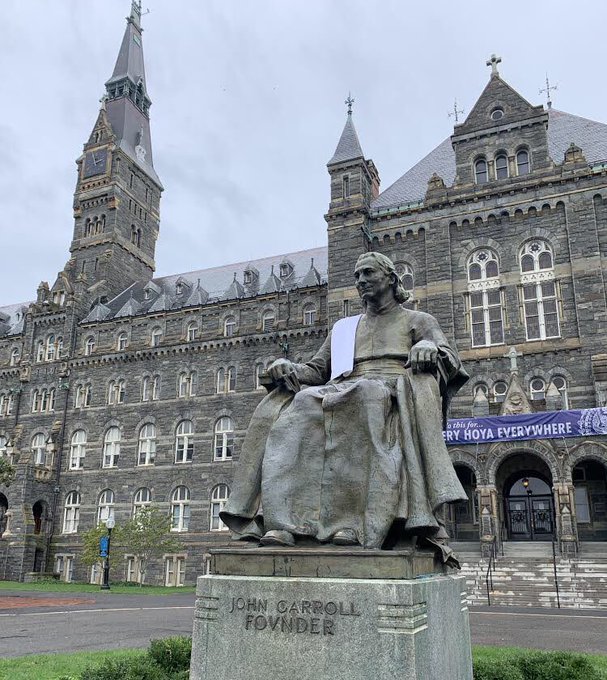
On Sunday night, the NBA on TNT crew, which once included him, all wore towels over their right shoulders in Thompson's memory: Ernie Johnson Jr., Shaquille O'Neal, Charles Barkley and Kenny Smith. Georgetown University also placed a towel over the right shoulder of the statue of their founder, Archbishop John Carroll.
Image
I will let the man who called himself "Big Ace" have the last word: "I told you that I always wanted to be a teacher, not a basketball coach."

Mission accomplished.

Broken heart

Friday, January 24, 2020

Top 10 Players Who Just Looked Wrong In Those Uniforms

"This was a bad idea. I guarantee it."

Eli Manning retired today. At his press conference, he quoted former New York Giants owner Wellington Mara: "Once a Giant, always a Giant," and added, for himself, "Only a Giant."
He looked done this season. Even if he's not, even if he has 1 good season left, it's still good that he retired. It's better to retire a year too early than a year too late.
There's the risk of injury. Then there's the risk of looking like some guys who really shouldn't have hung on as long as they did, and switched teams to do it.

Top 10 Players Who Just Looked Wrong In Those Uniforms

Honorable Mention to Hank Aaron with the Atlanta Braves, 1972 to 1974. True, he was still a legitimate All-Star at the time. But that uniform! Ye gods! It's a shame that he hit Number 715 in it. For being a black man threatening, and finally breaking the record, he got death threats, but whoever designed the uniform got away scot-free.
He spent his last 2 seasons, 1975 and 1976, back in his previous city, with the Milwaukee Brewers. He didn't play as well, but he had a better uniform, even if it was powder blue on the road.
At the 1976 All-Star Game in Philadelphia.
The black armband on Mays' sleeve is for Casey Stengel.
The cap is in honor of the National League's 100th Anniversary.

Honorable Mention to Steve Garvey with the San Diego Padres, 1983 to 1987. He definitely hung on for 1 year too long, but until then, he was still hitting fairly well for the Padres.

But a Padre fan I know from online reminded me of the real reason he should be on this list: His classic description of his uniform change from Los Angeles to San Diego: "When I was a Dodger, I looked at myself in the mirror, and I looked like an American flag. Here, I look like a taco."
Ex-Yankee Graig Nettles and ex-Cardinal Garry Templeton
don't look thrilled by these togs, either.

Honorable Mention to several soccer players who went to the old North American Soccer League in the 1970s, for one big payday at the end of their career, but weren't seen by as many people due to the comparative lack of coverage.

Among them were Pelé and Franz Beckenbauer with the New York Cosmos; George Best and Johan Cruyff with the Los Angeles Aztecs; Best, Gordon Banks and Gerd Müller with the Fort Lauderdale Strikers; Cruyff with the Washington Diplomats; Bobby Moore with the San Antonio Thunder and the original Seattle Sounders; Charlie George with the Minnesota Kicks; and Eusébio with the Boston Minutemen, the Toronto Metros, the Las Vegas Quicksilvers, the New Jersey Americans and the Buffalo Stallions.

10. Patrick Ewing with the Seattle SuperSonics, 2000-01, and the Orlando Magic, 2001-02. This stings less because he didn't win a title with the Knicks, and he wasn't that bad. Still, it was weird.
To be fair, this uniform looked weird no matter who wore it.

Honorable Mention to Walt Frazier with the Cleveland Cavaliers, 1977-80. Seriously? Clyde with the Cavalosers? Only the last season was bad, though.

9. Bob Cousy with the Cincinnati Royals, 1970. Having last played in 1963 with the Boston Celtics, Cooz went into coaching, first at Boston College, and then with the Royals. In the 1969-70 season, the team was losing, and tickets were not selling. He was 41 years old and hadn't played in nearly 7 years, but he thought he could help.

Did he? At the box office, yes: Ticket sales jumped by 77 percent. On the court, no: He played 34 minutes over 7 games, scoring 5 points. "The Houdini of the Hardwood" proved that his heart was in the right place, but his legs were nowhere to be found. The team moved to become the Kansas City Kings in 1972, and he resigned as head coach in 1973, never to coach again.
Lucky for him, there was no ESPN to cover his sad efforts, or else we might have had a situation like in the movie Mr. 3000, with Bernie Mac as a 47-year-old baseball player thinking a comeback might get him the 3,000th career hit he thought he had, and into the Baseball Hall of Fame. Cooz was elected to the Basketball Hall of Fame in 1971, after his 2nd retirement.

I had considered including another Celtic legend on this list: Dave Cowens, with the Milwaukee Bucks in 1982-83, under his former Celtic teammate Don Nelson, 2 years after his 1st retirement. But he actually did all right for the Bucks, averaging 8.1 points per game at age 44, and helping them win 51 games. But he got hurt in the last regular-season game, and never played again. Ironically, with him unavailable to either team, the Bucks beat the Celtics in the 1st round of the Playoffs.

8. Duke Snider with the San Francisco Giants, 1964. The Duke, his former Brooklyn Dodger teammate Gil Hodges, Warren Spahn, Richie Ashburn, and even Yogi Berra, coming off the coaching staff to play 4 more games in 1965, all played with the Mets at or near the ends of their careers. (Spahn also closed it out with the Giants.)

The Duke playing in Los Angeles with the Dodgers wasn't that big a deal, since it was his hometown. But the Duke playing for the Giants? In San Francisco? That was so wrong, it should be said with a "hard G": "That's just wrong-guh."
This photograph, and this card, are totally real.
They shouldn't have been.

He played in 91 games, batted just .210, hit 4 home runs and had only 17 RBIs. He was 38 and not injury-prone, so he should have had something left. But if he did, Candlestick Park was not the place to show it.

7. Michael Jordan with the Washington Wizards, 2001-03. When he made his 1st comeback in 1995, he was 32, and no one was worried that he was making a mistake. Besides, it was still with the Chicago Bulls. But when he made his 2nd comeback, he was 38, he'd taken 2 1/2 years off, and was signing with... the Washington Wizards? A team that hadn't mattered in 20 years, since they were the Washington Bullets?

Yes, he announced he was donating his entire salary to 9/11 relief efforts (he announced his comeback 2 weeks after the attacks), so that was going to help. But the question was asked: "Will this comeback destroy Michael Jordan's legacy?"

In 2001-02, he battled injuries, especially to his knee, and was limited to 60 games, although he did lead the Wiz in scoring with 22.9 points per game. That should have been it. It wasn't. He played in all 82 games in 2002-03, and averaged 20.0 points, including 3 games of at least 40 points. Every Wizards home game was sold out.

But he publicly criticized his teammates, and he was not in the best of positions to do so. This was not the Jordan of 1996, or even of 1998. And fans saw him on ESPN's SportsCenter every night, looking like less than His Airness.

When Epic Rap Battles of History brought on the comedy team of Keegan-Michael Key to play Jordan, and Jordan Peele to play Muhammad Ali, Ali said to Jordan, "Your whole basketball career turned wack, when you came back a Wizard, like Gandalf the Black!" No, it wasn't a Mr. 3000 situation, and it didn't "destroy his legacy." But it did tarnish the legacy.
6. Steven Gerrard with the L.A. Galaxy, 2015-16. Due to the growth of telecasts of soccer, no player, not even 1970s-'80s great Kenny Dalglish, has become as identified with Liverpool Football Club as Stevie G. But for all he achieved with the Mersey Reds, he never won the Premier League.

So, at the age of 35, after 17 seasons with his hometown team, he went to Carson, California, to the Gals, who had 3 of the last 4 MLS Cups and 5 of the last 13. Surely, there, he could win a league. Result: They were eliminated in the 1st round in 2015 and the Conference Semifinals in 2016. And he retired. Oh well.
Dishonorable Mention to 2 other European legends, who played in MLS in the 2018 and '19 seasons: Zlatan Ibrahimović with the Galaxy, who at least scored a few goals; and Wayne Rooney with D.C. United.

5. Willie Mays with the New York Mets, 1972-73. He hit a home run in his 1st home game as a Met, the 649th of his career, and he should have retired right there. Instead, he kept going. The Mets won the Pennant in 1973, but he had very little to do with it. The entire country saw him stumbling in the subsequent World Series, both at the plate and in the field.

What he said in his retirement ceremony the previous month at Shea Stadium was something he should have said after that return homer: "Willie, say goodbye to America."

4. Joe Namath with the Los Angeles Rams, 1977. I understand going to Hollywood, but with those knees, Joe should've retired a couple of years earlier. And those garish blue and yellow (not "gold") uniforms were so wrong for him. He played in 4 games, completed 46.7 percent of his passes, threw 3 of them for touchdowns, and 5 for interceptions.

I once saw a Mad magazine which showed "Joe Nomyth" (as in, "no myth") interviewing a judge who turned out to be corrupt. He asked the judge, "What kind of cases do you enjoy most?" The judge said, "Pornography cases! I have to view all the films to see if they're obscene! Isn't this great?" And Joe said, "It sure beats looking at old football films. Except for the last few games of my career, which really were obscene!" They say all great humor is rooted in truth. It certainly was on that occasion.

I had considered including Brett Favre, who played for the Jets in 2008 and the Minnesota Vikings in 2009 and '10. But, as weird as he looked in those teams' uniforms, rather than those of the Green Bay Packers -- and, keep in mind, the Vikings are 2nd to the Chicago Bears as the Packers' rivals -- he actually made the Pro Bowl in 2008 and '09. In 2009, turning 40 during the season, he had the highest completion percentage of his career, a League-leading 68.4 percent, and threw 33 touchdown passes and only 7 interceptions.

Even in his last season, with an awful ratio of 11 touchdown passes and 19 interceptions, he still completed 60.6 percent of his passes. He may have hung on 1 year too long, but he still had something left when he got to Minneapolis, never mind the Meadowlands.

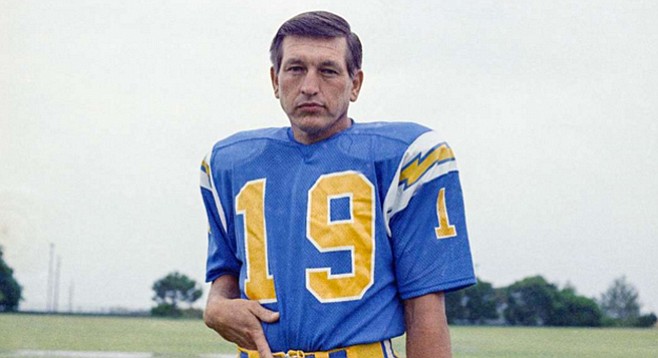
3. Johnny Unitas with the San Diego Chargers, 1973. In Baltimore Colts blue and white, he looked more like a quarterback than anyone ever has. In Charger blue and yellow (again, not "gold"), he looked like an old man in a Hawaiian shirt and Bermuda shorts going for the early bird special in Florida.
He appeared in 5 games, completed 44.7 percent of his passes, threw 3 touchdown passes and 7 interceptions. And while he had a bad back, it wasn't as bad as Broadway Joe's knees. Plus, given that he was better than Namath, it was more of a comedown for him. About the only thing Johnny U got out of his San Diego experience was good weather.

I also considered O.J. Simpson with the San Francisco 49ers in 1978 and '79 (he gained 1,000 yards in 2 seasons, and it was his hometown team, although he was only 32 at the end), Thurman Thomas with the Miami Dolphins in 2000 (an injury-riddled last season with an AFC East rival of the Buffalo Bills), and Jerry Rice with the Seattle Seahawks in 2004 (the greatest career, statistically speaking, in NFL history finally ran out).

2. Bobby Orr with the Chicago Blackhawks, 1976-78. In 1976, the Boston Bruins offered Orr's agent, Alan Eagleson, a contract that would have sold him 18 percent ownership in the franchise in 1980. Eagleson turned the offer down -- without even telling him, Orr said. This was inexcusable. It's one reason why Eagleson was a crook, and is the only man who has ever had to resign membership in his sport's Hall of Fame: Because he defrauded the players he was working for, including Orr and other Hall-of-Famers.

Eagleson was a friend of Blackhawks owner Bill Wirtz, who offered Orr a contract. He played a grand total of 26 games for Chicago, limited by injury, and retired at age 30. This is how I remember Bobby Orr: Not as the greatest player of his generation, not as the biggest reason the Bruins won 2 Stanley Cups (1970 and '72, the only ones they won between 1941 and 2011), but as a broken-down Blackhawk. I knew that was a shame even before I knew how Eagleson had arranged it.
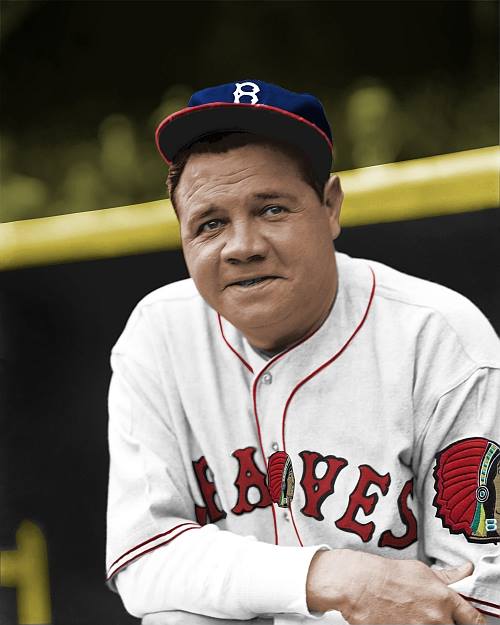
1. Babe Ruth with the Boston Braves, 1935. The ultimate example. The greatest player in the history of the greatest sport, and he ended up a fat, injured DH on a 115-loss team in a league that didn't have the DH (and still doesn't). 
I don't blame him for wanting to go back to his first major league city. And I don't blame him for believing the promise of also being assistant manager, and manager-in-waiting. Lots of people would have been fooled by that. And, to be fair, he was injured (his elbow), but that game where he hit 3 home runs (at Forbes Field in Pittsburgh, a pitcher's park) showed what he could still do when he felt good.

A few days later, he tripped and fell while chasing a fly ball. There was no designated hitter at the time. The Bambino was done, and he knew it, and retired within days. He was lucky there was no ESPN to show the entire country just how done he was.

Tuesday, June 25, 2019

How Long It's Been: The Knicks Were In the NBA Finals

The New York Knickerbockers, or Knicks for short, were founded in 1946. They reached the NBA Finals in 1951, 1952 and 1953, but lost all 3 times. They didn't get back to the Finals until 1970, and finally won it. They lost in the Finals in 1972, but won again in 1973. It took them until 1994 to get back, and they blew a 3-2 lead and lost in Game 7.

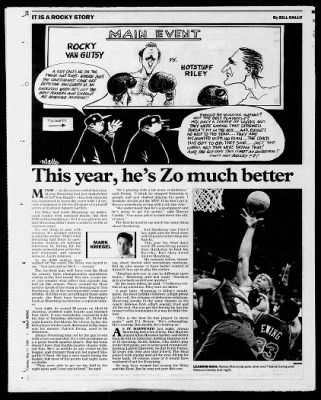
In 1999, despite having traded away Charles Oakley -- no, James Dolan was not yet in control -- and Patrick Ewing being hurt for the run-in, they made the Finals again. They had to win 6 of their last 8 games just to get the 8th and last seed in the Eastern Conference. But once they did that, they won a tough 5-game series with the Miami Heat. This was a year after they'd faced each other in the Playoffs, with a fight that encompassed even Van Gundy.

Bill Gallo, the great cartoonist for the New York Daily News, began drawing Jeff as a boxer, calling him "Rocky Van Gutsy." The Knicks swept the Atlanta Hawks, and stopped nemesis Reggie Miller and the Indiana Pacers. Each time, Gallo's cartoons showed Rocky Van Gutsy looking more battered, but still winning the fight.
With his fancy suits and slicked-back hair,
Heat coach, and former Knicks and Lakers boss, Pat Riley
made a fitting "Apollo Creed" for "Rocky Van Gutsy."

The dream ended in the Finals: The San Antonio Spurs won their 1st title, clinching at Madison Square Garden in Game 5, 78-77. Thus did Tim Duncan do for David Robinson what Hakeem Olajuwon did for Clyde Drexler in 1995, what Moses Malone did for Julius Erving in 1983, what Walt Frazier did for Earl Monroe and Jerry Lucas in 1973, what Kareem Abdul-Jabbar did for Oscar Robertson in 1971, what Billy Cunningham did for Wilt Chamberlain in 1967, what Bill Russell did for Bob Cousy in 1957: Get the great man his title at long last.

Ewing is still looking for that title, Maybe he can win it as a coach somewhere.

Gallo's last cartoon in the series was forced to acknowledge what the original Rocky film did: The protagonist had given his all, and won respect and hearts, but it wasn't quite enough.

The movie public demanded a sequel, and Sylvester Stallone had Rocky Balboa win a rematch, but there has been no Rocky Van Gutsy II: The Knicks lost to the Pacers in the Conference Finals in 2000, and Jeff has never gotten past the 1st Round again: The Knicks lost in the 1st Round in 2001, he quit early in the 2001-02 season, got hired by the Houston Rockets in 2003, and lasted 4 years, missing the Playoffs once and losing in the 1st Round the other 3 times.

He was fired after the 2007 season, and has gone into broadcasting, and hasn't coached again. Maybe he's becoming the new Hubie Brown: He could get the Knicks respect, but not a title, and has found his true calling as a color commentator.

But as valiant as they were, the Knicks fell a little short. In the following off-season, team owner Charles Dolan gave his son James the reins. Since then, 20 seasons, the Knicks have made the Playoffs only 6 times, missing the last 6 times. Since making the Conference Finals in 2000, they have won 1 Playoff series (against the Boston Celtics in 2013), and only 9 Playoff games.

That's right: With all the resources at their disposal, admittedly working within the NBA's salary cap system, the New York franchise has won 9 Playoff games in 19 years. That is a searing indictment of "Guitar Jimmy" Dolan's management. The Rangers have only made the Stanley Cup Finals once under his ownership, too. Think about that: 2 teams at The Garden, 20 years, 1 Finals berth. That's inexcusable.

And the Knicks haven't played an NBA Finals game since June 25, 1999, 20 years ago today. How long has that been?

*

The starting lineup, presuming everybody was healthy, was Patrick Ewing at center, Larry Johnson and Marcus Camby at forward, and Allan Houston and Latrell Sprewell as the guards. (The joke got around: Sprewell should fit in well with the Knicks, because they always choke.)

Backups included Rick Brunson, Chris Childs, Ben Davis, Chris Dudley, Kurt Thomas, Herb Williams, Ewing's former Georgetown University teammate David Wingate, and Charlie Ward, the Heisman Trophy winner who led Florida State to the 1993 National Championship, but wasn't drafted by any NFL team, so he made the NBA, and led to the joke that "the best quarterback in New York plays for the Knicks."

All of them are still alive. Houston and Thomas lasted the longest with the Knicks, staying until 2005. Oddly, both Thomas and Camby returned in the 2012-13 season, and were the last of the '99 Knicks to still be playing in the NBA.

Ewing, Brunson, Ward and Williams have gone into coaching. Ewing is now the head coach at Georgetown. Houston and Johnson now work in the Knicks' front office. Johnson and, much more infamously, Sprewell went bankrupt, and their finances remain a mess. Not Dudley: He went back to his home State of Oregon, opened a financial management company, and was nominated for Governor by the Republican Party in 2010, but lost.

In the 1998-99 NBA season, the Memphis Grizzlies were still in Vancouver, the Oklahoma City Thunder were still the Seattle SuperSonics, the New Orleans Pelicans were still the Charlotte Hornets, and the current Charlotte Hornets franchise did not yet exist.

Prior to that Finals, the Spurs, the Miami Heat, the Dallas Mavericks, the Cleveland Cavaliers, and the Toronto Raptors had never won an NBA Championship. The Spurs, the Heat, the Pacers, the Mavs, the Cavs, the Raptors, and the team then known as the New Jersey Nets had never reached the Finals. (The Pacers and the then-New York Nets had won ABA titles.)

Only 11 of the 29 teams then in the NBA are using the same arenas, including the Knicks. Ewing, Robinson, Miller, Olajuwon, Charles Barkley, John Stockton, Karl Malone, Scottie Pippen, Dennis Rodman, Chris Mullin, Arvydas Sabonis, Gary Payton, Alonzo Mourning, Mitch Richmond, Dikembe Mutombo, Shaquille O'Neal, Allen Iverson, Tracy McGrady, Ray Allen, Grant Hill, Jason Kidd, Steve Nash and Vlade Divac were playing that season, and are now in the Hall of Fame.

Michael Jordan did not play that season, but would return. Yao Ming was still playing in China, yet to arrive in the NBA, but is now in the Hall of Fame. Vince Carter was a rookie, and might make the Hall of Fame, but he's got to stop playing first. Dirk Nowitzki was also a rookie, and has retired, and will make the Hall. Duncan and Kobe Bryant were also active. Duncan will make the Hall, and Kobe will, because the world has chosen to forget what he did in Colorado in the Summer of 2003.

Dwyane Wade and Carmelo Anthony were in high school. LeBron James was in junior high school. Steph Curry and Brook Lopez were 11 years old; Kevin Durant, Derrick Rose and Russell Westbrook were 10; James Harden was 9, Damian Lillard was 8, Kawhi Leonard and Kyrie Irving were 7, Anthony Davis was 6,  Giannis Antetokounmpo was 4, Kristaps Porzingis and Karl-Anthony Towns were 3, Ben Simmons was 2, Luca Doncic was 4 months old, and Zion Williamson was a year away from being born.

Current Knicks coach David Fizdale was an assistant coach at the University of San Diego. Current Brooklyn Nets coach Kenny Atkinson was playing in Germany's basketball league. Katie Smith of the Liberty was playing for the Minnesota Lynx.

Barry Trotz of the Islanders was wrapping up the debut season of the Nashville Predators as their head coach. Domenec Torrent of New York City FC was managing Palafrugell in his native Spain. Pat Shurmur of the Giants was an assistant coach with the Philadelphia Eagles. David Quinn of the Rangers was an assistant coach at the University of Nebraska at Omaha. John Hynes of the Devils was an assistant coach at Boston University.

Aaron Boone of the Yankees was playing for the Cincinnati Reds. Mickey Callaway of the Mets was a rookie with the Tampa Bay Devil Rays. Chris Armas of the Red Bulls was playing for the Chicago Fire. And Adam Gase of the Jets was playing at Michigan State University.

The Spurs dethroned the now-collapsed Chicago Bulls as NBA Champions. The World Championship holders in the other sports were the Yankees, the Denver Broncos and the newly-crowned Dallas Stars. The Heavyweight Championship of the World was divided between Evander Holyfield and Lennox Lewis.

The Olympics have since been held in America, Canada, Britain, Australia, Greece, Italy, China, Russia, Brazil and Korea. The World Cup has since been held in Japan, Korea, Germany, South Africa, Brazil and Russia.

The idea that 2 people of the same gender could get married, with all the legal benefits of marriage, was considered ridiculous. But then, so was the idea that corporations were "people" and entitled to all the rights thereof. Three Justices who were on the Supreme Court then are still on it now: Clarence Thomas, Ruth Bader Ginsburg and Stephen Breyer.

The President of the United States was Bill Clinton. George H.W. Bush, Ronald Reagan, Jimmy Carter and Gerald Ford were still alive, as were the widow of Lyndon Johnson. George W. Bush had launched his campaign for the next year's election. Barack Obama was in the Illinois State Senate. Donald Trump was in the process of divorcing his 2nd wife and going bankrupt for the 2nd (3rd?) time.

The Governor of the State of New York was George Pataki, the Mayor of the City of New York was Rudy Giuliani, and the Governor of New Jersey was Christine Todd Whitman. Current Governor Andrew Cuomo was U.S. Secretary of Housing & Urban Development, and one of his deputies was current Mayor Bill de Blasio. Phil Murphy was President of the Asia office of Goldman Sachs in Hong Kong; he still owns a home there, though he is now Governor of New Jersey.

There were still surviving veterans of World War I, the Mexican Revolution, the Pancho Villa Expedition, the Buffalo Soldiers, the Bolshevik Revolution, the Easter Rising and the March On Rome. There were still living survivors of the 1900 Galveston Hurricane, the 1906 San Francisco Earthquake, the 1911 Triangle Shirtwaist Factory Fire, the 1914 Ludlow Massacre, the builders of the Panama Canal, and the disasters that befell the General Slocum in 1904, the Titanic in 1912, the Lusitania and the Eastland in 1915, and the Britannic in 1916.

Northern Ireland peacemakers John Hume and David Trimble were the holders of the Nobel Peace Prize. The Pope was John Paul II. The current Pope, Francis, then Jorge Mario Bergoglio, was Archbishop of Buenos Aires -- not yet a Cardinal.

The Prime Minister of Canada was Jean Chretien. The monarch of Great Britain was Queen Elizabeth II (that hasn't changed), but the Prime Minister was Tony Blair. There have since been 4 Presidents of the United States, 4 Prime Ministers of Britain (soon to be 5), and 3 Popes.

Manchester United had just won the Premier League, the FA Cup, and the UEFA Champions League, the only time an English club has done the "European Treble." To win the Champions League Final, they had to come from behind in stoppage time to beat German giants Bayern Munich, a highly symbolic victory considering the 1958 Munich Air Disaster that killed 8 Man United players and injured 2 others so badly that they never played again.

Major novels of 1999 included Girl with a Pearl Earring by Tracy Chevalier, Timeline by Michael Crichton, Bridget Jones: The Edge of Reason by Helen Fielding, The Testament by John Grisham, Chocolat by Joanne Harris, The Girl Who Loved Tom Gordon by Boston Red Sox fan Stephen King, Harry Potter and the Prison of Azkaban (the 3rd book in the series) by J.K. Rowling, and Hannibal (chronologically, the most recent book in the series) by Thomas Harris. George R.R. Martin was working on A Storm of Swords (the 3rd book in his A Song of Ice and Fire series).

June 1999 was not a good month for new movies. It featured Disney's cartoon version of Tarzan, complete with a love theme sung by Phil Collins. Me Tarzan, you nauseous. It featured the spy spoof sequel Austin Powers: The Spy Who Shagged Me. It featured the Adam Sandler gross-out film Big Daddy. It featured the South Park film, Bigger, Longer & Uncut, in which series creators Trey Parker and Matt Stone were able to show all the stuff that was too disgusting for TV, even by their standards.

And it featured the awful film version of the 1960s TV Western Wild Wild West, including the giant spider (in this case, mechanical/steampunk) that producer Jon Peters so badly wanted to have Superman fight in a movie, a big reason why there were no Superman movies from 1987 to 2006. This movie was so bad (How bad was it?), even Salma Hayek couldn't save it.

Star Wars Episode I: The Phantom Menace and the James Bond film The World Is Not Enough with Pierce Brosnan had premiered the month before, while Star Trek: Insurrection had premiered 6 months earlier. None of these would do its franchise much critical good.

The attempts to bring Superman and Batman back to the big screen were failing, and so the last men to play them remained Dean Cain (a Superman on TV) and George "This is why Superman works alone" Clooney, respectively. Paul McGann, in a one-shot deal, was the most recent man to play The Doctor.

Major TV shows that debuted in the 1998-99 season included Sports Night, Will & Grace, The King of Queens, Felicity, Becker, MTV's Total Request Live, and some shows that weren't set in New York City, like The Sopranos (okay, it was in North Jersey, and some of it happened in New York), Farscape (which didn't even take place on this planet), V.I.P. (which frequently seemed like it was on another planet), The Hughleys, Charmed, the disastrous The Secret Diary of Desmond Pfeiffer, and cartoons like Batman Beyond, The Powerpuff Girls, Jay Jay the Jet Plane, The Wild Thornberrys, Rolie Polie Olie, Ed, Edd n Eddy, Family Guy, Futurama, SpongeBob SquarePants, and the U.S. premiere of Pokémon.

No one had yet heard of Robert Langdon, Master Chief, Leroy Jethro Gibbs, Rick Grimes, Lisbeth Salander, Bella Swan, Don Draper, Katniss Everdeen, Walter White or Richard Castle.

Kourtney Kardashian was 20 years old, Kim 18, Khloe was about to turn 15, Rob was 12, Kendall 3 and Kylie almost 2. Of the Modern Family kids, Sarah Hyland was 8, Ariel Winter was a year and a half, and Rico Rodriguez and Nolan Gould were less than a year old. From Game of Thrones: Richard Madden had just turned 13; Emilia Clarke, Kit Harington and Rose Leslie were 12, Nathalie Emmanuel was 10, Jack Gleeson was 7, Sophie Turner was 3, Maisie Williams was 2, and Isaac Hempstead Wright was 2 months old.

Jennifer Lopez and Ricky Martin had just released their debut albums, the White Stripes were about to, and the debuts of Britney Spears and Eminem were new. For most of us, "Selena" still meant Quintanilla-Perez; "Demi" meant Moore; and "Kylie" meant Minogue.

Christina Aguilera had debuted thanks to her song in the Disney cartoon Mulan, but the English-speaking world had not yet heard of Shakira, and Pink, Destiny's Child and Alicia Keys had yet to debut. Katy Perry was in high school. Lady Gaga was 13 years old, Drake 12, Rihanna 11, Taylor Swift 9, Ed Sheeran 8, Louis Tomlinson 7; Selena Gomez, Demi Lovato, Nick Jonas, Cardi B, Miley Cyrus, Nicki Minaj and Zayn Malik were all 6; Ariana Grande was about to turn 6; Liam Payne, Niall Horan Harry Styles and Justin Bieber were 5 (Justin wasn't yet a "Boyfriend," he was barely past being a "Baby"); Halsey was 3, and Camila Cabello was 2.

Inflation was such that what $1.00 bought then, $1.54 would buy now. A U.S. postage stamp cost 33 cents, and a New York Subway ride $1.50. The average price of a gallon of gas was $1.22, a cup of coffee $1.90, a McDonald's meal (Big Mac, fries, shake) $5.69, a movie ticket $5.09, a new car $20,686, and a new house $189,100. The Dow Jones Industrial Average closed that day at 10,552.57.

At that point, the leading home video game system was the original Sony PlayStation. We did have the Internet, but not yet Facebook, Twitter, Instagram or Pinterest. Nor the iPod, iPhone or iPad.

Mobile phones were now quite common, but they were still the flip-open kind, bringing to mind the communicators on the original Star Trek series -- except that show took place 300 years in the future, and the new "mobiles" were smaller. This was around the time that cellular phones began to be called "cell phones" more often, and were already becoming, in some cases, so annoying that New York Daily News writer Pete Hamill described them in his column as "yell phones."

A movie released the next year, Frequency, had a storyline where a 1999 New York police detective found his father's old ham radio set (sort of like the Internet for the middle of the 20th Century), and, through a sci-fi phenomenon, is able to talk to his father, a New York fireman in 1969, and warn him of his impending death in a fire. The Mets' '69 World Series win becomes a major plot point in the film.

Remembering his best friend complaining about not buying stock in Yahoo! when it was cheap, he uses the ham set to tell the 7-year-old version of that best friend to remember the word "Yahoo!" When (spoiler alert) the movie's happy ending happens, the cop is shown hitting a baseball that breaks the headlight of the best friend's car -- a Mercedes with a New York license plate reading YAHOO1. 

In June 1999, America's economy was booming like never before -- and, sadly, like never since. The single European currency had gone into effect. NATO and Serbia signed a peace treaty, ending the Kosovo War, and allowing the independence of Kosovo. The post-Nelson Mandela era began in South Africa, as Thabo Mbeki was elected the country's 2nd President. The Fourth Nigerian Republic was proclaimed, ending military rule in Africa's most populous nation. Napster debuted. A week into July, Moroccan runner Hicham El Guerrouj set a new record for the mile run: 3 minutes, 43.13 seconds. It remains the record.

Mel Torme, and DeForest Kelley, and Marion Motley died. Kately Nacon, and Natalie Alyn Lynd, and Eddie Nketiah were born.

June 25, 1999. The San Antonio Spurs defeated the New York Knicks 78-77 at Madison Square Garden. The Spurs won their 1st NBA Championship, denying the Knicks their 3rd.

Since then, the Spurs have appeared in 29 NBA Finals games, winning 19. The Knicks have appeared in none.

When will the Knicks make it again? I think they're just 1 man away from being legitimate NBA title contenders again.

Unfortunately, that one man is James Dolan.

Tuesday, February 6, 2018

Top 10 Athletes From Massachusetts

February 6, 1788: Massachusetts becomes the 6th State to ratify the Constitution of the United States.

Top 10 Athletes From Massachusetts

Honorable Mention to Baseball Hall-of-Famers: William "Candy" Cummings of Ware, outside Springfield; Tim Keefe, John Clarkson and Joe Kelley, all of Cambridge, north of Boston; Tommy McCarthy of Boston; Wilbert Robinson of Bolton, outside Worcester, although he's probably in the Hall more for what he did as a manager; Jack Chesbro of North Adams, outside Pittsfield; Rabbit Maranville of Springfield; and Charles "Gabby" Hartnett of Millville, outside Worcester. (Jeff Bagwell was born in Boston, but grew up in Connecticut, and is in my Top 10 for that State.)

Honorable Mention to Connie Mack of East Brookfield, outside Worcester. Cornelius Alexander McGillicuddy never legally changed his name, but thought "Mack" would look better in a box score. An ordinary major league catcher from 1884 to 1896, he began managing in 1894 and didn't stop until 1950. In between, he won 9 Pennants and 5 World Series with the Philadelphia Athletics: In 1910, 1911, 1913, 1929 and 1930.

But because he was also the main owner, he couldn't be removed as manager, despite it becoming clear after World War II that he was senile. Finally, after the 1950 season, his 50th year as manager of the Philadelphia Athletics, his sons Earle, Roy and Connie Jr., who agreed on little else, found a way to maneuver him out.

No manager ever managed more games, or won more -- or lost more. Along with his 1905, 1911 and 1913 World Series opponent, John McGraw, he was 1 of the 1st 2 managers elected to the Baseball Hall of Fame, and the only one ever elected while still managing. (The eligibility rules have since changed.)

After he was removed, and the Philadelphia Phillies bought Shibe Park from the family, the Phils renamed it Connie Mack Stadium. After his death, they erected a statue outside, moving it to Veterans Stadium and now to Citizens Bank Park. He and Robin Roberts were the 1st inductees the Phillies placed into the Philadelphia Baseball Wall of Fame.

Honorable Mention to Harry Agganis of Lynn, north of Boston. "The Golden Greek" starred in baseball and football at Boston University. In 1955, he was in his 2nd season with the Red Sox, and he had impressed even Ted Williams, when he got sick. He developed pneumonia, and died from a pulmonary embolism at age 24. BU's sports arena is named for him.

Honorable Mention to Tony Conigliaro of Revere, north of Boston. When he was 19, he hit a home run in the Red Sox' home opener. When he was 22, he was the youngest player ever to reach 100 career home runs. He had a local background, good looks, a great personality, and a swing tailor-made for Fenway Park. The future seemed limitless.

On August 18, 1967, baseball history was changed when Tony C was hit in the face with a pitch. The Sox were in a tight Pennant race, and he missed the rest of the season, although they win it anyway. He missed all of 1968, came back strong in 1969 and 1970, but his vision problems returned, and was done at 26 - except for a brief comeback at 30, failing to stick with the Sox' next Pennant team in 1975.

It gets worse. In 1982, his budding broadcast career ended with a heart attack, and oxygen deprivation caused brain damage. He was essentially comatose until his death in 1990. The Sox have inducted him into their team Hall of Fame, but if a New Englander had written Field of Dreams, it might have been about C.

Honorable Mention to Mark Fidrych of Northborough, outside Worcester. Another candidate for the screenplay. His sensational 1st season with the Detroit Tigers - sensational both both the quality of his pitching and his quirky personality - made him the 1976 American League Rookie of the Year.

But he got hurt in Spring Training the next year, and was never the same pitcher. Like Tony C, he was a superstar at 22 and done at 26. He went back to his Northborough farm, made a living, and supplemented that with appearances at memorabilia shows, accepting that he was still popular among baseball fans. But he fell victim to a fatal accident on his farm in 2009. At least he had more time to enjoy it all than Conigliaro did.

Honorable Mention to Fran Healy of Holyoke, outside Springfield, for helping the Yankees win the 1977 World Series. He became a broadcaster for both New York teams.

Honorable Mention to Jeff Reardon of Dalton, outside Pittsfield. A 4-time All-Star, he began his career with the 1979 Mets, and ended it with the 1994 Yankees. In between, he saved more games than any player before him, surpassing Rollie Fingers' record of 341 in 1992 -- but, before he retired with 367, was himself surpassed by Lee Smith. He reached the postseason with the 1981 Montreal Expos, the 1987 Minnesota Twins (winning the World Series), the 1990 Boston Red Sox, and the 1992 Atlanta Braves.

Honorable Mention to Angelo Bertelli of Springfield and Joe Bellino of Winchester, north of Boston. Bertelli quarterbacked Notre Dame to the 1943 National Championship, winning the Heisman Trophy, before a brief career in the All-America Football Conference. Bellino went to the Naval Academy, and the running back won the Heisman in 1960. After fulfilling his military commitment, he played for his hometown Patriots.

Honorable Mention to Mark Bavaro of Danvers, north of Boston. A Notre Dame grad like Bertelli, the tight end won Super Bowls XXI and XXV with the Giants, making 2 Pro Bowls. He has been elected to the Giants' Ring of Honor, but not yet to the Pro Football Hall of Fame.

Honorable Mention to Ray Flynn of South Boston. He played basketball at Providence College, and, exhibiting the parochialism of that most stubborn of neighborhoods in the City of Boston, got mad at the public address announcer, and told him that, from now on, he was to be introduced as, "from South Boston."

He was named an All-American, and the Most Valuable Player of the 1963 NIT. He was drafted by the Syracuse Nationals, just before their move to become the Philadelphia 76ers, was traded to his hometown Celtics, and was the last player cut from the defending World Champions.

He went into politics, elected to the City Council in 1977, and Mayor in 1983, 1987 and 1991. While Mayor, he ran in both the Boston and the New York City Marathon in 1984, and appeared on a 1989 episode of the Boston-based sitcom Cheers. He resigned as Mayor in 1993, to accept the post of U.S. Ambassador to the Vatican.

Honorable Mention to Massachusetts natives on the U.S. Hockey Team that won the Gold Medal at the 1980 Winter Olympics in Lake Placid, New York: Captain Mike Eruzione of Winthrop, north of Boston; goaltender Jim Craig of Easton, and Dave Silk of Scuituate, both south of Boston; and Jack O'Callahan of the Somerville section of Boston. The entire team was named Sports Illustrated's 1980 Sportsmen of the Year.

Honorable Mention to Massachusetts natives on the New Jersey Devils' Stanley Cup winners: Bobby Carpenter of Beverly, north of Boston (1995, he had been the 1st high school hockey player on the cover of SI); Bill Guerin of Worcester (1995, the 1st player of Hispanic descent in the NHL, he was also a member of the 2009 Cup-winning Pittsburgh Penguins); and Jay Pandolfo of Winchester, north of Boston (2000 and 2003).

Current Devils goalie Cory Schneider is from a certain town north of Boston, which has been part of an insult used by Bruin fans from the beginning of the franchise in 1924: "We got a town around here named after you: Marblehead!"

Honorable Mention to Massachusetts natives on the U.S. Hockey Team that won the 1996 World Cup of Hockey: Guerin; Keith Tkachuk of Medford, north of Boston; Tony Amonte of Hingham, south of Boston; Scott Young of the Worcester suburb of Clinton; Shawn McEachern of Waltham, north of Boston; and Jim Carey of the Dorchester section of Boston.

Honorable Mention to Rod Langway of Randolph, south of Boston. He won the Stanley Cup as a rookie with the 1979 Montreal Canadiens. With the Washington Capitals, he made 6 All-Star Games, and won the 1983 and 1984 Norris Trophies as the best defenseman of the year. The Caps retired his Number 5, and he was elected to the Hockey Hall of Fame, the only native of the Boston Bruins' home State yet so honored.

Tkachuk is not yet in the Hall of Fame, but is in the U.S. Hockey Hall of Fame. This is also true for Tom Barrasso of Stow, west of Boston. Jeremy Roenick of Marshfield, south of Boston, is not yet in either, despite 9 All-Star Games and 513 goals. So Honorable Mentions to them as well.

Honorable Mention to John Souza and Ed Souza of Fall River, closer to Providence, Rhode Island than to Boston. Despite not being closely related, they played together for Ponta Delgada Soccer Club of Fall River, founded by Portuguese immigrants and named for the capital of the Azores, islands off the coast of Portugal. Both forwards, they were members of the U.S. team that shocked England at the 1950 World Cup.

Honorable Mention to Debbie Belkin of Needham, west of Boston. She was a member of the U.S. team that won the 1st Women's World Cup in 1991. Under her married name of Debbie Radamacher, she became the 1st coach of the women's team at the University of Michigan.

Honorable Mention to Tracy Ducar of North Andover, north of Boston. She was the backup goalkeeper to Briana Scurry on the U.S. team that won the 1999 Women's World Cup, and was collectively named Sportswomen of the Year by Sports Illustrated.

Honorable Mention to Chris McCarron of the Dorchester section of Boston. He never rode a horse until he was 16. At 19, in 1974, he raced professionally for the 1st time, and won 547 races, a new record. He also led all U.S. jockeys in wins in 1975 and 1980.

He won the 1986 Belmont Stakes aboard Danzig Connection. He won the 1987 Kentucky Derby and Preakness Stakes, and the 1988 Breeders' Cup Classic (the 1st of 5 times he would win that race), aboard Alysheba. He won the 1992 Preakness Stakes aboard Pine Bluff. He won the 1994 Kentucky Derby aboard Go for Gin. He won the 1997 Belmont Stakes aboard Touch Gold.

He finished his career in 2002 with 7,141 wins, and $264 million in winnings, a record at the time. While still active, he was elected to the National Museum of Racing and Hall of Fame.

Honorable Mention to Tony DeMarco of the North End of Boston. He was Welterweight Champion of the World for 11 weeks in 1955. That was enough to get DeMarco, who just turned 86, a statue in the North End.

Honorable Mention to Paul Pender of Brookline, west of Boston. He fared a little better than DeMarco, ending Sugar Ray Robinson's 5th and last reign as Middleweight Champion of the World, holding it for nearly a year and a half in 1960 and 1961, and then holding it again for a year, in 1962 and 1963.

Honorable Mention to John Thomas of Cambridge, north of Boston. The 1st man to clear 7 feet in the high jump, he won the Bronze Medal at the 1960 Olympics in Rome and the Silver Medal at the 1964 Olympics in Tokyo. He had the misfortune to be a star in the event at the same time as the great Siberian Valeriy Brumel.

Honorable Mention to Johnny Kelley of Arlington, west of Boston. He ran his 1st Boston Marathon in 1928, at age 20, but didn't finish it. He won the race in 1935 and 1945. He competed in the Olympic marathon in 1936 in Berlin and 1948 in London, although he didn't come close to winning either one. (The Olympics of 1940 and 1944 were canceled due to World War II.) He ran his last Boston Marathon in 1992, at age 84, and finished it for the 58th time in his 61 attempts.

In 1957, John J. Kelley won the Boston Marathon. Not related, he became known as "Kelley the Younger," as his predecessor was nicknamed "Kelley the Elder." In 1993, a statue of Kelley the Elder -- 2 figures, showing him as the 27-year-old 1935 winner and the 84-year-old 1992 competitor -- was erected outside City Hall in Newton, which faces the course.

Honorable Mention to Alberto Salazar of Wayland, west of Boston. He won the New York City Marathon in 1980 and 1981, and won in both Boston and New York in 1982.

Honorable Mention to Tenley Albright of Newton, west of Boston. She won the Silver Medal in ladies' figure skating at the 1952 Winter Olympics in Oslo, Norway. She topped that with the Gold Medal in 1956 at Cortina d'Ampezzo, Italy. This made her the 1st American to win in, preceding, thus far, Carol Heiss in 1960, Peggy Fleming in 1968, Dorothy Hamill in 1976, Kristi Yamaguchi in 1992, Tara Lipinski in 1998 and Sarah Hughes in 2002.

Dishonorable Mention to Leo Durocher of West Springfield. A half-decent player who linked the 1928 Murderers' Row Yankees (he wasn't up yet in 1927) to the 1934 Gashouse Gang St. Louis Cardinals, he was an indecent human being.

He managed the Brooklyn Dodgers to the 1941 National League Pennant, and the New York Giants to the 1951 Pennant and the 1954 World Championship. But the disreputable parts of his character meant that, despite winning over 2,000 games as a manager, he wasn't elected to the Baseball Hall of Fame until after he died. No one wanted to hear his acceptance speech.

Now, the Top 10:

10. Harold "Pie" Traynor of Somerville, north of Boston. His nickname, inspired by his childhood love of the pastry, aside, as late as the 1969 Centennial of professional baseball, he was considered the greatest 3rd baseman who ever lived.

Fielding statistics weren't readily available in the 1920s and '30s, but contemporary observers believed that the Pittsburgh Pirate had surpassed Boston Red Sox star Jimmy Collins as the all-time best third sacker.

He wasn't a home run hitter. Forbes Field was considerably more conducive to doubles and triples, and, like later 3rd base stars Brooks Robinson, George Brett and Wade Boggs he took advantage of that, batting ,320 lifetime, with 2,416 hits, and 12 seasons of at least 100 RBIs.

He helped the Pirates win the 1925 World Series and the 1927 National League Pennant. He was the NL's starting 3rd baseman in the 1st 2 All-Star Games, in 1933 and 1934. He nearly managed the Pirates to the 1938 Pennant, and later served as a broadcaster, calling their 1960 World Series win along with Bob Prince.

He was the 1st 3rd baseman elected to the Baseball Hall of Fame by the writers (in charge of handling the recently retired, as Collins had been elected by the Veterans Committee). He lived long enough to see the Pirates win the 1971 World Series and retire his Number 20. In 1999, The Sporting News named him to their 100 Greatest Baseball Players.

9. Howie Long of Milford, outside Worcester. To look at Howard Matthew Moses Long today, with his short hair, glasses, suit, calm demeanor, and highly intelligence pronouncements on the game of football on Fox NFL Sunday, it's easy to guess that he is a cultured New England gentleman who went to a tweedy Northeastern school -- which he did, Villanova University, outside Philadelphia. What's not so easy to guess, even with his football knowledge, is that he played for the team that defines NFL badness, the Raiders.

He played in their last season in their 1st run in Oakland, 1981; and all but their last season in Los Angeles, 1982-93. He made 8 Pro Bowls, won Super Bowl XVIII with them in the 1983 season, and was named NFL Defensive Player of the Year in 1985. He was named to the Pro Football Hall of Fame and the NFL's 1980s All-Decade Team. The Raiders don't retire uniform numbers, so his 75 is still in circulation.

His son, Chris Long, a defensive end who just made it back-to-back Super Bowls with different teams, the New England Patriots last year and the Philadelphia Eagles this time, might make the Pro Football Hall of Fame as well. But he grew up in the Los Angeles area, and would qualify for California, not Massachusetts. Howie's songs Kyle and Howie Jr. also played in the NFL.

8. Patrick Ewing of Cambridge, north of Boston. He was actually born in Jamaica, on August 5, 1962, the day before Jamaica was granted independence by Britain. There he excelled at cricket and soccer, the British games from which baseball and American football, respectively, evolved. But when the family moved to Cambridge when he was 13, his growth led him to basketball.

At Georgetown University from 1981 to 1985, he was arguably the best player in college basketball all 4 seasons, reaching 3 NCAA Finals, but only winning 1, in 1984, and he was named the Tournament's Most Outstanding Player. He helped the U.S. team win the Gold Medal at the 1984 Olympics, and was a member of the 1992 "Dream Team" in Barcelona.

It is still suggested that the 1985 NBA Draft was fixed for the Knicks to get him. The question at that point was not if the Knicks would win an NBA title, but how many. Over 15 seasons, he became an 11-time All-Star, the 1986 Rookie of the Year, and the Knicks' all-time leading scorer.

But they could never break through, blocked first by the Detroit Pistons of Isiah Thomas, then the Chicago Bulls of Michael Jordan, then the Orlando Magic of Shaquille O'Neal, and finally the Miami Heat of Alonzo Mourning. They made the Finals twice: In 1994, while Jordan was away; and 1999, after Jordan's 2nd "retirement," and Ewing was hurt and missed the Finals.

It became a joke: Like Joe Namath and Mark Messier, Ewing predicted titles; unlike them, he couldn't deliver. He left the Knicks, still without a title since 1973 -- and still without one today. For all his achievements, he is the biggest failure in the history of New York Tri-State Area sports, ahead of Don Mattingly. Heck, even Alex Rodriguez won a title.

After a season in Seattle and another in Orlando, he retired, serving on the staffs of Washington, Houston, Orlando and Charlotte. He is now the head coach at Georgetown. The Knicks retired his Number 33, and he was named to the Basketball Hall of Fame and, while still active, the NBA's 50th Anniversary 50 Greatest Players.

7. Doug Flutie of Natick, west of Boston. Boston College had some good teams, especially in the 1930s and '40s, but the program had been in the dumps for a few years when, as a freshman in a 1981 game that the Eagles were losing badly, head coach Jack Bicknell told him, "Okay, Flutie, see what you can do." He didn't lead a comeback win, but brought them to 5-6. Repeating this story in their 1982 College Football Preview Issue, Sports Illustrated noted BC's tougher schedule, and wrote, "Good luck, Flutie."

In 1982, he led them to an 8-3-1 record, and into the Tangerine Bowl, which they lost. In 1983, they began moving some home games from Alumni Stadium, then seating only 32,000, to the Patriots' 61,000-seat Foxboro (then Sullivan) Stadium, beating Penn State, Alabama, and local rival Holy Cross there, finishing 9-3 and reaching the Liberty Bowl (but losing).

In 1984, they went 10-2, losing only away to West Virginia and Penn State, beating North Carolina and Syracuse in Foxboro, and winning that Day After Thanksgiving thriller in the rain at the Orange Bowl, beating Miami 47-45 on Flutie's desperation pass to his roommate, Gerard Phelan. If he hadn't already clinched the 1984 Heisman Trophy, that pass would have done it. Had there been a Big East Conference at the time, they would have won it back-to-back in 1983-84. He then led them to a Cotton Bowl win over the University of Houston, BC's 1st bowl win in 44 years.

But the NFL balked at him because of his height, 5-foot-9¾. The USFL's New Jersey Generals tried him out, and then he was signed by the Chicago Bears. His hometown Patriots also gave him a shot. But it was in Canada where he achieved professional success, winning the Grey Cup with the Vancouver-based British Columbia Lions in 1992 and the Toronto Argonauts in 1996 and 1997. He was named the CFL's Most Outstanding Player 6 times in 7 years from 1991 to 1997.

Finally, in 1998, when he was 36, the NFL could ignore him no longer, and he got the Buffalo Bills into the Playoffs. In 1999, he got the Bills into the Playoffs again, but coach Wade Phillips – who said he was acting on the orders of owner Ralph Wilson – benched him in favor of Rob Johnson for a Playoff game against the Tennessee Titans. The Titans won, on the play known as the "Music City Miracle." The Bills didn't make the Playoffs again for 18 years.

He went to the San Diego Chargers, and closed his career on January 1, 2006 with the Patriots. In his 1st attempted kick in NFL play, Flutie executed a dropkick for a field goal, the only one in NFL play since 1941.

He is now a motivational speaker. He is a member of the College Football Hall of Fame, and is the only non-Canadian in the Canadian Football Hall of Fame. A short stretch of road connecting the Natick Mall in his hometown of Natick and the Shoppers' World Mall in Framingham is named Flutie Pass. And it took Tom Brady's 12 to make Flutie's Number 22 the 2nd-most familiar uniform number in Boston football history.

6. Nick Buoniconti of Springfield, in Western Massachusetts. The site of the invention of basketball, and of its Hall of Fame, the greatest athlete it's produced has been a football player. An All-American linebacker at Notre Dame, he was a 6-time AFL All-Star for the team then known as the Boston Patriots, who named him to their team Hall of Fame. He played on their team that reached the 1963 AFL Championship Game, but was beaten badly by the San Diego Chargers.

He was traded to the Miami Dolphins, and won 3 AFC Championships, including Super Bowls VII and VIII in 1972-73 and 1973-74, as the leader of their "No-Name Defense." He was also elected to the Pro Bowls in those seasons, making 8 All-Star berths. The Dolphins named him to their Honor Roll, and he was elected to the Pro Football Hall of Fame. Sure, he has a tough name to spell and pronounce, but he's hardly a "No-Name."

5. Marvelous Marvin Hagler of Brockton, south of Boston. He actually grew up in the Central Ward of Newark, but after the 1967 riot, the family moved to the Boston area, where he learned to fight -- hence, he is included here, not with New Jersey's athletes.

At first, "Marvelous" was a nickname. He noticed that broadcasters didn't use it. So he had his name legally changed to "Marvelous Marvin." It wasn't just a boast: Aside from Tony Zale, whose reign included World War II and its manpower drain, nobody ever continuously held the Middleweight Championship of the World longer: 7 years, from 1980 to 1987.

He got his 1st shot at the title, against Vito Antuofermo in 1979, and it was a tough one that was ruled a draw. Antuofermo then lost the title to Alan Minter, who gave Hagler a shot. Despite being at the Wembley Arena in London, Hagler slaughtered him. He then welcomed Antuofermo into the Boston Garden, and beat him even worse.

The list of fighters he beat also includes Mustafa Hamsho (twice), Roberto Duran, a devastating 3-round demolition of Thomas Hearns, and a knockout of John "The Beast" Mugabi. The Ring
magazine named him Fighter of the Year in 1983 and 1985.

He was shocked by former Welterweight Champion Sugar Ray Leonard, a split decision that people still dispute. Tired of waiting for Leonard to give him a rematch, he retired in 1988, with a record of 62-3-2 -- and, unlike most boxers (Leonard sure didn't, "unretiring" more than Roger Clemens or Brett Favre), he stayed retired.

Since his retirement, he has moved to Italy, acted in films there, and served as a color commentator on European boxing broadcasts. Ironically, Antuofermo went the other way: He came from Italy, and became an actor in America.

4. Rebecca Lobo of Southwick, a little west of Springfield and a little north of Hartford, Connecticut. The center had a pretty good 1994-95 season at the University of Connecticut: 35-0, National Champions, National Player of the Year, and the Honda-Broderick Cup as the nation's outstanding female collegiate athlete. She then played on the greatest women's basketball team ever, the U.S. team that won the Gold Medal at the 1996 Olympics in Atlanta.

Her professional career wasn't as extraordinary, due to a recurring knee injury. With the founding of the WNBA in 1997, she was put on what was intended to be the league's marquee team, the New York Liberty. She did help them reach the Finals 3 times, but never won it.

A writer for Sports Illustrated, Steve Rushin, mocked the WNBA in a 2001 article. Shortly thereafter, they just happened to meet in a Manhattan bar. She challenged him to actually watch a game. He accepted. He was won over. He asked him to marry her. She accepted. The ceremony was held at the Basketball Hall of Fame, to which she was elected last year. They now have 4 children. She is a color commentator for ESPN.

But she was born in Hartford. Despite all the legends for the Boston Celtics, and the fact that the sport was invented in Springfield by Dr. James Naismith in 1891, the only person born in Massachusetts to make the Hall of Fame is Bill Laimbeer, a Detroit Pistons player that Celtic fans came to hate, and he grew up outside Los Angeles.

3. Tom Glavine of Billerica, to the north of Boston. 1995 World Series MVP. Had the Braves never moved to Milwaukee, and later to Atlanta, he would have pitched for his hometown team. He was also a high school hockey star, good enough to be drafted by the Los Angeles Kings, ahead of Brett Hull and Luc Robitaille in that 1984 NHL draft.

He chose baseball, and it was the right choice. A 10-time All-Star, he led the National League in wins 5 times. He won the NL Cy Young Award in 1991 and 1998. He helped the Braves reach the postseason 12 times, and the Mets once. He won Pennants with the Braves in 1991, 1992, 1995, 1996 and 1998. When they won their only World Series in Atlanta in 1995, he was named the Most Valuable Player.

Met fans will remember his horrendous season finale in 2007 more than how he contributed to their near-Pennant in 2006. Greg Prince, of the blog Faith and Fear In Flushing, named him "The Manchurian Brave" -- as if the Braves, rather than the Phillies (or the Yankees) were the Mets' true rivals. But he won 305 games, with 2,607 strikeouts. The Braves retired his Number 47, and he has been elected to the Baseball Hall of Fame.

2. Mickey Cochrane of Bridgewater, to the south of Boston. "My father named me Mickey after his favorite player," Mickey Mantle said. "His real name was Gordon. I'm sure glad he didn't name me Gordon Mantle."

"Cochrane" is a Gaelic name, and Gordon Stanley Cochrane was nicknamed "Mickey" because somebody thought he looked Irish, which he was, as his father had immigrated from Omagh in Northern Ireland. Some people called him the greatest catcher who ever lived, and when Mickey Mantle was born in 1931, and for a few years thereafter, it was a valid suggestion.

There was no All-Star Game until 1933 (although he was named to it in 1934 and 1935), and there were no Gold Gloves until 1957, so his defense was never quantified in his time. But from 1925 to 1933, he whipped the Philadelphia Athletics' pitching staff into shape, and they won 3 straight Pennants from 1929 to 1931, and the 1929 and 1930 World Series.

When Connie Mack needed money, among his fire sale items was Cochrane to the Detroit Tigers, and as both catcher and manager, he led them to the Pennant in 1934 and the World Series in 1935. Unfortunately, it was a Yankee pitcher, the unfortunately nicknamed Irving "Bump" Hadley (ironically, a native of nearby Lynn), who ended his career with a beanball in 1937. He left the manager's job a year later.

His lifetime batting average was .320. He was named American League Most Valuable Player in 1928 (ahead of Babe Ruth and Lou Gehrig of the World Champion Yankees) and 1934 (ahead of Gehrig again, despite Lou winning the Triple Crown). He was named to the Baseball Hall of Fame and to The Sporting News' 100 Greatest Baseball Players.

The Athletics, now in Oakland, have never retired his Number 2, and the Tigers are finally retiring the Number 3 he wore with them, but for Alan Trammell. Nevertheless, the Phillies honored him in their Philadelphia Baseball Wall of Fame (the A's honorees's plaques have been moved, but their names are inscribed on the base of Mack's statue), and the Tigers have placed his name with their other Hall-of-Famers on the outfield wall at Comerica Park.

1. Rocky Maricano of Brockton, to the south of Boston. "The Brockton Blockbuster" was the Heavyweight Champion of the World from 1952 to 1956, and retired undefeated, at 49-0. And 43 of those wins were by knockout. And unlike most boxers, he stayed retired. The Ring magazine named him Fighter of the Year in 1952, 1954 and 1955.
He won the title by knocking out Jersey Joe Walcott. He closed his career by knocking out Light Heavyweight Champion Archie Moore. In between he had 2 brutal fights with former Heavyweight Champion Ezzard Charles.

Sure, he almost lost a few fights, but almost beating The Rock was the worst thing you could have done, because it made him reach down deep and find something that allowed him to mess your face up. Muhammad Ali liked to say that his opponents were ugly, but few fighters made their opponents ugly as much as did Marciano.

Two men who learned to fight in Brockton, Massachusetts. Rocky Marciano and Marvin Hagler. The Rock and the Marvelous One. Both longtime champions, 30 years apart. Both retired and stayed that way.

Marciano was born when Jack Dempsey was Heavyweight Champion. He knocked Joe Louis out when Louis was at the end. He filmed a "computerized bout" with Ali in 1969, long after his retirement -- and right before he was killed in a plane crash, on the eve of his 46th birthday. And he never saw Larry Holmes, Mike Tyson, Evander Holyfield, Lennox Lewis, or the huge Eastern European fighters who've held pieces of the title recently. I'd love to have seen what he would have done with any of them.