Showing posts with label georgetown university. Show all posts

Tuesday, April 1, 2025

April 1, 1985: Villanova's Perfect Game

April 1, 1985, 40 years ago: Someone who had been following the college basketball season, but had been unable to watch the game, might have seen the final score, and thought it was an April Fool's joke. After all, this was mere days after Sports Illustrated's article "The Curious Case of Sidd Finch." But it was real, and it remains the biggest upset in the history of the NCAA's men's basketball tournament.

In Philadelphia college basketball, the "Big Five," an unofficial group, are the University of Pennsylvania, Temple University, La Salle University, St. Joseph's University, and Villanova University. Temple is secular. Penn is Ivy League. La Salle and St. Joe's are Catholic. Villanova is Catholic, likes to pretend that it is Ivy.

While St. Joe's straddles the City Line and the western "Main Line" suburbs, Villanova, is 11 miles to the northwest, well into the Main Line. While the other 4 schools, especially Temple, are more racially diverse (yes, even Penn), the Wildcats are mocked as "Vanilla-nova," and with claims that half the black people on campus are on the basketball team.

One season, as the seconds ticked down in a win over St. Joe's, allowing them to clinch the best overall record in the Big 5, their fans chanted, "We own Philly!" The St. Joe's fans chanted back, "You ain't Philly!" They do seem, of the 5 student bodies, the least likely to eat a cheesesteak and then work it off by running up the steps of the Philadelphia Art Museum -- but then, their track and field program has been among the nation's best for decades.

In 1972, Chuck Daly, later to coach the Detroit Pistons to back-to-back NBA Championships, hired Rollie Massimino as an assistant coach. In 1973, trying to move on from the scandal that got their 1971 Final Four berth stricken from the record, Villanova needed a young man of integrity. The fact that the 38-year-old Rollie was Catholic, and had the endorsement of the admired Daly, helped a lot.

Burdened by NCAA sanctions that the previous regime had brought on, his 1st 2 seasons were bad. But in 1976, he went 16-11. In 1977, he got them into the NIT. In 1978, he got them into the NCAA Tournament.

In 1982, he won the Big East Conference, and got 'Nova to the Elite Eight. In 1983, he did that again, tying Georgetown for the title. In 1984, he finished 2nd in the Big East, to Georgetown.

The Wildcat players were believing in the man they called Daddy Mass, and they were giving him something to believe in. In other words, what happened in the 1984-85 season, while worthy of expressions of surprise, should not have been considered an outright shock.

The big rivalry in the Big East was between 2 big-city Catholic schools: St. John's in New York, and Georgetown in Washington, D.C. Almost nobody was paying attention to the one in between, where Rollie had made the Wildcats big enough that the 1,500-seat Villanova Field House (shortly thereafter, renamed the Jake Nevin Field House) was woefully inadequate, and even the 6,500-seat Pavilion that was then under construction wasn't enough: 'Nova played nearly every game at the 18,000-seat Spectrum, the South Philly home of the 76ers and Flyers, 14 miles from campus.

Villanova went just 9-7 in Big East play, and were 19-10 going into the NCAA Tournament. They were seed 8th in their region, and their game against 9th seed Dayton was, uncharacteristically, on Dayton's home court. The Wildcats won anyway. Then they best 1st seed Michigan, 4th seed Maryland (with Len Bias), and 2nd seed North Carolina.

The Big East had 3 of the Final Four berths: Lou Carnsecca's St. John's, John Thompson's Georgetown, and Rollie Massimino's Villanova. Dana Kirk's Memphis State had the other one.

The Final Four was set for Rupp Arena in Lexington, Kentucky. On spite of being named the Wildcats and wearing blue, like the venue's home team, most observers didn't give Villanova a chance. Even if they beat Memphis in the Final, the other Semifinal, between defending National Champion Georgetown and St. John's, who had split their regular-season meetings, was being considered "the real final."

But Villanova did beat Memphis, and when Georgetown beat St. John's rather easily, it seemed to set Monday, April 1, 1985 up as a coronation for the defending National Champion Hoyas.

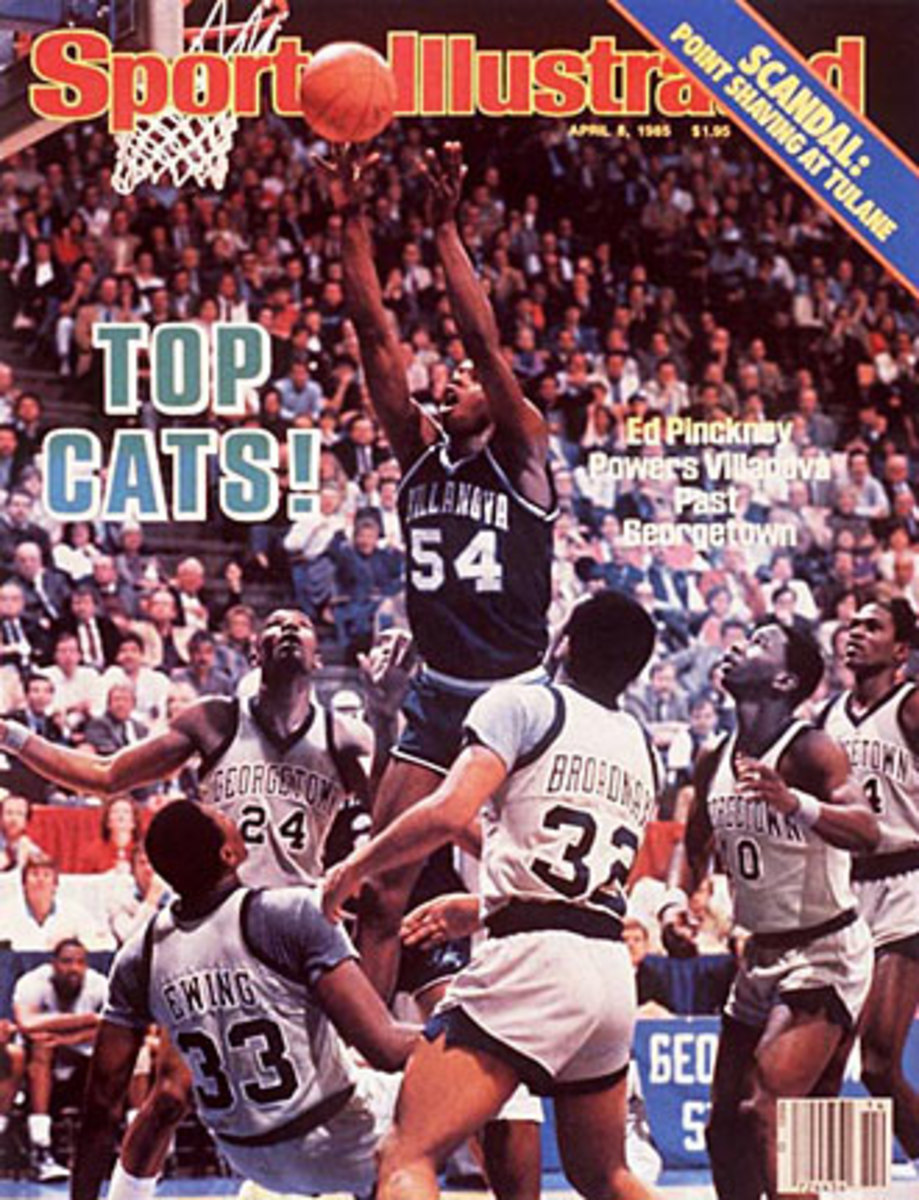
Instead, Villanova pulled off one of the biggest upsets of all time. They shot 22-for-28 from the field, 78 percent, the highest in Final Four history. Georgetown hardly folded, but Villanova won, 66-64. It was April Fool's Day, but there was no joke in Rupp Arena.

It was the 1st NCAA men's basketball National Championship won by a Philadelphia-area team since La Salle in 1954. And, with the 9th seed in their region, the 1985 Villanova team remains the lowest seed ever to win the Tournament.

"I still never saw the Championship Game replay in its entirety," Massimino said in 2015, at a 30th Anniversary reunion. "I still think we might lose."

But they won. Hail the Champions:
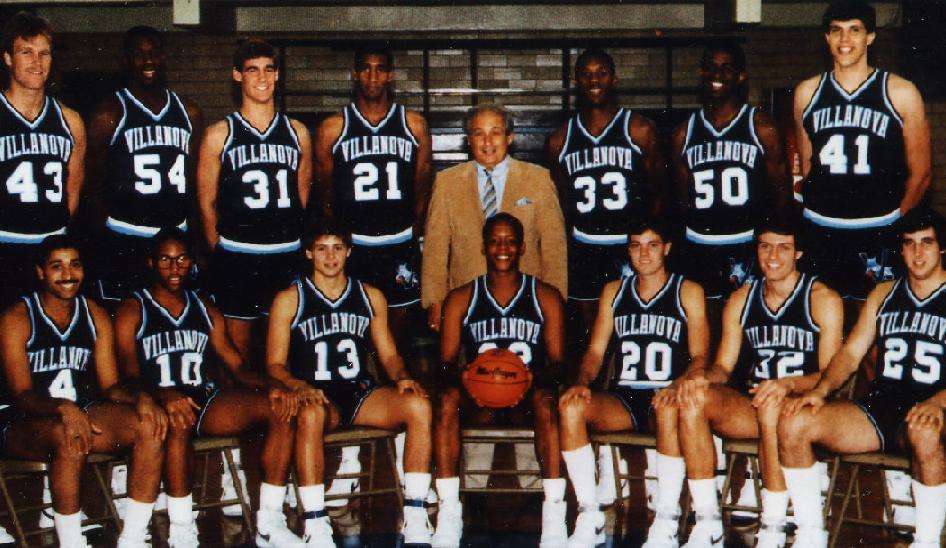
Top row, left to right: Center Wyatt Maker; forward Ed Pinckney,
forward Mark Plansky, forward Howard Pressley,
head coach Rollie Massimino, forward Dwayne McClain,
forward Connally Brown, center Chuck Everson.
Bottom row: Guard Dwight Wilbur, guard DeAlvin Phillips,
guard R.C. Massimino, guard Gary McLain,
guard Brian Harrington, guard Harold Jensen, forward Steve Pinone.

Pretty much all of them went on to do good things. Ed Pinckney played 12 seasons in the NBA, mostly for the Phoenix Suns. He went back to Villanova, on Jay Wright's staff, and has been an assistant coach for 3 NBA teams. Dwayne McClain played 12 seasons of pro ball, mostly in Europe, but did have 1 season with the Indiana Pacers. He went into coaching, and now runs a financial firm in Florida.

Harold Pressley played for the Sacramento Kings, and is now a TV announcer in Sacramento. Connally Brown became an FBI Agent. And R.C. Massimino, 1 of 5 kids Rollie had with his wife, now runs a construction management company in the Philadelphia suburbs.

Rollie stayed at Villanova until 1992, when he got an offer that spoke to his integrity, and mirrored his arrival at Villanova. The University of Nevada at Las Vegas, reeling from NCAA sanctions after their failure to defend their 1990 National Championship, a 1991 Semifinal loss to Duke nearly as shocking as Georgetown's 1985 loss to Villanova (a win by Duke could still be considered a big upset then), had fired crooked head coach Jerry Tarkanian.

But maybe, just maybe, Vegas corrupts everyone eventually. Just 2 years later, Rollie's own integrity was impeached. It was revealed that he and UNLV President Robert Maxson cut a deal to lift Rollie's salary above the figure that was reported to the State of Nevada, violating ethics rules. He had to go.

He resurfaced in 1996, at Cleveland State University. He did not do well there, and he couldn't control his players, who were involved in substance abuse, other crimes, and academic fraud. He left in 2003.

He moved to Florida, intending to be retired. But in 2005, Northwood University, an NAIA school in West Palm Beach, started a basketball program, and the athletic director asked Rollie to be their 1st coach. He led them to 4 conference titles, getting to the NAIA Semifinal in 2011 and the Final in 2012. In 2014, Northwood was bought by a private corporation, and renamed Keiser University.

He began battling cancer, but in 2016, Villanova got back to the NCAA Final, and coach Jay Wright asked Rollie to come to the Final at NRG Stadium in Houston. He did, and met with the team. Villanova won a thriller against North Carolina, to take their 2nd National Championship. He died the following year.

Villanova won another National Championship in 2018. The Big 5's count currently stands as follows: Villanova 3, Penn 2 (if you count retroactive titles from the pre-NCAA Tournament era), La Salle 1, Temple 1 (if you count NIT titles from the era before the NCAA Tournament became the big one), St. Joseph's none.

Tuesday, September 1, 2020

John Thompson, 1941-2020

Imagine a man who has won 2 NBA Championships as a player, and it's among the least important parts of his legacy.

John Robert Thompson Jr. was born on September 2, 1941 in Washington, D.C. When he was growing up in the 1940s and '50s, it was unusual for a black American to be a Roman Catholic. But his family was, and he attended Archbishop Carroll High School in the District of Columbia. Other notable alumni include basketball players Austin Carr, Johnny Dawkins, and Eddie Jordan, who played on Rutgers' 1976 Final Four team and coached in the NBA.

John Carroll, for whom the school was named, was the 1st Catholic Archbishop in America, appointed to Baltimore in 1789. This was right after he founded the 1st Catholic university in America, Georgetown University. It should not be confused with The Catholic University of America, which is also in Washington.

But Thompson did not attend Georgetown. Instead, after back-to-back undefeated seasons and City Championships in 1959 and 1960, he went to a different Catholic school, Providence College. In 1963, he and Ray Flynn, who later served as Mayor of Boston, led the Friars to the NIT Championship. The following year, they got Providence into their 1st NCAA Tournament.

Upon graduation, Thompson was PC's all-time leader in points, scoring average and field goal percentage, and 2nd in rebounds. The success of the program since 1964 has led to several players surpassing him.

Nevertheless, he was drafted by the Boston Celtics, where he played center and backed up the great Bill Russell. He played 2 seasons, 1964-65 and 1965-66, and the Celtics won the NBA Championship in both seasons.

After the 1966 Finals, the Celtics left him unprotected in the expansion draft, and he was selected by the Chicago Bulls. If he had stuck with the Bulls, basketball history could have been very different. He might have stayed in Chicago, and ended up succeeding Ray Meyer at the city's DePaul University. Or, he might have restored Loyola University to the glory it received when it won the NCAA Tournament in 1963.

*

Instead, he went back to his hometown, and coached at St. Anthony High School. (A few years ago, St. Anthony was merged into Archbishop Carroll.) In 6 seasons, he went 122-28. That got the attention of Georgetown. I don't know if he was the 1st black man to become head coach at a major Catholic university, but his impact was quick: In just 3 years, he took them from 3-23 in the season before he arrived to 12-14, then 13-13, and then 18-10 and the 1975 NCAA Tournament.

In 1979, the Big East Conference was formed, and ESPN began broadcasting. This combination was very beneficial for college basketball, with the Georgetown Hoyas taking on St. John's of New York City, Syracuse of New York State, the University of Pittsburgh, and other high-profile teams.

This might be a good time to answer the question, often used as a taunt by Georgetown's opponents: "What's a Hoya?" Officially, the University says it does not know where the word came from. But, as with Indiana and "Hoosiers," there are theories.

Given the school's Catholic background, studying Greek and Latin was common. The accepted version of the story ties in with that: The Greek hoya means "what" or "such," and the Latin saxa means "rocks." A stone wall then surrounded the Georgetown campus in the west of the District, and so was born the chant of "Hoya Saxa!" or "What Rocks!" (Or "Such Rocks!")

A variant is that the football team's defense was called the Stonewalls, perhaps in reference to the wall around the campus. Although this is retroactively ironic, given the Church's opposition to gay rights and the association of the Stonewall Inn in New York with the movement since 1969.

Thompson led the Hoya basketball team to the Big East Conference's regular-season Championship in 1980, 1984, 1987, 1989, 1992, 1996 and 1997. And he led them to win the Big East Conference Tournament in 1980, 1982, 1984, 1985, 1987 and 1989. So he won both in 1980, 1984, 1987 and 1989.

Since 1983, the Big East Tournament has been held at Madison Square Garden in New York -- which is the secondary home court of St. John's, their main home court having been Alumni Hall on their campus in Jamaica, Queens. That building is now named Carnesecca Arena, for longtime coach Lou Carnesecca, known as Louie the Sweater for his colorful outerwear.

Likewise, in 1981, the Hoyas had outgrown their on-campus McDonough Gymnasium, and began playing their bigger home games out in the suburbs of Landover, Maryland, at the Capital Centre, home of the NBA's Washington Bullets (now the Washington Wizards) and the NHL's Washington Capitals.

And, compared to Carnesecca's garish sweaters, Thompson was known for a towel that he would drape over his sportsjacket. And that wasn't the only fashion statement at 1980s Georgetown. The team's success led to the navy blue Georgetown vinyl jacket becoming popular Winter outerwear in black communities.

And while wearing a T-shirt under your jersey is illegal in the NBA, and is illegal in the NCAA now, it was legal in the NCAA in the early 1980s. During a particularly cold game in his freshman year of 1981-82, Patrick Ewing wore a T-shirt under his Number 33 jersey, and it caught on with the rest of the team.

Eventually, the rivalry between the Hoyas and the St. John's Redmen -- the name was changed to Red Storm in 1995, to avoid references to exploitation of Native Americans -- reached the point where Chris Mullin of St. John's started wearing a T-shirt under his Number 20 jersey as well.

The battles between the Hoyas and the Redmen packed the Cap Centre and The Garden. In the 1984-85 season, they played each other 4 times. They split the Conference games, each winning on the other's court, with St. John's taking the title. But the Hoyas won the Conference Tournament. Then, in the NCAA Tournament, 3 of the Final Four teams were from the Big East, and Georgetown beat St. John's once more, while Villanova of Philadelphia beat Louisiana State.

But the Hoyas turned out to be underachievers. They got to the Elite Eight in 1980, but failed in the 1st Round in 1981. In 1982, they got all the way to the Final at the Superdome in New Orleans, and were underdogs to North Carolina. They were down by 1 point as the last seconds ticked down, and Fred Brown mistakenly passed the ball to James Worthy, and that was it.

The Hoyas lost in the 2nd Round in 1983, but in 1984, they went all the way, beating the University of Houston in the Final. Thompson had become the 1st black head coach in basketball to win a National Championship. The 1st player he hugged was Fred Brown.

They were expected to repeat as National Champions in 1985, and were a whopping 35-2 going into the Final against Villanova at Rupp Arena in Lexington, Kentucky. But 'Nova's phenomenal shooting led to the erroneous (but it sure didn't feel like it) title "The Perfect Game," and a 66-64 victory.

It was Ewing's last game. His battles with Mullin, with Worthy, with Akeem Olajuwon of Houston (as Hakeem was then known), with Ralph Sampson of Virginia, and with Len Bias of Maryland became college basketball legend. But he only won the 1 title.

*

Thompson's teams continued to be excellent, winning the league in both the regular season and the tournament, but he never reached another Final Four, getting to the Elite Eight in 1987, 1989 and 1996. And he recruited and coached some of the best players in the country, such as Basketball Hall-of-Famers Ewing, Dikembe Mutombo, Alonzo Mourning and Allen Iverson; plus All-Americans and NBA stars Eric "Sleepy" Floyd, David Wingate, Reggie Williams, Othella Harrington and Jerome Williams.

He also earned a great deal of street cred, not just for being a black man who led black men to victory in a city whose permanent residents (most federal government workers living there are not) are black, to the point where funk bandleader George Clinton called Washington "Chocolate City" or "C.C.," but also for showing just who was the most powerful man in town -- and it wasn't Mayor Marion Barry.

It was believed to be Rayful Edmond III, the man who introduced crack cocaine to the District, and whose, shall we say, employees were connected to over 40 murders. Edmond had been a talented basketball player (though not quite talented enough to make a college team), and so he knew pretty much every hoopster who came into the District, including Mourning and his then-Hoya teammate John Turner.

Thompson got wind of this, and invited Edmond to meet him in his office at McDonough Gym. At first, Thompson asked nicely, to cease all contact with his players. Edmond tried to match Thompson's calmness by informing him that none of his players were involved in illegal activities. Thompson stood up to his full 6-foot-10-inch height, stuck a huge finger in Edmond's face, cursed him out, and told him that he had crossed a line, and said, "I will not allow you to destroy their lives!"

Edmond knew that if he launched any kind of reprisal against Thompson, it would cause more problems than it would solve. He backed down, and stayed away from Thompson's players.

In 1997, as did the Wizards and Capitals, the Hoyas moved into the downtown arena now known as the Capital One Arena, and currently split their home games between that building and McDonough. Thompson's marriage broke up in 1999, and he announced his resignation. Later that year, he was elected to the Basketball Hall of Fame. His longtime assistant Craig Esherick replaced him, but was not very successful.

In 2004, he was fired, and replaced by Thompson's son, John Thompson III. John III had coached Princeton to 3 Ivy League regular-season titles, and led Georgetown to 3 Big East regular-season titles, and also won the Big East Tournament in 2007. He got them to the Final Four that year, but that was the only time he got them past the Sweet 16, and he was fired after the 2017 season -- replaced by Patrick Ewing, 

John III now works with the Wizards. Another son of John Jr., Ronny Thompson, was the head coach at Ball State University in Indiana in the 2006-07 season, and now works for NBA TV.

On September 11, 2001, John Thompson had a place on an airline flight canceled. That flight was American Airlines Flight 77, which took off from Dulles International Airport in the Virginia suburbs of D.C., with an intended destination of Los Angeles, but was hijacked by al-Qaeda terrorists, turned around, and crashed into the Pentagon, with all aboard being killed.

Thompson lived another 19 years, commentating for various networks. He lived long enough to see a statue of himself dedicated inside McDonough Gymnasium.
He died on Sunday, August 30, 2020, at his home in Arlington, Virginia, across the Potomac River from D.C., 3 days short of his 79th birthday. No cause has yet been released, but "a family source" said he'd been in ill health for a while.

Bill Russell: "Very sad to hear of my friend & teammate John Thompson's passing this morning. Our thoughts are with his family & all of the men he brought through #Georgetown & the impact he had on so many lives. He will be greatly missed #RIP my friend"

Magic Johnson: "The world has lost another icon. Hall of Fame Coach John Thompson was a basketball legend, pioneer, advisor, friend and all around incredible man. Coach Thompson had a heart for teaching and helped so many players become men."

Michael Jordan, whose shot won the 1982 NCAA Final for North Carolina over Thompson's Georgetown: "Coach Thompson was truly a great man and a legend in college basketball. He had such a profound impact on his players and was a father figure to so many of them. I admired him and loved him dearly."

Roy Williams, assistant coach to Dean Smith in that 1982 Final, and now head coach at North Carolina: "He was truly a great man who just happened to be a basketball coach, and a great one at that."

Mike Krzyzewski, head coach at Duke University: "He was an incredibly strong person who always put his players first and fought for them at every turn. Repeatedly, I was amazed at his passion for doing what is right, even when unpopular and no one was looking."

Jim Boeheim, head coach at Syracuse and a longtime rival: "We lost a great basketball coach and a great person with the passing of my friend John Thompson."

Dikembe Mutombo: "He was my mentor, great teacher, hero and a father figure to so many us who got the chance to play for him. Under coach Thompson, I learned a lot about the game of basketball but most importantly, I learned how to be a man in society. We will really miss him."

Allen Iverson, repeating the words of his Hall of Fame induction speech: "Thanks For Saving My Life Coach. I’m going to miss you, but I’m sure that you are looking down on us with a big smile. I would give anything just for one more phone call from you only to hear you say, 'Hey MF', then we would talk about everything except basketball......."

Alonzo Mourning, echoing Iverson: "Coach Thompson, saved my life.... continuously motivating and molding me into the man that I am today. With all the lives he touched and inspired, the best way to pay homage to him is by celebrating his life, applauding his legacy; and using our voices and actions to serve others." ⁣

Patrick Ewing: "We will all miss you, Coach Thompson - but we will never forget you."

Michele Norris, ABC News: "John Thompson had a 97% graduation rate for his players at Georgetown. At some point a teacher claimed he was “uneducatable”. He showed her & then he spent a lifetime showing all of us how to lift up athleticism/scholarship/courage/righteousness & victory on and off the court."

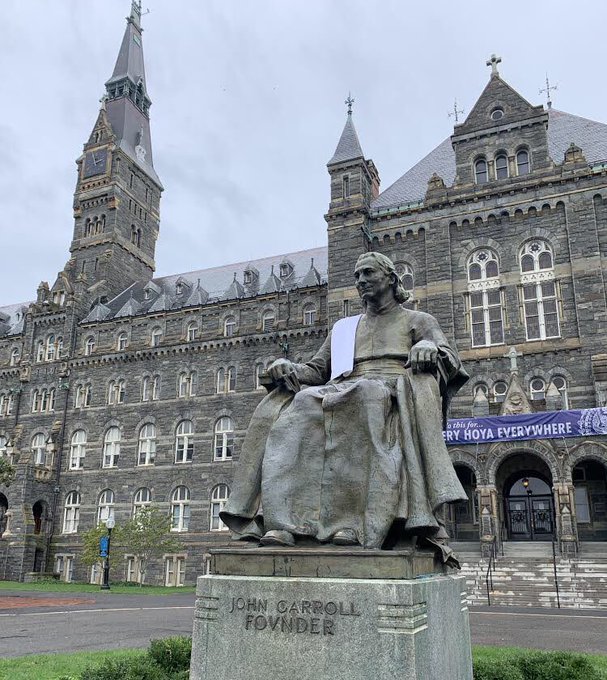
On Sunday night, the NBA on TNT crew, which once included him, all wore towels over their right shoulders in Thompson's memory: Ernie Johnson Jr., Shaquille O'Neal, Charles Barkley and Kenny Smith. Georgetown University also placed a towel over the right shoulder of the statue of their founder, Archbishop John Carroll.
Image
I will let the man who called himself "Big Ace" have the last word: "I told you that I always wanted to be a teacher, not a basketball coach."

Mission accomplished.

Broken heart