Showing posts with label nba draft. Show all posts

Thursday, April 30, 2026

April 30, 1956: The Boston Celtics Trade for Bill Russell

April 30, 1956, 70 years ago: The NBA Draft is held in New York. With the 1st pick, the Boston Celtics -- having just completed their 1st 10 seasons, and not yet having appeared in an NBA Finals -- selected Tommy Heinsohn, forward from the nearby College of the Holy Cross.
With the 2nd pick, the Rochester Royals selected Sihugo Green, a guard from Duquesne University in Pittsburgh. "Si" Green was a decent player, but hardly the kind of star you would expect to go as the 2nd pick overall.
With the 3rd pick, the St. Louis Hawks drafted Bill Russell, a center who had led the University of San Francisco to back-to-back National Championships. It looked like the Hawks had gotten the best player.
But later that day, the Hawks traded the rights to the as-yet-unsigned Russell to the Celtics, for center Ed Macauley and forward Cliff Hagan.
Result: Over the next 13 seasons, Russell would lead the Celtics to 12 NBA Finals, and 11 NBA Championships. The Celtics became the most dominant team in North American sports history -- not winning as many World Championships as Major League Baseball's New York Yankees or the National Hockey League's Montreal Canadiens, but winning more titles in a shorter period of time. 
Meanwhile, the Hawks won just 1 title, and were forced to move out of St. Louis, to Atlanta, where they have been a perennial letdown.
It is the biggest transactional blunder in the NBA's history. How could the Hawks have been so dumb? Well, maybe, they were not as dumb as we've been led to believe. As the biggest star coming out of college basketball, Russell was already believed to be ready to demand big money, which most NBA team owners didn't have. Hawks owner Ben Kerner didn't have it. Celtics owner Walter Brown did, because he also owned his arena, the Boston Garden, and the other team that played there, the NHL's Boston Bruins.
What's more, Brown owned the Ice Capades. At the time, it was a bigger moneymaker than the NBA or the NHL. So was the Ringling Brothers and Barnum & Bailey Circus. It came to New York every April, and so the Madison Square Garden Corporation gave them choicer dates. This forced the Rangers in 1950, and the Knicks in 1951, to play Finals games on the road, possibly costing them titles.
The Royals had a chance to select Russell, but passed on him. Why? Because Brown made a deal with Royals owner Les Harrison: Select somebody other than Russell, and I'll add Rochester to the Ice Capades' tour. It was an offer Harrison couldn't refuse. (And no heads -- human, horse, or otherwise -- were hurt in the process.)
It was a short-term fix for the Royals. But that's the way the NBA had to operate at the time. A year later, Harrison moved the Royals to Cincinnati. They won the NBA Championship in 1951. Through the 2025-26 season, 75 years later, this franchise, now known as the Sacramento Kings, has never been back to the NBA Finals. But Harrison did what he had to do to stay in business, and that meant giving up a chance at a man who could have become one of the NBA's greatest players ever, and did.
But he might not have. Until Michael Jordan led the Chicago Bulls to 6 NBA Championships -- 3 with Bill Cartwright at center, and 3 with Luc Longley -- it was generally believed that you had to have a really good center, a big man in the middle, to win an NBA Championship.
But until Russell, Mikan was the only big man who was able to lead a team to an NBA title. Until Russell, the NBA's best players had been smaller guys who were good outside shooters, guys like Joe Fulks (1947 Philadelphia Warriors), Buddy Jeannette (1948 Baltimore Bullets), Bob Davies (1951 Rochester Royals), Dolph Schayes (1955 Syracuse Nationals) and Paul Arizin and Tom Gola (1956 Philadelphia Warriors).
Before Russell, there were 3 truly great "big men" in college basketball. Mikan, from DePaul University in Chicago, was one. Another was Bob Kurland of Oklahoma A&M (now Oklahoma State). He never played pro ball, instead taking a job with Phillips Petroleum, with a great benefits package, including playing for their "semipro" team.
And the other was Clyde Lovellette of the University of Kansas. He had a good pro career, winning titles as Mikan's backup on the Lakers, and later as Russell's backup on the Celtics. But he was never a pro star: He's in the Basketball Hall of Fame, but mainly for what he did in college.
But there was, as yet, no model for what kind of college stars would become pro stars. Like I said, the NBA was only 10 years old at this point. In hindsight, Mikan was the model. Russell admitted that Mikan was his idol. Mikan enjoyed being thought of the progenitor of the NBA's big men.
But at the time, he was seen as a freak of nature, a happy accident that the Lakers had gotten their hands on. Big men were considered to be slow. Mikan was a good shooter and a strong rebounder, but he wasn't fast. Bill Mazer, the great New York sportscaster, compared him to a stampeding elephant. Bob Ryan of The Boston Globe, in a 1996 ESPN appearance celebrating the NBA's 50th Anniversary, said that, in the modern game, he would be "a good backup center. Deserved every accolade he got at the time, but he's Greg Kite with a hook shot." 
In 2021, at the NBA's 75th Anniversary; in 1996, at the 50th; in 1971, at the 25th... Russell seemed like the obvious player to both select and hang onto. In 1956, he wasn't the obvious pick to do that. Maybe he should have been, but he wasn't.
Then there's St. Louis to consider. It's not just that the Hawks were far behind baseball's Cardinals in terms of popularity in the city. It's that St. Louis was a racially segregated city, in Missouri, a racially segregated State. Cardinal stars like Bob Gibson and Curt Flood would chafe under the policies that segregation forced, until federal law broke it.
Russell -- who would eventually, very accurately, title his autobiography Memoirs of an Opinionated Man -- might not have adjusted so well, having been a boy in segregated Louisiana, and grown up in noticeably (but not completely) more racially liberal Oakland. He eventually had problems with race relations in Boston. In St. Louis, it might have been worse. As a result, he might not have won all those titles with the Hawks.
Anyway, it's not as if the Hawks blew it completely. In 1957, the Celtics and Hawks each made the NBA Finals for the 1st time. It went to double overtime of Game 7 before the Celtics won it. In 1958, both teams made it back, and Russell hurt his ankle in Game 3, and was out the rest of the way. The Hawks, led by the men traded for the rights to Russell, Hagan and St. Louis native Macauley, as well as Hall-of-Fame forward Bob Pettit, won the title in 6 games.
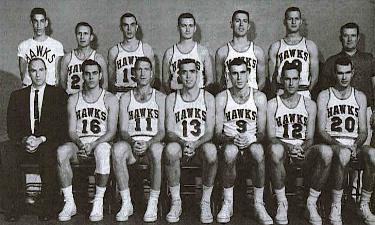
The 1958 NBA Champions.
Hagan is Number 16, Pettit 9, and Macauley 20.
In 1959, the Minneapolis Lakers won the Western Conference, and lost to the Celtics in the Finals. In 1960 and '61, the Hawks returned to the Finals, and lost to the Celtics both times. Still, at that point, the players the Hawks got for Russell had gotten them into 4 Finals, winning 1. It could have been better, but it was still better than anybody else except the Celtics were doing.
Still, it was a dumb trade. 

Monday, May 12, 2025

May 12, 1985: The Fixed NBA Draft Lottery for Patrick Ewing

Left to right: David Stern, Patrick Ewing, Dave DeBusschere

May 12, 1985, 40 years ago: The NBA holds its 1st-ever Draft Lottery, at the Felt Forum, a sub-arena of Madison Square Garden in New York. It was designed to stop teams having a bad season from "going into the tank" or "tanking": Losing games on purpose so that they could finish with the league's worst record, thus guaranteeing them the 1st pick in the NBA Draft.

David Stern, in his 1st full season as Commissioner, drew envelopes containing the logos of the 7 teams, out of the 23 then in the NBA, that didn't make the Playoffs. The theory was that each non-Playoff team had an equal chance to obtain the first pick. The rest of the first-round picks were determined in reverse order of their won–loss record.

It was no secret that the player most likely to be taken with the 1st overall pick would be Patrick Ewing, a center who had led Georgetown University to the previous year's National Championship, and the NCAA Tournament Final in 3 of his 4 years. Some observers were calling the lottery the Ewing Bowl, as if it were a football contest.

The general managers of the 7 teams patiently waited for Stern to draw the envelopes. The 1st one drawn, and thus the team that got the 7th pick, was the Golden State Warriors. The Warriors and the Indiana Pacers had tied for the worst record in the NBA, 22-60. Under the old system, those two teams would face a coin flip: The winner would get the 1st pick, the loser the 2nd pick. The Warriors were thus the 1st team who looked like a loser in the lottery.

The 6th pick went to the Sacramento Kings, the 5th to the Atlanta Hawks, the 4th to the Seattle SuperSonics, and the 3rd to the Los Angeles Clippers. It came down to the Pacers, represented by GM Robert Salyers; and the New York Knicks, represented by their GM, one of their all-time greatest players, Dave DeBusschere.

When Stern opened the next envelope, and pulled out the card, it contained the Pacers' logo. That meant they would pick 2nd, and the Knicks 1st. DeBusschere pumped his fist, and the New Yorkers inside the Felt Forum roared with delight. They knew exactly who DeBusschere, who had been a defensive and rebounding specialist as a player, would pick when the actual draft was held on June 18: The similarly-controlling Ewing.

When DeBusschere got up to shake hands with Stern, he reached into the pocket of his sportscoat, and pulled out a Knicks jersey with Number 33 on it. It wasn't in honor of his teammate on the 1970 NBA Champion Knicks, University of Michigan Hall-of-Famer Cazzie Russell. DeBusschere turned the jersey around, and revealed the name on the back: "EWING."

Ever since, people outside the New York Tri-State Area -- and some inside it, who had no problem with the idea -- have suggested that the fix was in: Stern wanted the best collegiate player of his generation to play for the New York team, because the New York team winning titles would be good for the league, TV-wise, therefore money-wise.

The question became not if Ewing would lead the Knicks to a World Championship, but how many. Of course, that same question would be asked for Eric Lindros and the Philadelphia Flyers in 1992. And if you had suggested at the times of their acquisitions that, in each case, the number would turn out to be zero, you would have been laughed out of the room.

But no one foresaw that the Boston Celtics would still dominate the Eastern Conference through 1987; that the Detroit Pistons would then do so through 1990; and that the Chicago Bulls, led by Michael Jordan, would then do so through 1998. With Ewing, the Knicks would reach the NBA Finals in 1994. Without him -- he was injured earlier in the Playoffs -- they reached the Finals in 1999.

It got to the point where, like Joe Namath of the 1969 New York Jets and Mark Messier of the 1994 New York Rangers, Ewing began predicting that the Knicks would win the Championship. He did become the franchise's all-time leading scorer. But the franchise still hasn't won a title since 1973, with DeBusschere, Willis Reed, Walt Frazier, Bill Bradley, Earl Monroe and Jerry Lucas, Hall-of-Famers all.

So if there was a fix, it didn't work. Even so, Jordan and the Bulls did everything for the league that Stern had hoped that Ewing and the Knicks would do.

The Pacers chose Wayman Tisdale, who turned out to be a good player, but not a great one. The Clippers chose Benoit Benjamin, also a good one. The Sonics chose Xavier McDaniel, a very good player. The Hawks chose Jon Koncak, and the Kings Joe Kleine, who both turned out to be decent players.

The 7th pick that the Warriors got stuck with? They chose Chris Mullin, who, like Ewing and Jordan, would make the Hall of Fame and play on the 1992 Olympic "Dream Team." He would later play for the Pacers, and they got more out of him than they got out of Tisdale. So while the Warriors got robbed, they got more out of their pick than anybody but the Knicks got out of theirs.

There were other interesting picks. The Dallas Mavericks got Detlef Schrempf, a German star who did well for them, and later for the Pacers; Uwe Blab, also German, but not as good as Schrempf, and neither was as good for them as later German player Dirk Nowitzki; and Bill Wennington, who did little for them, but became a reserve for the Bulls' dynasty.

The Cleveland Cavaliers drafted Charles Oakley. He didn't do much for them, but he was later traded to the Knicks, and teamed with Ewing to produce the 2nd-best team in the East in the 1990s. They also drafted John "Hot Rod" Williams, who did well for them.

The Utah Jazz drafted Karl Malone, who would pair with John Stockton to form one of the greatest NBA duos. The Pistons drafted Joe Dumars, who became the defensive leader of the "Motor City Bad Boys," and later served as the general manager who built their next great team. The Pistons have reached the NBA Finals 5 times: 3 with Dumars as a player, winning 2; and 2 with Dumars as GM, winning 1.

The Los Angeles Lakers took A.C. Green, who helped them win 3 titles and set the NBA's consecutive games played record. The Portland Trail Blazers drafted Terry Porter, who helped them reach 2 NBA Finals. The Washington Bullets drafted 7-foot-6 shot-blocking specialist Manute Bol.

So the team that did the best in this draft was Detroit -- and they weren't in the Lottery. So much for the old slogan of the New York State Lottery: "You gotta be in it to win it."

Under the current rules, only the top four picks are decided by the lottery, and are chosen from the 14 teams (out of 30) that do not make the playoffs. The team with the worst record, or the team that holds the draft rights of the team with the worst record, has the best chance to obtain a higher draft pick. After the top four positions are selected (from the lottery slotting system), the remainder of the first-round draft order is in inverse order of the win–loss record for the remaining teams, or the teams who originally held the rights if they were traded. The lottery does not determine the draft order in the subsequent rounds of the draft.

Since the 2019 draft, the NBA changed the lottery odds (the bottom three teams will all have an equal 14 percent chance of winning the top pick), and increased the number of teams selected in the lottery from three to four.

Friday, April 30, 2021

Top 5 Reasons You Can't Blame the St. Louis Hawks for Trading Bill Russell

Along with the late Henri Richard of the Montreal Canadiens,
Bill Russell is the only North American professional athlete
with more championship rings than he has fingers.

April 30, 1956: The NBA Draft is held in New York. With the 1st pick, the Boston Celtics -- having just completed their 1st 10 seasons, and not yet having appeared in an NBA Finals -- select Tommy Heinsohn, forward from the nearby College of the Holy Cross.

With the 2nd pick, the Rochester Royals selected Sihugo Green, a guard from Duquesne University in Pittsburgh. Green was a decent player, but hardly the kind of star you would expect to go as the 2nd pick overall.

With the 3rd pick, the St. Louis Hawks draft Bill Russell, a center who had led the University of San Francisco to back-to-back National Championships. It looked like the Hawks had gotten the better player.

But later that day, the Hawks traded the rights to Russell to the Celtics, for center Ed Macauley and forward Cliff Hagan.

Result: Over the next 13 seasons, Russell would lead the Celtics to 12 NBA Finals, and 11 NBA Championships. The Celtics became the most dominant team in North American sports history -- not winning as many World Championships as Major League Baseball's New York Yankees or the National Hockey League's Montreal Canadiens, but winning more in a short period of time. 
Meanwhile, the Hawks won just 1 title, and were forced to move out of St. Louis, to Atlanta, where they have been a perennial letdown.

It is the biggest transactional blunder in the NBA's 75-year history. How could the Hawks have been so dumb?

How dumb were they? Maybe not as dumb as we've been led to believe.

Top 5 Reasons You Can't Blame the St. Louis Hawks for Trading Bill Russell

5. Money. As the biggest star coming out of college basketball, Russell was already believed to be ready to demand big money, which most NBA team owners didn't have. Hawks owner Ben Kerner didn't have it. Celtics owner Walter Brown did, because he also owned his arena, the Boston Garden, and the other team that played there, the NHL's Boston Bruins.

What's more, Brown owned the Ice Capades. At the time, it was a bigger moneymaker than the NBA or the NHL. So was the Ringling Brothers and Barnum & Bailey Circus. It came to New York every April, and so the Madison Square Garden Corporation gave them choicer dates. This forced the Rangers in 1950, and the Knicks in 1951, to play Finals games on the road, possibly costing them titles.

4. The Rochester Royals. They had a chance to select Russell, but passed on him. Why? Because Brown made a deal with Royals owner Les Harrison: Select somebody other than Russell, and I'll add Rochester to the Ice Capades' tour. It was an offer Harrison couldn't refuse. (And no heads -- human, horse, or otherwise -- were hurt in the process.)

It was a short-term fix for the Royals. But that's the way the NBA had to operate at the time. A year later, Harrison moved the Royals to Cincinnati. They won the NBA Championship in 1951. In the 70 years since, this franchise, now known as the Sacramento Kings, has never been back to the NBA Finals. But Harrison did what he had to do to stay in business, and that meant giving up a chance at a man who could have become one of the NBA's greatest players ever, and did.

But he might not have:

3. The Big Man Theory. Until Michael Jordan led the Chicago Bulls to 6 NBA Championships -- 3 with Bill Cartwright at center, and 3 with Luc Longley -- it was generally believed that you had to have a really good center, a big man in the middle, to win an NBA Championship:

1949, '50, '52, '53 and '54 Minneapolis Lakers: George Mikan.

1957, '59, '60, '61, '62, '63, '64, '65, '66, '68 and '69 Boston Celtics: Bill Russell.

1958 St. Louis Hawks: Ed Macauley.

1967 Philadelphia 76ers, and 1972 Los Angeles Lakers: Wilt Chamberlain.

1970 and '73 New York Knicks: Willis Reed.

1971 Milwaukee Bucks, and 1980, '82, '85, '87 and '88 Los Angeles Lakers: Kareem Abdul-Jabbar.

1974 and '76 Boston Celtics: Dave Cowens.

1977 Portland Trail Blazers: Bill Walton.

1978 Washington Bullets: Elvin Hayes.

1979 Seattle SuperSonics: Jack Sikma.

1981, '84 and '86 Boston Celtics: Robert Parish.

1983 Philadelphia 76ers: Moses Malone.

1989 and '90 Detroit Pistons: Bill Laimbeer.

But did you notice? Until Russell, Mikan was the only big man who was able to lead a team to an NBA title. Until Russell, the NBA's best players had been smaller guys who were good outside shooters, guys like Joe Fulks (1947 Philadelphia Warriors), Buddy Jeannette (1948 Baltimore Bullets), Bob Davies (1951 Rochester Royals), Dolph Schayes (1955 Syracuse Nationals) and Paul Arizin and Tom Gola (1956 Philadelphia Warriors).

Before Russell, there were 3 truly great "big men" in college basketball. Mikan, from DePaul University in Chicago, was one. Another was Bob Kurland of Oklahoma A&M (now Oklahoma State). He never played pro ball, instead taking a job with Phillips Petroleum, with a great benefits package, including playing for their "semipro" team. And the other was Clyde Lovellette of the University of Kansas. He had a good pro career, winning titles with the Lakers and later as Russell's backup on the Celtics. But he was never a pro star.

But there was no model for what kind of college stars would become pro stars. Like I said, the NBA was only 10 years old at this point. In hindsight, Mikan was the model. Russell admitted that Mikan was his idol. Mikan enjoyed being thought of the progenitor of the NBA's big men.

But at the time, he was seen as a freak of nature, a happy accident that the Lakers had gotten their hands on. Big men were considered to be slow. Mikan was a good shooter and a strong rebounder, but he wasn't fast. Bill Mazer, New York sportscaster, compared him to a stampeding elephant.

Russell was fast. Chamberlain turned out to be even faster.

In 2021 at the NBA's 75th Anniversary, in 1996 at the 50th, in 1971 at the 25th, Russell seemed like the obvious player to both select and hang onto. In 1956, he wasn't the obvious pick to do that. Maybe he should have been, but he wasn't.

2. St. Louis. It's not just that the Hawks were far behind the Cardinals in terms of popularity in the city. It's that St. Louis was a racially segregated city, in Missouri, a racially segregated State. Cardinal stars like Bob Gibson and Curt Flood would chafe under the policies that segregation forced, until federal law broke it.

Russell -- who would eventually, very accurately, title his autobiography Memoirs of an Opinionated Man -- might not have adjusted so well, having been a boy in segregated Louisiana, and grown up in noticeably (but not completely) more racially liberal Oakland. He eventually had problems with race relations in Boston. In St. Louis, it might have been worse. As a result, he might not have won all those titles with the Hawks.

Anyway, it's not as if the Hawks blew it completely:

1. The Hawks Won a Championship. In 1957, the Celtics and Hawks each made the NBA Finals for the 1st time. It went to double overtime of Game 7 before the Celtics won it. In 1958, both teams made it back, and Russell hurt his ankle in Game 3, and was out the rest of the way. The Hawks, led by the men traded for the rights to Russell, Hagan and St. Louis native Macauley, as well as Hall-of-Fame forward Bob Pettit, won the title in 6 games.
The 1958 NBA Champions.
Hagan is Number 16, Pettit 9, and Macauley 20.

In 1959, the Minneapolis Lakers won the Western Conference, and lost to the Celtics in the Finals. In 1960 and '61, the Hawks returned to the Finals, and lost to the Celtics both times. Still, at that point, the players the Hawks got for Russell had gotten them into 4 Finals, winning 1. It could have been better, but it was still better than anybody else except the Celtics were doing.

VERDICT: Guilty. In St. Louis and Atlanta (where they moved in 1968), the Hawks haven't won a title since 1958, or reached the Finals since 1961. And if Bob Gibson could play in St. Louis and win the fans over, Bill Russell could do it, too.

Usually, these Top 5 Reasons posts end with an acquittal. This one simply can't. None of the 5 reasons provides reasonable doubt. The Hawks might not have traded 17 NBA Championships overall, or the 11 that Russell won, for the 1 that they did win and the inability to stay put long-term. But they did make this trade.

That's how dumb they were.