Showing posts with label les harrison. Show all posts

Thursday, April 30, 2026

April 30, 1956: The Boston Celtics Trade for Bill Russell

April 30, 1956, 70 years ago: The NBA Draft is held in New York. With the 1st pick, the Boston Celtics -- having just completed their 1st 10 seasons, and not yet having appeared in an NBA Finals -- selected Tommy Heinsohn, forward from the nearby College of the Holy Cross.
With the 2nd pick, the Rochester Royals selected Sihugo Green, a guard from Duquesne University in Pittsburgh. "Si" Green was a decent player, but hardly the kind of star you would expect to go as the 2nd pick overall.
With the 3rd pick, the St. Louis Hawks drafted Bill Russell, a center who had led the University of San Francisco to back-to-back National Championships. It looked like the Hawks had gotten the best player.
But later that day, the Hawks traded the rights to the as-yet-unsigned Russell to the Celtics, for center Ed Macauley and forward Cliff Hagan.
Result: Over the next 13 seasons, Russell would lead the Celtics to 12 NBA Finals, and 11 NBA Championships. The Celtics became the most dominant team in North American sports history -- not winning as many World Championships as Major League Baseball's New York Yankees or the National Hockey League's Montreal Canadiens, but winning more titles in a shorter period of time. 
Meanwhile, the Hawks won just 1 title, and were forced to move out of St. Louis, to Atlanta, where they have been a perennial letdown.
It is the biggest transactional blunder in the NBA's history. How could the Hawks have been so dumb? Well, maybe, they were not as dumb as we've been led to believe. As the biggest star coming out of college basketball, Russell was already believed to be ready to demand big money, which most NBA team owners didn't have. Hawks owner Ben Kerner didn't have it. Celtics owner Walter Brown did, because he also owned his arena, the Boston Garden, and the other team that played there, the NHL's Boston Bruins.
What's more, Brown owned the Ice Capades. At the time, it was a bigger moneymaker than the NBA or the NHL. So was the Ringling Brothers and Barnum & Bailey Circus. It came to New York every April, and so the Madison Square Garden Corporation gave them choicer dates. This forced the Rangers in 1950, and the Knicks in 1951, to play Finals games on the road, possibly costing them titles.
The Royals had a chance to select Russell, but passed on him. Why? Because Brown made a deal with Royals owner Les Harrison: Select somebody other than Russell, and I'll add Rochester to the Ice Capades' tour. It was an offer Harrison couldn't refuse. (And no heads -- human, horse, or otherwise -- were hurt in the process.)
It was a short-term fix for the Royals. But that's the way the NBA had to operate at the time. A year later, Harrison moved the Royals to Cincinnati. They won the NBA Championship in 1951. Through the 2025-26 season, 75 years later, this franchise, now known as the Sacramento Kings, has never been back to the NBA Finals. But Harrison did what he had to do to stay in business, and that meant giving up a chance at a man who could have become one of the NBA's greatest players ever, and did.
But he might not have. Until Michael Jordan led the Chicago Bulls to 6 NBA Championships -- 3 with Bill Cartwright at center, and 3 with Luc Longley -- it was generally believed that you had to have a really good center, a big man in the middle, to win an NBA Championship.
But until Russell, Mikan was the only big man who was able to lead a team to an NBA title. Until Russell, the NBA's best players had been smaller guys who were good outside shooters, guys like Joe Fulks (1947 Philadelphia Warriors), Buddy Jeannette (1948 Baltimore Bullets), Bob Davies (1951 Rochester Royals), Dolph Schayes (1955 Syracuse Nationals) and Paul Arizin and Tom Gola (1956 Philadelphia Warriors).
Before Russell, there were 3 truly great "big men" in college basketball. Mikan, from DePaul University in Chicago, was one. Another was Bob Kurland of Oklahoma A&M (now Oklahoma State). He never played pro ball, instead taking a job with Phillips Petroleum, with a great benefits package, including playing for their "semipro" team.
And the other was Clyde Lovellette of the University of Kansas. He had a good pro career, winning titles as Mikan's backup on the Lakers, and later as Russell's backup on the Celtics. But he was never a pro star: He's in the Basketball Hall of Fame, but mainly for what he did in college.
But there was, as yet, no model for what kind of college stars would become pro stars. Like I said, the NBA was only 10 years old at this point. In hindsight, Mikan was the model. Russell admitted that Mikan was his idol. Mikan enjoyed being thought of the progenitor of the NBA's big men.
But at the time, he was seen as a freak of nature, a happy accident that the Lakers had gotten their hands on. Big men were considered to be slow. Mikan was a good shooter and a strong rebounder, but he wasn't fast. Bill Mazer, the great New York sportscaster, compared him to a stampeding elephant. Bob Ryan of The Boston Globe, in a 1996 ESPN appearance celebrating the NBA's 50th Anniversary, said that, in the modern game, he would be "a good backup center. Deserved every accolade he got at the time, but he's Greg Kite with a hook shot." 
In 2021, at the NBA's 75th Anniversary; in 1996, at the 50th; in 1971, at the 25th... Russell seemed like the obvious player to both select and hang onto. In 1956, he wasn't the obvious pick to do that. Maybe he should have been, but he wasn't.
Then there's St. Louis to consider. It's not just that the Hawks were far behind baseball's Cardinals in terms of popularity in the city. It's that St. Louis was a racially segregated city, in Missouri, a racially segregated State. Cardinal stars like Bob Gibson and Curt Flood would chafe under the policies that segregation forced, until federal law broke it.
Russell -- who would eventually, very accurately, title his autobiography Memoirs of an Opinionated Man -- might not have adjusted so well, having been a boy in segregated Louisiana, and grown up in noticeably (but not completely) more racially liberal Oakland. He eventually had problems with race relations in Boston. In St. Louis, it might have been worse. As a result, he might not have won all those titles with the Hawks.
Anyway, it's not as if the Hawks blew it completely. In 1957, the Celtics and Hawks each made the NBA Finals for the 1st time. It went to double overtime of Game 7 before the Celtics won it. In 1958, both teams made it back, and Russell hurt his ankle in Game 3, and was out the rest of the way. The Hawks, led by the men traded for the rights to Russell, Hagan and St. Louis native Macauley, as well as Hall-of-Fame forward Bob Pettit, won the title in 6 games.
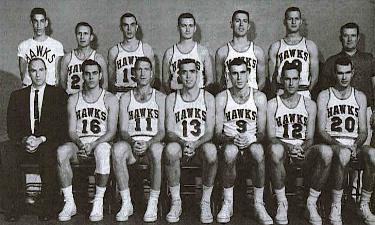
The 1958 NBA Champions.
Hagan is Number 16, Pettit 9, and Macauley 20.
In 1959, the Minneapolis Lakers won the Western Conference, and lost to the Celtics in the Finals. In 1960 and '61, the Hawks returned to the Finals, and lost to the Celtics both times. Still, at that point, the players the Hawks got for Russell had gotten them into 4 Finals, winning 1. It could have been better, but it was still better than anybody else except the Celtics were doing.
Still, it was a dumb trade. 

Saturday, March 13, 2021

Top 5 Reasons You Can't Blame Les Harrison for Moving the Rochester Royals to Cincinnati

March 13, 1957: The Rochester Royals beat the St. Louis Hawks, 104-99 at the Rochester Community War Memorial Arena, or "The War Memorial" for short, in Rochester, New York. The Royals got a balanced attack: Bob Burrow scored 19 points, Maurice Stokes 17, Jack Twyman 15, Art Spoelstra 14, and Tom Marshall and Dave Piontek 10 each. This overcame 22 points by the Hawks' Ed Macauley.

It was the Royals' last game of the regular season, and, at 31-41, they had the worst record in the NBA, so they didn't make the Playoffs. So this would be the last game they ever played. 

The team was founded by the brothers Lester and Joseph Harrison, known as Les and Jack, and entered the National Basketball League for the 1945-46 season. At first, they played at the Edgerton Park Arena. In that 1st season, the Royals won the Championship of that Midwest-based league, and reached the Finals in each of the next 2 seasons, but lost.

The Basketball Association of America was founded for the 1946-47 season, based mostly in the Northeast. In 1949, the NBL and the BAA merged to form the National Basketball Association, which dates its founding to the 1946 formation of the BAA. The Royals joined, and won the Championship in 1951, with "Lucky Les" (who had starred as a player at East High in Rochester) as head coach, defeating the New York Knicks in 7 games.
Among the Royals' players were Basketball Hall-of-Famers Bob Davies, Bobby Wanzer, Al Cervi, Arnie Risen, Pop Gates, Alex Hannum, and future Knicks coach Red Holzman, who was elected as a coach, but was also a very good player, making 2 All-NBL Teams before the institution of the NBA All-Star Game in 1951. Les Harrison has also been elected to the Hall, in the Contributor category.
Bob Davies. He had starred at Seton Hall,
and a banner honoring him hangs
at the Prudential Center in Newark.

In 1955, the Royals moved to the 11,000-seat War Memorial. Among the construction workers was Robert Morella, who became one of the most popular professional wrestlers of the 1960s and '70s, under the name Gorilla Monsoon. Like the Philadelphia and Baltimore Civic Centers, it had a horseshoe-shaped seating area with a stage at one end.

Like the Baltimore version (now the Royal Farms Arena), but unlike the Philadelphia version (demolished to make way for a hospital), it still stands, under the name of the Blue Cross Arena It serves as the home of one of the most historic minor-league hockey teams, the Rochester Americans. It is also the home of the Rochester Nighthawks of the National Lacrosse League. 
For a while, on a court named for Les Harrison, it hosted the minor-league Rochester Razorsharks. Since 1963, it has hosted the Kodak Classic, an annual college basketball tournament founded by Les Harrison, and named for the photography company that put Rochester on the world's map.

But the arena no longer hosts professional basketball. After the 1956-57 season, the Harrison brothers moved the team to Cincinnati. Cincy is known as "The Queen City of the Midwest," so the name "Royals" still fit.

The experiment didn't work. The Royals got to the NBA Eastern Conference Finals in 1963 and 1964, but not to an NBA Finals, unable to get past the Boston Celtics. In 1966, the Harrisons sold the team to another pair of brothers, Max and Jeremy Jacobs. Jeremy would later buy the NHL's Boston Bruins. In 1972, the team was moved to Kansas City, which already had a baseball team called the Royals, so they became the Kansas City Kings.

In 1985, under yet another owner, they moved again, becoming the Sacramento Kings. In the 21st Century, there were threats to move to Anaheim and Seattle, before the Golden 1 Center was built, to keep them in California's capital.

To this day, the Kings hang a banner with the name "ROCHESTER," the NBA logo (the silhouette of Jerry West), and the legend "WORLD CHAMPIONS 1951" -- even though that was 70 years and 3 cities ago. That 70-year drought is easily the NBA's longest. And it's actually 4 cities, if you count the fact that the team was actually the Kansas City-Omaha Kings from 1972 to 1975, playing some home games in Nebraska.

Whether they should have stayed in Cincinnati, or in Kansas City, or in Omaha, is each a discussion for another time. But maybe leaving Rochester set them on a path to moving around, and to failure: In the 64 years since leaving Rochester, they have won just 9 Playoff series (and haven't even made the Playoffs since 2006, the NBA's longest current drought), and have never made the NBA Finals. They reached the Conference Finals in 1963 and 1964 in Cincinnati, did so in 1981 in Kansas City, and have done so in 2002 in Sacramento. That's just 4 trips to the NBA's round of 4 in 70 years. That's pathetic.

Should they have left Rochester?

Top 5 Reasons You Can't Blame Les Harrison for Moving the Rochester Royals to Cincinnati

5. Seagram. The liquor producer had sponsored Les' 1st pro basketball team, and also sponsored the Royals at first. But they did not support his wish to take them into the larger league that was formed with the NBL-BAA merger. Had they stuck with him, the team might have lasted longer.

4. Television. Seeing Major League Baseball games on TV helped to kill the Negro Leagues and devastate the minor leagues. That didn't affect the NBA much, since there was almost no overlap in season.

But the rise of TV did give people a reason to stay home during basketball season. What's more, unlike MLB, boxing, horse racing and (eventually) the NFL, in the 1950s, the NBA didn't handle TV well. You'd think it would, since the court was small enough for cameras to easily follow. (Horse racing was then popular on TV because, despite having the largest "field," the horses were all bunched together, making for easy camera work.) Games were locally broadcast, but not nationally, and the teams just didn't get enough revenue from it.

3. The NBA. Like the NFL, it had started in smaller cities in the Northeast and the Midwest, and all those cities would turn out to be to small to keep the league going, and would lose their teams, except for Green Bay, Wisconsin.

There were 4 teams that didn't even survive the 1st BAA (NBA) season of 1946-47: The Pittsburgh Ironmen, the Cleveland Rebels, the Detroit Falcons and the Toronto Huskies -- and those were all big cities at the time. By the dawn of the 1950-51 season, Providence, St. Louis, Washington and even Chicago had lost their teams. The next season, Indianapolis followed. And the original version of the Baltimore Bullets, NBA Champions in 1948, folded early in the 1954-55 season.

The Royals/Kings aren't the only team that has made several moves. One of the charter BAA teams was the Buffalo Bisons. They didn't even make it to the New Year in that 1st season, moving to Moline, Illinois, next-door to Rock Island, and across the Mississippi River from Davenport and Bettendorf, Iowa. They became the Tri-Cities Blackhawks. (The region is now known as the Quad Cities.) They only stayed until 1951, became the Milwaukee Hawks, and then moved again in 1955, becoming the St. Louis Hawks, the team the Royals played in their last game in Rochester. In 1968, they moved again, becoming the Atlanta Hawks.

The Royals weren't even the only team moving in 1957: The Fort Wayne Pistons moved to Detroit. (As with the Royals, the name made even more sense in their new city than in their old one.) In 1960, the Minneapolis Lakers, winners of 5 titles, moved to Los Angeles.

In 1961, an expansion team called the Chicago Packers began. After 1 year, they became the Chicago Zephyrs, probably because Chicagoans didn't want to root for a team called the Packers. In 1963, they became the new Baltimore Bullets. In 1973, they moved to Washington. In 1997, the Washington Bullets became the Washington Wizards.

So the moving of teams wasn't something the early NBA establishment frowned upon. They would have been more surprised if the Harrison brothers had tried to stay in Rochester. Especially when there were other options.

2. Cincinnati. At the time, it looked like a good market. Between the University of Cincinnati and Xavier University, it had proven itself to be a good market for college basketball. There wasn't much competition: The overlap with baseball's Reds was minimal, since the NBA Playoffs had yet to extend into May; and there was no professional football team, just UC.
Cincinnati, circa 1957

On February 1, 1957, the Royals had played a regular-season game in Cincinnati, at the Cincinnati Gardens. Two of the Royals' players, Jack Twyman and Dave Piontek, were Cincinnti natives, and suggested the game. Playing games at neutral sites, in order to build up NBA fandom in places where the league didn't have teams, was fairly common in those days before a national TV contract would make such games unnecessary.

The Royals beat the Pistons, 96-80. The Gardens was roughly the same age and size as the War Memorial: It was relatively new, opening in 1949; and seated 10,000, slightly less. It, too, had the horseshoe shape with a stage at one end. The game was a sellout, unlike most of the Royals' games in Rochester.
At the time, Cincinnati was home to about 500,000 people. Today, it's only a little over 300,000, thanks to "white flight." And with just 2.8 million people, it's one of the smallest metropolitan areas with a major league team in any sport.

And the city did lose the Royals in 1972. Despite the building of the Riverfront Coliseum in 1975, the NBA has never returned. The Gardens was torn down in 2018, and the Coliseum, now the Heritage Bank Center, has had minor-league hockey as its main program for most of its history.

1. Western New York State. While Cincinnati's population has shrunk significantly, Rochester didn't have a whole lot of people to lose. Even in 1957, it was home to only about 330,000 people, a little more than Cincinnati has now. Today, despite a reputation for scientific research, and for being the basis of the city of Port Charles on the ABC soap opera General Hospital, Rochester has barely over 200,000 people, with a metro area less than half the size of Cincinnati's, at 1.1 million.
A recent photo of downtown Rochester

This is matched by the other cities in Western New York. Syracuse lost the NBA's Nationals in 1963, becoming the Philadelphia 76ers. Like Rochester, Syracuse has a longtime team in minor-league hockey, the Syracuse Crunch. Both cities also have long had teams in baseball's Class AAA International League, the Rochester Red Wings and the Syracuse Chiefs. But not in the major leagues in either sport.
Frontier Field, home of the Rochester Red Wings since 1996

As stated earlier, Buffalo had already lost the BAA's Bisons in 1946. Buffalo also had a team called the Buffalo Bills in the All-America Football Conference from 1946 to 1949, but when the NFL took 3 teams from the AAFC, they took the Cleveland Browns, the Baltimore Colts and the San Francisco 49ers. It became known as "The Screwing of Buffalo."

Buffalo would gain the AFL's version of the Bills in 1960, and the NBA's Braves and the NHL's Sabres in 1970, the same year the Bills became part of the AFL-NFL merger. The Braves would move in 1978, and are now the Los Angeles Clippers. And the Bills and Sabres have both faced the possibility of having to move. Today, both are still struggling, despite both being owned by billionaires Terry and Kim Pegula.

Remember the movie It's a Wonderful Life? George Bailey (played by Jimmy Stewart), operator of a building and loan association, is shown what his New York State hometown of Bedford Falls would have been like if he had never been born.

He sees that the company his father had founded had gone out of business, because George wasn't there to save it; the low-income housing George had built wasn't built; Henry Potter, the miserable old man who controlled everything in town but the building and loan, had changed the town's name to Pottersville; and, like an organized crime boss, he let other businessmen do what he pleased, so long as he got his cut.

And what businesses were doing well? Bars and casinos. The very things that, today, are pretty much the only businesses doing well in New York State, thanks to the local Native tribes getting casino licenses. In 2009, at the depth of a recession, a New York Times writer pointed this out, and contrasted it with the housing market that George Bailey once ran. The writer concluded that, for the sake of the future of the State of New York, the kindhearted Bailey was wrong, and the old bastard Potter was right. (And you thought the Times was a liberal newspaper.)

Put simply, New York State, from the capital of Albany on west through Syracuse, Rochester and Buffalo, simply can't support major league sports in the modern era.

VERDICT: Not Guilty. If Les Harrison (1904-1997) and his brother Jack hadn't moved the Royals when they did, they would have had to do so eventually. If they had sold the team, to take the decision out of their hands, no matter how committed the new owner(s) would have been to the city, the move would still have to have happened.

Thursday, January 28, 2016

Bobby Wanzer, 1921-2016

A New York/New Jersey basketball legend has left us, and you may have never heard of him.

Robert Francis Wanzer was born on June 4, 1921 in Brooklyn, and grew up on the Upper East Side of Manhattan -- "when it was poor," according to his son Bob. Despite growing to only 6 feet even, he got a basketball scholarship to Seton Hall University in South Range, New Jersey. In 1942-43, he helped the Pirates to a 16-2 record. Then he enlisted in the U.S. Marine Corps, made the Armed Forces All-Star basketball team, and served during the occupation of Guam.

He returned to Seton Hall after The War, and in 1946-47, under former Hall star Bob Davies, and alongside former Seton Hall Prep star Frank "Pep" Saul, the Pirates went 24-3. From 1939-40 to 1947-48 -- with the program suspended for 3 seasons due to The War -- Seton Hall's "Wonder Five" won 113 games and lost just 14, for a winning percentage of .890.

Bobby Wanzer, nicknamed "Hooks" for his hook shot, was drafted by the Rochester Royals of the National Basketball League in 1947. They had been founded 2 years earlier by Lester Harrison, who owned and coached them, and got them to the NBL title in only their 1st season, 1945-46. Bob Davies had played for that team, while also coaching The Hall (you could do that without running yourself ragged in those days), and recommended Wanzer and Saul.

Davies and Wanzer formed the NBL's best backcourt. In 1949, Harrison was among the men who brokered the merger between the 1937-founded NBL and the 1946-founded Basketball Association of America to form the National Basketball Association. (The NBA officially traces its lineage to the founding of the BAA in 1946, making this year its 70th Anniversary.) The Royals maintained their excellence, and won the title in 1951, the only team to become NBA Champions between 1949 and 1954, other than the Minneapolis Lakers. They beat the Knicks in a 7-game Finals.

Hail the 1951 NBA Champion Rochester Royals: Number 3, guard Frank Saul; Number 7, forward Paul Noel; Number 9, guard Bobby Wanzer; Number 10, forward Jack Coleman; Number 11, guard Bob Davies; Number 12, forward Arnie Johnson; Number 14, center Arnie Risen; Number 16, guard William "Red" Holzman; Number 19, forward Bill Calhoun; Number 20, center Joe McNamee; and team founder, owner and head coach Les Harrison.

Davies and Holzman had previously won the NBL title with the 1946 Royals; since there was no BAA/NBA yet, this made them, them, technically, 2-time "World Champions." Saul would be traded to the Minneapolis Lakers, and make it 4 straight NBA titles with 2 different teams: 1951, '52, '53 and '54. Risen would win a title with the 1957 Boston Celtics, Coleman with the 1958 St. Louis Hawks. Holzman, of course, would coach the Knicks to the title in 1970 and 1973.

The Royals were unusual in that their players didn't wear single-digit uniform numbers. So Wanzer actually wore "09," Saul "03" and Noel "07."
Wanzer played his entire career with the Royals, retiring after the 1957 season. That was the team's last season in the Flour City. The NBA was growing to the point where the mid-size cities where so many pro basketball teams had started were no longer big enough.

The 1957 season was also the last for the NBA in Fort Wayne, Indiana, as the Pistons (whose name did make sense there, as it was a major auto-parts-building center) moved to Detroit. In 1949, the Tri-Cities Blackhawks, based in the Moline, Illinois/Davenport, Iowa region (now better known as the Quad Cities), moved to become the Milwaukee Hawks, then the St. Louis Hawks in 1955, and the Atlanta Hawks in 1968.

The Oshkosh All-Stars, NBL Champions in 1941 and '42, knew the game was up, and declined to join the NBA in 1949. Another Wisconsin team, the Sheboygan Redskins, 1943 NBL Champions, joined the NBA in 1949, but left a year later. The year after that, the Iowa-based Waterloo Hawks bit the dust. The Royals' geographic rivals, the Syracuse Nationals, hung on until 1963, when they moved to become the Philadelphia 76ers.

Wanzer was a 5-time All-Star. In 1951-52, he became the 1st NBA player to shoot over 90 percent from the free throw line in a season. He was the Royals' player-coach their last 2 seasons in Rochester, then served as their 1st head coach as the Cincinnati Royals in 1957-58. The team became the Kansas City Kings in 1972 (having to change their name because Kansas City already had the baseball Royals), and the Sacramento Kings in 1985. The Kings still hang the Royals' 1951 NBA Championship banner, 55 years and 3 cities later.

In 1962, Wanzer was hired as the 1st head basketball coach at St. John Fisher College in the Rochester suburb of Pittsford. He coached there for 24 season,and also served as athletic director.

He was elected to the Basketball Hall of Fame in 1987. His Royals teammate Holzman would also be elected, for his coaching of the Knicks. Wanzer was also elected to the U.S. Marine Corps Sports Hall of Fame, which is located at Hall of Fame inductees will be enshrined in the National Museum of the Marine Corps near Quantico, Virginia. Other inductees include baseball legend Ted Williams, 2-time Olympic decathlon champion Bob Mathias, former Heavyweight Champion Ken Norton Sr. and golf legend Lee Trevino.

Seton Hall has retired Number 8 for Wanzer, Number 3 for Saul, and Number 11 for Davies. They've also retired 5 for 1950s player Walter Dukes, 12 for 1950s player Richie Regan, 24 for 1990s player Terry Dehere, 34 for 1970s player Glenn Mosley, and 44 for 1960s player Nick Werkman. These numbers are posted on a single banner at the Prudential Center in Newark, but, aside from Dehere, most fans my age and younger don't know any of them, with the possible exception of Davies, whose 11 has been retired by the Sacramento Kings.
Bobby Wanzer remained in Pittsford, and married a local woman named Nina. They had 3 children: Mary, Beth and Bob. He died at his home in Pittsford on January 23, 2016. He was 94 years old.

With his death, Saul and Calhoun are the only living players from the '51 Royals.

"I owe basketball a lot," he liked to say, "because I never had to get a real job."

Leo Roth, who covered the Royals and is still writing for Rochester's paper, The Democrat & Chronicle, wrote this week: "Bobby Wanzer — player, coach, teacher, husband, father, grandfather, friend — had just given us a 94-year clinic on how to live."

UPDATE: Wanzer's final resting place is not publicly known.