Showing posts with label jerry west. Show all posts

Tuesday, December 31, 2024

Good News and Bad News

Catherine Goldberg, born March 9, 1928, died December 21, 2024.
She survived the Great Depression, the Nazi occupation of her homeland,
and 70 years of living in New York City.

I have good news and bad news. The good news is, 2024 is over. The year we lost:

* From acting: David Soul of Starsky & Hutch, Joyce Randolph of The Honeymooners, Carl Weathers, Louis Gossett Jr., Dabney Coleman, Donald Sutherland, Martin Mull, Bob Newhart, James Earl Jones, Maggie Smith. Also, talk-show hosts Dr. Ruth Westheimer and Phil Donahue, exercise expert Richard Simmons, game show host Peter Marshall.

* From music: Shangri-Las singer Mary Weiss, folksinger Melanie Safka, Allman Brothers guitarist Dickey Betts, guitarist Duane Eddy, Four Tops singer Duke Fakir, singer James Darren, singer Tito Jackson, songwriter J.D. Souther, Kris Kristofferson and Quincy Jones.

* From politics: President Jimmy Carter; Senators Jean Carnahan, Fred Harris, Bob Graham, David Pryor, Jim Sasser and Tim Johnson; Representative Sheila Jackson Lee; Russian dissident Alexei Navalny; political matriarch Ethel Kennedy; and civil rights figures Dexter Scott King and Thelma Mothershed Wair.

* From journalism: Charles Osgood of CBS, Robert MacNeil of PBS, and Aaron Brown of ABC and CNN.

* From sports: Baseball players Willie Mays, Carl Erskine, Rocky Colavito, Orlando Cepeda, Luis Tiant, Fernando Valenzuela and Rickey Henderson, and manager Whitey Herzog; football players Jimmy Johnson, Jim Otto, Larry Allen, Joe Schmidt and Billy Shaw; basketball players Jerry West, Bill Walton and Dikembe Mutombo, and coach Lou Carnesecca; hockey star Johnny Gaudreau; soccer legends Mário Zagallo, Gigi Riva, Franz Beckenbauer, Johan Neeskens, Karl-Heinz Schnellinger and George Eastham, and managers César Luis Menotti and Sven-Göran Eriksson; broadcaster Chris Mortensen. (But also sports pariahs Pete Rose and O.J. Simpson.) 

And, in my own family, a beloved dog, Carly the Hug-a-Pug, age 12; and my great aunt, Catherine Goldberg, 96, the last surviving family member from my grandparents' generation. (For perspective: The last survivor from my great-grandparents' generation passed away in 1966, 58 years ago, before I was even born.)

And we lost the White House to Donald Trump again. 

And I had two nasty colds this year.

And, while the New York Liberty won their sport's final, the New York Yankees and the New York Red Bulls lost theirs.

So, yes, 2024 is over. That's the good news.

The bad news is, 2025 isn't looking much better.

As an old Christmas song put it, we'll have to muddle through somehow.

Wednesday, June 12, 2024

Jerry West, 1938-2024

The two greatest figures in the history of the National Basketball Association are Red Auerbach and Jerry West. That cannot be disputed.

Wilt Chamberlain was a greater player. So were Magic Johnson and Michael Jordan. Phil Jackson was a better coach. Maurice Podoloff, the 1st Commissioner, and David Stern, the longest-serving Commissioner, shaped the league more in an official capacity. But in terms of shaping the history of the league, it's Red and Jerry.

Jerome Allen West was born on May 28, 1938 in Chelyan, West Virginia, 17 miles up the Kanawha River from the State capitol of Charleston, and on the bank of Cabin Creek, leading to a hick nickname he hated, "Zeke from Cabin Creek." He had an abusive father, and his brother was killed in the Korean War, a combination he later admitted made him introverted. He was cut by the head basketball coach at East Bank High School for being too short.

He grew to 6 feet even, and his endless practice made him the best basketball player, maybe the best athlete, in his State's history. On March 24, 1956, he led East Bank to the State Championship. Thereafter, every year on March 24, until the school closed in 1999, the name of the school was changed for the day to West Bank High School.

He got West Virginia University into the NCAA Final Four in 1959, losing to the University of California, coached by Pete Newell and led by Darrall Imhoff, in the Final. He was an easy selection for the U.S. team at the 1960 Olympics in Rome, coached by Newell. Not only did they win the Gold Medal, but that entire team was collectively elected to the Basketball Hall of Fame. Meaning that some of them were elected twice: Newell, West, Oscar Robertson, Jerry Lucas and Walt Bellamy.

The rest of the team: Imhoff, Jay Arnette, Bob Boozer, Terry Dischinger, Allen Kelley, Lester Lane, Adrian "Odie" Smith, and a holdover from the 1956 Gold Medalists, Burdette Haldorson. This was the best basketball team ever assembled, until the "Dream Team" of 1992. How good were they? Lucas' Ohio State teammate John Havlicek only made it as an alternate.

He was drafted by the Los Angeles Lakers, and was a rookie in their 1st season after moving from Minneapolis, 1960-61, joining Elgin Baylor. He was an All-Star in all 14 seasons in which he played in the NBA, and became known as one of the best shooters, and one of the best passers, in NBA history. He was named Most Valuable Player of the 1969 Finals, even though the Lakers lost, the only player from the losing team ever so honored.

In 1970, despite the team eventually losing the game and the series, he launched a 60-foot shot to send Game 3 of the Finals into overtime. In spite of the defeat, it's considered one of the greatest shots in NBA history. Shots like that gave him a much better nickname than "Zeke from Cabin Creek," or the one that Baylor gave him because of his country accent, "Tweety Bird." Shots like that gave him the nickname "Mr. Clutch."

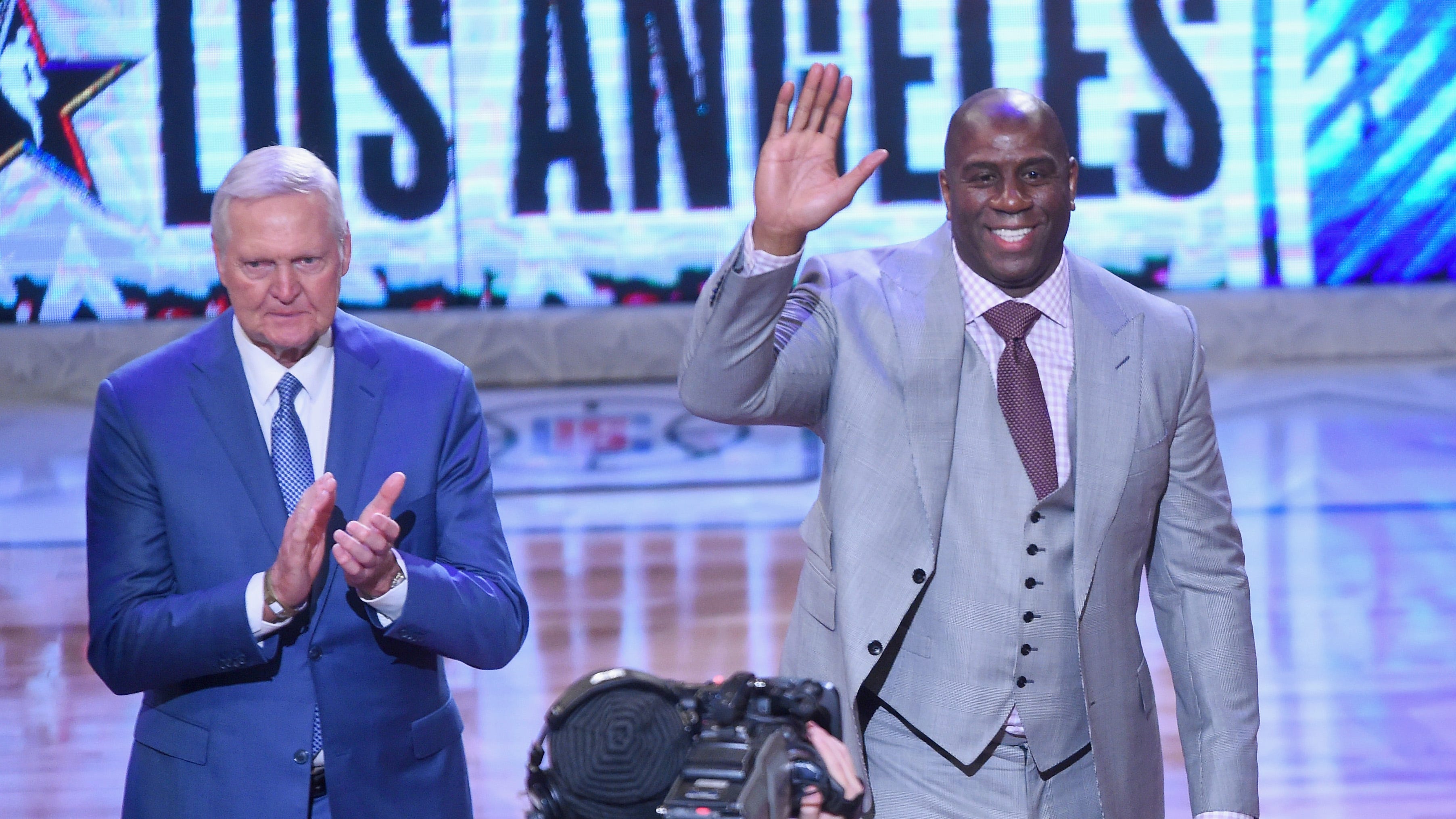
And he is "The Logo": In 1969, Alan Siegel, following up his design of the Major League Baseball logo that bears a resemblance to Harmon Killebrew, used a photograph of West dribbling with his left hand, to design the NBA logo. There is some dispute about the picture: Siegel claimed it was by Wen Roberts, but it appears the photo at the top of this post is the one, and that photo is credited to the great Sports Illustrated photographer Walter Iooss Jr. So when you hear of someone being called an "icon," know that this term is usually used as an exaggeration. Jerry West was The Logo: He was literally an icon.

In the 1971-72 season, with Baylor retiring, the Lakers finally put it all together. Coach Bill Sharman, as West's predecessor as the game's best shooter while with the Boston Celtics, led West, Wilt Chamberlain, Gail Goodrich, Keith Erickson and Jim McMillian -- and a backup guard named Pat Riley -- to the team's 1st NBA Championship in Los Angeles, after going 0-7 in the Finals, 0-8 if you count their last Finals defeat in Minneapolis.

This run included a 33-game winning streak, the longest in the history of major league sports. (While the 1979-80 Philadelphia Flyers, and some European soccer teams, have had longer unbeaten streaks, that included ties.) They avenged their 1970 defeat to the New York Knicks.

*

But the legacy of Jerry West was just getting warmed up. He was the Lakers' head coach from 1976 to 1979, chief scout from 1979 to 1982, and general manager from 1982 to 2002. He built the Laker dynasties of 1980-91 and 2002-10. At the 2001 title parade, Kobe Bryant, whom West talked the Lakers into acquiring in a trade after the Charlotte Hornets drafted him out of high school, wore West's Number 44 jersey instead of his own Number 8.

He wanted a new challenge, and moved on to the Memphis Grizzlies. He had no luck there, retiring in 2007, but in 2011 he joined the board of the Golden State Warriors, who won 4 titles as a result of his involvement. He went back to Los Angeles, with the Clippers, whom he got to their 1st-ever trip to the Western Conference Finals in 2021.

After going 1-for-9 in the Finals as a player, he officially had 9 rings, though he had a hand in building 15 titles. That's the most of anybody in NBA history except for longtime Boston Celtics head coach, general manager and team president Red Auerbach, who won 16.
His Number 44 has been retired by both WVU and the Lakers, and statues of him are outside the WVU Coliseum in Morgantown and the Crypto.com Arena. The stretch of U.S. Route 19 that runs past the Coliseum, named Monongahela Boulevard for most of its run, is named Jerry West Boulevard. (Elsewhere in town, U.S. Route 119 is named for another WVU graduate: Don Knotts Boulevard.)

He was named to the Basketball Hall of Fame and the NBA's 50th Anniversary 50 Greatest Players. When the ceremony for the 50 Greatest was held at the 1997 All-Star Game in Cleveland, 47 players showed up. One, Pete Maravich, was already dead. One, Shaquille O'Neal, was injured, couldn't play in the game, and simply refused to show up. His name was heavily booed when it was announced. The other was West, who was in the hospital, recovering from surgery.

He was able to attend the 2022 ceremony for the 75th Anniversary 75 Greatest Players. That same year, The Athletic ranked him 14th on their list of the greatest players ever. In 2019, in a rare decision of his that I agreed with, Donald Trump awarded him the Presidential Medal of Freedom.

He married his college sweetheart, Martha Jane Kane, in 1960. They divorced in 1976. They had three sons: David, Mark, and Michael. Jerry married his second wife, Kristine "Karen" Bua, in 1978. They had two sons, Ryan and Jonnie. Jonnie played guard for West Virginia, like his father, and married professional golfer Michelle Wie in 2019.

After being in ill health for a year, Jerry West died today, June 12, 2024. He was 86 years old.

NBA Commissioner Adam Silver: "Jerry West was a basketball genius and a defining figure in our league for more than 60 years. He distinguished himself not only as an NBA champion and an All-Star in all 14 of his playing seasons, but also as a consummate competitor who embraced the biggest moments."

Kareem Abdul-Jabbar: "The reason Jerry West is the logo for the NBA is because he embodied the qualities we admire in our best athletes: skills as a player, dedication as a teammate, and integrity as a person. He was my coach, and my advisor, but mostly he was my friend."

Byron Scott, part of the Laker dynasty of the 1980s, who later coached the New Jersey Nets to the 2002 and '03 Finals: "It’s because of Jerry West that there was even 'Showtime.' It’s because of you that I am who I am today. You believed in me when no one else did and for that I’m forever grateful. You will always be my 'Basketball Dad'. I love you Logo my heart is broken. You will be missed."

Adrian Wojnarowski, ESPN: "Jerry West lived a profound basketball and American life — iconic as a player, executive and looming figure in the history of the game. He was an MVP, a champion, a gold medalist, a dynasty-builder and literally the league’s logo. His loss leaves a massive void."

Michael Jordan: "I am so deeply saddened at the news of Jerry's passing. He was truly a friend and a mentor. Like an older brother to me. ... Rest in Peace, Logo."

Paul George, Clippers All-Star: "We will always remember you for your undeniable legacy, and more importantly, greatness as a human being."

LeBron James: "My thoughts and prayers goes out to your wonderful family! Forever love Jerry! Rest in Paradise my guy!"

Wednesday, September 5, 2018

Los Angeles' 10 Greatest Athletes

This week, the Mets are in Los Angeles to play the Dodgers.

Los Angeles' 10 Greatest Athletes

Note that this includes Anaheim (Angels 1965-present, Rams 1980-94, Ducks 1993-present), Inglewood (Lakers 1967-99, Kings 1967-99, and the Rams and Chargers will start playing there in 2020), and Carson (Galaxy 2003-present).

Honorable Mention to Los Angeles Dodgers in the Baseball Hall of Fame, who did not otherwise make this Top 10: Duke Snider (the one holdover from the Brooklyn years who qualifies for both places), Don Drysdale, Don Sutton, Eddie Murray and Mike Piazza.

Honorable Mention to Los Angeles Angels in the Baseball Hall of Fame: Nolan Ryan, Rod Carew, Reggie Jackson and Vladimir Guerrero -- any of whom would have made the Top 10 had they spent their entire careers in L.A. (or Anaheim).

Honorable Mention to Los Angeles Rams in the Pro Football Hall of Fame, who did not otherwise make this Top 10: Bob Waterfield, Tom Fears, Elroy "Crazy Legs" Hirsch, Norm Van Brocklin, Les Richter, Deacon Jones, Merlin Olsen, Tom Mack, Jack Youngblood, Jackie Slater, Eric Dickerson and Kevin Greene.

Honorable Mention to Los Angeles Raiders in the Pro Football Hall of Fame, who did not otherwise make this Top 10: Ray Guy, Howie Long, Marcus Allen and Mike Haynes. Ted Hendricks peaked in Oakland, but was still around for the Raiders' win in Super Bowl XVIII, as an L.A. team.

When The Sporting News named its 100 Greatest Football Players in 1999, Olsen was ranked 25th, Dickerson 38th, Allen 72nd and Hirsch 89th. When the NFL Network named its 100 Greatest Players in 2000, Olsen dropped slightly to 27th, Dickerson dropped a bit to 52, Van Brocklin got onto the list at 83rd, Allen dropped a bit to 85th, and Hirsch rose slightly to 87th.

Honorable Mention to Los Angeles Lakers in the Basketball Hall of Fame, who did not otherwise make this Top 10: Elgin Baylor, Gail Goodrich, Jamaal Wilkes, Bob McAdoo and James Worthy. Baylor and Worthy were also named to the NBA's 50th Anniversary 50 Greatest Players.

Honorable Mention to Blake Griffin and Chris Paul, likely to become the 1st and 2nd players (if not necessarily in that order) to reach the Basketball Hall of Fame based on what they did with the Los Angeles Clippers.

No player who played more than 1 season for them has yet reached the Basketball Hall of Fame. Bill Walton counts from their years as the San Diego Clippers, and Bob McAdoo does from their time as the Buffalo Braves, but not for L.A.

Honorable Mention to Los Angeles Kings in the Hockey Hall of Fame: Rogie Vachon, Marcel Dionne, Larry Murphy, Luc Robitaille, Wayne Gretzky, Rob Blake and Jari Kurri.

Honorable Mention to Anaheim Ducks in the Hockey Hall of Fame: Paul Kariya, Scott Niedermayer and Teemu Salanne. Jari Kurri, Adam Oates, Sergei Fedorov and Chris Pronger also played for the Ducks and have made the Hall, but, between them, played just 7 seasons for the team.

Honorable Mention to Soccer Legends Derek Dougan and Phil Parkes (1967 Wolves), George Best (1976-78 Aztecs), Johan Cruijff (1978-79 Aztecs), David Beckham (2007-12 Galaxy), Steven Gerrard (2015-16 Galaxy), and Ashley Cole and Zlatan Ibrahimovic (current Galaxy). Los Angelenos didn't get to see these guys at their best, but they did get to call them their own. No, Robbie Keane does not count as a legend.

Honorable Mention to U.S. Soccer Stars who played for the LA Galaxy: Cobi Jones (1996-2007), Alexi Lalas (2001-04), and Landon Donovan (2005-16).

10. Wayne Gretzky, center, Los Angeles Kings, 1988-96. Counting only what he did for the Kings: 246 goals, their 1st trip to the Stanley Cup Finals, and the 1st nationwide attention in franchise history. Vachon and Dionne couldn't provide that, even though they did more for the Kings, and for longer.

The Kings (as did the entire league) retired his Number 99, and a statue of him stands outside the Staples Center (in addition to the one as outside Edmonton's Northlands Coliseum).

9. Wilt Chamberlain, center, Los Angeles Lakers, 1968-73. He only played 5 seasons in Los Angeles, the last 5 of his career. They reached the Conference Finals in all 5, the NBA Finals in 4, and won the 1972 NBA Championship with a then-record 69 regular-season wins, including a 33-game winning streak, the longest in the history of North American major league sports.

His Number 13 has been retired by the University of Kansas, the Harlem Globetrotters, the Golden State Warriors, the Philadelphia 76ers, and the Lakers. He was named to the Basketball Hall of Fame and the NBA's 50th Anniversary 50 Greatest Players. He is the greatest basketball player who ever lived, and I don't want to hear about no His Airness.

8. Merlin Olsen, defensive tackle, Los Angeles Rams, 1962-76. Your generation might not know him at all. My generation knew him as a color commentator on NBC's NFL broadcasts, as an actor on Little House On the Prairie and Father Murphy, and, perhaps incongruously, as a commercial pitchman for FTD florists. Before that, he was one of the best defensive tackles ever.

He was NFL Rookie of the Year in 1962, the 1st of 14 Pro Bowl seasons. He, Deacon Jones, Rosey Grier and Lamar Lundy formed the Los Angeles Rams defensive line that became known as the Fearsome Foursome. (The San Diego Chargers actually used that first, but they were in San Diego and the AFL, not Hollywood and the NFL.)

The Rams never reached an NFL Championship Game or a Super Bowl while Merlin was with them, but he was still named to the College and Pro Football Halls of Fame, the NFL's 1960s and 1970s All-Decade and 75th Anniversary Teams, The Sporting News' 100 Greatest Football Players (ranking 25th in 1999) and the NFL Network's 100 Greatest Players (ranking 27th in 2010). The Rams retired his Number 74.

7. Shaquille O'Neal, center, Los Angeles Lakers, 1996-2004. He became a 15-time NBA All-Star, being named MVP of the All-Star Game 3 times. With the Orlando Magic, he was 1993 Rookie of the Year, and led them to the 1995 NBA Eastern Conference title, winning the NBA's scoring title. Orlando proved too small for him, and he signed with the Los Angeles Lakers as a free agent for the 1996-97 season.

At the 1997 All-Star Game in Cleveland, he was honored as one of the league's 50th Anniversary 50 Greatest Players. He was injured, and didn't show up. When his name was announced, he was booed. (Patrick Ewing was also selected, and injured. He showed up, was announced, and was cheered.) And in his 1st 3 seasons in L.A., which were also Kobe Bryant's 1st 3, Shaq couldn't get them into the NBA Finals. His legacy was at stake.

Whether you think the Lakers benefited from officials' calls or not, the results are there to read. In 2000, he led the league in scoring again, was named regular season MVP, and took the Lakers to the NBA Championship. He took them to 3 straight, 2000-02, and was given the Bill Russell Award as Finals MVP all 3 times. Eventually, after the Lakers lost the 2004 Finals, it became clear that he and Kobe could no longer work together, and Shaq got his wish and got out.

He won another title in 2006 with Dwyane Wade, Alonzo Mourning, Gary Payton and the Miami Heat. The rest of his career was less dramatic, making single-season stops in Phoenix, Cleveland and Boston, before retiring in 2011, as the last active member of the 50 Greatest Players. He was elected to the Basketball Hall of Fame, has a statue outside the Staples Center, and has the rare distinction of 3 different numbers retired: 33 by LSU, 34 by the Lakers, and 32 by the Heat. (Oddly, the Magic haven't yet retired his 32.)

He tried his enormous hand at acting and rapping. Well, let's just say it's a good thing he kept his "day job."

6. Kobe Bryant, guard, Los Angeles Lakers, 1996-2016. He played 20 seasons, the 1st guard in NBA history to do so, and was an All-Star 18 times, winning the game's MVP 4 times. He was a 9-time All-Defensive First Team, scoring champion in 2006 and 2007, regular season MVP in 2008, and NBA Finals MVP in 2009 and 2010, his 4th and 5th titles, on top of the 2000, 2001 and 2002 titles he won with Shaq.

Kobe became The Man in L.A., as had Bob Waterfield, Sandy Koufax, Jerry West, Steve Garvey, Magic Johnson and Shaq before him. He recently became the 1st U.S. athlete to have 2 different uniform numbers retired by the same team: The 8 he wore until 2006, and the 24 he wore thereafter. I suppose it's like what's been said about Rickey Henderson: If you split his career in 2, you would have 2 Hall-of-Famers. He becomes eligible for the Hall next year.

Of course, it could be argued that his career should have been cut in half. After all, what he was accused of doing in Colorado was worse than what Ray Rice did in Atlantic City. Kobe was lucky that, whatever happened, it happened before the era of "Me Too."

5. David "Deacon" Jones, defensive end, Los Angeles Rams, 1961-71. He led the "Fearsome Foursome" defensive line with Olsen, Rosey Grier and Lamar Lundy. "The Secretary of Defense" made 8 Pro Bowls. In 1967 and 1968, he was named NFL Defensive Player of the Year.

He changed the game in 3 different ways. Because of him, at 6-foot-5 and 265 pounds, defensive ends were now expected to be both big and fast. He was the original Reggie White. Because of him, the headslap -- slapping your hand on the earhole on an opponent's helmet -- was banned, and, given what we now know about head injuries, this was a good thing.

Most of all, he changed the terminology of the sport. He thought that defensive players needed a statistic. Until Deacon, tackling the quarterback behind the line of scrimmage was called nothing more than that: A tackle behind the line of scrimmage. He thought of tossing a burlap sack over the quarterback, and created the term "sack" for the action.

Although the NFL did not officially keep record of sacks until 1982, examination of game films suggests he had 173 1/2 for his career, which would have made him the all-time leader, although he would since have been surpassed by White and Bruce Smith.

He was named to the Pro Football Hall of Fame and the NFL's 1960s All-Decade and 75th Anniversary All-Time Teams. The Rams retired his Number 75. In 1999, The Sporting News ranked him 13th on their list of the 100 Greatest Football Players. In 2010, the NFL Network listed him 15th on their 100 Greatest Players. He lived long enough to see all these distinctions. When he died in 2013, the NFL instituted the Deacon Jones Award, given to the League leader in sacks.

4. Jerry West, guard, Los Angeles Lakers, 1960-74. "Mr. Clutch" got West Virginia University into the NCAA Final Four in 1959, the U.S. team to the Gold Medal at the 1960 Olympics in Rome (that entire team was collectively elected to the Basketball Hall of Fame), and the Lakers into the NBA Finals 9 times, although they only won once, in 1972. He was named Most Valuable Player of the 1969 Finals, even though the Lakers lost.

He was an All-Star in all 14 seasons in which he played in the NBA, and became known as one of the best shooters, and one of the best passers, in NBA history. And he is "The Logo": In 1969, Alan Siegel, following up his design of the Major League Baseball logo that bears a resemblance to Harmon Killebrew, used a photograph by Wen Roberts, of West dribbling with his left hand, to design the NBA logo.

But his legacy was just getting warmed up. He was the Lakers' head coach from 1976 to 1979, chief scout from 1979 to 1982, and general manager from 1982 to 2002. He built the Laker dynasties of 1980-91 and 2002-10. He wanted a new challenge, and moved on to the Memphis Grizzlies. He had no luck there, retiring in 2007, but in 2011 he joined the board of the Golden State Warriors, who've now won 2 titles with him involved. He just returned to Los Angeles, with the Clippers.

After going 1-for-9 in the Finals as a player, he now has 12 rings as an executive -- his 13 titles the most of anybody in NBA history except for longtime Boston Celtics head coach, general manager and team president Red Auerbach, who won 16. So if we're talking about the greatest sports figure for Los Angeles, it could be West.

His Number 44 has been retired by both WVU and the Lakers, and statues of him are outside the WVU Coliseum in Morgantown and the Staples Center. He was named to the Basketball Hall of Fame and the NBA's 50th Anniversary 50 Greatest Players.

3. Sandy Koufax, pitcher, Los Angeles Dodgers, 1958-66, plus 1955-57 in Brooklyn. For the 1st third of his career, he struggled. For the 2nd third, he may have been, by the standard of peak performance, the best pitcher ever. And we never got to see the last third, which is why he doesn't rank higher on this list.

He was a 7-time All-Star. A rookie on the Dodgers' 1955 World Series winners in Brooklyn, he didn't make the Series roster. He was on their roster for their 1959 win, and was the key figure in their 1963 and 1965 wins. He was the 1963 NL MVP, and won the Cy Young Award in 1963, '65 and '66 -- 3 of the last 4 seasons when it was still an award for the most valuable pitcher in both leagues.

His total of 382 strikeouts in 1965 remains a record for National League pitchers, and for all lefthanded pitchers. He pitched a no-hitter every year from 1962 to '65, the last a perfect game. As the biggest Jewish sports star of his time, he refused to pitch Game 1 of the 1965 World Series because it fell on Yom Kippur, turning him from big star to all-time icon. The Dodgers lost it. Then he lost Game 2. Then he pitched a shutout in Game 5. Then he pitched a shutout to win Game 7 -- only Jack Morris in 1991 has done that since. Sports Illustrated named him Sportsman of the Year for 1965. He swept the World Series MVPs in both 1963 and '65.

At the close of the 1966 season, his career records were 165-87, a 2.79 ERA, and 2,396 strikeouts. But his elbow was in terrible pain, and he didn't like the idea of all those cortisone shots. Unlike Denny McLain when he was faced with the same decision a few years later, Koufax decided enough was enough, and retired shortly before his 31st birthday.

He was the youngest man ever elected to the Baseball Hall of Fame, at 36. The Dodgers retired his Number 32. He was named to the MLB All-Time Team in 1969, and in 1999 was named to the MLB All-Century Team and Number 26 on The Sporting News' list of the 100 Greatest Baseball Players.

2. Kareem Abdul-Jabbar, center, Los Angeles Lakers, 1975-89. The greatest college basketball player of all time, and this was also in Los Angeles, he went 88-2 at UCLA, and won the National Championship, the National Player of the Year, and the NCAA Tournament Most Outstanding Player all 3 years: 1967, '68 and '69. Not 4, but not because he left early; rather, because freshmen weren't eligible until 1972.

1970 NBA Rookie of the Year. 1971, '72, '74, '76, '77 and '80 NBA MVP. 19-time All-Star. 1971 NBA Champion with the Milwaukee Bucks. 1980, '82, '85, '87 and '88 NBA Champion with the Los Angeles Lakers. That's 6 titles, and twice, 1971 and 1985 -- 14 years apart -- he was named MVP of the NBA Finals. Sports Illustrated named him Sportsman of the Year for 1985.

He is the NBA's all-time leader in minutes played, field goals made, and points scored in both the regular season and the Playoffs -- ahead of Bill Russell, Wilt Chamberlain, Michael Jordan, Shaquille O'Neal, Kobe Bryant and LeBron James.

He was 1 of the top 5 players in the NBA at the moment he entered, at age 22. He was 1 of the top 5 players in the NBA at age 40. He may be 1 of the top 5 players in NBA history. His Number 33 has been retired by UCLA, the Bucks and the Lakers. He was an easy choice for the Basketball Hall of Fame and the NBA's 50th Anniversary 50 Greatest Players, and he has a statue outside the Staples Center.

President Barack Obama awarded him the nation's highest civilian honor, the Presidential Medal of Freedom, in 2016. (At the same ceremony, he also honored another New York native best known for working in sports in Los Angeles, Vin Scully.) He is the greatest athlete ever produced by New York City. "Roger, Roger."

But he's not quite the greatest athlete ever to play for a Los Angeles team. He might be, if he'd been a Laker his entire pro career. This is certainly true of Wilt. But this guy did spend his entire pro career with the Lakers:

1. Earvin "Magic" Johnson, guard, Los Angeles Lakers, 1979-92, with a brief comeback in 1996. He was drafted by the Lakers, who already had Kareem, forcing him to switch from Number 33, which he wore while leading Michigan State to the National Championship, to 32. The Lakers reached the 1980 NBA Finals, and when Kareem was hurt for Game 6, Magic, though 6-foot-9 was by then short for a center, moved from point guard, and torched the Philadelphia 76ers for 42 points on their own court, and won the title.

He also helped the Lakers win the NBA Championship in 1982 (again against the 76ers), 1985 (against the Celtics of Larry Bird, whose Indiana State team he beat for the 1979 NCAA title), 1987 (against Bird again) and 1988 (against the Detroit Pistons). He was named Finals MVP (now named the Bill Russell Award) in 1980, 1982 and 1987. They also reached the Finals in 1983, 1984, 1989 and 1991. He became the all-time assists leader, a record since broken by John Stockton. He was a 12-time All-Star, and a 2-time All-Star Game MVP.

Just before the 1991-92 season could begin, Magic announced he was retiring, because he'd been diagnosed with HIV, the virus that causes AIDS. He was nonetheless selected to that season's All-Star Game, and showed he still had his A-game, and was named the Game's MVP. He was named to the "Dream Team" that stormed to victory at the 1992 Olympics in Barcelona. Even then, he couldn't stay away, briefly coaching the Lakers in 1994 (not well) and briefly returning as a player in 1996 (ditto).

Michigan State retired his Number 33. The Lakers retired his Number 32 and dedicated a statue of him outside the Forum, since moved to the Staples Center. He was named to the Basketball Hall of Fmae and the NBA's 50th Anniversary 50 Greatest Players.

More than that, before he retired, he was already investing wisely, and had founded a chain of movie theaters, all in historically black neighborhoods, including on Harlem's iconic 125th Street. Not long before his diagnosis was announced, but right after Michael Jordan had led the Chicago Bulls to their 1st NBA Championship (beating Magic and the Lakers in the Finals), Magic said, "If Michael were doing what I'm doing, he really would own the world."

Magic's holdings now include a minority share of the Lakers, and the majority ownership of baseball's Los Angeles Dodgers, now defending National League Champions. Earvin Johnson still has a magic touch.

Tuesday, June 20, 2017

Top 10 Athletes From West Virginia

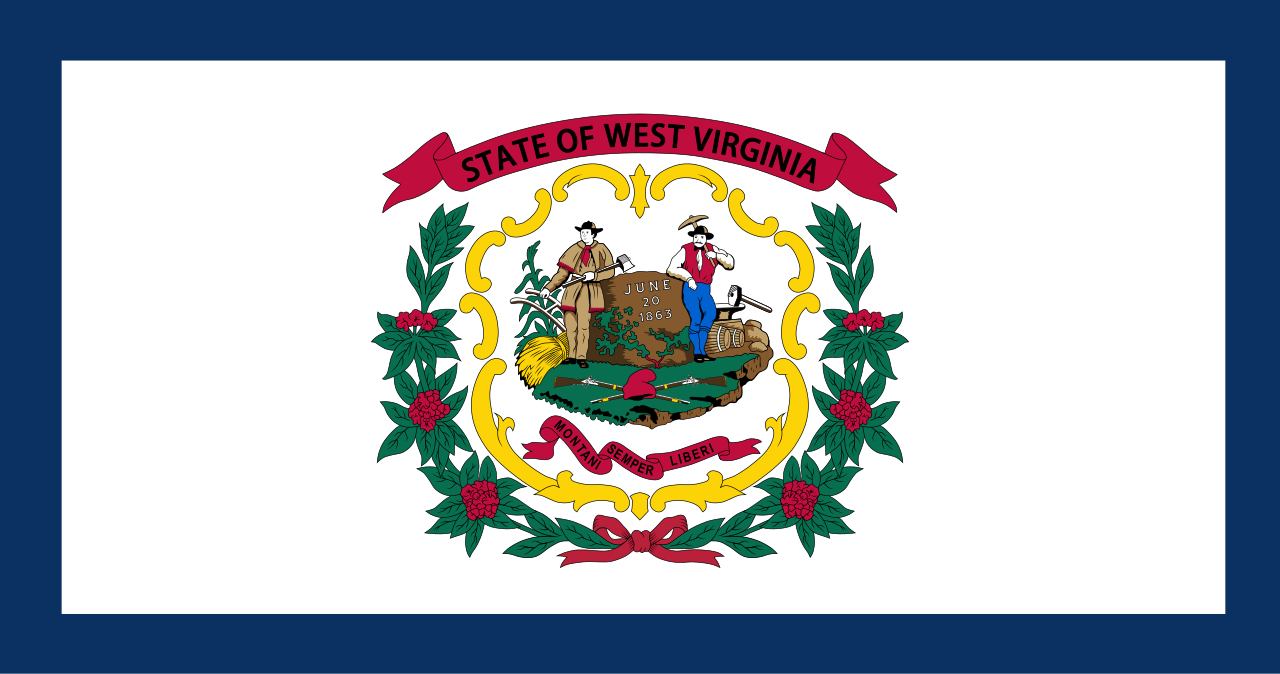
June 20, 1863: 55 Counties from the Confederate State of Virginia, having voted to secede from the State and rejoin the Union, are admitted to the Union as the 35th State, West Virginia. This was the only State to leave the Confederacy and rejoin the Union until the Civil War was over.

Top 10 Athletes from West Virginia

Honorable Mention to Randy Barnes of St. Albans. The current holder of the world records, both outdoor and indoor, for the shot put, over 75 feet, he won the Gold Medal in the event at the 1996 Olympics in Atlanta.

Honorable Mention to Nick Swisher of Parkersburg. He helped the Yankees win the 2009 World Series.

10. Lew Burdette of Nitro. In 1951, the Yankees put him in a trade package to the Boston Braves to get Johnny Sain. This is has been regarded as one of the worst trades in Yankee history, because of what Burdette went on to do to them. In fact, Sain was a key factor on the pitching staff that won the 1951, '52 and '53 World Series for the Yankees.

But Burdette became a really good pitcher after the Braves moved to Milwaukee, winning 203 games, losing just 144. A 2-time All-Star, he led the National League in ERA in 1956 and wins in 1959. He won 3 games against the Yankees in the 1957 World Series, being named the Series' Most Valuable Player. He won 2 more games against the Yankees in the 1958 World Series, before they came back and won Game 7, including lighting him up. He pitched a no-hitter in 1960.

9. Chuck Howley of Wheeling. No West Virginia native has won the Heisman Trophy, but the State has produced several football legends, including Howley. The Dallas Cowboys linebacker was a 6-time Pro Bowler, and reached 5 NFL or NFC Championship Games. In Super Bowl V, he became the 1st and still only player from a losing team to win the game's Most Valuable Player award. The Cowboys won Super Bowl VI.

He is not in the Pro Football Hall of Fame, but he probably should be. He is in the Dallas Cowboys Ring of Honor. The Cowboys do not retire numbers, and, as a result, his Number 54 would be worn by a later legend, Randy White.

8. Glenn Davis of Wellsburg. He won a the Gold Medal in the 400-meter hurdles at the 1956 Olympics in Melbourne, Australia. In 1960, in Rome, he won that event again, and won another Gold Medal with the U.S. 4x400-meter relay team, making him one of the few people to win Gold Medals as both a sprinter and a hurdler. In between, in 1958, he won the Sullivan Award as the nation's top amateur athlete.

Nicknamed "Jeep," in 1960 and '61, he played for the Detroit Lions. His 2 seasons in the NFL matched those of Glenn Davis, the 1946 Heisman Trophy winner from West Point. They were frequently confused for each other, and often received each other's mail, but despite both being famous for nearly 50 years, apparently, they never met. (The Heisman winner died in 2005, the Sullivan winner in 2009.)

7. Frank Gatski of Farmington. A 4-time All-Pro center, he was a member of the Cleveland Browns team that went to 10 straight league championship games: 4 in the All-America Football Conference (winning all 4: 1946, '47, '48 and '49), 6 in the NFL (winning in 1950, '54 and '55, losing in '51, '52 and '53). Those '52, '53 and '54 NFL Championship Games were against the Detroit Lions, and he went to the Lions in 1957, and closed his career going the other way, beating the Browns for his 4th NFL Championship, his 8th league title overall.

He is in the Pro Football Hall of Fame. But he's not even the greatest player ever from his hometown. The man at Number 2 is. But I'm getting ahead of myself.

6. Randy Moss of Rand. The Marshall University star, who was also a great basketball player in high school (playing both basketball and football with NBA star Jason "White Chocolate" Williams), may have been the most talented receiver in football history, even more than Jerry Rice.

Certainly, he got some results: 982 career receptions, over 15,000 receiving yards, 156 receiving touchdowns. He set records for receiving touchdowns by a rookie (17 in 1998) and any player (23 in 2007). He was NFL Offensive Rookie of the Year in 1998, made 6 Pro Bowls, and was named to the NFL's 2000s All-Decade Team.

But he was an egomaniac and a disciplinary problem. And he never won a title. He got to the 1998 NFC Championship Game with the Minnesota Vikings, and Super Bowl XLII with the New England Patriots, and his teams' losses in those games were hardly his fault: Their opponents' good defenses shut more than him down.

He is now a studio analyst for ESPN. Next year, he will become eligible for the Pro Football Hall of Fame. Presuming he doesn't do something stupid, it's a matter of when he gets in, not if. His brother Eric was briefly a Vikings teammate, an offensive tackle. His son Thaddeus is a tight end at North Carolina State University, and his daughter Sydney plays basketball at a Division III school.

5. Hal Greer of Huntington. After starring at his hometown's Marshall University, he went to the NBA's Syracuse Nationals, and moved with them in 1963 to become the Philadelphia 76ers. He was a 10-time NBA All-Star, and a member of the 1967 76ers team that won the NBA Championship and is regarded by some as the greatest team in NBA history.

Unfortunately, he is best remembered for a game the Sixers lost, through little fault of his own: At the end of Game 7 of the 1965 Eastern Conference Finals, he tried to inbound the ball so that the Sixers could score a game-winning basket, but, as Boston Celtics broadcaster Johnny Most said, "Johnny Havlicek stole the ball!"

Nevertheless, Greer was a sensational ballhandler, and scored over 20,000 points at a time when that was something that hadn't been done by very many players. The Sixers retired his Number 15, and he was named to the Basketball Hall of Fame and the NBA's 50th Anniversary 50 Greatest Players.

4. Alfred Earle "Greasy" Neale of Parkersburg. An outfielder, he played 8 seasons in the major leagues, including winning the 1919 World Series with the Cincinnati Reds. But football was his main sport, and the 2-way end won Ohio League titles -- the closest thing professional football had to a "world championship" at the time -- with the Canton Bulldogs, led by Jim Thorpe, in 1917 and 1918.

He is better remembered as a coach. He began his coaching career at his alma mater, West Virginia Wesleyan, coached Marietta College of Ohio to an undefeated season in 1919, nearly did so again in 1920, and coached Pittsburgh-area school Washington & Jefferson to one in 1921, all while still playing Major League Baseball. He coached both Virginia and West Virginia, and led the Philadelphia Eagles to the 1948 and 1949 NFL Championships. He was elected as a coach to the College and Pro Football Halls of Fame.

3. Mary Lou Retton of Fairmont. She's 4-foot-9 and a high school dropout, but she's world-famous. She had a good excuse for dropping out in her sophomore year: She got a lot of money from endorsements after winning the all-around women's gymnastics Gold Medal at the 1984 Olympics in Los Angeles. She also won 2 Silver Medals and 2 Bronze Medals.

Sports Illustrated divided its Sportspeople of the Year for 1984 between her and hurdler Edwin Moses. She became the 1st female athlete ever to be shown on the Wheaties cereal box, is a member of the International Gymnastics Hall of Fame, and became a motivational speaker and an analyst of TV broadcasts of gymnastics. She is married to real estate developer and former University of Texas quarterback Shawn Kelley.

2. Sam Huff of Farmington. As the NFL went to the 2-platoon system in the mid-1950s, meaning that players played on only 1 side of the ball, the West Virginia University star was not only the 1st great linebacker for the New York Giants, before Lawrence Taylor was even born, but the 1st defensive celebrity in football.

He led the Giant defense that steamrolled the NFL, winning the Championship in 1956, and reaching 5 more Championship Games (but losing them all). It was Huff leading the charge that also included Hall-of-Famers Andy Robustelli and Emlen Tunnell that first made fans chant, "De-fense! De-fense!"

In 1960, CBS Reports miked him up for a documentary, hosted by Walter Cronkite (not yet the anchor of The CBS Evening News), titled The Violent World of Sam Huff. Before NFL Films, this was the 1st time that people who never played the sport, even those who had gone to games and had front-row seats, could hear what playing football actually sounded like. How successful was it? A CBS executive wrote a letter, wrote only "Number 70" on it, and dropped it in a mailbox. Two days later, that letter ended up in Huff's locker at Yankee Stadium.

He was a 5-time Pro Bowler, 4 times for the Giants and once for the Washington Redskins. WVU retired his Number 75. Neither of his pro teams has retired his Number 70, but he has been elected to the New York Giants Ring of Honor, the Washington Redskins Ring of Fame, the NFL's 1950s All-Decade Team, the Pro Football Hall of Fame, The Sporting News' 100 Greatest Football Players in 1999, and the NFL Network's 100 Greatest Players in 2010. He went on to a long broadcasting career for the Redskins, partnered with his Washington teammate, Hall of Fame quarterback Sonny Jurgensen.

1. Jerry West of Cheylan, just down the Kanawha River from Charleston, where Cabin Creek flows into it. Hence, he was known as "Zeke from Cabin Creek." But his performance as a guard for the Los Angeles Lakers got him nicknamed "Mr. Clutch."

He got West Virginia University into the NCAA Final Four in 1959, the U.S. team to the Gold Medal at the 1960 Olympics in Rome (that entire team was collectively elected to the Basketball Hall of Fame), and the Lakers into the NBA Finals 9 times, although they only won once, in 1972. He was named Most Valuable Player of the 1969 Finals, even though the Lakers lost. He was a 14-time All-Star, and became known as one of the best shooters, and one of the best passers, in NBA history.

He's not the greatest player in NBA history, and not nicknamed "Mr. NBA" or "Mr. Basketball," but he is nicknamed "The Logo." In 1969, Alan Siegel, following up his design of the Major League Baseball logo that bears a resemblance to Harmon Killebrew, used a photograph by Wen Roberts, of West dribbling with his left hand, to design the NBA logo.
But his legacy was just getting warmed up. He was the Lakers' head coach from 1976 to 1979, chief scout from 1979 to 1982, and general manager from 1982 to 2002. He built the Laker dynasties of 1980-91 and 2002-10. He wanted a new challenge, and moved on to the Memphis Grizzlies. He had no luck there, retiring in 2007, but in 2011 he joined the board of the Golden State Warriors, who've now won 2 titles with him involved. He just returned to Los Angeles, with the Clippers.

After going 1-for-9 in the Finals as a player, he now has 12 rings as an executive -- his 13 titles the most of anybody in NBA history except for longtime Boston Celtics head coach, general manager and team president Red Auerbach, who won 16.

His Number 44 has been retired by both WVU and the Lakers, and statues of him are outside the WVU Coliseum in Morgantown and the Staples Center. He was named to the Basketball Hall of Fame and the NBA's 50th Anniversary 50 Greatest Players.

Friday, March 2, 2012

Top 10 NBA Players Ever (Wilt 100 at 50)

March 2, 1962, 50 years ago today: A National Basketball Association game is played at the Hershey Sports Arena, nearly 100 miles west of Center City Philadelphia, and just to the east of Harrisburg.

The Philadelphia Warriors, one of the NBA's best teams, hosted the New York Knickerbockers. Marv Albert, then studying broadcasting at Syracuse University and soon to become the radio voice of the Knicks, likes to say that, in those days, the NBA had 9 teams, and the sole purpose of the regular season was to eliminate the Knicks from the Playoffs.

The arena, built in 1936, still stands, near the Hersheypark theme park, and is now known as the Hersheypark Arena. It's best known for this game, and is also known as the home of the minor-league hockey team the Hershey Bears (who have since moved to a new arena nearby), and the longtime home of the Pennsylvania high school wrestling championships (since it's close to the State capital of Harrisburg). The arena seats 7,286, but only 4,124 attended, 56 percent of capacity.

The Warriors, who would move to San Francisco the next season (and in 1971 across the Bay to Oakland, taking the name "Golden State Warriors"), defeated the Knicks, 162-147. For over 20 years, this was the highest-scoring game in NBA history.

Of those 162 points, 100 were scored by Wilt Chamberlain, the 25-year-old 7-foot-1 superhuman from West Philly.

The old record was 78, done by Wilt himself. Aside from this game, that figure has been topped only once, recently by Kobe Bryant with 81. But in 1962, there was no 3-point shot, and, as far as I know, no study has been done of this game to see how many points Wilt would have had if the 3-pointer had been in effect.

This would have been easier if there was a surviving TV broadcast or film of this game, but there isn't one. The Warriors didn't have a local TV contract. The Knicks did, but most of the New York stations' sports guys were in Florida to cover the spring training camps of the defending World Champion Yankees and the newborn Mets.

All we have is a scratchy recording of the radio broadcast done by legendary Philly announcer Bill Campbell, which reveals that the fans were chanting, "Give it to Wilt!" The Warriors were obliging, giving up easy shots for themselves so Wilt could get the 3-digit milestone. He did so with a rather unemphatic dunk with 46 seconds left on the clock. The fans stormed the court, but, contrary to legend, the surviving broadcast proves that, after a 9-minute delay, the game was completed.

Wilt scored 23 points in the 1st quarter, 18 in the 2nd to make it 41, 28 in the 3rd to make it j69, and 31 in the 4th to make it an even 100 -- which, being a round number, does stand out more than if he'd gotten 101 or 102. He attempted 69 shots from the field, made 36, took 32 free throws and made 28 -- belieing his legendary difficulty with free throws. All except most free throws attempted were records that still stand (and Wilt already had that record, which still stands). Richie Guerin scored 39 for the Knicks, but nobody noticed.

When asked about the unbelievable total, Wilt noted that he averaged 50 points per game that season. "So it was like doubling my average," he said, as casually as if he'd been averaging 25 and had scored 50. He considered his record (which still stands) of 55 rebounds in a game better, because it was against the World Champion Boston Celtics and their great center, Bill Russell. (However, the Celtics rendered that record dubious by winning the game.)

The attendance of 4,124 belies the fact that thousands of people told Wilt that they were there at the game. Some said they were at the Spectrum -- which wasn't built until 1967. Some said that they were at "the Convention Hall" -- the main building of the Philadelphia Civic Center complex, which served as the main home of the Warriors from 1946 to 1962 and then for the 76ers from 1963 to 1967. Some said that they were at "the Arena," meaning the Philadelphia Arena, which stood in West Philly across from the ABC studio where American Bandstand was once taped, and was last used, sports-wise, by the short-lived Philadelphia Blazers of the World Hockey Association in 1972-73. 

And some said they were at the old Madison Square Garden that night, thinking the game wasn't in Philadelphia (they were right), but in New York (they were wrong). If they said that, Wilt would ask, "You were at the Garden that night? How did the Rangers do?" (I looked it up: They were not scheduled to play that night.)

Before his death in 1999, Wilt said in a number of interviews that Hershey Arena must have held 100,000 people, to accommodate all the people who said they were there that night. Bobby Thomson said pretty much the same thing about the Polo Grounds, which was filled only to a similar capacity when he hit his "Shot Heard 'Round the World in 1951: 34,320 out of 55,987, or 61 percent.

What Red Smith of the New York Herald Tribune said about that home run could apply equally well to Wilt's 100-point game: "Now it is done. Now the story ends. And there is no way to tell it. The art of fiction is dead. Reality has strangled invention. Only the utterly impossible, the inexpressibly fantastic, can ever be plausible again."

*

That 1961-62 season, Wilt averaged over 48 minutes per game -- because he'd played all but 8 minutes of every game, including overtime. And he never fouled out of a game -- not that season, not ever, which is shocking for a big man. He averaged 50.4 points per game.

That same season, Oscar Robertson, then playing for the Cincinnati Royals, averaged what we would now call a triple-double: 30.8 points, 11.4 assists and 12.5 rebounds per game.

And both men did it in a 9-team league, much more balanced than the 23-team league I grew up with and the 30-team league we have now. The competition was tougher. Even from the league office: The league widened the lane to make it tougher for Wilt to score. It didn't stop him.

Top 10 NBA Players Ever

10. George Mikan, center, Minneapolis Lakers, 1947-54.
Bob Ryan, the great Boston Globe sports columnist, grew up in Trenton, New Jersey, and thus had a great opportunity to watch the Warriors and their opponents in the Wilt years, and as a result, he probably knows more about the NBA and its history than anyone who's never been actively employed by an NBA team -- and more than all but a few who have been.

On a 1996 ESPN panel, seeking to determine the greatest NBA team ever, after the Bulls won the title with a record 72 wins, he was asked about the players in the early days of the NBA, and he suggested that the 1954 institution of the 24-second shot clock, designed to stop Mikan and the Lakers, who'd won 5 of the last 6 titles, not only worked, but changed the game completely.

"I'm not going to kid you," Ryan said about the effect the shot clock had on the game. He cited the star of the NBA's 1st Champions, the 1947 Warriors: "I don't think Jumpin' Joe Fulks makes it in today's NBA, except maybe as a 12th man. George Mikan? A good backup center. Deserved every accolade he got in his time, but, now? He's Greg Kite with a hook shot."

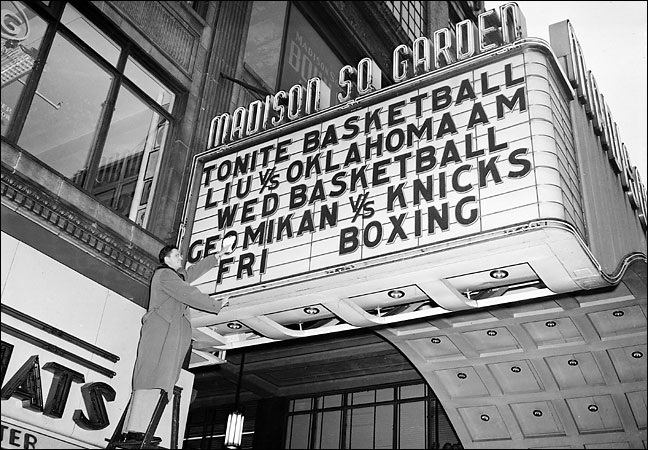
But Mikan did dominate the 1st decade of the NBA. So much so that this famous photo of the old Garden's famed marquee shows that he, rather than his team, was the drawing card. It doesn't say, "Knicks vs. Lakers," or even "Knicks vs. Geo. Mikan." Mikan got top billing, over even the home team.

9. Shaquille O'Neal, center, multiple teams but best known for the Los Angeles Lakers, 1992-2011. Shaq turns 40 next week, and while his inclusion in the NBA's 50th Anniversary 50 Greatest Players was met with disbelief in 1997, it cannot be disputed now, 15 years and 4 titles later.

For good, and for excess if not necessarily for ill, he defined an era, more so than his ex-teammate Kobe Bryant, more so than Tim Duncan, more so than, thus far, LeBron James (who doesn't yet come close to making the Top 10, or even the Top 20). George Mikan (1947-54), Bill Russell & Wilt Chamberlain (1959-69), Magic Johnson & Larry Bird (1979-89), Michael Jordan (1989-98): These men defined eras in the NBA. So did Shaq.

8. Jerry West, guard, Los Angeles Lakers, 1960-74. He has arguably had a greater impact as an executive, the man who built the Laker dynasties of 1980-91, 1999-2004, and 2008-present. But he remains the greatest shooter in NBA history, in spite of being relatively short (6-foot-2), and was so popular that not only was he the 1st Laker to get his number retired (44), but a photo of him dribbling lefthanded became the NBA logo.
7. Julius Erving, forward, New York Nets and Philadelphia 76ers, 1973-87. People who say that Magic and Larry "saved the NBA" starting in 1979 are idiots. The NBA was not in dire straits, except maybe with the way it was covered on TV. And there were already some great stars in the league. Kareem. Bill Walton. Elvin Hayes. And the man known as Doctor J.

Like a lot of great scorers in other sports (including hockey and soccer), Erving became a better defensive player after he lost a step on offense. But that step he lost was one that most players will never have. He could have shaved his head instead of having one of the greatest Afros (or should that be "Afroes"?) ever, and he still would have been 1 of the 5 coolest men in the world.

How many human beings, let alone basketball players, have ever moved like Doc? Indeed, how many athletes have ever been credibly described as "graceful"? However many there have been, I can think of only 3: Joe DiMaggio, Lynn Swann, and Julius Erving.

6. Bill Russell, center, Boston Celtics, 1956-69. Sport's ultimate winner. He led the University of San Francisco to back-to-back National Championships, part of a 60-game winning streak that was the longest in college basketball history until UCLA broke it with an 88-game streak in 1971-74 (after Lew/Kareem, but including Bill Walton). He led the U.S. team, including his USF and Celtic teammate K.C. Jones, to the Olympic Gold Medal in 1956.

Then he played 13 seasons with the Celtics, getting into 12 Finals and winning 11 of them -- the last 2 as not just player-coach, but as the 1st black coach in major league sports history. (Unless you count the NFL, in its first days, as "major league": Look up a man named Fritz Pollard.)

Those 11 World Championships have been matched in North American sports only by Henri Richard of the Montreal Canadiens. The record in baseball is 10 by Yogi Berra; in football, 6, by Forrest Gregg and Herb Adderley, teammates on 5 titles in Green Bay and 1 in Dallas.

The reason the Celtics won all those titles, beating Wilt's Warriors, Wilt's 76ers, and the Lakers of West and Baylor and eventually also Wilt, is that they were a more balanced team. But also because, like Jordan but unlike Wilt, Russell was a cutthroat. I'm not saying he cheated (this wasn't the current era of Boston sports), but he took pleasure in beating an opponent. I've seen pictures of Wilt where he looks like he's trying to find out if looks could kill, but that really wasn't his personality. It was Russell's.

5. Kareem Abdul-Jabbar, center, Milwaukee Bucks and Los Angeles Lakers, 1969-89. The man originally named Lew Alcindor was the most accomplished player in the history of college basketball, winning the National Championship and the tournament MVP all 3 years he was at UCLA, going 88-2. If he had never played a professional game, he would still be 1 of the Top 20 basketball players of all time.

He did play basketball professionally, longer than any man before him. He helped the Bucks win what is still their only title in 1971. Then, preferring to live in a more culturally-advantageous city, demanded a trade to either his hometown of New York or his college town of Los Angeles. He was sent to the Lakers and, along with Magic, led them to 5 titles.

Kareem remains the NBA's all-time leading scorer, surpassing Wilt's old record of 31,419 career points by 7,000. At the age of 38 (1985), he was still 1 of the top 3 players in the game; at 40, he was still 1 of the top 5. Although his reticence and his intellectual pursuits (he was always a student of history, music and religion, even before his conversion to Islam) rendered him an enigma in the eyes of the media, he has opened up a bit in recent years, and is truly one of the most interesting people alive today.

4. Oscar Robertson, guard, Cincinnati Royals and Milwaukee Bucks, 1960-74. The Big O has often been called the most complete player in NBA history. For years, until Magic and then John Stockton, he held the NBA career records for most assists and most steals.

Although the 1960s Royals (forerunners of the Sacramento Kings) had Oscar, Jerry Lucas and Jack Twyman, the closest they ever got to a title was losing to the Celtics in the 1964 Eastern Conference Finals. Oscar finally won a title in 1971, with the Bucks, with young Lew as a dominating center and a much more balanced team than Oscar had in Cincy.

3. Earvin "Magic" Johnson, guard, Los Angeles Lakers, 1979-91, with a brief comeback in 1996. Whereas Jordan inspired his teammates through cold stares and fear, Magic made them better through joy and trust. That he was able to play center despite being 6-foot-9 (which wouldn't have been a big deal 20 years earlier, but was at this point) in Game 6 of the 1980 NBA Finals, filling in for such a talent as Kareem, on the road against a team as tough as that era's 76ers, and score 42 points and lead his team to victory, at the age of 20, shows his completeness and his leadership even then.

Even before illness forced him to stop playing, he was investing the money he'd made from playing, putting it into inner-city businesses and becoming the kind of job creator the Republicans like to talk about, but who haven't been creating many jobs the last few years. Magic built a business empire that has grown exponentially in the 20 years since. Shortly before he announced his forced retirement, right after Jordan had won his 1st title, I saw an interview with Magic in his office at his company, where he said, "If Michael was doing what I'm doing, he really would own the world."

By the way, you'll notice that I do not have Larry Bird in this Top 10. It's not to spite New England sports fans. I simply believe that there have been at least 10 players in the league's 65-year history that were better. In fact, I don't even think Bird was the greatest-ever Celtic forward, and I don't mean that he's been surpassed by Paul Pierce. I give that honor to John Havlicek, who I probably would've included in this Top 10, except, at this point, I had to get Shaq in.

2. Michael Jordan, guard, Chicago Bulls, 1984-98. That 2001-03 comeback with the Washington Wizards shouldn't diminish his legacy: 6 NBA Titles, Finals MVP in all of them, and a great defensive player too.

Put it this way: In Game 5 of the 1998 NBA Finals, at age 35, he had the flu, and had to play the Utah Jazz, the team with the best defense in the league, in Salt Lake City at altitude. And he scored 38 points and led his team to victory. When you or I have the flu, the only thing we usually feel like doing is dying.

1. Wilt Chamberlain, center, Philadelphia-San Francisco Warriors, Philadelphia 76ers, Los Angeles Lakers, 1959-73. At the NBA's 50th Anniversary celebration at the 1997 All-Star Game, the 50th Anniversary 50 Greatest Players were announced, and, in the locker room beforehand, Jordan was telling people that, in spite of all the talent in that room, he was the greatest ever. Wilt walked over to him and said, "Michael, my man, when you played, they changed the rules to make it easier for you. When I played, they changed the rules to make it harder for me. And it didn't work." And Wilt walked off. Game over.

True, Wilt won only 2 titles, but, both times, with the '67 76ers and the '72 Lakers, they broke the established NBA record for wins in a season. True, the '96 Bulls broke the '72 Lakers' record... but if you had a time machine, and brought the '96 Bulls back to play either the '72 Lakers or the '67 76ers, who was gonna guard Wilt? Wilt would have completed teaching Jordan the lesson. (Who was gonna guard Jordan? Hal Greer or Jerry West.)

Oh, and, by the way, that 1st title Wilt won? With a team often considered the greatest in NBA history? That was the 1st season he played in which he didn't lead the NBA in scoring. The next year, he led it in assists, the only center ever to do so. Jordan never led the league in assists, or rebounds, like Wilt did.

A generation whose template is Jordan needs to know: Wilton Norman Chamberlain of Overbrook, Philadelphia, Pennsylvania is the greatest player the game of basketball will ever see.