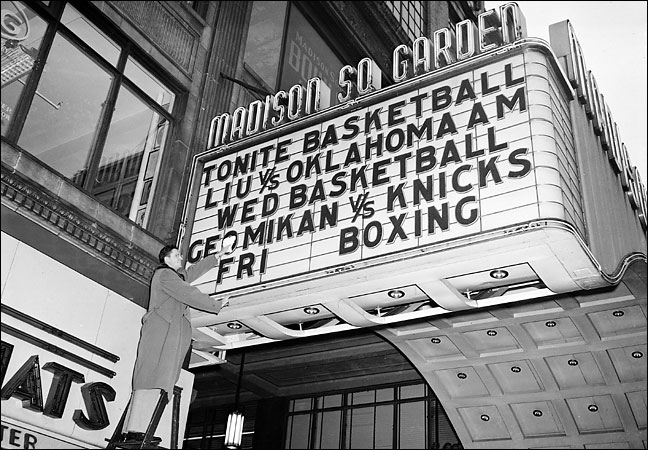
It was not unusual for such games to be played by NBA teams in those days, in the hopes of building a regional fanbase. It might have worked better if the games had been on television. But there is no surviving TV broadcast of this game, and it might not have been on TV at all. There is no surviving film, either. Just a radio broadcast, with Bill Campbell on the microphone, and a few photographs.
Which is too bad, because this was the game in which the Warriors' Wilt Chamberlain scored 100 points.
Wilton Norman Chamberlain was born on August 21, 1936 in Philadelphia. He was 6 feet even at age 10, and 6-foot-10 when he entered Overbrook High School in West Philadelphia. He eventually grew to 7-foot-1 and 1/16th inch. Or, as he later put it, "Kids, smoking is bad for you. I smoked a stogie when I was 14, and I haven't grown an inch since."
He also said that all the people who said, "My God, are you tall!" and "Lord, when are you going to stop growing?" and "Jesus, you are huge!" were balanced out by the people who said, "Holy shit!"
He wasn't the only pro basketball player produced by the Overbrook Rams (although they were the Panthers in his day): They also include Hal Lear, Wali Jones, Walt Hazzard, Wayne Hightower,
Among their other celebrities: Baseball player Jeffrey Leonard, Super Bowl-winning New York Jets defensive back Johnny Sample, Philadelphia Eagles broadcaster Merrill Reese; doo-wop singers Rosetta Hightower (lead singer of The Orlons and Wayne's sister), Dee Dee Sharp and Len Barry; all the members of the soul group The Delfonics, Fresh Prince Will Smith, and Guion Bluford, the 1st black American astronaut.
Wilt excelled in track, in running, jumping and throwing events. But his combination of size, strength and speed had never been seen in basketball before. He broke Tom Gola's record to become Philadelphia's all-time high school basketball scoring leader, including 3 straight games in which he scored 74, 78 and 90 points. He led them to 3 straight Public League titles and 2 straight City Championships.
The University of Kansas, under head coach Forrest "Phog" Allen, had won the National Championship in 1952, lost the NCAA Final in 1953, and opened the Fieldhouse that would later bear Allen's name in 1955. Wilt went there, and led them to the NCAA Final in 1957, where they lost in triple overtime to North Carolina.
Until the 1970s, only Conference Champions and independents could enter the NCAA Tournament, and Kansas did not repeat as Big Eight Champions in 1958. After that junior year, Wilt left KU and signed with the Harlem Globetrotters. They paid him more than any NBA team would have, and he loved the traveling, going all over the world.
For the 1959-60 season, with his college class having graduated, he was eligible to play in the NBA, and the Philadelphia Warriors selected him with their territorial pick. He was now a teammate of Gola and Paul Arizin, both of whom went on to the Basketball Hall of Fame. And the Warriors' coach was the coach of the North Carolina team that had stopped him in the 1957 NCAA Final: Frank McGuire. McGuire knew Wilt was not a disciplinary problem, so he pretty much let Wilt play however he wanted.
As a result, Wilt practically re-wrote the NBA record book. In spite of this, the Warriors couldn't get past the Boston Celtics: Bill Russell wasn't quite as good a player as Wilt, but he was able to do something Wilt wasn't: He made his teammates better. The Warriors lost the Eastern Division Finals to the Celtics in 1960 and 1962, and lost the Division Semifinals to the Syracuse Nationals in 1961.
Wilt led the NBA in scoring in 1960 and 1961. Nobody could stop him. The league widened the lane, in the hopes that stopping him could be made easier. It didn't help. On November 24, 1960, at the Convention Hall of the Philadelphia Civic Center, perhaps the most Wiltian game of all was played. Wilt grabbed 55 rebounds. In one game. Against Russell. He also scored 34 points. But the Celtics won the game, anyway.
In the 1961-62 season, he was averaging about 50 points a game. He had games of 73 and 78 points, to set new NBA records. In the All-Star Game, he scored 42, setting a record that stood until 2017, broken by Anthony Davis. On March 2, having not gotten any sleep the night before, he went out to Hershey with his Warrior teammates to play the Knicks.
*
This is what the world was like at the time of the Wilt 100 Game:
The National Basketball Association had just 9 teams, meaning 8 made the Playoffs. At the time, the Knicks were so bad (How bad were they?), Marv Albert, then a student at Syracuse University, and not far from being named their main radio announcer, said he was convinced that the regular season served only to eliminate the Knicks.
The Knicks, the Warriors, the Boston Celtics and the Syracuse Nationals were in the Eastern Division. The Western Division consisted of the Los Angeles Lakers, the Detroit Pistons, the Cincinnati Royals, the St. Louis Hawks, and... the Chicago Packers.
Yes, you read that right: The Chicago Packers. It was their 1st season. But no Chicago Bears fan wanted to pay to see a team called the Packers. For the 1962-63 season, their name was changed to the Chicago Zephyrs. Still, nobody wanted to watch them. So they moved, taking the name of a team that had folded in 1954: The Baltimore Bullets. Today, they are the Washington Wizards.
Despite having Wilt, the Warriors moved to San Francisco after the season. A year later, the Nationals moved to replace them, becoming the Philadelphia 76ers. The Hawks moved to Atlanta in 1968. The Royals became the Kansas City Kings in 1972, and the Sacramento Kings in 1985.
Despite their move, the Nationals' arena, the Onondaga County War Memorial, still stands, now known as the Upstate Medical University Arena. So does Cobo Hall, the home of the Pistons, now named Huntington Place. The other 7 NBA arenas from 1962 are gone: The old Madison Square Garden was demolished in 1968, the Kiel Auditorium in 1992, the Boston Garden in 1998, the International Amphitheatre in Chicago in 1999, the Philadelphia Civic Center in 2005, the Los Angeles Memorial Sports Arena in 2016, and the Cincinnati Gardens in 2018.
The Commissioner of the NBA, still the only one the league had had since it was founded in 1946, was Maurice Podoloff. He was older than the sport itself: He was born somewhere in the Ukraine (he said records weren't kept) on August 18, 1890, and Dr. James Naismith invented basketball in Springfield, Massachusetts on December 21, 1891. (Podoloff, a lawyer who built and operated the New Haven Arena in Connecticut and also served as President of the American Hockey League, retired as NBA Commissioner in 1963, and lived until 1985.)
Wilt wasn't the only NBA star having a season for the ages: Oscar Robertson of the Royals averaged 30.8 points, 12.5 rebounds, and 11.4 assists. That's right: He averaged a triple-double for the season. Nobody knew that, though, until the NBA made it an official statistic for the 1979-80 season. Oddly, it was Wilt's friend, Harvey Pollack, the statistician for Philadelphia basketball teams from the founding of the league and the Warriors in 1946 until his death in 2015, who coined the term, and led the NBA to adopt it.
"The Big O" would be the only NBA player to average a triple-double for an entire season until 2017, when Russell Westbrook did it for the 1st time. Through the 2020-21 season, he's now done it 4 times. However, in only 1 of those 4 seasons did he top Robertson in points, in only 1 (a different one) did he top him in assists, and in none of them did he top him in rebounds.
Jerry Lucas, John Havlicek, Jim Calhoun, Willis
Reed, David Stern and Bill Bradley were still in college. Rick Barry, Pat
Riley, Walt Frazier, Phil Jackson, Elvin Hayes, Mike Krzyzewski, Kareem
Abdul-Jabbar and Pete Maravich were in high school.
Dave Cowens and Gregg
Popovich were 13 years old; Julius Erving was 12; Roy Williams was 11; Pat
Summitt and Bill Walton were 9; Geno Auriemma was 7, and Moses Malone was about
to turn 7; Bernard King and Larry Bird were 5; Magic Johnson was 2, Isiah
Thomas and Dennis Rodman were 9 months old; and John Stockton, Clyde Drexler,
Patrick Ewing, Hakeem Olajuwon, Michael Jordan, Charles Barkley and Karl Malone
weren’t born yet.
Mets manager Buck Showalter was 5 years old, Knicks coach Tom Thibodeau was 4, Devils coach Lindy Ruff was 2; and the other current New York Tri-State Area head coaches and managers weren't born yet.
The Celtics were the defending NBA Champions, the Chicago Black Hawks held the Stanley Cup, the Yankees were baseball's World Champions, the Green Bay Packers had won the NFL Championship, and the Houston Oilers had won the AFL Championship. That franchise, now known as the Tennessee Titans, hasn't gone as far as the rules allowed them to go since then. The Heavyweight Champion of the World was Floyd Patterson.
The Olympic Games have since been held 4 times each in America and Japan; 3 times in Canada; twice each in Austria, France, Russia, Korea and China; and once each in Mexico, Germany, Bosnia, Spain, Norway, Australia, Greece, Italy, Britain and Brazil. The World Cup has since been held twice each in Mexico and Germany; and once each in America, England, Chile, Argentina, Spain, Italy, France, Japan, Korea, South Africa, Brazil and Russia.
Segregation was still in place in several States. There was no Medicare, no Medicaid, no Environmental Protection Agency, no OSHA, no Title IX. The ideas that a woman could legally obtain an abortion, or that people of the same gender could get married and be entitled to all the rights of a married couple, were ridiculous. But then, so was the idea that corporations were "people" and entitled to the rights thereof.
The President of the United States was John F. Kennedy. Dwight D. Eisenhower, Harry Truman, their wives, Herbert Hoover, and the widow of Franklin Delano Roosevelt were still alive.
Lyndon Johnson was Vice President. Richard Nixon was running for Governor of California. Gerald Ford was in the U.S. House of Representatives. Jimmy Carter was running for the State Senate in Georgia. Ronald Reagan was acting. George H.W. Bush was in the oil business in Texas, and his son George W. was in high school. So were Bill Clinton, Hillary Rodham and Donald Trump. Joe Biden was in college. Jill Biden was 11 years old. Michelle Obama, Melania Trump and Kamala Harris weren't born yet.
The Governor of the State of New York was Nelson Rockefeller, of the powerful oil and banking family. The Mayor of the City of New York was Robert F. Wagner Jr., son of one of the greatest U.S. Senators. The Governor of New Jersey was Richard J. Hughes. And, in the places in question, the Governor of the Commonwealth of Pennsylvania was David L. Lawrence, and the Mayor of Philadelphia was James Tate.
The current holders of those offices? Kathy Hochul was 3 years old, Eric Adams was a year and a half, Phil Murphy was 4, Tom Wolf was 13, and Jim Kenney was 3.
There were still living veterans of America's Indian Wars and Canada's North-West Rebellion. There were still living players from that 1st basketball game in 1891.
The Nobel Peace Prize had been awarded, for the only time in its history, posthumously, to Dag Hammarskjöld, Secretary-General of the United Nations, for his efforts to end civil wars in Africa. He had been killed in a plane crash the preceding September, and awarded the Prize in November.
The Prime Minister of Canada was Lester Pearson; and of Britain, Harold Macmillan. The monarch of both nations was Queen Elizabeth II -- that hasn't changed. The Pope was John XXIII. The current Pope, Francis, was Jorge Mario Bergoglio, was 25, and had taken his Jesuit vows, although he had not yet been ordained as a priest. There have since been 12 Presidents of the United States, 12 Prime Ministers of Britain, and 6 Popes.
Major novels of 1962 included Another Country by James Baldwin, Lilies of the Field by William Barrett, Fail-Safe by Eugene Burdick and Harvey Wheeler, A Clockwork Orange by Anthony Burgess, The Mirror Crack'd from Side to Side by Agatha Christie, King Rat by James Clavell, The IPCRESS File by Len Deighton, The Thin Red Line by James Jones, Big Sur by Jack Kerouac, One Flew Over the Cuckoo's Nest by Ken Kesey, Seven Days in May by Fletcher Knebel and Charles W. Bailey II, Ship of Fools by Katherine Anne Porter, One Day in the Life of Ivan Denisovich by Aleksandr Solzhenitsyn, Mother Night by Kurt Vonnegut, the alternate-history story The Man in the High Castle by Philip K. Dick, and the last novel by William Faulkner, The Reivers.
For children, Madeleine L'Engle published A Wrinkle in Time, and Ezra Jack Keats published The Snowy Day. Definitely not for kids, Helen Gurley Brown published Sex and the Single Girl, Barbara Tuchman published The Guns of August, Milton Friedman published Capitalism and Freedom, and Edward Albee premiered his play Who's Afraid of Virginia Woolf? For everybody, John Steinbeck published Travels With Charley: In Search of America, and Rachel Carson launched the modern environmental movement with Silent Spring.
Notable films in the late Winter of 1962 included Light in the Piazza, Walk on the Wild Side, a remake of State Fair, and the last of Bob Hope and Bing Crosby's "Road Pictures," The Road to Hong Kong. Ian Fleming had just published the James Bond novel The Spy Who Loved Me, and Sean Connery was filming the 1st Bond film, Dr. No. The late George Reeves was the last live-action Superman, Robert Lowery the last live-action Batman, and Doctor Who was still just a concept.
C.S. Lewis and J.R.R. Tolkien were still alive and writing. Gene Roddenberry was still writing for TV. George Lucas, Steven Spielberg and Stephen King were in high school. George R.R. Martin was in junior high. J.K. Rowling wasn't born yet.
The Number 1 song in America was "Duke of Earl" by Gene Chandler. Elvis Presley was about to premiere the film Follow That Dream, beginning his commercial downward spiral. The Beatles had begun to be managed by Brian Epstein. Bob Dylan was just getting started in the recording industry. Elton John was 15; Billy Joel and Bruce Springsteen were 12; and Michael Jackson, Madonna and Prince were all 3.
Inflation was such that what $1.00 bought then, $9.31 would
buy now. A U.S. postage stamp cost 4 cents, and a New York Subway ride 15 cents.
The average price of a gallon of gas was 31 cents, a cup of coffee 34 cents, a McDonald's meal (cheeseburger -- no Big
Mac yet -- fries and shake) 49 cents, a movie ticket 81 cents, a new car $2,500, and a
new house $19,508. The Dow Jones Industrial Average closed that day at 711.00.
The tallest building in the world was the Empire State Building. Telephone numbers were still based on
"exchanges," based on the letters on a rotary dial. So a number that,
today, would be (718) 293-6000 (this is the number for the Yankees' ticket
office, so I’m not hurting anyone's privacy), would have been CYpress 3-6000. That would change: On May 11, 1962, all-number calling would begin.
There were no ZIP Codes, either. They ended up being based on the old system:
The old New York Daily News Building, at 220 East 42nd Street, was
"New York 17, NY"; it became "New York, NY 10017" starting on July 1, 1963.
Unless you were a teenager who needed to hear the day's biggest hits on "Top 40 Radio," television had completely replaced radio for entertainment. By this point, most American homes had at least 1 TV set. However, only about 1/3rd of those homes had a color set.
Photocopiers were still new. Credit cards were still a
relatively new thing, and there were no automatic teller machines in America. There were artificial
kidneys, but no artificial hearts. Transplanting a kidney was possible, but not
a heart, lung or liver. There were no video games. Computers could take up the entire wall of a city building. Steve Jobs had just turned 7, while Bill Gates and Tim Berners-Lee were 6. Men had been launched into Earth orbit, but not past it. President Kennedy had set the goal of putting a man on the Moon and returning him safely to the Earth by the end of the decade.
In the late Winter of 1962, President Kennedy announced an embargo against Cuba. The London-based Sunday Times became the 1st newspaper to print a color supplement. France granted Algeria its independence, ending a 7-year war. A cola mine explosion in West Germany killed nearly 300 people. Another 300 Germans died in a flood of the North Sea. The U.S. and the Soviet Union exchanged captured spies, Francis Gary Powers of U-2 plane fame for Rudolf Abel. Margot Fonteyn and Rudolf Nureyev danced together for the 1st time. A coup in Burma resulted in a military ditctatorship.
In America, First Lady Jacqueline Kennedy led a nationally-televised tour of the White House. John Glenn became the 1st American to be launched into Earth orbit. Two of the Flying Wallendas were killed when their "seven-person pyramid" collapsed during a performance in Detroit. Comedian Danny Thomas founded the St. Jude Children's Research Hospital in Memphis. The 1st annual 24 Hours of Daytona race was run. The 1st Kmart store opened in Garden City, Michigan. And the 1st Taco Bell restaurant opened in Downey, California.
Conductor Bruno Walter, and baseball pitcher George Mogridge, and football legend Walt Kiesling died. Garth Brooks, and Chris Chelios, and Jackie Joyner-Kersee were born.
That's what the world was like on March 2, 1962, when the 46-29 Philadelphia Warriors took on the 27-45 New York Knickerbockers at the Hershey Arena in Hershey, Pennsylvania. It was the Warriors' 3rd "home game" there that season.
*
Only 4,124 people paid to see the game in the 7,286-seat arena, built in 1936. The game was not televised, in either New York or Philadelphia. No film footage is known to exist. In other words, only those 4,124 people, plus the teams, plus the people working with them, plus the people otherwise working in the arena, ever saw this performance. The only known recording is a off an audiotape, of the 4th quarter, of Bill Campbell (who also broadcast for the Philadelphia Phillies and Eagles) on WCAU, 1210 on the AM dial (now WPHT).
Before the game, the Philadelphia Eagles and the Baltimore Colts, football teams played a charity basketball game. (The arena is 14 miles east of the State Capitol in Harrisburg, 96 miles west of Center City Philadelphia, and 81 miles north of downtown Baltimore.) It is suspected that more of the 4,124 people paid to see that than to see the Warriors take on the woeful Knicks.
At the end of the 1st quarter, the Warriors led 42-26, and Chamberlain had 23 points. Darrall Imhoff had helped the University of California win the 1959 National Championship, but he was now tasked with guarding Wilt for the Knicks. He was soon benched for getting into foul trouble, and asked the ref, "Why don't you just give the guy a hundred now, and we'll all go home?" Fine question to ask: Referees rarely gave Wilt the benefit of the doubt.
At the half, it was Warriors 79, Knicks 68. Wilt had added another 18 points, for 41. Teammate Guy Rodgers, formerly a star at Temple University, cited a nickname Wilt liked, "the Big Dipper," because he had to dip his head under some doorways (he hated the nickname "Wilt the Stilt"), or "Dippy" or "Dip" for short, and said, "Let's get the ball to Dip. Let's see how many he can get." McGuire had no problem with this.
When Wilt got to 50, Dave Zinkoff -- the public-address announcer for Philadelphia's NBA teams from the league's founding in 1946 until his death in 1985 -- began to shout the number, to get the small crowd going. And it worked. By the time the 3rd quarter ended, with the Warriors leading 125-106, and Wilt added 28 to make 69, the fans were chanting, "Give it to Wilt! Give it to Wilt! Give it to Wilt!"
With 7:51 left, Wilt got to 79, breaking his own record. Al Attles, who would later coach the Warriors to the 1975 NBA Championship, passed up an easy layup and passed to Wilt, so he could score points 88 and 89, with 5 minutes to go. Attles later said, "We wanted that Wilt got the record, because we all liked him."
The Knicks changed strategy, fouling any player but Wilt, to try to stop him from getting 100. He got to 96 with a fadeaway with 2:12 to go. He didn't dunk often, but he slammed one home for 98 with 1:19 left.
With less than a minute to go, Joe Ruklick passed to Rogers, who saw Wilt close to the basket, and passed to him for the chance at 99 and 100. But he missed. Ted Luckenbill got the rebound, and passed to Wilt, who put up another shot, and missed again. Luckenbill got another rebound, and passed to Ruklick. He had an easy layup, but sacrificed it to lob it to Wilt. With 46 seconds left, Wilt jumped and laid the ball in. (Some accounts say it was a dunk, but most say it was a layup.)
Wilt had 100. About 200 fans stormed the court. Ruklick, wanting to be a part of history, got through them to the scorer's table. He wanted it recorded for all time that he had the assist for Wilt's 99th and 100th points of the night.
It is widely believed -- and Wilt himself claimed -- that the remainder of the game was never played. The surviving recording proves that this wasn't true: It took 9 minutes to clear the court, and the last 46 seconds were played. Wilt did play them, but did not score again. It's just as well: 101, 102, 103 or 104 wouldn't have had the same historical oomph as the nice, round, even number of 100.
Final score: Warriors 169, Knicks 147. This would remain the highest-scoring game in NBA history for 21 years. That final score was then the highest in NBA history, and the combined total of 316 points would remain an NBA record for 21 years.
Everybody else on the Warriors: Al Attles scored 17, Paul Arizin 16, Tom Meschery 16, Guy Rodgers 11, York Larese 9; and, playing but not scoring, Ed Conlin, Joe Ruklick and Ted Luckenbill.
For the Knicks: Richie Guerin 39, Cleveland Buckner 33, Willie Naulls 31, Dave Budd 13, Donnie Butcher 10, Al Butler 8, Darrall Imhoff 7 and Johnny Green 6.
After the game, Harvey Pollack, the Warriors' statistician and publicist since day one, who would hold that job for the 76ers until his death in 2015, found him in the locker room, and gave him a piece of paper with the number 100 on it, figuring a photograph of him holding it would make for good publicity. Pollack was right.
Wilt set these records: Most points in a game, 100; most points in a half, 59; most field goals in a game, 36; most field goals in a half, 22; and, belying his infamous problems with shooting them, most free throws in a game, 28, in 32 attempts.
Think about that: Wilt scored 100 despite being fouled 16 times, an average of once every 3 minutes. He also scored 100 without the 3-point field goal being available to him: The NBA would not adopt it until 1979, 6 years after his last game. With no video, we'll never know how many he would have scored if the 3-pointer had been available to him.
That season, Wilt scored more points than any player ever has, 4,029, over 1,000 more than the next-best total, by Michael Jordan, the only other guy ever to get 3,000 in a season.
Wilt averaged 50.36 points per game. Today, when a player has a single 50-point game, the way Ja Morant got 52 for the Memphis Grizzlies the other day, it's a big deal. Wilt averaged over 50 a game that season. Even if you take out that 1 game, he still averaged 49.73. As the man himself said, "So, it was like doubling my average."
Wilt had games of 78 and 73 points that season. Take out those 2 games, and the 100-pointer, and he still averaged 49.06 points per game. He also had 2 games with 67, 2 with 65, 3 with 62, 3 with 61, and 2 with 60.
The previous record was 71. The highest total since has been 81 by Kobe Bryant in 2006, and that included 7 treys. So, under the old rules, it would have been 74, still the 3rd-highest ever, behind Wilt and... Wilt.
Despite Wilt's achievements, at the end of the 1961-62 season, the Warriors were sold, and moved across the continent. They would play from 1962 to 1971 as the San Francisco Warriors, then move across the Bay to Oakland, using the name Golden State Warriors. They returned to San Francisco in 2019, but have kept the Golden State name.
After 1 season without an NBA team, 1962-63, Philadelphia got the Syracuse Nationals to move into the Warriors' former home, the Convention Hall of the Philadelphia Civic Center. They were renamed the Philadelphia 76ers. They moved into The Spectrum in 1967, and the arena now named the Wells Fargo Center in 1996. Wilt died in 1999, and a statue of him now stands outside the Wells Fargo Center.
The arena in question, built in 1936, still stands, under the name of the Hersheypark Arena. It was long the home of the Hershey Bears of the American Hockey League, until 2002, when a new arena was built adjacent, now named the Giant Center after a supermarket chain.
Wilt would lead the Warriors to the NBA Finals in 1964, where they lost to the Celtics. In 1965, he was traded back to his hometown, to the 76ers. In 1966, his 7th season in the NBA, he led the league in scoring for the 7th straight year.
Finally, in 1966-67, he did not league the NBA in scoring. But the Sixers were better off. They won 41 of their 1st 44 games, finished 68-13 to set a new league record for wins in a season, embarrassed the Celtics in the Eastern Conference Finals, and then beat, oddly enough, the Warriors in the Finals. Wilt finally had his title.
In 1968, he was traded to the Los Angeles Lakers, and he lived in L.A. for the rest of his life. The Lakers lost the Finals to the Celtics again in 1969, and to the Knicks in 1970. In 1971-72, they set a North American major league sports record that still stands with a 33-game winning streak. For the 2nd time, Wilt led a team that broke the NBA record for wins in a season, going 69-13. They beat the Knicks in the Finals. The next season, the Knicks beat the Lakers in the Finals, and Wilt retired.
Don't say Kobe. Don't say LeBron. Don't say Jordan. Wilt Chamberlain is the greatest basketball player of all time. He not only did to offensive stats in basketball what Babe Ruth did to them in baseball and Wayne Gretzky in hockey, he was the best defensive player, too. At the absolute least, 2nd in his time to Bill Russell.
Today, young fans like to say, "Wilt played against slow white guys." He also played against fast white guys. And fast black guys. In a league not watered down by expansion. Sure, the Knicks were bad, but there was no Donald Sterling-era Clippers, or pre-Jason Kidd Nets in the league.
Some young fans like to say, "Wilt played against plumbers." Guys who couldn't stay in shape all year long, because salaries were so low, they had to get off-season jobs. Well, if they were plumbers, then they brought their wrenches into the game, because Wilt got fouled like crazy, and it didn't stop him. Shaquille O'Neal whined about "Hack-a-Shaq." He didn't take half of what Wilt took, back when games weren't televised, and players knew they could get away with stuff that wouldn't get played on ESPN 5 times an hour. LeBron James? He would have faced the 1960s Celtics, with their thuggery, and run in stark terror.
At the 1997 All-Star Game, in Cleveland, the league's 50th Anniversary 50 Greatest Players were introduced. In the locker room before the halftime introduction, Jordan was holding court, smoking a cigar, and bragging about how he was the greatest basketball player who ever lived.
Wilt had been hearing this for a few years, and he walked over to Jordan, and, very calmly, said, "Michael, my man, when you played, they changed the rules to make it easier for him. When I played, they changed the rules to make it harder for me. And it didn't work."
And he walked away. Dead silence in the room. Talk about "dropping the Mike."
Wilt died of heart trouble at his Los Angeles home on October 12, 1999. He was 63 years old.
UPDATE: On March 10, 2026, Bam Adebayo scored 83 for the Miami Heat in a win over the Washington Wizards. That is now the most since Wilt's 100. He had 7 3-pointers, so it would have been 76 under the rules Wilt played under; and he broke Wilt's record for most points on, and attempts on, free throws, raising it to 36 out of 43. After the game, he said, "Wilt, me, then Kobe. Sounds crazy."