Showing posts with label sacramento kings. Show all posts

Tuesday, January 6, 2026

January 6, 1951: The NBA's Longest Game

Ralph Beard. No, he didn't have one.

January 6, 1951, 75 years ago: The longest game in National Basketball Association history is played. You might not recognize the name of either team, though. And the building in which it was played is long gone.

The building was the Edgerton Park Arena, in Edgerton Park, in Rochester, New York. It was built in 1892, had an artificial ice surface installed in 1935, and was home to the Rochester Royals from 1945 to 1955. But, at 4,200 seats, it was too small to be a major league sports facility, and the Royals moved to the Community War Memorial Arena.

The Royals had won the Championship of the National Basketball League in 1946, before joining the Basketball Association of America. The BAA and the NBL merged in 1949, to form the NBA, although the NBA now recognizes the BAA's founding in 1946 as its own founding. Their players included former Seton Hall University All-American Bob Davies and a flashy (for the time) point guard from Brooklyn named William "Red" Holzman.

Their opponents were the Indianapolis Olympians. They were so named because they signed up several members of the U.S. team that won the Gold Medal at the 1948 Olympics in London. Three of those were still there, men who had led the University of Kentucky to National Championships in 1948 and 1949: Alex Groza (brother of Cleveland Browns lineman and kicker Lou Groza), Ralph Beard and Cliff Barker.

The Royals came into the game a strong 18-11. The Olympians were shuffling along at 16-15. Apparently, those Kentucky Wildcats weren't used to professional competition. But, at least on this night, they adjusted: At the end of the 1st quarter, the Olympians led, 20-10.

The Royals came back, and it was 38-33 Indianapolis at the half. After 3 quarters, it was 57-53 Indianapolis. A strong 4th quarter resulted in the game being tied at the end of regulation, 65-65.

Unlike the NFL and the NHL, the NBA, then as now, had no provision for ties: Teams have always played until somebody won. But this was the era before the shot clock: In overtime, the idea was to get the ball, and stall until you could make a last-second shot; and, if you lost the ball, foul away.

Each team scored only 2 free throws in overtime, so it went to a 2nd overtime. Nobody scored in it, so the game went on. And on. And on. Each team scored only 2 free throws in the 3rd overtime. Nobody scored in the 4th. Each team scored 4 free throws in the 5th overtime. 

And so, for what remains the only time in professional basketball history -- neither the old ABL, nor the 1967-76 American Basketball Association, nor any women's league including the WNBA has had one go that long -- a 6th overtime was needed.

Finally, with 1 second left in that 6th OT, Beard put up a shot, and it went in. The Olympians had won, 75-73.

The game went 78 minutes, and Holzman, who later coached the Knicks to the 1970 and 1973 NBA Championships, played 76 of them. Harvey Frommer, better known as a travel writer but also the author of a few sports books, wrote Holzman's authorized biography, and quoted him as saying that this was 1 of 2 games in the 1950-51 season that led to the creation of the shot clock. The other was a game in which the Fort Wayne Pistons tried to freeze the ball against George Mikan and the Minneapolis Lakers.

The following season, Groza and Beard were charged with shaving points at Kentucky, and were banned from the NBA for life. Both men went on to work in the ABA, but their NBA bans were never lifted. Nor have they ever been elected to the Basketball Hall of Fame, as they likely would have if not for the scandal. The Olympians survived until the 1953 season, but, without their big stars, they couldn't draw fans, and folded.

The Royals went on to win the NBA Championship in 1951, beating the Knicks in the Finals in 7 games. In 1955, they moved to the Community War Memorial Arena, which still stands, now known as the Blue Cross Arena at the War Memorial, and home to minor-league hockey's Rochester Americans. 

But Rochester, the 3rd-biggest city in the State of New York behind New York City and Buffalo, was, and remains, too small to host a major league team. In 1957, the Royals moved to Cincinnati. They moved to become the Kansas City Kings in 1972, and again in 1985, becoming the Sacramento Kings.

Since 1951, the longest game in the NBA has been a 5-overtime game at the Bradley Center in Milwaukee on November 9, 1989, the day the Berlin Wall came down. The Milwaukee Bucks beat the Seattle SuperSonics, 155-154.

Friday, October 28, 2022

October 28, 1962: The Cuban Missile Crisis Is Resolved

Herbert Block (Herblock) cartoon in The Washington Post,
November 1, 1962: JFK says, "Let's get a lock for this thing."

October 28, 1962: The Cuban Missile Crisis is resolved, as Soviet Premier Nikita Khrushchev
announces that he has ordered the removal of Soviet missile bases in Cuba, as demanded by President John F. Kennedy.

In a secret deal between them, JFK agrees to the withdrawal of U.S. missiles from Turkey. The fact that the Turkey part of the deal is not made public makes it look like the Soviets have backed down, rather than that the deal was a true compromise.

Much of the world thought that this was it, that World War III was assured, that the NFL and AFL games of this day might be the last sporting events that they'd ever see, or even that they would be prevented. They weren't, and the world moved on.

One event the world moved on to was the Nuclear Test Ban Treaty, signed on July 26, 1963 by JFK, Khrushchev, and British Prime Minister Harold Macmillan, banning nuclear testing in the atmosphere -- including above the Arctic Circle.

*

October 28, 1962 was a Sunday. The baseball season ended on October 16, as the New York Yankees beat the San Francisco Giants 1-0 in Game 7 of the World Series, the 1st Series to be between a team on the Atlantic Coast and a team on the Pacific Coast. (The Dodgers had already been in a World Series since their move from Brooklyn to Los Angeles, in 1959, but their opponent was the Chicago White Sox, not a coastal team. The Dodgers won it.)

There was 1 NBA game played that day. The Cincinnati Royals beat the San Francisco Warriors, 131-130 at the Cincinnati Gardens. The Warriors were in their 1st season on the Coast, after playing in Philadelphia. They changed their name to the Golden State Warriors in 1971.

Wilt Chamberlain scored 53 points and grabbed 27 rebounds. Just another day at the office for the greatest basketball player who ever lived. But Oscar Robertson, himself a serious contender for that title, scored 36 to lead the team now named the Sacramento Kings to victory.

For the NHL, this was the "Original Six" era, and 4 of the 6 played. The New York Rangers lost to the Chicago Black Hawks, 5-3 at the old Madison Square Garden. And the Detroit Red Wings beat the Toronto Maple Leafs, 2-0 at the Olympia Stadium in Detroit. The Montreal Canadiens and the Boston Bruins did not play.

And there was football. In the NFL, at the original Yankee Stadium. Y.A. Tittle tied an NFL record with 7 touchdown passes, and the New York Giants beat the Washington Redskins 49-34.

Tittle is 1 of 8 NFL quarterbacks to have thrown 7 touchdown passes in a single game. Sid Luckman of the Chicago Bears did it against the Giants in 1943. Adrian Burk of the Philadelphia Eagles did it against the Redskins in 1954. Although it was in the AFL, the NFL counts George Blanda of the Houston Oilers doing it against the New York Titans (the Jets) in 1961. Joe Kapp of the Minnesota Vikings did it against the Baltimore Colts in 1969.

It was done twice in 2013, by Peyton Manning of the Denver Broncos against the Baltimore Ravens, and by Nick Foles of the Philadelphia Eagles against the Oakland Raiders. In 2015, the Giants were victimized again, by Drew Brees of the New Orleans Saints.

Also on October 28, 1962:

* The Green Bay Packers beat the Baltimore Colts, 17-6 at Memorial Stadium in Baltimore. Johnny Unitas was the greatest quarterback of the era, but Vince Lombardi was the best coach and the best general manager, and had built the best team. From September 24, 1961 to September 13, 1964, the Packers went 38-5-1, including winning the 1961 and 1962 NFL Championship Games.

* The Cleveland Browns beat their arch-rivals, the Pittsburgh Steelers, 41-14 at Forbes Field in Pittsburgh.

* The St. Louis Cardinals beat the Dallas Cowboys, 28-24 at the Cotton Bowl in Dallas.

* The Detroit Lions beat the Chicago Bears, 11-3 at Tiger Stadium in Detroit.

* The Philadelphia Eagles beat the Minnesota Vikings, 31-21 at Metropolitan Stadium in the Minneapolis suburb of Bloomington, Minnesota.

* And the Los Angeles Rams beat their arch-rivals, the San Francisco 49ers, 28-14 at Kezar Stadium in San Francisco.

In the upstart American Football League:

* The New York Titans beat the San Diego Chargers, 23-3 at the Polo Grounds in New York. The Titans changed their name to the New York Jets the next year.

* The Boston Patriots beat the Oakland Raiders, 26-16 at Boston University Field. The stadium would be renamed Nickerson Field in 1964, and the team would be renamed the New England Patriots upon their move to suburban Foxborough, Massachusetts in 1971.

* The Dallas Texans beat the Houston Oilers, 31-7 at Jeppesen Stadium in Houston. The teams would meet again in the AFL Championship Game, and the Texans won. The next year, though, tired of trying to compete for attention with the NFL's Cowboys, they moved, becoming the Kansas City Chiefs.

* The Buffalo Bills beat the Denver Broncos, 45-38 at Bears Field in Denver. Bears Field would be expanded and turned into the original Mile High Stadium.

Saturday, January 29, 2022

How to Be a New York Basketball Fan In Sacramento -- 2022 Edition

The Brooklyn Nets will play away to the Sacramento Kings this coming Wednesday night, February 2. The New York Knicks will do so on March 7.

Before You Go. Sacramento is 90 miles inland from San Francisco, so the city's notorious weird weather won't be a factor. The Sacramento Bee website is predicting the mid-60s for Wednesday afternoon, but it will drop to the mid-30s for the evening. No rain is predicted for the entire week, but you should still bring a Winter jacket.

Sacramento is in the Pacific Time Zone, which is 3 hours behind us. Adjust your timepieces accordingly.

Tickets. Once a guaranteed sellout of 17,317 fans per game, every game, the Kings fell off significantly. In 2019-20, before COVID shut everything down, their per-game attendance was now 16,896, about 96 percent of capacity. You should be able to get a ticket.

In the lower level, the 100 sections, seats are $138 between the baskets and $101 behind them. In the upper level, the 200 sections, they're $38 and $37.

Getting There. It's 2,824 miles from Times Square to downtown Sacramento. Unless you want to spend 41 hours, plus rest stops making it more like 48 hours, each way, on Interstate 80 (getting off at Interstate 5 and taking that south to downtown), or take an even longer-time trip on Amtrak, you're flying. You should be able to get a flight for under $600, but it won't be nonstop: You'll have to change planes each way, in Chicago, Denver, or maybe even in San Francisco.

If you board Greyhound at Port Authority by 4:10 PM on Sunday, you'll get to Sacramento at 6:20 PM local time on Wednesday, which will be in time to get to the game. It's $748 round-trip, but, depending on when you leave, it can be reduced to $516 on advanced purchase. The Greyhound station is at 420 Richards Blvd. at 7th Street. Walking 2 blocks east on Richards will take you to the Township 9 station on the Light Rail Green Line, and from there it's 1 stop to downtown, including the new arena.

To get there in time via Amtrak, you'd have to take the Lake Shore Limited out of Penn Station at 3:40 PM on Sunday, get to Union Station in Chicago at 9:50 AM on Monday, switch to the California Zephyr at 2:00 PM, and arrive in Sacramento at 2:13 PM on Wednesday. Then you'd have to leave Sacramento at 11:09 in the morning on Thursday, and arrive back in New York at 6:23 PM on Sunday. Round-trip fare is $596. The Amtrak station is at 4th & I Streets.

WARNING: You can't do Amtrak this time. The Lake Shore Limited for Sunday, January 30 has been canceled.

Once In the City. Founded in 1850, and the capital of the State of California since 1854 (Monterey had been the capital when California was ruled by Spain and Mexico), Sacramento is home to a little over 500,000 people, and growing.
The metropolitan area is home to 2.6 million people, ranking it 23rd out of the NBA's 30 markets, and larger than older NBA markets like Indianapolis, San Antonio, Milwaukee and Salt Lake City.
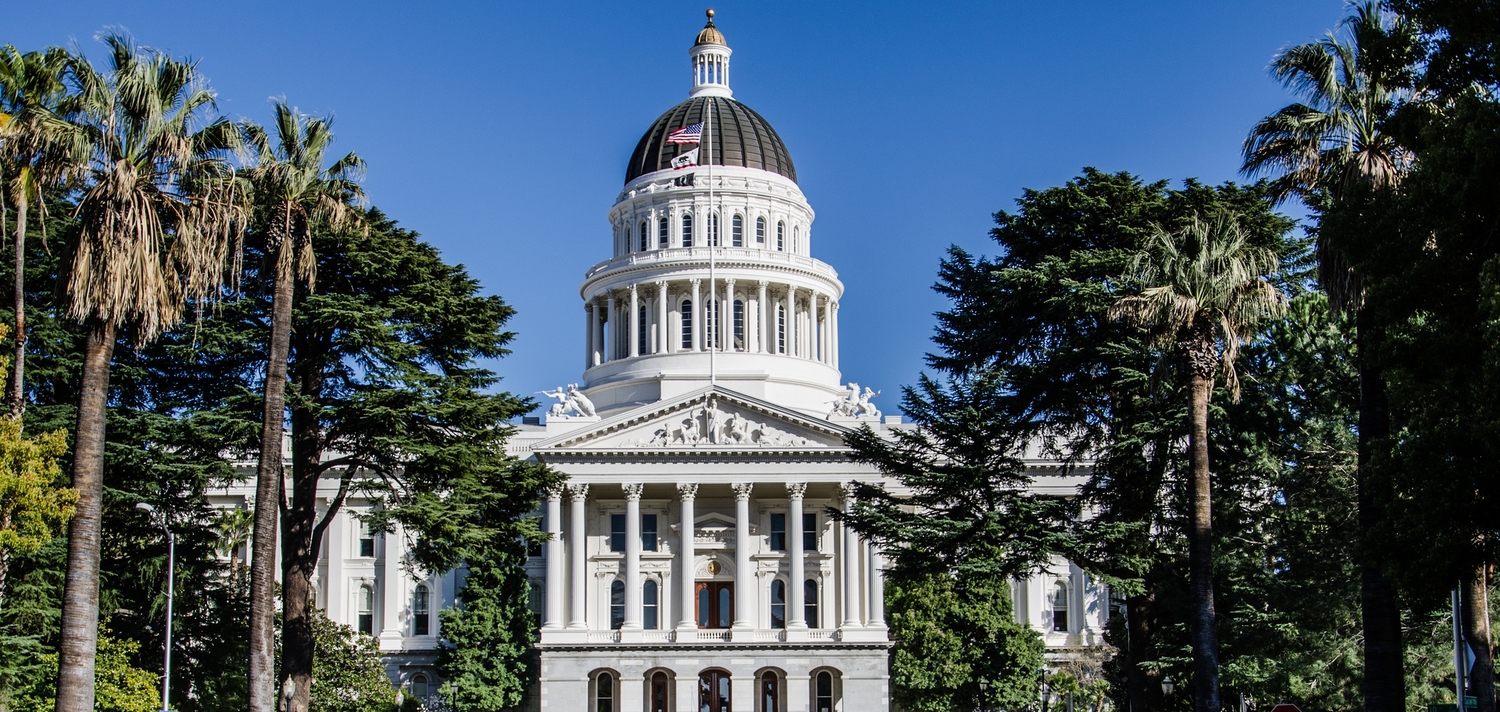
The California State House

Sacramento still tries to retain a small-town feel, and to resist its connections to far-out places like San Francisco, Oakland, Berkeley, Los Angeles, Hollywood and Venice Beach. Or, as Nancy Reagan said when her husband was working there as Governor (1967-74), "Sacramento is not in California."
The Sacramento River divides street addresses into east and west, and the railroad does so into north and south. There is no freeway "beltway." The Sacramento Regional Travel District runs buses and a light-rail system. A single fare is $2.50, while a daily pass is $6.00.
The sales tax in the State of California is 7.5 percent, in the County of Sacramento 8 percent, and in the City of Sacramento 8.5 percent. ZIP Codes in Sacramento start with the digits 942, 956, 957 and 958; and the Area Code is 916. The Sacramento Municipal Utility District (SMUD) runs power and water for the city, which is about 36 percent white, 29 percent Hispanic, 16 percent black and 19 percent Asian.

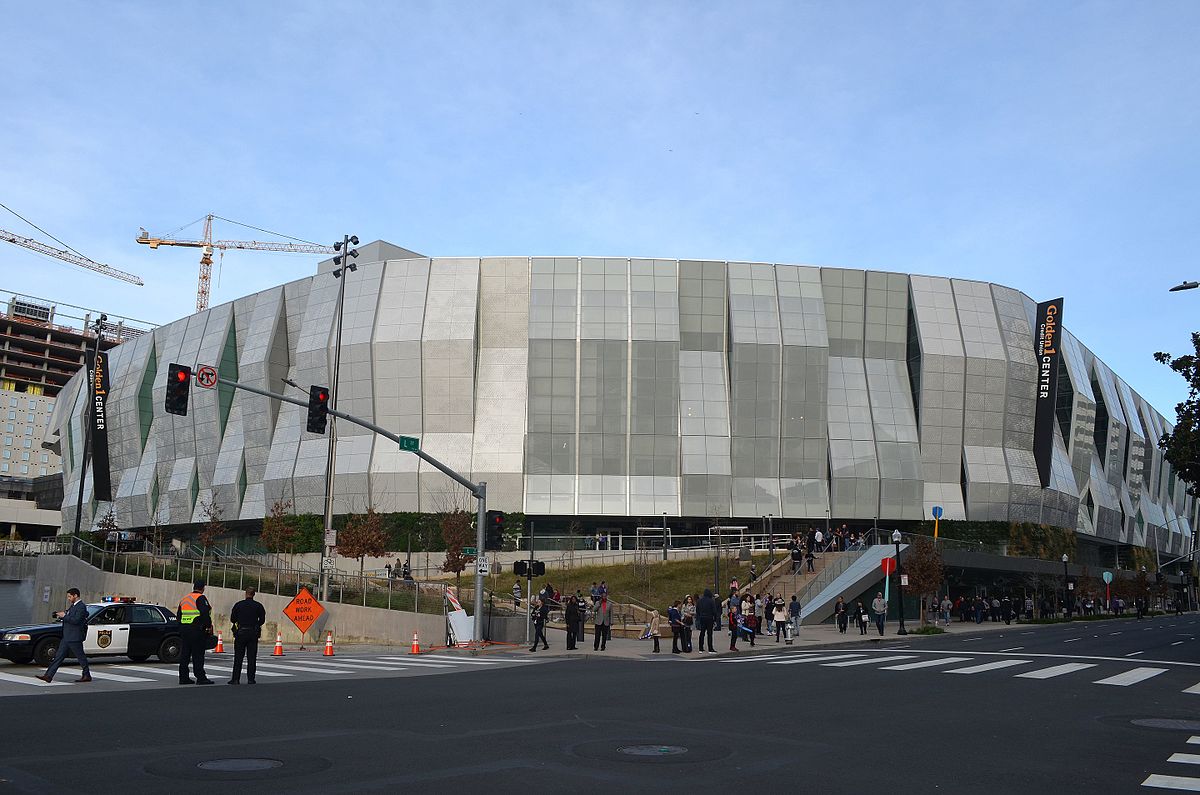
Going In. The 17,500-seat Golden 1 Center opened for the 2016-17 season. The official address is 500 David J. Stern Walk (named for the former NBA Commissioner). It is in the Downtown Commons and Capitol Mall area, bounded by J Street to the north, 6th Street to the east, L Street to the south and 5th Street to the west. Parking is $11.
Not quite as weird-looking as the Nets' Barclays Center,
but pretty weird.

Golden 1 Credit Union bought the naming rights. Like Gainbridge Fieldhouse in Indianapolis, it has big windows, allowing fans to see out, which is a novelty in the NBA. The court is aligned north-to-south (more or less).
Every March, it hosts the California high school basketball State Championships. It also hosts NCAA Tournament games, WWE and UFC events, and concerts.

Food. The new arena quickly got rave reviews for its food. And the theme is buy local: A recent Sacramento Bee article says:

Its stalls are not anonymous hot-dog huts but brand extensions of Paragary's, Selland's, Mulvaney's, Star Ginger and other popular local restaurants that have licensed their names and recipes to concessions giant Legends Hospitality...
We enter the arena at 5:30 p.m., just as Kings fans are starting to trickle in. We hit Selland's Market-Cafe first, because it's so close to the entrance and because Tuohy had told us earlier that pizza from Selland's and Paragary's were top sellers at previous arena events... 
Next we hit Cafe Bernardo Burgers & Shakes, for a $14 bacon habanero burger. Though the patty is slimmer than what we have had at other Bernardos, the meat holds a similar, and welcome, peppery taste. The sandwich comes with more smoky bacon than one expects to get at an arena, and noticeably fresh lettuce and tomato.
Near the condiment station, at the edge of the main concourse, we spot the dapper figure of Randy Paragary, looking out onto the court and seating areas below. Though not precisely the king of all he surveys, Paragary has more of his brands on Golden 1 stands than any other local restaurateur – two Bernardos, two Paragary's pizza places and a Centro street-taco spot.
Paragary says he and corporate executive chef Kurt Spataro have come to every arena event so far, tweaking ingredients and fine-tuning the preparation process. Centro started with the staff adding salsa to tacos, but that process proved too time-consuming. Now there's a salsa bar that also includes cilantro, chopped onion and cotija cheese...
Whereas the same items repeated at most stands at Sleep Train, Golden 1 offers 82 distinct menu items, Tuohy said. They include a well-executed $12 chicken banh mi, its French roll crunchy and its marinated vegetables crisp, at the Star Ginger stand...
We try Porchetta House, a rotisserie spot named after a specialty of Tuohy, former chef at Sacramento's Grange and LowBrau. The porchetta sandwich marries tender, expertly seasoned pork roast from Chico's Rancho Llano Seco with a substantial yet airy bun and is as good as anything we ever have tried at any sports venue.
The $12 "carnitas nachos" and $13 "loaded bacon cheese dog" served at another in-house spot, El Jefe, disappoint. The nachos feature Petaluma Creamery cheese and chunky, very fresh guacamole, but lack snap. The dog, covered in the same rich yet bland-tasting cheese sauce, makes a mess of your face when you bite into it...
It was a fitting cap to a night that never required us to make that other kind of concession so common to eating at sports venues. The one in which you settle for an arena hot dog or pizza slice because you lacked the time to grab a bite elsewhere before a game. Golden 1 Center is a legitimate dinner option.
Read more here: http://www.sacbee.com/food-drink/restaurants/article108066327.html#storylink=cpy
Team History Displays. The Kings have a complicated history. They are the oldest franchise in the NBA (even if you count the Philadelphia/San Francisco/Golden State Warriors as the direct successor to the Philadelphia SPHAs), yet they have gone longer without winning a title than any other team, and their last title was 3 cities ago.

They began in 1923 -- at which point, there were only 16 current MLB franchises, 3 from the NFL, and 2 from the NHL -- as the Rochester Pros. At some point, they became the Rochester Royals, winning the championship of the Midwest-based National Basketball League in 1945.

In 1948, they moved to the fledgling NBA (known for 1 more season as the Basketball Association of America), and in 1951 won the NBA Championship. That's 68 years, and they haven't even been back to the Finals since. It's also, unless you count the 1955 NBA Champion Syracuse Nationals, the last time a team from Western New York won a World Championship.

But, as with Syracuse and Fort Wayne, Rochester was not big enough to support a truly major league team, though their Red Wings baseball team and Americans hockey team are minor-league legends. So, in 1957, they moved, becoming the Cincinnati Royals. The closest they got to a title in Cincy was the 1963 and 1964 Eastern Division Finals.

In 1972, they moved to become the Kansas City-Omaha Kings. They couldn't remain the Royals because Kansas City already had a baseball team with that name, and they didn't want to double-up like the NFL's Chicago Cardinals did upon moving to St. Louis.

After 3 years dividing between K.C. and their status as the only major league team the State of Nebraska has ever known, they played all home games in Kansas City from 1975 to 1985, but didn't like their arena deal, and moved to Sacramento in 1985. Until the Golden 1 Center deal was cut in 2014, their threats to move to Anaheim and Seattle were very real.

The Kings hang a banner for the Rochester Royals' NBA title of 1951, and also for their Division titles from 1979 (Kansas City), 2002 and 2003. The Kings reached the Western Conference Finals in Kansas City in 1981 and in Sacramento in 2002 -- in the latter, combining an epic choke against the Los Angeles Lakers with an equally epic screwing-over by the referees. (Ironically, it was Mitch Richmond, arguably the greatest player in Sacramento Kings history, who dribbled out the clock for the Lakers.) For this reason, the Lakers, not the much-closer Golden State Warriors, remain the Kings' arch-rivals.
Most of the Northern California sports teams don't honor retired numbers from their previous cities. The San Francisco Giants do it for New York, but neither the Oakland Athletics nor the Warriors do it for Philadelphia (Wilt Chamberlain, who moved with them to the West Coast, is an exception), and the once-again-departed Raiders don't retire numbers at all, for Oakland or Los Angeles.

The Kings do. It makes sense that the NBA's oldest franchise would have so many retired numbers; in their case, 11. Number 11, guard Bob Davies, and Number 12, forward Maurice Stokes, played for them as the Rochester Royals. Number 14, guard Oscar Robertson, and Number 27, forward Jack Twyman, are honored for their time with the Cincinnati Royals. (Number 16, forward Jerry Lucas, has not been so honored, despite having been named to the Basketball Hall of Fame.

From the Kansas City Kings period, they honor Number 1, guard Nate "Tiny" Archibald, and Number 44, center Sam Lacey. And despite having had only 1 close call in their 31 years in Sacramento (2002), they have honored 4 players from this period: Number 2, guard Mitch Richmond; Number 4, forward Chris Webber; Number 16, forward Predrag "Peja" Stojaković; and Number 21, center Vlade Divac. The 2 Serbs are now both working in the team's front office.

The Kings have a banner honoring the ARCO/Sleep Train Arena, and have recognized a long sellout streak that began with their arrival in 1985 and extended into well into their current Playoff drought (which began in 2006, but the sellout streak is long over), by retiring Number 6 for their fans, as "The Sixth Man."
In the Basketball Hall of Fame, Rochester is represented by Davies, Stokes, Arnie Risen, Bobby Wanzer, Al Cervi, and team owner Les Harrison; Cincinnati by Robertson, Twyman and Lucas; Kansas City by Archibald; and Sacramento by Richmond, Divac and Webber.

Center Wayne Embry played 8 seasons in Cincinnati, but he's been elected to the Hall as a "Contributor," for his role as a pioneering black executive. There are 6 other members of the Hall with just 1 season with the franchise: In Cincinnati, Clyde Lovellette in 1957-58 and Guy Rodgers in 1967-68; and, in Sacramento, Jo Jo White in 1980-81, Bill Russell as head coach in 1987-88, Ralph Sampson in 1989-90, and Sarunas Marciulionis in 1995-96. Cotton Fitzsimmons coached the Kings in Kansas City (1978-84), and Rick Adelman coached them in Sacramento (1998-2006), but they're in the Hall of Fame for coaching elsewhere (Phoenix and Portland, respectively).

Davies was named to the NBA's 25th Anniversary Team in 1971. Robertson was named to the NBA's 35th Anniversary Team in 1980. Robertson, Lucas and Archibald were named to the NBA's 50th Anniversary 50 Greatest Players and its 75th Anniversary 75 Greatest Players.

The Monarchs won the WNBA title in 2005 and reached the Finals again in 2006. They have banners honoring general manager Jerry Reynolds, who previously worked in the Kings' front office, was their interim head coach in 1987 and official head coach from 1988 to 1990; and Number 6, Ruthie Bolton. Despite the team having been folded, their banners are still in the rafters.

Bolton was not named to the WNBA's 15th Anniversary 15 Greatest Players in 2012, or to the WNBA Top 20 at 20 in 2016 -- in the 20th Season, rather than at the 20th Anniversary -- but Yolanda Griffith and Ticha Penicheiro were named to both all-time teams.
It seems odd to leave up retired number banners 
for a team that no longer exists. 
Who's going to wear the numbers,
 now that there's no team to issue them?

Stuff. The Kings have Official Kings Stores at the north end of the arena, at the Arden Fair Mall in Sacramento, and at the Westfield Galleria in Roseville.

Having had such a disjointed history, there are no official NBA videos about the Kings, but there are some good books about them. Zach Wyner wrote the Kings' edition of the NBA's On the Hardwood series. In 2005, Jerry Reynolds wrote a book about his 20 years of experiences with the Kings called Reynolds Remembers: Tales from the Sacramento Kings. And Jason Coldiron wrote of the now-successful struggle to save what is, for the moment, the only major league sports team in the area: Saving Sacramento: A Story of Fans, Sports & Politics.

During the Game. A November 13, 2014 article on DailyRotoHelp ranked the NBA teams' fan bases, and listed the Kings at 11th. The author said, "I still can't believe how many people come out and support the Kings. They somehow have a loyal fan base come out to games who are fully aware this team isn't even coming close to contending in the next 5 years. They are there day and night without complaint." Well, the big reason is that the Kings are all they've got: No pro football, lost their WNBA team, nearest pro hockey team is in Stockton, Triple-A in baseball, 3rd division in soccer.

While Sacramento, like most large California cities, has developed a problem with gang violence, the Golden 1 Center is downtown, with a large police presence. Kings fans will not treat Knicks or Nets fans with the same kind of contempt that they have for Laker fans. You (and, if you drove in, your car) will be safe.

Naturally, given their royal name, the King's mascot is a "king of the jungle," a lion named Slamson. (A play on "Samson" and "slam dunk.") The Tuesday night game against the Nets is being celebrated as Slamson's "birthday" -- probably the anniversary of the character's introduction.

Not only do the Kings hold auditions for singing the National Anthem instead of having a regular singer, but, with a purchase of 75 tickets and "performance approval," a group may sing it together. Their theme song is "Kings of the Court." But the biggest fan chant is, "SAC-ra-MEN-to! (clap, clap, clap-clap-clap)." At least they're cheering for their city, as much as for their team.
Slamson the Lion

After the Game. Win or lose, Kings fans will not bother you. Your safety will not be an issue. But if you came by public transportation, your best bet for a postgame meal will be to take the bus back downtown. If you drove, there are nearby options, although none that is a place where New York sports fans are known to gather.

The Downtown Commons Mall, or DOCO, was built across from the northwest corner of the Golden 1 Center, which was essentially built on the site of the previous mall. But, after a night game, it might be closed. There are other postgame dining options. To the north: Lotus Thai Cuisine is at 425 J Street, Subway stores are at 428 and 731 J Street and 931 K Street, Cilantro's Mexican Restaurant is at 705 J Street, and a Starbucks is at 630 K Street.

To the south: Il Fornaio Sacramento, an Italian restaurant, is at 400 Capitol Mall; Morton's The Steakhouse, if you feel like spending as much for your dinner as you did on your game ticket, is at 621 Capitol Mall; The Foundation Restaurant & Bar is at 400 L Street, and Frank Fat's, a Chinese restaurant, is at 806 L Street.

There's a lot more places to the west, along the riverfront, but you'll have to go under the elevated Interstate 5 to get there.

Tropic's Ale House Midtown is supposedly a bar for fans of the football Giants. 2001 J Street, downtown. The Limelight Cardroom, also downtown, is supposedly a home for Jet fans. 1014 Alhambra Blvd. at J Street.

If your visit to Sacramento is during the European soccer season, which is currently underway, the California capital's top "football pub" is Henry's Lounge, at 2019 O Street, about a mile east of the Golden 1 Center. Bus 62. (The former hub pub, de Vere's at 1521 L Street, went out of business due to COVID.)

Sidelights. Aside from the Kings -- and a State government that might make California 1 of the 10 strongest nations in the world all by itself -- Sacramento is a minor-league town.

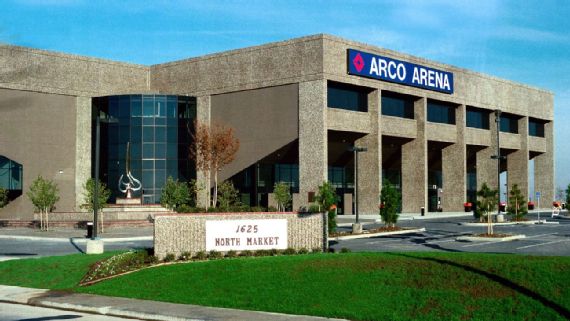
When the Kings arrived in 1985, a temporary arena was built, seating only 10,333, the smallest in the NBA at the time. Like its successor originally was, it was named the ARCO Arena, but was nicknamed the Madhouse on Market.
It was only meant to be a stopgap facility, never a special place. But it still stands, may end up outliving its successor, and, as the 1st major league sports building in the metro area, it is a special place. It now houses the California Department of Consumer Affairs. 1625 N. Market Blvd. at Sports Drive, about 7 miles north of downtown. Bus 88.

The 2nd ARCO Arena, which became the Power Balance Pavilion and is now the Sleep Train Arena, amed for a bedding store chain, was built n 1988. It has an address of One Sports Parkway. It's 5 miles north of downtown. Take the Number 11 bus to Truxel Road & Terracina Drive, and then a 15-minute walk west on Terracina, down "E Entrance."
The arena has hosted NCAA Tournament games, and is one of the leading West Coast sites for Ultimate Fighting. From 1997 until they folded in 2009, it was home to the WNBA's Sacramento Monarchs. (Why not "Queens" to go with "Kings"? Does "Monarchs" sound like they have more power? Or did they not use "Queens" because they were afraid of gay jokes?) There has been talk of reviving the Monarchs for the new arena.

The Sacramento River Cats, now a San Francisco Giants farm team, play at Raley Field, named for a locally-headquartered supermarket chain. It opened in 2000 with 10,624 seats. Counting lawn seating, they can have over 14,000 fans in the place, which is big for the minors, even Triple-A.

They led the minor leagues in attendance in each of their 1st 8 seasons in Raley, got rated as the most valuable minor-league franchise by Forbes magazine in 2012, and have won 4 Pennants since moving in: 2003, 2004, 2007 and 2008.
But if Sacramento ever wants to lure an established MLB team, or get an expansion team, there is room to add outfield seating, but they'd also have to add a 2nd deck to the main grandstand to get the number of seats above 35,000. This seems unlikely. 400 Ballpark Drive at 5th Street, West Sacramento, just over Tower Bridge and the Sacramento River from downtown.

The old PCL team, the Sacramento Solons, was not particularly successful. They played from 1909 to 1976, and won Pennants only in 1938 and 1939. From 1910 to 1960, they played at Edmonds Field. It was located at the southeast corner of Broadway and Riverside Blvd. Demolished in 1964, a Target store currently occupies its footprint, and there is a plaque in the parking lot where home plate once sat. Bus 51.
According to an April 23, 2014 article in The New York Times, the San Francisco Giants (86 miles away) are way ahead of the Oakland Athletics (87 miles away) when it comes to baseball popularity in Sacramento, averaging 55 percent of local fandom to around 12 percent for the A's. Considering that the Coliseum is on the same side of the Bay (but actually further away, now that the Giants have moved from Candlestick Park to downtown), and that the A's had so much more success prior to the Giants' early 2010s run of glory, the A's should have a much higher percentage than they do.

Charles C. Hughes Stadium, named for a school superintendent, opened in 1928, and seats 20,311. It hosts Sacramento City College football and high school football, hosted the Camellia Bowl from 1961 to 1980, and hosted a revival of the Sacramento Solons from 1974 to 1976, despite having a left field fence that was way too short. In 2014, it briefly hosted Sacramento Republic FC, a team in the United Soccer League, the 3rd tier of American soccer.
Hornet Stadium, built in 1969, seats 21,195, and has hosted California State University at Sacramento (a.k.a. "Sacramento State") football since it opened. It also hosted the Sacramento Surge of the short-lived World League of American Football in 1992, and the Sacramento Gold Miners in 1993 and 1994, in the Canadian Football League's desultory excursion into the U.S. market.
Stadium Drive and College Town Drive, although its mailing address is 6000 J Street. Gold Line light rail to University/65th Street Station.

According to a September 5, 2014 article in The Atlantic, the San Francisco 49ers are easily the most popular NFL team in the Sacramento area, even though the Oakland Coliseum is a little closer to Sacramento than Candlestick Park was (87 miles to 91 -- Levi's Stadium is 114 miles away). The closest NHL team is the San Jose Sharks (120 miles).

The aforementioned Sacramento Republic FC, with the USL now considered American soccer's 2nd division, play at Papa Murphy's Park, named for a local pizza chain. Built in 2014 and seating 11,569, it's just fine for lower-division soccer, but "The Quails" will need a larger stadium if they're to get promoted to Major League Soccer.
1600 Exposition Blvd., about 4 miles northeast of downtown, next to Raging Waters theme park. Bus 68. Presuming that this is the closest Sacramento will ever get to MLS, as now seems likely, the closest current MLS team is the San Jose Earthquakes (117 miles).

Major college football and basketball isn't all that close, either: If you live in or around Sacramento, and you don't want to go to games at Sac State, you're out of luck: Cal-Davis is 15 miles west, but it's FCS (formerly known as Division I-AA); and the University of the Pacific is 47 miles to the south, so you might as well go the distance to the Bay Area, all the way to Cal (79 miles) or Stanford (126 miles).

With its relatively low metropolitan population, Sacramento would rank 29th among MLB markets (ahead of only Kansas City and Milwaukee), 26th in the NFL, and 23rd in the NHL.

Sacramento is the closest major league city to the recently-renamed Palisades Tahoe, California, formerly Squaw Valley, site of the 1960 Winter Olympics. It was here that the U.S. hockey team first beat the Soviet Union -- and, as would happen 20 years later in Lake Placid, New York, they still had to win one more game to win the Gold Medal, which they did, in this case against Czechoslovakia. This team included some of the fathers of the 1980 players, and the last player cut from the 1960 team -- although he did make the 1964 team -- was Herb Brooks, who coached the 1980 team.

The hockey games were held at Blyth Arena, built for the Games, and torn down in 1983. A hotel, The Village at Squaw Valley, is now on the site. 1840 Squaw Valley Road, just off Lake Tahoe, part of the State Line between California and Nevada. It's 110 miles east of downtown Sacramento, 43 miles southwest of Reno, and just 24 miles west of the now-closed theme park based on Bonanza's Ponderosa Ranch in Incline Village. (Palisades Tahoe is 68 miles west of the real-life Virginia City.)
Note the pine trees: In Spanish, ponderosas,
giving their name to the Bonanza ranch.

The best-known museum in Sacramento is the California State Capitol Museum, under the dome at 1315 10th Street. The Crocker Art Museum is at 2nd & O Streets. The only Presidentially-related site in the area is the Governor's Mansion, where Ronald Reagan lived during his 1967-1974 Governorship. It's a State Historic Park, at 1526 H Street downtown. The tallest building in town is the Wells Fargo Center (same name as the Philadelphia arena currently has), 429 feet high, at Capitol Mall & 4th Street.

Elvis Presley never performed in Sacramento. Neither did the Beatles. Johnny Cash did, although his best-known concert in the Sacramento area was 25 miles to the northeast, at Folsom State Prison, namesake of his song "Folsom Prison Blues," on January 13, 1968. I wouldn't recommend going there (as a visitor or otherwise), but if you're that big of a fan of The Man In Black, it's at 300 Prison Road -- which sounds like it could be the title of a Johnny Cash song.

It is reachable by public transit, sort of: Take the Gold Line light rail from Sacramento Valley station to Glenn station, nearly an hour; then transfer to Bus 30, to Natoma Street & Wales Drive, and then it's a 20-minute walk up Natoma Street and Prison Road. (That other California prison he's famous for having recorded a live album at, San Quentin, on February 24, 1969, is in Marin County, about 20 miles north of downtown San Francisco.)

The best-known TV shows set in Sacramento have been the late 1970s, early 1980s ABC comedy-drama Eight Is Enough, the recent CBS crime drama The Mentalist, and the Disney Channel series Even StevensSons of Anarchy was set in the fictional town of Charming, said to be near Sacramento. The late 1960s Western The Big Valley was set at a ranch in Calaveras County, outside Stockton, about 45 miles southeast of Sacramento.

There haven't been many movies set or filmed there. Those that were include Clint Eastwood's 1989 Pink Cadillac, The Al Pacino & Michelle Pfeiffer movie Frankie & Johnny, John Travolta's Phenomenon, Kurt Russell's Breakdown, and Almost Famous, the film that made Cameron Crowe and Kate Hudson more than that.

*

Sacramento is a bigger city than it seems to be, but not as big a city as it would like to be. If you're an NBA fan, and have to cross all 30 teams off your list, this should be a good guide for you. 

Wednesday, March 13, 2019

How to Be a New York Basketball Fan In Sacramento -- 2019 Edition

The Brooklyn Nets will play away to the Sacramento Kings this coming Tuesday night. As with the Los Angeles Clippers, I misread my schedule, and blew it with the New York Knicks' visit, which was March 4. This closes out my Winter sports trip guides until this coming October: All 30 NBA teams are done, and so are all 31 NHL teams.

Before You Go. Sacramento is 90 miles inland from San Francisco, so the city's notorious weird weather won't be a factor. The Sacramento Bee website is predicting low 70s for Tuesday afternoon, and low 50s for the evening. No rain is predicted for Tuesday, but it is for Wednesday, which could make going home a little complicated.

Sacramento is in the Pacific Time Zone, which is 3 hours behind us. Adjust your timepieces accordingly.

Tickets. Once a guaranteed sellout of 17,317 fans per game, every game, the Kings fell off significantly. This season, their per-game attendance is now 16,706, about 95 percent of capacity. You should be able to get a ticket.

In the lower level, the 100 sections, seats are $190 between the baskets and $95 behind them. In the upper level, the 200 sections, they're $53 and $45.

Getting There. It's 2,824 miles from Times Square to downtown Sacramento. Unless you want to spend 41 hours, plus rest stops making it more like 48 hours, each way, on Interstate 80 (getting off at Interstate 5 and taking that south to downtown), or take an even longer-time trip on Amtrak, you're flying. You should be able to get a flight for a little over $700, but it won't be nonstop: You'll have to change planes each way, in Chicago, or maybe even in San Francisco.

If you board Greyhound at Port Authority by 5:00 PM on Monday, you'll get to Sacramento at 5:45 PM local time on Thursday, which will be in time to get to the game. It's $628 round-trip, but, depending on when you leave, it can be reduced to $450 on advanced purchase. The Greyhound station is at 420 Richards Blvd. at 7th Street. Walking 2 blocks east on Richards will take you to the Township 9 station on the Light Rail Green Line, and from there it's 1 stop to downtown, including the new arena.

To get there in time via Amtrak, you'd have to take the Lake Shore Limited out of Penn Station at 3:40 PM on Saturday, get to Union Station in Chicago at 9:50 AM on Sunday, switch to the California Zephyr at 2:00 PM, and arrive in Sacramento at 2:13 PM on Tuesday. Then you'd have to leave Sacramento at 11:09 in the morning on Wednesday, and arrive back in New York at 6:23 PM on Saturday. Round-trip fare is $596. The Amtrak station is at 4th & I Streets.

Once In the City. Founded in 1850, and the capital of the State of California since 1854 (Monterey had been the capital when California was ruled by Spain and Mexico), Sacramento is home to a little over 500,000 people, and growing.
The metropolitan area is home to 2.6 million people, ranking it 23rd out of the NBA's 30 markets, and larger than older NBA markets like Indianapolis, San Antonio, Milwaukee and Salt Lake City.
The California State House

Sacramento still tries to retain a small-town feel, and to resist its connections to far-out places like San Francisco, Oakland, Berkeley, Los Angeles, Hollywood and Venice Beach. Or, as Nancy Reagan said when her husband was working there as Governor (1967-74), "Sacramento is not in California."
The Sacramento River divides street addresses into east and west, and the railroad does so into north and south. There is no freeway "beltway." The Sacramento Regional Travel District runs buses and a light-rail system. A single fare is $2.50, while a daily pass is $6.00.
The sales tax in the State of California is 7.5 percent, in the County of Sacramento 8 percent, and in the City of Sacramento 8.5 percent. ZIP Codes in Sacramento start with the digits 942, 956, 957 and 958; and the Area Code is 916. The Sacramento Municipal Utility District (SMUD) runs power and water for the city, which is about 36 percent white, 29 percent Hispanic, 16 percent black and 19 percent Asian.

Going In. The 17,500-seat Golden 1 Center opened for the 2016-17 season. The official address is 500 David J. Stern Walk (named for the former NBA Commissioner). It is in the Downtown Commons and Capitol Mall area, bounded by J Street to the north, 6th Street to the east, L Street to the south and 5th Street to the west. Parking is $11.
Not quite as weird-looking as the Nets' Barclays Center,
but pretty weird.

Golden 1 Credit Union bought the naming rights. Like Bankers Life Fieldhouse in Indianapolis, it has big windows, allowing fans to see out, which is a novelty in the NBA. The court is aligned north-to-south (more or less).
It's already hosted a WWE event and a UFC event, and concerts by Paul McCartney, Maroon 5, Pentatonix, Jimmy Buffett and Kanye West. This March, it will host the California high school basketball State Championships, NCAA Tournament games, and concerts by Blake Shelton and Ariana Grande.

Food. The new arena quickly got rave reviews for its food. And the theme is buy local: A recent Sacramento Bee article says:

Its stalls are not anonymous hot-dog huts but brand extensions of Paragary's, Selland's, Mulvaney's, Star Ginger and other popular local restaurants that have licensed their names and recipes to concessions giant Legends Hospitality...
We enter the arena at 5:30 p.m., just as Kings fans are starting to trickle in. We hit Selland's Market-Cafe first, because it's so close to the entrance and because Tuohy had told us earlier that pizza from Selland's and Paragary's were top sellers at previous arena events... 
Next we hit Cafe Bernardo Burgers & Shakes, for a $14 bacon habanero burger. Though the patty is slimmer than what we have had at other Bernardos, the meat holds a similar, and welcome, peppery taste. The sandwich comes with more smoky bacon than one expects to get at an arena, and noticeably fresh lettuce and tomato.
Near the condiment station, at the edge of the main concourse, we spot the dapper figure of Randy Paragary, looking out onto the court and seating areas below. Though not precisely the king of all he surveys, Paragary has more of his brands on Golden 1 stands than any other local restaurateur – two Bernardos, two Paragary's pizza places and a Centro street-taco spot.
Paragary says he and corporate executive chef Kurt Spataro have come to every arena event so far, tweaking ingredients and fine-tuning the preparation process. Centro started with the staff adding salsa to tacos, but that process proved too time-consuming. Now there's a salsa bar that also includes cilantro, chopped onion and cotija cheese...
Whereas the same items repeated at most stands at Sleep Train, Golden 1 offers 82 distinct menu items, Tuohy said. They include a well-executed $12 chicken banh mi, its French roll crunchy and its marinated vegetables crisp, at the Star Ginger stand...
We try Porchetta House, a rotisserie spot named after a specialty of Tuohy, former chef at Sacramento's Grange and LowBrau. The porchetta sandwich marries tender, expertly seasoned pork roast from Chico's Rancho Llano Seco with a substantial yet airy bun and is as good as anything we ever have tried at any sports venue.
The $12 "carnitas nachos" and $13 "loaded bacon cheese dog" served at another in-house spot, El Jefe, disappoint. The nachos feature Petaluma Creamery cheese and chunky, very fresh guacamole, but lack snap. The dog, covered in the same rich yet bland-tasting cheese sauce, makes a mess of your face when you bite into it...
It was a fitting cap to a night that never required us to make that other kind of concession so common to eating at sports venues. The one in which you settle for an arena hot dog or pizza slice because you lacked the time to grab a bite elsewhere before a game. Golden 1 Center is a legitimate dinner option.
Read more here: http://www.sacbee.com/food-drink/restaurants/article108066327.html#storylink=cpy
Team History Displays. The Kings have a complicated history. They are the oldest franchise in the NBA (even if you count the Philadelphia/San Francisco/Golden State Warriors as the direct successor to the Philadelphia SPHAs), yet they have gone longer without winning a title than any other team, and their last title was 3 cities ago.

They began in 1923 -- at which point, there were only 16 current MLB franchises, 3 from the NFL, and 2 from the NHL -- as the Rochester Pros. At some point, they became the Rochester Royals, winning the championship of the Midwest-based National Basketball League in 1945.

In 1948, they moved to the fledgling NBA (known for 1 more season as the Basketball Association of America), and in 1951 won the NBA Championship. That's 68 years, and they haven't even been back to the Finals since. It's also, unless you count the 1955 NBA Champion Syracuse Nationals, the last time a team from Western New York won a World Championship.

But, as with Syracuse and Fort Wayne, Rochester was not big enough to support a truly major league team, though their Red Wings baseball team and Americans hockey team are minor-league legends. So, in 1957, they moved, becoming the Cincinnati Royals. The closest they got to a title in Cincy was the 1963 and 1964 Eastern Division Finals.

In 1972, they moved to become the Kansas City-Omaha Kings. They couldn't remain the Royals because Kansas City already had a baseball team with that name, and they didn't want to double-up like the NFL's Chicago Cardinals did upon moving to St. Louis.

After 3 years dividing between K.C. and their status as the only major league team the State of Nebraska has ever known, they played all home games in Kansas City from 1975 to 1985, but didn't like their arena deal, and moved to Sacramento in 1985. Until the Golden 1 Center deal was cut in 2014, their threats to move to Anaheim and Seattle were very real.

The Kings hang a banner for the Rochester Royals' NBA title of 1951, and also for their Division titles from 1979 (Kansas City), 2002 and 2003. The Kings reached the Western Conference Finals in Kansas City in 1981 and in Sacramento in 2002 -- in the latter, combining an epic choke against the Los Angeles Lakers with an equally epic screwing-over by the referees. (Ironically, it was Mitch Richmond, arguably the greatest player in Sacramento Kings history, who dribbled out the clock for the Lakers.) For this reason, the Lakers, not the much-closer Golden State Warriors, remain the Kings' arch-rivals.
Most of the Northern California sports teams don't honor retired numbers from their previous cities. The San Francisco Giants do it for New York, but neither the Oakland Athletics nor the Warriors do it for Philadelphia (Wilt Chamberlain, who moved with them to the West Coast, is an exception), and the Raiders don't retire numbers at all, for Oakland or Los Angeles.

The Kings do. It makes sense that the NBA's oldest franchise would have so many retired numbers; in their case, 11. Number 11, guard Bob Davies, and Number 12, forward Maurice Stokes, played for them as the Rochester Royals. Number 14, guard Oscar Robertson, and Number 27, forward Jack Twyman, are honored for their time with the Cincinnati Royals. (Number 16, forward Jerry Lucas, has not been so honored, despite having been named to the Basketball Hall of Fame.

From the Kansas City Kings period, they honor Number 1, guard Nate "Tiny" Archibald, and Number 44, center Sam Lacey. And despite having had only 1 close call in their 31 years in Sacramento (2002), they have honored 4 players from this period: Number 2, guard Mitch Richmond; Number 4, forward Chris Webber; Number 16, forward Predrag "Peja" Stojaković; and Number 21, center Vlade Divac. The 2 Serbs are now both working in the team's front office.

The Kings have a banner honoring the ARCO/Sleep Train Arena, and have recognized a long sellout streak that began with their arrival in 1985 and extended into well into their current Playoff drought (which began in 2006, but the sellout streak is long over), by retiring Number 6 for their fans, as "The Sixth Man."

The banners show the style of uniforms the players were wearing at the time, and the numbers go in reverse chronological order, from left to right: Stojakovic, Divac, Sixth Man, Richmond, Lacey, Archibald, Roertson, Twyman, Stokes, Davies.
In the Basketball Hall of Fame, Rochester is represented by Davies, Stokes, Arnie Risen, Bobby Wanzer, Al Cervi, and team owner Les Harrison; Cincinnati by Robertson, Twyma and Lucas; Kansas City by Archibald; and Sacramento by Richmond.

Center Wayne Embry played 8 seasons in Cincinnati, but he's been elected to the Hall as a "Contributor," for his role as a pioneering black executive. There are 6 other members of the Hall with just 1 season with the franchise: In Cincinnati, Clyde Lovellette in 1957-58 and Guy Rodgers in 1967-68; and, in Sacramento, Jo Jo White in 1980-81, Bill Russell as head coach in 1987-88, Ralph Sampson in 1989-90, and Sarunas Marciulionis in 1995-96.

Davies was named to the NBA's 25th Anniversary Team in 1971. Robertson was named to the NBA's 35th Anniversary Team in 1980. Robertson, Lucas and Archibald were named to the NBA's 50th Anniversary 50 Greatest Players.

The Monarchs won the WNBA title in 2005 and reached the Finals again in 2006. They have banners honoring general manager Jerry Reynolds, who previously worked in the Kings' front office, was their interim head coach in 1987 and official head coach from 1988 to 1990; and Number 6, Ruthie Bolton. Despite the team having been folded, their banners are still in the rafters.

Bolton was not named to the WNBA's 15th Anniversary 15 Greatest Players in 2012, or to the WNBA Top 20 at 20 in 2016 -- in the 20th Season, rather than at the 20th Anniversary -- but Yolanda Griffith and Ticha Penicheiro were named to both all-time teams.
It seems odd to leave up retired number banners 
for a team that no longer exists. 
Who's going to wear the numbers,
 now that there's no team to issue them?


Stuff. The Kings have Official Kings Stores at the north end of the arena, at the Arden Fair Mall in Sacramento, and at the Westfield Galleria in Roseville.

Having had such a disjointed history, there are no official NBA videos about the Kings, but there are some good books about them. Zach Wyner wrote the Kings' edition of the NBA's On the Hardwood series. In 2005, Jerry Reynolds wrote a book about his 20 years of experiences with the Kings called Reynolds Remembers: Tales from the Sacramento Kings. And Jason Coldiron wrote of the now-successful struggle to save what is, for the moment, the only major league sports team in the area: Saving Sacramento: A Story of Fans, Sports & Politics.

During the Game. A November 13, 2014 article on DailyRotoHelp ranked the NBA teams' fan bases, and listed the Kings at 11th. The author said, "I still can't believe how many people come out and support the Kings. They somehow have a loyal fan base come out to games who are fully aware this team isn't even coming close to contending in the next 5 years. They are there day and night without complaint." Well, the big reason is that the Kings are all they've got: No pro football, lost their WNBA team, nearest pro hockey team is in Stockton, Triple-A in baseball, 3rd division in soccer.

While Sacramento, like most large California cities, has developed a problem with gang violence, the Golden 1 Center is downtown, with a large police presence. Kings fans will not treat Knicks or Nets fans with the same kind of contempt that they have for Laker fans. You (and, if you drove in, your car) will be safe.

Naturally, given their royal name, the King's mascot is a "king of the jungle," a lion named Slamson. (A play on "Samson" and "slam dunk.") The Tuesday night game against the Nets is being celebrated as Slamson's "birthday" -- probably the anniversary of the character's introduction.

Not only do the Kings hold auditions for singing the National Anthem instead of having a regular singer, but, with a purchase of 75 tickets and "performance approval," a group may sing it together. Their theme song is "Kings of the Court." But the biggest fan chant is, "SAC-ra-MEN-to! (clap, clap, clap-clap-clap)." At least they're cheering for their city, as much as for their team.
Slamson the Lion

After the Game. Win or lose, Kings fans will not bother you. Your safety will not be an issue. But if you came by public transportation, your best bet for a postgame meal will be to take the bus back downtown. If you drove, there are nearby options, although none that is a place where New York sports fans are known to gather.

With the Downtown Commons Mall being rebuilt alongside the Golden 1 Center (which was essentially built on the site of the previous mall), postgame dining options are currently limited. To the north: Perko's Farm Fresh Cafe is at 925 3rd Street, Lotus Thai Cuisine is at 425 J Street, Subway stores are at 428 and 731 J Street, Cilantro's Mexican Restaurant is at 705 J Street, La Bonne Soupe Cafe is at 920 8th Street, and a Starbucks is at 980 9th Street.

To the south: Il Fornaio Sacramento, an Italian restaurant, is at 400 Capitol Mall; Morton's The Steakhouse, if you feel like spending as much for your dinner as you did on your game ticket, is at 621 Capitol Mall; The Foundation Restaurant & Bar is at 400 L Street, and Frank Fat's, a Chinese restaurant, is at 806 L Street.

There's a lot more places to the west, along the riverfront, but you'll have to go under the elevated Interstate 5 to get there.

Pete's Restaurant & Brewhouse is supposedly a bar for fans of the football Giants. 2001 J Street, downtown. The Limelight Cardroom, also downtown, is supposedly a home for Jet fans. 1014 Alhambra Blvd. at J Street.

If your visit to Sacramento is during the European soccer season, which is currently underway, the California capital's top "football pub" is de Vere's Irish Pub, at 1521 L Street, 5 blocks east of the State House.

Sidelights. Aside from the Kings -- and a State government that might make California 1 of the 10 strongest nations in the world all by itself -- Sacramento is a minor-league town.

When the Kings arrived in 1985, a temporary arena was built, seating only 10,333, the smallest in the NBA at the time. Like its successor originally was, it was named the ARCO Arena, but was nicknamed the Madhouse on Market.
It was only meant to be a stopgap facility, never a special place. But it still stands, may end up outliving its successor, and, as the 1st major league sports building in the metro area, it is a special place. It now houses the California Department of Consumer Affairs. 1625 N. Market Blvd. at Sports Drive, about 7 miles north of downtown. Bus 88.

The 2nd ARCO Arena, which became the Power Balance Pavilion and is now the Sleep Train Arena, amed for a bedding store chain, was built n 1988. It has an address of One Sports Parkway. It's 5 miles north of downtown. Take the Number 11 bus to Truxel Road & Terracina Drive, and then a 15-minute walk west on Terracina, down "E Entrance."
No, that's not any kind of racetrack to the left.

The arena has hosted NCAA Tournament games, and is one of the leading West Coast sites for Ultimate Fighting. From 1997 until they folded in 2009, it was home to the WNBA's Sacramento Monarchs. (Why not "Queens" to go with "Kings"? Does "Monarchs" sound like they have more power? Or did they not use "Queens" because they were afraid of gay jokes?) There has been talk of reviving the Monarchs for the new arena.

The Sacramento River Cats, now a San Francisco Giants farm team, play at Raley Field, named for a locally-headquartered supermarket chain. It opened in 2000 with 10,624 seats. Counting lawn seating, they can have over 14,000 fans in the place, which is big for the minors, even Triple-A.
They led the minor leagues in attendance in each of their 1st 8 seasons in Raley, got rated as the most valuable minor-league franchise by Forbes magazine in 2012, and have won 4 Pennants since moving in: 2003, 2004, 2007 and 2008.
But if Sacramento ever wants to lure an established MLB team, or get an expansion team, there is room to add outfield seating, but they'd also have to add a 2nd deck to the main grandstand to get the number of seats above 35,000. This seems unlikely. 400 Ballpark Drive at 5th Street, West Sacramento, just over Tower Bridge and the Sacramento River from downtown.
The old PCL team, the Sacramento Solons, was not particularly successful. They played from 1909 to 1976, and won Pennants only in 1938 and 1939. From 1910 to 1960, they played at Edmonds Field. It was located at the southeast corner of Broadway and Riverside Blvd. Demolished in 1964, a Target store currently occupies its footprint, and there is a plaque in the parking lot where home plate once sat. Bus 51.
According to an April 23, 2014 article in The New York Times, the San Francisco Giants (86 miles away) are way ahead of the Oakland Athletics (87 miles away) when it comes to baseball popularity in Sacramento, averaging 55 percent of local fandom to around 12 percent for the A's. Considering that the Coliseum is on the same side of the Bay (but actually further away, now that the Giants have moved from Candlestick Park to downtown), and that the A's had so much more success prior to the Giants' early 2010s run of glory, the A's should have a much higher percentage than they do.

Charles C. Hughes Stadium, named for a school superintendent, opened in 1928, and seats 20,311. It hosts Sacramento City College football and high school football, hosted the Camellia Bowl from 1961 to 1980, and hosted a revival of the Sacramento Solons from 1974 to 1976, despite having a left field fence that was way too short. In 2014, it briefly hosted Sacramento Republic FC, a team in the United Soccer League, the 3rd tier of American soccer.
Hornet Stadium, built in 1969, seats 21,195, and has hosted California State University at Sacramento (a.k.a. "Sacramento State") football since it opened. It also hosted the Sacramento Surge of the short-lived World League of American Football in 1992, and the Sacramento Gold Miners in 1993 and 1994, in the Canadian Football League's desultory excursion into the U.S. market.
Stadium Drive and College Town Drive, although its mailing address is 6000 J Street. Gold Line light rail to University/65th Street Station.

According to a September 5, 2014 article in The Atlantic, the San Francisco 49ers are easily the most popular NFL team in the Sacramento area, even though the Oakland Coliseum is a little closer to Sacramento than Candlestick Park was (87 miles to 91 -- Levi's Stadium is 114 miles away). The closest NHL team is the San Jose Sharks (120 miles).

The aforementioned Sacramento Republic FC, with the USL now considered American soccer's 2nd division, play at Papa Murphy's Park, named for a local pizza chain. Built in 2014 and seating 11,569, it's just fine for lower-division soccer, but "The Quails" will need a larger stadium if they're to get promoted to Major League Soccer.
1600 Exposition Blvd., about 4 miles northeast of downtown, next to Raging Waters theme park. Bus 68. Presuming that this is the closest Sacramento will ever get to MLS, as now seems likely, the closest current MLS team is the San Jose Earthquakes (117 miles).

Major college football and basketball isn't all that close, either: If you live in or around Sacramento, and you don't want to go to games at Sac State, you're out of luck: Cal-Davis is 15 miles west, but it's FCS (formerly known as Division I-AA); and the University of the Pacific is 47 miles to the south, so you might as well go the distance to the Bay Area, all the way to Cal (79 miles) or Stanford (126 miles).

With its relatively low metropolitan population, Sacramento would rank 28th among MLB markets (ahead of only Kansas City, Cincinnati and Milwaukee), 25th in the NFL, and 22nd in the NHL.

Sacramento is the closest major league city to Squaw Valley, California, site of the 1960 Winter Olympics. It was here that the U.S. hockey team first beat the Soviet Union -- and, as would happen 20 years later in Lake Placid, New York, they still had to win one more game to win the Gold Medal, which they did, in this case against Czechoslovakia. This team included some of the fathers of the 1980 players, and the last player cut from the 1960 team -- although he did make the 1964 team -- was Herb Brooks, who coached the 1980 team.

The hockey games were held at Blyth Arena, built for the Games, and torn down in 1983. A hotel, The Village at Squaw Valley, is now on the site. 1840 Squaw Valley Road, just off Lake Tahoe, part of the State Line between California and Nevada. It's 110 miles east of downtown Sacramento, 43 miles southwest of Reno, and just 24 miles west of the now-closed theme park based on Bonanza's Ponderosa Ranch in Incline Village. (Squaw Valley is 68 miles west of the real-life Virginia City.)
Note the pine trees: In Spanish, ponderosas,
giving their name to the Bonanza ranch.

The best-known museum in Sacramento is the California State Capitol Museum, under the dome at 1315 10th Street. The Crocker Art Museum is at 2nd & O Streets. The only Presidentially-related site in the area is the Governor's Mansion, where Ronald Reagan lived during his 1967-1974 Governorship. It's a State Historic Park, at 1526 H Street downtown. The tallest building in town is the Wells Fargo Center (same name as the Philadelphia arena currently has), 429 feet high, at Capitol Mall & 4th Street.

Elvis Presley never performed in Sacramento. Neither did the Beatles. Johnny Cash did, although his best-known concert in the Sacramento area was 25 miles to the northeast, at Folsom State Prison, namesake of his song "Folsom Prison Blues," on January 13, 1968. I wouldn't recommend going there (as a visitor or otherwise), but if you're that big of a fan of The Man In Black, it's at 300 Prison Road -- which sounds like it could be the title of a Johnny Cash song.

It is reachable by public transit, sort of: Take the Gold Line light rail from Sacramento Valley station to Glenn station, nearly an hour; then transfer to Bus 30, to Natoma Street & Wales Drive, and then it's a 20-minute walk up Natoma Street and Prison Road. (That other California prison he's famous for having recorded a live album at, San Quentin, on February 24, 1969, is in Marin County, about 20 miles north of downtown San Francisco.)

The best-known TV shows set in Sacramento have been the late 1970s, early 1980s ABC comedy-drama Eight Is Enough, the recent CBS crime drama The Mentalist, and the Disney Channel series Even StevensSons of Anarchy was set in the fictional town of Charming, said to be near Sacramento. The late 1960s Western The Big Valley was set at a ranch in Calaveras County, outside Stockton, about 45 miles southeast of Sacramento.

There haven't been many movies set or filmed there. Those that were include Clint Eastwood's 1989 Pink Cadillac, The Al Pacino & Michelle Pfeiffer movie Frankie & Johnny, John Travolta's Phenomenon, Kurt Russell's Breakdown, and Almost Famous, the film that made Cameron Crowe and Kate Hudson more than that.

*

Sacramento is a bigger city than it seems to be, but not as big a city as it would like to be. If you're an NBA fan, and have to cross all 30 teams off your list, this should be a good guide for you.

Friday, February 23, 2018

How to Be a New York Basketball Fan In Sacramento -- 2018 Edition

The Brooklyn Nets will play away to the Sacramento Kings this coming Thursday night. The New York Knicks will do the same the following Sunday night.

Before You Go. Sacramento is 90 miles inland from San Francisco, so the city's notorious weird weather won't be a factor. The Sacramento Bee website is predicting low 50s for Thursday afternoon, and low 30s for the evening, with rain; and low 60s for Sunday afternoon, and low 40s for the evening. You won't need a jacket before the game, but you'll definitely need one for after.

Sacramento is in the Pacific Time Zone, which is 3 hours behind us. Adjust your timepieces accordingly.

Tickets. Once a guaranteed sellout of 17,317 fans per game, every game, the Kings fell off significantly. However, with their improvement and their new arena, their per-game attendance is now 17,541, a sellout. Tickets may be hard to come by.

But Kings tickets are among the cheapest in the NBA. In the lower level, the 100 sections, they're $102 between the baskets and $65 behind them. In the upper level, the 200 sections, they're $29 and $15.

Getting There. It's 2,824 miles from Times Square to downtown Sacramento. Unless you want to spend 41 hours, plus rest stops making it more like 48 hours, each way, on Interstate 80 (getting off at Interstate 5 and taking that south to downtown), or take an even longer-time trip on Amtrak, you're flying. You should be able to get a flight for under $800, but it won't be nonstop: You'll have to change planes each way, in Denver, Dallas or Phoenix.

If you board Greyhound at Port Authority by 5:00 PM on Monday, you'll get to Sacramento at 5:45 PM local time on Thursday, which will be in time to get to the game. It's $646 round-trip, but, depending on when you leave, it can be reduced to $488 on advanced purchase. The Greyhound station is at 420 Richards Blvd. at 7th Street. Walking 2 blocks east on Richards will take you to the Township 9 station on the Light Rail Green Line, and from there it's 1 stop to downtown, including the new arena.

To get there in time via Amtrak, you'd have to take the Lake Shore Limited out of Penn Station at 3:40 PM on Sunday, get to Union Station in Chicago at 9:45 AM on Monday, switch to the California Zephyr at 2:00 PM, and arrive in Sacramento at 2:13 PM on Thursday. Then you'd have to leave Sacramento at 11:09 in the morning on Friday, and arrive back in New York at 6:23 PM on Monday. For some reason, it's really expensive this time: Round-trip fare is $1,009. The Amtrak station is at 4th & I Streets.

Once In the City. Founded in 1850, and the capital of the State of California since 1854 (Monterey had been the capital when California was ruled by Spain and Mexico), Sacramento is home to a little over 500,000 people, and growing.
The metropolitan area is home to 2.6 million people, ranking it 23rd out of the NBA's 30 markets, and larger than older NBA markets like Indianapolis, San Antonio, Milwaukee and Salt Lake City.
The California State House

Sacramento still tries to retain a small-town feel, and to resist its connections to far-out places like San Francisco, Oakland, Berkeley, Los Angeles, Hollywood and Venice Beach. Or, as Nancy Reagan said when her husband was working there as Governor (1967-74), "Sacramento is not in California."
The Sacramento River divides street addresses into east and west, and the railroad does so into north and south. There is no freeway "beltway." The Sacramento Regional Travel District runs buses and a light-rail system. A single fare is $2.50, while a daily pass is $6.00.
The sales tax in the State of California is 7.5 percent, in the County of Sacramento 8 percent, and in the City of Sacramento 8.5 percent. ZIP Codes in Sacramento start with the digits 942, 956, 957 and 958; and the Area Code is 916. The Sacramento Municipal Utility District (SMUD) runs power and water for the city, which is about 36 percent white, 29 percent Hispanic, 16 percent black and 19 percent Asian.

Going In. The 17,500-seat Golden 1 Center opened for the 2016-17 season. The official address is 500 David J. Stern Walk (named for the former NBA Commissioner). It is in the Downtown Commons and Capitol Mall area, bounded by J Street to the north, 6th Street to the east, L Street to the south and 5th Street to the west. Parking is $11.
Not quite as weird-looking as the Nets' Barclays Center,
but pretty weird.

Golden 1 Credit Union bought the naming rights. Like Bankers Life Fieldhouse in Indianapolis, it has big windows, allowing fans to see out, which is a novelty in the NBA. The court is aligned north-to-south (more or less).
It's already hosted a WWE event and a UFC event, and concerts by Paul McCartney, Maroon 5, Pentatonix, Jimmy Buffett and Kanye West. This March, it will host the California high school basketball State Championships, NCAA Tournament games, and concerts by Blake Shelton and Ariana Grande.

Food. The new arena quickly got rave reviews for its food. And the theme is buy local: A recent Sacramento Bee article says:

Its stalls are not anonymous hot-dog huts but brand extensions of Paragary's, Selland's, Mulvaney's, Star Ginger and other popular local restaurants that have licensed their names and recipes to concessions giant Legends Hospitality...
We enter the arena at 5:30 p.m., just as Kings fans are starting to trickle in. We hit Selland's Market-Cafe first, because it's so close to the entrance and because Tuohy had told us earlier that pizza from Selland's and Paragary's were top sellers at previous arena events... 
Next we hit Cafe Bernardo Burgers & Shakes, for a $14 bacon habanero burger. Though the patty is slimmer than what we have had at other Bernardos, the meat holds a similar, and welcome, peppery taste. The sandwich comes with more smoky bacon than one expects to get at an arena, and noticeably fresh lettuce and tomato.
Near the condiment station, at the edge of the main concourse, we spot the dapper figure of Randy Paragary, looking out onto the court and seating areas below. Though not precisely the king of all he surveys, Paragary has more of his brands on Golden 1 stands than any other local restaurateur – two Bernardos, two Paragary's pizza places and a Centro street-taco spot.
Paragary says he and corporate executive chef Kurt Spataro have come to every arena event so far, tweaking ingredients and fine-tuning the preparation process. Centro started with the staff adding salsa to tacos, but that process proved too time-consuming. Now there's a salsa bar that also includes cilantro, chopped onion and cotija cheese...
Whereas the same items repeated at most stands at Sleep Train, Golden 1 offers 82 distinct menu items, Tuohy said. They include a well-executed $12 chicken banh mi, its French roll crunchy and its marinated vegetables crisp, at the Star Ginger stand...
We try Porchetta House, a rotisserie spot named after a specialty of Tuohy, former chef at Sacramento's Grange and LowBrau. The porchetta sandwich marries tender, expertly seasoned pork roast from Chico's Rancho Llano Seco with a substantial yet airy bun and is as good as anything we ever have tried at any sports venue.
The $12 "carnitas nachos" and $13 "loaded bacon cheese dog" served at another in-house spot, El Jefe, disappoint. The nachos feature Petaluma Creamery cheese and chunky, very fresh guacamole, but lack snap. The dog, covered in the same rich yet bland-tasting cheese sauce, makes a mess of your face when you bite into it...
It was a fitting cap to a night that never required us to make that other kind of concession so common to eating at sports venues. The one in which you settle for an arena hot dog or pizza slice because you lacked the time to grab a bite elsewhere before a game. Golden 1 Center is a legitimate dinner option.
Read more here: http://www.sacbee.com/food-drink/restaurants/article108066327.html#storylink=cpy
Team History Displays. The Kings have a complicated history. They are the oldest franchise in the NBA (even if you count the Philadelphia/San Francisco/Golden State Warriors as the direct successor to the Philadelphia SPHAs), yet they have gone longer without winning a title than any other team, and their last title was 3 cities ago.

They began in 1923 -- at which point, there were only 16 current MLB franchises, 3 from the NFL, and 2 from the NHL -- as the Rochester Pros. At some point, they became the Rochester Royals, winning the championship of the Midwest-based National Basketball League in 1945. In 1948, they moved to the fledgling NBA (known for 1 more season as the Basketball Association of America), and in 1951 won the NBA Championship. That's 65 years, and they haven't even been back to the Finals since. (It's also, unless you count the 1955 NBA Champion Syracuse Nationals, the last time a team from Western New York won a World Championship.)

But, as with Syracuse and Fort Wayne, Rochester was not big enough to support a truly major league team (though their Red Wings baseball team and Americans hockey team are minor-league legends). So, in 1957, they moved, becoming the Cincinnati Royals. The closest they got to a title in Cincy was the 1963 and 1964 Eastern Division Finals.

In 1972, they moved to become the Kansas City-Omaha Kings. (They couldn't remain the Royals because Kansas City already had a baseball team with that name, and they didn't want to double-up like the NFL's Chicago Cardinals did upon moving to St. Louis.) After 3 years dividing between K.C. and their status as the only major league team the State of Nebraska has ever known, they played all home games in Kansas City from 1975 to 1985, but didn't like their arena deal, and moved to Sacramento in 1985. Until the Golden 1 Center deal was cut in 2014, their threats to move to Anaheim and Seattle were very real.

The Kings hang a banner for the Rochester Royals' NBA title of 1951, and also for their Division titles from 1979 (Kansas City), 2002 and 2003. The Kings reached the Western Conference Finals in Kansas City in 1981 and in Sacramento in 2002 -- in the latter, combining an epic choke against the Los Angeles Lakers with an equally epic screwing-over by the referees. (Ironically, it was Mitch Richmond, arguably the greatest player in Sacramento Kings history, who dribbled out the clock for the Lakers.) For this reason, the Lakers, not the much-closer Golden State Warriors, will remain the Kings' arch-rivals.
Most of the Northern California sports teams don't honor retired numbers from their previous cities. The San Francisco Giants do it for New York, but neither the Oakland Athletics nor the Warriors do it for Philadelphia (Wilt Chamberlain, who moved with them to the West Coast, is an exception), and the Raiders don't retire numbers at all, for Oakland or Los Angeles.

The Kings do. It makes sense that the NBA's oldest franchise would have so many retired numbers; in their case, 11. Number 11, guard Bob Davies, and Number 12, forward Maurice Stokes, played for them as the Rochester Royals. Number 14, guard Oscar Robertson, and Number 27, forward Jack Twyman, are honored for their time with the Cincinnati Royals. (Number 16, forward Jerry Lucas, has not been so honored, despite having been named to the Basketball Hall of Fame.

From the Kansas City Kings period, they honor Number 1, guard Nate "Tiny" Archibald, and Number 44, center Sam Lacey. And despite having had only 1 close call in their 31 years in Sacramento (2002), they have honored 4 players from this period: Number 2, guard Mitch Richmond; Number 4, forward Chris Webber; Number 16, forward Predrag "Peja" Stojaković; and Number 21, center Vlade Divac. The 2 Serbs are now both working in the team's front office.

And the Kings have recognized a long sellout streak that began with their arrival in 1985 and extended into their current Playoff drought (they haven't made it since 2006) by retiring Number 6 for the fans, "The Sixth Man."

The banners show the style of uniforms the players were wearing at the time, and the numbers go in reverse chronological order, from left to right: Stojakovic, Divac, Sixth Man, Richmond, Lacey, Archibald, Roertson, Twyman, Stokes, Davies.
In the Basketball Hall of Fame, Rochester is represented by Davies, Stokes, Arnie Risen, Bobby Wanzer, and coach Al Cervi; Cincinnati by Robertson, Twyman and Lucas; Kansas City by Archibald; and Sacramento by Richmond.

Davies was named to the NBA's 25th Anniversary Team in 1971. Robertson was named to the NBA's 35th Anniversary Team in 1980. Robertson, Lucas and Archibald were named to the NBA's 50th Anniversary 50 Greatest Players.

The Monarchs won the WNBA title in 2005 and reached the Finals again in 2006. They have banners honoring general manager Jerry Reynolds, who previously worked in the Kings' front office, was their interim head coach in 1987 and official head coach from 1988 to 1990; and Number 6, Ruthie Bolton. Despite the team having been folded, their banners are still in the rafters.

Bolton was not named to the WNBA's 15th Anniversary 15 Greatest Players in 2012, or to the WNBA Top 20 at 20 in 2016 -- in the 20th Season, rather than at the 20th Anniversary -- but Yolanda Griffith and Ticha Penicheiro were named to both all-time teams.
It seems odd to leave up retired number banners 
for a team that no longer exists. 
Who's going to wear the numbers,
 now that there's no team to issue them?

Stuff. The Kings have Official Kings Stores at the north end of the arena, at the Arden Fair Mall in Sacramento, and at the Westfield Galleria in Roseville.

Having had such a disjointed history, there are no official NBA videos about the Kings, but there are some good books about them. Zach Wyner wrote the Kings' edition of the NBA's On the Hardwood series. In 2005, Jerry Reynolds wrote a book about his 20 years of experiences with the Kings called Reynolds Remembers: Tales from the Sacramento Kings. And Jason Coldiron wrote of the now-successful struggle to save what is, for the moment, the only major league sports team in the area: Saving Sacramento: A Story of Fans, Sports & Politics.

During the Game. A November 13, 2014 article on DailyRotoHelp ranked the NBA teams' fan bases, and listed the Kings at 11th. The author said, "I still can't believe how many people come out and support the Kings. They somehow have a loyal fan base come out to games who are fully aware this team isn't even coming close to contending in the next 5 years. They are there day and night without complaint." Well, the big reason is that the Kings are all they've got: No pro football, lost their WNBA team, nearest pro hockey team is in Stockton, Triple-A in baseball, 3rd division in soccer.

While Sacramento, like most large California cities, has developed a problem with gang violence, the Golden 1 Center is downtown, with a large police presence. Kings fans will not treat Knicks or Nets fans with the same kind of contempt that they have for Laker fans. You (and, if you drove in, your car) will be safe.

Neither of the upcoming games, against either the Nets or the Knick, will feature a promotion.

Naturally, given their royal name, the King's mascot is a "king of the jungle," a lion named Slamson. (A play on "Samson" and "slam dunk.") Not only do the Kings hold auditions for singing the National Anthem instead of having a regular singer, but, with a purchase of 75 tickets and "performance approval," a group may sing it together. Their theme song is "Kings of the Court." But the biggest fan chant is, "SAC-ra-MEN-to! (clap, clap, clap-clap-clap)." At least they're cheering for their city, as much as for their team.
Slamson the Lion

After the Game. Win or lose, Kings fans will not bother you. Your safety will not be an issue. But if you came by public transportation, your best bet for a postgame meal will be to take the bus back downtown. If you drove, there are nearby options, although none that is a place where New York sports fans are known to gather.

With the Downtown Commons Mall being rebuilt alongside the Golden 1 Center (which was essentially built on the site of the previous mall), postgame dining options are currently limited. To the north: Perko's Farm Fresh Cafe is at 925 3rd Street, Lotus Thai Cuisine is at 425 J Street, Subway stores are at 428 and 731 J Street, Cilantro's Mexican Restaurant is at 705 J Street, La Bonne Soupe Cafe is at 920 8th Street, and a Starbucks is at 980 9th Street.

To the south: Il Fornaio Sacramento, an Italian restaurant, is at 400 Capitol Mall; Morton's The Steakhouse, if you feel like spending as much for your dinner as you did on your game ticket, is at 621 Capitol Mall; The Foundation Restaurant & Bar is at 400 L Street, and Frank Fat's, a Chinese restaurant, is at 806 L Street.

There's a lot more places to the west, along the riverfront, but you'll have to go under the elevated Interstate 5 to get there.

Pete's Restaurant & Brewhouse is supposedly a bar for fans of the football Giants. 2001 J Street, downtown. The Limelight Cardroom, also downtown, is supposedly a home for Jet fans. 1014 Alhambra Blvd. at J Street.

If your visit to Sacramento is during the European soccer season, which is currently underway, the California capital's top "football pub" is de Vere's Irish Pub, at 1521 L Street, 5 blocks east of the State House.

Sidelights. Aside from the Kings -- and a State government that might make California 1 of the 10 strongest nations in the world all by itself -- Sacramento is a minor-league town.

When the Kings arrived in 1985, a temporary arena was built, seating only 10,333, the smallest in the NBA at the time. Like its successor originally was, it was named the ARCO Arena, but was nicknamed the Madhouse on Market.
It was only meant to be a stopgap facility, never a special place. But it still stands, may end up outliving its successor, and, as the 1st major league sports building in the metro area, it is a special place. It now houses the California Department of Consumer Affairs. 1625 N. Market Blvd. at Sports Drive, about 7 miles north of downtown. Bus 88.

The 2nd ARCO Arena, which became the Power Balance Pavilion and is now the Sleep Train Arena, amed for a bedding store chain, was built n 1988. It has an address of One Sports Parkway. It's 5 miles north of downtown. Take the Number 11 bus to Truxel Road & Terracina Drive, and then a 15-minute walk west on Terracina, down "E Entrance."
No, that's not any kind of racetrack to the left.

The arena has hosted NCAA Tournament games, and is one of the leading West Coast sites for Ultimate Fighting. From 1997 until they folded in 2009, it was home to the WNBA's Sacramento Monarchs. (Why not "Queens" to go with "Kings"? Does "Monarchs" sound like they have more power? Or did they not use "Queens" because they were afraid of gay jokes?) There has been talk of reviving the Monarchs for the new arena.

The Sacramento River Cats, now a San Francisco Giants farm team, play at Raley Field, named for a locally-headquartered supermarket chain. It opened in 2000 with 10,624 seats. Counting lawn seating, they can have over 14,000 fans in the place, which is big for the minors, even Triple-A.
They led the minor leagues in attendance in each of their 1st 8 seasons in Raley, got rated as the most valuable minor-league franchise by Forbes magazine in 2012, and have won 4 Pennants since moving in: 2003, 2004, 2007 and 2008.
But if Sacramento ever wants to lure an established MLB team, or get an expansion team, there is room to add outfield seating, but they'd also have to add a 2nd deck to the main grandstand to get the number of seats above 35,000. This seems unlikely. 400 Ballpark Drive at 5th Street, West Sacramento, just over Tower Bridge and the Sacramento River from downtown.
The old PCL team, the Sacramento Solons, was not particularly successful. They played from 1909 to 1976, and won Pennants only in 1938 and 1939. From 1910 to 1960, they played at Edmonds Field. It was located at the southeast corner of Broadway and Riverside Blvd. Demolished in 1964, a Target store currently occupies its footprint, and there is a plaque in the parking lot where home plate once sat. Bus 51.
According to an April 23, 2014 article in The New York Times, the San Francisco Giants (86 miles away) are way ahead of the Oakland Athletics (87 miles away) when it comes to baseball popularity in Sacramento, averaging 55 percent of local fandom to around 12 percent for the A's. Considering that the Coliseum is on the same side of the Bay (but actually further away, now that the Giants have moved from Candlestick Park to downtown), and that the A's had so much more success prior to the Giants' current run of glory that began in 2010, the A's should have a much higher percentage than they do.

Charles C. Hughes Stadium, named for a school superintendent, opened in 1928, and seats 20,311. It hosts Sacramento City College football and high school football, hosted the Camellia Bowl from 1961 to 1980, and hosted a revival of the Sacramento Solons from 1974 to 1976, despite having a left field fence that was way too short. In 2014, it briefly hosted Sacramento Republic FC, a team in the United Soccer League, the 3rd tier of American soccer.
Hornet Stadium, built in 1969, seats 21,195, and has hosted California State University at Sacramento (a.k.a. "Sacramento State") football since it opened. It also hosted the Sacramento Surge of the short-lived World League of American Football in 1992, and the Sacramento Gold Miners in 1993 and 1994, in the Canadian Football League's desultory excursion into the U.S. market.
Stadium Drive and College Town Drive, although its mailing address is 6000 J Street. Gold Line light rail to University/65th Street Station.

According to a September 5, 2014 article in The Atlantic, the San Francisco 49ers are easily the most popular NFL team in the Sacramento area, even though the Oakland Coliseum is a little closer to Sacramento than Candlestick Park was (87 miles to 91 -- Levi's Stadium is 114 miles away). The closest NHL team is the San Jose Sharks (120 miles).

The aforementioned Sacramento Republic FC, with the USL now considered American soccer's 2nd division, play at Bonney Field. Built in 2014 and seating 11,442, it's just fine for lower-division soccer, but "The Quails" will need a larger stadium if they're to get promoted to Major League Soccer.
1600 Exposition Blvd., about 4 miles northeast of downtown, next to Raging Waters theme park. Bus 68. Presuming that this is the closest Sacramento will ever get to MLS, as now seems likely, the closest current MLS team is the San Jose Earthquakes (117 miles).

Major college football and basketball isn't all that close, either: If you live in or around Sacramento, and you don't want to go to games at Sac State, you're out of luck: Cal-Davis is 15 miles west, but it's FCS (formerly known as Division I-AA); and the University of the Pacific is 47 miles to the south, so you might as well go the distance to the Bay Area, all the way to Cal (79 miles) or Stanford (126 miles).

With its relatively low metropolitan population, Sacramento would rank 28th among MLB markets (ahead of only Kansas City, Cincinnati and Milwaukee), 25th in the NFL, and 22nd in the NHL.

Sacramento is the closest major league city to Squaw Valley, California, site of the 1960 Winter Olympics. It was here that the U.S. hockey team first beat the Soviet Union -- and, as would happen 20 years later in Lake Placid, New York, they still had to win one more game, in this case against Czechoslovakia. This team included some of the fathers of the 1980 players, and the last player cut from the 1960 team -- although he did make the 1964 team -- was Herb Brooks, who coached the 1980 team.

The hockey games were held at Blyth Arena, built for the Games, and torn down in 1983. A hotel, The Village at Squaw Valley, is now on the site. 1840 Squaw Valley Road, just off Lake Tahoe, part of the State Line between California and Nevada. It's 110 miles east of downtown Sacramento, 43 miles southwest of Reno, and just 24 miles west of the now-closed theme park based on Bonanza's Ponderosa Ranch in Incline Village. (Squaw Valley is 68 miles west of the real-life Virginia City.)
Note the pine trees: In Spanish, ponderosas,
giving their name to the Bonanza ranch.

The best-known museum in Sacramento is the California State Capitol Museum, under the dome at 1315 10th Street. The Crocker Art Museum is at 2nd & O Streets. The only Presidentially-related site in the area is the Governor's Mansion, where Ronald Reagan lived during his 1967-1974 Governorship. It's a State Historic Park, at 1526 H Street downtown. The tallest building in town is the Wells Fargo Center (same name as the Philadelphia arena currently has), 429 feet high, at Capitol Mall & 4th Street.

Elvis Presley never performed in Sacramento. Neither did the Beatles. Johnny Cash did, although his best-known concert in the Sacramento area was 25 miles to the northeast, at Folsom State Prison, namesake of his song "Folsom Prison Blues," on January 13, 1968. I wouldn't recommend going there (as a visitor or otherwise), but if you're that big of a fan of The Man In Black, it's at 300 Prison Road.

It is reachable by public transit, sort of: Take the Gold Line light rail from Sacramento Valley station to Glenn station, nearly an hour; then transfer to Bus 30, to Natoma Street & Wales Drive, and then it's a 20-minute walk up Natoma Street and Prison Road. (That other California prison he's famous for having recorded a live album at, San Quentin, on February 24, 1969, is in Marin County, about 20 miles north of downtown San Francisco.)

The best-known TV shows set in Sacramento have been the late 1970s, early 1980s ABC comedy-drama Eight Is Enough, the recent CBS crime drama The Mentalist, and the Disney Channel series Even Stevens. Sons of Anarchy was set in the fictional town of Charming, said to be near Sacramento. The late 1960s Western The Big Valley was set at a ranch in Calaveras County, outside Stockton, about 45 miles southeast of Sacramento.

There haven't been many movies set or filmed there. Those that were include Clint Eastwood's 1989 Pink Cadillac, The Al Pacino & Michelle Pfeiffer movie Frankie & Johnny, John Travolta's Phenomenon, Kurt Russell's Breakdown, and Almost Famous, the film that made Cameron Crowe and Kate Hudson more than that.

*

Sacramento is a bigger city than it seems to be, but not as big a city as it would like to be. If you're an NBA fan, and have to cross all 30 teams off your list, this should be a good guide for you.