Showing posts with label milwaukee bucks. Show all posts

Sunday, August 9, 2026

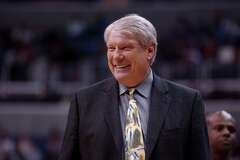
Don Nelson, 1940-2026

Don Nelson was a basketball lifer. He had an interesting career as a player, but he became more interesting as a coach.

Donald Arvid Nelson was born on May 15, 1940 in Muskegon, Michigan, right across Lake Michigan from Milwaukee. He grew up in a farm outside Sherrard, Illinois, in the Quad Cities region that straddles the Mississippi River in Illinois and Iowa. He graduated from Rock Island High School, 2 years ahead of Ken Bowman, a center who helped the Green Bay Packers win the 1st 2 Super Bowls.

Milton "Sharm" Scheuerman was the head basketball coach at the University of Iowa, and a Rock Island High graduate, and recruited Nelson. He also recruited Brooklyn high school star Connie Hawkins, but Hawkins was caught up in a gambling scandal. Despite never being charged with a crime, Hawkins was kicked out of school, and banned from the NBA, playing in the ABL, AAU ball, and the ABA before his ban was lifted.

At a time when the NCAA Tournament only invited 24 teams, and from a conference only the Champion, Iowa finished 2nd to Ohio State team of Jerry Lucas and John Havlicek in 1961, and missed the Tournament. "If Connie had stayed, we would have had a great team," Nelson said. "I feel we could have edged out Ohio State my junior and senior years." Nelson was named a 3rd-term All-America in 1962.

He was taken by the Chicago Zephyrs in the 3rd round of the 1962 NBA Draft. After 1 season, he was waived, claimed by the Los Angeles Lakers. They reached the Finals in each of his 2 seasons with them, but lost both to the Boston Celtics.

He was released, but the Celtics must have liked what they saw, because they signed him as a free agent. He helped them win the 1966, '68 and '69 NBA titles. He remained with them through their rebuilding, and helped them win the title again in 1974 and '76, at which point he retired as a player. In 1973, he was inducted into the Illinois Basketball Coaches Association Hall of Fame as a player. The Celtics retired his Number 19 in 1978.

*

His son Donnie remembers the family sitting in a Maid Rite restaurant in Moline, Illinois (one of the "Quad Cities," along with Rock Island, and Davenport and Bettendorf, Iowa), and Don saying he had three choices: sell cars, become an NBA referee, or accept an assistant's job under Milwaukee coach Larry Costello. They voted 5–0 for the Milwaukee job, which paid $25,000.

The Bucks got off to a 3-15 start in 1976-77, and Costello, despite having led the Bucks to the 1971 NBA Championship and the 1974 NBA Finals, which they lost to "Nellie" and the Celtics, was fired. Nelson was named head coach. At the end of the season, only 37 years old, he was also given the general manager's job. He built a team around speed, and not caring about height, often letting shorter but faster players guard taller but slower ones.

The result of "Nellie Ball" was 7 straight Division titles: 1980 in the Midwest Division; then, after an NBA realignment, 6 in the Central Division, in 1981, '82, '83, '84, '85 and '86. He was named NBA Coach of the Year in 1983 and '85. But the closest he could get to a title was reaching the Eastern Conference Finals 3 times, in 1983, '84 and '86.
In 1985, Jim Fitzgerald sold the Bucks to department store mogul and future U.S. Senator Herb Kohl. Nelson didn't get along with him, but he had gotten along with Fitzgerald. In 1986, Fitzgerald bought a different NBA team, the Golden State Warriors. After a season as a broadcaster, Nellie accepted the head coaching job with the Warriors, and even bought an ownership stake.

Again using a run-and-gun style, he coached them for 6 seasons, building an offense known as Run TMC, after the rap group Run-DMC, for Tim Hardaway Sr., Mitch Richmond and Chris Mullin. He was awarded a 3rd Coach of the Year trophy in 1992. But he only won 2 Playoff series, and resigned during the 1994-95 season.

He was hired to coach the New York Knicks for 1995-96, replacing Pat Riley. But Riley had built a defense-oriented team, and Nellie Ball didn't work with them. When he recommending trading the team's marquee player, Patrick Ewing, so that enough salary cap space would be available to make an offer to Shaquille O'Neal, who was unhappy with the Orlando Magic and wanted to play in a big market, that was the last straw for Knicks management: He was canned on March 8, 1996. Shaq ended up going to the Los Angeles Lakers.

In 1997, he was hired as head coach and general manager of the Dallas Mavericks. It took him 4 seasons to turn them from dreadful to a Playoff team, and in 2003, the Mavs won the Midwest Division and reached the Western Conference Finals. But that was as close as he would get, and he resigned late in the 2004-05 season.
In 2006, Mullin, now the Warriors' GM, brought Nelson back to Oakland. He won 16 of their last 21 games, squeezing into the Playoffs as the 8th seed, and upset his former team, the Mavericks, in the 1st round. This was only the 3rd time an NBA 8th seed had beaten a 1st seed, and the 1st time since the 1st round went to a best 4-out-of-7.

But he never got them into the Playoffs again. On April 7, 2010, the Warriors beat the Minnesota Timberwolves, 116-107 at the Target Center in Minneapolis, giving Nelson his 1,333rd career coaching win, surpassing Lenny Wilkens for the most in history. He held that record until 2022, when he was surpassed by Gregg Popovich. He retired at the end of that season, with a record of 1,335-1,063 (.557).

In all, he coached 17 members of the Basketball Hall of Fame. With the Bucks: Alex English, Bob Dandridge, Sidney Moncrief, his former Celtics teammate Dave Cowens, Nate "Tiny" Archibald, Bob Lanier and Jack Sikma. With the Warriors: Chris Mullin, Ralph Sampson, Mitch Richmond, Tim Hardaway, Šarūnas Marčiulionis and Chris Webber. With the Knicks: Patrick Ewing. With the Mavericks: Steve Nash, Dirk Nowitzki, Dennis Rodman briefly, and Hardaway again. 

He coached 6 of the 9 players to have had their uniform numbers retired by the Bucks: 10, Dandridge; 4, Moncrief; 16, Lanier; 32, Brian Winters, 2, Junior Bridgeman; and 8, Marques Johnson. Only 1 of his Warriors players had his number retired: Mullin, 17. Ewing had his Number 33 retired by the Knicks, and Nowitzki had his Number 41 retired by the Mavs.

He was elected into the Iowa Sports Hall of Fame in 1983, the Quad City Sports Hall of Fame in 1987, the University of Iowa Athletics Hall of Fame in 1989, and the Basketball Hall of Fame in 2012. In 1996, in coordination with the NBA's 50th Anniversary, he was named one of their Top 10 Coaches. In 2021, in coordination with the NBA's 75th Anniversary, he was named one of their Top 15 Coaches.

He married twice, and had 7 children and 15 grandchildren. His son, Donn Charles Nelson, known as Donnie Nelson, played basketball at Wheaton College in Wheaton, Illinois -- making it up to a school that his father had turned down to go to Iowa. Donnie became an assistant to his father the 1st time around with the Warriors, and with the Mavericks, and in between to Dannie Ainge with the Phoenix Suns. From 2005 to 2021, he was the Mavs' GM, helping to build teams that won 3 Division titles, 2 Western Conference titles, and the 2011 NBA Championship.

In 2012, 50 years after leaving the University of Iowa, Don Nelson finally completed his degree there. He settled on a farm on the Hawaiian Island of Maui, where he grew flowers, coffee and cannabis. He hosted poker games, where he was joined by celebrities like country singer Willie Nelson and actor Woody Harrelson, who are also fond of the last of those crops.

"I know how far I've come from being a hog farmer," Nelson said. "I've come a long, long way from being some country kid. I got in the fast lane, and I've stayed there a long time. I've done pretty well."
But his health began to fail, and earlier this year, he moved back to the mainland, to the Dallas suburb of Frisco, Texas. He suffered a stroke, was admitted to hospice care, and died today, August 9, 2026, at the age of 86.

Saturday, April 16, 2022

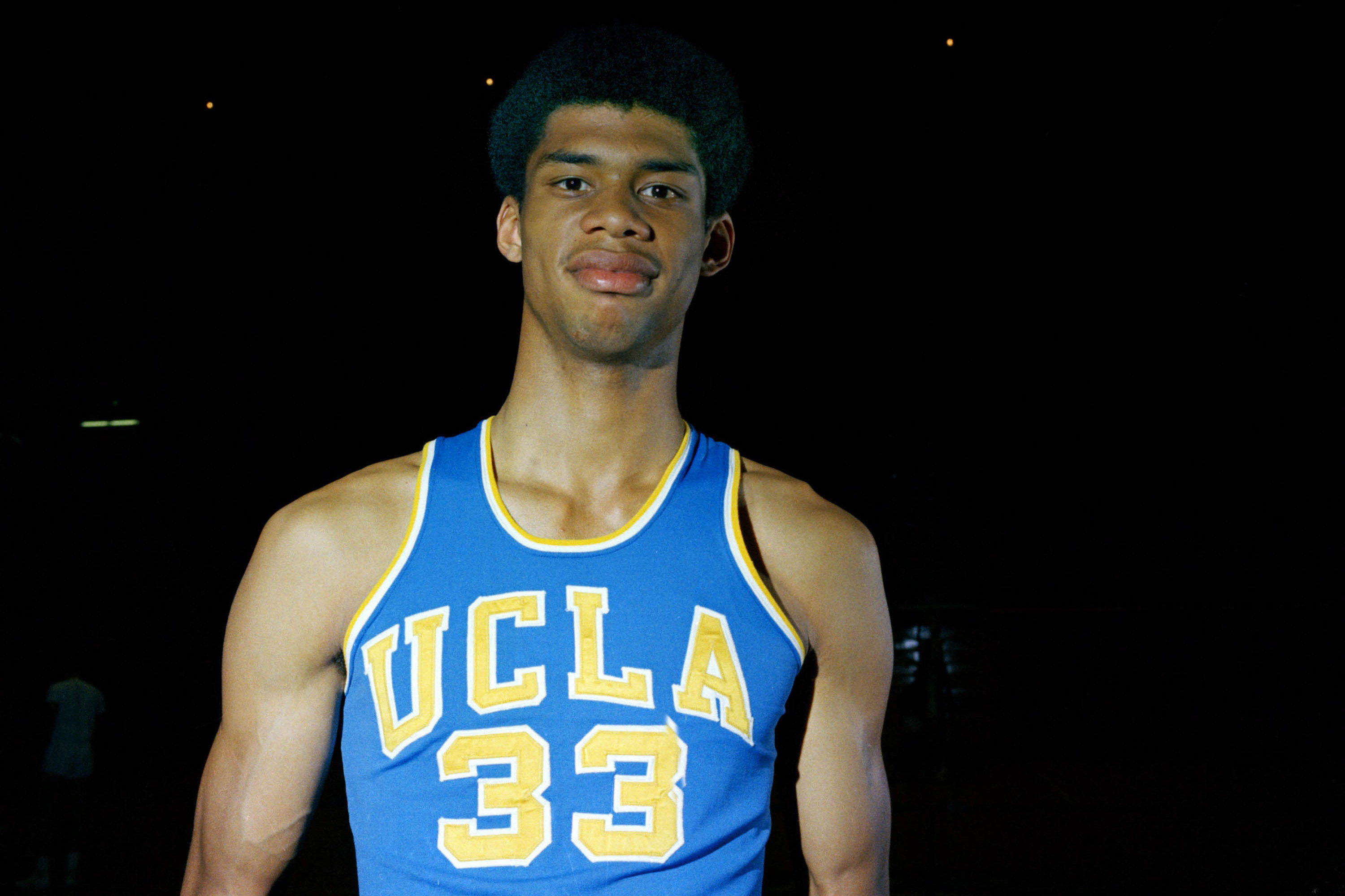
Happy 75th Birthday, Kareem Abdul-Jabbar

In 1989, in a column for Sports Illustrated, titled "The Heavenly Hundred," Rick Reilly made a list of the greatest athletes ever to wear each uniform number. For Number 33, he chose "Lew Alcindor, slightly ahead of Kareem Abdul-Jabbar."

It was funny to me at the time. But it messed with the man's identity, not just his religion. He wouldn't have said that Cassius Clay was ahead of Muhammad Ali on the list of greatest Heavyweight Champions, would he?

Kareem was one of the greatest athletes who ever lived -- and one of the most complicated. And he still is.

Ferdinand Lewis Alcindor Jr. was born on April 16, 1947 in Harlem, Upper Manhattan, New York City. Lew grew up in the Dyckman Street projects in Inwood. By age 9, he was already 5-foot-8. In the 8th grade, he was 6-foot-8 and could already dunk a basketball.

In 1961, he was enrolled at Power Memorial Academy, a Catholic high school at 161 West 61st Street in Manhattan. He led them to the City Championship in 1963 and 1964. They extended their winning streak to 71 games, 2nd-longest in the history of American high school basketball, behind New Jersey's "Passaic Wonder Five" winning 159 straight from 1919 to 1925. On January 30, 1965, they went to Cole Field House on the campus of the University of Maryland, and lost to DeMatha High School of nearby Hyattsville, 46-43.

Power Memorial went 96-6 in Lew's high school career. His 2,067 points were a City record. The school later produced basketball stars Len Elmore, Mario Elie and Chris Mullin, but closed in 1984, when they couldn't afford needed repairs to their building.

Now 7-foot-1, Lew was recruited to the University of California at Los Angeles by their head coach, John Wooden, who had been a great player himself at Purdue University in the early 1930s, and had already guided UCLA to what would now be called the NCAA Final Four in 1962, and won the National Championship in 1964 and 1965.

Until 1972, college freshmen weren't allowed to play varsity sports. So Lew played for UCLA's freshman team, and on November 27, 1965, in the 1st event ever held at UCLA's Pauley Pavilion, the UCLA freshmen beat the varsity, 75-60. Lew scored 31 points and had 21 rebounds. The freshmen went 21-0 that season.

In 1966-67, with Lew as a sophomore, UCLA went 30-0 and won the National Championship. To try to stop him, the NCAA banned the dunk shot, not restoring it until 1977. In response, he developed a new shot, a variation on the hook shot: The "skyhook." Between his height and the length of his right arm, the shot was undefendable, and he was deadly accurate with it.

In 1968, a "Game of the Century" was set up at the Astrodome, between UCLA, then undefeated and ranked Number 1, and the University of Houston, with All-American Elvin Hayes, then undefeated and ranked Number 2. Lew had an eye injury, and Houston won, 71-69. UCLA then beat Houston in the NCAA Tournament Semifinal, and won another National Championship, finishing 29-1. In 1969, they lost a meaningless regular-season finale to the University of Southern California, and went 29-1 to win another National Championship.
In 3 years, Lew Alcindor led UCLA to 3 National Championships, won the Tournament's Most Outstanding Player all 3 times, and went 88-2. Counting his freshman team performance, he was 109-2. That is insane. Throw in his high school play, and he was 195-8. Think about that: He had played over 200 competitive games, and lost fewer than 10 of them.

*

In 1968, Lew converted from Catholicism to Sunni Islam, and adopted the name Kareem Abdul-Jabbar. It means "noble one, servant of the Almighty." However, he did not announce these changes until 1971. By that point, it was considerably less controversial than the conversion and name change made in 1964, when Cassius Clay became Muhammad Ali.

Kareem should have led the U.S. national team to the Gold Medal at the 1968 Olympics in Mexico City. But with everything that had gone on in race relations in the 1960, especially the assassination of Dr. Martin Luther King 6 months earlier, he chose not to try out: "I was trying to point out to the world the futility of winning the Gold Medal for this country, and then coming back to live under oppression." Hayes also boycotted, so Spencer Haywood was the player who led the U.S. to the Gold.

Kareem got his Bachelor of Arts degree from UCLA in 1969, and began studying martial arts with Bruce Lee. In 1972, he appeared as an opponent for Lee, with an extraordinary height and reach advantage (both arms and legs), in the film Game of Death. (It was left unfinished when Lee died in 1973, and not released until 1978.)

The Harlem Globetrotters offered Kareem $1 million to play for them. He turned it down, and became the Number 1 pick in the 1969 NBA Draft, by the Milwaukee Bucks. He immediately turned them from an expansion team to a title contender, and was the 1970 NBA Rookie of the Year. In 1971, his 2nd season, he led them to the NBA Championship, winning the Finals' Most Valuable Player Award, alongside veteran guard Oscar Robertson, sweeping the Baltimore Bullets in 4 straight. It would be the Big O's only title.
In 1972, the Bucks broke the Los Angeles' Lakers' record 33-game winning streak, but lost to them in the Western Conference Finals. They won the West in 1974, but lost the NBA Finals to the Boston Celtics in 7 games. In both of those seasons, he was named the NBA's regular-season MVP.

Robertson retired right before the 1974-75 season, because he and the Bucks could not agree on a new contract. Right after that, Kareem requested a trade. His choices were, in order: The New York Knicks, the Washington Bullets, and the Los Angeles Lakers. He had never spoken negatively of the city of Milwaukee or its fans, but he said that being in the Midwest "did not fit his cultural needs."

On June 16, 1975, the Bucks traded Kareem and Walt Wesley to the Lakers for Dave Meyers (who had not yet played a pro game, but had just led UCLA to the last of their 10 National Championships under Wooden), Junior Bridgeman, Elmore Smith and Brian Winters. Wesley was essentially a throw-in, to make it look like it wasn't just 4-for-1. All 4 players the Bucks got helped them win some Division titles, so it wasn't a terrible trade for the Bucks. But they did not return to the NBA Finals until 2021.

It took the Lakers a while to get back, too, until 1980. That year, Kareem appeared as co-pilot Roger Murdock in the disaster-film spoof Airplane! It was a tribute to the film on which Airplane! was based on, Zero Hour! where the character was played by an earlier Los Angeles sports legend, Rams receiver Elroy "Crazy Legs" Hirsch. Kareem briefly breaks character, complaining about how hard it is to "drag (Bill) Walton and (Bob) Lanier up and down the court for 48 minutes!"

The Lakers got to Game 6 of the NBA Finals, needing 1 more win over the Philadelphia 76ers to win the title. But Kareem was injured, and rookie sensation Earvin "Magic" Johnson -- his 6-foot-9 height now being considered short for the position -- played center, and the Lakers won the title.

The Lakers won again in 1982, 1985, 1987 and 1988. In 1985, at age 38, Kareem was still 1 of the 3 best players in the NBA, alongside Johnson and Larry Bird of the team they beat in the Finals, the Boston Celtics. It was the 9th time the Lakers had played the Celtics in the Finals, but it was the 1st one they won. It was also the 1st time a team had clinched the NBA title against the Celtics on the parquet floor of the Boston Garden. Sports Illustrated named Kareem its Sportsman of the Year. The 1988 title was his 6th.

In 1984, Kareem surpassed Wilt Chamberlain to become the NBA's all-time leading scorer. They even did a TWA (Trans World Airlines) commercial together. However, they had a difficult relationship, to the point that, when Sports Illustrated celebrated the NBA's 50th Anniversary in 1996, they wanted to get the 4 great Laker centers together: George Mikan from the Minneapolis years, Wilt, Kareem, and Shaquille O'Neal, a superstar newly-acquired from the Orlando Magic. Shaq, Kareem, and Mikan, despite being 72 years old and a bit unsteady on his feet, were all willing to participate, and even wear their respective uniforms. Wilt refused.

The 1988-89 season was Kareem's 20th (at the time, an NBA record) and last, and it was a season-long celebration of his career. The Bucks and the Lakers both retired his Number 33, and his hometown Knicks gave him a huge plaque with all 4 of his 33 jerseys: Power Memorial, UCLA, the Bucks and the Lakers. The Celtics gave him a replica segment of the Boston Garden's parquet.

The Lakers were unable to make it 3 straight titles, as the Detroit Pistons, who nearly derailed the Lakers' back-to-back titles the year before, swept them in 4 straight. But although the Pistons led Game 4 at The Forum in Inglewood big in the final minute, the crowd just kept chanting, "Kareem! Kareem! Kareem!"

He won 6 regular-season and 2 Finals MVP awards. He was elected to the Basketball Hall of Fame in his 1st year of eligibility. He was named to the NBA's 35th, 50th and 75th Anniversary All-Time Teams. A statue of him stands outside the Lakers' home, now named the Crypto.com Arena.

In a 2017 post, I named him the greatest athlete ever to come from the City of New York, ahead of Yankees legend Lou Gehrig; and the 2nd-greatest to come from the State of New York, behind Cleveland Browns running back Jim Brown.

*

Kareem is an introvert. He did not open up to the media for most of his playing career. After a game, instead of answering reporters' questions, he would rather have gone straight home, read, and listen to music. Many reporters considered him "difficult."

He thinks it got in the way of him receiving coaching opportunities: "I didn't understand that I also had affected people that way, and that's what it was all about. I always saw it like they were trying to pry. I was way too suspicious, and I paid a price for it." He served as an assistant coach with the Los Angeles Clippers and the Seattle SuperSonics, as the head coach of the minor-league Oklahoma Storm, a scout with the Knicks, and a "special assistant coach" to Phil Jackson on the Lakers.

In 2013, he gave up on an NBA head coaching job. He has spent a significant amount of his retirement writing. Some of it focuses on the history of African-Americans, including:

* Black Profiles in Courage: A Legacy of African-American Achievement.
* What Color Is My World? The Lost History of African American Inventors. 
* On the Shoulders of Giants: My Journey Through the Harlem Renaissance.
* Brothers In Arms: The Epic Story of the 761st Tank Battalion, World War II's Forgotten Heroes.

During his senior year at UCLA, he met Janice Brown. When they married, she became Habiba Abdul-Jabbar. They had 3 children: Daughters Habiba and Sultana, and son Kareem Abdul-Jabbar Jr., who played basketball at Western Kentucky. Kareem Sr. and Habiba have since divorced. He later had sons Amir and Adam.

He has survived 2 eye injuries that led to his iconic on-court goggles, severe migraines, leukemia, and heart bypass surgery, to reach the age of 75.

Happy Birthday, Kareem. May you enjoy many more.

Sunday, October 31, 2021

How to Be a New York Basketball Fan In Milwaukee -- 2021-22 Edition

The Brooklyn Nets visited the Milwaukee Bucks on October 19. I did not do a Trip Guide for that game, because it was the season opener, at home, for the defending NBA Champions, so tickets would have been next to impossible to get. The Bucks won, 127-104.

The Nets will visit again on February 26. The Knicks will visit this coming Friday, November 5, and again on January 8.

Before You Go. Milwaukee is on Lake Michigan. It's not Green Bay, but it is still Wisconsin. It gets chilly in the Autumn, let alone in the Winter. Since this will be early November, the weather could be an issue. Although the game will be indoors, you still have to get to it.

The Milwaukee Journal Sentinel website is predicting high 40s for Friday afternoon, and mid-30s for the evening. You will need a Winter jacket at night.

Milwaukee is in the Central Time Zone, an hour behind New York. Adjust your various timepieces accordingly.

Tickets. The Bucks averaged 17,603 fans, a sellout, during 2019-20, before COVID shut everything down. And now, they are the defending World Champions. So tickets may be very difficult to get.

In the Lower Level, the 100 sections, they have seats for $165 between the baskets and $90 behind; and, in the Upper Level, the 200 sections, they're $67 between and $45 behind.

Getting There. Downtown Milwaukee is 892 land miles from Times Square. Knowing this, your first reaction is going to be to fly out there.

At first, unlike some other Midwestern cities, this seems like a good idea if you can afford it. Most airlines can fly you there for $519 round-trip. However, there is a catch: There are few non-stops between any of the New York area airports and General Mitchell International Airport in Milwaukee. You will almost certainly have to change planes, most likely in Chicago, and you'll spend nearly as much time on the ground at O'Hare as you do in the air. The GRE bus will get you downtown in a little over half an hour. (Billy Mitchell was a Milwaukee-area native and an early advocate for air power.)

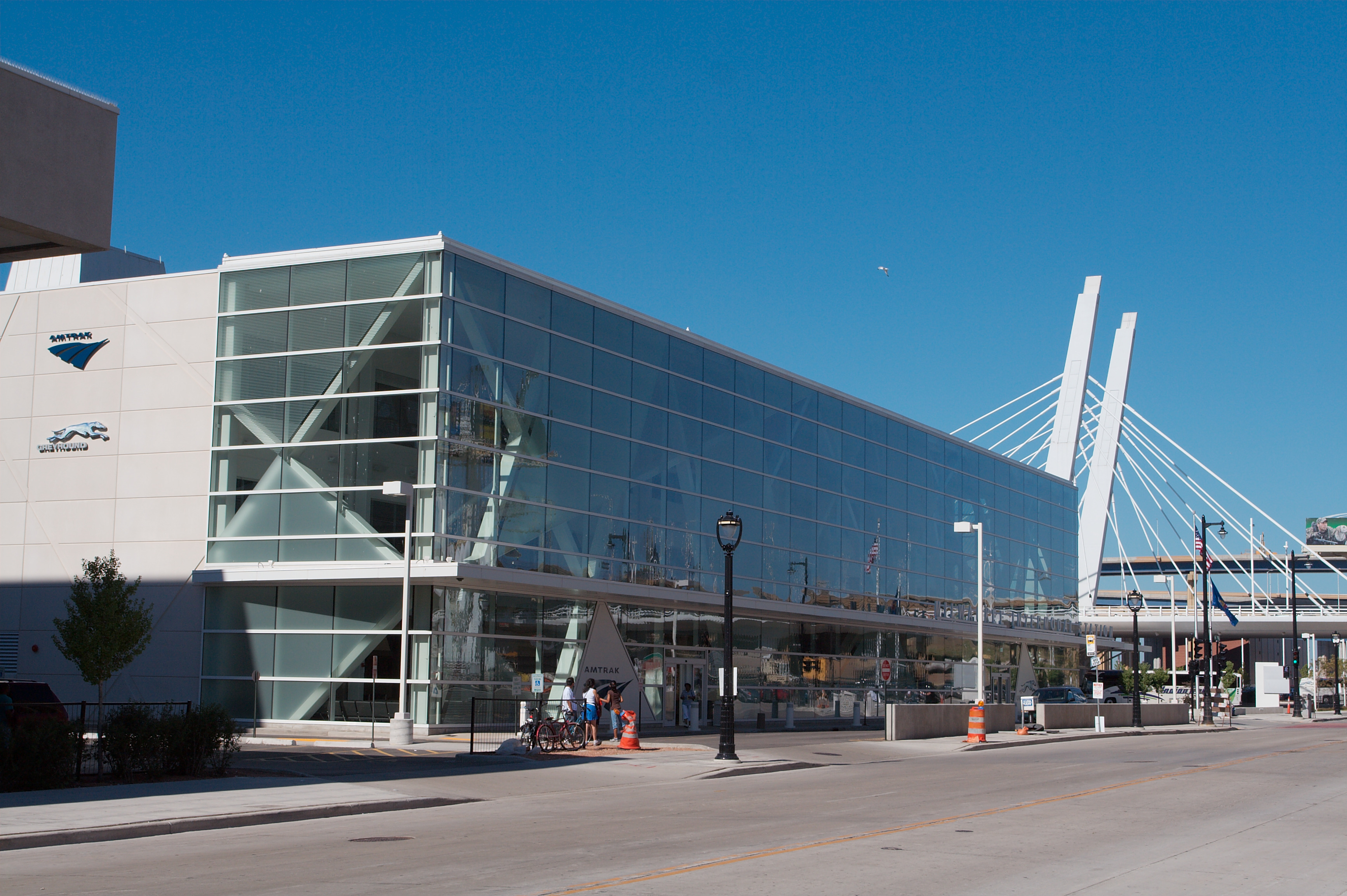
The Milwaukee Intermodal Station, which serves both Greyhound and Amtrak, is at 433 W. St. Paul Avenue, at 5th Street. There are 4 daily Greyhound runs that will get you from New York to Milwaukee. Most of these runs require 2 changeovers, in Indianapolis and Chicago. Round-trip fare is $612, but you can get it for $357 on advanced purchase.
Milwaukee Intermodal Station

Amtrak's Lake Shore Limited (formerly known as the Twentieth Century Limited when the old New York Central Railroad ran it from Grand Central Terminal to Chicago's LaSalle Street Station) leaves New York's Penn Station at 3:40 every afternoon, and arrives at Union Station at 225 South Canal Street in Chicago at 9:50 (Central Time) every morning. From there, you have to wait until 11:05 AM to get on "Hiawatha Service," which will bring you to Milwaukee at 12:34. That's 21 hours, 49 minutes. Round-trip fare is $306 -- this time, possibly, cheaper than Greyhound.

If you decide to drive, it's far enough that it will help to get someone to go with you and split the duties, and to trade off driving and sleeping.  You'll need to get into New Jersey, and take Interstate 80 West. You'll be on I-80 for the vast majority of the trip, through New Jersey, Pennsylvania and Ohio. In Ohio, in the western suburbs of Cleveland, I-80 will merge with Interstate 90.

From this point onward, you won't need to think about I-80 until you head home; I-90 is the key, until it merges with Interstate 94, which will merge with Interstate 43. Stay on I-43 after I-94 splits off south of downtown. Take Exit 73A onto Wisconsin Route 145, which will become N. 6th Street. Take that to State Street, and the Bradley Center will be on the left.

If you do it right, you should spend about an hour and a half in New Jersey, 5 hours and 15 minutes in Pennsylvania, 4 hours in Ohio, 2 hours and 30 minutes in Indiana, an hour and a half in Illinois, and just under an hour in Wisconsin. That's about 15 hours and 45 minutes. Counting rest stops, and accounting for traffic in both New York and Chicago, it should be no more than 20 hours, which would save you time on both Greyhound and Amtrak, if not on flying.

Once In the City. As Alice Cooper taught us in the film version of Wayne's World, Milwaukee gets its name from a Native American word meaning "the good land." But this may not be correct: Another version says the name comes a word meaning "Gathering place by the water."

Whichever version is true, both descriptions are accurate: The land of Wisconsin is good for farming, and Milwaukee is based on a confluence of 3 rivers that flow into Lake Michigan: The Milwaukee, the Menomonee, and the Kinnickinnic; so there's plenty of water. The Menomonee River separates the city's streets into North and South, and the other 2 rivers separate them into East and West.
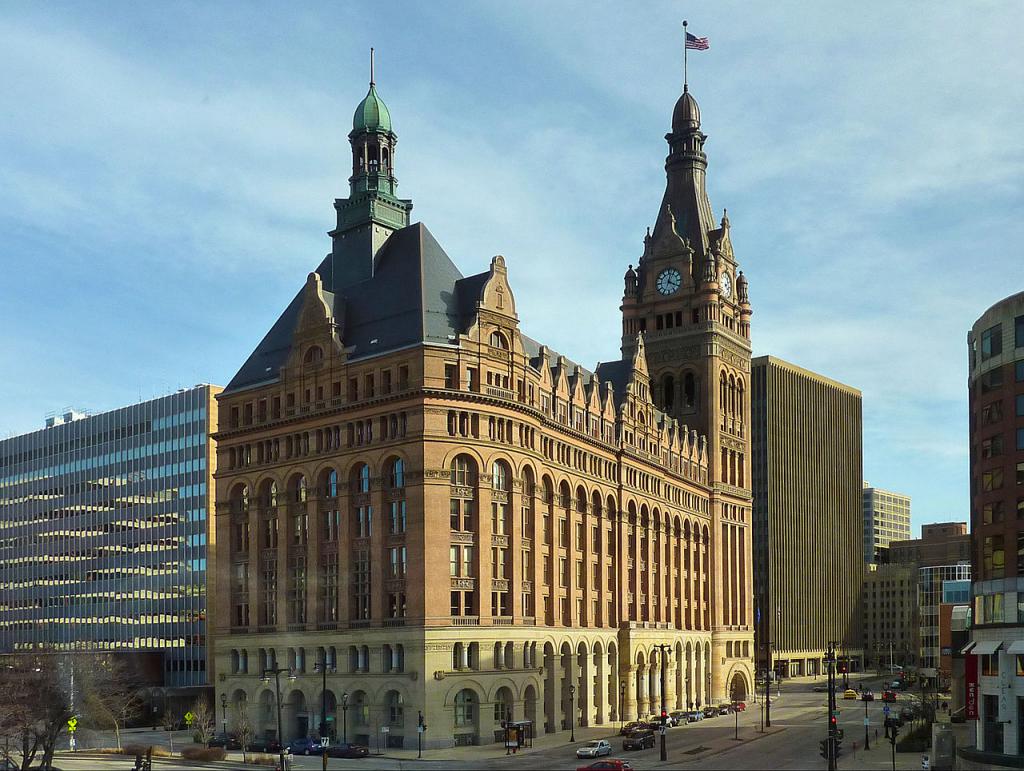
Milwaukee's historic City Hall

Founded in 1846, the city has about 600,000 people, making it the 3rd-largest in the Great Lakes region behind Chicago and Detroit. But the metropolitan area has only about 2 million, making it 27th among the 30 NBA teams, ahead of only New Orleans, Oklahoma City and Memphis. (Throwing in Green Bay's metro area only boosts it by about 325,000, and doesn't raise their ranking at all.)

Milwaukee was about 72 percent white as recently as 1980, but is now about 42 percent black, 37 percent white, 17 percent Hispanic, and 4 percent Asian. The German presence that established the city as a major brewing center is still in place, about 21 percent, or more than half of the white population. Poles make up about 9 percent, Irish 6 percent, Italian 3 percent, with some of mixed heritage. Most of the Hispanics, as is the case with most Midwestern cities, are Mexican.

On July 30, 1967, right after it happened in Newark and Detroit, Milwaukee was struck with a race riot. They were lucky in that only 4 people died. In 2002, Jet magazine called Milwaukee "the most segregated city in the United States." In 2011, a University of Michigan study backed this up. North of the Menomonee River, but west of the Milwaukee River, the city is mostly black. North of the Menomonee, but east of the Milwaukee, and in the suburbs, it's mostly white. South of the Menomonee River, it's mostly Hispanic.

In 2015, the news site 24/7 Wall Street labeled Milwaukee "the worst place for African-Americans to live," despite the Sheriff of Milwaukee County being black. But that Sheriff was David Clarke, an arch-conservative and a Trump ally, who said that the Black Lives Matter group had to be "eradicated."

Wisconsin Electric Power Company runs the city's electricity. Wisconsin's sales tax is 5 percent, but inside Milwaukee County, it's 5.6 percent. Which is still lower than those of the States of New York, New Jersey and Connecticut even before local taxes are added on. The Milwaukee County Transit System has a fare of $2.25 for its buses. The city now has a light rail system, "The Hop," and it's free!
ZIP Codes in Wisconsin start with the digits 53 and 54, and for the Milwaukee area, 530, 531 and 532. The Area Code is 414 for the city and 262 for the suburbs. Milwaukee does not have a "beltway."

Going In. The new Fiserv Forum, named for a "provider of financial services technology," has an address of 1111 Vel R. Phillips Avenue. This is a stretch of N. 4th Street, renamed in 2018, upon the death of Velvalea "Vel" Phillips. She was a local judge and the only black person ever elected to Statewide office in Wisconsin (Secretary of State in 1978). It's a short walk from downtown. If you drive in, parking is $11.

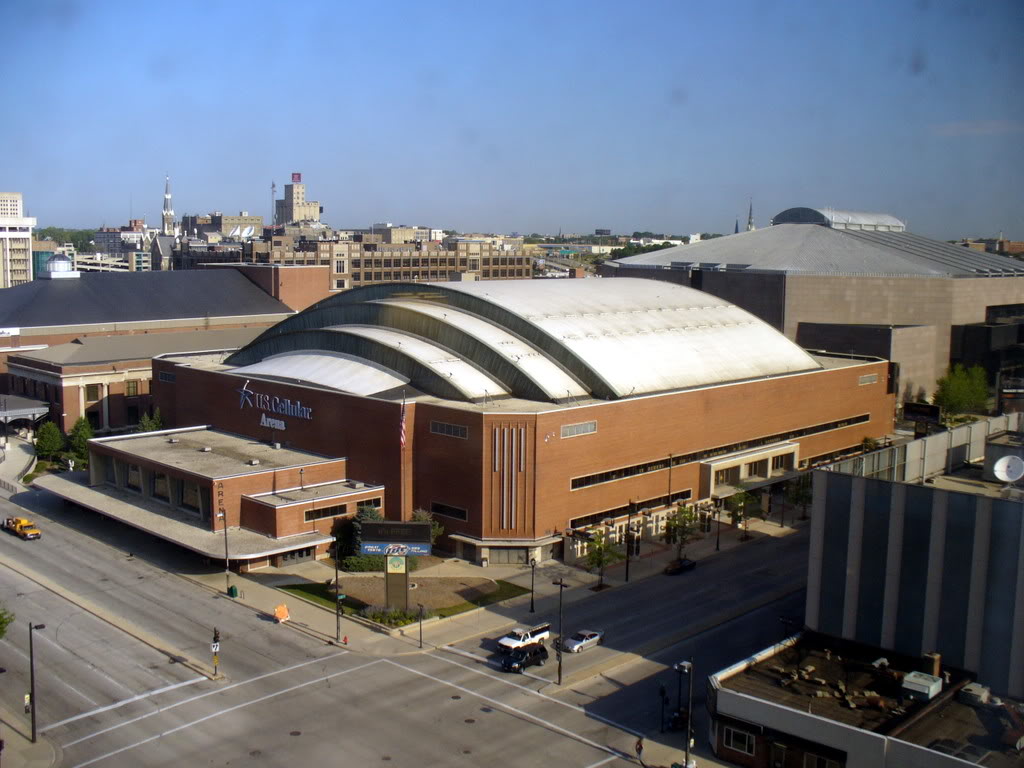
The new arena is bounded by 4th and 6th Streets, and Juneau and Highland Avenues. Across Highland, to the south of the new arena, is the old arena, the Bradley Center, officially at 1001 N. 4th Street. To the south of that, across State Street, at 400 W. Kilbourn Avenue, is the previous home of the Bucks, minor-league hockey's Milwaukee Admirals, and Marquette University basketball (back then, they were known as the Warriors, not the Golden Eagles). Built in 1950 as the Milwaukee Arena, it became part of a complex known as the Milwaukee Exposition Convention Center & Arena, or MECCA.
The old Arena, then using the name U.S. Cellular Arena.
Behind it to the left, the Milwaukee Auditorium.
Behind it to the right, the Bradley Center.

The Bucks had to move out, as it seated only 10,783 and had no luxury boxes at all. Now known as the UW-Milwaukee Panther Arena, it holds 12,700 fans, and the University of Wisconsin at Milwaukee plays its home basketball games there. Before the Bucks played there from 1968 to 1988, it was home to the Milwaukee Hawks from 1951 to 1955, when they moved to St. Louis, and then in 1968 to Atlanta.
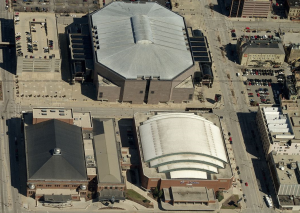
Overhead shot. Top: Bradley Center.
Bottom: Milwaukee Theatre and MECCA.

Elvis Presley sang at the old arena on June 28, 1974 and April 27, 1977. The Beatles played there on September 4, 1964. The inductees to the Wisconsin Athletic Hall of Fame are honored there in a Wisconsin Athletic Walk of Fame, which includes stars from the Bucks, the Milwaukee Brewers, the Green Bay Packers, the University of Wisconsin Badgers, and State natives who made it big elsewhere.
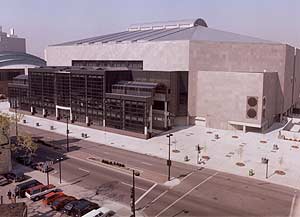
The Bradley Center was paid for by funds donated by Jane Bradley Pettit and her husband Lloyd Pettit, in memory of her father, factory-equipment magnate Harry Bradley. Lloyd Pettit was the Hall of Fame broadcaster for the Chicago Blackhawks, and the owner of the Milwaukee Admirals of the American Hockey League.

Ironically, Harry Bradley was a big donor to conservative causes, but, for most of the arena's existence, its main tenant, the Bucks, were owned by Herb Kohl, a very liberal U.S. Senator. BMO Harris Bank bought naming rights in 2012.

Milwaukee might be able to support an NHL team, as its metropolitan area population, even without adding Green Bay and Madison to its "market," would rank 26th in the NHL. So it's unlikely that it can support an NBA team and an NHL team.

It's also hosted arena football's Milwaukee Mustangs and indoor soccer's Milwaukee Wave. Although Milwaukee has never had a major league hockey team (not in the NHL or in the WHA), the NCAA has used it as the site of its National Championships, the Frozen Four, in 1993, 1997 and 2006. It's also hosted NCAA Tournament basketball games in the rounds of 64 & 32, and 16 & 8, including the 2013-14 season.
The new arena's exterior is meant to suggest a beer barrel.

But only the Bucks and Marquette have moved into the Fiserv Forum. The Admirals have moved back to the MECCA, and the Bradley Center will likely be demolished. The Forum's court is laid out north-to-south, and it has all the modern amenities that both fans and team owners demand.
The Forum opened on August 26, 2018. Among the musical performers who have already appeared in concert there are The Killers, Maroon 5, Justin Timberlake, Metallica, Foo Fighters, the Glenn Frey-less Eagles and the Lindsay Buckingham-less Fleetwood Mac.

Food. In Big Ten Country, where tailgate parties are practically a sacrament, you would expect the Milwaukee arena to have lots of good options. It certainly does. According to the team website:

Fiserv Forum has an exclusive concessionaire agreement with Levy Restaurants. Levy Restaurants, founded in Chicago in 1978, is recognized as one of America’s fastest growing and most critically acclaimed restaurant companies, and is the leader in premium sports and entertainment dining. Levy was recently named one of the 10 most innovative companies in sports in the world by Fast Company magazine. The company’s diverse portfolio includes award-winning restaurants such as James Beard Award-winning Spiaggia in Chicago, Fulton’s Crab House, Portobello and Wolfgang Puck Grand Café at Walt Disney World Resort, renowned sports and entertainment venues like Churchill Downs in Louisville, STAPLES Center in Los Angeles, and American Airlines Arena in Miami, and events including the Super Bowl, World Series, U. S. Open, Kentucky Derby, NHL and NBA All-Star Games and the GRAMMY® Awards.​ 
Levy Restaurants is proud to present MKE Eats, a program that features food offerings from 10 local restaurants, including Sobelman’s, The Laughing Taco, Iron Grate BBQ, FreshFin Poke, and Collectivo. MKE Eats also includes nationally renowned brands such as Chick-Fil-A, Jack Daniel’s, and Casamigos.
And you thought the TV show set in Milwaukee was called Happy Days because it was set during the 1950s? Nope: It was because of the food! Why do you think they all hung out at Arnold's? Why do you think the Fonz was always telling "Mrs. C" how wonderful her cooking was? Because it was.

Team History Displays. The Bucks have consolidated their banners. They have separate banners for their 1971 and now the 2021 World Championship banners; separate banners for the 1971 and 1974 Western Conference titles, and the 2021 Eastern Conference titles; and one single banner for the Division titles of 1971, 1972, 1973, 1974, 1976, 1980, 1981, 1982, 1983, 1984, 1985, 1986, 2001, 2019, 2020 and 2021.
They have 9 retired numbers:

* From the 1971 title team: 1, guard Oscar Robertson; 10, forward Bob Dandridge; 14, guard Jon McGlocklin; and 33, center Kareem Abdul-Jabbar, who changed his name in 1972, so he was still using his birth name of Lew Alcindor during the title season.

* From the Division title teams of the late 1970s and early 1980s: 2, forward Ulysses "Junior" Bridgeman; 4, guard Sidney Moncrief; 8, forward Marques Johnson; 16, center Bob Lanier; and 32, guard Brian Winters.
Oscar, Kareem and Lanier were elected to the Basketball Hall of Fame. Oscar and Kareem were named to the NBA's 50th Anniversary 50 Greatest Players in 1996. Kareem was also named to the NBA's 35th Anniversary All-Time Team in 1980. Oscar, Kareem and Giannis Antetokounmpo, the Nigerian-born "Greek Freak," were just named to the NBA's 75th Anniversary 75 Greatest players.

So far, the only player elected to the Hall of Fame with significant contributions as a Buck from after 1984 is the newly-elected Ray Allen. His Number 34 has not been retired, and it may not be for some time, as it's currently being worn by Giannis, and will likely be retired for him, and he's only 26 years old.

It's almost the exact opposite of what you would expect from an expansion team: After a weak 1st season, 1968-69, they won the coin flip with the Phoenix Suns for the 1st pick in the Draft, selected Alcindor, and got a title out of it in just 2 seasons. Then, they were a very good team for the next 20 years, but not so much in the last 25. In contrast, the Suns, who also started play in the fall of 1968, have been a respectable team for most of their history, but have never won a title, the difference between their zero and the Bucks' one being a lot bigger than the Bucks' one and, say, the Philadelphia 76ers' two.

Robertson, Bridgman, McGlocklin, Moncrief, Herb Kohl, previous owner Jim Fitzgerald, and Jane Bradley Pettit have been honored in the Wisconsin Athletic Hall of Fame. As I said, it's across the street at the MECCA. Also honored are Marquette basketball figures Al McGuire, George Thompson and Johnny Sisk. So is Shirley Martin, one of the earliest stars of women's basketball.

Marquette also hangs banners at the Fiserv Forum: Their 1977 National Championship; their Final Four berths of 1974, 1977 and 2003; their regular-season conference titles of 1994, 2003 and 2013; and their 1997 conference tournament win. The 1974 and 1977 achievements were won while their home court was the MECCA; from 1988 onward, the Bradley Center.

Marquette has retired the numbers of 9 players: 3, Dwyane Wade; 14, former Knick Dean Meminger; 15, former Knick Butch Lee; 20, Maurice Lucas; 24, George Thompson; 31, for both former Knick Doc Rivers and Bo Ellis; 43, Earl Tatum; and 44, Don Kojis.

They've also retired 11 in honor of the Apollo 11 crew (even though Milwaukee native Jim Lovell flew on Apollo 8 and Apollo 13, and has a street renamed for him), 38 for trainer Bob Weingart, and 77 for coach Al McGuire for the 1977 title. Al grew up in Far Rockaway, Queens, as did his brother Dick, and both played for the Knicks in the 1950s. Dick is in the Hall as a Knick player, Al as Marquette coach.

The University of Wisconsin, in Madison, is the only other Wisconsin school to reach the Final Four, and that was all the way back in 1941, although they've reached hockey's version, the Frozen Four, many times, including 6 National Championships: 1973, 1977, 1981, 1983, 1990 and 2006.

The Admirals took their banners back to the MECCA. They hang them for their 1976 U.S. Hockey League title; their International Hockey League regular season titles of 1983, 1993, 1995 and 1996; their 2004 and 2006 AHL Conference Championships; and their 2004 AHL regular season and Calder Cup titles.

They also hang 7 retired number banners, including 2 retired for 2 players each: 9, 1970s center Phil Wittliff; 14, 1980s center Fred Berry and 1990s center Mike McNeill; 26, 1990s-2000s center Tony Hrkac; 27, 1970s-80s left wing Danny Lecours; and 44, 1980s defenseman Kevin Willison and 1990s center Gino Cavallini. Aside from Cavallini, none of them made much of an impact in the NHL.

Unlike the Brewers-Cubs and Packers-Bears rivalry, the Wisconsin-Illinois rivalry doesn't really make Bucks-Bulls all that intense. and the Wisconsin-Minnesota rivalry, formerly seen in Brewers-Twins and still seen in Packers-Vikings and Badgers-Gophers, hasn't yet made Bucks-Timberwolves a big deal. The Bucks trail the Bulls 132-123, and the T-Wolves 32-31.

Stuff. The Bucks Pro Shop is located in the Fiserv Forum's atrium. And there are several portable kiosks, with locations varying by event.

The Bucks have been around for 50 years now, but because Milwaukee, as a city, gets lost in the shadows not only of Chicago, with the far more noteworthy Bulls 90 miles to the south, but the smaller yet higher-profile city of Green Bay, with the legendary Packers 115 miles to the north, the Bucks tend to get forgotten. They trail not only the Packers, but also the football team at the University of Wisconsin in popularity among Badger State teams. (They may even trail that school's very successful hockey program, even though Milwaukee doesn't have an NHL team.)

As part of the NBA's A History of Hoops series, Nate Leboutillier wrote The Story of the Milwaukee Bucks in 2006; Jim Whiting wrote an update that was published in 2017. Back in 1978, Marv Fishman and Tracy Dodds wrote Bucking the Odds: The Birth of the Milwaukee Bucks, chronicling their rather successful early years. The sports staff of The Milwaukee Journal Sentinel put together a commemorative book for the 2021 title, History Makers.

Forget about DVDs: There is no collection showing the 1971 Finals or a "Greatest Games" series.

During the Game. A November 13, 2014 article on DailyRotoHelp ranked the NBA teams' fan bases, and listed the Bucks' fans in 20th place. This is meant to suggest not that they are unpleasant, but that they are disengaged, that not enough show up, and that not enough of those who do show up generate much of an atmosphere.

Bucks fans, as you might expect in America's foremost brewing city, like to drink. If this were a Packer game and you were wearing Chicago Bears or Minnesota Vikings gear, you might be in trouble. If this were a UW game and you were wearing University of Minnesota gear, you might be in trouble. If this were a Brewers-Cubs game, and you were wearing Cubs gear, you might be in trouble. But this is a Bucks game, and even if you were wearing Chicago Bulls or Minnesota Timberwolves gear, you'd probably be safe. Despite their slogan, you won't need to "Fear the Deer."

None of the Bucks' home games against either of the New York Tri-State Area teams will feature a promotion. The Bucks' mascot is Bango the Buck, presently performed by Kevin Vanderkolk. The word "Bango" was originally coined by Eddie Doucette, the the longtime play-by-play announcer for the Bucks. Doucette used the word whenever a Bucks player connected on a long-range basket, much like old-time Knicks announcer Marty Glickman used "Swish" for a shot that was nothing but net. It was often used for sharpshooter Jon McGlocklin. When it came time for the Bucks to choose a name for their new mascot, the name "Bango" won the contest.
He wears Number 68 in honor of the team's 1968 debut.

Bango has been the Bucks' official mascot for more than 36 years. He made his official debut on October 18, 1977, which was Milwaukee's home opener of the 1977-78 season. (Those of you who are Yankee Fans will recognize the date as the night that Reggie Jackson hit 3 home runs in Game 6 to clinch the World Series.) In addition to the date being Bango's home debut, the game itself pitted Milwaukee against former Bucks center Kareem Abdul-Jabbar and his Los Angeles Lakers at the MECCA. The Bucks won, 117-112.

Bango has worked hard to become popular with Bucks fans all throughout the State of Wisconsin over the years, appearing at schools, parades, and festivals as a goodwill ambassador for the team. His high-flying acrobatic layups, daring rebounds, and other entertaining antics still play an important role in energizing Bucks fans at the Bradley Center.

Since 2001, Bango has also made perennial appearances at the NBA All-Star Game, although he tore an ACL during a stunt at the 2009 All-Star Weekend in Phoenix, and missed the rest of the season. He bounced back, and in 2010 was named NBA Mascot of the Year.

Ben Tajnai is the Bucks' National Anthem singer. They've replaced their 1977 theme song "Green and Growing (The Bucks Don't Stop Here)" with a 2013 theme, "King of the Court." As far as I can tell, there are no traditional chants at Bucks games. Nor does there appear to be a postgame victory song.
Ben Tajnai

After the Game. Milwaukee has some rough neighborhoods, but downtown is safe. Although Milwaukeeans like to drink, this is not a Packers or Badgers game, so you should be fine on your way out.

Unfortunately, I can find no reference to any Milwaukee bar or restaurant that caters to New York expatriates. However, downtown has plenty of places to get a postgame meal, or just a pint. Major Goolsby's, at 340 W. Kilbourn, across 4th from the MECCA, is one of the most famous sports bars in the country. The Mecca Sports Bar, named for the former arena, is across from the Fiserv Forum, at 1134 Phillips Avenue.

If you visit Milwaukee during the European soccer season (which we are now in), the best place to watch your favorite club is the Highbury Pub, at 2322 S. Kinnickinnic Avenue at Lincoln Avenue, about 3 miles south of downtown. Bus 15. Named for the former stadium of Arsenal Football Club, which was named for the North London neighborhood it was in, there is also a bar by that name in Brooklyn.

Sidelights. Milwaukee's sports history is long, but not especially successful, especially when you consider the distance between the city and the State's most successful sports team, the Green Bay Packers.

* American Family Field and site of Milwaukee County Stadium. The old ballpark was located behind the home plate entrance to the new one, which was built across center field from its predecessor. The Braves played at County Stadium from 1953 to 1965, the Brewers from 1970 to 2000, and the Packers played several home games there from 1953 to 1994, first 2 out of their 6 (when the NFL had a 12-game schedule), then 2 of their 7 (14), and finally 3 of their 8 (16), plus a preseason game (an another preseason game at the University of Wisconsin's Camp Randall Stadium).

The Packers played a Playoff game against the Los Angeles Rams at County Stadium in 1967, before winning the NFL Championship against the Dallas Cowboys at Lambeau Field on New Year's Eve, the famed Ice Bowl.

County Stadium hosted the only game, to date, played by the U.S. national soccer team in Wisconsin. It was on July 28, 1990, against East Germany, in one of that foul country's last games before being reunited with their Federal Republic (West German) brothers. We lost.

American Family Field, known as Miller Park from its 2001 opening until 2020, has an official address of 1 Brewers Way. The Number 10 bus goes down Wisconsin Avenue, but its closest point is a little over a mile from the stadium. You'd need to get off at the intersection of Wisconsin Avenue and 44th Street, under I-94, to Selig Drive. You'd make a right on Selig, and on your left will be Miller Park, and on your right is a baseball field on the site of its predecessor, Milwaukee County Stadium.  Make a left on Brewers Way and proceed to the home plate gate.

Lambeau Field in Green Bay is 116 miles from downtown Milwaukee. But the Packers' arch-rivals, the Chicago Bears, are actually closer: Soldier Field is 96 miles away. The Chicago Blackhawks are the closest NHL team, 91 miles. The University of Wisconsin is in the State capital of Madison, 80 miles away.

The closest Major League Soccer team is the Chicago Fire, 101 miles away. Wisconsin's highest-ranking soccer team is Milwaukee Bavarians, which is only at the 5th level of the U.S. soccer pyramid, although they have been in business since 1929. They play at the 2,000-seat Heartland Value Fund Stadium. 700 W. Lexington Blvd. in Glendale, 6 miles north of downtown. Bus 15.

* Borchert Field. The minor-league Milwaukee Brewers played here from 1888 to 1952, at a wooden park originally named Athletic Park and renamed for former owner Otto Borchert. These Brewers were the first pro baseball team owned by Bill Veeck, from 1941 to 1945, before he moved on to the major leagues.

It was at "Borchert's Orchard" that he first tried his promotional stunts, and it made Milwaukee one of the most successful minor-league markets, not just on the field but at the box office. The Brewers won 8 Pennants there, including 3 straight under Veeck, and in their last 2 seasons of existence before the Braves came in.

The Milwaukee Bears of the Negro Leagues also played here, as did the Milwaukee Badgers of the NFL from 1922 to 1926, and the Packers played the occasional Milwaukee game here from 1933 to 1952. Actually, the place was better for football than for baseball: Like the Polo Grounds, it had a distant center field but foul poles that were much too close, 267 feet. An overhanging roof that covered the infield stands didn't help matters.

As Veeck himself put it, "Borchert Field, an architectural monstrosity, was so constructed that the fans on the first-base side of the grandstand couldn't see the right fielder, which seemed perfectly fair in that the fans on the third-base side couldn't see the left fielder. 'Listen,' I told them. 'This way you'll have to come back twice to see the whole team.'" 

Borchert stood between North 7th & 8th Streets, and Burleigh & Chambers Streets.  The entire land area is now occupied by Interstate 43, the North-South Freeway, and entrance-and-exit ramps. It's in a bit of a rough neighborhood, so unless you're just that into baseball history, if you have to cross one item off your list, this is the one. Number 50 bus to Holton & Burleigh, then Number 60 bus, or walk 12 blocks west.

* Milwaukee Mile. This racetrack, on the grounds of the Wisconsin State Fair in suburban West Allis, is the oldest continuously-operating auto racetrack in the world. "But Mike," you say, "auto racing is not a sport. Why are you talking about it?" Because the track's infield was used as the Packers' main Milwaukee-area home from 1934 to 1951.

Seating 45,000, the stadium was nicknamed the Dairy Bowl for Packer games, including the 1939 NFL Championship Game, in which the Packers beat the Giants, 27-0. The Milwaukee Chiefs of the 1940-41 version of the American Football League also played here.

I don't know if this is the earliest remaining stadium to have hosted an NFL game (1933), but it's not quite the oldest site: Racing began there in to 1903, while the Philadelphia Eagles once played at Franklin Field, where football has been played at 2 separate stadiums since 1895. 7722 W. Greenfield Avenue at 77th Street. Number 60 bus to 60th & Vliet Streets, then transfer to Number 76 bus.

Horlick Field opened in 1907, and hosted the Racine Legion from 1919 to 1924 (including 1922 to '24 in the NFL), the NFL's Racine Tornadoes in 1926, and the Racine Belles of the All-American Girls Professional Baseball League from 1943 to 1950. The current 8,500-seat stadium on the site hosts high school sports. 1648 N. Memorial Drive in Racine, Wisconsin, 29 miles south of downtown Milwaukee, and 70 miles north of Chicago's Loop. Amtrak from either to Sturtevant, then Bus 8.

The Kenosha Maroons played in the NFL in 1924, at Nash Field. The 5,000-seat stadium also hosts high school sports. 5909 56th Street in Kenosha, Wisconsin. Even though it's closer to Milwaukee (34 miles as opposed to 60), it can only be reached by public transportation from Chicago, riding the train from the Ogilvie Transportation Center (the former Northwestern Station) to Kenosha, then Bus 2.

The Sheboygan Red Skins played pro basketball from 1933 to 1952, winning the National Basketball League title in 1943 (making them, technically, if not officially recognized by the NBA, World Champions in the sport), and were merged into the NBA for the 1949-50 season.

Due to Sheboygan's small size (about 50,000 people, smaller even than since-abandoned NBA cities Syracuse, Rochester and Fort Wayne), the rest of the league wanted them out, and got their wish. They lasted only 2 years in their new league, and folded. But they are still winners of a World Championship. They played at the 3,974-seat Sheboygan Municipal Auditorium and Armory, 58 miles north of Milwaukee (Bus 916) and 67 miles south of Green Bay.

The Oshkosh All-Stars began in 1929, entered the NBL in 1937, and won 2 NBL titles, in 1941 and 1942. But they folded in 1949. Unlike the Red Skins, they weren't even welcomed into the merged NBA, despite coming from a larger city (66,000). At least the Red Skins had a decent venue by the standards of the time. The All-Stars played at the Recreation Gym. 425 Division Street, 88 miles northwest of Milwaukee, and 51 miles southwest of Green Bay.

Wisconsin had 2 teams in the All-American Girls Professional Baseball League, founded in 1943 as a way to offset the manpower drain of World War II, but it lasted until 1954. The Milwaukee Chicks played at Borchert Field, and won the Pennant in 1944. The Racine Belles played at Horlick Field, and won the Pennant in 1943 and 1946.

Wisconsin, let alone Milwaukee, has never produced a President -- although, in 2012, Congressman Paul Ryan, now the Speaker of the House of Representatives, was the Republican nominee for Vice President, and he's pretty young by political standards, so he could run for President in the future.

The Milwaukee Theatre, formerly, the Milwaukee Auditorium, built in 1909 at 500 W. Kilbourn Avenue downtown (across from the MECCA), has been one of the city's most historic sites. It's where Theodore Roosevelt, running to return to the Presidency on the Progressive Party ticket in 1912, gave a speech on October 14. For an hour and a half. After having been shot. The shooting happened a block away, at the Hotel Gilpatrick, now the Hyatt, at 333 W. Kilbourn. He recovered, and finished 2nd to Democratic nominee Woodrow Wilson, but ahead of incumbent Republican William Howard Taft.

Other Presidents, and men who tried to be, spoke at the 4,000-seat building now named the Milwaukee Theatre: Taft in 1911, Wilson in 1916, Wendell Willkie in 1944, John F. Kennedy in 1960, Michael Dukakis in 1988, and the George Bushes, the father in 1991 and the son in 2000. Martin Luther King gave a noted speech there in 1964.

Elvis sang there on June 14, and 15, 1972, even though the MECCA was already an established arena. Other Wisconsin arenas to have been played by Elvis were the Mary E. Sawyer Auditorium in La Crosse on May 14, 1956; the Dane County Coliseum in Madison on October 19, 1976 and June 24, 1977; and the Brown County Veterans Memorial Arena in Green Bay on April 28, 1977.

* Happy Days. Airing from 1974 to 1984 but taking place in Milwaukee from 1955 to 1965, this ABC sitcom did as much to make Milwaukee famous as beer and the Braves did. A statue of Henry Winkler as Arthur "Fonzie" Fonzarelli -- a.k.a. The Bronze Fonz -- is at 117 E. Wells Street, on the Riverwalk, across from the 1895-built, 353-foot-high City Hall, which will be recognized by fans of Happy Days' spinoff series, Laverne & Shirley, although the sign saying, "WELCOME MILWAUKEE VISITORS" is long-gone.

The Cunningham house was said to be at 565 North Clinton Drive, an address which does not actually exist in the Milwaukee area. The exterior was shot in Los Angeles, near the Paramount Pictures studios. Both the original building used as the exterior for Arnold's, in the Milwaukee suburbs, and its replacement, in Los Angeles, have been demolished. The exterior shot for Richie and Joanie's alma mater, Jefferson High School, was filmed at Milwaukee's Washington High at 2525 N. Sherman Blvd.

Wisconsin was the location of 2 other famous nostalgia-based TV shows: The Happy Days spinoff Laverne & Shirley, running from 1976 to 1983, and set in Milwaukee from 1957 to 1964, before moving to Los Angeles for 1965 to 1967; and That '70s Show, airing 1998 to 2006, but set from 1976 to 1979, in fictional Point Place, a name that may have been based on the real town of Stevens Point, but said to be a suburb of Green Bay.

The Dairy State/Badger State was also the location of the 1990s CBS drama Picket Fences, set in the small town of Rome, which is the name of a real town in Wisconsin; the 1990s ABC sitcom Step By Step, set in a fictionalized version of a real Wisconsin town, Port Washington; and the longtime CBS soap opera The Young and the Restless, set in Genoa City, which is the name of a small town on the Wisconsin-Illinois State Line, but, on the show, we are led to believe it is a much larger city.

Milwaukee doesn't have museums on the level of New York, Philadelphia or Chicago, but of note is the Milwaukee Public Museum, at 800 W. Wells Street, at 8th Street downtown.

The tallest building in Wisconsin is the U.S. Bank Center, formerly the First Wisconsin Center, at E. Wisconsin Avenue & N. Van Buren Street. Opening in 1973, it is 601 feet high. It's not much to look at, unlike the building it replaced as the tallest in town, City Hall.

If you want to go on a brewery tour, be my guest -- or, rather, put your money down and be their
guest. But I have no interest in it, so you'll have to look up your own info.

*

Milwaukee may not be one of America's biggest cities, but it's one of the most fun. And sports, including basketball, is a big part of it. A Bucks game is a good time, and a tasty time, whether the team is good or not. 

Friday, April 30, 2021

How Long It's Been: Milwaukee Won a World Championship

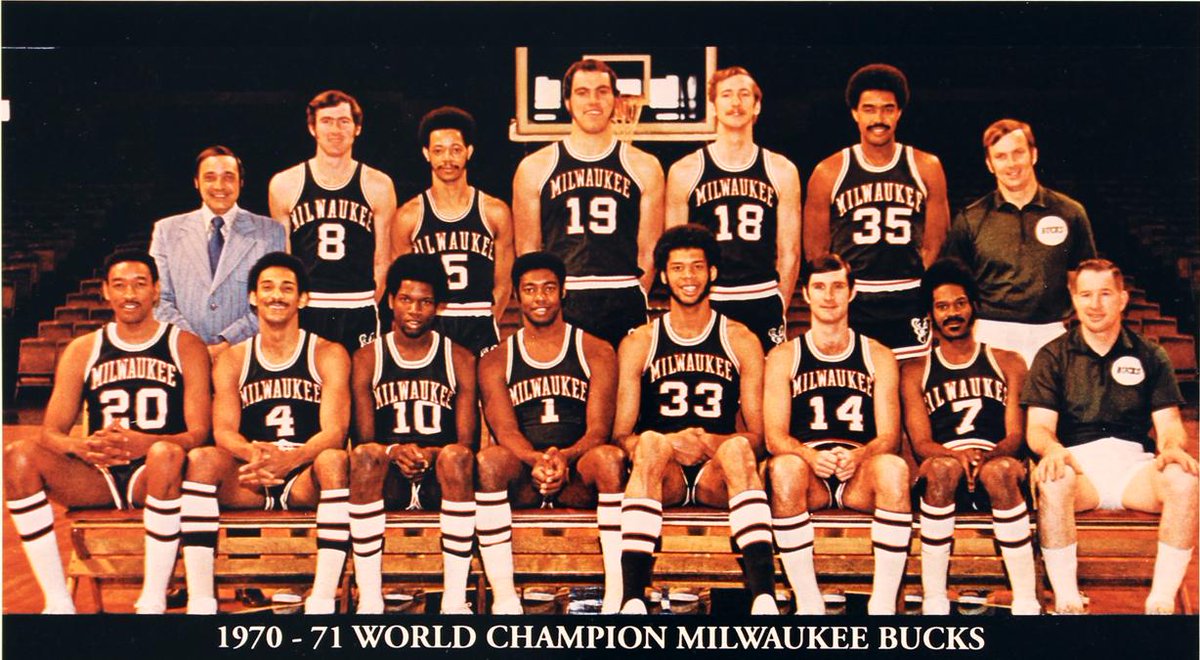
April 30, 1971, 50 years ago: The Milwaukee Bucks beat the Baltimore Bullets, 118-106, at the Baltimore Civic Center, to complete a 4-game sweep, and win the NBA Championship.

The Bullets had 3 future members of the Basketball Hall of Fame: Forwards Wes Unseld and Gus Johnson, the latter being one of the NBA's earliest dunk artists; and guard Earl Monroe. "Earl the Pearl" was a sensational player. Walt Frazier of the Knicks was then his only competitor for the title of the NBA's flashiest player, and said, "I dreamt about a lot of women, but Earl Monroe was the only man I dreamt about." A year later, trying to regain the title they won in 1970, the Knicks traded for Monroe, paired him in the backcourt with Frazier, reached the Finals in 1972, and won the title in 1973.

But the Bucks, in only their 3rd season as an NBA expansion team, were also loaded. They had one of the greatest all-around players in basketball history, guard Oscar Robertson. And now, the Big O had been joined by the greatest player in college basketball history, center Lew Alcindor -- who, a year later, would announce his conversion to Islam, and the change of his name to Kareem Abdul-Jabbar.

Oscar and Kareem would be named to the Hall of Fame and the NBA's 50th Anniversary 50 Greatest Players. As the league's 75th Anniversary arrives later this year, each is arguably still 1 of the 10 best players in NBA history.

Robertson (1), Abdul-Jabbar (33), forward Bob Dandridge (10) and guard Jon McGlocklin (14) would all eventually have their uniform numbers retired by the Bucks. Guard Lucius Allen (7) and forward Bob Boozer (20) had been All-Stars. Larry Costello, who had played on the Philadelphia 76ers team that won the 1967 NBA title, coached them to a 66-16 record. So while the Bullets were really good, this was not an upset.

The Bucks would reach the NBA Finals again in 1974, and lose a tough 7-game series to the Boston Celtics. Oscar retired after that Game 7. After another season, Kareem demanded a trade, to either his hometown of New York, or to Los Angeles, where he'd starred at UCLA. He was traded to the Los Angeles Lakers, and helped them win 5 titles.

The Bucks have won Division titles in 1972, 1976, 1980, 1981, 1982, 1983, 1984, 1985, 1986, 2001, 2019 and 2020; and reached the Conference Finals in 1972, 1983, 1984, 1986, 2001 and 2019. But they have never reached the NBA Finals since 1974 -- although, at this writing, they stand to be the 3rd seed in the 2021 Eastern Conference Playoffs. This may be their best chance since 1974.

But they haven't won an NBA Championship since 1971. In fact, no Milwaukee-based team has won a major league World Championship since then. The city has never had an NHL team, nor an MLS team. Nor did it have one in the ABA, the WHA or the NASL. The Milwaukee Braves won the 1957 World Series, but moved to Atlanta in 1966. The Milwaukee Brewers debuted in 1970, but have won only 1 Pennant, in 1982, and lost the World Series.

And while the Green Bay Packers used to play some "home" games in Milwaukee from 1933 to 1994, they don't count as a Milwaukee team, so their 13 NFL Championships can't be included. Milwaukee hasn't had a professional football team since the Milwaukee Chiefs of the 1940-41 version of the American Football League.

So the last Milwaukee title remains that of the Bucks, won on April 30, 1971. That's exactly 50 years, half a century. How long has that been?

*

The 1970-71 season was the 1st in the NBA for 3 teams: The Portland Trail Blazers, the Cleveland Cavaliers, and the Buffalo Braves. The Braves have moved twice: They became the San Diego Clippers in 1978, and the Los Angeles Clippers in 1984.

Of the NBA's 17 franchises, 7 -- the Blazers, the Cavs, the Braves, the Bucks, the Phoenix Suns, the Seattle SuperSonics, and the Chicago Bulls -- had begun play no more than 5 years earlier. In addition to the Braves: The San Francisco Warriors moved across San Francisco Bay to Oakland before the next season, changed their name to the Golden State Warriors, and kept that name despite moving back to San Francisco in 2019; the San Diego Rockets moved to Houston before the next season; the Cincinnati Royals became the Kansas City Kings in 1972 and the Sacramento Kings in 1984; the Bullets moved to the D.C. area for 1973, taking the name Capital Bullets for a season before taking the name Washington Bullets in 1974, and becoming the Washington Wizards in 1997; and the Sonics became the Oklahoma City Thunder in 2008.

The New York Knicks had moved into "the new Madison Square Garden Center" 3 years earlier. Not only has that version of The Garden now outlasted each of the 3 that came before it, but it is, by far, the oldest arena currently in use in the NBA, and the only one that was in use in both 1971 and 2021.

The home arenas of both 1971 finalists still stand. The Bucks played at the Milwaukee Exposition Convention Center and Arena, usually shortened to "The Milwaukee Arena" or, due to its initials, "The MECCA." It opened in 1950. They moved across the street to the Bradley Center in 1988, and across another street to the Fiserv Forum in 2019.

The University of Wisconsin at Milwaukee still plays their home games at the MECCA (officially, now the UW-Milwaukee Panther Arena), but the Bucks (except for a regular season game celebrating their 50th Season in 2017), the basketball team at Marquette University, and minor-league hockey's Milwaukee Admirals have moved to each new arena in turn.

The Baltimore Civic Center opened in 1962, and was home to the Bullets from 1963 to 1973. It is now named the Royal Farms Arena, for a convenience store chain native to Maryland. Both it and the MECCA seat about 11,000 people, and while Baltimore would like to attract a new (or moved) NBA team, they will have to build a replacement, as there is no way to expand the older arena.

Several other arenas in use in the 1970-71 season still stand: The Suns' original home, the Arizona Veterans Memorial Coliseum; the building the Lakers were then using, the Forum in suburban Inglewood; the building the Warriors were then using, the Cow Palace in suburban Daly City; the building the Blazers were then using, the Portland Memorial Coliseum; the building the Rockets were then using, the San Diego Sports Arena, now known as the Pechanga Arena; and the building the Detroit Pistons were then using, Cobo Hall, now known as the TCF Center.

The American Basketball Association was in its 4th season of play, and their title would be won by the Utah Stars, who defeated the Louisville-based Kentucky Colonels in 7 games. Despite some strong seasons by the NBA's Utah Jazz, the '71 Stars remain the only Utah-based major league sports team to go as far as they were allowed to -- if, that is, you consider the ABA to be "major league," and not Major League Soccer, whose MLS Cup was won by Real Salt Lake in 2009.

Of the 11 franchises then in the ABA, only 4 survive today, having been absorbed into the NBA in 1976. But only 1 of them is still using the same name, the Indiana Pacers. They had won the title in 1970, and would win it again in 1972 and 1973. The Denver Rockets survive, but became the Denver Nuggets in 1974. The New York Nets, based on Long Island, won the ABA title in 1974 and 1976, became the New Jersey Nets in 1977 and the Brooklyn Nets in 2012. And the Dallas Chaparrals became the San Antonio Spurs in 1976.

None of those teams is using the same arena. But 8 of the 1970-71 ABA arenas still stand: The Pacers' Indiana State Fairgrounds Coliseum, the Rockets' Denver Auditorium, the Chaparrals' Moody Coliseum, the Colonels' Freedom Hall, the Virginia Squires' Norfolk Scope, the Memphis Pros' Mid-South Coliseum, the Carolina Cougars' Charlotte Coliseum (now the Bojangles Coliseum), and the Miami Floridians' Miami Beach Convention Center.

(The Nets' Island Garden and the Stars' Salt Palace have both been demolished and replaced by new buildings with the same name. And the Pittsburgh Condors' Civic Arena is gone.)

Major League Baseball had 24 teams. The National Football League had recently finished its 1st season after the merger with the American Football League, with 26 teams. The National Hockey League was wrapping up a season with 14 teams, including the expansion Buffalo Sabres and Vancouver Canucks.

The defending World Champions in each sport were the Knicks in basketball, the Baltimore Orioles in baseball, the Baltimore Colts in football, and, in hockey, the Montreal Canadiens were 18 days away from completing their dethroning of the Boston Bruins, whom they'd already beaten in what is -- rather unfairly -- considered one of the greatest upsets in the history of the Stanley Cup Playoffs. The Heavyweight Champion of the World was Joe Frazier.

Pete Maravich and Dave Cowens were pro rookies that season. Julius Erving and Bill Walton were in college. Moses Malone was in high school. Bernard King and Larry Bird were in junior high school. Magic Johnson was 11 years old. Isiah Thomas turned 10 that very day, and Dennis Rodman was about to turn 10.

John Stockton was 9. Clyde Drexler, Patrick Ewing, Hakeem Olajuwon, Michael Jordan and Charles Barkley were 8. Karl Malone (no relation to Moses) was 7. David Robinson and Scottie Pippen were 5. Dikembe Mutombo was 4. Gary Payton was 2. Christian Laettner was a year and a half old. Alonzo Mourning was 1. Shaquille O'Neal, Allen Iverson, Tim Duncan, Vince Carter, Dirk Nowitzki and Kobe Bryant weren't born yet.

Tom Thibodeau, now the head coach of the Knicks, was 13. Lindy Ruff of the Devils was 11. Barry Trotz of the Islanders was 9. David Quinn of the Rangers was 4. Aaron Boone of the Yankees, Steve Nash of the Nets, Ronny Deila of NYCFC, Gerhard Struber of the Red Bulls, Robert Saleh of the Jets, Luis Roas of the Mets, Joe Judge of the Giants, and Walt Hopkins of the Liberty weren't born yet.

The Olympic Games have since been held in America 4 times; Canada 3 times; twice each in Japan, Russia, Korea; and once each in Germany, Austria, Bosnia, France, Spain, Norway, Australia, Greece, Italy, China, Britain and Brazil. The World Cup has since been held in Germany twice, and once each in America, Argentina, Spain, Mexico, Italy, France, Japan, Korea, South Africa, Brazil and Russia.

The 26th Amendment to the Constitution, lowering the voting age from 21 to 18, was a few weeks away from being ratified. The EPA and OSHA were new. Title IX hadn't yet happened. Abortion was legal in a few States, including New York, but Roe v. Wade was nearly 2 years away. Amy Coney Barrett, the newest Justice on the Supreme Court, wasn't born yet.

The gay rights movement was in its infancy. The idea that people of the same gender could marry each other, and have the legal protections of marriage, was ridiculous -- but so was the idea that corporations were "people," and entitled to the rights thereof.

The President of the United States was Richard Nixon. The Governor of the State of New York was Nelson Rockefeller; of New Jersey, William T. Cahill; and of the State that was home to the Bucks, Wisconsin, Patrick Lucey. The Mayor of the City of New York was John Lindsay; and of Milwaukee, Henry Maier.

The current holders of those offices? Joe Biden was in his 1st year in public office, on the New Castle County Council in Delaware. Andrew Cuomo and Phil Murphy were 13. Bill de Blasio was about to turn 10. Governor Tony Evers of Wisconsin and Mayor Tom Barrett of Milwaukee were in college.

Former Presidents Harry Truman and Lyndon Johnson, their wives, and the widows of Dwight D. Eisenhower and John F. Kennedy were still alive. Gerald Ford was the House Minority Leader. Jimmy Carter was the Governor of Georgia. Ronald Reagan was the Governor of California. George H.W. Bush was America's Ambassador to the United Nations. Donald Trump was starting out in his father's real estate company. Bill Clinton was at Yale Law School, where he was about to meet Hillary Rodham. George W. Bush was in the Texas Air National Guard. (Sort of.) Barack Obama was 9 years old.

There were still living veterans of the Indian Wars and the Northwest Rebellion. Peter Mills, the last American known to have been born into slavery, was still alive. Norman Borlaug, leader of what was being called the food production revolution, was the holder of the Nobel Peace Prize. The Pope was Paul VI. The current Pope, Francis, then Jorge Mario Bergoglio, was teaching at a seminary in his native Argentina.

The Prime Minister of Canada was Pierre Trudeau, and of Britain, Edward Heath. The monarch of both nations was Queen Elizabeth II -- that hasn't changed. Arsenal of North London was 3 days away from dethroning Everton of Liverpool as Champions of England's Football League, and 8 days away from dethroning Chelsea of West London as holders of the FA Cup. There have since been 10 Presidents of the United States, 10 Presidents of the United States, and 5 Popes.

Major novels of 1971 included The Exorcist by William Peter Blatty, The Day of the Jackal by Frederick Forsyth, The Autobiography of Miss Jane Pittman by Ernest J. Gaines, Being There by Jerzy Kosinski, The Lathe of Heaven by Ursula K. Le Guin, Honor Thy Father by Gay Talese, and The Winds of War by Herman Wouk.

Under his pen name Dr. Seuss, Theodor Seuss Geisel published his environmental allegory The Lorax. Books that were edgy about sex were still very much in, including Joan Garrity's The Sensuous Woman and Xaviera Hollander's The Happy Hooker: My Own Story.

J.R.R. Tolkein was still alive. Stephen King was a newlywed, and had yet to publish a novel. George R.R. Martin was about to get his master's degree from Northwestern University. J.K. Rowling was 5 years old.

Major films of the Spring of 1971 included Summer of '42, Melvin Van Peebles' Sweet Sweetback's Baadasssss Song, Woody Allen's Bananas, Billy Jack, The Beguiled, They Might Be Giants (inspiring the name of a band), a remake of Wuthering Heights, Who Is Harry Kellerman and Why Is He Saying Those Terrible Things About Me?, McCabe & Mrs. Miller, Klute, Carnal Knowledge, and Willy Wonka & the Chocolate Factory.

Gene Roddenberry was kind of lost after the end of Star Trek, writing and producing the sexploitation film Pretty Maids All In a Row. George Lucas had just premiered his 1st directed film, THX 1138. Steven Spielberg's 1st, Duel, would premiere on ABC on November 13. Sean Connery had just wrapped up his last official James Bond film, Diamonds Are Forever. Jon Pertwee was playing The Doctor. George Reeves, dead for 12 years, was still the last live-action Superman, while Adam West was still a recent Batman.

All in the Family had recently debuted. The Sonny & Cher Comedy Hour, Columbo, McMillan & Wife, Soul Train and the PBS kids' show The Electric Company were on their way. CBS had just done its "Rural Purge," ending The Beverly Hillbillies, Mayberry R.F.D. and Green Acres. ABC followed with The Johnny Cash Show. Also recently canceled were Family Affair, Julia, Hogan's Heroes, Dark Shadows and The Ed Sullivan Show. In the latter case, they had to: Ed was slipping into dementia, and died in 1974.

Robert Kardashian was early in his law practice. Bruce Jenner had just graduated from Graceland University in Lamoni, Iowa. Kris Houghton was in high school. None of them were famous yet, and, as far as I know, none of them knew each other.

No one had yet heard of John Shaft, Kwai Chang Caine, Fred Sanford, Leatherface, Arthur Fonzarelli, Barney Miller, Lestat de Lioncourt, Rocky Balboa or J.R. Ewing.

The Number 1 song in America was "Joy to the World" by Three Dog Night. The Rolling Stones released their album Sticky Fingers, they introduced their lips-and-tongue logo, and lead singer Mick Jagger married model Bianca de Macias. John Denver released "Take Me Home, Country Roads," Stevie Wonder "If You Really Love Me," Jerry Reed "When You're Hot, You're Hot," Rod Stewart Every Picture Tells a Story, Johnny Cash The Man In Black, Paul McCartney Ram, Ringo Starr "It Don't Come Easy," and Elvis Presley Love Letters from Elvis. The Carpenters and The Doobie Brothers each released their self-titled debut album. 

The Temptations released "Just My Imagination (Running Away With Me)," and Eddie Kendricks left the group. The Doors released L.A. Woman. Within weeks, lead singer Jim Morrison was dead. The 1st Glastonbury Festival was held, and promoter Bill Graham closed the Fillmore East in New York and the Fillmore West in San Francisco. Don McLean first performed his song "American Pie," and referenced the closings in the last verse: "I went down to the sacred store, where I'd heard the music years before, but the man there said the music wouldn't play."

Inflation was such that what $1.00 bought then, $6.49 would buy now. A U.S. postage stamp cost 8 cents, and a New York Subway ride 30 cents. The average price of a gallon of gas was 33 cents, a cup of coffee 46 cents, a McDonald's meal (Big Mac, fries, shake) $1.26, a movie ticket $1.65, a new car $3,742, and a new house $28,600. The Dow Jones Industrial Average closed that Friday at 941.75.

The tallest building in the world was the Empire State Building in New York, but the World Trade Center in New York and the Sears Tower in Chicago were both under construction, and would surpass it. Mobile telephones were still in development.

There were no home video game systems. Computers could still take up an entire wall. Steve Jobs was 16 years old, and Bill Gates and Tim Berners-Lee were about to be. Apollo 14 had landed on the Moon 3 months earlier. Automatic teller machines were still a relatively new thing, and many people had never seen one. There were heart transplants, liver transplants and lung transplants, and artificial kidneys, but no artificial hearts. There were birth control pills, but no Viagra.

During the Spring of 1971, there was a military coup in Argentina. East Pakistan declared its independence, becoming Bangladesh, and suffering a war, a famine and a cyclone, which led to the charity concert at Madison Square Garden, hosted by former Beatle George Harrison.

An earthquake killed over 1,000 people in Turkey. A plane crash in Rijeka, Yugolsavia killed 78 people, mostly British tourists. Neville Bonner became the 1st Indigenous Australian to sit in his country's Parliament. And the Montreal Canadiens overcame internal strife, made worse by recent Quebec separatist terrorism, to win the Stanley Cup.

In America, on the day of the decisive North London Derby, the largest antiwar demonstration in the nation's history, 750,000 people, hit Washington; and President Nixon ordered Robert F. Kennedy Stadium, named in memory of a former political rival, to be used as a giant holding center for arrestees, who numbered over 12,000 -- about 1 out of every 62 demonstrators.

Lieutenant William Calley was convicted in the My Lai Massacre. Starbucks, Southwest Airlines and Federal Express were founded. The Supreme Court ruled that busing of students may be ordered to achieve racial desegregation. The New York Times published the Pentagon Papers. President Richard Nixon declared the War On Drugs. And the day after the Bucks won the NBA Championship, Amtrak officially took over America's passenger rail service.

Thomas Dewey, and Igor Stravinsky, and Ogden Nash died. Ewan McGregor, and Selena Quintanilla, and David Tennant were born. So were legendary athletes Pavel Bure and Picabo Street.

April 30, 1971. The Milwaukee Bucks won the NBA Championship. No Milwaukee team has won a World Championship since.

Will it happen again? The only current teams that can make it happen are the Bucks and the Brewers. The Bucks look like they'll have a good Playoff seed, while the Brewers are currently in 1st place in the National League Central Division. The potential for ending a half-century's drought is there. Stay tuned.

UPDATE: On July 20, 2021, the Bucks won the NBA Championship, beating the Phoenix Suns, 105-98, in Game 6, at the Fiserv Forum in Milwaukee. The Suns had won the 1st 2 games, but the Bucks took the next 4 straight. In Game 6, Giannis Antetokounmpo, the Bucks' Nigerian-Greek forward, scored 50 points, only the 7th time in the league's 75 years that this has been done.