Showing posts with label alabama. Show all posts

Friday, April 10, 2026

April 10, 1956: Nat King Cole Is Assaulted Onstage In Birmingham

April 10, 1956, 70 years ago: Nat King Cole, one of the most popular singers in America, is assaulted in mid-concert.

America's favorite black singer -- white adults weren't ready to accept Chuck Berry, Fats Domino and Little Richard yet -- was playing piano and singing with the Ted Heath Orchestra at the Municipal Auditorium in Birmingham, Alabama.

Cole sat at his piano before 4,000 people -- all white, as State law required separate concerts for white and black audiences. Three songs in, three white men rushed the stage and attacked him. He fell backward. His suit was torn, and his body was bruised. The audience screamed as police flooded the stage in chaos. Behind the curtain, the orchestra played "God Save the Queen," a desperate attempt to restore order while one of the greatest voices in America lay shaken backstage.

When Cole finally returned to the microphone, the crowd rose as one. They applauded for 10 straight minutes. Many were crying. Quietly, calmly, he said, "I just came here to entertain you. That was what I thought you wanted. I was born in Alabama."

He couldn't finish the show. But later that night -- injured, shaken, and still sore -- Nat King Cole kept his promise: He returned to the theater, and performed for the black audience waiting for their edition of the segregated concert.

The next day, reporters asked how he felt. "I didn’t think I had an enemy in Alabama," he said. "I''m not mad at a soul."

That grace unsettled people. Some civil rights leaders wanted anger. They wanted fire. They wanted confrontation. Cole chose something else.

Six months later, he made history: On November 5, 1956, The Nat King Cole Show premiered on NBC. It was the first national television program hosted by a Black American. He performed alongside legends like Ella Fitzgerald and Harry Belafonte. He sang. He played. He smiled with dignity in living rooms that had never imagined a Black man at their center. The ratings were strong. The reviews were glowing.

And still, not one major advertiser would sponsor the show. Corporations feared backlash. Executives worried about Southern customers. So for 13 months, NBC paid for the program alone, hoping sponsors would eventually step forward. They never did.

When the show ended in December 1957, Cole finally named the truth: "Madison Avenue is afraid of the dark."

In 1965, Nat King Cole died of lung cancer, at only 45 years old. He had lived long enough to see the March On Washington and the Civil Rights Act of 1964, but not the Voting Rights Act of 1965.

He understood exactly what he had done: "For thirteen months, I was the Jackie Robinson of television."

The Municipal Auditorium, built in 1924, still stands, at 1930 Reverend Abraham Woods Jr. Boulevard, formerly 8th Avenue, facing Linn Park, and across Interstate 20/59 from the city's main arena, the Birmingham-Jefferson Civic Center.
It was renamed the Boutwell Auditorium, in memory of Albert Boutwell, elected Mayor in 1963 as a rejection of racist Police Commissioner Eugene "Bull" Connor. He had previously been Lieutenant Governor and a State Senator. He was defeated for re-election in 1967, and died in 1978.

*

That same night, April 10, 1956, the Montreal Canadiens won the Stanley Cup, beating the team that had beaten them in the last 2 Stanley Cup Finals, the Detroit Red Wings. The Habs won, 3-1 at the Montreal Forum, to win Game 5 and take the 1st of what turned out to be 5 straight Stanley Cups.

Three days earlier, on April 7, the Philadelphia Warriors won Game 5 of the NBA Finals, beating the Fort Wayne Pistons, to win the NBA Championship.

Monday, December 1, 2025

December 1, 1955: Rosa Parks Holds Her Seat

December 1, 1955, 70 years ago: Rosa Parks is told to get up and move. She says, "No." In so, doing, she made history.

As historian Laurel Thatcher Ulrich said, "Well-behaved women rarely make history."

Let the record show that Rosa Parks was not the first woman to make this kind of history. In 1943, 17-year-old Bernice Delatte was arrested for defying segregation rules on a bus in New Orleans. In 1944, a U.S. Army Lieutenant was told to go to the back of a bus, to make room for a lower-ranking soldier. He refused. He got court-martialed. He was acquitted. His name was Jack Roosevelt Robinson. Yes, that Jackie Robinson. And in 1953, a 6-day boycott got the buses in Baton Rouge, Louisiana desegregated.

On March 2, 1955, Claudette Austin was arrested in Montgomery, the capital of Alabama, for refusing to give up her seat to a white woman on a crowded, segregated bus. The National Association for the Advancement of Colored People had been waiting for a chance to challenge a "send the blacks to the back of the bus" law, in line with the decision the year before, by the U.S. Supreme Court, in Brown v. Board of Education of Topeka, Kansas, that accommodations that were officially "separate but equal" was unconstitutional.

But Claudette was 15 years old, unmarried, and pregnant. Parks later said, "If the white press got ahold of that information, they would have a field day. They'd call her a bad girl, and her case wouldn't have a chance." The NAACP would need a more sympathetic defendant. Nine months later -- perhaps an appropriate time period -- they found one: Parks herself.

Rosa Louise McCauley was born on February 4, 1913 in Tuskegee, Alabama, and grew up in Pine Level, outside Montgomery. She was bullied by white children, and never forgot it. In 1932, she married Raymond Parks, a barber who worked with the NAACP. She joined the Montgomery chapter in 1943, and was elected its secretary. During World War II, she rode on an integrated trolley at Maxwell Air Force Base in Montgomery. She later said, "You might just say Maxwell opened my eyes up."

On November 27, 1955, Rosa Parks was attending Dexter Avenue Baptist Church in Montgomery, whose pastor was 26-year-old Dr. Martin Luther King Jr. He had invited T.R.M. Howard, head of the Regional Council of Negro Leadership in Mississippi, to speak of the recent murder of Emmett Till, and the acquittal of the 2 men who did it.

It was still on her mind 4 days later, on December 1. At around 6:00 PM, she boarded a Montgomery City Lines bus downtown. Eventually, all of the White-only seats in the bus filled up. The bus reached the third stop, in front of the Empire Theater, and several White passengers boarded. The driver, James F. Blake, noted that two or three White passengers were standing, as the front of the bus had filled to capacity.

Blake moved the "colored" section sign behind Parks, and demanded that four Black people give up their seats in the middle section, so that the White passengers could sit. Three of them complied. Parks said, "I thought of Emmett Till, a 14-year-old African American who was lynched in Mississippi in 1955, after being accused of offending a White woman in her family's grocery store, whose killers were tried and acquitted – and I just couldn't go back." In her autobiography, she said:
People always say that I didn't give up my seat because I was tired, but that isn't true. I was not tired physically, or no more tired than I usually was at the end of a working day. I was not old, although some people have an image of me as being old then. I was forty-two. No, the only tired I was, was tired of giving in.
When Parks refused to give up her seat, Blake took to his radio, and called the police. When she was arrested, she asked the officer, "Why do you push us around?" She remembered him saying, "I don't know, but the law's the law, and you're under arrest."

She was charged with a violation of Chapter 6, Section 11, segregation law of the Montgomery City code. Edgar Nixon, president of the Montgomery chapter of the NAACP and leader of the Pullman Porters Union, and her friend Clifford Durr bailed Parks out of jail that evening.

On Sunday, December 4, plans for the Montgomery bus boycott were announced at Black churches in the area, and a front-page article in the Montgomery Advertiser helped spread the word. At a church rally that night, those attending agreed unanimously to continue the boycott until they were treated with the level of courtesy they expected, until Black drivers were hired, and until seating in the middle of the bus was handled on a first-come-first-served basis.

The next day, Parks was tried on charges of disorderly conduct and violating a local ordinance. The trial lasted 30 minutes. After being found guilty and fined $10, plus $4 in court costs -- the total of $14 worth about $170 in 2025 money -- she appealed her conviction, and formally challenged the legality of racial segregation.

It rained that day, but the Black community persevered in their boycott. Some rode in carpools, while others traveled in Black-operated cabs that charged the same fare as the bus, 10 cents. Most of the remainder of the 40,000 Black commuters walked, some as far as 20 miles.

The boycott lasted for an entire year. On December 20, 1956, the federal ruling Browder v. Gayle took effect, declaring the Alabama and Montgomery laws that segregated buses were unconstitutional. All the seats on all the buses were now open to all.

In 1957, Rosa and Raymond Parks moved to Detroit, living with her brother and sister-in-law. She became a fair housing activist, helped John Conyers get elected to Congress in 1964, and served as his secretary until 1988. She participated in the Selma-to-Montgomery march in 1965. Her husband and brother died within weeks of each other in 1977, and she stepped back from civil rights activities thereafter to care for her mother, who died in 1979.

She then returned to the struggle, adding Planned Parenthood to her causes. In 1994, she was robbed and assaulted in her Detroit home. Mike Ilitch, founder of Detroit-based pizza chain Little Caesars, and owner of baseball's Detroit Tigers and hockey's Detroit Red Wings, bought her an apartment in a high-rise riverfront condo.

The following year, in commemoration of the 40th Anniversary of her seated stand, President Bill Clinton invited her to the State of the Union Address. He said, "She's sitting down with the First Lady tonight, and she may get up, or not, as she chooses." Acknowledging a standing ovation, she briefly stood.
She died on October 24, 2005, at the age of 92, after years of ill health and cognitive decline. Although often called "the mother of the Civil Rights Movement," she had no children of her own. She became the 1st woman, the 2nd black person, and the 1st private citizen to lie in state under the Rotunda of the U.S. Capitol Building in Washington.
A statue of her stands in Montgomery, roughly where she was arrested. In her adopted hometown of Detroit, the bus terminal is named for her. The bus on which she was arrested was also moved to Detroit, to the Henry Ford Museum in adjoining Dearborn, where it is on display along with the limousine in which President John F. Kennedy was assassinated, and the Ford's Theatre chair in which President Abraham Lincoln was sitting when he was assassinated.
As has been said, Rosa Parks sat, so that Martin Luther King could march, so that Barack Obama could run.
Bernice Delatte, the 1943 New Orleans protestor, lived until 2010. Claudette Austin became a nurse, married, and took the name Claudette Colvin. As of December 1, 2025, she is still alive.

Friday, June 6, 2025

Each State's Greatest Baseball Player

Monte Irvin of Orange, New Jersey

Notes: This is based not necessarily on where the player was born, but where he was trained to play baseball. And, as you will see, personal feelings will be set aside, except where steroids are concerned: All players known to have used steroids are ineligible.

1. Alabama: Willie Mays of Fairfield.
2. Alaska: Chad Bentz of Juneau.
3. Arizona: Jim Palmer of Scottsdale.
4. Arkansas: Brooks Robinson of Little Rock.
5. California: Joe DiMaggio of San Francisco.
6. Colorado: Roy Halladay of Arvada.
7. Connecticut: Jeff Bagwell of Killingworth.
8. Delaware: Chris Short of Milford.
9. District of Columbia: Maury Wills of Washington.
10. Florida: Steve Carlton of North Miami.
11. Georgia: Ty Cobb of Royston.
12. Hawaii: Shane Victorino of Wailuku.
13. Idaho: Harmon Killebrew of Payette.
14: Illinois: Robin Roberts of Springfield.
15. Indiana: Sam Rice of Morocco.
16. Iowa: Bob Feller of Van Meter.
17. Kansas: Walter Johnson of Humboldt.
18. Kentucky: Jim Bunning of Southgate.
19. Louisiana: Mel Ott of Gretna.
20. Maine: George Gore of Hartland.
21. Maryland: Babe Ruth of Baltimore.
22. Massachusetts: Mickey Cochrane of Bridgewater.
23. Michigan: Derek Jeter of Kalamazoo.
24. Minnesota: Dave Winfield of St. Paul.
25. Mississippi: Frank White of Greenville.
26. Missouri: Albert Pujols of Independence.
27. Montana: Dave McNally of Billings.
28. Nebraska: Grover Cleveland Alexander of St. Paul.
29. Nevada: Greg Maddux of Las Vegas.
30. New Hampshire: Carlton Fisk of Charlestown.
31. New Jersey: Monte Irvin of Orange.
32. New Mexico: Alex Bregman of Albuquerque.
33. New York: Lou Gehrig of Manhattan.
34. North Carolina: Gaylord Perry of Williamston.
35. North Dakota: Roger Maris of Fargo.
36. Ohio: Cy Young of Newcomerstown.
37. Oklahoma: Mickey Mantle of Commerce.
38. Oregon: Mickey Lolich of Portland.
39. Pennsylvania: Honus Wagner of Carnegie.
40. Rhode Island: Nap Lajoie of Woonsocket.
41. South Carolina: Joe Jackson of Greenville.
42. South Dakota: Dave Collins of Rapid City.
43. Tennessee: Todd Helton of Knoxville.
44. Texas: Tris Speaker of Hubbard.
45. Utah: Bruce Hurst of St. George.
46. Vermont: Ray Fisher of Middlebury.
47. Virginia: Justin Verlander of Goochland.
48. Washington: Ryne Sandberg of Spokane.
49. West Virginia: Jesse Burkett of Wheeling.
50. Wisconsin: Al Simmons of Milwaukee.
51. Wyoming: Tom Browning of Casper.

Saturday, March 15, 2025

March 15, 1965: President Lyndon B. Johnson Says "We Shall Overcome"

LBJ addressing Congress, in front of Vice President Hubert Humphrey
(left) and Speaker of the House John McCormack

March 15, 1965, 60 years ago: President Lyndon B. Johnson speaks before a Joint Session of Congress, on the need for a Voting Rights Act.

The speech comes 8 days after "Bloody Sunday," when demonstrators attempting to march from Selma, Alabama to the State capital in Montgomery were beaten by local police. Having gotten the Civil Rights Act of 1964 passed the previous summer, and with the biggest majorities that the Democratic Party has had since the 1937-38 session, Johnson now knew it was time to act.

As as a native of Texas, he had previously resisted advances in civil rights. At the time, it was a requirement for a Southerner who wanted to stay in office. But after he became the Senate Majority Leader in 1955, he began to open up to the idea. He was one of the few Southern Senators who refused to sign the Southern Manifesto of 1956.

In a speech written by Richard Goodwin, one of the few White House employees he had kept from the John F. Kennedy Administration, he said: 

There is no Negro problem. There is no Southern problem. There is no Northern problem. There is only an American problem...

Our mission is at once the oldest and the most basic of this country: To right wrong, to do justice, to serve man...

What happened in Selma is part of a far larger movement, which reaches into every section and State of America. It is the effort of American Negroes to secure for themselves the full blessings of American life. Their cause must be our cause too.

Because it is not just Negroes, but, really, it is all of us, who must overcome the crippling legacy of bigotry and injustice.

Johnson then leaned forward slightly, to make his point more deeply, and said, "And we shall overcome." He emphasized the word "shall."

The inclusion of that last line bolstered Johnson's status within the Civil Rights Movement. It showed that this 56-year-old white Southerner was completely serious about making sure that black people were going to get the right to vote.

The line came Pete Seeger's civil rights folk anthem. Seeger stated he first heard the line sung by striking African-American tobacco workers in the 1940s.

John Lewis, who had been one of those beaten at Selma, watched the speech with Dr. Martin Luther King Jr., and said that King wiped away a tear when Johnson uttered the phrase.

The Voting Rights Act of 1965 was introduced into Congress 2 days later. The Senate passed it on May 26. The House of Representatives passed it with amendments on July 9. A conference committee worked out the differences on July 29. It was passed by the House, 328-74, on August 3. It was passed by the Senate, 79-18, on August 4. And on August 6, 1965, LBJ signed it into law.

It was the high-water mark of American liberalism, and of Johnson's Administration, coming just 7 days after he signed Medicare and Medicaid into law. Just 5 days after he signed the Voting Rights Act into law, a race riot broke out in the Watts section of Los Angeles. It wasn't the first such riot, but nor would it be the last. Meanwhile, people began to realize that the Vietnam War was not coming to an end.

From November 22, 1963 to August 6, 1965, a span of 622 days, Lyndon Baines Johnson did more good as President than most others who have held the office have done, even if given a full 8 years. But from 1967 onward, he has been remembered as "The Vietnam President" first, and the pro-civil rights and anti-poverty President second, if that. It's been 60 years. It's time to remember the good he did.

Friday, March 7, 2025

March 7, 1965: Bloody Sunday in Selma & U.S. Soccer's Great Missed Opportunity

March 7, 1965, 60 years ago: Selma, Alabama becomes a flashpoint in the Civil Rights Movement. A crowd estimated at 600 people were determined to march from Selma to the State capital of Montgomery, 54 miles away, to demand a Voting Rights Act to follow the Civil Rights Act of the previous year.

The march was led by John Lewis of the Student Nonviolent Coordinating Committee (SNCC), and the Rev. Hosea Williams of the Southern Christian Leadership Conference (SCLC).

The marches reached the Edmund Pettus Bridge, carrying U.S. Route 80 over the Alabama River. Built in 1940, the bridge was already heavy with symbolism: Pettus was a Brigadier General in the Confederate Army, and later an official in the Ku Klux Klan. He was elected to the U.S. Senate in 1896, and served until his death in 1907.

By 1965, Pettus was virtually unknown outside Alabama, but the bridge named for him became a landmark.

When the marchers got to the other side of the bridge, State Troopers were waiting for them. Their commanding officer, John Cloud, ordered them to disband. Williams tried to speak to him, but was shoved. The Troopers then moved forward, shoved other demonstrators, and began beating them with their nightsticks. Tear gas was fired. Mounted Troopers charged.

Williams escaped serious injury. Lewis did not: He sustained a fractured skull. (That's him in the overcoat, in the middle of the photograph above.) Amelia Boynton, another organizer of the march, was beaten unconscious. Television cameras captured it all: The horses, the shoving, the beating, the gas. There were 67 injuries, including 17 people admitted to hospitals. Incredibly, no one died. But the event became known as Bloody Sunday.

There have been many "Bloody Sundays" in human history:

* Many of them have involved the struggle for Ireland: An 1887 police attack on a demonstration in London, a 1920 battle between the Irish Republican Army and undercover British intelligence agents in Dublin, a 1921 Loyalist massacre in Belfast, and a 1972 British Army shooting of protesters in Derry City.

* Some of them were in connection with the labor movement: A police charge during the 1911 Liverpool transit strike, the Everett Massacre in Washington State in 1916, police attacking a steelworkers' strike in Nova Scotia in 1923.

* Probably the best-known one outside the English-speaking world was in St. Petersburg, leading to the failed Russian Revolution of 1905.

This was America's Bloody Sunday. March 9 was "Turnaround Tuesday." Dr. Martin Luther King led marchers over the bridge, then, faced with another phalanx of State Troopers, turned them around and marched back. That night, 4 KKK members attacked the 3 white Unitarian Universalist ministers who had been assisting the black marchers. One of them, the Rev. James Reeb, died from his injuries on March 11. 

On March 15, President Lyndon B. Johnson addressed a joint session of Congress, demanding the Voting Rights Act that the marchers wanted. This white Southerner, once an opponent of civil rights, had made a complete turnaround, and told the nation, "It is not just Negroes, but, really, it is all of us, who must overcome the crippling legacy of bigotry and injustice. And we shall overcome."

On March 17, the bill for the Act was introduced in Congress. The same day, a federal judge ruled that the marchers had the legal right to proceed, and that the government of the State of Alabama, through any of its law enforcement agencies, could not interfere.

On March 21, 2 Sundays after the 1st attempt, the marchers, led by Dr. King, tried again. Among the celebrities who joined the march were black singers Sammy Davis Jr., Harry Belafonte and Nina Simone, and Hispanic singer Joan Baez -- but also white singers Tony Bennett, Frankie Laine, the Chad Mitchell Trio, and Peter, Paul and Mary (Peter Yarrow, Paul Stookey and Mary Travers). Many of those had been at the March On Washington a year and a half earlier.

On March 25, the march reached the State Capitol, where Dr. King said, "I know you are asking today, 'How long will it take?' I come to say to you this afternoon, however difficult the moment, however frustrating the hour, it will not be long."

That night, Viola Liuzzo, a 39-year-old white mother of 5 from Detroit was driving marchers back to Selma, as she had volunteered to do. A car full of Klansmen pulled up to her, and shot her. The KKK had no respect for the dead, especially those they murdered: They said she was a registered member of the Communist Party who had abandoned her white children in the North to have sex with black men in the South. It was a total lie.

On July 15, Barry McGuire recorded "Eve of Destruction," a song written by P.F. Sloan. The 4th and last verse contains these lines, invoking strife foreign and domestic:

Think of all the hate
there is in Red China
then take a look around
to Selma, Alabama.
You may leave here
for four days in space
but when you return
it's the same old place.

Some things did change: On August 6, 1965, 5 months after the 1st attempt at the march, LBJ signed the Voting Rights Act into law.

Some things didn't change: On April 4, 1968, Dr. King was assassinated in Memphis. In 1975, his widow, Coretta Scott King, led 4,000 marchers over the Edmund Pettus Bridge to commemorate the 10th Anniversary of the march.

In 1986, John Lewis was elected to Congress from a district in Atlanta. In 1995, Lewis led a 30th Anniversary march. In 1996, with the Olympics set for Atlanta, the Olympic torch was carried over the bridge.

In 2015, on the 50th Anniversary, Lewis, Amelia Boynton Robinson, Barack Obama (the 1st black President), Michelle Obama (the 1st black First Lady, and she and her husband flanked Lewis and held hands with him), their daughters Malia and Sasha, Vice President Joe Biden, and George W. Bush (whose record on race relations as Governor of Texas and then as President was, to put it politely, less than stellar), led a new march, of 40,000 people, including some of the original marchers, some now elderly and in wheelchairs.
Mrs. Robinson died later that year. Hosea Williams had died in 2000. On July 17, 2020, John Lewis died at age 80, having served in Congress for 33 years. On July 26, a horse-drawn carriage carried his coffin over the Edmund Pettus Bridge, and he lay in state at the Alabama State Capitol. The coffin was flown back to Washington, where it lay in state in the Rotunda of the U.S. Capitol on July 27 and 28.

He was buried in South-View Cemetery in Atlanta, which is also the final resting place of fellow civil rights figure Julian Bond, several members of Dr. King's family (but not Dr. King himself), singer Chuck Willis, baseball icon Hank Aaron, and Basketball Hall-of-Famer Walt Bellamy.

*

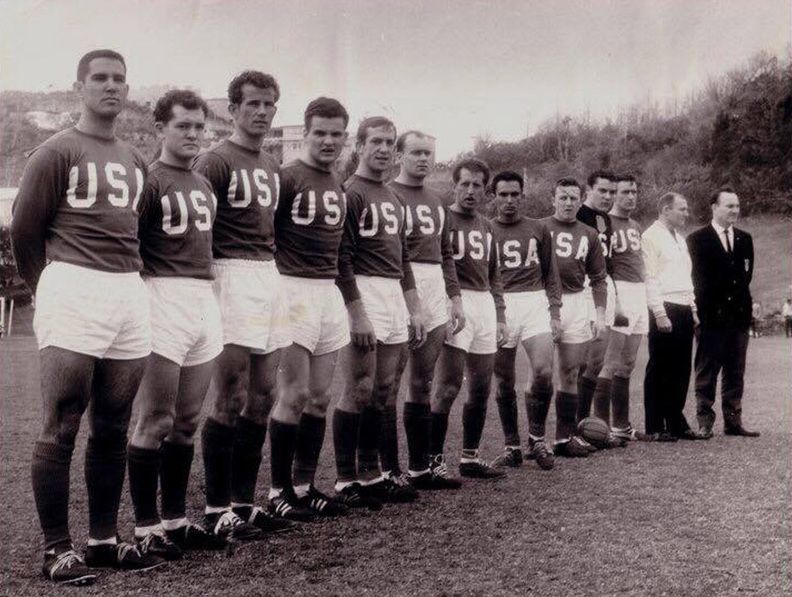
There is another event that took place on March 7, 1965 that should be mentioned. The U.S. national soccer team was in qualification, through CONCACAF -- the governing body for soccer in North America, Central America, and the Caribbean region -- for the 1966 World Cup in England.
The 1965 U.S. soccer team

The U.S. was placed in a group with Mexico and Honduras. We got a 1-0 win and a 1-1 draw with Honduras, but only a 2-2 draw and a 2-0 loss with Mexico. Had that 2-2 draw with Mexico at the Los Angeles Memorial Coliseum on March 7, 1965 been a 3-2 win, we would have advanced to the round-robin with Costa Rica and Jamaica.

Could we have won that? We'll never know. We still would have had to beat Mexico out for the one and only berth in the World Cup awarded to CONCACAF.

But even if we had won that game with Mexico, it would not have been the biggest story of the day. The Selma-to-Montgomery March was a story that should be remembered for all time.

Monday, June 26, 2023

1963: The Last Summer, Part I

The Summer of 1963 was a beginning for some, and an ending for many more. America would never quite be so young again as it was that year.

The Beach Boys emphasized youth as much as any rock and roll band ever has. Their home ground of Southern California, of course, features Summer weather all year long, and Summer activities all year long. And 1963 was the year of surf rock. The Beach Boys had released the album Surfin' U.S.A. on March 25. 

It contains the title track, which rose to Number 3 on Billboard magazine's Hot 100 chart. It's not the best Beach Boys song, but it is the most familiar one – much like the soon-to-be-recorded "She Loves You" became the prototypical early Beatles song. The album also contains the racing song "Shut Down," which became the B-side to "Surfin' U.S.A.," and also became a Top 40 hit.

It also includes 2 instrumentals that had been made famous the year before by lefthanded guitarist Dick Dale, considered the true father of surf rock: "Misirlou" and "Let's Go Trippin'." At the time, "trippin'" meant just that, going on a roadtrip, not feeling the effects of a mind-altering drug, or simply being crazy.

Beach Boys bass guitarist and main songwriter Brian Wilson was then dating a woman named Judy Bowles, whose brother Jim was a surfer, and knew all the surfing spots in the southern half of California. Brian thought of how Chuck Berry had listed a bunch of cities in his 1958 song "Sweet Little Sixteen," and decided to try the same thing.

Brian's brother, Carl Wilson, was one of the few guitarists who has ever been able to play Chuck Berry riffs as well as Chuck himself. But this song was so close to "Sweet Little Sixteen" that Chuck sued. A settlement was reached, and Chuck has been listed as the sole author of "Surfin' U.S.A." ever since. Chuck later told them that he loved the song.

The Beach Boys' 1st song, titled simply "Surfin'," was released in 1961, and was a regional hit. The next year, they released "Surfin' Safari," and it became a national Top 20 hit. "Surf rock" became a big deal, especially with instrumentals like "Misirlou," the Chantays' "Pipeline," and the Surfaris' "Wipe Out," with its epic drumming by Ron Wilson (no relation to the Beach Boys).

And yet, the only song about surfing that ever hit Number 1 on Billboard magazine's "Hot 100" chart was "Surf City," by Jan & Dean (Jan Berry and Dean Torrence), in their July 20 edition. As the skateboarding craze followed, Jan & Dean had a Top 20 hit with "Sidewalk Surfin'" in 1964.

The Beach Boys also specialized in songs about cars, and the racing thereof, like "Shut Down," "409," "Little Deuce Coupe," "Fun, Fun, Fun" (about a teenage girl and her Ford Thunderbird), and their 1st Number 1 hit, "I Get Around," which topped the chart in Summer 1964. They even recorded a Christmas album, which included "Little Saint Nick," which invoked Santa Claus working on his sleigh as if it were a hot rod.

The Beach Boys' car songs inspired others: "G.T.O." by Ronnie & the Daytonas, "Hey Little Cobra" by The Rip Chords, and "Dead Man's Curve" by Jan & Dean. The last of these, partly written by Brian Wilson, proved tragic and prophetic: In 1966, Jan Berry was badly hurt in a crash on North Whittier Drive, not far from the real-life curve mentioned in the song, at 9900 Sunset Boulevard in Los Angeles.

Ironically, the only member of the Beach Boys who was a regular surfer was the other Wilson brother, Dennis, the drummer. Brian, Carl, their cousin and lead singer Mike Love, and rhythm guitarist Al Jardine, who had been Hawthorne High School quarterback Brian's best friend and star receiver, weren't surfers, though they all acted out the part, especially with their onstage clothes. Brian never went surfing until 1976.

In a further irony, Dennis died by drowning in 1983, although that was because he was drunk and fell off a boat, not because of a surfing accident.

*

On June 1, 1963, Jomo Kenyatta was sworn in as the 1st President of Kenya, which would achieve full independence from Britain on December 12. On June 3, Northwest Airlines Flight 293, a Douglas DC-7, crashed into the Pacific Ocean off the coast of Alaska. All 101 people on board, including several U.S. military personnel, were killed.

Also on June 3, The Shoes of the Fisherman was published. This novel, by Morris West, was about a priest who had been a prisoner in a Soviet gulag, who was named Pope, affecting the Cold War. Green Bay Packers coach Vince Lombardi, a devout Catholic, would later call it his favorite novel, and hand out copies of it.

But the timing of its publication couldn't be worse: With the Second Vatican Council (a.k.a. Vatican II) still in progress, the real Pope, John XXIII, died of cancer that day. A new Pope would be selected on June 21: Giovanni Battista Montini, the Archbishop of Milan. He took the name Paul VI.

On June 4, reflecting the fact that professional athletes were paid so little that they had to have off-season jobs, Cleveland Browns safety Don Fleming and co-worker Walter Smith were electrocuted and killed on a construction site outside Orlando Florida. Fleming was only 25 years old. The Browns retired his Number 46.

This came just 17 days after the death of Ernie Davis, the 1st black player to win the Heisman Trophy, also signed by the Browns, but who died of leukemia without ever playing a professional down. Despite this, the Browns retired his Number 45. And that was just 8 days after the death of Eugene "Big Daddy" Lipscomb of the Pittsburgh Steelers, one of the top defensive linemen of the era, apparently from drugs.

On June 5, John Profumo, Britain's Secretary of State for War, resigned after revelations of an extramarital affair with Christine Keeler, who had also had an affair with a man who turned out to be a Soviet spy. One thing led to another, and Prime Minister Harold Macmillan had to resign on October 18. On June 7, The Rolling Stones released their 1st single, "Come On." On June 9, actor Johnny Depp was born.

On June 10, actress Jeanne Tripplehorn was born. And President John F. Kennedy gave the commencement address at American University in Washington, D.C. In it, he announced a plan for a Nuclear Test Ban Treaty, which would be signed by the U.S., Britain and the Soviet Union on August 5. Following the incredibly close call of the Cuban Missile Crisis the previous October, JFK wanted a genuine peace:

Not a Pax Americana enforced on the world by American weapons of war. Not the peace of the grave or the security of the slave. I am talking about genuine peace, the kind of peace that makes life on earth worth living, the kind that enables men and nations to grow and to hope and to build a better life for their children. Not merely peace for Americans, but peace for all men and women. Not merely peace in our time but peace for all time...

If we cannot end now our differences, at least we can help make the world safe for diversity. For, in the final analysis, our most basic common link is that we all inhabit this small planet. We all breathe the same air. We all cherish our children's future. And we are all mortal.

But the world, and its politics, move on. On June 11, Thích Quảng Đức, a 65-year-old South Vietnamese Buddhist monk, committed suicide by self-immolation, burning himself to death at a major intersection in the national capital of Saigon, to protest the oppression of Buddhists by the government of President Ngô Đình Diệm, who filled that government with his fellow Catholics.

It was, perhaps, the first sign that Americans had that, while the North Vietnamese were Communist and evil, the South Vietnamese may not have been "good" simply because they were capitalist and anti-Communist.

And June 11 would be a turning point in civil rights, as well.

*

The University of Cincinnati, despite being based in a "border" city, had featured one of the more racially-integrated college basketball teams in the country, including the most versatile player in the game, Oscar Robertson. He was already in the NBA, though, by the time the Bearcats won the NCAA Tournament, and thus the National Championship, in 1961 and 1962.

They reached the Final again in 1963, on March 23, at Freedom Hall in the Southern city of Louisville, Kentucky. Their opponents would be Loyola University of Chicago. In that Final, while Cincinnati started 2 black players, Loyola started 4 players, the 1st team ever to do so: Center Les Hunter, forwards Jerry Harkness and Vic Rouse, and guard Ron Miller. Only guard Jack Egan was white. Loyola won the game, 60-58 in an overtime classic.

On April 16, having been arrested in Birmingham, the largest city in Alabama, Dr. Martin Luther King Jr. wrote what became known as the "Letter From Birmingham Jail." On May 3, there was another demonstration, and the police turned biting police dogs and fire hoses -- powerful enough to be called "water cannons" and cause real pain -- on the demonstrators. It made the white police look like totalitarian animals, and rendered their claims of the black protestors being "Communists" look damned stupid.

On January 14, George Wallace was inaugurated as Governor of Alabama, and, in his Inaugural Address, promised, "And I say to you: Segregation now, segregation tomorrow, and segregation forever!" On June 11, he stood in the doorway of Foster Auditorium, then both the main indoor athletic facility and the registration building for the University of Alabama, in Tuscaloosa. The purpose was to deny the registration of the school's 1st black students. Two were making the attempt: James Hood and Vivian Malone. He said, as Governor, he had to "denounce and forbid this unwarranted and illegal action by the central government!"

It was not illegal: The Supreme Court had ruled segregation illegal in 1954, so Wallace was the one breaking the law. And it was not unwarranted. So Kennedy wanted his Attorney General, also his brother, Robert F. Kennedy, to do something about it. RFK sent his Deputy, Nicholas Katzenbach, and federal marshals to Tuscaloosa. Katzenbach showed Wallace a federal warrant for his arrest, letting him known that if he did not get out of that door, he would  be handcuffed and arrested, and exposed as a federal criminal on national television.

Martin Luther King Jr. was willing to go to jail to challenge a law he believed was unjust. George Corley Wallace was not: He decided that looking weak was better than looking like a criminal, and he backed down. But he was still a hero to America's bigots.

Nevertheless, accompanied by Katzenbach and the marshals, Malone walked in, and became the 1st black person to register as a student at the University of Alabama. Hood followed.

That night, JFK spoke from the Oval Office of the White House, and announced he was having a Civil Rights Bill submitted to Congress. He said, "We preach freedom around the world, and we mean it... But are we to say to the world, and, much more importantly to each other, that this is the land of the free, except for the Negroes?"

Mere hours later, Medgar Evers, the field secretary for Mississippi by the National Association for the Advancement of Colored People (NAACP), was shot and killed in his driveway by white supremacist Byron de la Beckwith. Twice in 1964, all-white juries would be unable to reach a verdict. In 1994, a mixed-race jury finally convicted him.

Despite the Evers assassination, the civil rights bill would become law, as the Civil Rights Act of 1964 -- but JFK would not be the President who signed it into law.

And on August 28, Dr. King would speak at the Lincoln Memorial, the highlight of the March On Washington for Jobs and Freedom. In front of a crowd of 300,000 people, he said, "I have a dream that, one day, this nation will rise up and live out the true meaning of its creed: 'We hold these truths to be self-evident: That all men are created equal.'"

*

Cleopatra, starring Elizabeth Taylor and Richard Burton, the most expensive and most-hyped movie ever made to that point, premiered on June 12. Somehow, it made a profit. Other notable films released in the Summer of 1963 included Jerry Lewis' The Nutty Professor, Irma la Douce, Jason and the Argonauts, PT 109 (about JFK's real-life World War II heroics), The Great Escape, Toys in the Attic, the Frankie Avalon & Annette Funicello franchise-starter Beach Party, Flipper, Promises! Promises!, and a horror film whose title would become the name of perhaps the first "heavy metal" band: Black Sabbath.

Actress Helen Hunt was born on June 15. On June 16, Valentina Tereshkova of the Soviet Union became the 1st woman in space, and Prime Minister David Ben-Gurion of Israel retired, handing the post over to Levi Eshkol. On June 17, in Abington School District v. Schempp, the U.S. Supreme Court ruled that State-mandated Bible reading in public schools was unconstitutional.

On June 18, Mexican actor Pedro Armendáriz died of cancer, and Pro Football Hall of Fame defensive lineman Bruce Smith was born. On June 20, the Moscow-Washington Hotline was authorized, to improve communications between the Cold War capitals. And the last episode of the ABC sitcom Leave It to Beaver aired.

On June 24, 94 people were killed in a landslide on Geoje Island in South Korea, and Britain granted Zanzibar self-rule. In 1964, Zanzibar would united with Tanganyika to form the Republic of Tanzania. Singer George Michael was born on June 25

*

President Kennedy traveled to Europe to meet with various national leaders. On June 26, 1963, 60 years ago today, he spoke at West Berlin's City Hall, with Chancellor Konrad Adenauer, and the man who would succeed him in that post, then the Mayor of West Berlin, Willy Brandt.

JFK addressed a crowd estimated at 450,000 people, roughly the same number that was on hand for Woodstock, 6 years later. Heinz Weber, of the German mission to the United Nations, translated Kennedy's English words to the crowd:

Two thousand years ago, the proudest boast was "Civis Romanus sum." Today, in the world of freedom, the proudest boast is "Ich bin ein Berliner."

I appreciate my interpreter translating my German!

There are many people in the world who really don't understand, or say they don't, what is the great issue between the free world and the Communist world. Let them come to Berlin!

There are some who say that Communism is the wave of the future. Let them come to Berlin!

And there are some who say, in Europe and elsewhere, we can work with the Communists. Let them come to Berlin!

And there are even a few who say that it is true that Communism is an evil system, but it permits us to make economic progress. Lass' sie nach Berlin kommen. Let them come to Berlin!

Freedom has many difficulties and democracy is not perfect, but we have never had to put a wall up to keep our people in, to prevent them from leaving us.

The great Boston Irishman had the Germans eating out of the palm of his hand. The Hall was 3 miles from the Wall, but the speech was broadcast on West German television and radio. How well the East Germans were able to jam the transmission is unknown, but, surely, some people in East Berlin heard Kennedy's words.

He closed with:

Freedom is indivisible, and when one man is enslaved, all are not free. When all are free, then we can look forward to that day when this city will be joined as one, and this country and this great Continent of Europe in a peaceful and hopeful globe. When that day finally comes, as it will, the people of West Berlin can take sober satisfaction in the fact that they were in the front lines for almost two decades.

All free men, wherever they may live, are citizens of Berlin, and, therefore, as a free man, I take pride in the words "Ich bin ein Berliner."

JFK's favorite part of the trip was a visit to his ancestral homeland, Ireland, on June 28. In 1843, Patrick Kennedy, JFK's great-grandfather, left Dunganstown in County Wexford. At this time, 120 years later, the biggest business in town was the Albatross Company, a fertilizer factory. JFK told the locals of Patrick, "If hadn't left, I'd be working at the Albatross Company."

Baseball Hall-of-Famer John "Home Run" Baker, a 3rd baseman for the 1910s Philadelphia Athletics, died on June 28.

Part II of this article will follow in August.

Saturday, September 12, 2020

September 12, 1970: The Sam Cunningham Game

September 12, 1970, 50 years ago: The University of Southern California, a.k.a. USC, takes the field at Legion Field in Birmingham, the secondary home field of the University of Alabama. They do so with the 1st all-black backfield in college football history, outside of historically black schools: Quarterback Jimmy Jones and running backs Clarence Davis and Sam Cunningham. 'Bama had been forced to racially integrate by President John F. Kennedy in 1963, but still hadn't fielded a single black football player. Of the schools then in the Southeastern Conference, Alabama's arch-rival Auburn, Florida, Kentucky, Mississippi State, Tennessee and Vanderbilt had; Georgia, Louisiana State (a.k.a. LSU) and Mississippi (a.k.a. Ole Miss) also had not. To be fair, Paul "Bear" Bryant had tried hard to recruit Frank Dowsing to be Alabama's 1st black player in 1969, but, a Mississippi native, he chose Mississippi State instead, becoming their 1st. So the Crimson Tide put an all-white team out against the USC Trojans. Sam Cunningham runs for 135 yards and 2 touchdowns. USC beats 'Bama 42-21. The Bear knew he couldn't send an all-white team out anymore. Jerry Claiborne, an assistant to Bryant at Texas A&M and Alabama, was head coach at Virginia Tech at the time, and later at Maryland and Kentucky, said, "Sam Cunningham did more to integrate Alabama in 60 minutes than Martin Luther King Jr. did in 20 years." Ironically, in the next off-season, Bryant played golf with USC coach John McKay, who mentioned he had a commitment from a junior college transfer from Alabama, defensive end John Mitchell. Bryant got him to switch. He even became one of Bear's assistant coaches, and has been on the Pittsburgh Steelers' staff since 1994. "Sam Bam" Cunningham helped USC win the National Championship in 1972. He spent the next 10 seasons with the New England Patriots, rushing for 5,453 yards and making the 1978 Pro Bowl. Despite all their success in the last 20 years, he is still their all-time leading rusher. He was elected to the College Football Hall of Fame, and the Patriots elected him to their team Hall of Fame.

But if not for that game in Birmingham in 1970, he would now be known as the older brother of the great Philadelphia Eagles quarterback Randall Cunningham, who played his college ball at Nevada-Las Vegas (UNLV). The other members of that USC backfield? Jones played in the Canadian Football League, and helped the Montreal Alouettes win their championship, the Grey Cup, in 1974. Although less regarded in college than Cunningham, Davis had a better pro career, helping the Oakland Raiders win Super Bowl XI in 1977.

UPDATE: Sam Cunningham died on September 7, 2021.

Thursday, December 14, 2017

Top 10 Athletes From Alabama

December 14, 1819: Alabama is admitted to the Union as the 22nd State.

July 13, 1868: Alabama is readmitted to the Union after having seceded for the Civil War.

December 12, 1819: Alabama really rejoined the Union, rejecting Roy Moore for the U.S. Senate, and electing Doug Jones.

Top 10 Athletes From Alabama

Note: While Paul William Bryant is the person best known for being associated with sports in Alabama, and he was a good football player at the University of Alabama in the 1930s, he was from Arkansas. And, besides, this is about athletes, with what they may have later done as coaches and executives being irrelevant. Therefore, the Bear will not be on this list.

Bryant was "the other end" when 'Bama had the great Don Hutson. But he, too, was born and raised in Arkansas. Joe Louis and Evander Holyfield were born in Alabama, but learned to box elsewhere. Same with Jesse Owens and running.

Honorable Mention to members of the Baseball Hall of Fame who didn't otherwise make the Top 10: Joe Sewell of Wetumpka, Henry "Heinie" Manush of Tuscumbia, Early Wynn of Hartford, Billy Williams of Whistler. Tim Hudson of Phenix City might join them, as he becomes eligible in 2021. Sewell, a graduate of the University of Alabama, was a charter inductee into the recently established College Baseball Hall of Fame.

A Very Honorable Mention to Leroy Robert "Satchel" Paige. The age-old questions about him were, "How old was he?" and "What would he have done if he'd been allowed to play in the white major leagues from the beginning?" Since the statistics we have on him are woefully incomplete, I can't honestly put him in the Top 10 -- even though he might be in the Top 4.

Here's what we do know: He first pitched in the Negro Leagues with the 1926 Chattanooga Black Lookouts -- many of the teams in the all-black leagues, even in the South, took on the names of the white team in the same city (including the most absurdly-named one of all, the Atlanta Black Crackers).

He won Pennants with the 1936 Crawfords, and the Kansas City Monarchs in 1939, 1940, 1941, 1942 and 1946. He also famously played in the Dominican Republic, for a team sponsored by dictator Rafael Trujillo, in 1937 and in the Mexican League in 1938.

In 1934, Dizzy Dean -- also a rural Southerner who might have been the best pitcher in the world at the time, and who also liked to tell conflicting stories about his background, including his birthdate -- knew he couldn't get Satch for the St. Louis Cardinals, but was enlightened enough to tell him, "Satch, if you an' me was on the same team, we'd have the Pennant wrapped up by the 4th of July, and then I'd take you fishin' until World Series time."

After the 1946 season, knowing the players needed money after World War II, Bob Feller organized a barnstorming tour, leading a team of white players, and hiring Satch to lead a team of black players.

Satch was built like Pedro Martinez, tall and skinny, but could still bring serious heat. And throw some odd pitches, sometimes making them up on the spot, like Luis Tiant (against whose father he'd pitched in Winter leagues in the Caribbean), David Cone and Orlando (El Duque) Hernandez.

He liked to say, "I ain't never thrown an illegal pitch. But, sometimes, I throw a pitch that ain't never been seen by this generation." He called one pitch "Bat Dodger," and it had nothing to do with Brooklyn. But his control was so sharp, he claimed in his 40s that he could still throw a ball over the top of a Coca-Cola bottle.

He was the biggest drawing card in black baseball, and whenever his team would face the Homestead Grays, setting up a battle between him and Josh Gibson, it was the toughest ticket in town. But when it was not he but his 1945 Monarchs teammate Jackie Robinson who was selected by the Brooklyn Dodgers to be the 1st black man in Major League Baseball since 1887, he was hurt. He later admitted that Robinson was the right man, because of his disposition.

In 1948, Bill Veeck, who'd already made Larry Doby the 1st black player in the American League, signed Satch for the Cleveland Indians. Satch had just turned 42 years old, still the oldest "rookie" in MLB history. (Veeck went down to Mobile, bribed who he had to bribe, and got his hands on the elusive birth certificate.) He went 6-1 down the stretch, and he and Doby became the 1st black men to play on a World Series winner.

Satch played on the Indians through 1949, spent the 1950 season with the Negro Leagues' Philadelphia Stars, and when Veeck bought the St. Louis Browns in 1951, signed him again, staying through the end of the franchise in 1953. Despite Yankee manager Casey Stengel liberally using racist language, he named Satch to the AL All-Star Team in 1952 and 1953 -- the latter at age 47.

The Negro Leagues having fallen apart due to the majors having taken their best players, he was still pitching regularly in the minor leagues in 1961, age 55. On September 25, 1965, desperate for attendance, Kansas City Athletics owner Charlie Finley held a Negro Leagues Night, and signed Satch to a contract to once again play in K.C.'s Municipal Stadium. At 59, he was the oldest MLB player ever, tossing 3 scoreless innings, allowing only 1 hit.

He was the 1st player elected to the Baseball Hall of Fame by the special committee looking at Negro League candidates, in 1971. In 1999, The Sporting News ranked him 19th on their 100 Greatest Baseball Players, the highest-ranking of the 5 players they chose based on their Negro League reputations.

Honorable Mention to James Lamar "Dusty" Rhodes of Mathews. His home run in the 10th inning won Game 1 of the 1954 World Series -- a game I will mention again in this post -- for the New York Giants, and he was given the Babe Ruth Award as the Series MVP.

Honorable Mention to Jimmy Key of Huntsville. He went 186-117 as a major league pitcher, winning World Series with the 1992 Toronto Blue Jays and the 1996 Yankees. He should be in the Hall of Fame.

Honorable Mention to David Robertson of Tuscaloosa. A graduate of Paul W. Bryant High School, he helped the Yankees win the 2009 World Series, and was the Pinstripes' 1st closer after the retirement of Mariano Rivera. That didn't last long, as Brian Cashman, in another of his rocket-scientist moves, let him go, but he's brought D-Rob back.

Honorable Mention to Johnny Mack Brown of Dothan. Perhaps the 1st in the long line of great football players at the University of Alabama, the running back led them to the 1925 National Championship, before a film career that lasted from the end of the Silent Era in 1927 to the end of World War II in 1945, specializing in Westerns.

Honorable Mention to Pat Sullivan of Birmingham. The quarterback won the Heisman Trophy in 1971. Auburn retired his Number 7. He also played basketball there. His pro career was a bust, but he coached Texas Christian University to the 1994 Southwest Conference title, and he's in the College Football Hall of Fame.

Honorable Mention to Jameis Winston of the Birmingham suburb of Hueytown. In 2013, he became the 1st Freshman ever to win the Heisman Trophy, and led Florida State University, to the National Championship. He was also a baseball star there. It remains to be seen how well he will do in the pros, as he is now the starting quarterback of the Tampa Bay Buccaneers.

Despite all their football glory, the University of Alabama has only had 2 Heisman winners: Mark Ingram Jr., 2009, who grew up in Michigan; and Derrick Henry, 2015, who grew up in Florida. So neither one qualifies here. Cam Newton of Auburn, the 2010 Heisman winner, isn't from Alabama, either, but Georgia. So is Auburn baseball legend Frank "Big Hurt" Thomas.

Honorable Mention to members of the Pro Football Hall of Fame from Alabama, who didn't otherwise make the Top 10: Lee Roy Jordan of Excel, Ken Stabler of Foley, John Stallworth of Tuscaloosa, and Walter Jones of Aliceville. Philip Rivers of Decatur and DeMarcus Ware of Auburn could join them someday.

Honorable Mention to Justin Tuck of Rockford, a defensive end who helped the Giants win Super Bowls XLII and XLVI.

Honorable Mention to William "Pop" Gates of Decatur. He starred for one of the early great black pro basketball teams, the New York Renaissance, and was the 1st black player in the National Basketball League, in 1946, for the Moline, Illinois-based Tri-Cities Blackhawks, the team now known as the Atlanta Hawks. He is in the Basketball Hall of Fame.

Honorable Mention to Artis Gilmore of Dothan. A center, he got Jacksonville University into the Final of the 1970 NCAA Tournament, losing to UCLA. With the Louisville-based Kentucky Colonels in the ABA, he was Rookie of the Year and Most Valuable Player in 1972, MVP of the All-Star Game in 1974, and MVP of the Playoffs as he led the Colonels to the 1975 ABA Championship.

He played for the Chicago Bulls and San Antonio Spurs after the 1976 merger. He was an 11-time All-Star, 5 in the ABA and 6 in the NBA. He was named to the ABA All-Time Team and the Basketball Hall of Fame.

Honorable Mention to Ben Wallace of Hayneville. He was the defensive rock of the 2004 NBA Champion Detroit Pistons, and is the only undrafted player ever selected by NBA fans to start in the All-Star Game. He will be eligible for the Basketball Hall of Fame next year.

Honorable Mention to Vonetta Flowers of Birmingham. Until the 1988 Jamaican bobsled team, the idea of black performers in Olympic bobsledding events never occurred to most people. After that, black American sprinters, and even football player Herschel Walker, started preparing for it.

The one who did was Flowers, who sprinted at the University of Alabama at Birmingham (UAB), and turned to the Winter Olympics after failing to qualify for the Summer Games. In 2002, in Salt Lake City, she became the 1st black person, of any country, of either gender, to win a Gold Medal in the Winter Olympics, as the brakewoman with Jill Bakken, a white Oregonian, as the driver.

Now, for the Top 10:

10. Junious "Buck" Buchanan of Birmingham. Not that long ago, a guy 6-foot-7 and 270 pounds was considered gigantic in the NFL. Buck came out of a segregated high school in Birmingham, and went to the program that defined football at "historically black colleges and universities" (HBCUs), Grambling State University in northern Louisiana, under coach Eddie Robinson.

Despite Missouri being a quasi-Southern State, and the team's owner Lamar Hunt being a Dallas native, the Kansas City Chiefs had no qualms about drafting black players, including those from HBCUs. Buck was the greatest defensive tackle in AFL history. He made 8 All-Star teams, 6 in the AFL and 2 in the NFL after the merger. He helped the Chiefs win the AFL title in 1966 (losing Super Bowl I) and 1969 (winning Super Bowl IV).

He was elected to the College and Pro Football Halls of Fame. The Chiefs retired his Number 86, and named him to their team Hall of Fame. He was named to the AFL All-Time Team.

9. Terrell Owens of Alexander City. He played basketball at the University of Tennessee at Chattanooga, helping them reach the 1995 NCAA Tournament. But his best sport was football. Few players generated as many yards as he did, and few generated as much controversy.

A 6-time Pro Bowler, he caught 1,078 passed for 15,934 yards and 153 touchdowns -- including the fact that he was the 1st, and is still the only, player to have scored a touchdown against all 32 current teams.

But, like some other athletes I could mention -- Cliff Lee, Jaromir Jagr, Zlatan Ibrahimovic -- team after team finally had enough of him and couldn't get rid of him fast enough. He feuded with Jeff Garcia, his quarterback on the San Francisco 49ers.

He was the subject of an arbitration ruling as to where he would go, and it was the Philadelphia Eagles. He helped them reach Super Bowl XXXIX in 2005, and, despite an injury, seemed determined to singlehandedly win it, but it was not to be. He then sought a contract renegotiation, and it got ugly, as he slammed his quarterback again, this time, Donovan McNabb.

Once, as a 49er, he had scored a touchdown, and then ran back to the star logo at midfield at Texas Stadium, and spiked the ball on it. This made Dallas Cowboy fans despise him. But when the Cowboys picked him up in 2006, they loved him. He spent 3 years with them, and then team owner Jerry Jones released him, with no explanation.

He spent a season each with Buffalo and Cincinnati, and then no one would pick him up for 2011. Seattle did so for 2012, but cut him in preseason. He played his last NFL game at age 35. Why? In his last season, he caught 72 passes for 983 yards. Clearly, he wasn't over the hill.

He is now eligible for the Hall of Fame. It may take a lot of guts to elect him. It shouldn't: He has the numbers. How likable he is should not be an issue. (UPDATE: He was elected in 2018.)

After all, this guy made it in his sport:

8. Charles Barkley of Leeds. The forward for Auburn University was named Southeastern Conference Player of the Year for 1984, but wasn't selected for the U.S. team for the Olympics in Los Angeles. The U.S. Olympic Committee would make it up to him once professionals were allowed to compete, as he played on the "Dream Team" in Barcelona in 1992 and "Dream Team II" in Atlanta in 1996, winning 2 Gold Medals.

An 11-time NBA All-Star, "the Round Mound of Rebound" was the MVP of the 1991 All-Star Game. Controversy followed him wherever he went: The Philadelphia 76ers, the Phoenix Suns, the Houston Rockets. He was named NBA MVP in 1993, helping the Suns win the Western Conference title, before losing to Michael Jordan's Chicago Bulls in the Finals. He was elected to the Basketball Hall of Fame and, while still active, to the NBA's 50th Anniversary 50 Greatest Players. His Number 34 has been retired by Auburn, the Sixers and the Suns.

He also gained renown as a disciplinary problem. But the media cut him some slack, because he cooperated with them, to the point where he was frequently named to "the All-Interview Team." TNT hired him as an NBA studio analyst, and that's how the generation growing up watching LeBron James and Steph Curry knows him. They should know his playing. To ignore it would be, as Sir Charles himself would say, "Turrible."

7. Ozzie Newsome of Muscle Shoals. Despite being home to only 13,000 people, with a name like "Muscle Shoals," you would expect that this town in the northwest corner of Alabama has produced at least one great football player. In addition to Ozzie, it's produced Jason Allen, Dennis Homan, Leigh Tiffin, and Rece Davis, better known for his work on ESPN.

An All-American and a 3-time SEC Champion at the University of Alabama, Ozzie made 3 Pro Bowls with the Cleveland Browns, catching 662 passes for 7,980 yards and 47 touchdowns. These were fantastic numbers for a receiver in the era. He was a tight end, for which these numbers were unheard-of.

He is a member of the College and Pro Football Halls of Fame, the NFL's 1980s All-Decade Team, and the Browns' Ring of Honor. He was in their front office when they moved to become the Baltimore Ravens after the 1995 season, receiving a ring for their win in Super Bowl XXXV. In 2002, he was named their general manager, the 1st black man to hold that office with any NFL team, and built the squad that won Super Bowl XLVII.

6. Vincent Edward "Bo" Jackson of the Birmingham suburb of Bessemer. There haven't been many 2-sport athletes since Bo knew baseball and Bo knew football. Bo also knew track, as a sprinter, long jumper and high jumper, although he never competed in it beyond his sophomore year at Auburn University.

In football, he helped Auburn win the 1983 Southeastern Conference Championship and the 1984 Sugar Bowl -- and they should also have been awarded the National Championship. (They went into that game Number 3 in the nation, and Number 1 Nebraska and Number 2 Texas both lost.) He was injured for most of 1984, but won the Heisman Trophy in 1985. Auburn retired his Number 34. In 2008, ESPN named ranked him 8th on their list of the Top 25 College Football Players of All Time.

A bureaucratic screwup resulted in his refusal to play for the Tampa Bay Buccaneers, even though they held the top pick in the 1986 NFL Draft. They drafted him anyway, and he sat out the year to sign with baseball's Kansas City Royals, who had also drafted him. The Bucs' draft rights ran out, and he was then drafted by the Los Angeles Raiders.

He played parts of 4 seasons for the Raiders, missing the early part due to baseball (Raiders owner Al Davis was fine with that), rushing for 2,782 yards. In 1990, the Raiders won the AFC Western Division title, but in a Playoff game against the Cincinnati Bengals, his hip was dislocated, ending his football career. (The Bengals haven't won a Playoff game since. The Curse of Bo Jackson, anyone?)

In baseball, he starred for the Royals, making the All-Star Game in 1989 and hitting a 475-foot blast to the football bleachers at Anaheim Stadium (perhaps appropriately). They cut him after his injury, though. He got a hip transplant, becoming the 1st athlete to play any sport at the major league level after such a surgery.

He played the 1993 season with the Chicago White Sox and the 1994 season with the California Angels, before realizing that it wasn't going to work out. He played his last major league game in any sport at the age of 32. Not quite as depressing as Gale Sayers or Bobby Orr, but then, Sayers and Orr, however superbly, only played 1 sport.

Bo knew baseball, and Bo knew football. But we only know a small part of what Bo would have done after January 13, 1991. That day changed sports history, and we can only speculate as to how.

5. John Hannah of Albertville. The son of Herb Hannah, who played for the NFL Giants in 1951, John followed his father onto the University of Alabama football team, helping them win SEC titles in 1971 and 1972. Bear Bryant later said he was the greatest lineman he ever coached.

He was drafted by the New England Patriots. On August 3, 1981, at the start of his 9th season, Sports Illustrated put him on its cover, with the legend "THE BEST OFFENSIVE LINEMAN OF ALL TIME." Hannah knew of "The Dreaded SI Cover Jinx," and, in their next week's issue, quoted him in their "They Said It" feature: "Lord, help me: This is going to be a long year." He was right: They went 2-14.

There would be better times. He made 9 Pro Bowls, and helped the Patriots win the AFC Eastern Division title in 1976, and the AFC Championship in 1985, although they lost Super Bowl XX. He was elected to the College and Pro Football Halls of Fame, making him the 1st player to spend all or most of his career as a Patriot enshrined in Canton.

The Patriots elected him to their team Hall of Fame and retired his Number 73. He was named to the NFL's 75th Anniversary All-Time Team, and he and Walter Payton were the only players elected to the All-Decade Team for both the 1970s and the 1980s. In 1999, The Sporting News ranked him 20th on their list of the 100 Greatest Football Players, the highest-ranking guard, and 2nd to Anthony Munoz among offensive linemen. In 2010, the NFL Network ranked him 24th on their list of the 100 Greatest Players.

His brother Charley Hannah and David Hannah also made All-SEC at Alabama, and Charley was a member of the Los Angeles Raiders team that won Super Bowl XVIII in 1984.

4. Willie McCovey of Mobile. The best lefthanded hitter, and the best infielder (1st base), to come from Alabama, is "Stretch." But he's only the 2nd-best Giant from Alabama, and the 2nd-best baseball player from Mobile!

A 6-time All-Star, he was NL Rookie of the Year in 1959, and MVP in 1969. His lifetime batting average was only .270, but his OPS+ was a mighty 147. He hit 521 home runs, and hit line drives that could have taken an infielder's head off.

Unfortunately for him, his only trip to the World Series, with the 1962 San Francisco Giants, ended with him hitting a line drive that could have gotten the tying and winning runs in Game 7 home, but Bobby Richardson of the Yankees caught it. The Giants also came close to the Pennant in 1964, 1965 and 1966, and won the NL Western Division in 1971.

The Giants retired his Number 44, dedicated a statue to him outside AT&T Park, named the part of San Francisco Bay right outside the park "McCovey Cove," and since his 1980 retirement, have annually presented the Willie Mac Award to their "most inspirational player." In 1999, The Sporting News ranked him 56th on their 100 Greatest Baseball Players. He was elected to the Baseball Hall of Fame in 1986, and I was at the induction ceremony.

(A word of advice: If you want to go to the Hall of Fame, I say, Absolutely, do it, but not for Induction Weekend. Cooperstown, New York held 2,500 people at its peak, and it was not designed to hold the 100,000 people who descend on it on that weekend every year -- which is about double what it was when I first went! When I went back in 1994, for Phil Rizzuto, it was nuts!)

3. Bart Starr of Montgomery. After an injury-plagued collegiate career at the University of Alabama -- before Bear Bryant got there -- the school's basketball coach, Johnny Dee, told his friend Jack Vainisi, personnel director for the Green Bay Packers, about Starr. He split time with Babe Parilli until Vince Lombardi arrived in 1959, and made Starr a starter, and a star.

He made 4 Pro Bowls, despite playing in the same league at the same time as Johnny Unitas, Bobby Layne, Y.A. Tittle, Sonny Jurgensen, John Brodie, Don Meredith and Fran Tarkenton. The Packers reached the 1960 NFL Championship Game, and then won 5 titles in 7 years, including the 1st 2 Super Bowls, of which Starr was named the MVP. He remains the only man to quarterback a team to 5 NFL Championships -- without cheating, anyway. He was named NFL MVP in 1966, and his quarterback sneak for a touchdown won the 1967 NFL Championship Game, a.k.a. "The Ice Bowl."

He was elected to the Pro Football Hall of Fame and the NFL's 1960s All-Decade Team. The Packers elected him to their team Hall of Fame and retired his Number 15. In 1999, The Sporting News
ranked him 41st on their list of the 100 Greatest Football Players. In 2010, the NFL Network ranked him 51st on their list of the 100 Greatest Players.

2. Hank Aaron of Mobile. He was a guest on the TV show Home Run Derby, filmed at Wrigley Field in Los Angeles before the 1960 season, and with the home runs he hit, he won more money on it than any other player.

Having said that, he wasn't then thought of as a power hitter. He had already won batting titles in 1956 and 1959, but, at that point, he seemed a better candidate for a .400 batting average on a season (which he didn't do) or 3,000 career hits (which he did) than he was for breaking Babe Ruth's still-standing records of 61 home runs in a season (he topped out at 47) and 714 home runs in a career.

From 1958 to 1962, there were 2 All-Star Games every year. That's how Hammerin' Hank played in 24 All-Star Games in 23 seasons. He won 3 Gold Gloves as a right fielder, led the National League in home runs and RBIs 4 times each, and in 1957 led the Milwaukee Braves to their city's only World Championship, hitting an extra-inning home run to win the Pennant clincher and winning the MVP. He also played on their 1958 Pennant team, their 1959 Playoff team, and, after the move to Atlanta, their 1969 NL West Champions.

In 1968, he hit his 500th career home run, and people realized he had that many despite being only 34 years old. Until then, Mickey Mantle and Willie Mays were considered the likeliest to surpass Ruth's 714. In 1970, Aaron got his 3,000th hit, becoming the 1st man to reach both major hitting milestones, beating Mays to it by a few weeks. In 1972, he passed Mays. As he approached the milestone all through 1973, he got more mail than anyone in America except President Richard Nixon -- some of it dreadfully racist, but the vast majority of it supportive.

On April 8, 1974, he hit his 715th home run to surpass Ruth. He would finish with 755, an all-time record that lasted until 2007... and is still the most among honest men. He also set records with 2,297 RBIs, 1,477 extra-base hits, and 6,856 total bases. He had a .305 lifetime batting average and a 155 OPS+. He finished with 3,771 career hits. Think about that for a moment: If you don't count any of his home runs, he would still have over 3,000 hits! He is up there with Mays, Stan Musial and Rogers Hornsby as the best hitter in National League history.

This is why the award given to the best hitter in each league, a relatively new award, is called the Hank Aaron Award. Both the Braves and their replacements in Milwaukee, the Brewers, for whom he played his last 2 seasons, retired his Number 44. The address of Turner Field, the Braves' former ballpark, was filed with the U.S. Postal Service as 755 Hank Aaron Drive. It has a statue of him outside, as does Miller Park in Milwaukee. The minor-league ballpark in his hometown, home of the Class AA Mobile BayBears, is Hank Aaron Stadium.

He and Ruth are the only individual players to have an exhibit all to themselves at the Baseball Hall of Fame in Cooperstown, New York, to which he was elected in his 1st year of eligibility. He came in 5th on The Sporting News' list of the 100 Greatest Baseball Players, and was easily elected to the Major League Baseball All-Century Team. In 2002, George W. Bush awarded him the nation's highest civilian honor, the Presidential Medal of Freedom.

1. Willie Mays of the Birmingham suburb of Fairfield. Say, hey, do you know of any other baseball player who's enough of a cultural icon that his name has been worked into The Honeymooners, Peanuts and Star Trek? And was on What's My Line? Twice?

Nope, not even Babe Ruth, the one and only player selected ahead of Mays in The Sporting News' 1999 list of the 100 Greatest Baseball Players.
Willie, Hank, and Stan Musial share the record of appearing in the most All-Star Games, 24. He was named NL Rookie of the Year in 1951, and the MVP twice, in 1954 and 1965, and probably should have won at least 1 more. He won 12 Gold Gloves, and would have won more had the award been established earlier than 1957. He led the League in batting average once, home runs 4 times and stolen bases 4 times.
No, the uniforms don't look right.
But 7,054 hits, 1,415 of them home runs, don't lie.

From 1954 to 1965, he was 1 of the top 3 players in baseball every year, and was still one of the top 10 as late as 1971, when he was 40 years old. He batted at least .300 and had at least 100 RBIs 10 times each. His lifetime batting average was .302, he had a 156 OPS+, his 3,283 hits included 523 doubles, 140 triples and 660 home runs, and he had 1,903 RBIs. He also had 338 stolen bases, making him the only guy with 500 homers and 300 steals until Barry Bonds came along.

He was less lucky in the team achievement department. In his 1st 2 full seasons -- he missed most of 1952 and all of 1953 serving in the U.S. Army in the Korean War -- he helped the New York Giants win the 1951 Pennant and the 1954 World Series, including making the most famous defensive play in the history of sports, "The Catch," in Game 1. After that, there was a Pennant with the San Francisco version of the Giants in 1962, a Division title in 1971, and he closed his career with the Pennant-winning 1973 Mets, looking like he should have retired at least a year earlier.

The Giants retired his Number 24, filed the street address for their new AT&T Park as 24 Willie Mays Plaza, and dedicated a statue of him outside it. Back in New York, a playground built at the Polo Grounds Towers housing project was named Willie Mays Field. He was brought back to the Mets because owner Joan Payson had been a Giants part-owner, and the Mets have unofficially retired 24 for him.

He was elected to the Baseball Hall of Fame and the Major League Baseball All-Century Team. In 2015, Barack Obama awarded him the nation's highest civilian honor, the Presidential Medal of Freedom.

Because he started out as a center fielder in New York, he would be forever compared to his contemporary, Mickey Mantle; and Mantle's predecessor, Joe DiMaggio -- compounded by the Giants moving from New York to San Francisco, DiMaggio's hometown. Mantle vs. Mays was the ultimate New York playground argument, more than Rizzuto vs. Reese, Berra vs. Campanella, or Ford vs. Newcombe -- and would remain so well after the Dodgers and Giants skipped town.

Mays and Mantle were the opening guests on Home Run Derby, and Mays took an 8-2 lead, but Mantle won 9-8. Willie was invited back, and beat 3 Washington Senators (soon to be Minnesota Twins), Bob Allison, Harmon Killebrew (who had previously dethroned Mantle on the show) and Jim Lemon, before being defeated by his fellow New York-to-California transplant, Gil Hodges.

Indeed, when Allen Barra, who's also written biographies of Yogi Berra and Bear Bryant, went back to Birmingham, where his journalism career started, and wrote a book about their minor-league ballpark, Rickwood Field, which was Willie's 1st pro home, with the 1948 Birmingham Black Barons of the Negro Leagues, he learned so much about Willie, who had been his favorite player, that he decided to write a biography -- and came to the conclusion that, while there had been good biographies of both Willie and Mickey, one thing seemed to be missing from them: The comparison with each other, and their relationship. So he expanded his idea, and the result was the fantastic Mickey and Willie: Mantle and Mays, the Parallel Lives of Baseball's Golden Age.
The greatest center fielder who ever lived.
And another pretty good player.

Mays also had the greatest song any athlete's ever had. It came out during the title season of 1954, and you can almost hear the Big Band Era phase out, and the Rock and Roll Era take over.

Was Willie Mays the greatest ballplayer who ever lived? I've argued that, because he was a great pitcher, Babe Ruth's ability to prevent runs was greater than Mays'. And I've also seen numbers -- including some posted by Barra, who, predisposed to prefer Mays, was forced to reconsider -- that show that Mantle wasn't just a better peak hitter, but a better all-around player.

But "suggesting" and "showing" aren't necessarily proving. Willie was one of the top players in baseball from Harry Truman's 2nd term to Richard Nixon's 1st. At the release of Destination Moon and at Neil Armstrong's one small step and one giant leap 18 years later. Through the eras of Frank Sinatra and Elvis Presley through the entire run of the Beatles. That's plenty to "Say Hey" about.
I'll let Ted Williams have the last word: "If there was a guy born to play baseball, it was Willie Mays."