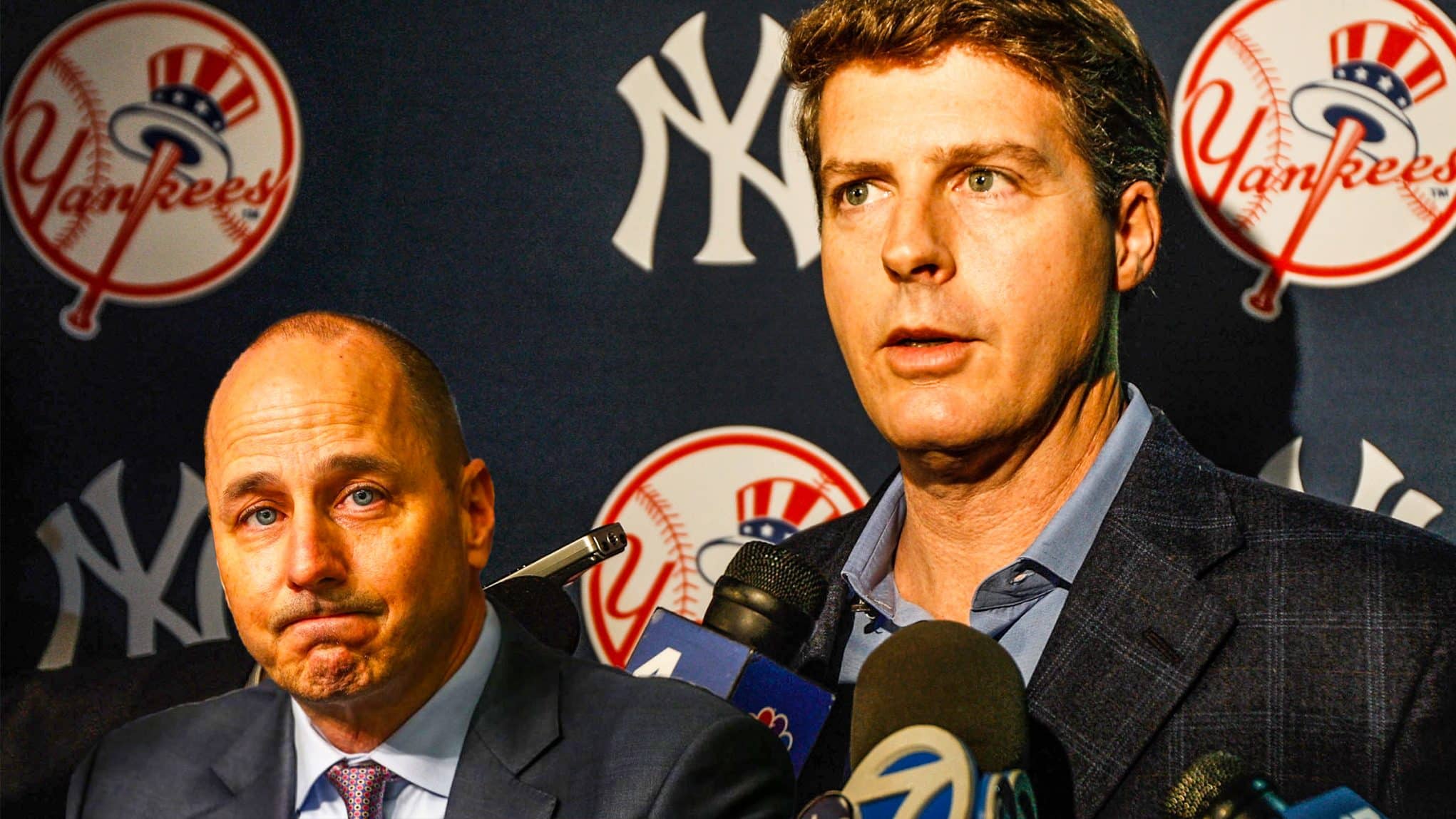
Brian Cashman (left) and Hal Steinbrenner
Take a look at these numbers. The 1st is team ERA, the 2nd is team WHIP (walks plus hits, divided by innings pitched), the 3rd is team fielding percentage... and the 4th is runs per game:
Team A: 3.74, 1.209, .983, 4.39
Team B: 4.26, 1.378, .981, 5.12
Team C: 3.67, 1.168, .986, 5.29
Team D: 3.76, 1.230, .988, 5.33
Team E: 3.90. 1.230, .983, 3.93
Sounds like Teams A, C, D and E should be about equal, while Team B should lag noticeably behind. Until you look at the runs per game. Then, it looks like Team A significantly trails Teams B, C and D, and Team E may well be hopeless.
Team A is the New York Yankees, who won 92 games during the regular season.
Team B is the Boston Red Sox, who also won 92 games.
Team C is the Tampa Bay Rays, who won 100 games.
Team D is the Houston Astros, who won 95 games.
Team E is the New York Mets, who won 77 games.
The Yankees spent much of the season swinging at terrible pitches, grounding into double plays, and making baserunning mistakes, including tying the Kansas City Royals for the most runners thrown out at home plate.
As Michael Kay said yesterday on ESPN Radio and the YES Network, the problem isn't that the Yankees use "analytics," it's that Boston, Tampa Bay and Houston use them better.
Over 100 years ago -- worth pointing out, still in baseball's Dead Ball Era -- Connie Mack said, "Pitching is 75 percent of baseball." But, this year, the Yankees had the pitching. They didn't support it, for the most part. Here are the OPS+'s for all Yankee players with at least 100 plate appearances, keeping in mind that 100 is exactly average:
Aaron Judge 149
Giancarlo Stanton 136
Anthony Rizzo 110
Luke Voit 109
Gary Sanchez 99
DJ LeMahieu 97
Gio Urshela 96
Gleyber Torres 93
Joey Gallo 93
Brett Gardner 90
Tyler Wade 90
Rougned Odor 82
Miguel Andujar 82
Clint Frazier 76
Aaron Hicks 73
Kyle Higashioka 71
I don't care how good your defense is: If you've got an OPS+ of under 90, you shouldn't be playing for the New York Yankees. And if your OPS+ is 71, nobody, not even Gerrit Cole, should be demanding you as his personal catcher.
This is the team that Brian Cashman built: A starting lineup that could be called Aaron Judge, Giancarlo Stanton, and the Seven Dwarfs.
Or, they could be called what I've been calling them since 2017: Gutless Wonders.
And the coaching. Pitching coach Larry Rothschild was fired a year ago, and replaced by Matt Blake. The results are clear. But Cashman has gone through hitting instructors, the latest being Marcus Thames, and it hasn't worked. And Phil Nevin as 3rd base coach? Bad choice. Is Aaron Boone a bad manager? Maybe he would be a better one if his bench coach weren't Carlos Mendoza.
When you crunch the numbers that have crunched the Yankees, it becomes clear: Brian Cashman is the problem.
But he won't be fired. He's been in the organization so long, along with men like Randy Levine and Lonn Trost, he has become a secondary part of the Steinbrenner family. Hal will not fire him.
Twelve years of failure.
*
October 7, 3761 BC: This is the date on which the Hebrew calendar begins. However, in 1650, an Irish bishop named James Ussher calculated that the Biblical Creation happened on October 22, 4004 BC -- 243 years earlier. Oy vey.
At any rate, believers in "Young Earth Creationism" believe that any archaeological or geological records that reveal any artifact, any skeleton (human or animal), any fossil, or any rock, to be older than (approximately) 6,000 years old are not merely wrong, but blasphemous: They believe that the Bible is not merely the final word on the subject, but the only word on it.
Or, as Matthew Brady, the William Jennings Bryan analogue, says in the play Inherit the Wind, set around a fictionalized version of the 1925 Scopes Monkey Trial, "I am more interested in the Rock of Ages than in the age of rocks."
Someone recently noted that, while the Jewish calendar begins with 3761 BC, the Chinese calendar begins with 2698 BC, meaning that there was a 1,063-year gap when Jewish people had to live without Chinese food, which the writer called, "Truly, the Dark Ages."
October 7, 1745: Henry Rutgers is born in Manhattan. One of his grandfathers was a Mayor of New York. One of his grandmothers was a sister of a Mayor of Albany. Another of his grandmothers was a direct descendant of Claes Martenszen van Rosenvelt, one of Manhattan's early Dutch settlers, and an ancestor of both Theodore and Franklin Roosevelt.
A graduate of King's College in Manhattan, which became Columbia University, he rose to the rank of Colonel in the New York Militia during the War of the American Revolution. He served in the New York State Assembly, on the New York Board of Education Regents, and 3 times as a Presidential Elector. In the War of 1812, though too old to lead troops himself, he again organized a New York regiment.
In 1825, the year that Queens College in New Brunswick, New Jersey, completed its administration building, later known as Old Queens, the school ran out of money and had to close. At the time, they thought it might be permanent.
Enter Colonel Rutgers, a high-ranking member of the Dutch Reformed Church, which had founded Queens in 1766, and still ran it. Rutgers was a lifelong bachelor with no children, legitimate or otherwise (it has been retroactively suggested by activist groups that he was gay), and, having no family to whom he could leave his money, made considerable donations in his time.
Knowing of New Brunswick's role in slowing the British down, making the Continental Army's retreat, its regrouping in Pennsylvania, and its subsequent victories at Trenton and Princeton possible, he donated $5,000 (about $120,000 in today's money), and a bell for the cupola at Old Queens.
In gratitude, and in hopes that the Colonel would leave them something more in his will, the regents renamed the school Rutgers College. The Colonel died in 1830, and left them nothing more, but the name stuck, and the school's marching band still plays a song titled "The Colonel Rutgers March."
Rutgers became New Jersey's only land-grant college under the Morrill Act of 1862 (which created land-grant colleges), and, following the consolidation with Cook College and Douglass College, it became the State University in 1956. Douglass College had originally been the New Jersey College for Women. Its founder, Mabel Smith Douglass, and Henry Rutgers are both buried in Green-Wood Cemetery in Brooklyn.
October 7, 1777: The Battle of Saratoga is fought in Upstate New York. U.S. troops under the command of General Horatio Gates defeat British troops under the command of General John Burgoyne. It is a stunning victory for the Continental Army, and when word of it reaches Paris, it enables the American envoy, Benjamin Franklin, to convince King Louis XVI to send French troops to help.
Gates nearly lost the battle. The true hero is his adjutant, who reorganizes things and makes victory possible. He is shot late in the battle. He is asked by one of his men where he was hit. "In the leg," he says. "I wish it had been in my heart." If it had been, he would have been 2nd only to George Washington among the heroes of the War of the American Revolution.
Instead, the leg injury causes him tremendous pain for the rest of his life. And he never gets credit for his victories from the Continental Congress. Indeed, this lack of respect allows his Loyalist wife, Peggy Shippen, to convince him to turn coat. The General's name is Benedict Arnold, and that name has become synonymous with treachery ever since.
Benedict Arnold was a precursor to such sports "traitors" as Leo Durocher, Roger Clemens, Sol Campbell, Luis Figo and Ashley Cole. And, unlike LeBron James, he never got a chance to turn his coat back. But had he not first been a hero, the war would have been lost, and America might now be a member of the British Commonwealth, observing cricket and soccer, not baseball and football.
The same day, General Francis Nash dies from wounds received 3 days earlier at the Battle of Germantown. He was 35. Nashville, the capital of Tennessee, and the home of the NFL's Tennessee titans, the NHL's Nashville Predators, and Vanderbilt University is named for him.
October 7, 1821,
200 years ago: William Still (no middle name) is born in Shamong, Burlington
County, New Jersey. He was a major part of the Underground Railroad, aiding
fugitive slaves, and wrote what was long its definitive record, “The
Underground Railroad Records,” published in 1872. He lived another 30 years.
October 7, 1849: Edgar Allan Poe dies in Baltimore, of an illness that has never been definitively identified. It's been suggested that it was rabies, from an animal bite. It probably wasn't, as has always been commonly believed, either a drug overdose or the effects of alcohol: While he was an alcoholic, he'd been on the wagon for months, and he wasn't a drug user. He was only 42 years old.
What does the man who might have been America's greatest writer, and practically the inventor of the detective story and horror fiction, have to do with sports? Not much. At the time he died, baseball was still a new game and not nationally known, although Americans were already turning to it and away from cricket. Boxing and horse racing were popular, but not exactly at the level they would reach later in the 19th Century. Soccer and rugby were in their infancy, and Americans hadn't yet noticed them anyway. And American football, basketball, hockey and, in its modern form, tennis had not yet been invented.
However, he had lived in both The Bronx and Boston, so he might have understood the New York-New England, and particularly the Yankees-Red Sox, rivalry were he to see American life today. And, certainly, he would have understood the horror stories that come with teams like the Red Sox, the Chicago Cubs, the New York Jets, the Buffalo Bills, and others.
Finally, his death and burial in Baltimore led to the city's new football team, established in 1996, being named after his most famous poem: The Baltimore Ravens. Their mascot is named Poe the Raven. The author's grave is just 1 mile from the Ravens' M&T Bank Stadium.
October 7, 1851, 170 years ago: Christian Friedrich Wilhelm von der Ahe (pronounced "VAHN-der-AH-hee") is born in Hille, Prussia, now part of East Westphalia, Germany. Like many Germans of the period, he immigrated to St. Louis, where he became a clerk in a grocery store. He bought out the store's owner, and built a saloon in the back. He realized that many of his customers had come there after seeing baseball games at nearby Sportsman's Park. He had inadvertently invented the sports bar.
In 1882, he founded the St. Louis Brown Stockings, and entered them into the American Association. He was a lot like his fellow German-American, George Steinbrenner, impressing his personality on his team, but willing to spend big if it meant winning.
He did: Under the reign of the man who called himself "der boss president of der Browns," they won 4 straight AA Pennants, in 1885, 1886, 1887 and 1888. In 1885 and '86, they defeated the National League Champions, the Chicago White Stockings, in postseason series. Thus began the rivalry between the teams now known as the St. Louis Cardinals and the Chicago Cubs.
The spectators loved him, and were nuts about the team -- or "bugs" about it, to the point where baseball spectators originally became known as "bugs," and this term lasted well into the 20th Century. But it became a secondary term to one that von der Ahe (nobody ever called him "VDA," as they probably would have today) said of one, "That feller is a fanatic! A fan-at-ic!" And so, sports spectators became known as "fans."
In 1892, the AA folded, and the Browns joined the NL. The team wasn't as good, and he lost a lot of money investing in an amusement park he had built next-door. The newspapers called it "Coney Island West" and him "Von Der Ha Ha." In 1898, Sportsman's Park and its amusement park burned down, and he had to sell the team.
By 1900, they were called the Cardinals, and moved to a nearby park named for the brothers who now owned them, Robison Field. In 1902, a team in the new American League took up the St. Louis Browns name and the Sportsman's Park site, and built the best-known version of the park, which lasted from 1909 to 1966. In 1920, the Cardinals moved into it, and the Browns moved to become the Baltimore Orioles in 1954.
By that point, von der Ahe was forgotten. In 1908, the Cardinals (the old Browns) and the new Browns played a benefit game for him, raising $4,300, about $121,000 in today's money. In 1913, 62 years old, he died of cirrhosis, apparently having sampled too much of his own product. He has recently appeared on Hall of Fame ballots, but, for all his personality, innovations and on-field success, he has never been elected.
October 7, 1885: The Providence Grays sweep a doubleheader from the Buffalo Bisons, 4-0 and 6-1 at Olympic Park in Buffalo. Fred Shaw wins both games for the Grays, pitching a no-hitter in the opener.
These are the last 2 games ever played by these franchises, who are both struggling for cash. Only 12 fans pay admission, as Buffalo, as it so often is, turns out to be cold in October. Not twelve thousand, not twelve hundred, but
twelve.
Never again has a major league baseball team -- capitalized or otherwise -- played in the State of Rhode Island. And, unless you count the Federal League of 1914-15, it took until the COVID-19 epidemic, forcing the Toronto Blue Jays to play their 2020 "home games," and the early ones of 2021, at Sahlen Field, for another major league baseball team to represent Buffalo, or any other city in the State of New York, other than the City of New York.
Although Buffalo has an NFL team and an NHL team, and it has an in-city population of 280,000 that isn't that much less than those of St. Louis, Pittsburgh and Cincinnati, its metropolitan area population of 1.2 million ranks it 45th among American metro areas. The current smallest area with an MLB team, Milwaukee, has nearly twice as many: A little over 2 million. If you count Canadian cities, Buffalo drops to 52nd.
Providence? It has 191,000 people, and while its metro count of 1,604,000 isn't that far behind Milwaukee, it's usually included within Boston's area. With the move of the Pawtucket Red Sox to the Worcester Red Sox a year ago, the Providence area is no longer the home of Boston's Triple-A baseball team. But it is still the home of the Providence Bruins. And the New England Patriots are actually slightly closer to Kennedy Plaza in Providence than to Downtown Crossing in Boston.
But Providence ain't getting another MLB team. And, presuming the Jays can go back to Toronto in 2021, this is probably it for Buffalo, which will never again get any closer than it did in 1991, when it was one of 5 finalists for the 2 that began play in 1993.
October 7, 1899: The Brooklyn Superbas clobber their arch-rivals, the New York Giants, 13-2 at home at Washington Park, to win the NL Pennant, and thus the unofficial World Championship of baseball.
The last surviving 1899 Superba was shortstop Bill Dahlen, who ended up crossing the City and winning the 1905 World Series with the New York Giants, and living until 1950.
*
October 7, 1901, 120 years ago: François Xavier Boucher is born in Ottawa, Ontario. Known as Frank or Raffles, he is, aside from Lester Patrick, the greatest figure in New York Rangers history. And, if you're under the age of 80, chances are, you've never heard of him.
The center debuted in the NHL with the Ottawa Sentors in 1922, alongside his brother, Georges "Buck" Boucher. After 4 seasons with the Vancouver Maroons, Patrick, the 1st head coach and general manager of the Rangers, made him an original member of the team.
Centering "The A-Line" (named for the Subway line that went past the old Madison Square Garden -- and, as it turned out, the new one as well), later renamed the "Bread Line" during the Great Depression, he was flanked by brothers Bill and Bun Cook. They helped the Rangers reach the 1928, 1929, 1932, 1933 and 1937 Stanley Cup Finals, winning in 1928 and 1933.
Lady Byng, wife of the Governor-General of Canada, donated a trophy to be awarded to "the most gentlemanly player" in the NHL. Boucher won it 7 times in 8 years, so Lady Byng let him keep the trophy, and donated another one. (Eventually, a new trophy would be given out each season.)
In 1939, Patrick stayed on as GM, but stepped aside as coach, and named Boucher to succeed him. In his 1st season, 1939-40, the Rangers won the Cup again. Indeed, not until 1994 would they win the Stanley Cup without Frank Boucher being directly involved.
He got them into the Playoffs in each of his 1st 3 seasons, but World War II took many of the better players. The manpower shortage got so bad that Boucher came out of retirement and played in 15 games in 1944. He resigned in 1949, having made the Playoffs again the year before, and coached them again in the 1953-54 season.
Both Frank and Buck Boucher are in the Hockey Hall of Fame. The Rangers have retired his uniform number -- but for another player: 7 is retired for Rod Gilbert. In 1974, Frank Boucher wrote When the Rangers Were Young. He died in 1977. In 1998, The Hockey News ranked him Number 61 on their list of the 100 Greatest Hockey Players. In 2009, the book 100 Ranger Greats listed him as Number 9 on their list.
October 7, 1902: Perhaps the first all-star game in North American sports is played at Exposition Park in Pittsburgh -- the Pirates' current stadium, PNC Park, is built roughly on the site. Sam Leever and the Pirates, including the great Honus Wagner, beat a team of American League all-stars‚ with Cy Young of the Boston Americans (Red Sox) as the losing pitcher, 4-3.
October 7, 1905: The University of Pennsylvania hosts nearby Swarthmore College in a football game at the original Franklin Field. (Built in 1895, it was replaced by the current structure in 1923.) Penn won the game, 11-4.
Swarthmore guard Robert Maxwell, known as Tiny for being so big and fat, got his nose broken, but played both ways the whole game. It was the only game Swarthmore lost all season, and it would probably be forgotten today, especially since Swarthmore is now a Division III school.
Except a photograph was taken of Maxwell's bloody face, and the wire services put it on the front pages of newspapers all over the country. One of them made its way to President Theodore Roosevelt. A former athlete himself -- he had been on the Harvard boxing team in 1880, and played tennis even while President -- he requested figures, and found out that 18 young men had died playing college football in 1904.
So the Rough Rider hauled the presidents of Harvard, Yale and Princeton -- then the nation's leading football-playing universities -- into the White House, and, in a meeting on October 9, told them point-blank: Either you do something to make football safer, or I will take action.
TR -- he did not like the nickname "Teddy" -- didn't have to actually threaten to ban the sport. Given his reputation as a man who got things done and didn't let anything stand in his way, just the possibility that he would be taking over their sport, taking their power away, was enough to spur them into action. The safety measures they took over the next year are now considered the founding of the National Collegiate Athletic Association (NCAA).
This may have been the moment that saved the game Americans call "football," making the college game that became big business, and the NFL that was founded, both in the 1920s, possible. It may also have been the moment that prevented soccer, the sport that most of the rest of the world calls "football" or some linguistic variant, from becoming popular in America. Had the gridiron game been stopped in the Progressive Era, the world's game might have caught on, and, like so many other things that began elsewhere, been given an American touch, so it wouldn't have carried the "foreign" label.
What happened to Tiny Maxwell? He shrugged off his injury, and played early pro football in Ohio and Pennsylvania in the next few years. Oddly, he later served as an assistant coach at both Swarthmore and Penn. He became one of the most respected referees in the game, with his size and his vast knowledge of the rules both cowing players into submission. But he was killed in a car crash in 1922.
In 1937, a group of Philadelphia sportswriters founded the Maxwell Football Club in his memory. Ever since, it has presented the Maxwell Award to the best player in the country. It is considered secondary to the Heisman Trophy, but 40 out of its 70 awards, including the last 4, have gone to the player who also won the Heisman; 2 others went to a player who would win the Heisman in a different year.
*
October 7, 1911, 110 years ago: With just 1‚000 fans on hand at the Polo Grounds‚ and with the Pennant already clinched, Giant manager John McGraw finally listens to the appeals of Charles Victor "Victory" Faust, who'd told McGraw that a fortune teller in his home town of Marion, Kansas had told him that if he pitched for the Giants, they'd win the Pennant.
Faust was kept on the roster all season, as a good-luck charm. Now, 2 days short of his 31st birthday, he is sent to the mound in the 9th inning against the Boston Rustlers (the Doves having been renamed for their new owner, William H. Russell)‚ allowing a hit and a run in a 5-2 loss. Faust also hits‚ circling the bases for a score as the Rustlers, who are in on the joke, deliberately throw wildly.
Faust will reprise his act on October 12, in the regular season finale against Brooklyn: He allows a hit in his 1 inning; is hit by a pitch and then steals 2nd base and 3rd base‚ and scores on a grounder. In both cases, it was the 9th inning of games that the Giants were already losing.
On November 21, 1911, William H. Russell died. The team was purchased by James Gaffney, an officer in New York's Tammany Hall political organization. These officers are known as "Braves," and the team was renamed the Boston Braves.
The team carries the name to this day, although they are now in Atlanta. Braves Field is built in 1915, and one of the bordering streets is still named Gaffney Street. Boston University's Nickerson Field complex was built on the site, with the right-field pavilion of Braves Field still standing as the home stand. An NFL team named the Boston Braves will also play there, changing its name, to avoid confusion, to the Redskins. They will move to Washington in 1937.
As for Charlie Faust, you may be thinking that he's the Rudy Roettiger of baseball. No, he wasn't: Rudy, at least, was good at football in high school. Faust was nothing but a joke. The laughter stopped: McGraw and Giants owner John T. Brush did not invite him to spring training in 1912, and his baseball career was over.
He told anyone who would listen that it wasn't, and in 1913, he was committed to a psychiatric hospital in Oregon, and then to another in Steilacoom, Washington, where he died of tuberculosis in 1915.
*
October 7, 1921, 100 years ago: Game 3 of the World Series. Being down 2 games to 0 isn't nearly as bad in a best-5-out-of-9 series (the last time the World Series has had this format) as it would be in a best-4-out-of-7 (which it has been ever since). The Giants set what were then Series records for runs and hits in a game (13 and 20, respectively), doing it without a single home run (manager John McGraw must have loved that), and beat the Yankees 13-5.
Over the 1st 20 1/2 innings of this Series, the Yankees outscored the Giants 10-0. Over the last 51 1/2 innings, the Giants would outscore the Yankees 31-10.
Also on this day, Vaughn Hall Mancha is born in Sugar Valley, Georgia. An All-American center at the University of Alabama, played the 1948 NFL season with the Boston Yanks, and served as athletic director at Florida State. He was elected to the Florida Sports Hall of Fame, and lived until 2011.
Also on this day, Raymond Goethals (no middle name) is born in Vorst, Belgium. A decent goalkeeper in the Belgian and French soccer leagues, Le Sorcier (The Sorcerer) managed Belgium to 3rd place at Euro 72, Anderlecht to the European Cup Winners' Cup in 1978 and the Belgian Cup in 1989, Standard Liège to the League title in 1982 and 1983, and Olympique de Marseille to the League in 1991, 1992 and 1993.
In 1993, he led L'OM to the UEFA Champions League, the only French club ever to win it. At 71, he is the oldest manager to have won it. However, for reasons he probably had nothing to do with, L'OM were stripped of their 1993 League title, relegated to France's 2nd division, and were denied the right to defend their European title. He died in 2004. His son, Guy Goethals, is an admired referee.
Also on this day, Richard L. Duchossois -- I can find no record of what the L stands for -- is born in Chicago. Dick Duchossois (DUCH-a-swah) fought on D-Day, and then served as a tank commander for the rest of World War II.
In 1983, as Chairman of Duchossois Industries, he bought Arlington Park, the leading horse racing track in the Chicago area (and, really, in the entire Midwest). In 2000, he bought Churchill Downs Incorporated, thus making him the owner of the most famous of all American racetracks, site of the Kentucky Derby. He is also a major donor to Loyola University of Chicago, although his own degree is from Washington & Lee University in Virginia. He is still alive, turning 100.
October 7, 1931, 90 years ago: Game 5 of the World Series. Philadelphia Athletics manager Connie Mack, who surprised everyone in 1929 by starting veteran Howard Ehmke in the Series opener, tries the ploy against the St. Louis Cardinals with former Yankee Waite Hoyt. This time, it doesn't work: Pitching in his 7th Series, Hoyt falls victim to Pepper Martin, who homers and drives in 4 runs with 3 hits. Hallahan wins for the Cards 5-1.
Also on this day, Lowell Fitzsimmons is born in Hannibal, Missouri, hometown of the real-life Samuel Clemens, a.k.a. Mark Twain, and of the fictional characters he created such as Tom Sawyer and Huckleberry Finn, as well as the fictional M*A*S*H commanding officer, Colonel Sherman T. Potter.
Cotton Fitzsimmons -- when your real name is Lowell and you have no middle name, it helps to have a nickname -- was, as songwriter-actor Kris Kristofferson would say, "a walking contradiction, partly truth and partly fiction." He played basketball at Midwestern State University in Wichita Falls, Texas, and coached 2 seasons at Kansas State, before going to the pros.
He was named head coach of the Phoenix Suns in just their 2nd season, 1970, and got them to the Playoffs. He got the Atlanta Hawks into the Playoffs in 1973, the Kansas City Kings in 4 times between 1979 and 1984, the San Antonio Spurs in in 1985 and '86, and the Suns 4 straight times from 1989 to 1992, and 1 more time in his 3rd stint in Phoenix in 1996.
He was named NBA Coach of the Year in 1979 (with Kansas City) and 1989 (with Phoenix). Overall, he won 832 games as an NBA head coach, 341 of them with the Suns, who hung a banner with the number 832 on it, standing in for a retired uniform number. In 8th place on the all-time wins list when he retired, he still ranks 10th.
He is a member of the Suns' Ring of Honor and the Missouri Sports Hall of Fame, and on the NBA's 50th Anniversary in 1996, he was named to its 10 Greatest Coaches. Alas, he has not yet been elected to the Basketball Hall of Fame. He died of the combined effects of lung cancer and several strokes, in 2004, age 72.
Also on this day, Thomas Edison Lewis -- Thomas Alva Edison died the same year -- is born in Greenville, Alabama. Not Greenbow: Forrest Gump was also a football star at the University of Alabama, but his story and his hometown are fictional. Tommy Lewis was real, and, in his case, the truth was stranger than fiction.
A fullback, he scored 2 touchdowns in the Crimson Tide's win over Syracuse in the 1953 Orange Bowl. His last game was the 1954 Cotton Bowl, and he scored a touchdown to give 'Bama a 6-0 lead. But in the 2nd quarter, Rick halfback Dickey Moegle scored on a 79-yard touchdown run, and, unlike Alabama, they successfully kicked the extra point.
Later in the quarter, Moegle took off from his own 5-yard line, and sped down the sideline in front of the Alabama bench. He was going to score a touchdown, but Lewis ran onto the field -- he didn't even have his helmet on at the time -- and tackled him at the Alabama 42-yard line. This was interference -- not to mention 12 men on the field -- and Lewis knew it, thinking that Alabama would be penalized only 5 yards for, as the rule book calls it, "illegal participation."
Referee Cliff Shaw wouldn't have it: He invoked "the palpably unfair act," which accounts for situations when a flagrant rule violation prevents a player from scoring by awarding the score anyway. (This is the equivalent of a "professional foul" in other forms of football. I don't know what it would be in rugby or its close cousin, Australian rules football. But in soccer, it is cause for a straight red card, the fouling player getting thrown out of the game; if it happens in the penalty area, a penalty kick is awarded.) Shaw ruled that Moegle would have scored, and awarded Rice a touchdown.
It remains one of the most shocking plays in football history. At the time, the only more famous play in college football history was probably the wrong-way run by California's Roy Riegels that resulted in a safety that gave Georgia Tech a win in the 1929 Rose Bowl. Someone looked "Wrong Way" Riegels up, hoping for a quote by a man who might understand. Riegels did, indeed, watch the '54 Cotton Bowl on TV, and said Lewis "must feel like a sap." (After all, it was still only 7-6 Rice at the time. Even at 14-6, the game would still have been winnable for Alabama.)
Lewis apologized to Moegle as the teams left the field for halftime. Moegle would score a 3rd touchdown, and teammate Buddy Grantham would add another, and Rice won, 28-6. All told, Moegle rushed for an astounding 265 yards, a Cotton Bowl record for the next 54 years -- 208 of them on his 3 touchdown runs.
But both players became celebrities as a result, partly due to the game being on television, and TV having become almost universal by 1954. CBS was the broadcaster, and another CBS figure, Ed Sullivan, invited them onto his variety show. Ed asked Lewis what he was thinking when he saw the chance to make the illegal tackle. He said, "Mr. Sullivan, I guess I was just so full of 'Bama."
Lewis was drafted by the Chicago Cardinals, but didn't make the team. He played for the Ottawa Rough Riders of the Canadian Football League in 1956 and '57 -- appropriate, since Canadian-style football is 12-a-side to begin with! He later coached a minor-league team in Alabama, and died in 2014, at the age of 83.
Moegle would later change the spelling of his name so that it matched the pronunciation, and tended to drop the juvenile-sounding Y, so that he's usually now called "Dick Maegle." He had a longer career, playing as a defensive back in the NFL from 1955 to 1961, mostly with the San Francisco 49ers, and closed his career with his home-State Dallas Cowboys (before they got good). He was elected to the College Football and Texas Sports Halls of Fame. He later broadcast for the Houston Oilers and, this past July 4, age 86.
Cliff Shaw was rated as the top referee in the Southwest Conference every season from 1951 until his retirement in 1966, and later served as an executive at a dairy in Little Rock, Arkansas. He lived until 1998, age 91.
Also on this day, Desmond Mpilo Tutu is born in Klerksdorp, South Africa. A minister and anti-apartheid activist, he was the 1st black man to be the (Anglican, not Catholic) Archbishop of Cape Town. He was awarded the Nobel Peace Prize in 1984. The 1990 release and 1994 election of Nelson Mandela would not have been possible without his efforts.
In 2010, he retired from public life, but not before attending the World Cup in his homeland. The footage of a 78-year-old theologian celebrating a goal by the South Africa national team reminded us all that sports is supposed to be fun. (The team is known as "Bafana Bafana," meaning, "Boys Go Boys Go," with the women's team being "Banyana Banyana.")
October 7, 1933: Prior to Game 5 of the World Series‚ at Griffith Stadium in Washington, flags are lowered to half-staff to honor William L. Veeck‚ president of the Chicago Cubs, who died suddenly. He is not well remembered with the passage of more than 80 years, but his son, Bill Veeck, already working in the Cubs' front office by 1933, will become one of baseball’s most remarkable men.
In the meantime, the Series comes to a close when Mel Ott homers in the top of the 10th inning for a 4-3 Giants victory. Adolfo "Dolf" Luque, Cuban but light-skinned enough to play in the majors of the time, gets the win in relief. The Giants are World Champs for the 4th time, tying the Yankees and the Philadelphia Athletics for the most all-time.
For 86 years, this was the last World Series game played by a Washington team, and the last one played in the District of Columbia. The Washington Nationals finally put an end to that in 2019.
The last surviving member of the 1933 Giants was left fielder Joseph "Jo-Jo" Moore, who lived until 2001.
October 7, 1935: Game 6 of the World Series, at Navin Field (later renamed Briggs Stadium and Tiger Stadium) in Detroit. Stan Hack of the Cubs leads off the top of the 9th inning with a triple, but his teammates can't bring him home. In the bottom of the 9th, Goose Goslin singles home his catcher and manager, Mickey Cochrane, to win 4-3, giving Detroit its 1st World Championship in any sport.
This will quickly be followed by the Lions winning the 1935 NFL Championship, the Red Wings winning the 1936 and 1937 Stanley Cups, and Alabama-born, Detroit-raised boxer Joe Louis winning the Heavyweight Championship of the World in 1937.
The last survivor of the 1935 Tigers was Elden Auker, a submarine-style pitcher, who lived until 2006, enabling him to write the last baseball memoir of the period, Sleeper Cars and Flannel Uniforms; and to give interviews to Major League Baseball Productions that were used for the 1999 Major League Baseball All-Century Team broadcast, The Sporting News' 100 Greatest Baseball Players special the same year, the 2001 special honoring the 100th Anniversary of the American League, and various YES Network Yankeeography installments.
*
October 7, 1943: Game 3 of the World Series. Bloomfield, New Jersey native Hank Borowy pitches the Yankees to a 6-2 win over the Cardinals at Sportsman's Park, and the Yankees take a 2 games to 1 lead. It is the 1st time as a World Series hero for Borowy. It will not be the last -- but it will be the last as a Yankee.
October 7, 1946, 75 years ago: Game 2 of the World Series at Sportsman's Park. Harry "the Cat" Brecheen pitches a 4-hit shutout, and the St. Louis Cardinals beat the Boston Red Sox 3-0. The Series goes to Boston tied 1-1.
October 7, 1950: Game 4 of the World Series. Rookie lefthander Eddie Ford, with 9th inning help from Allie Reynolds, beats the Philadelphia Phillies 5-2, as the Yankees complete the sweep. Coleman wins the Babe Ruth Award as the Series Most Valuable Player.
Ford and the Phillies' center fielder Richie Ashburn both have very light blond hair that gets them nicknamed "Whitey." In Ashburn's case, even that was a shortening, of "The White Mouse." Ford will be drafted into the Army, and spend the 1951 and '52 seasons in the Korean War, but when he comes back in '53, he will be at the top of his game, and he will be "Whitey" from then on.
In contrast, most Phillies fans did not yet know Ashburn as "Whitey," but his friends did. The nickname became more familiar as he became a broadcaster, with partner Harry Kalas calling him "Whitey" and referring to him, when he's not there, as "His Whiteness." A fact not quite related: The 1950 Phillies also turned out to be the last all-white team to win a National League Pennant.
Ford started Game 4, and he outpitched Bob Miller, taking a 5-0 lead into the top of the 9th, partially thanks to a home run by his catcher, Yogi Berra. Whitey allowed 2 runners in the 9th, but got the next 2 outs. What should have been the last out was Phils catcher Andy Seminick sending an easy fly ball to left field. But Gene Woodling dropped it, and 2 runs scored.
Manager Casey Stengel came out to remove Ford. The fans were booing. Whitey, then a rookie, not quite 22 years old, couldn't understand why they were booing him. They weren't: They were booing Casey, for removing him. Casey brought Reynolds in, and he struck Stan Lopata out to end it, 5-2.
It was the 1st of 10 World Series games won by Whitey, who would go on to be nicknamed "The Chairman of the Board." He liked that nickname, not so much because it rhymed with his name, but because he was a big fan of the other celebrity with it, singer Frank Sinatra.
The Phils had their chances, but didn't make the most of them. They also did not hit a home run in the World Series, and this has not happened since.
They were nicknamed "the Whiz Kids" because they had the youngest average age of any Pennant-winner ever: 23. Ashburn would later say that they figured they had enough time to win a few more Pennants. But mismanagement, and the success of the team the Phils edged to win the Pennant, the Brooklyn Dodgers, meant that, by the time the Phils did win another Pennant, Ashburn was in the booth, and the Phils' biggest stars would be men who were small children in 1950: 9-year-old Pete Rose, 6-year-old Steve Carlton and Tug McGraw, 2-year-old Mike Schmidt, and a child who would not be born until a few weeks after the 1950 World Series, Greg Luzinski.
With Whitey's death a year ago, and Bobby Brown's earlier this year, there are no more living Yankees from this Series. For the Whiz Kids, Simmons and Miller are the last survivors.
October 7, 1951, 70 years ago: Derland Paul Moore is born in Malden, in the "Bootheel" of southeastern Missouri. A defensive tackle, he played 13 seasons with the New Orleans Saints, making the 1983 Pro Bowl. He closed his career with the Jets in 1986.
The Saints named him to their 40th and 50th Anniversary Teams, and their team Hall of Fame. He was also elected to the Missouri Sports Hall of Fame. He died in 2020.
Also on this day, John J. Mellencamp is born in Seymour, Indiana. (I can find no reference to what the J stands for.) As he correctly said in one of his songs, he was born in a small town: In the 2010 Census, Seymour was found to have 17,503 residents.
This makes it a little bigger than the Borough of Freehold, New Jersey, hometown of Bruce Springsteen. Through most of the 1980s, Mellencamp -- recording under the name Johnny Cougar from 1976 to 1979, as John Cougar from then until 1982, and as John Cougar Mellencamp through 1990 -- tried, sometimes a little too hard, to pass himself off as the Midwest's answer to what Bruce was to the Northeast: The musical poet laureate of the working man who wonders where so much of it, but not quite all of it, went wrong.
Johnny Cash called him "one of the 10 best songwriters in music." He continues to play his "R.O.C.K. in the U.S.A."
October 7, 1952: In the decisive Game 7, the Yankees beat the Dodgers at Ebbets Field, 4-2, to win their 4th consecutive World Championship, their 15th overall, and their 1st without Joe DiMaggio in 20 years. The Dodgers still haven't won a World Series, and the idea that "Next Year" will come is getting more and more frustrating.
This game was highlighted by the Dodgers loading the bases in the bottom of the 7th. Yankee manager Casey Stengel had already used each of his "Big Three": Vic Raschi, Eddie Lopat, and now Allie Reynolds. He calls on the lefty reliever who had closed out the previous year's Series, Bob Kuzava.
He gets Jackie Robinson to pop the ball up, but the late afternoon sun is peeking through the decks of Ebbets Field, and nobody sees the ball! Nobody except 2nd baseman Billy Martin, who dashes in, and catches the ball at his knee to end the threat. It was the 1st time Billy would ruin Dodger hopes. The last time he did so, it would be as a manager, and the Dodgers would represent Los Angeles.
Even though he did not enter the game, or any game in this Series, Dodger pitcher Ralph Branca is ejected by home plate umpire Larry Goetz, for excesses in bench-jockeying.
Gil Hodges finishes the Fall Classic hitless in 21 at-bats, which had prompted some Brooklyn fans, some fellow Catholics, some not, to gather at local churches asking for divine help for their beloved 1st baseman.
Fortunately, Dodger owner Walter O'Malley, mean old man that he is, is not George Steinbrenner, and doesn't do what George did to Dave Winfield following his 1-for-21 performance in the '81 Series against the L.A. edition of the Dodgers: Call him "Mr. May," in comparison to "Mr. October," Reggie Jackson.
Outfielder Irv Noren was the last surviving 1952 Yankee, dying on November 15, 2019. Ford was not on the roster in this season, as he was serving in the Korean War.
October 7, 1955: Allen Ginsberg gives the 1st public reading of his poem "Howl" at the Six Gallery in the North Beach section of San Francisco. The poets reading that night were, in order: Philip Lamantia, Michael McClure, Philip Whalen, Ginsberg and Gary Snyder. Jack Kerouac, already a published novelist but 2 years away from his magnum opus On the Road being published, refused to read his own poetry, but cheered the other writers on.
While the poem, which sparked an obscenity trial, is best remembered for its opening of, "I saw the best minds of my generation destroyed by madness," the part that sticks out to me is Part II, written after this date, in which Ginsberg compares America's consumer culture to a Canaanite god, usually in the form of a giant bull and demanding the sacrifice of children, mentioned in the Old Testament (5 times in
Leviticus, and also in
2 Kings 23:10 and
Jeremiah 32:35) as Molech (MOLL-ick) or Moloch (MOH-lock):
What sphinx of cement and aluminum bashed open their skulls and ate up their brains and imagination? Moloch! Solitude! Filth! Ugliness! Ashcans and unobtainable dollars! Children screaming under the stairways! Boys sobbing in armies! Old men weeping in the parks!
Moloch! Moloch! Nightmare of Moloch! Moloch the loveless! Mental Moloch! Moloch the heavy judger of men!
Moloch the incomprehensible prison! Moloch the crossbone soulless jailhouse and Congress of sorrows! Moloch whose buildings are judgment! Moloch the vast stone of war! Moloch the stunned governments!
Moloch whose mind is pure machinery! Moloch whose blood is running money! Moloch whose fingers are ten armies! Moloch whose breast is a cannibal dynamo! Moloch whose ear is a smoking tomb!
Moloch whose eyes are a thousand blind windows! Moloch whose skyscrapers stand in the long streets like endless Jehovahs! Moloch whose factories dream and croak in the fog! Moloch whose smokestacks and antennae crown the cities!
Moloch whose love is endless oil and stone! Moloch whose soul is electricity and banks! Moloch whose poverty is the specter of genius! Moloch whose fate is a cloud of sexless hydrogen!...
Moloch! Moloch! Robot apartments! invisible suburbs! skeleton treasuries! blind capitals! demonic industries! spectral nations! invincible madhouses! granite cocks! monstrous bombs!
They broke their backs lifting Moloch to Heaven!
Moloch in whom I sit lonely! Moloch in whom I dream angels! Crazy in Moloch!
I don't know if Ginsberg (1926-1997) cared about sports at all -- although, as a native of Paterson, New Jersey and a New York resident for most of his life, he certainly had the opportunity to face sports. (In contrast, Kerouac was a star football player and track performer in high school, who washed out at Columbia University.)
But he wouldn't have been surprised at the move of the Brooklyn Dodgers to Los Angeles just 2 years later; at the corporations buying the naming rights to stadiums and arenas; or at the massive amounts of money that TV networks pay to televise sports, to the point where the NFL teams could lock their stadiums and not admit one single fan to a game, and not collect one single admission fee, and still make a profit.
Of the 5 readers that night, Ginsberg died in 1997, Whalen in 2002, Lamantia in 2005, and McClure this past May 4, leaving Snyder, now 90, as the last survivor. Lawrence Ferlinghetti, owner of the nearby City Lights Bookstore, who put it together and published
Howl, died this past February 22, at the age of 101. The readers were introduced by Kenneth Rexroth, an older San Francisco-based poet, who died in 1982. Wally Hedrick, an artist and sculptor, organized the reading and invited the authors. He died in 2003. Kerouac died in 1969, the result of an adult life of heavy drinking.
October 7, 1957: Lew Burdette beats the Yankees in Game 5, his 2nd win of the Series, a brilliant 1-0 shutout to give the Milwaukee Braves a 3-2 Series lead.
The day gets much, much worse for New York baseball, as the Los Angeles City Council approves the Chavez Ravine site for Dodger Stadium by a vote of 10 to 4. The Giants had already announced their move to San Francisco, and now the Dodgers' move was inevitable. It was announced the next day. Apparently, finally winning the World Series in 1955 and another Pennant in 1956 couldn't save them.
Also on this day, Jayne Torvill (no middle name) is born in Nottingham, England. With Christopher Dean, she won the Gold Medal in ice dancing at the 1984 Winter Olympics. They both got married to other skaters, but not to each other, but you wouldn't know that by watching them: Their routine, to the tune of Maurice Ravel's Bolero, was too hot for 1980s prime-time TV.
Also on this day, Faruk Hadžibegić is born in Sarajevo, Yugoslavia, now in Bosnia. A sweeper, he led FK Sarajevo to the 1985 Yugoslav First League title, and played for Yugoslavia in the 1990 World Cup. He has managed teams in his homeland, France, Spain and Turkey, and is curently the manager of the national team of Montenegro.
*
October 7, 1961, 60 years ago: Game 3 of the World Series at Crosley Field, the 1st Series game in Cincinnati in 21 years. William "Dummy" Hoy, the 99-year-old former center fielder who was a fine hitter and base stealer for the Reds in the 1890s despite being deaf, throws out the ceremonial first ball. (Unfortunately, he dies 2 months later, 5 months short of turning 100.)
The Yankees trail the Reds 2-1 going into the 8th inning, but home runs by Johnny Blanchard and Roger Maris (not officially counted as his 62nd of the season) off Reds starter Bob Purkey give the Yanks a 3-2 win, and a 2 games to 1 lead in the Series.
Most of NBC's World Series footage from 1947 to 1974 has been lost. Somehow,
the 9th inning of this game has survived. Note that Mel Allen gives a recap of the scoring as Maris steps up to bat, since instant replay was still 2 years away from being invented. (CBS would debut it at the 1963 Army-Navy Game.)
At about the 6:15 mark, you can see the Reds' bullpen in foul territory, and the famous "incline" in Crosley's deep left field. You'll also notice that the Reds fans gave a nice hand to Maris as he trotted around the bases, even though he hit the home run that may have just beaten them -- a better reception than he got for some of his Yankee Stadium homers that year. They still, however, cheered when Purkey struck out the next batter, Mickey Mantle. And Mel's broadcast partner, Joe Garagiola, was Yogi Berra's across-the-street neighbor growing up in St. Louis, and has insight into him as he bats.
Also on this day, Anthony Joseph Sparano III is born in West Haven, Connecticut. His name confused people familiar with the fictional Tony Soprano. He is one of many NFL coaches who has proved successful as an assistant, but not as a head man: He got the Miami Dolphins to the 2008 AFC East title, but had a losing record after that.
He was offensive coordinator for the Jets in 2012, closed out the 2014 season as interim head coach of the Oakland Raiders, and became the offensive line coach of the Minnesota Vikings in 2016. He still held that job on July 22, 2018, when he died of heart disease. He was only 56.
*
October 7, 1971, 50 years ago: Jimmy Gallagher dies in Cleveland at age 70. Born in Scotland, his family moved to New York when he was 12, and the midfielder became one of the earliest American soccer stars, playing on the U.S. team in the 1st 2 World Cups in 1930 and 1934. He was posthumously inducted into the National Soccer Hall of Fame in 1986.
Also on this day, Bettina Wiegmann (no middle name) is born in Euskirchen, North Rhine-Westphalia, Germany. A midfielder, she played most of her club soccer for the women's team at 1. FC Köln in Cologne, Germany. She led them to the women's version of the UEFA Champions League in 1991, 1995, 1997 and 2001; and the German national team to the 2003 Women's World Cup.
October 7, 1972: The NHL's 2 new expansion teams, the New York Islanders and the Atlanta Flames, play their 1st regular-season games, against each other, at the Nassau County Veterans Memorial Coliseum, 30 miles east of Midtown Manhattan.
Original Captain Ed Westfall scores the Islanders' 1st goal, and Morris Stefaniw scores the 1st for the Flames, who win, 3-2. Stefaniw's goal is the 1st in the Coliseum's history, and it turns out to be the only one he scores in the NHL: Aside from 13 games with the Flames that season, he turns out to be a career minor leaguer.
The Isles' 1st season will be very rough, giving no indication as to the consistent excellence they will produce from 1975 to 1987, and the 4 straight Stanley Cups they will win from 1980 to 1983.
October 7, 1975: Both Leagues' Championship Series end in sweeps. In the afternoon, Rick Wise of the Red Sox shuts down the Oakland Athletics, Carl Yastrzemski makes 2 great defensive plays, and the Sox win, 5-3 at the Oakland Coliseum, ending the A's dynasty. It is the 1st American League Pennant for the Sox in 8 years, since the "Impossible Dream" of 1967. Only Yaz and Rico Petrocelli remain from that team in 1975.
That night, at Three Rivers Stadium, the Cincinnati Reds score twice in the top of the 10th inning, and beat the Pittsburgh Pirates 5-3, to take their 3rd National League Pennant in the last 6 years.
The Reds will be seeking their 1st World Championship in 35 years; the Red Sox, their 1st in 57. The Ohio Valley vs. New England, the Big Red Machine vs. the Olde Towne Teame, both loaded with characters, both having waited a long time. Something's got to give.October 7, 1976: The Cleveland Barons play their 1st NHL game, after 7 seasons as a Bay Area team, known first as the Oakland Seals and then as the California Golden Seals. A team named the Cleveland Barons had played in the American Hockey League from 1929 to 1973, from 1937 onward at the old Cleveland Arena, and won 9 Calder Cups. In the 1950s, they challenged the NHL for the right to play their champions for the Stanley Cup, remembering that the Cup was once a challenge trophy, but were turned down.
The major-league edition of the Barons opens at the Coliseum in the Cleveland suburb of Richfield, and plays the Los Angeles Kings to a 2-2 tie. But they will be so cash-poor that they missed paying their players twice, and only a loan from the League kept them afloat. After 2 awful seasons, the NHL allows them to merge with another bankrupt team, the Minnesota North Stars, continuing under the North Stars name.
Despite the opening of what is now the Rocket Mortgage FieldHouse in downtown Cleveland in 1994, the NHL has never returned to Northern Ohio, and wouldn't return to Ohio at all until 2000 (see below). A minor-league team would revive the Barons name in 2001, playing at "The Q," but failed, and moved in 2006. The current team playing at The Q is the Cleveland Monsters, and they won the Calder Cup last season.
Also on this day, Charles Woodson (no middle name) is born in Fremont, Ohio. Despite being named Ohio's Mr. Football at Ross High School in 1994, he rejected Ohio State to play for Michigan. In 1997, the free safety led the Wolverines to the National Championship, and became the 1st purely defensive player to win the Heisman Trophy.
An 8-time Pro Bowler, he helped get the Oakland Raiders to Super Bowl XXXVII, and the Green Bay Packers to win Super Bowl XLV. He is the only player in NFL history to have career totals of at least 50 interceptions and 20 sacks. He was named to the NFL's All-Decade Team for the 2000s. He retired after the 2015 season, and is now part of ESPN's NFL Sunday Countdown team.
He has been elected to the College Football Hall of Fame and the Bay Area Sports Hall of Fame, and will become eligible for the Pro Football Hall in 2021.
Also on this day, Gilberto Aparecido da Silva is born in Lagoa da Prata, Minas Gerais, Brazil. The midfielder starred in his homeland before being signed by North London club Arsenal. He helped them win the 2003 FA Cup, win the Premier League with its only modern unbeaten season in 2004, and another FA Cup in 2005, before falling in the Champions League Final in 2006.
He moved on to Athens club Panathinaikos, winning Greece's Super League and Cup (Double) in 2010. He returned to Brazil and helped "hometown" club Atlético Mineiro win the state championship and the Copa Liberatores in 2013. For his country, he won the World Cup at Yokohama International Stadium in Japan in 2002, the Confederations Cup in 2005 and 2009, and the Copa América in 2007. He retired after the 2013 Copa Libertadores, and was later the technical director at Panathinaikos
.
October 7, 1977: Game 3 is played in each League Championship Series. Dennis Leonard, a Brooklyn native, goes the distance, and the Kansas City Royals beat the Yankees 6-2. The Royals take a 2-1 lead in the series, and need just 1 more win for their 1st Pennant.
They will be disappointed. But perhaps not as badly as the Phillies. First 1950, then 1969, now 1977: October 7 is not a good day for baseball in the City of Brotherly Love.
It starts out as a great one: The 63,719 fans at Veterans Stadium are
so loud (How loud
are they?), they force Dodger pitcher Burt Hooton to load the bases in the 2nd inning, and then walk 2 runs home. The Phils, who won 101 games (a team record not broken until 2011), look like they're going to win this game, and will need just one more win for their 1st Pennant in 27 years, since the 1950 Whiz Kids.
But in the top of the 9th, trailing 5-3 and down to their last out, the Dodgers benefit from a sickening turn of events. Pinch hitter Vic Davalillo, a 41-year-old Venezuelan outfielder who has already retired from baseball once, shows enough guts to lay down a drag bunt, at his age, with 2 strikes, and he beats it out.
Another Latin pinch hitter, 39-year-old Dominican Manny Mota, hits a long drive to left field. Ordinarily, Phils manager Danny Ozark would have sent Jerry Martin out to left for defensive purposes, in place of the powerful but defensively suspect Greg Luzinski. This time, he didn't, and the Bull can only trap the ball against the fence. (In fairness, I’ve seen the play several times, and I don't think Martin would have caught it, either, especially since he was a bit shorter than the Bull.) Luzinski throws back to the infield, but Phils 2nd baseman Ted Sizemore mishandles it, Mota goes to 3rd, and Davalillo scores. It's 5-4 Phils, with 2 out.
Then comes one of the most brutal umpiring screwups ever. Remember, the Dodgers are still down to their last out. Davey Lopes' grounder hits a seam in the artificial turf, and caroms off Mike Schmidt's knee to shortstop Larry Bowa‚ and Bowa's throw is incorrectly ruled late. Instead of the game being over in Philly's favor, Mota scores the tying run. The Dodgers go on to win, 6-5, and win the Pennant the next day.
In Philadelphia, the game is known as Black Friday. The umpire whose call killed the Phils? Bruce Froemming. He had already cost Milt Pappas a perfect game with a bogus ball four call in 1972 (though Pappas kept the no-hitter), and will go on to umpire for a record 37 years, with his swan song being the 2007 AL Division Series between the Yankees and the Cleveland Indians, when he, as crew chief, refused to stop the game until the Lake Erie Midges left.
October 7, 1978: The University of Oklahoma, ranked Number 1 in the nation, beats the University of Texas, ranked Number 6, 31-10, in their annual Red River Rivalry showdown at the Cotton Bowl in Dallas. Keith Jackson broadcasts the game for ABC Sports, then flies to New York, arriving just in time to call Game 4 of the American League Championship Series at Yankee Stadium.
He sees the Yankees beat the Kansas City Royals for the 3rd straight year, and win their 3rd straight Pennant, their 32nd overall. Roy White, in his 14th season with the Yankees, hits a tiebreaking homer in the 6th. Graig Nettles homers and makes a sensational play at 3rd, and Ron Guidry wins for the 26th time in his remarkable season.
The NL Pennant is also decided today, and, yet again, the Phillies can't catch a break on an October 7. In Game 4 of the NLCS, Ron Cey scores in the 10th inning on Bill Russell's 2-out game winning single, giving the Dodgers a 5-4 victory, and their 2nd consecutive Pennant. Cey, who walked after the 1st 2 batters were retired, advanced into scoring position when Garry Maddox misplayed Dusty Baker's fly ball in center field.
How odd is this? Maddox was so good in center field that he was nicknamed the Secretary of Defense. Ralph Kiner, the Pirate slugger turned Met broadcaster, said, "Two-thirds of the Earth is covered by water. The other third is covered by Garry Maddox." But on this occasion, Maddox blows it. He will, however, catch the final out of the NLCS in 1980, when the Phillies finally win the Pennant after 30 years.
*
October 7, 1981, 40 years ago: For the 1st time, a Major League Baseball postseason game is played outside the United States. The Montreal Expos defeat the Phillies 3-1 in Game 1 of the strike-forced National League Eastern Division Series at the Olympic Stadium in Montreal.
October 7, 1984: Game 5 of the NLCS. Winner takes the Pennant. The San Diego Padres are in their 16th season, and have never won one. The Cubs haven't won one in 39 years. Something has to give at San Diego's Jack Murphy Stadium.
The Cubs lead 3-0 going into the bottom of the 6th, but the Padres score 2 runs. Eventual NL Cy Young Award winner Rick Sutcliffe begins the bottom of the 7th by walking Carmelo Martinez. Garry Templeton bunts him over to 2nd. The batter is Tim Flannery, a good-field-no-hit 2nd baseman, pinch-hitting for pitcher Craig Lefferts (and not much of an upgrade at the plate). He hits a dribbler to 1st, and Leon Durham lets it go through his legs -- much as the man he replaced as Cub 1st baseman, Bill Buckner, will do in the World Series 2 years later. Martinez scores the tying run.
Then the Padres pile it on. Alan Wiggins singles. Tony Gwynn doubles Flannery home with the go-ahead run. Wiggins also scores on the play. And last night's Padre hero, Steve Garvey, singles home Gwynn. The score is 6-3, and it stays that way.
Of note for Yankee Fans: There are 3 members of their 1981 Pennant-winners on the Padres: Graig Nettles, Goose Gossage, and outfielder Bobby Brown (no connection to the earlier Yankee 3rd baseman of the same name). It has only been 3 years, but, for Yankee Fans, that 1981 Pennant now seems very far away.
For Padre fans, it is their 1st Pennant, and the biggest moment in San Diego sports since the Chargers won the 1963 AFL Championship. For Cub fans, it is a bigger heartbreak than 1969. In 1969, it took them an entire month to melt down; in 1984, it takes less than 24 hours. (They hadn't seen nothin' yet: In 2003, it would take them 15 minutes.)
On this same day, there is big football news. Walter Payton of the Chicago Bears breaks Jim Brown's career rushing record of 12,312 yards. The Bears beat the New Orleans Saints 20-7 at Soldier Field. Payton would eventually be surpassed by Emmitt Smith, who still holds the record.
This was also the date in the movie Ghostbusters where the title characters -- Bill Murray as Peter Venkman, Dan Aykroyd as Ray Stantz, and Harold Ramis as Egon Spengler -- had their 1st public "bust," at the Sedgewick Hotel in Manhattan. Venkman: "We came, we saw, we kicked his ass!"
*
October 7, 1992: The Tampa Bay Lightning play their 1st game, at home at the Expo Hall of the Florida State Fairgrounds. Chris Kontos scores not only the club's 1st goal, but a hat trick, as they beat the Chicago Blackhawks 7-3.
The Bolts, who beat the Miami-based Florida Panthers to the ice by a year, became popular enough that they easily outgrew the 10,425-seat Expo Hall, and played the 1993-94 season at the ThunderDome, now Tropicana Field. In its hockey setup, they set an NHL record (since totally blown away by Winter Classics and other outdoor games) of 27,227 fans.
They moved into what's now named the Amalie Arena in 1996, and, ironically considering how hot Florida gets and how hockey is played on ice, doing much better at the box office than MLB's Rays and the NFL's Buccaneers. And that was before they reached the 2015 Stanley Cup Finals (but after they won the Cup in 2004).
Also on this day, Markus Lynn Betts is born in the Nashville suburb of Brentwood, Tennessee. Like Met hero William Julius Wilson, he is nicknamed Mookie. The right fielder has become a superstar with the Red Sox, making 4 All-Star teams and 3 postseasons, including 2018, when he led them to win the World Series and was awarded the American League's Most Valuable Player.
The Sox refused to sign him to a contract extension, and he asked to be traded. They sent him to the Los Angeles Dodgers, thinking they could sign him again at a discount rate after the 2020 season. They thought wrong: The Dodgers signed him to an extension worth $365 million, the 3rd-highest in North American sports history. It now looks like he will be a Dodger for life.
The Red Sox did not make the Playoffs, not even with the COVID-forced expansion. The Dodgers did, and won the World Series.
October 7, 1995: Game 4 of the ALDS. The Yankees can win the series over the Seattle Mariners at the Kingdome tonight. But Edgar Martinez has other ideas. He breaks an 8th-inning tie with a grand slam, and the Mariners go on to win 11-10, forcing a Game 5.
The Yankees had now blown a 2-games-to-none lead, and I was thinking, "Uh-oh... " I had little confidence that they would win Game 5. They led in it, late, but...
Also on this day, the Boston Bruins play the 1st regular-season sporting event at their new arena, the FleetCenter, now known as the TD Garden. They play the New York Islanders to a 4-4 tie.
October 7, 1998: Game 2 of the ALCS. In the top of the 12th inning, Travis Fryman bunts for the Cleveland Indians. Yankee 1st baseman Tino Martinez fields it, and throws to 2nd baseman Chuck Knoblauch covering 1st. Except the ball hits Fryman in the back, and he reaches base safetly. That would have been bad enough.
Except Knoblauch argues that Fryman ran out of the baseline -- which he had. But the ball is still loose and in play, and Enrique Wilson (later a Yankee) notices this and, even though he stumbles approaching the plate, scores the go-ahead run. The Indians score 2 more runs in the inning, and win 4-1.
I had gotten up to get a drink, and missed what became known as "the Blauch-head Play." Had I seen it as it happened, I would have gone straight to Newark Airport, where the Yankees would have been heading to fly to Cleveland for the next 3 games, and beaten Knoblauch to a pulp with my bare hands.
Right, I think somebody would have stopped me. But I sure wanted to! He had put the Yankees' magnificent season in jeopardy.
*
October 7, 2000: Game 3 of the NLDS. Benny Agbayani’s 13th inning home run ends the longest LDS game ever played, 5 hours and 22 minutes. The dramatic round-tripper by the Mets outfielder, who (like a previous Met, Sid Fernandez) wears Number 50 because he's from Hawaii, the 50th State, gives the Mets a 3-2 victory, and a 2-games-to-1 series advantage over the San Francisco Giants.
On the same day, the Columbus Blue Jackets bring the NHL back to Ohio after 22 years, and give the State capital its 1st-ever major league team, unless you count MLS' Crew, or the Columbus Bullies who won the only titles of the 1940-41 American Football League.
Like the Tampa Bay Lightning, their 1st game is at home against Chicago. Unlike the Bolts, they lose, as the Blackhawks win, 5-3 at Nationwide Arena, still their home. Their 1st goal is scored by Bruce Gardiner.
Also on this day, the last event is held in the 77-year history of the original Wembley Stadium in London. The England national soccer team loses to Germany, 1-0. The last goal in the stadium is scored by Dietmar Hamann, who was, at the least, playing for an English club at the time, Liverpool.
Liverpool had been the club at which Kevin Keegan rose to stardom. He had also played in Germany, for Hamburger SV, before returning home, and then starring for Southampton and Newcastle United. He had managed several teams, including nearly taking Newcastle to the 1996 Premier League title. So after Glenn Hoddle was properly fired as England manager, Keegan, known as Mighty Mouse for being short but talented, was named manager.
But after this match, the media cornered him in the bathroom of the dressing room, and he resigned. And so, Wembley's history as the home of English football ended with "Keegan quits in the toilet." (In England, "the toilet" is the entire rest room, not just the bowl.) Although Keegan has had a few managing jobs since, he has never again managed any national side.
October 7, 2001, 10 years ago: On the last day of the regular season -- delayed a week, due to the 9/11 attacks -- Rickey Henderson, now with the Padres, bloops a double down the right-field line off John Thomson of the Colorado Rockies. It is the 3,000th hit of his career.
Tony Gwynn, who is playing in his last game, meets him at home plate, 2 members of the 3,000 Hit Club together. Gwynn retires with a .338 lifetime batting average, which remains the highest of any player who debuted after the 1939 season. (That was Ted Williams' rookie year, and he finished his career at .344.) It is also the highest of any black man, whether American or Hispanic. However, the Rockies win the game, 14-5.
Also on this day, Barry Bonds extends his major league record for home runs in season to 73*, as he drives a 3-and-2 1st-inning knuckleball off Dodger Dennis Springer over the right field fence. The blast also secures two more major league records * for the Giants’ left fielder, as he surpasses Babe Ruth (1920, .847) with a .863* season slugging percentage, and bests Mark McGwire (1998, one homer every 7.27 AB * ) by homering in every 6.52 at-bats *.
Indeed, it is a day of records. The Chicago Cubs lose to the Pittsburgh Pirates, 4–3. They become the 1st team in major league history to not allow an opposing pitcher to throw a complete game against them all season. Sammy Sosa closes out 2001 with his 64th home run in his final at-bat of the game, and sets a new franchise record with 98 extra base hits, one more than Hack Wilson had in 1930.
Sosa also finishes with another franchise record of 425 total bases (the 7th-best all-time total), 2 ahead of Wilson. His 160 RBI are the highest total in the NL since Wilson set the MLB record with 191 in 1930. Chuck Klein had 170 that year. Sosa's RBI total for the past 4 years also breaks Klein's 4-year mark set in 1929-32. To finish out the record day, 5 Cubs pitchers combine for 12 strikeouts as the staff sets a major league record with 1,246 strikeouts. The Yankees do the same, setting an AL mark with 1,266 strikeouts.
As for the guy with whom Sosa battled for the single-season home run record in 1998, Mark McGwire plays his last game. He pinch-hits for Jim Edmonds in the bottom of the 9th, and flies to center, as the St. Louis Cardinals lose 9-2 to the Houston Astros at Busch Stadium. He finishes with 583 home runs.
It hadn't been all that long since people were thinking he had a shot at breaking Hank Aaron's record of 755. But it would be Bonds that broke it. At 38, McGwire should have had something left. But he battled injury and batted just .187 that season. The steroids caught up to him.
Also on this day, the Pittsburgh Steelers play their 1st game at Heinz Field, it having been postponed after the 9/11 attacks. They beat the Cincinnati Bengals 16-7.
This was also the day American forces began combat operations in Afghanistan, in response to the 9/11 attacks. The Taliban were soon routed. But it took 9 1/2 years to find and kill Osama bin Laden -- and when we did, he was no longer in Afghanistan. Eventually, through mistakes made by Presidents of both parties, but especially Donald Trump, the Taliban returned to power. On August 30, 2021, President Joe Biden finally ended our combat operations in that country.
October 7, 2006: The Mets win a postseason series. Stop laughing. They defeat Los Angeles at Dodger Stadium, 9-5, to complete a 3-game sweep in the NLDS. For their fans, the Mets finally get revenge on the evil O'Malleys, even though that family hasn't owned the L.A. Bums since 1997. It took the Mets 9 years to win another postseason series.
On the same day, the Tigers beat the Yankees 8-3, to win their Division series, 3 games to 1. Magglio
Ordóñez and Craig Monroe homer for the Tigers. Just 3 years after setting an AL record with 119 losses in a season, the Tigers will be playing for the Pennant.
The Yankees had played so well all year long, but in this series, they couldn't hit the ground if they fell off a freakin' ladder. Hideki Matsui batted only .250, Johnny Damon .235, Robinson Cano .133, Jason Giambi .125, Gary Sheffield .083 (1-for-12), and Alex Rodriguez .071 (1-for-14). A-Rod had been hitting so poorly that manager Joe Torre bats him 8th today. With a few exceptions, every Yankee Fan I know thinks it was totally deserved.
Cory Lidle finished the 3rd inning for the Yankees, relieving Jaret Wright, and pitched a scoreless 4th, before getting tagged for 3 runs without retiring a batter in the 5th. Sheffield and Wright never appeared for the Yankees again. Lidle never appeared for anyone again.
October 7, 2007: Game 3 of the ALDS. Roger Clemens has nothing, and leaves the game in the 3rd inning, never to appear in another major league game. His 2nd go-round with the Yankees is an utter failure, though at age 45 -- and neither a lefthander nor a reliever -- it was a surprise that he was still pitching in the major leagues at all.
The Yankees trail the Cleveland Indians 3-0 when he leaves. But 4 runs in the 5th, including a Johnny Damon home run, and 3 more in the 6th, plus fine relief by Phil Hughes, make the Yankees an 8-4 winner. The Indians still lead the series 2-1. It is the last time the Yankees will win a postseason game at the old Yankee Stadium.
October 7, 2009: For the 1st time, a postseason game is played at the new Yankee Stadium. The Minnesota Twins take a 2-0 lead in the top of the 3rd inning, but that's as close as they come to winning the ALDS. The Yankees strike back in the bottom of the 3rd, and ride home runs by Derek Jeter and Hideki Matsui to win 7-2.
October 7, 2014: The Flash premieres on The CW. Grant Gustin plays the Barry Allen version of the DC Comics character, a scientist working for a big-city police department, who is turned by a freak accident into the fastest man alive.
The character had previously appeared on the CBS series The Flash in the 1990-91 TV season. He was played by John Wesley Shipp, who was brought back for the CW series to play Barry's father, Henry Allen, and also Jay Garrick, the original version of the character. (Garrick's Flash had debuted in comic books in 1940, Allen's in 1956.)
When The CW's "Arrowverse" staged its multi-series "crossover event" Crisis On Infinite Earths in 2019-20, it was in tribute to DC's 1985 series of the same title. In that series, Barry sacrificed his life to save "the multiverse," although he was brought back in 2009. The CW Flash series had foreshadowed this. Instead, Shipp's Flash was brought in, and provided the sacrifice, allowing Gustin's version to continue.
October 7, 2016: The Washington Post releases a videotape from a never-aired Access Hollywood
interview that correspondent Billy Bush -- a cousin of then-President George W. Bush -- did of The Apprentice star Donald Trump in September 2005. On the tape, Trump confesses to committing sexual assault on multiple occasions:
You know, I'm automatically attracted to beautiful -- I just start kissing them. It's like a magnet. Just kiss. I don't even wait. And when you're a star, they let you do it. You can do anything. Grab 'em by the pussy. You can do anything.
NBC kept the tape hidden, because The Apprentice meant big ratings for them. But by the time the tape was released, Trump was the Republican Party's nominee for President, running against a woman, former Secretary of State, U.S. Senator from New York, and First Lady Hillary Clinton. It should have destroyed him.
As a result of the tape, Billy Bush was fired. Trump became President. Maybe Billy should have had some friends in Russia fix things for him, like Trump did.
October 7, 2019: The Yankees complete a 3-game sweep of the ALDS, beating the Minnesota Twins 5-1 at Target Field. Gleyber Torres and Cameron Maybin hit home runs. This is the 16th consecutive postseason appearance that the Twins have lost, a record; 13 of those games have been against the Yankees. Ironically, the last one they won, Game 1 of the 2004 ALDS, was also against the Yankees.
Also on this day, the Atlanta Braves lead Game 4 of the NLDS, 4-3 over the St. Louis Cardinals, going into the bottom of the 8th. But the Cards tie it in the 8th, and win it in the 10th on a sacrifice fly by Yadier Molina. They will play a deciding Game 5 in the Atlanta suburbs 2 days later.