Showing posts with label martin luther king. Show all posts

Tuesday, September 8, 2026

September 8, 1966: "Star Trek" Premieres

Back row, left to right: James Doohan as Scotty, Walter Koenig as Chekov,
Majel Barrett as Nurse Chapel, Nichelle Nichols as Uhura,
and George Takei as Sulu. Front row: DeForest Kelley as McCoy,
William Shatner as Kirk, and Leonard Nimoy as Spock.

September 8, 1966, 60 years ago: The TV series Star Trek first airs on NBC, with the episode "The Man Trap" -- a.k.a. "The Space Vampire."

NOTE: This is an adaptation of a post I wrote for the 50th Anniversary, in 2016.

The show was created by Gene Roddenberry (1921-1991), who had previously been a combat pilot in World War II and a Los Angeles police officer. He pitched it to the network as "Wagon Train to the stars," in essence a Western in space. But with his ship's Captain, he was inspired by C.S. Forester's novels about Captain Horatio Hornblower, and he liked to call his adventures "Hornblower in space."

The show had a pilot filmed in December 1964, titled "The Cage." NBC passed on the story, but approved the concept, and asked for a 2nd pilot. Except for Leonard Nimoy as Spock, it was a completely new cast that filmed "Where No Man Has Gone Before" in July 1965. The show was picked up, although that 2nd pilot didn't air until September 22, 1966, the 3rd episode to air.

As for the pilot, here's the affiliates you could have watched it on, if you were in what would now be considered a "major league" city (note that not all of these are still NBC affiliates, or operating under the same call letters as there were using in 1966):

* Channel 2: WGRZ, Buffalo; WSB, Atlanta; KPRC, Houston; KUTV, Salt Lake City.

* Channel 3: KYW, Philadelphia; WKYC, Cleveland; KSNV, Las Vegas; KCRA, Sacramento.

* Channel 4: WNBC, New York; WRC, Washington; WBZ, Boston; WDIV, Detroit; WTMJ, Milwaukee; WSMV, Nashville; WDAF, Kansas City, KFOR, Oklahoma City; WOAI, San Antonio; KCNC, Denver; KNBC, Los Angeles; KRON, San Francisco.

* Channel 5: WLTW, Cincinnati; WMC, Memphis; WMAQ, Chicago; KSDK, St. Louis; KXAS, Dallas; KING, Seattle.

* Channel 6: WFBM, Indianapolis; WDSU, New Orleans.

* Channel 7: WSVN, Miami.

* Channel 8: WFLA, Tampa; KGW, Portland, Oregon.

* Channel 9: WSOC, Charlotte.

* Channel 10: KGTV, San Diego.

* Channel 11: WBAL, Baltimore; WIIC, Pittsburgh, WTVD, Raleigh.

* Channel 12: WTLV, Jacksonville; KPNX, Phoenix.

The series depicted the USS Enterprise, a starship with a crew of 430, representing the Starfleet (one word) of the United Federation of Planets, a galactic version of the United Nations, headquartered on Earth, at some unspecified point in the future.
Since they didn't want to be locked into an exact time, they obscured this with the clever use of "Stardates." Despite at least 2 episodes suggesting that the series took place around 200 years later, later series would definitively place it 300 years in the future -- i.e., the 1st episode took place in the year 2266.

The ship's mission, partly invoking the late President John F. Kennedy's "New Frontier," was written by  Roddenberry, and recited near the start of each episode by William Shatner:

Space: The final frontier. These are the voyages of the starship Enterprise. Its five-year mission: To explore strange new worlds, to seek out new life and new civilizations, to boldly go where no man has gone before!

The show ran for 3 years, and led to a brief animated series and 6 movies. It has spun off several connected TV series.

Of the main cast, pictured above:

* DeForest Kelley, who played the Chief Medical Officer, Lieutenant Commander Leonard H. McCoy, a.k.a. "Bones," died on June 11, 1999, at the age of 79.

* James Doohan, who played the Chief Engineer, Lieutenant Commander Montgomery Scott, a.k.a. "Scotty," died on July 20, 2005, at 85.

* Majel Barrett, Roddenberry's wife, who played Nurse Christine Chapel (her rank was never stated on the original series), and also voiced the computers on every starship in every show for as long as she lived, died on December 18, 2008, at 76.

* Leonard Nimoy, who played the ship's half-human and half-Vulcan First Officer and Science Officer, Commander Spock, died on February 27, 2015, at 83.

* Nichelle Nichols, who played the Communications Officer, Lieutenant Nyota Uhura, died on July 30, 2022, at 90.

* George Takei, who played the Chief Helmsman, Lieutenant Hikaru Sulu, is 89.

* Walter Koenig, who played a navigator, Ensign Pavel Chekov, turns 90 next week. His character was created when the Soviet Union objected to the fact that, despite their pioneering status in spaceflight, there were no Russians in the Enterprise crew, and Roddenberry admitted they had a point. Koenig said, "When they thought I was Russian, 22 and single, I got more mail than anybody except Leonard (Nimoy). When they found out I was American, 31 and married, the mail dried up."

* And William Shatner, who played Captain James T. Kirk, is 95, and, by all appearances, still going strong.

(By the end of their movies' run in 1994, Kirk had been promoted to Admiral, and demoted back down to Captain; Spock, Scotty and Sulu had been promoted to Captain; and McCoy, Uhura, Chekov and Chapel to Commander.)

In a 2011 episode of the YouTube series Epic Rap Battles of History, "Epic" Lloyd Ahlquist played Captain Kirk, although his impersonation sounded more like one of Shatner's exaggerated acting. In non-speaking guest roles, Omar Garaibeh played Spock, and Jon Na played Sulu. Both were ERB crew members. Kirk's opponent was Christopher Columbus, played by "Nice" Peter Shukoff.

September 8, 1966 was a Thursday. The next day, the science fiction series The Time Tunnel and the superhero show The Green Hornet debuted.

*

The show had a cult following. Frank Sinatra, Elvis Presley, and Michael Jackson were all known to be fans of what's now come to be known to fans of "The Original Series" or "TOS." (There is no account of any of the individual Beatles being Trek fans. Nor is it known if President Lyndon B. Johnson, despite his strong support of the real-life space program, ever watched the show.) Sinatra later admitted to preferring The Next Generation. His cognitive decline was already underway when James Darren began playing holodeck-inspired Las Vegas lounge singer Vic Fontaine, practically an homage to Sinatra, on Deep Space Nine, so his thoughts on that are unknown.

The most famous story of a celebrity connection with the show came in early 1967, although it wasn't revealed for many years thereafter: Nichelle Nichols didn't like the shooting schedule, or the way she was being treated, and thought she could be treated better and make more money with her nightclub singing act, which was ongoing. At one point, she met Dr. Martin Luther King, and told her she was thinking of quitting the show.

He told her she couldn't quit. He admitted that he and his family were fans of the show, and that her presence, as both a black person and a woman on the command level of such a vessel, was of great symbolic value, and that she should stay because of that. She did.

But the show didn't get past its core support, and the ratings were never good. NBC was ready to cancel it after 2 seasons, but a fans' write-in campaign saved it. For its 3rd season, the show's budget was slashed, and it was put in a bad time slot. The ratings got worse, and nothing could save it to allow it to complete the ship's "five-year mission."

"We all thought it was over," Shatner said. And while Nimoy immediately went to another Paramount Pictures show, Mission: Impossible -- taking the master-of-disguise role played by Martin Landau, who was allegedly the studio's first choice to play Spock, but Roddenberry put his foot down and wanted Nimoy -- the other castmembers weren't so lucky. They were typecast. With his Southern accent, Kelley was often cast in Westerns, but that genre was in decline by 1969. Doohan got roles in 2 1970s Saturday-morning-kid-show sci-fi adventures. Nichols went on singing.

Everybody else got whatever they could get. Shatner, at one point, was so broke, he was homeless, living out of his car. He and Nimoy both played killers caught by the title character on Columbo.

But the fans wouldn't give up. Star Trek fan conventions began in 1972. And the show caught on in syndicated reruns. In 1973, Filmation decided to do an animated Star Trek series. They were going to pay Shatner and Nimoy starring amounts, but not the others. Nimoy put his foot down, and said he wouldn't do it unless the others got the same pay. They did, with the exception of Koenig, although he did write an episode. Star Trek: The Animated Series (TAS) ran on NBC for 22 episodes in 1973 and '74.

Paramount decided there was enough demand to form a 4th major TV network, and they wanted its flagship show to be a sequel series, titled Star Trek: Phase II. But the network fell apart, and they shifted to Star Trek: The Motion Picture. Premiering in 1979, it was directed by Roddenberry himself, and that was a bad choice: All the criticisms leveled at "The Cage" back in 1965 came back: It was long, too cerebral, not enough action.

It became known as "The Motionless Picture." It was compared to another dragged-out 1979 film, and was nicknamed "A Spock-alypse Now." And the story's similarity to the episode "The Changeling" got it nicknamed "Where Nomad Has Gone Before." While it was visually spectacular, it was a very expensive flop. And it almost killed the franchise.

In 1982, Star Trek II: The Wrath of Khan premiered. Nicholas Meyer directed, and it saved the franchise. It was a sequel to the TOS episode "Space Seed," with Ricardo Montalban, returning as Khan Noonien Singh. While Trek has had villainous species, including the Klingons, the Romulans, the Borg, the Dominion, and the Xindi, Khan remains the greatest single villain in its history.

Nimoy was tired of playing Spock, so the character was killed. This was a terrible shock to Trek fans, including myself, 12 years old at the time. And yet, in hindsight, it is one of the greatest sacrifices, one of the greatest death scenes, and is followed by one of the greatest funerals in film history.

What Nimoy really wanted to do was direct, and so, when TWOK was a hit, they let him direct Star Trek III: The Search for Spock. As traumatic as Spock's death was, and as weird as it was to see the opening credits go directly from Shatner to Kelley without mentioning Nimoy (except as director), deep down, we all knew he would be restored to life.

Except... we didn't know that the Enterprise was going to be destroyed. And by Christopher Lloyd? Reverend Jim from Taxi? Are you kidding? Well, Lloyd put on a spectacular performance as Klingon Commander Kruge, and it probably got him the role of Doc Brown in Back to the Future, which is how he's now remembered.

The trilogy was completed with Star Trek IV: The Voyage Home. Nimoy directed again, and the Enterprise Seven (or "The Magnificent Seven") are forced to travel back to the present day, 1986, to save Earth in their time. It's not the best Trek film, but it is the most fun, and the funniest. My grandmother, 62 years old when it was released, was not a science fiction fan, but even she liked "the one with the whales."

After 2 Nimoy-directed films, Shatner, who had done some directing, wanted to direct one. The result was Star Trek V: The Final Frontier, where the crew met Spock's brother, and "God." It tanked, and Shatner never directed within Trek again, although many other Trek actors and Trek-connected people have directed episodes, including Leonard's son, Adam Nimoy.

Star Trek VI: The Undiscovered Country, reflecting the end of the Cold War by showing the beginning of peace with the Klingons, may have been the best overall film in the franchise, and it was a fitting sendoff for the original crew -- or so we thought. Indeed, it was the last Trek film appearance for Kelley, Nichols and Takei.

*

The success of ST IV led to Paramount launching Star Trek: The Next Generation in 1987, taking place 100 years after TOS, in the 24th Century. This would result in the 1994 film Star Trek: Generations, where Shatner, Doohan and Koenig were on hand to "pass the torch" to the TNG crew, although it was only Shatner's Kirk who was transported to the time of the USS Enterprise-D, resulting in a death that should have been more heroic.

TNG ran until 1994, and produced 4 movies from 1994 to 2002; Star Trek: Deep Space Nine from 1993 to 1999; Star Trek: Voyager, 1995 to 2001; the prequel series Star Trek: Enterprise from 2001 to 2005. Then came the 3 horrible J.J. Abrams "Bad Reboot" movies from 2009 to 2016. And "legit Trek" didn't to much better. The prequel series Star Trek: Discovery (2017-24) and its sequel series Star Trek: Starfleet Academy (starting this year and getting cut off next year) were ripped by fans. And it wasn't just because it wasn't "their Trek": They were genuinely bad.

Star Trek: Picard had 2 bad seasons, starting in 2020, though the 3rd, in 2023, gave enough fan service" to make most TNG fans think that the crew of Jean-Luc Picard (Patrick Stewart) had a proper conclusion to their stories.

The franchise won a lot of fans back with the animated series Star Trek: Lower Decks (2020-24) and Star Trek: Prodigy (2021-24), and the prequel series Star Trek: Strange New Worlds (starting in 2022 and set to conclude as planned in 2027, showing the Enterprise under Anson Mount's Captain Christopher Pike as it transitions to Kirk, now played by Paul Wesley).

On its 60th Anniversary, Star Trek remains as popular as ever. As Gene Roddenberry liked to say, "The human adventure is just beginning."

But as David Gerrold, who's written for Star Trek and other science fiction, has said, "The final frontier is not space. The final frontier is the human soul. Space is merely the place where we are most likely to meet the challenge."

Monday, December 1, 2025

December 1, 1955: Rosa Parks Holds Her Seat

December 1, 1955, 70 years ago: Rosa Parks is told to get up and move. She says, "No." In so, doing, she made history.

As historian Laurel Thatcher Ulrich said, "Well-behaved women rarely make history."

Let the record show that Rosa Parks was not the first woman to make this kind of history. In 1943, 17-year-old Bernice Delatte was arrested for defying segregation rules on a bus in New Orleans. In 1944, a U.S. Army Lieutenant was told to go to the back of a bus, to make room for a lower-ranking soldier. He refused. He got court-martialed. He was acquitted. His name was Jack Roosevelt Robinson. Yes, that Jackie Robinson. And in 1953, a 6-day boycott got the buses in Baton Rouge, Louisiana desegregated.

On March 2, 1955, Claudette Austin was arrested in Montgomery, the capital of Alabama, for refusing to give up her seat to a white woman on a crowded, segregated bus. The National Association for the Advancement of Colored People had been waiting for a chance to challenge a "send the blacks to the back of the bus" law, in line with the decision the year before, by the U.S. Supreme Court, in Brown v. Board of Education of Topeka, Kansas, that accommodations that were officially "separate but equal" was unconstitutional.

But Claudette was 15 years old, unmarried, and pregnant. Parks later said, "If the white press got ahold of that information, they would have a field day. They'd call her a bad girl, and her case wouldn't have a chance." The NAACP would need a more sympathetic defendant. Nine months later -- perhaps an appropriate time period -- they found one: Parks herself.

Rosa Louise McCauley was born on February 4, 1913 in Tuskegee, Alabama, and grew up in Pine Level, outside Montgomery. She was bullied by white children, and never forgot it. In 1932, she married Raymond Parks, a barber who worked with the NAACP. She joined the Montgomery chapter in 1943, and was elected its secretary. During World War II, she rode on an integrated trolley at Maxwell Air Force Base in Montgomery. She later said, "You might just say Maxwell opened my eyes up."

On November 27, 1955, Rosa Parks was attending Dexter Avenue Baptist Church in Montgomery, whose pastor was 26-year-old Dr. Martin Luther King Jr. He had invited T.R.M. Howard, head of the Regional Council of Negro Leadership in Mississippi, to speak of the recent murder of Emmett Till, and the acquittal of the 2 men who did it.

It was still on her mind 4 days later, on December 1. At around 6:00 PM, she boarded a Montgomery City Lines bus downtown. Eventually, all of the White-only seats in the bus filled up. The bus reached the third stop, in front of the Empire Theater, and several White passengers boarded. The driver, James F. Blake, noted that two or three White passengers were standing, as the front of the bus had filled to capacity.

Blake moved the "colored" section sign behind Parks, and demanded that four Black people give up their seats in the middle section, so that the White passengers could sit. Three of them complied. Parks said, "I thought of Emmett Till, a 14-year-old African American who was lynched in Mississippi in 1955, after being accused of offending a White woman in her family's grocery store, whose killers were tried and acquitted – and I just couldn't go back." In her autobiography, she said:
People always say that I didn't give up my seat because I was tired, but that isn't true. I was not tired physically, or no more tired than I usually was at the end of a working day. I was not old, although some people have an image of me as being old then. I was forty-two. No, the only tired I was, was tired of giving in.
When Parks refused to give up her seat, Blake took to his radio, and called the police. When she was arrested, she asked the officer, "Why do you push us around?" She remembered him saying, "I don't know, but the law's the law, and you're under arrest."

She was charged with a violation of Chapter 6, Section 11, segregation law of the Montgomery City code. Edgar Nixon, president of the Montgomery chapter of the NAACP and leader of the Pullman Porters Union, and her friend Clifford Durr bailed Parks out of jail that evening.

On Sunday, December 4, plans for the Montgomery bus boycott were announced at Black churches in the area, and a front-page article in the Montgomery Advertiser helped spread the word. At a church rally that night, those attending agreed unanimously to continue the boycott until they were treated with the level of courtesy they expected, until Black drivers were hired, and until seating in the middle of the bus was handled on a first-come-first-served basis.

The next day, Parks was tried on charges of disorderly conduct and violating a local ordinance. The trial lasted 30 minutes. After being found guilty and fined $10, plus $4 in court costs -- the total of $14 worth about $170 in 2025 money -- she appealed her conviction, and formally challenged the legality of racial segregation.

It rained that day, but the Black community persevered in their boycott. Some rode in carpools, while others traveled in Black-operated cabs that charged the same fare as the bus, 10 cents. Most of the remainder of the 40,000 Black commuters walked, some as far as 20 miles.

The boycott lasted for an entire year. On December 20, 1956, the federal ruling Browder v. Gayle took effect, declaring the Alabama and Montgomery laws that segregated buses were unconstitutional. All the seats on all the buses were now open to all.

In 1957, Rosa and Raymond Parks moved to Detroit, living with her brother and sister-in-law. She became a fair housing activist, helped John Conyers get elected to Congress in 1964, and served as his secretary until 1988. She participated in the Selma-to-Montgomery march in 1965. Her husband and brother died within weeks of each other in 1977, and she stepped back from civil rights activities thereafter to care for her mother, who died in 1979.

She then returned to the struggle, adding Planned Parenthood to her causes. In 1994, she was robbed and assaulted in her Detroit home. Mike Ilitch, founder of Detroit-based pizza chain Little Caesars, and owner of baseball's Detroit Tigers and hockey's Detroit Red Wings, bought her an apartment in a high-rise riverfront condo.

The following year, in commemoration of the 40th Anniversary of her seated stand, President Bill Clinton invited her to the State of the Union Address. He said, "She's sitting down with the First Lady tonight, and she may get up, or not, as she chooses." Acknowledging a standing ovation, she briefly stood.
She died on October 24, 2005, at the age of 92, after years of ill health and cognitive decline. Although often called "the mother of the Civil Rights Movement," she had no children of her own. She became the 1st woman, the 2nd black person, and the 1st private citizen to lie in state under the Rotunda of the U.S. Capitol Building in Washington.
A statue of her stands in Montgomery, roughly where she was arrested. In her adopted hometown of Detroit, the bus terminal is named for her. The bus on which she was arrested was also moved to Detroit, to the Henry Ford Museum in adjoining Dearborn, where it is on display along with the limousine in which President John F. Kennedy was assassinated, and the Ford's Theatre chair in which President Abraham Lincoln was sitting when he was assassinated.
As has been said, Rosa Parks sat, so that Martin Luther King could march, so that Barack Obama could run.
Bernice Delatte, the 1943 New Orleans protestor, lived until 2010. Claudette Austin became a nurse, married, and took the name Claudette Colvin. As of December 1, 2025, she is still alive.

Tuesday, August 5, 2025

Crossing the Lines

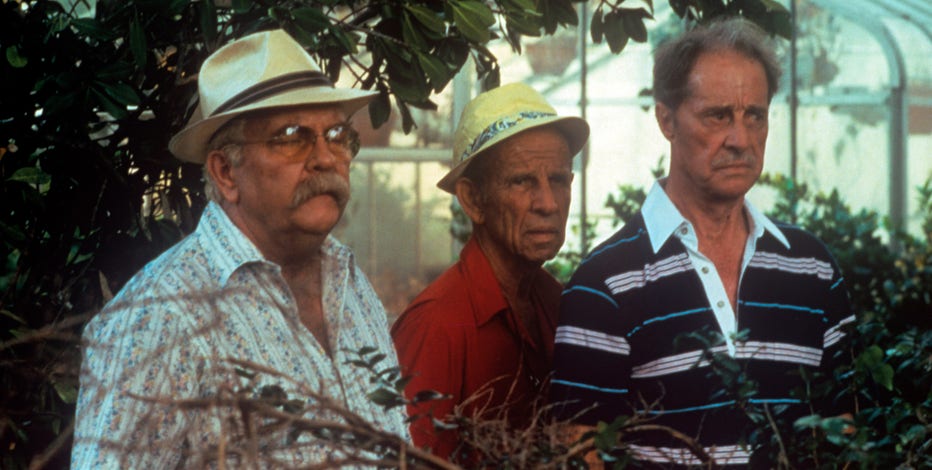
Left to right: Wilford Brimley, Hume Cronyn and Don Ameche, in Cocoon

Today, I learned about The Brimley/Cocoon Line. A feed on BlueSky dedicated it said:

Born Nov. 11, 1974, Leonardo DiCaprio is 18,530 days old today, matching Wilford Brimley’s age on the day ‘Cocoon’ was released. Congrats Leo! You’ve reached the Brimley/Cocoon Line. 

The old people in the movie, released in 1985 and directed by Ron Howard, were Don Ameche, 77; Jack Gilford, about to turn 77; Hume Cronyn, 74; Jessica Tandy, Cronyn's wife, also 74; Herta Ware, 68; Maureen Stapleton, 60; Gwen Verdon, also 60; and Wilford Brimley, described in the film review written for Time magazine by Richard Corliss as "53, but he can pass for old," but, really, only 50. Brian Dennehy, about to turn 47, wasn't yet considered "old." Nor were Steve Guttenberg, 26; Tyrone Power Jr., Tyrone's son, also 26; or Latanee "Tahnee" Welch, Raquel's daughter, 23.

Brimley had become famous the year before, playing Pop Fisher, the manager of the New York Knights, in the film The Natural. He already had white receding hair and a bushy mustache, so he looked considerably older. Having to stand alongside a 45-year-old but still dashing Robert Redford, the Depression setting of the film, the baggy uniform, and the dilapidated condition of the main filming location, War Memorial Stadium in Buffalo, didn't help how he looked.

He later became a spokesman for Quaker Oats, looking older than the old Quaker man on the container; and for diabetes awareness and an insurance company, and lived until 2020. It wasn't COVID that killed him, it was diabetes-aided kidney failure. He was 85, and looked it -- but he had looked 85 for years.

Seeing the words "Brimley/Cocoon Line" made me think of the various "age lines" I've crossed. I was born on December 18, 1969, so:

* I outlived every rock star in "The 27 Club," including Jimi Hendrix, Janis Joplin, Jim Morrison, Kurt Cobain and Amy Winehouse, on my 28th birthday, December 18, 1997 -- the day Chris Farley died.

* Thurman Munson died at 32 years, 1 month and 26 days. I outlived him on February 9, 2002.

* Farley's hero, John Belushi, died at 33 years, 1 month and 9 days. I outlived him on January 28, 2003.

* Farley died at 33 years, 10 months and 3 days. I outlived him on October 22, 2003.

* Diana Spencer, former Princess of Wales, died at 36 years, 1 month and 30 days. I outlived her on February 18, 2006.

* Marilyn Monroe died at 36 years, 2 months and 4 days. I outlived her on February 23, 2006. (Elton John wrote his most famous song about Marilyn, then rewrote it for Diana -- and they were almost the exact same age when they died!)

* Lou Gehrig died at 37 years, 11 months and 15 days. I outlived him on December 4, 2007.

* Roberto Clemente died at 38 years, 4 months and 13 days. I outlived him on May 1, 2008.

* Martin Luther King Jr. died at 39 years, 2 months and 20 days. I outlived him on March 7, 2009.

* Malcolm X died at 39 years, 9 months and 2 days. I outlived him on September 20, 2009.

* John Lennon died at 40 years, 1 month and 29 days. I outlived him on February 18, 2010.

* Robert F. Kennedy died at 42 years, 6 months and 16 days. I outlived him on July 7, 2012.

* Elvis Presley died at 42 years, 7 months and 8 days. I outlived him on July 27, 2012.

* Freddie Mercury died at 45 years, 2 months and 19 days. I outlived him on March 10, 2015.

* Walter Payton died at 46 years, 3 months and 7 days. I outlived him on March 25, 2016.

* John F. Kennedy died at 46 years, 5 months and 24 days. I outlived him on June 13, 2016.

* Jack Kerouac died at 47 years, 7 months and 9 days. I outlived him on July 28, 2017.

* The Brimley/Cocoon Line is 50 years, 8 months and 26 days. I reached it on September 13, 2020.

* Michael Jackson died at 50 years, 9 months and 27 days. I outlived him on October 16, 2020.

* Babe Ruth died at 53 years, 6 months and 10 days. I outlived him on July 29, 2023.

* Jackie Robinson died at 53 years, 8 months and 24 days. I outlived him on September 11, 2023. (Probably the 2 most important baseball players of all time -- and they were very close to the same age when they died!)

* Abraham Lincoln died at 56 years, 2 months and 3 days. I would outlive him if I make it to February 22, 2026.

* Humphrey Bogart died at 57 years and 20 days. I would outlive him if I make it to January 8, 2027.

To match my grandparents, I would have to make it to early 2027, early 2035, early 2048, and late 2051. To match my father, I would have to make it to early 2041. To match my mother's current age, I would have to make it to mid-2048.

To match Donald Trump's current age, I would have to make it to early 2049. But I was more mature than he was when I was 14.

Saturday, March 15, 2025

March 15, 1965: President Lyndon B. Johnson Says "We Shall Overcome"

LBJ addressing Congress, in front of Vice President Hubert Humphrey
(left) and Speaker of the House John McCormack

March 15, 1965, 60 years ago: President Lyndon B. Johnson speaks before a Joint Session of Congress, on the need for a Voting Rights Act.

The speech comes 8 days after "Bloody Sunday," when demonstrators attempting to march from Selma, Alabama to the State capital in Montgomery were beaten by local police. Having gotten the Civil Rights Act of 1964 passed the previous summer, and with the biggest majorities that the Democratic Party has had since the 1937-38 session, Johnson now knew it was time to act.

As as a native of Texas, he had previously resisted advances in civil rights. At the time, it was a requirement for a Southerner who wanted to stay in office. But after he became the Senate Majority Leader in 1955, he began to open up to the idea. He was one of the few Southern Senators who refused to sign the Southern Manifesto of 1956.

In a speech written by Richard Goodwin, one of the few White House employees he had kept from the John F. Kennedy Administration, he said: 

There is no Negro problem. There is no Southern problem. There is no Northern problem. There is only an American problem...

Our mission is at once the oldest and the most basic of this country: To right wrong, to do justice, to serve man...

What happened in Selma is part of a far larger movement, which reaches into every section and State of America. It is the effort of American Negroes to secure for themselves the full blessings of American life. Their cause must be our cause too.

Because it is not just Negroes, but, really, it is all of us, who must overcome the crippling legacy of bigotry and injustice.

Johnson then leaned forward slightly, to make his point more deeply, and said, "And we shall overcome." He emphasized the word "shall."

The inclusion of that last line bolstered Johnson's status within the Civil Rights Movement. It showed that this 56-year-old white Southerner was completely serious about making sure that black people were going to get the right to vote.

The line came Pete Seeger's civil rights folk anthem. Seeger stated he first heard the line sung by striking African-American tobacco workers in the 1940s.

John Lewis, who had been one of those beaten at Selma, watched the speech with Dr. Martin Luther King Jr., and said that King wiped away a tear when Johnson uttered the phrase.

The Voting Rights Act of 1965 was introduced into Congress 2 days later. The Senate passed it on May 26. The House of Representatives passed it with amendments on July 9. A conference committee worked out the differences on July 29. It was passed by the House, 328-74, on August 3. It was passed by the Senate, 79-18, on August 4. And on August 6, 1965, LBJ signed it into law.

It was the high-water mark of American liberalism, and of Johnson's Administration, coming just 7 days after he signed Medicare and Medicaid into law. Just 5 days after he signed the Voting Rights Act into law, a race riot broke out in the Watts section of Los Angeles. It wasn't the first such riot, but nor would it be the last. Meanwhile, people began to realize that the Vietnam War was not coming to an end.

From November 22, 1963 to August 6, 1965, a span of 622 days, Lyndon Baines Johnson did more good as President than most others who have held the office have done, even if given a full 8 years. But from 1967 onward, he has been remembered as "The Vietnam President" first, and the pro-civil rights and anti-poverty President second, if that. It's been 60 years. It's time to remember the good he did.

Friday, March 7, 2025

March 7, 1965: Bloody Sunday in Selma & U.S. Soccer's Great Missed Opportunity

March 7, 1965, 60 years ago: Selma, Alabama becomes a flashpoint in the Civil Rights Movement. A crowd estimated at 600 people were determined to march from Selma to the State capital of Montgomery, 54 miles away, to demand a Voting Rights Act to follow the Civil Rights Act of the previous year.

The march was led by John Lewis of the Student Nonviolent Coordinating Committee (SNCC), and the Rev. Hosea Williams of the Southern Christian Leadership Conference (SCLC).

The marches reached the Edmund Pettus Bridge, carrying U.S. Route 80 over the Alabama River. Built in 1940, the bridge was already heavy with symbolism: Pettus was a Brigadier General in the Confederate Army, and later an official in the Ku Klux Klan. He was elected to the U.S. Senate in 1896, and served until his death in 1907.

By 1965, Pettus was virtually unknown outside Alabama, but the bridge named for him became a landmark.

When the marchers got to the other side of the bridge, State Troopers were waiting for them. Their commanding officer, John Cloud, ordered them to disband. Williams tried to speak to him, but was shoved. The Troopers then moved forward, shoved other demonstrators, and began beating them with their nightsticks. Tear gas was fired. Mounted Troopers charged.

Williams escaped serious injury. Lewis did not: He sustained a fractured skull. (That's him in the overcoat, in the middle of the photograph above.) Amelia Boynton, another organizer of the march, was beaten unconscious. Television cameras captured it all: The horses, the shoving, the beating, the gas. There were 67 injuries, including 17 people admitted to hospitals. Incredibly, no one died. But the event became known as Bloody Sunday.

There have been many "Bloody Sundays" in human history:

* Many of them have involved the struggle for Ireland: An 1887 police attack on a demonstration in London, a 1920 battle between the Irish Republican Army and undercover British intelligence agents in Dublin, a 1921 Loyalist massacre in Belfast, and a 1972 British Army shooting of protesters in Derry City.

* Some of them were in connection with the labor movement: A police charge during the 1911 Liverpool transit strike, the Everett Massacre in Washington State in 1916, police attacking a steelworkers' strike in Nova Scotia in 1923.

* Probably the best-known one outside the English-speaking world was in St. Petersburg, leading to the failed Russian Revolution of 1905.

This was America's Bloody Sunday. March 9 was "Turnaround Tuesday." Dr. Martin Luther King led marchers over the bridge, then, faced with another phalanx of State Troopers, turned them around and marched back. That night, 4 KKK members attacked the 3 white Unitarian Universalist ministers who had been assisting the black marchers. One of them, the Rev. James Reeb, died from his injuries on March 11. 

On March 15, President Lyndon B. Johnson addressed a joint session of Congress, demanding the Voting Rights Act that the marchers wanted. This white Southerner, once an opponent of civil rights, had made a complete turnaround, and told the nation, "It is not just Negroes, but, really, it is all of us, who must overcome the crippling legacy of bigotry and injustice. And we shall overcome."

On March 17, the bill for the Act was introduced in Congress. The same day, a federal judge ruled that the marchers had the legal right to proceed, and that the government of the State of Alabama, through any of its law enforcement agencies, could not interfere.

On March 21, 2 Sundays after the 1st attempt, the marchers, led by Dr. King, tried again. Among the celebrities who joined the march were black singers Sammy Davis Jr., Harry Belafonte and Nina Simone, and Hispanic singer Joan Baez -- but also white singers Tony Bennett, Frankie Laine, the Chad Mitchell Trio, and Peter, Paul and Mary (Peter Yarrow, Paul Stookey and Mary Travers). Many of those had been at the March On Washington a year and a half earlier.

On March 25, the march reached the State Capitol, where Dr. King said, "I know you are asking today, 'How long will it take?' I come to say to you this afternoon, however difficult the moment, however frustrating the hour, it will not be long."

That night, Viola Liuzzo, a 39-year-old white mother of 5 from Detroit was driving marchers back to Selma, as she had volunteered to do. A car full of Klansmen pulled up to her, and shot her. The KKK had no respect for the dead, especially those they murdered: They said she was a registered member of the Communist Party who had abandoned her white children in the North to have sex with black men in the South. It was a total lie.

On July 15, Barry McGuire recorded "Eve of Destruction," a song written by P.F. Sloan. The 4th and last verse contains these lines, invoking strife foreign and domestic:

Think of all the hate
there is in Red China
then take a look around
to Selma, Alabama.
You may leave here
for four days in space
but when you return
it's the same old place.

Some things did change: On August 6, 1965, 5 months after the 1st attempt at the march, LBJ signed the Voting Rights Act into law.

Some things didn't change: On April 4, 1968, Dr. King was assassinated in Memphis. In 1975, his widow, Coretta Scott King, led 4,000 marchers over the Edmund Pettus Bridge to commemorate the 10th Anniversary of the march.

In 1986, John Lewis was elected to Congress from a district in Atlanta. In 1995, Lewis led a 30th Anniversary march. In 1996, with the Olympics set for Atlanta, the Olympic torch was carried over the bridge.

In 2015, on the 50th Anniversary, Lewis, Amelia Boynton Robinson, Barack Obama (the 1st black President), Michelle Obama (the 1st black First Lady, and she and her husband flanked Lewis and held hands with him), their daughters Malia and Sasha, Vice President Joe Biden, and George W. Bush (whose record on race relations as Governor of Texas and then as President was, to put it politely, less than stellar), led a new march, of 40,000 people, including some of the original marchers, some now elderly and in wheelchairs.
Mrs. Robinson died later that year. Hosea Williams had died in 2000. On July 17, 2020, John Lewis died at age 80, having served in Congress for 33 years. On July 26, a horse-drawn carriage carried his coffin over the Edmund Pettus Bridge, and he lay in state at the Alabama State Capitol. The coffin was flown back to Washington, where it lay in state in the Rotunda of the U.S. Capitol on July 27 and 28.

He was buried in South-View Cemetery in Atlanta, which is also the final resting place of fellow civil rights figure Julian Bond, several members of Dr. King's family (but not Dr. King himself), singer Chuck Willis, baseball icon Hank Aaron, and Basketball Hall-of-Famer Walt Bellamy.

*

There is another event that took place on March 7, 1965 that should be mentioned. The U.S. national soccer team was in qualification, through CONCACAF -- the governing body for soccer in North America, Central America, and the Caribbean region -- for the 1966 World Cup in England.
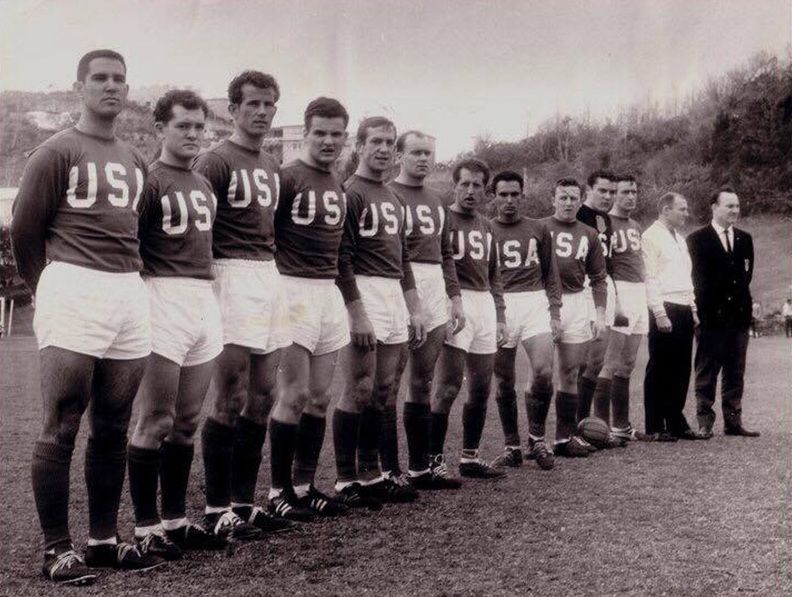
The 1965 U.S. soccer team

The U.S. was placed in a group with Mexico and Honduras. We got a 1-0 win and a 1-1 draw with Honduras, but only a 2-2 draw and a 2-0 loss with Mexico. Had that 2-2 draw with Mexico at the Los Angeles Memorial Coliseum on March 7, 1965 been a 3-2 win, we would have advanced to the round-robin with Costa Rica and Jamaica.

Could we have won that? We'll never know. We still would have had to beat Mexico out for the one and only berth in the World Cup awarded to CONCACAF.

But even if we had won that game with Mexico, it would not have been the biggest story of the day. The Selma-to-Montgomery March was a story that should be remembered for all time.

Tuesday, July 2, 2024

July 2, 1964: The Civil Rights Act Becomes Law

July 2, 1964, 60 years ago: President Lyndon B. Johnson signs the Civil Rights Act of 1964 into law. Among those attending the signing ceremony is Dr. Martin Luther King Jr., then the nation's leading civil rights activist.

Angry over various events holding African-Americans back, President John F. Kennedy gave a nationally-televised speech on June 10, 1963, asking Congress for a bill that would ban racial and religious discrimination "in facilities which are open to the public: Hotels, restaurants, theaters, retail stores, and similar establishments."

There were 3 key hurdles to the bill's passage. Many Congressional committees were then chaired by powerful Southern Democrats, unwilling to help civil rights. The bill had to pass the House Judiciary Committee. Fortunately, it was then chaired by Emmanuel Celler, a Jewish New Yorker, who got it through. The next step was being passed by the House Rules Committee, then chaired by Howard W. Smith, a racist from Virginia.

And before that could happen, Kennedy was assassinated on November 22, 1963. Johnson, his Vice President and a Texan who favored the bill, became President, and demanded that the bill pass.

Smith knew the rules of the U.S. House of Representatives as well as anyone. But so did Celler, who had a plan: He filed a petition to discharge the bill from the Rules Committee, and move it directly to the House floor, for a vote by the full House. That required the support of a majority of House members.

When the Winter recess began, Celler was 50 votes short, but letters, telegrams and phone calls were coming in to members on the fence. Smith "read the room," and realized that he would be utterly humiliated if the bill was discharged, so he told the Rules Committee members they could vote their conscience, and it passed.

On February 10, 1964, the full House voted 290-130 to pass it. It went on to the Senate, and Southern Democrats filibustered it for 54 days. But Northern and Western Democrats, and Republicans who were conservative but believed that civil rights could be good for business, worked on breaking the filibuster. In particular, 2 Senators led the way: Hubert Humphrey of Minnesota, the Democrats' "Whip"; and Everett Dirksen of Illinois, the Republicans' Leader. Each man's personal popularity was enough.

On June 19, 1964, the Senate passed the bill. The vote was 73-27. The Senators who voted No:

* Democrats: Lister Hill and John Sparkman of Alabama, William Fulbright and John McClellan of Arkansas, Spessard Holland and George Smathers of Florida, Richard Russell and Herman Talmadge of Georgia, Allen Ellender and Russell Long of Louisiana, James Eastland and John Stennis of Mississippi, Sam Ervin and Everett Jordan of North Carolina, Strom Thurmond and Olin Johnston of South Carolina, Albert Gore and Herbert Walters of Tennessee, Harry Byrd and Willis Robertson of Virginia, and Harry's cousin Robert Byrd of West Virginia.

* Republicans: Norris Cotton of New Hampshire, Bourke Hickenlooper of Iowa, Edwin Mechem of New Mexico, John Tower of Texas, Milward Simpson of Wyoming, and Barry Goldwater of Arizona.

The only Southern Senator of either Party to vote for the bill was Ralph Yarborough of Texas, an ally of LBJ's, who was with him in the car behind the one carrying JFK, Governor John Connally, and their wives when JFK was assassinated in Dallas. One of the reasons JFK went to Dallas in the first place was because, after Tower won LBJ's Senate seat, becoming the 1st Republican Senator in the South since Reconstruction, Texas' Democrats were split between factions led by Yarborough (a liberal) and Connally (a conservative who would later switch to the Republicans).

Robert Byrd, the Senate Majority Leader from 1977 to 1988, would later renounce his racist past. Ervin didn't, but redeemed himself somewhat with his Chairmanship of the Select Committee investigating Watergate in 1973 and '74.

Thurmond had been Governor of South Carolina in 1948, and briefly left the Democratic Party to run for President on the ticket of the States' Rights Party, all former Democrats. From that point onward, Southern Democrats who opposed civil rights were known as "Dixiecrats." Thurmond launched a filibuster designed to stop the Civil Rights Act of 1957, lasting a little over 24 hours, setting a record previously held by Huey Long of Louisiana, Russell's father. When the CRA of 1964 became law, Thurmond became the 1st major Democratic official in the South to switch to the Republican Party.

Gore was running for re-election, and was, by his own later admission, afraid to vote for the bill. He had previously voted for the Civil Rights Acts of 1957 and 1960. His re-election secure, he went on to vote for the Voting Rights Act of 1965, the confirmation of Thurgood Marshall as the 1st black Justice on the U.S. Supreme Court, and the Fair Housing Act of 1968. He lost his next bid for re-election in 1970, but that's been attributed to his opposition to the Vietnam War, rather than to his pro-civil rights votes. His son, usually known as Al Gore, would also be elected to both houses of Congress, serve as Bill Clinton's Vice President, and be the Democratic nominee for President in 2000.

Robertson was the father of Marion G. "Pat" Robertson, the Virginia Beach-based televangelist who ran for the Republican nomination for President in 1988, and was a major figure in "Christian" conservatism, often on the back of various forms of bigotry, until his death in 2023.

Cotton -- no relation to current Republican Senator Tom Cotton of Arkansas -- also ended up voting for every other Civil Rights Act from 1957 to 1968, including the Voting Rights Act of 1965, as well as the 24th Amendment, banning poll taxes. (Gore was not present for the vote on that.) He voted against the Civil Rights Act of 1964, he said, on the grounds that part of it was unconstitutional.

Goldwater, like Cotton, claimed the bill was unconstitutional. Although he was the conservative movement's favorite son at the time, he had never previously been accused of racism. Indeed, in Arizona, a State then with few Black people, Hispanics and Native Americans praised him for his efforts on their behalf.

Hickenlooper was the great-uncle of John Hickenlooper, now a Senator from Colorado, previously that State's Governor and Mayor of Denver -- and a Democrat. Simpson was the father of a later Senator from Wyoming, Alan Simpson.

The bill the Senate passed was slightly different from the one passed by the House, so the House had to approve it again. That took until July 2, and the vote was 289-126. Now, it headed to the President's desk, and LBJ wasted no time: He called in the media, and he called in key figures, including Dr. King, and the Attorney General, who was also the previous President's brother, Robert F. Kennedy.

It was Johnson who began the tradition of the President using a different pen to sign each letter of his name, including the period after the middle initial B. This way, he could give out 15 ceremonial pens -- 6 for "Lyndon," 2 for "B.," and 7 for "Johnson" -- and 15 different people could truthfully say, "I have the pen that made this bill a law."

On the film, he can be heard telling RFK to give pens to his deputies, Nicholas Katzenbach and Burke Marshall, as well as to take one for himself. The best-known photograph of the ceremony, shown above, shows LBJ giving a pen to MLK.

A generous gesture, given that LBJ and RFK couldn't stand each other, for reasons that don't matter here. Soon, RFK would resign as Attorney General -- he probably would have if his brother lived, anyway, to run the re-election campaign -- and ran for a U.S. Senate seat from New York. He won it -- but won by a smaller margin than Johnson did in the State.

By this point, Goldwater had already secured the Republican nomination for President, beating out pro-civil rights candidates like Governors Nelson Rockefeller of New York and William Scranton of Pennsylvania, and former Senator Henry Cabot Lodge of Massachusetts.

But people who cared about civil rights -- for or against -- didn't care why Goldwater voted against the Act, only that he did. Southerners who would never have voted for the nominee of "the Party of Lincoln" before this voted for Goldwater, because he voted the way they wanted. And Midwesterners and Westerners that would have normally voted Republican went for Johnson.

On Election Day, November 3, Johnson won 61.0 percent of the national popular vote, still an all-time record, while Goldwater got just 38.4 percent. Johnson won 44 States with 486 Electoral Votes, Goldwater 6 with 52. Goldwater won Mississippi, Alabama, South Carolina, Louisiana and Georgia, all in the South; and his home State of Arizona, barely, with 50.4 percent, a winning margin of 4,782 votes.

He came close in some other Southern States. He got 48.8 percent in Florida, 46.1 in Virginia, and was the 1st Republican in the 20th Century to top 40 percent in Tennessee, Oklahoma, North Carolina and Arkansas.

He also got 49.1 percent in Idaho, 47.4 in Nebraska, 45.1 in Utah and 45.0 in Kansas. But if he had won every State where he got at least 45 percent, that still would have given him only 98 Electoral Votes. Even if he had won every State where he got at least 40 percent, including California (40.8, then with 40 EVs) and Illinois (40.5, 26), he still would have had only 199, well short of the necessary majority of 270.

To be fair, the false perception that Goldwater was racist was not the only reason he lost. But it didn't help. As no less than Jackie Robinson, a Republican who had worked for Rockefeller, put it, "It would make everything I worked for meaningless if baseball were integrated, but America's political parties were segregated."

Johnson knew it, too: "I think we have just given the South to the Republican Party for a generation." It's now been 3 generations. There have been blips since, but:

* Virginia has voted for the Democratic nominee for President in every election since 2008. But, before that, it hadn't voted for one since 1976, Jimmy Carter; and not for a non-Southern Democratic nominee since 1948, Harry Truman.

* Georgia voted for Joe Biden in 2020. Other than that, they haven't voted for the Democratic nominee since Bill Clinton in 1992.

* Florida last voted for the Democratic nominee in 2012, Barack Obama.

* North Carolina last voted for the Democratic nominee in 2008, Obama. Other than that, they haven't voted for the Democratic nominee since 1976; and not for a non-Southern Democratic nominee since 1948.

* Arkansas, Tennessee and Louisiana last voted for the Democratic nominee in 1996, Bill Clinton. Arkansas last voted for a non-Southern Democratic nominee in 1956, Adlai Stevenson; Louisiana in 1952, Stevenson; and Tennessee in 1948. Tennessee didn't even vote for native son Al Gore in 2000, although that's been attributed to guns as much as to race. This is also the case for West Virginia, which was a reliably Democratic State until 2000.

* Texas, Mississippi, Alabama and South Carolina last voted for the Democratic nominee in 1976, and haven't voted for a non-Southern Democratic nominee since 1960, John F. Kennedy.

* Oklahoma last voted for the Democratic nominee in 1976, and hasn't voted for a non-Southern Democratic nominee since 1948.

We will never know how many of the 21 Democrats who voted against the Civil Rights Act of 1964 would have done so if they weren't afraid of their respective electorates dumping them for more racist candidates in Democratic Primaries, or switching to Republican candidates.

What we do know is that racism, like all other forms of bigotry, is an inherently conservative trait, and the American Southeast remains conservative. And when conservatism meant switching from Democratic to Republican, they did, and have stayed as such.

And what has voting Republican gotten them? Extended poverty and lousy services.

Neil Young may be Canadian, and ineligible to vote in America, but he was right: "Southern man, better use your head." And Lynyrd Skynyrd were wrong: A Southern man does need him around, anyhow.

The last surviving Senator who voted for the Civil Rights Act of 1964 was Birch Bayh of Indiana, who lived until 2019. The last one who voted against it was George Smathers of Florida, who lived until 2007.

Given the decisions of the Roberts Court from 2005 onward, and especially from 2022 onward, I wonder how long it will be before they declare the Civil Rights Act of 1964 unconstitutional.

Tuesday, March 26, 2024

March 26, 1964: Martin Luther King & Malcolm X Meet

March 26, 1964, 60 years ago: Martin Luther King Jr. and Malcolm X, the opposing poles of the Civil Rights Movement, meet face-to-face for the first time. It will turn out to be the only time.

They both had the goal of making life better for black Americans. They disagreed as to the means. Martin preferred nonviolent resistance. Malcolm wanted a tougher stance. He called Martin "a 20th Century Uncle Tom." Martin said of Malcolm's ideas, "Fiery, demagogic oratory in the Black ghettos, urging Negroes to arm themselves and prepare to engage in violence, as he has done, can reap nothing but grief."

Nevertheless, in July 1963, Malcolm invited Martin to join a rally in Harlem. He called for a period of racial unity to fight white oppression, writing, "If capitalistic Kennedy and communistic Khrushchev can find something in common on which to form a United Front despite their tremendous ideological differences, it is a disgrace for Negro leaders not to be able to submerge our 'minor' differences in order to seek a common solution to a common problem posed by a Common Enemy." But Martin never responded to the invitation, and didn't show up.

On one occasion, Malcolm called Martin a "chump," and called other civil rights leaders "stooges of the white establishment." He called the August 28, 1963 March On Washington, ending at the Lincoln Memorial, Dr. King's finest moment, "the farce on Washington," and "a demonstration run by whites in front of a statue of a President who has been dead for a hundred years, and who didn't like us when he was alive."

On March 26, 1964, both men were on Capitol Hill in Washington, watching a U.S. Senate hearing regarding legislation aimed at ending segregation in public places and racial discrimination in employment. The bill had been proposed by President John F. Kennedy following intense lobbying by King and others, and, following JFK's assassination, was being shepherded through Congress by President Lyndon B. Johnson, despite harsh opposition by many Southern elected officials.

As Martin was wrapping up a press conference, he was approached by Malcolm, and the two shook hands and exchanged greetings. As cameras clicked away, Malcolm expressed his desire to become more active, saying, "I'm throwing myself into the heart of the civil rights struggle." Then, just as quickly as it began, the brief meeting between the two legends was over.

The Kennedy civil rights bill passed Congress, and Johnson signed it into law as the Civil Rights Act of 1964 on July 2. Johnson invited King to the signing ceremony, and gave him one of the signing pens. He did not invite Malcolm X, and it's unlikely that Malcolm would have accepted, anyway. There is no record of him ever having visited the White House.

By that point, Malcolm had returned from an extensive visit to North Africa and the Middle East, including a pilgrimage to the Muslim holy city of Mecca, Saudi Arabia. Having seen Muslims of every race and color, from all over the world, the trip fundamentally shifted his thinking on the issue of race in America. While not entirely denouncing his earlier positions, he adopted a more conciliatory approach, writing, "I was no less angry than I had been, but, at the same time, the true brotherhood I had seen had influenced me to recognize that anger can blind human vision."

Malcolm X was assassinated in New York on February 21, 1965. Martin Luther King Jr. was assassinated in Memphis on April 4, 1968. Each man was 39 years old at the time of his death. In the years to come, their widows, and then their children, would build strong friendships that uplifted the cause of civil rights.

Tuesday, October 10, 2023

Never Be Neutral, Never Be Silent

"The penalty good men pay for indifference to public affairs is to be ruled by evil men." -- Plato

"When bad men combine, the good must associate; else they will fall one by one, an unpitied sacrifice in a contemptible struggle." -- Edmund Burke (usually misattributed as "All that is necessary for evil to triumph is for good men to do nothing.")

"It is a wicked thing to be neutral between right and wrong." -- Theodore Roosevelt 

"We must always take sides. Neutrality helps the oppressor, never the victim. Silence encourages the tormentor, never the tormented." -- Elie Wiesel

"In the end, we will remember not the words of our enemies, but the silence of our friends." -- Martin Luther King 

Injustice begets injustice. When you see the strong picking on the weak, you must act, or else the cycle continues. Especially if the weak one is a child, who will grow up to pass that meanness on to others, and become what he once hated.

Don't sit back and do nothing. Punish the bully. Show him you're stronger, because that's the only thing he respects, and that you won't tolerate it. Otherwise, the child he bullies will become a nasty person himself.

I speak, literally, from painful experience. People ask why I'm always so angry, why I have to win every argument, why I always have to get the last word. It's because I see everyone who disagrees with me as a schoolyard bully, who must be punished for what he did to me long ago.

There are a lot of men now in their mid-to-late 50s who are lucky that I didn't grow to be as big as they got. Like the old joke says: A big man says to a little man, "If you were two inches taller, I'd knock you out." The little man says to the big man, "If I were two inches taller, I'd knock you out."

Back then, I was too scared to try to fight back, because I knew I couldn't win. But that wasn't the worst part. The worst part is that no one would step in and win for me. Or so it seemed: It seemed like I was facing the same vicious clods year after year, until I got to high school. The torment slowed down and stopped. Did the tormentors grow out of it? Did they get punished for other things they did? I noticed a lot of them did not end up graduating with my class (or the ones before). Did they get expelled, or have to transfer, or drop out?

Now, I no longer give a damn: If I see someone getting picked on, I do something about it. I call the authorities' attention to it, because I know I still wouldn't win many fights. But I make sure that the one who started the fight loses it.

Declaring ourselves neutral, and deciding that something is none of our business because it is an ocean away, is what kept us from opposing the Nazis at the start of World War II. The results were disastrous for humanity.

I STAND WITH ISRAEL. Not just because I'm one-quarter Jewish. Not just because I'm half-Polish. Not just because of my personal history. But because I'm a human being.

And as a human being, I refuse to be neutral, and I refuse to be silent.

Thursday, August 31, 2023

1963: The Last Summer, Part II

The Summer of 1963 was a beginning for some, and an ending for many more. America would never quite be so young again as it was that year.

My mother was 16, and she remembered spending a week at Schroon Lake, New York, in the Adirondack Mountains, about 240 miles north of Midtown Manhattan. She enjoyed the peacefulness that was so different from her childhood in New York and Newark, and rowing on the lake.

On July 1, ZIP Codes came into use. Most towns weren't big enough to need more than one postal zone. For those that were, there were simple numbers, one or two digits, starting in 1943. For example: From the time he was born in 1943 until he went off to war in 1965, my father lived in the Forest Hill Section of the North Ward of Newark. People living in the North Ward would write their addresses as "Newark 4, New Jersey." With ZIP Codes, it became "Newark, NJ 07104." Note that the 4 became the last digit. An address of "New York 17, NY" became "New York, NY 10017."

Outside cities, ZIP Codes were arranged alphabetically. For example, I grew up in East Brunswick, in Central New Jersey. Our ZIP Code was, and remains, 08816. A town neighboring us both geographically and alphabetically, Edison, had 08817, 08818 and 08820, with 08819 available for overspill. (So far, despite Edison's huge growth, it hasn't been needed.) Oddly, they also use 08837. 

Of all the changes that happened in America in the 1960s, and particularly during the Administration of President John F. Kennedy, two that were huge parts of our culture, but are rarely talked about now, are the institutions of Area and ZIP Codes.

On July 2, baseball pitchers Juan Marichal of the San Francisco Giants and Warren Spahn of the Milwaukee Braves faced off against each other in a National League game that one author would later call "the greatest game ever pitched." Marichal was 24 years old. Spahn was 42. Tied 0-0 after 9 innings, the game was won in the 16th by the Giants on a home run by Willie Mays.

On July 5, actress Edie Falco was born. And a delegation from the People's Republic of China, led by Prime Minister Zhou Enali, departed from Beijing on a train bound for Moscow, to attend talks in an effort to repair the poor relations between the Chinese Communists and the Communist Party of the Soviet Union. The talks, intended to mend the Sino-Soviet split, broken down on July 14, when the Soviets published a rebuttal to Chinese charges that the Soviets had departed from the Communist ideology.

On July 10, the all-white University of South Carolina was ordered to admit its first African-American student, Henri Monteith, by order of U.S. District Judge J. Robert Martin. On the same day, Judge Martin ordered the desegregation of all 26 of South Carolina's State Parks.

On July 11, in South America, there was a military coup in Ecuador, and the Argentine ferry Ciudad de Asunción sank in the River Plate between the capital cities of Buenos Aires, Argentina and Montevideo, Uruguay. Hockey Hall-of-Famer Al MacInnis and actress Lisa Rinna were born.

On July 12, 16-year-old Pauline Reade was abducted and murdered by Myra Hindley and Ian Brady in Manchester, England. It was the 1st of their 5 "Moors Murders." On July 13, Kenny Johnston was born. He played the Flash in the 1997 Justice League of America movie. Also born that day was Anthony "Spud" Webb, who became an NBA slam-dunk artists despite being only 5-foot-6. Danish actress Brigitte Nielsen was born on July 15, and American actress Phoebe Cates on July 16.

At the height of the Summer, "Wildwood Days" was a Top 20 hit. Wildwood is on the Jersey Shore, and attracts people from New York City, 155 miles to the north; and Philadelphia, 90 miles to the northwest. It was sung by a Philadelphia-born, -bred and -based doo-wop singer, Bobby Rydell.

On July 22, Sonny Liston retained the Heavyweight Championship of the World, by winning a rematch with the man from whom he took the title, Floyd Patterson. Both fights ended in 1st-round knockouts. Liston is now on a collision course with challenger Cassius Clay. Clay would take the title from him in 1964, and change his name to Muhammad Ali. Also on July 22, actor Rob Estes was born.

On July 24, the American Legion-sponsored Boys Nation event was held at the White House. JFK shook hands with all of the delegates, including an Arkansas delegate soon to turn 17: Bill Clinton. Clinton would be elected President in 1992. Also on July 24, Karl Malone, a future member of the Basketball Hall of Fame, was born. On July 26, an earthquake in Skopje (then in Yugoslavia, now the capital of North Macedonia) killed 1,800 people.

On July 30, the Soviet newspaper Izvestia reported that British diplomat Kim Philby, who had disappeared on January 23, had been given asylum in Moscow, as a double agent. And actress Lisa Kudrow, famous for her role on the 1990s sitcom Friends, was born. So was another Basketball Hall-of-Famer, Chris Mullin.

*

Artis Leon Ivey Jr., eventually to become the rapper known as Coolio, was born on August 1. On August 2, the Green Bay Packers were upset in the Chicago College All-Star Game. It would be the last time that the defending NFL Champions lost the game, which was played from 1934 to 1963. On August 3, Phil Graham, the publisher of The Washington Post, shot and killed himself. His wife, Katherine Graham, inherited the paper, and ran it better. The same day, Metallica singer James Hetfield was born.

Keith Ellison, the Minnesota Democrat who became the 1st Muslim elected to the U.S. Congress, was born on August 4. On August 5, Mark Strong was born. The bald English actor became known for playing villains. That day, the Partial Nuclear Test Ban Treaty was signed by U.S. Secretary of State Dean Rusk, British Foreign Secretary Alec Douglas-Home (soon to become Prime Minister), and Soviet Foreign Minister Andrei Gromyko.

On August 7, First Lady Jacqueline Kennedy gave birth to a son, Patrick Bouvier Kennedy. The boy was born with bad lungs, and died just 2 days later. Supposedly, the tragedy brought the President and the First Lady closer together.

On August 8, a Royal Mail train headed from Glasgow to London is robbed at Bridego Railway Bridge in Ledburn, Buckinghamshire, about 45 miles northwest of London. It becomes known as the Great Train Robbery. A gang of 16 men, led by Bruce Reynolds, without using firearms, escaped with £2.61 million pounds -- about £70 million in 2023, or $88 million with the current exchange rate --  mostly in £1 and £5 notes. The police soon cracked the case, and most of the gang was convicted, with the ringleaders were sentenced to 30 years in prison.

On August 9, Lee Harvey Oswald and 3 Cuban men were arrested in New Orleans after fighting. Each man spent the night in jail, and was released. Singer Whitney Houston was born that same day. Senator Estes Kefauver of Tennessee died on August 10. He had launched hearings into organized crime, and run for President in 1952 and 1956, becoming the Democratic nominee for Vice President in the latter year.

Valerie Plame, CIA Agent turned 2003 cause célèbre, was born on August 13. On August 14, playwright Clifford Odets died, and actress Emmanuelle Beart was born. On August 15, convicted murderer Eddie Mays was executed in the electric chair at Sing Sing Prison. He remains the last person executed in the State of New York. Actor John Stamos was born on August 19. The future King Mohammed VI of Morocco was born on August 21, and singer Tori Amos on August 22.

August 24 saw American John Pennel become the 1st pole vaulter to top 17 feet. It also saw the first games played in the Bundesliga (meaning "federal league"), the 1st professional soccer league in Germany. Due to its culture of sports clubs, Germany was well behind the rest of Europe in starting pro soccer. That would change, as Bayern Munich and, to lesser extents, clubs such as Borussia Mönchengladbach, Borussia Dortmund, and Hamburger SV would become among the best in Europe.

*

W.E.B. Du Bois, once a leading figure in the Civil Rights Movement, died in exile in the African nation of Ghana, at the age of 95, on August 27. On August 28, the March On Washington for Jobs and Freedom brought 250,000 people to the Lincoln Memorial in Washington. It was organized by union leader A. Philip Randolph and organizer Bayard Rustin.

Mahalia Jackson, then America's greatest living singer of gospel music, sang "How I Got Over." Marian Anderson, who had sung at the Lincoln Memorial in an Easter concert before 75,000 in 1939, sang "He's Got the Whole World in His Hands." Joan Baez sang "We Shall Overcome," Bob Dylan sang, "Only a Pawn in Their Game," and, then a couple, together they sang Bob's song "When the Ship Comes In." Peter, Paul and Mary sang "If I Had a Hammer" and Bob's song "Blowin' in the Wind." Odetta sang "I'm On My Way."

Other celebrities on hand: Singers Josephine Baker, Harry Belafonte, Sammy Davis Jr., Diahann Carroll, Lena Horne, Judy Garland and Bobby Darin; actors Sidney Poitier, Marlon Brando, Burt Lancaster, James Garner, Robert Ryan, Rita Moreno, married couple Ossie Davis and Ruby Dee, married couple Paul Newman and Joanne Woodward, and, surprising many people only old enough to remember him as a conservative and a gun-rights advocate, Charlton Heston; novelist James Baldwin; and baseball trailblazer Jackie Robinson.

But it would be remembered for the speech by Dr. Martin Luther King Jr., chairman of the Southern Christian Leadership Conference. Early in his speech, he said some things that many white Americans did not want to hear -- and probably still don't, because they are largely still true:

In a sense, we have come to our Nation’s Capital to cash a check. When the architects of our great republic wrote the magnificent words of the Constitution and the Declaration of Independence, they were signing a promissory note to which every American was to fall heir.
This note was a promise that all men, yes, black men as well as white men, would be guaranteed the inalienable rights of life, liberty, and the pursuit of happiness.
It is obvious today that America has defaulted on this promissory note insofar as her citizens of color are concerned. Instead of honoring this sacred obligation, America has given its colored people a bad check, a check that has come back marked "insufficient funds."
But we refuse to believe that the bank of justice is bankrupt. We refuse to believe that there are insufficient funds in the great vaults of opportunity of this nation. So we have come to cash this check, a check that will give us upon demand the riches of freedom and security of justice.
A little later, he said, confronting the differing challenges of South and North:
We cannot be satisfied as long as a colored person in Mississippi cannot vote, and a colored person in New York believes he has nothing for which to vote.
No, no, we are not satisfied, and we will not be satisfied until justice rolls down like waters and righteousness like a mighty stream.
When he seemed to be wrapping up, Mahalia Jackson remembered a speech he had given a few weeks earlier, at Cobo Hall in Detroit, in which he spoke of a dream he had. She said, "Martin, tell them about the dream." He did:
I still have a dream. It is a dream deeply rooted in the American dream. I have a dream that, one day, this nation will rise up and live out the true meaning of its creed: "We hold these truths to be self-evident that all men are created equal."
I have a dream that, one day, out in the red hills of Georgia, the sons of former slaves and the sons of former slaveowners will be able to sit down together at the table of brotherhood.

I have a dream that, one day, even the state of Mississippi, a State sweltering with the heat of oppression, will be transformed into an oasis of freedom and justice.


I have a dream that my four little children will, one day, live in a nation where they will not be judged by the color of their skin but by the content of their character. I have a dream today.

He went on a little longer with this point. And his closing was unforgettable: 

And if America is to be a great nation, this must become true. So let freedom ring from the hilltops of New Hampshire. Let freedom ring from the mighty mountains of New York. Let freedom ring from the heightening Alleghenies of Pennsylvania. Let freedom ring from the snow-capped Rockies of Colorado. Let freedom ring from the curvaceous slopes of California.

But, not only that, let freedom ring from Stone Mountain of Georgia. Let freedom ring from Lookout Mountain of Tennessee. Let freedom ring from every hill and molehill of Mississippi.

"My country, 'tis of thee, sweet land of liberty, of thee I sing. Land where my fathers died. Land of thy pilgrims' pride. From every mountainside, let freedom ring."

When we let freedom ring, when we let it ring from every tenement and every hamlet, from every State and every city, we will be able to speed up that day when all of God’s children, black men and white men, Jews and Gentiles, Protestants and Catholics, will be able to join hands and sing in the words of the old spiritual, "Free at last, free at last. Thank God Almighty, we are free at last."

Watching the speech on television, President John F. Kennedy told the others in the room, "He's damn good." Afterward, Dr. King was among the figures from the demonstration invited to meet him at the White House.

*
On August 30, the Moscow-Washington hotline began operations, as the U.S. Department of Defense made a one-sentence announcement to the world press: "The direct communication link between Washington and Moscow is now operational." Because the spoken word could be misunderstood, the hot line was actually a link of teletype machines, rather than the red telephone commonly depicted in television and film.
On the same day, the modern audio cassette tape, and the tape recorder that used it, were both introduced to the public by the Philips Company. For the next 30 years, the "cassette" would be the standard form of portable recorded music. Kansas City Chiefs rookie Stone Johnson, a former U.S. Olympic sprinter, sustained a fractured vertebra in his neck during a kickoff return in a preseason game against the Houston Oilers. He would die on September 8 as a result of the injury. Actors Michael Chiklis and Mark Strong were born.
On August 31, French cubist painter Georges Braque died. On September 1, The Spy Who Came In From the Cold was published by David John Moore Cornwell, under the pen name John le Carré. He had worked for both MI5 (Britain’s FBI) and MI6 (its CIA). The novel became a landmark of spy fiction, and was filmed in 1965.
Also on that day, Avengers #1 was published, Marvel Comics' attempt to copy DC Comics' Justice League of America. Iron Man, Thor, the Hulk, Ant-Man and the Wasp took on Thor's brother Loki. In Avengers #3, the Hulk went rogue, and the others went go after him. In Avengers #4, Captain America was thawed out.

September 2, Monday, was Labor Day, the symbolic, if not meteorological, end of Summer. At 6:30 PM U.S. Eastern Time, Walter Cronkite, who had become the anchor of The CBS Evening News the year before, began the broadcast by saying, "Good evening from our CBS newsroom in New York, on this, the first broadcast of network television's first half-hour news program." Cronkite had succeeded Douglas Edwards as host of the 15-minute version the year before, and would remain the anchor until 1981.

The first show included a prerecorded segment of Cronkite's interview with President John F. Kennedy, live from the Kennedy Compound in Hyannis Port, on Massachusetts' Cape Cod. He asked JFK about his 1964 re-election campaign. On who he thought his opponent would be, he diplomatically said, "There are a good many of them." Cronkite also asked him about civil rights, the Nuclear Test Ban Treaty, and the U.S. role in the civil war in Vietnam.

JFK said something that has led people to think that, eventually, he would have pulled U.S. troops out of Vietnam: "In the final analysis, it is their war. They are the ones who have to win it or lose it. We can help them, we can give them equipment, we can send our men out there as advisers. But they have to win it, the people of VietnNam, against the Communists."

But, next, he said something that made others think that he would have kept the troops in for the long haul: "All we can do is help, and we are making it very clear. But I don't agree with those who say we should withdraw. That would be a great mistake. I know people don't like Americans to be engaged in this kind of an effort. Forty-seven Americans have been killed in combat with the enemy. But this is a very important struggle, even though it is far away. We took all this,  made this effort to defend Europe. Now, Europe is quite secure. We also have to participate -- we may not like it -- in the defense of Asia."

Over the months of September, October and November 1963, JFK would deepen the U.S. effort in Vietnam. Would he have continued that in 1964, knowing that he had to get re-elected? Would he have taken a 1964 win as a mandate to keep it going? Would he have taken a 1964 win as a mandate to get out of Vietnam safely, since he could tell people he was "chickening out" that a majority of the American people were behind him?

Because of the events of November 22, 1963, we will never know.

*

Jacqueline McDonnell made a living as a backup singer, and had one hit record, under the name Robin Ward: It was titled "Wonderful Summer," but it wasn't released until November 1963. In December, it reached the Top 20. Perhaps, in the wake of the Kennedy assassination, people had already begun to be nostalgic for an era that had been lost.

A few weeks later, The Beatles came, and people began to feel good again. But because of the events of November 22, 1963, there was still something of a cloud over America in the Summer of 1964. And, that Summer there would be race riots in Harlem and North Philadelpiha.

And then the Summer of 1965 was the 1st Summer of major U.S. combat in Vietnam, and there was also the race riot in the Watts section of Los Angeles. After that, it was war aboard, civil strife at home, and finally Watergate and a recession at the same time.

Not until 1976, the Bicentennial, would there really be a nice Summer again.