Showing posts with label arkansas. Show all posts

Wednesday, April 9, 2025

April 9, 1925: Babe Ruth's "Bellyache Heard 'Round the World"

Ruth being loaded into the ambulance at Penn Station.
Every paper in the country had this photo then, but it's rare now.

April 9, 1925, 100 years ago: Babe Ruth, the biggest star in baseball, is rushed to the hospital. It becomes known as "The Bellyache Heard 'Round the World."

History remembers the great New York Yankees slugger as a big jolly fat man who loved children and delivered for his fans, baseball's answer to Santa Claus -- or, as his contemporary, sportswriter Jimmy Canon, put it, "Santa Claus drinking his whiskey straight, and complaining of a bellyache." But for much of his career, his 6-foot-2 frame carried a strapping 215 pounds, hardly fat at all.

But his massive appetites, including for food and drink, got him in trouble. He was overweight for much of the 1922 season, and used farmwork at his home in Sudbury, Massachusetts, 23 miles west of downtown Boston, to get in shape for the 1923 season. He remained in good shape for 1923 and 1924.

But the 1924-25 off-season saw him out of control. By the time he got to Hot Springs, Arkansas -- where Spring Training had been invented in 1885 by Cap Anson of the team now known as the Chicago Cubs, to "boil the beer out" of his players, Ruth was 256 pounds. On this annual "Babe Boil," he lost 30 pounds.

But Hot Springs had become a resort town, with all kinds of illegal establishments, from bars (it was the middle of Prohibition) to casinos to houses of otherwise ill repute -- to satisfy yet another of the Babe's irresistible-force appetites, while his wife, Helen, and their daughter, Dorothy, were left behind in Sudbury.

He suffered abdominal pains and a fever in Hot Springs, before joining the Yankees in St. Petersburg, Florida. The Yankees had previously trained in New Orleans, but, already known as America's biggest party city, it offered too many temptations for the Great Bambino. So they moved to St. Pete, where they stayed until 1961.

(They moved to Fort Lauderdale in 1962, and the Mets took up the Yankees' former complex at Miller Huggins Field, renaming it Huggins-Stengel Field. The Mets moved to Port St. Lucie in 1988, and the Yankees moved to Tampa in 1996. Huggins-Stengel Field is still in use for amateur baseball.)

While in St. Pete, Ruth fell ill again. On April 7, as the team's train headed north, it stopped in Asheville, North Carolina, where the Yankees were to play an exhibition game. Ruth collapsed on the platform, and was hospitalized. The team played the game without him.

Trying to get back to New York, he missed a train connection, making him unable to meet the team in Washington. This story got around the world, and, like a "game of telephone," it got wilder until a newspaper in London printed that the Sultan of Swat was dead at the age of 31. (He was actually 30. How he didn't know his own birthdate is a story for another time.) He sent a telegram to Helen, telling her to meet him in New York, so she would know he was alive.

As his train got through New Jersey on its way to Pennsylvania Station on April 9, Ruth, having just had a typically huge breakfast, lost consciousness in the train's rest room. He was taken to his sleeping compartment, and, upon arrival, its window had to be removed to get him out on a stretcher. He went into convulsions in the ambulance, and it took 6 attendants to hold him down. He was given a sedative, and taken to St. Vincent's Hospital at 14th Street and 7th Avenue in Greenwich Village.

What did Ruth have? Sportswriter W.O. McGeehan wrote that Ruth's illness was due to binging on hot dogs and soda pop before a game -- a "safe for public consumption" story. Because of this, it became known as "The Bellyache Heard 'Round the World." A report from his doctor, issued through the Yankees' front office, said that Ruth had a "fistula" -- essentially, a gastric ulcer. Also, a safe story.

Decades later, a distant cousin on his father's side said that Crohn's disease, an inflammation of the colon (the large intestine), runs in the Ruth family. This would explain the symptoms, but Crohn's tends to be a chronic issue, and this was the only time in Ruth's life that he suffered such symptoms.

Given Ruth's carousing, there has been a rumor ever since that he was suffering from some sort of sexually-transmitted disease. Supposedly, this was confirmed by Yankee general manager Ed Barrow. But Ruth underwent surgery on April 17, and surgery has never been a typical treatment for either syphilis or gonorrhea, the 2 main venereal diseases.

In 1959, in her memoir, Claire Ruth, the Babe's 2nd wife, wrote that it was something that couldn't be mentioned in polite company at the time, but not V.D.: It was a torn groin muscle. But that wouldn't have explained the fever or the faintings.

In his 1938 memoir Farewell to Sport, sportswriter Paul Gallico wrote, "A baseball player lay close to death and an entire nation held its breath, worried and fretted, and bought every edition of the newspapers to read the bulletins as though the life of a personal friend or a member of the family were at stake." (And, remember, this was before his epic 1927 season, or his 1932 "called shot.") There was no 24-hour TV news or social media to spread the stories, true or otherwise. Even radio broadcasting was still in its infancy.

On April 24, with the Babe still hospitalized, Helen collapsed on the grounds of St. Vincent's, having "a complete nervous breakdown." She couldn't take all the talk about his illness, and the various things that could have caused it.

They separated not long thereafter. He wasn't too Catholic to cheat on her, but he was too Catholic to ever divorce her. She eventually left him for another man, and died in a house fire in 1929. Ruth seemed genuinely sad at her funeral. However, just three months later, he married Claire, who had basically been the real Mrs. Ruth since 1923.

Ruth didn't make his season debut until June 1, and had his worst season as a Yankee. Several other Yankees weren't hitting, either. Indeed, between June 1, 1925 -- also the day Lou Gehrig's playing streak began -- and April 13, 1926, the next season's Opening Day, the starters were replaced at 1st base, 2nd base, shortstop, center field and catcher. Respectively: Wally Pipp was replaced by Gehrig, Aaron Ward was replaced by Tony Lazzeri, Everett Scott was replaced by Mark Koenig, Whitey Witt was replaced by Earle Combs; and Wally Schang was replaced by a platoon of Mike Gazella, Pat Collins and Benny Bengough. (It is odd that the 1927 Yankees, often considered the greatest team of all time, were weak at the most important position, catcher.)

What's more, Ruth talked to the one athlete in the 1920s who could match him for press attention, the Heavyweight Champion of the World, Jack Dempsey. Dempsey lent Ruth one of his trainers, Artie McGovern. This made Ruth perhaps the 1st person in America, other than prizefighters like Dempsey and actors, to have what would now be called a personal trainer. He whipped Ruth back into shape.

The results speak for themselves: Year, Ruth's age, batting average, home runs, RBIs, OPS+, Yankees' finish:

1926, 31: .372, 47, 153, 226, 91-63, Won Pennant, but lost World Series
1927, 32: .356, 60, 165, 225, 110-44, Won World Series
1928, 33: .323, 54, 146, 206, 101-53, Won World Series
1929, 34: .345, 46, 154, 193, 88-66, 2nd place
1930, 35: .359, 49, 153, 211, 86-68, 3rd place
1931, 36: .373, 46, 162, 218, 94-59, 2nd place
1932, 37: .341, 41, 137, 201, 107-47, Won World Series 

Saturday, August 31, 2024

Major League Distances From SEC Cities

* University of South Carolina, Columbia, South Carolina. Braves, Panthers, Hornets, Hurricanes, Charlotte FC.
MLB: Atlanta Braves 230.
NFL: Carolina Panthers 99, Atlanta Falcons 218.
NBA: Charlotte Bobcats 99, Atlanta Hawks 218.
NHL: Carolina Hurricanes 238.
MLS: Charlotte FC 99, Atlanta United 218.  

* University of Georgia, Athens, Georgia. Braves, Falcons, Hawks, Predators, United.
MLB: Atlanta Braves 71.
NFL: Atlanta Falcons 71.
NBA: Atlanta Hawks 71.
NHL: Nashville Predators 307, Carolina Hurricanes 349.
MLS: Atlanta United 71.

* University of Florida, Gainesville, Florida. Rays, Jaguars, Magic, Lightning, Orlando City.
MLB: Tampa Bay Rays 152, Miami Marlins 336, Atlanta Braves 343.
NFL: Jacksonville Jaguars 74, Tampa Bay Buccaneers 134, Miami Dolphins 323, Atlanta Falcons 331.
NBA: Orlando Magic 113, Atlanta Hawks 331, Miami Heat 336.
NHL: Tampa Bay Lightning 131, Florida Panthers 317.
MLS: Orlando City 111, Inter Miami 309, Atlanta United 331.

* University of Kentucky, Lexington, Kentucky. Reds, Bengals, Pacers, Blue Jackets, FC Cincinnati.
MLB: Cincinnati Reds 82.
NFL: Cincinnati Bengals 82, Indianapolis Colts 188, Tennessee Titans 212.
NBA: Indiana Pacers 188.
NHL: Columbus Blue Jackets 189, Nashville Predators 214.
MLS: FC Cincinnati 82, Nashville SC 215.

* University of Tennessee, Knoxville, Tennessee. Braves, Titans, Hawks, Predators, Nashville SC.
MLB: Atlanta Braves 202, Cincinnati Reds 251.
NFL: Tennessee Titans 180, Carolina Panthers 229.
NBA: Atlanta Hawks 213, Charlotte Hornets 229, Indiana Pacers 358, Memphis Grizzlies 393.
NHL: Nashville Predators 181.
MLS: Nashville SC 180, Atlanta United 213, Charlotte FC 229.

* Vanderbilt University, a.k.a. Vandy, Nashville, Tennessee. Braves, Titans, Grizzlies, Predators, Nashville SC.
MLB: Atlanta Braves 237, Cincinnati Reds 275, St. Louis Cardinals 310.
NFL: Tennessee Titans 3.
NBA: Memphis Grizzlies 212, Atlanta Hawks 248, Indiana Pacers 291.
NHL: Nashville Predators 2.
MLS: Nashville SC 3.

* University of Alabama, a.k.a. 'Bama, Tuscaloosa, Alabama. Braves, Falcons, Hawks, Predators, Atlanta United.
MLB: Atlanta Braves 206.
NFL: Atlanta Falcons 203, Tennessee Titans 249, New Orleans Saints 292.
NBA: Atlanta Hawks 203, Memphis Grizzlies 239, New Orleans Pelicans 292.
NHL: Nashville Predators 248.
MLS: Atlanta United 203, Nashville SC 246.

* Auburn University, Auburn, Alabama. Braves, Falcons, Hawks, Predators, Atlanta United.
MLB: Atlanta Braves 117.
NFL: Atlanta Falcons 110, Tennessee Titans 304, Jacksonville Jaguars 328, New Orleans Saints 362.
NBA: Atlanta Hawks 110, Memphis Grizzlies 348, New Orleans Pelicans 362.
NHL: Nashville Predators 302.
MLS: Atlanta United 110, Nashville SC 301.

* University of Mississippi, a.k.a. Ole Miss, Oxford, Mississippi. Braves, Titans, Grizzlies, Predators, Nashville SC.
MLB: Atlanta Braves 335.
NFL: Tennessee Titans 266, Atlanta Falcons 332, New Orleans Saints 347.
NBA: Memphis Grizzlies 83, Atlanta Hawks 332, New Orleans Pelicans 347.
NHL: Nashville Predators 264.
MLS: Nashville SC 246, Atlanta United 332.

* Mississippi State University, Starkville, Mississippi. Braves, Titans, Grizzlies, Predators, Nashville SC.
MLB: Atlanta Braves 287.
NFL: Tennessee Titans 265, Atlanta Falcons 284, New Orleans Saints 295.
NBA: Memphis Grizzlies 179, Atlanta Hawks 284, New Orleans Pelicans 295.
NHL: Nashville Predators 264.
MLS: Nashville SC 263, Atlanta United 284.

* University of Missouri, a.k.a. Mizzou, Columbia, Missouri. Royals, Chiefs, Bulls, Blues, St. Louis City.
MLB: Kansas City Royals 120, St. Louis Cardinals 126, Chicago White Sox 384, Chicago Cubs 394.
NFL: Kansas City Chiefs 120, Chicago Bears 385.
NBA: Chicago Bulls 387, Memphis Grizzlies 396.
NHL: St. Louis Blues 125. Chicago Blackhawks 387.
MLS: St. Louis City 125, Sporting Kansas City 141.

* University of Arkansas, Fayetteville, Arkansas. Rangers, Cowboys, Thunder, Stars, FC Dallas.
MLB: Texas Rangers 348, St. Louis Cardinals 362.
NFL: Dallas Cowboys 349, Tennessee Titans 530.
NBA: Oklahoma City Thunder 236, Memphis Grizzlies 318, Dallas Mavericks 332.
NHL: Dallas Stars 332, St. Louis Blues 361, Nashville Predators 528.
MLS: FC Dallas 310, St. Louis City 361, Nashville SC 531.

* Louisiana State University, a.k.a. LSU, Baton Rouge, Louisiana. Astros, Saints, Pelicans, Stars, Dynamo.
MLB: Houston Astros 268, Texas Rangers 444, Atlanta Braves 533.
NFL: New Orleans Saints 80, Houston Texans 277, Dallas Cowboys 445, Tennessee Titans 590.
NBA: New Orleans Pelicans 80, Houston Rockets 269, Memphis Grizzlies 383, Dallas Mavericks 430.
NHL: Dallas Stars 430, Nashville Predators 588.
MLS: Houston Dynamo 269, FC Dallas 449, Nashville SC 587.

* University of Oklahoma, Norman, Oklahoma. Rangers, Cowboys, Thunder, Stars, FC Dallas.
MLB: Texas Rangers 191, Kansas City Royals 373.
NFL: Dallas Cowboys 192, Kansas City Chiefs 373.
NBA: Oklahoma City Thunder 21, Dallas Mavericks 186.
NHL: Dallas Stars 186.
MLS: FC Dallas 172, Sporting Kansas City 358.

* University of Texas, Austin, Texas. Astros, Texans, Spurs, Stars, Dynamo.
MLB: Houston Astros 168, Texas Rangers 201.
NFL: Houston Texans 170, Dallas Cowboys 201.
NBA: San Antonio Spurs 77, Houston Rockets 167, Dallas Mavericks 195.
NHL: Dallas Stars 195.
MLS: Austin FC 8, Houston Dynamo 168, FC Dallas 220.

* Texas A&M University, College Station, Texas. Astros, Texans, Rockets, Stars, Dynamo.
MLB: Houston Astros 94, Texas Rangers 188.
NFL: Houston Texans 99, Dallas Cowboys 187.
NBA: Houston Rockets 94, San Antonio Spurs 168, Dallas Mavericks 180.
NHL: Dallas Stars 180.
MLS: Houston Dynamo 95, Austin FC 105, FC Dallas 205.

Thursday, November 3, 2022

November 3, 1992: Bill Clinton Is Elected President

November 3, 1992, 30 years ago: Governor Bill Clinton of Arkansas is elected President of the United States, defeating incumbent President George H.W. Bush and computer billionaire H. Ross Perot, who ran an independent campaign.

The popular vote: Clinton, 44.9 million, Bush 39.1 million, Perot 19.7 million. This was the 1st time that over 100 million people voted in a Presidential election. Clinton won 43.0 percent of the vote, Bush 37.4, Perot 18.9. States: Clinton 32, Bush 18, Perot none. Electoral Votes: Clinton 370, Bush 168, Perot none.

It had once been a longshot that things would reach this point. In April 1991, after winning the Persian Gulf War, Bush had an approval rating of 91 percent. And some of the biggest names in the Democratic Party got scared out of running: Senator Bill Bradley of New Jersey, Senator and former Governor Bob Graham of Florida, Representative Pat Schroeder of Colorado; 1988 candidates like the Rev. Jesse Jackson, Representative Dick Gephardt of Missouri, and former Gov. Bruce Babbitt of Arizona; even the 1988 Vice Presidential nominee, Senator Lloyd Bentsen of Texas. Certainly, the defeated 1988 Presidential nominee, former Governor Michael Dukakis of Massachusetts, wasn't going to try again.

Others had good excuses for not running. Senator Ted Kennedy of Massachusetts found his personal life in a mess at that point; Senator Al Gore of Tennessee (a candidate in '88) had to deal with a family emergency at the time his candidacy would have had to start; and Governor Mario Cuomo of New York was facing a budget crisis in his home State, interfering with his ability to file as a candidate, as the deadlines coincided.

That left a comparatively weak field. Senator and former Governor Bob Kerrey of Nebraska, a wounded veteran of the Vietnam War, seemed like a great candidate. But he won only the Primary in neighboring South Dakota, and ran out of money. Doug Wilder of Virginia, the 1st black Governor of a Southern State, didn't get anywhere. Senator Tom Harkin won the Caucuses in his home State of Iowa, but since he had them locked up anyway, nobody else ran there, and so that victory, so meaningful to Jimmy Carter in 1976, may have ended up hurting him.

The Governor of California was a Republican, Pete Wilson, who ended up running in 1996. One of the State's former Governors, Jerry Brown ran, but his image as a flake -- his nickname was "Governor Moonbeam" -- hurt him. By the time campaigning in the New Hampshire Primary got serious, there were only 2 candidates with any traction.

And one of them was Paul Tsongas, a former Congressman from a neighboring State, Massachusetts. Anything he got in New Hampshire could be attributed to proximity. And his location and his Greek ancestry, and his "face made for radio" all evoked Dukakis' failed campaign. At least Dukakis didn't have a speech impediment: Tsongas did.

That left Clinton, who'd been elected Governor of Arkansas in 1978, lost in 1980, regained the office in 1982, and was re-elected in 1984, 1986 (then it became a 4-year term) and 1990. He was young (45), and a good-looking guy whose Southern accent seemed charming. He certainly wasn't a "dumb Southerner": He was a Rhodes scholar at Oxford, with degrees from Georgetown and Yale Law. He seemed like just the guy to break the Republicans' hammerlock on the South, and like just the guy to appeal to young people.

But his youth led to problems. He was the 1st Presidential candidate from the "Baby Boom" generation to be taken this seriously. (Gore tried to be, 4 years earlier, but he didn't get very far, through little fault of his own.) Every President going back to Franklin Roosevelt had some sort of role in World War II. Clinton wasn't even born until after that war. He was the 1st serious candidate where serving in Vietnam, or not, would be a serious issue. And he didn't serve. The way he avoided it was legal, but it was sketchy, and a lot of people who served, or loved someone who served, held that against him.

He was also the 1st Presidential candidate taken this seriously for whom the use of marijuana and other drugs associated with 1960s youth culture were an issue. By his own admission, he handled it badly. But what really threatened to derail him was his lack of marital fidelity. His wife, the former Hillary Rodham, whom he'd met at Yale Law, defended him a joint interview on 60 Minutes, broadcast on CBS after that network broadcast the Super Bowl, so millions were still watching. Her angry defense of him ended up polarizing more people than he did.

But it worked: He finished 2nd to Tsongas in New Hampshire, and the nickname "The Comeback Kid," first used on him when he regained the Governorship 10 years earlier, was revived. The questions about his lovelife, drug use and war avoidance didn't go away, though: It took until June 2, when he won the California Primary, before he clinched the Democratic nomination. (It didn't help that Brown made a big effort to win his home State, but failed.)

But Bush wasn't running away with the race, either. The American economy was in tatters. And a race riot had broken out in Los Angeles on April 29. There was little confidence in him. The conservative wing of the Republican Party had never fully trusted him. When, in June 1990, he saw the recession deepening and the federal budget deficit skyrocketing, he broke his 1988 Republican Convention promise of "Read my lips: No new taxes." Reasonable people realized that he had to do it. But conservatives, as has usually been the case since the Barry Goldwater campaign of 1964, were not interested in being reasonable people.

Pat Buchanan, a journalist who had worked in the Administrations of Richard Nixon (as a speechwriter, with a brief holdover under Gerald Ford) and Ronald Reagan (as White House Director of Communications), had some credibility with the hard right wing, and challenged Bush in the Primaries, gaining 38 percent of the vote in New Hampshire. This pushed Bush to the right for the rest of the campaign: Buchanan "lost the nomination, but won the nominee."

But that pushed moderates, and independents, people who didn't belong to any party, away. So Perot, a Dallas businessman who became a billionaire through early investing in the computer industry, and, years earlier, a household name when he worked to bring prisoners of war back from Vietnam, ran as an independent candidate.

For a while, he was ahead of Clinton in the polls, and not that far behind Bush. People were actually willing to trust a struggling economy, and a quickly-changing "world chessboard," to a completely unqualified, and apparently "nutty" (to use one of Bush's favorite words), businessman, because they no longer trusted the establishments of either major party. Oh yes: Perot also had odd hair.

Sound familiar? Not quite: Unlike Donald Trump, Ross Perot was (as far as we know) faithful to his wife, wasn't obsessed with golf, never acted like he had to be the center of attention, and had never expressed appreciation for foreign dictators. (He did seem to be obsessed with Fidel Castro of Cuba, but in a negative way, which helped feed his paranoia.)

So there it was: Three major candidates for President, and it didn't look like any of them could win -- or should win. Had a more qualified candidate than Buchanan -- say, 1988 Republican candidates Bob Dole or Jack Kemp -- challenged Bush from the right, that candidate might have won the whole thing.

But the night after the California Primary, Clinton stuck around in the Golden State, and appeared as a guest on The Arsenio Hall Show. Hall was the 1st black person to succeed as a late-night talk show host, and had more credibility with young people than did the retiring Johnny Carson, Carson's replacement Jay Leno, or even David Letterman. It is hard to explain to today's kids just how big Arsenio was at that point. After all, he did something neither Carson, nor Leno, nor Letterman ever did: He made a man President. (As much as any man, including the candidate himself, did.)

The show began with Clinton, wearing sunglasses, jamming with The Posse, Arsenio's band, playing "Heartbreak Hotel" by Elvis Presley on the saxophone he'd played since he was a kid. This was considerably hipper than the classical piano playing that Presidents Harry Truman and Nixon had done: This was a President who appreciated rock and roll, which Jimmy Carter and Bush had accepted, but that was about it.

After a careful examination of what Hall called "the smokin' the joint thing," in which Clinton admitted he should've just answered the original question, "Yes," they got serious, talking about job creation and educational opportunities, especially in the inner cities. Hall's Hollywood studio was just a short bus ride from the epicenter of the riot, and Clinton's comments really resonated with his studio audience. Hall brought Hillary on as well, and the appearance helped to humanize her as much as it did him.

At the Democratic Convention at Madison Square Garden in New York, Clinton took Gore, whose family emergency had been resolved, as his Vice Presidential nominee. It was a very inclusive Convention, with Cuomo, Kennedy and Jackson all giving good speeches for Clinton. And then, the morning of the last day of the Convention, Perot dropped out of the race. Suddenly, Clinton had all of the energy, and all of the momentum -- or, as Bush called it in a previous campaign, "The Big Mo."

So the Republican Convention, at the Astrodome in Houston, Bush's adopted hometown, became the nastiest major-party convention ever. (At least, until 2016.) Buchanan gave a speech with the most reluctant of endorsements of Bush, and saying, "There is a religious war going on in our country, for the soul of America." Speaker after speaker ripped the Democrats for favoring civil rights, gay rights, single mothers and public schools -- to the detriment of, respectively, white people, straight people, "traditional families" and religious schools.

It seemed like a Nuremberg rally in 1930s Germany. The Texas-based newspaper columnist Molly Ivins said of Buchanan's speech, and could have said it of others, "It probably sounded better in the original German."

The Republican attacks on Clinton got worse. They even attacked him for a trip he took to the Soviet Union -- in 1969, when he was 23 and a Rhodes scholar at Oxford, 5 years before he ran his 1st campaign for public office. And things got more complicated when Perot got back in the race, resulting in the 1st-ever 3-way Presidential debate.

That happened on October 11, which just happened to be the Clintons' 17th wedding anniversary, at Washington University in St. Louis. In the debate, citing his experience, Bush mentioned the '69 Soviet trip. But, remembering how Bush had done similar things to Dukakis 4 years earlier, Clinton was ready, and he ended Bush's campaign, right there:

When Joe McCarthy went around this country, questioning people's patriotism, he was wrong. He was wrong. And a Senator from Connecticut stood up to him, named Prescott Bush. Your father was right to stand up to Joe McCarthy. You were wrong to attack my patriotism.

If Clinton could stand up to Bush, people realized, he could stand up to nations and terrorist groups that would attack America. The Republican campaign continued to get nastier, but it had little effect. The Republicans made slight gains in each house of Congress, but Clinton won solidly in the popular vote, and overwhelmingly in the Electoral Vote, largely because young people, who hadn't really had a candidate to back since the assassination of Robert Kennedy in 1968, finally had someone who seemed to understand their needs.

To this day, many conservatives blame Perot, with his big spending on October half-hour infomercials full of charts, and his overly folksy manner, for throwing the election to Clinton. This is a stupid idea: Those very conservatives pushed Bush too far to the right, making him seem as crazy as they were, when he wasn't; Bush himself ran a bad campaign, looking in his speeches like he'd rather be anywhere else on the planet but at that podium; the economy, though slightly better in the 2nd half of 1992 than it was in the 1st half, was still working against an incumbent; and exit polls taken on Election Night showed that about half of Perot's voters wouldn't have voted at all, and the other half were pretty much evenly split between Bush and Clinton.

Perot finished 2nd in 2 States: Utah, ahead of Clinton; and, surprisingly, Maine, ahead of Bush, who had a family home there. It is possible that Perot siphoned off enough conservative (or, at least, non-liberal) votes to throw the following States to Clinton: Georgia, Kentucky, Montana, Nevada, New Hampshire, possibly New Jersey, and Ohio. That's a shift of 68 Electoral Votes, which would have turned a 370-168 Clinton win into a 302-236 Clinton win. And it could be just as easily argued that Perot siphoned enough votes to swing Arizona, Florida, North Carolina, South Dakota and Texas to Bush. That's 82 EVs: Clinton could have won 452-86.

Perot ran again in 1996, and in the last days, told his audiences that Clinton would have pending criminal charges against him. This turned out not to be true. Perot didn't do nearly as well, but still did well enough to deny Clinton a majority.

He never ran for office again, and endorsed Bush's son, George W. Bush in 2000. He supported Mitt Romney in 2008 (Romney didn't get the Republican nomination for President) and 2012 (he did, but lost to Barack Obama). He did not endorse anyone in 2016, and died in 2019.

George Herbert Walker Bush told his audience in his concession announcement, "I intend to get fully involved in the grandchild business." He certainly did, and kind of became America's Grandpa. Oddly, his son George W. Bush's Presidency, 2001-09, resembled Nixon's and Reagan's -- right down to the international swagger and the domestic corruption -- much more than his father's. Every mistake he made seemed to be the opposite of a decision his father got right. As Dubya's reputation tumbled, his father's rose. Clinton worked with both George Bushes on disaster relief in the 2000s and 2010s. The elder George Bush died in 2018, and was remembered fondly.

Bill Clinton's 2 terms were full of controversy, but, in terms of accomplishments and leaving the country better off when he arrived, he was the most successful President since Lyndon Johnson. He fully supported his wife Hillary's political career, and seemed more hurt than she was when the 2016 election was stolen from her. He is now 75 years old. 

It was a very nasty campaign, or so it seemed by the standards of the time. This built an odd friendship, to the point where both preferred Bill's wife Hillary for President in 2016 -- though that could also be due to how Donald Trump treated Jeb Bush in that year's campaign.

Friday, December 6, 2019

December 6, 1969: Texas vs. Arkansas, "The Game of the Century"

December 6, 1969, 50 years ago: One of college football's occasional "Games of the Century" is played.

NOTE: This was the same day as the disastrous Altamont concert outside San Francisco.

They seemed to be coming every year. 1966 saw Michigan State vs. Notre Dame, in the Big Ten region if not a Big Ten game in its own right. 1967 saw USC vs. UCLA, in the league now known as the Pac-12. Now, it was Texas vs. Arkansas, for the Championship of the Southwest Conference.

Darrell Royal had been a quarterback under Bud Wilkinson at the University of Oklahoma. He never played pro football, but went into coaching. His 1st head coaching job was with the Edmonton Eskimos of the Canadian Football League of 1953. He must have gotten tired of the cold, because he went to Mississippi State University in 1954, and the University of Washington in 1956.

In 1957, he was hired at the University of Texas, one of Oklahoma's main rivals. By 1963, he had made Texas National Champions. In 1967, he installed the wishbone offense, and made his team nearly unstoppable. They won or shared the SWC title in 1959, 1961, 1962, 1963 and 1968.
They roared through the 1969 season, hanging 69 points on Texas Christian (TCU), 56 each on Navy and Baylor, 49 each on Texas A&M and Texas Tech, and 45 on Southern Methodist (SMU). But they only played 1 ranked team all season, beating Number 8 Oklahoma, 27-17 at the Cotton Bowl in Dallas. After beating A&M away on Thanksgiving Day, they were 9-0, and ranked Number 1 in the nation. They went into the game with an 18-game winning streak, their last loss to Texas Tech early in the 1968 season.

Frank Broyles had also been a college quarterback, at Georgia Tech, but not a pro one. He got his 1st head coaching job in 1957, at the University of Missouri. After just 1 year, the University of Arkansas was impressed enough to hire him away.

At the time, the Southwest Conference had 9 teams, and Arkansas, in Fayetteville, was the only 1 of them not in the State of Texas. The others were: Texas, in Austin; Texas A&M, in College Station; Texas Tech, in Lubbock; Texas Christian University (TCU), in Fort Worth; Southern Methodist University (SMU), in Dallas; Baylor, in Waco; and 2 schools in Houston, Rice University and the University of Houston.

But Broyles' Razorbacks held their own, winning the SWC title in 1959, 1960, 1961, 1964, 1965 and 1968, and taking the National Championship in a split poll in 1964. (Alabama won the other poll.) Future Dallas Cowboys head coach Jimmy Johnson and owner Jerry Jones played on his '64 National Champions.
Arkansas also had a fabulous season in 1969. Its offense wasn't as high-powered, but they scored 55 points on the University of Tulsa, 52 on Wichita State, 39 on Oklahoma State, 35 on Texas A&M, 33 on Texas Tech, and 30 on Rice. After beating Texas Tech on Thanksgiving, they were 9-0, and ranked Number 2, behind only Texas. They went into the game with a 15-game winning streak, their last loss being to Texas the season before.

The 1969 season marked the 100th Anniversary of college football, with Rutgers having beaten Princeton in the first game in 1869. Beano Cook, then an executive with ABC Sports, suggested moving the Texas-Arkansas game, normally played in October, to the 1st weekend in December, a week after most other teams had finished playing. The teams agreed, because it meant the entire country would be focused on their game, not on another.

And moving the game turned out to be a lucky break. Because, on November 22, Ohio State, defending National Champions and ranked Number 1, were upset by their arch-rivals, Michigan, handing Michigan the Big 10 title. That moved Texas up to Number 1 and Arkansas up to Number 2, without either of them even playing. All each team had to do was win their respective game on Thanksgiving, which they did: The 'Horns beat A&M 49-12, and the Hogs beat Texas Tech 33-0.

And so, on Saturday, December 6, 47,500 people shoehorned themselves into Razorback Stadium in Fayetteville. That was about 5,000 above normal capacity at the time, and later expansions have made it now a 76,000-seat facility.
Razorback Stadium, 1969. The practice fields in the upper left corner
are where Marine One landed, depositing Nixon.

Among those 47,500 fans, his Marine One helicopter landing on an adjacent practice field a few minutes before the scheduled kickoff, was the nation's Number 1 football fan, a former offensive lineman at Whittier College outside Los Angeles, the President of the United States, Richard Nixon. He had said that week that he would give a plaque to the winning coach, declaring them the National Champions. Of course, this was before the New Year's Day bowl games could have messed that up. 

Also among the fans was the Rev. Billy Graham, who delivered a pregame prayer over the public address system. Graham had a degree from Wheaton College, in Wheaton, Illinois, hometown of football legend Red Grange, although Grange went to the University of Illinois.

Not among the fans was Bill Clinton, then 23 years old, himself a future President, and a future Governor of Arkansas. At some point during his political career, a rumor got out that he had watched the game for free from a tree. The rumor grew, until it involved him flashing Nixon, or holding up an antiwar sign in front of Nixon. But he was then a Rhodes scholar at Oxford University in England, left to listen to the game on the Armed Forces Radio Network.

One time, while he was Governor, a man asked him if it was true he had heckled Nixon that day. Clinton was forced to deny it, and, disappointed, the man said, "That's one of the reasons I voted for you!"

At the time, both schools had racially integrated student bodies, but all-white football team rosters, all-white bands, and all-white cheerleading corps. How many black fans were in the stands is unknown, but the number probably wasn't very large. In 2002, Terry Frei, who has written many books about football, published one about this game, fittingly titled Horns, Hogs, and Nixon Coming: Texas vs. Arkansas in Dixie's Last Stand, pointing out that, the last month of the 1960s, this was the last major all-white sporting event in America.

It was only 38 degrees at kickoff, and there was still some fog after an early morning rain when the game kicked off at 12:00 noon Central Time (1:00 PM Eastern Time). The game had to be held that early, because Razorback Stadium didn't yet have lights.

Broyles offered to move the game to War Memorial Stadium in Little Rock, which was a secondary home for the Razorbacks, did have lights, was a larger stadium, was in the central part of the State and thus closer to most people in Arkansas, and was closer to Austin, thus making it an easier roadtrip for the Texas fans. But ABC rejected this idea, dismissing that stadium's lights as not bright enough.

Arkansas, in red, kicked off, and benefited from Texas, wearing white, fumbling the ball away on their 2nd play from scrimmage. The Razorbacks converted that into a touchdown run by Bill Burnett. Their 7-0 lead held through halftime.

(If you get a chance to see this game, on a nostalgia network or online, you'll miss the 1st Arkansas touchdown: ABC only managed to save the last 3 quarters of their broadcast. The full game should be available on film.)

The Hogs started the 2nd half by driving through the Longhorn defense, resulting in a 29-yard touchdown pass from Bill Montgomery to Chuck Dicus. With 9:06 left in the 3rd quarter, it was Arkansas 14, Texas 0. And the Longhorns hadn't yet looked like scoring on the afternoon. This "Game of the Century" was not yet living up to the hype.

On the 1st play of the 4th quarter, Texas quarterback James Street made a 42-yard dash for a touchdown. Now, it was 14-6 Razorbacks. Royal, remembering the 1966 "Game of the Century" between Michigan State and Notre Dame that ended in a 10-10 tie, chose to go for a 2-point conversion. Street got over the goal line, to make it 14-8.

The Hogs were not fazed. On their next drive, Montgomery took them down to the Texas 7-yard line. But on 3rd and goal, his pass was intercepted in the end zone by Danny Lester. Had it merely been incomplete, a chip-shot field goal would have made it 17-8, a 2-score game, and probably cinched it for Arkansas.

Instead, it was still 14-8, and, with 4:47 left, Royal rolled the dice again, going for it on 4th and 3 from his own 43. Street threw to Randy Peschel, who caught it and took it deep, to the Arkansas 13. Two plays later, Jim Bertelsen scored a touchdown. The extra point by James "Happy" Feller gave the Longhorns a 15-14 lead. Now, with 3:58 left, the game was living up to the hype.

Arkansas refused to fold. They got to the Texas 40, and Campbell let a pass loose, but it was intercepted by Tom Campbell on the Texas 21 with under a minute to go. The Longhorns ran out the clock, and were 15-14 victors.

In the Longhorn locker room, ABC cameras captured Nixon's presentation of his National Championship plaque to Royal. But the bowl games were still left to play. Texas still had to beat Notre Dame in the Cotton Bowl in Dallas to truly be National Champions. They did, coming back from 10-0 down to win 21-17.
Nixon gives Royal the plaque. Number 24 is tailback Ted Koy.
Number 16 is quarterback James Street.

Arkansas went to the Sugar Bowl in New Orleans, and lost again, to Mississippi, 27-22. USC, undefeated at 9-0-1, beat Michigan in the Rose Bowl in the Los Angeles suburb of Pasadena, California. Undefeated and untied Penn State rose to Number 2 after Arkansas' loss to Texas, and won the Orange Bowl in Miami, 10-3 over Missouri, the Big 8 Champions and previously undefeated and untied.

Being undefeated, but with a tie, USC did not claim to be National Champions over Texas. Undefeated and untied Penn State did, and felt robbed when both the AP and UPI published final polls listing Texas at Number 1 and Penn State at Number 2.

Penn State have no case. They had their chance. The Cotton Bowl committee invited Penn State, hoping to set up a Number 1 vs. Number 2 matchup with the SWC Champion, regardless of whether it turned out to be Texas or Arkansas. But Joe Paterno figured it wouldn't be Number 1 vs. Number 2, because Ohio State were still Number 1, and turned them down.

Paterno later said, "I've wondered how President Nixon could know so little about Watergate in 1973, and so much about college football in 1969." Nixon died in 1994, before everyone found out that Joe Paterno was a lesser human being, and presided over more felonies, than Tricky Dick.

James Street was also a pitcher on the Longhorn baseball team, and pitched a perfect game. He was drafted by the Cleveland Indians, but got hurt, and never played in the major leagues, nor in professional football. He became a successful settlement planner. He died in 2013, having lived to see his son, Huston Street, become a star major league reliever.

Happy Feller kicked in the NFL for Philadelphia in 1971 and New Orleans in 1972 and '73. As of December 6, 2019, he is still alive.

In 1970, Julius Whittier became the 1st black football player at the University of Texas. In 1972, the Longhorns had 1 touchdown pass all season long. Whittier caught it, in their Thanksgiving win over Texas A&M. He became a lawyer, and died in 2018.

Darrell Brown had tried to be the 1st black player at Arkansas, and played for their freshman team in 1965, but broke his ankle, and was unable to play a varsity down. Like Whittier, he became a lawyer, and died in 2015.

Due to Brown's injury, Arkansas didn't integrate until 1974, after every other school in the SWC and the Southeastern Conference had already done so. Leotis Harris was a guard, and played for their 1977 team that nearly won the National Championship. He played 6 seasons for the Green Bay Packers, and is still alive.

"A lot of other coaches from other schools used to talk about that Coach Broyles wouldn't have a black player on his team," Harris said. He found otherwise: "He was a fair guy. Some people said some things about him, about the black-white thing, but he was just a great man."
Broyles and Royal both retired as head coach after the 1976 season. Royal remained the Longhorns' athletic director until 1980, and lived until 2012. Broyles remained the Razorbacks' athletic director until 2007, and lived until 2017.
And that plaque that Nixon gave Royal? Well, it turns out, Nixon only posed with Royal and the plaque. He didn't give it to Royal. He said he would take it back to Washington, and have "TEXAS LONGHORNS" engraved above the words "NATIONAL CHAMPIONS."
After that, it disappeared. No one knows where it is. The UT athletic department denies that it has possession. No player on the 1969 Longhorn team claims to have it, either. Nor does Royal's widow, Edith. Nor does the Nixon Presidential Library. Nor does the Lyndon B. Johnson Presidential Library, which was then being built across from Texas' Memorial Stadium. Nor does the White House. Nor does the National Archives. Nor does the Smithsonian Institution. Nor does the College Football Hall of Fame. Nor does the Texas Sports Hall of Fame.
Bill Little, the Texas football program's official historian, said on the game's 50th Anniversary in 2019, "No one's seen it in 50 years." Cotton Speyrer, a receiver on that Texas team, suggested, "Some Penn State fan had probably gotten the plaque and thrown it into Lake Erie." (Hayden Fox and Jack Geller, noted throwers of football-related things into lakes, couldn't be reached for comment.)
In 2019, to celebrate the 50th Anniversary of the game, a replica of the plaque was made, and put on display at the Longhorn Hall of Fame, in the north end zone of what's now named Darrell K. Royal Texas Memorial Stadium in Austin.

Tuesday, October 17, 2017

How to Go to an Arkansas Football Game

Old Main, on the Fayetteville campus

40 States down, 10 to go. This Saturday, the University of Arkansas plays football against Auburn, one of the powers of the Southeastern Conference.

It's still strange to see Arkansas in the SEC, even 26 years after leaving the Southwest Conference (SWC), essentially leading to its demise. But in the SEC, they are.

Before You Go. Being in the South, Arkansas can get quite hot. But this will be late October, so daytime temperatures on Saturday are projected to be in the mid-70s, and nighttime temperatures in the low 50s. You should bring a jacket.

Despite being a former Confederate State, you will not need to bring a passport or change your money to go to Arkansas. However, it is in the Central Time Zone, an hour behind New York, so you will have to adjust your timepieces.

Tickets. Despite not being a championship contender in recent years, the Razorbacks usually top 70,000 fans at home games. So tickets may be difficult to get. Sideline seats are $85 in the lower level, and $65 in the upper level.

Getting There. It is 1,328 miles from Midtown Manhattan to Fayetteville, Arkansas. Knowing this, your first instinct is going to be to fly.

Arkansas is one of the few States whose capital doesn't have a major football-playing college in it. (There is a University of Arkansas at Little Rock, but they're not Division I-A.) As a result, flying to Northwest Arkansas Regional Airport to attend a Razorbacks game could be difficult.

United Airlines offers one daily nonstop flight there from Newark, leaving at 8:15 AM (Eastern) and arriving at 10:28 AM (Central, 11:28 Eastern). But there are no nonstops on the way back, and the total fare is going to be over $1,500. Flying to Little Rock instead (into the airport now named Bill and Hillary Clinton National Airport), and renting a car to go the rest of the way, won't help, as it's 189 miles away.

So what are the other options? Amtrak does not go to Fayetteville. Greyhound does, and it will cost $358, but it could drop to $302 with advanced-purchase. The station is at 3075 W. Wedington Drive, about 2 miles northwest of the campus.

Oh... kay. So what about driving? As I said, over 1,300 miles. I would definitely recommend bringing a friend and sharing the driving. You'll need to get on the New Jersey Turnpike, and take Interstate 78 West across New Jersey, and at Harrisburg get on the Pennsylvania Turnpike, which at this point will be both I-70 and I-76. When the two Interstates split outside Pittsburgh, stay on I-70 west. You'll cross the northern tip of West Virginia, and go all the way across Ohio (through Columbus), Indiana (through Indianapolis) and Illinois.

When you cross into Missouri, you'll be in St. Louis, going over the new Stan Musial Veterans Memorial Bridge. Switch to Interstate 44 West, and take that across southern Missouri until reaching Exit 11A, onto Interstate 49 South. Exit 66 will get you to the campus.

If you do it right, you should spend about an hour and 15 minutes in New Jersey, 5 hours in Pennsylvania, 15 minutes in West Virginia, 3 hours and 45 minutes in Ohio, 2 hours and 30 minutes in Indiana, 2 hours and 30 minutes in Illinois, 5 hours and 15 minutes in Missouri, and 45 minutes in Arkansas. That's going to be a little over 21 hours. Counting rest stops, preferably 5 of them, and accounting for traffic at both ends, it should be about 28 hours.

Once In the City. Arkansas was the 25th State admitted to the Union, on June 15, 1836; the 9th State to secede from the Union, on May 6, 1861; and the 2nd former Confederate State to be readmitted to the Union, on June 2, 1868.
Founded in 1828, Fayetteville was named for the founders' hometown, which was Fayetteville, Tennessee, which was named for Fayetteville, North Carolina, which was named for the Marquis de Lafayette, the French nobleman who helped America win its Revolutionary War.

Arkansas' most famous citizen, former President Bill Clinton, once explained that the reason the State is so poor is that the major transcontinental rail lines bypassed it. Neither the one going westward from St. Louis to San Francisco nor the one going westward across the south to Los Angeles, through Dallas, went through it. Thus, there were no towns established around such stops, and thus there were no such towns to grow into revenue-generating cities.

The image of Arkansas as a racist bastion, due to the 1957 Little Rock school integration crisis (on top of the 1919 Elaine Massacre where over 200 black people were murdered), didn't help. Nor did the corporate-owned media's portrayal of Clinton as a horny, corrupt country bumpkin who was in over his head upon his arrival in the White House. He wasn't corrupt, he was no bumpkin, and if he was ever in over his head, he swam out of it.

The Fayetteville area, in the northwestern part of the State, is home to about 84,000 people (not counting University students in residence), and the area is home to about 500,000. Arkansas as a whole is home to about 3 million people.
The State House in Little Rock

ZIP Codes in Arkansas start with the digits 716 to 729, and for Fayetteville 727. The Area Codes are 501 for Little Rock and Hot Springs, 479 for Fayetteville, and 870 for the southwestern part that includes Texarkana and Bill Clinton's hometown of Hope. The State sales tax is 6.5 percent. Neither Little Rock nor Fayetteville has a "beltway."
The State's largest newspaper, the Arkansas Democrat-Gazette, recently took over the local paper, the Northwest Arkansas Times, and made it the Northwest Arkansas Democrat-Gazette. College Avenue divides street addresses into East and West, and Center Street into North and South. The University of Arkansas was founded there in 1871, and their Razorback Transit bus system is free, and provides access around town, mostly to the campus.

In addition to the main campus in Fayetteville, there's also a campus in Little Rock (including the Medical School), one in Monticello, one in Pine Bluff and one in Fort Smith. UAPB is NCAA Division I, but in the Football Championship Subdivision, what used to be known as Division I-AA. UALR doesn't play football, but is Division I in all other sports. UAM and UAFS are in Division II.

Among UA's alumni are Dillard's Departent Stores founder William T. Dillard; Alltel founder Joe T. Ford; pacemaker inventor Dr. Walter Keller; novelists Charles Portis and E. Lynn Harris; CNN anchor T.J. Holmes; actor Laurence Luckinbill; Governors Jeff Davis (not that Jefferson Davis), Xenophon Pindall, George Donaghey, Junius Futrell, Charles H. Brough, John Martineau, Joseph T. Robinson, Tom Terral, Francis Cherry, Sid McMath, Bob Riley, Joe Purcell, Dale Bumpers, David Pryor, Jim Guy Tucker, Asa Hutchinson and Mike Beebe, plus Governor Edwin Mechem of New Mexico; Senators Robinson, Davis, Bumpers, Pryor and his son Mark Pryor, J. William Fulbright, Tim Hutchinson and John Boozman; and a President of Panama, Ricardo Martinelli.

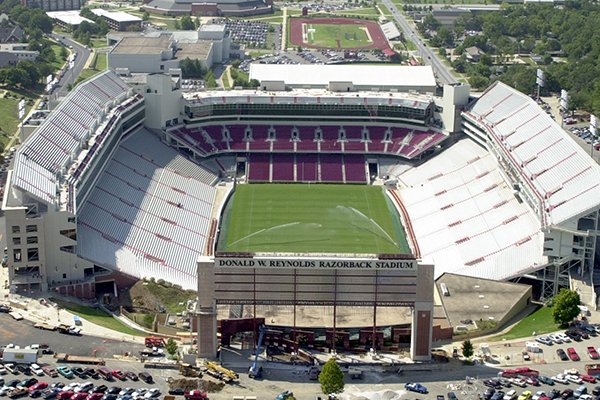
Going In. Razorback Stadium opened in 1938, at 350 N. Razorback Road, about a mile northest of downtown. If you drive in, parking is $20.

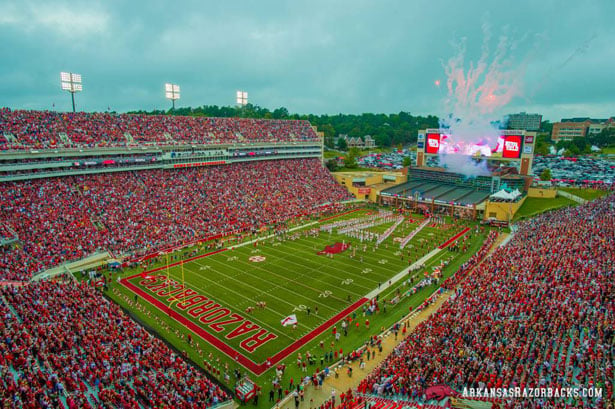
Originally seating 13,500, it was expanded to 21,000 in 1950, 30,000 in 1957, 42,000 in 1969, 52,000 in 1985, and its present 76,000 in 2001. That last expansion was funded by the Donald W. Reynolds Foundation, founded by an Arkansas media chief, and the stadium was renamed Donald W. Reynolds Razorback Stadium.
The field is laid out north to south, and has been artificial turf since 2009. It was named Frank Broyles Field for the former football coach and athletic director upon his 2007 retirement as AD. The scoreboard includes not a "big screen," but, in keeping with the Razorback theme, a "Pig Screen."

(UPDATE: Arkansas returned to natural grass for the 2019 season.)

The Athletic Center, including team offices and training centers, was also named for Broyles, and in the north end zone. It was recently demolished to make way for an replacement facility under a bleacher section that will expand capacity to over 80,000.
Food. It's the South. You're gonna get food that's long on taste and low on health benefits. You can get your organic Whole Foods and nonfat latte from Starbucks when you get back to New York.

They seem to like macaroni & cheese in Arkansas, because they put it on both a "Mac Attack Burger" (definitely not to be confused with a McDonald's Big Mac) and a quarter-pound hot dog. They also serve Big Red Pork Tenderloin Sandwiches, Petit Jean Grilled Ham & Cheese Sandwiches, and Buffalo Chicken Nachos. In other words, if you're rooting for the visiting team, if they can't beat you, they'll kill you by ruining your diet.

Team History Displays. Long a mainstay of the Southwest Conference, Arkansas won it 13 times: In 1936, 1946, 1954, 1959, 1960, 1961, 1964, 1965, 1968, 1975, 1979, 1988 and 1989. They've found the Southeastern Conference rough going, winning the Western Division in 1995, 2002 and 2006, but losing the SEC Championship Game each time.

They won the National Championship in 1964, with a team that included future Dallas Cowboys owner Jerry Jones (guard, Number 61) and future Cowboys coach Jimmy Johnson (defensive tackle, Number 60). This included beating Nebraska 10-7 in the 1965 Cotton Bowl in Dallas.

They won the Cotton Bowl again in 1976, 2000 and 2012. They also won the 1947 Dixie Bowl, the 1960 Gator Bowl, the 1969 Sugar Bowl, the 1978 Orange Bowl, the 1980 Hall of Fame Classic, the 1982 Bluebonnet Bowl, the 1985 Holiday Bowl, the 2003 Independence Bowl, the 2009 Liberty Bowl, the 2014 Texas Bowl, and the 2015 Liberty Bowl. However, there is no open display for any of these honors in the fan-viewable areas of the stadium.

Razorback football legends the following members of the College Football Hall of Fame, with their senior years included: End Wear Schoonover (1929), running back Clyde Scott (1948), linebacker Wayne Harris (1960), receiver Lance Alworth (1961), running back Billy Joe Moody (1962), offensive tackle Loyd Phillips (1966), receiver Chuck Dicus (1970), defensive end Billy Ray Smith Jr. (1982); and head coaches Hugo Bezdek (1908-12), Francis Schmidt (1922-28), Bowden Wyatt (1953-54, elected for what he did elsewhere), Frank Broyles (1958-76) and Lou Holtz (1977-83). Alworth is also in the Pro Football Hall of Fame.

Other prominent Arkansas football players include end Jim Lee Howell (1936, was an NFL Champion with the Giants as a player in 1938 and as head coach in 1956), end Jim Benton (1937), offensive tackle Pat Summerall (1951, won an NFL Championship with the Giants, better known as a broadcaster), defensive tackle Dave Hanner (1951), quarterback Joe Ferguson (1972), linebacker Dennis Winston (1976, won 2 Super Bowls with the Pittsburgh Steelers), guard R.C. Thielemann (1976, went from Arkansas to the Washington Redskins, so remained a "Hog," won a Super Bowl), defensive tackle Dan Hampton (1978, won a Super Bowl with the Chicago Bears, Pro Football Hall of Fame), guard Fred Childress (1988), safety Steve Atwater (1988, won 2 Super Bowls with the Denver Broncos), offensive tackle Brandon Burlsworth (1998), running back Darren McFadden (2007).

Former college head coaches Red Hickey, Barry Switzer, Fred Akers, Ken Hatfield, Jimmy Johnson and Butch Davis are also Razorbacks.

The Razorbacks have retired 2 numbers: 12, for Clyde Scott; and 77, for Brandon Burlsworth. Scott, born in 1924, was a member of the 1949 NFL Champion Philadelphia Eagles, and is still alive. Burlsworth, born in 1976, is not, killed in a car crash in 1999, after being drafted by the Indianapolis Colts, but before he could play for them.

Arkansas is also known for a great track & field program, which has produced Olympic Gold Medalists Mike Conley Sr. (1992), Veronica Campbell (2004 and 2008 for Jamaica), Omar McLeod (2016 for Jamaica) and Taylor Ellis-Watson (2016). The school also produced swimming Gold Medalist Neil Brooks (1980, for Australia).

Other prominent Razorback athletes included baseball players Tim Lollar, Kevin McReynolds, Tom Pagnozzi, Cliff Lee, Eric Hinske, Dallas Keuchel and Andrew Benintendi; basketball players Gordon Carpenter and Robert Pitts (Gold Medal, 1948 Olympics), Sidney Moncrief (the Milwaukee Bucks retired his number), Joe Kleine and Alvin Robertson (Gold Medal, 1984 Olympics), Corliss Williamson (led them to the 1994 National Championship) and Joe Johnson (current Brooklyn Nets star); and, if you want to really stretch the meaning of "athlete," beyond the amount you normally would for a golfer, there's John Daly.

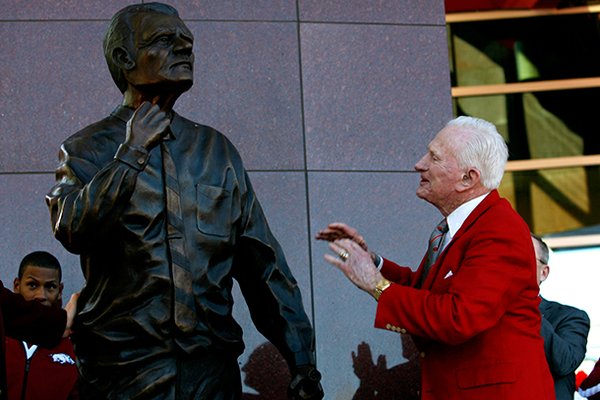
Outside the north end zone, where the Athletic Center named for him was, and will be again after the renovations, a statue was dedicated to Frank Broyles. He lived long enough to see it.
The Razorbacks' greatest rival was the University of Texas, culminating in a game at Razorback Stadium on December 6, 1969, with the Longhorns coming in ranked Number 1 and the Razorbacks Number 2, and the winner getting the SWC title, a berth in the Cotton Bowl, and a shot at the National Championship.

It was billed as one of those periodic "Game of the Century" matches, and was attended by President Richard Nixon. (Legend has it that Arkansas native and future President Bill Clinton attended, but he was at Oxford University at the time.) Arkansas led 14-0, but Texas won it 15-14, ruining the Hogs' hopes. In his book Horns, Hogs, and Nixon Coming: Texas vs. Arkansas in Dixie's Last Stand, Terry Frei of the Denver Post called it "Arkansas' Greek tragedy." They ended up losing the Sugar Bowl to neighboring Mississippi, too.

Texas leads the rivalry 56-22, but the annual game stopped after Arkansas left the SWC for the Southeastern Conference in 1991 (rendering the SWC a Texas-only league, and probably leading to its doom 5 years later), they haven't played each other since Arkansas won the 2014 Texas Bowl, and they won't play each other again until 2021.

Arkansas' move to the SEC led to rivalries with schools from neighboring States, including the University of Missouri (a.k.a. "Mizzou," also a new SEC team, they lead Arkansas 5-3), the University of Tennessee (they lead 13-5, although Arkansas has won the last 2), the University of Mississippi (a.k.a. "Ole Miss," Arkansas leads them 35-27-1), and Louisiana State University (a.k.a. LSU. who lead Arkansas 38-22-2).

UPDATE: Through the 2020 season, Arkansas now leads Ole Miss 36-28-1, but trails Missouri 9-3, trails LSU 42-22-2, and still trails Tennessee 13-5.

A trophy in the shape of the adjoining States of Arkansas and Louisiana, called the Golden Boot, goes to the winner of the Arkansas-LSU game, usually played on Thanksgiving weekend since 1992.
Stuff. There is no big team store at the stadium, just souvenir stands. You'll have to go to the University  Bookstore, at 616 Garland Avenue, at Douglas Street, about a 5-minute walk northeast of the stadium.

The most comprehensive history of Razorback football I could find on Amazon.com only goes up to 1995: Orville Henry's The Razorbacks: A Story of Arkansas FootballTerri Frei of the Denver Post wrote Horns, Hogs, and Nixon Coming: Texas vs. Arkansas in Dixie's Last Stand, about the 1969 Texas-Arkansas Game

There's not much on video, either, just the period specific 22 Straight: Arkansas Football 1963-1965 and Arkansas SEC Classics (which covers 1992 to 2008).

During the Game. In 2013, Arkansas visited Rutgers, and thousands of their fans came in their cardinal red clothes, and were very polite, and didn't make a fuss about going 1,300 miles just to lose to Rutgers. If you return the favor, I don't think you'll have a problem with rough treatment.

In 1909, the team, then known as the Arkansas Cardinals for the school color went 7-0, and outscored the opposition 186-18. Coach Hugo Bedzek said his team "played like a wild band of razorback hogs." The name was changed to the Razorbacks for 1910, and by the 1920s, the traditional cheer, the Calling of the Hogs, was in place: "Woooooooo... Pig! Sooie!" It usually starts in the student section, the upper deck of the southeast corner.
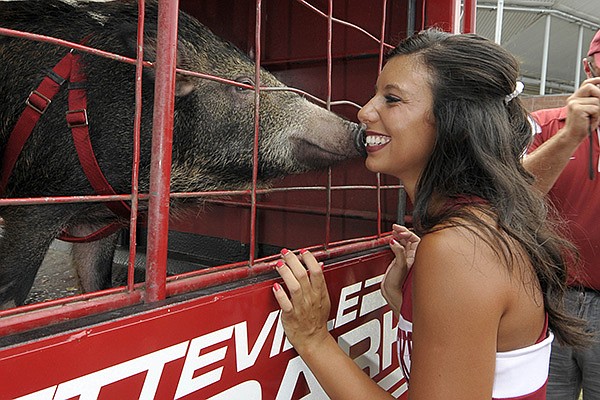
Tusk IV and a Razorback cheerleader. At Arkansas,
if you call a man a "pig," he might say, "Thank you, sir."

The fight song is "Arkansas, Fight!" There are 2 mascots: A live Tusk IV, a Russian boar and the great-grandson of Tusk I, who debuted in 1994; and Big Red, a student in a costume, used since 1973. There's also a female Hog, naturally named Sue E. (UPDATE: Tusk IV died in 2020, and has been replaced by a Tusk V.)
Big Red appears to be cheating on Sue E.
by hamming it up with these cheerleaders.

After the Game. Your safety won't be an issue. Getting a postgame meal might be. Despite my joke earlier, there is a Starbucks about half a mile east of the stadium, at 111 Ozark Avenue. There's also a Chick-fil-A at 435 Garland Avenue; and a Quizno's, in Brough Commons Dining Hall, at 1021 W. Dickson Street. But you're probably better off heading downtown.

If you visit Arkansas during the European soccer season, as we are now in, you're probably out of luck: The best-known "football pub" in the State is back in Little Rock, Dugan's Pub, at 401 E. 3rd Street.

Sidelights. Just to the southeast of Razorback Stadium at 285 Stadium Drive is the 10,000-seat home of Arkansas basketball from 1954 to 1993. Originally known as the Arkansas Fieldhouse, it was renamed Barnhill Arena in 1973, for the late John Barnhill, football coach 1946 to 1949 and athletic director 1946 to 1971.
Head coach Nolan Richardson ran his "Forty Minutes of Hell" offense, and the arena was nicknamed "Barnhell." He was successful enough to get a new arena built, named for a member of the Walton family of nearby Bentonville and Walmart infamy: The 19,368-seat Bud Walton Arena. 1270 Leroy Pond Drive, about half a mile south of Razorback Stadium and Barnhill Arena.

In their 1st season in it, 1993-94, the Razorbacks won the National Championship. In their 2nd season, they got back to the Final.
They won their conference's regular-season title 24 times (including 1992 and 1994 since moving to the SEC) and its tournament 7 times (including 2000 in the SEC). They've reached the Final Four in 1941, 1945, 1978, 1990, 1994 and 1995.

Aside from the University, there isn't much to see in Fayetteville. Headquarters House, at 118 E. Dickson Street, was a headquarters for both sides in the Civil War, as the city changed hands.

Back in Little Rock, 189 miles to the southeast, is War Memorial Stadium, a 54,128-seat stadium built in 1948, which the Razorbacks have used as a secondary home, usually once a season. (They opened this season there, beating Florida A&M.) It is also home to the football team of Arkansas Baptist College, and minor-league soccer's Little Rock Rangers. 1 Stadium Drive, about 2 1/2 miles west of downtown.
Hot Springs, 185 miles southeast of Fayetteville and 55 miles southwest of Little Rock, where Bill Clinton spent his teenage years, was a resort well known for having actual hot springs, and also for illegal gambling. It is said that Spring Training was invented there when, coming off a Pennant-winning season, Chicago White Stockings (forerunners of the Cubs) manager and 1st baseman Adrian "Cap" Anson took his team there before the 1886 season to "boil the beer out of them." It remained a popular Spring Training site into the 1920s, before railroads and air-conditioning made Florida, and later Arizona, practical.

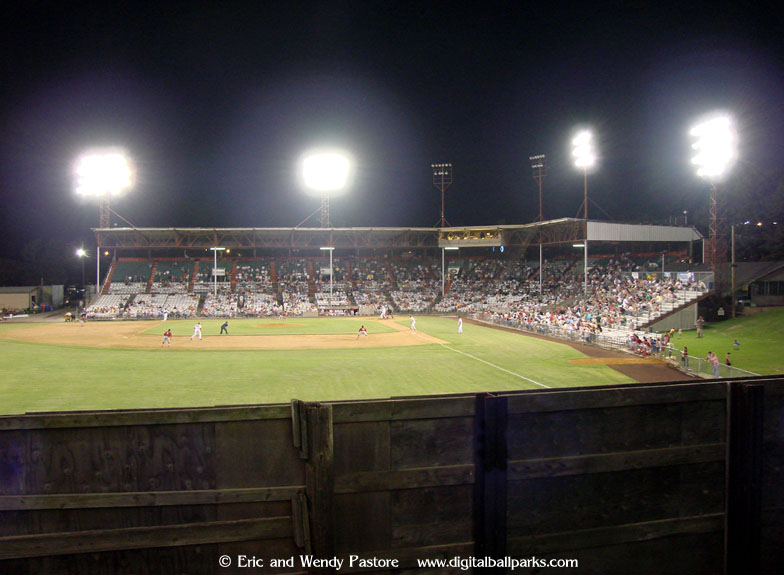
There are 2 minor-league baseball teams in Arkansas. The Arkansas Travelers, currently a farm team of the Seattle Mariners, play at the 7,200-seat Dickey-Stephens Park in North Little Rock. 400 W. Broadway Street, just across the Arkansas River from downtown Little Rock.
Dickey-Stephens Park, with the Arkansas River
and downtown Little Rock in the background

DSP replaced the Travelers' previous home, 1932 to 2006, the 6,000-seat Traveler Field, renamed Ray Winder Field in 1966. 4936 W. Markham Street, just south of War Memorial Stadium.
The Travelers, named for the old folk song "The Arkansas Traveler," have won 9 Pennants: In 1937, 1960, 1971, 1977, 1979, 1980, 1989, 2001 and 2008.
Despite their name, the Travelers compete in the Class AA Texas League, as does the State's other team, the Northwest Arkansas Naturals. They are a farm team of the Kansas City Royals, have won 4 Division titles, including the 2010 Texas League Pennant, and play in Arvest Ballpark. 3000 Gene George Blvd. in Springdale, about 8 miles north of the UA campus.
Dickey-Stephens Park is named for 2 sets of brothers, local businessmen Jackson and Witt Stehens, and ex-big league catchers Bill and George Dickey. Bill Dickey, of course, was the 1st great Yankee catcher, starting from 1929 until 1943, and winning 8 Pennants and 7 World Series. He was Lou Gehrig's best friend on the team, played himself in the movie The Pride of the Yankees, and, while the Captaincy was officially vacant from 1939 to 1976, he was the effective captain from 1939 until 1939.

He managed the team in 1946, and was a coach from 1949 to 1960, teaching Yogi Berra how to be a proper catcher. The Yankees retired Number 8 for him and Berra in 1972, and dedicated Plaques in Monument Park for them in 1988. He died in 1993, and is buried at Roselawn Memorial Park in Little Rock. 2801 Asher Avenue, about 3 miles southwest of downtown.

From the UA campus in Fayetteville, it is far to any major-league city: 216 miles west to Oklahoma City, 232 miles north to Kansas City, 318 miles southeast to Memphis, 331 miles southwest to Dallas, and 358 miles northeast to St. Louis.

In baseball, most of Arkansas shows the effects of the old St. Louis Cardinals' radio network, plus Card superstar Dizzy Dean being from Arkansas. Both Little Rock and Fayetteville give about 25 percent of their baseball fandom to the Cards, with the Yankees and Red Sox both around 10 percent. Except for the southenrmost tier of the State, which tilts toward the New Orleans, Saints, Arkansans tend to root for the Dallas Cowboys in the NFL.

In basketball, the easternmost part of the State, bordering Tennessee, supports the nearby Memphis Grizzlies; and the western area, bordering Oklahoma, favors the Oklahoma City Thunder. But Little Rock and Fayetteville are too isolated from Memphis or OKC for those teams to register. Fans there mostly root for the most successful teams: The Los Angeles Lakers, the Golden State Warriors, and whatever team LeBron James is playing for now. Hockey is barely on the radar, but the St. Louis Blues are preferred over the Nashville Predators and the Dallas Stars.

The University of Arkansas also has a campus in Pine Bluff, and won the National Championship of historically black colleges and universities (HBCUs) in 2012. The Golden Lions play at the 16,000-seat Golden Lion Stadium, 1960 Oliver Road. The school is 43 miles southeast of Little Rock, 229 miles southeast of Fayetteville, and 142 miles southwest of Memphis.
The Beatles never played in Arkansas. Elvis Presley did, especially early in his career, because his hometown of Memphis, Tennessee is right across the Mississippi River from West Memphis, Arkansas.

He played at the Texarkana Municipal Auditorium on November 24, 1954, April 22 and May 27, 1955; the Catholic Club in Helena on December 2, 1954, January 13, March 8 and December 14, 1955; the P and G Auditorium in West Memphis on December 8, 1954; the City Auditorium in Camden on February 21, 1955;  the Robinson Auditorium in Little Rock: On February 20 and August 3, 1955, and May 16, 1956; City Hall in Hope on February 22, 1955; the Armory and Porky's Rooftop in Newport on March 2, 1955; the Arkansas Municipal Auditorium in Texarkana on March 3, September 2 and November 17, 1955; the Fair Park Coliseum in Hope on June 7, 1955; the Sevier County Fair in De Queen on June 16, 1955; the Silver Moon Club in Newport on July 21 and October 24, 1955; the Camden Municipal Auditorium on August 4 and November 16, 1955; River Stadium in Batesville on August 6, 1955; Memorial Stadium in El Dorado on October 17, 1955; the B&I Club in Swifton on December 9, 1955; and the Community Center in Jonesboro on January 4, 1956.

And at high schools in 1955 in Leachville on January 20, August on February 2, Aubrey on February 3, Pine Bluff on February 23, Parkin on March 21, Marianna on March 24, Dermott on March 25, El Dorado on March 30, Nettleron on April 4, Bono on September 6, Watson Chapel on September 27, Forrest City on November 14, and Swifton on December 9.

In his later years, he played the T.H. Barton Coliseum in Little Rock (2600 Howard Street) on April 17, 1972, and the Pine Bluff Convention Center (1 Convention Center Plaza) on September 7 and 8, 1976. Both buildings are still standing.

Bill Clinton is the only President with a significant connection to Arkansas. The William J. Clinton Presidential Center is at 1200 President Clinton Avenue, just east of downtown. Between the Library and downtown is the Historic Arkansas Museum, at 200 E. 3rd Street.

The Clinton Birthplace Foundation is at his childhood home, at 117 S. Hervey Street in Hope, 113 miles southwest of Little Rock, 232 miles south of Fayetteville, and 209 miles northeast of Dallas. This was the home of his maternal grandparents.

But it was not his birthplace: He was born on August 19, 1946 at Julia Chester Hospital, which was demolished in 1991, just before he began his run for President. (This happened to Gerald Ford as well: The house where he was born was torn down 4 years before he became President.) Ironically, a funeral home was built on the site. Brazzel-Oakcrest Funeral Home, 1001 S. Main Street. He later lived nearby at 321 E. 13th Street; in Hot Springs at 1011 Park Avenue; and at the Governor's Mansion in Little Rock, at 1800 Center Street.

The tallest building in Arkansas is the 547-foot Simmons Tower, at 425 W. Capitol Avenue in downtown Little Rock.
There have been 2 notable TV shows set in Arkansas. Evening Shade, running on CBS from 1990 to 1994, was a sitcom with Burt Reynolds playing a local football hero coming home to coach his old high school's team. Although taped in Los Angeles, several Arkansas scenes were used in the opening sequence, including McClard's Bar-be-que in Hot Springs National Park. And what started as 17, becoming 18, and finally 19 Kids and Counting starred the Duggar Family, who lived in Tontitown, outside Springdale. It ran from 2008 to 2015, until scandal sank it.

Thelma & Louise started in Little Rock, as did Brubaker, Robert Redford's 1980 prison film. So did Walk the Line, the film biography of Dyess native Johnny Cash.

*

Arkansas is an odd place in many ways, but they do love their college football. The Razorbacks are an institution, and if you hear the call of the Hogs, find a time to answer it, and go.

Thursday, June 15, 2017

Top 10 Athletes From Arkansas

June 15, 1836: Arkansas is admitted to the Union as the 25th State.

The 3 most famous people from Arkansas are probably more identified with other places. Paul W. "Bear" Bryant of Fordyce is remembered as the head football coach at the University of Alabama. Johnny Cash of Dyess is remembered for his connections to Tennessee, both Memphis where he began his recording career and Nashville where he had his greatest fame. And Bill Clinton of Hope and Hot Springs became President, and now lives in New York.

Speaking of Presidents, in 1983, Ronald Reagan posthumously awarded Bryant the nation's highest civilian honor, the Presidential Medal of Freedom.

Top 10 Athletes From Arkansas

Honorable Mention to Allan James Burnett of North Little Rock. A.J. helped the Yankees win the World Series in 2009.

Honorable Mention to Bill Carr of Pine Bluff. At the 1932 Olympics in Los Angeles, he won 2 Gold Medals, including in the 400 meters, setting a world record. A car crash a year later ended his career, and may have prevented him from repeating in Berlin in 1936, and thus rising much higher on this list.

10. Sidney Moncrief of Little Rock. He led the University of Arkansas to the Southwest Conference basketball title and the NCAA Final Four in 1978, and was named SWC Player of the Year in 1979. He became a 5-time NBA All-Star with the Milwaukee Bucks, who retired his Number 4.

How good was he? So far, the voters for the Basketball Hall of Fame haven't considered him good enough for election. But he's in the Wisconsin Sports Hall of Fame. And he was good enough for Michael Jordan to say this about him: "When you play against Moncrief, you're in for a night of all-around basketball. He'll hound you everywhere you go, both ends of the court. You just expect it."

9. George Kell of Swifton. A .306 lifetime hitter, the 3rd baseman for the Detroit Tigers was a 10-time All-Star. In 1949, he won the American League batting title, denying Ted the Triple Crown by the slimmest of margins. He then starred for the Baltimore Orioles, before age led them to turn to someone else on this list. He went back to the Tigers as a broadcaster, and was elected to the Baseball Hall of Fame. His brother Everett "Skeeter" Kell also played in the major leagues.

8. Bobby Mitchell of Hot Springs. He starred in both football and track at the University of Illinois. He thought he could make the 1960 Olympics in Rome, but Cleveland Browns head coach Paul Brown offered him a $6,000 bonus to play pro football, and he made the easy decision.

A 4-time Pro Bowler, he starred for the Browns before becoming the 1st black player for the Washington Redskins in 1962, returning a kickoff for 92 yards and a touchdown in his 1st game. He led the NFL in receiving yards that year and in 1963 (including catching a record-tying 99-yard touchdown pass from Sonny Jurgensen), and in receiving touchdowns in 1964.

A key figure in the long-terrible Redskins' return to respectability, he caught 521 passes, a huge number for his era. He was named to the Pro Football Hall of Fame, the 70 Greatest Redskins (for the team's 70th Anniversary, and then the 80 Greatest for their 80th), and the Washington Redskins Ring of Fame. The Redskins don't retire numbers (except for Sammy Baugh's 33), but his 49 has rarely been given back out.

7. Charles "Sonny" Liston of Sand Slough. Because there was no birth certificate, we don't know exactly when he was born. Because he was found dead shortly after a New Year, we don't know exactly when he died. In each case, we don't even know the year for sure. He may be the most recent famous person for whom both of these facts are true. The best guesses are that he was born on July 22, 1930 and died on December 30, 1970.

I won't get into his past, other than to say that, when Muhammad Ali called him "too ugly to be the world's champ," he meant Liston's face, but could also have been talking about Liston's character. He was Heavyweight Champion of the World for 17 months, from September 25, 1962, when he destroyed Floyd Patterson at Comiskey Park in Chicago, until February 25, 1964, when Ali wrecked him at the Miami Beach Convention Center. Few people cheered when he won the title, and many did so when he lost it. Nevertheless, he was the champ, and that's something no other Arkansas-born or Arkansas-raised heavyweight can say.

6. Dizzy Dean of Lucas. Ol' Diz liked to tell different stories to different people. He told people his name was Jay Hanna Dean (which was true), Jerome Herman Dean, and Jerome Hanna Dean. He told people he was from Arkansas (which was true), Mississippi, Louisiana and Texas. He told people he was born in 1910 (which was true), 1911 and 1912. He also told people he was the greatest pitcher who ever lived.

With a mouth like that, he had better have been great. He was: A 4-time All-Star, he led the St. Louis Cardinals' "Gashouse Gang" to the 1934 World Championship, going 30-7, making him, to this day, the last National League pitcher to win 30 games in a season. His brother Paul Dean, who didn't like being called "Daffy," was also a pretty good pitcher on that Cardinal team.

His career was cut short by a line drive hit by Earl Averill of the Cleveland Indians at the 1937 All-Star Game in Washington, smacking him on the toe. Supposedly, the doctor told him the toe was fractured, and Diz said, "Fractured, hell, the damn thing's broken!" To favor the toe, he altered his pitching motion, and he wrecked his elbow. The Cards traded him to the Chicago Cubs in 1938, and he had enough left to help them win the Pennant. But by 1941, age 31 (we think), he was done, except for a brief 1-game comeback in 1947.

That injury limited him to 150 wins. Nevertheless, he was dominant enough in his brief time, and enough of a cultural icon (in each case, like the much quieter Sandy Koufax 30 years later), that he was elected to the Baseball Hall of Fame. The Cardinals elected him to their team Hall of Fame, and retired his Number 17. Second to Bobby Orr (the Boston Bruins' Number 4), he is probably the greatest athlete whose name rhymes with his uniform number.

5. Scottie Pippen of Hamburg. Say what you want about Michael Jordan, but he won nothing until Pippen arrived at the Chicago Bulls. Together, they won 6 NBA Championships in 8 years: 1991, '92, '93, '96, '97 and '98. Pip nearly led them to another title in 1994, coming a whole lot closer to a title without Jordan than Jordan ever did without him.

He was a 7-time All-Star, an 8-time All-Defensive First Temaer, and led the league in steals in 1995. He won Olympic Gold Medals in 1992 (the Dream Team, another title Jordan won with him) and '96. His Number 33 was retired by both the University of Central Arkansas and the Bulls. He was named to the Basketball Hall of Fame and the NBA's 50th Anniversary 50 Greatest Players.

He is now a senior advisor to the Bulls. In 2011, at age 45, he led the NBA All-Star Celebrity Game in scoring. Even more importantly, he blocked a shot by Justin Bieber: "He played pretty well, but he has an ugly shot." Pippen thus proved not only that he could still play a little, but that his eyes still worked.

4. Willie Davis of Texarkana. A 5-time Pro Bowler, he stands with Reggie White as the 2 greatest defensive ends (and, indeed, defensive linemen) in the long, proud history of the Green Bay Packers. He helped them win 5 NFL Championships, including the 1st 2 Super Bowls in 1967 and '68. He was named to the NFL's 1960s All-Decade Team, the Pro Football Hall of Fame, and The Sporting News' 100 Greatest Football Players.

3. Brooks Robinson of Little Rock. In 1955, he arrived with the Baltimore Orioles. In 1960, he won his 1st Gold Glove at 3rd base, and made his 1st All-Star Team. In 1964, he was the 1st Oriole named American League Most Valuable Player. In 1966, he helped the Orioles win their 1st Pennant and their 1st World Series. In 1970, he won another World Series, redefining the way people viewed the playing of 3rd base, and winning the Series MVP. In 1974, he played in his last All-Star Game, his 18th, and made his 6th postseason appearance. In 1975, he won his last Gold Glove, his 16th.

In 1977, he retired, had his Number 5 retired, and, with Frank Robinson (no relation), became the 1st 2 inductees into the Orioles' Hall of Fame. In 1983, he was elected to the Baseball Hall of Fame. In 1991, he was invited to throw out the ceremonial first ball before the last Orioles game at Memorial Stadium (along with Johnny Unitas of the Colts, who threw a football). In 1999, he was named to The Sporting News' 100 Greatest Baseball Players and the Major League Baseball All-Century Team.

2. Bill Dickey of Searcy. Though born in Bastrop, Louisiana, Arkansas is where he called home most of his life. He is on the short list for the title of "Greatest Catcher Who Ever Lived": A .313 lifetime batting average, 4 20-plus home run seasons (a big number for a catcher at that time), 4 100+ RBI seasons, and 11 All-Star Game appearances, including the 1st 2 and 10 of the 1st 11. He probably would have had 3 or 4 more had the ASG been established earlier.

He helped the Yankees win 8 Pennants (1932, '36, '37, '38, '39, '41, '42 and '43) and 7 World Series (all but '42). He briefly managed the Yankees in 1946, then returned in 1949 as a coach, turning Yogi Berra from a very shaky catcher into one who might have been even better: "Bill Dickey is learning me all his experiences."

The Yankees retired Number 8 for both Dickey and Berra. (Dickey wore 33 as a coach while Berra played and wore 8.) He is in the Yankees' Monument Park, the Baseball Hall of Fame, and The Sporting News' 100 Greatest Baseball Players.

1. Don Hutson of Pine Bluff. Raymond Berry may have put it into question in the late 1950s, but until Jerry Rice came along in the mid-1980s, Hutson was the greatest receiver in football history. (In 1989, Hutson graciously, and perhaps not prematurely, said that Rice had surpassed him.)

He led the University of Alabama to the 1934 National Championship, when "the other end" was a kid named Paul Bryant. The Bear had seen him star in high school: "He was something to see even then. We'd hitchhike to Pine Bluff just to watch him play."

It's unlikely anyone from Arkansas or Alabama hitchhiked all the way to Green Bay, Wisconsin to watch "The Alabama Antelope" play. But for the Green Bay Packers, he won 3 NFL Championships: 1936, 1939 and 1944. He was NFL Most Valuable Player in 1941 and 1942. He was an 8-time All-Pro. In 1940, he led the NFL in receptions and interceptions, so he was great on both sides of the ball. He caught 488 passes for 7,991 yards and 99 touchdowns, all of which stood as records long after he retired. He also had 30 career interceptions.
Don Hutson, playing for the Packers against
the Chicago Bears at Wrigley Field,
pioneering the use of eyeblack.
The photo is colorized, but accurate.

The Packers retired his Number 14, and elected him to their team Hall of Fame. He was elected to the College and Pro Football Halls of Fame (with the latter, a charter inductee in 1963), the NFL's 1930s All-Decade Team, the 50th and 75th Anniversary All-Time Teams, The Sporting News' 100 Greatest Football Players, and, in 2010, 65 years after his last game and 13 years after his death, Number 9 on the NFL Network's 100 Greatest Players, 2nd only to Rice among receivers.