Showing posts with label al gore. Show all posts

Friday, December 12, 2025

December 12, 2000: Bush v. Gore

December 12, 2000, 25 years ago: The Supreme Court of the United States overrules the Supreme Court of the State of Florida. It is the case of Bush v. Gore.

In the Presidential election of November 7, the Democratic nominee for President of the United States, the then Vice President of the United States, Albert Arnold Gore Jr., got more popular votes than the Republican nominee, the Governor of Texas, George Walker Bush: Gore 50,999,897, Bush 50,456,002, a margin of 543,895 votesRalph Nader, famous as a consumer advocate since the 1960s, ran as the nominee of the Green Party. He got 2,882,955 votes. Gore got 48.4 percent of the popular vote; Bush, 47.9 percent, Nader, 2.7 percent.

Bush's brother, Governor John Ellis "Jeb" Bush of Florida, saw how close the vote was in his State, and tampered with the voting process, and that one State held everything up for 5 weeks. The best attempt at a recount, in downtown Miami, was interrupted on November 22 by what became known as the Brooks Brothers Riot. As a result, there were votes that were never counted. I don't mean they weren't recounted, I mean they were never counted, not even once.

On December 8, the Florida Supreme Court ruled that all 61,000 "undervotes" had to be counted. Had that happened, Gore surely would have won. The Bush campaign immediately appealed to the U.S. Supreme Court. SCOTUS ruled on December 12:

* Four Justices ruled that the recount had to go forward: John Paul Stevens, appointed by Republican President Gerald Ford; David Souter, appointed by Republican President George H.W. Bush, the current Republican nominee's father; Ruth Bader Ginsburg, appointed by the current President, Democrat Bill Clinton; and Stephen Breyer, also appointed by Clinton.

* Five Justices ruled that the recount had to stop immediately, all of them appointed by Republican Presidents: William Rehnquist, appointed by Richard Nixon, and promoted to Chief Justice by Ronald Reagan; Sandra Day O'Connor, appointed by Reagan; Antonin Scalia, appointed by Reagan; Anthony Kennedy, appointed by Reagan; and Clarence Thomas, appointed by the elder George Bush.

It was pretty easily guessed that all 4 Justices who voted to keep the recount going would do so; and that 3 Justices known for being archconservatives -- Rehnquist, Scalia and Thomas -- would vote to stop it.

The question marks were 2 moderates, both known as "swing votes": O'Connor and Kennedy. If either of them had voted to keep the recount going, it would have been kept going, and Gore would have won. Instead, both voted to stop it.

And so, in an election where over 104 million votes had been accepted as counted, only two votes ended up mattering: Those of O'Connor and Kennedy.

It may have been the ghastliest decision in the Court's history, aside from the 1857 decision in Dred Scott v. Sandford, that said that black people weren't citizens (a decision remedied by the 14th Amendment to the Constitution). It also marked perhaps the 1st time in the nation's history that political conservatives overruled a case based in part on a State's rights.

It may have been surpassed as the ghastliest decision in the Court's history by Trump v. United States in 2024, when the Court ruled that Presidents have immunity from criminal prosecution.

Gore conceded the election the next day, forever doomed to be "the 42nd 1/2 President of the United States" -- a President-elect, but never a President. On January 6, 2001, in his role as the outgoing Vice President, Gore properly read the Electoral Votes, including the 25 of the State of Florida. Whether those votes were properly arrived at is another matter. Congress then certified the Electoral Votes.

On that January 6, no Democrats stormed the U.S. Capitol Building in an attempt to stop that process.

Twenty years later, of course, when it was Republicans who didn't like the result, they did storm the Capitol, and attempt to stop the process. They only delayed the inevitable.

Rehnquist died in office in 2005. O'Connor retired right before that. Souter retired in 2009. Stevens retired in 2010, and died in 2019. Scalia died in office in 2016. Kennedy retired in 2018. Ginsburg died in office in 2020. Breyer retired in 2022. O'Connor died in 2023. Souter died in 2025. As of December 12, 2025, Kennedy, Thomas and Breyer are still alive; while Thomas is the only 1 of the 9 who is still on the Court.

Bush's 2 terms in office were an unmitigated disaster, both domestically (especially economically) and internationally. Had Gore been allowed to accept his victory, he would have governed completely differently, and most Americans, including the conservatives, would have been better off.

Saturday, November 22, 2025

November 22, 2000: The Brooks Brothers Riot

November 22, 2000, 25 years ago: An election that began to be stolen on Election Day itself, November 7, takes a big step closer to being stolen, with "The Brooks Brothers Riot."

The Republican nominee for President, Governor George W. Bush of Texas, lost the national popular vote to the Democratic nominee, Vice President Al Gore. But he appeared to have won enough Statewide popular votes to win 271 Electoral Votes to Gore's 269.

In dispute was the State of Florida, where Bush was originally certified to have won by 1,784 votes. It's important to note that the Governor of Florida was his brother, John Ellis "Jeb" Bush. Through his Secretary of State -- and, it was rumored, his mistress -- Katharine Harris, Jeb had the Florida vote fixed for his brother, including the deletion of the names of 55,000 people, nearly all black men, from the voter rolls.

In other words, if those 55,000 people were permitted to vote, even if less than half of them ended up voting at all, there was no way Gore wouldn't have gotten enough of those 55,000 votes to offset a 1,784-vote lead for "Dubya."

A clause in Florida's State Constitution mandated that, since the election was so close, a Statewide recount had to be done. The recount for Dade County, including the City of Miami, was done at the Stephen P. Clark Government Center, at 111 Northwest 1st Street in downtown Miami. (Clark was Mayor of Miami from 1967 to 1972, and again from 1993 to 1996.)
The Stephen P. Clark Government Center

The recount began, but Representative John E. Sweeney, then a freshman Congressman from New York's Capital Region, including the State capital of Albany, told an aide to "Shut it down." And so dozens of people, many of them wearing sharp suits typical of Republican staffers at the time -- hence the name of the demonstration, as Brooks Brothers is a popular store chain with them -- found their way into the building, and pounded on the doors of the room where the recount was being done, making it unsafe for the counters.

They got what they wanted. Bush's lead got down to 537 votes, when a local court ordered that the recount be stopped. In other words, some votes were never counted, not even once. The State Supreme Court ruled that the recount had to resume.

But on December 12, the U.S. Supreme Court ruled that the recount had to stop. And so, Bush's 537-vote win in Florida was certified by the State of Florida, and later by Congress.

Strange: For decades, conservatives -- first in the Democratic Party, then in the 1960s they began to shift to the Republican Party -- were in favor of States' rights over civil rights. But when States' rights and civil rights came together in Florida in 2000, the conservatives wanted the State of Florida to have no rights.

Did Democratic protestors try to stop Congress from certifying this apparently stolen election, as Republican ones tried 20 years later? No. Every Democratic demonstration, including outside Bush's Inauguration as the 43rd President of the United States on January 20, 2001, was peaceful.

But the Republicans have now tried this sort of thing twice in the 21st Century. Indeed, the Brooks Brothers Riot has been called a "dress rehearsal" for the Capitol Insurrection of January 6, 2021.

Many of the Miami demonstrators later took jobs in the Bush Administration. One of them was Roger Stone, a self-described "GOP Hitman," with a history of Republican dirty tricks going back to his work for Richard Nixon's Committee for the Re-Election of the President, the group behind the Watergate burglary of 1972.

Nobody was ever charged with a crime in connection with the Brooks Brothers Riot -- not with election fraud, not with property damage, not with assault, not even with trespassing, of which they were all guilty.

*

November 22, 2000 was a Wednesday, the day before Thanksgiving. As was tradition in my family, I spent Thanksgiving weekend at my grandmother's house, including the Thursday night with my parents and sister, and we sat transfixed at the TV, watching not football games -- the Detroit Lions beat the New England Patriots 34-9 at the Silverdome in suburban Pontiac, Michigan; while the Dallas Cowboys lost to the Minnesota Vikings, 27-15 at Texas Stadium in suburban Irving, Texas -- but footage of the Brooks Brothers Riot, on a seemingly endless loop, as talking heads on CNN and MSNBC tried to make sense of the most blatant election theft in American history.

Other Presidential elections have had accusations of fraud. But this was on television. Even the alleged theft of Illinois' votes by Mayor Richard J. Daley of Chicago in 1960 -- the overturning of which wouldn't have swung the election from John F. Kennedy to Nixon anyway -- wasn't caught by TV or film cameras. The Brooks Brothers Riot was, and the news networks were all too happy to show it over and over again, refusing to say that it was wrong.

The fact that Al Gore's rightly-won Presidency was being assassinated on November 22, the anniversary of the assassination of President John F. Kennedy in 1963, seemed not to have occurred to most people. Certainly, I didn't think of it at the time. With the chaos of the election, the JFK anniversary may have been mentioned less than on any November 22 since 1963. 

Friday, November 7, 2025

November 7, 2000: No One Is Elected President

November 7, 2000, 25 years ago: Election Day. The Democratic Party's nominee for President, Vice President of the United States, Albert Arnold Gore Jr., gets more votes than the Republican Party's nominee, the Governor of Texas, George Walker Bush: Gore 51.0 million, Bush 50.4 million. Gore gets 48.4 percent of the popular vote, Bush 47.9 percent.

Ralph Nader, famous as a consumer advocate since the 1960s, runs as the nominee of the Green Party. He gets 2.9 million votes, or 2.7 percent.

Bush's brother, Governor John E. "Jeb" Bush of Florida, sees how close the vote is in his State, and tampers with the voting process, and that one State holds everything up for 5 weeks.

The following Sunday, November 12, among the guests on NBC's Meet the Press is William Safire, longtime political columnist for The New York Times; before that, a speechwriter for President Richard Nixon. Host Tim Russert asks him, "What do we have here, Bill?" And Safire says, "We have a tie."

For all intents and purposes, he was correct. Both Bush and Gore had a base that thought their man would make a good President. Both of them had party regulars who might not have been happy that the party as a whole nominated the candidate that it did, but would vote for that party's nominee anyway, because that's what they always did. And then there were people who weren't members of either party, and didn't especially like either one, but decided one was worse, and voted for the other one.

It would have been so simple for Gore to win. All he had to do was ask the outgoing President, Bill Clinton, to do one rally for him in downtown Miami. It would, literally, have made all the difference in the world, because, in spite of his personal mistakes, Clinton was a very successful President, and still popular nationwide -- more so than Gore or Bush.

But Gore was terrified that Clinton's personal scandal, which led to his impeachment by a Republican-controlled U.S. House of Representatives, and then his acquittal by a Republican-controlled U.S. Senate, would attach itself to him. So, in his speech at the Democratic Convention at the Staples Center in Los Angeles, he tried to run on the Clinton economic record without the Clinton personal-conduct record, and said, "I stand here today as my own man."

Bush couldn't say that. Well, he could, but, like so many other things he said, it would have been a lie. The son of a President, he was a dimwitted hothead who had faked his way through life. Every time he failed -- in keeping out of military service, in business, and in a 1978 run for Congress -- his father's friends bailed him out.

But Texas evangelicals got him nominated for that State's Governor, an office where the only real requirement is make it easier for businessmen to make money. He got elected in 1994 and 1998. Jeb, considered the smart, level-headed one in the family -- often compared to Michael Corleone, to George's Sonny and father George's Don Vito -- lost in his 1st race for Governor, also in 1994, but won in 1998.

The media gave Bush the benefit of every doubt, and Gore the doubt of every benefit. Case in point: The 1st debate, on October 3, at the Boston campus of the University of Massachusetts. Bush, as he usually did, made himself look like he was not smart enough to be President. Gore was caught on camera sighing over some of Bush's dumb answers. The reaction of most of the American media was not that Bush was too dumb to be President, but that Gore was too rude to be President.

This was the problem: Bush, a known recovering alcoholic, was seen as "the kind of guy you'd like to have a beer with," while Gore was "stiff," "uptight," and "a know-it-all." As comedian Bill Maher put it, "God forbid, the President of the United States should be smarter than we are." But Maher also addressed Gore's image: "People like what he stands for. They just don't like him." And people did like Bush, even if they thought he was dumb.

And enough people didn't like Gore to throw Florida into doubt. Jeb Bush's Secretary of State, in charge of running elections, was Katherine Harris: Young (33 in 2000), attractive, every bit as committed to the conservative movement as the Bush brothers were, and, it was rumored at the time, Jeb's mistress. He put her in charge of ensuring that "Dubya" won in Florida.

Court-ordered recounts were undertaken, and "the Brooks Brothers Riot" in downtown Miami the day before Thanksgiving stopped the one in Dade County. When the U.S. Supreme Court finally ruled on December 12 that the recounts must stop, and Bush be accepted as the winner, it was the ghastliest decision in the Court's history, aside from the Dred Scott decision that said black people weren't citizens (a decision remedied by the 14th Amendment to the Constitution).

Nader, appealing to leftists who felt betrayed by Gore and President Bill Clinton over the last 8 years, won 97,488 votes in Florida. Bush's final lead in Florida was 537 votes. But Nader's voters wanted their "pure" candidate, and the result was the most un-Nader-like (and the most un-Gore-like) Administration anyone could have imagined.

Needless to say, New York's 2 major tabloid newspapers had differing opinions. The Daily News cared about journalism, and their headline was "TOO CLOSE." The Post cared about promoting the conservative candidate, and their headline was "BUSH WINS!"

The election of sitting First Lady Hillary Clinton to be a U.S. Senator from New York was almost unnoticed outside that State. More attention was paid in Missouri, where Governor Mel Carnahan was killed in a plane crash, too close to the election to be replaced on the ballot, and still won the election for Senator over the incumbent, former Governor John Ashcroft. His widow, Jean Carnahan, was appointed to replace him. Bush appointed Ashcroft to be his Attorney General.

Indeed, in connection with the Democratic nominee for President getting the most popular votes, the Democrats gained 4 seats in the Senate, forging a 50-50 tie, which went 51-49 in their favor the following June, when Jim Jeffords of Vermont switched to become an Independent caucusing with the Democrats. The Democrats only gained 1 seat in the House, not nearly enough to take control.

Monday, September 15, 2025

In the Better Timeline...

I've heard people who are fans of science fiction, including time travel stories, say things like, "We are living in the worst timeline."

I've also heard people who are fans of the TV show The Good Place use that show's Season 1 finale shocker to describe the real world in which we now live: They've come to realize that this is the Bad Place: Hell.

The idea being that, maybe, there's another world where a historical event happened differently, leading to a better timeline, or that maybe we died, and began living in what would be, to us, considered Hell.

There's an old bit:

Heaven is where the police are British, the chefs are French, the mechanics are German, the lovers are Italian, and it is all organized by the Swiss.

Hell is where the police are German, the chefs are British, the mechanics are French, the lovers are Swiss, and it is all organized by the Italians.

And Trump has been President continuously since 2009, because there was a coup after President Black Man was elected.

In the better timeline...

* On November 2, 1968, a plane had mechanical difficulties, and Anna Chennault couldn't get on it to fly to Paris and sabotage the Vietnam War peace talks.

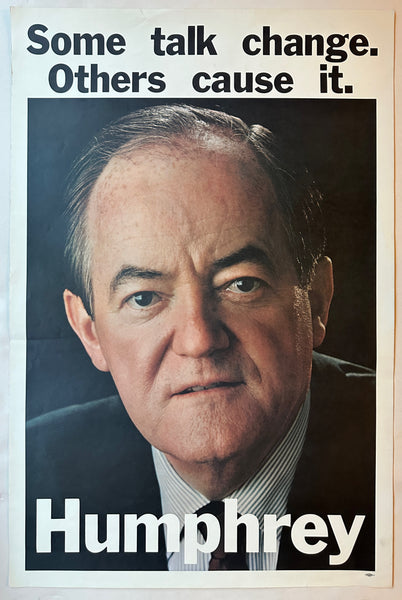
* Hubert Humphrey was elected President. The peace talks continued. Lyndon Johnson got a peace deal by Christmas. Humphrey took office without having to worry about Vietnam. He placed the call to the astronauts on the Moon, not Richard Nixon. There was no Kent State Massacre. Humphrey took us one step closer to universal health care, with MediKid, a children's version of Medicare. He replaces the retiring Chief Justice Earl Warren with former Attorney General Nicholas Katzenbach, the man who, as Robert F. Kennedy's Deputy, got George Wallace out of the schoolhouse door in 1963.

*  With Nixon out of the way, Ronald Reagan was free to be the representative of both the traditional conservative movement and the evangelicals, and ended 12 years of the New Frontier and the Great Society. Reagan's Vice President was chosen because he was a part of the "Southern Strategy": Senator John Tower of Texas.

* It was the Reagan Administration that bugged the Democratic National Committee headquarters at the Watergate, and Bob Woodward and Carl Bernstein of The Washington Post got right on it. It was also Reagan and company who orchestrated the coup in Chile in 1973. Mark Felt was still at the FBI, and, as "Deep Throat," he spilled the beans, and Reagan was impeached, and removed on August 9, 1974. The conservative and evangelical movements were struck a blow from which they could not recover in the short term.

* Tower became President, and couldn't stop the recession Reagan's tax cut had caused. The evangelicals abandoned him, because of his apparent womanizing and alcoholism. With the Reagan scandals hanging over him, he had no chance in 1976, and Jimmy Carter was elected.

* As President-elect, Carter met with the new Speaker of the House, Thomas "Tip" O'Neill of Massachusetts, and the new Senate Majority Leader, Robert Byrd of West Virginia. In our timeline, by his own admission, "I treated Congress like the Georgia legislature, and they treated me like the Governor of Georgia." In this timeline, they get off on the right foot, and, with the Kennedy-Harkin Bill, sponsored by Representative Tom Harkin and Senator Edward M. "Ted" Kennedy of Massachusetts, universal health coverage passes on October 18, 1977. (I chose the date because it's the day the Yankees ended a 15-year World Series drought.) 

* With Nixon defeated in 1968, Henry Kissinger never becomes a person of influence in the American government. He's not there to, along with others like David Rockefeller, convince Carter to let the Shah of Iran into America for cancer treatment. Instead, Carter is warned by his Secretary of State, Cyrus Vance, and Humphrey's, George Ball, not to do it, and he agrees. While Iran remains a problem from 1979 onward, there is no Iran Hostage Crisis.

* There is still a Soviet invasion of Afghanistan. This time, though, with no hostage crisis, and no resulting OPEC actions that have jacked up gas prices and caused overall inflation, Carter's announcement of a boycott of the 1980 Olympics in Moscow is treated as a principled action, and widely supported. Ted Kennedy sees no reason to run for President, gets his drinking under control, and his separation and divorce from Joan is relatively quiet. Unopposed in the Democratic Primaries, Carter rolls to re-election over former Representative and Republican National Committee Chairman George H.W. Bush.

* In a bipartisan gesture, Carter makes his one and only appointment to the Supreme Court the 1st woman, a Republican, Sandra Day O'Connor.

* Having gotten the Camp David Accords and the Panama Canal Treaty, then a 2nd term, Carter mediates the reunification of Vietnam under a coalition government committed to free elections, and ends the civil wars in Nicaragua and El Salvador. He gets a peace agreement between Israel and Jordan, there is no Israeli incursion into Lebanon, and that nation, Jordan and Egypt work with Yassir Arafat to turn the West Bank into the Republic of Palestine, with a capital to be built in East Jerusalem. It is nicknamed "Israel's Marshall Plan," and Carter is awarded the 1982 Nobel Peace Prize.

* Having achieved several domestic aims in his 1st term, there wasn't a whole lot for Carter to do in his 2nd. His Vice President, Walter Mondale, won a narrow victory over Senate Minority Leader Bob Dole of Kansas. There was no Iran-Contra Scandal.

* In 1986, Chief Justice Katzenbach retired. In his place, Mondale appointed the leading Democrat on the Senate Judiciary Committee, Joe Biden of Delaware. And there was no bitter partisan fight over the nominations to the Supreme Court of Robert Bork in 1987. Because, in 1987, to replace Lewis Powell on the Court, Mondale nominated Laurence Tribe, and the popular Harvard Law School professor was easily confirmed.

By 1987, the economy had slowed, and the stock market crash that October sends the nation into recession. Complaints about "kitchen table issues" and crime lead to the election in 1988 of the darling of the tax-cut movement, Representative from New York, and former professional quarterback, Jack Kemp.

* It became one of the great ironies of American political history that President Kemp should be best remembered not for the tax cut he signed into law, or the recession it deepened, or for the budget reconciliation bill he signed to alleviate it, raising taxes, and causing those who had once been his foremost advocates to abandon him as "a traitor to the cause."

It was the Persian Gulf War. It could have been worse: He could have been dumb enough to press on to Baghdad, but his Secretary of State -- 1980 Republican Presidential nominee George H.W. Bush -- warned him against it, and he agreed. Kemp also presided over the closing of the Cold War, as first the Berlin Wall, then the Soviet Union, fell.

* There was no bitter partisan fight over the nomination to the Supreme Court of Clarence Thomas in 1991. Because, not desperate to pander to the conservative movement as the elder Bush was in our timeline, Kemp would have considered Thomas' record, and found him to be under-qualified to replace anyone, let alone Thurgood Marshall, the 1st black Justice on the Court.

Instead, he appointed Amalya Lyle Kearse to be the 1st black woman on it. (In our timeline, Carter appointed her to the federal bench, and Reagan thought enough of her to make her a finalist for the seat that went to O'Connor in 1981.) Kemp "crossed the aisle" to appoint her, being strong on civil rights. The joke was, because he'd played pro football, he had showered with more black people than most Republicans had ever actually met.

* Kemp responded to the beating of Rodney King by working with Democratic leaders to come up with a Crime Bill that not only would properly respond to escalating crime in the inner cities, but also hire more and better police officers. He knew it had to be done, but he also wanted to take crime off the table for the 1992 election. The officers who beat King were convicted on the 1st try, and there was no riot in Los Angeles.

* The 1992 Presidential election has been called one of the best ever. Kemp, only 57 and still full of vigor, was opposed by Governor Bill Clinton of Arkansas. It was a conservative idea man vs. a liberal idea man, both very popular with college-age voters, who didn't yet have to go out and get a job. People who did turned to Clinton, because the recession was still going on, and the Republicans' attempts to blame Mondale for starting it weren't working anymore. With Vietnam a non-issue after 1968, Clinton didn't have it as part of his problems. But with universal coverage passed, Clinton couldn't campaign on that, either. The election was very close, but Clinton won a narrow victory.

* Without an evangelical movement to stand in his way, the more ridiculous accusations against Clinton never gained traction. But with much of what our timeline's Clinton wanted to do having already been done, there seemed little for him to do domestically after getting his budget passed. With Israel at peace with every neighbor except Syria and not-so-neighboring Iran, he was able to end the genocides in Rwanda and Bosnia. But while his economic and peace achievement got him a 2nd term in 1996, over Senator Phil Gramm of Texas, there seemed little reason beyond ambition for him to run again. His 2nd term looked like it would be dull.

* It wasn't. Conservative journalists broke the scandal of his affair with Monica Lewinsky. With the country in peace and prosperity, on January 26, 1998, Clinton came clean, and, deciding that Vice President Al Gore could be President, but only he could be the one to work on his failings to his family, he became the 1st President ever to resign the office. He spared the nation a drawn-out story, and there was little celebrating among the Republicans, for whom the evangelical movement was just a quirky memory.

* Gore's environmental and tech initiatives helped, but while he proved an able administrator, he wasn't much of a politician. With the evangelical movement ruined, and the Bush name unable to regain momentum following the defeats for Governor of George W. in Texas and Jeb in Florida in 1994, the Republican nominee in 2000 was Senator John McCain of Arizona. He defeated Gore in a close election.

* On August 6, 2001, McCain read a Presidential Daily Briefing titled "Bin Laden Determined to Attack Inside U.S." He took it seriously. On September 11, he announced to the nation that a major terrorist attack had been foiled. On September 14, he gave a press conference at Austin J. Tobin Plaza at the World Trade Center in New York, one of the saved targets, and warned Afghanistan to turn Osama bin Laden over to the U.S. It did. McCain also worked with Iraqi rebels, and Saddam Hussein was toppled from power in late 2003, without a large U.S. military presence.

* The Democrats thought they had to counter McCain's various foreign policy achievements with their own war hero and foreign policy expert. This was Senator John Kerry of Massachusetts. But, with most of the things our timeline's Democrats wanted already long established in law, and with most of the things our timeline's Democrats wanted prevented already done so, there seemed little reason to vote for him. McCain won in a landslide.

* But the recession that began in 2007 due to the Republicans' deregulations turned into a full-blown crash in 2008. With Hillary Clinton teaching at Yale Law School, and not in the Senate, Senator Barack Obama of Illinois cruised to victory in the Democratic Primaries. The Republican Primaries were a mess, as McCain's Vice President, Senator Dan Quayle of Indiana, was seen as insufficiently intelligent and mature for someone 60 years old. His demand for "a return to honor and integrity" following the 1998 Clinton scandal got him on the ticket, but his actions and words since nearly derailed him in the Primaries. Obama beat him in a landslide, becoming the 1st black President. With Biden on the Supreme Court, his running mate, lending experience and "gravitas," is Senator Patrick Leahy of Vermont.

* Obama solved the recession. But there was no reason to fight for "Obamacare": Something better had already been passed. There was no reason to kill Osama bin Laden: He was rotting away in the "supermax" federal prison in Colorado. What could he run on in 2012? In part, civil rights, including for women, by convincing Congress to codify Roe v. Wade into law and approve a renewal of the Equal Rights Amendment; and gay rights, including replacing Clinton's "Don't Ask, Don't Tell" with an Executive Order allowing openly gay military personnel.

* Obama put Sonia Sotomayor and Elena Kagan on the Supreme Court. With them joining a liberal wing that included Joe Biden, Laurence Tribe, Amalya Lyle Kearse, and Clinton appointees Ruth Bader Ginsberg and Stephen Breyer, the 2 conservative McCain appointees of 2005, John Roberts and Samuel Alito, are all but powerless. The cases of Citizens United v. FECShelby County v. Holder and Burwell v. Hobby Lobby Stores, Inc. go in the liberals' favor; while Obergefell v. Hodges goes the same way.

* In 2011, Donald Trump brings up the issue of Obama's birth certificate. Only this time, every living former President -- Carter, Mondale, Clinton, Gore and McCain (Kemp having died in 2009) -- signs a joint statement denouncing this as the rantings of a bigot, and saying it has no place in 21st Century America.

* With fewer achievements, Obama's win over former Governor Mitt Romney of Massachusetts is a close one. His 2nd term amounts to little more than holding the fort.

* On June 16, 2015, Donald Trump comes down the escalator in the lobby of Trump Tower in Midtown Manhattan, ready to begin a press conference to announce his campaign for President of the United States. When he gets there, he is arrested by the FBI. It seems that Jeffrey Epstein chose to save his own skin as much as he could, and ratted Trump out. Before the 2016 election can be held, Trump is convicted of over 100 felonies, from the "Epstein Island" charges to business fraud.

* Governor John Kasich of Ohio is elected President in 2016, since Obama had no obvious successor, given that Vice President Leahy was 76 years old and not interested in the Presidency himself. Kasich governs as a traditional Republican, with tax cuts, deregulation, and the appearance of a strong foreign policy. There is little about him that is racist, and nothing like the neo-Nazi march in Charlottesville ever happens. Because of earlier policing initiatives by Presidents Kemp and Clinton, many of the victims of police brutality in our timeline live out their lives. There is no Black Lives Matter movement, because nearly everybody in America agrees with that principle.

* Because of previous appointments to the Supreme Court, Kasich gets to make only one, replacing the late Ruth Bader Ginsburg with Neil Gorsuch in 2020. The Heritage Foundation wanted Brett Kavanaugh, but Kasich rejected their choice based on his inexperience and his personal behavior.

* When COVID hits in March 2020, Kasich follows the suggestions in the "pandemic playbook" that the Obama Administration left behind. Over 300,000 people die, but people take his word for it that things could have been even worse than that. By November, because people took him seriously in March, the crisis is over, and Kasich is re-elected over the 1st Jewish nominee for President of any major American party, Senator Al Franken of Minnesota.

* Kasich's 2nd term dealt mainly with the economic fallout of COVID, and the early 2020s are a time of recession. He aids Ukraine in its defense against Russia. He appoints Amy Comey Barrett to replace Stephen Breyer on the Supreme Court in 2022, so the next appointment will decide the 5-4 majority. For this reason, Biden, Tribe and Kearse refuse to retire.

* Noting that these Justices, in 2024, are, respectively, 81, 83 and 87 years old, the Democratic nominee for President made the Court a big issue, saying that abortion rights and gay marriage could be overturned. Her message of "We're not going back" resonates, making Kasich's Vice President, the archconservative Mike Pence, look like the man who would reestablish a rejected old order. Kamala Harris is elected the 1st female President of the United States.
In our timeline, this was her swearing-in as Vice President in 2021.

* In 2025, Justice Kearse retires, and President Harris appoints Ketanji Brown Jackson to succeed her. Later in the year, following his cancer diagnosis, Chief Justice Biden retires, and President Harris appoints Patricia Guerrero, 53 years old and Chief Justice of the California Supreme Court, someone she'd once worked with as California's Attorney General, to be the 1st Hispanic Chief Justice. She joins a liberal contingent with Jackson, Tribe, Sotomayor and Kagan; while the conservatives have Roberts, Alito, Gorsuch and Barrett.

And here we are: A nation at peace, both domestic and foreign. Bigotry has been put in its place: In private, out of the public sector. When Democrats win, progress is made. When Republicans win, it's difficult, but it's not insane.

Less insanity -- in an official capacity, if not overall -- may have been the greatest gifts that Barack Obama and Joe Biden gave us in their time in office. Maybe the next President can do that for us, whoever he -- or she -- turns out to be.

Monday, November 18, 2024

Winners of the Popular Vote in Presidential Elections

Bigger than anyone ever has.
But he felt he couldn't run again.

Note: Up until 1824 or so, popular vote totals are pretty much unreliable, and didn't matter much, anyway. But with the Adams-Jackson race being the 1st true divergence, from that point onward, it matters:

1964 Lyndon Johnson 61.1 (no one has topped this)
1936 Franklin D. Roosevelt 60.8
1972 Richard Nixon 60.7 (no one has topped this since)
1920 Warren G. Harding 60.4
1984 Ronald Reagan 58.8 (no one has topped this since)
1928 Herbert Hoover 58.1
1932 Franklin D. Roosevelt 57.4
1956 Dwight D. Eisenhower 57.4
1904 Theodore Roosevelt 56.4
1872 Ulysses S. Grant 55.6
1828 Andrew Jackson 55.5
1952 Dwight D. Eisenhower 55.2
1864 Abraham Lincoln 55.1
1940 Franklin D. Roosevelt 54.7
1832 Andrew Jackson 54.2
1924 Calvin Coolidge 54.0
1944 Franklin D. Roosevelt 53.4
1988 George H.W. Bush 53.4 (no one has topped this since)
2008 Barack Obama 52.9 (no one has topped this since)
1840 William Henry Harrison 52.9
1868 Ulysses S. Grant 52.7
1900 William McKinley 51.6
1908 William Howard Taft 51.6
2012 Barack Obama 51.1 (no one has topped this since)
1896 William McKinley 51.0
1876 Samuel Tilden 50.9 (lost Electoral Vote)
2020 Joe Biden 50.8
1836 Martin Van Buren 50.8
1852 Franklin Pierce 50.8
1980 Ronald Reagan 50.7 (3-man race)
2004 George W. Bush 50.7
1976 Jimmy Carter 50.1
-------------------------------------------------------------------------
2024 Donald Trump 49.9 (several minor-party candidates)
1960 John F. Kennedy 49.7 (several minor-party candidates)
1948 Harry Truman 49.6 (4-man race)
1844 James K. Polk, 49.5 (3-man race)
1996 Bill Clinton 49.2 (3-man race)
1916 Woodrow Wilson 49.2 (several minor-party candidates)
1884 Grover Cleveland 48.8 (several minor-party candidates)
1888 Grover Cleveland 48.6 (several minor-party candidates, lost Electoral Vote)
2000 Al Gore 48.4 (3-man race, lost Electoral Vote)
1880 James Garfield 48.3 (3-man race)
2016 Hillary Clinton 48.2 (4-candidate race, lost Electoral Vote)
1848 Zachary Taylor 47.3 (3-man race)
1892 Grover Cleveland 45.9 (3-man race)
1856 James Buchanan 45.3 (3-man race)
1968 Richard Nixon 43.4 (3-man race)
1992 Bill Clinton 43.0 (3-man race)
1912 Woodrow Wilson 41.8 (3-man race)
1824 Andrew Jackson 40.5 (4-man race, lost Electoral Vote)
1860 Abraham Lincoln 39.7 (4-man race)

Thursday, November 3, 2022

November 3, 1992: Bill Clinton Is Elected President

November 3, 1992, 30 years ago: Governor Bill Clinton of Arkansas is elected President of the United States, defeating incumbent President George H.W. Bush and computer billionaire H. Ross Perot, who ran an independent campaign.

The popular vote: Clinton, 44.9 million, Bush 39.1 million, Perot 19.7 million. This was the 1st time that over 100 million people voted in a Presidential election. Clinton won 43.0 percent of the vote, Bush 37.4, Perot 18.9. States: Clinton 32, Bush 18, Perot none. Electoral Votes: Clinton 370, Bush 168, Perot none.

It had once been a longshot that things would reach this point. In April 1991, after winning the Persian Gulf War, Bush had an approval rating of 91 percent. And some of the biggest names in the Democratic Party got scared out of running: Senator Bill Bradley of New Jersey, Senator and former Governor Bob Graham of Florida, Representative Pat Schroeder of Colorado; 1988 candidates like the Rev. Jesse Jackson, Representative Dick Gephardt of Missouri, and former Gov. Bruce Babbitt of Arizona; even the 1988 Vice Presidential nominee, Senator Lloyd Bentsen of Texas. Certainly, the defeated 1988 Presidential nominee, former Governor Michael Dukakis of Massachusetts, wasn't going to try again.

Others had good excuses for not running. Senator Ted Kennedy of Massachusetts found his personal life in a mess at that point; Senator Al Gore of Tennessee (a candidate in '88) had to deal with a family emergency at the time his candidacy would have had to start; and Governor Mario Cuomo of New York was facing a budget crisis in his home State, interfering with his ability to file as a candidate, as the deadlines coincided.

That left a comparatively weak field. Senator and former Governor Bob Kerrey of Nebraska, a wounded veteran of the Vietnam War, seemed like a great candidate. But he won only the Primary in neighboring South Dakota, and ran out of money. Doug Wilder of Virginia, the 1st black Governor of a Southern State, didn't get anywhere. Senator Tom Harkin won the Caucuses in his home State of Iowa, but since he had them locked up anyway, nobody else ran there, and so that victory, so meaningful to Jimmy Carter in 1976, may have ended up hurting him.

The Governor of California was a Republican, Pete Wilson, who ended up running in 1996. One of the State's former Governors, Jerry Brown ran, but his image as a flake -- his nickname was "Governor Moonbeam" -- hurt him. By the time campaigning in the New Hampshire Primary got serious, there were only 2 candidates with any traction.

And one of them was Paul Tsongas, a former Congressman from a neighboring State, Massachusetts. Anything he got in New Hampshire could be attributed to proximity. And his location and his Greek ancestry, and his "face made for radio" all evoked Dukakis' failed campaign. At least Dukakis didn't have a speech impediment: Tsongas did.

That left Clinton, who'd been elected Governor of Arkansas in 1978, lost in 1980, regained the office in 1982, and was re-elected in 1984, 1986 (then it became a 4-year term) and 1990. He was young (45), and a good-looking guy whose Southern accent seemed charming. He certainly wasn't a "dumb Southerner": He was a Rhodes scholar at Oxford, with degrees from Georgetown and Yale Law. He seemed like just the guy to break the Republicans' hammerlock on the South, and like just the guy to appeal to young people.

But his youth led to problems. He was the 1st Presidential candidate from the "Baby Boom" generation to be taken this seriously. (Gore tried to be, 4 years earlier, but he didn't get very far, through little fault of his own.) Every President going back to Franklin Roosevelt had some sort of role in World War II. Clinton wasn't even born until after that war. He was the 1st serious candidate where serving in Vietnam, or not, would be a serious issue. And he didn't serve. The way he avoided it was legal, but it was sketchy, and a lot of people who served, or loved someone who served, held that against him.

He was also the 1st Presidential candidate taken this seriously for whom the use of marijuana and other drugs associated with 1960s youth culture were an issue. By his own admission, he handled it badly. But what really threatened to derail him was his lack of marital fidelity. His wife, the former Hillary Rodham, whom he'd met at Yale Law, defended him a joint interview on 60 Minutes, broadcast on CBS after that network broadcast the Super Bowl, so millions were still watching. Her angry defense of him ended up polarizing more people than he did.

But it worked: He finished 2nd to Tsongas in New Hampshire, and the nickname "The Comeback Kid," first used on him when he regained the Governorship 10 years earlier, was revived. The questions about his lovelife, drug use and war avoidance didn't go away, though: It took until June 2, when he won the California Primary, before he clinched the Democratic nomination. (It didn't help that Brown made a big effort to win his home State, but failed.)

But Bush wasn't running away with the race, either. The American economy was in tatters. And a race riot had broken out in Los Angeles on April 29. There was little confidence in him. The conservative wing of the Republican Party had never fully trusted him. When, in June 1990, he saw the recession deepening and the federal budget deficit skyrocketing, he broke his 1988 Republican Convention promise of "Read my lips: No new taxes." Reasonable people realized that he had to do it. But conservatives, as has usually been the case since the Barry Goldwater campaign of 1964, were not interested in being reasonable people.

Pat Buchanan, a journalist who had worked in the Administrations of Richard Nixon (as a speechwriter, with a brief holdover under Gerald Ford) and Ronald Reagan (as White House Director of Communications), had some credibility with the hard right wing, and challenged Bush in the Primaries, gaining 38 percent of the vote in New Hampshire. This pushed Bush to the right for the rest of the campaign: Buchanan "lost the nomination, but won the nominee."

But that pushed moderates, and independents, people who didn't belong to any party, away. So Perot, a Dallas businessman who became a billionaire through early investing in the computer industry, and, years earlier, a household name when he worked to bring prisoners of war back from Vietnam, ran as an independent candidate.

For a while, he was ahead of Clinton in the polls, and not that far behind Bush. People were actually willing to trust a struggling economy, and a quickly-changing "world chessboard," to a completely unqualified, and apparently "nutty" (to use one of Bush's favorite words), businessman, because they no longer trusted the establishments of either major party. Oh yes: Perot also had odd hair.

Sound familiar? Not quite: Unlike Donald Trump, Ross Perot was (as far as we know) faithful to his wife, wasn't obsessed with golf, never acted like he had to be the center of attention, and had never expressed appreciation for foreign dictators. (He did seem to be obsessed with Fidel Castro of Cuba, but in a negative way, which helped feed his paranoia.)

So there it was: Three major candidates for President, and it didn't look like any of them could win -- or should win. Had a more qualified candidate than Buchanan -- say, 1988 Republican candidates Bob Dole or Jack Kemp -- challenged Bush from the right, that candidate might have won the whole thing.

But the night after the California Primary, Clinton stuck around in the Golden State, and appeared as a guest on The Arsenio Hall Show. Hall was the 1st black person to succeed as a late-night talk show host, and had more credibility with young people than did the retiring Johnny Carson, Carson's replacement Jay Leno, or even David Letterman. It is hard to explain to today's kids just how big Arsenio was at that point. After all, he did something neither Carson, nor Leno, nor Letterman ever did: He made a man President. (As much as any man, including the candidate himself, did.)

The show began with Clinton, wearing sunglasses, jamming with The Posse, Arsenio's band, playing "Heartbreak Hotel" by Elvis Presley on the saxophone he'd played since he was a kid. This was considerably hipper than the classical piano playing that Presidents Harry Truman and Nixon had done: This was a President who appreciated rock and roll, which Jimmy Carter and Bush had accepted, but that was about it.

After a careful examination of what Hall called "the smokin' the joint thing," in which Clinton admitted he should've just answered the original question, "Yes," they got serious, talking about job creation and educational opportunities, especially in the inner cities. Hall's Hollywood studio was just a short bus ride from the epicenter of the riot, and Clinton's comments really resonated with his studio audience. Hall brought Hillary on as well, and the appearance helped to humanize her as much as it did him.

At the Democratic Convention at Madison Square Garden in New York, Clinton took Gore, whose family emergency had been resolved, as his Vice Presidential nominee. It was a very inclusive Convention, with Cuomo, Kennedy and Jackson all giving good speeches for Clinton. And then, the morning of the last day of the Convention, Perot dropped out of the race. Suddenly, Clinton had all of the energy, and all of the momentum -- or, as Bush called it in a previous campaign, "The Big Mo."

So the Republican Convention, at the Astrodome in Houston, Bush's adopted hometown, became the nastiest major-party convention ever. (At least, until 2016.) Buchanan gave a speech with the most reluctant of endorsements of Bush, and saying, "There is a religious war going on in our country, for the soul of America." Speaker after speaker ripped the Democrats for favoring civil rights, gay rights, single mothers and public schools -- to the detriment of, respectively, white people, straight people, "traditional families" and religious schools.

It seemed like a Nuremberg rally in 1930s Germany. The Texas-based newspaper columnist Molly Ivins said of Buchanan's speech, and could have said it of others, "It probably sounded better in the original German."

The Republican attacks on Clinton got worse. They even attacked him for a trip he took to the Soviet Union -- in 1969, when he was 23 and a Rhodes scholar at Oxford, 5 years before he ran his 1st campaign for public office. And things got more complicated when Perot got back in the race, resulting in the 1st-ever 3-way Presidential debate.

That happened on October 11, which just happened to be the Clintons' 17th wedding anniversary, at Washington University in St. Louis. In the debate, citing his experience, Bush mentioned the '69 Soviet trip. But, remembering how Bush had done similar things to Dukakis 4 years earlier, Clinton was ready, and he ended Bush's campaign, right there:

When Joe McCarthy went around this country, questioning people's patriotism, he was wrong. He was wrong. And a Senator from Connecticut stood up to him, named Prescott Bush. Your father was right to stand up to Joe McCarthy. You were wrong to attack my patriotism.

If Clinton could stand up to Bush, people realized, he could stand up to nations and terrorist groups that would attack America. The Republican campaign continued to get nastier, but it had little effect. The Republicans made slight gains in each house of Congress, but Clinton won solidly in the popular vote, and overwhelmingly in the Electoral Vote, largely because young people, who hadn't really had a candidate to back since the assassination of Robert Kennedy in 1968, finally had someone who seemed to understand their needs.

To this day, many conservatives blame Perot, with his big spending on October half-hour infomercials full of charts, and his overly folksy manner, for throwing the election to Clinton. This is a stupid idea: Those very conservatives pushed Bush too far to the right, making him seem as crazy as they were, when he wasn't; Bush himself ran a bad campaign, looking in his speeches like he'd rather be anywhere else on the planet but at that podium; the economy, though slightly better in the 2nd half of 1992 than it was in the 1st half, was still working against an incumbent; and exit polls taken on Election Night showed that about half of Perot's voters wouldn't have voted at all, and the other half were pretty much evenly split between Bush and Clinton.

Perot finished 2nd in 2 States: Utah, ahead of Clinton; and, surprisingly, Maine, ahead of Bush, who had a family home there. It is possible that Perot siphoned off enough conservative (or, at least, non-liberal) votes to throw the following States to Clinton: Georgia, Kentucky, Montana, Nevada, New Hampshire, possibly New Jersey, and Ohio. That's a shift of 68 Electoral Votes, which would have turned a 370-168 Clinton win into a 302-236 Clinton win. And it could be just as easily argued that Perot siphoned enough votes to swing Arizona, Florida, North Carolina, South Dakota and Texas to Bush. That's 82 EVs: Clinton could have won 452-86.

Perot ran again in 1996, and in the last days, told his audiences that Clinton would have pending criminal charges against him. This turned out not to be true. Perot didn't do nearly as well, but still did well enough to deny Clinton a majority.

He never ran for office again, and endorsed Bush's son, George W. Bush in 2000. He supported Mitt Romney in 2008 (Romney didn't get the Republican nomination for President) and 2012 (he did, but lost to Barack Obama). He did not endorse anyone in 2016, and died in 2019.

George Herbert Walker Bush told his audience in his concession announcement, "I intend to get fully involved in the grandchild business." He certainly did, and kind of became America's Grandpa. Oddly, his son George W. Bush's Presidency, 2001-09, resembled Nixon's and Reagan's -- right down to the international swagger and the domestic corruption -- much more than his father's. Every mistake he made seemed to be the opposite of a decision his father got right. As Dubya's reputation tumbled, his father's rose. Clinton worked with both George Bushes on disaster relief in the 2000s and 2010s. The elder George Bush died in 2018, and was remembered fondly.

Bill Clinton's 2 terms were full of controversy, but, in terms of accomplishments and leaving the country better off when he arrived, he was the most successful President since Lyndon Johnson. He fully supported his wife Hillary's political career, and seemed more hurt than she was when the 2016 election was stolen from her. He is now 75 years old. 

It was a very nasty campaign, or so it seemed by the standards of the time. This built an odd friendship, to the point where both preferred Bill's wife Hillary for President in 2016 -- though that could also be due to how Donald Trump treated Jeb Bush in that year's campaign.

Saturday, December 12, 2020

December 12, 2000: Bush v. Gore

December 12, 2000, 20 years ago: The Supreme Court of the United States overrules the Supreme Court of the State of Florida. It is the case of Bush v. Gore.

In the Presidential election of November 7, the Democratic nominee for President of the United States, the then Vice President of the United States, Albert Arnold Gore Jr., got more popular votes than the Republican nominee, Governor George W. Bush of Texas: Gore 51.0 million, Bush 50.4 million. Gore got 48.4 percent of the popular vote, Bush 47.9 percent. Ralph Nader, famous as a consumer advocate since the 1960s, ran as the nominee of the Green Party. He gets 2.9 million votes, or 2.7 percent.

Bush's brother, Governor John E. "Jeb" Bush of Florida, saw how close the vote was in his State, and tampered with the voting process, and that one State held everything up for 5 weeks. The best attempt at a recount, in downtown Miami, was interrupted on November 22 by what became known as the Brooks Brothers Riot. As a result, there were votes that were never counted. I don't mean they weren't recounted, I mean they were never counted once.

On December 8, the Florida Supreme Court ruled that all 61,000 "undervotes" had to be counted. Had that happened, Gore surely would have won. The Bush campaign immediately appealed to the U.S. Supreme Court. SCOTUS ruled on December 12:

* Four Justices ruled that the recount had to go forward: John Paul Stevens, appointed by Republican President Gerald Ford; David Souter, appointed by Republican President George H.W. Bush, the current Republican nominee's father; Ruth Bader Ginsburg, appointed by the current President, Democrat Bill Clinton; and Stephen Breyer, also appointed by Clinton.

* Five Justices ruled that the recount had to stop immediately, all of the appointed by Republican Presidents: William Rehnquist, appointed by Richard Nixon, and promoted to Chief Justice by Ronald Reagan; Sandra Day O'Connor, appointed by Reagan; Antonin Scalia, appointed by Reagan; Anthony Kennedy, appointed by Reagan; and Clarence Thomas, appointed by the elder George Bush.

It was pretty easily guessed that all 4 Justices who voted to keep the recount going would do so; and that 3 Justices known for being archconservatives -- Rehnquist, Scalia and Thomas -- would vote to stop it.

The question marks were 2 moderates: O'Connor and Kennedy. If either of them had voted to keep the recount going, it would have been kept going, and Gore would have won. Instead, both voted to stop it. And so, in an election where over 104 million votes had been accepted as counted, only two votes ended up mattering: Those of O'Connor and Kennedy.

It remains the ghastliest decision in the Court's history, aside from the 1857 decision in Dred Scott v. Sandford, that said that black people weren't citizens (a decision remedied by the 14th Amendment to the Constitution).

Gore conceded the election the next day, forever doomed to be "the 42nd 1/2 President of the United States" -- a President-elect, but never a President. On January 6, 2001, in his role as the outgoing Vice President, Gore properly read the Electoral Votes, including the 25 of the State of Florida. Whether those votes were properly arrived at is another matter.

(UPDATE: On that day, no Democrats stormed the U.S. Capitol Building in an attempt to stop the process. Twenty years later, of course, when it was Republicans who didn't like the result, they did storm the Capitol, and attempt to stop the process. They only delayed the inevitable.)

Rehnquist died in office in 2005. O'Connor retired right before that, and is still alive. Souter retired in 2009, and is still alive. Stevens retired in 2010, and died in 2019. Scalia died in office in 2016. Kennedy retired in 2018, and is still alive. Ginsburg died in office, 3 months ago. Thomas and Breyer are still on the Court.

Bush's term in office was an unmitigated disaster, both domestically (especially economically) and internationally. Had Gore been allowed to accept his victory, he would have governed completely differently, and most Americans, including the conservatives, would have been better off.

Sunday, November 22, 2020

November 22, 2000: The Brooks Brothers Riot

November 22, 2000, 20 years ago: An election that began to be stolen on Election Day itself, November 7, takes a big step closer to being stolen, with "The Brooks Brothers Riot."

The Republican nominee for President, Governor George W. Bush of Texas, lost the national popular vote to the Democratic nominee, Vice President Al Gore. But he appeared to have won enough Statewide popular votes to win 271 Electoral Votes to Gore's 269.

In dispute was Florida, where Bush was originally certified to have won by 1,784 votes. It's important to note that the Governor of Florida was his brother, John Ellis "Jeb" Bush. Through his Secretary of State -- and, it was rumored, his mistress -- Katharine Harris, Jeb had the Florida vote fixed for his brother, including the deletion of the names of 55,000 people, nearly all black men, from the voter rolls. In other words, there was no way Gore wouldn't have gotten enough of those 55,000 votes to offset a 1,784-vote lead for "Dubya."

A clause in Florida's State Constitution mandated that, since the election was so close, a Statewide recount had to be done. The recount for Dade County, including the City of Miami, was done at the Stephen P. Clark Government Center, at 111 Northwest 1st Street in downtown Miami. (Clark was Mayor of Miami from 1967 to 1972, and again from 1993 to 1996.)

The re-count began, but Representative John E. Sweeney, then a freshman Congressman from New York's Capital Region, including the State capital of Albany, told an aide to "Shut it down." And so dozens of people, many of them wearing sharp suits typical of Republican staffers at the time -- hence the name of the demonstration, as Brooks Brothers is a popular store chain with them -- found their way into the building, and pounded on the doors of the room where the recount was being done, making it unsafe for the counters.

They got what they wanted. Bush's lead got down to 537 votes, when a local court ordered that the recount be stopped. In other words, some votes were never counted, not even once. The State Supreme Court ruled that the recount had to resume.

But on December 12, the U.S. Supreme Court ruled that the recount had to stop. And so, Bush's 537-vote win in Florida was certified by the State of Florida, and later by Congress.

Did Democratic protestors try to stop Congress from certifying this apparently stolen election, as Republican ones tried 20 years later? No. Every Democratic demonstration, including outside Bush's Inauguration as the 43rd President of the United States on January 20, 2001, was peaceful.

Many of the Miami demonstrators later took jobs in the Bush Administration. One of them was Roger Stone, a self-described "GOP Hitman," with a history of Republican dirty tricks going back to his work for Richard Nixon's Committee for the Re-Election of the President, the group behind the Watergate burglary of 1972.

Nobody was ever charged with a crime in connection with the Brooks Brothers Riot -- not with election fraud, not with property damage, not with assault, not even with trespassing, of which they were all guilty.

*

November 22, 2000 was a Wednesday, the day before Thanksgiving. As was tradition in my family, I spent Thanksgiving weekend at my grandmother's house, including the Thursday night with my parents and sister, and we sat transfixed at the TV, watching not football games -- the Detroit Lions beat the New England Patriots 34-9 at the Silverdome in suburban Pontiac, Michigan; while the Dallas Cowboys lost to the Minnesota Vikings, 27-15 at Texas Stadium in suburban Irving, Texas -- but footage of the Brooks Brothers Riot, on a seemingly endless loop, as talking heads on CNN and MSNBC tried to make sense of the most blatant election theft in American history.

Other Presidential elections have had accusations of fraud. But this was on television. Even the alleged theft of Illinois' votes by Mayor Richard J. Daley of Chicago in 1960 -- the overturning of which wouldn't have swung the election from John F. Kennedy to Nixon anyway -- wasn't caught by TV or film cameras. The Brooks Brothers Riot was, and the news networks were all too happy to show it over and over again, refusing to say that it was wrong.

The fact that Al Gore's rightly-won Presidency was being assassinated on November 22, the anniversary of the assassination of President John F. Kennedy in 1963, seemed not to have occurred to most people. Certainly, I didn't think of it at the time. With the chaos of the election, the JFK anniversary may have been mentioned less than on any November 22 since 1963.

Saturday, November 7, 2020

Worth the Wait

It took three and a half days from the time the polls closed, and it seemed like the TV networks and other media outlets were all refusing to be the 1st to call a winner in the Presidential election. What were they afraid of? Angry tweets?

But, this morning, CNN finally accepted that Joe Biden's lead in Pennsylvania was too big for Donald Trump to overcome; and that, even if Trump won all the other States that were too close to call, Pennsylvania would still push Biden past the threshold of 270 Electoral Votes.

So they declared Biden to be the President-elect. Every other major news organization, no longer having to bear the brunt of Trump's anger over being the 1st, soon followed.

Joe Biden had waited 50 years, since his 1st run for public office, for New Castle County Council in his native Delaware, for this moment. We had waited 4 years, since Trump was installed as President.

The waiting is over, and it was worth it.

And he won because there was a distinct difference, in the messages of the two candidates. Not in these exact words, but this is what they meant:

Donald Trump told Americans, "You've been through hard times. It's not your fault. See those people over there? It's their fault! Vote for me, and I will punish them for you!"

Joe Biden told Americans, "You've been through hard times. So have I. I understand. It doesn't matter whose fault it is. Let me help."

America decided it was time to have a President who wanted to help.

*
 
November 7, 1728: James Cook is born in Middlesbrough, North Yorkshire, England. The Royal Navy's Captain Cook made detailed maps of Newfoundland prior to making three voyages to the Pacific Ocean, during which he achieved the 1st recorded European contact with the eastern coastline of Australia and the Hawaiian Islands, and the first recorded circumnavigation of New Zealand.

In 3 voyages, Cook sailed thousands of miles across largely uncharted areas of the globe. He mapped lands from New Zealand to Hawaii in the Pacific Ocean, in greater detail and on a scale not previously achieved. As he progressed on his voyages of discovery he surveyed and named features, and recorded islands and coastlines on European maps for the first time. He displayed a combination of seamanship, superior surveying and cartographic skills, physical courage and an ability to lead men in adverse conditions.

Cook was attacked and killed in a confrontation with Hawaiians during his 3rd exploratory voyage in the Pacific on February 14, 1779. He left a legacy of scientific and geographical knowledge which was to influence his successors well into the 20th century, and numerous memorials worldwide have been dedicated to him. 

NASA named a space shuttle after his flagship, Endeavour, even keeping the chiefly British spelling. Also, his name has been parodied: The villain of Peter Pan was named Captain Hook, and the pirate character in the McDonald's commercials was Captain Crook.

However, the natives of Oceania -- including the Aborigines of Australia and the Maori of New Zealand -- think of Cook in much the same way that Native Americans think of Andrew Jackson, as the beginning of their colonization and their oppression, as a villain rather than as a hero.

What does he have to do with sports? Well, if he hadn't been the 1st European to discover Hawaii, the NFL's Pro Bowl wouldn't be played there. And his visits to Australia and New Zealand made those countries possible, as well as their traditions of cricket and rugby. And they've also taken to baseball in the last 25 years.

*

November 7, 1811: The Battle of Tippecanoe is fought in northwestern Indiana, about 68 miles northwest of Indianapolis, 122 miles southeast of Chicago, and 7 miles northeast of the Purdue University campus in West Lafayette.

General William Henry Harrison, then the Governor of the Indiana Territory, led U.S. Army troops to a decisive victory over Native Americans of Tecumseh's Confederacy. Tecumseh was away, trying to gain allies from other tribes, and his brother, Tenskwatawa, was in command. Known as The Prophet, he was recognized as a spiritual leader, but he was a lousy tactician. He ordered an attack on Harrison's men, and this was a huge mistake.

Two years later, as Tecumseh's Confederacy joined the British cause in the War of 1812, Tecumseh's and Harrison's troops met in battle again, at the Battle of the Thames near present-day Chatham, Ontario, and Tecumseh was killed. Tenskwatawa lived on until 1836, and Harrison was elected President in 1840, under the nickname "Old Tippecanoe" or "Tip" for short.

The Battle of Tippecanoe wasn't nearly as important as the Battle of the Thames, which eliminated Tecumseh as a threat. But because of the 1840 Presidential campaign's rhyming slogan of Harrison and John Tyler -- "Tippecanoe and Tyler, Too" -- it is more remembered. It did, however, make it easier to settle what became the Midwest, including Chicago, thus making that city and its teams possible.

November 7, 1837: Elijah P. Lovejoy is assassinated. He was not a politician, but a newspaper publisher and a Presbyterian minister. He had founded a newspaper, the St. Louis Observer, that printed anti-slavery stories and editorials. This angered people in the city, and they destroyed his printing press. He got a new one, and they destroyed that one, too. He got another new one, and they destroyed that one, too.

He got the message: He wasn't welcome in St. Louis, and, in 1836, crossed the Mississippi River from the slave State of Missouri to the free State of Illinois, to nearby Alton, starting a new abolitionist newspaper, the Alton Observer.

Gun-wielding advocates of slavery caught up with him, and attacked the warehouse where he had his 4th printing press. He and his supporters thought they were ready, with their own guns, and a shootout commenced. Lovejoy was shot, and both he and his printing press were thrown into the river.

He was just short of his 35th birthday, and became the 1st white martyr in the cause against slavery. A 110-foot monument crowns his gravesite in Alton.

Hearing of his murder, John Brown dedicated his life to the abolition of slavery, but his cause would also end with gunfire. Not his life, though: That was by hanging, through due process, if not justice.

November 7, 1848: Zachary Taylor is elected the 12th President of the United States. The leading General of the recently-concluded Mexican-American War, nicknamed Old Rough and Ready by the men who served under him and revered him, had never previously run for office, and later admitted that he'd never voted in his life, not even for himself.

However, as the nominee of the Whig Party, he beat the Democratic nominee, Senator Lewis Cass of Michigan, and former President Martin Van Buren, who was running to regain the office as the nominee of the Free Soil Party, opposed to slavery.

Because of the 3-way race, Taylor was a plurality President, getting 47 percent of the popular vote, to Cass' 42 and Van Buren's 10. And Taylor and Cass split the States between them, 15 apiece. But Taylor got a majority of the Electoral Vote, 163 to 127, while Van Buren took no States and got no EVs.

Taylor was inaugurated on March 5, 1849 -- he refused to take office on the traditional day, March 4, because it was a Sunday, and so, in a way, for 24 hours, the nation was without a President -- and died on July 9, 1850, from food poisoning.

(It was accidental. In 1991, in response to historians' suggestions that he was poisoned on purpose, and thus assassinated, his body was exhumed from the veterans' cemetery that bears his name in Louisville, Kentucky, and tested. No traces of artificial poison were found.)

Vice President Millard Fillmore became the 13th President. No Whig was ever again elected, as the party was broken over the slavery issue. Therefore, the Whigs have the odd status as having as many Presidents rise to the office without election as with it: 2. (John Tyler had become President when William Henry Harrison died in 1841.) Here's the count:

Republican Party, 20: Abraham Lincoln (formerly a Whig), Andrew Johnson (formerly a Democrat), Ulysses S. Grant, Rutherford B. Hayes, James A. Garfield, Chester A. Arthur, Benjamin Harrison, William McKinley, Theodore Roosevelt, William Howard Taft, Warren G. Harding, Calvin Coolidge, Herbert C. Hoover, Dwight D. Eisenhower, Richard M. Nixon, Gerald R. Ford, Ronald Reagan, George H.W. Bush, George W. Bush and Donald Trump.

Democratic Party, 18: Thomas Jefferson, James Madison, James Monroe, Andrew Jackson, Martin Van Buren, James K. Polk, Franklin Pierce, James Buchanan, Grover Cleveland (his nonconsecutive terms sometimes get him counted twice, which would make 18 "Democratic Presidents"), Woodrow Wilson, Franklin D. Roosevelt, Harry S Truman, John F. Kennedy, Lyndon B. Johnson, Jimmy Carter, Bill Clinton, Barack Obama and Joe Biden.

Whig Party, 4: William Henry Harrison, John Tyler (formerly a Democrat), Zachary Taylor and Millard Fillmore.

Federalist Party, 1: John Adams.

National Republican Party, 1: John Quincy Adams (formerly a Federalist, later a Whig).

No party, 1: George Washington (sometimes incorrectly called a Federalist).

Total years in office: Democrats, 112; Republicans, 96; Whigs, 8; No party, 8; Federalists, 4; National Republicans, 4.

November 7, 1851: Christian Friedrich Wilhelm von der Ahe is born in Hille, Prussia -- now in the German state of North Rhine-Westphalia. He immigrated to St. Louis, then with a large German community, and bought a saloon near Sportsman's Park, the baseball park in town.

He bought the team that played there, the St. Louis Browns of the American Association, in 1882, proclaiming, in his accent, "I am der boss president of der Prowns!" There's some dispute as to whether his saloon, or Michael T. "Nuf Ced" McGreevy's Third Base Saloon across from Boston's South End Grounds was the first "sports bar," but von der Ahe did something Nuf Ced didn't: Built a championship team, as the Browns won 4 straight AA Pennants from 1885 to 1888.

In 1892, the AA folded, and he was able to move the Browns into the National League. But a dispute with his 1st baseman and manager, Charlie Comiskey -- later the infamous owner of the Chicago White Sox -- led him to sell the star, and the Browns' glory days were over, as they wouldn't win an NL Pennant until 1926.

His glory days were over, too: By 1898, he was bankrupt, and had to sell the team. In 1908, the team, now called the Cardinals, and the new Browns, in the American League, played a benefit game for him. He died of cirrhosis in 1913.

Chris von der Ahe was baseball's 1st celebrity team owner. He was one of the most famous men in America in the 1880s and '90s. But he has been virtually forgotten, and has never been elected to the Baseball Hall of Fame.

November 7, 1857: Edward Sylvester Nolan is born in Trenton, Ontario, Canada, and grows up in Paterson, Passaic County, New Jersey. A journeyman pitcher from 1878 to 1885, his career record was 23-52, in spite of being, for his time, unusually fast with a variety of curveballs.

He became known as "The Only Nolan," because he reminded people of a popular minstrel performer of the era, Francis Leon, who was so often copied that he began calling himself "The Only Leon." Ed Nolan became a policeman in Paterson, and lived until 1913.

November 7, 1867: Maria Salomea Skłodowska is born in Warsaw, in what was then "Congress Poland," in the Russian Empire. In 1891, she and her sister, eventually known as Bronisława Dłuska, fled to Paris, and became renowned scientists.

Maria married French scientist Pierre Curie, and became known in France as Marie Curie or, more popularly, "Madame Curie." Together, the Curies conducted pioneering research into radioactivity. She was the 1st woman to win a Nobel Prize, the 1st person and the only woman to win 2 Nobels, and remains the only person to win in 2 different scientific fields: Chemistry and Physics.

She discovered the elements polonium (atomic number 84, named after her homeland) and radium (atomic number 86). Once synthesized, curium (atomic number 96) was named for her. She died in 1934, probably from the effects of long-term exposure to radioactivity.

Pierre had died in 1906. Their daughter Irène Joliot-Curie (1897-1956) and her husband Frédéric Joliot-Curie (1900-1958) shared a Nobel Prize in 1935, but they also died young due to exposure to radioactivity. In contrast, their daughter Hélène Langevin-Joliot became a scientist and still teaches at the University of Paris at the age of 92, and their son Pierre Joliot is still working at 87. Between them, the Joliot-Curie grandchildren have 3 children of their own, all scientists.

Marie Curie has been played by Greer Garson in the 1943 film Madame Curie, Isabelle Huppert in the 1997 film The Palms of Madame Schutz, fellow Pole Karolina Gruszka in the 2016 film Marie Curie: The Courage of Knowledge, and Rosamund Pike in the 2019 film Radioactive.

November 7, 1868: Royal Samuel Copeland is born in the Detroit suburb of Dexter, Michigan. Very few politicians have been elected to public office as both a Republican and a Democrat. Even fewer have been elected to public office in 2 different States. Royal Copeland achieved both of these distinctions.

A doctor and a professor at the University of Michigan's medical school in Ann Arbor, he was elected that town's Mayor in 1901, and to its Board of Education and its Board of Park Commissioners, all as a Republican. He moved to New York to take an official's position at a hospital, served on the City Board of Health, and helped to maintain calm in the City during the 1918-19 Spanish Flu epidemic.

In 1922, he ran for the U.S. Senate, as a Democrat, with Franklin D. Roosevelt as his campaign chairman. He won, and was re-elected in 1928 and 1934. In spite of this, when FDR became President, Copeland's innate conservatism kicked back in, and he was opposed to the New Deal. He ran for Mayor against Fiorello LaGuardia in 1937, and lost, and died in office as U.S. Senator the next year.

November 7, 1876: Samuel Jones Tilden, former Governor of New York, wins the popular vote and the Electoral Vote in the Presidential election, defeating the Governor of Ohio, Rutherford B. Hayes. Tilden got 51 percent of the popular vote, to Hayes' 48; and 204 Electoral Votes, to Hayes' 165.

What's that? You've never heard of Tilden? Unless you're a history buff, or are from Brooklyn where there's a high school named for him, that's not surprising. He didn't get to become President, because the Republicans stole the Electoral Votes of Louisiana (8), South Carolina (7) and Florida (4), plus 1 in Oregon.

So the final count, not made official until the Electoral Commission made its ruling on a pure party-line vote of 8-7 on March 2, 1877 -- 2 days before the Inauguration -- was Hayes 185, Tilden 184.

Hayes, nicknamed "His Fraudulency" and "Old 8 to 7," announced he would serve only 1 term, and kept his promise. Tilden was convinced he was robbed, but did not run again in 1880 or 1884, due to ill health, and died in 1886.

But was he robbed? The Democrats, then the nation's conservative party, may have engaged in serious intimidation of newly-enfranchised black voters in Southern States. It's possible they tried every bit as hard to steal those States on Election Day as the Republicans did afterward. We may never know who truly deserved to win. Regardless, there is absolutely no known evidence that either Hayes or Tilden participated in any election fraud on their own behalfs. (Behalves?)

Also on this day, Culbert Levy Olson is born in Fillmore, Utah. Like Royal Copeland, he was elected to office in 2 different States, but, in his case, was always a Democrat. He has another slight connection to Copeland, having gone to the University of Michigan for its law school.

He was elected to the State Senate in Utah in 1916, and that of California in 1934, having established a practice devoted to liberal causes like labor law in each State. In 1938, he was elected Governor of California. But he feuded with the conservative Democrats that controlled the State's Assembly, and they offered him no help when he ran for re-election in 1942, and lived another 20 years.

But it might be a good thing that he lost in 1942. It was the State's Attorney General that defeated him. He was re-elected in 1946 and 1950. In 1948, the Republicans nominated him for Vice President with Thomas Dewey. In 1953, President Dwight D. Eisenhower appointed him Chief Justice of the Supreme Court of the United States, and he became the greatest jurist of the 20th Century. His name was Earl Warren.

November 7, 1878: Elise Meitner (no middle name) is born in Vienna, in what was then the Austro-Hungarian Empire. Like Marie Curie, born on the same day 11 years earlier, "Lise" Meitner became a pioneer in the study of radioactivity. She was among a group of German-speaking scientists who discovered nuclear fission, launching the race to build the 1st atomic bomb.

But she was Jewish, and fled in 1938, before her contributions could be published, and they were published without giving her credit. This would become a pattern: She would be nominated for the Nobel Prize 19 times for Chemistry and 29 times for Physics, but never won it. She died in 1968. When the element with the atomic number 109 was first synthesized in 1992, it was named meitnerium for her.

November 7, 1879: Lev Davidovich Bronstein is born in what was then Yanovska, in the Russian Empire. Today, it is Berslavka, Ukraine. He also became known by another name: Leon Trotsky.

He began actively fighting the Czarist regime in 1896, and joined the Bolshevik Party in the fateful year of 1917. The Bolshevik Revolution was completed on November 7, his birthday -- not that he cared, because Russian was still using the Julian Calendar, which placed his birthday on October 26 and the revolution's completion on October 25, hence it is also called the October Revolution.

New dictator Vladimir Lenin appointed him Commissar for Foreign Affairs, and he negotiated the Treaty of Brest-Litovsk that pulled Russia out of World War I. He was then appointed the leader of the Red Army, and won the Russian Civil War.

But when Lenin died in early 1924, his replacement, Josef Stalin, forced Trotsky out of power, expelling him from the country. Trotsky fled to Mexico, and, paranoid that he might lead a revolution against him, Stalin had him assassinated.

Two attempts, in 1939 and earlier in 1940, failed, before August 20, when NKVD agent Ramón Mercader took an ice axe and hit Trotsky in the head. Not only did he not die immediately, but he had enough strength left to subdue Mercader himself before the authorities could take him. Trotsky died the next day, at age 60.

Mercader confessed, and served 20 years in a Mexican prison. Stalin awarded him the Order of Lenin. Upon his release, Mercader went to nearby and Soviet-friendly Cuba, and died there in 1978. He was buried in Moscow, as no later Soviet regime "rehabilitated" Trotsky's legacy. To this day, though, some Communists call themselves "Trotskyites" to differentiate themselves from "Stalinists."

November 7, 1885: Samuel Russell Crawford is born in Cardinal, Ontario, outside Ottawa. A left wing, "Rusty" Crawford won the Stanley Cup with the 1913 Quebec Bulldogs, and again with the 1st NHL Champions, the 1918 Toronto Arenas (forerunners of the Maple Leafs). He was still playing pro hockey at age 44, was elected to the Hockey Hall of Fame in 1963, was also a member o the Ontario Sports Hall of Fame, and lived until 1971.

November 7, 1889: Thomas Carl Thompson is born outside Chattanooga in Spring City, Tennessee. A pitcher, he made 7 major league appearances, all for the New York Highlanders in 1912, going 0-2. They became the Yankees the next year. He died in 1963. His brother Homer Thompson (1891-1957) played 1 game in the majors, the Highlanders' last game under that name, on October 5, 1912.

November 7, 1896: The St. Nicholas Rink opens at 69 West 66th Street, on the corner of Columbus Avenue (9th Avenue), on the Upper West Side of Manhattan. In 1900, it was the site of the 1st hockey game between Harvard and Yale, and Yale won 5-4. In 1917, it hosted the 1st women's hockey game in America. It was New York vs. New England, and the hosts won: St. Nicholas 1, Boston 0.

In 1911, professional boxing was legalized in the State of New York, and a wooden floor was put over the ice so prizefights could be staged. By 1920, boxing was making the place so much money, the rink was eliminated, and it was known as the St. Nicholas Arena from then on. Jack Johnson, Jess Willard, Kid Chocolate, Rocky Graziano, Floyd Patterson (including his 1st professional fight) and Muhammad Ali (then still using his birth name of Cassius Clay) fought there.

The ABC Network used it as a production center, and early rock and roll concerts were held there. In 1983, ABC bought the building and its land, tore the Arena down, and built their headquarters, a.k.a. Lincoln Square, on the site, now carrying the address of 77 West 66th Street. WABC-Channel 7 Eyewitness News, ABC World News Tonight, Live! (formerly with Regis Philbin & Kathie Lee Gifford) and The Rachael Ray Show all tape and broadcast from there.

*

November 7, 1900, 120 years ago: Canada holds a federal election. The Liberal Party gains 11 seats, increasing its majority, and keeping Prime Minister Wilfrid Laurier in power.

November 7, 1904: Little Johnny Jones opens at the Liberty Theatre at 236 West 42nd Street in New York. It is the 1st play staged there. George M. Cohan is the writer, director and star, playing a jockey who goes to London to race in the Epsom Derby, loses, is accused of throwing the race, and must clear his name.

The show contains 2 of Cohan's legendary songs: "Yankee Doodle Dandy" and "Give My Regards to Broadway." The former not only becomes the title of the 1942 film biography of Cohan, starring James Cagney, but also helps to popularize "Yankees" as an alternative name for the New York Highlanders of baseball's American League.

I had considered doing a "Scores On This Historic Day" post for this premiere, but there were no scores: Baseball was out of season; it was a Monday, so there were no football games; and the NBA and the NHL hadn't been founded yet.

Ironically, because New York Giants manager John McGraw cultivated Broadway performers as friends, Cohan became a Giants fan. Cagney, however, was a Yankee Fan, and even threw out the ceremonial first ball at a 1981 World Series game. It was one of his last public appearances.

The Liberty Theatre still stands, but has been converted into retail space, including a Ripley's Believe It Or Not Museum and a Famous Dave's restaurant. With some appropriateness, a Yankees Clubhouse Store is almost right across the street, at 236 West 42nd.

Also on this day, James Stein is born outside Glasgow in Coatbridge, Scotland. An outside left (today, we would say, "left winger"), Jimmy Stein (like the great Glasgow Celtic manager Jock Stein, that's pronounced "Steen," not "Stine") helped Everton-based Liverpool win the Football League in 1932, and scored the opening goal in Everton's victory in the 1933 FA Cup Final. He died in 1979.

November 7, 1906: Apostolos Mavrogenis dies in Athens at the age of 108. A former army doctor, he is believed to have been the last surviving serviceman of the Greek War of Independence (1821-1832).

November 7, 1908: Allegedly, this was the day that American outlaws Robert Leroy Parker and Harry Alonzo Longabaugh -- a.k.a. Butch Cassidy and the Sundance Kid, respectively -- were killed in a shootout with the Bolivian Army at San Vicente.

Attempts to determine whether this was true have thus far failed. It has been alleged, including by Cassidy's sister, that Butch left Bolivia and was still alive as late as 1937. (He would have been 72.) A suggestion that Sundance was still alive as late as 1936 has been proven by DNA testing to be false, but, so far, that's as close as DNA testing has come to proving anything. For all we know, the old Utah and Wyoming bank and train robbers of the 1890s may well have had a good laugh about it all for a long time thereafter.

November 7, 1913: Albert Camus is born in Mondovi, French Algeria -- now Dréan, Algeria. Like many Europeans, including Frenchmen, the author of The Stranger was a soccer fanatic. He was a goalkeeper for Algiers club Racing Universitaire d'Alger (RUA, now defunct), but tuberculosis ended his athletic career.

He wrote, "What I know most surely about morality and the duty of man, I owe to sport." In his novel The Plague, he included a professional soccer player as a character, and discusses the sport in the dialogue. 

In 1957, he was awarded the Nobel Prize for Literature. At 44, he was, and remains, its 2nd-youngest recipient. (Rudyard Kipling was 42.) On January 4, 1960, he was killed in a car crash in Sens, France. He was only 46, and had already written about the wars of independence from France by Vietnam and his native Algeria. He should have lived long enough to see the revolution of 1968 (he would have been 54), and perhaps even the dawn of the European Union (he would have been 85 when the Euro currency went into effect).

November 7, 1916: America elects a President. The Democratic nominee is the incumbent, President Woodrow Wilson, campaigning against American entry into World War I. His slogan was, "He kept us out of war." The Republican nominee is Charles Evans Hughes, who had been Governor of New York and a Justice of the Supreme Court, who believes America should enter the war. It should be noted that each man's party is roughly evenly divided on the subject, for various reasons.

When the night is over, Hughes appears to be the winner. But, as with President Samuel J. Tilden, there's a reason most of you have never heard of President Charles E. Hughes: He, too, went to bed as the President-elect, and woke up as not that.

The problem turns out to be the communication systems of the time, with the results in rural areas not getting to the State capitals quickly, and thus not being sent on to the national capital quickly. For example, New Hampshire: Wilson ended up winning it by 56 votes. Not 56,000, not 5,600, but fifty-six. That's the smallest margin ever recorded in a State in a Presidential vote.

The key State is California, then having 13 Electoral Votes (about 1/4 of what it has now). At first, Hughes is winning it, and he goes to bed believing he has won it. Wilson, too, had gone to bed, thinking he had lost the Station, and thus the country.

The story, perhaps apocryphal, tells of a reporter learning early the next morning that Wilson has taken the lead in California, and thus won the election, and calling Hughes' home. His son, or his butler, or someone else (depending on who's telling the story), tells the reporter, "The President-elect is asleep." The reporter says, "When he wakes up, tell him he's not the President-elect anymore."

With 266 Electoral Votes then needed for victory, Wilson wins 277-254. If Hughes had won California, he would have won 267-264. Wilson won 49.2 percent of the popular vote, Hughes 46.1 percent. For both of his terms, Wilson would be a plurality President -- which had already happened to Grover Cleveland, and would later happen to Bill Clinton.

By the time he is Inaugurated again on March 5, 1917 (the usual date until 1933, March 4, was a Sunday that year), it is clear that Wilson will have to take America into the war. The war will make him beloved around the world. The peace process will make him despised at home.

A stroke in October 1919 paralyzed him, and when he left office in March 1921, he was, physically and emotionally, a broken man. He died in 1924. Hughes was appointed Secretary of State by Wilson's successor, Warren Harding, in 1921, and Chief Justice of the Supreme Court by Herbert Hoover in 1930. He served until retiring in 1941, and lived until 1948.

In the same election, Jeannette Rankin becomes the 1st woman elected to Congress. At the time, her home State of Montana was 1 of 10 States which then had full voting rights for women – all of them West of the Missouri River.

November 7, 1917: The Winter Palace in Petrograd is stormed by Bolshevik troops, and the Bolshevik Revolution is complete. It is also known as the October Revolution, since Russia was still using the Julian Calendar, and they thought it was October 25. The new national leader, Vladimir Lenin, switches the vast country to the Gregorian Calendar.

Lenin also moved the capital to Moscow, and after his death in 1924, Petrograd was renamed Leningrad. After the end of the Soviet Union in 1991, that city's name was restored to what it was before the failed Russian Revolution of 1905: St. Petersburg. As was said at the time, "Better to name it for a saint than for a monster."

This was 29 years before the founding of the NBA, 3 years before the founding of the NFL, and 19 days before the founding of the NHL. And it was during baseball's off-season. And it was a Wednesday, so there were no college football games played on the day. So there's no point in doing my new series "Scores On This Historic day" for the day: There were no games of which to take note.

We may never know how sports in Russia would have developed had either the Czars, or the provisional government under Alexander Kerensky that replaced them in the February Revolution earlier in 1917, lasted. Some dictators understand how sports can be used to spread propaganda for their government at home and for their country abroad. The fascist dictators of the 1930s did: Adolf Hitler of Germany, Benito Mussolini of Italy, and Francisco Franco of Spain.

Soviet dictators Lenin and Josef Stalin did not. Lenin was too busy trying to keep his country from flying apart to care. Stalin is only known to have attended 1 sporting event in his life, a soccer demonstration on Moscow's Red Square itself.

But Nikita Khrushchev certainly used the Olympics to spread Red propaganda, and Leonid Brezhnev used the 1980 Olympics in Moscow to do so. Vladimir Putin is a former judo champion, although he's not nearly as good at hockey as he's been allowed to think he is -- much like Fidel Castro and his pitching. Putin used the 2014 Winter Olympics in Sochi to spread the Russian image, and did so again with the 2018 World Cup.

One thing is for sure: If the Bolsheviks had failed, the 1972 Summer Olympic basketball tournament, the 1972 "Summit Series" between Canada and the Soviets, and the 1980 Winter Olympic hockey tournament, while still exciting, would have had far less controversy. Also, movies such as WarGames, Red Dawn and Rocky IV might still have been made, but would have had very different enemies -- possibly more than one.

Also on this day, the Tulsa Outrage occurs. Judge T.D. Evans convicts 12 members of the Industrial Workers of the World of the crime of not owning a war bond. This was during World War I. The IWW were opposed to WWI, and not because of the reverse of their initials. Evans also convicts 5 men who were witnesses for the defense, even though they were not IWW members.

These men are delivered into the custody of not the police, or the Oklahoma penal system, but a group calling itself the Knights of Liberty. They are driven to the outskirts of town, bound to a tree, whipped, and tarred and feathered.

This was done under the leadership of W. Tate Brady, one of the city's founders, and a member of the Ku Klux Klan. Four years later, he became one of the men responsible for the Tulsa Race Riot of 1921. Four years after that, Brady shot and killed himself. It wasn't due to a guilty conscience: Rather, he was despondent over the recent death of his son John in a car crash.

November 7, 1918: Frederick Michael Cusick is born in the Brighton section of Boston. He played hockey at Boston University, but became known as a broadcaster instead. In 1957, he became the 1st man to announce a hockey game on U.S. television, for CBS. In 1960, he broadcast the 1st American Football League game, as he was the lead announcer for the Boston Patriots.

But he's best known as the voice of the Boston Bruins from 1963 to 1997. While Foster Hewitt of the Toronto Maple Leafs made, "He shoots, he scores!" a catchphrase, Cusick would simply yell, "Score!" In 1984, when the Foster Hewitt Award was introduced by the Hockey Hall of Fame, tantamount to election for broadcasters, Fred Cusick was one of the charter honorees. He died in 2009, at age 90.

Also on this day, William Franklin Graham Jr. is born in Charlotte, North Carolina. From 1947 until illness forced him to retire in 2005, he was America's leading Protestant evangelist. His "Billy Graham Crusades" packed auditoriums, arenas and stadiums all over the world, including Yankee Stadium and Madison Square Garden. Despite being a white man from a Southern State, he supported integration, and preached with Martin Luther King on a few occasions.

He was an unofficial spiritual adviser to Presidents from Harry Truman to Barack Obama, becoming particularly close with both Democrat Lyndon Johnson and Republican Richard Nixon. He was a guest of LBJ's on his last night in the White House in 1969, and of Nixon's the next night, his first night in the White House.

Billy Graham died in 2018, not quite making it to 100. Unfortunately, his son, Franklin (William Franklin Graham III), has taken a very harsh turn to the right, taking some stances in favor of Donald Trump that Jesus would never recognize as Christian.

*

November 7, 1920, 100 years ago: Edward S. Steitz (I can't find any reference as to what the S stands for) is born in Brooklyn, and grows up in Beacon, in Dutchess County in the Hudson Valley. He served as head basketball coach and athletic director at Springfield College in Massachusetts, the birthplace of basketball, and the location of the sport's Hall of Fame.

He also worked with the NCAA Men's Basketball Rules Committee, and led them to institute the 45-second shot clock in 1986 and the 3-point field goal the next year. He was elected to the Hall of Fame, and lived until 1990.

Also on this day, Francis James Rosa is born in Boston. He got a job as a copy boy with The Boston Globe before World War II, served in the U.S. Army, and went to Harvard on the G.I. Bill. He returned to the Globe as a sportswriter, became sports editor in in 1966, and built one of the best sports sections in America, including hiring Bob Ryan, Leigh Montville and Peter Gammons.

His last act as editor was to appoint himself beat writer for the NHL's Boston Bruins, enabling him to cover the peak years of Bobby Orr and Phil Esposito, and the team's 1970 and 1972 Stanley Cup wins. He was one of the last sportswriters to be popular with the team he covered, and the Hockey Hall of fame gave him its Elmer Ferguson Award, tantamount to induction for writers, in 1987. He retired in 1991, and died in 2012.

November 7, 1922: Sam Thompson dies of a heart attack at age 62, while working as an election inspector in Detroit. The right fielder had won the National League batting and RBI titles in 1887, helping the Detroit Wolverines win the Pennant. When they went bankrupt just a year later, he starred for the Philadelphia Phillies. He was elected to the Hall of Fame in 1974, over half a century after his death.

November 7, 1923: Billy Miske, "the St. Paul Thunderbolt," gets into the ring against Bill Brennan at the St. Paul Auditorium in Minnesota. Three years earlier, he had been good enough to get a shot at the Heavyweight Championship of the World, but Jack Dempsey knocked him out in the 3rd round. (He had previously faced Dempsey before he was champion, and lasted until the 6th round.)

But now, Miske was dying. He had Bright's disease, a kidney disorder that can be treated today, but couldn't be then. It was a death sentence. It had killed President Chester Arthur, the first wives of Presidents Theodore Roosevelt and Woodrow Wilson, Canadian independence leader George-Étienne Cartier, department store pioneer R.H. Macy, and poet Emily Dickinson. After Miske, it would kill Baseball Hall-of-Famer Ross Youngs, Broadway producer and former Boston Red Sox owner Harry Frazee, and science fiction writer H.P. Lovecraft.

In spite of his precarious condition, Miske knocked Brennan out in the 4th round. The money he made from this fight allowed him to buy his kids one last Christmas. He died on January 1, 1924, at age 29, with a record of 72-15 with 14 draws. In 2010, he was elected to the International Boxing Hall of Fame.

November 7, 1927: Dmytro Prystai is born in Yorkton, Saskatchewan. Known as Metro Prystai, the center played in the NHL from 1947 to 1958, and helped the Detroit Red Wings win the 1952 and '54 Stanley Cups. He made 3 All-Star Games, and was elected to the Saskatchewan Sports Hall of Fame. He died in 2013.

Also on this day, Hiroshi Yamauchi is born in Kyoto, Japan. Too young to fight in World War II, he worked in a military factory. In 1947, he succeeded his ill grandfather as head of a company that produced playing cards and other games: Nintendo.

Still in charge in the 1970s, he embraced the video game revolution, developing Donkey Kong in 1981, the Nintendo Entertainment System (NES) in 1983. In 1991, he approved Nintendo's purchase of the Seattle Mariners, making him the 1st Japanese person to own an MLB team. He died in 2013, having never attended a game played by the team he owned for 22 years. Nintendo sold out in 2016, and now owns just 10 percent of the team.

November 7, 1929: Austin Raymond Renfro is born outside Dalals in Whitesboro, Texas. A receiver, Ray Renfro helped the Cleveland Browns win the 1954 and 1955 NFL Championships. He was an assistant coach on the 1971-72 Dallas Cowboys, winners of Super Bowl VI. He died in 1997.

His brother Dean Renfro played for the Baltimore Colts. Ray's son Mike Renfro was the waterboy for that Cowboys team. He became an All-American receiver at Texas Christian University, where Dean was an assistant coach. Mike played for both Texas teams then in the NFL: 6 seasons for the Houston Oilers, and 5 for the Cowboys. He is still alive, age 65. His son Clint was a track star at TCU.

*

November 7, 1932: Richard Lee Stuart is born in San Francisco, and grows up in nearby Redwood City, California. In the 1956 season, playing for the Lincoln Chiefs, a Nebraska-based Class A farm team of the Pittsburgh Pirates, 23-year-old Dick Stuart hit 66 home runs.

This was the absolute worst thing that could have happened to him, as people expected him to be one of the great sluggers of his generation. He even signed autographs, "Dick Stuart 66."

He debuted with the Pirates in 1958, and he certainly could hit the ball over the fence, far and frequently. On June 5, 1959, he became the 1st player to hit a home run over the center field fence at Forbes Field, over 457 feet away. That earned him a place on the 1960 TV show Home Run Derby. That year, he helped the Pirates win the World Series, and was on deck when Bill Mazeroski hit the winning home run.

The problem was, he couldn't play any position. His manager at Lincoln, Bobby Bragan, said, "Dick Stuart is the worst outfielder I ever saw in my life." In those pre-designated hitter days, they put him at 1st base, where they figured he could do less damage than anywhere else. But he was horrible, worse than Marv Throneberry was at that position for the Mets.

His fielding was so bad! How bad was it? One time, Art McKennan, the Pirates' long-time public address announcer, said, "Anyone who interferes with the ball in play will be ejected from the ballpark," and manager Danny Murtaugh was overheard saying, "I hope Stuart doesn't think he means him."

They called him The Ancient Mariner -- not because he played for the Seattle Mariners (he was long retired by the time they debuted), but because the opening line in Samuel Taylor Coleridge's poem is, "It is an ancient mariner, and he stoppeth one of three." Another literary allusion, to Alexandre Dumas' The Man in the Iron Mask, got him nicknamed The Man in the Iron Glove.

He also struck out more often than Mickey Mantle, which caught people's attention. He was also slow: Twice, he grounded into more than 20 double plays in a season.

In 1963, despite his having hit 117 home runs for them in less than 5 full seasons while playing in a pitcher's park, and making the All-Star Team in 1961, the Pirates had had enough. They traded him to the Boston Red Sox, who spent the last 2/3rds of the 20th Century looking for a great righthanded slugger who could send enough balls over the Green Monster in Fenway Park's left field to lead them to the Pennant.

Stuart became one in that long line, and in 2 seasons with them, he hit 75 home runs and had 232 RBIs, including leading the American League in 1963, when he set career highs with 42 homers and 118 RBIs.

But his fielding actually got worse. In 1963, he made 29 errors, still a record for a major league 1st baseman. In 1964, he made 24. He killed so many games for the Sox, he was nicknamed the Boston Strangler. Two movies released in 1964 would give him more nicknames: Dr. Strangelove led to him being called Dr. Strangeglove, and Goldfinger would brand him Stonefingers.

Pitcher Dick Radatz said his license plate should read, "E-3." One time, the swirling Fenway wind sent a hot-dog wrapper toward the field, and he made a diving catch of it, and got the biggest ovation of his Boston tenure.

For 1965, the Sox traded him to the Philadelphia Phillies. In 1966, the Phils traded him to the Mets. In June, the Mets released him. In July, the Los Angeles Dodgers picked him up, and he did help them win the Pennant, and he played in another World Series. The Dodgers released him, he played the 1967 and 1968 seasons in Japan, he was signed by the California Angels in 1969, and released. At 37, he was done.

He hit just 228 home runs in the major leagues. He wasn't a bad guy -- though managers like Murtaugh and the Red Sox' Johnny Pesky might have disagreed -- he was just a one-dimensional player. But sometimes, that one dimension was amazing.

He moved to Stamford, Connecticut, making him a neighbor of Jackie Robinson, and made quite a bit of money (by the standards of retired ballplayers in the 1970s) in the financial sector. He died of cancer on December 15, 2002, in his hometown of Redwood City, at age 70.

November 7, 1936: Alvin Austin Attles Jr. is born in Newark, New Jersey. A graduate of Weequahic High School, he played guard, for 1 franchise for his entire NBA career, starting with the Philadelphia Warriors in 1960, and moving west with them as the San Francisco Warriors in 1962. He helped them win the Western Conference title twice, but they lost in the Finals both times, to the Boston Celtics in 1964 and, with some irony, to the team that replaced them, the Philadelphia 76ers, in 1967.

He retired in 1971, having been player-coach for that season. The next season, the team moved across San Francisco Bay to Oakland, and became the Golden State Warriors. In 1975, he coached them to the NBA Championship, sweeping the Washington Bullets in 4 straight, in what was then considered the biggest upset in NBA Finals history.

He reamined head coach until 1983, and is still their longest-serving head coach, with a career record of 557-518. He is still in the team's front office, and his 60-year uninterrupted service with the franchise is an NBA record. The old record was 56 years: Red Auerbach was with the Celtics from 1950 to his death in 2006.

His Number 22 was retired by his college, North Carolina A&T, and his Number 16 by the Warriors. He is a member of the the Basketball Hall of Fame, the New Jersey Sports hall of Fame, and the Bay Area Sports Hall of Fame.

Also on this day, Tom Busby (I can find no record of his full name) is born in Toronto. The actor is best known for playing Milo Vladek, one of The Dirty Dozen. He died in 2003.

November 7, 1938: Jerry Dean Gibbs is born in Grenada, Mississippi. Jake Gibbs was the 1st great quarterback at the University of Mississippi, before either Archie Manning or his son Eli. He led them to a 10-0-1 record in 1960, with only a tie against Louisiana State spoiling their record. They won the 1961 Sugar Bowl. He is a member of the College Football Hall of Fame and the Mississippi Sports Hall of Fame.

But he never played a down in the NFL, probably because he thought he could make more money playing baseball. He was a Yankee from 1962 to 1971, a backup catcher to Yogi Berra and Elston Howard on the 1962 World Champions, of which he is 1 of 9 surviving players. He was the starter in the 1967, '68 and '69 seasons, but lost his job to Thurman Munson.

He returned to Ole Miss, coached their baseball team to the 1972 Southeastern Conference Championship and into the College World Series, and was named Coach of the Year, winning that award again in 1977. He later coached in the Yankees' system.

Also on this day, James Lee Kaat is born in Zeeland, Michigan. Jim Kaat debuted for the Washington Senators in 1959, and was the last active player who had played for the original version of that franchise. The lefthanded pitcher moved with them, and as the Minnesota Twins he helped them win the 1965 American League Pennant and the 1969 and '70 AL Western Division titles. He won 25 games in 1966, and probably would have been named the AL's Cy Young Award winner, except that this was the last season in which it was given only to the most valuable pitcher in both Leagues.

He won National League Eastern Division titles with the Philadelphia Phillies in 1976, '77 and '78, and the AL East with the Yankees in 1980. Finally, in 1982, his 24th season in the majors, a record wait, he won the World Series, with the 1982 St. Louis Cardinals.

He closed his career with the Cards in 1983, making him the last player who had played in the 1950s. He retired with a record of 283-237, 3 All-Star berths, and 16 Gold Gloves. (Admittedly, the Gold Glove is not a big deal for a pitcher, but 16!) And yet, he is not in the Hall of Fame. The only eligible-but-not-in pitcher in the post-1920 Lively Ball Era with more wins is his 1979-80 Yankee teammate, Tommy John.

Like TJ, "Kitty" became a broadcaster, for the Yankees, the Twins and CBS, and was one of the most astute in the business, winning 7 Emmy Awards. Maybe he can get into the Hall of Fame that way.

*

November 7, 1940, 80 years ago: Clarence Woodrow Jones is born in Birmingham, Alabama. A right fielder, he had "cups of coffee" with the Chicago Cubs in 1967 and '68, and then played 8 seasons in Japan, leading the Pacific League in home runs in 1976, with 36 for the Osaka Kintetsu Buffaloes. He is still alive. His son Richard T. Jones is an actor.

Also on this day, the Tacoma Narrows Bridge collapses. Opening just 4 months earlier outside Tacoma, Washington, the wind gusts that came through the Narrows made the road wobble in midair, giving it the nickname Galloping Gertie. Someone heard that it was particularly wobbly, and got a home movie camera, and took spectacular color footage of the event.

A new Tacoma Narrows Bridge opened in 1950, and became the new model for suspension bridges standing up to high winds. It was nicknamed Sturdy Gertie, and is still in use. Due to increasing traffic as the Seattle-Tacoma area has developed, a parallel span was added in 2007. As far as I know, this one has no nickname.

November 7, 1942: Tony B. Jackson -- he was born "Tony," not "Anthony," and I can find no record of what the B stood for -- is born in Brooklyn. A forward, he played at Thomas Jefferson High School Brooklyn and St. John's University in Queens, and was drafted by the Knicks, but never played in the NBA.

It wasn't that he wasn't good enough: St. John's retired his Number 24. But he and fellow Brooklyn natives Connie Hawkins, Roger Brown and Doug Moe were all indicted in a point-shaving scandal in 1962. Although none was ever convicted of any crime, all were banned for life by Commissioner Walter Kennedy.

All would make their mark in the ABA, though. Jackson played for the New Jersey Americans in that league's 1st season, 1967-68, making him an original member of the team now known as the Brooklyn Nets. That season, he set the ABA record for free throws in a game with 24, and made the All-Star Game.

He only played 1 more season of pro ball, so it wouldn't have mattered if he had been reinstated. He lived until 2005. Brown helped the Indiana Pacers win 3 ABA titles, but also retired before the leagues merged in 1976. Hawkins was reinstated in 1969, and made 4 NBA All-Star Games. He and Brown went on to be elected to the Basketball Hall of Fame. Moe also retired before the leagues merged, went into coaching, and was reinstated as part of the merger agreement, eventually winning 628 games as a head coach over both leagues.

Also on this day, Norman James Johnson is born in Winnipeg. A center, Jim Johnson played 8 games for the New York Rangers, before being lost in the 1967 expansion draft and becoming an original Philadelphia Flyer. He also played for the Los Angeles Kings, and the World Hockey Association's Minnesota Fighting Saints and Indianapolis Racers. He is still alive, and a member of the Manitoba Hockey Hall of Fame.

November 7, 1943: Roberta Joan Anderson is born in Fort MacLeod, Alberta. At age 9, in 1952, she survived North America's last big polio outbreak, and, missing a lot of school, she focused on music and art. She settled on music, hit it big in Toronto's folk music scene, got married, and started using a variation on her married name: Joni Mitchell.

They moved to Detroit, and while the city was bubbling with Motown and proto-punk, she kept playing folk-rock. By 1967, she had recorded her 1st album, but her 1st hit as a writer was not a hit record for herself: It was Judy Collins who had the hit version of "Both Sides Now."

And not only did she not have the hit version of the song "Woodstock," she wasn't even there. Crosby, Stills & Nash, who were, had the hit version, whose citation of the phrase, "We were half a million strong," embedded the number 500,000 as the attendance figure in American minds, although it may not have quite been that many. (Rolling Stone magazine, right after the festival, said 450,000.)

By the early 1970s, she was having hits under her own name. She kept writing and performing until a brain aneurysm in 2015. She has recovered enough to appear in public, but hasn't played any concerts since.

November 7, 1944: President Franklin D. Roosevelt is elected to an unprecedented 4th term, defeating Thomas E. Dewey, who held FDR's former post of Governor of New York. FDR won 432 Electoral Votes to Dewey's 99, and 53 percent of the popular vote to Dewey's 46.

FDR was not well, struggling with heart disease and high blood pressure, brought on by the pressure of fighting, essentially, 2 major wars at once, against the Nazis in Europe and the Japanese Empire in the Pacific. His smoking and drinking didn't help. He was 62 years old, and looked at least 72. The Republicans began a "whispering campaign," saying that the Democratic titan was too old and tired to handle the Presidency, and possibly dying.

To counter this, FDR held a parade down Broadway in Lower Manhattan. In the rain. Not good for his health. The parade went over the Manhattan Bridge into Brooklyn, and he held a rally at Ebbets Field. "I've got a confession to make," he said. "I come from the State of New York, and I've practiced law in New York City. But I have never been in Ebbets Field before." He was not booed.

He did say, "I've rooted for the Dodgers" -- even though he had, on numerous occasions, been to Yankee Stadium to cheer on the Yankees and the Polo Grounds to cheer on the Giants, and saw them both at the Polo Grounds in Game 2 of the 1936 World Series. "And I hope to come back someday and watch 'em play." That got a huge roar.

FDR would be unable to go back. He had not been to a major league game since before Pearl Harbor, thinking it inappropriate for the President to do so. (There was Presidential precedent: Woodrow Wilson loved baseball, and threw out the first ball at every Opening Day of his first term, but not in 1917 and '18 due to World War I, not in '19 due to his trip to the postwar peace conference, and not in '20 due to his health.) FDR died at the dawn of the next season, of a stroke brought on by working himself to death to save civilization from fascism.

In 2016, there was no "whispering campaign": The Republicans came right out and said that the year's Democratic nominee, also (officially) from the State of New York, Hillary Clinton, was "dying" and "doesn't have the stamina to be President." She did 3 90-minute debates and kicked Donald Trump's ass in each of them. In 2020, when it became clear that Trump was becoming more and more unhealthy and unhinged, they said it was Joe Biden who had "dementia." He did 2 debates that, because of Trump's interruptions, lasted more than 90 minutes, and mopped the floor with him both times. So, you tell me.

Also on this day, Joseph Franklin Niekro is born in Martins Ferry, Ohio. He pitched in the major leagues from 1967 to 1988, and won 221 games. He combined with his brother Phil (who was only his teammate on the 1973 and '74 Atlanta Braves and the 1985 Yankees) for 539 wins, a record for a pair of brothers. Both had the knuckleball as their main pitch. In 1976, he hit his only major league home run, off Phil.

Joe led the National League in wins in 1979, and reached the postseason with the 1972 Detroit Tigers, the 1980 and '81 Houston Astros, and the 1987 Minnesota Twins, finally winning a World Series in his 21st season, just before turning 42. He died of a brain aneurysm in 2006. His son Lance Niekro also played in the major leagues.

Also on this day, Luigi Riva is born in Leggiuno, in Lombardy in the Italian Alps. "Gigi" Riva was a forward for his hometown soccer team Legnano when, in 1963, he was sold to Cagliari, on the island of Sardinia. Based on what he had heard of this island backwater, he thought he was going to Africa. (Sicily is closer to the African continent.)

He became the greatest player Cagliari have ever had, nicknamed Rombo di Tuono (Roar of Thunder). Three times, he was the leading scorer in Serie A (Italy's national league). In 1969, he was voted 2nd in the Ballon d'Or (Golden Ball) for World Player of the Year, behind fellow Italian Gianni Rivera of AC Milan.

In 1970, he led Cagliari to their one and only Serie A title, bringing them enough revenue that they could build a new stadium, and finishing 3rd in the Ballon d'Or voting behind Gerd Muller of Germany and Bobby Moore of England. He also helped Italy win Euro 1968 and reach the Final of the 1970 World Cup.

He later became an executive with Cagliari, which has retired his Number 11, and is now a consultant to the Italian national team.

Also on this day, Tommy Lee Hart is born in Macon, Georgia. A defensive end, he made the 1976 Pro Bowl with the San Francisco 49ers. He later joined their coaching staff, helping them win 3 Super Bowls (XIX, XXIII and XXIV). As a scout, he helped build another Super Bowl winner (XXIX). He is still alive, and a member of the Georgia Sports Hall of Fame.

November 7, 1946: The Philadelphia Warriors, descended from the legendary South Philadelphia Hebrew Association basketball team (a.k.a. the Philadelphia Sphas), play their 1st game, at the Philadelphia Arena at 46th and Market Streets. They beat the Pittsburgh Ironmen, 81-75. Led by Jumpin' Joe Fulks, the NBA's 1st scoring champion, they went on to win the NBA's 1st title, beating the Chicago Stags.

November 7, 1947: Bernhard Hugo Goetz is born in Kew Gardens, Queens, New York City. On December 22, 1984, in a scene that appeared to be out of the 1974 Charles Bronson movie Death Wish, Goetz, a white electronics salesman living in Greenwich Village, Manhattan, faced a mugging attempt from 4 young black men on a Subway train. Fearing for his life, he took out a .38-caliber revolver and shot them. One of them ended up paralyzed.


Goetz ran, but surrendered to the police 9 days later. Ultimately, the more serious charges against him were dropped, and he was convicted only of one count of carrying an unlicensed firearm. He was sentenced to 1 year in prison, and served 8 months. "The Subway Vigilante" became a in cause célèbre among white New Yorkers sick of crime, but more intelligent people recognized that he did not have a viable excuse for shooting one of the men after he was already down.


Episodes of the New York-based crime drama Law & Order were based on this story, as were the 1993 Los Angeles-based movie Falling Down and, in part, the 2019 film Joker. Goetz as mentioned in songs by Lou Reed, The Beastie Boys, and, in "We Didn't Start the Fire," Billy Joel.


Now 73, he is the most-recently-born individual mentioned in that song, and thus has the best chance to be the last survivor. The other people specifically mentioned in it who are still alive as of November 7, 2020 are 94-year-old Queen Elizabeth II, 86-year-old actress Brigitte Bardot, and 79-year-old singers Chubby Checker and Bob Dylan.


November 7, 1948: John Albert Martinez is born in Redding, California. Unlike most people with the name, who pronounce it "Mar-TEE-nez," Buck Martinez pronounces it "MAR-tin-ez." He played in the major leagues from 1969 to 1986, reaching the Playoffs as a backup catcher with the Kansas City Royals in 1976 and '77, and the Toronto Blue Jays in 1985.


He later managed the Jays, and the U.S. team at the 1st World Baseball Classic in 2006. He later broadcast for the Baltimore Orioles, and is now in the Jays' booth.

*

November 7, 1950, 70 years ago: Vladislav Bogićević is born in Belgrade, Yugoslavia (now Serbia). A midfielder, he helped hometown club Red Star Belgrade win the Yugoslav First League in 1969, '70, '73 and '77, and the Yugoslav Cup in 1970 and '71 -- meaning they "did the Double" in 1970. He also played for Yugoslavia in the 1974 World Cup.

In 1978, he came to the New York Cosmos. Local fans, not familiar with South Slavic names, called him "Bogie," and he helped the Cosmos win the North American Soccer League title in 1978, 1980 and 1982, leading it in assists in 1981, '82 and '83.

He later coached the New York Centaurs of the of the A-League, became part of the Serbia coaching staff, and founded a soccer school that bears his name in Clifton, Passaic County, New Jersey. He is a member of the U.S. Soccer Hall of Fame, and is a coach with the women's team at Nyack College, an NCAA Division II school in Rockland County, New York.

Also on this day, in midterm congressional elections, the Democratic Party retains its majority, but loses 28 seats in the House of Representatives (from 263-171 to 235-199), and 5 in the Senate (from 54-42 to a two-seat lead of 49-47).

In the closest Senate race, in Connecticut, incumbent Democrat William Benton narrowly defeats Republican investment banker Prescott Bush, by 802 votes, averting a 48-48 tie. Bush tries again in a special election in 1952, and wins, and is re-elected in 1956, but doesn't run again in 1962, nd dies 10 years later. He does not get to see his son and, 50 years later to the day, and even more narrowly, his grandson be elected President.

U.S. Representative Richard Nixon becomes one of California's U.S. Senators by defeating Helen Gahagan Douglas. Nixon had tried to tie her to Communism by calling her "the Pink Lady," and "pink right down to her underwear. A former actress, and wife of actor Melvyn Douglas, she got the last laugh: She gave him the nickname that stuck with him for the rest of his life, "Tricky Dick," and lived long enough to see his downfall.

Also in California, James Roosevelt, son of FDR, is defeated by the incumbent Governor, Republican Earl Warren. In 1954, James would win the 1st of 5 terms in Congress. By then, Warren was the Chief Justice of the United States.

November 7, 1951: John Felix Tamargo is born in Tampa. The Yankees drafted him in 1969, but he chose to go to college instead. He played in the major leagues as a backup catcher from 1976 to 1980, mostly with the St. Louis Cardinals. He is now the Latin American coordinator for the Seattle Mariners' organization.

Also on this day, Chris Mortensen (I don't have a full name for him) is born in the Los Angles suburb of Torrance, California. He covered the NFL for the Atlanta Journal-Constitution, and has been at ESPN in 1991.

Also on this day, James M. O'Brien (I can find no reference as to what the M stands for) is born outside Washington, D.C. in Falls Church, Virginia. At this point, unless your college basketball team was an independent, only Conference Champions qualified for the NCAA Tournament. Jim O'Brien and Len Elmore led the University of Maryland to the Final of the 1973 Atlantic Coast Conference Tournament, but lost a triple-overtime thriller to North Carolina State.

A forward, Jim never played in the NBA, but was a member of the 1974 ABA Champion New York Nets. He is still alive.

Also on this day, Lawrence Francis O'Donnell Jr. is born in Boston. He was the Captain of the baseball team, and a receiver on the undefeated football team, at St. Sebastian's School in nearby Needham, Massachusetts. But it would not be through sports that the nation at large would come to know him.

He graduated from Harvard with an economics degree, and wrote for their humor magazine, The Harvard Lampoon. He wrote A Case of Deadly Force, a book about his father serving as the lawyer for the plaintiff in a wrongful death and police brutality case.

It became a movie in 1986, with Richard Crenna playing Lawrence Sr. and Tate Donovan as Lawrence Jr., who also served as an associate producer on the project. He then worked as an aide to one of his former Harvard professors, Senator Pat Moynihan of New York.

These last 2 jobs got him hired as part of the writing and production staff for the NBC drama The West Wing. He co-wrote 16 episodes, including "Five Votes Down," "Lord John Marbury," "Take This Sabbath Day" and "Celestial Navigation" in Season 1; "18th and Potomac" in Season 2; "In the Room" in Season 6; and "The Debate" in Season 7. In the unforgettable Season 2 finale, "Two Cathedrals," he played John Bartlet, the President's father, in a flashback set in 1960.

Since 2009, he has been a regular contributor to MSNBC. Since September 27, 2010, he has hosted The Last Word with Lawrence O'Donnell on the network.

November 7, 1952: Valeriy Zuyev is born in Kiev, Ukraine. The centreback was part of the Dynamo Kiev team that dominated Eastern European soccer in the 1970s, winning the Soviet Top League in 1974, '75, '77 and '83; the Soviet Cup in 1974, '78 and '81; and the UEFA Cup Winners' Cup in 1975. He died in 2016, at 63.

November 7, 1954: Michel Dubois (no middle name) is born in Montreal. A defenseman, he was a member of the Quebec Nordiques when they won the World Hockey Association title in 1977. He is still alive.

November 7, 1957: Catherine Laverne McMillan is born in Raeford, North Carolina. One of the "Tigerbelles" of the Tennesse State University women's track team, Kathy McMillan won a Silver Medal in the long jump at the 1976 Olympics in Montreal. She won the Gold Medal at the special "Boycott Games" in Philadelphia for the countries that boycotted the 1980 Olympics in Moscow. She is still alive, and a member of the North Carolina Sports Hall of Fame.

November 7, 1959: Tennessee beats Louisiana State 14-13 at Shields-Watkins Field (now Neyland Stadium) in Knoxville, Tennessee. The game ends LSU's 19-game winning streak, and ends their chance at back-to-back Southeastern Conference and National Championships.

Also on this day, Billy Clyde Gillispie is born in Abeilene, Texas, and grows up in Fort Worth. BCG was head basketball coach at Texas-El Paso, Texas A&M, Kentucky and Texas Tech. Although he won the Western Athletic Conference title at UTEP in 2004, he was a flop at Kentucky, and has battled alcoholism. He is now dry, and since 2015 has served as head coach at his alma mater, Ranger Junior College in Fort Worth.

Also on this day, Valerie B. Ackerman is born in Lakewood, Ocean County, New Jersey, and grows up in nearby Pennington, Mercer County. A graduate of Hopewell Valley Cental High School, where her father was the athletic director, Val Ackerman set the school's still-standing scoring records in basketball (regardless of gender) and field hockey (which is male-only in New Jersey scholastic sports).

She played basketball at the University of Virginia, and was an Academic All-American. She played pro ball in France's women's league, got a law degree at UCLA, and was hired for the NBA's legal staff. Commissioner David Stern appointed her legal liaison between the NBA and USA Basketball, which oversees the national teams for international competitions, including the Olympics.

In 1996, she became the 1st President of the WNBA. She held that post until 2005, when she was named the 1st female President of USA Basketball.

*

November 7, 1960, 60 years ago: The Boston Garden is packed beyond its fire laws with over 20,000 people, and perhaps another 100,000 are outside. Who's the attraction? Not the Celtics. Not the Bruins. Not a boxer. Not a wrestler. Not a singer. Not any kind of entertainer. It's the Democratic nominee for President, the city's favorite son, Senator John F. Kennedy, holding his Election Eve rally.

"The next President of the United States will face greater challenges than any President since Lincoln," he says, forgetting that he's old enough to remember Franklin Roosevelt becoming President in 1933, at the depth of the Great Depression, and staying on through World War II. But he is acting as though he is not afraid of these challenges: "I run for the Presidency because it is the center of action!"

November 7, 1961: Orlando Mercado Rodríguez is born in Arecibo, Puerto Rico. A weak-hitting catcher for several teams, Orlando Mercado was Terry Steinbach's backup on the 1988 Pennant-winning Oakland Athletics. He is now a catching instructor in the Los Angeles Angels' organization.

November 7, 1962: Frank Ahearn dies in Ottawa at age 76. He owned the Ottawa Senators when they won the Stanley Cup in 1920, 1921, 1923 and 1927. But he had to fold the team as a result of the Great Depression. He also served in Canada's House of Commons from 1930 to 1940. He was elected to the Hockey Hall of Fame shortly before his death.

Also on this day, the results of the previous day's election are in, and Governor Edmund G. "Pat" Brown of California has been re-elected. The Democrat won 52 percent of the vote, and his Republican opponent 47 percent.

That opponent was Richard Nixon, who had served California in both houses of the U.S. Congress before being elected Vice President under Dwight D. Eisenhower in 1952 and 1956, but had lost the 1960 Presidential election to John F. Kennedy.

Nixon became the 1st notable Republican politician to publicly blame his defeat on negative coverage by the media. At a press conference that morning, at the Beverly Hilton Hotel in Beverly Hills, the man known as Tricky Dick said, "I leave you gentlemen now. And you will now write it. You will interpret it. That's your right. But as I leave you, I want you to know: just think how much you're going to be missing. You don't have Nixon to kick around anymore. Because, gentlemen, this is my last press conference." Nixon did not keep that promise.

One person who would not be giving any more press conferences was former First Lady Eleanor Roosevelt, who died on this day, at her apartment on the Upper East Side of Manhattan, of heart failure, at age 78.

November 7, 1963: John Charles Bryan Barnes is born in Kingston, Jamaica. His father was an officer in the newly-formed Jamaican Army (independence had been gained the year before John was born), and in 1976, the British Commonwealth called Colonel Ken Barnes to London, where John finished his education and turned professional in soccer, which his father had played at the semi-pro level.

The midfielder helped Hertfordshire club Watford rise to 2nd place in the Football League in 1983, and to the FA Cup Final in 1984, where they lost to Merseyside club Everton. He was soon snatched up by the bigger Merseyside club, Liverpool F.C. He helped them win the League in 1988 and 1990, the FA Cup in 1989 and 1992, and the League Cup in 1995. He also played for England in the 1986 and 1990 World Cups, and later managed the Jamaica national team to the 2008 Caribbean Cup.

He is famous for 2 things. At a point when Liverpool were embracing the rise of black players in the British Isles, Everton were not, and their fans were proud of the club's all-white status. That is no longer the case: Everton would have been relegated long ago if not for many fine black players, including New Jersey native goalkeeper Tim Howard.

On February 21, 1988, in an FA Cup 5th Round match that was also a Merseyside Derby, at Everton's Goodison Park, an Everton fan threw a banana onto the field, an overt suggestion that black people are apes. Noble in the face of darkness, Barnes backheeled it off the pitch, and a picture of it became one of the iconic photos of English football. (Liverpool won the game, 1-0, and advanced to the Final, losing to Wimbledon in one of the all-time FA Cup shocks.)

That's the sublime. The ridiculous is his music career, including the songs that Liverpool recorded as the FA Cup Final songs for 1988, "Anfield Rap (Red Machine In Full Effect)"; and 1996, "Pass & Move (It's the Liverpool Groove)." To be fair, he was hardly the only offender, and the other players in the videos, all white, looked even more ridiculous.

Also on this day, Randy Fichtner is born in Cleveland, where his father Ross Fichtner is playing for the Cleveland Browns. He grows up in Meadville, Pennsylvania, outside Erie, and, like his father, plays football at Purdue University.

Unlike his father, he wasn't good enough to play in the NFL, so he went into coaching, serving on the staffs at Michigan, Southern California, Nevada-Las Vegas, Memphis, Purdue and Arkansas State. Since 2007, he has been on Mike Tomlin's staff with the Pittsburgh Steelers, including winning Super Bowl XLIII. He is now the team's offensive coordinator.

Also on this day, It's a Mad, Mad, Mad, Mad World premieres, produced and directed by Stanley Kramer. It was a "cast of thousands" movie, and a caper film, with everyone in pursuit of $350,000 buried by a dying crook played by Jimmy Durante. (That's just under $3 million in today's money.)

Aside from Durante, the main cast includes Spencer Tracy, Edie Adams, Milton Berle, Sid Caesar, Buddy Hackett, Ethel Merman, Dorothy Provine, Mickey Rooney, Dick Shawn, Phil Silvers, Terry-Thomas and Jonathan Winters. (Apparently, Tracy wanted top billing rather than alphabetical order, despite some other rather large egos involved.)

In supporting roles: Eddie "Rochester" Anderson, Jim Backus, William Demarest and Peter Falk. In cameos: Rochester's longtime "boss" Jack Benny, Joe E. Brown, Selma Diamond, Norman Fell, Stan Freberg, Leo Gorcey of the Bowery Boys, Sterling Holloway, Edward Everett Horton, silent film legend Buster Keaton, Don Knotts, Jerry Lewis, ZaSu Pitts, Madlyn Rhue, Arnold Stang, future "Maytag Repairman" Jesse White, and all of the last lineup of the Three Stooges: Moe Howard, Larry Fine, and Curly Joe DeRita.

With the death earlier this year of Carl Reiner, only 2 actors from the film are still alive: Nicholas Georgiade and Barrie Chase. Georgiade is also the last survving regular castmember of the 1959-63 TV series The Untouchables, as Agent Rico Rossi.

November 7, 1964: Leeds United defeat Everton 1-0 at Goodison Park in Liverpool. It becomes known as the Battle of Goodison. The game was so rough (How rough was it?), it was the 1st time in the history of England's Football League that a referee sent all the players off for a cooling-down period.

The referee, Ken Stokes, sent Everton's Sandy Brown off for punching Leeds' Johnny Giles. In spite of an already-established reputation for rough play by the Yorkshire outfit, which would earn them the nickname "Dirty Leeds," Brown was the only player punished by the Football Association: A 2-week suspension.

The game got rougher, and, in the 40th minute, Stokes had seen enough: Unwilling to wait for halftime, he sent everyone off for 10 minutes. At the end, the Everton fans could be seen spitting on the Leeds players, and they needed a police escort out of the stadium.

Also on this day, Arsenal sell forward Geoff Strong to Liverpool for £40,000, considered a ludicrous transfer in hindsight. He had scored 69 goals in 125 league games for Arsenal, and went on to become a legend at Liverpool where he was remembered with much affection upon his death in 2013.

Also on this day, East Brunswick High School beats South River High School in football for the 1st time. In their 1st 3 seasons of varsity football, EBHS, established in 1958 so the growing school-age population of E.B. would no longer have to attend South River, lost to them. In this 4th season, led by sophomore quarterback and future ABA and NBA player Dave Wohl, they get their 1st win against their forebears, 14-7.

Eventually, enrollment changes meant that some schools were now too small to compete in the Middlesex County Athletic Conference, and the Bicentennial Athletic Conference (so named because it was founded in 1976) was founded. South River, reduced to a student body of around 500 by this point, was put in the BAC.

East Brunswick, with a student body of over 2,000, remained in the MCAC. Despite the reconsolidation (albeit with divisions based on enrollment level) into the Greater Middlesex Conference in 1985, East Brunswick and South River have not played each other in football since 1975. (In other sports, due to Middlesex County Tournament pairings, yes; in football, no.) Each school has won 7 times, with a tie.

November 7, 1966: Raymond "Rube" Bressler dies in Cincinnati, at age 72. He had recently been interviewed by Lawrence S. Ritter for The Glory of Their Times, his book about baseball players of the early 20th Century.

Bressler had started as a pitcher, but had converted to an outfielder. He had a 26-32 career record, and a .301 lifetime batting average. He won the American League Pennant with the 1914 Philadelphia Athletics and the World Series with the 1919 Cincinnati Reds. Like most of that 1919 Cincy team, he maintained to the end of his life that the Reds would still have won even if the 8 players on the Chicago White Sox who were accused of "throwing" the Series had played on the level.

Also on this day, Calvin H. Borel (I can find no record of what the H stands for) is born in St. Martinville, Louisiana. The jockey has won 5,146 races, including the 2007 Kentucky Derby aboard Street Sense, the 2009 Kentucky Derby on 50-1 longshot Mine That Bird, the 2009 Preakness on Rachel Alexandra (the 1st filly to win that race in 85 years, and making him the 1st jockey to win both races in the same year but on different horses), and the 2010 Kentucky Derby on Super Saver. He is still active, and a member of the Louisiana Sports Hall of Fame.

November 7, 1968: The St. Louis Blues beat the Philadelphia Flyers 8-0 at The Spectrum in Philadelphia. Red Berenson scores 6 goals -- the NHL record remains 7, by Joe Malone in 1920, but this was the most anyone had scored since, and while 6 has been done since, 7 has not. Berenson remains the only player ever to score a "double hat trick" in an away game.

Also on this day, Russell Paul Springer is born in Alexandria, Louisiana. A pitcher, Russ Springer began his career with the Yankees in 1992, and reached the postseason with the California Angels in 1995, the Houston Astros in 1997, the Atlanta Braves in 1998 and '99, the Arizona Diamondbacks in 2001 (beating the Yankees in the World Series), the Houston Astros in 2004 and '05, and the Cincinnati Reds in his final season of 2010. He was 36-45 for his career.

November 7, 1969: Tanya Dubnicoff (as far as I know, her full name) is born in Winnipeg. She competed as a cyclist for Canada in the 1992, 1996 and 2000 Olympics, and won a World Championship in 2003. She is a member of the Manitoba Sports Hall of Fame.

*

November 7, 1972: Hasim Sharif Rahman is born in Baltimore. He won his 1st 29 professional fights, and was recognized by the WBC and the IBF as the Heavyweight Champion of the World from April 22, 2001, when he knocked Lennox Lewis out in South Africa, until November 17 of that year (meaning through 9/11), when Lewis avenged that defeat in Las Vegas.

"The Rock" was recognized by the WBC again from August 13, 2005, when Vitali Klitschko retired and Rahman defeated Monte Barrett at the United Center in Chicago in the last elimination bout, until August 12, 2006, when Oleg Maskaev beat him in Las Vegas. He fought until 2014, and his career record is 50-9-2. He is a member of the Maryland Sports Hall of Fame.

Also on this day, exactly 10 years after giving his "last press conference," Richard Nixon was re-elected President in a massive landslide, winning every State except Massachusetts against his Democratic challenger, Senator George S. McGovern of South Dakota. Nixon won 60.7 percent of the popular vote. Only Lyndon Johnson in 1964 (61.1) and Franklin Roosevelt in 1936 (60.8) had won a higher percentage, and no candidate has since.

But it was a "lonely landslide," with hardly any "coattails": The Republicans only gained 12 seats in the House of Representatives, and 2 in the Senate. One Republican Senator who lost his seat was J. Caleb Boggs of Delaware, defeated by a member of the New Castle County Council, who wouldn't even be legally permitted to serve in the Senate until his 30th birthday, 13 days later: Joseph R. Biden Jr.

November 7, 1973: Martín Palermo is born in La Plata, in the province of Buenos Aires, Argentina. A striker, he won 6 league titles with Buenos Aires club Boca Juniors from 1998 to 2008, and the Copa Libertadores, the South American version of the UEFA Champions League, in 2000 and 2007. He also played for Argentina in the 2010 World Cup. He recently managed Pachua in Mexico's Liga MX.

November 7, 1974: Kristin James Benson is born in Superior, Wisconsin, and grows up in Milledgeville, Georgia. Despite a major league career that ran from 1999 to 2010, going 70-75, Kris Benson is best known for his ex-wife, supermodel Anna Benson, who got him into some hot water while he was with the Mets in 2004 and '05.

Also on this day, Christian Gómez is born in Buenos Aires, Argentina. The midfielder helped D.C. United win the MLS Cup in 2004, and was named MLS Most Valuable Player in 2006.

November 7, 1975: Michael Mintenko (no middle name) is born in Moose Jaw, Saskatchewan. A swimmer, Mike Mintenko won medals for Canada in the Pan Pacific Championships, the Commonwealth Games, and the World Championships, but never a Gold Medal. Nor did he ever win an Olympic Medal, despite competing in 2000 and 2004. His luck was rotten: He ran into the end of Ian Thorpe's medal run, and the beginning of Michael Phelps'. He is a member of the Saskatchewan Sports Hall of Fame.

Also on this day, The New Original Wonder Woman premieres on ABC, an hour-and-a-half "backdoor pilot" for a series that began a year later. After a failed pilot the year before, starring Cathy Lee Crosby as a blonde version of the "secret agent" Wonder Woman seen in DC Comics from 1968 to 1973, Lynda Carter, winner of the Miss World America pageant in 1972, is cast in the traditional star-spangled outfit.

In the show's 1st season, 1976-77, the setting was World War II, which was fitting, as the character debuted in 1941 and fought Nazis on behalf of the Allies. But ABC canceled the show after the 1st season, due to the cost of the period costumes and cars. CBS picked it up for the 1977-78 TV season, and, to save money, moved it up to the present day, putting her to work as a secret agent alongside Steve Trevor Jr., like his father played by Lyle Waggoner. The show ran until 1979.

Also on this day, on CBS, M*A*S*H airs the episode "Quo Vadis, Captain Chandler?" Alan Fudge plays a bomber pilot, so horrified at the damage he has caused in the Korean War that he imagines himself as the least harmful person he could think of, telling people, "I'm Jesus Christ."

This intrigues some, and intrigues others, including the last man who should be at the 4077th Mobile Army Surgical Hospital at a time like this, the recurring character of paranoid CID Agent Colonel Sam Flagg (Edward Winter).

The psychiatrist sent to talk to him, Major Sidney Freedman (Allan Arbus), is Jewish, and while the Jews revere Jesus as a teacher and a prophet, they don't consider him the Son of God or the Messiah. (They're still waiting for the First Coming, not the Second.)

Sidney asks him, "Is it true that God answers all prayers?" With a single tear rolling down his face, Chandler says, "Yes... but, sometimes, the answer is, 'No.'" This may have been the first sign that Chandler realized that his own prayer, to become someone harmless, has been answered with a "No."

Sidney's diagnosis: "He's not Christ. But he's not Chandler, either." Sidney thinks Chandler can be led back to his true personality, but doesn't think they should try to turn him back into a bomber pilot.

By the end of the episode, when he's shipped out to the 121st Evacuation Hospital in Seoul, he still acts as though he thinks he's Jesus. Corporal Walter "Radar" O'Reilly (Gary Burghoff) asks him to bless his teddy bear. He does, and blesses Radar, too.

Winter died in 2001. Fudge would later play Ed Hobbs, Roy's father, in The Natural, and died in 2011. Arbus died 2 years later. Burghoff is still alive.

November 7, 1978: Gene Tunney dies of a circulatory ailment in Greenwich, Connecticut. He was 81. The boxer went 65-1-1 in his career, the only blemishes being a loss to Harry Greb and a draw with Tommy Loughran, both in 1922. Both of those men would become Light Heavyweight Champion of the World.

Tunney, who learned to box while in the U.S. Marine Corps in World War I, was nonetheless a very cultured man, who refused to call what he did "boxing." Instead, he called it "pugilism." He avenged his loss to Greb twice.

On September 23, 1926, he defeated Jack Dempsey at Sesquicentennial (later Municipal and John F. Kennedy) Stadium in Philadelphia to become Heavyweight Champion of the World. Tunney's "scientific fighting" style made him the ideal man to take on the free-swinging Dempsey. He would also have been good against someone like Sonny Liston, George Foreman or Mike Tyson. Not so much against Joe Louis, Rocky Marciano or Muhammad Ali, who were capable of adapting to the fighter at hand.

A year later, on September 22, 1927, he fought Dempsey again, at Soldier Field in Chicago. It was the "Long Count" fight, where Dempsey knocked Tunney down -- the only time in his career that the strong-chinned Tunney was ever floored -- but forgot the new rule (for which he had advocated) that the still-standing fighter had to go to a neutral corner before the referee could start the count.

The film of the fight shows Tunney carefully watching the count made by referee Dave Barry, and getting up at 9 -- what should have been 14. Could he have gotten up at 4 (what should've been 9)? Certainly. Would he have been steady enough to avoid one of Dempsey's legendary knockouts? We'll never know. Tunney hung on, and won the fight. In spite of the controversy, the 2 men stayed friends for the next 51 years.

Tunney fought once more, taking on New Zealander Tom Heeney at Yankee Stadium on July 26, 1928. When Tex Rickard, the great fight promoter who had recently built what would later be known as "the old Madison Square Garden," told Tunney his take for the fight would be a record $970,000, Tunney wrote him a check for $30,000, just so that he could then legitimately receive a check for an even $1 million (about $14.2 million in today's money), and hang the canceled check on his wall.

Tunney then retired as champion, and, unlike most great boxers, stayed retired. He enlisted in the U.S. Navy in World War II, despite already being past draft age. He saw no combat, and instead became a boxing instructor. Among his acts in The War was to swear baseball pitcher Bob Feller into the Navy. Other than The War, he lived a quiet life in Connecticut with his wife and 4 kids. Gene's son, John Tunney, served California as a Democrat in both houses of Congress.

Also on this day, Rio Gavin Ferdinand is born in Denmark Hill, South London. The centreback was typical of soccer players at East London club West Ham United: Hard-working, but not as good as the hype would have you believe. He helped them win their most recent trophy, the 1999 Intertoto Cup.

Then he became typical of players at Manchester United: Going to them for the money, and being a dirty player. He famously missed a drug test, and got suspended for it. Ever since, he has been called a "cokehead" and an "addict," which probably isn't true. He was also grossly overrated, but his teammates' dirty play allowed him to win 6 Premier League titles, 3 League Cups and the 2008 UEFA Champions League -- but never the FA Cup, as United only won it once while he was with them, in 2004, while he was serving his drug suspension.

He played for England in the 1998, 2002 and 2006 World Cups, never getting closer than the Quarterfinals, typical of England's failed "Golden Generation." He's also had his driver's license suspended twice, once for drunk driving, once for repeated speeding offenses. He retired from playing in 2015, and is now a studio analyst. His brother Anton and his cousins Les and Kane all played professionally.

Also on this day, Johannes Vennegoor of Hesselink is born in Oldenzaal, the Netherlands. In this case, "of" doesn't mean "from," it's Dutch for "and." It's like if he were English, and his name were "John Gore-Hess." Instead, it's "Jan Vennegoor of Hesselink," and when he played with his name on the back, it was, in full, "VENNEGOOR OF HESSELINK."

The striker won the KNVB Beker (Dutch Cup) with Twente Enschede in 2001, and with PSV Eindhoven in 2005 and 2012. He won the Eredivisie (Dutch league) in 2003, 2005 and 2006. And he won the Scottish Premier League with Glasgow Celtic in 2007 (also the Scottish Cup, for a Double) and 2008. He played for the Netherlands in the 2006 World Cup and Euro 2008.

November 7, 1979: Michael W. Commodore (I can find no record of what the W stands for) is born in Fort Saskatchewan, Alberta. A defenseman, Mike Commodore debuted with the New Jersey Devils in 2001, but was traded before they could win the 2003 Stanley Cup. He did, however, win the Cup with the 2006 Carolina Hurricanes. He last played professionally in Russia in 2014, and famously feuded with Mike Babcock, his coach with the Detroit Red Wings.

*

November 7, 1980, 40 years ago: Steve McQueen dies at age 50, in Ciudad Juárez, Mexico, where he had been seeking alternative treatment for the asbestos-induced cancer that was killing him. The legendary actor and daredevil had starred in The Blob, The Sand Pebbles, The Magnificent Seven, The Great Escape, Papillon, The Cincinnati Kid, Bullitt, The Thomas Crown Affair, The Getaway and The Towering Inferno.

Shortly after his death, Yogi and Carmen Berra were watching TV at home, and one of McQueen's films came on. Yogi said, "He must have made that before he died."

Steve's son Chad and his grandson, billed as Steven R. McQueen, also became actors. The original Steve remains an exemplar of macho Hollywood charisma. Sheryl Crow had a hit song titled "Steve McQueen" in 2002. Starting in 2006, Disney began an animated film franchise titled Cars, and the lead character, voiced by Owen Wilson, is a race car named Lightning McQueen in his memory.

November 7, 1981: The Washington Capitals retire their 1st number, the 7 of Yvon Labre. They lose to the New York Rangers, 3-1 at the Capital Centre in Landover, Maryland.

Also on this day, supermodel and actress Lauren Hutton hosts Saturday Night Live. At this point in her career, before playing a vampire opposite a young Jim Carrey in Once Bitten, she was best known to my generation for her Pepsi Light commercials. Beat Generation writer William S. Burroughs appears, reciting poetry. And Rick James performs "Super Freak" -- known to people born after this date as MC Hammer's "U Can't Touch This."

November 7, 1983: Able Archer 83 begins. It is the codename for wargames by the North Atlantic Treaty Organization (NATO), which had been an annual event for a few years. The purpose was to simulate a period of conflict escalation between NATO and the Warsaw Pact, meaning the Soviet Union and their satellite nations in Eastern Europe. It was coordinated from NATO headquarters in Casteau, Belgium.

This came while President Ronald Reagan was placing Pershing II missiles in Western Europe; 8 months after he made a speech declaring the Soviet Union to be "an evil empire"; 67 days after the Soviets shot down Korean Air Lines Flight 007; 42 days after Soviet Lieutenant Colonel Stanislav Petrov figured out that the detection of 2 U.S. nuclear missiles heading for Russia were a false alarm, and refused to give the order to launch a retaliation, thus becoming known (years later, once the world found out) as "The Man Who Saved the World"; and would be followed, 13 days later, with ABC airing the TV-movie The Day After, which imagined a nuclear attack on the U.S.

Able Archer 83 includes some steps forward that previous exercises had not. These, on top of everything else that had happened in 1983, led the Soviet government to consider that this was a setup for an actual war. So they placed their military units on the highest possible alert.

Able Archer 83 ended on November 11 -- appropriately enough, the anniversary of the Armistice that ended World War I -- and so the Warsaw Pact forces, seeing that nothing further had happened, were ordered to stand down. This may have been the closest the world came to nuclear war, except for the Cuban Missile Crisis of 1962 and Col. Petrov's moment.

Also on this day, Esmerling Vásquez is born in Tenares, Dominican Republic. He had a 5-12 record pitching for the Arizona Diamondbacks and the Minnesota Twins from 2009 to 2012. He pitched in Japan in 2015 and '16, pitched in the Texas Rangers' system in the 2020 season, and is now a free agent.

November 7, 1984: Jonathan Rey Bornstein is born in the Los Angeles suburb of Torrance, California. The son of a Romanian Jewish father and a Mexican mother -- hence his middle name is Spanish for "King" -- he naturally became an American soccer player.

A centreback, he played for Chivas USA in Los Angeles, before winning the Liga MX in Mexico with Monterrey club Tigres UANL and the Copa MX with Querétaro in 2016. He helped the U.S. team win the 2007 CONCACAF Gold Cup, and also played in the 2010 World Cup. He now plays for the Chicago Fire.

November 7, 1986: East Brunswick High School defeats Cedar Ridge of Old Bridge, 28-0. I was a senior at EBHS in the 1986-87 schoolyear, and this was the one football game I missed that season. I was with my family in Central Florida. We went to Walt Disney World, Sea World, Cape Canaveral, and to visit relatives in the Tampa Bay area.

On this night, I called the sports department at The Central New Jersey Home News, as the New Brunswick paper was then known (prior to its 1995 merger with the Perth Amboy-based The News Tribune, making it The Home News Tribune), from my hotel room in Kissimmee. Sports editor Gene Haley, who I knew a bit (his son John now holds that post at the combined paper), and asked him for the result. He recognized my voice, and couldn't believe that I was calling for the result of a high school football game from 1,064 miles away.

Due to declining enrollment, Cedar Ridge would only play East Brunswick once more, the next year, another EB win. We had a 16-3 record against them. In 1994, with enrollment declining further, Cedar Ridge was merged with the other Old Bridge school, Madison Central, to form a combined Old Bridge High School.

Also on this day, Lawrence McFarlane "Baldy" Northcott dies in Winnipeg at age 78. A left wing, he helped the Montreal Maroons win the 1935 Stanley Cup. The 1937-38 season was bittersweet for him: He played on the combined Canadiens-Maroons team in the Howie Morenz Memorial Game, but that was also the last season for the Maroons, as they folded due to the long-term effects of the Great Depression. He finished his playing career with the Chicago Blackhawks.

He went into coaching, and in 1941, he led the Winnipeg Rangers to the Memorial Cup, the championship of Canadian junior hockey. He later ran a sporting goods store, and was elected to the Manitoba Hockey Hall of Fame.

November 7, 1988: The Ottawa Sun is founded. Like the other Sun papers in Toronto, Winnipeg, Calgary and Edmonton (but not Vancouver), it is a tabloid, liberal with the language in its headlines, but conservative with its politics.

November 7, 1989: David Dinkins, President of the Borough of Manhattan, is elected the 1st black Mayor of New York City. A Democrat, he wins a close election over the Republican nominee, former U.S. Attorney Rudolph Giuliani.

Jim Florio, a Congressman representing the Philadelphia suburbs of South Jersey, is elected Governor. In a landslide, the Democrat gets 61 percent of the vote to defeat Jim Courter, also in the House, whose District included my hometown of East Brunswick. In 1981, Florio had lost to State Assembly Speaker Tom Kean by less than 1,800 votes, the closest election in the office's history. After 2 terms, Kean was term-limited, and couldn't run again.

And Doug Wilder, Lieutenant Governor of Virginia, is elected the 1st black Governor of any State since Reconstruction. He defeats Marshall Coleman, a former Attorney General of the State.

None of these 3 victorious Democrats would serve a 2nd term. Governors of Virginia are limited to 1 term, although Wilder would return to public life, being elected Mayor of Richmond, the State capital. In 1993, both Dinkins and Florio would lose close and very nasty races for re-election, the former in a rematch with Giuliani, the latter to Somerset County Freeholder Christine Todd Whitman.

Also on this day, Sonny Douglas Gray is born in Nashville. Yes, he was born with the name "Sonny," and it's not a nickname. The pitcher debuted with the Oakland Athletics in 2013, made the American League All-Star Team in 2015, and was acquired by the Yankees in 2017.

He has reached the postseason 4 times: The 2013 ALDS and the 2014 AL Wild Card Game with the A's, and twice with the Yankees. Of course, it could be argued that the Yankees reached the 2017 ALCS in part because of him, and the 2018 ALDS in spite of him.

He was traded to the Cincinnati Reds, and made the 2019 All-Star Game. Apparently, he and the Yankees are both better off without each other. His career record is 75-63.

*

November 7, 1990
, 30 years ago: David de Gea Quintana is born in Madrid, Spain. The goalkeeper won the 2010 UEFA Europa League with Atlético Madrid, before being bought by Manchester United, with whom he has now won the 2013 Premier League, the 2016 FA Cup and the 2017 UEFA Europa League. Don't let anyone tell you he's "world-class," though: Hit it anywhere but right at him, and he can't stop it.

He wasn't yet ready to play for the Spain teams that won Euro 2008 and 2012 or the 2010 World Cup, but he did play for them at the 2012 Olympics, the 2014 World Cup, Euro 2016 and the 2018 World Cup -- none of which they won. Typical Man United player: In international play, without English referees to fix things for them, they win nothing.

November 7, 1991: Earvin "Magic" Johnson of the Los Angeles Lakers stuns the world: He announces that he has contracted HIV, the virus that causes AIDS, through sex -- even though he's heterosexual. 

Along with Ryan White, the teenage boy who fought the disease for himself and others, Magic changes the face of AIDS. No longer is it presumed to be a promiscuous gay man: It could be any of us, even a straight, world-famous multi-millionaire athlete.

The announcement also makes fellow Los Angeles Laker legend Wilt Chamberlain's book, Wilt: A View From Above, containing a claim about 20,000 women, one of the most ill-timed books ever.

The next day, Magic appears on The Arsenio Hall Show, to further explain, because he doesn't want anyone else to have to go through what he's going through.

A few weeks later, Magic appears in an Ancient Egypt-themed scene in Michael Jackson's video "Remember the Time." Eddie Murphy plays the Pharoah. And Eddie's pal Arsenio says, "I hope Magic lives a long time, so, someday, we can go up to him, and say, 'Hey, Magic: Remember the Time?'" It wasn't the only way we dealt with it through laughter: People joked that Magic was the only man who had HIV and gained weight.

It is 29 years later. A lot of progress has been made in preventing and treating HIV and AIDS. And Magic Johnson is alive, one of the richest men in the world, the owner of the World Champion Los Angeles Dodgers, and the operational part-owner of the World Champion Los Angeles Lakers, meaning he can tell both LeBron James and Clayton Kershaw to call him "Boss." Magic is alive... and Michael Jackson is dead. Not from AIDS.

November 7, 1993: Ronaldo de Lima, just 17 years old, scores 5 goals for Cruzeiro against Bahia, at Estádio Governador Magalhães Pinto, a.k.a. Mineirãoin Belo Horizonte. Cruzeiro wins, 6-0. A legend is born.

Ronaldo went on to win the 1993 Copa do Brasil and the 1994 Campeonato Mineiro with Cruzeiro, the 1996 Dutch Cup (KNVB-Beker) with PSV Eindhoven, the 1997 King's Cup (Copa del Rey) and UEFA Cup Winners' Cup with Barcelona, the 1998 UEFA Cup (now the UEFA Europa League) with Internazionale Milano, the 2003 and 2007 Spanish league (La Liga) with Real Madrid, the 2009 Campeonato Paulista and Copa do Brazil with Corinthians of São Paulo, and, most importantly, the 1994 and 2002 World Cups with Brazil.

The man known as Fenômeno (The Phenomenon) played 1 season with Barcelona and 5 with their arch-rivals, Real Madrid. Yet he remains beloved by fans of both teams. He played 5 seasons with Inter and 1 with their arch-rivals, A.C. Milan. Yet he remains beloved by fans of both teams. And his performance reminds us all that Cristiano is not even the greatest Ronaldo to play for Real Madrid in the 21st Century.

November 7, 1995, 25 years ago: Jerry Daniels dies at the age of 89. He was the last surviving original member of The Ink Spots, one of the leading vocal groups of the 1930s and '40s.

Of the other "official" members: Orville “Hoppy” Jones died from a cerebral hemorrhage in 1944, only 39 years old; Derek Watson lived until 1969, Charlie Fuqua until 1971, Bill Kenny until 1978, and Bill's brother Herb Kenny until 1992.

November 7, 1996: Ella Marija Lani Yelich-O'Connor is born in Auckland, New Zealand. Known professionally as Lorde (the E is silent), her 2013 debut hit "Royals" is about a life of luxury, but the title came from seeing a picture of Kansas City Royals star George Brett. Baseball is not especially popular in New Zealand, although it has become so in neighboring Australia. As far as I know, she is not related to Milwaukee Brewers star Christian Yelich.

November 7, 1997: ABC does a crossover for its Friday night "TGIF" block of sitcoms. Starting at 8:00 PM Eastern Time, Sabrina the Teenage Witch shows talking cat Salem (voiced by Nick Bakay) swallowing a magical "time ball" which sends the titular Sabrina Spellman (Melissa Joan Hart) of fictional Westbridge, Massachusetts back to 1967.

She likes that education is more free-form, and that student protests are taken seriously. (In real life at the time, both of these things were true in college, but definitely not in high school.) But she also sees that women are not taken seriously in the Sixties, and is relieved to get back to her own time.

In the 8:30 time slot, Boy Meets World: Salem has learned how to control the time ball, and, somehow, ends up in Philadelphia, and sends 17-year-old Cory Matthews (Ben Savage) and Shawn Hunter (Rider Strong) back to the 1940s, where they go off to fight in World War II.

In the 9:00 slot, You Wish: Salem appears in Los Angeles, and sends teenage brothers Mickey Apple (Alex McKenna) and Travis Apple (Nathan Lawrence) back to 1957. Apparently, in the TGIF universe (which also includes the former Friday-airing sitcoms Full House, Perfect Strangers and Family Matters), witches are more powerful than genies, because Genie, a.k.a. "Steve from Canoga Park" (John Ales), also gets sent back.

Genie embraces Fifties culture, taking on the persona of a Beatnik jazz musician. But Mickey mentions the upcoming launch of Sputnik 1, and when his teacher and classmates wonder how he knows that, he gets mistaken for a Communist. It's been 3 years since the fall of Senator Joe McCarthy, but a Communist is still a bad thing to get called.

Finally, in the 9:30 slot, Teen Angel: Still in L.A., Salem sends Steve Beauchamp (Corbin Allred) and his best friend Marty DePolo (Mike Damus), now dead but Steve's guardian angel, to 1976. Yes, apparently, in the TGIF universe, angels are also susceptible to witch magic. Finally, Sabrina shows up, catches Salem, and explains everything to Marty. But Marty likes Sabrina, which complicates things.

The episodes of the 4 shows are titled, respectively, "Inna Gadda Sabrina," "No Guts, No Cory," "Genie Without a Cause," and "One Dog Night."

Sabrina was ABC's attempt to recapture the idea of 1960s sitcom Bewitched; Boy Meets World, 1950s sitcom Leave It to Beaver; You Wish, another 1960s sitcom, I Dream of Jeannie; and Teen Angel was reminiscent of the early 1980s sitcom Out of the Blue, which didn't last long. But this crossover stunt didn't do much good for You Wish and Teen Angel: The former was canceled, and never aired again; and the latter only made it to the following February.

November 7, 1999: PBS premieres Ken Burns' documentary Not For Ourselves Alone: The Story of Elizabeth Cady Stanton and Susan B. Anthony, about the 2 leading figures of the women's rights movement of the 19th Century, culminating in the passage of the 19th Amendment to the Constitution, guaranteeing women the right to vote, in 1920 -- 18 years after Stanton died, 14 years after Anthony did, and 72 years after the Seneca Falls Convention that began the movement, in which they were both leading participants.

Sally Kellerman narrated. Ronnie Gilbert, the only woman iin the otherwise all-male 1950s folk quartet The Weavers, voiced Stanton. Anthony was voiced by Julie Harris, best known for playing the most famous woman of that period, Britain's Queen Victoria.

Burns managed to find and interview 2 women, both age 100 at the time, who cast their 1st votes in that demarcating election of 1920.
*

November 7, 2000, 20 years ago: Election Day. The Vice President of the United States, Albert Arnold Gore Jr., gets more votes than Governor George W. Bush of Texas: Gore 51.0 million, Bush 50.4 million. Gore gets 48.4 percent of the popular vote, Bush 47.9 percent.
Ralph Nader, famous as a consumer advocate since the 1960s, runs as the nominee of the Green Party. He gets 2.9 million votes, or 2.7 percent.
Bush's brother, Governor John E. "Jeb" Bush of Florida, sees how close the vote is in his State, and tampers with the voting process, and that one State holds everything up for 5 weeks.
When the U.S. Supreme Court finally rules on December 12 that the recounts must stop, and Bush be accepted as the winner, it is the ghastliest decision in the Court's history, aside from the Dred Scott
decision that said black people weren't citizens (a decision remedied by the 14th Amendment to the Constitution).
Nader, appealing to leftists who felt betrayed by Gore and President Bill Clinton over the last 8 years, won 97,488 votes in Florida. Bush's final lead in Florida was 537 votes. But Nader's voters wanted their "pure" candidate, and the result was the most un-Nader-like (and the most un-Gore-like) Administration anyone could have imagined.
Needless to say, New York's 2 major tabloid newspapers had differing opinions. The Daily News cared about journalism, and their headline was "TOO CLOSE." The Post cared about promoting the conservative candidate, and their headline was "BUSH WINS!"
The election of sitting First Lady Hillary Clinton to be a U.S. Senator from New York was almost unnoticed.

November 7, 2006: Johnny Sain dies in the Chicago suburb of Downers Grove, Illinois. He was 89. A 3-time All-Star pitcher who won 139 games, he won the Pennant with the Boston Braves in 1948, and the World Series with the Yankees in 1951, '52, and '53. 

He may have been the greatest pitching coach ever, winning Pennants with the Yankees in 1961, '62 and '63; the Minnesota Twins in 1965; and the Detroit Tigers in 1968.

Also on this day, Jackie Parker dies in Edmonton at age 74. A multiple threat, a passer, a runner, a defensive back and a placekicker, he starred at Mississippi State, and helped the Edmonton Eskimos win the Grey Cup, the championship of the Canadian Football League, in 1954, 1955 and 1956.

He was elected to the Mississippi Sports Hall of Fame, the College Football Hall of Fame, the Canadian Football Hall of Fame, and the Edmonton Eskimos Wall of Honour, where his Number 91 is retired.

November 7, 2011: Joe Frazier dies of liver cancer in his adopted hometown of Philadelphia. The 1964 Olympic Gold Medalist boxer, Heavyweight Champion of the World from 1968 to 1973, was 67. It appears that he and his arch-rival, Muhammad Ali, had patched things up by the time he died.

Also on this day, Castle airs the episode "Heartbreak Hotel." A murder in New York leads to a casino in Atlantic City, leading to Richard Castle (Nathan Fillion) and Detectives Kevin Ryan (Seamus Dever) and Javier Esposito (Jon Huertas) disguising themselves as Elvis impersonators.

November 7, 2012: Darrell Royal dies in Austin, Texas, from complications from Alzheimer's disease. He was 88. A quarterback at the University of Oklahoma, he turned their arch-rivals, the University of Texas, into one of the great college football programs, using the wishbone formation to win 11 Southwest Conference titles from 1959 to 1975, and the National Championship in 1963, 1969 and 1970.

Also on this day, Carmen Basilio dies in Rochester, New York. He was 85. Welterweight Champion of the World in 1955-56 and again in 1956-57, and Middleweight Champion in 1957-58, the Marine Corps veteran famously stood up to the Mob men who controlled boxing in New York and Chicago in the 1950s.

November 7, 2015: Republican Presidential candidate Donald Trump hosts Saturday Night Live. His daughter Ivanka Trump also appears. The musical guest is Australian singer Sia -- a woman, a foreigner, and bisexual, 3 things Trump hates. Larry David, best known for co-creating Seinfeld and basing the George Costanza character on himself, plays Democratic Presidential candidate Bernie Sanders.

November 7, 2017: Roy Halladay is killed in a plane crash off the coast of St. Petersburg, Florida. He was 40 years old. An 8-time All-Star, he won the Cy Young Award in the American League with the 2003 Toronto Blue Jays, and in the National League with the 2010 Philadelphia Phillies. That made him only the 5th pitcher to win the Cy Young Award in both Leagues. There has since been a 6th.

In that 2010 season, he joined Don Larsen as the only pitchers to throw no-hitters in postseason play, and became the 5th pitcher to throw 2 no-hitters in the same season, andthe only one ever to throw one in the regular season and the postseason in the same season. If you had told someone then that 81-year-old Don Larsen would still be alive on November 8, 2017, and 33-year-old Roy Halladay wouldn't, no one would have believed you.

Injuries cut his career short: He finished 203-105, for a .659 winning percentage. His ERA was 3.38, his ERA+ 131, his WHIP 1.178. He had 2,117 strikeouts against only 592 walks. The Blue Jays retired his Number 32 and named him to their Level of Excellence, and the Phillies named him to the Philadelphia Baseball Wall of Fame. He was elected to the Baseball Hall of Fame this year, in his 1st year of eligibility.