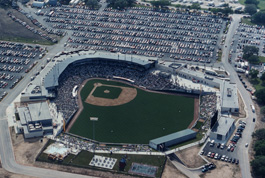
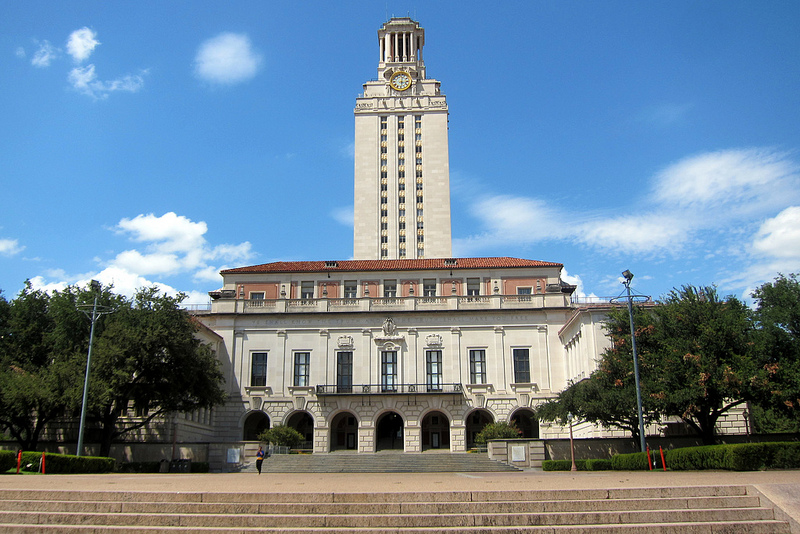
Showing posts with label confederate state. Show all posts

Wednesday, November 8, 2017

How to Go to an LSU Football Game

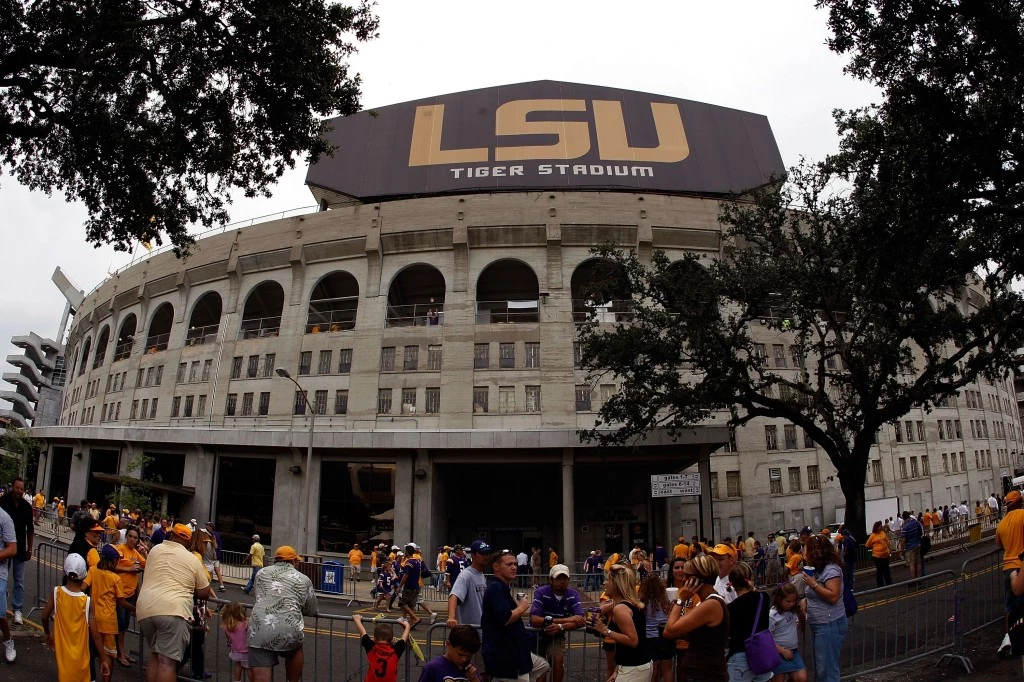
This Saturday, the football team at Louisiana State University -- hereafter to be referred to by its familiar initials, LSU -- takes on perhaps its biggest rival in the modern era, the University of Arkansas, at Tiger Stadium in Baton Rouge.

Buddy Songy, who hosts an LSU-themed radio talk show in Baton Rouge, calls LSU home games "Six days of foreplay, and one big bang on Saturday night." However, this game, due to being on national TV (ESPN), will be at 11:00 AM Central Time.

Before You Go. This is Louisiana football, but it will not be inside the climate-controlled Superdome. Actually, the Bayou State being warmer than New York and New Jersey will be to your advantage for once.

The Advocate, Baton Rouge's daily paper, is currently predicting low 70s throughout the weekend for daylight hours, and mid-50s for the evenings. They're predicting rain for Sunday, but Saturday should be clear.

Louisiana is in the Central Time Zone, so set your timepieces back an hour. However, in spite of the Confederate chapter of its past, you won't need a passport. You might think you'll need it, especially in New Orleans, but you won't. You won't need to change your money, either. But the ability to speak fluent French, while hardly required, might help.

Tickets. LSU has gotten at least 96,000 fans for every home game this season and last season. Apparently, having a stadium with at least that many seats means that demand exceeds supply. Getting tickets will be difficult, especially since this is a rivalry game.

Upper level bench spots -- no seat backs -- will cost $70. Any other spot, with an actual seat, will be $80. Actually, considering how big the LSU program is, that's not a bad price.

Getting There. It's 1,364 miles from Times Square in New York to Tiger Stadium in Baton Rouge. Unless you really, really like driving, you're probably going to fly.

Google Maps says the fastest way from New York to New Orleans by road is to take the Holland Tunnel to Interstate 78 to Harrisburg, then I-81 through the Appalachian Mountains, and then it gets complicated from there.

No, the best way to go, if you must drive, is to take the New Jersey Turnpike/I-95 all the way from New Jersey to Petersburg, Virginia. Exit 51 will put you on I-85 South, and that will take you right through Charlotte and Atlanta, to Montgomery, Alabama. There, you'll switch to I-65 South, and take that into Mobile, where you'll switch to I-10 West, then, outside New Orleans, onto I-12 West, which will take you into Baton Rouge. Exit 155C is for the LSU campus.

You'll be in New Jersey for about an hour and a half, Delaware for 20 minutes, Maryland for 2 hours, inside the Capital Beltway (Maryland, District of Columbia and Virginia) for half an hour if you're lucky (and don' make a rest stop anywhere near D.C.), Virginia for 3 hours, North Carolina for 4 hours, South Carolina for about an hour and 45 minutes, Georgia for 3 hours, Alabama for 4 hours and 45 minutes, Mississippi for an hour and 15 minutes, and Louisiana for 2 hours and 15 minutes.

So we're talking about 25 hours. Throw in traffic in and around New York at one end, Washington and Atlanta in the middle, and New Orleans at the other end, plus rest stops, preferably in Delaware, and then one each State in Virginia, North Carolina, South Carolina, Georgia and Alabama, and it'll be closer to 29 hours. Still wanna drive? Didn't think so.

Flying? Good luck. You could get a round-trip fare from Newark to Louis Armstrong International Airport for about $500, but it won't be nonstop, and you'd still have to get to Baton Rouge. The city does have Baton Rouge Metro Airport, but getting in and out from anywhere other than New Orleans is not going to be easy.

Amtrak won't work, because it doesn't go to Baton Rouge, which is off the New Orleans-to-Los Angeles Sunset Limited line. The bus doesn't sound much better. It takes 34 1/2 hours, counting the time change, changing buses in both Richmond and Atlanta. You'd have to leave Port Authority by 10:30 PM on Thursday night to get there by gametime -- or else take your chance with a bus that gets there at 5:30 PM on Saturday, half an hour before tipoff. Greyhound charges $466 round-trip, with a drop to $430 for advanced purchase. The station is at 1300 Florida Street.

Once In the City. In 1699, French explorers saw a red pole marking the boundary between the hunting grounds belonging to the Houma and Bayogoula tribes, and named their settlement after that "red stick": Baton Rouge.
The city was incorporated 200 years ago, on January 16, 1817, after the War of 1812 and its climactic Battle of New Orleans ensured control stayed in American rather than British hands. It is home to about 230,000 people, with the metro area, more or less next-door to, but not part of, that of New Orleans, having about 830,000 people. The city is about 50 percent black, 42 percent white, 4 percent Hispanic and 4 percent Asian. The south side is mostly white, the north side mostly black.
Louisiana is in the Deep South, and has had its share of racial disturbances: The 1866 New Orleans Massacre, the 1868 St. Bernard Parish Massacre, the 1868 Opelousas Massacre, the 1873 Colfax Massacre, the 1874 Battle of Liberty Place, the 1874 Coshatta Massacre, and the 1900 Robert Charles Riot.
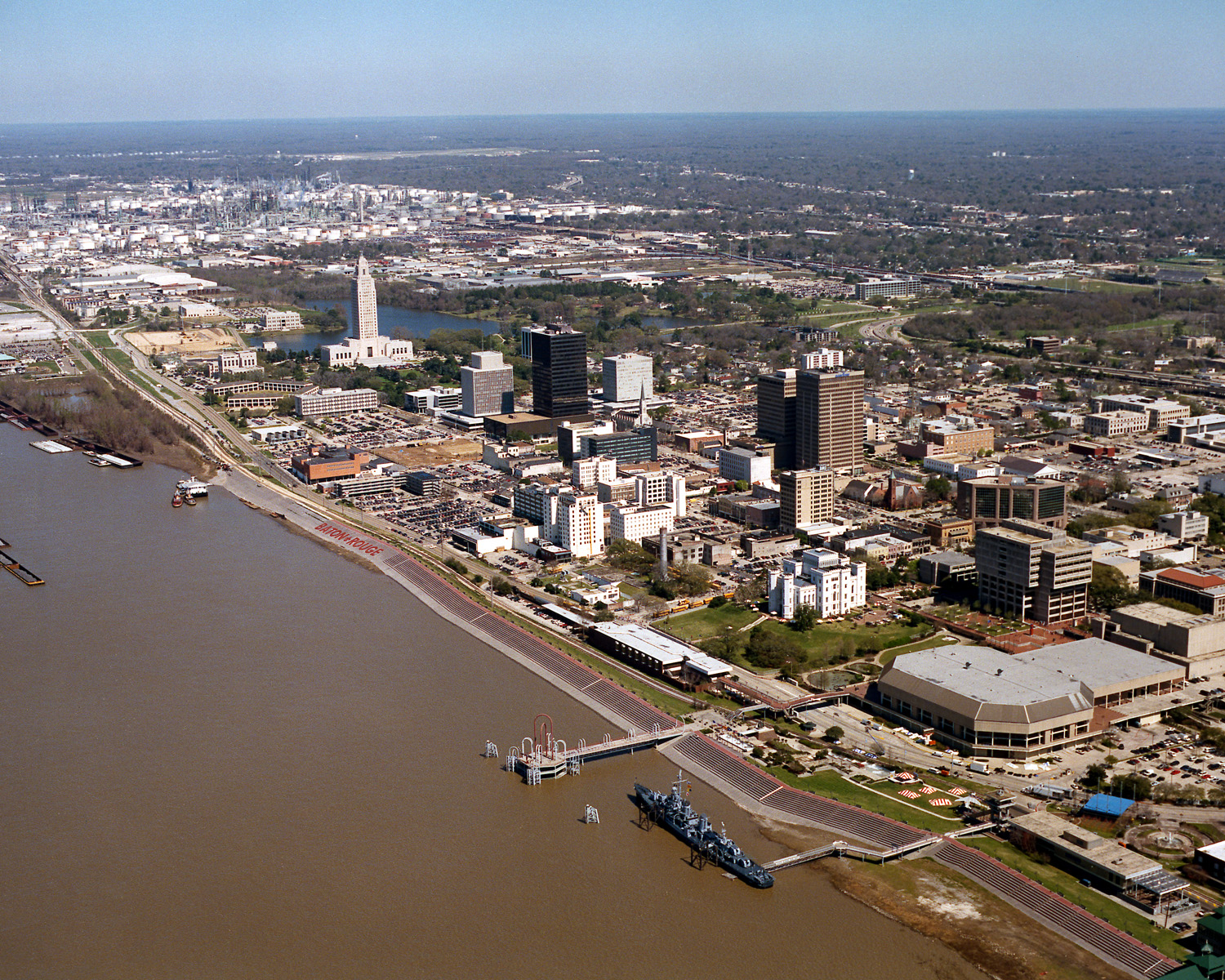
Because it is on the Mississippi River, Baton Rouge did take some flood damage from Hurricane Katrina in late August 2005. Unlike New Orleans, however, Baton Rouge is not below sea level, and recovered fairly quickly.
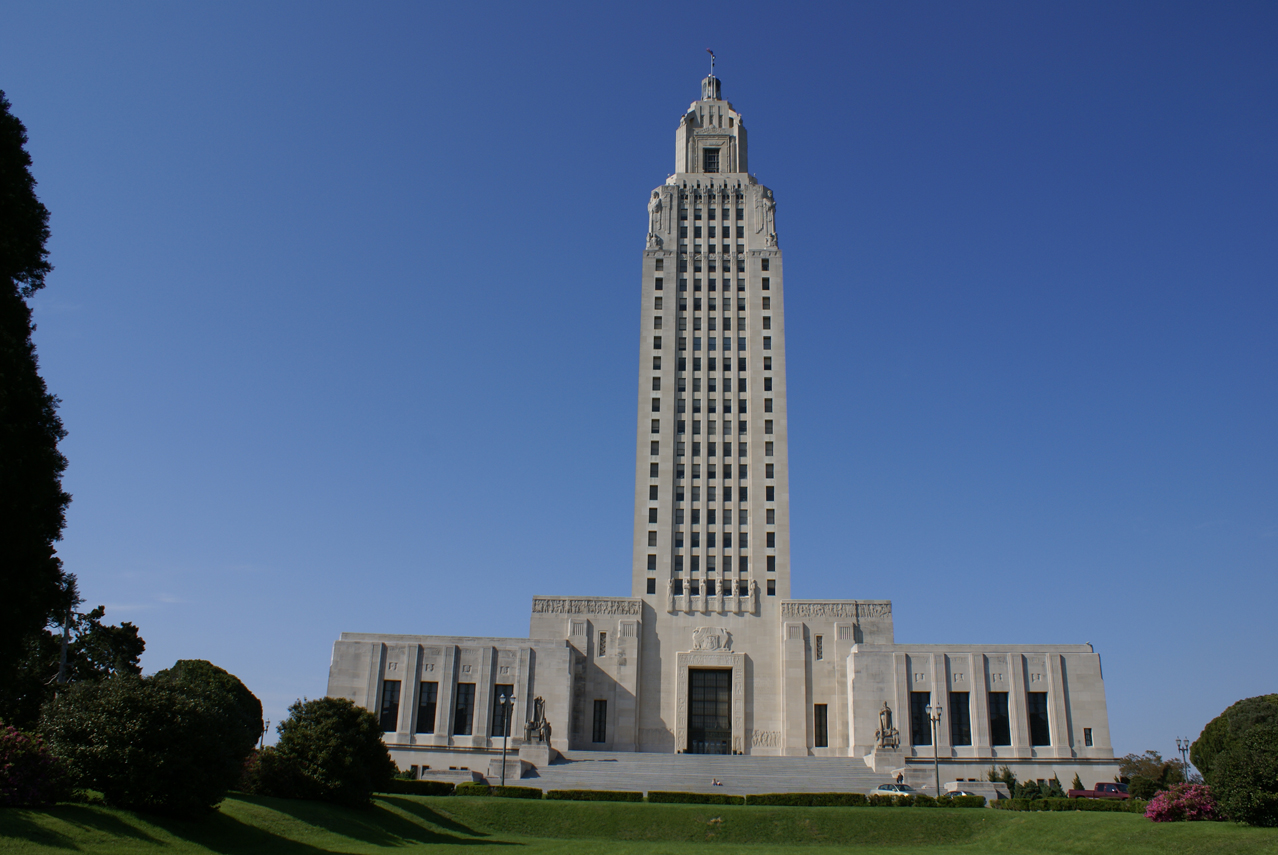
Louisiana was admitted to the Union as the 18th State on April 30, 1812. The sales tax is 4 percent. Baton Rouge is the State capital, and Louisiana has the tallest State Capitol building in the country, at 450 feet.
Huey Long's 450-foot 1932 Art Deco State Capitol

North Boulevard, for north and south, and the Mississippi River, for east and west, are the "zero points" for street addresses. The city has no beltway. ZIP Codes for the Baton Rouge area start with the digits 707 and 708. The Area Code is 225. Capital Area Transit System (CATS) runs buses and historic (or at least historic-style) streetcars. The fare is just $1.75. Cajun Electric Power Cooperative runs the electricity.

Once On Campus. The Louisiana State Seminary of Learning & Military Academy was founded in 1853, in Pineville. In 1860, William Tecumseh Sherman was named its superintendent. On January 26, 1861, Louisiana seceded from the Union, the 6th State to do so, and Sherman resigned, and was named a General in the Union Army. After the war, Sherman donated 2 cannons to the school. Louisiana was the 5th former Confederate State readmitted to the Union, on July 9, 1868.

The Pineville campus burned down in 1869. A few days later, they resumed operations in Baton Rouge, where the University's seat has remained. In 1874, the Louisiana State University and Agricultural & Mechanical College was founded. In 1877, it merged with the LSSLMA, which took the newer school's name.

The 1st female student was admitted to LSU in 1905. The current main campus opened in 1926, and Governor Huey Long vastly expanded it during his term in office, 1928 to 1932. After a long legal battle, the 1st black student was admitted in 1956. In 1969, at the height of the Vietnam War, mandatory ROTC for freshmen and sophomores was abolished.

LSU-Baton Rouge is the flagship institution of the Louisiana State University System, which also includes campuses (or should that be "campii"?) in New Orleans (a science-themed campus, established in 1931), Alexandria (1960), Shreveport and Eunice (both in 1967).

Notable non-sports alumni include:

* Entertainment: Actresses Joanne Woodward and Elizabeth Ashley; Rocky theme composer Bill Conti, screenwriter (creator of True Detective) Nic Pizzolatto, film critic Rex Reed. The rock band Better Than Ezra was formed at LSU.

* Literature: Rebecca Wells.

* Journalism: Edwin Newman and Don Lemon.

* Military: Generals John A. Lejeune (Marine Corps, namesake of the Corps base in North Carolina) and Claire Chennault (Air Force, leader of the Flying Tigers squadron in the Pacific Theater of World War II).

* Politics, representing Louisiana unless otherwise stated: Governors Jimmie Davis (previously a renowned country singer), Robert F. Kennon, John McKeithen, Edwin Edwards, Mike Foster and John Bel Edwards (no relation to Edwin); Senators Edwin Broussard, Russell Long, John Breaux, Mary Landrieu; Secretary of Labor Ray Marshall. Also, campaign operatives James Carville and Donna Brazile.

    Going In. The address for Tiger Stadium is merely "Stadium Road." It is bounded by North Stadium Road on the north, Powerhouse Lane on the east, South Stadium Drive on the south, and West Stadium Road on the west. Confused yet? It's about 2 miles south of downtown, and Bus 14 will get you there. If you drive in, parking can be anywhere from $20 to $40.
    Like Clemson's Memorial Stadium, it is nicknamed Death Valley. It opened in 1924, after the Detroit Tigers' longtime home opened, but well before that ballpark adopted the name Tiger Stadium.
    Speaking of ballparks, from this angle,
    it looks a bit like Yankee Stadium.

    Opening with 12,000 seats, it was expanded to 22,000 in 1931, 67,000 in 1953, 78,000 in 1978, 91,000 in 2000, and 102,321 in 2014. The field runs (more or less) north to south, and, unless most major college stadiums, especially in the South, has always been natural grass.

    Bear Bryant led Alabama's Crimson Tide into Death Valley 16 times, winning 14. Nevertheless, he said, "Baton Rouge happens to be the worst place for a visiting team. It's like being inside a drum." In 2007, an ESPN poll named it the loudest stadium in college football - and there's no dome to hold the noise in. A 2016 USA Today poll named it the Southeastern Conference's best gamers experience.
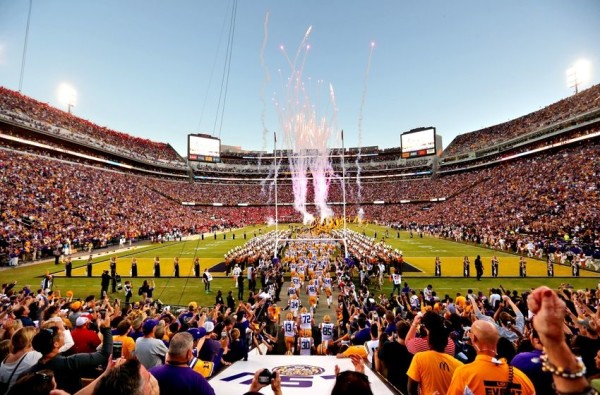
    This past October 6, Thrillist compiled a list of their Best College Football Stadiums, the top 19 percent of college football, 25 out of 129. Tiger Stadium came in 4th, and the article called it "an immersion in Southern football traditions that's crazier and more intense than anywhere in the SEC."

    Due to Hurricane Katrina in 2005, the New Orleans Saints played 4 home games at Tiger Stadium, and Tulane University, once a major rival of LSU's but considerably downgraded in football, played 1.

    Tiger Stadium has also hosted concerts. The Bayou Country Superfest is held there every Memorial Day Weekend, and Taylor Swift played it in 2015.

    Food. There are many great food cities in America. New Orleans considers itself special in this regard. Baton Rouge is not New Orelans, though, and one of the stereotypes of Louisiana outside the Crescent City is that the people there will eat anything.

    LSU's concession stands do reflect this, and you can decide for yourself whether that's a good thing. They serve "fry stak" -- apparently, Louisiana's answer to the blasphemy that is chicken fried steak -- Creole gumbo nachos, and crawfish poutine. Gag me with a spoon that has not been used to stir any of that!

    One of the chefs that Aramark has hired to prepare food at Tiger Stadium has said, "Feed 'em, but don't feed 'em too much. If they eat too much, they can't cheer." Fair enough: Eat before and after the game, but not during, and then cheer as much as you like.

    Team History Displays. LSU won the Southern Intercollegiate Athletic Association title in 1896 and 1908, and the Southern Conference title in 1932, the last season before the founding of the Southeastern Conference. They've won the SEC in 1935, 1936, 1958, 1961, 1970, 1986, 1988, 2001, 2003, 2007 and 2011. That's 11 SEC titles, and 14 Conference Championships overall.

    Since the creation of the SEC Championship Game, they've won the West Division 8 times. They failed to advance to the Championship Game due to losing the head-to-head tiebreaker to Alabama in 1996, to Auburn in 1997, and to Arkansas in 2002; won the Division but lost the Championship Game to Georgia in 2005; and won the Championship Game, beating Tennessee in 2001 and 2007, and Georgia in 2003 and 2011.

    They've been awarded the National Championship in 1958, led by coach Paul Dietzel and star running back Billy Cannon, clinching an undefeated season by beating Clemson in the 1959 Sugar Bowl; in 2003, under coach Nick Saban, beating Oklahoma in the BCS National Championship Game; and in 2007, under Saban's former assistant Les Miles, beating Ohio State. Their main scoreboard lists their National Championships on the left, and their Conference Championships on the right.

    In 2011, they won a Number 1 vs. Number 2 battle with Alabama, by then coached by Saban, but a quirk in the BCS meant that, even though 'Bama didn't win its own Division, let alone its own Conference, it still ended up Number 2 in the final rankings, getting it a rematch with LSU in the National Championship Game, and Alabama won. This made Saban the only coach ever to win National Championships at 2 different schools.

    Only 2 LSU players have ever had their uniform numbers retired: Billy Cannon, 20, the running back who led them to the 1958 National Championship and won the 1959 Heisman Trophy; and Tommy Casanova, 37, a defensive back who starred in the 1969, '70 and '71 seasons.

    Cannon cemented his Heisman win by returning a 4th quarter punt for a touchdown and then, as a defensive back, making a last-play game-saving tackle to beat the University of Mississippi on October 31, 1959. The touchdown became known as the Halloween Run. He won AFL Championships with the 1960 and '61 Houston Oilers and the 1967 Oakland Raiders, but only his last pro season, with the 1970 Kansas City Chiefs, the 1st year after the AFL-NFL merger, was in the NFL.
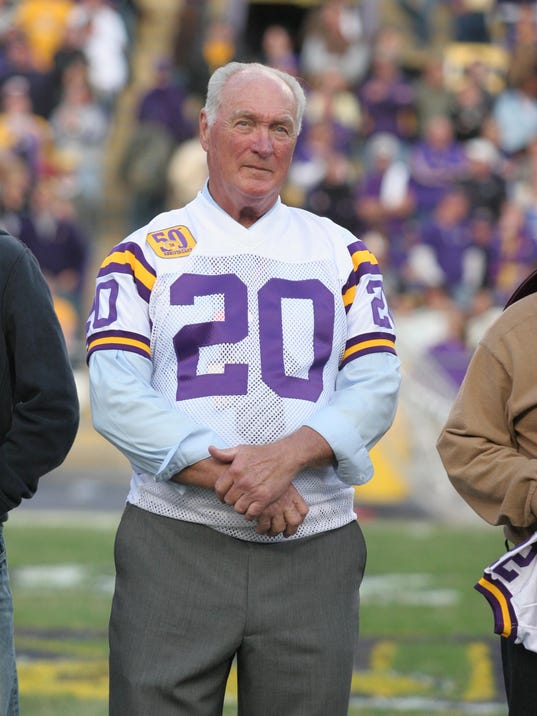
    He married his high school sweetheart, went to medical school, and became a dentist. But he ran up gambling debts, and ran a counterfeiting operation. He ended up going to prison for it, and, struggling to re-start his dental practice after he got out, did so by becoming the dentist at the Louisiana State Penitentiary. He remains so, at age 80. The character in Frank Deford's novel Everybody's All-American, Gavin Grey, played by Dennis Quaid in the film version, is said to be modeled on Cannon, and much of the movie was filmed on and around the LSU campus.

    UPDATE: Billy Cannon died on May 20, 2018, just 6 months after I posted this.

    By a weird coincidence, Casanova also went to medical school, after 6 years with the Cincinnati Bengals, 3 of them as an All-Pro. He became an eye surgeon, and was elected to the Louisiana State Senate, as a Republican, in 1995. He chose not to run for a 2nd term, and returned to his ophthalmology practice.

    Number 18 is not retired at LSU, but it is part of a tradition. It was worn by Matt Mauck, the starting quarterback of their 2003 National Champions. He passed it to running back Jacob Hester. His senior year, 2007, was another National Championship. That got Les Miles' attention, and he established the tradition of the number going to a player chosen by the coaching staff, specifically for success on and off the field, and for a selfless attitude. This season 2 players have it (which is allowed under NCAA rules, due to teams frequently having more than 100 players): 1 offensive, fullback J.D. Moore; and 1 defensive, end Christian LaCouture.

    There are 9 LSU players in the College Football Hall of Fame, listed here with their senior years: George "Doc" Fenton, quarterback, 1909; Abe Mickal, running back, 1935; Gaynell Tinsley, end, 1936; Ken Kavanaugh, end, 1939; Cannon, 1959; Jerry Stovall, running back, 1962; Casanova, 1971; Bert Jones, quarterback, 1972; and Charles Alexander, running back, 1978. Also elected to the Hall have been head coaches Mike Donahue, 1923-27; Lawrence "Biff" Jones, 1932-34; Bernie Moore, 1935-47; and Charlie McClendon, 1962-79 -- but not Paul Dietzel, 1955-61 and winning the National Championship in 1958.

    LSU has a few major rivalries. They trail the one with Alabama 51-25-5. A trophy in the shape of the adjoining States of Arkansas and Louisiana, called the Golden Boot, goes to the winner of the LSU-Arkansas game, usually played on Thanksgiving weekend since 1992. This time, however, it's being played this Saturday. LSU leads the rivalry 38-22-2.

    (UPDATE: Through the 2019 season, LSU leads Arkansas 41-22-2, but trails Alabama 53-26-5.)

    Before Arkansas, LSU's main rivals were the University of Mississippi, a.k.a. Ole Miss, and in-State rival Tulane University of New Orleans, 80 miles away. From 1935 to 1975, Tulane Stadium hosted the Sugar Bowl game, before the Superdome was opened and it was moved there, as were Tulane's home games.

    The Green Wave used to be a big-time program, but have had only 5 winning seasons since 1981. With LSU in the SIAA from 1896 to 1922, the Southern Conference through 1932, and the SEC through 1966, they were independents from then until 1996, when they began playing in Conference USA. Tulane won league titles in 1920, 1925, 1929,1 930, 1931, 1934, 1939 and 1949, and then not again until their undefeated season of 1998, but, being in such a weak league, they didn't qualify for the NCAA Playoff. The 2014 was their 1st season in the new Yulman Stadium, and their last in C-USA, before joining their current league, the American Conference.

    The Tigers and the Green Wave first played in 1893, and by 1949, LSU's lead in the series was only 23-18-5. Since then, LSU has gone 45-4-2, for a total of 68-22-7. They haven't met since 2009. The trophy they played for, still owned by LSU, was the Tiger Rag, and the game was called the Battle for the Rag.
    The game between LSU and Ole Miss is known as the Magnolia Bowl, and the winner receives the Magnolia Bowl Trophy. As previously mentioned, the best-known game was the 1959 contest with Billy Cannon's heroics. They first played in 1894, and LSU leads the series 61-41-4. LSU has won not only the 2016 and 2017 games, but 12 of the last 16.

    Oddly, Ed Orgeron, who succeeded Miles as head coach at LSU in 2016, was previously head coach at Ole Miss from 2005 to 2007.
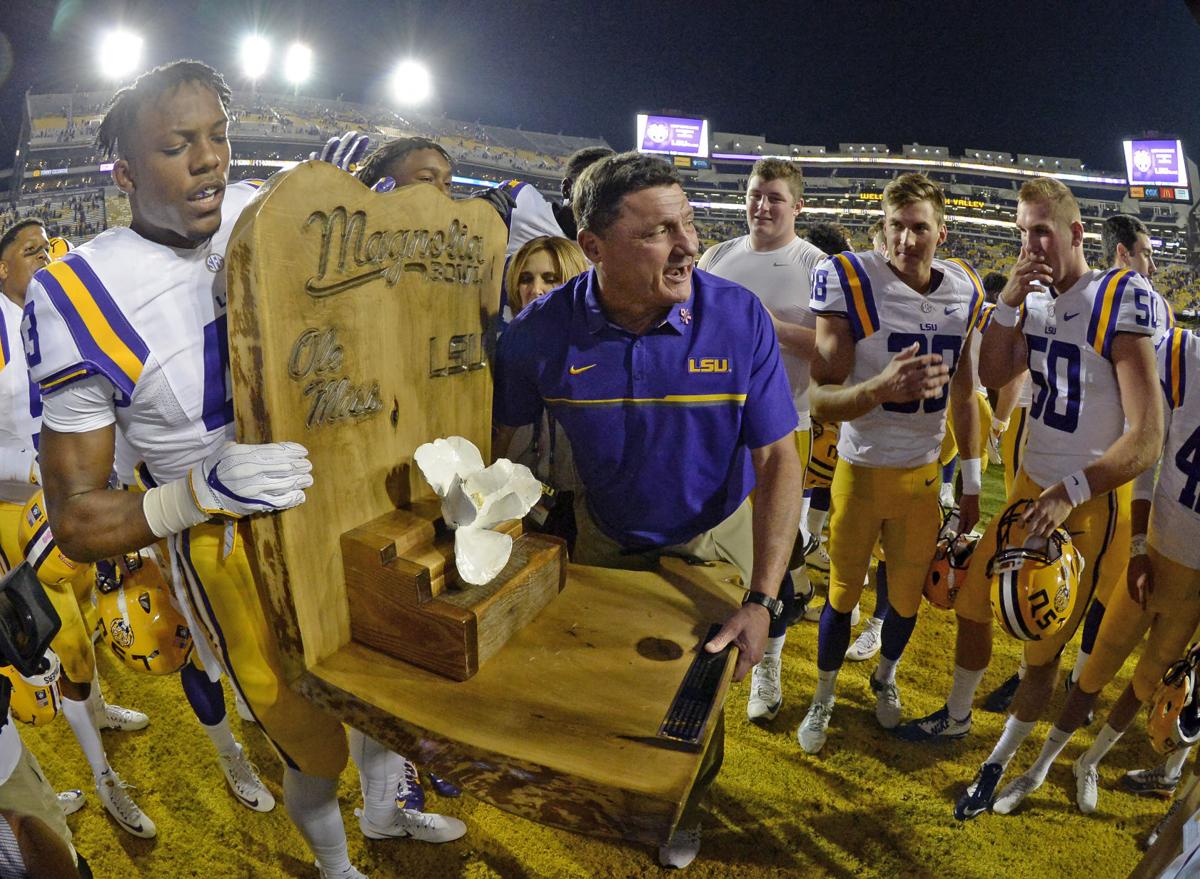
    Ed Orgeron and players with the Magnolia Bowl Trophy

    Ironically, LSU's most famous athlete may not be a football player, but a basketball player. Having played for them, under his father, LSU head coach Press Maravich, from 1968 to 1970, Pete Maravich set NCAA records that still stand for most career points and highest career points per game average -- despite there then being no 3-point rule, no shot clock, and no freshman eligibility (meaning that he scored all those points in 3 years, not 4).

    Maravich starred in the NBA, too, but injuries cut his career short in 1980. After his death in 1988, LSU's 13,215-seat Louisiana State University Assembly Center, opened in 1972 -- nicknamed the Deaf Dome, but it could be called "The House That Pistol Pete Built" -- was renamed the Pete Maravich Assembly Center. But he doesn't have a statue there. Who does? The other candidate for the title of the most famous LSU athlete: Shaquille O'Neal.

    The Assembly Center is across North Stadium Road from the north end zone of Tiger Stadium. Elvis Presley sang there on June 17 and 18, 1974; July 2, 1976; and May 31, 1977.
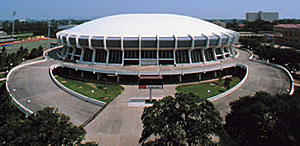
    Aside from the preceding, notable LSU athletes include: 

    * Basketball: Bob Pettit, Mahmoud Abdul-Rauf (still using his birth name of Chris Jackson while at LSU), Glen "Big Baby" Davis and Ben Simmons.

    * Baseball: Paul Byrd, Mike Sirotka, Todd Walker, Brian Wilson (the reliever with the big beard, not the Beach Boy), Alex Bregman and Aaron Nola.

    * Wrestling: Kevin Jackson, Olympic Gold Medalist in 1992, now the head coach at an even bigger college wrestling program, Iowa State.

    Stuff. The LSU Sport Shop is on North Stadium Road, across from Tiger Stadium's northwest corner. The LSU Bookstore is at 2 Union Square, at Highland Road and Raphael Semmes Road, across Highland from the Student Union, about a 10-minute walk east of Tiger Stadium.

    Chet Hilburn wrote Legendary Tiger Stadium: The Thirty Greatest LSU Football Games, an update of his book The Mystique of Tiger Stadium: 25 Greatest Games: The Ascension of LSU Football. This is probably as close as we can get to a definitive history of the program. In 2007, the DVD Fields of Glory: LSU Tiger Stadium was released.

    During the Game. LSU football games tend to come in 2 categories: Day games against teams that are rivals of LSU's, or night games. Neither, when mixed with Southern football, sounds like a safe combination.

    However, there is also the concept of Southern hospitality. and LSU fans are Louisianans. Due to the multiracial and multiethnic nature of the State, they have to get along, and, with the help of their teams -- LSU, the Saints and the Pelicans -- they do. They have no interest in starting violence. Be nice to your hosts, and don't root for the visiting team, and you should be fine.

    ESPN.com and The Sporting News have both, in recent years, rated LSU as the best tailgate party school in the country. So if you drive down, and are willing to tailgate, be willing to share, and others will be, too. Tailgating is, as at many other Southern schools, practically a sacrament. So is drinking. As radio talk show host Buddy Songy said, "There's no alcohol allowed in Tiger Stadium, but beware of funny-looking radios." (He means "flasks disguised as other objects.")

    Like a few NFL teams, including the Philadelphia Eagles, the Washington Redskins and the Dallas Cowboys, LSU usually prefers to wear their white jerseys at home, instead of their solid color, purple. This started in 1958, when Paul Dietzel realized that Georgia Tech, then also in the SEC (now in the ACC) had been doing it (and is one of the few other college teams that still does), so he ordered white jerseys for his players for home games. Since they won the National Championship, the tradition stuck.

    Until 1983, when the NCAA made a new rule requiring teams to wear their solid color jerseys at home. In 1995, new LSU coach Gerry DiNardo lobbied the NCAA Football Rules Committee to drop the rule. They did, and in their 1st game allowed to wear white again, LSU, then unranked, beat Auburn, then ranked Number 6.

    In addition, Tiger Stadium is unusual in that the field has yard markers every 5 yards, not just every 10 like most football fields do.
    "Mike the Mascot" -- not "Mike the Tiger."

    LSU has 2 Tiger mascots, a guy in a costume, and a live Tiger mascot in a cage, both named Mike. Since 1936, a series of Bengal tigers named Mike, after LSU trainer Mike Chambers, has been used. The 1st Mike lasted until 1956, having survived, among other things, being kidnapped and spray-painted green by Tulane students. After his death, he was stuffed and mounted, and put on display at the LSU Museum of Natural Science, at Murphy J. Foster Hall, 119 Dalrymple Drive, about a 5-minute walk northeast of the stadium.

    Mike VI died of cancer last year, but, knowing that he didn't have long, the University got a replacement that would grow to adulthood before the next season. Mike VII debuted this past August, and, like his predecessor, is a Bengal-Siberian mix. Mike the Tiger's Habitat (read: "Cage") is on the north side of North Stadium Road, between the Stadium and the Assembly Center.
    Mike VII in his Habitat, with Tiger Stadium in the background

    Before every game, the players, coaches and cheerleaders walk down Victory Hill on North Stadium Drive. They used to bring Mike with them in his purple trailer, but now they leave him in his Habitat, and pass it. Thousands of people line the road to watch this variation on the tradition of college football players walking into their stadium.

    The Louisiana State University Tiger Marching Band Pregame Show was created in 1964. The Band, a.k.a. The Golden Band from Tigerland, lines up along the end zone shortly before kick off. Then the band strikes up a drum cadence and begins to spread out evenly across the field. When the front of the band reaches the center of the field, the band stops and begins to play an arrangement of "Tiger Rag," the song better known by its chorus of "Hold That Tiger." While it does this, the band turns to salute the fans in all four corners of the stadium. Then the band, resuming its march across the field, begins playing "Touchdown for LSU."
    The Golden Band from Tigerland
    is now fully race-and-gender-integrated.

    Before kickoff, the public address system plays "Callin' Baton Rouge" by Garth Brooks. After every new 1st down, the band plays "Tiger Rag," and the fans shout, "Go, Tigers!" In the French tradition of Louisiana, it gets spelled, "Geaux Tigers" on bumper stickers, T-shirts, etc.

    In 2012, a new tradition was established: When LSU wins, the lights that illuminate the upper arches on the stadium's north end light up. They call it "Victory Gold."

    After the Game. New Orleans has had a crime problem for almost 300 years. But Baton Rouge is not New Orleans. You, and your car if that's how you came down, should be safe.

    You would think there'd be lots of good places to eat nearby, but there aren't. You might have to go to Highland Road, northeast of the stadium, to find chain restaurants, including fast food. Or, you could go about 3 blocks south of the stadium, and find Walk-On's Bistreaux & Bar, at 3838 Burbank Drive. Bogie's, at 705 E. Boyd Drive, and Reggie's, at 1176 Bob Pettit Blvd., are also well-known LSU bars. (Before Shaq and Pistol Pete, 1950s NBA legend Pettit was the most familiar name from LSU basketball.)

    If your visit to Baton Rouge is during the European soccer season, which we are now in, there's no place all that close that shows games. Ivar's Sports Bar & Grill is 2 miles northeast of Tiger Stadium, at 2954 Perkins Road. The Londoner is even farther, 10 miles east at 4215 S. Sherwood Forest Blvd. So unless you've got a car, I would say forget about seeing your club on TV, unless they play in the morning and LSU plays at night, or you're staying overnight and they play on Sunday.

    Sidelights. History? Atmosphere? Sports? Debauchery? N'Awlins has got it all. But Baton Rouge is not New Orleans: It's got about one-quarter of the spirit, and about 1/100th of the history. Indeed, the only professional sports teams in Louisiana are in New Orleans and its suburbs, and that's 80 miles to the southeast. These include the closest NFL team, the Saints; and the closest NBA team, the Pelicans.

    The closest Major League Baseball team to Baton Rouge is the newly-crowned World Champion Houston Astros, 269 miles to the west. Houston is also home to the closest MLS team, the Dynamo. There is no professional soccer team in town. The closest NHL team is the Dallas Stars, 430 miles to the northwest.

    According to an April 2014 article in The New York Times, the Yankees are the most popular baseball team in Baton Rouge, with about 20 percent of locals calling them their favorite team. The Red Sox are 2nd, with around 15 percent. The Atlanta Braves are 3rd, getting around 10 percent.

    In addition to the Assembly Center, Elvis sang in Baton Rouge early in his career, in 1955, at Baton Rouge High School (2825 Government Street) on May 2, and at the Plaquemine Casino Club (I can't find an address, or any mention of whether the building still stands) on July 1.

    In addition to the aforementioned LSU Museum of Natural Science, Baton Rouge also has the Louisiana Art and Science Museum, downtown at 100 River Road South; and the Capitol Park Museum, also downtown, at 660 N. 4th Street.

    There are 5 colleges in Louisiana that are in the NCAA Division I Football Bowl Subdivision (FBS), what used to be called Division I-A. There's LSU in Baton Rouge, Tulane in New Orleans, Louisiana Tech in Ruston, the University of Louisiana at Lafayette (known as the University of Southwestern Louisiana until the creation of the UL system in 1999), and the University of Louisiana at Monroe (formerly Northeast Louisiana University).

    UPDATE: On November 19, 2018, Moneywise compiled a list of their Worst College Football Stadiums, the bottom 19 percent of college football, 25 out of 129. Louisiana-Monroe was ranked 6th, and Louisiana-Lafayette 12th.

    And there are 7 schools in the State that are the NCAA Division I Football Championship Subdivision (FCS), what used to be called Division I-AA. One is the private and Catholic University of New Orleans.

    Four are public universities and, before the Civil Rights Movement, were all-white schools: Nicholls State University in in Thibodaux, McNeese State University in Lake Charles, Northwestern State University in Natchitoches, and Southeastern Louisiana University in Hammond. These 4, and UNO, are all in the Southland Conference.

    Then there are the 2 historically black colleges and universities (HBCUs) in the Southwestern Athletic Conference (SWAC), which are arch-rivals due to the North-South divide in Louisiana, and meet every Saturday after Thanksgiving in the Bayou Classic at the Superdome: Grambling State University in Grambling, near Ruston; and Southern University in Baton Rouge.

    Grambling (most people don't add the "State") was coached by Eddie Robinson from 1941 to 1997, and he won more games as a Division I head coach than anyone, before being surpassed by J-- P------ of P--- S----. He led them to 9 black college National Championships: 1955, 1967, 1972, 1974, 1975, 1977, 1980, 1983 and 1992.

    More importantly, he almost singlehandedly made black college football something white professional coaches had to pay attention to, producing players like Paul "Tank" Younger, Willie Davis, Ernie Ladd, Buck Buchanan, Willie Brown, Gary "Big Hands" Johnson, Charlie Joiner and Doug Williams, who ended up succeeding him as head coach.

    Subsequent coaches have added National Championships in 2000, 2001, 2002, 2005, 2008 and 2016, for a total of 15. In 1983, they replaced the old 18,000-seat Grambling Stadium with the more modern 19,600-seat Eddie Robinson Stadium. Ballock Street in Grambling, about 65 miles west of Shreveport, 217 miles northwest of Baton Rouge, and 296 miles northwest of New Orleans. (It's actually closer to Dallas than New Orleans: 250 miles to the east of Big D.)

    Southern has won the black college National Championship 11 times: 1948, 1949, 1950, 1954, 1960, 1975, 1993, 1995, 1997, 1998 and 2003. Their contributions to the NFL include Rich "Tombstone" Jackson, Mel Blount, Harold Carmichael and Aeneas Williams.

    They play ace the 28,500-seat Arnett W. Mumford Stadium. ("Ace" Mumford was their coach from 1936 to 1961, even before Eddie Robinson arrived at Grambling.) Swan Avenue & Robert Smith Blvd., 7 miles north of downtown Baton Rouge. Bus 70.

    Louisiana has never produced a President. As a young man, Zachary Taylor lived in St. Francisville, 32 miles north of Baton Rouge and 112 miles northwest of New Orleans. But he's much more identified with Virginia, where he was born; and Kentucky, where he lived the last few years of his life.

    But the State's greatest political icon remains Huey Pierce Long Jr., elected Governor in 1928. He built the 450-foot State Capitol, the city's tallest building, in the Art Deco style at 900 N. 3rd Street, opening in 1932, as he was leaving the Governorship to accept the U.S. Senate seat he'd won.

    On June 13, 1935, this most colorful of colorful Southern politicians set a record (later broken by Strom Thurmond of South Carolina, in a vain attempt to stop the Civil Rights Act of 1957) for the longest filibuster in Senate history, 15 hours and 30 minutes. He was trying to require Senate confirmation of the National Recovery Administration's senior employees, so that his opponents in Louisiana's Democratic Party (the Republican Party was next to nothing in the South in those days) wouldn't get those jobs without what we would now call "extreme vetting."

    He kept the filibuster going by, among other things, reading recipes, including his own, at one point famously intoning, "Now, I come to pot likker... " That's how it's spelled in The Congressional Record. More frequently spelled "pot liquor," a.k.a. "collard liquor," it's the liquid that is left behind after boiling greens or beans. It doesn't sound like much, but it's actually very nutritious.

    Originally a supporter of President Franklin D. Roosevelt, he soured on him, and thought that, with the Great Depression still going, his "Share the Wealth" platform would appeal to people who would be souring on FDR for re-election in 1936. Huey, nicknamed the Kingfish, liked to say, "Every man a king, but no man wears a crown." His critics said, "Except for Huey."

    But he never got the chance to run for President: On September 8, 1935, he was assassinated outside the State Capitol he had built, but the nephew of a judge Long had fired. His bodyguards fired 60 shots, and the assassin died instantly. Huey hung on for 2 days. His last words were either, "God, don't let me die, I have so much to do," or, "I wonder what will happen to my poor university boys." (Given his ego, it was probably the former. LSU fans would probably prefer that it was the latter.) He was only 42 years old, and was buried on the Capitol grounds.

    The Long family has a, well, long history in politics. Huey's wife Rose was appointed to the unexpired term of his Senate seat. His brother George moved to Oklahoma and was elected to their State House of Representatives, then moved back to Louisiana and was elected to Congress. Another brother, Earl, served 3 separate terms as Governor, then lost his last bid for re-election when he left wife Blanche (who served as a Democratic National Committeewoman) for the famous stripper Blaze Starr, as seen in the movie Blaze. (Lolita Davidovich had the title role, and Paul Newman played Earl.)

    Huey and Rose's son Russell was elected to the Senate in 1948, and served 6 terms, until 1986. Huey's cousin Gillis served in Congress from 1963 to 1985, and his widow Catherine was elected to serve out his last term. Another cousin, who was actually born with the name of Speedy Oteria Long, also served in Congress. Gerald Long, a 3rd cousin of Huey, Earl and George, is the only member of the family currently in public office, in the State Senate.

    Blaze, based on Starr's memoir, is easily the most famous movie set in Baton Rouge, unless you count the movies based on Robert Penn Warren's 1946 novel All the King's Men, whose Governor Willie Stark was, despite Warren's protestations, clearly based on Huey. It was filmed in 1949 with Broderick Crawford, and in 2006 with Sean Penn.

    Several TV shows have been set in Louisiana, most of them in New Orleans. Duck Dynasty, a "reality" show, is based in West Monroe, in the northern part of the State, far from New Orleans or Baton Rouge. True Detective and Queen Sugar filmed in several places in the State. In fictional towns, True Blood was set in Bon Temps, and the Scream films were set in Lakewood.

    *

    Louisiana State University is one of the defining places in the college football experience. It may have taken Hurricane Katrina for the New Orleans Saints to mean more to people in Louisiana than the LSU Tigers do. But it's still a special football program, and well worth a visit.

    Tuesday, October 17, 2017

    How to Go to an Arkansas Football Game

    Old Main, on the Fayetteville campus

    40 States down, 10 to go. This Saturday, the University of Arkansas plays football against Auburn, one of the powers of the Southeastern Conference.

    It's still strange to see Arkansas in the SEC, even 26 years after leaving the Southwest Conference (SWC), essentially leading to its demise. But in the SEC, they are.

    Before You Go. Being in the South, Arkansas can get quite hot. But this will be late October, so daytime temperatures on Saturday are projected to be in the mid-70s, and nighttime temperatures in the low 50s. You should bring a jacket.

    Despite being a former Confederate State, you will not need to bring a passport or change your money to go to Arkansas. However, it is in the Central Time Zone, an hour behind New York, so you will have to adjust your timepieces.

    Tickets. Despite not being a championship contender in recent years, the Razorbacks usually top 70,000 fans at home games. So tickets may be difficult to get. Sideline seats are $85 in the lower level, and $65 in the upper level.

    Getting There. It is 1,328 miles from Midtown Manhattan to Fayetteville, Arkansas. Knowing this, your first instinct is going to be to fly.

    Arkansas is one of the few States whose capital doesn't have a major football-playing college in it. (There is a University of Arkansas at Little Rock, but they're not Division I-A.) As a result, flying to Northwest Arkansas Regional Airport to attend a Razorbacks game could be difficult.

    United Airlines offers one daily nonstop flight there from Newark, leaving at 8:15 AM (Eastern) and arriving at 10:28 AM (Central, 11:28 Eastern). But there are no nonstops on the way back, and the total fare is going to be over $1,500. Flying to Little Rock instead (into the airport now named Bill and Hillary Clinton National Airport), and renting a car to go the rest of the way, won't help, as it's 189 miles away.

    So what are the other options? Amtrak does not go to Fayetteville. Greyhound does, and it will cost $358, but it could drop to $302 with advanced-purchase. The station is at 3075 W. Wedington Drive, about 2 miles northwest of the campus.

    Oh... kay. So what about driving? As I said, over 1,300 miles. I would definitely recommend bringing a friend and sharing the driving. You'll need to get on the New Jersey Turnpike, and take Interstate 78 West across New Jersey, and at Harrisburg get on the Pennsylvania Turnpike, which at this point will be both I-70 and I-76. When the two Interstates split outside Pittsburgh, stay on I-70 west. You'll cross the northern tip of West Virginia, and go all the way across Ohio (through Columbus), Indiana (through Indianapolis) and Illinois.

    When you cross into Missouri, you'll be in St. Louis, going over the new Stan Musial Veterans Memorial Bridge. Switch to Interstate 44 West, and take that across southern Missouri until reaching Exit 11A, onto Interstate 49 South. Exit 66 will get you to the campus.

    If you do it right, you should spend about an hour and 15 minutes in New Jersey, 5 hours in Pennsylvania, 15 minutes in West Virginia, 3 hours and 45 minutes in Ohio, 2 hours and 30 minutes in Indiana, 2 hours and 30 minutes in Illinois, 5 hours and 15 minutes in Missouri, and 45 minutes in Arkansas. That's going to be a little over 21 hours. Counting rest stops, preferably 5 of them, and accounting for traffic at both ends, it should be about 28 hours.

    Once In the City. Arkansas was the 25th State admitted to the Union, on June 15, 1836; the 9th State to secede from the Union, on May 6, 1861; and the 2nd former Confederate State to be readmitted to the Union, on June 2, 1868.
    Founded in 1828, Fayetteville was named for the founders' hometown, which was Fayetteville, Tennessee, which was named for Fayetteville, North Carolina, which was named for the Marquis de Lafayette, the French nobleman who helped America win its Revolutionary War.

    Arkansas' most famous citizen, former President Bill Clinton, once explained that the reason the State is so poor is that the major transcontinental rail lines bypassed it. Neither the one going westward from St. Louis to San Francisco nor the one going westward across the south to Los Angeles, through Dallas, went through it. Thus, there were no towns established around such stops, and thus there were no such towns to grow into revenue-generating cities.

    The image of Arkansas as a racist bastion, due to the 1957 Little Rock school integration crisis (on top of the 1919 Elaine Massacre where over 200 black people were murdered), didn't help. Nor did the corporate-owned media's portrayal of Clinton as a horny, corrupt country bumpkin who was in over his head upon his arrival in the White House. He wasn't corrupt, he was no bumpkin, and if he was ever in over his head, he swam out of it.

    The Fayetteville area, in the northwestern part of the State, is home to about 84,000 people (not counting University students in residence), and the area is home to about 500,000. Arkansas as a whole is home to about 3 million people.
    The State House in Little Rock

    ZIP Codes in Arkansas start with the digits 716 to 729, and for Fayetteville 727. The Area Codes are 501 for Little Rock and Hot Springs, 479 for Fayetteville, and 870 for the southwestern part that includes Texarkana and Bill Clinton's hometown of Hope. The State sales tax is 6.5 percent. Neither Little Rock nor Fayetteville has a "beltway."
    The State's largest newspaper, the Arkansas Democrat-Gazette, recently took over the local paper, the Northwest Arkansas Times, and made it the Northwest Arkansas Democrat-Gazette. College Avenue divides street addresses into East and West, and Center Street into North and South. The University of Arkansas was founded there in 1871, and their Razorback Transit bus system is free, and provides access around town, mostly to the campus.

    In addition to the main campus in Fayetteville, there's also a campus in Little Rock (including the Medical School), one in Monticello, one in Pine Bluff and one in Fort Smith. UAPB is NCAA Division I, but in the Football Championship Subdivision, what used to be known as Division I-AA. UALR doesn't play football, but is Division I in all other sports. UAM and UAFS are in Division II.

    Among UA's alumni are Dillard's Departent Stores founder William T. Dillard; Alltel founder Joe T. Ford; pacemaker inventor Dr. Walter Keller; novelists Charles Portis and E. Lynn Harris; CNN anchor T.J. Holmes; actor Laurence Luckinbill; Governors Jeff Davis (not that Jefferson Davis), Xenophon Pindall, George Donaghey, Junius Futrell, Charles H. Brough, John Martineau, Joseph T. Robinson, Tom Terral, Francis Cherry, Sid McMath, Bob Riley, Joe Purcell, Dale Bumpers, David Pryor, Jim Guy Tucker, Asa Hutchinson and Mike Beebe, plus Governor Edwin Mechem of New Mexico; Senators Robinson, Davis, Bumpers, Pryor and his son Mark Pryor, J. William Fulbright, Tim Hutchinson and John Boozman; and a President of Panama, Ricardo Martinelli.

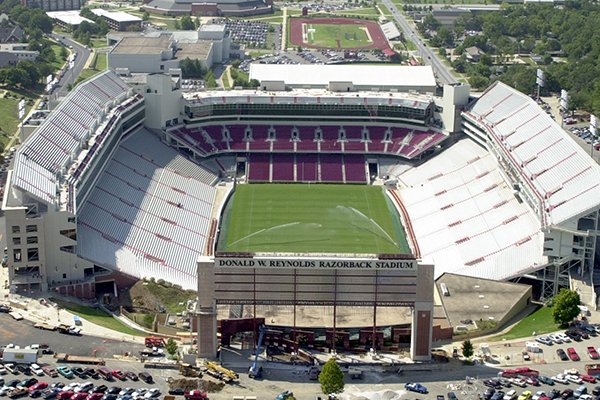
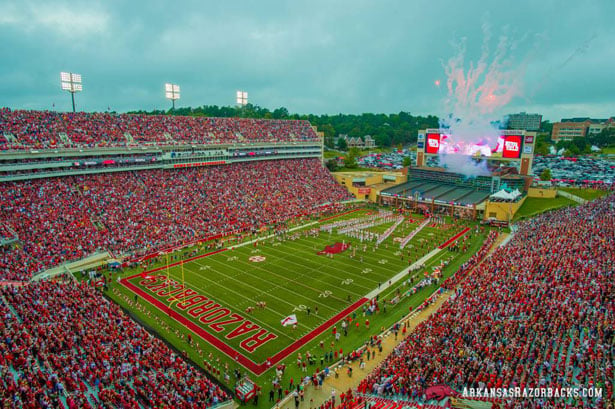
    Going In. Razorback Stadium opened in 1938, at 350 N. Razorback Road, about a mile northest of downtown. If you drive in, parking is $20.

    Originally seating 13,500, it was expanded to 21,000 in 1950, 30,000 in 1957, 42,000 in 1969, 52,000 in 1985, and its present 76,000 in 2001. That last expansion was funded by the Donald W. Reynolds Foundation, founded by an Arkansas media chief, and the stadium was renamed Donald W. Reynolds Razorback Stadium.
    The field is laid out north to south, and has been artificial turf since 2009. It was named Frank Broyles Field for the former football coach and athletic director upon his 2007 retirement as AD. The scoreboard includes not a "big screen," but, in keeping with the Razorback theme, a "Pig Screen."

    (UPDATE: Arkansas returned to natural grass for the 2019 season.)

    The Athletic Center, including team offices and training centers, was also named for Broyles, and in the north end zone. It was recently demolished to make way for an replacement facility under a bleacher section that will expand capacity to over 80,000.
    Food. It's the South. You're gonna get food that's long on taste and low on health benefits. You can get your organic Whole Foods and nonfat latte from Starbucks when you get back to New York.

    They seem to like macaroni & cheese in Arkansas, because they put it on both a "Mac Attack Burger" (definitely not to be confused with a McDonald's Big Mac) and a quarter-pound hot dog. They also serve Big Red Pork Tenderloin Sandwiches, Petit Jean Grilled Ham & Cheese Sandwiches, and Buffalo Chicken Nachos. In other words, if you're rooting for the visiting team, if they can't beat you, they'll kill you by ruining your diet.

    Team History Displays. Long a mainstay of the Southwest Conference, Arkansas won it 13 times: In 1936, 1946, 1954, 1959, 1960, 1961, 1964, 1965, 1968, 1975, 1979, 1988 and 1989. They've found the Southeastern Conference rough going, winning the Western Division in 1995, 2002 and 2006, but losing the SEC Championship Game each time.

    They won the National Championship in 1964, with a team that included future Dallas Cowboys owner Jerry Jones (guard, Number 61) and future Cowboys coach Jimmy Johnson (defensive tackle, Number 60). This included beating Nebraska 10-7 in the 1965 Cotton Bowl in Dallas.

    They won the Cotton Bowl again in 1976, 2000 and 2012. They also won the 1947 Dixie Bowl, the 1960 Gator Bowl, the 1969 Sugar Bowl, the 1978 Orange Bowl, the 1980 Hall of Fame Classic, the 1982 Bluebonnet Bowl, the 1985 Holiday Bowl, the 2003 Independence Bowl, the 2009 Liberty Bowl, the 2014 Texas Bowl, and the 2015 Liberty Bowl. However, there is no open display for any of these honors in the fan-viewable areas of the stadium.

    Razorback football legends the following members of the College Football Hall of Fame, with their senior years included: End Wear Schoonover (1929), running back Clyde Scott (1948), linebacker Wayne Harris (1960), receiver Lance Alworth (1961), running back Billy Joe Moody (1962), offensive tackle Loyd Phillips (1966), receiver Chuck Dicus (1970), defensive end Billy Ray Smith Jr. (1982); and head coaches Hugo Bezdek (1908-12), Francis Schmidt (1922-28), Bowden Wyatt (1953-54, elected for what he did elsewhere), Frank Broyles (1958-76) and Lou Holtz (1977-83). Alworth is also in the Pro Football Hall of Fame.

    Other prominent Arkansas football players include end Jim Lee Howell (1936, was an NFL Champion with the Giants as a player in 1938 and as head coach in 1956), end Jim Benton (1937), offensive tackle Pat Summerall (1951, won an NFL Championship with the Giants, better known as a broadcaster), defensive tackle Dave Hanner (1951), quarterback Joe Ferguson (1972), linebacker Dennis Winston (1976, won 2 Super Bowls with the Pittsburgh Steelers), guard R.C. Thielemann (1976, went from Arkansas to the Washington Redskins, so remained a "Hog," won a Super Bowl), defensive tackle Dan Hampton (1978, won a Super Bowl with the Chicago Bears, Pro Football Hall of Fame), guard Fred Childress (1988), safety Steve Atwater (1988, won 2 Super Bowls with the Denver Broncos), offensive tackle Brandon Burlsworth (1998), running back Darren McFadden (2007).

    Former college head coaches Red Hickey, Barry Switzer, Fred Akers, Ken Hatfield, Jimmy Johnson and Butch Davis are also Razorbacks.

    The Razorbacks have retired 2 numbers: 12, for Clyde Scott; and 77, for Brandon Burlsworth. Scott, born in 1924, was a member of the 1949 NFL Champion Philadelphia Eagles, and is still alive. Burlsworth, born in 1976, is not, killed in a car crash in 1999, after being drafted by the Indianapolis Colts, but before he could play for them.

    Arkansas is also known for a great track & field program, which has produced Olympic Gold Medalists Mike Conley Sr. (1992), Veronica Campbell (2004 and 2008 for Jamaica), Omar McLeod (2016 for Jamaica) and Taylor Ellis-Watson (2016). The school also produced swimming Gold Medalist Neil Brooks (1980, for Australia).

    Other prominent Razorback athletes included baseball players Tim Lollar, Kevin McReynolds, Tom Pagnozzi, Cliff Lee, Eric Hinske, Dallas Keuchel and Andrew Benintendi; basketball players Gordon Carpenter and Robert Pitts (Gold Medal, 1948 Olympics), Sidney Moncrief (the Milwaukee Bucks retired his number), Joe Kleine and Alvin Robertson (Gold Medal, 1984 Olympics), Corliss Williamson (led them to the 1994 National Championship) and Joe Johnson (current Brooklyn Nets star); and, if you want to really stretch the meaning of "athlete," beyond the amount you normally would for a golfer, there's John Daly.

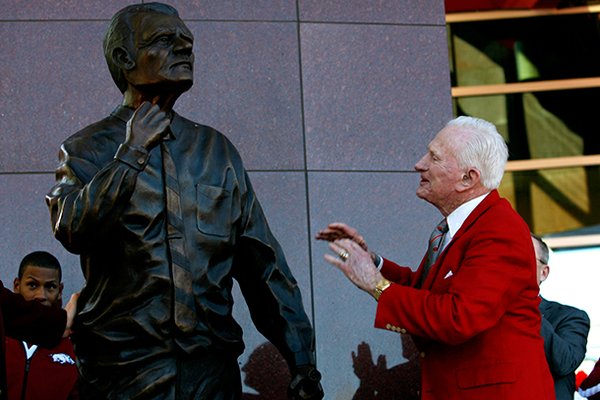
    Outside the north end zone, where the Athletic Center named for him was, and will be again after the renovations, a statue was dedicated to Frank Broyles. He lived long enough to see it.
    The Razorbacks' greatest rival was the University of Texas, culminating in a game at Razorback Stadium on December 6, 1969, with the Longhorns coming in ranked Number 1 and the Razorbacks Number 2, and the winner getting the SWC title, a berth in the Cotton Bowl, and a shot at the National Championship.

    It was billed as one of those periodic "Game of the Century" matches, and was attended by President Richard Nixon. (Legend has it that Arkansas native and future President Bill Clinton attended, but he was at Oxford University at the time.) Arkansas led 14-0, but Texas won it 15-14, ruining the Hogs' hopes. In his book Horns, Hogs, and Nixon Coming: Texas vs. Arkansas in Dixie's Last Stand, Terry Frei of the Denver Post called it "Arkansas' Greek tragedy." They ended up losing the Sugar Bowl to neighboring Mississippi, too.

    Texas leads the rivalry 56-22, but the annual game stopped after Arkansas left the SWC for the Southeastern Conference in 1991 (rendering the SWC a Texas-only league, and probably leading to its doom 5 years later), they haven't played each other since Arkansas won the 2014 Texas Bowl, and they won't play each other again until 2021.

    Arkansas' move to the SEC led to rivalries with schools from neighboring States, including the University of Missouri (a.k.a. "Mizzou," also a new SEC team, they lead Arkansas 5-3), the University of Tennessee (they lead 13-5, although Arkansas has won the last 2), the University of Mississippi (a.k.a. "Ole Miss," Arkansas leads them 35-27-1), and Louisiana State University (a.k.a. LSU. who lead Arkansas 38-22-2).

    UPDATE: Through the 2020 season, Arkansas now leads Ole Miss 36-28-1, but trails Missouri 9-3, trails LSU 42-22-2, and still trails Tennessee 13-5.

    A trophy in the shape of the adjoining States of Arkansas and Louisiana, called the Golden Boot, goes to the winner of the Arkansas-LSU game, usually played on Thanksgiving weekend since 1992.
    Stuff. There is no big team store at the stadium, just souvenir stands. You'll have to go to the University  Bookstore, at 616 Garland Avenue, at Douglas Street, about a 5-minute walk northeast of the stadium.

    The most comprehensive history of Razorback football I could find on Amazon.com only goes up to 1995: Orville Henry's The Razorbacks: A Story of Arkansas FootballTerri Frei of the Denver Post wrote Horns, Hogs, and Nixon Coming: Texas vs. Arkansas in Dixie's Last Stand, about the 1969 Texas-Arkansas Game

    There's not much on video, either, just the period specific 22 Straight: Arkansas Football 1963-1965 and Arkansas SEC Classics (which covers 1992 to 2008).

    During the Game. In 2013, Arkansas visited Rutgers, and thousands of their fans came in their cardinal red clothes, and were very polite, and didn't make a fuss about going 1,300 miles just to lose to Rutgers. If you return the favor, I don't think you'll have a problem with rough treatment.

    In 1909, the team, then known as the Arkansas Cardinals for the school color went 7-0, and outscored the opposition 186-18. Coach Hugo Bedzek said his team "played like a wild band of razorback hogs." The name was changed to the Razorbacks for 1910, and by the 1920s, the traditional cheer, the Calling of the Hogs, was in place: "Woooooooo... Pig! Sooie!" It usually starts in the student section, the upper deck of the southeast corner.
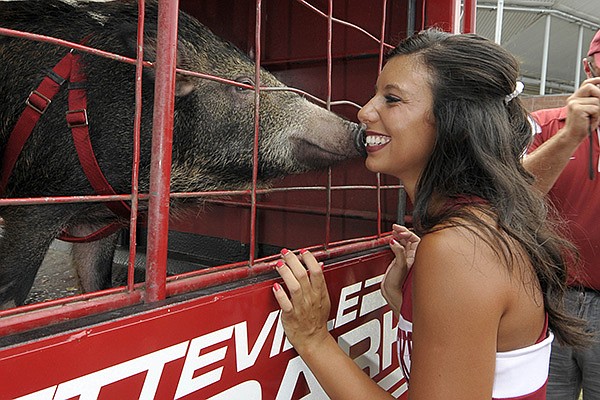
    Tusk IV and a Razorback cheerleader. At Arkansas,
    if you call a man a "pig," he might say, "Thank you, sir."

    The fight song is "Arkansas, Fight!" There are 2 mascots: A live Tusk IV, a Russian boar and the great-grandson of Tusk I, who debuted in 1994; and Big Red, a student in a costume, used since 1973. There's also a female Hog, naturally named Sue E. (UPDATE: Tusk IV died in 2020, and has been replaced by a Tusk V.)
    Big Red appears to be cheating on Sue E.
    by hamming it up with these cheerleaders.

    After the Game. Your safety won't be an issue. Getting a postgame meal might be. Despite my joke earlier, there is a Starbucks about half a mile east of the stadium, at 111 Ozark Avenue. There's also a Chick-fil-A at 435 Garland Avenue; and a Quizno's, in Brough Commons Dining Hall, at 1021 W. Dickson Street. But you're probably better off heading downtown.

    If you visit Arkansas during the European soccer season, as we are now in, you're probably out of luck: The best-known "football pub" in the State is back in Little Rock, Dugan's Pub, at 401 E. 3rd Street.

    Sidelights. Just to the southeast of Razorback Stadium at 285 Stadium Drive is the 10,000-seat home of Arkansas basketball from 1954 to 1993. Originally known as the Arkansas Fieldhouse, it was renamed Barnhill Arena in 1973, for the late John Barnhill, football coach 1946 to 1949 and athletic director 1946 to 1971.
    Head coach Nolan Richardson ran his "Forty Minutes of Hell" offense, and the arena was nicknamed "Barnhell." He was successful enough to get a new arena built, named for a member of the Walton family of nearby Bentonville and Walmart infamy: The 19,368-seat Bud Walton Arena. 1270 Leroy Pond Drive, about half a mile south of Razorback Stadium and Barnhill Arena.

    In their 1st season in it, 1993-94, the Razorbacks won the National Championship. In their 2nd season, they got back to the Final.
    They won their conference's regular-season title 24 times (including 1992 and 1994 since moving to the SEC) and its tournament 7 times (including 2000 in the SEC). They've reached the Final Four in 1941, 1945, 1978, 1990, 1994 and 1995.

    Aside from the University, there isn't much to see in Fayetteville. Headquarters House, at 118 E. Dickson Street, was a headquarters for both sides in the Civil War, as the city changed hands.

    Back in Little Rock, 189 miles to the southeast, is War Memorial Stadium, a 54,128-seat stadium built in 1948, which the Razorbacks have used as a secondary home, usually once a season. (They opened this season there, beating Florida A&M.) It is also home to the football team of Arkansas Baptist College, and minor-league soccer's Little Rock Rangers. 1 Stadium Drive, about 2 1/2 miles west of downtown.
    Hot Springs, 185 miles southeast of Fayetteville and 55 miles southwest of Little Rock, where Bill Clinton spent his teenage years, was a resort well known for having actual hot springs, and also for illegal gambling. It is said that Spring Training was invented there when, coming off a Pennant-winning season, Chicago White Stockings (forerunners of the Cubs) manager and 1st baseman Adrian "Cap" Anson took his team there before the 1886 season to "boil the beer out of them." It remained a popular Spring Training site into the 1920s, before railroads and air-conditioning made Florida, and later Arizona, practical.

    There are 2 minor-league baseball teams in Arkansas. The Arkansas Travelers, currently a farm team of the Seattle Mariners, play at the 7,200-seat Dickey-Stephens Park in North Little Rock. 400 W. Broadway Street, just across the Arkansas River from downtown Little Rock.
    Dickey-Stephens Park, with the Arkansas River
    and downtown Little Rock in the background

    DSP replaced the Travelers' previous home, 1932 to 2006, the 6,000-seat Traveler Field, renamed Ray Winder Field in 1966. 4936 W. Markham Street, just south of War Memorial Stadium.
    The Travelers, named for the old folk song "The Arkansas Traveler," have won 9 Pennants: In 1937, 1960, 1971, 1977, 1979, 1980, 1989, 2001 and 2008.
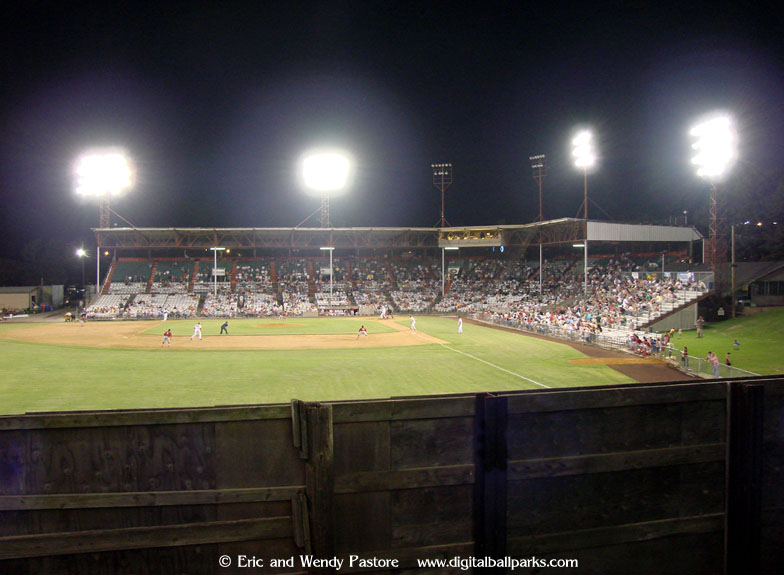
    Despite their name, the Travelers compete in the Class AA Texas League, as does the State's other team, the Northwest Arkansas Naturals. They are a farm team of the Kansas City Royals, have won 4 Division titles, including the 2010 Texas League Pennant, and play in Arvest Ballpark. 3000 Gene George Blvd. in Springdale, about 8 miles north of the UA campus.
    Dickey-Stephens Park is named for 2 sets of brothers, local businessmen Jackson and Witt Stehens, and ex-big league catchers Bill and George Dickey. Bill Dickey, of course, was the 1st great Yankee catcher, starting from 1929 until 1943, and winning 8 Pennants and 7 World Series. He was Lou Gehrig's best friend on the team, played himself in the movie The Pride of the Yankees, and, while the Captaincy was officially vacant from 1939 to 1976, he was the effective captain from 1939 until 1939.

    He managed the team in 1946, and was a coach from 1949 to 1960, teaching Yogi Berra how to be a proper catcher. The Yankees retired Number 8 for him and Berra in 1972, and dedicated Plaques in Monument Park for them in 1988. He died in 1993, and is buried at Roselawn Memorial Park in Little Rock. 2801 Asher Avenue, about 3 miles southwest of downtown.

    From the UA campus in Fayetteville, it is far to any major-league city: 216 miles west to Oklahoma City, 232 miles north to Kansas City, 318 miles southeast to Memphis, 331 miles southwest to Dallas, and 358 miles northeast to St. Louis.

    In baseball, most of Arkansas shows the effects of the old St. Louis Cardinals' radio network, plus Card superstar Dizzy Dean being from Arkansas. Both Little Rock and Fayetteville give about 25 percent of their baseball fandom to the Cards, with the Yankees and Red Sox both around 10 percent. Except for the southenrmost tier of the State, which tilts toward the New Orleans, Saints, Arkansans tend to root for the Dallas Cowboys in the NFL.

    In basketball, the easternmost part of the State, bordering Tennessee, supports the nearby Memphis Grizzlies; and the western area, bordering Oklahoma, favors the Oklahoma City Thunder. But Little Rock and Fayetteville are too isolated from Memphis or OKC for those teams to register. Fans there mostly root for the most successful teams: The Los Angeles Lakers, the Golden State Warriors, and whatever team LeBron James is playing for now. Hockey is barely on the radar, but the St. Louis Blues are preferred over the Nashville Predators and the Dallas Stars.

    The University of Arkansas also has a campus in Pine Bluff, and won the National Championship of historically black colleges and universities (HBCUs) in 2012. The Golden Lions play at the 16,000-seat Golden Lion Stadium, 1960 Oliver Road. The school is 43 miles southeast of Little Rock, 229 miles southeast of Fayetteville, and 142 miles southwest of Memphis.
    The Beatles never played in Arkansas. Elvis Presley did, especially early in his career, because his hometown of Memphis, Tennessee is right across the Mississippi River from West Memphis, Arkansas.

    He played at the Texarkana Municipal Auditorium on November 24, 1954, April 22 and May 27, 1955; the Catholic Club in Helena on December 2, 1954, January 13, March 8 and December 14, 1955; the P and G Auditorium in West Memphis on December 8, 1954; the City Auditorium in Camden on February 21, 1955;  the Robinson Auditorium in Little Rock: On February 20 and August 3, 1955, and May 16, 1956; City Hall in Hope on February 22, 1955; the Armory and Porky's Rooftop in Newport on March 2, 1955; the Arkansas Municipal Auditorium in Texarkana on March 3, September 2 and November 17, 1955; the Fair Park Coliseum in Hope on June 7, 1955; the Sevier County Fair in De Queen on June 16, 1955; the Silver Moon Club in Newport on July 21 and October 24, 1955; the Camden Municipal Auditorium on August 4 and November 16, 1955; River Stadium in Batesville on August 6, 1955; Memorial Stadium in El Dorado on October 17, 1955; the B&I Club in Swifton on December 9, 1955; and the Community Center in Jonesboro on January 4, 1956.

    And at high schools in 1955 in Leachville on January 20, August on February 2, Aubrey on February 3, Pine Bluff on February 23, Parkin on March 21, Marianna on March 24, Dermott on March 25, El Dorado on March 30, Nettleron on April 4, Bono on September 6, Watson Chapel on September 27, Forrest City on November 14, and Swifton on December 9.

    In his later years, he played the T.H. Barton Coliseum in Little Rock (2600 Howard Street) on April 17, 1972, and the Pine Bluff Convention Center (1 Convention Center Plaza) on September 7 and 8, 1976. Both buildings are still standing.

    Bill Clinton is the only President with a significant connection to Arkansas. The William J. Clinton Presidential Center is at 1200 President Clinton Avenue, just east of downtown. Between the Library and downtown is the Historic Arkansas Museum, at 200 E. 3rd Street.

    The Clinton Birthplace Foundation is at his childhood home, at 117 S. Hervey Street in Hope, 113 miles southwest of Little Rock, 232 miles south of Fayetteville, and 209 miles northeast of Dallas. This was the home of his maternal grandparents.

    But it was not his birthplace: He was born on August 19, 1946 at Julia Chester Hospital, which was demolished in 1991, just before he began his run for President. (This happened to Gerald Ford as well: The house where he was born was torn down 4 years before he became President.) Ironically, a funeral home was built on the site. Brazzel-Oakcrest Funeral Home, 1001 S. Main Street. He later lived nearby at 321 E. 13th Street; in Hot Springs at 1011 Park Avenue; and at the Governor's Mansion in Little Rock, at 1800 Center Street.

    The tallest building in Arkansas is the 547-foot Simmons Tower, at 425 W. Capitol Avenue in downtown Little Rock.
    There have been 2 notable TV shows set in Arkansas. Evening Shade, running on CBS from 1990 to 1994, was a sitcom with Burt Reynolds playing a local football hero coming home to coach his old high school's team. Although taped in Los Angeles, several Arkansas scenes were used in the opening sequence, including McClard's Bar-be-que in Hot Springs National Park. And what started as 17, becoming 18, and finally 19 Kids and Counting starred the Duggar Family, who lived in Tontitown, outside Springdale. It ran from 2008 to 2015, until scandal sank it.

    Thelma & Louise started in Little Rock, as did Brubaker, Robert Redford's 1980 prison film. So did Walk the Line, the film biography of Dyess native Johnny Cash.

    *

    Arkansas is an odd place in many ways, but they do love their college football. The Razorbacks are an institution, and if you hear the call of the Hogs, find a time to answer it, and go.

    Tuesday, October 10, 2017

    How to Go to the Red River Rivalry: Texas vs. Oklahoma

    Next Saturday, one of the great American sports traditions will be held: The University of Texas playing the University of Oklahoma in football, at the Cotton Bowl stadium in Dallas, as part of the Texas State Fair.

    You would think that Texas' greatest rival would be Texas A&M, and that Oklahoma's greatest rival would be Oklahoma State. For TAMU and OSU, this is true. But for the Longhorns and the Sooners, it isn't. Their greatest rivals are each other.

    UPDATE: On June 26, 2022, Both schools announced that, at the end of their current contract with the Big XII Conference on June 30, 2025, they will switch to the Southeastern Conference. Presumably, they will go back to playing each other on an annual basis.

    Before You Go. It's not just The South, it's Texas. And you know what? Oklahoma is a lot like Texas, except without the added macho baloney about the Alamo. (You know, where a nation mighty in its time defended its land against illegal immigrants. Who were also slaveholders. Yes, at the Alamo, the good guys won.)

    So if you go to Dallas for this game, it would be best to avoid political discussions -- even if, by comparison, UT-Austin is a comparatively liberal bastion in the Lone Star State.

    Also within the realm of "It's not just The South, it's Texas," you should be prepared for hot weather. It's not just the heat that's so bad, it's the humidity. And the mosquitoes. You think it was only the heat that made the Houston Astros build the Astrodome? Sandy Koufax said, "Some of the bugs they've got down there are twin-engine jobs." At least, unlike in baseball, the Dallas-area football team has a dome. But you'll have to spend some time outside. It's hot, it's humid, it's muggy and it's buggy, and they have that shit all the time.

    So, before you go, check the website of the Austin American-Statesman for the weather. Right now, they're talking about it being in the mid-80s during daylight (by our standards, hot for this time of year), and the high 60s at night.

    Texas and Oklahoma are both in the Central Time Zone, 1 hour behind New York. (The exception for Texas is the southwestern corner, including El Paso, which borders New Mexico, so it's in the Mountain Time Zone.) Adjust your timepieces accordingly.

    Despite Texas' foreignness -- and that's before you factor in the Mexican-American presence, which improves things -- and its former Confederate status, you do not need to bring your passport or change your money. The same is true of Oklahoma, which wasn't yet a State during the Civil War.

    Tickets. The current capacity of the Cotton Bowl is 92,100 -- officially, even larger than AT&T Stadium, which nonetheless covers a lot more area. But getting tickets will still be hard. You'll have to go to StubHub or a similar site. Right now, even in the upper corners of the upper deck, tickets are going for around $200.

    For games at Texas: In the lower level, midfield seats are $140, end seats are $110, and end zone seats are $95; in the upper level, midfield seats are $95, end seats are $70, and end zone seats are $55.

    For games at Oklahoma: All tickets are $55.

    Getting There. It is 1,745 miles from Midtown Manhattan to downtown Dallas. So unless you want to be cooped up for 24-30 hours, you... are... flying.

    A round-trip nonstop flight on United Airlines from Newark, Kennedy or LaGuardia airports to Dallas/Fort Worth International Airport could set you back as little as $404 round-trip. DFW is a major airline hub: American Airlines has its corporate headquarters there. And yet, American offers fewer nonstops at considerably higher prices. There is Orange Line rail service from the airport to Dallas' Union Station, but it will take about an hour and a half.

    Amtrak offers the Lake Shore Limited (a variation on the old New York Central Railroad's 20th Century Limited), leaving Penn Station at 3:40 PM Eastern Time and arriving at Chicago's Union Station at 9:45 AM Central Time. Then switch to the Texas Eagle at 1:45 PM, and arrive at Dallas' Union Station (400 S. Houston Street at Wood Street) the following morning at 11:30. (In other words, if you left New York on Thursday, you'd have 3 hours on Saturday to get to a hotel, and then make the kickoff.) It would be $482 round-trip.
    Dallas' Union Station

    As with American Airlines, Dallas is actually Greyhound's hometown, or at least the location of its corporate headquarters: 205 S. Lamar Street at Commerce Street, which is also the address of their Dallas station. If you look at Greyhound buses, you'll notice they all have Texas license plates. So, how bad can the bus be?

    Well, it is cheaper: $364 round-trip, and advanced purchase can get it down to $351. But it won't be much shorter: It's a 38-hour trip, and you'll have to change buses at least twice, in Richmond, Virginia (and I don't like the Richmond station) and either Atlanta or Memphis.

    Oh... kay. So what about driving? As I said, over 1,500 miles. I would definitely recommend bringing a friend and sharing the driving. The fastest way from New York to Dallas is to get into New Jersey, take Interstate 78 West across the State and into Pennsylvania, then turn to Interstate 81 South, across Pennsylvania, the "panhandles" of Maryland and West Virginia, and across the Shenandoah Valley of Virginia into Tennessee, where I-81 will flow into Interstate 40. Take I-40 into Arkansas, and switch to Interstate 30 in Little Rock, taking it into the Dallas-Fort Worth metropolitan area, a.k.a. "The Metroplex."

    Once you get across the Hudson River into New Jersey, you should be in New Jersey for about an hour, Pennsylvania for 3 hours, Maryland for 15 minutes, West Virginia for half an hour, Virginia for 5 and a half hours (more than the entire trip will be before you get to Virginia), 8 hours and 15 minutes in Tennessee, 3 hours in Arkansas, and about 3 hours and 30 minutes in Texas.

    Taking 45-minute rest stops in or around (my recommendations) Harrisburg, Pennsylvania; Charlottesville, Virginia; Bristol, on the Virginia/Tennessee State Line; Nashville and Memphis, Tennessee; Little Rock and Texarkana, Arkansas; and accounting for overruns there and for traffic at each end of the journey, and we're talking 31 hours.

    But it would be better to leave on Friday afternoon, reach the area on Saturday night, and get a hotel. Fortunately, AT&T Stadium is in Arlington, midway between the downtowns of Dallas and Fort Worth. Well before either the Rangers or the Cowboys set up shop in Arlington, Six Flags Over Texas did so, as the original theme park in the Six Flags chain (opening in 1961), and so there are plenty of hotels available nearby. They’re also likely to be cheaper than the ones in downtown Dallas.

    Austin. Nonstop flights to and from Austin-Bergstrom International Airport (named for Captain John Bergstrom, who died in the attack on Pearl Harbor) are available, but a lot harder to get. Most likely, you'll have to change planes in Dallas. But they could be had for just a little over $500.

    On Amtrak, you'd have to start out a day earlier, on Wednesday, as the Texas Eagle wouldn't get to Austin until 6:21 PM. Round-trip fare is $464. The station is at 250 N. Lamar Blvd., downtown. On Greyhound, round-trip fare is $488, but can drop to $391. The station is at 916 E. Koenig Lane, 6 miles north of downtown, and 3 miles north of the campus. Bus 7.

    Driving from New York to Austin, follow the directions from Dallas, then take I-35E and I-35 South for about 3 hours. Once you get across the Hudson River into New Jersey, you should be in New Jersey for about an hour, Pennsylvania for 3 hours, Maryland for 15 minutes, West Virginia for half an hour, Virginia for 5 and a half hours (more than the entire trip will be before you get to Virginia), 8 hours and 15 minutes in Tennessee, 3 hours in Arkansas, and about 6 hours and 30 minutes in Texas.

    Taking 45-minute rest stops in or around (my recommendations) Harrisburg, Pennsylvania; Charlottesville, Virginia; Bristol, on the Virginia/Tennessee State Line; Nashville and Memphis, Tennessee; Little Rock and Texarkana, Arkansas, and Dallas itself; and accounting for overruns there and for traffic at each end of the journey, and we're talking 35 hours.

    Norman. To get to an Oklahoma game, you'd have to fly to Oklahoma City's Will Rogers International Airport (named for the Oklahoma-born entertainer of the early 20th Century) and then take a bus to Norman. This would be more expensive, around $840, before the ride on the Number 24 bus, which takes about an hour.

    Amtrak isn't all that convenient to OKC. You'd have to board the Lake Shore Limited at Penn Station at 3:40 PM Eastern Time, then arrive at Union Station in Chicago at 9:45 AM Central Time the next morning, then there's a 4-hour layover until the Texas Eagle leaves at 1:45 PM, and it arrives in Fort Worth the next day at 1:25 PM, and then you'd have to change trains again, with a 4-hour layover -- in Fort Worth, not the despised but much more modern city of Dallas -- before taking the Heartland Flyer at 5:25, finally arriving in Oklahoma City at 9:27 PM. That's 62 hours and 42 minutes. And it's $488 round-trip. That may not be worth the hassles. At any rate, the station is on Gaylord Blvd., between Reno and Sheridan Avenues, just 2 blocks from the arena -- sure, now, at the end, it's convenient.

    On Greyhound, the trip is much shorter, about 39 hours, and you only have to transfer once, and, believe me, 4 hours in Chicago is good. (More hours in Chicago is better, but that's a story for another time.) It's also possible that your transfer may be in Kansas City. The round-trip fare is $278, and you don't save much with advanced purchase. The station is at 1948 E. Reno Avenue at Martin Luther King Avenue, on the same street as the arena, but 2 miles to the east, so what it makes up for in convenience during the trip, it blows up at the end -- the opposite of Amtrak. To Norman itself, it's $353 round-trip. 506 N. Porter Avenue, about a mile north of the campus.

    If you decide to drive, it’s far enough that it will help to get someone to go with you and split the duties, and to trade off driving and sleeping. You'll need to get on the New Jersey Turnpike, and take Interstate 78 West across New Jersey, and at Harrisburg get on the Pennsylvania Turnpike, which at this point will be both I-70 and I-76. When the two Interstates split outside Pittsburgh, stay on I-70 west. You'll cross the northern tip of West Virginia, and go all the way across Ohio (through Columbus), Indiana (through Indianapolis) and Illinois. When you cross into Missouri, you'll be in St. Louis. Switch to Interstate 44 West, the Will Rogers Turnpike, and take that across southern Missouri and northeastern Oklahoma. Outside Edmond, you'll turn onto Interstate 35 South, passing Oklahoma City, then take Exit 108 A onto State Route 9. The campus is 3 miles ahead on your left.

    If you do it right, you should spend about an hour and 15 minutes in New Jersey, 5 hours in Pennsylvania, 15 minutes in West Virginia, 3 hours and 45 minutes in Ohio, 2 hours and 30 minutes in Indiana, 2 hours and 30 minutes in Illinois, 5 hours in Missouri, and 4 hours in Oklahoma before arriving. That's going to be about 24 hours. Counting rest stops, preferably 6 of them, and accounting for traffic at both ends, it should be about 30 hours.

    Once In the City. Texas declared its independence from Mexico on March 2, 1836; was admitted to the Union as the 28th State on December 29, 1845; became the 7th State to secede from the Union, on February 1, 1861; and the 10th former Confederate State to be readmitted, on March 30, 1870.

    Oklahoma was not yet a State at the time of the American Civil War, and thus did not secede, although, could it have, it likely would have. It was admitted to the Union as the 46th State on November 16, 1907.

    Dallas (population about 1.3 million, founded in 1856) was named after George Mifflin Dallas, a Mayor of Philadelphia and Senator from Pennsylvania who was James K. Polk's Vice President (1845-49). Fort Worth (about 850,000, founded in 1849) was named for William Jenkins Worth, a General in the War of 1812 and the Mexican-American War. And Arlington (400,000, founded in 1876) was named for the Virginia city across the Potomac River from Washington, D.C., as a tribute to Confederate General Robert E. Lee.

    The population of the entire Metroplex is about 6.8 million and climbing, although when you throw in Oklahoma, southern Arkansas and northern Louisiana, the total population of the Cowboys' "market" is about 19 million -- a little less than the New York Tri-State Area, and soon it will surpass us.
    Commerce Street divides Dallas street addresses into North and South. Beckley Avenue, across the Trinity River from downtown, appears to divide them into East and West. The sales tax in the State of Texas is 6.25 percent, in Dallas County 8.25 percent, and in Tarrant County (including Arlington and Fort Worth) 8 percent even. ZIP Codes for Dallas start with the digits 75 and 79. The Area Code for Dallas is 214.

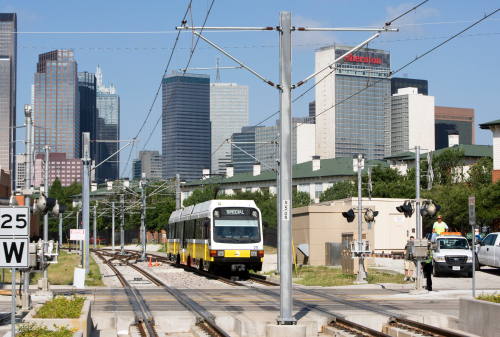
    Dallas Area Rapid Transit (DART) runs buses and light rail trains. A 2-hour pass costs $2.50, and a day pass is $5.00 local and $10.00 regional (if you want to go beyond Dallas to Arlington or Fort Worth).
    Green Line train just outside downtown

    Dallas' beltway is named for 2 Presidents: Interstate 635, to the north, is the Lyndon B. Johnson Freeway; while Interstate 20, to the south, is the Ronald Reagan Memorial Highway. I-20, along with Interstate 820, the Jim Wright Freeway (named for the local Congressman who was an ally of LBJ's, an enemy of Reagan's, and Speaker of the House from 1987 to 1989), is Fort Worth's beltway. And, as I said, I-30, the Tom Landry Freeway, connects the 2 cities and goes through Arlington. Austin, Norman and Oklahoma City don't have beltways.

    Dallas proper is about 42 percent Hispanic, 28 percent white, 24 percent black, and 3 percent Asian. South Dallas is mostly black, while North Dallas is mostly white. The northern suburbs are rich, and so conservative, they make New Jersey Republicans look like Socialists.

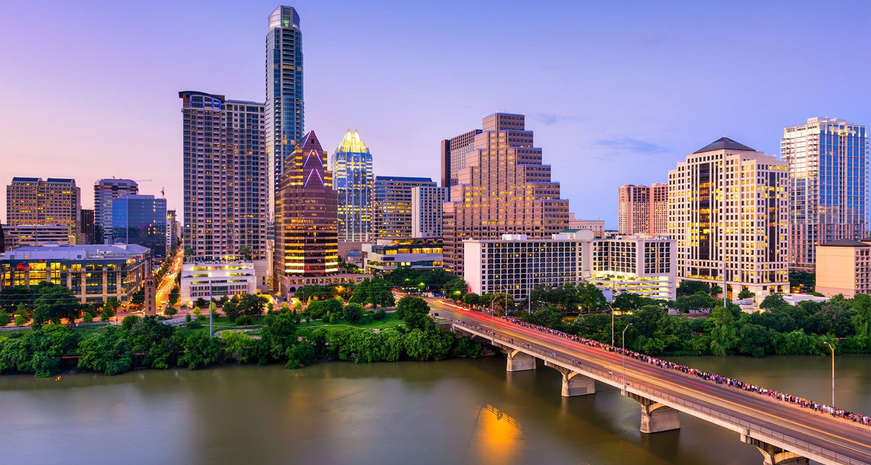
    Named for Stephen F. Austin, "the Father of Texas" and the leader of the successful Texas Rebellion of 1836, and founded 3 years later, Austin has grown by leaps and bounds, and is now home to about 950,000 people, and would be well over 1 million counting students at the University of Texas and people working for the State government, both of whom have their permanent residences elsewhere. The metropolitan area has over 2 million.
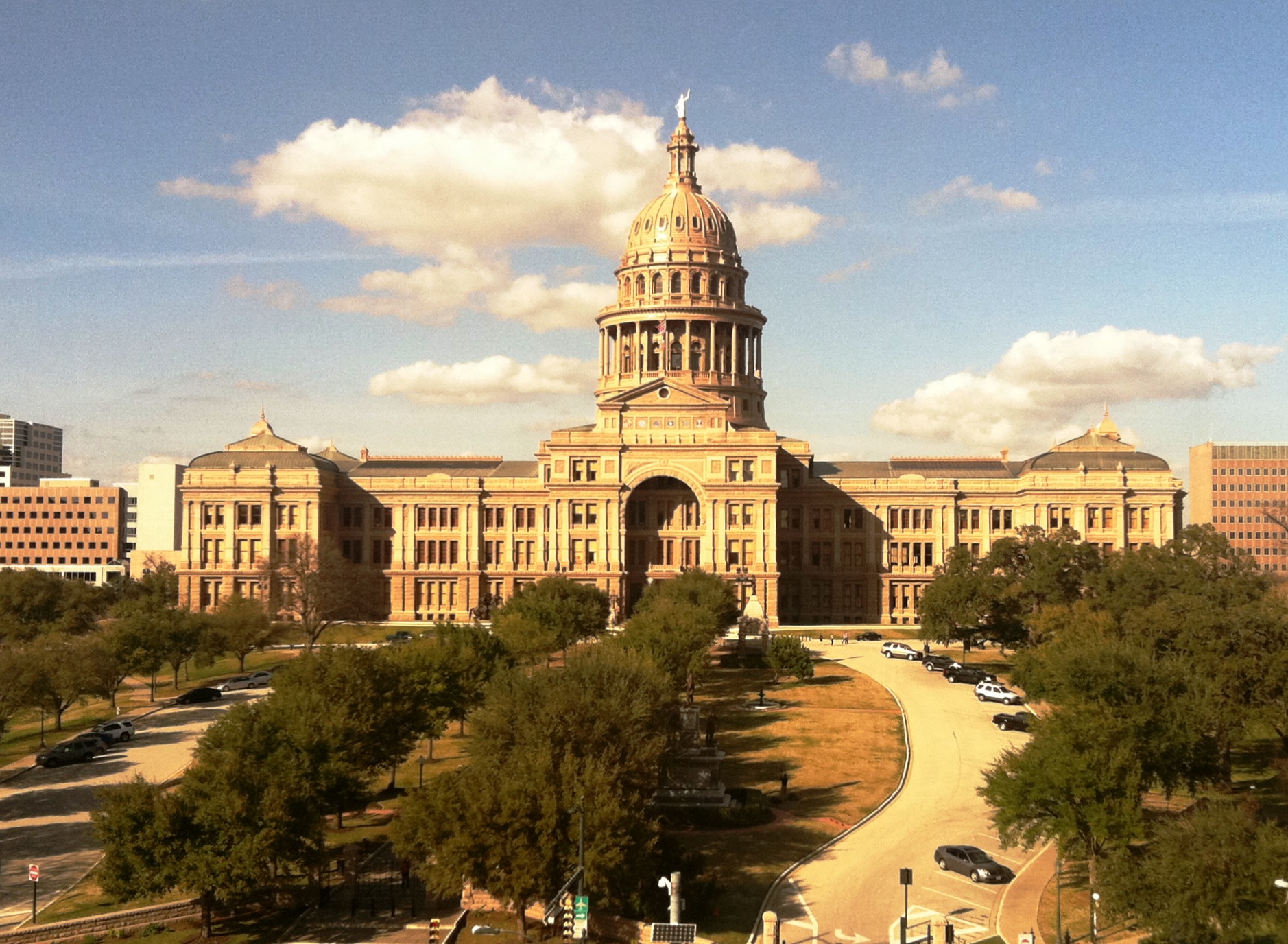
    The State Capitol building is larger in area and floor space than the national one in Washington. Like Raleigh, North Carolina; Nashville, Tennessee; Atlanta, Georgia; Jackson, Mississippi; Lincoln, Nebraska; Laramie, Wyoming and Salt Lake City, Utah, Austin is a liberal capital in a conservative State.
    The Texas State House in Austin

    The leading newspaper is the Austin American-Statesman. ZIP Codes for Austin start with 786, 787 and 789. The Area Code is 512. Austin Energy runs the city's electricity.

    Aside from the University and the State government, the city is known for its alternative music scene, including the South By Southwest Festival, a.k.a. SXSW. Congress Avenue divides addresses into East and West, and the Colorado River (not the same one that goes through Arizona and Nevada) into North and South.

    Consistent with much of Texas other than Dallas and Houston, Austin has a population that is about 48 percent non-Hispanic white, 35 percent Hispanic, 8 percent black, and 6 percent Asian. A 2014 study by UT showed that it was the only rapidly-growing U.S. city to have a net loss of African-Americans between 2000 and 2010.

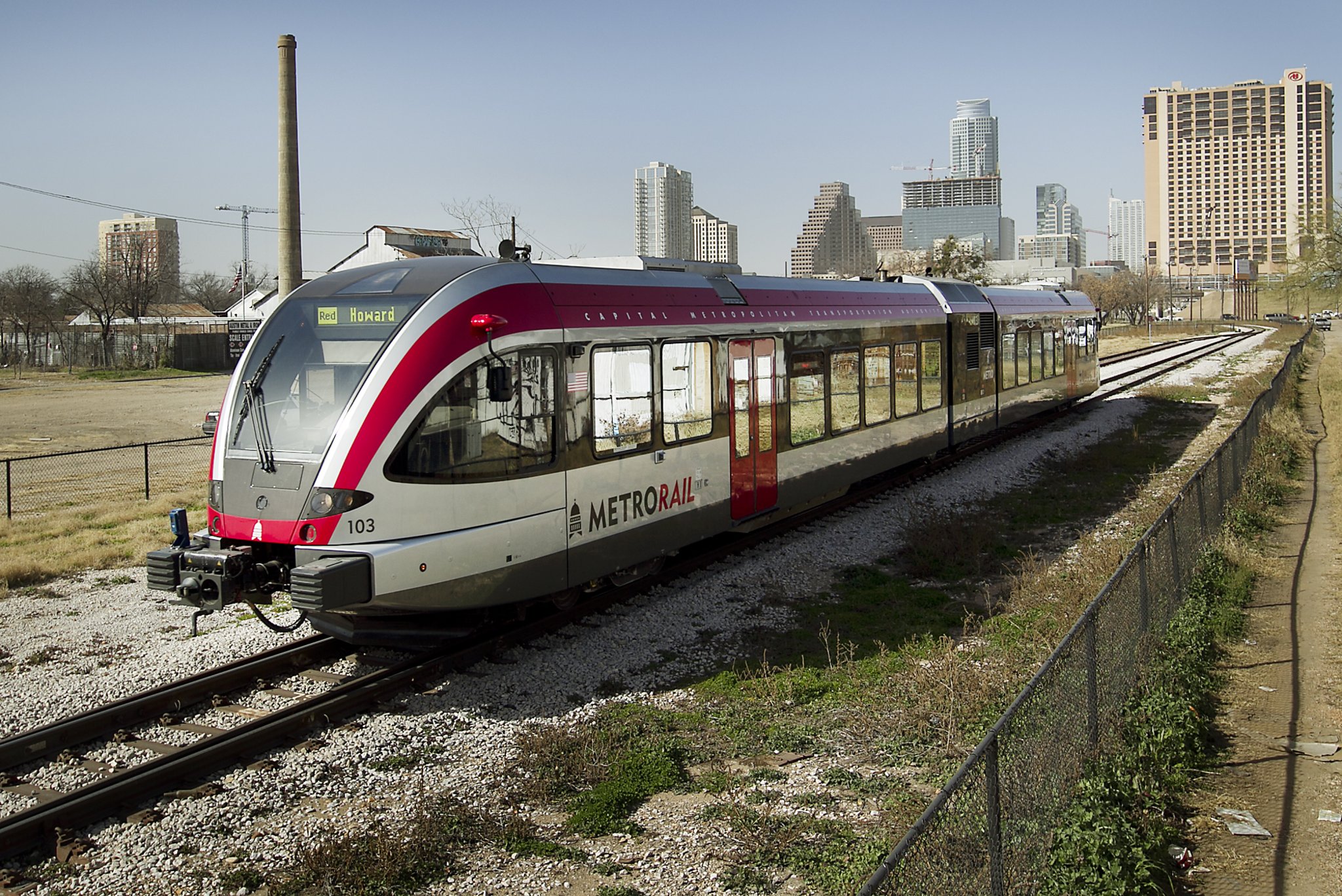
    The Capital Metropolitan Transportation Authority, or Capital Metro for short, runs buses and a commuter rail, Capital MetroRail, in the city and the nearby suburbs. A single ride is just $1.25.
    Capital Metro Rail

    The University of Texas was founded in 1883. It became the 1st major Southern university to racially desegregate, in 1950. In 1967, the State legislature, in recognition of the vast growth of the University of Texas System, officially renamed the main campus "The University of Texas at Austin." Texans call it "UT-Austin." Or maybe "The Longhorns," or "The 'Horns" for short. Unless they're Texas A&M people, in which case they call 'em "tea-sippin' liberals," or "tea-sips" for short.

    The University of Texas System also has campuses in Dallas, Arlington, San Antonio, El Paso, Rio Grande Valley (in Brownsville and Edinburg), Tyler, and the Permian Basin (in Odessa). Surprisingly, there is no campus in Houston, the State's largest city.

    Texas-El Paso, or UTEP, competes in NCAA Division I FBS. It was known as Texas Western University until 1967. It is best known for its all-black starting five that upset Kentucky for the 1966 National Championship. UT-Arlington, UTSA, UTRGV also compete in NCAA Division I FBS. UT-Tyler and UTPB are in NCAA Division II. UT-Dallas is in NCAA Division III. 

    Aside from athletes, notable UT-Austin graduates include: 

    Entertainment: Actors Eli Wallach '36, Fess Parker '50, Barbara Barrie '52, Tommy Tune '62, Bruce McGill '73, Marcia Gay Harden '80, Owen Wilson '91, Renee Zellweger '92, Matthew McConaughey '93; directors Thomas Schlamme '82, Wes Anderson '90 and Robert Rodriguez '08 (based on his age, probably should have been '90); singers Kinky Friedman '66, Nancy Griffith '75 and Michelle Shocked '83; game show host Allen Ludden '40.

    Literature: Novelist and journalist Willie Morris '56; fantasy writer and Percy Jackson creator Rick Riordan '86; and cartoonists Roy Crane '22, Ben Sargent '70 and Berkeley Breathed '79.

    Politics, representing Texas unless otherwise stated: Senators Tom Connally 1898, Earle Mayfield 1900, Ralph Yarborough '27, Lloyd Bentsen '42 and Kay Bailey Hutchison '62; Governors Dan Moody 1910, John Connally '39, Dolph Briscoe '42, Ann Richards '55, Jeb Bush of Florida '74 (but not George W.: He was Yale '68) and Greg Abbott '81; Secretary of State Rex Tillerson '75, Secretaries of the Treasury Connally, Bentsen and Robert B. Anderson '32; Secretary of Commerce Donald Evans '69, Attorneys General Tom Clark '22 and his son Ramsey Clark '49. Tom was also a Justice of the Supreme Court, but resigned because President Johnson wanted to appoint Ramsey as AG, and it would have been a conflict of interest.

    Also, First Ladies Claudia "Lady Bird" Johnson '33 and Laura Bush '73; and First Daughters Lynda Bird Johnson Robb '66 and Jenna Bush Hager '04. (But not their sisters: Luci Baines Johnson Turpin is Georgetown '69, and Barbara Bush Coyne is Yale '04.) Also, Clinton campaign adviser turned CNN correspondent Paul Begala '83.

    Oklahoma may have a "more Texas" State House than Texas does. Because it's the only one with an oil well on the Capitol's grounds.
    The Oklahoma State House in Oklahoma City

    ZIP Codes for Oklahoma start with the digits 73 and 74. For Oklahoma City, 731. For Norman, 730. The Area Codes are 405 for Oklahoma City and Norman. The sales tax is 4.5 percent.
    Oklahoma City is a decent-sized city, with about 630,000 people, but the metropolitan area is small, just 1.3 million. Norman, included in that, was founded in 1891 and has about 120,000. It is served by The Daily Oklahoman and The Norman Transcript. Norman is about 81 percent white, 6 percent Hispanic, 5 percent Native American, 4 percent black and 4 percent Asian. Oklahoma Gas & Electric (OG&E) runs the electricity for the State.
    Oklahoma's darkest hour came on May 31, 1921, when mobs of White residents, some of them deputized and given weapons by city officials, attacked Black residents and destroyed homes and businesses of the Greenwood District in Tulsa, Oklahoma. The attacks burned and destroyed more than 35 square blocks of the neighborhood – at the time one of the wealthiest Black communities in the United States, known as "Black Wall Street." As many as 300 people were killed.

    Cleveland Area Rapid Transit (Norman is in Cleveland County) runs Norman's buses. The fare is even cheaper than Austin's: 75 cents. Jones Avenue divides addresses into East and West, Main Street into North and South.

    Aside from the main campus in Norman, OU's only satellite campus is in Tulsa. Notable OU graduates in fields other than sports:

    * Entertainment: Actors Van Heflin, Rance Howard (father of Ron and Clint, grandfather of Bryce Dallas), Dennis Weaver, James Garner, Alice Ghostley, Larry Drake, Ed Harris and Olivia Munn; music personalities David Gates of Bread and Tom Paxton, Science fiction author C.J. Cherryh, and Miss America 2006 Jennifer Berry.

    * Politics, representing Oklahoma unless otherwise stated: Governors David Hall, David Boren, David Walters, Frank Keating, Brad Henry, and Susana Martinez of New Mexico; Senators Boren (his son Dan Boren served in the House) and Tom Coburn; Speaker of the House Carl Albert, House Majority Leader Dick Armey, Congressman and former OU quarterback J.C. Watts, and current Oklahoma City Mayor Mick Cornett. And, both as a student and a law professor at OU, Anita Hill.

    * Astronauts: Fred Haise of Apollo 13, and record-setting (since broken) Shannon Lucid.

    Going In. This game is played at the Cotton Bowl, aside from the Alamo the most famous building in the State of Texas. The address is 3750 The Midway, as it is the centerpiece of the Texas State Fair. It is 3 miles east of downtown, in the Fair Park section of south Dallas. Bus 012 or 026, or Green Line light rail to Fair Park station. Be advised that this is generally considered to be a high-crime area of Dallas. If you drove in, parking can be had for as little as $5.50.
    Known as Fair Park Stadium when it opened in 1930, the name was changed in 1937, when the Cotton Bowl Classic replaced the old Dixie Classic as Dallas' postseason college football game. It was the site of some (but not all) home games of Southern Methodist University (heretoafter called SMU) between 1932 and 2000. Because of the popularity of SMU running back Doak Walker, a second deck was put on each sideline, raising capacity to 75,504, earning it the nickname "The House That Doak Built."
    The Cotton Bowl, in its best-remembered configuration,
    before its recent renovation and expansion

    It was the Dallas Cowboys' 1st home, from their 1960 launch until the middle of the 1971 season. It also hosted the original NFL version of the Dallas Texans in 1952; the AFL's Dallas Texans from 1960 to 1962, before they moved and became the Kansas City Chiefs; the Tornado in their 1967 and 1968 seasons' some games of soccer's 1994 World Cup, 7 U.S. soccer games, most recently a draw to Mexico in 2004; and an Elvis concert on October 11, 1956, the 20,000 fans being his biggest crowd until he resumed touring in 1970.

    And it hosted the Cotton Bowl game from 1937 to 2009, after which it was moved to AT&T Stadium. On 5 occasions, the game decided the National Championship: 1959-60, Syracuse over Texas; 1963-64, Texas over Navy; 1964-65, Arkansas over Nebraska; 1969-70, Texas over Notre Dame; and 1977-78, Notre Dame over Texas.

    Due to its age, the deterioration of the neighborhood, and the construction of AT&T Stadium, since 2009 it's hosted just 2 games per year: The annual "Red River Rivalry" game between the Universities of Texas and Oklahoma, and the "Heart of Dallas Bowl," a very minor game.

    Nevertheless, the upper deck has been extended all the way around, and capacity is now 92,100. The field is laid out northwest-to-southeast, unusual due to the angle of the Sun, and was artificial turf from 1970 to 1993, when it was replaced with real grass for the World Cup, and kept. I still remember watching the 1985 Cotton Bowl, Doug Flutie's last college game, Boston College vs. the University of Houston, and it rained, so they had to squeegee the field. That's just wrong.
    The Cotton Bowl, in all its maroon (Oklahoma) and burnt orange (Texas) glory.

    Texas vs. Oklahoma is held at the Cotton Bowl every 2nd Saturday in October, because that's the weekend when the Texas State Fair is held, as the stadium is in Fair Park. (Just look for the statue of "Big Tex" -- you can't miss him.)
    This guy.

    While it doesn't seem fair that Oklahoma's visit to play Texas should be called a "neutral site" if it's in the State of Texas, the fact remains that each school gets half the tickets, and the stadium is split right down the middle at the 50-yard line, Texas Burnt Orange and Oklahoma Maroon. It's actually slightly closer to OU's campus in Norman, 191 miles, than it is from UT's in Austin, 197 miles. (While it should be "UO," it's always listed as "OU," and that's even the monogram on their helmets.)

    The game has several nicknames: The Red River Showdown (the Red River separates the States), the Red River Rivalry, the Red River Classic and the Red River Shootout. It was 1st played in 1900, 7 years before Oklahoma gained Statehood. It was played in Austin from 1900, 1901, 1902, 1903, 1904, 1907, 1909, 1910, 1911 and 1923; Norman in 1901, 1903 (played twice in those seasons), 1908 and 1922; Oklahoma City in 1905 and 1906; Houston in 1913; and in Dallas every other time, including every season since 1929. A deal has been made to keep the game at the Cotton Bowl through at least 2025.

    Texas leads the rivalry 61-45-5. The winner receives a trophy, the Golden Hat. In 1963, Texas came in ranked Number 1, and Oklahoma Number 2; Texas won. In 1984, Texas came in Number 1, Oklahoma Number 2, and in a driving rain and on a very slick carpet, Texas kicked a field goal on the last play to forge a 15-5 tie, which ended up sending both teams into mediocrity.
    The Golden Hat

    A running joke is that, unlike the Longhorns' rivalries with Texas A&M and Arkansas, and the Sooners' with Oklahoma State and Nebraska, this is a rivalry not for the people but the rich, and that millionaires have bet ranches and oil wells on the outcome, many regretting it.

    Texas' usual home field is Darrell K. Royal-Texas Memorial Stadium, about. Built in 1924, in 1996 it was named for the man who coached the Longhorns from 1957 to 1976. The official address is 405 E. 23rd Street, about 3 miles north of downtown. Bus 7. If you drive in, parking is $25. The playing surface is named Joe Jamail Field, a graduate of UT's Law School and a major benefactor.

    It opened with 27,000 seats, increasing to 40,000 in 1926, 60,000 in 1948, 66,000 in 1968, 78,000 in 1971, 85,000 in 2006, and the current 100,119 in 2009. There is a plan to enclose the south end zone, the open end of the horseshoe, raising capacity to 115,000, topping even Michigan Stadium and Neyland Stadium in Tennessee.
    You know the old saying, "Everything's big in Texas"? In 2006, a 7,370-square-foot scoreboard was added in the south end, nicknamed "Godzillatron," although it's got so many ads that it's also called "Adzillatron." The field runs north-to-south, and its original grass was replaced by artificial turf in 1969, went back to grass in 1996, and went to FieldTurf in 2009.
    The board is almost as big as the bleacher it stands over.
    A board as big as the crowd.

    Oklahoma's stadium opened in 1923, as Oklahoma Memorial Stadium. The coach was Bennie Owen, and the playing surface was named Owen Field. Since so many major colleges had named their facilities "Memorial Stadium" (since so many had been built in the 1920s, in the aftermath of World War I), "Owen Field" became the most familiar name for the Sooners' place. It is also nicknamed The Palace On the Prairie.
    In 2002, it was renamed Gaylord Family Oklahoma Memorial Stadium, after the Gaylords, the owners and publishers of The Daily Oklahoman, collectively donated $50 million to the University.

    The address is 180 E. Brooks Street, a mile south of downtown. Bus 24. If you drive in, parking is a whopping $46.
    As with Texas' stadium, it was a horseshoe with the south end open, but has now been fully enclosed, including their own ginormous scoreboard. The field was artificial from 1970 to 1993, but has been real grass again since 1994. It seated 16,000 when it opened, and was expanded to 32,000 in 1929, 55,000 in 1949 following the initial success under Bud Wilkinson, 61,000 in 1957, 71,000 in 1975, 75,000 in 1984, 81,000 in 2003, and the current 86,112 in 2016. Unlike the Longhorns, the Sooners allow their stadium to be used for other purposes. This includes concerts.
    September 17, 2016. Ohio State visited.
    That's their band in the process of doing "Script Ohio."

    UPDATE: Through the 2019 season, Texas leads Oklahoma 62-48-5, Texas A&M 76-37-5, Texas Tech 52-17, and Arkansas 56-22. Oklahoma leads Oklahoma State 89-18-7.

    Food. According to the stadium's website, "During the Red River Showdown, Cotton Bowl Stadium has more than 75 concession areas with specialty items ranging from chicken fajitas to game-day staples of hot dogs and soft drinks. They are located just outside Gates 1 through 10. Additionally, on each ramp you will find express beverage service. All fans have access to these areas before and throughout the game."

    The Red McCombs Red Zone Food Court -- named, as was UT's School of Business, for the car sales magnate who once owned the San Antonio Spurs, the Denver Nuggets and the Minnesota Vikings (not at the same time) -- is in the north end of Memorial Stadium, and is open on non-game days from 7:00 AM to 5:00 PM. It includes stands for Subway, Starbucks, Gatti's Pizza and Gigi's Cupcakes.

    Oklahoma's Gaylord Stadium has Bavarian pretzels with cheese, Sooner Street Tacos, Mackdaddy's Onion Burgers, and Billy Sims Barbecue stands. The Heisman winner runs restaurants and markets his sauce to supermarkets.

    Team History Displays. This game is so big because the teams and programs involved are so big. You can debate whether the greatest of all college football programs is Notre Dame, Alabama, USC, or anyone else; but any list of the Top 10 has got to include both Texas and Oklahoma. You don't have to like either one of them, or even respect them, but you should be impressed by their achievements. The Cotton Bowl isn't either team's home field, so, obviously, you won't see any display of those achievements there.

    Texas was granted unofficial National Championships in 1914, 1941, 1968, 1977 and 1981. They officially claim National Championships, due to having won either the Associated Press (AP) writers' poll or the United Press International (UPI) coaches' poll in 1963 (both), 1969 (both) and 1970 (UPI); and in 2005, for having won the Bowl Championship Series. So that's 4 official, 9 counting the unofficial ones.

    They won the Texas Intercollegiate Athletic Association title in 1913 and 1914; the Southwest Conference in 1916, 1918, 1920, 1928, 1930, 1942, 1943, 1945, 1950, 1952, 1953, 1959, 1961, 1962, 1963, 1968, 1969, 1970, 1971, 1972, 1973, 1975, 1977, 1983, 1990, 1994, and the last title of the league, 1995; and the Big 12 title in 1996 (the 1st season after the former Big 8 took in half of the SWC), 2005 and 2009. That's 32 league titles. They won the Big 12 South, but lost the Big 12 Championship Game, in 1999 and 2001.

    Texas has appeared in the Cotton Bowl Classic 22 times, winning 11, both records, most recently in 2003. They've also won 2 Sugar Bowls, 2 Orange Bowls, 2 Fiesta Bowls, and 2 Rose Bowls, including the 2006 thriller with USC that won them their most recent National Championship. Overall, they have a 27-24-2 record in bowl games.

    Texas has had 2 Heisman Trophy winners, both running backs: Earl Campbell in 1977 and Ricky Williams in 1998. Campbell's Number 20 (he wore 34 for the NFL's Houston Oilers) and Williams' Number 34 have been retired. So have the 22 of 1940s quarterback Bobby Layne, who starred for the Detroit Lions; the 60 of 1960s linebacker Tommy Nobis, the 1st draft pick and 1st star of the Atlanta Falcons; the 10 of 2000s quarterback Vince Young, whose pro career turned out every bit as star-crossed as Williams' and the 12 of Young's successor as quarterback, Colt McCoy, now with the Washington Redskins.

    Campbell and Williams each have a statue outside Royal Memorial Stadium. So does Royal himself, who coached the 1963, 1969 and 1970 National Champions. Ironically, he was an Oklahoma native, and a University of Oklahoma quarterback under Bud Wilkinson.
    Texas also has a trophy rivalry with Texas Tech of Lubbock, playing for the Chancellor's Spurs. The Longhorns lead the Red Raiders 50-15.
    Texas' longstanding rivalries with Texas A&M and Arkansas have been interrupted due to conference realignments. The 1969 Texas-Arkansas game, in Fayetteville, was a Number 1 vs. Number 2 matchup, billed as one of those periodic "Game of the Century" matches, and was attended by President Richard Nixon. (Legend has it that Arkansas native and future President Bill Clinton attended, but he was at Oxford University at the time.)

    Texas leads the rivalry 56-22, but the annual game stopped after Arkansas left the SWC for the Southeastern Conference in 1991 (rendering the SWC a Texas-only league, and probably leading to its doom 5 years later), they haven't played each other since Arkansas won the 2014 Texas Bowl, and they won't play each other again until 2021.

    The game with Texas A&M was usually played on Thanksgiving Weekend, sometimes on Thanksgiving Day itself. They began playing in 1894, and is nasty as hell. Someone once said that in Texas, football is religion, and this is the holy war.

    To a Texas Longhorn, A&M is a rural school, a "cow college," full of gung-ho rednecks. To a Texas Aggie, the Longhorns are effete intellectuals with more money than sense. There's a political aspect, too: The Longhorns are called "tea-sippin' liberals," too good for American and Texan values and good ole whiskey, and President Lyndon B. Johnson, the Democrat known for civil rights, health care and education (but also the Vietnam War), wisely put his Presidential Library literally across the street from Memorial Stadium.

    In contrast, "A&M" stands for "Agricultural and Mechanical," but a common misconception is that it's "Agricultural and Military," and they have the Library of a Republican President, George H.W. Bush. (George W.'s is in Dallas, at his wife Laura's alma mater, SMU.)

    A&M went from the SWC to the Big 12 with Texas in 1996, but left for the SEC in 2012. A last-second field goal gave the Longhorns a 27-25 win in what is currently the most recent meeting, on November 24, 2011. To keep the rivalry going, the schools agreed to establish the Lone Star Trophy, given to the school with the most wins against the other in other sports.
    This is the kind of rivalry that made the great ABC college football announcer Keith Jackson say, "These two teams just... don't... like each other." How much do the Longhorns and Aggies hate each other? Each mentions the other in their fight song. The Aggies hate the Longhorns more: While the 'Horns merely sing, "And it's Goodbye to A&M" in "Texas Fight," the entire 2nd verse of "The Aggie War Hymn" is about hating the University of Texas. The Longhorns lead the rivalry 76-37-5.

    Unlike the Longhorns, the Sooners display their titles, on the press box at Gaylord/Memorial/Owen. They've won National Championships in 1950, 1955, 1956, 1974, 1975, 1985 and 2000, as certified by either the AP, UPI, or the BCS. There are other titles, awarded by less authoritative agencies, that they do not claim.

    They won the Southwest Conference title in 1915 and 1918; the league that would eventually be known as the Big 8 in 1920 (as the Missouri Valley), 1938, 1943, 1944, 1946, 1947 (these as the Big 6), 1948, 1949, 1950, 1951, 1952, 1953, 1954, 1955, 1956, 1957 (these as the Big 7), 1958, 1959, 1962, 1967, 1968, 1972, 1973, 1974, 1975, 1976, 1977, 1978, 1979, 1980, 1984, 1985, 1986 and 1987; and the Big 12 in 2000, 2002, 2004, 2006, 2007, 2008, 2010, 2012, 2015 and 2016. So that's 46 titles: 2 in the SWC, 34 in the Big 8, and 10 in the Big 12. In addition, they won the Big 12 South Division, but lost the Championship Game, in 2003.
    Oklahoma is the only school to have 4 coaches with at least 100 wins at the school: Bennie Owen (1905-26), Charles Burnham "Bud" Wilkinson (1947-63), Barry Switzer (1973-88) and Bob Stoops (1999-2016). Included among Wilkinson's 145 wins was a 47-game unbeaten streak -- a tie, and then 46 straight wins. Led by running back Tommy McDonald and center-linebacker Jerry Tubbs, from 1953 to 1957 the Sooners avoided defeat in 47 straight games, and that's still a college football record. Both the last team and the next team to beat them was Notre Dame.

    Owen and Wilkinson have statues outside the stadium. So do the school's 5 Heisman Trophy winners: 1952 running back Billy Vessels (whose pro career was cut short by injury), 1969 running back Steve Owens (played 5 years with the Lions), 1978 running back Billy Sims (was headed for a Hall of Fame career with the Lions before a knee injury ended it in his 5th season), 2003 quarterback Jason White (the only Heisman winner ever willing to turn pro and still not be drafted, due to concerns over his knees, and he has since gotten rich in retail), and 2008 quarterback Sam Bradford (now the starter for the Vikings).
    Wilkinson's statue

    Other Sooner football stars include Tommy McDonald (Hall of Fame receiver for the 1950s Philadelphia Eagles), Bob Kalsu (Buffalo Bills linebacker killed in action in Vietnam), Greg Pruitt (All-Pro running back for the 1970s Cleveland Browns), Joe Washington (All-Pro running back for the 1970s Baltimore Colts and the 1980s Washington Redskins), Lee Roy Selmon (Hall of Fame defensive tackle for the Tampa Bay Buccaneers, who played on OU's defensive line with his brothers Dewey and Lucius), Brian Bosworth (controversial 1980s linebacker who went into action movies) and Tony Casillas (defensive tackle for the 1990s Dallas Cowboys). However, the Sooners do not retire uniform numbers, so even Sims' 20 is still available.

    Oklahoma has won 29 bowl games, including the Orange Bowl (once with an automatic bid to the Big 8 Champions) in 1954, 1956, 1958, 1959, 1968, 1976, 1979, 1980, 1981, 1986, 1987 and 2001 (and denied for 1955 and 1957, due to a rule, soon changed, that prohibited back-to-back appearances); the Sugar Bowl in 1949, 1950, 1972, 1973, 2014 and 2017; the Fiesta Bowl in 1976 and 2011; the Cotton Bowl in 2002; and the Rose Bowl in 2003.

    Texas, in 2004, and Oklahoma, in 2010, are 2 of the 5 schools to have won all 5 major bowls. The others: Notre Dame in 1989, Penn State in 1995 and Ohio State in 1999.

    Oklahoma's main in-State rival is Oklahoma State. It is called the Bedlam Series, and is one of the most lopsided rivalries in major college football. They first played each other in 1904, and have played every year since 1910. The Sooners lead the Cowboys 86-18-7. From 1946 to 1994, the Sooners led 45-3-1. It's been closer since 1995: The Sooners lead 15-7.

    For many years, Oklahoma's biggest rivalry was with Nebraska, as the 2 schools dominated the Big 8 in the 1960s, '70s and '80s. Oklahoma leads, They first played in 1912, and played every year from 1928 to 1997. But changing conference lineups ended that. They played each other in the Big 12 Championship Game in 2006 and 2010 (Oklahoma won both times). But with Nebraska now in the Big 10, the game becomes even rarer. The schools recently signed a deal to play each other in 2021 and 2022 (home-and-home). The Sooners lead the Cornhuskers, 45-38-3.

    The rivalry included the site of the 1971 "Game of the Century," when they played each other on Thanksgiving Day (the only major college football game scheduled for that day that year, thus the entire country could watch it), with the Sooners ranked Number 1 and the Cornhuskers ranked Number 2. Nebraska won, and went on to win the National Championship.

    Stuff. There are souvenir stands at the Cotton Bowl, but no big team store, as no team officially calls it home any longer. Longhorns Limited is located in under the west stand at Royal Memorial Stadium. Texas' University Co-Op is at 2246 Guadelupe Street, about a 10-minute walk from the stadium. The University of Oklahoma Bookstore is at 1185 Asp Avenue (yes, Asp like the snake), just outside the stadium's west stand.

    Dan Myers published The Story of the Cotton Bowl -- the game, not just the stadium -- in 2015. In 1997, John Eisenberg wrote Cotton Bowl Days: Growing up with Dallas and the Cowboys in the 1960s.

    Mike Shropshire, author of a few books on Dallas sports, wrote Runnin' with the Big Dogs: The Long, Twisted History of the Texas-OU Rivalry in 2007. Bobby Hawthorne wrote Longhorn Football: An Illustrated History in 2007. Royal and Pat Culpepper published Coach Royal: Conversations with a Texas Football Legend in 2005, 7 years before the coach died. Terri Frei of the Denver Post wrote Horns, Hogs, and Nixon Coming: Texas vs. Arkansas in Dixie's Last Stand, about the 1969 Texas-Arkansas Game.

    In 1991, John Maher and Kirk Bohls wrote Bleeding Orange: Trouble and Triumph Deep in the Heart of Texas Football. Not to be outdone, a Texas A&M fan named Frank W. Cox III soon cranked out a book titled I Bleed Maroon.

    Ray Dozier wrote Legends of Oklahoma Sooners Football in 2014. Bud Wilkinson: An Intimate Portrait of an American Legend was published in 1994, shortly after he died, by his son Jay Wilkinson and businesswoman Gretchen Hirsch.

    The DVD The History of Texas Longhorns Football immediately followed the 2006 Rose Bowl, to include the latest National Championship. The History of Oklahoma Football came out in 2010.

    During the Game. During the Fair, your safety probably won't be a problem. Otherwise, South Dallas can be a bit dicey. As for the game: Whichever side you pick, stick with them, and don't approach the other side. If you can somehow make it clear that you're a neutral, you should be okay.

    Each school gets the same number of tickets. The stadium will be split right down the middle, at the 50-yard-line: Longhorn Burnt Orange at the north and west, Sooner Crimson at the south and east.

    The Oklahoma Land Rush of 1889 inspired the title of the OU fight song, "Boomer Sooner." The music was swiped from Yale's "Boola Boola," and they also swiped an idea from North Carolina's "I'm a Tar Heel Born." Through their Show Band of the Southwest, UT has 2 fight songs: "The Eyes of Texas" (to the tune of "I've Been Working On the Railroad"), and "Fight, Texas."
    The Land Rush -- the participants were known as the 89ers -- also inspired Oklahoma's mascot, the Sooner Schooner, a prairie schooner pulled by 2 ponies, named, naturally, Boomer and Sooner. Debuting in 1964, it leads the team onto the field, and circles the stadium after after touchdown.
    On Thanksgiving Day 1916, Texas beat Texas A&M 21-7. At that game, the 1st live longhorn steer mascot was introduced. Ben Dyer, editor of a campus magazine, named him BEVO, a play on "beeve," which Texans used as the plural of "beef."

    On February 12, 1917, A&M students broke into the stockyard where the steer was kept, and branded the score of the previous year's game on him, which the Aggies won: "13 - 0." Aside from being cruel to the animal, these Aggies were idiots: It was easy to adjust the branding of the 13 to a B, consider the zero an O, and make it "BEVO." Most people believe that's where the name came from, but the name appeared in accounts of the Thanksgiving game 3 months earlier.

    Bevo XIII was the longest-serving mascot, 16 years, including Ricky Williams' Heisman season and the most recent last Longhorn National Championship. The current mascot is Bevo XV. He is kept at the stadium's south end, and when a Longhorn player scores a touchdown at that end, he runs over to greet Bevo.

    Given the animal's actual long horns, it is one of the meanest-looking live mascots. But a live bull would be too difficult to handle. So he's a steer. It has been suggested that Bevo be given "neuticles": Implants that look like testicles, so that he'll look more masculine. This idea has been rejected.

    For similar reasons of needing to be able to handle the animal, the University of Colorado uses a female buffalo as their mascot Ralphie. Someone once joked about cross-breeding Ralphie and Bevo, but Ralphie's trainer had to remind the jokester about the difference between a bull and a steer.

    Harley Clark, later a federal Judge, was head cheerleader in 1955, and told the crowd at a pep rally at Gregory Gym on November 11, 1955, before their game with Texas Christian (TCU) the next day, "This is the official hand sign of the University of Texas, to be used whenever and wherever Longhorns gather!" He held up his index finger and pinky, so that his hand resembled the Longhorn logo. The "Hook 'Em, Horns" gesture was born.

    Clark was told by Arno Nowotny, the dean of student life, that he had unwittingly copied the malocchio, the Sicilian "Evil Eye" gesture. This can be even nastier: When shaken, it is also taken by Mediterranean-based cultures such as the Italians, Greeks, Spanish and Portuguese to mean you've been cuckolded. Clark responded, "Dean, you need to look on the bright side of things. Instead of our mascot being a longhorn, it could've been a unicorn!"

    In spite of its resemblance to the malocchio, and to the later-invented heavy metal "devil horns" gesture, the Hook 'Em sign is familiar to college football fans from coast to coast, whether they are "Texas Exes" or otherwise.
    Judge Clark flashing his invention in front of the Tower,
    a few years before his death in 2014

    The Austin campus' the Main Building, known as The Tower, is normally lit up in white lights at night. But, like the Empire State Building, different colors are chosen for special occasions. And when the Longhorns win a football game, the lights are burnt orange.

    After the Game. Dallas has a bit of a bad reputation when it comes to crime, but you'll be pretty far from it. Not only is the stadium not in a bad neighborhood, it's one of those stadiums that's not really in any neighborhood. As long as you don't make any snide remarks about the Cowboys, or make any liberal political pronouncements, safety will not be an issue.

    Buffalo Joe's, at 3636 Frankford Avenue, is the local Giants fan bar. But it's 22 miles due north of downtown Dallas. Even further, the Cape Buffalo Grille, at 17727 Addison Road in Addison, 28 miles northeast of AT&T Stadium, has been described by a Giant fan as "a lifesaver for people from New York and New Jersey." Humperdink's, at 6050 Greenville Avenue in north Dallas, 15 miles north of downtown, seems to be the local home of Jet fans.

    If you visit Dallas during the European soccer season, as we are now in, the best-known "football pub" in town is Trinity Hall, at 5321 E. Mockingbird Lane, just off the SMU campus. Blue Line to Mockingbird Station.

    The UT campus is seriously sprawled, and you may have to go downtown to find a good place to eat. About 5 blocks south of the stadium is the Scholz Garten, a German-themed burgers, brats and beer place at 1607 San Jacinto Blvd. Sports Illustrated once included it as a reason why they believe Austin was the best college town in America: "If you don't like Austin, you're a sad case."

    Austin is a very good city for watching European soccer: At The Tavern (Arsenal, 922 W. 12th Street, at the western edge of downtown), Bull McCabe's (Liverpool, 714 Red River Street), Fado (Manchester United, 214 W. 4th Street), Haymaker (Manchester City, 2310 Manor Road, 3 miles northeast of downtown, Bus 20), and Quatro (Barcelona, 4407 Bee Cave Road, 5 miles west of downtown, Bus 30 only gets you within 2 miles).

    But if you're in Norman, and you want to see your favorite club before watching a Sooner home game, you may have to head up to Oklahoma City, to Skinny Slim's, at 201 E. Main Street, downtown, and hope you can make it back to Norman for kickoff.

    Sidelights.  My sidelights for Dallas can be found in my entries for them. The short version: The Mavericks and Stars play downtown at the American Airlines Center, while the Rangers and Cowboys play 18 miles west in suburban Arlington.

    UPDATE: On November 30, 2018, Thrillist published a list of "America's 25 Most Fun Cities," and Austin came in 10th, while Dallas came in 14th. 

    The 16,540-seat Frank C. Erwin Jr. Special Events Center has been the home of Texas basketball since 1977. Erwin was a member of UT's Board of Regents. 1701 Red River Street, about a 5-minute walk south of the stadium, about halfway between it and the State Capitol.
    Austin's nearest professional baseball team is the Round Rock Express, owned by Nolan Ryan (the Hall of Fame pitcher from the Houston suburbs, a.k.a. The Ryan Express) and his family. Appropriately, they are a farm team of the Texas Rangers, in Class AAA, in the now-inaptly-named Pacific Coast League. They've made the Playoffs 3 times in their 1st 18 seasons, most recently in 2015.

    They play at the 11,631-seat Dell Diamond. 3400 E. Palm Valley Blvd., 21 miles north of downtown Austin. No public transit.
    Elvis Presley sang in Austin 5 times: On March 17, 1955 (the day of the Rocket Richard Riot in Montreal), at Dessau Dance Hall, 13422 Dessau Road, 14 miles northeast of downtown, no public transit (the original burned down in 1967, replaced with this one in 1969); on August 25, 1955, at the Sportcenter, now the Armadillo World Headquarters, 501 Barton Springs Road, just south of the river from downtown, Bus 10; on October 6, 1955, at the Skyline Club, 11306 N. Lamar Blvd., about 10 miles north of downtown, Bus 801; on January 18, 1956, at the City Coliseum, 701 W. Riverside Drive, across from the Sportcenter site; and on March 28, 1977, at the Municipal Auditorium, also at that location.

    Austin is home to the Texas Memorial Museum, 2400 Trinity Street, just to the north of Memorial Stadium; the Lyndon Baines Johnson Presidential Library, 2313 Red River Street, just to the northeast of the stadium; the Bullock Texas State History Museum, 1800 Congress Avenue; and the Blanton Museum of Art, right across from the Bullock Museum at 200 E. Martin Luther King Jr. Blvd.

    The tallest building in Austin is The Austonian, at 683 feet the tallest residential building west of the Mississippi River. 200 N. Congress Avenue. Of course, you can't talk about tall buildings in Texas without referring to the University's 307-foot Tower. Built in 1937, it is, as I said, lit up in certain colors for special occasions, white otherwise.
    But it's best known for the 96-minute shooting spree on its 28th floor observation deck by Charles Whitman on August 1, 1966, resulting in the wounding of 34, 17 of whom died, before the police managed to get off a shot that killed him.

    The 11,562-seat Lloyd Noble Center has been the home of Oklahoma basketball since 1975. It was named for Samuel Lloyd Noble, a Houston oilman who had donated to OU. Elvis Presley sang there And he did shows at the Lloyd Noble Center n March 25 and 26, 1977. 2900 Jenkins Avenue, about a mile south of the stadium. No bus service.
    Oklahoma's basketball team reached the Final Four in 1947, 1988, 2002 and 2016, but has never won a National Championship in that sport. They also have highly-regarded baseball, wrestling and track programs.

    Oklahoma City is home to Chesapeake Energy Arena, home court of the Oklahoma City Thunder, 100 W. Reno Avenue, downtown; and Chickasaw Bricktown Ballpark, home field of the Oklahoma City Dodgers, 2 S. Mickey Mantle Drive, Bus 38. (UPDATE: In 2021, this arena was renamed the Paycom Center.)

    The Fred Jones Jr. Museum of Art, at 555 Elm Avenue, about a 10-minute walk northeast of Gaylord Family Stadium. The Sam Noble Oklahoma Museum of Natural History is at 2401 Chautauqua Avenue, about a mile southwest of the stadium.

    The MTV sitcom Faking It was set in Austin. The TNT crime drama Saving Grace was set in Oklahoma City, hometown of its creator Nancy Miller. While it used some location shots, it was largely filmed in Los Angeles and Vancouver. The HBO series Carnivàle was also set in Oklahoma, but filmed in Southern California.

    (UPDATE: In 2021, Hulu premiered the drama Reservation Dogs, set on a Native American reservation in Oklahoma. The show, whose title is a play on the Quentin Tarantino film Reservoir Dogs, is billed as the 1st TV series filmed completely in Oklahoma.)

    Special Agent Eleanor "Ellie" Bishop on NCIS grew up on an Oklahoma farm and is an Oklahoma State graduate, and has an OSU pennant on the wall of her cubicle. She is played by Emily Wickersham, who actually grew up in Mamaroneck, New York and went to Muhlenberg College in Pennsylvania. The University of Oklahoma doesn't have a claim on a pop-culture figure even that big.

    *

    Texas is a weird place, and the Dallas-Fort Worth Metroplex is no exception. But it's a pretty good area for sports, and the Texas-Oklahoma game is its signature sporting event, even more than the Cotton Bowl or Cowboys football. Go in and say, "Howdy."