The way people have reacted to Muhammad Ali has said more about America than he could ever say about himself.
Which is surprising, because he loved to talk about himself.
*
He was born with the name Cassius Marcellus Clay Jr. His father was named for Cassius Marcellus Clay, the son of a prominent Kentucky slaveholder and a cousin of storied Congressman and 3-time Presidential candidate Henry Clay. He became an abolitionist, working for the end of slavery, which cost him his seat in the Kentucky legislature. He was shot, but not only survived, but pulled a Bowie knife on his attacker, wounded him, and threw him over an embankment. On another occasion, 6 pro-slavery men beat him, and 1 stabbed him, but Clay fought them all off, and, with the same knife, killed 1 of them.
He was an officer in the Mexican-American War, a publisher of anti-slavery books and magazines, and one of the founders of the Republican Party. He was one of the earliest recognizers of the talent of Illinois politician and Kentucky native Abraham Lincoln.
Before giving a speech, he would say, "For those of you who believe in the laws of God, I have this," and reach into his coat pocket, and pull out a Bible. Then he would say, "For those of you who believe in he laws of man, I have this," and reach into his opposite coat pocket, and pull out a book whose cover announced that it contained the Constitution of the United States. Then he would say, "For those who you who believe in neither, I have these," and reach into his vest pockets, and pull out a pair of revolvers.
He was instrumental during the Civil War in convincing President Lincoln to write and sign the Emancipation Proclamation. Lincoln appointed him U.S. Ambassador to Russia, and he secured Russian support for the Union. He and Secretary of State William Seward were behind the purchase of Alaska.
I find it hard to believe that the man who became known as Muhammad Ali didn't know everything that was available to know about the original Cassius Marcellus Clay. But, for the rest of his life, Ali called his birth name "a slave name."
*
Cassius Marcellus Clay Jr., the boy who would become Muhammad Ali, was born on January 17, 1942 in Louisville, Kentucky. His father, Cassius Marcellus Clay, was a commercial painter who played piano. His mother, named Odessa O'Grady before her marriage, was a maid. Cassius Sr. and Odessa had 5 sons and a daughter.
Their son Rudolph Valentino Clay, known as Rudy Clay before he, like his brother, converted to Islam, taking the name Rahman Ali, was also a boxer. His 1st professional fight was on February 25, 1964, on the undercard at the Miami Beach Convention Center when his brother first won the title. He won 14 of his 1st 15 fights, but none of the next 3, and retired to work for his brother.
In 1954, at the age of 12, Cassius was seen moping down the street by Joe E. Martin, a Louisville police officer and boxing coach. Cassius told him that his bicycle had been stolen, and that he was gonna "whup" the thief. The cop told him he'd better learn how to box first. He did, winning 6 Golden Gloves titles in his State and 2 nationally.
A year later, photographs of the tortured and murdered Emmett Till appeared in national magazines. When Cassius saw what had been done to this 14-year-old black boy from Chicago -- only 6 months his senior -- when he was visiting relatives in Mississippi, it changed something in him. It made him aware of inequality in a way he had never personally experienced.
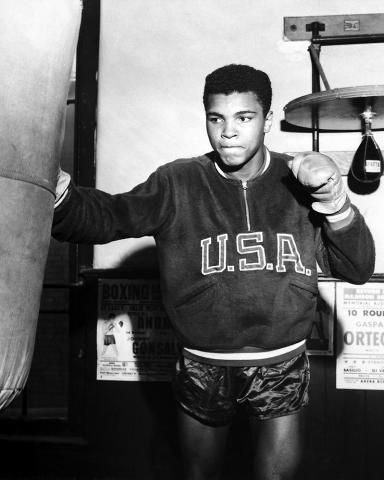
In 1960, just 18 years old, he won the Gold Medal in the light heavyweight division at the Olympic Games in Rome, Italy. He was a star.
He returned to America, and would later tell the story of how he was refused service at a white restaurant in Louisville, while still wearing the medal, and, in anger, walked onto a bridge over the Ohio River, and threw the medal in. Most people who knew him would later say that, while the incident at the restaurant happened, he most likely lost the medal sometime later.
*
Cassius Clay turned professional, and had a few fights in Las Vegas. It was there that he met professional wrestler George Wagner, a.k.a. Gorgeous George. George was flamboyant (but straight), wore his hair very long by the standards of the 1950s and '60s, sometimes wore makeup in the ring, and called himself not only "gorgeous" but "the greatest wrestler in he world!" Cassius took note.
He soon moved to Miami Beach, and set up his training camp there. It was there that he met entertainment legend Jackie Gleason, who liked to call himself "the Great One" and had a nearby theater where he taped a revived version of his 1950s variety show, including new
Honeymooners sketches with Art Carney (but replacement actresses for Audrey Meadows and Joyce Randolph). Gleason told him to think of himself as great, and he might well live up to it, and to enjoy life along the way.
The Beatles had one of their 1st U.S. shows in Miami,
a few days before Ali-Liston I. A picture had to happen.
Soon, the rising heavyweight contender was telling interviewers he was "pretty" and "the greatest." He wanted to prove it by beating Heavyweight Champion Floyd Patterson. But Sonny Liston beat him to it.
Ali didn't like Liston being champion. It wasn't that Liston was merely a big strong puncher, not a true all-around boxer like Patterson, Light Heavyweight Champion Archie Moore, or former Middleweight Champion Sugar Ray Robinson. And it wasn't that Liston was a thug, a muscle man for the Mob before he made it big in boxing. And it wasn't Liston's nasty personality that bothered him, either.
No, it was Liston's face: Clay would tell anyone who would listen, "He's too ugly to be the world's champ! The world's champ should be pretty, like me!" He called Liston "the big ugly bear."
He got his shot at Liston. It would be on February 25, 1964, at the Miami Beach Convention Center. By this time, he had already hooked up with the two men who would guide his career: Drew Brown, who had been a cornerman for Robinson (they were both black); and Angelo Dundee, who had been a cornerman for Carmen Basilio (they were both white and Italian).
Basilio had taken the middleweight title from Robinson in 1957, and Robinson took it back in 1958. Brown and Dundee were on opposite sides, but joined forces to work for the young man already known as the Louisville Hummingbird for his speed and quickness in the ring -- and as the Louisville Lip for his talk out of the ring.
Brown -- whom Ali always called "Bodini," a variation on his middle name, Bundini -- gave the boxing starlet his first big quote:
Float like a butterfly,
sting like a bee!
The hand can't hit
what the eye can't see!
Sometimes, to psych Clay up, Brown would look him in the eye, and, together, they would yell, "Float like a butterfly, sting like a bee! Ahhhh! Rumble, young man, rumble! Ahhhh!" Clay was telling people, "I am the greatest!" Brown was telling him, "Born the champ in the crib!" Dundee wasn't yelling or creating quotes, but he and Brown were both getting him ready.
Liston, due to his Mob background, previous imprisonment, and unpleasant demeanor, was not popular with the boxing public. Lots of people wanted Clay to take the title from him. But many didn't like Clay, either. Asked in the leadup to the fight what percentage of the crowd was coming to see him, as opposed to Liston, Clay said, "Well, 100 percent are coming to see me, but 99 percent are coming to see me get beat! 'Cause they think I talk too much."
He'd had a habit of predicting the round in which he'd knock an opponent out. It was just bravado, until he took on Archie Moore, and said he'd knock Moore out in the 4th round -- and he did. Moore was the Satchel Paige of boxers: His age was seriously in dispute, but he was at least 45 years old at the time, but still officially Light Heavyweight Champion of the World. He fought once more and retired.
Clay went to London and fought Henry Cooper, the Heavyweight Champion of Europe, at Wembley Stadium, and said the knockout would come in the 5th round. But in the 4th, Cooper him him with a left, known in H-dropping London as 'enry's 'ammer, and knocked him down. Clay needed the whole of the minute's break to clear his head, and then opened a cut on Cooper's eye, and the referee had to stop it -- in the round Clay had predicted.
(As champ, he would fight Cooper again, also in London, this time in 1966, at the Arsenal Stadium, a.k.a. Highbury, home of soccer's Arsenal Football Club. He won by decision, and one of the men who helped set the ring up was a 15-year-old apprentice electrician who was playing in Arsenal's youth system. His name was Charlie George, and he would later become one of Arsenal's biggest stars.)
So when the fight with Liston for the title came, everyone wanted to know when he was going to knock out Liston -- who had knocked Patterson out twice, both times in the 1st round. He said:
For those of you unable to watch the Clay-Liston fight, here is the 8th round exactly as it will happen:
Clay comes out to meet Liston, and Liston starts to retreat!
If Liston backs up any further, he'll end up in a ringside seat!
Clay swings with his left! Clay swings with his right!
Look at young Cassius carry the fight!
Liston keeps backing, but there's not enough room!
It's just a matter of time: There! Clay lowers the boom!
Liston crashes through the roof with a terrible sound!
But the ref can't start counting until Sonny comes down!
Liston disappears from view! The crowd is getting frantic!
But our radar stations have picked him up: He's somewhere over the Atlantic!
Who would've thought when they came to the fight
that they'd witness the launching of a human satellite!
The crowd did not dream when they put down their money
that they would see a total eclipse of the Sonny!
The odds were 8-1 in Liston's favor. Like Han Solo, Cassius Clay/Muhammad Ali was a man you would never tell the odds. He'd tell anyone who would listen, especially Liston, "If you'd like to lose your money, be a fool and bet on Sonny!"
Clay was in Liston's head, citing his appearance, his courage, and his age: "You're 40 years old, if a day, and you don't belong in the ring with Cassius Clay!" (Like Moore, nobody really knew how old Liston was. Officially, he was 31, but nobody believed he was that young.) Sportswriter Bert Sugar, who knew more about boxing than any man alive, said, "Liston could handle anything except crazy people. And Clay, then his name, struck Liston as a crazy person."
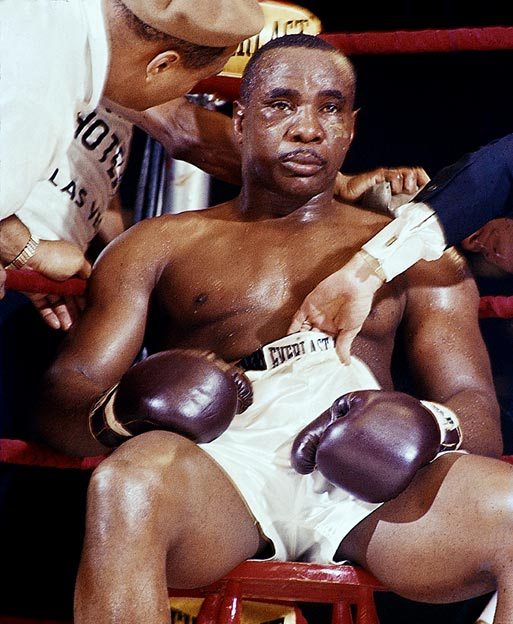
The 1st 4 rounds went exactly as Clay, Brown and Dundee had planned. Clay danced around the ring, and Liston hardly laid a glove on him. But with advantages in height, reach and speed, Cassius messed Sonny's face up. Anybody who said that Liston threw the fight needed only to look at a photo of Liston's face. Clay turned it into hamburger.
Like Mike Tyson, 33 years later against Evander Holyfield, Liston knew he was in trouble, and that cheating might get him out of it. In the 5th, he got his glove into Clay's eye, and suddenly, Clay started blinking. He couldn't see. And Liston finally started landing punches.
When Clay got back to his stool, he was, for the first time in his boxing career, scared. He told Dundee, "I can't see! Cut the gloves off!"
History -- that of boxing, and that of American culture -- hung in the balance at that moment. Everything this 22-year-old boxing contender would become, and everything he would mean to anyone, might not have happened.
Dundee saw a white powder on Clay's glove, from where he'd wiped it out of his eye. Dundee washed Clay's eyes out, and, acting as "bad cop" to Brown's "good cop," told him he was too close to the title to give up now. He told Clay to use his great footwork to stay out of Liston's way until his eyes cleared, and then go after him again.
He did. The film shows Clay pretty much dancing away from Liston's blows in the 5th and 6th rounds. Late in the 6th, Clay's eyes cleared, and he resumed his methodical demolition of Liston's face.
The bell rang for the 7th round, and Clay was ready to finish the job. Liston decided that, his cheat unsuccessful, the job was finished. He quit on his stool. Cassius Clay was the Heavyweight Champion of the World.
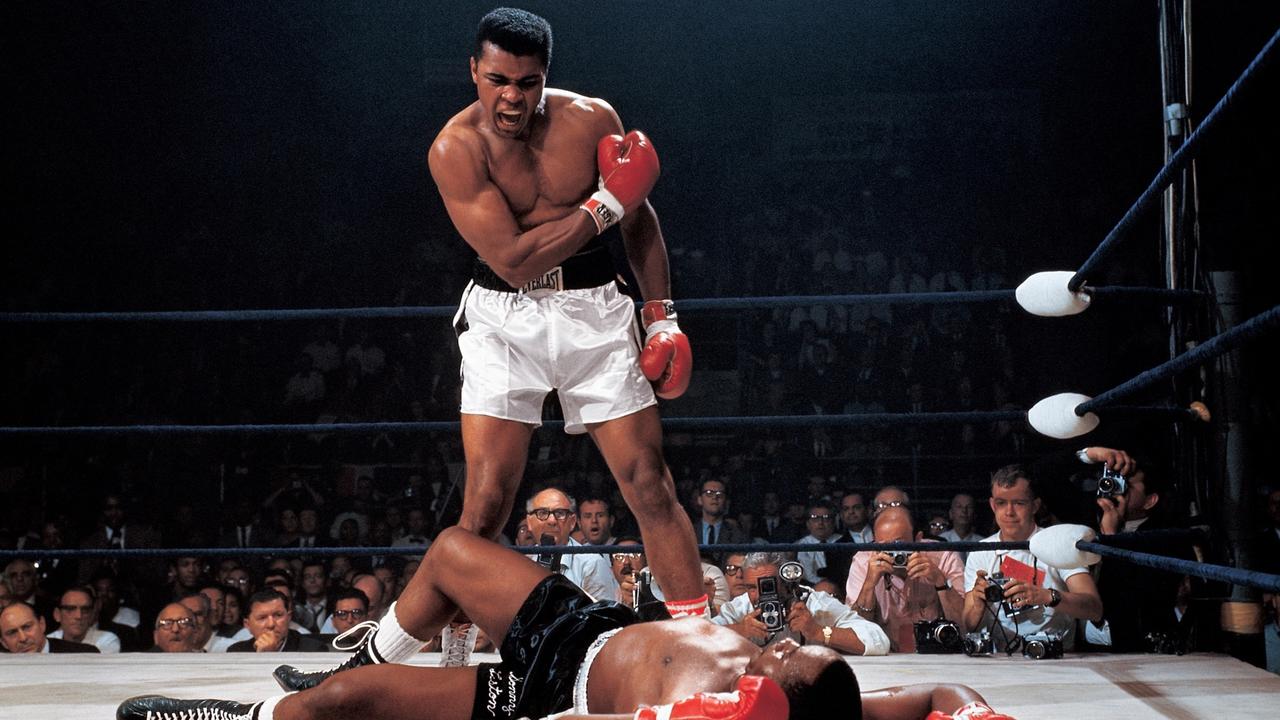
The most famous image of Ali,
standing over Liston during their 1965 rematch.
According to one source, he's yelling, "Get up, sucker!"
On the surviving TV broadcast, he can be heard yelling, "I just knocked out Sonny Liston, I don't have a mark on my face, I just became the world's champ, and I'm only 22 years old! I
must be the greatest! He wanted to go to heaven, so I knocked him out in seven! I am the king of the world! I'm pretty! I'm a
bad man! I shook up the world! I shook up the world! I shook up the world!"
Certainly, he'd thrilled the world. But the shakeup was yet to come.
*
"I'm young, I'm handsome, I'm fast, I'm pretty, and can't possibly be beat!"
As it turned out, there was one man who could beat Cassius Clay. He even wiped him out of existence. And his name was Muhammad Ali.
What the people around him knew, but the general public did not, until the
Miami Herald broke the story a few days before the fight, was that he'd been studying Islam. Malcolm X, seeing a potential publicity goldmine in Clay, became his friend and helped him along the path to conversion.
When Malcolm left the Nation of Islam, Clay stuck with the group's leader Elijah Muhammad. It would be 1975, after Elijah Muhammad's death, that Ali left the Nation and observed more mainstream Sunni Islam, which he maintained to the end.
He took the name Muhammad Ali: "Muhammad," the name of the first prophet of Islam, meaning "One who is worthy of praise"; and "Ali," the name of an early caliph, meaning "high" or "elevated." (The Hebrew name "Eli" is an equivalent.) He initially followed the NOI's views that segregation was right, that blacks and whites shouldn't live together, and that white people were "devils." But he had so many white friends that he found it difficult to accept this. One of those white friends, Dundee, would tell him, "I hope I'm half as good a Catholic as you are a Muslim."
How good a Muslim was he? Raised a Methodist, I am in no expert on the subject. But he married and divorced 3 times before marrying his 4th wife, Yolanda Williams, known in marriage as Lonnie Ali. He had 7 daughters and 2 sons -- 2 of the daughters with women who he never married. In his later years, Lonnie was his manager, and spoke when he no longer could.
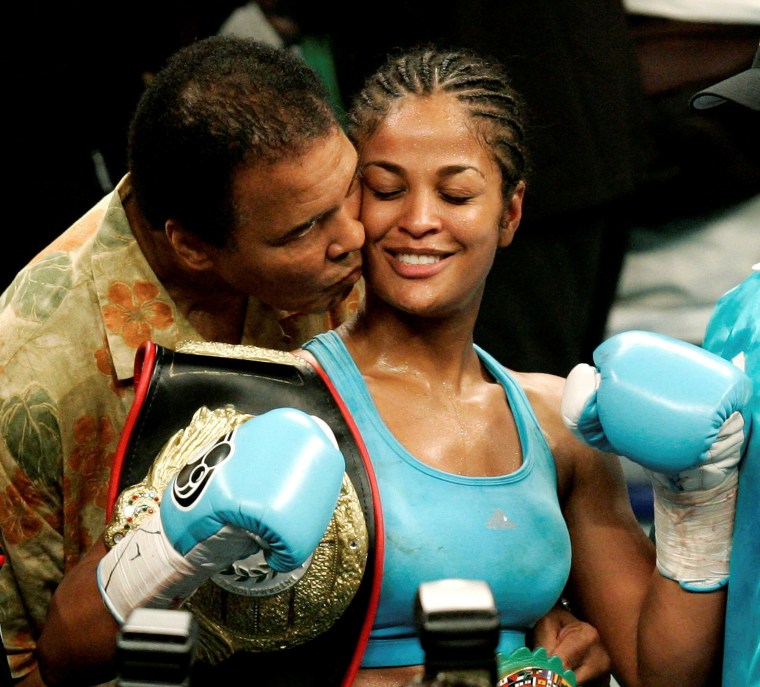
Daughter Maryum became a rapper, under the name May May. Considering her father's impromptu poetry recitals, she can be said to have gone into a family business. Another daughter, Laila, went into
the family business, boxing professionally from 1999 to 2007, adopting a variation on her father's old slogan: "She Bee Stingin'." Some -- including Jackie Frazier-Lyde, boxer and daughter of Smokin' Joe -- have questioned the quality of Laila's opponents. But she went undefeated: 24-0, including a 2001 decision over Frazier-Lyde.
All 4 of his wives converted to Islam, and the 7 children they raised with him were raised under it. But Laila did not stick with it. She is married to NFL receiver turned broadcaster Curtis Conway, and raised 5 children, 2 they had together.
Most people continued to call him "Cassius Clay." Tickets for his fights, including his 1965 rematch with Liston -- which, due to the various controversies around him, was moved from the Boston Garden to Lewiston, Maine -- still listed his name as Cassius Clay. Nearly every journalist still called him by his birth name.
Howard Cosell of ABC Sports did not, and, despite contentiousness between them at times, Muhammad never forgot that Howard -- who had gone the other way, changing his name from Howard Cohen to hide his religious affiliation, because when he started out it was disadvantageous to be known to be Jewish -- called him by his chosen name.
When Ali finally fought Patterson in Las Vegas in 1965, Floyd kept calling him "Cassius." For once, another boxer was in Ali's head. But Floyd, already 30 years old, was well past his glory days, and Ali decided to punish him. He was not going to knock Floyd out. He carried him through the entire 12 rounds. All the way through, he would yell, loud enough to be heard on the TV microphones, "What's my name, fool?" Patterson never gave in and said, "Muhammad Ali." Whether that was principled, courageous, or foolish, who knows.
In 1967, Ali fought at Madison Square Garden for the 1st time -- his only fight at the old Garden. Why did it take so long? Was Ali offended, as a Muslim, by the Garden being referred to as "the Mecca of Boxing?" (It was also called "the Mecca of Basketball.") No, it wasn't because of what the company running the Garden called the building. It was because of what they called him. His boxing license still read, "Cassius Clay," and they called a boxer whatever his license said.
The license was changed, and the Garden printed tickets with "Muhammad Ali" on them, and he was introduced as "Muhammad Ali." He fought Zora Folley, and knocked him out in the 7th round.
*
A month later, on April 28, 1967, the world was truly shaken up. Muhammad Ali, 25 years old and in amazing physical condition, was drafted into the United States Army. And he refused to accept it.
When he registered for the draft on his 18th birthday, January 17, 1962, he was classified as 1-A by the Selective Service System. That meant that there was nothing to stand in the way of his being drafted. In 1964, he took what's been described as a "mental test," and it revealed that his IQ was 78 -- below the military threshold, and in the range of retardation.
(For comparison's sake, the best-known developmentally-disabled person in American literature and film, Forrest Gump, was written as having an IQ of 75. But, in both book and film, he was not drafted. He enlisted.)
Clearly, Ali was neither stupid nor, in any way, developmentally disabled. But when asked about the result of the test, he said, "I said I was the greatest, not the smartest." He was given another test, and again scored 78. Is it possible that the test wasn't geared toward nonwhites? Whatever the reason, he was reclassified 1-Y: "Fit for service only in times of national emergency." Whatever the Vietnam War was, it wasn't a national emergency for America -- not in 1964, not in 1967, not at any point in its course.
But in 1966, the Army changed its rules to allow someone with an official IQ that low, and Ali was reclassified 1-A. And when he was ordered to report to the induction center in Houston, where he was living and training at the time, he did his duty and reported. And when his name was called, he refused to do the legal thing and step forward.
(I've heard that the name they called was "Cassius Clay." If so, then the Army had a problem. If the name on his boxing license had been changed, then his legal name must have been changed. So if they didn't call "Muhammad Ali," then he had every right to stay put. But if they did call his new name, then the legal onus was on him.)
He announced that he was a conscientious objector: "War is against the teachings of the Holy Qur'an.
I'm not trying to dodge the draft. We are not supposed to take part in no wars unless declared by Allah or The Messenger. We don't take part in Christian wars or wars of any unbelievers."
("Allah" is the Arabic word for God. It does not mean a God separate from the one in the Bible. Indeed, many figures from the Bible are also in the Qur'an, or the Koran as it's sometimes spelled. Muslims do not believe Jesus to be the Son of God or the Messiah, but they do revere him as a prophet and a teacher. They revere his mother Mary as well. And Abraham, and King David, and David's son King Solomon.)
Ali also said, "I ain't got no quarrel with them Viet Cong." This statement that he had no reason to oppose America's wartime enemy infuriated white mainstream America more than the act of refusal itself.
He went further. This is the first time I have ever used this word on my blog, and I fully intend it to be the last. I haven't even used it when writing about what Jackie Robinson faced. (Jackie himself always called Ali "Cassius.") I use this word only because I want to quote Ali correctly, in context, with no euphemism. What he said must be repeated, because his point, which he made so strenuously 49 years ago, must be made again.
As one of his explanations for refusing to accept being drafted into the U.S. Army and being sent to fight the Viet Cong, Muhammad Ali said, "No Viet Cong ever called me 'Nigger.'"
But many white men had called him that. And white men indicted him for refusing to be drafted. And the New York State Athletic Commission revoked his license to box in that State. And the other 49 States immediately followed. And because of this, the World Boxing Association stripped him of their recognition of him as Heavyweight Champion of the World. The World Boxing Council did the same, and there would be "unification fights" until 1970.
This is the beginning of the schism of the heavyweight title that my generation, barely old enough to remember Ali as an active fighter, and those that have followed us know now.
Ali would ask crowds, black and white alike, "Can my title be taken from me without me bein' whupped?" When the crowd answered back, "No!" Ali would tell the reporter interviewing him, "That's all I can say." Muhammad Ali knew when to speak, and when not to.
He would be convicted of draft evasion, but remained free upon appeal. On June 28, 1971, in the case of
Cassius Marsellus Clay, Jr. (sic) also known as Muhammad Ali v. United States, the Supreme Court ruled that Ali's request to register as a conscientious objector was improperly handled, and therefore he should not have been convicted, and the conviction was thrown out. The vote was unanimous: 8-0. It was easily the most important unanimous decision in the history of boxing.
Ironically, the one Justice who did not participate in the ruling was Thurgood Marshall. It wasn't because Marshall was the 1st black Justice on the Supreme Court. It was because he wasn't appointed to the Court until after the case had been initially decided: That had happened while he was working in the U.S. Department of Justice. Thus, one of the few black people more important in American history than Muhammad Ali, a civil rights icon long before he reached the Supreme Court, decided that he had to recuse himself from this case.
*
Even before his conviction was overturned, Ali got a license to box... from, believe it or not, a Southern State, Georgia. He had given up 3 1/2 years for his principles. Years when he was 25, 26, 27, 28 years old.
This wasn't like Sandy Koufax and Jim Brown retiring, as both did in 1966, at the ages of 31 and 30, respectively. They'd both had enough (Koufax of injury, Brown of dealing with his team's owner.) Nor was this like the later example of Michael Jordan, retiring from basketball at 30 and returning at 32. And it certainly wasn't like Michael Vick, going to prison at 27 and getting out and resuming his football career at 29. Ali gave up his prime years, and was ready to give up his freedom, and even his life ("I'm ready to die," he would tell people) in the name of his principle.
And this wasn't in the days when there was big money in endorsements for athletes even when they weren't playing. Ali couldn't do commercials for Vitalis or Brylcreem with a black man's hair. And with his religion, he couldn't do ads for alcohol or cigarettes, even if Anheuser-Busch or Philip Morris had wanted him to. But even for those things for which he wasn't forbidden to endorse, no company, and no advertising agency, would go near him with a draft-dodge conviction hanging over him. Commercially speaking, he was radioactive.
Even by the time he fought Joe Frazier the 1st time, by which point more Americans opposed the war than supported it, he was still not universally seen as having been right all along. Even people who opposed the war didn't necessarily support him. Many antiwar people were angry at the way he opposed going into it.
From April 1967 to October 1970, Ali stood up for what he believed in, and threw away a chance not only to make (by the standards of the time) gobs of money, but also to fight so well that there would have been no doubt that he -- not Jack Dempsey, not Joe Louis, not Rocky Marciano -- was what he had been saying he was: The greatest heavyweight boxer of all time.
(Incidentally, in 2013,
Epic Rap Battles of History had comedy duo Keegan-Michael Key and Jordan Peele play
Jordan and Ali, respectively. And the script for Peele as Ali did not have him use the words, "the greatest of all time." That's like having a rap battle with Franklin Roosevelt as a character, and not having him say, "The only thing you have to fear is me!")
So Ali fought Jerry Quarry in Atlanta, and knocked him out early. Then he fought South American champion Oscar Bonavena at the new Madison Square Garden, and won by a technical knockout. He probably should have had one more tuneup fight before taking on the man by then recognized as Heavyweight Champion, Joe Frazier. But he didn't.
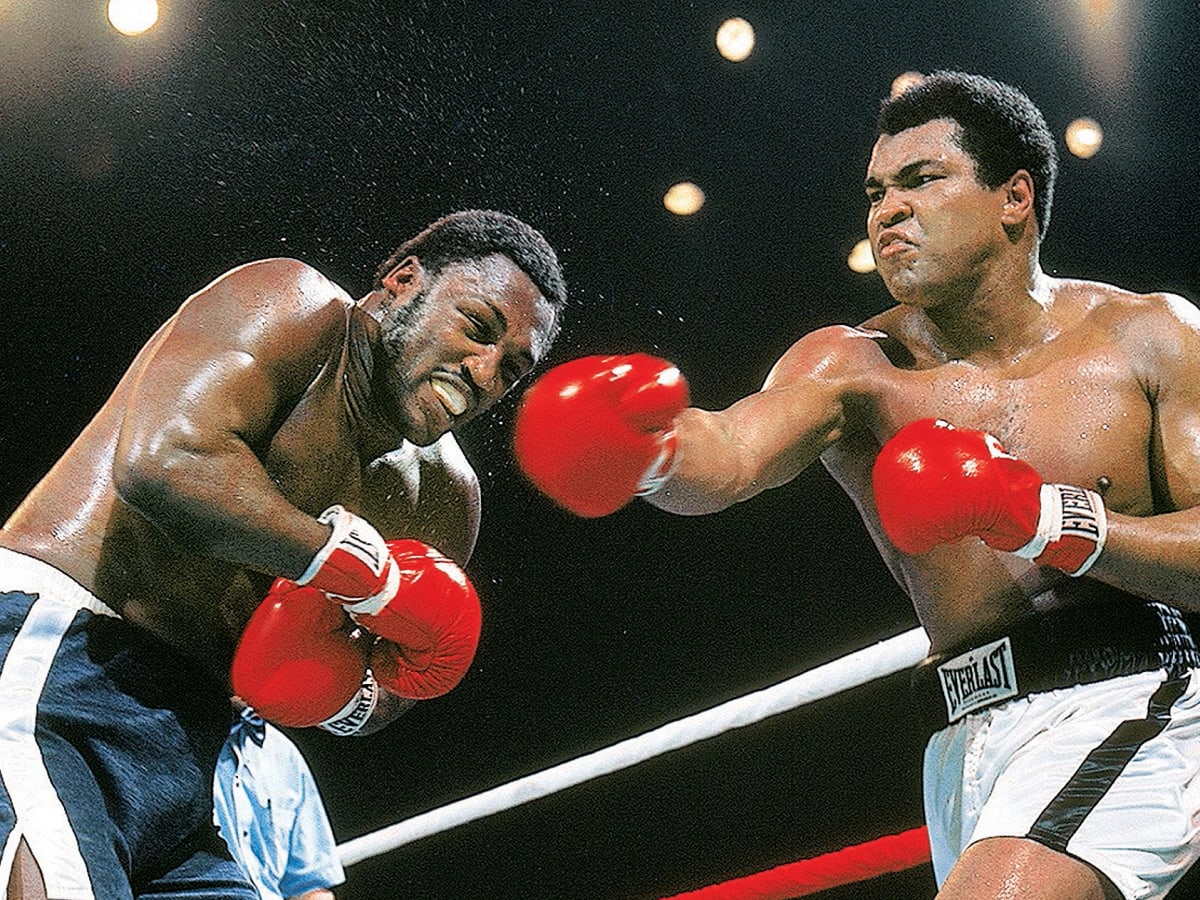
Frazier, like Ali, had won an Olympic Gold Medal, in 1964. Frazier, like Ali, had never lost a professional fight. This was the 1st time that 2 men who were undefeated Heavyweight Champions had faced each other in the ring. Of course, it had to be at the Garden. It was March 8, 1971. Like many others, it was billed as The Fight of the Century. It was also called The Super Fight. It was also called simply The Fight.
How big was this? How tough a ticket was it? Frank Sinatra, the biggest living name in entertainment, and a great fan of sports, especially boxing, and the man whose 1968 charity concert opened the building, couldn't get a ticket. So he made arrangements to be
Life magazine's official photographer for the fight.
Most of the fight was even. But as it went on, Ali's rustiness began to show. In the 15th and final scheduled round, Frazier's famed left hook knocked Ali down, the 1st time he'd been knocked down since Henry Cooper did it at Wembley 8 years earlier. He got right back up, but it was too late: The knockdown was enough to give Frazier a unanimous decision, and the undisputed title.
Muhammad Ali had lost a professional fight for the 1st time. He had been 31-0.
Sports Illustrated would put the knockdown on their cover, and used the headline "END OF THE ALI LEGEND."
Well, that time, "The Dreaded
SI Cover Jinx" fell on
SI itself. Ali stayed in the ring on a regular basis, winning 10 straight fights, until fighting Ken Norton in San Diego in 1973. Norton broke Ali's jaw -- "Perhaps poetic justice," Cosell would say -- and won a split decision. Undeterred, Ali fought Norton again, 6 months later at the Forum outside Los Angeles. Again, it was a split decision. This time, it went in Ali's favor. And then he fought Frazier a 2nd time, also at the Garden. After 12 rounds, he won a unanimous decision.
But Frazier was no longer champion. He'd been destroyed in just 2 rounds by the man who succeeded him as Olympic Heavyweight Champion, 1968 hero George Foreman. On the tape of the ABC broadcast, Angelo Dundee can be heard, before the 1st knockdown, yelling, "Frazier's hurt!" And Cosell started to point that out, when the knockdown came: "Angie Dundee, Ali's trainer, is saying... Down goes Frazier! Down goes Frazier! Down goes Frazier!" Next, Foreman fought Norton, and kicked the stuffing out of him, too.
Ali signed to fight Foreman, to get the title back. It's important to note the context. Here is Muhammad Ali, 32 years old. This is hardly too old to be a good boxer. But of his last 15 fights, 2 have been defeats, 1 win has been a split decision, 3 wins were over guys he'd beaten before (Patterson, Quarry, and Canadian champion George Chuvalo), and none was especially impressive, even his defeat of Frazier.
And here is George Foreman, 25 years old. A great age to be a good boxer. He is 40-0. His last 12 fights have lasted a total of 25 rounds. His last 8 have lasted 15. His last 3 have lasted 5, and included TKOs of the only men ever to beat Ali as a professional. (He's always been called "Big George." Actually, he wasn't much bigger than Ali: Both were 6-foot-3, and Foreman's 220 pounds at the weigh-in made him only 4 pounds heavier than Ali.)
There were very few people who thought that Ali could beat Foreman. Indeed, there were people who thought that Foreman was going to kill Ali. I don't mean figuratively: Some people thought that Foreman was actually going to end Ali's life in the ring. Ali was doing all his usual trash-talking (only we didn't call it that yet), but Foreman calmly stared into a film camera and said, "I'm gonna kill you." Then he grinned, to show everyone that he wasn't
really going to try to kill Ali.
If I tell you that a mosquito can pull a plow, don't argue. Hitch him up.
Or, as Sinatra put it, in the words of Sammy Cahn, "Everyone knows that an ant can't lift a rubber tree plant. But he had high hopes."
Well, there were at least 3 people who believed that Ali could win: Ali himself, Angelo Dundee, and Drew Bundini Brown. They had the fight set for Kinshasa, the capital of Zaire (now the Democratic Republic of the Congo). The trip allowed Ali to embrace his African roots, and for Africa to embrace him. They introduced him to a chant: "
Ali, boma ye!" Hearing this for the first time as he got off the plane, Ali asked someone what that meant. He was told it meant, "Ali, kill him!" So he started pumping his fist and chanting along with them.
Why were the Zaireans supporting Ali? Was it "Black Power"? No, because Foreman was also black. Was it because of religion? No, because Muslims make up only 8 percent of the country, Christians 80 percent. It was because Foreman arrived first, and got off the plane with 2 dogs. German shepherds. That was the breed used as police dogs by Belgium when they controlled the country until 1960. That really, really turned the people away from Foreman. And he had no idea until it was too late.
Ali was probably in the best mood of his life. He wasn't predicting the knockout round, but he was rattling off rhymes:
Last night, I hospitalized a stone, I murdered a brick.
I'm so mean, I make medicine sick!
You think the world was shocked when Nixon resigned?
Wait until I kick George Foreman's behind!
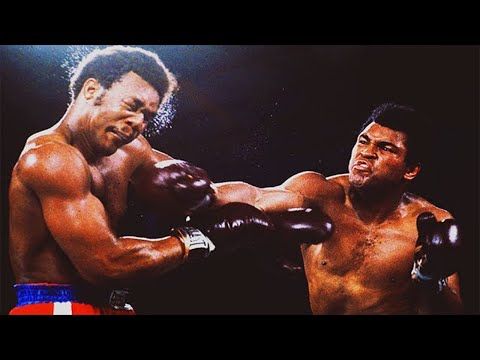
It was October 30, 1974. The fight was billed as "The Rumble in the Jungle." And it's been said that Ali used a strategy of leaning against the ring's ropes, absorbing Foreman's punches, until Foreman got tired and would be unable to face Ali's attack. It was called "rope-a-dope."
It's a great story. But it's not true. I've seen the tape of the fight a few times. Ali was not just biding his time. He was, as they say in English soccer, getting stuck in. On my card (not that I'm a qualified boxing referee), Ali won the 1st, 3rd, 4th, 5th and 7th rounds, and was winning the 8th. Foreman won only the 2nd and the 6th. Ali was winning the fight the whole way.
In an interview long after the fact, Foreman said that, after bell ending the 6th round, Ali yelled, "Is that all you got, George?" And Foreman admitted, "Yep, that's about it."
It was. Late in the 8th round, Ali, leaning on the ropes, grabbed Foreman, gave him a half-spin, and then let loose a flurry of punches. Had those same punches been delivered in the 1st few rounds, they probably wouldn't have hurt Foreman much. At this point, they were enough to knock him down. He tried to get up before the count of 10. He couldn't quite do it. Ali had regained the title.
In the locker room afterward, David Frost, who had called the fight with Jim Brown for the BBC, congratulated him on winning, and Ali asked Frost, "Is this camera working?" Told that it was, Ali pointed and said, "I told you I was the greatest of all time when I beat Sonny Liston! I am still the greatest of all time! Never again make me an underdog until I'm about 50 years old!"
*
And people got it. Richard Nixon was no longer President. America only had a token force left in Vietnam. Most people not only knew now that the warmakers were wrong, but accepted that Ali was right. Even the American establishment began to celebrate Ali.
Sports Illustrated named him Sportsman of the Year for 1974. (Indeed, until Jordan came along, no one was on more
SI covers than Ali.)
DC Comics honored him with a special issue:
Superman vs. Muhammad Ali. It's typically convoluted, to the point where Ali tells Superman he's figured out that he's actually Clark Kent. It ends, of course, with both men victorious.
It was 1978: In attendance: Lex Luthor, Batman,
Burt Reynolds, and President Jimmy Carter.
British reggae singer Johnny Wakelin recorded a song titled "Black Superman (Muhammad Ali)." Ali didn't like it, and wanted nothing to do with it. Once, Ali was on a plane getting ready to take off, and a black stewardess told him that he needed to put on his seat belt. Ali told her, "Superman don't need no seat belt!" The stewardess told him, "Superman don't need no plane." Not often did Ali admit defeat, but, this time, he was whupped.
Speaking of guys who liked to wear a cape, even before he completed his comeback, Elvis Presley, a big believer in America, an Army veteran, and, sadly, a fan of Nixon, met with Ali in Las Vegas, and showed he was a fan. Angelo Cataldi, the morning man on Philadelphia sports radio station WIP-FM these last few years, has said that even Elvis didn't have the charisma that Ali had.
Even The King knew he was
outranked by The Greatest.
Ali was, uh, honored by a
Dean Martin Celebrity Roast, with fellow Rat Packers Sinatra and Sammy Davis Jr. on hand, as well as Gene Kelly, Orson Welles and Red Buttons. Also Floyd Patterson, former Middleweight Champion Rocky Graziano, basketball superstar Wilt Chamberlain (who famously challenged Ali to a fight after his loss to Frazier in 1971, then wisely backed down), black comic Nipsey Russell,
The Jeffersons stars Sherman Hemsley and Isabel Sanford, and 2 new comedians: Puerto Rican New Yorker Freddie Prinze, and Jewish Long Islander Billy Crystal.
Unfortunately, the best picture I could find
of Ali and Sinatra together also has Don King in it.
The diminutive Crystal wowed them with impressions of Ali and Cosell (who was also there). Ali cracked up, and afterward, met him, and said, "From now on, you are my little brother." Crystal would later develop a routine he called "Fifteen Rounds," telling Ali's life story.
He liked to tell the story of coming out of a meeting at a Hollywood studio, when a limo pulled up, and the window rolled down, and it was Ali. Ali invited Crystal to play golf with him the next day. Crystal asked which club. Ali told him.
Crystal: "Champ, I can't play golf there. They won't let me."
Ali: "Why not? You a bad golfer?"
Crystal: "No, I'm Jewish, and it's a restricted club." They still had those in the 1970s.
Ali, thinking about this ridiculous idea for a moment, finally said, "But I'm a black Muslim! If they let
me play, they gotta let
you play!" And they did.
Robin Williams, Muhammad Ali, Billy Crystal
One time, on
The Tonight Show, Jay Leno asked Crystal about him impressions, the thing that first made him famous. He said, "I love to do impressions, but they don't always work. I tried to do Marlon Brando, but it ended up sounding like Muhammad Ali: 'Michael, I never wanted any of this. All I ever wanted to be was the greatest of all time!'"
In 1996, during the Opening Ceremony of the Olympics in Atlanta, Ali was invited to be the final torchbearer and light the cauldron. A special system had to be rigged up, to accommodate his condition, but he did it, to a thunderous ovation. By this point, he had become so accepted as an American icon, that when somebody wrote a letter to the New York
Daily News complaining that Ali had dodged the draft, over the next few days, the
Daily News printed several rebuttal letters, essentially telling that old conservative to get over it and get a life.
*
Ali's 1st fight after Zaire was in the Cleveland suburbs, against a journeyman from New Jersey, Chuck Wepner, a man known as the Bayonne Bleeder. But Wepner stepped on Ali's foot in the 9th round, and thus, accidentally, knocked him down. Ali let him have it after that, but it took until the 15th and final round to knock Wepner out.
A struggling young actor and screenwriter named Sylvester Stallone saw this on TV, and wrote the script that became
Rocky, playing the challenger himself, and basing the fictional champion, Apollo Creed, played by Carl Weathers, on Ali -- if an unapologetically pro-America version of Ali.
On October 1, 1975, Ali fought Frazier for a 3rd time. This one was at the Araneta Coliseum in Quezon City, the capital of the Philippines. Somehow, it got into people's minds that it was in the country's largest city, Manila. It was billed as The Thrilla In Manila.
And this time, these guys wanted each other bad. Ali went back to his old tactic of calling opponents ugly. He called Frazier "The Gorilla." As in, "It's gonna be a thrilla and a chilla and a killa, when I get The Gorilla in Manila!" He brought a little rubber gorilla to a press conference and started punching it.
He also called Frazier an "Uncle Tom," meaning a black man who is subservient to white men. That really burned Frazier up. Except Foreman, who somehow maintained friendships with both men, later suggested that Frazier was confusing "Uncle Tom" with "Peeping Tom," meaning a man who spies on women getting undressed. I guess only Frazier knew for sure.
Ali was 33. Frazier was 31. Frazier would say after the fight, "I hit him with punches that woulda brought down buildings." One such punch really stung Ali in the 6th round. After the bell rang, Ali yelled, "They told me Joe Frazier was washed up!" Frazier said, "They lied!"
Ali rallied in the 8th, but Frazier pounded him in the 9th, and when Ali got back to his stool, he told Dundee, "Man, this is the closest I've ever been to dying." Somehow, Ali held it together. Early in the 13th round, he crashed a right into Frazier's jaw, sending Smokin' Joe's mouthguard flying out of his mouth and out of the ring. Whatever Frazier had done to Ali in the 6th and the 9th, Ali did to him in the 13th and the 14th.
Frazier wanted to get back out there for the 15th and final round. But both of his eyes were swollen. He couldn't see. He protested, but his trainer, Eddie Futch, said, "The fight's over Joe. No one will forget what you did today." He was right, on both counts.
This may have inspired the scene in
Rocky, where Apollo's trainer Tony "Duke" Evers, played by Tony Burton, tells him after the 14th round, "Champ, you're bleedin' inside. I'm gonna stop the fight." And Apollo says, "You ain't stoppin' nothin'!" And Rocky tells his trainer, Mickey Goldmill, played by Burgess Meredith, "You stop this fight, and I'll kill you!"
Ali-Frazier III was stopped. Ali got off his stool, raised an arm in victory, and collapsed. If Frazier had just been allowed to get up, he would have won.
Cosell would later say, "A big part of Ali remained in that ring." He really wasn't the same, ever again. He should have stopped there.
He didn't. Jean-Pierre Coopman in Puerto Rico. Jimmy Young and Alfredo Evangelista at the Capital Centre outside D.C. Richard Dunn in Munich. A 3rd fight with Ken Norton, at Yankee Stadium, the only fight held at The House That Ruth Built after its renovation. (The whole thing was a messy situation, and some people think Norton got robbed.) Earnie Shavers at the Garden, a fight he won despite taking serious blows, a fight that
SI would call on its cover, "ALI'S DESPERATE HOUR."
Still, he wouldn't retire. Then he fought 1976 Olympic champion Leon Spinks in Vegas. Spinks was 24, with 8 professional fights to his credit before that night. Ali had just turned 36, was 55-2, and had first been champ 14 years earlier. Spinks won a split decision. It was as if Andy Gibb had been given a Grammy that had rightly belonged to John Lennon.
On September 15, 1978, at the Superdome in New Orleans, in the 1st prizefight I can ever remember seeing on TV, Ali won, and rightly so, a unanimous decision. He had become the 1st man to win the Heavyweight Championship of the World 3 times. Spinks was never a serious contender again, although he did get another title shot against Larry Holmes, and that was a mistake. His brother Michael Spinks dethroned Holmes, but was annihilated by Mike Tyson.
Still, Ali wouldn't retire. At first, he did... but, like too many boxers before him and after him, he couldn't stay away. On October 2, 1980, he made one more challenge for the title, against Holmes, who had unified the title after Ali vacated it, by beating Norton.
That fight hurt both men. It hurt Ali because it was clear that he was already impaired, and it made things much worse. It hurt Holmes because anyone who supported Ali came to look at him as "the guy who hurt my hero." Including me. It took me years to accept what a great fighter Holmes was. He probably never got he credit he deserved, because of this one fight.
SI called the fight "Doom in the Desert."
And still, Ali wouldn't give up, and fought once more, on December 11, 1981, against Trevor Berbick. It was another loss, which became known as "The Trauma in Bahama."
By the mid-1980s, newspaper and magazine articles were suggesting that all those punches he took, especially from the Thrilla in Manila onward, had left him with Parkinson's disease. Eventually, the truth had to be admitted, and Ali became a major fundraiser for Parkinson's research.
*
In 1990, Ali was a guest on
The Arsenio Hall Show. Arsenio brought out Mike Tyson and Sugar Ray Leonard, who testified to Ali's greatness. Arsenio asked Ali what would have happened if he fought Tyson in each man's prime.
Ali: "I was a dancin' master. I was so fast. But if he hit me... " (He leaned back as if knocked out.) "That's if he could catch me." (Big if.)
Tyson: "I'm vain, I know I'm great, but can I tell you something? Every head must bow, every tongue must confess: This is the greatest of all time."
Later that year, Paul Hogan was a guest on
Arsenio. Arsenio asked him who inspired him when he was growing up in Australia, and trying to establish himself as a young actor there. He would have been 23 when Ali first won the title, but he cited Ali as a big inspiration: "Oh, yeah, Muhammad Ali, he's the most famous man in the world!" Not the President of the United States, "the leader of the free world." Not the Queen of England, who is still head of state for Australia and every other country in the British commonwealth. Not the Pope. Not Nelson Mandela, who'd recently been freed, and had done some boxing in his youth. Ali.
Mandela and Ali
The next year, 1991, ABC celebrated the 30th Anniversary of its anthology series
Wide World of Sports, of which Ali had been so much a part. A feature was done on him. Football player turned broadcaster Frank Gifford narrated it. It showed Ali surrounded by people, especially children, well after his last fight, in places like Russia, China, and, as Gifford (probably with help from a scriptwriter) put it, "India, where there's never been a professional fight." (That is no longer the case.)
In 1996, Muhammad Ali was invited to light the cauldron at the Opening Ceremony of the Olympic Games in Atlanta. And he was given a new Gold Medal to replace the one he once had.
Lighting the thingamabob that allowed him
to light the cauldron despite his impairment.
Behind him is the previous torchbearer,
swimming legend Janet Evans.
In 1997, at its annual ESPY Award ceremony, ESPN gave him their annual Arthur Ashe Courage Award. In 1999,
SI, ESPN and the BBC all named him their Athlete of the Century. In 2005, while hardly a supporter of his when younger, George W. Bush invited him to the White House and awarded him the nation's highest civilian honor, the Presidential Medal of Freedom, our version of a knighthood.
Muhammad and Lonnie Ali had a farm in Berrien Springs, Michigan, on Lake Michigan, not far from Chicago. They eventually sold that and bought a home near Phoenix, and another back in his hometown of Louisville.
In 2005, they established the Muhammad Ali Center on Louisville's waterfront, as part of its Museum Row, a short walk from the George Rogers Clark Memorial Bridge, which may have been the bridge he spoke of throwing his medal off. It "features exhibitions regarding Ali's core values of respect, confidence, conviction, dedication, charity, and spirituality." By a weird coincidence, there's a museum named "Frazier" 2 blocks away: The Frazier History Museum features military memorabilia from all over the world. I cannot confirm that either museum is run by someone whose title is "Foreman."
Muhammad Ali and Joe Frazier would feud, make up, feud, make up, over and over again. By the time Frazier died in 2011, they must have been at peace, because Ali attended his funeral, and nobody objected to his presence.
In 2001, Will Smith starred in the film
Ali. After the 9/11 attacks later that year, more attention was focused on Muslims in America, and on Islam by Americans, than ever before, even during Ali's most controversial moments. A TV special, airing on all networks, to raise money for relief, featured some of the biggest performers in the world: Singers singing songs of peace and tolerance, actors reciting words of hope and brotherhood. Smith and Ali appeared together. Ali's hands shook throughout, and he had a lot of trouble speaking, but his message was clear:
Violence, even in the name of his own religion, was wrong.
*
Muhammad Ali died yesterday, June 3, 2016, at a hospital in Phoenix, from respiratory issues brought on by the effects of Parkinson's disease. He was 74 years old.
As the great Los Angeles sportswriter Jim Murray said when Casey Stengel died, "Well, God is certainly getting an earful tonight."
The reaction to the man's death has been as immense as his life:
* George Foreman: "A part of me slipped away. The greatest piece."
* Lennox Lewis: "A giant among men, Ali displayed a greatness in talent, courage and conviction, that most of us will EVER be able to truly comprehend." (I'm presuming he meant "NEVER.")
* Manny Pacquiao: "He was one of my inspirations. His accomplishments, we will never forget."
* Boxing promoter Don King: "People who didn't like him had to respect him."
* Kareem Abdul-Jabbar, basketball legend, who also adopted an Arabic name upon converting to Islam (he had been Lew Alcindor): "To the African-American community, he was a black man who faced overwhelming bigotry the way he faced every opponent in the ring: Fearlessly."
* Pelé, soccer icon, one of the few people alive who could match Ali for fame: "The sporting universe has just suffered a big loss. Muhammad Ali was my friend, my idol, my hero. We spent many moments together and always kept a good connection throughout the years. The sadness is overwhelming. I wish him peace with God. And I send love and strength to his family."
* Reggie Jackson: "The Greatest, a Giant that represented all our world, a true leader for all mankind, Every being, culture, color, creed, a gift from God for all... Proof He puts Angels among us. I was lucky to be called 'friend.'" (Reggie made his major league debut 6 weeks after Ali was stripped of the title, and won his last World Championship in his sport 5 weeks after Ali did the same. And there's no way Reggie would have been as celebrated as he was without Ali's stand. Certainly, without that stand, the criticism Reggie faced would have been worse.)
* Jerry Izenberg of The Star-Ledger, the greatest of all New Jersey sportswriters: "With Muhammad Ali, it was always the people. It didn't matter whether they were rich or poor, black or white, celebrity-famous, blue-collar weary or welfare poor. It didn't matter what language they spoke, what God they worshiped, what gender they were... His was a bond forged with a constituency that didn't have to meet him to know him, a constituency that transcended all economic, racial, ethnic and political barriers. With his passing, they lost a hero. With his passing, I lost a friend." * Moonwalking astronaut Buzz Aldrin: "I first met Muhammad Ali when we rode in the Rose Parade together in 1988. The world has lost The Greatest!"
* Oprah Winfrey, whose rise to fame would have been inconceivable as soon as it happened without him: "The world has lost a Legend and real Champion."
* Whoever writes the Twitter feed for DC Comics: "Today we lost a true superhero. You will be missed, Muhammad Ali."
* President Barack Obama: "He shook up the world, and the world's better for it. Rest in peace, Champ."
It is safe to say that, if Muhammad Ali hadn't done what he did outside the ring, it might have taken another generation before a black person could be elected President. Obama has a very different personality, but he knew he could take all the crap he's taken, because Ali had taken similar crap -- and Obama isn't even a Muslim.
* Bill and Hillary Clinton, in a joint statement: "Hillary and I are saddened by the passing of Muhammad Ali. From the day he claimed the Olympic gold medal in 1960, boxing fans across the world knew they were seeing a blend of beauty and grace, speed and strength that may never be matched again. We watched him grow from the brash self-confidence of youth and success into a manhood full of religious and political convictions that led him to make tough choices and live with the consequences. Along the way we saw him courageous in the ring, inspiring to the young, compassionate to those in need, and strong and good-humored in bearing the burden of his own health challenges." * Donald Trump: "Muhammad Ali is dead at 74! A truly great champion and a wonderful guy. He will be missed by all."
Really? After all the things you've said about Muslims and nonwhites?
* Tom Fletcher, writer and former boxer: "Don't judge those running for office by the eloquence of their tributes to Ali, but how they would treat a 20 year old version of him now."
*
Ali once claimed he was going to save boxing: "If not for me, boxing would be dead."
In the wake of his death, people are throwing around the phrase he used during his "exile": "The People's Champion."
Who is the Heavyweight Champion of the World today? Because of the split among the governing bodies, I didn't know. I had to look it up:
* World Boxing Council (WBC): Deontay Wilder, a 30-year-old Alabamian, known as the Bronze Bomber, 36-0, all but 1 of those wins by knockout.
* World Boxing Association (WBA): Ruslan Chagaev, a 37-year-old Uzbek, 34 wins (21 by knockout), 2 losses, 1 draw, 1 no-contest (reinstated as WBA Champion after losing the title when the man who beat him failed a drug test).
* International Boxing Federation (IBF): Anthony Joshua, a 26-year-old Englishman of Nigerian descent, 2012 Olympic Gold Medalist, 16 professional fights, all knockout wins.
* World Boxing Organization (WBO): Tyson Fury, a 27-year-old Englishman, 25 fights, all wins, 18 by knockout.
If you're wondering what happened to the giant Ukrainian Klitschko brothers, Wladimir was beaten by Fury last November, and Vitali retired from boxing in 2012, giving up the WBC title, and has been elected Mayor of Kyiv (Kiev), their nation's capital city.
*
I have a newborn niece, named Mackenzie. She has older sisters, twins, Ashley and Rachel, who will soon be 9 years old. Ashley and Rachel know the name of Muhammad Ali, but they can't possibly know what he meant to so many people. It's up to grownups like me to tell them just how important he was.
Someday, I will tell Mackenzie that the planet Earth has existed for over 4 billion years, and that, for 11 days, she lived on it at the same time as Muhammad Ali.
It was skill that made him the greatest boxer of his time, perhaps of all time. But it was circumstances, and the way he handled those circumstances, that made him "The Greatest of All Time."
Because of those circumstances, there will never be another person like him. There was only one Muhammad Ali.
UPDATE: He was laid to rest at Cave Hill Cemetery in Louisville.