To paraphrase the question from the old game show To Tell the Truth, the question every Yankee Fan was asking going into last night's game was, "Will the real New York Yankees please stand up?"
Well, last night, there were 2 massacres in Cleveland, and they were both self-inflicted as much as anything else. Donald Trump acted like an ass in the Presidential debate, and Joe Biden made him pay for it. And the Cleveland Indians kept putting pitches right in the Yankees' wheelhouse, and they showed up, and hit them.
Gerrit Cole had said that what he liked about starting Game 1 of a best-2-out-of-3 series was "the stakes." He pitched like he knew how high the stakes were: He went 7 innings, allowed 2 runs on 6 hits, and -- I love saying this about a Yankee pitcher -- no walks. He struck out 13 batters.
He pitched like he didn't think he could expect much run support. He got it anyway. Home runs were hit by Aaron Judge in the 1st inning, Gleyber Torres in the 5th, Brett Gardner in the 7th and Giancarlo Stanton in the 9th.
Much was made online before the game about Aaron Boone's decision to start Gardner in left field over the hot-hitting Clint Frazier. Boone must have remembered that Frazier is still a "Doctor Strangeglove" in the field. But Gardner did the business with the bat, too. As has been said before, under different circumstances, "Let Gardy bang."
Much was made online after the game about Stanton hitting a garbage-time home run, as he has done so often, not unlike a man to whom he has often been compared, Alex Rodriguez. Still, it was good to see.
The Yankees led 11-2 after 7 innings. Boone considered the lead safe enough to bring in Luis Cessa, and save his relievers for Game 2 and, if necessary, Game 3. Cessa did allow a run, but, with Stanton's homer, the final score was Yankees 12, Indians 3.
In other American League Playoff action yesterday:
* The Houston Astros scored 3 runs in the 9th to beat the Minnesota Twins 4-1. This was the Twins' 17th straight postseason game lost, far and away a record.
In the postseason, the Twins are so bad! (How bad are they?) They're so bad, the Astros didn't need to cheat to beat them.
I think.
* The Chicago White Sox beat the Oakland Athletics 4-1. Lucas Giolito took a perfect game into the 7t inning, before allowing 2 hits.
* And the Tampa Bay Rays beat the Toronto Blue Jays 3-1.The Rays were the only home team to win.
Tomorrow, the National League Playoffs get underway, and every series will be played on the day: Cincinnati at Atlanta at 12 noon, Houston at Minnesota at 1 (12 Central), Miami at the Chicago Cubs at 2 (1 Central), the Chicago White Sox at Oakland at 3 (12 Pacific), Toronto at Tampa Bay at 4, St. Louis at San Diego at 5 (2 Pacific), Yankees at Cleveland at 7, and Milwaukee at Los Angeles at 10 (7 Pacific).
Masahiro Tanaka is scheduled to start for the Yankees, and Carlos Carrasco for the Indians. Come on you Bombers: Close this one out!
*
September 30, AD 420: Jerome of Stridon dies near Bethlehem, said to be the birthplace of Jesus. He is believed to have been 73 years old. A native of the Roman province of Dalmatia, now in Croatia, he was known for his teachings on Christian moral life, especially to women. He was canonized as St. Jerome, and September 30 is now recognized as his feast day.
September 30, 1399: Having deposed King Richard II, his 1st cousin, Henry Bolingbroke, Earl of Derby and Northampton, Duke of Hereford and Duke of Lancaster, is proclaimed Henry IV, King of England and France, and Lord of Ireland.
Whether Richard II should have been deposed -- and killed a year later -- is a separate debate. But the rise of Henry IV set in motion what would become England's Wars of the Roses, between 2 branches of the House of Plantagenet: Henry's House of Lancaster, whose symbol was a red rose; and the House of York, whose symbol was a white rose.
These 2 families, each representing one of the North of England's historic counties, would fight on and off between 1455 and 1485, until King Richard III was killed in battle, ending the Yorkists' reign, and Henry Tudor, Earl of Richmond and a direct descendant of King Edward III (grandfather of Richard II and Henry IV), was proclaimed King Henry VII, and reunited the houses by marrying Princess Elizabeth of York, daughter of Richard's brother, King Edward IV.
What does this have to do with sports? Well, Lancaster and York still harbor deep resentments toward each other, over 600 years since the start of the conflict and over 500 years since the Wars of the Roses. In sports, this is most evidence in soccer rivalries. Manchester United, now in the separate "metropolitan county" of Greater Manchester but formerly in Lancaster (as was Liverpool, now in the metropolitan county of Merseyside), developed a rather nasty rivalry with the biggest team in Yorkshire, Leeds United.
Even the roses live on in soccer: Leeds United have a white rose in their crest, while Blackburn Rovers, one of the larger teams within the remaining County of Lancashire, have a red rose in theirs.
And many places in America have been named Lancaster and York, including in Eastern Pennsylvania, separated by 30 miles (less than Manchester and Leeds) and the Susquehanna River. Speaking of which...
September 30, 1833: Matthew Stanley Quay is born in Dillsburg, Pennsylvania, outside York. He won the Congressional Medal of Honor for his service at the Battle of Fredericksburg in 1863. The rest of his life was considerably less heroic.
He became a part of Pennsylvania's corrupt Republican Party machine, and served as Secretary of the Commonwealth from 1873 to 1882, Treasurer from 1886 to 1887, U.S. Senator from 1887 to 1899, and as Chairman of the Republican National Committee from 1888 to 1891, while serving in the Senate. (Then, as now, this was legal.)
This last post turned out to be key. In 1888, he became campaign manager to Republican Presidential nominee Benjamin Harrison. In the popular vote, the incumbent Democrat, President Grover Cleveland, came out slightly ahead. But the Electoral Vote went to Harrison, 233-168.
Harrison won his home State of Indiana by 2,348 votes, New Hampshire by 2,272, California by 7,087, and Quay's home State of Pennsylvania by 79,458 votes. Those close votes gained him 57 EVs, which could have swayed the election to Cleveland, 225-176. Pennsylvania alone would have made it 203-198, meaning 1 more State could have given Cleveland the win.
Harrison, a deeply religious man, said, "Providence has given us the victory." He wasn't talking about the capital of Rhode Island, another fairly closely-won State. Quay said, "He ought to know that Providence didn't have a damned thing to do with it!" In other words, as they had in 1876, and might have done in 1880, and would do again in 1968, 2000, 2004 and 2016, the Republicans stole it.
Having been accused of a separate scandal in 1899, Quay was not allowed to return to his Senate seat, and a special election was held. He won, and died in office in 1904, at age 70.
September 30, 1846: William Thomas Green Morton, a 27-year-old Boston dentist, used ether to render a patient unconscious, allowing him to painlessly extract a tooth. It was the 1st use of anesthetic in any form of surgery.
September 30, 1861: William Mills Wrigley Jr. is born in Philadelphia. His father sold soap, but he didn't want to sell soap. In 1891, at 29, with $32 (about $941 in today's money), he moved to Chicago, and sold... soap. He managed to get his hands on some baking powder, and found it sold better than soap. In 1893, he began giving his customers 2 packages of chewing gum for each can of powder, and found that this was more popular still. Thus was born the Wrigley chewing gum empire.
By 1916, he was fabulously wealthy, and bought part-ownership of the Chicago Cubs. As the other part-owners' businesses failed, he bought them out, and by 1925, he was sole owner. That same year, for the Cubs' top farm team, the Los Angeles Angels of the Pacific Coast League, he built a stadium that was a near-duplicate for Cubs Park. He named it Wrigley Field. He soon renamed Cubs Park "Wrigley Field" -- so L.A. had a Wrigley Field before Chicago had one, even though the Chicago park was older.
He developed Santa Catalina Island, off the coast of L.A., as a resort and a nature preserve. For a while, the Cubs had their Spring Training there. In 1924, he built the Wrigley Building, on North Michigan Avenue, overlooking the Chicago River. In 1931, he built the Wrigley Mansion and the Arizona Biltmore Hotel in Phoenix, leading him to move the Cubs' Spring Training to Phoenix. The Cubs have trained in the Phoenix area ever since, and William Wrigley is thus the founding father of Spring Training in Arizona, a.k.a. the Cactus League.
But he didn't enjoy his Mansion long, dying in 1932 at age 70. Under his ownership, the Cubs won Pennants in 1918 and 1929, but no World Series. His son, Philip K. Wrigley, owned the gum company and the Cubs until his death in 1977. His son, William Wrigley III, sold the Cubs to the Tribune Company in 1981. His son, William Wrigley Jr. II, a.k.a. Bill Wrigley, about to turn 56, is executive chairman of the Wm. Wrigley Jr. Company, but is retired as CEO. The family no longer owns any piece of the Cubs.
September 30, 1866: Thomas Benedict Cotter is born outside Boston in Waltham, Massachusetts. A pitcher, Tom Cotter was a late-season callup for the Boston Reds in 1891, helping them to win the last American Association Pennant. He never apeared in the major leagues otherwise, and died in 1906, only 40 year old.
September 30, 1878: The baseball season ends, and the National League has its 1st Triple Crown winner. Paul Hines, a center fielder for the Providence Grays, led the NL in batting average with .358, home runs with 4, and RBIs with 50.
He would be the next season's batting champion as well, and help the Grays win the 1879 Pennant. He retired with a .302 average, and died in 1935, at the age of 80.
September 30, 1882: Charles Evard Street is born in Huntsville, Alabama. Nicknamed for his talkativeness, Gabby Street wasn't much of a player, batting .208 as a backup catcher from 1904 to 1912, the last of these seasons with the New York Highlanders, soon to become the Yankees.
The highlight of his career came on August 21, 1908, during his brief tenure as the starting catcher for the Washington Senators. He bet that he could catch a ball dropped from the Washington Monument, which is 555 feet high. Journalist Preston Gibson took some balls to the top. After being unable to catch the 1st 12, Gabby caught the 13th, earning himself a place in baseball lore, if not quite in baseball immortality.
Like a lot of smart guys who were mediocre athletes, he went into coaching, and excelled there. He managed in the minor leagues, was brought up to the St. Louis Cardinals' coaching staff in 1929, and served as acting manager for 1 game, an 8-2 win over the Philadelphia Phillies on July 23. After the season, Bill McKechnie left to manage the Boston Braves, and Gabby was made permanent manager, and won Pennants the next 2 years, losing the World Series to the Philadelphia Athletics in 1930 and beating them in 1931.
"The Old Sarge" was fired in the middle of the 1933 season, and returned to the minor leagues before being called back to St. Louis, managing the Browns in 1938. He then became a broadcaster for both St. Louis teams, mentoring Harry Caray on Cardinals broadcasts, before dying in 1951. He was named to the Alabama Sports Hall of Fame.
September 30, 1884: George Napoleon Rucker is born outside Atlanta in Crabapple, Georgia. From 1907 to 1916, "Nap" Rucker pitched for the Brooklyn Dodgers -- or, as they were known at the time, the Superbas from 1899 to 1910, the Dodgers from 1911 to 1913, the Robins from 1914 to 1931, and the Dodgers from 1932 onward.
He went 134-134, but with a 2.42 career ERA, pitching for mostly awful Brooklyn teams. He pitched a no-hitter in 1908, and finally helped them win a Pennant in 1916. In spite of all their great pitchers after him, including strikeouts artists Dazzy Vance, Sandy Koufax and Fernando Valenzuela, he still holds the Dodger franchise record for strikeouts in a game, with 16.
He later made a fortune in business, and served as Mayor and Water Commissioner for Roswell, Georgia. He was elected to the Georgia Sports Hall of Fame, and lived until 1970. His nephew Johnny Rucker pitched in the majors, but for the Dodgers' arch-rivals, the New York Giants.
September 30, 1899: Admiral George Dewey, the naval hero of the previous year's Spanish-American War for his victory at the Battle of Manila Bay in the Philippines, becomes the recipient of one of New York City's earliest ticker-tape parades.
*
September 30, 1904: John Thomas Allen is born in Lenoir, North Carolina. A pitcher, Johnny Allen helped the Yankees win the World Series as a rookie in 1932. He was an All-Star with the Cleveland Indians in 1938, won another Pennant with the Brooklyn Dodgers in 1941, and closed his career with the New York Giants in 1944. He pitched for the Giants in the "Tricornered Game" against the Yankees and the Dodgers to raise war bonds.
How good was he? Ask a couple of Hall-of-Famers: Al Simmons said Johnny Allen was the toughest pitcher he ever faced; and Hank Greenberg called him 1 of the top 5 he faced. He finished with a career record of 142-75. He died in 1959, and was posthumously elected to the North Carolina Sports Hall of Fame.
September 30, 1907: The Philadelphia Athletics and the Detroit Tigers play for 17 innings at Columbia Park in Philadelphia, before the game is called due to darkness. A rainout the day before meant that a doubleheader was supposed to be played. They almost got 2 full games' worth of baseball in, but no result. That hurt the A's, and helped the Tigers win the Pennant.
The A's led 3-0 after the 1st inning, 7-1 after 6, 8-4 after 7, and 8-6 after 8. But Ty Cobb, still only 20 years old, hit a home run in the 9th to tie the game. Each team scored in the 11th, but that was it. Wild Bill Donovan went all 17 innings for the Tigers.
In an interview for John P. Carmichael's 1945 book My Greatest Day in Baseball, Cobb named this game as his: "The Athletics made 20 hits that day to our 15, and we had 17 runners left on base to their 13. They made 6 errors, so during the long afternoon, there was just about everything to be found in baseball." In his 1981 book Baseball's 10 Greatest Games, John Thorn included this game as his 1st, chronologically.
Also on this day, Edwin James (no middle name) is born in Winnipeg. A 2-way back, Eddie "Dynamite" James starred in Canadian football for the Regina Roughriders (now the Saskatchewan Roughriders), before returning to his hometown, before helping the Winnipeg Football Club (a.k.a. the 'Pegs, forerunners of the Blue Bombers) win the 1935 Grey Cup. He died in 1958.
The Eddie James Memorial Trophy is given to the leading rusher in the Canadian Football League's West Division. His son Gerry James also starred for the Blue Bombers. Both are in the Canadian Football and Manitoba Sports Halls of Fame.
September 30, 1908: Lewis Edward Hayman is born in Manhattan, and grows up in Paterson, Passaic County, New Jersey. Lew Hayman played football and basketball at Syracuse University, and kept going north, becoming head coach of the Toronto Argonauts, leading them to 4 Grey Cup wins: 1932, 1937, 1938 and 1942. He hired one of the CFL's earliest black players, Herb Trawick; and one of its earliest black assistant coaches, Green Bay Packer Hall-of-Famer Willie Wood.
In 1946, he became the general manager of one of the charter teams in the NBA, the Toronto Huskies, hosting the league's 1st game at Maple Leaf Gardens, losing to the Knicks. In 1949, he coached a 5th Grey Cup winner, the Montreal Alouettes. He later served as President of the CFL, and died in 1984, having lived long enough to see his election to the Canadian Football Hall of Fame. He is also a member of the Ontario Sports Hall of Fame.
September 30, 1914: Buford Garfield Ray is born in Una, Tennessee. With a name like that, he needed a nickname. Unfortunately, it was "Baby" Ray. A 2-way tackle, he starred at Vanderbilt University, and was a 4-time All-Pro, helping the Green Bay Packers win the 1939 and 1944 NFL Championships. He was named to the NFL's 1940s All-Decade Team, the Green Bay Packers Hall of Fame, and the Tennessee Sports Hall of Fame. He died in 1986.
September 30, 1917: Benjamin Hatskin (no middle name) is born in Winnipeg. One of the 1st Canadian students to win an athletic scholarship to an American university, he played football at the University of Oklahoma, and later for the Winnipeg Blue Bombers, winning the Grey Cup in 1939 and 1941.
He also played junior hockey, and raised racehorses. He tried to get in on the NHL's expansions of 1967, 1970 and 1972, but was denied each time. So he followed the lead of Lamar Hunt, who founded the AFL when the NFL wouldn't let him buy in: He became one of the founders of the World Hockey Association, and signed the league's 1st star, Bobby Hull, naming his team the Winnipeg Jets after Hull's nickname, the Golden Jet.
The Jets reached the WHA Finals in their 1st season, and won the title in 1976, 1978 and 1979. The trophy for best goaltender, equivalent to the NHL's Vezina Trophy, was named the Ben Hatskin Trophy in his honor. But when the merger with the NHL came in 1979, he couldn't afford the entry fee, and sold the Jets, and lived until 1990. They hung on as long as they could with their small market, and moved to Arizona in 1996. In 2011, the Atlanta Thrashers became the new Winnipeg Jets.
He was elected to the Manitoba Sports Hall of Fame, and when the World Hockey Association Hall of Fame was established in 2010, he was an inaugural inductee. But he is not in the Hockey Hall of Fame in Toronto. He should be.
Also on this day, Bernard Rich (no middle name) is born in Brooklyn. Buddy Rich has been called the greatest drummer who ever lived, having backed the "Big Bands" of Tommy Dorsey, Harry James and Count Basie in the 1940s and '50s.
In 1981, he guest-starred on The Muppet Show, and Kermit the Frog called him "the world's greatest drummer." He had a drum battle with Animal, the drummer for the house band, Dr. Teeth & the Electric Mayhem. Rich won. Animal knew it, but he didn't like it. Rich survived this, but died of cancer in 1987.
*
September 30, 1921: Deborah Jane Kerr-Trimmer is born in Glasgow, Scotland. A magnificent redhead, Deborah Kerr starred in From Here to Eternity, The King and I, An Affair to Remember, and many other classic films. She lived until 2007.
September 30, 1922: The University of Alabama defeats Marion Military Institute of Marion, Alabama, in football, 110-0. It is the highest point total, and the highest margin of victory, in the long and glorious history of Crimson Tide football.
Also on this day, the Yankees clinch their 2nd American League Pennant, and their 2nd straight. They beat the Boston Red Sox 3-1 at Fenway Park, to eliminate the St. Louis Browns, who probably had their best team ever, a more talented one than the 1944 team that won the only Browns Pennant.
September 30, 1924: William Goldwyn Nunn Jr. is born outside Pittsburgh in Homewood, Pennsylvania. He played basketball at Westinghouse High School in Pittsburgh, where 2 of his teammates were Chuck Cooper, the 1st black player drafted by an NBA team, and Earl Lloyd, the 1st black player to play in a game.
(Nat "Sweetwater" Clifton was the 1st black player signed by an NBA team. All debuted in the 1950-51 season, but Lloyd's Syracuse Nationals played before Cooper's Boston Celtics and Clifton's New York Knicks.)
Bill Nunn was good enough to be considered by the Harlem Globetrotters, but already had a job as a sportswriter with the local black newspaper, The Pittsburgh Courier. He stayed with it until 1970, when the Rooney family reorganized the Pittsburgh Steelers, and hired him as a scout. He stayed in the organization until his death in 2014, and helped build 6 Super Bowl-winning teams.
He was named to the Steelers' Hall of Honor, and was the 1st sportswriter elected to the Black College Football Hall of Fame. His son Bill Nunn became an actor, playing Radio Raheem in Do the Right Thing and Robbie Robertson in the Sam Raimi Spider-Man movies, before dying of leukemia in 2016.
September 30, 1926: Robin Evan Roberts is born in Springfield, Illinois. He was the Captain of the basketball team at Michigan State University in 1950, but it would be in baseball where he would make his mark. He was the biggest reason the Philadelphia Phillies' "Whiz Kids" won the 1950 National League Pennant.
He was a 7-time All-Star, and 7 times won 20 or more games, 6 seasons in a row. In 1952, he won 28 games, a feat not achieved by any major league pitcher since, with 1 exception: Denny McLain with 31 for the 1968 Detroit Tigers. His career record, despite pitching for some terrible Phillies teams, was 286-246.
He is a member of the Baseball Hall of Fame, and the team halls of fame of the Phillies and the Baltimore Orioles. Phillies fans elected him their greatest all-time player in a 1969 poll, and named him to their Centennial Team in 1983.
The Phillies made his Number 36 the 1st they ever retired, made him their 1st inductee into the Philadelphia Baseball Wall of Fame (along with longtime Athletics owner and manager Connie Mack), and dedicated a statue of him outside Citizens Bank Park. A minor-league ballpark in Springfield is named Robin Roberts Stadium, and he is also in the Philadelphia Sports, Pennsylvania Sports and Michigan State University Athletics Halls of Fame.
He was also, sort of, the subject of
this commercial, filmed at Veterans Stadium with the unrelated Leon "Bip" Roberts, and Hall-of-Famer Tony Gwynn.
He died in 2010, having lived to see their 1976-83 quasi-dynasty, the replacement of Connie Mack Stadium with Veterans Stadium, the replacement of The Vet with The Bank, the dedication of his statue, and their 2008 World Championship and 2009 Pennant.
He was not related to Robin René Roberts, the African-American ABC journalist who got her start doing sports on ESPN. She played basketball at Southeastern Louisiana University. Like Robin Evan (17), Robin René got her college basketball uniform number retired (21).
September 30, 1927: George Herman "Babe" Ruth hits a drive down the right field line at Yankee Stadium, off Tom Zachary of the Washington Senators. It is his 60th home run of the season, breaking the record of 59 that he set in 1921. The Yankees win the game 4-2. Herb Pennock is the winning pitcher, in relief of George Pipgras.
If you've ever seen film footage purporting to be from this game, it's not: There were no cameras, not even the newsreels. If you've ever heard a radio broadcast of it, that's also fake, a recreation: The Yankees didn't broadcast their games until 1939.
When the Sultan of Swat gets back to the dugout, he says, "Sixty! Count 'em, sixty! Let's see some other son of a bitch match that!"
Not until 1961 -- would another player match it. Roger Maris, also a lefthanded-hitting right fielder for the Yankees, did, and surpassed it, 34 years and 1 day later. Much is made of the small crowd when Maris hit Number 61, but when Ruth hit Number 60, only 8,000 showed up on a Saturday afternoon. It should be noted though that, in each case, the Yankees had already wrapped up the American League Pennant.
This game is notable for another reason: It was the last major league playing appearance for Walter Johnson, the Senators pitcher who would, like Ruth, Ty Cobb, Honus Wagner and Christy Mathewson, be 1 of the 1st 5 players elected to the Baseball Hall of Fame. Oddly, he did not appear as a pitcher, although he could have, had the Senators tied it and sent it to the bottom of the 9th: The Big Train pinch-hit for Zachary. He did not reach base.
Babe Ruth, baseball's greatest player;
and Walter Johnson, perhaps baseball's greatest pitcher.
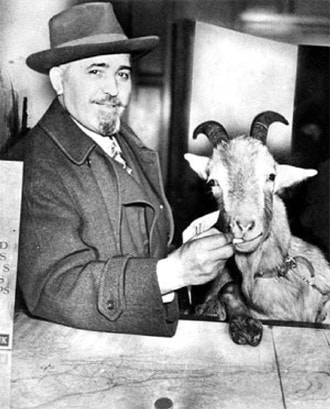
No, I don't know why the Great Bambino and the Big Train are holding roosters in that photo. But at they seemed to be friends. That was not the case between Ruth and Cobb, although they came around later. Cobb and Johnson were great admirers of one another.
I once saw a photo of Cobb, in street clothes, talking with Mathewson in the Giants' dugout in the 1911 World Series. Later, they served together in the same Army unit in World War I. Despite a professional rivalry, Cobb and Wagner were friends. I know nothing of the relationships, if any, between Ruth and Mathewson, Ruth and Wagner, or Wagner and Mathewson.
I do know that, when the 1st Hall of Fame induction ceremony was held in 1939, Mathewson was already dead, and Cobb was delayed and didn't make it to the ceremony on time, but Ruth, Johnson and Wagner had no issue with posing together.
Also on this day, Benjamin Eugene Taylor is born in Metropolis, Illinois. A 1st baseman, Ben Taylor had "cups of coffee" with the 1951 St. Louis Browns, the 1952 Detroit Tigers, and the 1955 Milwaukee Braves. He died in 1999.
He was not related to the Ben Taylor who played in the early Negro Leagues, and was later elected to the hall of Fame. But his nephew, Robert "Hawk" Taylor, also played for the Braves, and for the early Mets, and was an original 1969 Kansas City Royal. He died in 2012.
*
September 30, 1931: Angeline Brown (no middle name) is born in Kulm, North Dakota, and grows up in the Los Angeles suburb of Burbank, California. We know her as Angie Dickinson. Starting in 1956, she was one of the most glamorous actresses in the business, and, due to her work with Frank Sinatra and his pals in several films, she is often called the last surviving member of The Rat Pack.
In 1974, she began starring as Sergeant Leeann "Pepper" Anderson on Police Woman, making her the 1st woman to star in a cop show. She hasn't acted since 2009. For a time, she was married to songwriter Burt Bacharach.
It's been suggested that, if she ever wrote her memoirs, they would be the biggest-selling in history, because she is believed to have had affairs with both Sinatra and President John F. Kennedy. She has denied the fling with JFK.
September 30, 1932: John Joseph Podres is born in Witherbee, Essex County, New York. A 4-time All-Star, he shut the Yankees out in Game 7 of the 1955 World Series, giving the Brooklyn Dodgers their only World Championship before their move to Los Angeles. He was given the Babe Ruth Award as World Series Most Valuable Player, and Sports Illustrated named him Sportsman of the Year.
He led the NL in ERA in 1957, and also helped the Dodgers win the 1959, 1963 and 1965 World Series, and the 1966 National League Pennant. He was an original San Diego Padre in 1969, and closed his career that season, with a 148-116 regular-season record.
He married figure skater Joni Taylor, and was a longtime major league pitching coach, including with the 1993 National League Champion Philadelphia Phillies. He died in 2008, age 75.
September 30, 1933: Gertrude Dunn (the only name I have for her) is born outside Philadelphia in Sharon Hill, Pennsylvania. In 1952, she played for the South Bend Blue Sox, and was named Rookie of the Year in the All-American Girls Professional Baseball League.
The league was founded in 1943 to make up for the manpower shortage in World War II, and continued for a while. But, as with the Negro Leagues and the minor leagues, TV providing major league games for free ruined it, and it folded after the 1954 season.
But baseball might not have been her best sport, or even her 2nd-best. She played on the U.S. women's field hockey team, and also played lacrosse, and was elected to the national halls of fame in each sport. She died in 2004, a day before her 71st birthday -- not as a result of the ailments of advancing age, but in a plane crash outside Philadelphia.
September 30, 1934: The regular season ends, with the Yankees losing 5-3 to the Senators at Griffith Stadium in Washington, despite a home run from Lou Gehrig. Babe Ruth goes 0-for-3, and it turns out to be his last appearance for the Yankees.
The Yankees finish 2nd in the AL, 7 games behind the Detroit Tigers. This is in spite of having players winning both the batting and the pitching Triple Crown. Gehrig batted .363, with 49 home runs and 165 runs batted in. Lefty Gomez won 26 games (against just 5 losses, and no Yankee has matched those 26 wins since), had a 2.33 earned-run average, and struck out 158 batters. All of those figures led the League.
So why didn't the Yankees win the Pennant? Yes, the Tigers had a great team, but that didn't usually stop the Yankees between 1921 and 1964. Part of the problem was injuries. Center fielder Earle Combs hit his head on an unpadded outfield wall, played only 63 games, and was never the same. In addition, 3rd baseman Red Rolfe played only 89 games.
And while Gomez and Red Ruffing were, as usual, the best lefty-righty combo in AL pitching, there wasn't really a good 3rd starter, let alone a 4th. Between them, center fielder Myril Hoag, 3rd baseman Jack Saltzgaver, and starting pitchers Johnny Broaca, Johnny Allen and Johnny Murphy (usually the team's top reliever) were not, well, Johnny-on-the-spot.
Gehrig was the 1st Yankee to win the Triple Crown. Only one has done it since, as you'll see a little later.
Also on this day, Alan A'Court is born in Rainhill, Merseyside, England. A winger, he starred for hometown team Liverpool Football Club, but mostly during the 1950s, a down period for them. When they finally won the Football League in 1964, he had missed the entire season due to injury. He made just 1 appearance the next season, when they won the FA Cup, so he didn't get a winner's medal for that, either.
He played for England at the 1958 World Cup, and later managed Norwich City, Stoke City and Nantwich Town. He died in 2009.
September 30, 1935: John Royce Mathis is born outside Dallas in Gilmer, Texas, and grows up in San Francisco. Johnny Mathis is one of the last surviving big singers of the 1950s, and also one of the last surviving singers of notable Christmas recordings.
September 30, 1936: Game 1 of the World Series. George Selkirk hits a home run, but that's the only run Carl Hubbell, in the middle of his 24-game regular-season winning streak, allows, as the New York Giants beat the Yankees 6-1 at the Polo Grounds. Dick Bartell homers for the Jints.
Also on this day: Wayne Harrison Walker is born in Boise, Idaho. A linebacker, his Number 55 was retired by the University of Idaho, and he made 3 Pro Bowls for the Detroit Lions. He later moved to San Francisco, and broadcast for the San Francisco 49ers and the Oakland Athletics. He died on May 19, 2017.
He was named to the Lions' 75th Anniversary Team, the Idaho Athletic Hall of Fame, and the Michigan Sports Hall of Fame. As yet, however, he has not been elected to the Pro Football Hall of Fame.
Triborough Stadium was renamed J.J. Downing Stadium in 1955, and hosted Negro League games, the New York Cosmos in 1974 and '75, and the New York Stars of the 1974 World Football League. The 22,000-seat horseshoe was demolished in 2002, and the 5,000-seat Icahn Stadium, used mostly for track and field, opened on the site 2 years later.
September 30, 1939: For the 1st time, a football game is broadcast on television. W2XBS, the RCA-owned station that will become WNBC-Channel 4, sets their cameras up at Triborough Stadium on Randall's Island in New York, and shows Fordham University, of The Bronx, beat Waynesburg University of Southwestern Pennsylvania, 34-7.
Having previously used the Polo Grounds and the original Yankee Stadium, Fordham suspended their football program after the 1954. They revived it in 1970, and moved up to Division I-AA (now the Football Championship Subdivision, or FCS) in 1989. Since the revival, they have played their home games at their former baseball field, Jack Coffey Field, which was retrofitted into a 7,000-seat football stadium on their main campus in The Bronx.
Football and television is an epic love story, but it was far from love at first sight. It would really take another 19 years, and the 1958 NFL Championship Game -- Baltimore Colts 23, New York Giants 17, in overtime at Yankee Stadium -- for it to become more than a flirtation. If there is an event that can be called "the wedding," it's probably Super Bowl III, 10 years after that, on January 12, 1969.
But the couple is inseparable, partly because of the shared TV revenue which allows Green Bay, Wisconsin, with a metropolitan area of 300,000 people, to compete on the same level as New York City, with a metro area of nearly 24 million people. It's also why the Big Ten Conference wanted to add Rutgers and the University of Maryland: Between the markets of New York, Philadelphia, Baltimore and Washington, they added about 40 million.
The NFL's TV revenue is so big (How big is it?), it's been said that the NFL can shut the doors of all 16 stadiums hosting games in a given weekend, with a total official attendance of zero, and still make a profit.
*
September 30, 1940, 80 years ago: Henry Winston Jerome is born in Prince Albert, Saskatchewan. A sprinter, specializing in the 100-meter dash, he was one of many track legends at the University of Oregon. He won a Bronze Medal at the 1964 Olympics in Tokyo, and Gold Medals at the 1966 British Empire and Commonwealth Games in Kingston, Ontario and the 1967 Pan American Games in Winnipeg.
He became a teacher in Vancouver, and helped Prime Minister Pierre Trudeau start Canada's Ministry of Sport. He died of a brain aneurysm in 1982. He was named to the Order of Canada, Canada's Walk of Fame, Canada's Sports Hall of Fame, the Saskatchwan Sports Hall of Fame, and the B.C. Sports Hall of Fame. A statue of him stands in Stanley Park in Vancouver.
September 30, 1942: Game 1 of the World Series. Red Ruffing of the Yankees takes a no-hitter into the 8th inning against the St. Louis Cardinals, before Terry Moore breaks it up with 2 out. In the bottom of the 9th, the Cardinals score 4 runs, and then manage to load the bases, bringing Stan Musial -- then a rookie, a few years away from getting his nickname "Stan the Man," but already one of the game's top hitters -- to the plate as the winning run.
Yankee manager Joe McCarthy brings Spurgeon "Spud" Chandler in to relieve. He gets Musial to ground out. Final score: Yankees 7, Cardinals 4.
As historian Doris Kearns Goodwin, 3 months away from being born, would later say, "There's always these omens in baseball." Going into that bottom of the 9th, the Yankees led 7-0. Over the rest of the Series, including that bottom of the 9th, the Cardinals outscored the Yankees 21-11.
September 30, 1943: Marilyn McCoo (no middle name) is born in Jersey City, Hudson County, New Jersey, and grows up in Los Angeles. The lead singer of vocal group The 5th Dimension, she has long been married to fellow group member Billy Davis Jr., and they still perform together.
Also on this day, Austin Robbins (no middle name) is born outside Orlando in Leesburg, Florida. A forward, "Red" Robbins (nicknamed for his hair, not for his last name, sounding like "Red Robin") never played in the NBA, but reached the ABA Finals 3 times: Losing with the 1968 New Orleans Buccaneers, winning with the 1971 Utah Stars, and winning with the 1975 Kentucky Colonels. He died in 2009.
September 30, 1944: James Connolly Johnstone in born in Viewpark (now Uddingston), a suburb of Glasgow, Scotland. (James Connolly is a common name for Irishmen, for a martyr of the Easter Rising of 1916.) An outside right (a right winger in today's formations), Jimmy Johnstone, a.k.a. Jinky Johnstone, played for hometown soccer team Celtic from 1961 to 1975, winning 9 League titles and 4 Scottish Cups, and was voted the club's greatest player ever by its fans.
In 1967, he was the big star of their team that became the 1st British side to win the European Cup (the tournament now known as the UEFA Champions League), defeating Internazionale Milano at Lisbon, Portugal, earning the team the nickname the Lisbon Lions. Later that year, he played for the Scotland national team that beat World Cup holders England, leading Scottish fans to proclaim their team "World Champions." (Boxing works that way, but soccer does not.)
In 1975, he played for the original San Jose Earthquakes, in the original North American Soccer League. He died in 2006.
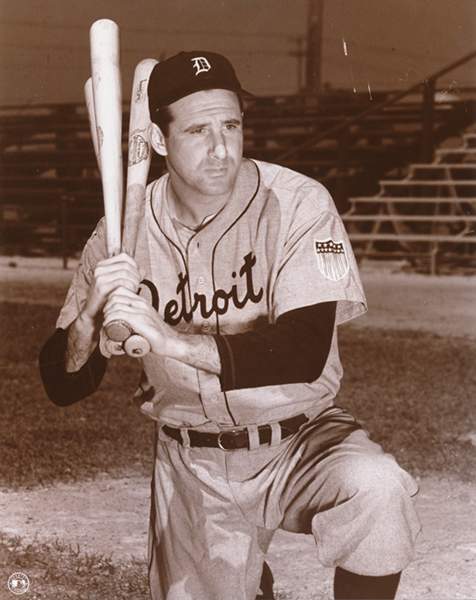
September 30, 1945, 75 years ago: Hank Greenberg, recently discharged from the U.S. Army, hits a grand slam off Nelson Potter in the top of the 9th inning, and gives the Detroit Tigers a 6-3 win over the St. Louis Browns at Sportsman's Park, clinching the American League Pennant, which the Browns had won the previous season, for the only time in their history.
Also on this day, John Sissons (no middle name) is born in Hayes, Middlesex -- now a part of West London. A forward, he was a member of the West Ham United team that won the 1964 FA Cup (becoming the youngest player to score in an FA Cup Final at the old Wembley Stadium) and the 1965 European Cup Winners' Cup. He briefly played in America, helping the Tampa Bay Rowdies win the 1975 North American Soccer League title. He is still alive.
Also on this day, Ehud Olmert is born in Binyamina, a suburb of Haifa, in present-day Israel. He served as Mayor of Jerusalem from 1993 to 2003, and Prime Minister of Israel from 2006 to 2009, when his government collapsed due to allegations of corruption. Ironically, his replacement was Benjamin Netanyahu, who had previously held the office and lost it due to corruption.
But Netanyahu did not go to prison. Maybe he should, for the way he has led Israel the 2nd time around has been even worse than the 1st, but he hasn't. Olmert did, and served 16 months. He is still alive.
September 30, 1946: Bernardus Adriaan Hulshoff is born in Deventer, Netherlands. We know him as Barry Hulshoff. Playing for Amsterdam soccer team AFC Ajax, the centreback won 7 national league (Eredivisie) titles, 4 national cups (KNVB Beker), and 3 straight European Cups (the tournament now known as the UEFA Champions League), in 1971, '72 and '73.
Despite his playing pedigree, he only played 14 times for the Netherlands national team, and never made their World Cup squad. He later managed Ajax and several teams in the Netherlands and Belgium, and died this past February 16.
September 30, 1947: Game 1 of the World Series. The Brooklyn Dodgers have won the Pennant, and, all together, Jackie Robinson and his 24 white teammates, stand on the 3rd-base line at Yankee Stadium, hearing the National Anthem.
Jackie would write in his memoir I Never Had It Made that this was the highlight of his career: It was not only that he had played in the white major leagues, but that he had been accepted by his teammates, and, together, they had succeeded. They were the National League Champions.
But they still had a World Series to play, in front of 73,365 people -- over twice the capacity of Ebbets Field. Dodger Captain Pee Wee Reese scores all the way from 2nd base on a wild pitch by rookie starter Frank "Spec" Shea in the 7th inning. But that's the only real highlight for the Dodgers, as the Yankees batter 21-year-old 21-game winner Ralph Branca for 5 runs in the 5th, and go on to win 5-3.
Also on this day, Mark Feld (no middle name) is born in Stoke Newington, East London. We knew him as Marc Bolan, lead singer of the "glam rock" band T. Rex. His songs "Get It On (Bang a Gong)" and "20th Century Boy" became classics in the early 1970s. I still don't know what "Well, you're built like a car, you got a hubcap-diamond-star halo" means, but it sounds like a cool thing to say to a girl.
He was killed in a car crash in Barnes, Southwest London in 1977. He had never learned to drive, and the Mini 1275GT was driven by his girlfriend, American soul singer Gloria Jones, the mother of his son Rolan Bolan. Earlier this year, long overdue, he was posthumously elected to the Rock and Roll Hall of Fame.
In the 2006 British TV series Life On Mars, Sam Tyler (Jon Simm), a present-day cop in Manchester, England somehow sent back to 1973, meets Bolan (William Matheson) at a music club. Forgetting that Bolan wasn't the driver, he warns Bolan, "Drive carefully, especially in Minis."
In the U.S. version that aired in the 2008-09 season, Sam (here, a New York cop played by Irish actor Jason O'Mara) meets Jim Croce (Don Puglisi), and, knowing that he'll be killed in a plane crash within weeks, warns him about small planes, while "Get It On" by T. Rex plays.
September 30, 1948: Rosendo Torres Hernández is born in Aguadilla, Puerto Rico, and grows up in The Bronx. We know him as Rusty Torres. An outfielder, he debuted with the Yankees in 1971, and closed his career with the Kansas City Royals in 1980, but was released and did not appear on their postseason roster. His lifetime batting average was just .212.
He played in the 3 most recent forfeited games in the American League. On September 30, 1971 -- his 23rd birthday -- he was with the Yankees during the last Washington Senators home game. More on that later. On June 4, 1974, he was with the Cleveland Indians on Ten-Cent Beer Night, and was on 2nd base, standing to be the winning run, against the Texas Rangers -- the team the Senators became. But the fans rushed the field, and the game was forfeited to the Rangers.
And on July 12, 1979, he was with the Chicago White Sox when Disco Demolition Night was held between games of a doubleheader at Comiskey Park. He had scored the only run in the Pale Hose's 4-1 loss to the Detroit Tigers in the opener. When fans rushed and tore up the field following the blowing-up of the records in center field, the umpires realized the field was unplayable, and forfeited the game to the Tigers.
He later founded a charity that brings at-risk teenagers into sports, but was arrested in 2012, on what once would have quaintly been called "morals charges." In 2014, he was convicted on 5 counts, and served 3 years in prison.
Also on this day, Edith Roosevelt dies at Sagamore Hill, the Roosevelt family home, overlooking Oyster Bay on New York's Long Island. She was 87. The wife of Theodore Roosevelt, 26th President of the United States, she was the 1st First Lady to have an official staff, and was one of the most popular First Ladies of all time, just as TR was one of the most popular Presidents. She outlived him by nearly 30 years. They had 5 children together, and also raised TR's daughter Alice from his tragic 1st marriage.
Although she put up with her husband's and children's "Strenuous Life" shenanigans, as far as I can tell, she was uninterested in athletic endeavors of any kind. While some subsequent First Ladies have accompanied their husbands to sporting events, she was not one of them.
September 30, 1949: Isaiah Blessitt (no middle name) is born in Detroit. An outfielder, Ike Blessitt played just 4 games in the major leagues, all for his hometown Tigers, as a September callup in 1972. Although the Tigers won the American League Eastern Division, he was not put on the Playoff roster. He is still alive.
*
September 30, 1950, 70 years ago: As they had 28 years to the day earlier, the Yankees clinch the Pennant at Fenway Park, beating the Red Sox 6-5. Yogi Berra hits a home run, and Tommy Byrne outpitches Mel Parnell.
Also on this day, two new college football stadiums open. Byrd Stadium opens on the campus of the University of Maryland in College Park, outside Washington, D.C. Maryland defeats the nearby U.S. Naval Academy 35-21.
It still stands, and the Terrapins still use it, but it is now named Capital One Field at Maryland Stadium. The playing surface's naming rights were sold, but the name of the stadium itself was changed upon objections to Harry "Curley" Byrd, who served the University as football coach, athletic director and eventually president, having been a segregationist.
It was also the home field for the USFL's Baltimore Stars in 1985. Having moved from Philadelphia, they wanted to fill the gap left by the Colts' move to Indianapolis, but, for legal reasons, they couldn't use Memorial Stadium that year, so they used Byrd Stadium, which is considerably closer to D.C. (The USFL's Washington Federals had moved to become the Orlando Renegades, so they weren't a block to it.) The Stars won the USFL title, and a deal was reached to allow them to play at Memorial Stadium from 1986 onward. But there would never be another USFL game.
I visited Byrd Stadium on September 26, 2009, and saw Rutgers beat Maryland 34-13. It rained all game long, and the steep grade of the stands and the rain made it treacherous. It may not be a bad stadium when it's dry, but if UMd wants to replace it, I won't mind a bit.
On this same day, Baylor Stadium opens in Waco, Texas, home to Baylor University. Baylor defeats the University of Houston 34-7. In 1988, it was renamed Floyd Casey Stadium, after Casey's son Carl donated the money needed to renovate it. Baylor moved into the new McLane Stadium in 2013, and the old stadium was demolished in 2017.
On the same day, Lynn St. John dies in Columbus at age 73. He was Ohio State University's basketball coach from 1911 to 1919, its baseball coach from 1913 to 1928, and its athletic director from 1912 to 1947. Ohio State's arena was named for him in 1956, and he was elected to the Basketball Hall of Fame in 1962.
September 30, 1951: After being 13 1/2 games behind the Brooklyn Dodgers on August 11, the New York Giants think they have the Pennant won, as they beat the Boston Braves 3-2 at Braves Field in Boston. The hero, with a home run, is 3rd baseman Bobby Thomson.
But the Dodgers, having blown that huge lead, aren't done yet. At Shibe Park in Philadelphia, Jackie Robinson makes a sensational catch at 2nd base in the bottom of the 12th inning, then hits a home run in the top of the 14th, and the Dodgers beat the Philadelphia Phillies 9-8. There will be a best-2-out-of-3 Playoff for the National League Pennant, starting the next day.
A coin is tossed to determine home-field advantage. The Dodgers win the toss -- and elect to host Game 1 at Ebbets Field, thus letting the Giants host Games 2 and 3 at the Polo Grounds. This will turn out to be one of the greatest blunders in the history of baseball.
In the meantime, the American League Champions, the Yankees, wait to see whom they will face in the World Series. Mickey Mantle, the Yankees' rookie right fielder their center fielder in waiting, asks his teammates who he should root for. He's told it should be the Giants, since Ebbets Field seats only 31,000 people, while the Polo Grounds seats 56,000, and the gate receipts, and thus the winners' share, will be much bigger if the Giants win.
Johnny Sain is the winning pitcher. The Yankees gave up Lew Burdette to get Sain from the Boston Braves. Burdette would help the Braves, by then in Milwaukee, drive the Yankees crazy in the 1957 and '58 Series. But Sain helped the Yankees big-time, so it was an even trade.
Also on this day, Catharine Northcutt Ball is born in Jacksonville. A former world record holder in 3 swimming events, Catie Ball won a Gold Medal as part of a U.S. relay team at the 1968 Olympics in Mexico City.
The University of Florida didn't have a women's swimming team. So she not only attended classes there, but was named its head coach. In their 1st season, 1972-73, they went undefeated in dual meets.
She became an interior decorator, and has been elected to the International Swimming and Florida Sports Halls of Fame. She is still alive.
September 30, 1953: Game 1 of the World Series. Gil Hodges, George "Shotgun" Shuba and Jim "Junior" Gilliam hit home runs for the Dodgers. It's not enough, as Yogi Berra and Joe Collins do the same for the Yankees, who win 9-5.
September 30, 1955, 65 years ago: Game 3 of the World Series. The Dodgers get back into the Series, thanks to the pitching of Johnny Podres and a home run by Roy Campanella. They beat the Yankees 8-3, and close to within 2 games to 1.
Also on this day, James Dean is killed in a car crash on California State Route 466 (since rebannered as Route 46) at the intersection of State Route 41, in San Luis Obispo County, California. (The nearest town was Cholam.) The star of a recent film version of John Steinbeck's novel East of Eden was one of the rising stars of Hollywood, and was just 24 years old.
He had just finished filming Edna Ferber's novel Giant, and Rebel Without a Cause was about to be released. That film, following East of Eden, it cemented his legend as an "angry young man." As humorist Clive James later put it, "James Dean was so moody, he made Marlon Brando look like Danny Kaye."
He was driving a Porsche 550 Spyder convertible, on which he had painted the words "Little Bastard," and was heading to the Salinas Road Races that were starting the next day. The "chickie run" in his film Rebel Without a Cause was art imitating life: He loved fast cars, and had competed in but sanctioned races himself in Palm Springs, Bakersfield and Santa Barbara, California.
Ironically, just a few days earlier while still in his Western costume on the set of Giant, he had filmed one of television's first public service ads. Interviewed by Gig Young, who would also die under mysterious circumstances, he said that when he drove, "I'm always extra cautious." The ad ended with Young asking Dean if he had any advice for young people. He said, "Take it easy, you know? The life you save might be mine!" (Instead of the more familiar "might be your own.")
At the time of his death, he had been signed to play Middleweight Champion Rocky Graziano in the film version of his memoir Somebody Up There Likes Me. That film made a star out of Paul Newman. Newman also loved to race cars (his last role was as the voice of Doc Hudson in the Cars animated films), and, unlike Dean, actually won some races. But he never crashed, and, although 6 years older than Dean, lived until 2008.
September 30, 1956: The Brooklyn Dodgers beat the Pittsburgh Pirates, 8-6 at Ebbets Field, and clinch the National League Pennant. Duke Snider and Sandy Amoros each hit 2 home runs. Jackie Robinson adds 1, Vern Law is knocked out of the box in the 1st inning, and Don Newcombe gets the win.
As it turns out, Jackie's home run is the last he will hit, and this is the last Pennant won by a National League team in New York City for 13 years.
Also on this day, Mickey Mantle finishes a season in which he batted .353, hit 52 home runs, and had 130 RBIs. He led both Leagues in all 3 categories, and that hasn't happened since. He was the 2nd Yankee, after Gehrig, to win the Triple Crown. None has done it since. Babe Ruth didn't do it. Nor did Joe DiMaggio, nor Reggie Jackson, nor Don Mattingly, nor Derek Jeter, nor Alex Rodriguez.
Also on this day, the Detroit Tigers beat the Cleveland Indians, 8-4 at Cleveland Municipal Stadium. Wayne Belardi hits a home run, and Billy Hoeft wins his 20th game of the season.
The losing pitcher is Bob Feller, who falls to 0-4 on the season, and 266-162 for his career, with 2,581 strikeouts, despite missing nearly 4 full seasons due to military service. Nearly 38, this is the last major league appearance for perhaps the best pitcher of his generation. It is interesting that it happens on the 29th Anniversary of Walter Johnson's last appearance.
September 30, 1957: Anthony Wayne Green is born in Cape May City, New Jersey, and grows up in nearby Woodbine, Cape May County. Bubba Green starred in football and track at North Carolina State University, and was drafted by the Baltimore Colts as a defensive tackle in 1981.
He played the 1st 15 games of his rookie season, starting 10, but injured his knee, and never played again. He remained in the Baltimore area, and lived there until his death in 2019, of cancer, at age 61.
Also on this day, Francine Joy Drescher is born in Flushing, Queens, New York City, and grows up a couple of neighborhoods away in Kew Gardens. In 1975, 2 future CBS sitcom stars graduated from Hillcrest High School in Jamaica, Queens: Fran Drescher of The Nanny and Ray Romano of Everybody Loves Raymond. In real life, her N'Yawk accent is slightly less abrasive than it was on The Nanny.
September 30, 1958: The Rifleman premieres on ABC. Chuck Connors, a former MLB and NBA player, plays Lieutenant Lucas McCain, a Civil War veteran who recently lost his wife, and takes his 12-year-old son Mark, played by former Mickey Mouse Club Mouseketeer Johnny Crawford, to a ranch outside the fictional North Fork, in what was then the New Mexico Territory. The show runs for 5 seasons.
McCain's signature weapon was a customized rapid-fire rifle, which Connors used to fire 13 shots in the show's famous opening. Although the show was set in the 1870s and 1880s, the actual rifle didn't go that far back: It was an 1892 Winchester that fired .44-caliber bullets.
In 1965, Connors began starring in another Western, Branded. This time, the Irish-American former Army officer he plays is Captain Jason McCord, disgraced for his actions in a Native massacre of a U.S. fort. Except, as Alan Alch, who both wrote and sang the theme song said, "He was innocent, not a charge was true." He took the fall to preserve a peace treaty and to protect the reputation of his senile commanding officer.
The opening sequence shows McCord getting his buttons and epaulets torn off, as he is literally drummed out of the corps. Then the fort's new commander takes his sword, breaks it over his knee, and tosses the handle part out of the fort. Connors said he wanted another "gimmick" weapon, like McCain's Winchester. The broken sword filled that need. The show lasted 2 years. Connors lived until 1992.
*
September 30, 1960, 60 years ago: The Philadelphia Eagles play the Dallas Cowboys for the 1st time. The Eagles win, 27-25, at the Cotton Bowl in Dallas. The Cowboys are headed for a winless season; the Eagles, for a Championship. No one yet knows that, though. Nor do they yet know that a rivalry has been born.
Also on this day, The Flintstones premieres on ABC. It runs for 6 years, and becomes the most popular cartoon in TV history, with a franchise that ended up greatly expanding. It is quickly obvious that the Hanna-Barbera Production is a ripoff of Jackie Gleason's The Honeymooners, set in the Stone Age.
Alan Reed is the voice of Fred Flintstone, the Ralph Kramden equivalent, right down to the love of bowling and the membership in a lodge. Jean Vander Pyl voices his wife Wilma, a redhead like Ralph's wife Alice. Eventually, they become the parents of a daughter, Pebbels, and Vander Pyl does her voice as well.
Mel Blanc, best known as the voice of Bugs Bunny, voices the Ed Norton analogue, Fred's best friend, Barney Rubble. Unlike on The Honeymooners, where Ralph is a bus driver and Ed a sewer worker, Fred and Barney work together at a construction company. Bea Bendaret voices Barney's wife and Wilma's best friend, Trixie -- I mean, Betty. They become parents of a son, Bamm-Bamm, voiced by Don Messick, later to become legend as the voice of Scooby-Doo.
September 30, 1962: David Joseph Magadan is born in Tampa, a cousin of Lou Piniella. In 1983, the 3rd baseman batted .525 for the University of Alabama, still a Southeastern Conference record, and earned one of college baseball's player of the year awards, the Golden Spikes Award.
He made his major league debut with the Mets in September 1986, too late to appear on their World Series roster. He was an original Florida Marlin in 1993, and bounced around a bit before ending his career with the 2001 San Diego Padres, with a .288 batting average. He has coached for the Padres, the Boston Red Sox (winning a World Series ring in 2007), the Texas Rangers, the Arizona Diamondbacks and the Colorado Rockies. For his achievements with the Crimson Tide, he was elected to the Alabama Sports Hall of Fame.
Also on this day, Franklin Edmundo Rijkaard is born in Amsterdam, the Netherlands. The son of immigrants from the Netherlands' South American colony of Surinam (now an independent country), the Jheri-curled midfielder helped hometown club Ajax win 5 Eredivisie (Dutch league) titles and the 1995 Champions League.
This was in 2 separate stints with the club. In between, he played in Italy for AC Milan, along with fellow Dutchman Marco Van Basten and fellow Dutch-Surinamese Ruud Gullit. Together, they combined Dutch totalvoetbaal, South American samba, and Italian catenaccio defense to form perhaps the best club side in soccer history, winning 2 Serie A (Italian league) titles, and the European Cup in 1989 and 1990 -- still the last team to win the tournament now named the Champions League back-to-back.
The 3 Milan players also helped the Netherlands win their only international tournament to date, Euro 1988. Rijkaard also managed Barcelona to the 2005 and 2006 La Liga (Spanish league) titles and the 2006 Champions League. He, his Milan teammate Carlo Ancelotti, and Zinedine Zidane are the only men to win the Champions League as both a player and a manager.
September 30, 1964: The Philadelphia Phillies complete what remains the most stunning regular-season collapse in Major League Baseball history, losing their 10th straight game, losing 8-5 to the St. Louis Cardinals at Busch Stadium (formerly Sportsman's Park) in St. Louis. Tim McCarver hits a home run for the Cards, while Alex Johnson hits one for the Phils.
Ironically, the winning pitcher for the Cards is Curt Simmons, whose drafting into the Korean War in 1950 cost him the chance to pitch for the Phils in their last World Series to this point, in 1950.
Going into the games of September 21, the Phillies led the National League by 6 1/2 games. Now, they are 2 1/2 behind the Cardinals, while the Cincinnati Reds are 1 game back. The Phils have 2 games left, the Cards 3, the Reds 4. The Phils could still win the Pennant if they win their last 2 games, although a 3-way tie for the Pennant is still possible.
Also on this day, Monica Anna Maria Bellucci is born in Città di Castello, Umbria, in Central Italy. One of the most beautiful actresses of her generation, in 2015 she played Lucia Sciarra in the James Bond film Spectre, making her, at 51, the oldest "Bond Girl" ever. She still has the face and the body for it.
September 30, 1966: The Yankees lose 6-5 to the Chicago White Sox in 11 innings at Comiskey Park. In the 9th inning, Roger Maris pinch-hits for Dooley Womack -- yes, the Dooley Womack -- and hits a home run. But a single by Johnny Romano drives in Wayne Causey, and makes a 20-game loser out of Mel Stottlemyre.
This drops the Yankees' record to 68-89, and assures that they will finish in 10th place in the single-division American League. This is the 1st time in 54 years that the Yankees have finished in last place. They have only done so once more, in 1990.
After the season, the final insult of the Webb-Topping regime -- they sold their last shares to CBS soon after -- was delivered, trading Roger even-up to the St. Louis Cardinals for Charlie Smith. And if you're asking, "Who?" I'm answering, "Exactly."
Also on this day, a rare trade is made in English "football." Usually, there are sales, a player for cash. This time, 2 London clubs trade players and cash. George Graham goes from Chelsea in West London to Arsenal in North London, while Tommy Baldwin goes from Arsenal to Chelsea, along with £50,000.
Graham had helped Chelsea win the 1965 League Cup, and would be a key figure in Arsenal's wins in the 1970 Inter-Cities Fairs Cup and the 1971 League title and FA Cup. He would later go into management, and the fun-loving player was gone, replaced by a man so strict, his own players called him "The Ayatollah." He freely admitted, "The player I was couldn't have played for the manager I am."
He managed Arsenal to the League Cup in 1987, the League title in 1989 and 1991, both the FA Cup and the League Cup in 1993 (the 1st time the "Cup Double" had ever been down), and the European Cup Winners' Cup in 1994. Arsenal had to let him go the next season due to financial improprieties. He would later manage Arsenal's North London arch-rivals, Tottenham, to the 1999 League Cup. He is still alive, at age 76.
September 30, 1967: The Boston Red Sox host the Minnesota Twins at Fenway Park on the next-to-last day of the season. They and the Detroit Tigers are all still eligible for the AL Pennant.
Oddly, NBC is not televising it as the Game of the Week. Fortunately, Boston's Channel 5, then WHDH, a CBS affiliate (it's now WCVB and part of ABC), is televising it, and keeps a copy. As far as we know, this is the earliest surviving entire TV broadcast of a Major League Baseball game in color.
Twins starter Jim Kaat is cruising until the 3rd inning, when he is injured, and has to leave the game. Jim Perry comes in, and holds the Sox off until the 5th. Reggie Smith leads off with a double, and Dalton Jones singles. Perry strikes out opposing pitcher Jose Santiago and Mike Andrews, but Jerry Adair and Carl Yastrzemski use back-to-back singles to turn a 1-0 Twins lead into 2-1 Red Sox.
The Twins tie the game in the 6th, but home runs by George Scott in the 6th and Yaz in the 7th make it 6-2 Sox. Harmon Killebrew homers for the Twins in the 9th, but Gary Bell (later to become famous as Jim Bouton's Seattle Pilots roommate in Ball Four) shuts them down, and the Sox win, 6-4.
The Sox and Twins are now tied. Whichever wins tomorrow will have at least a tie for the Pennant. The Tigers are rained out, and will play a doubleheader tomorrow. If they sweep, a Playoff will be necessary. If they only split, or lose both, the Sox-Twins winner takes the flag.
Also on this day, Philadelphia's new arena, The Spectrum, opens across from the north end zone at John F. Kennedy Stadium. To the north of The Spectrum, construction is underway on Veterans Stadium, to be the new home of MLB's Phillies and the NFL's Eagles.
The 1st event at The Spectrum is the Quaker Jazz Festival. Over the next few weeks, the NBA's 76ers and the NHL's Flyers will move in. Villanova University will also use it for games whose ticket demand exceed their on-campus arena. The building will be home to 4 championship teams: The back-to-back Stanley Cups of the Flyers in 1974 and 1975, the 76ers' 1983 NBA title, and Villanova's 1985 NCAA Championship.
It will be replaced as home of the Sixers, Flyers and 'Nova, and as the Delaware Valley's leading concert center, in 1996, by the building now known as the Wells Fargo Center, which will be built on the site of JFK Stadium. It will be demolished in 2010.
September 30, 1968: Bull Tales is first published in the Yale Daily News, a.k.a. the Daily Yalie, the official newspaper of Yale University in New Haven, Connecticut. The lead character of the comic strip is "B.D.," the quarterback of the Yale football team, based on real-life quarterback Brian Dowling. He had led the Bulldogs to the Ivy League title in 1967, and would lead them to a share of another in 1968, the season ending with the famous tie with Harvard.
The strip was drawn by Garry Trudeau. In 1970, it would be retooled and nationally syndicated, but Trudeau would rename it for B.D.'s roommate at fictional Walden College, Michael J. Doonesbury.
Doonesbury still runs today.
*
September 30, 1970, 50 years ago: Eric Todd Piatkowski is born in Steubenville, Ohio. The son of former ABA player Walt Piatkowski, Eric was a guard who had his Number 52 retired by the University of Nebraska. For his achievements there, he was named to the Nebraska Sports Hall of Fame.
He played 14 seasons in the NBA, from 1994 to 2008, for the Los Angeles Clippers, the Houston Rockets, the Chicago Bulls and the Phoenix Suns. For his skill at 3-point shooting, he became known as the Polish Rifle, a nickname previously used for former Philadelphia Eagles quarterback Ron Jaworski. He now broadcasts for Nebraska basketball.
September 30, 1971: The last Washington Senators game is played, against the Yankees at Robert F. Kennedy Stadium. Team owner Bob Short, having already moved the NBA's Minneapolis Lakers to Los Angeles in 1960, has announced he's moving the Senators to the Dallas area, to become the Texas Rangers. He complains about the low attendance, despite having the highest ticket prices in the American League, and no subway access to RFK Stadium. (Washington's Metro would not open until 1976.)
Frank Howard, the Senators' most popular player in their 2nd go-around of 1961-71, hits the last home run. Dick Bosman starts, and stands to be the winning pitcher as the Senators lead 7-5 with 1 out left in the 9th. All he has to do is get Bobby Murcer out.
But he can't, through no fault of his own. Angry fans from the "crowd" of 14,461 people storm the field. The umpires cannot restore order, and they forfeit the game to the Yankees.
The next April, Bosman also starts the team's 1st game as the Rangers. Major League Baseball will not return to the Nation's Capital, except for the occasional preseason exhibition game, until the 2005 season. Only 2 AL games have been forfeited since, both promotions that turned into fiascos: The Cleveland Indians' Ten-Cent Beer Night in 1974, and the Chicago White Sox' Disco Demolition Night in 1979. As I mentioned, Rusty Torres, who turned 23 on this day, was also in uniform on each of those occasions.
Also on this day, the San Francisco Giants beat the San Diego Padres 5-1, at what was then named San Diego Stadium. (Jack Murphy, Qualcomm, now SDCCU Stadium.) They clinch the National League Western Division title on the last day. This is their only postseason berth between 1962 and 1987.
Also on this day, the Mets beat the St. Louis Cardinals, 6-1 at Shea Stadium. Tom Seaver gets the win, his 20th of the season, and will go on to win his 2nd Cy Young Award. A young right fielder named Ken Singleton, who had grown up in New York as a Met fan, hits 2 home runs. But he will become better known for playing for the Baltimore Orioles, and broadcasting for the Yankees.
No one knows it at the time, but this is the last game the Mets will play with Gil Hodges as their manager. At the end of Spring Training in 1972, he suffers a heart attack and dies, not quite 48 years old.
Also on this day, Gregory Jay Myers is born in Tampa, and grows up in Windsor, Colorado. A safety, he was named to the Western Athletic Conference's All-Conference and All-Academic teams all 4 years he was at Colorado State, 1992 to 1995. In 1995, he won the Jim Thorpe Award as the country's top college defensive back.
He played 4 seasons with the Cincinnati Bengals, and another with the Dallas Cowboys. He is now an anesthesiologist in Denver. He has been elected to the College Football and Colorado Sports Halls of Fame.
September 30, 1972: The Mets lose to the Pittsburgh Pirates, 5-0 at Three Rivers Stadium. Roberto Clemente hits a double off Jon Matlack, for his 3,000th career hit. A quote, which may be apocryphal given what happened 3 months later, suggests Roberto's determination: "I have to get that hit this year. I might die."
Also on this day, Martin Stadium opens in Pullman, eastern Washington. Washington State University loses the 1st game at its new stadium, 44-25 to the University of Utah.
A new stadium was necessary because Wazzu's previous home field, Rogers Field, burned down on April 4, 1970. It was soon generally accepted that the cause was arson. The Cougars played the 1970 and '71 seasons at Joe Albi Stadium in nearby Spokane while Martin Stadium was built on the site of Rogers Field.
Clarence D. Martin Jr. donated the money necessary to build it, on the condition that it be named for his father, a former Governor of the State. Ironically, Clarence Sr. was a graduate of WSU's arch-rivals, the University of Washington. At 32,952 seats, Martin Stadium is the smallest football facility in the league now known as the Pacific-12 Conference.
September 30, 1973: The last game is played at Yankee Stadium before its renovation. The Yankees lose 8-5 to the Detroit Tigers. Duke Sims hits the last home run, but Lindy McDaniel implodes in the 8th inning, allowing 6 runs, making a winning pitcher of John Hiller. The last play is Mike Hegan hitting a fly ball to, appropriately, center field, once patrolled by Joe DiMaggio and Mickey Mantle, this ball caught by Mickey Stanley. Attendance: 32,238, in a Stadium whose capacity was then listed as 65,010.
Lasting until 1980, Fred Stanley was the last remaining Yankee who had played a home game at the pre-renovation Stadium, although Bobby Murcer had been traded away and reacquired, and played his last game on June 11, 1983, nearly 10 years later.
After the game, manager Ralph Houk resigns, tired of the meddling of the team's 1st-year owner, George Steinbrenner. The next day, the renovation begins. Claire Ruth, the Babe's widow, receives home plate. Eleanor Gehrig, Lou's widow, receives the 1st base that was used in the last game. The Yankees will play the 1974 and '75 seasons at Shea Stadium, and Yankee Stadium will reopen on April 15, 1976, and will remain open until September 21, 2008.
The 1923-73 version of The Stadium saw 27 Pennants and 20 World Championships in 51 seasons -- the 1st 2 Yankee Pennants coming at the Polo Grounds. The 1976-2008 version saw 10 Pennants and 6 World Championships in 33 seasons.
Also on this day, the Buffalo Bills play their 1st game at their new stadium, south of the city, in suburban Orchard Park, New York. Originally known as Rich Stadium, for the Rich family of meat-product producers, O.J. Simpson and his teammates beat the Jets, 9-7.
The stadium will be renamed Ralph Wilson Stadium for the team's founding owner in 1998, and, in 2015, was renamed New Era Field, as naming rights were bought by the New Era sports cap company. But New Era asked to be let out of the agreement earlier this year, and so the stadium currently has the temorary name of Bills Stadium. The Bills' new owners are looking to build a new stadium.
September 30, 1975: Carlos Alfonso Guillén is born in Maracay, Venzuela. A shortstop, he reached the postseason with the 2000 and 2001 Seattle Mariners, and with the 2006 and 2011 Detroit Tigers. He was a 3-time All-Star, and finished his career with a .285 lifetime batting average.
Also on this day, Happy Days airs the episode "Fearless Fonzarelli." In 1956, the Fonz (Henry Winkler) tries a what would, by 1975, be considered "an Evel Knievel stunt" on his motorcycle. He does it, but pays the price.
September 30, 1977: Del Pratt dies in Texas City, Texas at age 89. A 2nd baseman, he debuted with the St. Louis Browns in 1912, and led the American League in RBIs in 1916. In 1918, the Yankees traded pitcher Urban Shocker to get him.
While Pratt was a decent player, this trade was a big mistake. In his 1979 book This Date In New York Yankees History, Nathan Salant called it the worst trade in Yankee history to that point, saying that not having Shocker, whom they later reacquired, cost the Yankees the 1920 and 1924 Pennants, and almost cost them the one in 1922, when the Browns nearly beat the Yankees out.
Essentially, to replace Shocker, the Yankees traded Pratt to the Red Sox in 1921, for Waite Hoyt, who became a Hall-of-Famer. Pratt played until 1924, batting .292 lifetime. He also served as head baseball and assistant football coach at the University of Michigan.
Also on this day, Michael Stuart Solwold is born in the Milwaukee suburb of Menomonee Falls, Wisconsin. A center, Mike Solwold was with the Tampa Bay Buccaneers when they won Super Bowl XXXVII.
September 30, 1978: Ed Figueroa becomes the 1st pitcher born in Puerto Rico to win 20 games in a season, pitching a 5-hit shutout. The Yankees knock Cleveland starter Mike Paxton out of the box before he can get an out, and Rick Wise pitches the rest of the way, with Reggie Jackson homering off him in the 5th inning. (Mr. October was pretty good in September, too.) Given the boost, Figgy cruises to a 7-0 victory at Yankee Stadium.
The next day is the last day of the regular season. All the Yankees need to do is beat the Indians again, or have the Boston Red Sox lose to the Toronto Blue Jays at Fenway Park, and the Yankees will win their 3rd straight American League Eastern Division title.
They didn't get the win, and they didn't get the Boston loss. It would go to a Playoff at Fenway. Well, we know how that story ends, don't we?
Figueroa was just short of his 30th birthday. In a major league career that lasted from 1974 to 1981, and also included playing for the California Angels, the Texas Rangers and the Oakland Athletics, he went 80-67. He had almost pulled off the feat in his 1st season with the Yankees, 1976, going 19-10 but he did help the Yankees win the Pennant. In 1977, he went 16-11, helping the Yankees win the World Series. He finished the 1978 season 20-9, going 13-2 down the stretch, and a World Champion again.
Injuries struck him, and he was traded. As he did with the '77 Yanks, he helped Billy Martin reach the Playoffs with the '81 A's, but injury prevented him from pitching in the AL Championship Series -- against the Yankees, who won.
Today, almost 72, he owns a pair of restaurants, one in Old San Juan, and one near San Juan's Luis Muñoz Marín International Airport. He remains the only Puerto Rican-born pitcher to win 20 games in a season. That's got less to do with Puerto Ricans than with the major leagues' switch from the 4-man rotation common in his time to the 5-man rotation in the early 1990s.
September 30, 1979: The Mets beat the St. Louis Cardinals, 4-2 at Busch Memorial Stadium. This is the last game for Lou Brock, who goes 0-for-4 to end his career with 3,023 hits and, then a major league record and still a National League record, 938 stolen bases. The Cardinals retire his Number 20.
It is also the last game for Ed Kranepool, the last original Met from 1962. He pinch-hits for pitcher John Pacella in the top of the 7th, and doubles off Bob Forsch. It is the 1,418th hit of his career, which will remain a Met record until surpassed by David Wright. He remains the Mets' all-time leader in games played with 1,853, and in at-bats with 5,436. He hit .261 lifetime, with an OPS+ of 98, and 118 home runs.
The commercial he did for Gillette Foamy was correct: From 1962 to 1970, he batted .227. From 1971 to 1977, he batted .283. Whether he actually shaved every other inning after that, only he knows. He did make the All-Star Team in 1965, and won the World Series with the Mets in 1969 and the Pennant in 1973.
Also on this day, the Pittsburgh Pirates defeat the Chicago Cubs, 5-3 at Three Rivers Stadium, and clinch the NL East title. Willie Stargell, the "Pops" of this "Family," hits a home run to back the pitching of Bruce Kison.
That night, NBC airs a baseball-themed TV movie, The Kid from Left Field, a remake of a 1953 film. Gary Coleman, of the same network's Diff'rent Strokes, plays the son of a former major leaguer now down on his luck, making ends meet as a food vendor for the San Diego Padres, played by Robert Guillaume, of the ABC sitcom Benson. The film also stars Gary Collins, Ed McMahon, Tricia O'Neal, and Tab Hunter, who had been the star of the film version of the musical Damn Yankees.
The 1953 original starred Billy Chapin and Dan Dailey in the Coleman and Guillaume roles, respectively.
Also on this day, Justin Smith (no middle name) is born in Jefferson City, Missouri. A defensive end, he made 5 Pro Bowls with the San Francisco 49ers, and was named NFL Defensive Player of the Year in 2011. He helped the 49ers win the 2012 NFC Championship, although they lost Super Bowl XLVII. He is about to become eligible for the Pro Football Hall of Fame.
*
September 30, 1980, 40 years ago: Martina Hingisová is born in Košice, Czechoslovakia (now in Slovakia). We know her as Martina Hingis. In 1997, she won the Australian Open, Wimbledon and the U.S. Open, but missed the Grand Slam because she lost the Final of the French Open. She won the Australian again in 1998 and 1999. But she never completed the "Career Grand Slam," losing another French Open final in 1999. She did, however, win the Grand Slam in doubles in 1998. She had done all that while still a teenager.
She never reached another singles Final. Injuries doomed her, and she retired in 2003, made a comeback in 2005, was suspended for cocaine use in 2007, and, upon her return, stuck to doubles matches, where she won a few tournaments. She retired again in 2017. She has been elected to the International Tennis Hall of Fame. She is now living in Switzerland, married, with a daughter, a year and a half old.
September 30, 1981: The Kansas City Royals beat the Minnesota Twins 5-2. It is the last game at Metropolitan Stadium in Bloomington, Minnesota. Pete Mackanin hits a home run for the Twins, but Clint Hurdle of the Royals hits the last home run. The next season, the Twins will move to the Hubert H. Humphrey Metrodome in downtown Minneapolis.
Also on this day, Dominique Helena Moceanu is born in Los Angeles. She was a member of the U.S. women's gymnastics team that won the all-around Gold Medal at the 1996 Olympics in Atlanta.
September 30, 1982: Bill George, Hall of Fame linebacker for the Chicago Bears in the 1950s and '60s, is killed in a car crash in Rockford, Illinois. He was only 52.
Also on this day, NBC airs the pilot episode of Cheers, "Give Me a Ring Sometime." It introduces Sam Malone, a former relief pitcher for the Boston Red Sox and a recovering alcoholic, who owns a bar in Boston's Back Bay section -- and his motley crew of employees and customers.
A photograph of a Sox pitcher hangs on a post at the bar, purported to be Sam. It's actually an earlier Sox pitcher, Jim Lonborg, the American League Cy Young Award winner when the Sox won their "Impossible Dream" Pennant in 1967. This establishes Sam's uniform number as being the same as Gentleman Jim's, 16. In reality, on the Pennant-winning Sox of 1975, 16 was worn by outfielder Rick Miller.
September 30, 1985: Fasheed Rashad Najm is born in Tallahassee, Florida. The rapper abbreviated his hometown, and took the nom de rap T-Pain. He recently played Stevie Wonder on Epic Rap Battles of History, against Indian-Canadian YouTube personality Lilly Singh as Wonder Woman. Wonder vs. Wonder.
In February 2019, he won the 1st season of Fox's U.S. version of the Korean-born franchise The Masked Singer, as "The Monster," in an effort to prove that he can sing without autotune.
September 30, 1986: Olivier Giroud (no middle name) is born in Chambéry, Rhône-Alpes, France, and grows up in nearby Froges, near the 1968 Winter Olympic city of Grenoble. The forward starred for local club Grenoble 38 Foot and Tours FC, before leading the national league, Ligue 1, in scoring in 2011-12, and leading his club, Montpellier, to an improbable title.
That convinced Arsène Wenger, manager of North London team Arsenal, to sign him. There were many Arsenal fans, for whom 2nd place is "failure" and 4th place (out of 20 in the English Premier League) is "midtable mediocrity," with constant complaints about him: That he didn't score enough, that he wasn't "world-class" or "clinical," that he didn't have enough "pace," and was "useless unless the ball is put right on his foot" -- ignoring all the goals scored with what NBC Sports announcer Arlo White calls "the meaty French forehead of Olivier Giroud!"
When he scored, the Arsenal fans sang, to the Beatles' "Hey Jude," "Na, na na, na na na na... Na na na na... Giroud!" They also sang, to "The Roof Is On Fire" by Rock Master Scott & the Dynamic Three, "Giroud! Giroud! Giroud is on fire!"
Nevertheless, the man known as Oli G, who makes women swoon and men "confused," scored 105 goals in 253 appearances for The Arsenal over 5 1/2 seasons, before being sold to West London team Chelsea, whom he helped beat Arsenal in the 2019 UEFA Europa League Final. He also helped get the French national team to the Final of Euro 2016, and to win the 2018 World Cup. He was unable, however, to help Chelsea beat Arsenal in the 2020 FA Cup Final.
Chelsea? I refuse to believe such a beautiful player can play for such an ugly organization. I prefer to believe that he is unavailable to Arsenal due to injury. This is a lie, of course, but, given Arsenal's recent history, it's a very believable lie. (UPDATE: He helped Chelsea win the UEFA Champions League in 2021. He was then sold to Italian team AC Milan. I can respect him again.)
Also on this day, Quinn Marcus Johnson is born in New Orleans, and grows up in nearby Edgard, Louisiana. A running back, he was with the Green Bay Packers when they won Super Bowl XLV.
This turns out to be Willie Randolph's last game as a Yankee player, and he goes 0-for-4. He will remain in the major leagues until 1992, and will coach for the Yankees, Baltimore and Milwaukee, and manage the Mets to a Division title in 2006.
September 30, 1987: Kenley Geronimo Jansen is born in Willemstad, Curaçao, part of the Dutch Caribbean. A pitcher, he has made 3 All-Star Games and the 2017 and '18 World Series for the Los Angeles Dodgers. He goes into the 2020 postseason with 312 career saves.
September 30, 1988: The Yankees are eliminated from the American League Eastern Division race, losing to the Detroit Tigers, 6-2 at Tiger Stadium. They finish only 3 1/2 games behind the Red Sox, but in 5th place behind the Sox, the Tigers, the Brewers and the Toronto Blue Jays.
September 30, 1989: The Toronto Blue Jays beat the Baltimore Orioles, 4-3 at the new SkyDome in Toronto, and clinch the AL East title. The O's, who had lost 107 games the season before, had a remarkable rebound season under their former star player, now manager, Frank Robinson.
They had to sweep the Jays 3 straight in Toronto on the final weekend to win the Division, just as the Yankees had to do in 1985 at the Jays' previous home, Exhibition Stadium. The pattern held, as the O's won the Friday night game. Unfortunately, the pattern held for the rest of the series as well, as the Jays won the Saturday afternoon game before losing the Sunday afternoon game.
This was the last NBC Game of the Week. Aside from a few postseason games from 1995 to 1999, and the 1996 and 1998 All-Star Games, NBC has never televised baseball again.
Also on this day, Neil Young is the musical guest on Saturday Night Live. The Toronto native wears 2 Toronto Maple Leafs patches on his jeans, and sings his 1972 anti-drug song "The Needle and the Damage Done" and his current hit, "Rockin' in the Free World."
*
September 30, 1990, 30 years ago: The Chicago White Sox play the last game at Comiskey Park, closing the 81st and final season of what is, for the moment, Major League Baseball's longest-lasting stadium. Having opened in 1910, it is the last remaining ballpark in which Cy Young pitched. Ironically, the final opponent is the newest team in the American League, the Seattle Mariners.
Longtime coach Minnie Miñoso presents the final lineup card. Mayor Richard M. Daley, son of the longtime Mayor Richard J. Daley, and a lifelong resident of the Bridgeport neighborhood in which Comiskey was built, throws out the ceremonial first ball. (When the new ballpark opens, the first ball will be thrown out by the outgoing Governor, Jim Thompson, who got the bill providing for its construction through the Illinois legislature, thus saving the team from being moved to Tampa Bay.)
The ChiSox trail 1-0 in the bottom of the 6th, but Lance Johnson leads off with a triple, is singled home by rookie sensation Frank Thomas, and Thomas is tripled home by Dan Pasqua, once a highly-touted Yankee prospect who didn't pan out.
That's it for the scoring, as Jack McDowell goes 8 innings, and Bobby Thigpen finishes it off with his 57th save of the season, a new major league record. The last play is Harold Reynolds grounding to 2nd, with Scott Fletcher throwing to 1st, to Steve "Psycho" Lyons, in as a defensive replacement for Thomas. The Pale Hose defeat the M's 2-1.
To a full house of 42,849, organist Nancy Faust plays one last rendition of "Na Na Hey Hey Kiss Him Goodbye" -- to the season (in which the White Sox made a gallant but short run at the AL Western Division title), to the ballpark, and to the fans, who will, with the team, move across the street into the new Comiskey Park the next year. It is now Guaranteed Rate Field.
September 30, 1991: Star Trek: The Next Generation airs the episode "Darmok." The crew of the USS Enterprise-D encounters a species on whom their universal translator is virtually useless, since their language is based on storytelling and myth.
Their Captain, Dathon (played by Paul Winfield, who previously played a Federation starship Captain in Star Trek II: The Wrath of Khan), has himself and Captain Jean-Luc Picard (Patrick Stewart) beamed down to a planet, in the hopes of using the situation there, similar to their ancient story "Darmok and Jelad at Tenagra," to make a communications breakthrough.
Picard cannot save Dathon from being killed by the analog to "The Beast of Tenagra," but Dathon lives long enough to keep talking, to the point where Picard figures it out, in time to save his ship from attack and to make an official diplomatic "first contact."
Also on this day, at the other end of television quality, The Jerry Springer Show begins airing in syndication. It was taped in Chicago until 2009, and in Stamford, Connecticut from then until its final episode, which aired on July 26, 2018.
September 30, 1992: Ezra Matthew Miller is born in Wyckoff, Bergen County, New Jersey. He plays Barry Allen, the Flash, in the DC Comics film universe. He should not be confused with the star of The CW's TV show The Flash, Grant Gustin, who is... wait for it... Better Than Ezra. Nevertheless, the 2 of them were put together for 2 minutes during the CW crossover event Crisis On Infinite Earths in January 2020.
A Flash film has been announced for mid-2022. Miller will star in an adaptation of the 2011 DC Comics Flashpoint story, in which Barry went back in time to save his mother from being murdered, with disastrous consequences for the world.
September 30, 1994: The film The Scout premieres. Albert Brooks plays a scout that the Yankees banish to the Mexican League after one of his signings goes bust. He finds a hotshot pitcher played by Brendan Fraser, who comes with his own problems.
This film is totally fiction, and it's a comedy. Judged on that basis, it's okay. The old Yankee Stadium looks great. And George Steinbrenner does all right playing himself. But if you're looking for Yankee glory, well, look elsewhere.
20th Century Fox scheduled it for release just as the 1994 MLB Playoffs were supposed to begin, but then came the strike. Despite the success of Ken Burns' nostalgia-tugging Baseball documentary
miniseries on PBS, nobody was interested in spending $4.00 to watch a baseball movie. It would have been better if they had held the film back until the following Summer.
September 30, 1995, 25 years ago: The FleetCenter opens in Boston, right behind the Boston Garden. The new home of the NBA's Celtics and the NHL's Bruins is now named the TD Garden.
Also on this day, Saturday Night Live premieres its 21st season. It is the debut of castmembers Darrell Hammond, Will Ferrell, Cheri Oteri, Jim Breuer, David Koechner and Nancy Wells.
September 30, 1996: His contract with Japanese soccer team Nagoya Grampus Eight having run out, Arsène Wenger is free to manage another team, and he officially takes charge as manager of Arsenal Football Club of North London.
Wenger wasn't much of a player, winning Ligue 1 as a defensive midfielder at his hometown club, Racing Club Strasbourg Alsace (usually just listed as "Strasbourg"), in 1979. But as manager of AS Monaco, which is in the French league even though Monaco is a separate (but tiny) country, he won Ligue 1 in 1988 and the national cup, the Coupe de France, in 1991. He led Nagoya to Japan's national cup, the Emperor's Cup, in 1995.
Just short of his 47th birthday, and already successful as a manager, he seemed like a good choice for The Arsenal, who had won 6 trophies from 1987 to 1994, but had struggled in the Premier League, finishing 10th in 1993, 4th in 1994, 12th in 1995, and 5th in 1996.
But, at the time, it was rare for a manager not from the British Isles to manage in England. One newspaper printed the headline, "ARSENE WHO?" No less a personage than Arsenal's captain, centreback Tony Adams, asked, "What does this Frenchman know about English football?"
Wenger knew enough to know that Adams had recently made a public admission of being a recovering alcoholic. He straightened out the team's diet (including no booze the night before a game) and exercise program.
He also brought in several European players, including fellow Frenchmen Patrick Vieira, Emmanuel Petit and Nicolas Anelka, and Dutchman Marc Overmars. Together with already-present Dutch star Dennis Bergkamp, and the club's English core of Adams, David Seaman, Lee Dixon, Steve Bould, Nigel Winterburn, Martin Keown, David Platt, Ray Parlour and the legendary striker Ian Wright, in 1996-97, he finished his 1st season in charge in 3rd place. In 1998, he won the Premier League and the FA Cup, a.k.a. "doing The Double."
He finished runner-up in both in 1999, and Anelka, only 19 years old, thought his performances demanded a big raise, or a sale to a bigger club. Wenger sold him to Real Madrid, and used half the profits to build a new training ground, and the other half to buy young French winger Thierry Henry, whom he converted into a striker, who broke Wright's club record for career goals.
Wenger would also sign a great pair of wingers in Sweden's Freddie Ljungberg (in 1998) and France's Robert Pires (in 2000), develop great young defenders in Ashley Cole and Kolo Toure, and make the stunning acquisition (in 2001) of English centreback Sol Campbell, who had been captain of Arsenal's North London arch-rivals, Tottenham Hotspur.
Wenger finished 2nd and lost the UEFA Cup Final in 2000, finished 2nd and lost the FA Cup Final in 2001, won The Double again in 2002, finished 2nd and won another FA Cup in 2003, and, in the 2003-04 season, did something that had not been done since the League had only a 22-game season: He went unbeaten. As the broadcaster Jon Champion (appropriately named for the occasion) said after it was achieved: "Played 38, won 26, drawn 12, lost exactly none!" He would win another FA Cup in 2005, and reach the Final of the UEFA Champions League in 2006.
But the Arsenal Stadium, nicknamed Highbury after its neighborhood, only seated 38,000, and its east and west stands had been built in the 1930s. A modern stadium was needed if Arsenal was to compete, but paying for it meant that transactions needed to be made, perhaps sacrificing trophies for expediency.
The new Emirates Stadium opened in 2006, and here's what happened: Arsenal lost the League Cup Final in 2007, finished 2nd in the League in 2008, reached the Semifinals of the Champion League and the FA Cup in 2009, lost the League Cup Final in 2011, just barely scraped into Champions League qualification in 2012 and 2013, were struck by several injuries in just about every season, and had to sell several players because of financial concerns: Vieira in 2005, Pires in 2006, Henry in 2007, Manuel Almunia and Gilberto Silva in 2008, Toure and Emmanuel Adebayor in 2009, Cesc Fabregas and Samir Nasri in 2011, and Robin van Persie in 2012.
But Wenger built another great team: Signing Theo Walcott and Tomas Rosicky in 2006, Bacary Sagna in 2007, Aaron Ramsey in 2008, Laurent Koscielny in 2010, Per Mertesacker and Héctor Bellerín in 2011, Olivier Giroud and Santi Cazorla in 2012, Mesut Özil and Nacho Monreal in 2013, Alexis
Sánchez in 2014, Petr Čech in 2015, Mohamed Elneny in this year's January transfer window, and Granit Xhaka and Shkodran Mustafi in 2016. The result has been continuous Champions League knockout round qualification, and the FA Cup in 2014, 2015 and 2017.
Wenger is known for his clichés, which seem a little grammatically odd when they move from his French mind to his English words: A player who is good, "He has the quality"; if he's smart, "He has the mental strength"; if he's unsure of himself, "He lacks the confidence"; and dropping the qualifier "a little bit" into phrases, i.e., "He lacked a little bit the confidence." He doesn't like it when opposing players foul his, but when one of his players is charged, he tells the media, "I did not see it."
Whereas some managers want to win in the worst way, Wenger wanted to win in the best way. He is a remarkable man, an idealist in a cynical age. I hope he will not turn out to be the last such idealist.
He left Arsenal at the end of the 2017-18 season, after 22 years in charge, 3 League titles, 7 FA Cups, the new stadium, and with a world-class setup in place. His critics are glad he is gone, but the next manager, Unai Emery, squandered what Wenger left him. One of Wenger's former Captains, Mikel Arteta, has picked up the pieces.
September 30, 1997: Game 1 of the American League Division Series at Yankee Stadium. What is expected to be a pitchers' duel between wily veterans David Cone of the Yankees and Orel Hershiser of the Cleveland Indians does not develop.
The Indians torch David Coney for 5 runs in the 1st inning. In the bottom of the 6th, it is 6-3 Cleveland. But Tim Raines, Derek Jeter and Paul O'Neill hit 3 straight home runs, to win the game 8-6, with Ramiro Mendoza getting the win in relief.
September 30, 1998: Dan Quisenberry dies of brain cancer in the Kansas City suburb of Leawood, Kansas. He was only 45. The "submarine style" relief pitcher gave the Kansas City Royals the bullpen stopper they were missing in their 1976, '77 and '78 Playoff losses to the Yankees, enabling them to win the 1980 American League Pennant (finally beating the Yankees in the AL Championship Series) and the 1985 World Series. He finished his career with a record of 56-46, and 244 saves.
September 30, 1999: The San Francisco Giants, who nearly moved because Candlestick Park was so bad, to Toronto for 1976 and to Tampa Bay for 1993, finally play their last game at the big wind tunnel. They lose to their arch-rivals, the Los Angeles Dodgers, 9-4. Marvin Bernard homers for the Giants, but Raul Mondesi of the Dodgers hits the last home run, making a winner of Jeff Williams over Shawn Estes.
The Giants will move into what is now named Oracle Park. The difference? Besides the location, the transport access, the sight lines, and the atmosphere (both literal and figurative) all being far better? In 40 seasons at The 'Stick, the Giants made 5 postseasons, winning 2 Pennants, and no World Series. In their 1st 21 seasons at The Phone Booth, they've made 7 postseasons, winning 3 Pennants, and taking the World Series all 3 times.
*
September 30, 2004: The Yankees beat the Minnesota Twins 6-4, and clinch the AL East title. No one had any idea at the time, but this would be the last clincher at the Yankee Stadium: The Division titles of 2005 and 2006, the ALDS win of 2004, and the Wild Card clincher of 2007 would all be on the road.
van Persie could have been an all-time legend at Arsenal if he had stayed, or at his hometown club, Feyenoord in Rotterdam, the Netherlands, had he stayed there.
Instead, he got greedy, and demanded to be sold. He was sold to Manchester United, where he won the League title in 2013, then saw manager Alex Ferguson retire, leaving the club in a bit of a mess. He moved on to Fenerbahçe of Istanbul, one of Turkey's greatest teams, but won nothing there. He has returend to Feyenoord, and helped them win last season's KNVB Beker (the Dutch version of the FA Cup).
He could have been a legend at Feyenoord. He could have been a legend at Arsenal. Instead, he has become a footnote in the history of every team for whom he's played. That is what he got along with that 1 League title. Was it worth it?
Also on this date, Julio Franco breaks his own record as the oldest player ever to hit a home run in a major league game. He's 48 years old as he takes Beltran Perez deep in the 2nd inning. David Wright, Shawn Green, Ramon Castro and Endy Chavez also homer for the Mets, who beat the Washington Nationals, 13-0 at Robert F. Kennedy Stadium in Washington.
The Mets are the Champions of the National League Eastern Division -- the only time they will finish 1st between 1988 and 2015. They are the favorites for the NL Pennant as the regular season comes to an end.
September 30, 2007: One of the darkest days in Mets history. This is the game that got Tom Glavine branded "The Manchurian Brave" by Met fans.
Having led the NL East by 7 games with 17 to go, the Mets have collapsed, but they go into the regular-season finale, against the Florida Marlins at Shea Stadium, needing a win or a Philadelphia Phillies loss to clinch their 2nd straight NL East title, and a win or a Colorado Rockies loss to at least win the 1 Wild Card available at the time.
Glavine starts. He walks Hanley Ramirez. He gets Dan Uggla to ground into a force play at 2nd base. So far, not terrible. But the roof caves in. He gives up a single to Jeremy Hermida. He gives up a single to Miguel Cabrera, scoring Ramirez. He gives up a double to Cody Ross, and when the ball comes back to him in the infield, he tries to throw Ross out at 3rd, and makes a bad throw, and Ross becomes the 3rd run of the at-bat.
He allows a single to Mike Jacobs. He walks Matt Treanor. He gives up a single to future Met Alejandro de Aza, loading the bases. He faces the opposing starting pitcher, Dontrelle Willis, and hits him, forcing Jacobs in. Manager Willie Randolph has seen enough, and removes him with the score 5-0. He'd faced all 9 batters in the Marlin starting lineup, and had gotten exactly 1 of them out.
Jorge Sosa is the new pitcher, and he strikes Ramirez out. But he allows a double to Uggla, who drives in Treanor and de Aza, both of whose runs are charged to Glavine. When he finally gets Hermida to ground to 1st, it is Marlins 7, Mets 0.
By the time the game mercifully ends, the Mets have used 8 pitchers, and lost 8-1. The Phillies beat the Nationals, 6-1 at Citizens Bank Park, and win a Playoff berth and the Division for the 1st time in 14 years. And the Rockies complete their own amazing surge, beating the Arizona Diamondbacks, 4-3 at Coors Field. It's not enough to win them the NL West, but it's enough to get them a tie with the San Diego Padres for the Wild Card berth, instead of it going to the Mets.
"I'm not devastated," Glavine says after the game. "I'm disappointed, but devastation is for much greater things in life." Feeling pretty devastated themselves, Met fans never forgive him for this, and he never pitches for them again. He is released, and returns to Atlanta for a final season.
One of the pitchers the Mets used was former Yankee star Orlando Hernández, who pitches the 3rd inning, allowing 2 long fly outs, a triple to Willis, and then a foul pop to end the threat. It turns out to be the last MLB appearance of El Duque's career.
Also on this day, the Houston Astros beat the Atlanta Braves 3-0 at Minute Maid Park. It is the last game for future Hall-of-Famer Craig Biggio, who goes 1-for-4.
All the way across the country from Shea, Met legend Mike Piazza plays his last game on this day. He leads off the bottom of the 9th for the Oakland Athletics, who are tied with the Los Angeles Angels of Anaheim at the Oakland Coliseum. He singles, and is replaced by pinch-runner Shannon Stewart. Marco Scutaro bunts Stewart over to 2nd. Jack Hannahan singles to load the bases with nobody out. Kurt Suzuki singles to give the A's a 3-2 win. So Piazza is far luckier on this day than his old team is.
September 30, 2009: The Mets lose to the Washington Nationals, 7-4 at Nationals Park. It is the last major league game for Gary Sheffield, playing for the Mets, the team for whom his uncle, Dwight Gooden, once starred. He pinch-hits for pitcher Tim Redding in the top of the 7th, and draws a walk.
Sheff retires with 509 home runs. He is eligible for the Hall of Fame, but the steroid cloud hanging over him has kept him out thus far.
Also on this day, the Cincinnati Reds beat the St. Louis Cardinals 6-1 at Great American Ball Park. It is the last major league game for Atlanta Braves legend John Smoltz, who starts and loses the game for the Cards.
It looked like the A's have it won in the top of the 12th, as Josh Reddick leads off with a walk, gets bunted to 2nd by Jed Lowrie, advances to 3rd on a wild pitch by Jason Frasor, and then scores on a single by Alberto Callaspo.
But in the bottom of the 12th, Eric Hosmer triples with 1 out, and Christian Colon singles him home with the tying run. Colon steals 2nd, and Salvador Perez singles him home with the run that puts the Royals in the Playoffs proper, 9-8.
*
September 30, 2012: Barbara Ann Scott dies in Amelia Island, Florida. She was 84. Known as "Canada's Sweetheart," the Ottawa native won the women's figure skating Gold Medal at the 1948 Winter Olympics in St. Moritz, Switzerland. She later became a champion equestrienne.
September 30, 2014: The current and former Kansas City teams face off in the American League Wild Card game at Kauffman Stadium. The Oakland Athletics score 5 runs in the top of the 6th inning to take a 5-2 lead over the Kansas City Royals, but the Royals score 3 in the bottom of the 8th to stun the A's and send the game to extra innings.
September 30, 2015: The Toronto Blue Jays clinch their 1st AL East title, and their 1st Playoff berth, since 1993. They beat the Baltimore Orioles 15-2 at Camden Yards. And the St. Louis Cardinals defeat the Pittsburgh Pirates 11-1 at PNC Park in Pittsburgh, to clinch the NL Central title.
September 30, 2016: The Golden 1 Center opens in downtown Sacramento, built to save the NBA's Sacramento Kings from moving. They almost moved to Anaheim in 2012 and Seattle in 2013, before the deal to build this new arena, to replace the Sleep Train (formerly ARCO) Arena, was done in 2014.
September 30, 2017: The Yankees beat the Toronto Blue Jays, 2-1 at Yankee Stadium II. Aaron Judge hits his 52nd home run of the season, a record for rookies that will last 2 years, in support of CC Sabathia. Jacoby Ellsbury starts in center field for the Yankees, and goes 0-for-3. Through the end of the 2019 season, this remains his last major league game.
Also on this day, Andrew Romine, an infielder for the Detroit Tigers, plays all 9 positions, including the 4th pitching appearance of his career. The Tigers beat the Minnesota Twins, 3-2 at Target Field.
He is the 5th player to do so in an MLB game, following Bert Campaneris of the 1965 Kansas City Athletics, Cesar Tovar of the 1968 Twins (against Campaneris and the now-Oakland A's), Scott Sheldon of the 2000 Texas Rangers, and Shane Halter of the 2000 Tigers.
The son of former Red Sox outfielder Kevin Romine, and the brother of Yankee catcher Austin Romine, he now plays for the Seattle Mariners. He made 3 pitching appearances in 2018, and now has a career record of 0-0, a 12.75 ERA, a WHIP of 2.647, 1 strikeout and 5 walks in 5 2/3rds innings pitched.
Also on this day, Saturday Night Live premieres its 43rd season. It is the 15th for cast member Kenan Thompson, a new record, surpassing the 14 of Darrell Hammond, who replaced the late Don Pardo as the show's announcer. This means that Thompson has been on the show for exactly 1/3rd of its existence (14 out of 42 seasons). He has now made it 16 out of 44.