
Hal Newhouser
October 10, 1945, 80 years ago: Game 7 of the World Series is played at Wrigley Field in Chicago. It would be the last game in what would later be called Major League Baseball to be affected by the manpower drain of World War II, as V-J Day had come 2 months earlier, but many players were still in the service.
How drained was the game at this point? Frank Graham, the sports columnist for the New York Journal-American, called it "the fat men versus the tall men at the office picnic." Warren Brown, writing for the Chicago Herald-American, wrote, "I don't think either one of them can win it." A year later, he published a book titled Win, Lose or Draw, in which he called this contest the "World's Worst Series."
Wartime travel restrictions, which led to the cancellation of the All-Star Game for the 1st time (it wouldn't happen again until the COVID shutdown of 2020), meant that the location of the Series would shift only once, regardless of length, instead of a potential twice: The 1st 3 games would be played at the home of the American League Champions, and any games after that would be played at the home of the National League Champions.
The AL Pennant-winners turned out to be the Detroit Tigers, for the 4th time in a 12-season span. Hank Greenberg, the slugging 1st baseman who had been the 1st major league player to enlist in the armed forces, was one of the earliest to be discharged, and had hit a grand slam on the last day of the season to clinch the Pennant.
In 1944, Tiger ace Hal Newhouser went 29-9 with a 2.22 ERA. In 1945, he went 25-9 with a 1.89 ERA. There was no Cy Young Award at the time, but, both times, he was named the AL's Most Valuable Player. Fans arguing that he was merely taking advantage of war-strapped teams were silenced in 1946, when, against fully-restocked teams, he went 26-9 with a 1.94 ERA, and finished 2nd in the MVP vote behind Ted Williams of the Pennant-winning Boston Red Sox. It capped a 3-year stretch in which he went 80-27.
The NL Champions were the Chicago Cubs. Their 1st baseman, Phil Cavarretta, batted .355 to win the batting title, and was named the NL's MVP. Hank Wyse went 22-10, but a bigger story was Hank Borowy: The native of Bloomfield, Essex County, New Jersey had been a big reason why the New York Yankees won the 1943 World Series. But on July 27, the Cubs paid $97,000 to get him from the Yankees. Having gone 10-5 for the Yankees, he went 11-2 for the Cubs the rest of the way, finishing 21-7.

Hank Borowy
The Series began on October 3, at Briggs Stadium (later renamed Tiger Stadium) in Detroit. Borowy pitched a 6-hit shutout, outpitching Newhouser. Cavarretta hit a home run, and the Cubs won, 9-0. A Greenberg homer gave the Tigers a 4-1 win in Game 2. Claude Passeau pitched a 1-hit shutout in Game 3, the only hit a single by Rudy York in the 2nd inning, and the Cubs won, 3-0, taking a 2-1 into the Detroit phase of the Series.
*
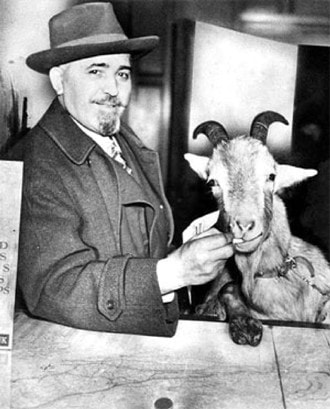
Billy Sianis and his 1945 mascot
Game 4 of the World Series is held at Wrigley Field on October 6. The Chicago Cubs are preparing to host the Detroit Tigers, with the Cubs leading 2 games to 1.
William "Billy Goat" Sianis was the owner of the Billy Goat Tavern, across from Chicago Stadium, home of the NHL's Blackhawks and the Midwest’s premier boxing venue. He had a goat as his bar's mascot, and he bought 2 tickets to this game, one for himself and one for the goat. At the time, there was no rule against bringing an animal into the ballpark. But fans around him complained to the ushers that the goat smelled bad, and Sianis and his goat were kicked out of the ballpark.

Wrigley Field during the 1945 World Series.
Note that the now-famous marquee includes the words
"NATIONAL LEAGUE CHAMPIONS."
It would be a long time before it could say that again.
Game 4, at Wrigley Field, was the source of "The Curse of the Billy Goat." William "Billy Goat" Sianis, owner of the Billy Goat Tavern, across from Chicago Stadium, bought 2 tickets to this game: One for himself, and one for his bar's mascot, a goat. At the time, there was no rule against bringing an animal into the ballpark. But fans around him complained to the ushers that the goat smelled bad, and Sianis and his goat were kicked out of the ballpark.
A Greek immigrant and a superstitious man, Sianis put a curse on the Cubs. The Tigers won the game, 4-1, with all their runs coming in the 4th inning, after Sianis and the goat were kicked out.
Newhouser outpitched Borowy in Game 5, and the Tigers won, 8-5, taking a 3-2 lead. In Game 6, the Tigers scored 4 runs in the top of the 8th, and the game went to extra innings. Stan Hack doubled Bill Schuster home in the bottom of the 12th, giving the Cubs an 8-7 win, and forcing a Game 7 on their home field.
Cubs manager Charlie Grimm used Borowy, on no rest, for the last 4 innings of Game 6, making him the winning pitcher. Game 7 was pushed back a day due to rain, and Grimm decided that, despite having pitched 18 innings in the preceding 7 days, Borowy was his best choice to pitch Game 7. Tiger manager Steve O'Neill went with Newhouser, who had pitched 12 innings to that point, but would be on 2 days' rest. Maybe, as the teams took the field on October 10, Warren Brown was right: Neither team could win.
The game was decided before Newhouser faced a single batter. Borowy had gotten the Cubs to within 1 win of a title, but he had nothing left to give: He began the game by giving up singles to Skeeter Webb, Eddie Mayo and Doc Cramer.
Already down 1-0, Grimm took the exhausted Borowy out, and brought in Paul Derringer, who'd helped the Cincinnati Reds win the 1940 World Series. He got an out, then Grimm ordered an intentional walk to load the bases and set up a play at any base, and Derringer got a 2nd out. But a bases-loaded walk made it 2-0, and Paul Richards hit a bases-clearing double to make it 5-0.
Cavarretta singled a run home in the bottom of the 1st, but that was as close as the Cubs would get. Newhouser went the distance, striking out 10 batters, and the Tigers won, 9-0. Within minutes of the last out, Billy Sianis sent a telegram to Cubs owner Philip K. Wrigley, asking, "Who stinks now?"
Billy Sianis, and the 1945 edition of his mascot
This also remained, for 71 years, the last World Series game the Chicago Cubs had ever played. Left fielder Ed Mierkowicz was the last survivor from the '45 Tigers, while shortstop Lennie Merullo was the last survivor from the '45 Cubs. From Merullo's death on May 30, 2015 until October 25, 2016, there were no living people who had played in a World Series game for the Chicago Cubs.
Newhouser's 170 wins during the 1940s made him the winningest pitcher of the decade. Later, as a scout, he discovered Jim Palmer, whose 186 wins during the 1970s made him the winningest pitcher of that decade.


No comments:
Post a Comment