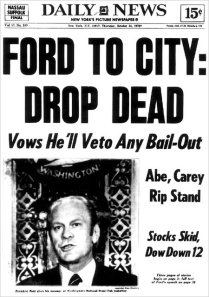
October 30, 1975, 40 years ago: The New York Daily News, responding to President Gerald Ford's statement that he wouldn't allow the federal government to bail out New York City's desperate finances, prints the most famous newspaper headline ever: "FORD TO CITY: DROP DEAD."
Ford didn't actually say that, but that was the message he sent, intentionally or otherwise.
Both sides compromised, as the City did a few more things to try to get its financial house in order, and this satisfied Ford to the point where he changed his mind and signed a bailout bill.
But Ford was damned when he did, and damned when he didn't. The bailout he actually did sign infuriated many conservatives, who already had a few problems with the mildly conservative Ford, and they voted for former Governor Ronald Reagan of California in the Republican primaries, and Reagan very nearly won the GOP nomination, and when Ford won the nomination anyway, many of those conservatives stayed home on Election Day, November 2, 1976.
This may have made the difference in throwing some States, including New York, to the Democratic nominee, former Governor Jimmy Carter of Georgia. White conservatives in Queens, Brooklyn, Staten Island, Long Island and Westchester abandoned him. Not that they voted for Carter (Southern or not, conservative by Democratic standards or not, they still viewed all Democrats as "socialists"), but they didn't vote at all.
It also upset undecided voters and disaffected Democrats. A lot of people remembered only the headline, and forgot that Ford changed his mind about the bailout, and held it against him, and a lot of people in the City who might not have been comfortable with Carter either voted for Carter or stayed home, enough to throw the State of New York to Carter. It may have made, literally, all the difference in the world. Had Ford simply won the State, he would have won a full term.
True, the Nixon pardon, lingering feelings over Watergate, the shaky economy, his debate gaffe about Eastern Europe, and conservatives issues with him over things like foreign policy and federal spending also hurt him.
But the day after the '76 election, Mayor Abe Beame posed in front of City Hall with the headline, as if to say, "City to Ford: Don't tell someone to drop dead unless you can make him drop dead. We just made your campaign drop dead."
Beame outside Gracie Mansion on November 3,
a year and 4 days after the headline,
and the day after the election.
A year later, with the City's finances still not fully straightened out, and crime seemingly out of control, the City’s voters told Beame to "drop dead," and elected Congressman Ed Koch as its Mayor.
What does this have to do with baseball? Well, the City's finances made a lot of people angry that it was spending so much money on renovating the old Yankee Stadium.
But as far as current baseball goes, a lot of people outside the New York Tri-State Area are thinking that the Mets, down 2 games to 0 with their top 2 starters already used once, are finished.
If I were a Met fan, I would think of this headline, and be defiant: If The City could come back in 1975, the Mets can come back in 2015. So...
MET FANS TO
DOUBTERS:
DROP DEAD
Of course, I'm not a Met fan. I'm a Yankee Fan. I want the Mets to lose.
I don't want the Mets to drop dead. Or even for their fans to drop dead. But I do want them to feel embarrassed enough to want to.
*
October 30, 1871: The final championship match of the season takes place on the Union Grounds in Brooklyn, between the Philadelphia Athletics and the Chicago White Stockings. Note that the former went out of business a few years later, and has no connection besides name to the team now known as the Oakland Athletics; while the latter would evolve into the Chicago Cubs, having no connection to the Chicago White Sox besides the name.
The Championship Committee decrees that today's game will decide the winner of the pennant. Chicago‚ having played all of its games on the road since the Great Chicago Fire on October 8‚ appears in an assorted array of uniforms. Theirs were all lost during the fire.
The 4-1 victory by the Athletics gives them the championship for 1871. It will be 41 years before another Philadelphia team wins a major league Pennant. The last survivor of this team was Alfred J. Reach, later (like his Chicago competitor, Albert G. Spalding) a sporting-goods magnate. He lived until 1928.
Also on this day, John Frank Freeman is born in Catasauqua, in Pennsylvania's Lehigh Valley. The right fielder, better known as Buck Freeman, was the 1st man to lead both Leagues in home runs: The National in 1899 with 25 for the Washington Nationals (who were about to be contracted out of the NL and are not to be confused with the current team with the name), and the American in 1903 with 13 for the Boston Americans, forerunners of the Red Sox. That season, he and the Americans won the 1st World Series.
Should he be in the Baseball Hall of Fame? He was in the Dead Ball Era, so his career home run total, while impressive for the time, was just 82. He batted .293 lifetime, with a 132 OPS+. He was a very good player in his time, but he wasn't great for long enough. So, no Cooperstown for him. But he is in the Red Sox' team Hall of Fame. He died in 1949, age 77.
October 30, 1875, 140 years ago: The Boston Red Stockings beat the visiting Blue Stockings of Hartford‚ 7-4‚ to finish the season without a home defeat. Boston finishes the year at 48-7, to win their 4th straight National Association Pennant.
Only 7 NA teams finish the season, with a total of 185 games played between them. The success of the Red Stockings has led to several forfeits, and this domination and erratic scheduling is one of the reasons the NA is abandoned and the National League established for 1876. The Red Stockings will join, eventually becoming the Beaneaters, the Rustlers, the Doves and finally the Braves, before moving to Milwaukee and later Atlanta.
The last survivor of the 1875 Red Stockings, and the last survivor of the 1869 Cincinnati Red Stockings, the 1st openly professional team, was shortstop George Wright, who lived on until 1937.
October 30, 1896: Ruth Gordon Jones is born in Quincy, Massachusetts, outside Boston. (Founding Father John Adams was also born in Quincy on an October 30, in 1735.) Dropping her last name, she starred on Broadway and in silent films before becoming a major star in the "talkies" of the 1930s. She also collaborated on screenplays with her husband, Garson Kanin.
But she’s best known for her role in the 1968 film Rosemary’s Baby. At age 72, she got an Academy Award for Best Supporting Actress, and said, "I can't tell you how encouraging a thing like this is." She was still acting up to the end of her life in 1985.
What does she have to do with sports? Well, in 1993, on an episode of Mad About You, Paul Reiser’s character, a documentary filmmaker named Paul Buchman, told his wife Jamie, played by Helen Hunt, that he was making a movie about Yankee Stadium, using the common nickname "The House That Ruth Built." Jamie: "Ruth who?" Paul, sarcastically: "Gordon, honey. Ruth Gordon built Yankee Stadium."
October 30, 1898: William Harold Terry is born in Atlanta, but lives most of his life in Memphis, giving him the nickname "Memphis Bill." The New York Giants 1st baseman helped them win Pennants in 1923 and ’24, and after succeeding John McGraw as manager, he led them to win the 1933 World Series and the ’36 and ’37 Pennants. In 1930, he batted .401, making him the last National Leaguer to date to bat .400 or higher for a season.
He is a member of the Hall of Fame, and the Giants retired his Number 3 (in 1984, albeit well after they had moved to San Francisco, but at least he lived long enough to see it, dying in 1989).
In his 1949 poem Lineup for Yesterday, poet and Giant fan Ogden Nash wrote:
T is for Terry
the Giant from Memphis
whose .400 average
you can't overemphis.
*
October 30, 1916: Leon Day (no middle name) is born in Alexandria, Virginia, across the Potomac River from Washington, D.C. He pitched for the Newark Eagles and the Baltimore Elite Giants in the Negro Leagues, and was also an excellent hitter. He landed on Utah Beach on D-Day.
Although just 30 years old when Jackie Robinson debuted, he only played two seasons, 1952 and 1953, in the formerly all-white minor leagues, and was never approached by a major league team to sign. He retired in 1955.
In 1995, he was elected to the Baseball Hall of Fame, based on his Negro League service. Just 6 days later, he died, making him the only person ever to be a living Hall-of-Famer-elect, but not a living Hall-of-Famer.
October 30, 1917: Robert Randall Bragan is born in Birmingham, Alabama. Bobby Bragan was a backup catcher for the Brooklyn Dodgers, but when team president Branch Rickey announced he would promote Jackie Robinson to the majors, Bragan was one of the Southern players who signed a petition opposing it, and even asked Rickey to trade him rather than make him play on a desegregated team. Rickey refused, and Bragan soon realized that he was wrong.
In 1948, Rickey wanted to promote Roy Campanella to the Dodgers, putting Bragan out of a job. To make up for this, he offered Bragan, then just 30, the post of manager of a Dodger farm team, the Fort Worth Cats of the Texas League. In 1955, Rickey, now president of the Pittsburgh Pirates, gave Bragan his 1st big-league managing job, which also made him Roberto Clemente’s 1st big-league manager. When Rickey died in 1965, Bragan attended his funeral. He said, “I had to go, because Branch Rickey made me a better man.”
In 1958, he was fired as manager of the Cleveland Indians, and legend has it that he walked out to the field at Cleveland Municipal Stadium and declared that the Indians would never win another Pennant. He denied this story many times, but the Indians didn’t win a Pennant from 1954 to 1995 -- by which point they had moved out of Municipal Stadium and into Jacobs Field.
He was named the manager of the Braves in 1963, meaning he managed 4 Hall-of-Famers: Hank Aaron, Warren Spahn, Eddie Mathews and a young Joe Torre. He was still their manager when they moved from Milwaukee to Atlanta in 1966, but was fired in that 1st season in Atlanta. Despite being only 49, he was finished as a big-league manager.
But it was in the minors that Bragan truly made his mark, gaining a reputation for winning, and for fairness to nonwhite players that he could not have imagined prior to 1947. He led the Fort Worth Cats to Texas League Pennants in 1948 and 1949, and the Hollywood Stars to the Pacific Coast League Pennant in 1953. As manager of the PCL’s Spokane Indians, he taught Maury Wills (a black player) to switch-hit, enabling him to become a big-leaguer and to revolutionize baserunning even more than Robinson had. He was named President of the Texas League in 1969 and of the National Association, the governing body for minor league baseball, in 1975.
On August 16, 2005, Bragan came out of retirement to manage the current version of the Fort Worth Cats, of the independent Central League, for 1 game. (The original Cats, along with their arch-rivals, the Dallas Eagles, had been replaced in 1965 by the Dallas-Fort Worth Spurs, whose new Turnpike Stadium was expanded into Arlington Stadium for the arrival of the Texas Rangers in 1972.) At age 87 years, 9 months, and 16 days, Bragan broke by one week the record of Connie Mack to become the oldest manager in professional baseball annals. Always known as an innovator with a sense of humor, and an umpire-baiter, Bragan was ejected in the 3rd inning of his "comeback", thus also becoming the oldest person in any capacity to be ejected from a professional sporting event. Bragan enjoyed the rest of the Cats' 11-10 victory from a more comfortable vantage point.
He is a member of the Sports Halls of Fames of both Alabama and Texas. He died in 2010, age 92.
October 30, 1927: Joseph Wilbur Adcock is born in Coushatta, Louisiana. The 1st baseman was an All-Star slugger for the Milwaukee Braves, hitting 4 home runs in a 1954 game, and was a member of their 1957 World Champions and 1958 Pennant winners. He also briefly managed the California Angels. He died in 1999.
*
October 30, 1935, 80 years ago: James Evan Perry Jr. is born in Williamston, North Carolina. Jim Perry was an All-Star pitcher for the Minnesota Twins, helping them win the 1965 Pennant. He won 215 games in the major leagues, and took the 1970 AL Cy Young Award.
Older but lesser-known than his Hall of Fame brother Gaylord Perry, they still combined for more wins and more strikeouts than any brother combination before them, and have since been surpassed in each category only by Phil and Joe Niekro. But the Perrys are still the only brothers ever to both win Cy Young Awards.
Also on this day, Robert Allan Caro is born in Manhattan. He won the Pulitzer Prize for Biography for The Power Broker: Robert Moses and the Fall of New York, in which he details both the benefits and the harm the legendary bureaucrat, builder and destroyer brought the City from the 1920s to the ‘60s, including standing in the way of Walter O’Malley getting a new stadium for the Brooklyn Dodgers. This led to O’Malley moving the team to Los Angeles, and building the Flushing Meadow facility that became Shea Stadium.
Incredibly, the book was published in 1974, while Moses was still alive. I can only guess the old bastard was no longer vigorous enough to mount any kind of attempt to stop it. Caro has also written a multi-volume biography of President Lyndon Johnson.
October 30, 1936: Richard Albert Vermeil is born in Calistoga, California, in the Napa Valley. It's hard to imagine Dick Vermeil as a quarterback, but he played the position at San Jose State University. He coached in high school and junior college, and in 1975 he led UCLA to the championship of the league then known as the Pacific-8. On New Year's Day 1976, he led them to beat then-Number 1-ranked Ohio State.
That got the attention of Leonard Tose, the trucking magnate who owned the Philadelphia Eagles. It took 3 seasons, but Vermeil got the Eagles into the Playoffs in 1978, in part because of a stunning last-minute comeback against the New York Giants known as "The Miracle of the Meadowlands." In 1979, he got them to the NFC East title. In both seasons, he was named NFL Coach of the Year. In the 1980 season, he got them to beat the Dallas Cowboys at Veterans Stadium to win the NFC Championship, which remains the Eagles' most celebrated victory since their 1960 NFL Championship.
But the Eagles lost the subsequent Super Bowl XV, and Vermeil became more obsessed than ever, spending pretty much all day at the Eagles' training facility, including sleeping there, sometimes falling asleep while watching film. After the 1982 season, he resigned, saying he was "burned out." Frequently seen crying tears of joy in the locker room after wins, his tearful farewell is as well-remembered in Philadelphia as that of Mike Schmidt when he retired from playing baseball.
Dick went into broadcasting, gaining a lot of respect as a color commentator on CBS' college football broadcasts, teaming with Brent Musburger. When Musburger's contract ran out in 1986, and he moved to ABC, he convinced them to take Vermeil with him.
In 1997, he felt ready to return to coaching, and was hired by the St. Louis Rams. As with the Eagles, it took 3 seasons, but he got them to the Playoffs. This time, he got them all the way to the Super Bowl in Year 3, and, with well-wishes from just about all of his old Eagles players, the Rams beat the Tennessee Titans in Super Bowl XXXIV. He was named NFL Coach of the Year again.
And then he resigned. It looked like he was satisfied, having finally gotten his ring. But he was quickly snapped up by the team across Missouri, the Kansas City Chiefs. Again, it took 3 years, but he turned a losing team into a Playoff team, winning the AFC West in 2003. He resigned after a difficult 2005 season, and hasn't coached since.
He has a farm outside Philadelphia, and a winery in his native Napa Valley. He has been elected to both the Eagles' and the Rams' team halls of fame, but not yet to the Pro Football Hall of Fame. In 2006, he was played by Greg Kinnear in the film Invincible, about Eagles walk-on Vince Papale. In a league where enemies are easily made, pretty much everybody likes Dick Vermeil.
*
October 30, 1941: Robert Primrose Wilson is born in Chesterfield, Derbyshire. Bob first kept goal for North London club Arsenal in 1963, became the starter in 1968, and remained so until retiring in 1974. In between, he helped Arsenal win the 1970 Inter-Cities Fairs Cup, and "the Double" of the Football League Division One and the FA Cup in 1971.
Although born in England, his parents were from Scotland, and he has always identified as Scottish. Yet he was only selected to play for Scotland twice. Despite all their talent from England and from Scotland, Arsenal players saw precious few international "caps" in that era.
Bob later became Arsenal's goalkeeping coach, with Pat Rice as defensive coach, under manager George Graham, the 3 members of the 1971 Double team taking them to the 1989 and 1991 League titles. Arsene Wenger kept Bob and Pat on, and they remained with the team through the 1998 and 2002 Doubles. Bob then retired, although Pat remained as assistant coach through 2012.
He and his wife Megs have been married for 51 years. They had 3 children, including daughter Anna, who died from cancer, leading Bob to found the Willow Foundation (the name taken from a nickname of his). In 2011, at age 70, he made a charity bicycle ride to all 20 of England's Premier League (successor to the old Division One) stadiums, and on to Hampden Park, Scotland's national stadium in Glasgow. He has since survived cancer himself, and, by all accounts (including his own Twitter account, @BobWilsonBWSC), is doing well.
October 30, 1945, 70 years ago: Henry Franklin Winkler is born in Manhattan. Ayyyyyyyy! He's had many fine roles since Happy Days went off the air, but he will always be that show's Arthur Fonzarelli. And that is so cool. Cooler than any typecasting could ever be. You don't think that's cool? As the Fonz would say, "Sit on it!"
When Robin Williams debuted his Mork from Ork character on an episode of Happy Days, he told Richie Cunningham (Ron Howard) that he wanted to take an Earth person back to Ork. He meant Richie, and the Fonz had to fight him for Richie. Before Richie realized what Mork meant, he asked Mork if he meant Milwaukee Braves star Hank Aaron. Mork said, "No, we'd have to trade the whole planet for him!"
October 30, 1956: Brooklyn Dodgers owner Walter O'Malley sells Ebbets Field to a real estate group. He agrees to stay until 1959‚ with an option to stay until 1961. Then again, as one of the most unscrupulous lawyers in New York, what the hell is a legally binding agreement to Lord Waltermort?
October 30, 1958: Joe Alton Delaney is born in Henderson, Texas, and grows up outside Shreveport, Louisiana. He was a sensational running back for the Kansas City Chiefs in 1981 and '82, but his career was cut short when he attempted to save two drowning boys in a lake near his Louisiana home, and ended up drowning as well. He was just 24.
The Chiefs have removed his Number 37 from circulation, although they have not officially retired it. They have also elected him to their team Hall of Fame, and placed him on their Ring of Honor at Arrowhead Stadium.
*
October 30, 1960: Diego Armando Maradona Franco is born Lanus, Buenos Aires state, Argentina. He led his homeland to the 1986 World Cup, thanks to a 2-goal game against England. The 2nd goal has been regarded as one of the greatest goals ever scored. But the 1st goal was scored when he punched it into the net, an obvious handball -- or, as he called it, “The Hand of God.” This came just 4 years after Britain had clobbered Argentina in the Falkland Islands War, so it was a huge boost for Argentina, but it made the English really mad, and it infuriated everybody else who hates Argentina (which includes most of South America).
He won league titles in Argentina with his hometown club, Boca Juniors of Buenos Aires in 1981; and in Italy with Napoli of Naples in 1987 and 1990, the only 2 Serie A titles they have ever won. However, the club narrowly missed winning in 1989, and for 25 years rumors have been floated that Maradona, already addicted to cocaine, was, shall we say, enticed to throw some matches.
After years of dealing with drug addiction, his weight and debt from unpaid taxes during the Italian phase of his playing career, Maradona managed of the Argentina team in the 2010 World Cup, just barely qualifying. He got them to the Quarterfinals before losing, and was fired. He then managed Al-Wasl in the United Arab Emirates, and was fired after the 2011-12 season. He has not been hired to manage again.
He has been married once, and is divorced. He has 2 sons, one of whom, who goes by Diego Sinagra, plays in Italy for A.S.D. San Giorgio. He also has 2 daughters, one of whom, Giannina, married Sergio Agüero, the Argentine striker whose last-minute-of-the-season goal won the 2012 Premier League title for Manchester City. They have a 6-year-old son, Benjamin. However, they have separated. And, a year ago, Maradona was caught on tape hitting his girlfriend and latest baby-mama, who has since left him. "El Diez" has been treated like a god for 30 years. Gods do not like to not get their way.
October 30, 1961: Scott William Garrelts is born in Urbana, Illinois. The All-Star pitcher led the National League in ERA in 1989 and helped lead the San Francisco Giants to the Pennant. The following year, he took a no-hitter into the 9th inning against the Cincinnati Reds, but it was broken up with one out to go by future Yankee legend Paul O’Neill. His career record was 69-53.
October 30, 1964: Buffalo Wings are invented. Frank and Teresa Bellissimo opened a bar on Main Street in Buffalo, New York in 1939. Because it was near the Buffalo River, they named it the Anchor Bar. Because it was just 5 blocks from War Memorial Stadium, then home of that season's eventual American Football League Champions, the Buffalo Bills, it became a hangout for Bills fans.
Legend has it that, on October 30, 1964, a Friday night, Dominic Bellissimo, son of the owners, came by with some friends, looking for a late-night snack. Teresa was there, preparing to make chicken stock with a bunch of wings and, improvising, stuck them under the broiler (later they switched to deep frying), sprinkled them with a hot sauce she concocted from a commercially available base (Frank's Hot Sauce), took some celery sticks off the antipasto dishes, put some blue cheese dressing (the house dressing) in a small bowl, and served them to the boys. They loved it, and the word of this new concoction spread.
Dom took over the bar after his parents died, and, still alive, he tells a different story. In 1980, he was interviewed for The New Yorker by Calvin Trillin. It wasn't until 1966 that the Catholic Church allowed its members to eat meat on Fridays. On this Friday night, since people were buying a lot of drinks, he wanted to do something nice for them at midnight, when the mostly Catholic patrons would be able to eat meat again. It was still Teresa who came up with the idea, he said, but Dom's friends weren't there.
Of course, buffaloes don't have wings. Chickens have wings... but they don't have fingers. Nevertheless, "Buffalo wings" and "chicken fingers" have become standard pub grub in America.
In 2004, I visited Buffalo, and had to stop by the Anchor Bar. I can't stand spicy food, so I didn't order the original Buffalo wings. But they make a fantastic Monte Cristo sandwich.
October 30, 1967: Arthur Allyn, owner of the White Sox, announces that they will play 9 "home" games at Milwaukee County Stadium in 1968 -- 1 against every other team in the League, just as the Brooklyn Dodgers did at Roosevelt Stadium in Jersey City in 1956 and '57.
The ChiSox will become the 1st AL team to play regular season games outside its own city since 1905. (This was occasionally done in that era, to get around "blue laws" prohibiting sporting events on Sundays in some cities.)
What Allyn really wants is to scare the City of Chicago into thinking he wants to move the team to Milwaukee full-time, thus building him a new ballpark, to replace Comiskey Park, at the edge of the South Side ghetto. Ordinarily, Mayor Richard J. Daley was a hard man to scare -- especially since he'd just gotten re-elected in the spring. However, Daley was a White Sox fan, who'd lived most of his life in the Bridgeport neighborhood, within walking distance of Comiskey. Allyn thought he could roll Daley.
He didn't -- and the "Milwaukee White Sox" ploy did more to bring Major League Baseball back to Milwaukee (in 1970, with the Brewers) than it did for Allyn or the White Sox. In 1972, and again in 1975, they nearly moved. Then Bill Veeck came back and bought the Sox, and canceled the intended move to Denver. But he couldn't afford to keep them, and sold them in 1980 to Jerry Reinsdorf and Eddie Einhorn.
"The Reinhorn Twins" then blackmailed the State of Illinois into building them a new ballpark, or else they would move to Tampa Bay for 1989. Governor James Thompson, a White Sox fan, lobbied for the new Comiskey Park, what's now U.S. Cellular Field, and the Sox stayed.
*
October 30, 1974: Former Heavyweight Champion of the World Muhammad Ali defeats the undefeated current Champion, George Foreman, in “The Rumble in the Jungle” in Kinshasa, in the former colony of Belgian Congo, at this point called Zaire, and since 1997 called the Democratic Republic of the Congo.
Foreman was heavily favored to defeat Ali. Ali was talking his usual trash, but most people thought Ali would lose. Indeed, there were some who feared that Ali would be killed in the ring.
Ali fooled them all. People who say Ali just leaned against the ropes in his “rope-a-dope” strategy and let Foreman tire himself out with punches are fools. I’ve seen the tape of the fight: Ali got in a lot of punches, enough to win every round except for the 2nd and the 6th. Foreman would later say that, at the end of the 6th, Ali yelled at him, “Is that all you got, George?” Years later, Foreman told an interviewer he had to admit, “Yup, that’s all I got.”
Through a months-long psychological campaign, including practically the entire black population of the continent of Africa in his favor and against the equally black Foreman – he had done something similar to Joe Frazier, who was puzzled by it: “I’m darker than he is!” – Ali had gotten into Foreman’s head, just as he had done to Sonny Liston, Floyd Patterson, and just about everybody else he’d ever fought.
In the 8th round, backed up against the ropes, Ali managed to turn an exhausted Foreman around, toss a few jabs, and knock him on his can. Foreman tried to get up, but he ran out of time, and Ali was the winner by a knockout.
When David Frost went to interview him for the BBC after the fight, he pointed at the camera and said, “Is this thing on? I told you all that I was the greatest of all time when I beat Sonny Liston! I am still the greatest of all time! Never again doubt me! Never again make me an underdog until I’m about 50 years old!”
He was off a bit, as he probably should have quit at 36, after losing the title to Leon Spinks and then regaining it from him. But, by far more than his boxing prowess, by the force of his personality, and by the example he set as a man of (at least, in America) a minority race and a minority religion, making him, somewhat contradictorily, the champion of the underdog, he proved that he really was The Greatest... Of All Tiiiiiiiime! At age 73, he still is.
October 30, 1975, 40 years ago: Marcos Scutaro (no middle name, very odd for a Latino) is born in San Felipe, Venezuela. Going by "Marco," the infielder debuted with the Mets in 2002, reached the American League Championship Series with the Oakland Athletics in 2006, and won the World Series with the San Francisco Giants in 2012 (when he was National League Championship Series MVP) and 2014 (reaching the All-Star Game in between, in 2013).
He missed the entire 2015 season due to injury, and it is unlikely that he will ever play in the majors again, although he remains under contract with the Giants.
October 30, 1979: Jason Alan Bartlett is born in Mountain View, California, in the Bay Area. A shortstop, he reached the Playoffs with the Minnesota Twins in 2004 and '06, the World Series with the Tampa Bay Rays in 2008, and the All-Star Game with the Rays in 2009. He retired due to injury early in 2014.
*
October 30, 1981: Ian Dante Snell is born in Dover, Delaware. A pitcher, he had a 38-59 record for the Pittsburgh Pirates and the Seattle Mariners from 2004 to 2010. He now plays for the Long Island Ducks of the independent Atlantic League.
October 30, 1982: Andrew Greene (no middle name) is born in the Detroit suburb of Trenton, Michigan. Since 2006, Andy Greene has been a defenseman for the New Jersey Devils. Before the start of this season, he was named team Captain. Along with Alternate Captains Patrick Elias (a former full Captain) and Travis Zajac, he is 1 of the last 3 Devils to have been with the team in the Meadowlands Era. (1982-2007 -- the other Alternate Captain, and the next seniormost player, 2012 Playoff hero Adam Henrique, arrived in the 1st Prudential Center season, 2007-08.)
October 30, 1983: On the 33rd birthday of its most famous player, Diego Maradona, Argentina holds a national election that ends its 8-year military dictatorship, which cast a pall over the 1978 World Cup.
The 2nd-largest country in South America, and the 3rd-largest Spanish-speaking country behind Mexico and Spain, has been free ever since, although not free of corruption. When they won the World Cup again, led by Maradona, in 1986, and reached the Final in 1990 and 2014 (both times losing to Germany), it was as a free country.
October 30, 1989: Anastasia Valeryevna Liukin is born in Moscow, the daughter of champion Soviet gymnasts, an Olympic Gold Medalist father and a World Championship-winning mother. They left after the USSR's breakup, and she grew up in Texas.
Known as Nastia Liukin, but not nasty at all, she won the Gold Medal in the all-around gymnastics competition at the 2008 Olympics in Beijing, also winning 3 Silver Medals and a Bronze.
She is now attending New York University, and recently got engaged to former college hockey star Matt Lombardi. In 2010, she founded the Nastia Liukin Cup for young gymnasts.
October 30, 1993: Marcus Ardel Tafuna Taulauniu Mariota is born in Honolulu. He quarterbacked the University of Oregon to a 36-5 record, reaching the National Championship Game and winning the Heisman Trophy for the 2014 season. He was the 1st Oregon player, the 1st Hawaii native, and the 1st player of Samoan ancestry to win the Heisman.
Having just turned 22, he is already making a mark on the NFL as the starting quarterback of the Tennessee Titans.
October 30, 1995, 20 years ago: The Quebec sovereignty referendum fails by a razor-thin margin, with 50.58 percent voting “Non” and 49.42 percent voting “Oui.” The number of “spoiled ballots,” unusable for whatever reason, is said to be greater than the margin of victory.
Despite the anger of the separatists, angry over their perception of victimization at the hands of the federal government in Ottawa and the English-speaking establishment – an absolutely ridiculous notion, since the Provincial government has been dominated by the ethnic and linguistic French for most of the last 100 years – the Province will remain a part of Canada, but there is still bitterness on both sides.
It’s just as well: Would you be the one who has to tell the Montreal Canadiens, the greatest cultural institution in Quebec, that they had to change their name?
*
October 30, 2000: Having finished off the Mets in the World Series 3 1/2 days earlier, the Yankees have their ticker-tape parade up the Canyon of Heroes, their 4th parade in the last 5 years.
October 30, 2001: Game 3 of the World Series at Yankee Stadium. The flag found at the World Trade Center on September 11, with some of the stripes having come apart, is flown at the flagpole in Monument Park. This is an honor.
George W. Bush throws out the ceremonial first ball. This is not an honor, it is a desecration: By ignoring the August 6 national-security briefing that told of Osama bin Laden’s plan to hijack American airliners, Bush allowed New York City to be attacked. Stand on the mound to throw out the first pitch? He shouldn’t have even been allowed inside the hallowed House That Ruth Built, no matter how much he was willing to pay for a ticket. (Not that the son of a bitch would have been willing to pay. Has he ever done anything in his life, without somebody doing it for him?)
The somewhat more honest and somewhat less egotistical born-elsewhere-but-calls-himself-Texan, Roger Clemens, does some of his best postseason work, and the Yankees ride a Jorge Posada homer and a Scott Brosius single to take a 2-1 win over the Arizona Diamondback, and close to within 2 games to 1.
October 30, 2002: Jason Mizell, a.k.. Jam Master Jay of Run-D.M.C., is murdered, shot at his recording studio in Jamaica, Queens. He is 37 years old. Although suspects have been questioned, the case remains unsolved.
Also on this day, the New Orleans Hornets making their debut, after 14 seasons as the original Charlotte Hornets. Ironically, it's against the last team to represent New Orleans in the NBA, the Utah Jazz, who left in 1979.
The Hornets win, 100-75 at the New Orleans Arena (now named the Smoothie King Center). Karl Malone scores 20 points for the visitors, and John Stockton 14. But Baron Davis of the Hornets leads all scorers with 21 points, while Courtney Alexander scores 19 off the bench.
October 30, 2005: Al Lopez, not only the oldest living member of the Baseball Hall of Fame but the oldest Hall-of-Famer ever, dies at age 97. He had been an All-Star catcher for the Pittsburgh Pirates, and he caught more games in the major leagues than anyone until Bob Boone surpassed him 1987, and more than anyone in the NL until Gary Carter surpassed him in 1990. (Boone’s achievement was spread over both leagues; Boone’s record was surpassed in 1993 by Carlton Fisk, and Fisk’s this past season by Ivan Rodriguez, if you cant count anything that steroid user does as legitimate.)
From 1949 to 1964 ,he was the only manager to take a team other than the Yankees to an American League Pennant, in 1954 with the Cleveland Indians and in 1959 with the Chicago White Sox. He dies just 4 days after the White Sox win their first Pennant since ’59.
Like another catcher who became famous in another sphere of baseball, Tim McCarver, he had outlived a minor-league ballpark that had been built in his home town. Al Lopez Field opened in Tampa in 1954 and was demolished in 1989. It stood in what is now the south end zone at the Buccaneers’ Raymond James Stadium. Just north of the stadium, Horizon Park was renamed Al Lopez Park, and a statue of him stands there.
October 30, 2007: The Yankees sign Joe Girardi to a 3-year deal worth a reported $7.5 million to replace popular manager Joe Torre, who left earlier in the month, rejecting a 29 percent pay cut after guiding his club to their 12th postseason appearance in 12 years.
The 43-year old former catcher and broadcaster, the NL manager of the year with the 2006 Marlins, beat out coaches Don Mattingly and Tony Pena to become the team's 32nd skipper.
October 30, 2010: For the 1st time, a team based in Texas wins a World Series game. The Texas Rangers, hosting a Series game for the 1st time in their 39 years in the Dallas area, beat the San Francisco Giants, 4-2, at Rangers Ballpark in Arlington (now named Globe Life Park), and close the gap to 2 games to 1. Previously, the Rangers (in this Series) and the Houston Astros (in their only appearance, in 2005) had been 0-6.
October 30, 2013: The Boston Red Sox beat the St. Louis Cardinals 6-1, to take Game 6 of the World Series, and capture a World Championship at Fenway Park for the first time since 1918. After not winning a Series for 86 years, they have now won 3 in 10 seasons.
Of course, the Most Valuable Player of the World Series was given to David Ortiz, the only man on all 3 title teams. Which means that all 3 titles are bogus, and the Red Sox still haven't won the World Series honestly since 1918.
Also on this day, 11 years to the day after their 1st game in their new city, the former New Orleans Hornets debut under their new name, the old name of the Crescent City's minor-league baseball team: The New Orleans Pelicans.
They aren't so lucky this time, losing to the Indiana Pacers, 95-90. Paul George scores 32 points for the Hoosier State club, while Eric Gordon leads the Pels with 25.