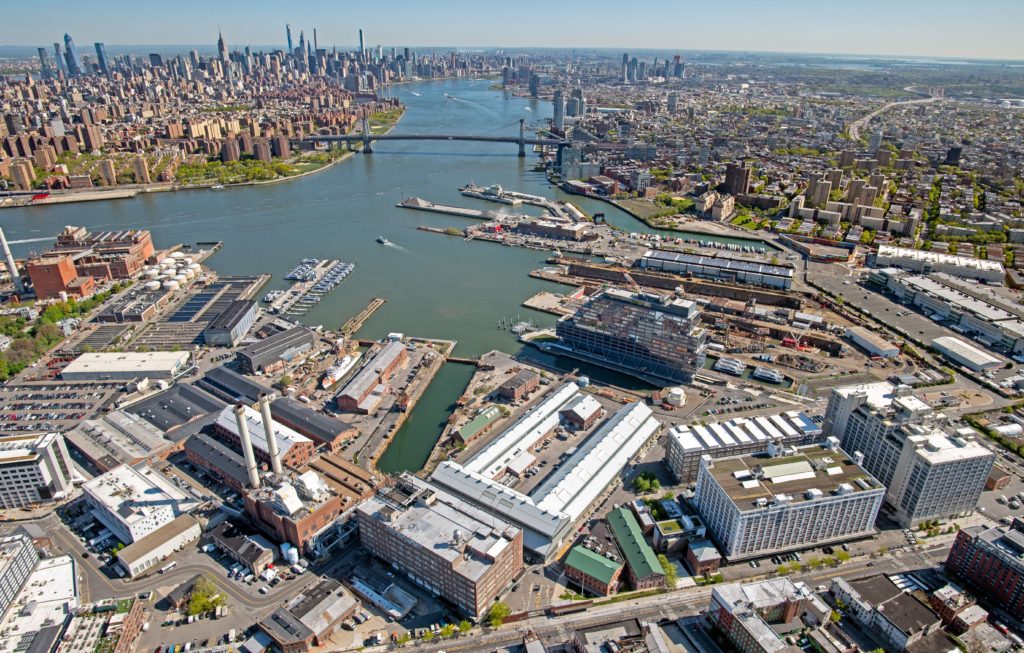
A recent photo of the Navy Yard,
which has been redeveloped for residential and retail use.
The Williamsburg Bridge is in the background.
June 25, 1966, 60 years ago: The Brooklyn Navy Yard is closed, emblematic of New York City's loss of industry.
At the height of World War II production, what was officially named the New York Naval Shipyard had 75,000 people working there. In 1947, it was down to 10,000 workers. It doubled back up to 20,000 by the end of the Korean War in 1953, but after that war ended, it was back to 10,000 again.
In 1960, with the Yard's workforce 11,000 strong, the aircraft carrier USS Constellation was being built there, and an accident caused a fire that killed 49 people. The investigation showed that, although this fact was not responsible for the fire, the Yard was obsolete, especially since it was determined that, in order to reach the open sea, ships built there had to pass under the Manhattan Bridge and the Brooklyn Bridge; and ships going there for repairs also had to pass under those bridges -- and most new ones were too big.
And so, on June 25, 1966, a closing ceremony was held at the Yard, with work stopping for good on June 30, and the last 9,500 workers were laid off.
This was symbolic of the loss of industry in New York City. The loss of jobs crushed the Borough economically, and was much more damaging to the communities of Brooklyn than the so-often-cited move of baseball's Brooklyn Dodgers in 1957 had been.
Indeed, it was crushing to the City as a whole. It wasn't the first time industry had been phased out: The Gashouse District, between 1st Avenue and the Hudson River, from 14th to 23rd Street, its name already appropriated for baseball's St. Louis Cardinals, "the Gashouse Gang," was torn down in World War II, to build the housing projects Stuyvesant Town and Peter Cooper Village.
*
June 25, 1966 was a Saturday. Basketball Hall-of-Famer Dikembe Mutombo was born on this day.


No comments:
Post a Comment