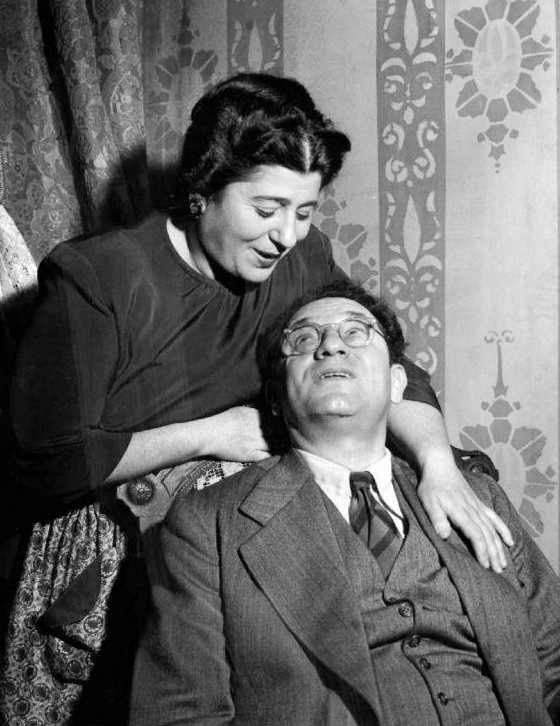
Gertrude Berg (left) and Philip Loeb
May 14, 1951, 75 years ago: American TV's 1st sitcom is canceled, because its creator and star stood up for her co-star when he was blacklisted.
Gertrude Berg had created the radio program The Rise of the Goldbergs for NBC radio in 1929. From the beginning, she played Molly Goldberg, described by an announcer as "a woman with a place in every heart and a finger in every pie." In 1936, it moved to CBS and became simply The Goldbergs.
According to the show, Molly lived at 1038 East Tremont Avenue in The Bronx, New York City, with her husband Jake, their son Sammy, their daughter Rosalie, and Molly's Uncle David. The generation gap was typical of immigrant families in America at the time: David, who came over on the boat, was still very much an "old country" man; Molly and Jake, who had grown up in New York, wanted to be Americans without giving up any of their Jewish heritage; while Sammy and Rosalie wanted to be totally assimilated.
Berg was not averse to incorporating serious real-world issues which affected Jewish families. One 1939 episode addressed Nazi Germany, including a rock through the family window as the Goldbergs had their Passover Seder. Other episodes during World War II alluded to friends or family members trying to escape the Holocaust.
But these were sporadic deviations from the show's main theme of family, neighborhood and the balance between old world values and new world assimilation. Molly shows viewers the strong matriarch she is by constantly helping others with their dilemmas, and proving to be the hero time and time again.
The role of husband Jake Goldberg was originally played by Himan Brown, and later, James R. Waters. When Waters died suddenly in 1945, Berg resisted recasting the role. Instead, she simply had Molly refer to Jake, occasionally setting up dialogue in which his reply was not heard when she spoke to him.
On September 26, 1949, The Goldbergs premiered on CBS television, and it is considered to be American TV's 1st "situation comedy" or "sitcom." Philip Loeb was cast as Jake. Eli Mintz played Uncle David, Larry Robinson played Sammy, and Arlene McQuade played Rosalie.
Each episode began with Berg opening her window and yelling to a neighbor, "Yoo-hoo, Mrs. Bloom!" Mrs. Bloom was never seen, and was thus TV's first unseen character, paving the way for the titular detective's wife on Columbo, Phyllis Lindstrom's husband Lars on The Mary Tyler Moore Show, Carlton the Doorman on Rhoda, the bullying Gooch on Diff'rent Strokes, Norm Peterson's wife Vera on Cheers, and Niles Crane's wife Maris on Frasier.
Berg, now 50 years old, continued to write every episode. By this point, World War II was over, and the State of Israel had won its war of independence. But she knew that hearing about situations was one thing, while seeing them was another. So she avoided issues that could be considered political, while still using Jewish mannerisms. It worked: Not only was the TV version of the show a hit, but, in 1950, she won the 1st Emmy Award for Best Actress.
(The transition from sound to pictures was a reason that Amos & Andy, one of the most popular radio shows, didn't make a successful transition to TV: It was one thing for white Americans to hear white men pretending to be black men for comedic effect, it was another thing to see black men, and they didn't like it.)
But, shortly after that, Loeb was named as a Communist in the publication Red Channels: The Report of Communist Influence in Radio and Television. He denied it. But General Foods, whom Berg had personally recruited as the show's main sponsor, demanded that Loeb be dropped from the show. She refused. On May 14, 1951, CBS aired the show's 2nd season finale, and received word that General Foods had canceled their sponsorship. CBS canceled the show.
Berg didn't give up. She tried to find other sponsors, but none would stand up for Loeb. Finally, Loeb sacrificed himself, telling Berg to go on without him, and to recast the character. On January 7, 1952, 8 months later, NBC agreed to pick up the show, with Harold Stone playing Jake. Robert H. Harris took over the role the next season, and played it for the rest of the show's run.
The show continued into 1955, when the family moved from The Bronx to Haverville, a fictional suburb, presumably also in the State of New York. In-universe, the family's adjustment was initially difficult, but they and their new suburban neighbors soon adapted to each other. In reality, though, the move was the death knell for the show, as the viewers now saw the Goldbergs as fish out of water.
The final episode aired on February 26, 1957 -- pretty much mirroring the move of baseball's Brooklyn Dodgers to Los Angeles at the end of the year. This would be mirrored in the 1991-93 CBS series Brooklyn Bridge, created by Gary David Goldberg (no relation), about a Jewish family in Brooklyn, and the show's final episode discussed the launch of Sputnik 1 on October 4, 1957, 10 days after the last game at Ebbets Field, and 4 days before the Dodgers officially announced the move.
Philip Loeb did not last as long as the show that made him famous: In 1955, he took an overdose of sleeping pills. He was 65 years old. Berg lived until 1966, shortly before her 67th birthday. Mintz, who played a character a generation older than Molly and Jake, was actually younger than either Berg or Loeb, and lived until 1988. Harris lived until 1981, Stone until 2005, Robinson until 2006, and McQuade until 2014.
In 2013, ABC debuted a sitcom titled The Goldbergs. Aside from the title, and the family's obvious Jewishness, it had nothing in common from the original show. It was more like Brooklyn Bridge, in that it was created by someone with the surname, Adam Goldberg; and took place in the past, in this case in the 1980s, in the suburbs of Philadelphia. It ran for 10 seasons.


No comments:
Post a Comment