Showing posts with label super bowl xl. Show all posts

Thursday, February 5, 2026

February 5, 2006: Last Stop for the Bus

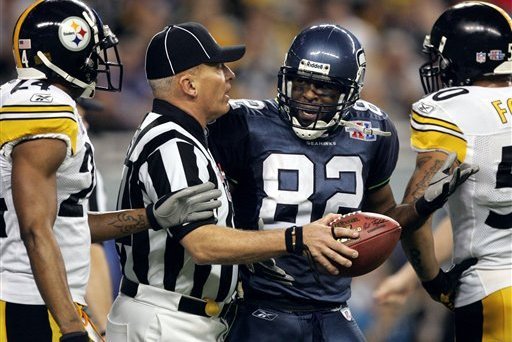
February 5, 2006, 20 years ago: Super Bowl XL is played at Ford Field in Detroit. The Seattle Seahawks were making their 1st appearance, having won the NFC Championship, after having played in the AFC from 1977 (after their 1st season, 1976, in the NFC) to 2001. They were coached by Mike Holmgren, who had coached the Green Bay Packers to victory in Super Bowl XXXI.

The Pittsburgh Steelers were making their 6th appearance. They had won their 1st 4, but had won their last in 1980, and thus sought "One for the Thumb In '81," but couldn't get it. They lost their most recent appearance, in 1996.

Head coach Bill Cowher had Ben Roethlisberger at quarterback. "Big Ben" had faced controversy over his treatment of women. Among his blockers was future Hall of Fame guard Alan Faneca. And a new edition of the "Steel Curtain" defense included linebackers James Farrior and Joey Porter, and future Hall of Fame safety Troy Polamalu.

But the leading figure on the team was running back Jerome Bettis. "The Bus" was retiring after 13,662 rushing yards, 200 receptions for 1,449 yards, and 94 total touchdowns. And he was playing his last game in his hometown of Detroit.

The Seahawks scored first, on a field goal by Josh Brown. They thought they had a touchdown on a 16-yard pass from Matt Hasselback to Darrell Jackson. But the officials called a penalty on Jackson for offensive pass interference, nullifying the score. The Seahawks and their fans were furious with this call, but replays showed it was correct.

The only score in the 2nd quarter was a 1-yard run by Roehtlisberger, and it was 7-3 Steelers at the half. Early in the 2nd half, Willie Parker broke off a 75-yard touchdown run to put the Steelers up 14-3. Hasselback threw a 16-yard touchdown pass to Jerramy Stevens, and the 3rd quarter ended with Seattle down just 14-10.

In the 4th quarter, Seattle right tackle Sean Locklear was called for holding Steelers linebacker Clark Haggans, nullifying a deep pass that would have put the Hawks in position to take the lead. Seattle and their fans were furious with this call as well, but, again, the replay proved the call to be correct. Also disputed was a penalty called on Hasselbeck for an illegal block below the waist, while making a tackle during Ike Taylor's interception return.

With 8:56 left in the game, the Steelers tried some trickery: A reverse got the ball to receiver Antwaan Randle El, who had been a quarterback at Indiana University. He threw an option pass to Hines Ward, who took it 43 yards for a touchdown. It was the 1st touchdown pass by a receiver in a Super Bowl, and it made the score 21-10 Pittsburgh. That score held, as good clock management on offense and strong defense got the Steelers their "One for the Thumb."

The retiring Bettis rushed 14 times for 43 yards. He did not score a touchdown, but he converted a key first down, and allowed his team to run time off the clock late in the 4th quarter.

The Seahawks had more 1st downs, 20-14; more net yards, 396-339; fewer turnovers, 2-1; and more time of possession, 33:02-26:58. It was argued that the difference was penalties: The Hawks were penalized 7 times for 70 yards; the Steelers, 3 times for 20 yards.

But there were also 2 questionable calls that hurt the Steelers, and these were equally justified by instant replay. It wasn't the officials that cost the Seahawks the game: It was the Steelers getting the job done that did that.

The Steelers won a 6th Super Bowl 3 years later. The Seahawks finally won their 1st Super Bowl in 2014. 

Friday, February 5, 2021

Top 5 Reasons You Can't Blame the Officials for the Seattle Seahawks Losing Super Bowl XL

February 5, 2006, 15 years ago: Super Bowl XL is played at Ford Field in Detroit. The Pittsburgh Steelers were going for their 5th Super Bowl win -- "One for the Thumb," as they put it back in 1980, but hadn't yet gotten. The Seattle Seahawks, in their 30th season, with only 1 previous appearance in a Conference Championship Game to their credit, were in their 1st Super Bowl.

The Steelers won the game, 21-10. But the statistics suggest that it shouldn't have ended that way. The Seahawks got 20 1st downs, the Steelers only 14. The Seahawks had 396 total yards, the Steelers 339. The Seahawks had the ball for 33 minutes, the Steelers for 27. (Well, 33:02 and 26:58, respectively.)

Seahawk fans have spent the last 15 years saying the officials gave the Steelers the game. They point to these calls: 

* With 2:08 left in the 1st quarter, and the game scoreless, Darrell Jackson appeared to have scored a touchdown on a 16-yard pass from Matt Hasselbeck. But he was called for offensive pass interference, by pushing off against Steeler safety Chris Hope. Four plays later, Josh Brown kicked a 47-yard field goal. That made it 3-0 Seattle.

* With 12:29 left in the 2nd quarter, and the score still 3-0 Seattle, Hasselback started from the Steelers' 47-yard line, and passed to Jerramy Stevens. Stevens appeared to have possession of the ball, and then fumble. But the officials ruled that he never had possession, nullifying the gain he might have made.

* With 12:35 left in the 4th quarter, and Pittsburgh leading 14-10, Hasselbeck completed a pass to Stevens, going for 18 yards, to the Steeler 1-yard line. But Seahawk offensive tackle was called for holding on linebacker Clark Haggans. So now it was 1st-and-20, and Hasselbeck was sacked by Casey Hampton on the next play. Then came a 7-yard run by Shaun Alexander.

* And on the play after Alexander's run, with 10:54 left in the game, the ball on the Steeler 27, and the Steelers still up by 4, Hasselbeck again tried to pass to Jackson, but was intercepted by cornerback Ike Taylor. On his return of the interception, Hasselback was penalized for an illegal block.

* The Steelers were flagged for only 3 penalties all game long, totaling just 20 yards. The Seahawks were flagged 7 times, for 70 yards. To put it another way, average yards per penalty: Seahawks 10, Steelers 6.67.

The next day, at a rally for the team at their stadium, Seahawks coach Mike Holmgren, who had previously led the Green Bay Packers into Super Bowls XXXI (won) and XXXII (lost), said at the team's rally, "We knew it was going to be tough going against the Pittsburgh Steelers. I didn't know we were going to have to play the guys in the striped shirts as well."

Jason Whitlock of the Kansas City Star and ESPN wrote, "Bill Leavy and his crew ruined Super Bowl XL. Am I the only one who would like to hear them defend their incompetence?"

Two days after the game, ESPN published a poll: Out of over 100,000 votes cast, 61 percent said that "officiating mistakes affected the outcome of Super Bowl XL."

In 2010, Leavy, the game's referee, admitted his mistakes:

It was a tough thing for me. I kicked two calls in the fourth quarter, and I impacted the game, and, as an official, you never want to do that. It left me with a lot of sleepless nights, and I think about it constantly. I'll go to my grave wishing that I'd been better...

I know that I did my best at that time, but it wasn't good enough...

When we make mistakes, you got to step up and own them. It's something that all officials have to deal with, but unfortunately when you have to deal with it in the Super Bowl it's difficult.

This seemed to confirm what every football fan in the Pacific Northwest wanted to believe: Their beloved 'Hawks got screwed by the officials.

What they wanted to believe was wrong.

Top 5 Reasons You Can't Blame the Officials for the Seattle Seahawks Losing Super Bowl XL

5. The Calls Went Both Ways. With 2:13 left in the 3rd quarter, and the Steelers up 14-10, the Seahawks started with the ball on their own 7-yard line. Hasselbeck ran around right end, and gained 8 yards before being tackled by Aaron Smith. The Steelers thought that Hasselbeck had fumbled, and that they had recovered. But the officials ruled that he was already out of bounds before losing the ball.

Had the Steelers gotten the call they wanted, they would have had the ball deep in Seattle territory. Instead, the Seahawks kept going, until the Taylor interception.

4. 5-for-17 on 3rd downs. A bad 3rd down conversion rate would also be a big reason why the Seahawks lost Super Bowl XLIX.

In the 1st quarter, they had a 3rd-and-9, and allowed Hasselbeck to get sacked. Still in the 1st, they had a 3rd-and-14. They were unlikely to convert anyway, but a false start penalty pushed them back further. They had a 3rd-and-6 in Pittsburgh territory, when Hasselbeck connected with Jackson for 18 yards, but it was called back for holding -- correctly. And all that was just in the 1st quarter.

In the 2nd quarter, they had a 3rd-and-2 in Pittsburgh territory, after Alexander had made 2 gains. Instead of giving him the ball again, Hasselbeck threw, and it fell incomplete. Later in the quarter, on 3rd-and-3, Hasselbeck completed a pass, but it went only 2 yards. In the last minute of the half, they had 3rd-and-6 in Pittsburgh territory, and Hasselbeck threw incomplete. The ensuing field goal attempt by Josh Brown was 54 yards, and missed.

Early in the 3rd quarter, with a 3rd-and-5 in Pittsburgh territory, Hasselbeck threw another bad pass, forcing Brown into another long attempt, 50 yards, also missed. With 6:36 to go, possibly enough time to make up the Steelers' 11-point lead, and with a 3rd-and-8 in Pittsburgh territory, Hasselbeck got sacked.

When Hasselbeck most needed to come through for his team, he didn't do a good job of it. As a result...

3. The Game Wasn't That Close. 21-10. Suppose the Darrell Jackson touchdown had been allowed to stand. Would that have changed the course of the game? Maybe. By enough? Maybe not. If that had been the only difference, the Steelers would still have won, 21-13.

2. The Steelers Were Better. Normally, "The opposition was better" would be Reason Number 1. Not this time, although the Steelers were a better team than the Seahawks. They went into the game favored by 4 points, won by 11, and held the Seahawks to 10 points.

That 10-point defensive performance had only been done, or bettered, in 14 of the previous 39 Super Bowls, and in only 3 of the 14 since. The Steel Curtain defense of the 1970s? They allowed the Minnesota Vikings 6 points in Super Bowl IX, the Dallas Cowboys 17 in Super Bowl X, the Cowboys 31 in Super Bowl XIII, and the Los Angeles Rams 19 in Super Bowl XIV.

In other words, what's usually regarded as the greatest defense in football history averaged, over 4 Super Bowls, 16 points per game. The Pittsburgh defense of 2005-06, led by Troy Polamalu, Casey Hampton, James Farrior and Joey Porter, bettered that by nearly a full touchdown.

1. The Officiating Wasn't Bad. Mike Pereira, then the NFL's Director of Officiating, and previously a referee in both the NFL and college ball, reviewed every play, and determined that all 7 of the penalties called against the Seahawks were correct. Referee Bill Leavy was right at the time, and wrong in his later confession.

VERDICT: Not Guilty. The reason the Seattle Seahawks lost Super Bowl XL is that they didn't get the job done, and that the Pittsburgh Steelers didn't let them.
Friday, April 14, 2017

Dan Rooney, 1932-2017

Daniel Milton Rooney was born on July 20, 1932, in Pittsburgh, Pennsylvania. His father, Art Rooney, founded the NFL's Pittsburgh Steelers on May 19, 1933.

This means that Dan Rooney was a Steeler for life. Not just for nearly all of his life, but, until now, for all of the team's life.

Art Rooney and his wife, the former Kathleen "Kass" McNulty, had 5 sons. They were Dan, Art Jr., Tim, Patrick and John. They would have 32 grandchildren and 75 great-grandchildren. Art Jr. said that Art Sr., known to all of Western Pennsylvania as "The Chief," always told his sons, "Treat everybody the way you'd like to be treated. Give them the benefit of the doubt. But never let anyone mistake kindness for weakness." Or, as Art Jr. put it, "He took the Golden Rule, and put a little bit of the North Side in it."

The Rooney family has long lived in the Troy Hill section of Pittsburgh's North Side, which included North Catholic High School -- now named Cardinal Wuerl North Catholic High School and located in nearby Cranberry Township. The Rooney boys would assist their father at Steeler training camp, and in games at Forbes Field and later at Pitt Stadium. Dan served as a ballboy, and sold game-day programs. The sons seemed to be the only ones to notice a young Pittsburgh native at the 1955 camp, but their father deferred to the judgement of his head coach, Walt Kiesling, who cut the rookie.

What's that? You've never heard of Walt Kiesling? I'm not surprised. But you have heard of the rookie. He caught on with the Baltimore Colts the next season. His name was Johnny Unitas.


In 1952, while a student at Pittsburgh's Duquesne University, from which he would graduate with a degree in accounting, Dan Rooney married Patricia Reagan, who was working in the Steeler offices. They had 9 children. In 1960, he became the Steelers' director of personnel.


*

In 1964, in its 2nd year of inductions, Art Rooney became a member of the Pro Football Hall of Fame, and admired by all who knew him. But, let's be blunt: At this point, he was a failure as the operator of a football team.

From 1933 to 1968, 36 seasons, the Steelers had made the Playoffs exactly once, in 1947, because they'd tied the cross-State Philadelphia Eagles for 1st place in the NFL's Eastern Division. They held a Playoff at Forbes Field, and the Eagles won it.

If Art had died shortly after the Jets won Super Bowl III on January 12, 1969, it would have been said -- as is now being said of the late Chicago Blackhawks owner Bill Wirtz -- that the best thing he did for his team was to die, so that his son could run the team.

Indeed, his sons held what we would now call an "intervention," telling him that they should take over the operations of the team. He agreed -- and lived another 20 years, in which the sons turned the Steelers from a joke franchise into an iconic team of American sports.


Pretty much the first thing that Dan Rooney did was offer the Steelers' head coaching job to the head coach at nearby Penn State, Joe Paterno. Paterno turned him down. So he offered it to the defensive coordinator of the team the Jets had just beaten in the Super Bowl, who had been on the staff of the San Diego Chargers team that won the 1963 AFL Championship, and a lineman who had won 2 NFL Championships with the Cleveland Browns: Chuck Noll.


Dan's brother Art Jr. drafted Joe Greene, Jon Kolb and L.C. Greenwood in 1969; Terry Bradshaw and Mel Blount in 1970; Jack Ham, Gerry Mullins, Dwight White, Larry Brown, Ernie Holmes and Mike Wagner in 1971; Franco Harris and Steve Furness in 1972; and, in 1974, in perhaps the greatest single draft in NFL history, Lynn Swann, Jack Lambert, John Stallworth and Mike Webster -- 4 Hall-of-Famers in one draft.


Counting Greene, Bradshaw, Blount, Ham and Harris, that was 9 Hall-of-Famers in 6 drafts. Counting Noll, 10 -- all based on the decisions of Dan Rooney and Art Rooney Jr. To put that in perspective: The team had 5 players from 1933 to 1968 who ended up making the Hall. (Since, they've had 3, although some of the players from the Super Bowl XL and XLIII who may make it are not yet eligible.)


(UPDATE: Through the Hall's NFL Centennial election of 2020, there are 19 players who could legitimately be said to have been elected based at least in art on their performance with the Steelers. Donnie Shell has made it 10 players from that 1969-74 period, and 5 from the 1974 Draft alone. Before them, there were 5: Bill Dudley in the 1940s, Ernie Stautner and Jack Butler in the 1950s, Bobby Layne and John Henry Johnson in the 1960s. Since those '70s stars, there's been 4: Dermontti Dawson and Rod Woodson in the 1990s, and Jerome Bettis and Troy Polamalu in the 2000s. Ben Roethlisberger is still active, and thus not yet eligible.)

It took a while to build a winner, especially because Noll and Bradshaw had a contentious relationship. Moving from 1925-built Pitt Stadium into the new Three Rivers Stadium in 1970 helped. But in 1972, the Steelers won the AFC Central Division Championship, and reached the AFC Championship Game.

They made the Playoffs again in 1973. In 1974, they finally went all the way, winning Super Bowl IX on January 12, 1975. Pete Rozelle said his happiest moment in his 29 seasons as Commissioner of the NFL was handing the Vince Lombardi Trophy to Art Rooney Sr. -- but it was because of the building done by Dan and Art Jr.

The Steelers would reach 4 Super Bowls (IX, X, XIII and XIV), winning all of them, in a span of 6 years. All tolled, under Dan Rooney's operation, 48 seasons, they reached the Playoffs 29 times, won 22 Division titles (15 in the old AFC Central, 7 in the AFC North following the 2002 realignment), reached 16 AFC Championship Games (including this past season), won 8 AFC Championships, and won 6 Super Bowls, the most NFL Championships in the Super Bowl era. He also built Heinz Field, the Steelers' new home, for the 2001 season, and it is one of the best stadiums in the NFL.

With the 1st 4 Vince Lombardi Trophies

The Steelers became a cultural phenomenon, with their black and gold uniforms, their helmets with the "Steelmark" logo on only the right side with the left side remaining blank, their multi-ethnic working-class fan base, and their bright yellow Terrible Towels being waved in the stands (first at Three Rivers Stadium, then at Heinz Field).


The fact that the Steelers stood up, usually successfully, to the Dallas Cowboys and the Oakland Raiders, 2 of the most hated NFL teams nationwide, also helped boost their national image. Along with the Cowboys, the Raiders, the Green Bay Packers (due to their similar cultural stamp in the 1960s) and the Chicago Bears (ditto for the 1980s), the Steelers are one of the few NFL teams to have a nationwide fan base.


In New York and New Jersey, 400 miles from Pittsburgh, you can see Steeler bumper stickers and window stickers on cars every day. A website called SteelersBars.com lists bars catering to Steeler fans in 48 States, all but Nebraska and South Dakota.


Art Rooney Sr. loved it -- but it was Dan Rooney, and, to a lesser but very significant extent, Art Rooney Jr., who made it happen.


*


Dan is widely credited with leading the negotiations that ended the 1982 NFL players' strike and passing the collective bargaining agreement that followed it. In 1989, Rozelle retired, and some owners wanted to make Dan the new Commissioner. He declined, saying he'd rather continue to run his team. Paul Tagliabue was elected instead. In 1993, Dan led the NFL in approving the salary cap. In 2006, when Tagliabue retired, it was Dan Rooney who called Roger Goodell, and told him that he'd been elected the new Commissioner.


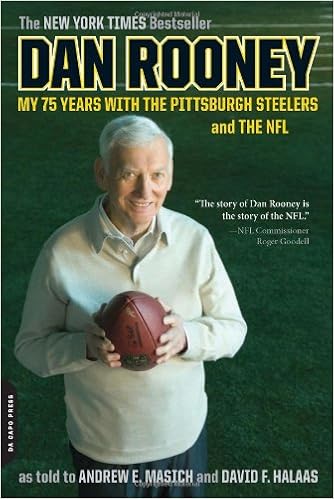
Goodell repaid the compliment with this blurb for Dan's memoir My 75 Years With the Pittsburgh Steelers and the NFL: "The story of Dan Rooney is the story of the NFL."


Art Rooney Sr. died in 1988, and Dan became majority owner, replacing Noll with Bill Cowher in 1992. By that point, Art Jr. had reduced his involvement in the team. (UPDATE: As of 2020, he remains a team vice president.) In 2003, Dan followed in his father's footsteps, and handed over day-to-day operations to his son, Art Rooney II (grandson of the founder and nephew of Art Jr.). It was Art II who oversaw the building of the teams that won Super Bowls XL and XLIII and lost Super Bowl XLV, and in 2007 replaced the retiring Cowher with his assistant, Mike Tomlin, the team's 1st black head coach.


That fact is significant because of "The Rooney Rule," which the NFL established at Dan's urging in 2003. Tony Dungy, a former Steeler defensive back and assistant coach, had just been fired as head coach of the Tampa Bay Buccaneers -- who ended up winning Super Bowl XXXVII under their new head coach, the white former Oakland Raider coach Jon Gruden. Dennis Green had also just been fired as head coach of the Minnesota Vikings, despite a winning record.


A group of civil rights attorneys, led by the legendary Johnnie Cochran, released a study showing that black head coaches, despite winning a higher percentage of games, were less likely to be hired, and more likely to be fired, than their white counterparts.


The Rooney family, like the great baseball executive Branch Rickey, consider themselves Abraham Lincoln-style Republicans, demanding fairness for all, regardless of race or religion. This was certainly an issue for the Rooneys, because Art Sr. was old enough to remember when being an Irish Catholic meant serious discrimination. Art Sr. had also helped to keep the Negro League's Pittsburgh-based Homestead Grays afloat for a time, and had no qualms about bringing black players to the Steelers once the color barrier had been broken in 1946.


One of Dan's key hires when he took control was Bill Nunn Jr., a black sportswriter who knew the football programs at what are now called Historically Black Colleges and Universities (HBCUs), and became one of the team's top scouts.


Dan's "Rooney Rule" requires teams to search among black, Hispanic and Asian candidates for all senior football operations positions within the NFL, regardless of a team's title for that position. Currently, 6 of the 32 head coaches in the NFL are African-American (Tomlin, Todd Bowles of the Jets, Hue Jackson of the Browns, Marvin Lewis of the Cincinnati Bengals, Jim Caldwell of the Detroit Lions and Anthony Lynn of the Los Angeles Chargers).


So 18.8 percent of the head coaches are black, and 7 of the general managers, or 21.9 percent -- as opposed to 12.6 percent of the general U.S. population, but 67.3 percent of NFL players. In addition,

1 head coach, Ron Rivera of the Carolina Panthers, is Hispanic. About 17.6 percent of Americans are Hispanic, but only 0.6 percent of NFL players are Hispanic.

In 2008, Dan and Art II bought out Dan's brothers, who wanted to increase their involvement in gambling establishments. Art Sr. had owned Yonkers Raceway in New York's Westchester County and Suffolk Downs in Boston. His son (Dan's brother) Tim runs Yonkers Raceway today.


A wing of the Rooney family lives in Florida, and controls horse and dog tracks there. Pat Rooney's son Tom is a Republican Congressman, representing a district southeast of Tampa Bay. His brother, Patrick Jr., is in the State House of Representatives, representing northern Palm Beach County.


Despite the family's Republican record, in 2008, Dan Rooney endorsed Senator Barack Obama of Illinois for President. He did not cite any unhappiness with Republican handling of the economy or the Iraq War. He did say, "When I think of Barack Obama's America, I have great hope. I support his candidacy, and look forward to his Presidency."


Some people believe Dan's endorsement won Pennsylvania for Obama. I doubt that it made much of a difference: The State had gone for the Democratic nominee in every election since 1992. And Obama would have won the election even if he'd lost Pennsylvania.

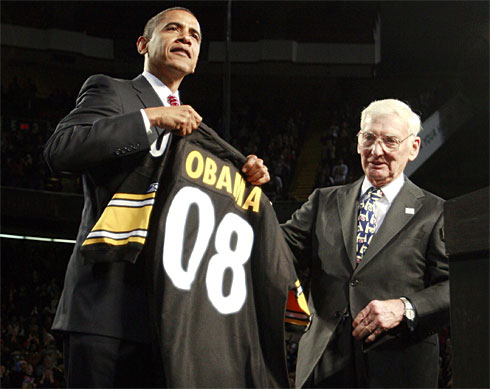
Dan would also give the 44th President a Number 44 jersey
at the White House ceremony honoring the Steelers
after winning Super Bowl XLIII in 2009.

But Obama remembered Dan's efforts, and also remembered his long record of support for Irish-American charities (inherited from his father), and named him U.S. Ambassador to the Republic of Ireland. He served in the post from July 1, 2009 to December 14, 2012.


Art Rooney Sr. and Dan Rooney are only the 2nd father-and-son combination to both be enshrined in the Pro Football Hall of Fame. The other is Tim and Wellington Mara of the Giants, with whom they would be linked by their descendants. Art Rooney Sr. and Tim Mara were good friends, linked by the horse-racing business. Wellington Mara's son Tim married Art Jr.'s daughter Kathleen. Their daughters, a
ctresses Kate Mara and Rooney Mara, are thus great-granddaughters of the founders of the Steelers and the Giants.

"Mean Joe" Greene made the presentation speech when Dan was elected to the Hall of Fame in 2000, saying "Dan has always led with humility. When things go as planned, Dan is in the background. When things don’t go as planned, he’s in the forefront."

Dan Rooney with a not-so-mean Joe Greene
at Heinz Field, September 8, 2013

That included always being there for his players, just as his father had, showing them that he was never going to be an absentee owner. As Steelers quarterback Ben Roethlisberger said this past January:


I have played with guys that have come from other teams. They look shocked when they see our owners, whether it's Mr. Dan Rooney or Mr. Art Rooney II, walking around the locker room and walking around practice. They don't ever see their owners. We see our owners every single day. I think it's just a blessing to know that they care about us, and that's one of the reasons we want to go win.


But it became harder for him as old age caught up to him. Recent photos showed him seriously stooped over. Dan Rooney passed away at the age of 84 yesterday, April 13, 2017. No cause was listed with the initial announcement, but it's been said that his health was deteriorating in recent weeks, and he missed the annual NFL owners' meeting a few weeks ago in Phoenix, his first time missing it since his father handed him the keys to the kingdom in 1969.


Bill Cowher said, "He was like a father, a friend, a mentor, a boss who inspired others around him. He was a people person and he never forgot where he came from. He epitomized Pittsburgh: Hard-working, humble, no-nonsense, tell it the way it is,and never forget where he came from. That's him. That's Pittsburgh."


No less an opponent than Dallas Cowboys owner Jerry Jones called it "a sad day for anyone who has had an association with the NFL," noting that Rooney "made all of our lives better."


"He shaped the league with instincts, wisdom and a soft-spoken velvet touch," Jones said. "He was a steward and a guardian for the growth and popularity of the NFL, because he loved the game so much."


Obama hailed him as well: "Dan Rooney was a great friend of mine. But, more importantly, he was a great friend to the people of Pittsburgh, a model citizen, and someone who represented the United States with dignity and grace on the world stage."


Dan Rooney knew what was important around the world. He knew what was important around the block, too.


Surely, he was taught by his father the words of Rudyard Kipling, because he certainly lived them:


If you can dream, and not make dreams your master
If you can think, and not make thoughts your aim
If you can meet with Triumph and Disaster
and treat those two impostors just the same...


If you can talk with crowds and keep your virtue
or walk with kings, nor lose the common touch
If neither foes nor loving friends can hurt you
If all men count with you, but none too much


If you can fill the unforgiving minute
with sixty seconds' worth of distance run,
yours is the Earth and everything that's in it

and, which is more, you'll be a Man, my son!

Dan Rooney was a man for all seasons -- not just 84 seasons of professional football, but for any season, for any occasion.


UPDATE: He was buried at Christ Our Redeemer Catholic Cemetery in Pittsburgh. It is also the final resting place of his father Art, Chuck Noll, long-ago Steeler coach Walt Kiesling, and 1890s baseball catcher Dick Buckley.