Showing posts with label seattle seahawks. Show all posts

Tuesday, February 10, 2026

NFL Championship Droughts, as of Super Bowl LXI

Years posted are of the season, not the year in which the Super Bowl happened. In other words, the Seattle Seahawks just became the 2025 NFL Champions. Teams ranked by their most recent title; then, for teams that have not won the title, fewest seasons without one:

1. Current Champions, Seattle Seahawks, 2025
2. 1 year, Philadelphia Eagles, 2024
3. 2 years, Kansas City Chiefs, 2023
4. 3 years, Los Angeles Rams, 2022
5. 5 years, Tampa Bay Buccaneers, 2020
6. 7 years, New England Patriots, 2018
7. 10 years, Denver Broncos, 2015
8. 13 years, Baltimore Ravens, 2012
9. 14 years, New York Giants, 2011
10. 15 years, Green Bay Packers, 2010
11. 16 years, New Orleans Saints, 2009
12. 17 years, Pittsburgh Steelers, 2008
13. 19 years, Indianapolis Colts, 2006
14. 30 years, Dallas Cowboys, 1995
15. 31 years, San Francisco 49ers, 1994
16. 34 years, Washington Commanders, 1991 as Washington Redskins
17. 40 years, Chicago Bears, 1985
18. 42 years, Las Vegas Raiders, 1983 as Los Angeles Raiders
19. 42 years, Miami Dolphins, 1973
20. 57 years, New York Jets, 1968
21. 61 years, Cleveland Browns, 1964
22. 68 years, Detroit Lions, 1957
23. 78 years, Arizona Cardinals, 1947 as Chicago Cardinals
24. Never in 13 years, Houston Texans, joined NFL in 2002
25. Never in 30 years, Carolina Panthers, joined NFL in 1995
26. Never in 30 years, Jacksonville Jaguars, joined NFL in 1995
27. Never in 55 years, Buffalo Bills, founded in 1960 in AFL, joined NFL in 1970
28. Never in 55 years, Los Angeles Chargers, founded in 1960 in AFL, joined NFL in 1970 as San Diego Chargers
29. Never in 55 years, Tennessee Titans, founded in 1960 in AFL, joined NFL in 1970 as Houston Oilers
30. Never in 55 years, Cincinnati Bengals, founded in 1968 in AFL, joined NFL in 1970
31. Never in 59 years, Atlanta Falcons, joined NFL in 1966
32. Never in 64 years, Minnesota Vikings, joined NFL in 1961

If I were ranking the teams that have not yet won titles by how close they have come:

24. Buffalo Bills, last won AFL Championship in 1965, last won AFC Championship in 1993
25. Los Angeles Chargers, last won AFL Championship in 1963, last won AFC Championship in 1994, both as San Diego Chargers
26. Tennessee Titans, last won AFL Championship in 1961 as Houston Oilers, last won AFC Championship in 1999
27. Cincinnati Bengals, last won AFC Championship in 2021
28. Atlanta Falcons, last won NFC Championship in 2016
29. Carolina Panthers, last won NFC Championship in 2014
30. Minnesota Vikings, last won NFC Championship in 1976
31. Jacksonville Jaguars, last reached AFC Championship Game in 2017
32. Houston Texans, best performance is reaching AFC Division Playoff, last in 2025

Monday, February 9, 2026

A Super Bowl of Redemptions

Sam Darnold (left) and Kenneth Walker III

Siri, what is Super Bowl Sunday?

Liberal Siri: It is America's annual tribute to violence, unregulated capitalism, and cholesterol.

Conservative Siri: It's the most wonderful time of the year!

*

Super Bowl LX was played last night, at Levi's Stadium in Santa Clara, California, home of the San Francisco 49ers, although it's closer to San Jose than to San Francisco. In fact, it's further from downtown San Francisco (43.6 miles) than my home of East Brunswick is from Midtown Manhattan (39.7 miles).

It was a chance at redemption for the Seattle Seahawks, after their loss to the New England Patriots in Super Bowl XLIX, 11 years earlier, when their head coach at the time, Pete Carroll, made the dumbest play call in the history of football.

It was a chance at redemption for their quarterback, Sam Darnold, who had previously washed out with the New York Jets, the Carolina Panthers and the San Francisco 49ers, and had been rejected by the Minnesota Vikings, despite getting them to a 14-3 regular-season record last season, before failing in the Playoffs. It was even a chance at redemption for his Southern California hometown, San Clemente, which is where Richard Nixon moved after he resigned the Presidency in disgrace.

Some people thought it was a chance at redemption for the Patriots: For the 1st time in 29 years, they were playing in a Super Bowl without Bill Belichick as head coach and Tom Brady at quarterback. They had been 6-3 in Super Bowls when suspected of cheating, and 0-2 in them before that when not.

There would be no redemption for the New York Jets or their fans. If the Patriots won, that would be the Jets' arch-rivals winning it -- again! If the Seahawks won, that would be Darnold winning it, reminding them of how their team totally mishandled him.

Unfortunately, for most of the game, it was looking like the worst-played Super Bowl, both teams combined, ever. For the 1st 46 minutes of the game, into the 4th quarter, the score was Seahawks 12, Patriots 0. Being a Yankee Fan, and thus hating all New England sports teams (though not the region of New England itself), and being a fan of fairness, and thus hating all cheating, I was happy about the score.

But, despite the fact that there were no turnovers until a Patriot fumble in the last 15 seconds of the 3rd quarter, the level of play was terrible. The Patriots had 4 1st Downs, while the Seahawks had 4 field goals, and neither team had scored a touchdown. There was a decent shot at the 1st shutout in a Super Bowl, and it wasn't even because the Seattle defense was so strong: It was that the New England offense, coached by Mike Vrabel and quarterbacked by Derek Maye, was so inept. They had not gotten further downfield than the Seahawks' 43-yard line.

Seahawk kicker Jason Myers was beginning to look like he would be the 1st placekicker to be named the Most Valuable Player of the Super Bowl. He ended up becoming the 1st man to kick 5 field goals in a Super Bowl, matching his uniform number; and scoring 17 points overall. (James White of the Patriots scored 20 -- 3 touchdowns and a 2-point conversion -- in Super Bowl LI, and Jalen Hurts of the Philadelphia Eagles tied that record in Super Bowl LVII.)

Finally, with 13 minutes and 24 seconds to go, Darnold threw a 16-yard touchdown pass to AJ Barner, to give the Seahawks a 19-0 lead. Very briefly, the Patriots started to make it interesting, getting to 19-7 and driving for a 2nd touchdown, and we were all, "Oh, here we go again: No Belichick, no Brady, but are the Patriots cheating again? Is this gonna be another comeback like Super Bowl LI between the Patriots and the Atlanta Falcons, 28-3 becomes a Patriot overtime win?

But, no: That drive ended with 8:37 to go, with an interception by Julian Love that led to Myers' 5th field goal. It was then that I saw in the eyes of Maye the look of a quarterback who knew he was going to lose the Super Bowl. I had seen it before, in the eyes of Craig Morton in 1978, Ron Jaworski in 1981, Joe Theismann in 1984, Dan Marino in 1985, Tony Eason in 1986, John Elway 3 times in the late 1980s before he finally won two in the late 1990s, Jim Kelly 4 times in the early 1990s, Kurt Warner in 2002, Peyton Manning in 2014, and even 3-time winner Patrick Mahomes last year.

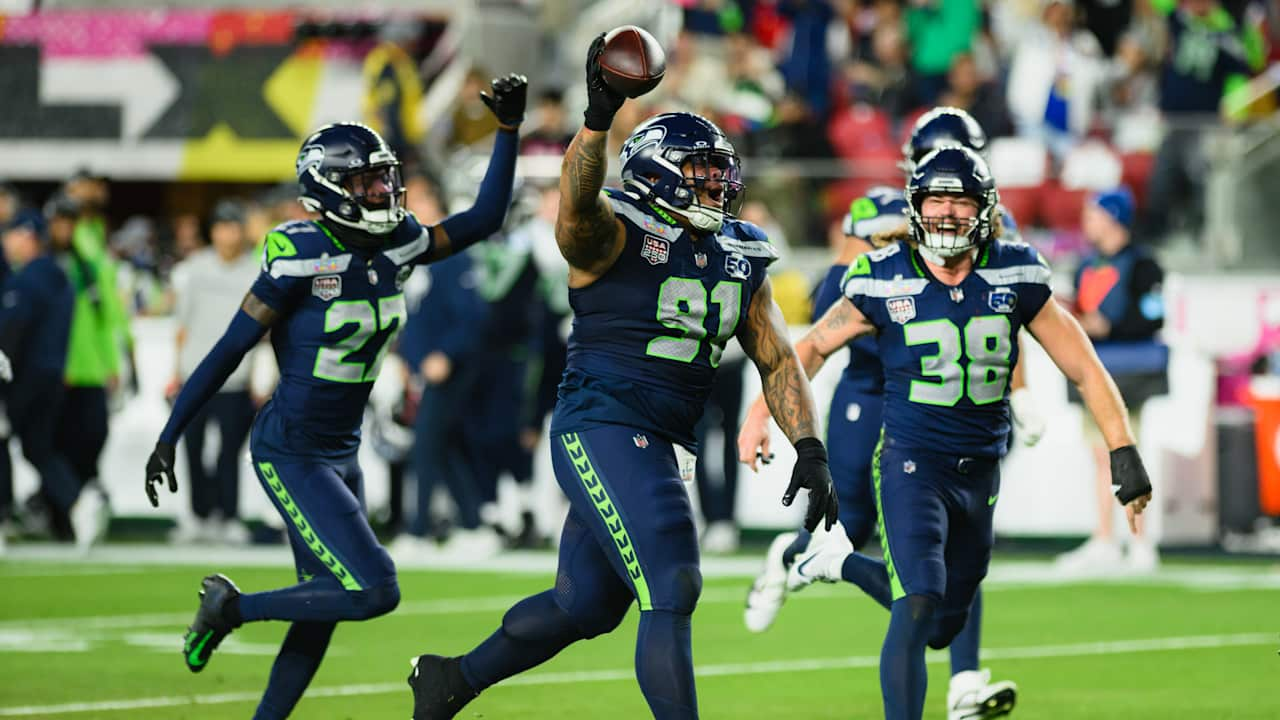
And on the Pats' next drive, Uchenna Nwosu intercepted a weak Maye pass, and returned it 45 yards for, Cliché Alert, the nail in the coffin. These 2 turnovers were a quick redemption for the Seahawk defense, which people were beginning to doubt. Final score: Seattle 29, New England 13.

The Seahawks had won their 2nd Super Bowl, and Seattle's 4th World Championship, following their win in Super Bowl XLVIII in 2014, the 1979 NBA Championship of the now-on-hiatus Seattle SuperSonics, and the 1st Stanley Cup won by an American team, in 1917, but the long-defunct Seattle Metropolitans. If you count Major League Soccer, add 2 for the Seattle Sounders: 2016 and 2019. If you count the WNBA, add 4 for the Seattle Storm: 2004, 2010, 2018 and 2020. So that would be 10 titles for the Queen City of the Northwest.

Mike McDonald, at 38, became the 3rd-youngest head coach to win a Super Bowl, following Sean McVay of the Los Angeles Rams in LV and Mike Tomlin of the Pittsburgh Steelers in XLIII, who were each 36. Kenneth Walker III rushed for 135 yards, the most in a Super Bowl in 28 years, and was named the MVP. And Darnold joined a select group of quarterbacks who had been mishandled by teams before being signed by teams willing to take a chance on them, and leading them to Super Bowl glory: Len Dawson, Earl Morrall, Jim Plunkett, Doug Williams, Brad Johnson, Drew Brees and Matthew Stafford.

*

As for the entertainment: The opening ceremony was led by Bay Area-based rock band Green Day, who played the title track of their best-known album, American Idiot. It was written in reflection of the President at the time, George W. Bush. Who knew that, one day, we would have a President whose words and actions would make him look even more idiotic?

Openly lesbian singer Brandi Carlisle sang "America the Beautiful." Black singer Coco Jones, daughter of 1990s Patriots player Mike Jones, sang "Lift Every Voice and Sing," a.k.a. "The Black National Anthem," to which Trump and conservatives have objected in the past. The actual National Anthem, "The Star-Spangled Banner," was sung by Charlie Puth, a white singer; but he was accompanied by saxophonist Kenny G, who is Jewish; and 3 multicultural groups: The Oakland Interfaith Gospel Choir, the Sainted Trap Choir, and the Color of Noize Orchestra. All 3 songs were signed for the hearing impaired by men of color: "America the Beautiful" by Julian Ortiz, Hispanic; the other 2 by Fred Beam, black. It was multicultural, it was intersectional, and regardless of whether it was designed to make Trump angry, it surely did.

The halftime show was led by Puerto Rican singer Benito Antonio Martínez Ocasio, a.k.a. Bad Bunny. When it was announced that he would be the halftime performer, Donald Trump lost whatever passes for his mind, seeing him as an immigrant who doesn't speak English, and doesn't represent American values. Puerto Ricans have officially been American citizens since President Woodrow Wilson, a man not exactly known for his tolerance of people of color, signed the Jones-Shafroth Act in 1917.

Did Bad Bunny make a political statement? Puedes apostar lo que quieras. (That means, "You can bet whatever you want." Apparently, there is no proper Spanish translation for the old Laugh-In phrase, "You bet your sweet bippy.") His delivery was almost entirely in Spanish. The show began with a stage full of people working in sugarcane fields, emblematic of Puerto Rico's poverty. He made a reference to Puerto Rico's troublesome electrical power grid, which the federal government has a responsibility to maintain, and doesn't.

He had a stage set of a block in a Puerto Rican city neighborhood, showing that Latinos and Latinas are just like Anglos, and just like any other immigrants. At one point, he fell through the stage, and seemed to crash into a private home, which the viewing audience took as a swipe at ICE's illegal entries.

In the show's most-talked-about moment, he handed an actual Grammy Award to a little boy. Officially, the boy was supposed to represent the boy he had once been, dreaming of stardom. But millions of people thought the boy was supposed to represent Liam Ramos, the 5-year-old Minneapolis resident detained by ICE for 12 days. Millions of those thought it actually was Liam, inadvertently bringing up the old racist trope of "They all look alike to me."

Guest stars included an earlier Puerto Rican singer, Ricky Martin; Dominican-American rapper Cardi B; Mexican-American actress and businesswoman, and Bay Area native, Jessica Alba; and the only English-first performer of the show, Lady Gaga, who had been the halftime performer at Super Bowl LI. Bad Bunny closed by holding up a football printed with the words, "TOGETHER, WE ARE AMERICA," surrounded by the flags of every nation in the Western Hemisphere -- including, it should be noted, the United States -- and, emblazoned on the main scoreboard in big capital letters, "THE ONLY THING STRONGER THAN HATE IS LOVE." The message was inescapable.
So this Super Bowl also provided a moment of redemption for all of us, not just those of Spanish heritage, because we are all descended from immigrants. I understood maybe 1 word out of 5 that Bad Bunny sang, and I am not a fan of Latin music. And I didn't immediately understand every message that he was trying to send. But I certainly understood that he was sending messages.

And Trump got the message. Instead of watching the "alternative halftime show" put on by Turning Point USA, the organization run by the recently assassinated bigot Charlie Kirk, Trump clearly watched the Bad Bunny show, and called it "disgusting," and saying it didn't uphold American values.

This has now been said so often, I have to issue a Cliché Alert for it: With Donald Trump, every accusation is a confession.

The alternative show was watched by about 6 million people. The main show, and the game it paused? About 135 million. The game itself had an average of about 125 million, slightly under last season's all-time record.

Thursday, February 5, 2026

February 5, 2006: Last Stop for the Bus

February 5, 2006, 20 years ago: Super Bowl XL is played at Ford Field in Detroit. The Seattle Seahawks were making their 1st appearance, having won the NFC Championship, after having played in the AFC from 1977 (after their 1st season, 1976, in the NFC) to 2001. They were coached by Mike Holmgren, who had coached the Green Bay Packers to victory in Super Bowl XXXI.

The Pittsburgh Steelers were making their 6th appearance. They had won their 1st 4, but had won their last in 1980, and thus sought "One for the Thumb In '81," but couldn't get it. They lost their most recent appearance, in 1996.

Head coach Bill Cowher had Ben Roethlisberger at quarterback. "Big Ben" had faced controversy over his treatment of women. Among his blockers was future Hall of Fame guard Alan Faneca. And a new edition of the "Steel Curtain" defense included linebackers James Farrior and Joey Porter, and future Hall of Fame safety Troy Polamalu.

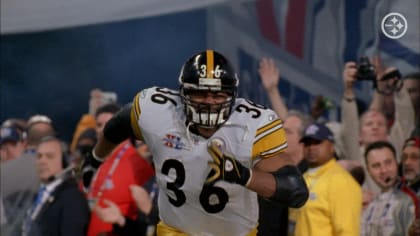
But the leading figure on the team was running back Jerome Bettis. "The Bus" was retiring after 13,662 rushing yards, 200 receptions for 1,449 yards, and 94 total touchdowns. And he was playing his last game in his hometown of Detroit.

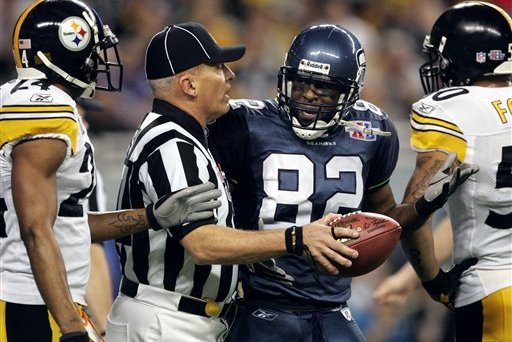
The Seahawks scored first, on a field goal by Josh Brown. They thought they had a touchdown on a 16-yard pass from Matt Hasselback to Darrell Jackson. But the officials called a penalty on Jackson for offensive pass interference, nullifying the score. The Seahawks and their fans were furious with this call, but replays showed it was correct.

The only score in the 2nd quarter was a 1-yard run by Roehtlisberger, and it was 7-3 Steelers at the half. Early in the 2nd half, Willie Parker broke off a 75-yard touchdown run to put the Steelers up 14-3. Hasselback threw a 16-yard touchdown pass to Jerramy Stevens, and the 3rd quarter ended with Seattle down just 14-10.

In the 4th quarter, Seattle right tackle Sean Locklear was called for holding Steelers linebacker Clark Haggans, nullifying a deep pass that would have put the Hawks in position to take the lead. Seattle and their fans were furious with this call as well, but, again, the replay proved the call to be correct. Also disputed was a penalty called on Hasselbeck for an illegal block below the waist, while making a tackle during Ike Taylor's interception return.

With 8:56 left in the game, the Steelers tried some trickery: A reverse got the ball to receiver Antwaan Randle El, who had been a quarterback at Indiana University. He threw an option pass to Hines Ward, who took it 43 yards for a touchdown. It was the 1st touchdown pass by a receiver in a Super Bowl, and it made the score 21-10 Pittsburgh. That score held, as good clock management on offense and strong defense got the Steelers their "One for the Thumb."

The retiring Bettis rushed 14 times for 43 yards. He did not score a touchdown, but he converted a key first down, and allowed his team to run time off the clock late in the 4th quarter.

The Seahawks had more 1st downs, 20-14; more net yards, 396-339; fewer turnovers, 2-1; and more time of possession, 33:02-26:58. It was argued that the difference was penalties: The Hawks were penalized 7 times for 70 yards; the Steelers, 3 times for 20 yards.

But there were also 2 questionable calls that hurt the Steelers, and these were equally justified by instant replay. It wasn't the officials that cost the Seahawks the game: It was the Steelers getting the job done that did that.

The Steelers won a 6th Super Bowl 3 years later. The Seahawks finally won their 1st Super Bowl in 2014. 

Monday, January 5, 2026

Deserve's Got Everything to Do With It: Super Bowl LX Edition

Little Bill Daggett (Gene Hackman): "I don't deserve this! To die like this!"
Will Munny (Clint Eastwood): "Deserve's got nothing to do with it!"
-- Unforgiven, 1992, directed by Eastwood

As I occasionally (but not annually) do, I am ranking Playoff teams by how much they, and their fanbases, deserve to win a World Championship. And I am casting baseball bias aside, so the Eagles won't be 1st. And -- this may shock you -- the Patriots won't be last, or even close to it.

14. Carolina Panthers, NFC South Division Champion, 4th Seed

May Deserve It Because: The Panthers are the only team on the NFC side that has never won a Super Bowl, and their fans have waited for 32 seasons.

May Not Deserve It Because: Not only are North Carolina and especially South Carolina Red States, but Charlotte is one of America's most conservative major cities. They're in the Playoffs because they won a Division title on a 2nd tiebreaker, and they're 8-9. A losing record. And who have they got that deserves a title? Andy Dalton? Be serious.

13. Los Angeles Chargers, AFC Wild-Card Berth, 7th Seed

May Deserve It Because: Los Angeles is a liberal city. After what it's gone through in the last year, it deserves a title. California is a Blue State. Of these 14 teams, they've gone the longest without a league title, since the 1963 AFL Championship. Khalil Mack deserves a title.

May Not Deserve It Because: The Dodgers just won the World Series for the 2nd straight year, so L.A. doesn't need another title that much. And team owner Dean Spanos abandoned San Diego. So they deserve it less than the Rams do.

If I thought that people in San Diego were still rooting for the Chargers, I might have them a little higher on the list. But a Super Bowl win for the Los Angeles Chargers would only remind San Diegans of what was taken from them. It won't be like when the Colorado Avalanche won the Stanley Cup in their 1st year in Denver, and then took the Cup back to Quebec City where they were the Quebec Nordiques, as a dubious reward for their former fans.

12. Los Angeles Rams, NFC Wild-Card Berth, 5th Seed

May Deserve It Because: Los Angeles is a liberal city. After what it's gone through in the last year, it deserves a title. California is a Blue State. Coach Sean McVay is a good guy. So are Matthew Stafford and Davante Adams.

May Not Deserve It Because: The won the Super Bowl just 4 years ago. And the Dodgers just won the World Series for the 2nd straight year, so L.A. doesn't need another title that much.

11. Pittsburgh Steelers, AFC North Division Champion, 4th Seed.

May Deserve It Because: Pittsburgh is a liberal city. And it's been 17 years since they won a title.

May Not Deserve It Because: Aaron Rodgers. That's it. That's all I need. Also Pennsylvania is a Red State. And as far back as that last title is, it was 1 of 6, which is more than most teams have. 

10. Green Bay Packers, NFC Wild-Card Berth, 7th Seed

May Deserve It Because: Um... they no longer have either Brett Favre or Aaron Rodgers? Lambeau Field is iconic. They're a classic NFL franchise. And their last title was 15 years ago.

May Not Deserve It Because: As far back as that last title is, it was 1 of 13, which is more than any team has. And aside from Micah Parsons, who deserved better than being a Dallas Cowboy, and is hurt, anyway, nobody really stands out as being very deserving. And Wisconsin became a Red State again, and Green Bay is a conservative part of the State.

9. Jacksonville Jaguars, AFC South Division Champion, 3rd Seed

May Deserve It Because: Like the Panthers, the Jags are in their 32nd season, and haven't yet won a title. They haven't even been to a Super Bowl yet. And their fans have had to suffer through incompetent ownership and the loss of home games to London. Trevor Lawrence is a good guy.

May Not Deserve It Because: Florida is not just a Red State, it's one of the rottenest Red States, and Jacksonville is part of the most conservative part of it. It might be the most conservative city with an NFL team. But that doesn't mean the players don't deserve it.

8. New England Patriots, AFC East Division Champion, 2nd Seed

May Deserve It Because: Boston is a liberal city. Massachusetts is a Blue State. New England is a liberal region. And these are not the Patriots of Bill Belichick and Tom Brady: There is no evidence of cheating. The Pats have a chance to build a champion which, as far we can tell, is clean.

May Not Deserve It Because: The Pats are still owned by Robert Kraft. And they have won it 6 times, most recently just 7 years ago. So even if they had won those titles fairly, it's a little soon. And who's their "Come on, root for him, he deserves it" guy? Stefon Diggs comes the closest.

7. San Francisco 49ers, NFC Wild-Card Berth, 6th Seed

May Deserve It Because: San Francisco is a liberal city. California is a Blue State. And it's been 31 years since they won a title.

May Not Deserve It Because: As far back as that last title is, it was 1 of 5, which is more than most teams have. And they abandoned San Francisco for suburban Santa Clara. Kevin McCaffrey and George Kittle might deserve a title, but that's not exactly an endorsement.

6. Philadelphia Eagles, NFC Eastern Division Champion, 3rd Seed

May Deserve It Because: Philadelphia is a liberal city. The Eagles are full of good guys, led by quarterback Jalen Hurts.

May Not Deserve It Because: Pennsylvania is a Red State. And the Eagles are the defending Champions, having won 2 and been to 3 of the last 8 Super Bowls. And the fans can be a little nuts.

5. Denver Broncos, AFC West Division Champion, 1st Seed

May Deserve It Because: Denver is a liberal city. Colorado is a Blue State.

May Not Deserve It Because: Head coach Sean Payton not only already has a ring, with New Orleans, but the shadow of "Bountygate" hangs over him. There's no "Let him win one" guy. And it's been only 10 years since the Broncos won a title.

4. Seattle Seahawks, NFC West Division Champion, 1st Seed

May Deserve It Because: Seattle is a liberal city. Washington is a Blue State. Sam Darnold is a good guy. And after their last Super Bowl appearance was sabotaged by their dumb coach, they deserve a chance at redemption.

May Not Deserve It Because: Those uniforms. Those horrid, horrid uniforms! Cooper Kupp is already a legend, but he's already got a ring, with the Rams. And while the 'Hawks have won a title, it wasn't that long ago: 12 years.

3. Houston Texans, AFC Wild-Card Berth, 5th Seed

May Deserve It Because: Alone among these 14 teams, the Texans have never even reached a Conference Championship Game. Houston's only league titles in football have been the 1st 2 AFL Championships, in 1960 and 1961, by the Oilers.

May Not Deserve It Because: Houston has 2 recent titles, by the Astros, ill-gotten. And they don't have a "He really deserves it" guy.

2. Chicago Bears, NFC North Division Champion, 2nd Seed

May Deserve It Because: Chicago is a liberal city. Illinois is a Blue State. They've got some good guys. They're a classic NFL franchise. And it's been 40 years.

May Not Deserve It Because: As far back as that last title is, it was 1 of 8, which is more than any team but the Packers have. And ownership is trying to abandon the City of Chicago, for either the O'Hare suburbs or Indiana.

1. Buffalo Bills, AFC Wild-Card Berth, 6th Seed

May Deserve It Because: The Longest-Suffering Fan Base, given that the Chargers abandoned San Diego. Indeed, in spite of the Bills winning the AFL Championship in 1964 and 1965, no Buffalo-based team has ever won a World Championship. No team from Western New York has won one since the 1955 Syracuse Nationals, unless you want to count the old NASL and women's soccer leagues as "major league." Josh Allen is a good guy. And Marv Levy is 100 years old: He deserves to at least see the Bills win the Super Bowl before he dies.

May Not Deserve It Because: There's always the chance that long-suffering sore losers could turn into bastard winners. And there's always the chance that bandwagoners might latch onto them, claiming they were always Bills fans, when their closet has Chiefs stuff in front of Patriots stuff in front of Cowboys stuff.

So, yes, the Buffalo Bills are the team that most deserves to win the Super Bowl.

Will they? Probably not. Some things never change.

Saturday, February 1, 2025

February 1, 2015: Pete Carroll Calls a Pass

February 1, 2015, 10 years ago: Super Bowl XLIX is played at University of Phoenix Stadium -- now named State Farm Stadium -- in the Phoenix suburb of Glendale, Arizona. Over 114 million viewers tuned in to NBC to watch it, making it the most-watched television program in American history.

The defending Champion Seattle Seahawks had a 10-point lead with 8 minutes left in regulation, and blew it. The New England Patriots took a 28-24 lead with 2:02 left. Quarterback Russell Wilson drove the Hawks to the Patriot 1-yard line with 26 seconds to go.

With the ball there, the call seemed obvious: A running play. Possibly Wilson on a quarterback sneak, like Bart Starr to win the 1967 NFL Championship Game, the Ice Bowl, for the Green Bay Packers. Or a handoff to Marshawn Lynch, the running back known as "Beast Mode," a 5-time Pro Bowler, who had already scored a touchdown in the game, and had gotten the ball 4 yards to the 1-yard line on the previous play.

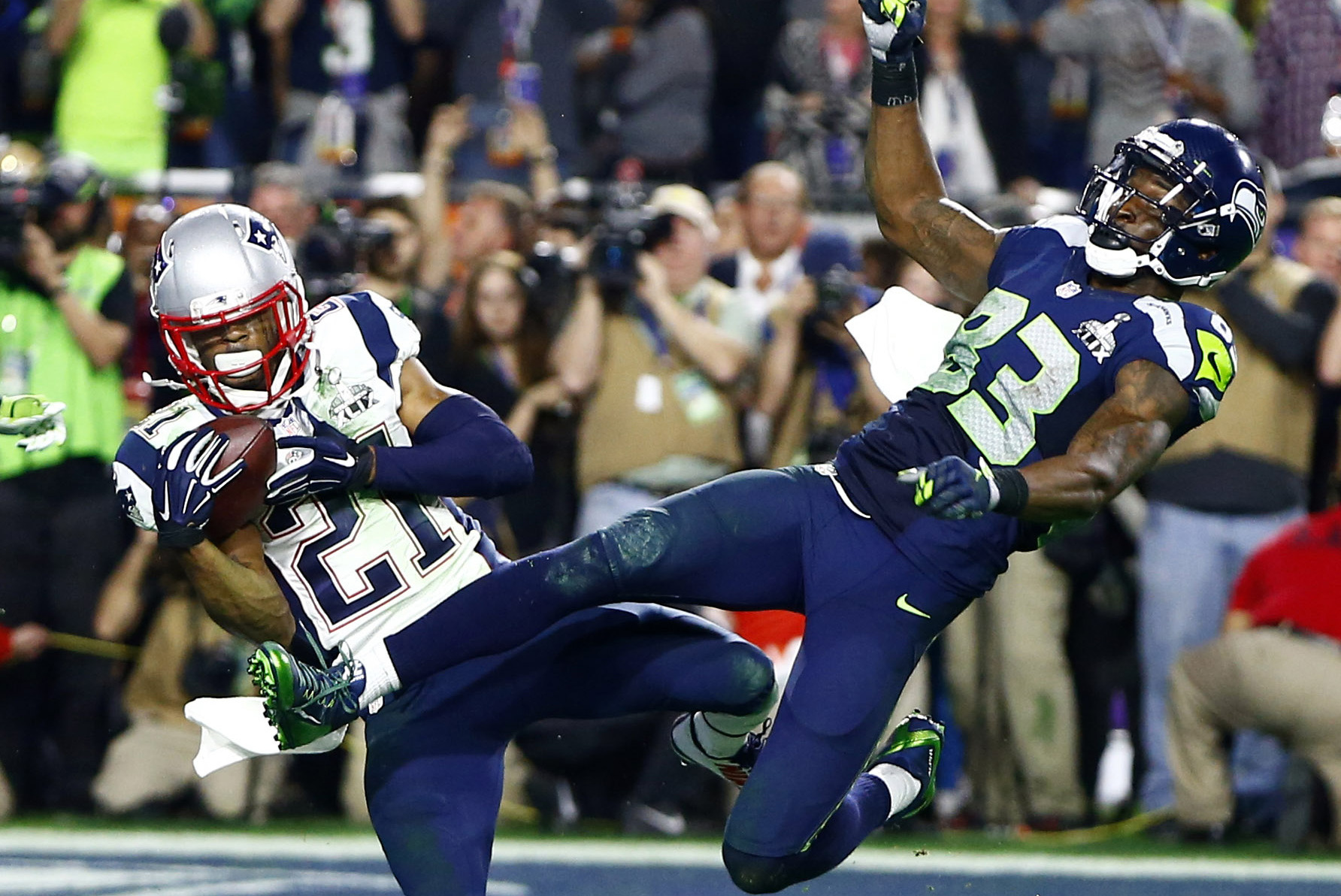
Instead, Seahawk head coach Pete Carroll called for a pass, from Wilson to Ricardo Lockette. Patriot cornerback Malcolm Butler correctly figured out that Lockette was the target, and intercepted the pass. The Patriots won the game.
It's hard to imagine now, with Ohio State University having had Heisman Trophy-winning quarterbacks and winning National Championships with a great passing game, but there was a time, in the 1960s and '70s, when their head coach was Woody Hayes. Famous for a running game described as "Three yards and a cloud of dust," he was known for hating the forward pass enough to say, "There are three things that can happen when you throw the ball, and two of them are bad." Meaning an incomplete pass and an interception.

Malcolm Butler clinched victory for the New England Patriots in Super Bowl XLIX with the most famous interception in football history.

Cris Collinsworth, a 3-time Pro Bowler who had played in Super Bowls XVI and XXIII for the Cincinnati Bengals, was broadcasting the game for NBC, and spoke for so many people watching:

I'm sorry, but I can't believe the call... You've got Marshawn Lynch in the backfield. You've got a guy that has been borderline unstoppable in this part of the field. I can't believe the call...

If I lose the Super Bowl because Marshawn Lynch can’t get it in from the 1-yard line, so be it. So be it! But there is no way.

He was absolutely right: You tell the other team, "Here he comes. Try to stop him." If they can't, that's expected, and you win. If they can, then they've earned their victory. To use an analogy from another sport, they've hit your best pitch.

Hall of Fame cornerback Deion Sanders, analyzing the game for CBS, called it "one of the worst calls in Super Bowl history." Peter King, the main football writer for Sports Illustrated, and a winner of the Pro Football Hall of Fame's Dick McCann Award for writers, used the exact same words: "one of the worst calls in Super Bowl history." Hall-of-Famer Emmitt Smith, the NFL's all-time leading rusher, went even further, calling it "the worst play call in the history of football."

So that's, effectively, 3 members of the Pro Football Hall of Fame, 3 guys who really know football -- one on offense, one on defense, and one watching from above -- saying it was a bad call, essentially blaming Pete Carroll for throwing away back-to-back wins in the Super Bowl, a rare achievement, and possibly Carroll's own eventual election to the Hall -- and maybe also Wilson's.

Is there any way to defend the call? Not really. Is there any way to say that Carroll shouldn't be blamed for the loss? Yes. Can any such way be taken seriously? Well, Wilson could have said, "This is a bad call. I'm calling a different play in the huddle." He could have shown the leadership that a great quarterback would show. He didn't.
We can also give Butler credit for pulling off the key play. Then there's the Seahawks' offense. Their 20 1st downs wasn't that bad, compared to the Pats' 25. But they were only 3-for-10 on 3rd down, compared to the Pats' 8-for-14. They also committed more penalties, 7-5, for twice as many yards, 70-36. And had less time of possession, 26:14 to 33:46.

It took them 20 minutes and 13 seconds to get their 1st score. Their last score came with 19 minutes and 54 seconds to go. They blew a 10-point lead, and they blew it with 8 minutes to go. Blowing a 10-point lead tied what was then a Super Bowl record. It would be eclipsed 2 years later by the Atlanta Falcons -- also against the Patriots. Hmmmm...

Did they cheat in this game? There has never been a serious accusation of it. But think of it this way: We have more proven instances of Belichick and/or Brady cheating, and the other benefiting from that cheating, than we have proven instances of them not cheating. So which is more likely: That these were the only times they cheated, or that they cheated in many more games?

In 2019, a poll ranked this game 8th on a list of the 100 Greatest Games of the NFL's 1st 100 years.

Lynch retired after the 2019 season. He becomes eligible for the Hall of Fame this week. Carroll and the Seahawks parted ways after the 2023 season. He is eligible for the Hall of Fame, but is not in. On January 24, 2025, he was named head coach of the Las Vegas Raiders.

In Seattle, he outlasted Wilson, whom he traded to the Denver Broncos in 2022. It was a disaster, and he was released after 2 years. For the 2024 season, he signed with the Pittsburgh Steelers. He was 7-2 in postseason games before Carroll called that pass, but has been 1-6 afterward.

On February 12, 2023, Super Bowl LVII broke this game's record for highest U.S. television audience: 115.1 million watched on Fox. The next year, on February 11, 2024, Super Bowl LVIII broke the record: 123.7 million watched on CBS. Both times, it was almost certainly due to the fact that millions of women and teenage girls, who wouldn't ordinarily have wanted to watch, wanted to see clips of singer Taylor Swift in the luxury boxes, cheering on her boyfriend, Travis Kelce, tight end for the victorious Kansas City Chiefs.

Friday, February 5, 2021

Top 5 Reasons You Can't Blame the Officials for the Seattle Seahawks Losing Super Bowl XL

February 5, 2006, 15 years ago: Super Bowl XL is played at Ford Field in Detroit. The Pittsburgh Steelers were going for their 5th Super Bowl win -- "One for the Thumb," as they put it back in 1980, but hadn't yet gotten. The Seattle Seahawks, in their 30th season, with only 1 previous appearance in a Conference Championship Game to their credit, were in their 1st Super Bowl.

The Steelers won the game, 21-10. But the statistics suggest that it shouldn't have ended that way. The Seahawks got 20 1st downs, the Steelers only 14. The Seahawks had 396 total yards, the Steelers 339. The Seahawks had the ball for 33 minutes, the Steelers for 27. (Well, 33:02 and 26:58, respectively.)

Seahawk fans have spent the last 15 years saying the officials gave the Steelers the game. They point to these calls: 

* With 2:08 left in the 1st quarter, and the game scoreless, Darrell Jackson appeared to have scored a touchdown on a 16-yard pass from Matt Hasselbeck. But he was called for offensive pass interference, by pushing off against Steeler safety Chris Hope. Four plays later, Josh Brown kicked a 47-yard field goal. That made it 3-0 Seattle.

* With 12:29 left in the 2nd quarter, and the score still 3-0 Seattle, Hasselback started from the Steelers' 47-yard line, and passed to Jerramy Stevens. Stevens appeared to have possession of the ball, and then fumble. But the officials ruled that he never had possession, nullifying the gain he might have made.

* With 12:35 left in the 4th quarter, and Pittsburgh leading 14-10, Hasselbeck completed a pass to Stevens, going for 18 yards, to the Steeler 1-yard line. But Seahawk offensive tackle was called for holding on linebacker Clark Haggans. So now it was 1st-and-20, and Hasselbeck was sacked by Casey Hampton on the next play. Then came a 7-yard run by Shaun Alexander.

* And on the play after Alexander's run, with 10:54 left in the game, the ball on the Steeler 27, and the Steelers still up by 4, Hasselbeck again tried to pass to Jackson, but was intercepted by cornerback Ike Taylor. On his return of the interception, Hasselback was penalized for an illegal block.

* The Steelers were flagged for only 3 penalties all game long, totaling just 20 yards. The Seahawks were flagged 7 times, for 70 yards. To put it another way, average yards per penalty: Seahawks 10, Steelers 6.67.

The next day, at a rally for the team at their stadium, Seahawks coach Mike Holmgren, who had previously led the Green Bay Packers into Super Bowls XXXI (won) and XXXII (lost), said at the team's rally, "We knew it was going to be tough going against the Pittsburgh Steelers. I didn't know we were going to have to play the guys in the striped shirts as well."

Jason Whitlock of the Kansas City Star and ESPN wrote, "Bill Leavy and his crew ruined Super Bowl XL. Am I the only one who would like to hear them defend their incompetence?"

Two days after the game, ESPN published a poll: Out of over 100,000 votes cast, 61 percent said that "officiating mistakes affected the outcome of Super Bowl XL."

In 2010, Leavy, the game's referee, admitted his mistakes:

It was a tough thing for me. I kicked two calls in the fourth quarter, and I impacted the game, and, as an official, you never want to do that. It left me with a lot of sleepless nights, and I think about it constantly. I'll go to my grave wishing that I'd been better...

I know that I did my best at that time, but it wasn't good enough...

When we make mistakes, you got to step up and own them. It's something that all officials have to deal with, but unfortunately when you have to deal with it in the Super Bowl it's difficult.

This seemed to confirm what every football fan in the Pacific Northwest wanted to believe: Their beloved 'Hawks got screwed by the officials.

What they wanted to believe was wrong.

Top 5 Reasons You Can't Blame the Officials for the Seattle Seahawks Losing Super Bowl XL

5. The Calls Went Both Ways. With 2:13 left in the 3rd quarter, and the Steelers up 14-10, the Seahawks started with the ball on their own 7-yard line. Hasselbeck ran around right end, and gained 8 yards before being tackled by Aaron Smith. The Steelers thought that Hasselbeck had fumbled, and that they had recovered. But the officials ruled that he was already out of bounds before losing the ball.

Had the Steelers gotten the call they wanted, they would have had the ball deep in Seattle territory. Instead, the Seahawks kept going, until the Taylor interception.

4. 5-for-17 on 3rd downs. A bad 3rd down conversion rate would also be a big reason why the Seahawks lost Super Bowl XLIX.

In the 1st quarter, they had a 3rd-and-9, and allowed Hasselbeck to get sacked. Still in the 1st, they had a 3rd-and-14. They were unlikely to convert anyway, but a false start penalty pushed them back further. They had a 3rd-and-6 in Pittsburgh territory, when Hasselbeck connected with Jackson for 18 yards, but it was called back for holding -- correctly. And all that was just in the 1st quarter.

In the 2nd quarter, they had a 3rd-and-2 in Pittsburgh territory, after Alexander had made 2 gains. Instead of giving him the ball again, Hasselbeck threw, and it fell incomplete. Later in the quarter, on 3rd-and-3, Hasselbeck completed a pass, but it went only 2 yards. In the last minute of the half, they had 3rd-and-6 in Pittsburgh territory, and Hasselbeck threw incomplete. The ensuing field goal attempt by Josh Brown was 54 yards, and missed.

Early in the 3rd quarter, with a 3rd-and-5 in Pittsburgh territory, Hasselbeck threw another bad pass, forcing Brown into another long attempt, 50 yards, also missed. With 6:36 to go, possibly enough time to make up the Steelers' 11-point lead, and with a 3rd-and-8 in Pittsburgh territory, Hasselbeck got sacked.

When Hasselbeck most needed to come through for his team, he didn't do a good job of it. As a result...

3. The Game Wasn't That Close. 21-10. Suppose the Darrell Jackson touchdown had been allowed to stand. Would that have changed the course of the game? Maybe. By enough? Maybe not. If that had been the only difference, the Steelers would still have won, 21-13.

2. The Steelers Were Better. Normally, "The opposition was better" would be Reason Number 1. Not this time, although the Steelers were a better team than the Seahawks. They went into the game favored by 4 points, won by 11, and held the Seahawks to 10 points.

That 10-point defensive performance had only been done, or bettered, in 14 of the previous 39 Super Bowls, and in only 3 of the 14 since. The Steel Curtain defense of the 1970s? They allowed the Minnesota Vikings 6 points in Super Bowl IX, the Dallas Cowboys 17 in Super Bowl X, the Cowboys 31 in Super Bowl XIII, and the Los Angeles Rams 19 in Super Bowl XIV.

In other words, what's usually regarded as the greatest defense in football history averaged, over 4 Super Bowls, 16 points per game. The Pittsburgh defense of 2005-06, led by Troy Polamalu, Casey Hampton, James Farrior and Joey Porter, bettered that by nearly a full touchdown.

1. The Officiating Wasn't Bad. Mike Pereira, then the NFL's Director of Officiating, and previously a referee in both the NFL and college ball, reviewed every play, and determined that all 7 of the penalties called against the Seahawks were correct. Referee Bill Leavy was right at the time, and wrong in his later confession.

VERDICT: Not Guilty. The reason the Seattle Seahawks lost Super Bowl XL is that they didn't get the job done, and that the Pittsburgh Steelers didn't let them.

Monday, February 1, 2021

Top 5 Reasons You Can't Blame Pete Carroll for the Seattle Seahawks Losing Super Bowl XLIX

February 1, 2015: Super Bowl XLIX is played at University of Phoenix Stadium -- now named State Farm Stadium -- in the Phoenix suburb of Glendale, Arizona. Over 114 million viewers tuned in to NBC to watch it, making it the most-watched television program in American history.

The defending Champion Seattle Seahawks had a 10-point lead with 8 minutes left in regulation, and blew it. The New England Patriots took a 28-24 lead with 2:02 left. Quarterback Russell Wilson drove the Hawks to the Patriot 1-yard line with 26 seconds to go.

With the ball there, the call seemed obvious: A running play. Possibly Wilson on a quarterback sneak, like Bart Starr to win the 1967 NFL Championship Game, the Ice Bowl, for the Green Bay Packers. Or a handoff to Marshawn Lynch, the running back known as "Beast Mode," a 5-time Pro Bowler, who had already scored a touchdown in the game, and had gotten the ball 4 yards to the 1-yard line on the previous play.

Instead, Seahawk head coach Pete Carroll called for a pass, from Wilson to Ricardo Lockette. Patriot cornerback Malcolm Butler correctly figured out that Lockette was the target, and intercepted the pass. The Patriots won the game.
It's hard to imagine now, with Ohio State University having had Heisman Trophy-winning quarterbacks and winning National Championships with a great passing game, but there was a time, in the 1960s and '70s, when their head coach was Woody Hayes. Famous for a running game described as "Three yards and a cloud of dust," he was known for hating the forward pass enough to say, "There are three things that can happen when you throw the ball, and two of them are bad." Meaning an incomplete pass and an interception.

Malcolm Butler clinched victory for the New England Patriots in Super Bowl XLIX with the most famous interception in football history.

Cris Collinsworth, a 3-time Pro Bowler who had played in Super Bowls XVI and XXIII for the Cincinnati Bengals, was broadcasting the game for NBC, and spoke for so many people watching:

I'm sorry, but I can't believe the call... You've got Marshawn Lynch in the backfield. You've got a guy that has been borderline unstoppable in this part of the field. I can't believe the call...

If I lose the Super Bowl because Marshawn Lynch can’t get it in from the 1-yard line, so be it. So be it! But there is no way.

Hall of Fame cornerback Deion Sanders, analyzing the game for CBS, called it "one of the worst calls in Super Bowl history." Peter King, the main football writer for Sports Illustrated, and a winner of the Pro Football Hall of Fame's Dick McCann Award for writers, used the exact same words: "one of the worst calls in Super Bowl history." Hall-of-Famer Emmitt Smith, the NFL's all-time leading rusher, went even further, calling it "the worst play call in the history of football."

So that's, effectively, 3 members of the Pro Football Hall of Fame, 3 guys who really know football -- one on offense, one on defense, and one watching from above -- saying it was a bad call, essentially blaming Pete Carroll for throwing away back-to-back wins in the Super Bowl, a rare achievement, and possibly Carroll's own eventual election to the Hall.

Is there any way to defend the call? Not really.

Is there any way to say that Carroll shouldn't be blamed for the loss? Yes. Can any such way be taken seriously? Read on:

Top 5 Reasons You Can't Blame Pete Carroll for the Seattle Seahawks Losing Super Bowl XLIX

5. Pete Carroll. He got the Seahawks into that Super Bowl. And into the one the year before, and won it. He, Jimmy Johnson and Barry Switzer are the only head coaches to win both an NCAA National Championship and an NFL Championship (either before or during the Super Bowl era, 1967 onward).

Did he make a mistake with that play-call? Almost certainly. But he got them to within 1 play of back-to-back Super Bowl wins. Here's all the head coaches who have reached back-to-back Super Bowls: Vince Lombardi, Tom Landry, Don Shula, Bud Grant, Chuck Noll, Joe Gibbs, Dan Reeves, Marv Levy, Jimmy Johnson, Mike Holmgren, Mike Shanahan, Bill Belichick and Pete Carroll. 

That's 13 guys. Of those, just 10 won at least 1 of them: Lombardi, Landry, Shula, Noll, Gibbs, Johnson, Holmgren, Shanahan, Belichick and Carroll. Both of them? 6: Lombardi, Shula, Noll, Johnson, Shanahan and Belichick.

Going back to the pre-Super Bowl era, back-to-back NFL Championship Games were also won by George Halas, Greasy Neale, Buddy Parker, Paul Brown and Weeb Ewbank. So, 11 guys since 1932. That should give you and idea of how hard it is.

(No, Bill Walsh never did it. Only once have the San Francisco 49ers made back-to-back Super Bowls: In 1988-89, Walsh's last season as head coach; and 1989-90, George Seifert's first.)

Pete Carroll got the Seattle Seahawks to within one yard of back-to-back World Championships. They would not have gotten that far without him.

4. Russell Wilson. He threw the pass. He also could have said, "This is a bad call. I'm calling a different play in the huddle." He could have shown the leadership that a great quarterback would show. He didn't.
3. Malcolm Butler. He made the interception. Give him credit for pulling off the key play.

2. The Seahawks Offense. Their 20 1st downs wasn't that bad, compared to the Pats' 25. But they were only 3-for-10 on 3rd down, compared to the Pats' 8-for-14. They also committed more penalties, 7-5, for twice as many yards, 70-36. And had less time of possession, 26:14 to 33:46.

It took them 20 minutes and 13 seconds to get their 1st score. Their last score came with 19 minutes and 54 seconds to go. They blew a 10-point lead, and they blew it with 8 minutes to go. Blowing a 10-point lead tied what was then a Super Bowl record.

It would be eclipsed 2 years later by the Atlanta Falcons -- also against the Patriots. Hmmmm...

1. The Patriots Cheated. We don't actually know that the Patriots cheated at any point in the 2014-15 NFL season, much less in this Super Bowl. We only know that they have been caught cheating multiple times. They have forfeited the presumption of innocence.

So we have heard the case for the prosecution, and we have heard the case for the defense. It's time to decide.

VERDICT: Guilty. Going over the Top 5 Reasons again:

5. It doesn't matter what Carroll did before, only what he did at the moment in question.

4. Wilson was following orders. If he had disobeyed that order, and run the ball, and had gotten stopped, he would have been blamed for losing the Super Bowl, in spite of the fact that he had won one just the year before. If there's one thing the powers that be in the NFL value more than money, it's control.

If Wilson had rebelled, and gotten it right, he could be headed for the Hall of Fame. But if he had rebelled, and gotten it wrong, they could have made bullshit stuff up about him, as has been made about countless players, including quarterbacks (and not always as brazen as what was said about Colin Kaepernick), and he could have been run out of the game.

3. Butler wouldn't have intercepted the pass if Carroll hadn't called it.

2. The Seahawks' offense put themselves in position to win the game. Granted, this would seem to contradict the rebuttal to Reason Number 5. But it does emphasize the fact that Carroll blew it.

1. If Carroll had made the right call, it wouldn't have mattered if the Patriots cheated: The Seahawks would have won anyway.

Yes, the New England Patriots have cheated their way to 6 Super Bowl wins in the 22 seasons that they have been coached by Bill Belichick. But they have also failed to win the Super Bowl 16 times, including losing the Super Bowl 3 times: XLII and XLVI to the New York Giants, and LII to the Philadelphia Eagles.

It is possible to beat the Patriots, even when they cheat. Carroll had a great chance to do so. He didn't. He is to blame for that.

Sunday, September 13, 2020

Top 5 American Sports Rivalries That Make No Sense

Last night, the New York Red Bulls (or, to be more corporately accurate, "Red Bull New York") went down to Washington, and beat D.C. United, 2-0.

Is that a big deal? I mean, any more than any other win? It shouldn't be. It's 230 miles from Times Square in Midtown Manhattan to downtown Washington, and 221 miles from Red Bull Arena in Harrison, New Jersey to Audi Field in Southwest Washington.

To some, this rivalry may make sense geographically. But hold on: There are not one, not two, but three Major League Soccer teams closer to Red Bull Arena than are DCU: The New England Revolution, at Gillette Stadium in Foxborough, Massachusetts, 215 miles; the Philadelphia Union, at Subaru Park (formerly Talen Energy Stadium and PPL Park) in Chester, Pennsylvania, 104 miles; and, easy enough to guess, New York City FC, still playing "home" games at the new Yankee Stadium in The Bronx, just 21 miles (although, with traffic, especially over the George Washington Bridge, it could take over an hour).

So why are DCU the Red Bulls' arch-rivals? Why do "Metro" (short for the team's name from 1996 to 2005, the New York/New Jersey MetroStars) fans treat DCU the way college teams treat their arch-rivals? Why is the week leading up to the game "Hate DC Week"?

Top 5 American Sports Rivalries That Make No Sense

Note: All distances given are between each team's current home venues. Where they may have played at the times of the rivalry's biggest moments, if not the same, is not relevant for this discussion. And all win totals are current as of last night's RBNY-DCU game.

5. Red Bull New York vs. D.C. United
Began: 1996, with the founding of Major League Soccer
Really Began: Same time
Distance: 221 miles
All-Time Series: DCU 44, RBNY 36 (counting last night's win), 17 draws
Trophy: Atlantic Cup, DCU lead 12-11, although RBNY have won the last 3
Playoff Games: DCU 8, RBNY 3, 3 draws

In no other sport is New York vs. Washington a real rivalry. The Yankees and the Washington Senators were never rivals. The Mets and the Washington Nationals have only been playing each other since 2005, when the former Montreal Expos moved to the District of Columbia.

The New York Giants and the Washington Football Team (formerly the Washington Redskins) have been playing each other, and always in the same Division (under various names), since 1937. But both teams have bigger rivalries: The Giants with the Philadelphia Eagles, and the WFT with the Dallas Cowboys (which I'll get to later).

The New York Jets aren't in the same Conference, let alone the same Division, so they don't care about Washington at all, except on those rare occasions when they play each other. But Giant fans take no special pleasure when Washington lose, unless it means the Giants get closer to winning the NFC Eastern Division. And that wouldn't affect Jet fans at all.

The New York Knicks and the Washington Wizards have been playing each other since 1963 (the DC team was the Baltimore Bullets until 1973, then the Washington Bullets until 1997). But, aside from the late 1960s and the early 1970s, when it was New York vs. Baltimore, there has never been much of a rivalry between them. And the team now known as the Brooklyn Nets have been playing them since 1976, with no animus toward them.

As for hockey, the Washington Capitals have had some memorable Playoff matchups with the locals, playing the Rangers in 9 series, the Islanders 8 (including losing to the Isles last month), and the Devils 2. But they don't consider any of those teams their rivals. They'd rather beat the Philadelphia Flyers or the Pittsburgh Penguins.

Even in college sports, there isn't much of a rivalry: St. John's vs. Georgetown was a huge basketball matchup in the Big East Conference in the mid-1980s, but that didn't last long: It was big on quality, but short on quantity. And St. John's discontinued football in 2002.

New York City FC? They have but one rival, and that's the Red Bulls. Maybe two rivals, if you count the New York City government, which isn't willing to build them a stadium. Maybe three, if you count the Yankees, who have forced them out of Yankee Stadium for 3 separate home games.

So, why RBNY vs. DCU? Because, when MLS was founded in 1996, there were only 3 teams in the Northeast: Those 2, and the New England Revolution. One would think that New York vs. Boston would become MLS' big rivalry, due to the Yankees-Red Sox, Jets-Patriots, Knicks-Celtics and Rangers-Bruins rivalries.

But DCU won 3 of the 1st 4 MLS Cups, and 4 of the 1st 9, establishing themselves as the league's dominant team in its first period. And they dominated the MetroStars as well. Metro fans got jealous, and they got nasty. Eventually, DCU began to decline. With the opening of Red Bull Arena in 2010, Metro got better. Not until 2014 would RBNY beat DCU in a Playoff game (which are sometimes two-legged "ties"), and not until 2015 would RBNY knock DCU out of the Playoffs.

Also with the opening of RBA, Metro fans began to point out the difference in the stadiums: RBA was new and soccer-specific, while Robert F. Kennedy Stadium, built in 1961 as a multipurpose facility, was not well-maintained. There were jokes about rats, and, to the tune of "London Bridge," Metro fans sang, "RFK is falling down!" That came to an end with DCU's 2018 move into the soccer-specific Audi Field.

It's not all on Metro's side. DCU fans would still rather beat them than Philly, New England, or the other New York. This may only be the 25th season of Major League Soccer, but there is some history there.

4. San Francisco 49ers vs. Seattle Seahawks
Began: 1976, with the founding of the Seahawks
Really Began: 2002, with the move of the Seahawks to the NFC West
Distance: 834 miles
All-Time Series: Seattle 25, San Francisco 17, no ties
Trophy: None
Playoff Games: Seattle 1, San Francisco 0

From the Seahawks' debut in 1976 until 2001, 25 years, this matchup only happened 6 times. Then, in 2002, came realignment, and the Seahawks were moved out of the AFC West into the NFC West. Suddenly, with the 49ers-Rams rivalry on hold because the Rams were in St. Louis, out of the traditional Northern California vs. Southern California hatred, the Niners had a real rival again.

Except, this one doesn't make sense, not even geographically. Since when are San Francisco and Seattle rivals? Okay, there's the whole tech thing: Seattle's Microsoft would not have been possible without the Silicon Valley around San Jose, which is part of the San Francisco Bay Area, where the 49ers moved when Levi's Stadium opened in Santa Clara in 2014.

But is that a reason for the fans of the respective cities to hate each other? St. Louis and Milwaukee are the nation's 2 major beer brewing centers, but they don't hate each other. Even when the St. Louis Cardinals and the Milwaukee Brewers faced each other in the 1982 World Series, there were a few "Suds Series" jokes, but they didn't hate each other. Since 1998, the Cards and the Brew Crew have been in the National League Central Division together, but both teams' fans hate the Chicago Cubs more. (Those 2 rivlries, at least, make geographical sense.)

Is there any other pair of cities that hate each other because they're industry rivals? San Diego and Seattle don't hate each other because they're both Navy cities. (Maybe if Norfolk, Virginia had a team.) New York and Atlanta don't like each other, but it's not because Atlanta has CNN's headquarters and nearly every other network is based in New York.

Boston and Philadelphia both have Revolutionary War connections, but the history they care about now is mainly their sports history against each other. You don't see too many Philadelphians bragging that Ben Franklin couldn't stand Boston so he left for Philly (even though that's true).

It is true that the Seahawks have usually been good since their move to the NFC West, and that the 49ers have had their moments since then. But, aside from the 2013 NFC Championship Game, won by the 'Hawks, this matchup has usually not meant very much.

Finally, once the Rams moved back to the Los Angeles area for the 2016 season, that automatically restored them to their 1950 to 1994 position as the 49ers' arch-rivals. Seahawk fans may still hate the 49ers more than any other team, but the feeling is not mutual.

3. University of Notre Dame vs. University of Southern California (hereafter referred to as "USC")
Began: 1926
Really Began: 1964, with a nationally-televised classic
Distance: 2,099 miles
All-Time Series: ND 47, USC 36, 5 ties
Trophy: Jeweled Shillelagh, ND 32, USC 29, 3 ties
Playoff/Bowl Games: None so far

That Knute Rockne, who had already built Notre Dame into one of the most successful college football programs in the country in the 1920s, would want to test his team against another of the sport's great programs, as USC had become under Howard Jones (who had previously coached at the University of Iowa and was a friend of Rockne's), is not a surprise. That it became an annual rivalry, especially given the distance involved and in the age before jet flights, is very much a surprise.

But, thanks to a discussion between Mrs. Rockne and the wife of USC athletic director Gwynn Wilson, it happened. Since that time, each program has gotten much bigger. It could be argued that these are the 2 most successful college football programs ever, although University of Alabama fans could legitimately dispute that, and fans of Ohio State, Michigan, Oklahoma and Texas would probably also like a word.

The modern era of the rivalry began in 1964, with a huge game, nationally telecast. Ara Parseghian and Notre Dame went into the Los Angeles Coliseum undefeated and 11-point favorites, with the eventual Heisman Trophy winner, John Huarte, at quarterback. But John McKay led the Trojans back from 17-0 to beat the Fighting Irish 20-17, with running back Mike Garrett leading them to the National Championship, and succeeding Huarte as Heisman winner the following year.

Since then, it's been back and forth, with the teams switching off periods of dominance. Due to the weather, it's played in midseason when Notre Dame has the home field advantage in South Bend, Indiana, in odd-numbered years, broadcast on NBC, which has an exclusive contract with Notre Dame for home games; while when USC has it, in even-numbered years, it's played on the Saturday of Thanksgiving Weekend, broadcast on ABC, which has the Pac-12 package.

Yes, it's a great spectacle. But it makes no sense geographically: There is no other intersectional college football rivalry that approaches this one. And it's been a while since both teams were serious national title contenders at the same time, making it make less sense competitively, too.

I should also point out that this rivalry only exists in football. USC doesn't have a great basketball program. Notre Dame's never really been great at the sport, although they've had their moments.

Even so, they've got a bigger rivalry with the other major Los Angeles school, USC's local rivals, the University of California at Los Angeles. When UCLA had its 88-game winning streak of 1971 to 1974, still a men's collegiate record, Notre Dame was both the last and the next team to beat them.

2. Philadelphia Eagles vs. Dallas Cowboys
Began: 1960, with the founding of the Cowboys
Really Began: 1967, with an incident detailed below
Distance: 1,480 miles
All-Time Series: Dallas 69, Philadelphia 53, no ties
Trophy: None
Playoff Games: Dallas 3, Philadelphia 1

In 1960, the NFL added the Dallas Cowboys as an expansion team, and the Philadelphia Eagles won the Championship. The following season, the NFL added the Minnesota Vikings as an expansion team, and placed them in the Western Division. That made sense. They decided to move a team from the Western Division to the Eastern Division. That made sense. They should have moved the Baltimore Colts, who were in the West despite being further east than 4 of the 6 teams then in the West.

Instead, it was the Cowboys who got moved to the East, despite being further west than only 2 teams in the entire League. And so, every year, the Cowboys and Eagles have played each other twice in the regular season: At Franklin Field on the University of Pennsylvania campus and the Cotton Bowl in Dallas from 1961 to 1970, at Veterans Stadium in South Philadelphia from 1971 to 2002, at Texas Stadium in suburban Irving from 1971 to 2008, at Lincoln Financial Field in South Philadelphia since 2003, and at AT&T Stadium in suburban Arlington since 2009.

On December 10, 1967, at the Cotton Bowl, the Cowboys, on their way to the NFL Championship Game, were leading 31-3 in the 4th quarter, when their linebacker Lee Roy Jordan gave a forearm shiver to Eagles running back Timmy Brown, knocking out a number of his teeth, depending on who you talked to. The newspapers at the time said it was 4. Until his death earlier this year, Brown said it was 9. Clearly, the viciousness of the hit was unnecessary, and the Cowboys won the game, 38-17.

This began a string of 12 straight wins in the series for the Cowboys, and 23 out of 25. Dick Vermeil became Eagles head coach in 1976, and, noting the Cowboys' dominance over not just the Eagles, but the entire Division, now known as the NFC East, made beating the Cowboys the team's 1st big goal. They accomplished this on ABC Monday Night Football in 1979, and then beat the Cowboys at the Vet in the 1980 NFC Championship Game. After nearly 40 years, it is still one of the most treasured victories for Eagle fans.

Dallas has had the Strikebreakers of 1987, and has knocked the Eagles out of the Playoffs in the seasons of 1992, 1995 and 2009. For Philly, there's been revenge for the Strikebreakers in 1987; the Bounty Bowls of 1989, one of them a 27-0 Eagles win in Irving on Thanksgiving; the snowballs thrown at Jimmy Johnson in 1993; the 4th & 1 Twice Game in 1995; the Eagle fans' cheering of Michael Irvin's career-ending injury in 1999; Roy Williams' illegal horse-collar tackle of Terrell Owens in 2004, before T.O., already with a reputation for disrespecting the Cowboys, became a Cowboy himself; and a Thanksgiving win by the Eagles in Arlington in 2014.

Through it all, as WIP morning show host Angelo Cataldi says he's seen -- and has often led -- "I've seen fathers with sons, three or four years old, and they know four, five, or six words, and two of those words, taught to them by their fathers, are, 'Dallas Sucks!'"

The New York Giants are just 95 miles away from The Linc. The Washington Football Team, 130 miles. The Pittsburgh Steelers, 312 miles. The Giants and the WFT are in the same Division as the Eagles, the Steelers not but in the same State.

Still, if you told Eagle fans they would go 2-14, but they could choose their 2 wins, they would both be over the Cowboys.

1. Washington Football Team vs. Dallas Cowboys
Began: 1960, with the founding of the Cowboys
Really Began: 1971, with details below
Distance: 1,480 miles
All-Time Series: Dallas 73, Washington 45, 2 ties
Trophy: None
Playoff Games: Washington 2, Dallas 0

In 1959, when Clint Murchison, leading the group that owned the Cowboys franchise, wanted entry into the NFL, a unanimous vote of the 12 established owners was required to admit them. The Washington Redskins' owner, George Preston Marshall, refused.

Marshall also owned the team's radio network. (The NFL was already negotiating TV rights separately.) As the Southernmost team in the League at the time, he was marketing the 'Skins as the South's team. The Redskins were also the last NFL team that hadn't yet racially integrated. These facts are connected. Marshall didn't want to give up his Southern status.

So Murchison pulled a dirty trick: He bought the rights to the fight song, "Hail to the Redskins." He told Marshall that if he wanted the right to ever play the song at his games again, he would have to vote to admit the Cowboys. Certainly, as an oilman, Murchison could not be bought with mere money. (Marshall was rich, but not that rich.) Not wanting to lose the NFL's best-known fight song (even more than "Bear Down, Chicago Bears,"), Marshall caved: He got the rights to the song, and Murchison got his admittance into the NFL.

In 1971, George Allen was named head coach of the Redskins. He knew that, in the newly-merged-and-realigned NFL, the Cowboys were well-positioned to dominate the NFC East. And, as a former coach of the Los Angeles Rams, he was already sick of the Cowboys for their success since 1966. So he made it his mission to beat the Cowboys, more than it was to win a title.

He made his players hate the Cowboys as much as he did. As Cowboy defensive end Harvey Martin said in an interview about the rivalry -- with some irony, given that the Cowboys played in the city where John F. Kennedy was assassinated, and that the Redskins' stadium was now named for JFK's assassinated brother, Robert F. Kennedy, "When you go to play the Redskins, you better have your guns on." The apotheosis of this was the Redskins' win over the Cowboys on New Year's Eve 1972, in the NFC Championship Game.

The contrast between the head coaches was remarkable. Cowboys coach Tom Landry was always described as stoic, never using his face to betray his emotions. Allen was one of the most emotional head coaches in NFL history. However, when Joe Gibbs became Redskins coach in 1981, he was less emotional than Allen, but more successful. He beat the Cowboys in the 1982 NFC Championship Game, sparking a run of 10 seasons in which the Redskins reached 4 Super Bowls, winning 3. The Cowboys won 2 out of 5 in 9 years before that, and would win 3 out of 3 in 4 years after that.

Biggest Event: They've face each other in 2 NFC Championship Games: 1972 and 1982, both times as RFK Stadium. The Redskins have won them both, and each time, faced the Miami Dolphins in the Super Bowl, losing in VII and winning in XVII.

The Redskins finally bowed to anti-racist pressure this calendar year, and will operate the 2020 season as "The Washington Football Team" until they decide on a new name. Ironically, "Cowboys" also has racial connotations, although few people know it. There was a strong black presence in the Wild West, and so there were "cowboys," and their white bosses, "cattlemen."
Wednesday, June 20, 2018

Seattle's 10 Greatest Teams

This week, the Yankees are hosting the Seattle Mariners.

Seattle's 10 Greatest Teams

Honorable Mention to the University of Washington Huskies. Their football team were awarded shares of the National Championship in 1960 and 1991, and has won the league now known as the Pacific-12 16 times, most recently in 2016. They've won 7 Rose Bowls, most recently in 2000.

Their basketball team has won the league 15 times in the regular season, and 3 times in the postseason tournament, and reached the NCAA Final Four in 1953.

Washington State University is all the way across the State, in Pullman, just a 10-minute drive from the Idaho State Line, so I won't count them here.

Honorable Mention to the 1983-88 Seattle Seahawks. The 'Hawks began play in 1976, and first reached the Playoffs in 1983, stunning the Denver Broncos at the Kingdome and the Miami Dolphins at the Orange Bowl, before falling to the Los Angeles Raiders at the Coliseum in the AFC Championship Game.

They won another Wild Card berth in 1984, beating the Raiders at the Kingdome, before the Dolphins got revenge. After missing the Playoffs the next 2 seasons, despite a 10-6 record in 1986, they reached the Wild Card in 1987, losing a Playoff game in overtime to the Houston Oilers. In 1988, they won their 1st Division title, then in the AFC West, but lost to the Cincinnati Bengals in the Divisional Playoffs. They made the Playoffs only once in the next 14 years

Honorable Mention to the 1999 Seattle Seahawks. The last team to play a home game in the Kingdome, they were only 9-7, but, as in 1988, it was enough to win the AFC West. But they lost the Dome's last sporting event, a Divisional Playoff to the Dolphins.

10. 1976-82 Seattle Sounders. One of the leading teams of the old North American Soccer League, they reached the Western Division Final in 1976, then won it in 1977, to reach the Soccer Bowl. But their luck was bad: Not only did they have to face the mighty New York Cosmos, but they had to do so at a neutral site -- Civic Stadium (now Providence Park), home of their own arch-rivals, the Portland Timbers. They lost.

They won regular-season Division titles in 1980 and 1982, and reached the Soccer Bowl again in 1982, but, again, smacked into the Cosmos. They missed the Playoffs in 1983, and then folded, but the team's name would be revived in later leagues.

9. 1995-97 Seattle Mariners. The Mariners, founded in 1977, never had a winning record until 1991, and didn't reach their 1st Playoff berth until 1995. Famously, they came from well behind the California Angels in the American League Western Division, beat the Angels in a 1-game Playoff for the Division title, and then came from 2-0 down to beat the Yankees in a raucous 5-game AL Division Series that convinced fans to approve the bond issue that would build Safeco Field, and thus saved Major League Baseball in the Pacific Northwest.

But the M's were beaten in the AL Championship Series by the Cleveland Indians. After a close 2nd place in 1996, they won the West again in 1997, but were defeated in the ALDS by the Baltimore Orioles. By the time they got back to the Playoffs in 2000, it was a very different team: No more Ken Griffey Jr., no more Randy Johnson, no more Tino Martinez... but also no more Kingdome, into a real ballpark.

8. 2000-01 Seattle Mariners. After 2 years of mediocrity, the M's bounced back, winning 91 games and taking the AL Wild Card in 2000. They beat the Chicago White Sox in the ALDS, and then took the Yankees to 6 games in the ALCS.

In 2001, they dominated the AL, putting together a season that reminded many of the 1986 Mets. Even in June, people were signing on to Internet chat rooms with the screen name "Seattle Mariners 2001 World Champs." And they did tie the all-time single-season MLB record, set by the 1906 Chicago Cubs, of 116 wins in a season, breaking the AL record of 114 set by the Yankees 3 years before.

But the best-laid plans of mice and Mariners went astray. They nearly got torpedoed by the Indians in the ALDS. As with the Yankees 6 years earlier, the M's had to come from 2-0 back to win the series. But the Yankees humiliated them in 5 games in the ALCS. The most-hyped team in Seattle sports history was a spectacular failure.

Despite winning 93 games in each of the next 2 seasons, the Mariners haven't been back to the postseason since -- now the longest postseason drought of any team in the "Big Four" sports (MLB, NFL, NBA and NHL).

7. 2003-07 Seattle Seahawks. Mike Holmgren tried to replicate his success with the Green Bay Packers at the stadium now named CenturyLink Field. He got the 'Hawks to the Playoffs in 2003, but lost in the 1st round in overtime -- ironically, to the Packers.

He led the 'Hawks to the next 4 NFC Western Division titles. In the 2005 season, he got them all the way to their 1st Conference Championship, beating the Washington Redskins and the Carolina Panthers along the way. But they lost Super Bowl XL to the Pittsburgh Steelers. This was followed by Playoff losses to the Chicago Bears in overtime and again to the Packers, and then it was over.

6. 1992-98 Seattle SuperSonics. The last great Sonics team (really, only the 2nd) won 7 Playoff series in 8 seasons, and won the 1996 Western Conference Championship. Unfortunately, this team is best known for 2 series they lost: The 1994 1st Round series, in which the Denver Nuggets became the 1st 8th seed to beat a 1st seed; and the 1996 NBA Finals, in which the 72-10 Chicago Bulls completed their destiny.

After winning a series in each of the next 2 seasons, the team began to break up, as egos and salary demands got out of control, especially considering they hadn't won a title. After 1998, the Sonics won only 1 more Playoff series, in 2005, and were sold, and were moved out of town after the 2007-08 season.

Will they ever return? It's not impossible, but after teases the last few years with the Los Angeles Clippers and the Sacramento Kings, it might not be within the next 5 years.

5. 2004-10 Seattle Storm. One of the leading teams of the WNBA, they won the Championship in 2004, coached by Anne Donovan, who died last week. They beat the Connecticut Sun in the Finals. They then made the Western Conference Semifinals every year through 2009, but couldn't get over the hump until 2010, under coach Brian Agler, going 7-0 in the Playoffs against the Los Angeles Sparks, the Phoenix Mercury, and finally 3-0 against the Atlanta Dream to take the title.

They have usually been a Playoff team since, but have yet to return to the WNBA Finals.

4. 2014-17 Seattle Sounders. Reborn in Major League Soccer, the Sounders won the U.S. Open Cup, the American equivalent of England's FA Cup, in 2009, 2010 and 2011. But they came into their own in 2014, winning the Cup again, and also taking the Supporters' Shield, the regular-season MLS title. They reached the MLS Cup Final in 2016 and 2017, facing Toronto FC each time, winning the 1st and losing the 2nd.

3. 1915-24 Seattle Metropolitans. Seattle's 1st professional hockey team lasted 9 seasons, making the Pacific Coast Hockey Association playoffs 7 times. In 1917, they won the title, then beat the National Hockey Association Champions, the Montreal Canadiens, to become the 1st American-based team to win the Stanley Cup. And the 1st Seattle-based team that could legitimately be called "World Champions."

They lost the PCHA Final to the Vancouver Millionaires in 1918, then beat them in 1919, setting up a rematch with the Canadiens. But the Spanish Flu epidemic cut the series short, and the Cup was not awarded. They were PCHA Champions again in 1920, but lost the Stanley Cup Finals to the Ottawa Senators. They then lost the PCHA Final to Vancouver in 1921, 1922 and 1924, before folding.

2. 1974-84 Seattle SuperSonics. The 1st Seattle-based team in major league sports in the modern era, the Sonics were founded in 1967, and struggled for 4 seasons, before going 47-35 in their 5th season, 1971-72. But that wasn't enough to make the NBA Playoffs that season.

In 1975, they reached and won a Playoff series for the 1st time. In 1978, they got all the way to the NBA Finals, before losing Game 7 to the Washington Bullets. In 1978-79, they took no prisoners, and avenged their loss to the Bullets to take their 1st NBA Championship.

There would not be a 2nd. They made the Playoffs 3 of the next 4 years, but didn't make the NBA Finals, and tailed off.

1. 2010-17 Seattle Seahawks. Pete Carroll has a problem with the 'Hawks that he didn't have at USC: The NFL has a salary cap.

Okay, bad joke. But in 2010, his 1st season in charge, he made the 'Hawks the 1st team ever to make the NFL Playoffs with a losing record, as their 7-9, with a tiebreaker, made them NFC West Champions. And then they justified their place in the Playoffs by beating the New Orleans Saints.

They missed the Playoffs in 2011, but made it in 2012, beating the Redskins before losing to the Atlanta Falcons. In the 2013 season, the Seahawks finally fulfilled their destiny. They went 13-3, won the West, beat the Saints, won the NFC Championship by beating their alleged new arch-rivals, the San Francisco 49ers, and then came to the Meadowlands for Super Bowl XLVIII, and demolished the Denver Broncos.

They won the West again in 2014, beating the Panthers and the Packers to reach Super Bowl XLIX. But Carroll called a pass play on the 1-yard line, and you know the rest. The 'Hawks won Playoff games again in 2015 and 2016, but missed in 2017. They have since seen some of their best players leave, and it remains to be seen if Carroll can add to the legacy of Seattle's most successful sports run.