Showing posts with label seattle. Show all posts

Sunday, November 9, 2025

Lenny Wilkens, 1937-2025

We have lost an NBA legend, one with ties to many places, and beloved among basketball fans everywhere.

Leonard Randolph Wilkens was born on October 28, 1937 in Brooklyn. One of New York City’s greatest basketball players, Lenny Wilkens starred for Brooklyn's Boys High School, where he was a basketball teammate of future baseball star Tommy Davis.

Boys High opened in a Romanesque Revival building at 832 Marcy Avenue in Bedford-Stuyvesant in 1891. Bed-Stuy was a mostly-Jewish neighborhood before World War II, and has been a mostly-black one since. In addition to Lenny and Tommy, Boys High's notable athletes included basketball players Sihugo "Si" Green, Connie Hawkins, and football quarterback and coach Allie Sherman.

Outside of sports, alumni included Congressman Emanuel Celler, Class of 1906; painter Man Ray 1908, film producer Irving Thalberg 1917, composer Aaron Copland 1918, real estate developer William Levitt 19'25, psychologist Abraham Maslow 1926, actor Norman Lloyd '32, broadcaster Howard Cosell '36, actor Lawrence Tierney '37, science fiction writer Isaac Asimov '38, jazz saxophonist Cecil Payne '40, novelist Norman Mailer '41, jazz drummer Max Roach '42, comedian Alan King '45, newspaper columnist Jack Newfield '56, singer "Little" Anthony Gourdine '59, and singer Ronnie Dyson '68.

As the name suggests, Boys High was segregated by gender, though not by race or religion. Brooklyn did have a Girls High School, also in Bed-Stuy, at 475 Nostrand Avenue. Both schools were public, but rather prestigious, and hard to get into. Girls High graduates included novelist Betty Smith 1914, singer Lena Horne '35, actress Rita Hayworth '36, actress Carol Bruce '37, Congresswoman Shirley Chisholm '42, actress Norma Donaldson '46, and actress Roxie Roker '47.

In 1975, the schools were merged into Boys and Girls High School, and moved to a new facility at 1700 Fulton Street. Graduates of the new version include basketball player Dwayne "the Pearl" Washington '82 and rapper John "Fabolous" Jackson '95.

"I learned my basketball on the playgrounds of Brooklyn," Lenny Wilkens once said. "Today, being a 'playground player' is an insult. It means all you want to do is go one-on-one. It means your fundamentals stink and you don't understand the game. But the playgrounds I knew were tremendous training grounds."

Like Queens' Bob Cousy and Jersey City's Tommy Heinsohn before him, both of whom went to the College of the Holy Cross in Worcester, Massachusetts, Lenny Wilkens left New York City to play college basketball in New England, in his case, to play for Providence College. In 1960, he was named a Second Term All-American. From 1960 to 1968, he played for the St. Louis Hawks, making 5 NBA All-Star Games. In his rookie season, 1960-61, he helped them reach the NBA Finals, something the franchise has not done since.
He would not make the move to Atlanta with the Hawks in 1968. Instead, he was traded to the Seattle SuperSonics, becoming their player-coach in 1969. He was the NBA's assists leader in 1970, and the Most Valuable Player of the All-Star Game in 1971. In 1972, he was traded to the Cleveland Cavaliers, and played his last season, 1974-75, with the Portland Trail Blazers, as player-coach that season and as head coach only the next season. All told, he was named to 9 All-Star Games, and he retired with more career assists than any player except Oscar Robertson.


The Sonics brought him back in 1977. In 1978, he led them to their 1st NBA Finals, losing to the Washington Bullets in 7 games. In 1979, he reversed that result, as the Sonics beat the Bullets in 5 games. It was the only World Championship won by a Seattle team between the Metropolitans' 1917 Stanley Cup and the Seahawks' win of Super Bowl XLVIII in 2014.

He remained with the Sonics until 1985. From 1986 to 1993, he coached the Cleveland Cavaliers. In 1993, he returned to the Hawks. On January 6, 1995, he won his 939th career regular-season game, to surpass Red Auerbach as the all-time winningest coach in NBA history. It came in a 112-90 win over the Bullets at The Omni in Atlanta. On March 1, 1996, also at The Omni, he led the Hawks past one of his former teams, the Cavs, 74-68, to become the 1st NBA head coach to win 1,000 games. (He also became the 1st to lose 1,000 games.) Later that year, with the Olympics in Atlanta, he coached the U.S. team to win the Gold Medal.

In 2000, he left the Hawks, and became head coach of the Toronto Raptors, lasting 3 years. In the 2004-05 season, he became one in a long line of coaches unable to turn James Dolan's New York Knicks into a championship team. It turned out to be his last coaching job, with a final record of 1,332-1155, a .536 winning percentage. He has since been surpassed in wins only by Gregg Popovich with 1,390 and Don Nelson with 1,335.

He returned to the Sonics in a management role. One of the oddities of his career is that the Hawks traded him immediately before moving to Atlanta in 1968, and he resigned his executive's position with the Sonics as they moved to become the Oklahoma City Thunder in 2008.

Providence retired his Number 14, and the Sonics retired his Number 19, and in each case he was the 1st on the team to be so honored. Along with John Wooden and Bill Sharman, he is one of just 3 people elected to the Basketball Hall of Fame as player and elected again a coach. But he tops them both, and everyone else, by having been elected a 3rd time, as an assistant coach on the 1992 U.S. Olympic "Dream Team," which in 2010 was elected to the Hall in its entirety.

He was also named, in 1996, as part of the NBA's 50th Anniversary celebrations, as one of its 50 Greatest Players and one of its 10 Greatest Coaches, the only man to receive both honors. In 2021, he was named to the NBA's 75th Anniversary 75 Greatest Players.

In 1962, he married Marilyn Reed. They had 3 children: Leesha, Randy and Jamie, leading to 7 grandchildren.

On June 28, 2025, a statue of Lenny Wilkens was dedicated outside the Climate Pledge Arena, built on the site of the Seattle Center Coliseum where he played and coached for the SuperSonics, a team that's officially been dormant since the original version was moved to become the Oklahoma city Thunder in 2008. He attended the ceremony.
It turned out to be his last public appearance. He died today, November 9, 2025, at his home in the Seattle suburb of Medina, Washington. He was 88 years old.

NBA Commissioner David Stern said:

Lenny Wilkens represented the very best of the NBA – as a Hall of Fame player, Hall of Fame coach, and one of the game’s most respected ambassadors. So much so that, four years ago, Lenny received the unique distinction of being named one of the league’s 75 greatest players and 15 greatest coaches of all time.

But even more impressive than Lenny’s basketball accomplishments, which included two Olympic gold medals and an NBA championship, was his commitment to service – especially in his beloved community of Seattle where a statue stands in his honor. He influenced the lives of countless young people as well as generations of players and coaches who considered Lenny not only a great teammate or coach but also an extraordinary mentor who led with integrity and true class.

Mayor Bruce Harrell of Seattle said:

Lenny was more than just a championship coach and basketball legend – he was a community hero who made it his life’s mission to uplift and empower others. His philanthropic work with the Lenny Wilkens Foundation has benefitted thousands of youth and families in our region, a testament to his compassion and generosity.

Lenny was generous with both his time and with his kindness. From the moment I met him, Lenny quickly became a personal friend and a mentor. I’ve always felt incredibly honored to have been able to spend time with him and to learn from him, and I know there are so many others who feel the same way.

Kenny Mayne of ESPN: "My favorite player growing up, then somehow a friend later in life. His foundation looked after kids who needed a little help. Classy and kind and kept his Brooklyn accent."

Golden State Warriors coach and Chicago Bulls playing legend Steve Kerr, who played for him in Cleveland: "He was an unbelievable man. Just an incredible man."

UPDATE: On November 10, Michael Wilbon of ESPN's Pardon the Interruption pointed out that, despite having coached in the NBA over a span of 36 years, Lenny Wilkens achieved all he achieved despite only coaching 1 future Hall-of-Famer in his prime: Himself. It's not quite true: He coached Bill Walton in Portland, Dennis Johnson and Paul Westphal in Seattle, and Vince Carter in Toronto..

Friday, October 25, 2024

October 25, 1924: Dr. Bobby Brown Is Born

October 25, 1924, 100 years ago: Robert William Brown is born in Seattle, and grows up in San Francisco. A 3rd baseman, he was signed by the Yankees, and manager Casey Stengel said, "Brown looks like a feller who's been hitting for 12 years and fielding for 1."

Nevertheless, he helped the Yankees win 4 World Series: 1947, 1949, 1950 and 1951. Then he was drafted into the Korean War, and by the time he returned in 1954, he'd lost his stuff.

That didn't matter, though, since he had another calling. He attended medical school during the off-season. On roadtrips, he roomed with Yogi Berra, a high school dropout, who, when asked how he liked school, said, "Closed." Legend has it that, one night, he finished his copy of Boyd's Pathology at the same time that Yogi finished one of the comic books he loved, and Yogi said, "Mine was good. How did yours turn out?"

It must have turned out well, because he moved to the Dallas area, and developed a cardiology practice. He gave it up in 1984, when he was elected President of the American League. He came to Old-Timers' Day at Yankee Stadium every year, but, since he was representing the entire AL, he always wore a suit, never a uniform.

He served in the post until 1994, and from then until 2019, he wore a Yankee uniform with his old Number 6 on it for Old-Timers' Day, even though it's now been retired for Joe Torre.
He was the last surviving member of the Yankees' 1947, 1949, 1950 and 1951 World Champions. COVID canceled the 2020 Old-Timers' Day, and Brown died on March 25, 2021, in Fort Worth, Texas, at age 96. 

Tuesday, July 11, 2023

All-Star Game Droughts

The last time each city or metropolitan area hosted an All-Star Game in one of the "Big Four" North American sports:

1. Seattle, 2023 Major League Baseball
2. Salt Lake City, 2023 National Basketball Association
3. Miami, 2023 National Hockey League
4. Las Vegas, 2023 National Football League "Pro Bowl"
5. Los Angeles, 2022 MLB (Anaheim, 2010 MLB)
6. Cleveland, 2022 NBA
7. Denver, 2021 MLB
8. Atlanta, 2021 NBA
9. Chicago, 2020 NBA
10. St. Louis, 2020 NHL
11. Charlotte, 2019 NBA
12. Orlando, 2019 NFL
13. Washington, 2018 MLB
14. Tampa Bay, 2018 NHL
15. New Orleans, 2017 NBA
16. San Diego, 2016 MLB
17. Toronto, 2016 NBA
18. Nashville, 2016 NHL (Memphis, Never)
19. Honolulu, 2016 NFL
20. Cincinnati, 2015 MLB
21. New York, 2015 NBA
22. Columbus, 2015 NHL
23. Phoenix, 2015 NFL
24. Minneapolis, 2014 MLB
25. Houston, 2013 NBA
26. Kansas City, 2012 MLB
27. Ottawa, 2012 NHL
28. Raleigh, 2011 NHL
29. Dallas, 2010 NBA
30. Montreal, 2009 NHL
31. San Francisco, 2007 MLB (Oakland, 2000 NBA; San Jose, 1997 NHL)
32. Pittsburgh, 2006 MLB
33. Detroit, 2005 MLB
34. Milwaukee, 2002 MLB
35. Philadelphia, 2002 NBA
36. Boston, 1999 MLB
37. Vancouver, 1998 NHL
38. San Antonio, 1996 NBA
39. Indianapolis, 1995 NBA
40. Baltimore, 1993 MLB
41. Edmonton, 1989 NHL
42. Quebec City, 1987 NHL
43. Hartford, 1986 NHL
44. Calgary, 1985 NHL
45. Buffalo, 1978 NHL (Syracuse, 1961 NBA; Rochester, 1956 NBA)
46. Norfolk, 1974 American Basketball Association
47. Hamilton, 1973 Canadian Football League
48. Louisville, 1972 ABA
49. Jacksonville, Never
50. Winnipeg, Never

The Yankees last hosted the MLB All-Star Game in 2008; the Mets, in 2013; the Rangers, in 1994; the Devils, in 1984; the Islanders, 1983; the Nets, in New Jersey in 1982.

Saturday, November 19, 2022

How to Go to the Apple Cup: Washington vs. Washington State

On Friday, the day after Thanksgiving, the Apple Cup will be played between arch-rivals, the University of Washington and Washington State University, at WSU's Martin Stadium in Pullman.

This could well be the last Trip Guide that I do. Most of them are repeats, and it doesn't feel worth it anymore.

Before You Go. The Pacific Northwest is notorious for rain. Check the websites of the Seattle Times and the Seattle Post-Intelligencer for the weather forecast. Right now, they're saying that the entire weekend (including Thanksgiving, Thursday, on whose evening you should have arrived, if you're flying) will be in the low 50s by day, and in the low 40s by night. Thursday and Friday should be dry, but Saturday and Sunday will have a better-than-even chance of rain.

The entire State of Washington is in the Pacific Time Zone, 3 hours behind New York. Adjust your timepieces accordingly.

Tickets. The Washington Huskies come close to a sellout every game. So do the Washington State Cougars. And for this game, tickets will be next to impossible to get, at least from the schools themselves. You may need a site like StubHub or Seatgeek.

UW games are expensive. In the lower level, they're $160 in midfield, and $75 near the goal lines and in the end zones. In the upper level, they're $75 in midfield and $45 toward the ends. WSU games are considerably cheaper: $65 in midfield, $50 toward the ends, and $25 in the end zone.

Getting There. Keep in mind, this will be Thanksgiving weekend. The normal travel rules may not apply, due to demand reducing the available seats and jacking up prices.

It's 2,641 miles from Times Square in Midtown Manhattan to Martin Stadium in Pullman; and 2,864 miles to Husky Stadium in Seattle. In other words, if you're going, you're going to want to fly.

After all, even if you get someone to go with you, and you take turns, one drives while the other one sleeps, and you pack 2 days' worth of food, and you use the side of the Interstate as a toilet, and you don't get pulled over for speeding, you'll still need over 2 full days to get there. One way. But, for future reference, if you really, really want to drive...

To get to the UW campus in Seattle: Get onto Interstate 80 West in New Jersey, and stay on that until it merges with Interstate 90 west of Cleveland, then stay on 90 through Ohio, Indiana, and Illinois, into Wisconsin, where it merges with Interstate 94. Although you could take I-90 almost all the way, I-94 is actually going to be faster. Stay on I-94 through Minnesota and North Dakota before re-merging with I-90 in Montana, taking it through Idaho and into Washington.

You'll get off I-90 at Exit 10, and take Interstate 405 North, to Exit 14. Here, you'll take State Route 520 West across Lake Washington, and turn right onto Montlake Blvd. The stadium will soon be on your right.

Not counting rest stops, you should be in New Jersey for an hour and a half, Pennsylvania for 5:15, Ohio for 4 hours, Indiana for 2:30, Illinois for 2 hours, Wisconsin for 3:15, Minnesota for 4:30, North Dakota for 6 hours, Montana for a whopping 13 hours (or 3 times the time it takes to get from New York to Boston), Idaho for 1:15 and 6:45 in Washington. That's 50 hours, and with rest stops, you're talking 3 full days.

That's still faster than Greyhound (67 1/2 hours, changing in Columbus, Chicago, Minneapolis, Billings and Spokane, leaving New York at 12:05 AM on Tuesday and arriving in Seattle at 4:35 PM on Thursday, $897 round-trip, but it can drop to $663 with advanced purchase) and Amtrak (67 hours, changing in Chicago, $700 before booking sleeping arrangements).

On Amtrak, you would leave Penn Station on the Lake Shore Limited at 3:40 PM Eastern Time on Tuesday, arrive at Union Station in Chicago at 10:12 AM Central Time on Wednesday, and board the Empire Builder at 2:15 PM, and would reach King Street Station at 11:55 AM Pacific Time on Thursday. (An 11:55 AM Friday arrival might not get you there in time for the kickoff.) But the Lake Shore Limited is sold out, so forget the train.

King Street Station is just to the north of the stadium complex, at S. King Street & 3rd Avenue. S., and horns from the trains can sometimes be heard as the trains go down the east stands of CenturyLink Field and the right-field stands of T-Mobile Park. The Greyhound station is at 811 Stewart Street at 8th Avenue, in the Central Business District, about halfway between the stadiums and the Seattle Center complex.

A round-trip flight from Newark to Seattle, if ordered now, could be had for under $600, but it won't be non-stop. Link Light Rail can get you out of Seattle-Tacoma International Airport (Sea-Tac), and the same system has Stadium Station to get to T-Mobile Park and CenturyLink Field. The fare is $2.75.

The schedule would be even more out of whack if going to Pullman: You'd have to leave Port Authority at 4:10 PM on Monday and arrive at 1:40 PM on Thursday to make the Friday kickoff, which could be as early as 12:00 Noon, Pacific Time. $782, but it could drop to $580 if ordering online.

Flying to Pullman? Good luck, you may have to fly into Spokane, and then rent a car to go 75 miles south. 

Once In the City. The State of Washington was admitted to the Union as the 42nd State on November 11, 1889.

Founded in 1853, and named for a Chief of the Duwamish Indians, Seattle is easily the biggest city in America's Northwest, with 740,000 people within the city limits and just over 4 million in its metropolitan area. Just as Charlotte is called the Queen City of the Southeast, and Cincinnati the Queen City of the Midwest, Seattle is known as the Queen City of the Northwest. All its greenery has also gotten it the tag the Emerald City.

With Lake Washington, Puget Sound, and the Cascade mountain range nearby, including Mount Rainier, it may be, on those rare clear days, America's most beautiful metro area.
East-west street addresses increase from Puget Sound and the Alaskan Way on eastward. North-south addresses are separated by Yesler Way. At 967 feet high, Columbia Center, a.k.a. The Black Tower, is the tallest building in the Northwest, and, for the moment, the tallest building in North America west of the Rocky Mountains. If you're wondering about Seattle's most famous icon, the Space Needle, it was once the tallest structure west of the Mississippi River, but at 605 feet it is well short of the Black Tower.

The Times is Seattle's only remaining daily print newspaper. The Post-Intelligencer is still in business, but in online form only. This is mainly due to the high cost of both paper and ink, and has doomed many newspapers completely, so Seattle is lucky to still, sort of, have 2 daily papers.

Sales tax in the State of Washington is 6.5 percent, but in the City of Seattle, it's 9.5 percent. Interstate 405 serves as Seattle's "beltway." Pullman doesn't have one.

The city's population is about 70 percent white, 14 percent Asian, 8 percent black, and 7 percent Hispanic. Seattle City Light is their electric company.

Off-peak bus fare in Seattle is $2.25. In peak hours, a one-zone ride (either totally within the City of Seattle or in King County outside the city) is $2.50 and a two-zone ride (from the City to the County, or vice versa) is $3.00. The monorail is $2.25. The light rail fares, depending on distance, are between $2.00 and $2.75. Fares are paid with a farecard, or, as they call it, an ORCA card: One Regional Card for All.
Although Seattle is the largest city in the State of Washington, the State Capitol is Olympia, 60 miles to the southwest. It can be reached by public transportation, taking Bus 594 Lakewood, and then transferring to Bus 620. It takes about 2 1/2 hours.
The Washington State House in Olympia

As a port city, Seattle has always been a home to job-seekers, both native-born and immigrant. As a result, there has frequently been trouble. There was a riot in 1886. In 1919, the leftist Industrial Workers of the World (a.k.a. the IWW or "Wobblies") led a 6-day general strike. There were anti-Filipino riots in Washington State in the Yakima Valley in 1927 and the Wenatchee Valley in 1928. In 1999, a meeting of the World Trade Organization was disrupted by leftist protestors.

In 2020, despite restrictions due to the COVID-19 pandemic, Seattle was the site of a demonstration calling for the city to become a "Cop-Free Zone," following multiple accusation of police brutality, there and all over America.

The University of Washington was founded in 1861, 28 years before Statehood. In addition to its main campus, about 4 miles northeast of downtown, there are campuses (campii?) in Tacoma and Bothell. Some of its greatest athletes, outside of football, include:

* Baseball: Fred Hutchinson, Mike Blowers, Kevin Stocker and Tim Lincecum.

* Basketball: Bob Houbregs, Rod Thorn, Todd MacCulloch, Nate Robinson, Brandon Roy, Isaiah Thomas (not to be confused with Isiah Thomas), Markelle Fultz, and women's star Kelsey Plum.

* Soccer: Hope Solo.

Notable UW graduates in other fields:

* Pilots and Astronauts: Joseph Sutter (chief designer of the Boeing 747), Albert S. Crossfield (the 1st man to fly faster than Mach 2 and a designer of the even faster X-15 plane), and Michael P. Anderson (killed in the 1986 Challenger disaster).

* Art: World Trade Center designer Minoru Yamasaki and painter Chuck Close.

* Business: Baskin-Robbins co-founder Irv Robbins (Burt Baskin went to the University of Illinios), Costco founder Jeffrey Brotman '64, MySpace co-founder Chris DeWolfe, and both of Bill Gates' parents, Bill Gates Sr. and Mary Maxwell Gates, but not Bill Jr., who famously went to Harvard and dropped out.

* Literature: Children's book author Beverly Cleary, Dennis the Menace creator Hank Ketcham, Dune author Frank Herbert, Ann Rule, Tom Robbins, Dust Bowl historian Timothy Egan, and noted political cartoonists David Horsey and Mike Lukovich.

* Government, representing the State of Washington unless otherwise stated: Secretary of the Interior Sally Jewell, Secretary of Transportation Brock Adams, Speaker of the House of Representatives Tom Foley; U.S. Senators: Warren Magnuson, Henry "Scoop" Jackson and the aforementioned Brock Adams; Governors: Clarence D. Martin (ironically, the namesake of Washington State's stadium), Albert Rosellini, Daniel J. Evans, Booth Gardner, Christine Gregoire, and current officeholder Jay Inslee; and former Governor Keith Miller of Alaska; and Mayors of Seattle: Norm Rice, Greg Nickels and current officeholder Bruce Harrell.

Another notable House of Representatives member who graduated from UW was the 1st woman elected, Jeannette Rankin. Elected in 1916, she voted against U.S. entry into World War I in 1917, and was defeated in 1918. She finally got back in with the 1940 election, was the only House member to vote against U.S. entry into World War II in 1941, and was defeated in 1942. Another notable UW grad in politics is CNN and NPR correspondent Angela Rye, former General Counsel to the Congressional Black Caucus.

* Military: Major General Leslie Groves, head of the Manhattan Project; Colonel Gregory "Pappy" Boyington, Marine fighter pilot, World War II flying ace, and Congressional Medal of Honor recipient; and Lieutenant Colonel William H. Holloman III, one of the Tuskegee Airmen, and the U.S. Air Force's 1st black helicopter pilot.

* Science: Alfred Moen, inventor of the single-handed mixing faucet, and founder of the company that bears his name; and Tim Paterson, creator of the MS-DOS operating system.

* Music: Kenny G is a UW graduate, as are Soundgarden lead guitarist Kim Thayil, Posies guitarist Ken Stringfellow, and Ryan Lewis, known for his work with rapper Macklemore. (Also a Seattle native, he graduated from Evergreen State College in Olympia.) The early 1960s folksinging group The Brothers Four and alternative rock group The Presidents of the United States of America formed at UW.

* Acting: Robert Armstrong (who played Carl Denham in the original 1933 version of King Kong), Frances Farmer, Dyan Cannon, Dawn Wells, Leann Hunley, Patrick Duffy, Jean Smart, TV director Lee Shallat, Pamela Reed, Julia Sweeney, Richard Karn, Kyle MacLachlan (yes, the Twin Peaks star really is from Washington State, from Yakima), Star Trek actor Jeffrey Combs, James Caviezel, Joel McHale, Anna Faris, Rainn Wilson, Jeopardy! star contestant-turned-host Ken Jennings, and, the biggest legend of them all, Bruce Lee. While not an actor, travel writer and PBS host Rick Steves is a UW graduate. Entertainment Tonight co-host Robb Weller (who falsely claimed to have invented "The Wave" at a UW football game in 1981).

Unfortunately, UW is also the Alma Mater of serial killer Ted Bundy and murder defendant (conviction overturned) Amanda Knox.

Pullman is about 79 percent white, 11 percent Asian, 6 percent Hispanic, 3 percent black and 1 percent Native American. The Agricultural College, Experiment Station and School of Science of the State of Washington was founded in 1890, 4 months after Statehood. It was renamed the State College of Washington in 1905, and Washington State University in 1959.

Like many schools now known as "(State Name) State University," the teams were originally called the Aggies, for "Agricultural," before becoming the Cougars. The area consisting of Eastern Washington and the Idaho Panhandle is called "The Palouse," after a Native tribe that lived there.
The Washington State campus in Pullman

"Wazzu" have a campus in downtown Seattle, but their main campus is in Pullman, all the way across the State, 286 miles away. This campus is actually close to the State Line, and is 7 miles from Moscow, Idaho, where the University of Idaho is located.

In their 1982 College Football Preview issue, Sports Illustrated listed Austin, home of the University of Texas, as the best college town. The worst? It named 2: "1. Pullman, Washington, home of Washington State. To party, students must drive 10 miles to Moscow, Idaho. 2. Moscow, Idaho." Ouch.

Notable non-football athletes at Wazzu include baseball players Gene Conley, Ron Cey, Tom Niedenfuer, Doug Sisk, John Olerud, Scott Hatteberg, and Aaron Sele; basketball players Craig Ehlo and Klay Thompson; boxer Pete Rademacher, Olympic Gold Medalist in Melbourne in 1956; Henry Rono, former world-record holder in the 3,000, 5,000 and 10,000 meters and the 3,000-meter steeplechase, for Kenya, although he never won an Olympic medal; Julius Korir, winner of the Olympic Gold Medal in the steeplechase for Kenya, in Los Angeles in 1984; and Lisa Roman, Olympic Gold Medalist in rowing for Canada, in Tokyo in 2020 (2021)

Also, ESPN commentator Cindy Brunson; and, despite his Georgia roots, Keith Jackson went to Washington State because of its journalism school, graduating with the Class of 1954.

Notable non-sports graduates include: 

* Entertainment: Far Side cartoonist Gary Larson, and Nirvana bass guitarist Krist Novoselic.

* Journalism: Edward R. Murrow.

* Politics, representing the State of Washington unless otherwise stated: Governor Mike Lowry and Senator Patty Murray.

* Social Science: Civil rights and poverty analyst William Julius Wilson, "Peter Principle" creator Laurence Peter, and LSD advocate Timothy Leary.

Going In. Husky Stadium, the home of the University of Washington football, the largest stadium in the Pacific Northwest (including Canada), is right on Lake Washington, and is one of the nicest-looking stadiums in college football. A rare feature in major college football is that fans can dock right outside and tailgate by boat. (The only others at which this is possible: Neyland Stadium at the University of Tennessee, and Acrisure Stadium, formerly Heinz Field, for University of Pittsburgh games.)
Husky Stadium, 1920-2011

It opened in 1920, making it the oldest stadium in the Pacific-12 Conference. In 1923, it was the site of the last public speech given by President Warren G. Harding before his death in a San Francisco hotel. The Seahawks played a few home games here in 1994, after some tiles fell from the Kingdome roof, and played their games here in 2000 and 2001 between the demolition of the Kingdome and the opening of what's now Lumen Field.

A major renovation was recently completed, necessary due to age and the moisture from being on the water and in Seattle's rainy climate. Pretty much everything but the north stand of the east-pointing horseshoe was demolished and replaced. The Huskies played the 2012 season at Lumen Field, and moved into the revamped, 70,138-seat Husky Stadium for the 2013 season.
3800 Montlake Blvd. NE, at Pacific Street. Bus 545 to Montlake & Lake Washington Blvd., then walk half a mile across Montlake Cut, a canal that connects Lake Washington with Lake Union. Or, Bus 511 to 45th St. & 7th Ave., then Bus 44 to Pacific & Montlake, outside UW Medical Center, then walk a quarter of a mile. If you drive in, parking is $40.

The playing surface is named Alaska Airlines Field, just as their arena, the Hec Edmondson Pavilion, is also named the Alaska Airlines Arena. The field is, oddly, aligned east-to-west. Given the rain situation, it's very possible that the cloud cover means less Sun interference during the game. The field was natural grass until the switch to artificial turf in 1968, and has been artificial ever since.
Tailgating by boat on Lake Washington

On October 6, 2017, Thrillist compiled a list of their Best College Football Stadiums, the top 19 percent of college football, 25 out of 129. Husky Stadium came in 3rd:

Its stadium might be the most picturesque setting in American sports. Boats line up on Lake Washington outside the east end zone, with the snow-capped Cascade Mountains set behind them in the distance creating a scene so beautiful it’s a legitimate distraction during the game. The stadium's metal roof and vertical stands -- which inspired Seahawks owner Paul Allen to later incorporate those elements into the notoriously deafening CenturyLink Field downtown -- project the crowd noise up and out for miles.

Washington State opened Martin Stadium in 1972, on the site of their previous facility, Rogers Field, which opened in 1892, and burned down in 1971, widely believed to have been arson. In the interim, Wazzu played 80 miles to the north, at Joe Albi Stadium in Spokane.

Clarence D. Martin Jr., better known as Dan Martin, made a big donation to the construction of the new stadium, on the condition that it be named for his father, the former Governor and a UW graduate, which no doubt brings laughs to UW fans. The address is 720 NE Stadium Way, a mile and a half east of downtown Pullman. Parking is much cheaper: $9.00. There is no public transportation on weekends.
Martin Stadium seats 32,952, and has never seated more than 38,000. The field has always been artificial, and, as at UW, is aligned east-to-west. In 2021, Richland, Washington-based Gesa Credit Union bought naming rights, so it's Gesa Field at Martin Stadium.
The nearby University of Idaho crossed the State Line to play their home games at Rogers Field in the 1969 and 1970 seasons, because their Neale Stadium had been condemned as unsafe. But it was their new home that proved unsafe, burning down, and so WSU and UI shared Albi Stadium in Spokane in 1970 and 1971. Idaho opened the Kibbie Dome during the 1971 season, but moved back to Martin Stadium in the 1999, 2000 and 2001 seasons, as they transitioned from NCAA Division I-A to Division I-AA.

In a 2020 article, MoneyWise named Martin Stadium 24th on their list of the worst college football stadiums, citing its status as the smallest stadium in the Pacific-Twelve Conference, and having mostly metal seats in a cold-weather area.

Food. As a waterfront city, and as the Northwest's biggest transportation and freight hub, it is no surprise that Seattle is a good food city, with the legendary Pike Place Market serving as their "South Street Seaport."

Fortunately, Husky Stadium lives up to this. A website named Sports-Teller.com rates these as the Top 5 items available, all of them available in the Stadium's Concourse:

1. Ivar's Seafood, featuring Salmon Burgers and Fish & Chips.
2. Kidd Valley Burgers, also featuring Fries and Milkshakes.
3. Gameday Grub, with Hot Dogs, Chicken Fingers, Cheesy Nachos, Popcorn and Peanuts.
4. Dawg Bites, with multi-ethnic sausages.
5. Trophy Cupcakes, with the Chocolate ones recommended.


1. The Elephant Ears Cart, featuring the pastry known as "elephant ears," which I thought were only popular in the Midwest.
2. Healthy Stand, featuring Turkey Sandwiches and Turkey Wraps, and Salads.
3. Cougars Concessions, with Cheeseburgers, Hot Dogs, Chicken Fingers, Fries, Pretzels and Popcorn.

Team History Displays. Seattle is an underachieving city in sports. But the Washington Huskies might be the metro area's most successful team, unless you count the 4-time WNBA Champion Seattle Storm.

Washington claims 2 National Championships. In 1960, the Helms Athletic Association recognized them as National Champions, but both the Associated Press (the sportswriters) and United Press International (the coaches) selected the University of Minnesota. In 1991, the final UPI poll voted them Number 1, while the AP gave it to the University of Miami. These titles are the only championship notations on the walls of Husky Stadium.
The Huskies were named retroactively named National Champions for 1910 by sports historian Bill Libby. In 1984, when Brigham Young University rode a weak schedule to a 13-0 season and the AP and UPI National Championships, 3 lesser organizations recognized the Huskies as National Champions, even though they didn't even win the Pac-10 title, as their only loss was to UCLA.

Washington have won 17 Conference Championships, all in, for all intents and purposes, the same league, under various names: The Pacific Coast Conference in 1916, '19, '25 and '36; the Athletic Association of Western Universities (AAWU) in 1959, '60 and '63; the Pacific-Eight Conference in 1977, the league's last season under that name; the Pacific-Ten Conference in 1980, '81, '90, '91, '92, '95 and 2000; and the Pacific-Twelve Conference in 2016 and '18. They also won a share of the Division title in 2017, losing a tiebreaker for the Championship Game berth to Stanford; and 2020, but a COVID outbreak left them unable to play the Championship Game.

The Huskies have won the Rose Bowl in 1959, 1960, 1977, 1981, 1990, 1991 and 2000. They've also reached the Rose Bowl in 1923 (a tie, the rest of these were losses), 1925, 1936, 1943, 1992 and 2018.

They've won the 1984 Orange Bowl, the 1937 Poi Bowl, the 1979 Sun Bowl, the 1982 and 1997 Aloha Bowl, the 1985 and 1989 Freedom Bowl, the 1987 Independence Bowl, the 2010 Holiday Bowl, the 2013 Fight Hunger Bowl, the 2015 Heart of Dallas Bowl, and the 2019 Las Vegas Bowl.

There are 15 Husky figures in the College Football Hall of Fame, 4 of them coaches. Darrell Royal was their head coach in 1956, but is in for what he did at the University of Texas. The other 3 are legit Husky Hall-of-Famers: Gil Dobie, 1908-16; James Phelan, 1930-41; and Don James, 1975-92. Not in the Hall is 1957-74 coach Jim Owens, but, due to his having coached the 1960 title team, he is honored with a statue outside Husky Stadium.
The 11 players: 1923-25 halfback George "Wildcat" Wilson, 1926-28 halfback Chuck Carroll, 1929-31 tackle Paul Scwegler, 1934-36 guard Max Starcevich, 1935-37 tackle Vic Markov, 1949-51 halfback Hugh McElhenny, 1949-52 quarterback Don Heinrich, 1958-60 quarterback Bob Schloredt, 1962-64 guard and linebacker Rick Redman, 1989-91 defensive tackle Steve Emtman, and 1989-92 offensive tackle Lincoln Kennedy.

They have 3 retired numbers: Carroll's 2, Wilson's 33, and the 44 of 1948-50 running back Roland Kirkby. McElhenny, 1946-47 defensive tackle Arnie Weinmeister, and 1975-77 quarterback Warren Moon are in the Pro Football Hall of Fame. Moon and 1969-72 slotback Tom Scott are in the Canadian Football Hall of Fame.

Washington State aren't nearly as successful. In 1915, they went undefeated, going 7-0, and allowing just 10 points all season. The Rose Bowl was restarted after the single experiment of 1902, and Washington State beat Brown University. But none of the organizations that retroactively recognized National Champions recognized them as such.

They've won only 4 Conference Championships: 1917, 1930, 1997 and 2002. They've also won a share of the 2018 Pac-12 North, but lost to Washington, and thus lost the tiebreaker for the Championship Game berth. There is no notation of these championships in the fan-viewable areas.

The 1916 Rose Bowl remains their only win in that game. They've also lost it in 1930 and 1997. They've also won the 1988 Aloha Bowl, the 1992 Copper Bowl, the 1994 and 2018 Alamo Bowl, the 2001 and 2015 Sun Bowl, and the 2003 Holiday Bowl.

Wazzu are known as a quarterback factory, and their 1st great quarterback, in 1950, was Jack Elway, later the head coach at Cal State Northridge, San Jose State and Stanford, and the father of an even better quarterback, Stanford and Denver Broncos legend John Elway. The school has also produced Jack Thompson in 1978, Mark Rypien in 1985, Timm Rosenbach in 1988, Drew Bledsoe in 1992, Ryan Leaf in 1997, Jason Gesser in 2002, and Gardner Minshew in 2018. Of those, however, only Bledsoe had a good pro career.

They've had 3 coaches and 5 players make the College Football Hall of Fame. The coaches: William "Lone Star" Dietz, 1915-17; Babe Hollingbery, 1926-42; and Dennis Erickson, 1987-88, who then left them for the University of Miami, where he built his real Hall of Fame credentials.

The players: 1929-31 center Mel Hein, 1929-31 tackle Glenn "Turk" Edwards, 1982-85 running back Rueben Mayes, 1985-88 guard Mike Utley, and 1988-91 kicker Jason Hanson. Hein's 7 and Thompson's 14 have been retired by Wazzu. Hein and Edwards were elected to the Pro Football Hall of Fame. Hugh Campbell, a 1959-62 receiver, has been elected to the Canadian Football Hall of Fame, for winning 5 straight Grey Cups with the Edmonton Eskimos (now named the Edmonton Elks), where his quarterback was UW man Warren Moon. 

The rivalry between the Huskies and the Cougars -- dogs and cats -- is a rough one, sometimes played in rough weather, including the occasional snowstorm. The rivalry was first played in 1900, and it was a tie. The Huskies dominated early, going 13-4-1 from 1902 to 1925. They won 8 straight from 1959 to 1966, did that again from 1974 to 1981, won 6 straight from 1998 to 2003, and 7 straight from 2013 to 2019. They lead the rivalry, 74-33-6.

Governor Clarence Martin, the UW grad for whom WSU's stadium would be named, donated the Governor's Trophy in 1934, and it was given out until 1946. In 1963, the Big Apple Trophy was donated by the Washington Apple Commission, in honor of the State's production of that fruit. It became more commonly known as the Apple Cup.
Trophy case at Wazzu, showing where the Cup would be

Since the Apple Cup began to be awarded, the Huskies lead, 42-17. However, Wazzu did win it last season, so they are the current holders.
And, here, they hold it.

Stuff. The Husky Team Store is in the west end of Husky Stadium. The University Bookstore is at 4326 Univesrity Way NE, a mile northwest of the Stadium.

The Cougars don't have a big team store at their stadium. Your best bet for souvenirs would be at the Bookstore, or "The Bookie," at 1500 North Glenn Terrell Mall, adjacent to the southwest corner of the stadium.

In 2013, W. Thomas Porter wrote Go Huskies! Celebrating the Washington Football Tradition. In 2021, on the 20th Anniversary, Mike Gastineau (no relation to Jets legend Mark) published Fear No Man: Don James, the '91 Huskies, and the Seven-Year Quest for a National Football Championship. The only book I could find about Washington State football was a tribute to their 1915 team: Chance for Glory: The Innovation and Triumph of the Washington State 1916 Rose Bowl Team, by Darin Watkins, published in 2015, for the 100th Anniversary.

During the Game. As is usually the case, college campuses are well-patrolled by their inside police, and are safer than their surrounding cities. So, as long as you don't antagonize anyone, you (and, if you drove, your car) won't be in serious danger.

The west entrance of Husky Stadium, the enclosed end of the horseshoe, is the student entrance, known as "The Path of the Pack." The west end zone is the student section, and the Huskies enter from the northwest corner, in front of them. The much smaller east stand is known as Touchdown Terrace. At Martin Stadium, the main student section is in the northwest corner, at the open end of the horseshoe.

Lester J. Wilson wrote "Bow Down to Washington" to win a $25 grand prize, and it was introduced as the UW fight song before their November 6, 1915 win away to the University of California. They also have a song titled "Vic'try for Washington." The Washington State University Cougar Marching Band, calling themselves "The Best in the West," but they are less imaginative in the title of their fight song: It is titled "The Fight Song."
Harry and his live counterpart...
Or is that Harry and his costumed counterpart?

Since 1922, UW have been using live Husky mascots, and have had a costumed Harry the Husky since 1995. WSU introduced a live mascot, Butch T. Cougar, in 1927. He was named after 1920s Washington State football star Herbert "Butch" Meeker, and the T stands for "The." In 1978, with Butch VI in declining health, the University President discontinued the live mascot tradition, and started with a costumed one, wearing Number 12, representative of the students, "The 12th Man."
After the Game. Most places to eat are on the opposite side of the UW campus from the stadium. You might be better off going downtown, or to places near the Mariners' and Seahawks' venues. Sluggers, formerly known as Sneakers (or "Sneaks" for short), is at 538 1st Avenue South, at the northwest corner of CenturyLink Field. A little further up, at 419 Occidental Avenue South, is F.X. McRory's. 

Buckley's in Queen Anne, 2 blocks west of Queen Anne Avenue N. ,at 232 1st Avenue W. at Thomas Street, just to the west of Seattle Center, near the waterfront, is the local Giants fan hangout. The Magnolia Village Pub, at 3221 W. McGraw Street at 33rd Ave. W., is also considered a Giants bar, but it's 5 miles northwest of downtown. The Ram at Kent Station, at 512 Ramsay Way in Kent, is the local Jets center, but it's 20 miles south of downtown.

Likewise, at Wazzu, you have to walk half a mile to the west, past several other athletic facilities, to get to anything to eat. The Coug, at 900 NE Colorado Street, is the best-known fan hangout.

If you visit during the European soccer season, which we are now in, the leading "football pub" in the Pacific Northwest is The George and Dragon Pub, 206 N. 36th Street, 5 miles north of downtown. Bus 40.

Sidelights. On February 3, 2017, Thrillist made a list ranking the 30 NFL cities (New York and Los Angeles each having 2 teams), and Seattle came in 3rd. They said:  

If Seattle just had, like, six more weeks of nice weather, it would be the most desirable city to live in in quite possibly the world. But alas, Seattle does not have those extra weeks, and so you're left with a choice: do I make my home in a city that is going to give me the best seafood, and teriyaki, and cool ferry rides to islands, or do I never go to Seattle outside of the summer because too much time in a depressing perpetual light drizzle will give me seasonal affective disorder and force me to start listening to Stone Temple Pilots albums backwards looking for clues to the meaning of life? 

On November 30, 2018, Thrillist published a list of "America's 25 Most Fun Cities," and Seattle came in 11th. Here are some other Seattle sports sites worth mentioning.

* Lumen Field and T-Mobile Park. The official address of Lumen Field, which opened in 2002 as Seahawks Stadium on the site of the Kingdome, is 800 Occidental Avenue South. It is in a neighborhood called SoDo, for "South of Downtown." (CenturyLink is an Internet provider. It bought out telecommunications carrier Qwest, which had naming rights from 2004 to 2011. When it was rebranded as Lumen Technologies in 2020, the stadium's name was changed from CenturyLink Field to Lumen Field.) T-Mobile Park, formerly known as Safeco Field, is next door.

Lumen Field is often cited as the loudest stadium in the NFL. This is in dispute, as Arrowhead Stadium in Kansas City claims to have set decibel records. But the way the stadium is built certainly gives the fans' noise less distance to travel: The upper levels were cantilevered over the lower sections, to fit within the limited space available for construction. Along with the angle of seats and the placement of the lower sections closer to the field, this provided a better view of the field than typically seen throughout the country and allowed for a 67,000 seat capacity. Space is available to increase the total capacity to 72,000 for special events. The city's impressive skyline can be seen through the north end, beyond the triangular end zone "Hawks Nest" stand.

It's also one of the best soccer facilities in the country, home to the revived version of the Seattle Sounders, one of the few teams in Major League Soccer that has a fan base that has proven it can regularly fill an NFL stadium. Their "Cascadia Derby" games against the Portland Timbers and the Vancouver Whitecaps are spectacular events. The U.S. soccer team has played at Lumen Field 4 times, and won them all. The stadium hosted the 2009 MLS Cup Final, in which Real Salt Lake beat the Los Angeles Galaxy on penalties. It has been approved by FIFA as one of the host venues for the 2026 World Cup.

* Sick's Stadium. The Pacific Coast League team that preceded the Mariners, known at various times as the Indians, the Rainiers and the Angels (when they were a farm team of the Anaheim club), played 2½ miles southeast of the future sites of T-Mobile Park & CenturyLink Field, first at Dugdale Field (1913-1932) and then, after a fire required rebuilding, at Sick's Stadium (1938-68 and 1972-76, built by Rainiers' owner Emil Sick).

The Seattle Pilots also played at Sick's, but lasted only one year, 1969, before being moved to Milwaukee to become the Brewers, and are now chiefly remembered for ex-Yankee pitcher Jim Bouton's diary of that season, Ball Four.

The book gives awful details of the place's inadequacy: As an 11,000-seat ballpark, it was fine for Triple-A ball in the 1940s, '50s and '60s; expanded to 25,420 seats for the Pilots, it was a lousy place to watch, and a worse one to play, baseball in anything like the modern era.

Elvis Presley sang at Sick's on September 1, 1957 (since it had more seats than any indoor facility in town). Supposedly, a 15-year-old Seattle native named James "Jimi" Hendrix was there. A few days prior, Floyd Patterson defended the heavyweight title there by knocking out fellow 1956 Olympic Gold Medalist Pete Rademacher.

Demolished in 1979 after the construction of the Kingdome (whose inadequacies were very different but no less glaring), the site of Sick's Stadium is now occupied by a Lowe's store. 2700 Rainier Avenue South, bounded also by McClellan & Bayview Streets & Martin Luther King Jr. Way. Mount Baker station on the Link light rail system.

* Edmunson Pavilion. Adjacent to Husky Stadium, at 3870 Montlake, is Alaska Airlines Arena at Clarence S. "Hec" Edmundson Pavilion, the home of "U-Dub" basketball since 1927. Hec was the school's longtime basketball and track coach, and "Hec Ed" hosted the NCAA Final Four in 1949 (Kentucky over Oklahoma State) and 1952 (Kansas over New York's St. John's). It has also hosted the State of Washington's high school basketball finals.

UW has been to the Final Four only once, in 1953, although they've won the regular-season title in the league now called the Pac-12 11 times, including 2012; and the Conference Tournament 3 times, most recently in 2011. Washington State, across the State in Pullman, reached the Championship Game in 1941, but hasn't been back to the Final Four since.

The Kingdome hosted the Final Four in 1984, Georgetown over Houston; 1989, Michigan over Seton Hall; and 1995, UCLA over Arkansas. It also hosted 3 U.S. soccer team matches: A win, a loss, and a draw.

* Tacoma Dome. The Sonics used this building during the 1994-95 season, as the Seattle Center Coliseum was demolished and the KeyArena put up in its place. Opening in 1983, it seats 17,100, and its most common use has been for minor-league hockey and concerts. 2727 East D Street, about 32 miles south of downtown Seattle. It can be reached from downtown Seattle by Bus 590, 592, 594 or 595, and it would take about 45 minutes.

Tacoma is also the home of Cheney Stadium, home of the Tacoma Rainiers of the Pacific Coast League, named for the former PCL team, the Seattle Rainiers. It is also the home of OL Reign of the National Women's Soccer League. Formerly known as the Seattle Reign, they are now owned by Olympique Lyonnaise of French soccer. 2502 S. Tyler Street. 

The night Elvis sang at Sick's Stadium, September 1, 1957, he gave an afternoon concert in Tacoma, at the Lincoln Bowl, the football stadium of Lincoln High School. 707 S. 37th Street. The day before, he sang across the State, at Memorial Stadium in Spokane. He returned to Spokane to sing at their Coliseum on April 28, 1973, and again on April 27, 1976.

The Spokane Coliseum, at Boone Street and Howard Avenue, seated 5,400, lasted from 1954 to 1995, and was replaced by the 12,200-seat Spokane Veterans Memorial Arena, across the street. It's home to minor-league hockey's Spokane Chiefs, who, despite not being in Canada, won their junior hockey championship, the Memorial Cup, in 1991 and 2008. 720 W. Mallon Avenue. Spokane is 280 miles east of Seattle.

* Seattle Ice Arena. The Seattle Metropolitans played in the Pacific Coast Hockey Association from 1915 to the league's folding in 1926, and won 5 league championships: 1917, 1919, 1920, 1922 and 1924. In 1917, they defeated the National Hockey Association champion Montreal Canadiens, and became the first American team to win the Stanley Cup. This would be Seattle's only world title in any sport for 62 years.

They played at the Seattle Ice Arena, which seated only 4,000 people, and was demolished in 1963. The IBM Building, a typically tacky piece of 1960s architecture, now stands on the site. 1200 Fifth Avenue at University Avenue, downtown.

There was also a hockey team named the Seattle Seahawks, competing in the North West Hockey League from 1933 to 1936, winning its championship in 1936; and then in the Pacific Coast Hockey League until 1941. Frank Foyston, who starred for the Metropolitans, was their 1st coach and their 1st general manager.

For years, Seattle tried to get an NHL team. On October 12, 2021, the Seattle Kraken played their 1st regular-season game, losing to the Vegas Golden Knights, 4-3. They play home games at the revamped old arena, now named the Climate Pledge Arena.

* Seattle Center. Erected for the 1962 World's Fair, as seen in the Elvis Presley film It Happened At the World's Fair, Seattle Center, north of the sports complex at 400 Broad Street at John Street, includes the city's trademark, the Space Needle. Admission is $11, half the cost of the Empire State Building, and it's open 'til 11:00 PM, with great views of the region's natural splendor.

Seattle Center also has the Pacific Science Center (think of it the Northwest's version of the American Museum of Natural History and its Hayden Planetarium), and the Science Fiction Museum and Hall of Fame (not sure why Seattle was chosen as the Hall's location, although the city is a major aerospace center).

Also in this complex is Memorial Stadium, a high school football stadium built in 1946. It used to host the old North American Soccer League version of the Sounders, and now hosts the women's soccer team, the Seattle Reign. On June 24, 1975, it hosted a game between the national teams of the U.S. and Poland, ending in a draw.

Also in this complex is the KeyArena, home of the WNBA's Seattle Storm and formerly the SuperSonics. The Storm won the 2004 and 2010 WNBA titles there, and their Sue Bird and Lauren Jackson were named to the NBA's 15th Anniversary 15 Greatest Players in 2012. A high school football stadium is also on the site. Number 33 bus, although the nearest Link station is several blocks' walk away.

The KeyArena was built on the site of the Sonics' previous home, the Seattle Center Coliseum, which stood from 1962 to 1994. Elvis sang there on November 12, 1970; April 29, 1973 (2 shows); and April 26, 1976. The KeyArena has now been replaced by the Climate Pledge Arena, home of the NHL's expansion Seattle Kraken, and, they hope soon, a new NBA team.

Beasley Coliseum, Washington State's arena, opened in 1973, two blocks north of Martin Stadium, 925 NE North Fairway Road.

On May 12, 2014, The New York Times printed a story that shows NBA fandom by ZIP Code, according to Facebook likes. (As yet, there is no hockey version.) With the loss of the Sonics, Seattle fans not only refused to accept their former heroes as Oklahoma City Thunder (Thunders? Thundermen?), but also refused to accept the next-closest team, their former arch-rivals, the Portland Trail Blazers, 172 miles away, as their new team. They seem to divide their fandom 4 ways, none of which should surprise you: The Chicago Bulls, the Los Angeles Lakers, the Boston Celtics and the Miami Heat. But if Seattle should ever get another team, these fans would certainly get behind the new Sonics.

Aside from Seattle Center and its Space Needle, and the stadiums, Seattle's best-known structure is the Pike Place Market. Think of it as their version of the South Street Seaport and Fulton Fish Market. (Or Philadelphia's Reading Terminal Market, Baltimore's Harborplace, or Boston's Quincy Market/Faneuil Hall.) It includes the first-ever Starbucks store, which is still open. Downtown, 85 Pike Street at Western Avenue.

Aside from the Pacific Science Center and the Science Fiction Museum, Seattle isn't a big museum city, although the Seattle Art Museum, at 1300 1st Avenue at University Street, might be worth a visit.

The State of Washington has never produced a President, so there's no Presidential Library. Senator Henry M. "Scoop" Jackson ran for the Democratic nomination in 1972 and 1976, but didn't get particularly close. The State's never produced a Vice President, either. Thomas S. Foley served a District centered on Spokane in Congress from 1965 to 1995, and was Speaker of the House of Representatives from 1989 to 1995.

The TV show Northern Exposure was filmed in the State of Washington, and Twin Peaks was both filmed and set there: The former in Roslyn (hence, Roslyn's Cafe), about 85 miles southeast of downtown Seattle; the latter in North Bend, about 30 miles east. The science-fiction series Dark Angel, which vaulted Jessica Alba and NCIS' Michael Weatherly to stardom, was set in a dystopian future Seattle, but was filmed in Vancouver. So was The X-Files. So was Millennium. So was Kyle XY. So was Smallville, but that wasn't meant to be Seattle.

Arrow, about another superhero, is filmed in Vancouver, and, perhaps due to Green Arrow wearing a green costume, I've often thought of his hometown of Star City (renamed Starling City on the show) as being DC Comics' analogue for Seattle. While Frasier was set in Seattle, and Grey's Anatomy still is, there were hardly any location shots. The same is true for Here Come the Brides, The 4400 and
iCarly.

The most obvious film made and set in Seattle is Sleepless in Seattle, and the city was home to Matthew Broderick's and Ally Sheedy's characters in WarGames (in which Broderick's computer hacking has much greater consequences than it would 3 years later in the Chicago-based Ferris Bueller's Day Off).

Singles came along in 1992, at the height of grunge and the rise of Starbucks, which helped make Seattle the hippest city in the country in the years of George Bush the father and Bill Clinton's 1st term -- or, as Jason Alexander put it shortly thereafter on Seinfeld, "It's the pesto of cities." It also reminded us of how good an actor Matt Dillon is, how gorgeous Kyra Sedgwick is, and that Bridget Fonda (daughter of Peter, niece of Jane and granddaughter of Henry) and Campbell Scott (son of George C. and Colleen Dewhurst) were worthy of their genes.

There's also been It Happened at the World's Fair (Elvis playing a visitor to the 1962 Fair), McQ
(John Wayne as a present-day cop in one of his last films, in 1974), The Parallax View, Stakeout, Black Widow, The Fabulous Baker Boys, My Own Private Idaho, The Hand That Rocks the Cradle, The Crush, Harry and the Hendersons, 10 Things I Hate About You, Agent Cody Banks, and the Fifty Shades series. An Officer and a Gentleman was filmed at the naval base in nearby Bremerton.

In spite of all the rain it gets, Seattle has a beach! Alki Beach is on a peninsula that forms West Seattle, and the ferries to Bremerton and Bainbridge pass in front of it. 1702 Alki Avenue SW, about 6 road miles from Pioneer Square. Bus 56.

*

So, if you can afford it, go on out and see the Apple Cup, between the Washington Huskies and the Washington State Cougars. It's one of the great rivalries in the American West. Just bundle up, because the weather can be unpredictable.

Tuesday, August 2, 2022

How to Be a Red Bulls Fan In Seattle -- 2022 Edition

The New York Red Bulls do not visit the Pacific Northwest to take on the Seattle Sounders this season. Nor do New York City FC. And, due to various reasons, including COVID, I haven't done a Trip Guide for the Sounders in 4 years (and 9 days). So, I'm going to simulate this one, based on an imagination of them hosting the Red Bulls this coming Sunday afternoon, at 2:00 Pacific Time, 5:00 Eastern Time.

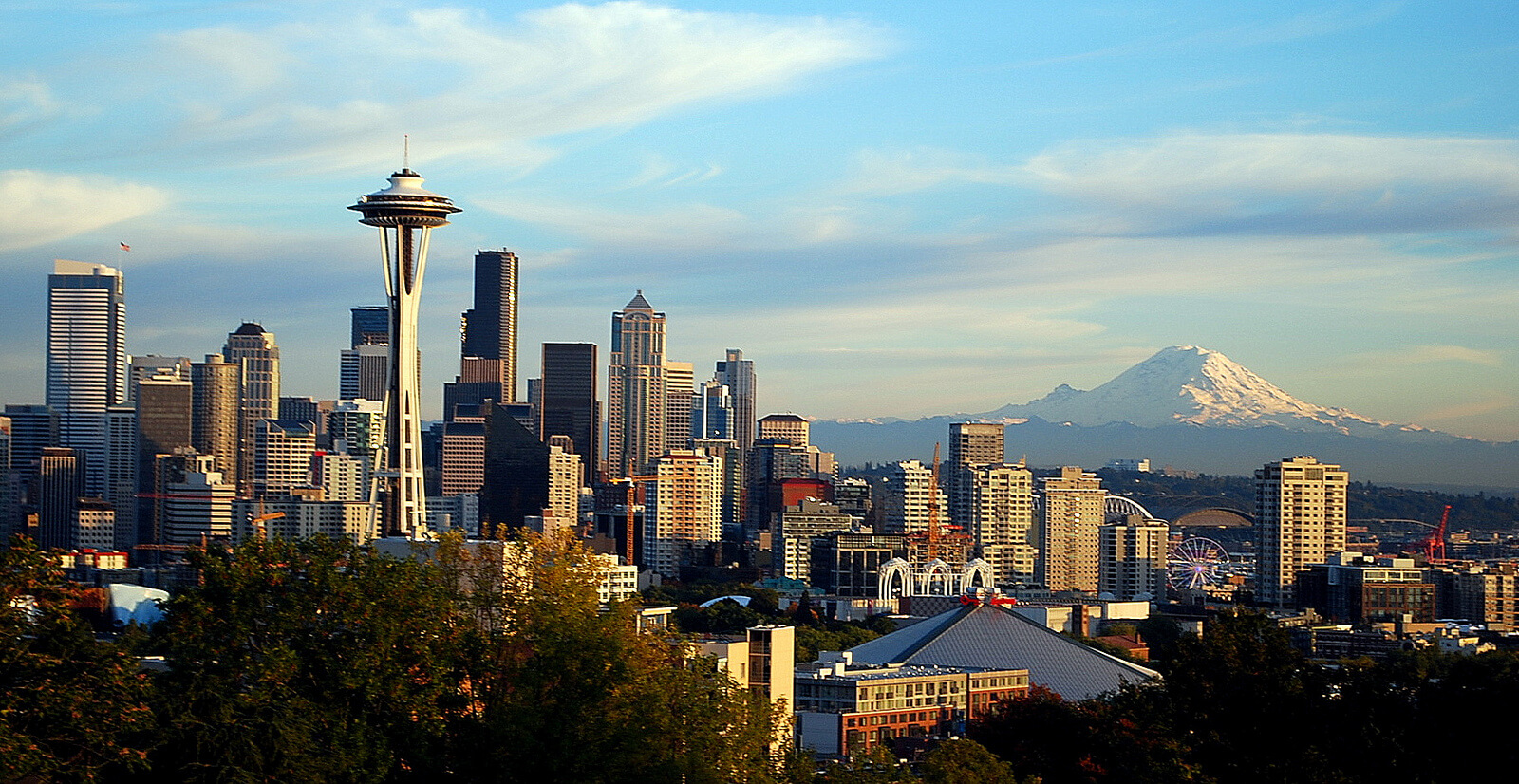
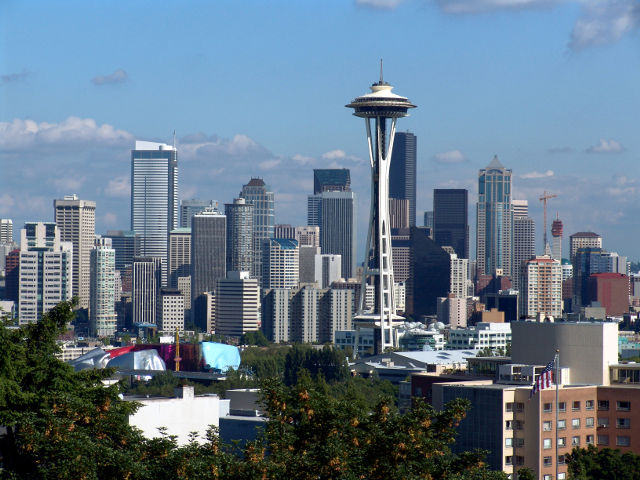
Yes, the city in that picture really is Seattle. Yes, that really is a nice blue sky overhead. When the clouds part, and you can see Lake Washington and the Cascadia Mountains, including Mount Rainier, it's actually a beautiful city. It's just that it rains so much, such a sight isn't all that common.

Before You Go. Seattle is notorious for rain. Check the websites of the Seattle Times and the Seattle Post-Intelligencer for the weather forecast. Right now, though, they're saying that Sunday afternoon won't have any rain -- none is forecast for over a week -- and that it will be in the low 80s by day, and the low 60s at night.

Seattle is in the Pacific Time Zone, 3 hours behind New York. Adjust your timepieces accordingly.

There is high-speed passenger ferry service from Seattle to the Canadian city of Victoria, the capital of the Province of British Columbia. It costs a bundle, though: $155 round-trip. (The scenery in Washington State and British Columbia is spectacular, and this is clearly part of what you're paying for.) From there, you can easily get to Vancouver.

If you want to make this trip, you will have to give confirmation within 48 hours of booking. And it's a passenger-only ferry service: No cars allowed. If you'd like to make a side trip to Vancouver, you're better off driving or taking the train. But any way you go over the border, you should have your passport with you. And, of course, you'll have to change your money: At the moment, US$1.00 = C$1.29, and C$1.00 = US 78 cents.

Tickets. Until expansion Atlanta United came in, the Sounders usually led MLS in attendance, so much so that they have no intention of getting out of the football stadium they originally inhabited, as have the Red Bulls, Colorado, Columbus, Dallas, D.C., Houston, Kansas City, Los Angeles, Orlando and San Jose have done; and as NYCFC would like to do. They averaged 39,598 fans in 2019, the last pre-COVID season -- a sellout, although the top deck is closed off. Getting tickets will be very difficult.

Away supporters are put in Sections 300 and 301, in the northeastern corner of the stadium. Tickets are $26.

Getting There. It's 2,860 miles from Times Square in Manhattan to Pioneer Square in Seattle, and 2,637 miles from Yankee Stadium to Lumen Field, where the Sounders play their home games. In other words, if you're going, you're going to want to fly.

After all, even if you get someone to go with you, and you take turns, one drives while the other one sleeps, and you pack 2 days' worth of food, and you use the side of the Interstate as a toilet, and you don't get pulled over for speeding, you'll still need over 2 full days to get there. One way.

But if you really, really want to drive... Get onto Interstate 80 West in New Jersey, and stay on that until it merges with Interstate 90 west of Cleveland, then stay on 90 through Ohio, Indiana, and Illinois, into Wisconsin, where it merges with Interstate 94. Although you could take I-90 almost all the way, I-94 is actually going to be faster. Stay on I-94 through Minnesota and North Dakota before re-merging with I-90 in Montana, taking it through Idaho and into Washington, getting off I-94 at Exit 2B.

Not counting rest stops, you should be in New Jersey for an hour and a half, Pennsylvania for 5:15, Ohio for 4 hours, Indiana for 2:30, Illinois for 2 hours, Wisconsin for 3:15, Minnesota for 4:30, North Dakota for 6 hours, Montana for a whopping 13 hours (or 3 times the time it takes to get from New York to Boston), Idaho for 1:15 and 6:45 in Washington. That's 50 hours, and with rest stops, you're talking 3 full days.

That's still faster than Greyhound (70 hours, changing in Pittsburgh, Chicago, Minneapolis and Missoula, $595 round-trip, $457 with advanced purchase) and Amtrak (67 hours, changing in Chicago, $579).

On Amtrak, you would leave Penn Station on the Lake Shore Limited at 3:40 PM Eastern Time on Thursday, arrive at Union Station in Chicago at 10:12 AM Central Time on Friday, and board the Empire Builder at 2:15 PM, and would reach King Street Station at 10:25 AM Pacific Time on Sunday, easily in time for the 2:00 PM kickoff. The trip back would leave Seattle at 4:40 PM on Monday, arrive at Chicago at 3:55 PM on Wednesday, leave at 9:30 PM on Wednesday, and arrive in New York at 6:23 PM Thursday.

ALERT: You can't do it this time. The Friday Empire Builder is sold out.

King Street Station is just to the north of the stadium complex, at S. King Street & 3rd Avenue. S., and horns from the trains can sometimes be heard as the trains go down the east stands of Lumen Field and the right-field stands of T-Mobile Park. The Greyhound station is at 811 Stewart Street at 8th Avenue, in the Central Business District, about halfway between the stadiums and the Seattle Center complex.
King Street Station. There is a Union Station,
next door, but it's an office building now.

A round-trip nonstop flight from Newark to Seattle, if ordered now, could be had for $688. Link Light Rail can get you out of Seattle-Tacoma International Airport (Sea-Tac), and the same system has Stadium Station to get to T-Mobile Park and Lumen Field. The fare is $2.75.

Once In the City. Founded in 1853, and named for a Chief of the Duwamish Indians, Seattle is easily the biggest city in America's Northwest, with 740,000 people within the city limits and 4.5 million in its metropolitan area.

Just as Charlotte is called the Queen City of the Southeast, and Cincinnati the Queen City of the Midwest, Seattle is known as the Queen City of the Northwest.

All its greenery has also gotten it the tag the Emerald City. With Lake Washington, Puget Sound, and the Cascade mountain range nearby, including Mount Rainier, it may be, on those rare clear days, America's most beautiful metro area.

East-west street addresses increase from Puget Sound and the Alaskan Way on eastward. North-south addresses are separated by Yesler Way. The Seattle Times is the city's only remaining daily print newspaper. The Seattle Post-Intelligencer is still in business, but in online form only. This is mainly due to the high cost of both paper and ink, and has doomed many newspapers completely, so Seattle is lucky to still, sort of, have 2 daily papers.

ZIP Codes in the State of Washington start with the digits 980 to 994. In Seattle proper, it's 980 and 981; and for the suburbs, 982, 983 and 984. The Area Code for Seattle is 206. Interstate 405 serves as Seattle's "beltway." The city's population is about 70 percent white, 14 percent Asian, 8 percent black, and 7 percent Hispanic. Seattle City Light is their electric company.

Sales tax in the State of Washington is 6.5 percent, but in the City of Seattle, it's 9.5 percent. Off-peak bus fare in Seattle is $2.25. In peak hours, a one-zone ride (either totally within the City of Seattle or in King County outside the city) is $2.50 and a two-zone ride (from the City to the County, or vice versa) is $3.00. The monorail is $2.25. The light rail fares, depending on distance, are between $2.00 and $2.75. Fares are paid with a farecard, or, as they call it, an ORCA card: One Regional Card for All.
Although Seattle is the largest city in the State of Washington, the State Capitol is Olympia, 60 miles to the southwest. It can be reached by public transportation, taking Bus 594 to Lakewood, and then transferring to Bus 620. It takes about 2 1/2 hours.
The Washington State House in Olympia

As a port city, Seattle has always been a home to job-seekers, both native-born and immigrant. As a result, there has frequently been trouble. There was a riot in 1886. In 1919, the leftist Industrial Workers of the World (a.k.a. the IWW or "Wobblies") led a 6-day general strike. There were anti-Filipino riots in Washington State in the Yakima Valley in 1927 and the Wenatchee Valley in 1928. In 1999, a meeting of the World Trade Organization was disrupted by leftist protestors.

In 2020, despite restrictions due to the COVID-19 pandemic, Seattle was the site of a demonstration calling for the city to become a "Cop-Free Zone," following multiple accusation of police brutality, there and all over America.

Going In. The official address of Lumen Field, which opened in 2002 as Seahawks Stadium on the site of the Kingdome and is shared by the NFL's Seahawks and MLS' Sounders -- officially, "Seattle Sounders FC," even though we say "soccer team," not "football club" -- is 800 Occidental Avenue South. This makes the Sounders 1 of 6 MLS teams "groundsharing" with a professional football team.

The stadium is in a neighborhood called SoDo, for "South of Downtown." Lumen is an Internet provider. It bought out competitor CenturyLink, which had naming rights from 2011 to 2020, and had bought out telecommunications carrier Qwest, which had naming rights from 2004 to 2011.

Occidental Avenue is the west sideline, the north side is King Street, the south side is Royal Brougham Way (Royal Brougham was not a car or a brand of booze, but the name of a Seattle sportswriter who championed the city as a site for major league sports), and the east sideline is the railroad. Parking is $8.00.

With the stadium being at the southern edge of downtown, you're likely to enter on the  north or west side. Tailgating is permitted in the north parking lot only.
Lumen Field, with T-Mobile Park behind it

It is often cited as the loudest stadium in the NFL. Certainly, due to the league-leading crowds, it's the loudest in MLS. The way the stadium is built certainly gives the fans' noise less distance to travel: The upper levels were cantilevered over the lower sections, to fit within the limited space available for construction.

Along with the angle of seats and the placement of the lower sections closer to the field, this provided a better view of the field than typically seen throughout the country and allowed for a 67,000 seat capacity. Space is available to increase the total capacity to 72,000 for special events. The city's impressive skyline can be seen through the north end, beyond the triangular end zone "Hawks Nest" stand.

The playing surface has always been FieldTurf, and is laid out north-to-south. College football games have been played there. The University of Washington has played games there, including their entire 2012 season, when their home across town, Husky Stadium, was being renovated. New Jersey's Rutgers University opened their 2016 season away to UW, who pounded RU. UW's arch-rivals, Washington State, opened their 2014 season there against Rutgers, who won a thriller.

(Wazzu's campus is nearly 300 miles to the southeast, so this wasn't exactly a home game for them. It may have been in the same State, but, distance-wise, it would have been like Rutgers playing them at Syracuse or Virginia Tech.)

It also hosts high school games, including a 2004 game in which Bellevue High, of the Seattle suburbs, beat De La Salle of the San Francisco Bay Area, ending the latter's national record 151-game winning streak, which had lasted 12 years. An art piece called The State of Football is on the grounds, as a tribute to high school football in the State of Washington.

It may be the best soccer facility in the country. The Sounders' "Cascadia Derby" games against the Portland Timbers and the Vancouver Whitecaps are spectacular events. The U.S. soccer team has played at Lumen Field 5 times, and won them all, most recently a Copa America match with Ecuador on June 16, 2016.

The stadium hosted the 2009 MLS Cup Final, in which Real Salt Lake beat the Los Angeles Galaxy on penalties. Along with the New England Revolution and (once Mercedes-Benz Stadium opens in the Summer) Atlanta United, the Sounders are 1 of 3 MLS teams that share a stadium with an NFL team. (The Whitecaps and Toronto FC share with CFL teams.)

In CONCACAF Gold Cup play, it's hosted 4 games in 2005, 2 in 2009, and 2 in 2013. It has been approved by FIFA to be one of the host venues for the 2026 World Cup.
The facility includes the 7,000-seat Washington Music Theater, or WAMU Theater, for smaller events.

The Kingdome hosted the Major League Baseball All-Star Game in 1979, T-Mobile Park did in 2001, and will again in 2023.

Food. As a waterfront city, and as the Northwest's biggest transportation and freight hub, it is no surprise that Seattle is a good food city, with the legendary Pike Place Market serving as their "South Street Seaport."

Fortunately, Lumen Field lives up to this. Unfortunately, they serve Coca-Cola as opposed to Pepsi, Budweiser as opposed to good beer, and, thumbing their noses in Seattle's history as a great labor-union city (not to mention the Seahawks' demolition of company spokesman Peyton Manning in the Super Bowl), Papa John's Pizza. They do have Seattle institution Starbucks, and I suppose there must be some Wisconsin people involved with Seahawk concessions, because they also serve Johnsonville Brats.

Don't want to make "Papa" John Schnatter any richer? Good for you! "Pizza of Seattle" stands are at Sections 107 and 122. Pioneer Square International District, specializing in Asian food, is at 105 and 139. Loud & Proud Fan Raves and Craves is at 109 and 116. Kidd Valley, specializing in burgers and fries, is at 111 and 147. The Cantina, specializing in Mexican food, is at 113 and 131. "Grounders World Famous Garlic Fries" is at 118. Kinder's BBQ is at 120. Seattle Dogs (hot dogs) is at 124, 135 and 149. Brougham Beer Hall is at 128. Ivar's, specializing in chicken and chowder (including bread bowls), is at 133. Pioneer Square Butcher is at 204 and 240. 360 Sizzle, specializing in Asian food, is at 208 and 236. Ciao Down! Italian food is at 210 and 234. Seafood stand Catch! is at 214 and 230.

Team History Displays. Seattle is an underachieving city in sports. Until the Seahawks won Super Bowl XLVIII at the Meadowlands in 2014, the city had won only 2 World Championships, ever: The 1917 Stanley Cup (I'll get to that in "Sidelights") and the 1979 NBA Championship. And since the SuperSonics' back-to-back Finals appearances in 1978-79, the city's only trips to the Finals had been the 1996 Sonics and the 2005-06 Seahawks, until the recent Seahawk Super Bowls (the one they won, and then the one they lost -- to the Patriots, thanks for nothing, Pete Carroll). However, the Seattle Storm have now won 4 WNBA Championships.

The Sounders were a part of this legacy of underachievement. They won the Supporters' Shield in 2014, and the U.S. Open Cup in 2009, 2010, 2011 and 2014 -- 4 of these cups being a total matches among MLS teams only by the Chicago Fire. (They also lost in the Final in 2012.) But in 2016, they won the MLS Cup, beating Toronto FC in Toronto in the Final. They went to Toronto for the Final again in 2017, but lost it. The Sounders beat Toronto for the Cup again in 2019, and lost the Final to the Columbus Crew in 2020. And, in 2022, they won the CONCACAF Champions League, beating Mexico City team UNAM in the Final.

The original Sounders, who played in the old North American Soccer League from 1974 to 1983, won division titles in 1980 and 1982, and got to the title game, the Soccer Bowl, in 1977 and 1982 -- both times, losing to the old New York Cosmos.

They featured stars from the English league such as Bobby Moore, Alan Hudson, Alan Hinton, Mike England and Jimmy Robertson. (Hinton would stay in Seattle, and later coached the Sounders, and now broadcasts for them. Despite his name, Mike England was from Wales.) The Sounders were also where one of the real characters of English soccer, Harry Redknapp, began his coaching career.

The Sounders name was revived in 1994, over such suggestions as Seattle FC, Seattle Alliance and Seattle Republic. They won the United Soccer League title in 1995, 1996, 2005 and 2007. As the current team is a continuation of that organization, they recognize those titles, but not the division titles won by the NASL Sounders. They hang banners for their USL and MLS/U.S. Open Cup achievements from the east side roof.
The Sounders, the Portland Timbers, and the Vancouver Whitecaps -- all named for teams that played in the NASL -- have competed for the Cascadia Cup since 2004. Oddly, the Sounders won the Cascadia Cup in 2015 despite the Timbers winning the MLS Cup, and the Timbers won the Cascadia Cup in 2016 despite the Sounders winning the MLS Cup. Overall, Seattle has won it 7 times, Vancouver 6, and Portland 4. But, in the MLS era, it's Seattle 5, Vancouver 3, and Portland 2. 
The Cascadia Cup, in the custody of
Sounders supporters' group Brougham Patrol

The Sounders and the San Jose Earthquakes, each team's secondary rival (the Quakes' primary rival is the Los Angeles Galaxy), play for a trophy whose name reflects their imagined lineage from the old NASL: The Heritage Cup. It's been awarded 11 times since the Sounders came into MLS for the 2009 season, and the Sounders lead, 8-5.
The Heritage Cup

The Sounders have no retired numbers -- not even 6 for Bobby Moore, unlike his English club, West Ham United -- but it's possible that Number 2 will be put away for Clint Dempsey at some point. They also don't have a team hall of fame.

Stuff. The Sounders FC Pro Shop, as well as the Seattle Seahawks Pro Shop, is located at Suite 300 at Lumen Field. Others are located at 410 Pike Street downtown, Renton Landing, Bellevue Square, and at the Lynnwood and Tacoma malls. 

Unlike most MLS teams, there is a good book written about this team. Two, in fact. (Well, in my opinion, anyway.) Both were published in 2013. Seattle radio sports-talk host Mike Gastineau (no relation to former Jets defender Mark) and U.S. soccer writer Grant Wahl collaborated on Sounders FC: Authentic Masterpiece: The Inside Story of the Best Franchise Launch In American Sports History. (The people behind the NHL's Vegas Golden Knights may now dispute that.)

Cascadia Clash: Sounders versus Timbers, by Geoffrey C. Arnold of The Oregonian and former Sounders goalie Kasey Keller, tells of the best rivalry in MLS.

Adrian Webster wrote of the original Sounders in Eternal Blue, Forever Green: The Sounders in the '70s. Garth Lagerwey and Sounder head coach Brian Schmetzer collaborated on the book Seattle Sounders: Our Moment - The Official MLS Cup Championship Commemorative. But, as yet, there do not appear to be any Sounders-themed DVDs, even of their MLS Cup win.

During the Game. Although Mariner fans hate the Yankees more than any other team, Sounder fans have no reason to dislike either of the New York soccer teams beyond merely being that game's opponent who must be defeated. As long as you don't antagonize anyone, you should be okay.

The Sounders hold auditions for National Anthem singers, instead of having a regular. They no longer have a mascot, as Sammy Sounder, an orca whale, has been dropped.
Comedian and The Price Is Right host Drew Carey is a part-owner of the Sounders. At his request, the team set up The Sounders FC Alliance. Based on the fan association at FC Barcelona, members have the ability to vote on the removal of the general manager and on other team decisions. Season-ticketholders are automatic members. As of yet, only once has such a vote been held, and the voters decided to retain the GM.

Also at the request of Carey, who was a trumpeter in his Cleveland high school's marching band, the Sounders have MLS' 1st marching band: The Sound Wave, which sits in the north end. Before every game, they lead The March to the Match from Occidental Park to the stadium.
The Sound Wave's March to the Match

Emerald City Supporters (ECS) preceded the club's entry into MLS, and sits in the south end, in Sections 121, 122 and 123. Gorilla FC (Gorilla Football Collective -- GFC also stands for their motto: Glory, Fellowship, Community) does a pregame march from the Seattle outlet of the Fadó pub chain to the stadium, led by Civ, a man in a gorilla suit. They sit in the south end, in Sections 119 and 120, next to ECS. Eastside Supporters sit in 150, which they call "The Pod." And the North End Faithful sit in Sections 100 and 144 to 152, beneath the Hawks Nest.
Some songs for the team are familiar adaptations. "We love you Sounders, we do!" "I'm Sounders 'Til I Die!" They took Arsenal fans' "Ooh to Be a Gooner" and made it "Ooh to Be a Sounder!" Like the Red Bull fans, they use the Cock Sparrer song: "Take 'em all, take 'em all, line 'em up against a wall and shoot 'em!" Perry Como's last hit song said, "The bluest skies you've ever seen are in Seattle," and Sounder fans sing that song in full.

After the Game. SoDo is not an especially high-crime area, and, as I said, Sounder fans generally do not get violent. You might get a little bit of verbal if you're wearing New York gear, but it won't get any worse than that.

Two bars are usually identified with Mariners and Seahawks games. Sluggers, formerly known as Sneakers (or "Sneaks" for short), is at 538 1st Avenue South, at the northwest corner of Lumen Field. A little further up, at 419 Occidental Avenue South, is F.X. McRory's. Keep in mind, though, that these will be Seattle-friendly bars.

As for New York-friendly bars, while there are Yankee Fans everywhere, I couldn't find anything specific on the Internet. I've been told that these 2 are good for football Giants fans, but I cannot confirm either: Buckley's (232 1st Ave. W. at Thomas St.), and the Lucky 7 Saloon (12715 NE 124th Street in Kirkland). Buckley's is just to the west of Seattle Center, near the waterfront, but the Lucky 7 is a fur piece from T-Mobile or even downtown, 18 miles northeast, and, without a car, you'd need a trolley and 2 buses. Not worth it.

If you visit Seattle during the European soccer season, you may be able to watch your favorite team at one of these places:

* Arsenal, Chelsea, Manchester City, Everton, Newcastle United and Barcelona: The George and Dragon Pub, 206 N. 36th Street, 5 miles north of downtown. Bus 40. If you can't find your team listed below, this is probably your best bet.

* Liverpool: St. Andrews Bar & Grill, 7406 Aurora Avenue N, 7 miles north of downtown. Bus 7. Also, Doyle's Public House, 208 St. Helens Avenue in Tacoma, about 35 miles south of downtown. Bus 590.

* Tottenham Hotspur: The Whits End Bar, 6510 Phinney Avenue North, 5 1/2 miles north of downtown. Bus 5.

* Manchester United: West Seattle Brewing Company, 4415 Fauntleroy Way Southwest, 5 miles southwest of downtown. C Line Bus.

* Bayern Munich: Shultzy's, 4114 University Way NE, 5 miles north of downtown, off the University of Washington campus. Bus 70.

Sidelights. On November 30, 2018, Thrillist published a list of "America's 25 Most Fun Cities," and Seattle came in 11th. Aside from the Climate Pledge Arena and the T-Mobile/Lumen complex, Seattle doesn't have a lot of sports sites worth mentioning. But there are places that should be mentioned.

* Sick's Stadium. The Pacific Coast League team that preceded the Mariners, known at various times as the Indians, the Rainiers and the Angels (when they were a farm team of the Anaheim club), played 2½ miles southeast of the future sites of T-Mobile Park and Lumen Field, first at Dugdale Field (1913-1932) and then, after a fire required rebuilding, at Sick's Stadium (1938-68 and 1972-76, built by Rainiers' owner Emil Sick).

The Seattle Pilots also played at Sick's, but lasted only one year, 1969, before being moved to Milwaukee to become the Brewers, and are now chiefly remembered for ex-Yankee pitcher Jim Bouton's diary of that season, Ball Four.

The book gives awful details of the place's inadequacy: As an 11,000-seat ballpark, it was fine for Triple-A ball in the 1940s, '50s and '60s; expanded to 25,420 seats for the Pilots, it was a lousy place to watch, and a worse one to play, baseball in anything like the modern era.

Elvis Presley sang at Sick's on September 1, 1957 (since it had more seats than any indoor facility in town). Supposedly, a 15-year-old Seattle native named James Hendrix (later known as Jimi) was there. A few days prior, Floyd Patterson defended the heavyweight title there by knocking out fellow 1956 Olympic Gold Medalist Pete Rademacher.

Demolished in 1979 after the construction of the Kingdome (whose inadequacies were very different but no less glaring), the site of Sick's Stadium is now occupied by a Lowe's store. 2700 Rainier Avenue South, bounded also by McClellan & Bayview Streets & Martin Luther King Jr. Way. Mount Baker station on the Link light rail system.

* Husky Stadium. The home of the University of Washington football team, the largest stadium in the Pacific Northwest (including Canada) is right on Lake Washington, and is one of the nicest-looking stadiums in college football. A rare feature in major college football is that fans can dock right outside and tailgate by boat. (The only others at which this is possible: Neyland Stadium at the University of Tennessee, and Heinz Field for University of Pittsburgh games.)

It opened in 1920, making it the oldest stadium in the Pacific-12 Conference. The Seahawks played a few home games here in 1994, after some tiles fell from the Kingdome roof, and played their games here in 2000 and 2001 between the demolition of the Kingdome and the opening of what's now Lumen Field. In 1923, it was the site of the last public speech given by President Warren G. Harding before his death in a San Francisco hotel. Sadly, The Wave was invented here in 1981, by university yell leader (think male cheerleader) Robb Weller, later one of Mary Hart's co-hosts on Entertainment Tonight. (This is disputed.)

A major renovation was recently completed, necessary due to age and the moisture from being on the water and in Seattle's rainy climate. Pretty much everything but the north stand of the east-pointing horseshoe was demolished and replaced. The Huskies played the 2012 season at Lumen Field, and moved into the revamped, 70,138-seat Husky Stadium for the 2013 season. 3800 Montlake Blvd. NE, at Pacific Street. Light Rail to University of Washington Station.

UW is 4 miles northeast of downtown Seattle. Washington State University, their big "Apple Cup" rivals, have a downtown campus, but their main campus is in Pullman, all the way across the State, 286 miles away. "Wazzu" is actually close to the State Line, and not far from Moscow, Idaho, where the University of Idaho is located.

In their 1982 College Football Preview issue, Sports Illustrated listed Austin, home of the University of Texas, as the best college town. The worst? It named 2: "1. Pullman, Washington, home of Washington State. To party, students must drive 10 miles to Moscow, Idaho. 2. Moscow, Idaho." (That's where the University of Idaho is. It's actually 7 miles between the WSU and UI campuses.)

* Edmunson Pavilion. Adjacent to Husky Stadium, at 3870 Montlake, is Alaska Airlines Arena at Clarence S. "Hec" Edmundson Pavilion, the home of "U-Dub" basketball since 1927. Hec was the school's longtime basketball and track coach, and "Hec Ed" hosted the NCAA Final Four in 1949 (Kentucky over Oklahoma State) and 1952 (Kansas over New York's St. John's). It has also hosted the State of Washington's high school basketball finals.

UW has been to the Final Four only once, in 1953, although they've won the regular-season title in the league now called the Pac-12 11 times, including 2012; and the Conference Tournament 3 times, most recently in 2011. Washington State, across the State in Pullman, reached the Championship Game in 1941, but hasn't been back to the Final Four since.

The Kingdome hosted the Final Four in 1984, Georgetown over Houston; 1989, Michigan over Seton Hall; and 1995, UCLA over Arkansas. It also hosted 3 U.S. soccer team matches: A win, a loss, and a draw; and Soccer Bowl '76, a 3-0 win by the Toronto Metros over the Minnesota Kicks.

* Tacoma Dome. The Sonics used this building during the 1994-95 season, as the Seattle Center Coliseum was demolished and the KeyArena put up in its place. Opening in 1983, it seats 17,100, and its most common use has been for minor-league hockey and concerts. 2727 East D Street, about 32 miles south of downtown Seattle. It can be reached from downtown Seattle by Bus 590, 592, 594 or 595, and it would take about 45 minutes.

Tacoma is also the home of Cheney Stadium, home of the Tacoma Rainiers of the Pacific Coast League, named for the former PCL team, the Seattle Rainiers. It is also the home of OL Reign of the National Women's Soccer League. Formerly known as the Seattle Reign, they are now owned by Olympique Lyonnaise of French soccer. 2502 S. Tyler Street. 

The night Elvis sang at Sick's Stadium, September 1, 1957, he gave an afternoon concert in Tacoma, at the Lincoln Bowl, the football stadium of Lincoln High School. 707 S. 37th Street. The day before, he sang across the State, at Memorial Stadium in Spokane. He returned to Spokane to sing at their Coliseum on April 28, 1973 and April 27, 1976.

The Spokane Coliseum, at Boone Street and Howard Avenue, seated 5,400, lasted from 1954 to 1995, and was replaced by the 12,200-seat Spokane Veterans Memorial Arena, across the street. It's home to minor-league hockey's Spokane Chiefs, who, despite not being in Canada, won their junior hockey championship, the Memorial Cup, in 1991 and 2008. 720 W. Mallon Avenue. Spokane is 280 miles east of Seattle.

* Seattle Ice Arena. The Seattle Metropolitans played in the Pacific Coast Hockey Association from 1915 until the league's folding in 1926, and won 5 league championships: 1917, 1919, 1920, 1922 and 1924. In 1917, they defeated the National Hockey Association champion Montreal Canadiens, and became the 1st American team to win the Stanley Cup. This would be Seattle's only world title in any sport for 62 years.

They played at the Seattle Ice Arena, which seated only 4,000 people, and was demolished in 1963. The IBM Building, a typically tacky piece of 1960s architecture, now stands on the site. 1200 Fifth Avenue at University Avenue, downtown.

There was also a hockey team named the Seattle Seahawks, competing in the North West Hockey League from 1933 to 1936, winning its championship in 1936; and then in the Pacific Coast Hockey League until 1941. Frank Foyston, who starred for the Metropolitans, was their 1st coach and their 1st general manager.

Seattle has been trying to get an NHL team. For now, the closest one is the Vancouver Canucks, 143 miles away. The probably could support one, and maybe an NBA team, too: The metro area's population would rank it 16th in the NBA and 15th in the NHL. According to an article in the January 8, 2016 edition of Business Insider, the Canucks are the most popular NHL team in the State of Washington.

* Seattle Center. Erected for the 1962 World's Fair (as seen in the Elvis film It Happened At the World's Fair), Seattle Center, north of the sports complex at 400 Broad Street at John Street, includes the city's trademark, the Space Needle. Admission is $11, half the cost of the Empire State Building, and it's open 'til 11:00 PM, with great views of the region's natural splendor.

Seattle Center also has the Pacific Science Center (think of it the Northwest's version of the American Museum of Natural History and its Hayden Planetarium), and the Science Fiction Museum and Hall of Fame (not sure why Seattle was chosen as the Hall's location, although the city is a major aerospace center).

Also in this complex is Memorial Stadium, a high school football stadium built in 1946. It used to host the old North American Soccer League version of the Sounders, and now hosts the women's soccer team, the Seattle Reign. On June 24, 1975, it hosted a game between the national teams of the U.S. and Poland, ending in a draw.

Also in this complex is the Climate Pledge Arena, home of the 4-time WNBA Champion Seattle Storm and the NHL's newest team, the Seattle Kraken. Previously, this was the site of the Seattle Center Coliseum from 1962 to 1994, and the KeyArena from 1995 to 2018. Elvis sang there on November 12, 1970; April 29, 1973 (2 shows); and April 26, 1976. A high school football stadium is also on the site. Number 33 bus, although the nearest Link station is several blocks' walk away.

On May 12, 2014, The New York Times printed a story that shows NBA fandom by ZIP Code, according to Facebook likes. (As yet, there is no hockey version.) With the loss of the Sonics, Seattle fans not only refused to accept their former heroes as Oklahoma City Thunder (Thunders? Thundermen?), but also refused to accept the next-closest team, their former arch-rivals, the Portland Trail Blazers, 172 miles away, as their new team. They seem to divide their fandom 4 ways, none of which should surprise you: The Chicago Bulls, the Los Angeles Lakers, the Boston Celtics and the Miami Heat. But if Seattle should ever get another team, these fans would certainly get behind the new Sonics.

Aside from Seattle Center and its Space Needle, and the stadiums, Seattle's best-known structure is the Pike Place Market. Think of it as their version of the South Street Seaport and Fulton Fish Market. (Or Philadelphia's Reading Terminal Market, Baltimore's Harborplace, or Boston's Quincy Market/Faneuil Hall.) It includes the first-ever Starbucks store, which is still open. Downtown, 85 Pike Street at Western Avenue.

Aside from the Pacific Science Center and the Science Fiction Museum, Seattle isn't a big museum city, although the Seattle Art Museum, at 1300 1st Avenue at University Street, might be worth a visit.

The State of Washington has never produced a President, so there's no Presidential Library. Senator Henry M. "Scoop" Jackson ran for the Democratic nomination in 1972 and 1976, but didn't get particularly close. The State's never produced a Vice President, either. Thomas S. Foley served a District centered on Spokane in Congress from 1965 to 1995, and was Speaker of the House of Representatives from 1989 to 1995.

At 967 feet high, Columbia Center, a.k.a. The Black Tower, is the tallest building in the Northwest, and, for the moment, the tallest building in North America west of the Rocky Mountains except for the U.S. Bank Tower in Los Angeles. (A building going up in San Francisco, and another in Los Angeles, are both expected to top the Black Tower by 2017.) If you're wondering about Seattle's most famous icon, the Space Needle, it was once the tallest structure west of the Mississippi River, but at 605 feet it is well short of the Black Tower.

The TV show Northern Exposure was filmed in the State of Washington, and Twin Peaks was both filmed and set there: The former in Roslyn (hence, Roslyn's Cafe), about 85 miles southeast of downtown Seattle; the latter in North Bend, about 30 miles east. The science-fiction series Dark Angel, which vaulted Jessica Alba and NCIS' Michael Weatherly to stardom, was set in a dystopian future Seattle, but was filmed in Vancouver. So was The X-Files. So was Millennium. So was Kyle XY. So was Smallville, but that wasn't meant to be Seattle.

Arrow, about another superhero, was filmed in Vancouver, and, perhaps due to Green Arrow wearing a green costume, I've often thought of his hometown of Star City as being DC Comics' analogue for Seattle. While Frasier was set in Seattle, and Grey's Anatomy still is, there were hardly any location shots. The same is true for Here Come the Brides, The 4400 and
iCarly.

The most obvious film made and set in Seattle is Sleepless in Seattle, and the city was home to Matthew Broderick's and Ally Sheedy's characters in WarGames (in which Broderick's computer hacking has much greater consequences than it would 3 years later in the Chicago-based Ferris Bueller's Day Off).

Singles came along in 1992, at the height of grunge and the rise of Starbucks, which helped make Seattle the hippest city in the country in the years of George Bush the father and Bill Clinton's 1st term -- or, as Jason Alexander put it shortly thereafter on Seinfeld, "It's the pesto of cities." It also reminded us of how good an actor Matt Dillon is, how gorgeous Kyra Sedgwick is, and that Bridget Fonda (daughter of Peter, niece of Jane and granddaughter of Henry) and Campbell Scott (son of George C. and Colleen Dewhurst) were worthy of their genes.

There's also been It Happened at the World's Fair (Elvis playing a visitor to the 1962 Fair), McQ (John Wayne as a present-day cop in one of his last films, in 1974), The Parallax View, Stakeout, Black Widow, The Fabulous Baker Boys, My Own Private Idaho, The Hand That Rocks the Cradle, The Crush, Harry and the Hendersons, 10 Things I Hate About You, Agent Cody Banks, and the Fifty Shades series. An Officer and a Gentleman was filmed at the naval base in nearby Bremerton.

In spite of all the rain it gets, Seattle has a beach! Alki Beach is on a peninsula that forms West Seattle, and the ferries to Bremerton and Bainbridge pass in front of it. 1702 Alki Avenue SW, about 6 road miles from Pioneer Square. Bus 56.

*

So, if you can afford it, go on out and join your fellow New York footie fans in visiting the Seahawks' nest for a Sounders game. Be advised, though, that it will be a lot harder than being Yankee Fans taking over the Mariners' ballpark. Aside from a Cascadia Derby against Portland (in either city), it may well be the defining MLS experience.