Due to various circumstances, including COVID, I have not done a Trip Guide for the Reds in 4 years. So there is some updating to do.
Before You Go. Cincinnati can get really hot in the Summer. The Cincinnati Enquirer website is predicting the high 80s by day, the high 70s by night. And there will be rain on Tuesday and Wednesday, which may have an effect on the game and result in a postponement. Given the heat, the rain, and the distance, which is not especially far compared to some other opponents, if Cincinnati is a city you haven't yet crossed off your list, you may want to wait until next season.
Cincinnati is in the Eastern Time Zone, so you won't have to set your clocks back.
Tickets. Great American Ball Park -- yes, 4 words -- seats 42,319 people. The Reds averaged 23,141 per home game in 2019, the last pre-COVID season. And the Reds got off to an atrocious start this season, as they are roughly even with the Oakland Athletics for the worst record in baseball. So tickets should be available; whether they're good tickets is for you to decide.
Given their frequent claims of a "family atmosphere," you would expect the Reds' tickets to be cheap. Compared with New York's ballparks, they are. Infield Boxes will go for $64, Field Boxes (down the foul lines) for $42, Mezzanine Box seats for $32, View Box seats for $18, Terrace Outfield (left field) are $31, and View Level (uppermost in the stadium) for a mere $12.
The right field bleachers go for $29. In honor of a similar section at the old Reds' ballpark, Crosley Field, these bleachers are known as the Sun Deck for day games and the Moon Deck for night games. Section 509, in the uppermost left field corner, is "Value View," and is sold for $5.00, the cheapest ticket in Major League Baseball. That's right: In the 2020s, you can see a Major League Baseball regular-season game for only $5.00. It's far from home plate, but there were plenty of seats in Riverfront Stadium that were further.
Getting There. Keep in mind, Monday is the 4th of July, which will increase demand for tickets, thus also increasing prices.
It's 641 miles from Times Square in New York to Fountain Square in Cincinnati, and 650 miles from Citi Field to Great American Ballpark.
Flying may seem like a good option, and don't let the fact that Cincinnati-Northern Kentucky International Airport is in Florence, Kentucky fool you: It's just 13 miles southwest of downtown, a little closer (and in the same direction) than Newark Airport is to Midtown Manhattan. And if you order now, you can get a round-trip nonstop ticket on United Airlines for under $500.
Greyhound's run between the 2 cities is not good, a 16-hour ride that costs $486 round-trip (but it can be dropped to $272 with advanced-purchase) and forces you to change buses in either Cleveland or Columbus. The terminal is at 1005 Gilbert Avenue, less than a mile northeast of Fountain Square. Take the Number 11 bus to get downtown.
Amtrak's run to Cincy is problematic as well, as it only offers service out of Penn Station to Cincinnati, on the Cardinal, every Wednesday, Friday and Sunday, and it'll be nearly 19 hours, from 6:45 AM until 1:31 AM outbound and from 3:27 AM to almost 9:58 AM back. At least it'll be cheap by Amtrak standards, $244.
This time, it's sold out, so you can't do the train this time, anyway.
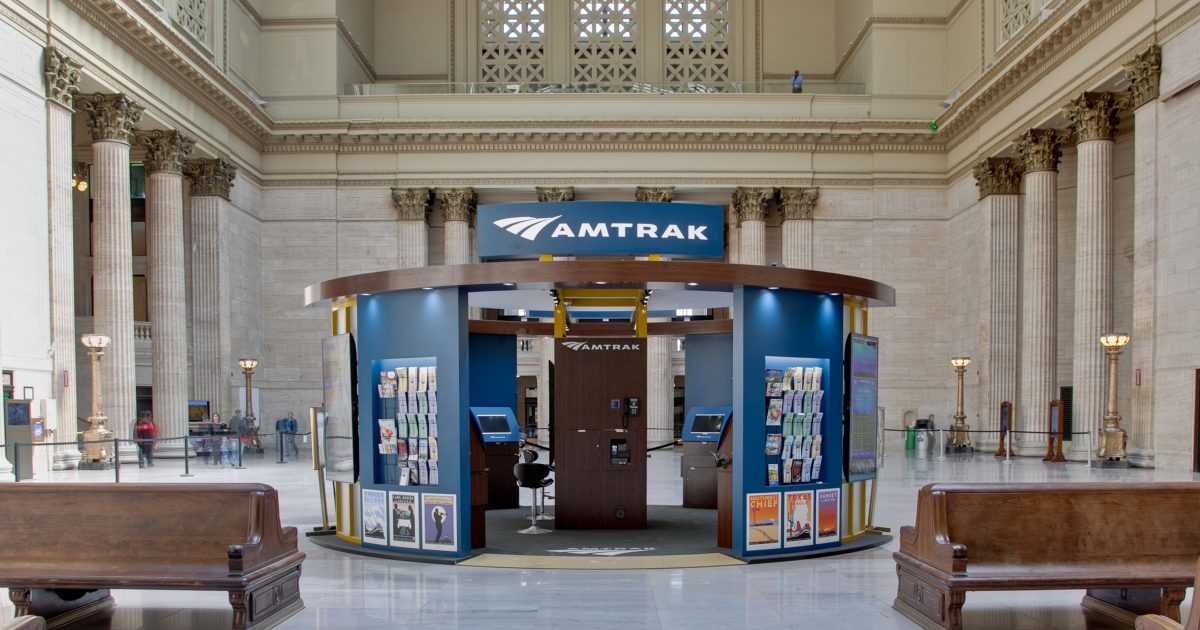
Union Terminal, now also a museum and shopping mall, is at 1301 Western Avenue, about a mile and a half northwest of downtown. And you'd have to walk 5 blocks to Linn & Clark Streets just to get to the closest downtown bus (Number 27).

In the 1970s, Cincinnati-based Taft Broadcasting owned
Hanna-Barbera Productions, producers of the cartoon Super Friends.
Union Terminal became the model for the Justice League's headquarters.
As Ted Knight did the voice: "Later, at the Hall of Justice... "
If you decide to drive, it's far enough that it will help to get someone to go with you and split the duties, and to trade off driving and sleeping.
You'll need to get on the New Jersey Turnpike. Take it to Exit 14, to Interstate 78. Follow I-78 west all the way through New Jersey, to Phillipsburg, and across the Delaware River into Easton, Pennsylvania. Continue west on I-78 until reaching Harrisburg. There, you will merge onto I-81. Take Exit 52 to U.S. Route 11, which will soon take you onto I-76. This is the Pennsylvania Turnpike, the nation's 1st superhighway, opening in 1940.
The Turnpike will eventually be a joint run between I-76 and Interstate 70. Once that happens, you'll stay on I-70, all the way past Pittsburgh, across the little northern panhandle of West Virginia, and into Ohio all the way to the State Capitol of Columbus. Then leave I-70 at Exit 99 and get on Interstate 71 south to Cincinnati.
If you do it right, you should spend about an hour and 15 minutes in New Jersey, 5 hours and 30 minutes in Pennsylvania, 15 minutes in West Virginia, and about 3 hours in Ohio. That's about 10 hours. Counting rest stops, preferably halfway through Pennsylvania and just after you enter Ohio and around Columbus, and accounting for traffic in both New York and Cincinnati, it should be no more than 14 hours, which would save you time on both Greyhound and Amtrak, if not flying.
Once In the City. Founded in 1788, Cincinnati was named by Arthur St. Clair, then Governor of the Northwest Territory. He was a member of the Society of the Cincinnati, an organization that was a tribute to George Washington, then called "the New Cincinnatus." Lucius Quinctius Cincinnatus was, like Washington, a farmer who had previously led his country, in his case ancient Rome, into battle, and was called back to lead the nation as a whole in 458 BC. He defeated the Aequi in battle, and then, just 16 days after he took charge, resigned and retired to his farm.
Germans, including "Pennsylvania Dutch" (including some Amish, and many remain in Ohio) were among the first settlers, which explains why the city had a strong brewing tradition, and why the 1882 version of the Cincinnati Red Stockings founded the original American Association, known as "The Beer and Whiskey League" because, unlike the National League, they refused to prohibit the selling of alcohol in their stadiums.
Even in the early 20th Century, sportswriters would refer to that team's spiritual (if not lineal) descendant, the Reds, as "the gingery Germans of Zinzinatti." Like Notre Dame's nickname of "The Fighting Irish," the nickname no longer has much ethnic relevance; unlike "The Fighting Irish," however, it's not still used.
Cincinnati is one of the smallest markets in the major leagues, with the city being home to just 299,000 people. If you count Tampa and St. Petersburg as one city, that would make Cincinnati the smallest in Major League Baseball. The metropolitan area is home to only 2.2 million people, making it the 2nd-smallest, ahead of only Milwaukee. However, if you count nearby Dayton, then it jumps to a little under 3 million. That makes it 24th in MLB, and 21st in the NFL.
Cincinnati also got hit hard by "white flight": It was 84 percent white in 1950, 72 percent in 1970, 61 percent in 1990. Today, it's 48 percent white, 45 percent black, 3 percent Hispanic and 2 percent Asian.
Despite this, and despite having lost their NBA team in 1972 and never regained it, Cincinnati has never been in serious danger of losing either the Reds or the Bengals. While the Reds were targeted by cities looking to get into MLB in the 1950s and '60s, the city was proactive in stopping them, and the construction of Riverfront Stadium made sure the teams were set to stay for the rest of the 20th Century. The construction of replacements for Riverfront, one for each sport, has made sure the teams are set to stay for at least the 1st half of the 21st.
In spite of the city's willingness to drink, it's one of the most conservative cities in America, home to the Taft political family that has now seen 5 straight generations achieve high office. Alphonso Taft was Attorney General under Ulysses S. Grant. His son, Charles Phelps Taft, was a Congressman who owned the Philadelphia Phillies and later the Chicago Cubs. Another son, William Howard Taft, was Secretary of War under Theodore Roosevelt, was elected to replace TR as President in 1908, and became the only President also to serve on the Supreme Court, as Chief Justice no less. His cousin, Kingsley Taft, was Chief Justice of the Ohio Supreme Court.
His son, Robert Taft, was a power in the Senate, so conservative he was known as "Mr. Republican" in opposition to Franklin Roosevelt and Harry Truman, serving as Majority Leader at the time of his death in 1953. Another son of William Howard, Charles Phelps Taft II, was Mayor of Cincinnati in the 1950s, and became known as "Mr. Cincinnati." Robert's son, Robert Taft Jr., served in both houses of Congress. Another son, William Howard Taft III, was U.S. Ambassador to Ireland in the 1950s. William III's son, William IV, was a Deputy Secretary of Defense, and his wife Julia was an Assistant Secretary of Defense. And Robert Jr.'s son, Bob Taft (Robert Alfonso Taft III), was Governor of Ohio in the 2000s.
Cincinnati's conservatism is reflected in the Reds' long-standing policy banning facial hair, considerably stronger than that of George Steinbrenner in liberal New York, who at least allowed mustaches.
And if you watched the TV show WKRP in Cincinnati (1978-82), you noticed that station owner Mama Carlson (Carol Bruce) only made the switch from "beautiful music" to rock and roll in 1978 because the station was losing money. Even her son, Arthur "Big Guy" Carlson (Gordon Jump), while willing to manage a rock station, was hopelessly square -- though not as square as newsman Les Nessman (Richard Sanders). Things hadn't changed much in the century or so since Mark Twain remarked that if the world came to an end, it would take Cincinnati 20 years to notice.
Vine Street is the street address divider between East and West, with the North-South streets' addresses increasing as you go north from the Ohio River. The "beltway" is Interstate 275, and it goes into Kentucky and Indiana, as well as Ohio. The sales tax in the State of Ohio is 5.75 percent, rising to 6.5 percent in Hamilton County, including the City of Cincinnati.
The Tyler Davidson Fountain, a.k.a. "The Genius of Water," is located in Fountain Square, 5th & Vine Streets. Henry Probasco, a Cincinnati businessman, had the statue and fountain made to honor his late brother-in-law and business partner.
It was dedicated in 1867, with a base reading, "TO THE PEOPLE OF CINCINNATI," and is turned off in the Winter, being turned back on for the Reds' Opening Day. It can be seen in WKRP's opening sequence, although a renovation led to its being moved elsewhere in the square in 2006.

ZIP Codes for Cincinnati start with the digits 452, and the Area Code is 513. Cincinnati does not have a subway: Construction of a system began in the 1910s, but was abandoned in the 1920s, and occasional attempts to try again, using the existing tunnels, have never gotten anywhere.
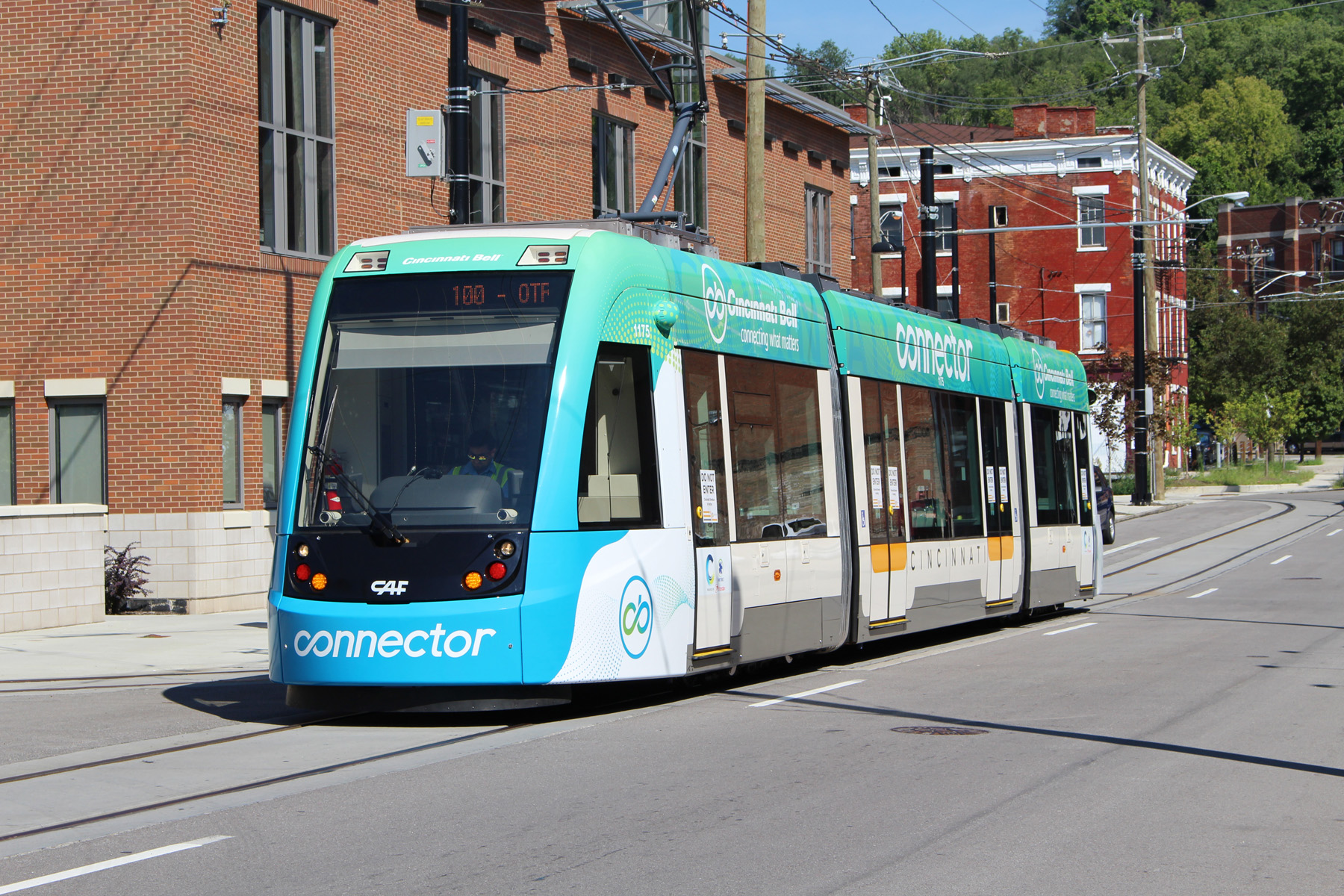
The city has since decided to go above-ground, and, since September 2016, the Cincinnati Bell Connector (naming rights sold to the phone company) heads north from downtown into the Over-the-Rhine region, and south across the Ohio River to Covington, Kentucky.

The Southbank Shuttle leaves from 5th & Vine Streets in Fountain Square, although the park is basically close enough to walk to from anywhere in downtown. The park's official address is 100 Joe Nuxhall Way, named for the 1950s-60 Reds reliever and longtime broadcaster who died in 2007. Officially, the streets around it are 2nd Street (3rd base) to the north, Broadway Street (left field, and, no, that's not "Broadway," it's "Broadway Street") to the east, Mehring Way/U.S. Route 27 (right field) to the south and Main Street/Joe Nuxhall Way (1st base) to the west. Extending from the 1st base side is Pete Rose Way.

Great American Ballpark, with the Heritage Bank Center next-door
Parking in Cincinnati is cheap. Most parking meters are free after 6:00 PM, and there's a garage on 6th Street between Broadway & Sycamore that charges only $2.00.
You'll be most likely to enter by 2nd Street or Pete Rose Way. You'll see a limestone carving of a kid in a baseball uniform looking up at grownup players. These statues are known as The Spirit of Baseball. They also have a mosaic paying tribute to the 2 most famous baseball teams from Cincinnati, which I'll get to when I discuss Team History Displays.
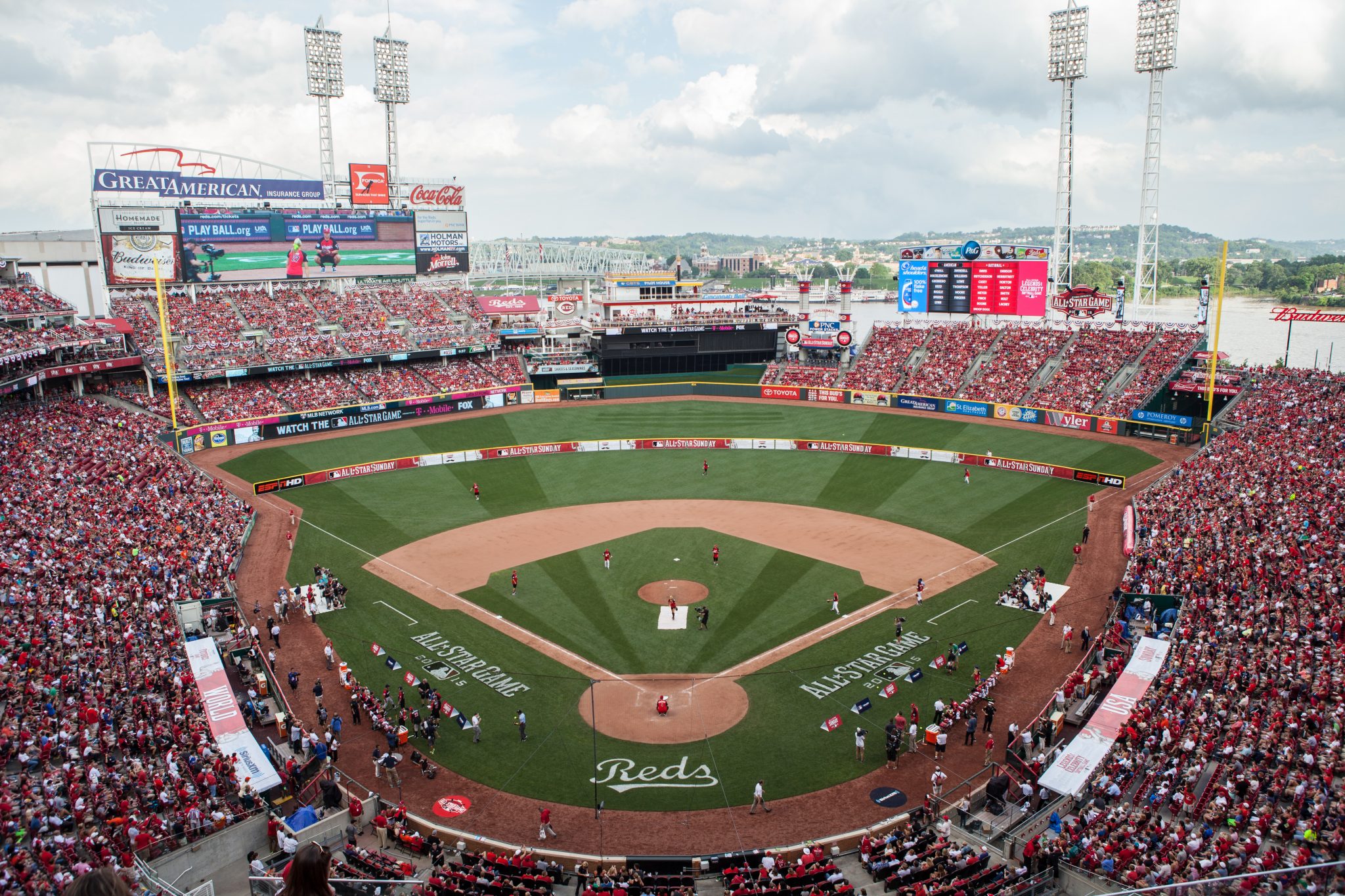

The Power Stacks. Behind them
is the Taylor-Southgate Bridge.
Adam Dunn hit the longest home run in the park's history, a 535-foot shot in 2004. Mark McGwire hit the longest at Riverfront Stadium, a 473-foot shot on May 5, 2000. Who hit the longest at Crosley Field isn't clear, but most sources cite a June 10, 1967 drive by Jimmy Wynn, a native of nearby Hamilton, Ohio: Then with the Houston Astros, "the Toy Cannon" (he was only 5-foot-9 but had a lot of power) cranked one over the left-center-field scoreboard (58 feet high), and it landed on Interstate 75, the Mill Creek Expressway. This was probably at least 475 feet.
Home plate from Crosley Field was moved to Riverfront Stadium in 1970, and to Great American Ball Park in 2003. I can't prove that it's the same plate from Crosley's opening in 1912, but it's been used since at least 1970.
Just before the 2004 election, President George W. Bush hosted a rally at Great American Ball Park. It's also hosted concerts, including Paul McCartney in 2011, Beyoncé and Jay-Z in 2014, and Billy Joel in 2021.
Food. Being in Big Ten Country, where tailgate parties are practically a sacrament, you would expect the Cincinnati ballpark to have lots of good options. Not really: The options are plentiful, but I wouldn't recommend them.
That traditional Midwestern favorite, the bratwurst, is sold at Queen City Brats, behind Section 514 in the upper deck. A stand called State Fair is at Section 130, and sells tradition state/county fair stuff like corn dogs, fried doughnuts and funnel cake -- check that, "funnel cake fries."
If your stomach is strong enough for that stuff, you may be prepared for this: Not only does Cincinnati, like Detroit, favor the "cheese coney," a hot dog with chili and cheese on it, but they like chili over… spaghetti. Huh? Cheese coneys are sold at Skyline Time stands at Sections 103, 116, 130, 519 and 534. A recent Thrillist article on the best food at every Major League Baseball stadium
names Skyline Chili as the best food at GABP, admitting, "out-of-towners might not be able to grasp what makes the famous Skyline puddle so damn endearing to Queen City taste buds," and calling it "messy pseudo-chili."
The 4192 Bar, named for Rose's record-breaking hit, is behind Section 306. Another section named for Rose, Pete's Head First Dogs, is at 512. (Apparently, MLB can prevent Rose from working for the Reds, or any other team, but they can't control who the Reds name facilities after.) Doggy's Dogs, a hot-dog stand named for the nickname of Tony Perez, is behind 525. Frank's Franks, named for Frank Robinson, are at 113, 143 and 531. Roebling Dogs, named for the family that built the old suspension bridge near the ballpark before moving to New York and building the Brooklyn Bridge, is at 112 and 130.
There's a Bob Evans restaurant (the chain is headquartered in Ohio) at 516. And the Machine Room, named for the 1970s "Big Red Machine," is at Suite Level -- which you're unlikely to even see. What you may see, at 130 or 514, is a stand called Penn Station, but this is no reference to New York. Indeed, it's closer to a Philadelphia-style stand, selling cheesesteaks.

The Mosaic's tribute to the 1869 Red Stockings
Team History Displays. Outside the park is The Mosaic, honoring Cincinnati's 2 most famous baseball teams: The 1869 Red Stockings, baseball's first openly professional team (though the current Reds have no official connection to this club, which was disbanded after the 1880 season) and the 1970s Reds, manager Sparky Anderson's Big Red Machine.

The Mosaic's tribute to the Big Red Machine. L to R:
Ken Griffey Sr., right field; Tony Perez, 1st base; Johnny Bench, catcher;
Joe Morgan, 2nd base; Pete Rose, 3rd base; Dave Concepcion, shortstop;
George Foster, left field; and Cesar Geronimo, center field.
Why are they apparently standing on the Kentucky side of the River?
A tribute to Rose is on the back of the left-field scoreboard, known as the 4192 Mural for his record-breaking 4,192nd career hit, which he notched at Riverfront Stadium on September 11, 1985. (A revision of records shows that Ty Cobb actually had 4,189 career hits, not 4,191, and this was known as early as 1981; however, MLB hadn't yet officially changed it by 1985. If they had, Rose would have broken the record earlier, on the road.)
The Power Stacks have 7 bats on them, totaling 14, a way of acknowledging Rose's Number 14, before they finally decided to retire it without caring what the MLB suits did. Commissioner Rob Manfred did nothing about it.
The number had only been issued once since Rose's 1989 ban, in the brief 1997 callup of Pete Rose Jr., who's had his own problems, but has never been banned from the game. The street named Pete Rose Way is outside the ballpark, and MLB and its Commissioner has no say in what the street can be named.)


June 26, 2016 -- almost 30 years after he played his last game
Phillies legend Mike Schmidt grew up in nearby Dayton, Ohio, while Robinson was starring for the Reds in the late 1950s and early 1960s, and wore 20 in tribute to him. Along with Willie McCovey and Reggie Jackson wearing 44 in honor of Hank Aaron, and Al Kaline wearing 6 in honor of Stan Musial, as far as I know it's the only number in baseball retired in honor of a player who wore it in tribute to another player's number that ended up retired. (Troy Tulowitzki admitted to wearing Number 2 in honor of Derek Jeter, but the Colorado Rockies are unlikely to retire it for him.)
Logos of microphones in honor of broadcasters Waite Hoyt, Joe Nuxhall and Marty Brennaman are placed alongside the retired numbers. Nuxhall, like Jimmy Wynn a native of Hamilton, was in high school, just short of his 16th birthday, when the manpower shortage of World War II made the Reds desperate enough to sign him, and make him the youngest player in major league history, on June 10, 1944. It didn't go so well: He got shelled in his one and only appearance.
This did not deter him, though: After graduation, he remained in the Reds' minor-league system, worked his way back, and pitched for them from 1952 to 1960, including their near-miss season of 1956, when he made his 2nd straight appearance on the NL All-Star team. But they traded him, and he missed their 1961 Pennant. He came back, retiring in 1966, and went into the broadcast booth.
Nuxy wore Number 39 for most of his Reds career, but the number has not been retired for him; it is currently worn by backup catcher Devin Mesoraco. Nuxy would conclude a broadcast by saying, "This is the Old Lefthander, rounding third and heading for home." It was an odd signoff, considering he was a pitcher... and is best remembered outside of Cincinnati not for being old (he wasn't quite 38 when he pitched his last game), but for being in a major league game when he was 15 years old.
Hoyt was also signed to his first pro contract at age 15, by the New York Giants out of Brooklyn's Erasmus Hall High School. He made his big-league debut with the Giants in 1918, shortly before turning 19. But they sent him to the Red Sox, who made him one of several players they sent to the Yankees, and he became a Hall-of-Fame pitcher throughout the 1920s. He would return to the Giants in 1932, and closed his playing career with his "hometown" Dodgers in 1938.
He won 237 games, but after he joined Alcoholics Anonymous -- one of the earliest pro athletes to publicly admit having done so -- he said he would have won 300 if not for his drinking. I believe him. He broadcast for the Reds from 1942 to 1972, and was so popular that the team released 2 record albums of his rain-delay stories, The Best of Waite Hoyt in the Rain. Born in 1899, he died in 1984.
Brennaman, who has been honored with the Hall of Fame's Ford Frick Award for broadcasting, actually started in the Mets' organization, doing 3 years with the team then known as the Tidewater Tides, as he is a native of the Norfolk area. He was been the Reds' main voice from 1974, the middle of the Big Red Machine years, until his retirement after the 2019 sesaon. His postgame tagline, in the event of a Cincinnati victory, is "And this one belongs to the Reds!"
His son Thom Brennaman joined him as a Reds broadcaster, after having been part of the inaugural broadcast team of the Arizona Diamondbacks, but was fired in 2020 after a homophobic comment.
Outside the main entrance is Crosley Terrace, a reference to Crosley Field, with statues of Crosley-era stars Nuxhall, Kluszewski, Robinson and 1930s-40s catcher Ernie Lombardi, a Hall-of-Famer and one of the best-hitting catchers ever, but whose Number 4 has never been retired by the Reds.
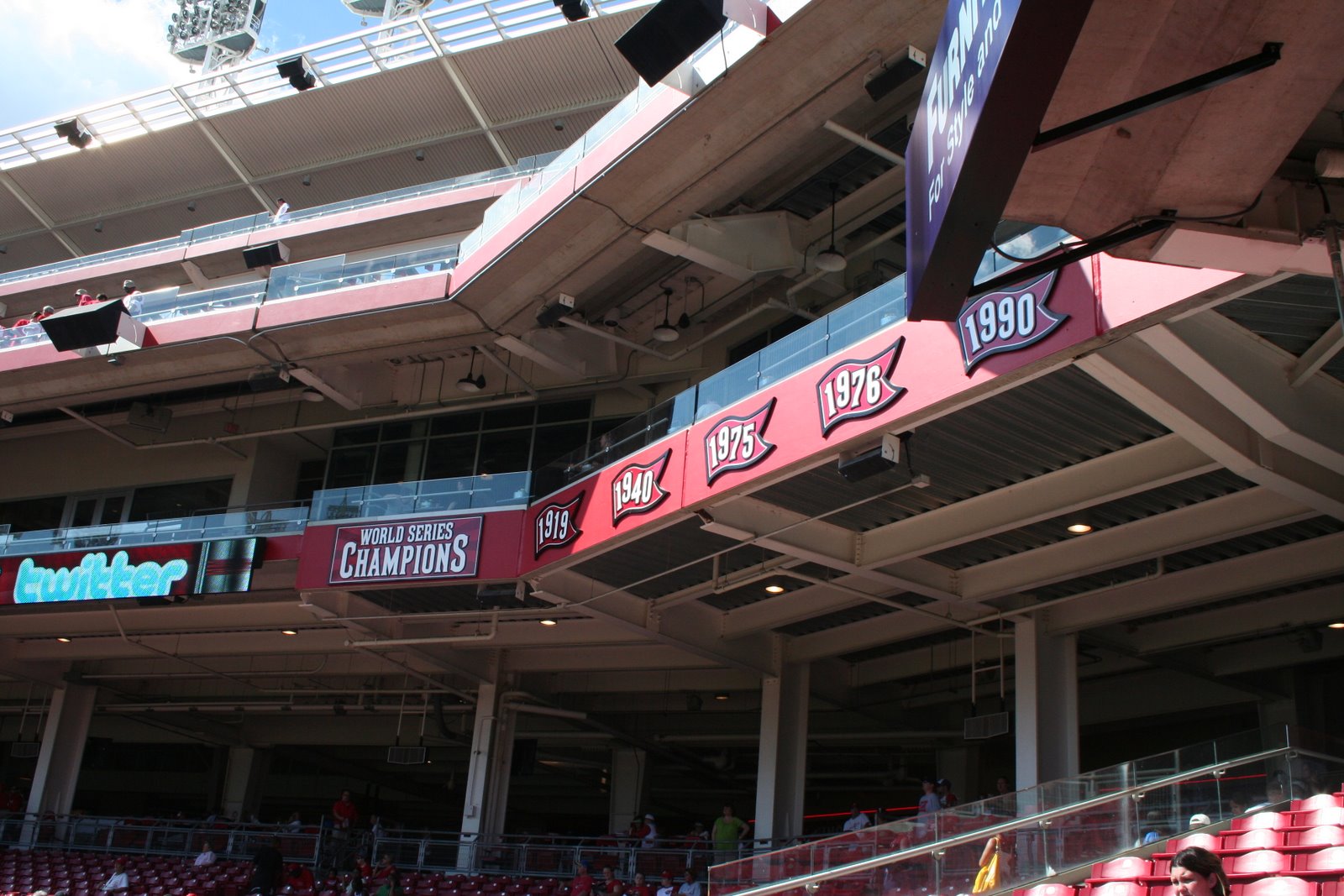
Banners for the Reds' 5 World Series wins are hung in the left field corner. They do not hang any other banners, for the Pennants where they lost the World Series, the Division titles where they didn't win the Pennant, or their 1999 Wild Card Playoff in which they lost to the Mets at Riverfront.
 The team has a Cincinnati Reds Hall of Fame and Museum, located on the west side of the park on Main Street. Oddly, the Reds have more players in their team Hall of Fame than any other MLB club – in fact, more than any team in the 4 North American major league sports except the Green Bay Packers: 90.
* From the 1869 Red Stockings: The brothers Harry and George Wright (not to be confused with the Wright Brothers from Southern Ohio who invented the airplane in 1903, these Wright Brothers invented professional baseball). They are in the Baseball Hall of Fame in Cooperstown.
* From the remainder of the 19th Century: Pitchers Will White and Tony Mullane, 1st basemen John Reilly and Jake Beckley, 2nd baseman John "Bid" McPhee, and center fielder Billy "Dummy" Hoy.
Hoy, a deaf player who was supposedly the inspiration for umpires' hand signals for balls and strikes, and who threw out the first ball at a 1961 World Series game between the Yanks and Reds, at age 99, then the oldest ex-player ever. (Sadly, he didn't quite make it to 100.) McPhee and Beckley are in Cooperstown.
* From early in the 20th Century, but not making it to 1919: Pitcher Frank "Noodles" Hahn, and outfielders Cy Seymour and Bob Ewing.
* From the 1919 World Champions: Team president August Herrmann, center fielder Edd Roush, 1st baseman Jake Daubert, left fielder Raymond "Rube" Bressler, 3rd baseman Henry "Heinie" Groh, shortstop Larry Kopf, and early Cuban pitcher Adolfo "Dolf" Luque.
Roush, who is in Cooperstown, was the possessor of the most lauded outfield arm of his era, and lived until 1988 insisting that the Reds would have beaten the Chicago White Sox in that World Series even if the "Black Sox" had played on the level. (He had a case: The Reds won 95 games that season, the White Sox only 88.)
* From between the 1919 and 1939 Pennants: Catcher Eugene "Bubbles" Hargrave, 2nd baseman Hughie Critz, and pitchers Eppa Rixey, Pete Donohue and Charles "Red" Lucas. Rixey is in Cooperstown.
* From the 1939 Pennant winners and the 1940 World Champions: Manager Bill McKechnie, general manager Warren Giles, catcher Ernie Lombardi, 1st baseman Frank McCormick, 2nd baseman Lonny Frey, shortstop Billy Myers, 3rd baseman Billy Werber, left fielder Mike McCormick (who didn't debut until 1940), center fielder Harry Craft, right fielder Ival Goodman, and pitchers Paul Derringer, Johnny Vander Meer (he of the back-to-back no-hitters in 1938) and William "Bucky" Walters. McKechnie, Giles and Lombardi are in Cooperstown.
* From between the 1940 and 1961 Pennants: Pitchers Ewell Blackwell, Brooks Lawrence and Joe Nuxhall, catcher Forrest "Smoky" Burgess, 1st baseman Ted Kluszewski and shortstop Roy McMillan.
* From the 1961 Pennant winners: Manager Fred Hutchinson, 1st baseman Gordy Coleman, 2nd baseman Johnny Temple, shortstop Leo Cardenas, left fielder Jerry Lynch, center fielders Gus Bell and Vada Pinson, right fielders Frank Robinson and Wally Post, and pitchers Jim Maloney, Joey Jay, Jim O'Toole and Bob Purkey.
Robinson is in Cooperstown. The next season, Gus Bell became an original Met. His son Buddy and grandson David became big-league stars as well. Each of them had David as their real name.
* From the 1961-69 interregnum: Manager Dave Bristol.
* From their 1970 and/or 1972 Pennant winners, but not making it to 1975: 1st baseman Lee May, 2nd baseman Tommy Helms and pitcher Wayne Granger.
* From their 1975 and 1976 World Champions: Manager George "Sparky" Anderson, GM Bob Howsam (also responsible for establishing the Denver Broncos), catcher Johnny Bench, 1st basemen Tony Perez and Dan Driessen, 2nd baseman Joe Morgan, shortstop Dave Concepcion, 3rd baseman Pete Rose, left fielder George Foster, center fielder Cesar Geronimo, right fielder Ken Griffey Sr., and pitchers Gary Nolan, Clay Carroll, Don Gullett, Pedro Borbon, Jack Billingham and Fred Norman; and broadcaster Marty Brennaman.
Anderson, Bench, Perez and Morgan are in Cooperstown, lots of people think Concepcion should be, lots of people thought Foster would be, and Rose would have been if he hadn't broken that rule.
* From their 1979 National League Western Division Champions: Brennaman, pitchers Tom Seaver and Mario Soto, and 2nd baseman Ron Oester. Seaver, of course, is in Cooperstown.
* From their 1985, '86, '87 and '88 teams that finished 2nd in the NL West, but had no Wild Card berth to take: Brennaman, Rose, and Cincinnati native right fielder Dave Parker.
* From their 1990 World Champions: Brennaman, shortstop Barry Larkin, 3rd baseman Chris Sabo, center fielder Eric Davis, and pitchers Tom Browning and Jose Rijo. Larkin is in Cooperstown.
* From since 1990: Brennaman; Center fielder Ken Griffey Jr., now in Cooperstown; 1st baseman Sean Casey; and left fielder Adam Dunn.
Only 1 Reds player was chosen for the 1st All-Star Game in 1933, and while he is in the Hall of Fame, he's better known as a St. Louis Cardinal: Slugging outfielder Charles "Chick" Hafey. Robinson, Rose, Bench, Morgan, Seaver and Griffey (then still active and not yet having played for the Reds) were named to The Sporting News' 100 Greatest Baseball Players in 1999. The same year, Rose, Bench and Griffey were named to the Major League Baseball Hall-Century Team. In 2006, DHL ran its Hometown Heroes poll, and Reds fans chose Rose.
Banners for the Reds' 5 World Series wins are hung in the left field corner. They do not hang any other banners, for the Pennants where they lost the World Series, the Division titles where they didn't win the Pennant, or their 1999 Wild Card Playoff in which they lost to the Mets at Riverfront.
* From the 1869 Red Stockings: The brothers Harry and George Wright (not to be confused with the Wright Brothers from Southern Ohio who invented the airplane in 1903, these Wright Brothers invented professional baseball). They are in the Baseball Hall of Fame in Cooperstown.
* From the remainder of the 19th Century: Pitchers Will White and Tony Mullane, 1st basemen John Reilly and Jake Beckley, 2nd baseman John "Bid" McPhee, and center fielder Billy "Dummy" Hoy.
Hoy, a deaf player who was supposedly the inspiration for umpires' hand signals for balls and strikes, and who threw out the first ball at a 1961 World Series game between the Yanks and Reds, at age 99, then the oldest ex-player ever. (Sadly, he didn't quite make it to 100.) McPhee and Beckley are in Cooperstown.
* From early in the 20th Century, but not making it to 1919: Pitcher Frank "Noodles" Hahn, and outfielders Cy Seymour and Bob Ewing.
* From the 1919 World Champions: Team president August Herrmann, center fielder Edd Roush, 1st baseman Jake Daubert, left fielder Raymond "Rube" Bressler, 3rd baseman Henry "Heinie" Groh, shortstop Larry Kopf, and early Cuban pitcher Adolfo "Dolf" Luque.
Roush, who is in Cooperstown, was the possessor of the most lauded outfield arm of his era, and lived until 1988 insisting that the Reds would have beaten the Chicago White Sox in that World Series even if the "Black Sox" had played on the level. (He had a case: The Reds won 95 games that season, the White Sox only 88.)
* From between the 1919 and 1939 Pennants: Catcher Eugene "Bubbles" Hargrave, 2nd baseman Hughie Critz, and pitchers Eppa Rixey, Pete Donohue and Charles "Red" Lucas. Rixey is in Cooperstown.
* From the 1939 Pennant winners and the 1940 World Champions: Manager Bill McKechnie, general manager Warren Giles, catcher Ernie Lombardi, 1st baseman Frank McCormick, 2nd baseman Lonny Frey, shortstop Billy Myers, 3rd baseman Billy Werber, left fielder Mike McCormick (who didn't debut until 1940), center fielder Harry Craft, right fielder Ival Goodman, and pitchers Paul Derringer, Johnny Vander Meer (he of the back-to-back no-hitters in 1938) and William "Bucky" Walters. McKechnie, Giles and Lombardi are in Cooperstown.
* From between the 1940 and 1961 Pennants: Pitchers Ewell Blackwell, Brooks Lawrence and Joe Nuxhall, catcher Forrest "Smoky" Burgess, 1st baseman Ted Kluszewski and shortstop Roy McMillan.
* From the 1961 Pennant winners: Manager Fred Hutchinson, 1st baseman Gordy Coleman, 2nd baseman Johnny Temple, shortstop Leo Cardenas, left fielder Jerry Lynch, center fielders Gus Bell and Vada Pinson, right fielders Frank Robinson and Wally Post, and pitchers Jim Maloney, Joey Jay, Jim O'Toole and Bob Purkey.
Robinson is in Cooperstown. The next season, Gus Bell became an original Met. His son Buddy and grandson David became big-league stars as well. Each of them had David as their real name.
* From the 1961-69 interregnum: Manager Dave Bristol.
* From their 1970 and/or 1972 Pennant winners, but not making it to 1975: 1st baseman Lee May, 2nd baseman Tommy Helms and pitcher Wayne Granger.
* From their 1975 and 1976 World Champions: Manager George "Sparky" Anderson, GM Bob Howsam (also responsible for establishing the Denver Broncos), catcher Johnny Bench, 1st basemen Tony Perez and Dan Driessen, 2nd baseman Joe Morgan, shortstop Dave Concepcion, 3rd baseman Pete Rose, left fielder George Foster, center fielder Cesar Geronimo, right fielder Ken Griffey Sr., and pitchers Gary Nolan, Clay Carroll, Don Gullett, Pedro Borbon, Jack Billingham and Fred Norman; and broadcaster Marty Brennaman.
Anderson, Bench, Perez and Morgan are in Cooperstown, lots of people think Concepcion should be, lots of people thought Foster would be, and Rose would have been if he hadn't broken that rule.
* From their 1979 National League Western Division Champions: Brennaman, pitchers Tom Seaver and Mario Soto, and 2nd baseman Ron Oester. Seaver, of course, is in Cooperstown.
* From their 1985, '86, '87 and '88 teams that finished 2nd in the NL West, but had no Wild Card berth to take: Brennaman, Rose, and Cincinnati native right fielder Dave Parker.
* From their 1990 World Champions: Brennaman, shortstop Barry Larkin, 3rd baseman Chris Sabo, center fielder Eric Davis, and pitchers Tom Browning and Jose Rijo. Larkin is in Cooperstown.
* From since 1990: Brennaman; Center fielder Ken Griffey Jr., now in Cooperstown; 1st baseman Sean Casey; and left fielder Adam Dunn.
Only 1 Reds player was chosen for the 1st All-Star Game in 1933, and while he is in the Hall of Fame, he's better known as a St. Louis Cardinal: Slugging outfielder Charles "Chick" Hafey. Robinson, Rose, Bench, Morgan, Seaver and Griffey (then still active and not yet having played for the Reds) were named to The Sporting News' 100 Greatest Baseball Players in 1999. The same year, Rose, Bench and Griffey were named to the Major League Baseball Hall-Century Team. In 2006, DHL ran its Hometown Heroes poll, and Reds fans chose Rose.
In 2022, ESPN
named its 100 Greatest Baseball Players. Among players who played
significant time for the Reds, Griffey Jr. was ranked 13th, Robinson 19th, Seaver 22nd, Bench 29th, Rose 34th, Morgan 37th, and Larkin 100th.
Outside the stadium are statues of Lombardi, Nuxhall, Robinson, Bench and Morgan. The statue of Bench calls him "Baseball's Greatest Catcher." To turn Sparky Anderson's words from the 1976 World Series about Thurman Munson on their head, Don't embarrass anybody by comparing him to Yogi Berra.

It doesn't mention that Bench hosted
The Baseball Bunch on NBC from 1980 to 1985.
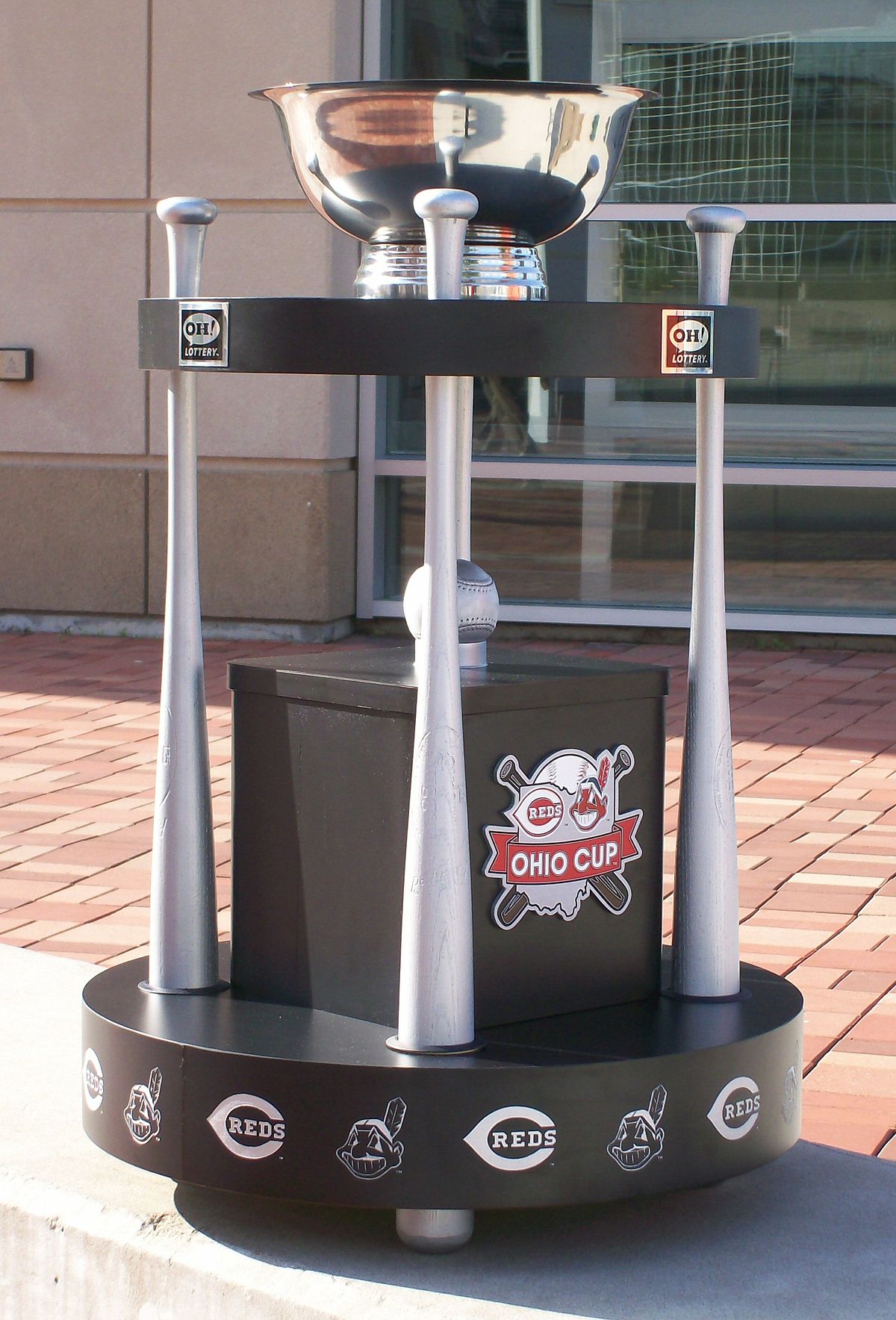
Since the start of Interleague Play in 1997, the Reds and the Cleveland Guardians (formerly the Indians) have competed for the Ohio Cup. The winner of the season series gets it. The Guardians have won it 11 times, the Reds, 5, and there have been 9 splits, including this season, for which all games have already been played. Overall, the Guardians lead the series, 71-56.
The Reds' other rivalry is with the Pittsburgh Pirates. From 1970 to 2000, when the Reds played at Riverfront and the Pirates at Three Rivers Stadium, 288 miles apart but on the same river (the Ohio), the joke was that you could knock somebody out in one stadium, transport him to the other, and when he woke up, he wouldn't know he was in a different stadium until he left the building.
The teams even started in the same league at the same time: The American Association in 1882. They've met each other in the Playoffs 6 times, with the Reds winning in 1970, 1972, 1975 and 1990; and the Pirates winning in 1979 and 2013. Overall, including the postseason, it's close: The Pirates have won 1,198 games, the Reds 1,185.
Stuff. Clubhouse stores are located all over GABP. The usual items that can be found at a souvenir store can be found there.
With the 1970s nostalgia wave in full flower now, books about the Reds teams of that decade, known as the Big Red Machine, have come out. In 2016, Ed Gruver published Hairs vs. Squares: The Mustache Gang, the Big Red Machine, and the Tumultuous Summer of '72, which culminates in the World Series between the Reds and the Oakland Athletics.
Tom Adelman's The Long Ball tells of the 1975 season, and how the Reds and the Boston Red Sox went through them on their way to their meeting in an epic World Series. There's The Machine: A Hot Team, a Legendary Season, and a Heart-Stopping World Series: The Story of the 1975 Cincinnati Reds, by Joe Posnanski; and The 1976 Cincinnati Reds: Last Hurrah for the Big Red Machine, by Doug Feldmann, a tribute to the only team ever to go undefeated in a baseball postseason of more than 1 round (7-0; the 1999 Yankees went 11-1).
There's also Before the Machine: The Story of the 1961 Pennant-Winning Reds by Mark J. Schmetzer and Greg Rhodes, issued on the 50th Anniversary of that team. A contemporary book about that team, Pennant Race, was written by one of their pitchers, Jim Brosnan, who had previously written about a less successful season with the St. Louis Cardinals in The Long Season. Jim Bouton's Ball Four was clearly influenced by Brosnan.
Available DVDs include Cincinnati Reds Memories, the official World Series highlight films of 1975, 1976 and 1990 (the 1919 and 1940 titles preceded official films), and a box set of the 1975 Series, including every Series game (yes, including the legendary Game 6 that the Red Sox lost) and a few bonuses from that era.
During the Game. A recent Thrillist article on "Baseball's Most Intolerable Fans" ranked Reds fans 11th, putting them not quite in the Top 10 of the most intolerable. Though I suspect they might not be even that bad if it weren't for their still being too willing to defend the indefensible Pete Rose.
Because of their Midwest/Heartland image, Reds fans like a "family atmosphere." You won't hear much dirty language at a Reds game. And you do not have to worry about wearing Yankee or Met gear in Great American Ball Park. Just because the sight of the Reds' "Wishbone C" logo still makes Met fans remember the 1973 NLCS fight that Rose picked with the far smaller Bud Harrelson doesn't make Reds fans hate the Mets. Though they do tend to not like New York, for reasons beyond baseball.
But unless you're wearing Cleveland Browns gear to a Cincinnati Bengals game, University of Michigan gear to an Ohio State University sporting event, or gear of either side of the local college basketball rivalry -- the University of Cincinnati or Xavier University -- to the other school's home game, people from Cincinnati aren't going to go out of their way to be obnoxious to you, let alone violent.
Since Monday is the 4th of July, there will be postgame fireworks. It will also be a Military Appreciation Day. At Great American Ball Park, Tuesdays are 3-2-1 Days: Budweiser and Bud Light are $3, hot dogs are $2, and ice cream cups are $1. The Wednesday game will not feature a promotion.
The Reds don't have a regular National Anthem singer, instead holding auditions for it. They don't have any notable in-park fans, although Harry Thobe, a stonemason from nearby Oxford, Ohio showed up at Crosley Field wearing a straw hat and carrying a megaphone. He was sort of a Midwestern version of the Dodgers' Hilda Chester, the Yankees' Freddy Sez or the Mets' Cow-Bell Man. He also did his act at Miami University football games in Oxford, because his work had led him to be one of the builders for MU's gymnasium. He claimed to have attended every Reds Opening Day from 1894 onward, and died just before the start of the 1950 season, age 80.

Plaque honoring Thobe at Great American Ball Park
Nor do they have many celebrity fans, although George Clooney is one, coming from Lexington, Kentucky, 83 miles away. True, that's about as close as Northeast Philadelphia is to Midtown Manhattan, but the Reds are still the closest major-league team, unless (as is incredibly unlikely) Louisville gets back into the majors for the first time since 1899.
The Reds were one of the first teams to have a mascot, Mr. Red. He served as the team's logo for a long time before becoming a man in a costume on the field. There is a retro version called Mr. Redlegs, which matches the team's logo from the 1950s when, due to McCarthyism, being called "Reds" was considered un-American. This version had a 19th Century-style mustache, reminding people that Cincinnati was the birthplace of professional baseball (though, again, this Reds team, which began in 1882, is not the same team as the 1869 one).
Mr. Red and Mr. Redlegs are now man-in-costume mascots. They've been joined by a female mascot, Rosie Red (perhaps named for George's aunt, the late Reds fan and legendary singer Rosemary Clooney, since naming her after Pete Rose wouldn't be a good idea as he's a notorious womanizer), and a furry red… thing called Gapper. And they have a mascot race

Left to right: Gapper, Rosie Red, Mr. Red, Mr. Redlegs
James Brown and some other big-time musicians were also associated with Cincy-based record companies. And Rosemary Clooney got her start there as well. But Cincinnati is simply not a very hip town – and those rural natives of Southern Ohio, Northern Kentucky, Southeastern Indiana and Western West Virginia like it that way.
After the Game. Downtown should be safe, but stay downtown. Cincinnati does have a bit of a crime problem. The city had race riots in 1829, 1836 and 1841, and was one of many stricken with them in "The Long Hot Summer" of 1967, from June 12 to 15, in the Avondale neighborhood north of downtown. Another took place from April 9 to 13, 2001, something rarely seen in America since the 1960s until the recent rash of police brutality protests.
Across Joe Nuxhall Way, to the west of the Ball Park, in an era known as "The Banks," are several places to go, including Holy Grail Tavern & Grill, and Moerlein Lager House. A little further down, on East Freedom Way at Walnut Street, is the Yard House.
I can find no references to well-known postgame bars, or to places where New Yorkers gather in or around Cincinnati. The sites that usually list bars for football fans in exile don't seem to have references to where Yankees, Mets, Giants or Jets fans go when they live near Cincy. In contrast, Phebe's, at 359 Bowery at East 4th Street, is New York's home for fans of the Cincinnati Reds and Bengals.
If you visit Cincinnati during the European soccer season, which is now underway, the main "football pub" in town is Rhinehaus, 119 E. 12th Street and Clay Street, in the neighborhood called Over-The-Rhine, or OTR, just north of downtown. Bus 19, or Streetcar to Washington Street.
Sidelights. Cincinnati may have only 2 major league teams now. One of those, the Reds, has usually been respectable, but hasn't won so much as an NLCS game for 26 years. The other, the Bengals, has been a joke for most of the last 20 years, even when they've had good regular seasons. But it's a pretty good sports town, and here's some of the highlights:
* Site of Riverfront Stadium. The home of the Reds from 1970 to 2002 (known as Cinergy Field in its final years) and the NFL's Bengals from 1970 to 1999 was across Main Street from its baseball replacement, bounded also by 2nd Street, Mehring Way and Vine Street.

Riverfront was a pioneer in artificial turf, the 1st outdoor stadium in either MLB or the NFL to have it, and the 1st to host either league's postseason on it. It switched to real grass for its last 2 seasons, 2001 and 2002.
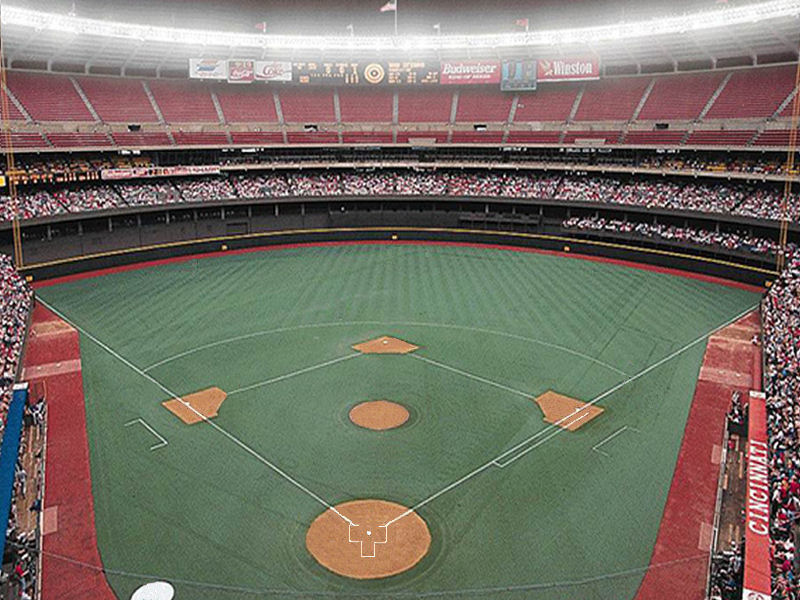
The National Underground Railroad Freedom Center is now on the site. And just beyond it is the John A. Roebling Suspension Bridge, opened in 1866 and named for its designer, who used it as the basis for his greatest achievement, the Brooklyn Bridge. The bar and restaurant district on the Covington, Kentucky side of the bridge is known as Roebling Point.
* Paul Brown Stadium. Opening in 2000, and named for the legendary coach of the Cleveland Browns and the founding owner and coach of the Bengals, This 65,000-seat stadium has also hosted the University of Cincinnati (including its entire 2014 home schedule while Nippert Stadium was being renovated, thus the Bengals returning the favor of UC letting them play there in their 1st 2 seasons), Ohio State, and Miami University of Ohio.

UPDATE: On August 9, 2022, the naming rights were sold to a payroll company. It's now named Paycor Stadium.
 The Cincinnati Stingers of the World Hockey Association played here from 1975 to 1979. They reached the Playoffs in 1977 and 1979, but were not invited to join the NHL. Hall-of-Famers Mark Messier and Mike Gartner made their "major league" debuts here, and, as such were named to the WHA All-Time Team.
The University of Cincinnati basketball team played home games here from 1976 to 1987 -- though, contrary to what I had posted in previous years, rivals Xavier University never used it as a home court. It hosted the NCAA's hockey Final Four, a.k.a. the Frozen Four, in 1996.
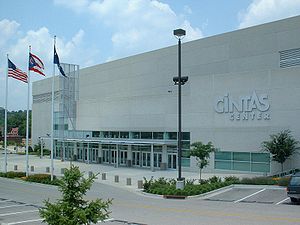
* Heritage Bank Center. Formerly known as the Riverfront Coliseum, this building went up across Broadway from Riverfront Stadium (and can be seen from Great American Ball Park) in 1975, and has hosted minor league hockey ever since, including the current Cincinnati Cyclones.

The University of Cincinnati basketball team played home games here from 1976 to 1987 -- though, contrary to what I had posted in previous years, rivals Xavier University never used it as a home court. It hosted the NCAA's hockey Final Four, a.k.a. the Frozen Four, in 1996.
Elvis Presley sang there on March 21, 1976 and, just before his death, on June 25, 1977. A review the next day called it maybe the worst show of his career. The next night, at Market Square Arena in Indianapolis, he got much better reviews, but it turned out to be his last concert.
Unfortunately, the arena is best known for the tragedy of December 3, 1979, when 11 fans were killed and 26 others were injured, when fans rushed in for "festival seating" for a concert by The Who. This event was immortalized shortly thereafter in an episode of WKRP in Cincinnati, ordinarily one of the funniest situation comedies of its time.
It's unlikely that Cincinnati will get a new major league team for this arena anytime soon, partly due to its being a typical 1970s arena, with 1 level of concourse for 2 levels of seating, and not enough skyboxes; and partly due to Cincinnati's market size. The metro area would rank 22nd in population among NBA markets, and 21st in the NHL.
The closest NBA team is the Indiana Pacers, 113 miles to the northwest; the Cleveland Cavaliers are 249 miles to the northeast, the Chicago Bulls 296 miles to the northwest. The closest NHL team, representing the entire State of Ohio (including Cincinnati and Cleveland, normally bitter rivals), is the Columbus Blue Jackets, 107 miles to the northeast; the Detroit Red Wings, 260 miles to the northeast; the Nashville Predators, 274 miles to the southwest; the Pittsburgh Penguins, 288 miles to the northeast; the St. Louis Blues, 350 miles to the west.
* Crosley Field site. Three different ballparks were at a location bounded by Findlay Street, Western Avenue, Liberty Street and Dalton Avenue, a convenient location for teams coming into the city through the Union Terminal: League Park from 1884 to 1901, the elaborate Palace of the Fans from 1902 to 1911, and the 3rd from 1912 to 1970. First named Redland Field, appliance executive Powel Crosley renamed it for himself when he bought the Reds in 1934.

Here, the Reds won the Pennant in 1919, 1939, 1940 and 1961, winning the World Series in 1919 and 1940. The Yankees clinched World Series wins here in 1939 and 1961. Bush Stadium, the former home of the Triple-A team in Indianapolis, stood in for it and Comiskey Park in Eight Men Out, the film about the Black Sox scandal.
Best known as the first big-league ballpark with lights, in 1935, it had an infamous incline, a.k.a. the "terrace," that was trouble for left fielders; a building behind left field with an ad for the Superior Towel and Linen Service, nicknamed the Laundry Roof, which was torn down in 1960 to make way for Interstate 75 and a rerouted U.S. Route 52, the Mill Creek Expressway; and a right field bleacher section known as the Sun Deck for day games and the Moon Deck for night games.
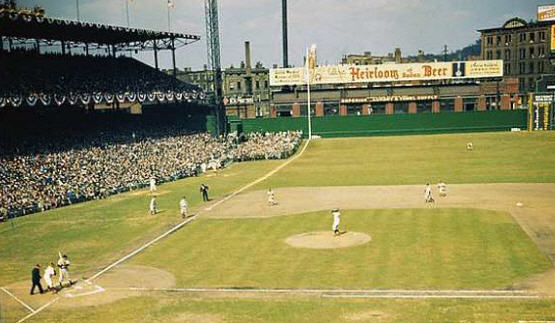
Crosley was also home to an NFL team named the Cincinnati Reds in 1933 and '34. There was also a Cincinnati Celts, pronounced with a hard C unlike the Boston basketball team, that played in the NFL from 1920 to 1923, but they were a traveling team, playing no home games.
The Beatles played there on August 21, 1966, and, in one of the ballpark's last events, the Cincinnati Pop Festival was held there on June 13, 1970, featuring Iggy & the Stooges, Mountain, Grand Funk Railroad, Alice Cooper, Traffic, Bob Seger and Mott the Hoople.
The park was demolished in 1972. An industrial park now stands on the site, a 15-minute walk from Union Terminal. The Number 27 and 49 buses will get you Linn and Findlay, a 7-block walk (counting I-75) from the site.
* Blue Ash Sports Center. A replica of Crosley Field was built in 1988 in suburban Blue Ash, complete with a few original seats. The field's dimensions are the same, and it includes a left-field terrace. The scoreboard shows the correct information (and advertising signs) from the last game, a 5-4 Reds win over the San Francisco Giants on June 24, 1970. The light towers don't look the same, but they are in the right places.
There is, however, no laundry roof behind left field or Sun Deck behind right field. Edd Roush and Ted Kluszewski are dead, and Frank Robinson and Johnny Bench won't show up -- although Pete Rose might, if you offer him enough money.
 "New Crosley" is the centerpiece of the Blue Ash Sports Center, which also includes 10 other baseball fields and 2 soccer fields. 11540 Grooms Road, 16 miles northeast of Fountain Square, just inside Interstate 275, Cincinnati's "beltway." Reachable by car only
As for the original 1869 Red Stockings, they played at the Union Cricket Club Grounds, a field with a stand for about 4,000 people. The Union Terminal was built on the site, so if you do come into Cincinnati by train, you're already on the birthplace of professional baseball. 1301 Western Avenue. Bus 1 from downtown.
* Nippert Stadium. Home to the University of Cincinnati's football team since 1924, and the original home (1968-69) of the Bengals, this ground has been extensively remodeled, so that it has few of the difficulties of being an old stadium, but also none of the look and atmosphere of one. 99 W. Corry Street, at Backstage Drive, on the UC campus. Number 17 or 19 bus.

FC Cincinnati played pro soccer at Nippert from 2016 to 2020, first in the United Soccer League, the 2nd tier of American soccer, and then in 2019 and '20 in Major League Soccer. The stadium has hosted 1 U.S. national team game, a 3-0 loss to Venezuela on June 9, 2019.
Unfortunately, the arena is best known for the tragedy of December 3, 1979, when 11 fans were killed and 26 others were injured, when fans rushed in for "festival seating" for a concert by The Who. This event was immortalized shortly thereafter in an episode of WKRP in Cincinnati, ordinarily one of the funniest situation comedies of its time.
It's unlikely that Cincinnati will get a new major league team for this arena anytime soon, partly due to its being a typical 1970s arena, with 1 level of concourse for 2 levels of seating, and not enough skyboxes; and partly due to Cincinnati's market size. The metro area would rank 22nd in population among NBA markets, and 21st in the NHL.
The closest NBA team is the Indiana Pacers, 113 miles to the northwest; the Cleveland Cavaliers are 249 miles to the northeast, the Chicago Bulls 296 miles to the northwest. The closest NHL team, representing the entire State of Ohio (including Cincinnati and Cleveland, normally bitter rivals), is the Columbus Blue Jackets, 107 miles to the northeast; the Detroit Red Wings, 260 miles to the northeast; the Nashville Predators, 274 miles to the southwest; the Pittsburgh Penguins, 288 miles to the northeast; the St. Louis Blues, 350 miles to the west.
* Crosley Field site. Three different ballparks were at a location bounded by Findlay Street, Western Avenue, Liberty Street and Dalton Avenue, a convenient location for teams coming into the city through the Union Terminal: League Park from 1884 to 1901, the elaborate Palace of the Fans from 1902 to 1911, and the 3rd from 1912 to 1970. First named Redland Field, appliance executive Powel Crosley renamed it for himself when he bought the Reds in 1934.
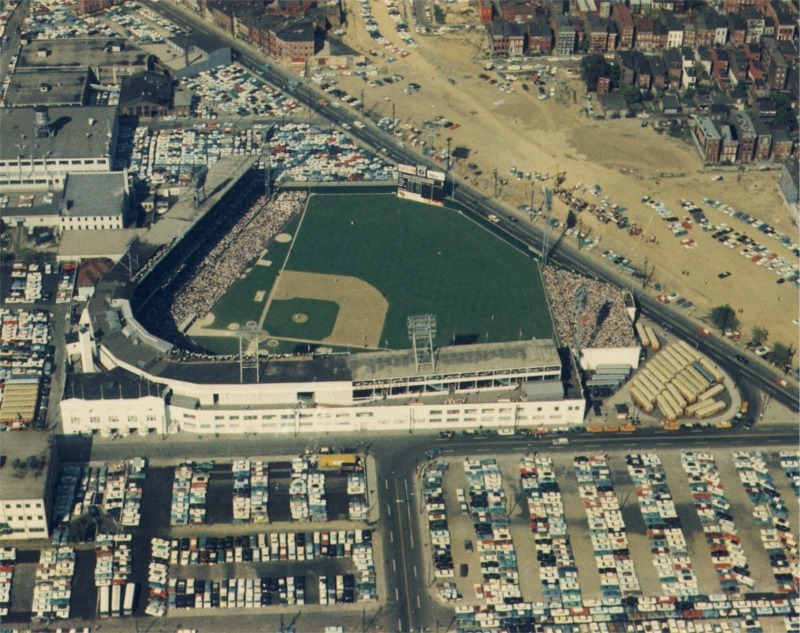
Photo possibly taken during the 1961 World Series,
since the path for the Expressway has been cleared.
Here, the Reds won the Pennant in 1919, 1939, 1940 and 1961, winning the World Series in 1919 and 1940. The Yankees clinched World Series wins here in 1939 and 1961. Bush Stadium, the former home of the Triple-A team in Indianapolis, stood in for it and Comiskey Park in Eight Men Out, the film about the Black Sox scandal.
Best known as the first big-league ballpark with lights, in 1935, it had an infamous incline, a.k.a. the "terrace," that was trouble for left fielders; a building behind left field with an ad for the Superior Towel and Linen Service, nicknamed the Laundry Roof, which was torn down in 1960 to make way for Interstate 75 and a rerouted U.S. Route 52, the Mill Creek Expressway; and a right field bleacher section known as the Sun Deck for day games and the Moon Deck for night games.
The "terrace," and the "laundry roof" before its demolition in 1960
Crosley was also home to an NFL team named the Cincinnati Reds in 1933 and '34. There was also a Cincinnati Celts, pronounced with a hard C unlike the Boston basketball team, that played in the NFL from 1920 to 1923, but they were a traveling team, playing no home games.
The Beatles played there on August 21, 1966, and, in one of the ballpark's last events, the Cincinnati Pop Festival was held there on June 13, 1970, featuring Iggy & the Stooges, Mountain, Grand Funk Railroad, Alice Cooper, Traffic, Bob Seger and Mott the Hoople.
Note the terrace in left field, and the Sun Deck in right field
The park was demolished in 1972. An industrial park now stands on the site, a 15-minute walk from Union Terminal. The Number 27 and 49 buses will get you Linn and Findlay, a 7-block walk (counting I-75) from the site.
* Blue Ash Sports Center. A replica of Crosley Field was built in 1988 in suburban Blue Ash, complete with a few original seats. The field's dimensions are the same, and it includes a left-field terrace. The scoreboard shows the correct information (and advertising signs) from the last game, a 5-4 Reds win over the San Francisco Giants on June 24, 1970. The light towers don't look the same, but they are in the right places.
There is, however, no laundry roof behind left field or Sun Deck behind right field. Edd Roush and Ted Kluszewski are dead, and Frank Robinson and Johnny Bench won't show up -- although Pete Rose might, if you offer him enough money.
As for the original 1869 Red Stockings, they played at the Union Cricket Club Grounds, a field with a stand for about 4,000 people. The Union Terminal was built on the site, so if you do come into Cincinnati by train, you're already on the birthplace of professional baseball. 1301 Western Avenue. Bus 1 from downtown.
* Nippert Stadium. Home to the University of Cincinnati's football team since 1924, and the original home (1968-69) of the Bengals, this ground has been extensively remodeled, so that it has few of the difficulties of being an old stadium, but also none of the look and atmosphere of one. 99 W. Corry Street, at Backstage Drive, on the UC campus. Number 17 or 19 bus.

Nippert Stadium. To the north, Campus Recreation Hall.
To the east, Fifth Third Arena. To the south,
the Corbett Center for the Performing Arts.
To the west, the student center and the bookstore.
FC Cincinnati played pro soccer at Nippert from 2016 to 2020, first in the United Soccer League, the 2nd tier of American soccer, and then in 2019 and '20 in Major League Soccer. The stadium has hosted 1 U.S. national team game, a 3-0 loss to Venezuela on June 9, 2019.
* TQL Stadium. The new home of FC Cincinnati opened on May 16, 2021. It seats 26,000, and has natural grass. The address is 1501 Central Parkway. The naming rights are held by Total Quality Logistics, a freight brokerage firm headquartered in the Cincy suburbs.

* Fifth Third Arena. Formerly the Myrl H. Shoemaker Center, the new home of the UC basketball team is adjacent to Nippert Stadium. It seats 13,176 and opened in 1989. The baseball stadium is also adjacent, and it was once named after former Reds owner, cheapskate and Nazi sympathizer Marge Schott. Apparently, the University thought her money was as good as anyone else's. Then again, they also stood by coach Bob Huggins for years, despite his recruiting violations and drunken driving. In 2020, 16 years after Schott's death, her name was taken off the facility, and its name has been simply "UC Baseball Stadium" since.

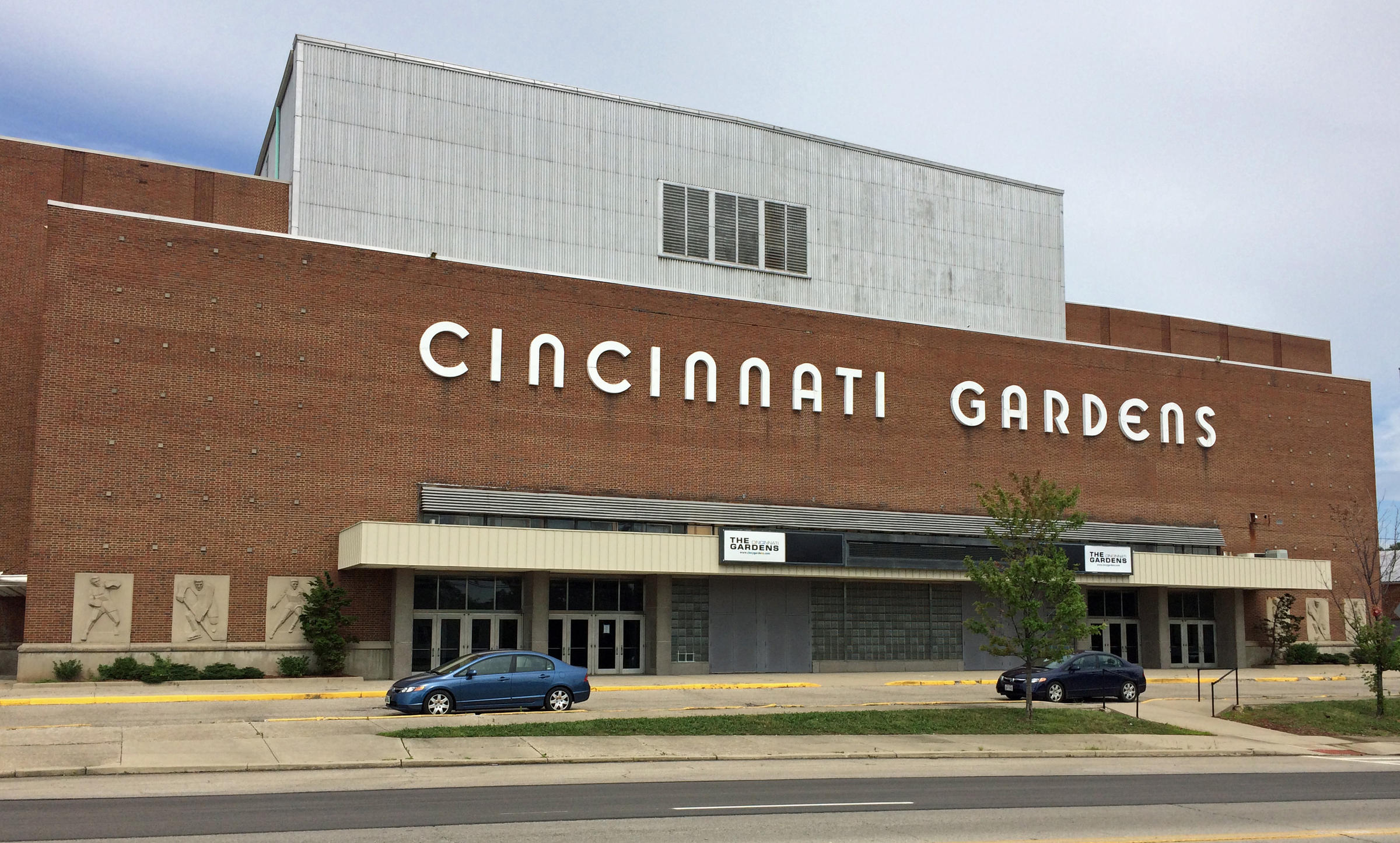
* Site of Cincinnati Gardens. Seating 10,208 people, this was one of the oldest surviving indoor sports arenas in North America, opening in 1949 and hosting the NBA's Cincinnati Royals from 1957 to 1972. Oscar Robertson and Jerry Lucas went from there to Hall of Fame careers, although neither won a title with the Royals. (The Big O did so with the 1971 Milwaukee Bucks, Lucas with the 1973 Knicks.) The Royals moved to Kansas City (and, due to the baseball team having the same name, became the Kansas City Kings, and, in 1985, the Sacramento Kings). The Gardens hosted the 1st nationally-televised NBA game, on January 3, 1965. with the Royals losing to the Boston Celtics, 89-85.
 A succession of minor league hockey teams played there, and it hosted arena football, too. Heavyweight Champion Ezzard Charles, a city native known as the Cincinnati Cobra, defended the title there against Nick Barone on December 5, 1950. The Gardens played host to the Beatles on August 27, 1964; and to Elvis on November 11, 1971 and June 27, 1973.
 The Gardens was demolished in 2018, so that property for "light manufacturing" can be built. 2250 Seymour Avenue at Langdon Farm Road, on the northeast side of town, near the Seymour Plaza, Swifton, and Hillcrest shopping centers. Number 43 bus.
Currently without an NBA team, a recent New York Times article shows basketball allegiances around the country. Since most people in Southern Ohio would rather vote for a Democrat than support a Cleveland-based team, the Cavaliers are not popular here, not even with LeBron James back. The Miami Heat, Los Angeles Lakers and Chicago Bulls were the top 3 choices in that article, although the Heat have no doubt fallen off dramatically without LeBron.
A recent Business Insider article shows the most popular hockey team in each State. Although the Columbus Blue Jackets, as you might guess, lead Ohio, neighboring Kentucky is led by the Nashville Predators, and neighboring Indiana by the Chicago Blackhawks.
It's 109 miles from downtown Cincinnati to Ohio State, 82 miles to the University of Kentucky, 103 miles to the University of Louisville, and 130 miles to Indiana University. And it's 52 miles from downtown Cincinnati to the University of Dayton, whose 13,435-seat University of Dayton Arena (I know, not a very imaginative name), opened in 1969, has hosted more NCAA Tournament games that any other building: 119. (No Final Four has ever been held in Ohio, and none probably ever will, unless they end up putting a dome on Paul Brown Stadium, FirstEnergy Stadium in Cleveland, or Ohio Stadium in Columbus.)
Elvis sang at the University of Dayton's old Fieldhouse on May 27, 1956, and at its "new" Arena on April 7, 1972; October 6, 1974; and October 26, 1976. He also sang at the Hobart Arena in Troy, 77 miles north of Cincinnati and 23 miles north of Dayton, on November 24, 1956.
The Dayton Triangles were an early pro football team, playing from 1913 to 1929, first in the Ohio League -- winning the title in 1913, 1914, 1915 and 1918 -- and then from 1920 to 1929 in the NFL. They were named for Triangle Park, at the confluence of the Stillwater and Miami Rivers, where they erected a 5,000-seat stadium. The Jim Nichols Tennis Center is now on the site. 2424 Ridge Avenue.
But from 1923 onward, they only won 5 games, as the better players didn't want to go to a city as small as Dayton. (Green Bay, the only surviving small city from the NFL's early days, had... other forms of entertainment to lure players.) Then they became... a New York team, being bought by Bill Dwyer, owner of hockey's New York Americans, moved to Ebbets Field and becoming the NFL version of the Brooklyn Dodgers.
Through a convoluted series of transactions, today's Indianapolis Colts are descended from the Dayton Triangles, though not officially recognized as such by the NFL. In other words, if the Colts tried to put up banners saying "World Champions 1913, 1914, 1915, 1918," the NFL wouldn't count it.
In 1856, the 1st university owned and operated by African-Americans was founded: Wilberforce University in Wilberforce, Ohio, about 60 miles northeast of Cincinnati, 20 miles east of Dayton, and 60 miles southwest of Columbus. Central State University, another historically black college and university (HBCU), was founded in Wilberforce in 1887.
Central State is currently in NCAA Division II. Wilberforce has dropped all the way into the NAIA. Wilberforce won the National Championship of black college football in 1931. Central State has won it 8 times: 1948, 1983, 1986, 1987, 1988, 1989, 1990 and 1992.
* Spring Grove Cemetery. If you're a visiting Met fan, you won't care about this. But if you're a visiting Yankee Fan, Spring Grove is the final resting place of Yankee Hall-of-Famers Miller Huggins (a Cincinnati native who played for the Reds) and Waite Hoyt (who broadcast for the Reds.)
Also buried there: Several Generals of the American Civil War, including Joseph Hooker; 4 U.S. Senators, including Salmon P. Chase; 3 Justices of the U.S. Supreme Court, including Chase, who served as Chief Justice; Nicholas Longworth, Speaker of the U.S. House of Representatives and husband of Alice Roosevelt Longworth, daughter of President Theodore Roosevelt; several members of the Taft family, including both of President William Howard Taft's parents, Alphonso and Louise, and his brother, Mayor Charles Taft II; Charles Fleischmann, founder of the yeast company that bears his name; Bernard Kroger, founder of the supermarket chain that bears his name. William Procter and James Gamble, founders of the Cincinnati-based company that bears their names, and several members of their families, including Nippert Stadium namesake James Gamble Nippert.
4521 Spring Grove Avenue. Number 20 bus to Winton Road & Froome Avenue, then a left on Gray Road.
Weeb Ewbank, the only man to coach the Jets to a Super Bowl win, is buried at Oxford Cemetery in Oxford, home to his alma mater, Miami University. (Not the one in Florida -- this Miami came first.) 4385 Oxford Millville Road, about 40 miles northwest of Cincinnati.
Cincinnati isn't a big museum city, but it is a Presidential birthplace, very nearly a Presidential birthplace twice over, and a Presidential burial place. The William Howard Taft National Historic Site, where the 27th President of the United States and the 10th Chief Justice of the Supreme Court of the United States was born and lived the first 25 years of his life, is at 2038 Auburn Avenue on the north side of town. The same Number 43 bus that would take you to Cincinnati Gardens would take you there.
The tomb of William Henry Harrison, the 9th President, who famously won the Battle of Tippecanoe (near Lafayette, Indiana and Purdue University) against Indians (not the Cleveland variety) in 1811 and died only a month after becoming President in 1841, is 16 miles west of downtown in North Bend.
A 10-minute walk from the Tomb is a house at Symmes & Washington Avenues, where "Old Tippecanoe" lived, and his grandson Benjamin Harrison, the 23rd President (1889-93), was born. The Number 50 bus will get you within 2 miles of these sites.
The 1856 Democratic Convention was held at Smith and Nixon's Hall. (There is no connection to the family of President Richard Nixon.) The Renaissance Cincinnati Downtown Hotel is on the site today. Former Secretary of State James Buchanan was nominated for President, and he won, but his Administration was possibly the most disastrous in the nation's history. 36 E. 4th Street at Walnut Street.
The 1876 Republican Convention was held at Exposition Hall. Ohio's sitting Governor, Rutherford B. Hayes, was nominated for President, and "won" the election in "The Fraud of the Century." But the Hall had a bad roof, and was replaced. Cincinnati Music Hall opened in 1878, and, in 1880, the Democrats held their Convention there, nominating Civil War General Winfield Scott Hancock, who lost an incredibly close race to Congressman James Garfield. Music Hall still hosts concerts. 1241 Elm Street at 14th Street, downtown, across from Washington Park.
As I mentioned, the Underground Railroad Museum is on the site of Riverfront Stadium, between the ballpark and the football stadium. Since Cincinnati was on the north side of a river between the free State of Ohio and the slave State of Kentucky, it was a major point on the Underground Railroad. The Cincinnati Museum Center is on the grounds of the Union Terminal.
The Cincinnati Art Museum is at 953 Eden Park Drive, in Johnston Park. The Taft Museum of Art is closer to downtown, at 316 Pike Street. The Number 1 bus will take you to each of them.
The tallest building in Cincinnati is the Great American Tower at Queen City Square, at 660 feet and opening in 2010. 301 E. 4th Street. It surpassed the Carew Tower, a 574-foot Art Deco building at 441 Vine Street, which had been the tallest in town since 1931. (No, it wasn't named for Baseball Hall-of-Famer Rod Carew. Joseph T. Carew had operated the Mabley & Carew department store on the site.)
The transmission tower seen at the beginning of WKRP in Cincinnati belonged to the city's NBC affiliate, WLWT-Channel 5, even though the show was on CBS. The tower has since been dismantled. The building shown as the home of WKRP and referred to on the show as the Osgood R. Flimm Building is the Cincinnati Enquirer Building at 617 Vine Street, just off Fountain Square, so it was (and remains) a media center in real life.
The show was created by Hugh Wilson (who also wrote the opening theme song, sung by Steve Carlisle, and directed the Police Academy movies), and was based upon his experiences working in advertising sales at an Atlanta Top 40 station, with the Gary Sandy character of Andy Travis based on himself. The New WKRP in Cincinnati, which ran in syndication from 1991 to 1993, featured some of the original characters, while the others were each brought back as guest stars at least once.
Cincinnati did have, and still has, a radio and a TV station with the call letters WKRC. CBS owns it now, but didn't when WKRP was running. WKRC's AM frequency is 550.) In 2008, an unrelated independent TV station in Cincinnati, WBQC-LD, took advantage of local nostalgia for the sitcom, promoting its conversion to digital broadcasting by rebranding as "WKRP-TV in Cincinnati."
As far as I can tell, the only other TV show set in Cincinnati has been Harry's Law, starring Kathy Bates as lawyer Harriet "Harry" Korn, which was recently canceled after 2 seasons. There was a series titled John from Cincinnati that ran on HBO in 2007, but it was set in Southern California.
On The West Wing, White House Press Secretary, and later Chief of Staff, Claudia Jean "C.J." Cregg is from Dayton, Ohio. So is her portrayer, Allison Janney. So is Martin Sheen, who played the President on the show, Jed Bartlet.
Aside from Eight Men Out (filmed, as I said, in Indianapolis), the best-known movie set in the city was Rain Man. A few other movies had scenes filmed there, including the sports-connected films Summer Catch (the final scene, where Freddie Prinze Jr.'s character makes his big-league debut at GABP and gets taken deep by Ken Griffey Jr. on his very 1st pitch), Seabiscuit and Mr. 3000.
*
Cincinnati calls itself the Queen City of the Midwest, and thinks of itself as a good, solid, family town. Read: They'd rather slit their economic throats and condemn their women to no say in if and when to have a child than vote for a liberal for national or Statewide office. Although they have elected mostly Democratic Mayors including, in 1977, Jerry Springer. (No joke.)
Currently without an NBA team, a recent New York Times article shows basketball allegiances around the country. Since most people in Southern Ohio would rather vote for a Democrat than support a Cleveland-based team, the Cavaliers are not popular here, not even with LeBron James back. The Miami Heat, Los Angeles Lakers and Chicago Bulls were the top 3 choices in that article, although the Heat have no doubt fallen off dramatically without LeBron.
A recent Business Insider article shows the most popular hockey team in each State. Although the Columbus Blue Jackets, as you might guess, lead Ohio, neighboring Kentucky is led by the Nashville Predators, and neighboring Indiana by the Chicago Blackhawks.
It's 109 miles from downtown Cincinnati to Ohio State, 82 miles to the University of Kentucky, 103 miles to the University of Louisville, and 130 miles to Indiana University. And it's 52 miles from downtown Cincinnati to the University of Dayton, whose 13,435-seat University of Dayton Arena (I know, not a very imaginative name), opened in 1969, has hosted more NCAA Tournament games that any other building: 119. (No Final Four has ever been held in Ohio, and none probably ever will, unless they end up putting a dome on Paul Brown Stadium, FirstEnergy Stadium in Cleveland, or Ohio Stadium in Columbus.)
Elvis sang at the University of Dayton's old Fieldhouse on May 27, 1956, and at its "new" Arena on April 7, 1972; October 6, 1974; and October 26, 1976. He also sang at the Hobart Arena in Troy, 77 miles north of Cincinnati and 23 miles north of Dayton, on November 24, 1956.
The Dayton Triangles were an early pro football team, playing from 1913 to 1929, first in the Ohio League -- winning the title in 1913, 1914, 1915 and 1918 -- and then from 1920 to 1929 in the NFL. They were named for Triangle Park, at the confluence of the Stillwater and Miami Rivers, where they erected a 5,000-seat stadium. The Jim Nichols Tennis Center is now on the site. 2424 Ridge Avenue.
But from 1923 onward, they only won 5 games, as the better players didn't want to go to a city as small as Dayton. (Green Bay, the only surviving small city from the NFL's early days, had... other forms of entertainment to lure players.) Then they became... a New York team, being bought by Bill Dwyer, owner of hockey's New York Americans, moved to Ebbets Field and becoming the NFL version of the Brooklyn Dodgers.
Through a convoluted series of transactions, today's Indianapolis Colts are descended from the Dayton Triangles, though not officially recognized as such by the NFL. In other words, if the Colts tried to put up banners saying "World Champions 1913, 1914, 1915, 1918," the NFL wouldn't count it.
In 1856, the 1st university owned and operated by African-Americans was founded: Wilberforce University in Wilberforce, Ohio, about 60 miles northeast of Cincinnati, 20 miles east of Dayton, and 60 miles southwest of Columbus. Central State University, another historically black college and university (HBCU), was founded in Wilberforce in 1887.
Central State is currently in NCAA Division II. Wilberforce has dropped all the way into the NAIA. Wilberforce won the National Championship of black college football in 1931. Central State has won it 8 times: 1948, 1983, 1986, 1987, 1988, 1989, 1990 and 1992.
* Spring Grove Cemetery. If you're a visiting Met fan, you won't care about this. But if you're a visiting Yankee Fan, Spring Grove is the final resting place of Yankee Hall-of-Famers Miller Huggins (a Cincinnati native who played for the Reds) and Waite Hoyt (who broadcast for the Reds.)
Also buried there: Several Generals of the American Civil War, including Joseph Hooker; 4 U.S. Senators, including Salmon P. Chase; 3 Justices of the U.S. Supreme Court, including Chase, who served as Chief Justice; Nicholas Longworth, Speaker of the U.S. House of Representatives and husband of Alice Roosevelt Longworth, daughter of President Theodore Roosevelt; several members of the Taft family, including both of President William Howard Taft's parents, Alphonso and Louise, and his brother, Mayor Charles Taft II; Charles Fleischmann, founder of the yeast company that bears his name; Bernard Kroger, founder of the supermarket chain that bears his name. William Procter and James Gamble, founders of the Cincinnati-based company that bears their names, and several members of their families, including Nippert Stadium namesake James Gamble Nippert.
4521 Spring Grove Avenue. Number 20 bus to Winton Road & Froome Avenue, then a left on Gray Road.
Weeb Ewbank, the only man to coach the Jets to a Super Bowl win, is buried at Oxford Cemetery in Oxford, home to his alma mater, Miami University. (Not the one in Florida -- this Miami came first.) 4385 Oxford Millville Road, about 40 miles northwest of Cincinnati.
Cincinnati isn't a big museum city, but it is a Presidential birthplace, very nearly a Presidential birthplace twice over, and a Presidential burial place. The William Howard Taft National Historic Site, where the 27th President of the United States and the 10th Chief Justice of the Supreme Court of the United States was born and lived the first 25 years of his life, is at 2038 Auburn Avenue on the north side of town. The same Number 43 bus that would take you to Cincinnati Gardens would take you there.
The tomb of William Henry Harrison, the 9th President, who famously won the Battle of Tippecanoe (near Lafayette, Indiana and Purdue University) against Indians (not the Cleveland variety) in 1811 and died only a month after becoming President in 1841, is 16 miles west of downtown in North Bend.
A 10-minute walk from the Tomb is a house at Symmes & Washington Avenues, where "Old Tippecanoe" lived, and his grandson Benjamin Harrison, the 23rd President (1889-93), was born. The Number 50 bus will get you within 2 miles of these sites.
The 1856 Democratic Convention was held at Smith and Nixon's Hall. (There is no connection to the family of President Richard Nixon.) The Renaissance Cincinnati Downtown Hotel is on the site today. Former Secretary of State James Buchanan was nominated for President, and he won, but his Administration was possibly the most disastrous in the nation's history. 36 E. 4th Street at Walnut Street.
The 1876 Republican Convention was held at Exposition Hall. Ohio's sitting Governor, Rutherford B. Hayes, was nominated for President, and "won" the election in "The Fraud of the Century." But the Hall had a bad roof, and was replaced. Cincinnati Music Hall opened in 1878, and, in 1880, the Democrats held their Convention there, nominating Civil War General Winfield Scott Hancock, who lost an incredibly close race to Congressman James Garfield. Music Hall still hosts concerts. 1241 Elm Street at 14th Street, downtown, across from Washington Park.
As I mentioned, the Underground Railroad Museum is on the site of Riverfront Stadium, between the ballpark and the football stadium. Since Cincinnati was on the north side of a river between the free State of Ohio and the slave State of Kentucky, it was a major point on the Underground Railroad. The Cincinnati Museum Center is on the grounds of the Union Terminal.
The Cincinnati Art Museum is at 953 Eden Park Drive, in Johnston Park. The Taft Museum of Art is closer to downtown, at 316 Pike Street. The Number 1 bus will take you to each of them.
The tallest building in Cincinnati is the Great American Tower at Queen City Square, at 660 feet and opening in 2010. 301 E. 4th Street. It surpassed the Carew Tower, a 574-foot Art Deco building at 441 Vine Street, which had been the tallest in town since 1931. (No, it wasn't named for Baseball Hall-of-Famer Rod Carew. Joseph T. Carew had operated the Mabley & Carew department store on the site.)
The transmission tower seen at the beginning of WKRP in Cincinnati belonged to the city's NBC affiliate, WLWT-Channel 5, even though the show was on CBS. The tower has since been dismantled. The building shown as the home of WKRP and referred to on the show as the Osgood R. Flimm Building is the Cincinnati Enquirer Building at 617 Vine Street, just off Fountain Square, so it was (and remains) a media center in real life.
The show was created by Hugh Wilson (who also wrote the opening theme song, sung by Steve Carlisle, and directed the Police Academy movies), and was based upon his experiences working in advertising sales at an Atlanta Top 40 station, with the Gary Sandy character of Andy Travis based on himself. The New WKRP in Cincinnati, which ran in syndication from 1991 to 1993, featured some of the original characters, while the others were each brought back as guest stars at least once.
Cincinnati did have, and still has, a radio and a TV station with the call letters WKRC. CBS owns it now, but didn't when WKRP was running. WKRC's AM frequency is 550.) In 2008, an unrelated independent TV station in Cincinnati, WBQC-LD, took advantage of local nostalgia for the sitcom, promoting its conversion to digital broadcasting by rebranding as "WKRP-TV in Cincinnati."
As far as I can tell, the only other TV show set in Cincinnati has been Harry's Law, starring Kathy Bates as lawyer Harriet "Harry" Korn, which was recently canceled after 2 seasons. There was a series titled John from Cincinnati that ran on HBO in 2007, but it was set in Southern California.
On The West Wing, White House Press Secretary, and later Chief of Staff, Claudia Jean "C.J." Cregg is from Dayton, Ohio. So is her portrayer, Allison Janney. So is Martin Sheen, who played the President on the show, Jed Bartlet.
Aside from Eight Men Out (filmed, as I said, in Indianapolis), the best-known movie set in the city was Rain Man. A few other movies had scenes filmed there, including the sports-connected films Summer Catch (the final scene, where Freddie Prinze Jr.'s character makes his big-league debut at GABP and gets taken deep by Ken Griffey Jr. on his very 1st pitch), Seabiscuit and Mr. 3000.
*
Cincinnati calls itself the Queen City of the Midwest, and thinks of itself as a good, solid, family town. Read: They'd rather slit their economic throats and condemn their women to no say in if and when to have a child than vote for a liberal for national or Statewide office. Although they have elected mostly Democratic Mayors including, in 1977, Jerry Springer. (No joke.)
But it's a good sports town, and a Reds game is well worth the trip.