Showing posts with label chuck knoblauch. Show all posts

Tuesday, July 30, 2019

July 30, 1999: I Came, I Saw, I Conquered

July 30, 1999, 20 years ago: It was my greatest achievement as a sports fan.

I, a Yankee Fan, walked into Fenway Park during a Yankees vs. Red Sox Pennant race, saw the Yankees win, walked out still wearing my Yankee cap, and got out of New England in one piece.

It was a good time in America. Bill Clinton was President, the economy was booming, and the nation was at peace. New York City was safer and cleaner than it had ever been in my lifetime. And the Yankees were winning.

But, in the Yankee-Red Sox rivalry, it turned out to be a weird time. This was the year the rivalry, kind of dormant since the 1980s ended, picked up again. But it was also the time that the Red Sox were planning on building a new Fenway Park, while the Yankees were merely talking about building a new Yankee Stadium.

Plans were made to build the new Fenway across Jersey Street/Yawkey Way from the old one, with its "front door" on Boylston Street. Plans were made for it to have much more office, concession and restroom space than the original, but keep the same dimensions, including a new Green Monster. The old park would be torn down, except for the original Green Monster, and a new field put in place.
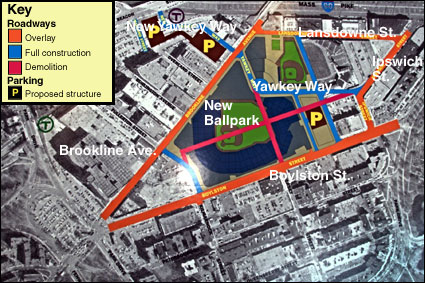
The New Fenway plan

They were planning on having it open by 2003, and they got endorsements from Sox legends Ted Williams, Carl Yastrzemski and Johnny Pesky, as well as celebrity Sox fans like Stephen King and Doris Kearns Goodwin.

As it turned out, Massachusetts politics got in the way, as it so often does. When John Henry and his people bought the Sox from the Yawkey Trust in 2002, they decided building a World Series winner was more important than building a new ballpark. And so, since then, we have a new Yankee Stadium with 1 World Series win, and the same Fenway Park, modernized as much as possible, with 4 World Series wins *.

But in 1999, it was possible that this would be the last season with a Yankees-Red Sox Pennant race at the old Fenway Park. And this was one of those few Summers in which I had money. I had seen 3 games at Fenway (in 1991, 1994 and 1996), but not against the Yankees. I had seen a Yankees-Red Sox game, but at Yankee Stadium (in 1991). This could have been my last chance, or so I thought. So I went.

*

I made a reservation for a bed-and-breakfast in the Allston section of Boston, just off the Boston University campus. The game was going to be on WNYW-Channel 5 (for the 1st time since 1950, the Yankees' "free TV" carrier was not WPIX-Channel 11), so I set my VCR (remember them?) to record it.

I packed my backpack, walked to the bus station at Tower Center, just off Exit 9 of the New Jersey Turnpike, and took the bus into Port Authority Bus Terminal. I boarded a Greyhound bus at Gate 84, and made a leisurely, uneventful ride to Boston. Everything was in place, except for one thing. I had no game ticket. That's a story in and of itself.

At any rate, we arrived a little early at South Station, the city's venerable rail terminal, which had just had a bus terminal added. I got on the subway, known as "The T" for "transit." South Station is on the Red Line, and I changed at Park Street under (or, "changed at Pahk Street undah," as they say up theah) to the Green Line, and checked in. I had plenty of time to get back on the Green Line and get to the little green pinball machine off Kenmore Square.

One thing Fenway has in common with Yankee Stadium (old or new) is that, as soon as you get out of the subway, there are the scalpers, asking, "Anybody buying? Anybody selling?" I made the left turn from Commonwealth Avenue onto Brookline Avenue, took the bridge over the Massachusetts Turnpike and the Boston & Albany Railroad (now serving Amtrak, MBTA commuter rail, and the T's Orange Line), and past the most famous of all Red Sox bars, the Cask 'n' Flagon, across Ted Williams Way (the recently renamed Ipswich Street) from the big left field wall, the Green Monster.

I went to Yawkey Way (which has since had its previous name of Jersey Street restored), stuck my Yankee cap in the backpack, and looked for a scalper. I found one, with a ticket for an Obstructed View seat in Section 12, behind 1st base. List price was $24, and he was offering it for $42. In 2019 dollars, he was charging $65 for a $37 seat, so you can see just how much the Red Sox' 2003-present success has driven up prices.

The look on the scalper's face when, after making the exchange, I put my cap back on, was worth it.

*

I made my way inside the venerable old ballyard. One thing I've done on every visit to Fenway (except one, having forgotten until I was on the bus to go back home, and I felt terrible about it) is look for one of the little red Jimmy Fund boxes.

One good thing you can do is look for the Jimmy Fund boxes. The Dana-Farber Cancer Institute has run the fund since 1948, when the Boston Braves pitched in to raise money for a kid named Einar Gustafsson, then 12 years old and a patient of the Institute's founder, Dr. Sidney Farber.

Gustafsson was called the much more generic "Jimmy," not so much because he had a decidedly non-English name (in the post-World War II era, a decidedly patriotic, pro-America time), but to protect his privacy. In the 1st year, $200,000 was raised for cancer research – about $2.1 million in today's money.

When the Braves left town in 1953, Farber turned to the Red Sox. Later that year, when Ted Williams returned from the Korean War, he volunteered, and became the face of the Fund, becoming close friends with Farber and raising money all over the country, especially after his retirement as a player in 1960 gave him more time to do so, until becoming too ill to do so a few years prior to his death in 2002.

*

Here were the lineups for the game. For the visiting Yankees, coming in at 61-39, leading the American League Eastern Division:

1. 11 2B Chuck Knoblauch
2. 2 SS Derek Jeter
3. 21 RF Paul O'Neill
4. 51 CF Bernie Williams
5. 24 1B Tino Martinez
6. 45 DH Chili Davis
7. 20 C Jorge Posada
8. 47 LF Shane Spencer
9. 18 3B Scott Brosius
P 14 Hideki Irabu

For the host Red Sox, coming in at 55-46, 6 1/2 games behind the Yankees, but in good position to take the 1 Wild Card berth then available in the AL:

1. 20 CF Darren Lewis
2. 13 3B John Valentin
3. 23 1B Brian Daubach
4. 5 SS Nomar Garicaparra
5. 25 LF Troy O'Leary
6. 44 DH Butch Huskey
7. 33 C Jason Varitek
8. 15 2B Donnie Sadler
9. 7 RF Trot Nixon
P 31 Mark Portugal

I was familiar all 9 position players. I had seen Huskey play for the Mets. Valentin had been with the Sox since 1992. And I had seen the other 7 play for the Trenton Thunder, now the Yankees' Class AA farm team in the Eastern League, but then belonging to the Boston system.

The home plate umpire was Mike Reilly. Had I known that I would one day become a fan of English soccer team Arsenal, and that a referee named Mike Riley would badly screw them over in 2004 (just 4 days after the Sox beat the Yankees for the Pennant), and then even more so as the supervisor for Premier League referees, I would have taken this as a bad sign. As far as I know, there is no connection between them, besides similar (if differently-spelled) names and a similar profession.

The other umpires: At 1st base, Brian O'Nora, of whom I have no memory; at 2nd base, Laz Diaz, not a good one; and at 3rd base, Rich Garcia, who wrote his name into Yankee history in the 1996 Playoffs, controversially giving Derek Jeter a home run despite then 12-year-old fan Jeffrey Maier seeming to interfere with play. (The call was correct: Baltimore Oriole right fielder Tony Tarasco was not going to catch the ball anyway.)

The game-time temperature was 84 degrees, quite tolerable, since there was a 17 mile-per-hour wind. Conspicuously, it was blowing from right field to left field, making the Green Monster slightly more tempting a target than usual, but not making it too easy a target. The sky was overcast, but there was no threat of rain. Given a cold drink, you couldn't have asked for a better night for baseball, a better place to watch it (I make a lot of remarks about Fenway to tease Sox fans, but I don't mean them), or a better pair of opponents.

*

Baseball games generally don't start on the hour or the half-hour. For TV's sake, the time printed on the ticket is usually at 5, or 10, or (in the case of Toronto Blue Jays home games) 7 minutes after the hour. Usually, first pitch comes at 7 or 8 minutes after. So this game should have started at 7:07 PM.

Instead, plate umpire Reilly shouted, "Play ball!" early, and Portugal threw the 1st pitch at 7:04. As I found out when I got back home and ran back the tape, this caught the Channel 5 camerman, and announcers Bobby Murcer and Tim McCarver, by surprise. They missed the 1st pitch of the game. They almost missed the 2nd pitch, too.

I had emerged from Fenway's concourse about halfway between 3rd and home, just in time to see that 1st pitch, and saw the 2nd pitch. It was a meatball -- or, since the pitcher's name was Portugal, maybe it was a chouriço -- and Knoblauch cooked it, sending it over the Monster. I was far from the only fan who had not yet reached his seat, and the Yankees were already up 1-0.

I got to Section 12, found my row, and, at just the right moment, turned around to see Jeter hit the 5th pitch of the game. This was no cheap Green Monster hit: He sent it to center field, into the bleachers behind the Red Sox bullpen. I was still not in my seat (neither were a few hundred others), and it was 2-0 Yankees.

Finally, I got to my seat. On the 9th pitch of the game, to O'Neill, Portugal was so fershimmeled that the force of his delivery knocked him down. And by "him," I don't mean O'Neill, I mean Portugal. He literally fell off the mound.

You would think that this would leave the Red Sox shellshocked and unable to come back. But this was Fenway Park. Strange things happen. Irabu did not have his best stuff in the bottom of the 1st inning, and after starting things by getting Lewis to pop up, he gave up a home run to Valentin. He got Daubach to ground out, but he allowed a single to Nomar and an RBI double to O'Leary, tying the game, before he struck Huskey out to end the threat.

Fenway was still buzzing after hosting the All-Star Game 17 days earlier, with the pregame ceremony honoring Ted Williams and the in-game pitching of Pedro Martinez. At this point, with the score 2-2, everyone on hand, regardless of who they were rooting for, was expecting a classic.
The 1999 All-Star Game

But the game would not be close. With 1 out in the top of the 2nd, Spencer hit a ground ball to Nomar, then in a 3-way discussion with Jeter and Alex Rodriguez, then with the Seattle Mariners, as to who was the best shortstop in baseball. Met fans argued that the best was their shortstop, Rey Ordoñez, but he wasn't as good a fielder as any of the 3, and he was a lousy hitter. Nomar did his role in this discussion no favors on this play, botching the grounder. Three straight singles followed: By Brosius, by Knoblauch to get Spencer home, and by Jeter to get Brosius home.

Jimy Williams was the Sox manager at the time, and he had seen enough. He took Portugal out, and brought in Korean pitcher Jin Ho Cho. O'Neill almost hit it out, deep enough to score Knoblauch. Nixon (full name: Christopher Trotman Nixon) made a bad throw, and Jeter was able to score as well. 6-2 Yankees.

Is any game ever really out of reach at Fenway Park? The Sox led off the bottom of the 2nd with Varitek drawing a walk and Sadler singling. Cliche Alert: Walks can kill you, especially the leadoff variety. But Irabu got out of the inning, on his way to getting 10 straight batters out.

Tino led off the top of the 3rd with a single. Chili walked. Posada doubled Tino home. Spencer popped up, and then Brosius singled home Chili and Jorge. 9-2 Yankees.

The Sox, now with Rich Garcés on the mound -- a Venezuelan righthander known as El Guapo, the Handsome One, although he should have been called El Gordo, the Fat One -- kept the Yankees from scoring in the 4th and the 5th. The Sox scored in the bottom of the 5th on a triple by Lewis and a sac fly by Valentin, making in 9-3, but that was as close as they would get. Garces and Mark Guthrie kept the Yanks off the board in the 6th, but in the bottom of the inning, Irabu struck out the side: Garciaparra, O'Leary and Huskey.

The Yankees ended any doubt in the top of the 7th: Single by Chili, home run by Jorge, walk by Spencer, double by Brosius, single by Knoblauch. 13-3. At the 7th inning stretch, the Sox fans sang, "For it's root, root, root for the Red Sox!" I could only answer, "If they don't win, it's the same!"

By this point, there were about 10,000 people left in Fenway, and about 5,000 of them were chanting, "Let's go, Yankees!" I was one of them.

I did not, however, make a nuisance of myself. I was 29 years old, no longer a kid. Certainly, I yelled encouragement to my team's players, but I did not taunt the Sox players, and I did not go out of my way to antagonize the fans around me, most of whom were reasonable, and none of them tried anyting. This may have been my 1st Yankees game at Fenway Park, but, as the saying goes, this was not my first rodeo.

Yankee manager Joe Torre went against his usual instinct, and kept Irabu in the game. Or maybe he figured that, since this was Fenway, he needed to keep his bullpen as rested as possible. Irabu allowed a single to pinch-hitter Reggie Jefferson in the 7th, and a single to Nomar in the 8th. 

But in the 9th, he got Huskey to pop up to Tino, got Lenny Webster (who had replaced Varitek behind the plate) to ground to Brosius, and ended the game with his 123rd pitch of the night, fanning Lou Merloni (who had replaced Sadler at 2nd base) for his 12th strikeout, against just 1 walk.

Cue John Sterling on the radio, the team then being broadcast on WABC, 770 AM: "Ballgame over! Yankees win! Theeeeeeee Yankees win!"

Yankees 13, Red Sox 3. For the Yankees: 13 runs, 16 hits, no errors, 8 men left on base. For the Red Sox: 3 runs, 7 hits, 2 errors, 5 men left on base.

The winning pitcher: Hideki Irabu (8-3), a surprising complete game from the tubby Japanese pitcher who was already being considered a bust, despite having been part of a World Championship team the season before. Obviously, no save. The losing pitcher: Mark Portugal (6-8).

Knoblauch went 5-for-6, with the leadoff home run, and 4 RBIs. Jeter went 2-for-6 with a home run and 2 RBIs. Posada went 3-for-5, with a home run and 3 RBIs. Brosius didn't hit a home run, but went 3-for-5 with 2 RBIs. Not only did Knoblauch almost outhit the Sox all by himself, but the Sox were 0-for-4 with runners in scoring position. That tells a lot.

The attendance was 33,777, and, as Yankee broadcaster Michael Kay would say, the time of the game, a slightly unmanageable, but enjoyable 3 hours and 3 minutes.

*

I had been to Fenway, and seen the Yankees kick the Sox' asses. That was the easy part. The hard part would be getting out alive.

Not yet knowing that, in soccer leagues around the world, visiting fans are put in the same section, kept segregated from the home fans, and kept behind until after the home sections have been emptied, and only then let out, I stuck around for as long as they would let me, even finding my way to the edge of the bleachers, looking for the famous red seat that marked the spot where Ted Williams hit what is, officially, Fenway's longest home run, a 502-foot shot in 1946.

(There may have been a longer one hit by Babe Ruth in the 1920s, or over the Green Monster. But, as far as those home runs that have been measured, this blast by the Splendid Splinter is the longest.)

This being the era before camera phones, I used my regular camera, but it was already dark, and I didn't get a good picture.
A better photo than the one I took

I was not the only Yankee Fan who felt like sticking around. I even ran into a Boston University student who had played football at my high school. (BU had dropped its football program in 1997.) Finally, the ushers began asking us to leave. They did so politely. We followed their instructions.

I tried to find my way to the main entrance, the big wooden doors on Yawkey Way. There were enough people left that it was easy to bump into people. And I did bump into someone. I looked up, and, before I could see who it was, I said, "Sorry, mister."

It was Bobby Murcer. Star Yankee outfielder of the early 1970s who returned at the end of the decade, and broadcaster since his retirement as a player in 1983. Next to him was Tim McCarver, the longtime St. Louis Cardinals and Philadelphia Phillies catcher who had broadcast for the Mets in the 1980s, who was in the 1st of 3 seasons doing so for the Yankees. They were nice enough to not be mad at me for literally bumping into Bobby. (I did not ask for autographs. I never see the point in it.)
Bobby Murcer, at the old Yankee Stadium.
Sadly, both their lives ended in 2008.

I walked out of Fenway. Here is where the real trouble could have begun. I had to get back to the T, without getting killed for wearing a Yankee cap in the aftermath of a Yankee shellacking of the home team. But enough time had passed since the final pitch, and enough of a margin of the score, for it to not be so bad. Nobody bothered me.

I decided to press my luck. I got off the Green Line at Arlington, and walked over to the Bull & Finch Pub on Beacon Street. Although it only opened in 1969, unlike on the show where the sign said 1895 but the script said 1889, The Bull & Finch was used as the basis for the bar on the TV show of the same name, Cheers.

Since then, both the bar and the restaurant above, Hampshire House, used on the show is the basis for Melville's, have been bought by someone who turned all of it into a single establishment called Cheers, with the permission of the ship's production company.

I went down those famous steps, walked in, still wearing the Yankee cap, but did not yell, like Norm Peterson (played by George Wendt), "Good evening, everybody!" After all, there, not only would a Yankee Fan announcing his presence in such a way have been a bad idea, as seen on an early episode; but, unlike with Norm, nobody would have known my name.

There was an empty stool, I ordered a Samuel Adams beer, drank it, paid for it, and walked out in one piece, cap still on my head. I got back to my hotel, and slept a very restful night.

(Sam Adams is still regarded as good beer, but, since it is so easily identified with the Red Sox, I haven't had one since 2004. On principle.)

*

The next day was a hot Saturday. I had time to visit the John F Kennedy Presidential Library, but, while trying to get back to South Station to head home, I had my Walkman with me, and the Red Sox were beating the Yankees, with the newly-acquired Roger Clemens on the mound -- for us, not them.

By the time I got on the bus to head back to New York, the game was over, and the Sox had won. They would win the Sunday game, too. In other words, of the 3 games in the series, the Yankees won only the one that I went to. This has frequently worked out the other way, including this year, when the Yankees took 3 out of 4 from Houston at home, and they only lost the one that I saw live.

But once the bus reached the "neutral zone" of New Haven, Connecticut, I realized that I had accomplished my mission. I had been to the belly of the Beast, and not only escaped, but emerged victorious. As Julius Caesar said after the Battle of Zela (in what's now Zile, Turkey) in 47 BC, "Veni, vidi, vici." I came, I saw, I conquered.

*

The Yankees did go on to win the American League East, but the Red Sox went on to win the Wild Card. In the AL Division Series, the Yankees swept the Texas Rangers, while the Red Sox beat the Cleveland Indians, to set up an AL Championship Series showdown.

The Yankees won Game 1 in 10 innings, on Bernie Williams' walkoff home run, and won Game 2 as well. Game 3 was the much-hyped showdown between Clemens and Pedro Martinez, but it didn't pan out: The Red Sox shellacked us, 13-1. Sox fans acted as if they just won the World Series, but, at the time, how would they have known? As they would say in English soccer, they had"won their Cup Final."

Game 4 was incredibly controversial. It was only 3-2 Yankees going into the ninth inning, but Ricky Ledée hit a grand slam, and Sox fans threw garbage on the field. When the field was cleared, and play resume, Yankees scored again to make it 9-2. There were questionable calls from the umpires, but Sox fans has absolutely no right to complain. Their team made 9 errors in the series, 4 in that Game 4 alone. Their team did it to themselves.

The Yankees won Game 5 to clinch the Pendant at Fenway Park on October 18, before winning the World Series against the Atlanta Braves in 4 straight, clinching at Yankee Stadium on October 27.

The Yankees-Red Sox rivalry would get wilder, and nastier. But, for me, it was never better than on July 30, 1999, 20 years ago today.

Thursday, March 17, 2016

Top 10 Yankee Second Basemen

Honorable Mention to Horace Clarke, 1965-74. He had terrible timing, getting to the big leagues right as the old dynasty was collapsing, and tailing off just as it was all coming back together. For years, he was the answer to a trivia question: "Who was the only player to play 10 years for the New York Yankees without winning a Pennant?" There is now, of course, one who played 14 seasons for the Yankees without winning a Pennant: Don Mattingly.

Clarke wasn't a terrible ballplayer; you generally don't last that long if you are truly terrible. But he was a typical middle infielder of his time, the kind often described with the expression "good field, no hit." He batted .285 in 1969, but that was pretty much as good as it got: He never topped 6 home runs (1966) or 48 RBI (1969), was a good but not exceptional base stealer (also topped out in that stat in '69, with 33), and never won a Gold Glove or made the All-Star Team.

He gave his best, and was hardly the worst of the players the Yankees had when CBS was running the team (into the ground). Roy White, who came up at the same time and did last long enough to help the Yankees win titles, paid him a pretty good compliment: "A 100 percent player. He wanted to play everyday."

His Number 20 has been retired, but for Jorge Posada.

Honorable Mention to Brian Doyle, 1978-80. He stepped in for the injured Willie Randolph in September and October 1978, and helped to put the finishing touches on what was, until 1996, my favorite baseball season. Speaking of which...

Honorable Mention also to Mariano Duncan, 1996-97. He was only a Yankee for a season and a half, but that full season was 1996, when the Bronx Bombers won the World Series, with Duncan batting .340 and giving the team its motto: "We play today, we win today, das it."

Honorable Mention to Luis Sojo, 1996-2003. Okay, he wasn't a great player, but he played on 5 Yankee Pennant winners and 4 World Champions, and got the hit that won the clinching Game 5 of the 2000 World Series against the Mets, making him (at least, from the perspective of those of us who had to listen to Met fans in the Eighties) one of the most important players in Yankee history.

Honorable Mention to Jose Vizcaino, 2000. He played a grand total of 82 games for the Yankees, but 4 of them were in the aforementioned 2000 World Series. His 12th inning RBI single won Game 1, and essentially decided the Series that means that, no matter what the Mets did after that, the Yankees would have the edge over them for all time.

Honorable Mention to Alfonso Soriano, 1999-2003, returning 2013-14. The Yankees had him at the beginning and the end of his career, and didn't really get the best of him, although he came within 2 outs of being the hero of the 2001 World Series, and in 2002 he led the American League in hits, runs and stolen bases.

He hit 412 home runs during his career, but only 121 were with the Yankees. He played on 7 teams that reached the postseason, but never won a World Series ring, playing for the Yankees in the 2001 and '03 Series. But his weak postseason performance in 2003 (I called him Strikeout Soriano) made him trade bait in the offseason, being exchanged even-up for Alex Rodriguez.

10. Aaron Ward, 1917-26. If you say you saw him play, either you're about 100 years old, or you've got a time machine, or you're lying. But somebody had to be the 1st Yankee 2nd baseman to win a Pennant, and the 1st to win a World Series.

This Arkansan was the Yanks' regular "keystone sacker" from 1920 to '25, and batted .306 in '21 to help win that first Pennant. The coming of Tony Lazzeri was the beginning of the end for him, but it should not be forgotten that he was at the beginning of the original Yankee Dynasty.

9. Billy Martin, 1950-57. Let's clear something up: Billy was batting .241 when he was sent to the Kansas City Athletics at the trading deadline, June 15, 1957. True, he was at the Copacabana Club that night a month earlier, but he never threw a punch, and it can be legitimately argued that he was traded because he wasn't hitting. He was not traded because of "the Copacabana Incident," even if it did give general manager George Weiss, who hated Billy's guts, the final nail in his coffin, one his beloved manager Casey Stengel couldn't keep from being slammed shut.

Nevertheless, prior to that, Billy the Brat had his moments. He was a good fielder, and in 1953 hit 15 homers with 75 RBIs. In all 7 seasons he played for the Yankees, 1950 to '57, they won the Pennant. They failed to win it in '54, when Billy was in the Army. (The Korean War was over, but he got drafted anyway.) He never got tired of pointing out that fact.

In the 1952 World Series, his catch of a bases-loaded popup by Jackie Robinson, lost in the sun by all the other infielders, ended a potential Dodger rally and saved a Game 7 lead for the Yankees. In 1953, he got 12 hits, tying a Series record (since broken), and his 12th and final hit drove home the Series-winning run in Game 6.  He's often called the MVP of the 1953 World Series, but the award wasn't created until 1955.

He batted .257 during the regular season, but .333 in the 4 World Series where he was a regular. Counting only full seasons, Billy was a member of 4 Pennant winners (1952, '53, '55 and '56) and 3 World Champions (all but '55). In those 4 Series, he played every game, despite the potential availability of Jerry Coleman.

It was his managing, from 1975 to '78 (and 4 more times between '79 and '88) that got him his Plaque in Monument Park and the retirement of his Number 1. But for most of his playing career, Billy was a good player.

Weiss said Billy was a "bad influence" on his teammates, especially Mickey Mantle. Oh yeah? In 1950, in his brief callup, Billy was roomed with Phil Rizzuto; in 1951, with Yogi Berra; in 1956, with Mickey; in all 3 seasons, his roomie won the AL's MVP. As Mickey himself said, "In 1956, I roomed with Bill,y and I won the Triple Crown and the MVP. How bad an influence could he have been? Then they traded him, and they realized it was Whitey (Ford) who was the bad influence on me."

8. George "Snuffy" Stirnweiss, 1943-50. The native New Yorker helped the Yankees win the World Series in 1943, '47 and '49. In 1944, he led the American League in hits, triples, and, rare for a Yankee, stolen bases, with 55. In 1945, he led the AL in all those categories again, and also in batting average, slugging percentage, on-base percentage and total bases. Had the Yankees been in the Pennant race that year, he would have been a good choice for the AL's Most Valuable Player.

He played his last big-league game at age 33, and went into private business. On September 15, 1958, shortly before his 40th birthday, he was 1 of 48 people killed in a commuter train crash in Newark. He wore Number 1, which, as I said, has been retired for Billy Martin.

7. Jerry Coleman, 1949-57. Billy's fellow native of the San Francisco Bay Area (San Jose and later San Francisco, as opposed to Billy's Berkeley) both preceded and outlasted him. Coleman served in both World War II (delaying his big-league debut) and the Korean War (causing him to miss all but the start of the '52 season and all but the end of '53), and was a renowned Marine Corps pilot -- though he said many times that he didn't consider himself a hero.

In 1949, his 8th-inning double in the season finale against the Boston Red Sox clinched the Pennant, putting him on the way to winning a World Series ring in his rookie season. He remained the Yanks' regular 2nd baseman in '50 and '51, with his reserve callup into the Corps giving Billy his chance. He was the regular again in '54 when Billy was in the service, but once Billy came back, that was it for him. Still, he won 5 Pennants (1949, '50, '51, '55 and '56) and was on the World Series roster for 4 titles (all but '55).

Coleman went into the broadcast booth, teaming with former double-play partner Phil Rizzuto for a few years -- what a mess that must've been, between Phil's whacked-out stories and Jerry's "Colemanisms" (known as "Colemanballs" in Britain in honor of sportscaster David Coleman, who died within a few weeks of Jerry) -- before going to the expansion San Diego Padres. He was the voice of the team almost throughout their history until his death, and for this service received the Ford Frick Award, the broadcasters' equivalent of election to the Hall of Fame.

Like Ralph Kiner with the Mets and Herb Score with the Cleveland Indians, Jerry was known for malaprops -- like the other two, he has used, "He slides into second with a standup double." He's also used, "Rich Folkers is throwing up in the bullpen." About a Cy Young Award winner with blond curly hair reminiscent of Harpo Marx, he said, "On the mound for the Padres is Randy Jones, the lefthander with the Karl Marx hairdo."

Then there was this line, used on a Padre star who became a Yankee star: "There's a long fly ball, deep to right field, Winfield goes back to the wall, he hits his head on the wall! And it rolls off! It's rolling all the way back to second base. This is a terrible thing for the Padres!"

But he was also known for his equivalent of Rizzuto's "Holy Cow": "Oh, doctor!" which was often paired with, "You can hang a star on that baby!" For this, his notation along with the Padres' retired numbers at Petco Park is a star. The uniform number he wore with the Yankees has been retired, but it's 42, so it was retired for Mariano Rivera (and, officially, is already retired for Jackie Robinson).

6. Bobby Richardson, 1955-66. After brief callups in 1955 and '56, Richardson stepped into the void caused by the trade of Martin in '57, and was the Yanks' starting 2nd baseman for the next 10 years, winning 7 Pennants (1957, '58, '60, '61, '62, '63 and '64) and 3 World Series (1958, '61 and '62).

He made 7 All-Star Teams. In 1961, the 1st season of the 162-game schedule, he became the 1st player ever to play in 162 games in a season. In '62, he set major-league records with 754 plate appearances and 692 at-bats (both since broken), got a League-leading 209 hits, batted .302, and finished 2nd to Mickey Mantle in the MVP voting -- after Mantle, asked in an interview who should get the MVP, said it should be Richardson.

Richardson's 2 most impressive feats came in losing causes. In the 1960 World Series, he collected a record 12 RBIs, including a grand slam, but the Yankees lost to the Pittsburgh Pirates. In 1964, he became the first player to get 13 hits in a World Series (since tied but not broken), but the Yanks lost to the St. Louis Cardinals. But he's best known for catching a Willie McCovey line drive that ended a San Francisco Giant threat and preserved Ralph Terry's 1-0 shutout to win Game 7 of the 1962 Series. He was a .266 hitter in the regular season, but batted .305 in Series play.

Injuries forced his retirement at age 31. He became an ordained minister, and the head baseball coach at Jerry Falwell's Liberty University in Virginia, and, in his home State, at Coastal Carolina University and the University of South Carolina, leading them to the Final of the 1975 College World Series. Rev. Richardson presided over Mantle's funeral in Dallas in 1995, and recently published a memoir, Impact Player.

5. Chuck Knoblauch, 1998-2001. Go ahead, make your jokes. And, I admit it, after that "Knob-block-head" play in the 1998 ALCS, I personally wanted to beat him to death with my own two hands. But this man won 4 World Series rings, in 1991 with the Minnesota Twins (he was AL Rookie of the Year that season) and in '98, '99 and 2000 with the Yankees, and another Pennant in '01.

The Houstonian's home runs tied up Game 1 in '98 and Game 3 in '99, and his sacrifice fly sent Game 1 in 2000 into extra innings, making Yankee wins in those games possible. He started the rally that won Game 5 in '01, scoring the winning run.

He made 4 All-Star Games. He led the AL in doubles in 1994 (had 45, a great total for a full season, in 2/3 of a season before the strike hit) and in triples in 1996. He had 3 .300 seasons and just missed a 4th. He had over 300 doubles and 400 stolen bases despite playing only 12 big-league seasons before whatever happened to his throwing also began to affect his hitting. But he still hit .289 for his career.

4. Willie Randolph, 1976-88. The 1st Yankee 2nd baseman I knew, and until recently still the best in my memory. He got a cup of coffee with the Pirates in 1975, and was on their postseason roster as they won the NL East. Then he was on 3 straight Pennant winners with the Yankees, winning the Pennant in '76 and the World Series in '77 and '78, although he got hurt in September '78 and missed the postseason. In fact, starting in '75, he reached the postseason in 6 of his 1st 7 seasons.

But that was it, and the rest of his career, while respectable, came with lots of injuries. His last 4 seasons in Pinstripes, '85 through '88, he missed significant time each year; each year, the Yankees were in first place late, but didn't make the Playoffs. His injury shortly after the 1987 All-Star Game was particularly troublesome, as the Yanks went from 1st to 4th in the AL East before he came back.

Still, he twice batted .300, had 2,210 hits (1,731 as a Yankee), 271 stolen bases (252 as a Yankee), made 6 All-Star Games (5 as a Yankee), and was as dependable at getting on base and fielding his position as anybody the Yankees have had in my lifetime.

After bouncing around for 4 years, he returned to the Yankees in 1993, first as an assistant general manager, then as 3rd base coach, winning 4 more rings and guiding several young players including Derek Jeter.

In 2005, he became the 1st black manager in New York -- albeit with the Mets, the team he grew up rooting for in Brooklyn (though he was born in South Carolina). He got the Mets to the 2006 NL East title (their only first-place finish since 1988), but we know how that ended. The Mets were still in contention for another Division Title on the final day in 2007, but we know how that ended.

Then came the Midnight Massacre (not to be confused with the one the Mets pulled on Tom Seaver in '77), and "Witless Willie," as the Mets' buh-rilliant fans called him, was gone. It wasn't just the results they hated: They hated him because he was a Yankee. Then Jerry Manuel was hired as Met manager and proved that it wasn't Willie's fault at all.

He is now working with the U.S. national team. Last year, he got a Monument Park Plaque, although his Number 30 will probably never be retired. On Old-Timers' Day in 2008, shortly after being fired by The Other Team, he got the biggest ovation of the day -- bigger than Yogi, Whitey, Reggie or Donnie. And in the pregame cermonies for the final game at the old Stadium, Willie, then 54 years old, ran out to his old position and slid into the base, to another thunderous ovation. It may have been 2nd base he was standing on, but, a Yankee forever, he was, truly, safe at home.

3. Robinson Cano, 2005-13. When I originally did this list, I had him at Number 1. Now, I've dropped him to 3. Is it fair to hold his leaving, or the way he left, against him on this ranking? I don't know. After all, neither of the guys ahead of him ended their careers with the Yankees -- then again, neither left in bitterness or in a way that was insulting to either the Yankee organization or the Yankee Fans. Cano did.

The Dominican's parents named him after Jackie Robinson, and he wore Number 24, the reverse of 42, as a tribute, Robbie was 2nd in the race for AL Rookie of the Year in 2005 and 3rd for MVP in 2010. As a Yankee, he was named to 5 All-Star Games, won 2 Gold Gloves, batted .309 with a 126 OPS+, hit 204 of his 239 home runs thus far, and had 3 100-RBI seasons and 7 40-doubles seasons.

He had just turned 31 when he left. He should have had several more solid seasons in him. But was it worth acceding to his contract demands, given the ways the Yankees had already been burned on long-term contracts in the 21st Century? His 1st 2 seasons with the Seattle Mariners have been good, and certainly would have helped the Yankees in place of the weak-hitting Stephen Drew. But the decision to let him go was never about his next 2 seasons; it was about his last 2, and maybe his last 5, whenever those turn out to be.

2. Joe Gordon, 1938-46. Born in Los Angeles and raised in Portland, Oregon, he was one of many West Coasters to come east in the 1920s and '30s to put on the Pinstripes. With the science-fiction movie serial becoming a phenomenon in the Thirties, it surprised no one that he was nicknamed Flash Gordon, and he certainly knew what it was to "flash the leather." There was no Gold Glove Award until 1957, but Gordon would have been a perennial contender.

But it's not his glove that finally, over 30 years after his death in 1978, got him into the Hall of Fame: Unusual for a 2nd baseman in those days, he was a heck of a hitter. A 9-time All-Star, he had a 120 career OPS+, and collected 1,530 hits in only 11 seasons.

In 1942, he was named AL MVP even though Ted Williams won the Triple Crown. Red Sox fans are still pissed about that, but it's Most Valuable Player, not Most Outstanding, and Gordon led the Yankees to the Pennant with a .322 average, 29 doubles, 18 homers, 103 RBIs and 12 stolen bases (not much, but then the Yankees rarely needed a running game until Billy Martin became manager so this was a lot for a Yankee).

Gordon then missed 3 seasons due to World War II, and had a bad first season back in 1946. Then the Yankees pulled off a stunning trade, sending Gordon to the Cleveland Indians, straight-up, for pitcher Allie Reynolds. This may have been the greatest trade in baseball history, because it worked wonders for both teams. Reynolds became the ace of a staff that won 6 of the next 7 World Series. The one AL Pennant the Yanks didn't win in that stretch was in 1948, when Gordon and his manager and double-play partner Lou Boudreau led the Tribe to what is still their last World Championship.

Gordon later became a manager, taking the Indians to a 2nd place finish in 1959 and, 10 years later, becoming the first manager of the expansion Kansas City Royals.

1. Tony Lazzeri, 1926-37. Yet another -- perhaps the first -- great player who came out of the Pacific Coast League to star with the Yankees. Like Joe DiMaggio, basketball pioneer Hank Luisetti, and football legend turned criminal defendant O.J. Simpson, he came out of Galileo High School in San Francisco, and became a star on the playing fields of the Bay Area.

In 1925, playing for the Salt Lake Bees, he became the 1st player in the history of professional baseball to hit 60 home runs -- albeit in the PCL, where the weather allowed them a 200-game schedule. But it was enough for the Yankees to send the Bees 3 players and $50,000 for him. As sports historian Bert Randolph Sugar would say, these were Coolidge dollars: It's about $650,000 in today's money.

He wasn't the 1st Italian player in Major League Baseball, but he was the 1st who was that good, and New York's Italian community saw runners on base and yelled from the stands, "Push them up, Tony!" In their accent, he became known as Poosh-em-Up Tony.

In his 1st big-league season, 1926, the Yankees won the Pennant. Unfortunately, the Yanks lost the World Series to the Cardinals, with aging legend Grover Cleveland Alexander coming out of the bullpen to strike Lazzeri out with the bases loaded in the bottom of the 7th in Game 7. It is still the most famous strikeout in baseball history, save for the fictional one of the poem "Casey At the Bat."

It didn't faze the 22-year-old star. He helped the Yankees win 6 Pennants (1926, '27, '28, '32, '36 and '37) and 5 World Series (never losing one after that first). In 5 seasons he batted at least .300, and 7 times he had at least 100 RBIs. In 1933, he was the AL's starting 2nd baseman in the 1st All-Star Game. In 1937, he dropped from a .287 average the year before to .244, and Gordon was brought in to replace him. He signed with the Chicago Cubs, and in 1938 won one more Pennant, but losing the Series to the Yankees. He hung on in the high minors until 1943, age 39.

In 1945, in an interview for John P. Carmichael's classic book My Greatest Day In Baseball, Alexander chose that 1926 Game 7, and mentioned that, just the other day in New York, he'd met Lazzeri on the street, and said, referencing how many times he'd been asked to tell the story, "Tony, I'm getting tired of fanning you." Lazzeri didn't think it was funny, and said, "Maybe you think I'm not!"

Sadly, within 5 years, both men would be dead. On August 6, 1946, Lazzeri, who had epilepsy, suffered a seizure at his San Francisco home, fell down the stairs, and broke his neck, killing him at age 42. Alexander, by a sad twist of fate, also had epilepsy, but it was not that but alcoholism that ruined his health and led to his death in 1950, at 63. Alexander did live long enough attend his election to the Hall of Fame in 1938. Lazzeri, with only 14 big-league seasons under his belt, didn't make it until well after his death, in 1991.

I previously chose him as the greatest Yankee 2nd baseman because he was the first Yankee 2nd baseman elected to the Hall; Gordon recently joined him. But there is no consensus that Lazzeri was better than Gordon; in fact, a lot of people disagree.

As a result of there not being a consensus on who the all-time Yankee 2nd baseman is, neither Lazzeri nor Gordon has a Plaque in Monument Park. Nor has the Number 6 that both wore for most of their careers been retired for either of them: It was retired, but for Joe Torre. And there are very few fans left who saw either of them at their peak. But they deserve to be remembered.

Tuesday, March 18, 2014

Houston's All-Time Baseball Team

South Texas -- including Houston with Rice University, and Austin with the main campus of the University of Texas -- has produced, either through indigenousness or collegiate production, a lot of very good baseball players.

In spite of this, the region remains football-centric. It is Texas, after all, where they thought God looked like Sammy Baugh, whose centennial just passed (born on March 17, 1914 in Temple, Texas), before they thought God looked like Tom Landry.

Also in spite of South Texas' baseball tradition, Houston has not been a great force for winning in the major leagues. Although the Houston Buffaloes won 18 Pennants in the various leagues they were in, including 8 as a farm team of the St. Louis Cardinals from 1928 to 1957, the Astros have won just 1. They reached the National League Playoffs 9 times before switching over to the American League last year, but only in 2005 were they a League Champion -- and then they got swept by the Chicago White Sox in the World Series.

They finally won a Pennant after 44 seasons, and they got swept in the World Series by a Chicago team, when there hadn't been a Chicago team in the World Series in 46 years. As Chicago native Ferris Bueller would say, "How's that for being born under a bad sign?"

Even the Astrodome, the one-time Eighth Wonder of the World, turned out to be a disappointment. It was a contender for worst stadium in Major League Baseball, stylistically speaking. Then the NFL's Oilers abandoned it in 1996, then the Astros in 1999. With Reliant Stadium built next-door to house the expansion Texans, and larger, the Astrodome became a joke. Somebody said it looks like a relic from a future than never came to pass. A referendum to renovate it was rejected by voters last November, and its future remains unsettled.

In 2000, the Astros moved into Enron Field. Unlike the Astrodome, a great pitcher's park, the new stadium, downtown and with a retractable roof, was such a hitters' park that it was nicknamed Ten Run Field. When Enron spectacularly went bankrupt shortly thereafter, the naming rights were sold off, and Coca-Cola bought them, putting one of its brand names on it.

When the Yankees played an Interleague series against the Astros at the old Yankee Stadium in June 2003 -- the one where 6 Astros combined to no-hit the Yanks but the Yanks took the next 2 games and the series -- John Sterling turned to his broadcast partner at the time, Charlie Steiner, and said, "You know, Charlie, I hear that, at Minute Maid Park, the balls are juiced." And Steiner said, "Ah, that's just pulp fiction."

Last year, the Astros' 1st in the AL, the Yankees closed their season at Minute Maid, enabling Andy Pettitte to make his last career appearance in his "hometown" ballpark. This season, the Yankees will open at Minute Maid, before going to Baltimore, and then playing their home opener.

25. Houston's All-Time Baseball Team

For some reason, the Astros' regional team, featuring players from South Texas and Southern Louisiana, is far less stacked than the Dallas/North Texas/Rangers regional team. But they should be able to hold a few teams down with some incredibly accomplished pitching.

All of these players are from Texas, unless otherwise stated.

1B Will Clark of New Orleans, Louisiana. Will the Thrill was a 6-time All-Star, and finished 2nd to teammate Kevin Mitchell in the 1989 National League Most Valuable Player balloting, as they led the San Francisco Giants to their 1st Pennant in 27 years. He was the MVP of the NL Championship Series that season.

He won a Gold Glove in 1991, but was best known for his hitting. He led the NL in games, plate appearances, RBIs and walks in 1988, in runs scored in 1989, and total bases and slugging percentage in 1991.

He reached the postseason with the Giants in 1987 and '89, and nearly again in '93; he did so with the Texas Rangers in 1996 and '98, and was on track to do it in '94 when the strike hit; and made it one more time with the St. Louis Cardinals in 2000. He had 4 100-RBI seasons, and finished with a lifetime batting average of .303 and a mighty OPS+ of 137. And he was popular, liked by his teammates and loved by his fans.

So why is he not in the Hall of Fame, for which he's been eligible since 2006? He is in the College Baseball and Mississippi Sports Halls of Fame, due to his heroics at Mississippi State University. But injuries dogged him from 1992 onwards, and he finished with just 2,176 hits, including 440 doubles and 284 home runs – very nice, but not Cooperstown numbers. He was only 34 when he had his last season of more than 507 plate appearances and 36 when he hung ‘em up. He now works in the Giants' front office.

In a 1994 interview, when asked to sum up his experiences in the game, he wisely said, "Expect the unexpected in baseball. There ya go, buddy!" Legend has it that his answering-machine message was, "This is Will. The Thrill is gone. Leave a message."

Honorable Mention to Cecil Cooper of Brenham. Having traded 1st baseman George “the Boomer” Scott and outfielder Bernie Carbo to the Brewers, the Red Sox got them back for the 1977 season by sending Cooper to the Brewers, after 3 years of him platooning at 1st with Carl Yastrzemski (who, of course, is better known as a left fielder). Big mistake, as Scott’s weight and Carbo's drug use ballooned, while the chant of "Coooooooop" could be heard at Milwaukee County Stadium for the next 11 seasons.

He remains the team's all-time 1st baseman, in spite of Prince Fielder, having made 4 All-Star teams, won 2 Gold Gloves, and having 4 100-RBI seasons. He won Pennants with the 1975 Red Sox and the 1982 Brewers, and led the AL in doubles in 1979 and '81 and in RBIs in 1980 and '83, also in total bases in 1980.

In a 1979 game against the Yankees, he hit 3 home runs, making a 9-year-old kid watching on TV in Central Jersey (me) wince in pain all 3 times. (The Yanks always had trouble with the Brewers until they were moved to the NL in 1998, and Coop especially hit well against them.) Lifetime batting average .298, OPS+ 121, 2,192 hits, 415 doubles, 241 homers.

He recently managed his hometown Astros, although was fired in 2009 and is currently out of baseball. He is a member of the Brewers' Walk of Fame and the Wisconsin Athletic Hall of Fame.

Honorable Mention to Lance Berkman of New Braunfels. Having just retired this past January, he put up some big seasons for his hometown Astros, joining Carlos Beltran to form a second set of "Killer B's" with Jeff Bagwell and Craig Biggio. (The first set was Bagwell, Biggio and Derek Bell.) "The Big Puma" -- also nicknamed "Fat Elvis," even though he's never been fat -- gave the Astros 5 All-Star seasons and 6 100-RBI seasons. He led the NL in doubles in 2001 with a whopping 55, in RBIs in 2002 with 128 (also 42 homers), and in doubles again in 2008 with 46.

Lifetime batting average is .293, OPS+ is 144, 1,905 hits, 422 doubles, and 366 home runs (peaking at 45 in 2006). He reached the postseason with the Astros in 2001, '04 and '05 (including the '05 Pennant), with the Yankees in 2010, and with the Cardinals in 2011.

So why do I not have him ahead of Clark and Cooper? Because Clark had to hit in Candlestick Park, and Cooper had to hit in Milwaukee County Stadium (and, before that, in Fenway Park as a lefty), while Berkman spent all but his first Astro season (that at the hitter-unfriendly Astrodome) at Minute Maid Park.

2B Chuck Knoblauch of Bellaire. What? The Knob-blockhead? The guy with the worst 2nd-base arm of all time? Surely, I can't be serious!

I am serious, and don't call me "Shirley." Knobby was Rookie of the Year with the World Champion Minnesota Twins in 1991, a 3-time World Champion with the Yankees, a 4-time All-Star, a Gold Glove winner (yes, in 1997), had a .289 lifetime batting average, hit 322 doubles and 64 triples despite his career ending at age 33 due to his psychosomatic throwing problems affecting his hitting too, and 407 stolen bases.

He's been listed in the Mitchell Report, which provides only the word of Brian McNamee; and has pled guilty to a misdemeanor assault against his soon-to-be ex-wife. Despite his talent, he seems to have been unsuited to a life in the public eye.

Honorable Mention to Davey Johnson, born in Orlando, Florida, but went to high school in San Antonio. While he's known now as a manager, the only living person to manage the Mets to a World Championship (rest in peace, Gil Hodges), he was a pretty good player with the Baltimore Orioles' semi-dynasty of 1966-71, including making the last out in the only other World Series the Mets have won, in 1969. (Which means, along with '69 shortstop and '86 3rd base coach Bud Harrelson, he was also one of the only 2 men to have been in uniform for both clinchings.)

He was a 4-time All-Star, a 3-time Gold Glove, and had a little power. Only once did he hit more than 18 homers in a season, but in that year, 1973, with the Atlanta Braves, he hit 43 -- with "only" 99 RBIs.

Those of you familiar with Brady Anderson (whom Davey managed in Baltimore) may have an alarm going off in your head, but it wasn't due to steroids, it was due to Fulton County Stadium being at the highest elevation in the majors in those pre-Coors Field days, and it became known as the Launching Pad; if the Braves had stayed in Milwaukee and Hank Aaron had stayed with them, he still might have hit 600 homers, but he wouldn't have hit 755.

Davey finished with 136 homers, but with 2 World Series rings (1966 and 1970) -- and, of course, a 3rd as a manager (1986), although with all the talent he had to manage in Flushing, Cincinnati, Baltimore and L.A., he should have won more, which is why he's not also the manager of this team.

SS Pete Runnels of Lufkin. I had to stretch this a bit, as he played more at 1st base and more at 2nd base, but he did play 463 games at short, mostly for the Washington Senators before becoming the starting 2nd baseman and then 1st baseman for the Red Sox. He won the AL batting title in 1960 and '62, and made the All-Star Team in each year and also in '61.

3B Max Alvis of Jasper. He wasn't an especially good player, but he was a 2-time All-Star -- as was 1970s California Angel Dave Chalk of Del Rio, but he wasn't even as good as Alvis. From 1963 to 1967, Alvis put up home run totals of 22, 18, 21, 17 and 21, despite playing his home games at cavernous Cleveland Municipal Stadium. But he stopped hitting, and played his last professional game at age 32.

LF Adam Dunn of New Caney. With 2,220 career strikeouts going into the 2014 season, and just 34 years old, he has an excellent shot of doing what Jim Thome didn't quite do: Surpassing Reggie Jackson as the all-time leader in being K'ed. His 222 strikeouts in 2012 were an NL record. He struck out in 36 straight games that season. In both cases, those were 1 off the established major league record.

In 2011, he batted just .159. Had he made just 6 more plate appearances, he would had the lowest batting average in a full season since Bill Bergen batted .139 for the 1909 Brooklyn Superbas (Dodgers). And, since coming to the White Sox, he's been almost a full-time designated hitter, as his experience in left field and at 1st base has not been good.

So how can I, in good conscience, put him on this team? 440 career home runs, without any serious accusation of PED usage, that's how. He has hit at least 38 homers in 7 seasons. He has 6 100+ RBI seasons. He's made the All-Star Game twice -- 10 years apart, in 2002 and 2012. His lifetime batting average is just .238, but in spite of all his strikeouts, he's twice led the League in walks, and his career OPS+ is 124.

So why didn't I just make him the DH on this team? After all, the Astros are now an AL team. Because I have a better idea for DH.

Honorable Mention to Ron Gant of Victoria. He hit 321 homers in a 16-year career, starting out with the Atlanta Braves. He won Pennants with them in 1991 and '92, and also reached the postseason with the Braves in '93, the Cincinnati Reds in '95, the St. Louis Cardinals in '96 and the Oakland Athletics in 2001.

Honorable Mention to Carl Crawford of Houston. It's too soon to put him ahead of Gant, but he's already a 4-time All-Star, a .295 career hitter, a 3-time AL leader in triples, a 4-time AL leader in stole bases – 401 total – and has 1,427 hits, and has led the Tampa Bay Rays to the 2008 AL Pennant and has them tied for first in the AL East at the moment, and he's only 28. He's a free agent after this season, and if he signs with, say, the Yankees, it could take him from potential Hall-of-Famer to realizing that potential.

CF Clarence "Cito" Gaston of Corpus Christi. A rookie with the expansion San Diego Padres in 1969, he was an All-Star for them in 1970 with a .318 batting average, 29 homers and 93 RBIs. But he never approached those numbers again, struck out too much, and was last a regular at age 29 and last played in the bigs at 34. Still, he's the best of a bad lot, and having won the World Series with the Toronto Blue Jays in 1992 and '93, he's also the manager of this team.

Honorable Mention to Juan Pierre of Alexandria, Louisiana. Now 36 and a free agent going into this season, he's the active leader in stolen bases with 614. Lifetime batting average .295, 2,217 hits (twice led the League), and a member of postseason teams for the Florida Marlins (2003 World Champions) and Los Angeles Dodgers (2008 and '09 NL West Champions).

RF Mel Ott of Gretna, Louisiana. From August 28, 1937, when he passed Rogers Hornsby with his 302nd career home run, to May 4, 1966, when later Giant Willie Mays hit his 512th, Ott was the NL's all-time home run leader. Until May 19, 2001, he remained the all-time NL home run leader among lefthanded hitters, and that record was broken by another Giant – albeit Barry Bonds, so take that with a mine of salt. His 511 home runs led to the NL home run leadership trophy being named the Mel Ott Award.

Of course, due to the short right-field fence at the Polo Grounds, a lot of Ott's 511 homers were cheap ones. He hit 323, or 63 percent of his total, at home. This also means that he has more home runs hit in New York City than any other player – ahead of Mickey Mantle with 270 and Babe Ruth with 266. But he wasn't just a guy who had the gift of the Polo Grounds. He was a genuinely great hitter, making 12 All-Star Games (missing the 1st in 1933, but then making every one until 1945, although that one was cancelled).

He had a lifetime batting average of .304, an OPS+ of 155 (so he wasn't just a product of the homer-happy 1930s, either), 2,876 hits, 488 doubles (as well as the 511 homers), and 9 100-RBI seasons. That includes 8 in a row, a feat matched in the NL only by Mays, Chipper Jones, Albert Pujols and, uh, Sammy Sosa. In the 1933 World Series, his top of the 10th-inning home run gave the Giants Game 5 and the title, against the Washington Senators. He also played for the Giants in the '36 and '37 World Series, losing to the Yankees.

He managed the Giants from 1942 to '48, but the manager of the arch-rival Dodgers, Leo Durocher, didn't like his style: "Look at Ott. He's a nice guy, and they'll finish 8th for him. All nice guys, and they'll finish 8th." With 8th place then being last, this got turned into the phrase most often identified with the bastard Durocher: "Nice guys finish last."

Durocher made his point when he was hired to replace Ott, and managed the Giants to the 1951 Pennant and the 1954 World Championship. But Durocher was despised, and Ott was popular. They're both in the Hall of Fame, but Ott got there in his 1st year of eligibility, and had his Number 4 retired by the Giants; while Durocher didn't get in until after he died, and neither the Dodgers nor the Giants have retired Number 2 for him (the Dodgers did so for Tommy Lasorda). When The Sporting News announced its 100 Greatest Baseball Players in 1999, Ott came in at Number 42.

Honorable Mention to Ross Youngs of Shiner, whom Ott replaced as the Giants' right fielder. He arrived in 1917, became the Giants' starting right fielder in 1918, and it seemed like he would never stop hitting. He topped out at .356 in 1924, a season in which the Giants won their 4th straight Pennant, including winning the 1921 and 1922 World Series. He led the NL in doubles in 1919 and runs scored in 1923. Known as "Pep" for his hustle, manager John McGraw called him his favorite player – an honor he gave to only one other, his former pitcher Christy Mathewson.

Unfortunately, like Matty, Youngs would die, well, young. In 1925, he began to suffer from nephritis, a kidney disorder also known as Bright's disease. He still managed to hit .306 in 1926, but played his last game on August 10 of that year, and died on September 25, 1927, just 30. His "lifetime" batting average was .322, his OPS+ was 130, and, in just 9 full seasons, he got 1,491 hits, including 236 doubles. He could have been a member of the 3,000 Hit Club if he could've played until he was 40.

He played before uniform numbers were worn, but he is in the Hall of Fame despite playing just 10 seasons, the minimum barring special cases. (I wonder if one would have been made for him, as it was for Addie Joss, dead of meningitis on the eve of his 10th season?)

The Giants were unlucky to lose Youngs, but they were lucky that Ott was about to arrive, and I wonder if either of them would have moved to left or center field, had Youngs lived? (After all, when the Giants signed Ott, they had no idea Youngs was sick.) Think what a lineup the Giants could have had with both of them, as well as with Bill Terry, Frankie Frisch, Travis Jackson, Fred Lindstrom, Emil "Irish" Meusel and George "Highpockets" Kelly.

Honorable Mention to Jay Bruce of Beaumont. Like Dunn, he started his career hitting the ball out of sight for the Cincinnati Reds. Unlike Dunn, who was only his teammate for a few weeks in 2008, he's still there, and in just 6 full seasons has hit 164 home runs. Last season, having helped the Reds reach the postseason for the 2nd time in 4 years, he had his first 100-RBI season. He's a 2-time All-Star, and he'll turn just 27 around Opening Day, so this could be one of the finest careers of the 2010s.

I could give an Honorable Mention to Jay Buhner of League City, what with his 310 career home runs, 124 career OPS+, and 4 trips to the postseason with the Seattle Mariners. (They've never reached it without him.) But he really, really fits the steroid profile: A so-so player until age 26, then one of the game's top sluggers from 26 to 32, then injuries curtailed his career and he was done at 36. 

Is this just bitterness because the Yankees traded him for Ken Phelps, and also bitterness for the 1995 ALDS? Hell no: If we hadn't gotten rid of Buhner, we never would've gotten Paul O'Neill. And Buhner never won a Pennant, with the Yanks getting in the way in 2000 and '01, his last 2 seasons.

DH Daniel Joseph "Rusty" Staub of New Orleans, Louisiana. He was known as Rusty for his hair, while playing for his "hometown" Colt .45's/Astros (the team's name was changed in 1965), and in 1969 became an original member of the Montreal Expos, whose Francophone fans loved him for his hitting, and his own French-Canadian ancestry (Quebecois who got forced into Louisiana were called Acadians or "Cajuns"), and called him "Le Grand Orange."

He moved on to the Mets, helping them win the 1973 Pennant, but a shoulder injury while making a catch in the World Series may have cost them. The Mets foolishly traded him to the Detroit Tigers in 1976 for a washed-up Mickey Lolich, but wisely got him back in 1981, where he became the game’s top pinch-hitter. The only players to hit major league home runs before their 20th birthday and after their 40th are Staub, Ty Cobb and Gary Sheffield – curiously, all played for the Tigers, although only Cobb hit both as a Tiger.

Rusty is not in the Hall of Fame, but a case can be made for him. His lifetime batting average is just .279, and he has "only" 292 home runs. But he spent most of his career in pitchers' parks such as the Astrodome, Montreal's Jarry Park, and Shea Stadium, and only spent 3½ years at hitter-happy Tiger Stadium.

His OPS+ is 124. He collected 2,716 hits, 499 of which were doubles. He is the only man to collect at least 500 hits with 4 different teams. He was a 6-time All-Star. His last really productive season was at age 34, but he was still capable of hitting .296 as a pinch-hitter at 39. According to Baseball-Reference.com, of his 10 Most Similar Batters, 2 are in the Hall (Tony Perez and Brooks Robinson), 3 more should be (Harold Baines, Al Oliver and Dwight Evans), and the other 4 are worth consideration (Dave Parker, Luis Gonzalez, Steve Garvey and Garret Anderson).

Rusty has been a Met broadcaster, and as a result of his connections to great food cities – French-influenced New Orleans and Montreal, barbecue-happy Houston and Detroit, and of course New York – he is perhaps the greatest cook ever to play in the majors. (If there's ever been a better one, I'm not aware of it. Certainly, if Roger Maris were still alive, I'd eat anything Rusty made before I'd eat Roger's infamous eggs.) For years, his restaurant Rusty's, at 1271 3rd Avenue at East 73rd Street, was a mainstay for sports personalities and fans until it closed in 1991.

The Expos retired the Number 10 for both him and Andre Dawson (though the franchise, now the Washington Nationals, has put it back into circulation), and the Mets elected him to their team Hall of Fame.

C Jerry Grote of San Antonio. From 1969 to 1977, both starting catchers in New York wore Number 15. Grote was not as good as Thurman Munson, but after a couple of cups of coffee with his hometown Colt .45's (Astros) in 1963 and '64, he became a Met in 1966 and made 2 All-Star teams – not easy for an NL catcher in the era of Johnny Bench.

He helped the Mets win the 1969 World Series and the 1973 Pennant, and then helped the Dodgers win Pennants in 1977 and 1978. He was never a great hitter, although he did bat .295 for the Mets in 1975. He’s the best of a bad bunch for South Texas catchers.

Honorable Mention to James Raleigh "Biz" Mackey of Eagle Pass. No, not the rapper Biz Markie. Biz Mackey was one of the stars of Negro League baseball, producing a lot of hits and handling pitchers for the Hilldale Daisies (no, I'm not making that name up) of Philadelphia in the 1920s and the Baltimore Elite Giants in the 1930s (and that's pronounced EE-light, not Eh-LEET).

As player-manager of the Elite Giants, he turned a chubby, half-black/half-Italian teenager from the Nicetown neighborhood of Philadelphia into a Hall-of-Famer: Roy Campanella. In the 1940s, as player-manager of the Newark Eagles, he managed future Hall-of-Famers Leon Day, Ray Dandridge, Willie Wells, Larry Doby and Monte Irvin.

He was elected to the Hall himself in its making-up-for-lost-time election of Negro Leaguers in 2006, long after the elections of all the other players I mentioned in this paragraph -- and long after his own death in 1965. But he did get his due: In 1959, when the Dodgers held Roy Campanella night to raise money for Campy after his paralyzing car crash, Biz was introduced as Campy's mentor, and 93,103 people at the Los Angeles Memorial Coliseum -- the largest crowd in baseball history -- gave him a standing ovation, even though most had never seen Roy play (he got hurt before the move to L.A. could be completed) and had probably never heard of Biz.

Biz' grandson, Riley Odoms, was an All-Pro tight end for the Denver Broncos and a member of their 1977 AFC Championship team that lost Super Bowl XII.

SP Ted Lyons of Vinton, Louisiana. Yankee manager Joe McCarthy said that if he'd pitched for the Yankees, he would have won 400 games. Maybe he wouldn't have won that many, but pitching for a White Sox team that never once in all his 21 seasons got anywhere close to 1st place, he won 260 against 230 losses.

He won 20 3 times, and had a 1.089 WHIP at age 38 and a 14-6 record and a 2.10 ERA at 41. He pitched a no-hitter in 1926, in just 1 hour and 7 minutes. Early in his career, his out pitch was what he called a "sailer," and it was an early version of the cut fastball. After a 1931 injury, he used a knuckleball and a variety of curves. Hall of Fame, Number 16 retired, statue in his honor at the White Sox' U.S. Cellular Field.

Legend has it that, while serving in the Army in World War II – despite already being over 40 – his Marine Corps baseball team faced an Army Air Force team that included Joe DiMaggio, and he said, "I joined the Army to get away from DiMaggio, and here he is!"

SP Nolan Ryan of Alvin. You could say that he pitched from 1970 to 1993 and did not win a single Pennant in all that time. And you could say that he choked in the 1980 and 1986 NLCS – both times, for his hometown team, no less. And you could say that he never won a Cy Young Award (just missing in 1973 and '74).

And you could say that, despite being one of the fastest pitchers of all time, he is the all-time leader in walks with 2,795, and that his 292 losses (3rd all-time, and easily 1st among post-1920 Lively Ball Era pitchers), his .526 winning percentage, his 1.247 WHIP, his 3.19 ERA and 112 ERA+ are not especially impressive.

Or you could say that he helped the Mets win the 1969 World Series, as the winning pitcher in Game 3. And that he won 324 games. And that he is far and away the all-time leader with 5,714 strikeouts, 7 no-hitters, and 6.6 hits per 9 innings pitched. And that he also struck out 383 batters in 1973, still the single-season record. And that he struck out 19 batters in a game 4 times (although "only" 1 of those was without extra innings).

And that he made 8 All-Star teams. And that he helped the Mets, Angels and Astros, all teams with spotty histories, reach the postseason. And that he did a lot of pitching for mediocre teams, but still pitched well; emblematic of this was 1987, when the Astros were under .500, so that, while he led the NL in both ERA and strikeouts at age 40, he went 8-16.

And you could say that his arrival across the State with the Texas Rangers in 1989 led to the franchise building what's now called Globe Life Park in Arlington, saving them from being moved. And you could say that he was still one of the best pitchers in the game at the age of 44, without being lefthanded or a knuckleballer, and that he was still pitching in the majors at age 46. And you could say that, after his bid to buy the team from bankrupt outgoing owner Tom Hicks was accepted, he saved the Rangers a 2nd time.

And you could say that he has been elected to the Baseball Hall of Fame and the Major League Baseball All-Century Team. And that the Angels have retired his Number 30, and the Astros and Rangers his Number 34, and the Rangers have a statue of him outside the ballpark. And that a highway outside Houston and another adjacent to the Rangers' ballpark are both named the Nolan Ryan Expressway – a variation on his nickname "the Ryan Express," itself a variation on the name of the film Von Ryan’s Express. And that when The Sporting News announced its 100 Greatest Baseball Players in 1999, he came in at Number 41.

Ryan's record is as big and as varied as the State of Texas itself, and he may be the State's most celebrated living athlete – quite a feat for someone who didn't play college or pro football.

SP Ron Guidry of Lafayette, Louisiana. As a rookie in 1977, he went 16-7 for the Yankees, not including winning Game 4 of the World Series. In 1978, the Yankees made it back-to-back World Championships, for many reasons, none more than Guidry having maybe the best season any pitcher has ever had, considering that this was well into the Lively Ball Era.

He went 25-3 – 27-3 counting the postseason, winning the clinching Game 4 of the ALCS and Game 3 of the World Series. He set a record for highest winning percentage for a 20-game winner, .893. He had a 1.74 ERA – an ERA+ of 208, a great figure for a reliever, an astounding one for a starter in any era. His WHIP was 0.946. He pitched 9 shutouts, including 3 2-hitters in September, 2 of those against the Red Sox in that classic season-long Yanks-Sox duel.

He struck out 248 batters, still a Yankee record. This included 18 Angels on June 17, still a Yankee record and a record for AL lefties until Randy Johnson broke it. That night, fans began to stand and clap on 2 strikes, starting a New York baseball tradition that Met fans think was started in 1984 for Dwight Gooden.

Of his 25 wins, 16 came after a Yankee loss. If he had gone .500, 14-14, the Yankees would have finished 4th; with that 25-3, they won 100, the last being the Playoff to win the Division at Fenway Park, the Bucky Dent Game. And they gave the AL Most Valuable Player to Jim Rice of the Sox? No player has ever defined "Most Valuable" in a single season the way the Gator did in 1978. From August 10, 1977 to October 13, 1978, including the postseason, Ron Guidry went 37-4 -- and this was in the era of the lively ball, integration and coast-to-coast flights, and with Billy Martin, the king of wearing pitchers out, as his manager for most of that.

"Louisiana Lightning" (a nickname Yankee broadcaster Phil Rizzuto gave him on the 18-K night, but one he didn't like, preferring also-Louisiana-themed "Gator") led the AL in ERA again in 1979, with 2.78, going 18-8 for a troubled Yankee team. He won 20 again for the Yanks in 1985, going 22-6 and leading the AL with a .786 winning percentage. But, at 34, that was his last good season, and he only won 16 more games.

He finished at 170-91, with a 3.29 ERA, a 119 ERA+, a 1.184 WHIP, 1,778 strikeouts, 4 All-Star berths and 5 Gold Gloves. Good enough for a Plaque in Yankee Stadium’s Monument Park and the retirement of his Number 49. Baseball-Reference.com's Hall of Fame Monitor has him at 106 of 100 (which should mean he gets in), but their Hall of Fame Standards has him at 38 of 50 (which means he shouldn't).

Their 10 Most Similar Pitchers to him include 2 HOFers, Sandy Koufax and Lefty Gomez, plus the still-active Johan Santana and Chris Carpenter, the recently-retired Roy Oswalt and Roy Halladay, and such legends as Eddie Lopat, Bret Saberhagen, Jimmy Key, John Candelaria and Dave McNally. Until recently, it also included Don Newcombe. Those 11 include a lot of really good pitchers whose careers were cut short by injury. I'’d love to say he belongs, but he doesn't quite make it.

SP Roger Clemens of Spring Woods H.S. in Houston. He was born in Dayton, Ohio, and grew up in nearby Vandalia, so he should be in with the Reds' all-time regional team, but he did play high school ball in South Texas, and he does identify with that State, rather than with Ohio.

I seriously debated not putting him on this team, because he truly has become a thoroughly unlikable person. Some, remembering him as a headhunter with both the Red Sox (beaning Derek Jeter) and the Yankees (beaning Mike Piazza), would say he always was a thoroughly unlikable person. But until we can get better evidence of his steroid use than just the word of Brian McNamee, he's eligible, both for this list and for the Hall of Fame.

And what an eligibility: 354 wins, only 184 losses. 3.12 ERA, 143 ERA+, a 1.173 WHIP. 4,672 strikeouts, formerly 2nd on the all-time list behind his childhood hero, Ryan. He gained his 4,000th strikeout and his 300th win on the same night, June 13, 2003, against the Cardinals in an Interleague game at Yankee Stadium.

He won 7 Cy Young Awards, in 1986, '87, '91, '97, '98, 2001 and '04. He won the AL MVP in 1986 as he went 24-4 and the Red Sox won the Pennant. He finally got his ring with the Yankees in 1999, and again in 2000, plus Pennants in 2001 (starting the season 20-1 before finishing 20-3) and '03, and with his hometown Astros in '05.

He struck out a new major league record 20 batters in a 1986 game, then did it again in 1996. (The record has since been tied, but not broken.) Led a League in wins 4 times, winning percentage 3, ERA 7, shutouts 6 and strikeouts 5. He was already enough of an icon by 1993, at age 30, that his name was used as a standard for power pitching in the film Little Big League.

And, lest any Red Sox fans still think of him as a traitor for going to the Yankees for the money, let the record show that Sox GM Dan Duquette let him go after the 1996 season, in which he went 10-13 at age 33, saying Clemens was "in the twilight of his career." The change of scenery was first to Toronto, then to New York, and he wanted the rings as much as the money, and he got them. He went 18-4 at age 41 and had a 1.87 ERA at 42.

Whether any of that, especially his post-Boston renaissance, was due to performance-enhancing drugs, is as yet unproven. What is proven is that, until we have more than the word of a man who is, himself, a lying weasel desperate to stay out of legal liability, Roger Clemens was, by statistical measures, one of the greatest pitchers who ever lived. You don't have to like him. You don't even have to respect him. But this is my choice for the all-time South Texas baseball team, and I'm putting him on. For now.

SP Andy Pettitte of Deer Park. Born in Louisiana (Baton Rouge) like Guidry, he grew up in the suburbs of Houston like his idols Ryan and Clemens. Counting his 3-year interlude with his hometown Astros, he went 256-153, a winning percentage of .626, an ERA of 3.85, an ERA+ of 117, a WHIP of 1.351, 14 postseason appearances, a record 19 postseason wins (against 9 losses), 8 Pennants and 5 rings. I wouldn't count on any future Yankee wearing his Number 46, and Monument Park is probably also in his future.

Of all pitchers with more wins, only these have a higher career winning percentage: Clemens, Lefty Grove, Christy Mathewson, John Clarkson, Randy Johnson, Grover Cleveland Alexander, Mike Mussina and Jim Palmer. (It's interesting that Clemens, Johnson and Mussina have been his teammates. CC Sabathia, whose percentage is slightly higher at the moment and who may end up with more wins, also became a teammate.)

Andy is eligible for the Hall of Fame in 2019. Baseball-Reference.com has him at 128 on its HOF Monitor (in) and 44 on its HOF Standards (out). Of their 10 Most Similar Pitchers, 2 are in: Palmer and Carl Hubbell. That list also includes former teammates Mussina, David Wells and Kevin Brown.

Very Honorable Mention to Andrew "Rube" Foster of Calvert. Considered the best black pitcher of the 1900s and 1910s, and the top black manager of the 1920s, he was the founder of the Chicago American Giants (1911) and the Negro National League (1920). He was black baseball's Al Spalding, but exposure to a gas leak in 1925 left him physically and mentally ill, and he died in 1930, just 51 years old. He was the first "pioneer or executive" elected to the Hall of Fame based on service to black baseball.

Josh Beckett of Spring will turn 34 in May, and his career record is 132-100, plus 7-3 in postseason play including World Championships with the 2003 Florida Marlins and the 2007 Red Sox – though both of those are tainted due to steroid use by his teammates (although not, as far as we know, by him). His career ERA+ is 111, his WHIP 1.235, his strikeout total 1,794. He could end up on this team, but for now, I have to give "Super Punk" a Dishonorable Mention.

RP Keith Foulke of Huffman. He reached the postseason with the White Sox in 2000, the Oakland Athletics in 2003 (going 9-1 with a league-leading 43 saves), and the Red Sox in 2004 and '05. In the 2004 World Series for the Sox, was the winning pitcher in Game 1, pitched 2 innings in a non-save situation in Game 2, 1 inning in a non-save situation in Game 3, and closed out Game 4 to get the save and the clincher. That Series is tainted, but don't blame Foulke: As far as we know, he's innocent. But knee and elbow injuries cut short his career, but he still saved 191 games and won 41 others.

Honorable Mention to Norm Charlton of Fort Polk, Louisiana and Houston’s Rice University. Formed the "Nasty Boys" bullpen with Randy Myers and Rob Dibble, leading the Reds to the 1990 World Championship. Also reached the postseason with the Mariners in 1995, 1997 and 2001, and the Braves in 1998. A career total of just 97 saves means he's not the closer on this team, although he did post a 112 career ERA+.

Honorable Mention to Huston Street of Austin. (You were thinking Houston?) A 2nd-generation sports star, his father, the late James Street, was the quarterback on the University of Texas' 1969 National Champions, and went 20-0 with 2 no-hitters as a Longhorns pitcher. He never played pro ball in either sport, but his son, now with the San Diego Padres, has a good chance to overtake Foulke as the closer on this team.

He's saved 234 games, won 34 others, has an ERA+ of 144, and a WHIP of 1.036. He was AL Rookie of the Year with the A's in 2005, and reached the postseason with the A's in 2006 and the Colorado Rockies in 2009. He was an All-Star in 2012. He's only 30.

Thursday, February 17, 2011

Top 10 Yankee Second Basemen

Honorable Mention to Brian Doyle, for stepping in for the injured Willie Randolph in September and October 1978, and helping to put the finishing touches on what was, until 1996, my favorite baseball season. Speaking of which...

Honorable Mention also to Mariano Duncan. He was only a Yankee for a season and a half, but that full season was 1996, when the Bronx Bombers won the World Series, with Duncan batting .340 and giving the team its motto: "We play today, we win today, das it."

10. Horace Clarke, 1965-74. The native of the Virgin Islands had terrible timing, getting to the big leagues right as the old dynasty was collapsing, and tailing off just as it was all coming back together. For years, he was the answer to a trivia question: "Who was the only player to play 10 years for the New York Yankees without winning a Pennant?" There is, of course, now one who played 14 seasons for the Yankees without winning one, Don Mattingly.

Clarke wasn't a terrible ballplayer -- you generally don't last that long if you are. But he was a typical middle infielder of his time, "good field, no hit." He batted .285 in 1969, but that was pretty much as good as it got: He never topped 6 home runs (1966) or 48 RBI (1969), was a good but not exceptional base stealer (also topped out in that stat in '69, with 33), and never won a Gold Glove or made the All-Star Team.

He gave his best, and was hardly the worst of the players the Yankees had when CBS was running the team (into the ground). Roy White, who came up at the same time and did last long enough to help the Yankees win titles, paid him a pretty good compliment: "A 100 percent player. He wanted to play everyday."

9. Aaron Ward, 1917-26. If you say you saw him play, either you're over 90 years old, or you've got a time machine, or you're lying. But somebody had to be the 1st Yankee 2nd baseman to win a Pennant and the 1st to win a World Series.

This Arkansas native was the Yanks' regular "keystone sacker" from 1920 to '25, and batted .306 in '21 to help win that 1st Pennant. The coming of Tony Lazzeri was the beginning of the end for him, but it should not be forgotten that he was at the beginning of the original Yankee Dynasty.

8. Billy Martin, 1950-57. Let's clear something up: Billy was batting .241 when he was sent to the Kansas City Athletics at the trading deadline, June 15, 1957. True, he was at the Copacabana Club that night a month earlier, but he never threw a punch, and it can be legitimately argued that he was traded because he wasn't hitting.

Nevertheless, prior to that, Billy had his moments. He was a good fielder, and in 1953 hit 15 homers with 75 RBIs. In all 7 seasons he played for the Yankees, 1950 to '57, they won the Pennant. They failed to win it in '54, when Billy was in the Army. (The Korean War was over, but he got drafted anyway.) He never got tired of pointing out that fact.

In the 1952 World Series, his catch of a bases-loaded popup by Jackie Robinson, lost in the sun by all the other infielders, ended a potential Dodger rally and saved a Game 7 lead for the Yankees. In 1953, he got 12 hits, tying a Series record (since broken), and his 12th and final hit drove home the Series-winning run in Game 6.

He batted .257 during the regular season, but .333 in the 4 World Series where he was a regular. Counting only full seasons, Billy was a member of 4 Pennant winners (1952, '53, '55 and '56) and 3 World Champions (all but '55). In those 4 Series, he played every game, despite the potential availability of Jerry Coleman and/or Gil McDougald.

It was his managing, from 1975 to '78 (and 4 more times between '79 and '88) that got him his Plaque in Monument Park and the retirement of his Number 1. But for most of his playing career, Billy was a good player. Yankee general manager George Weiss said he was a "bad influence" on his teammates, especially Mickey Mantle. Oh yeah? As Mickey himself said, "In 1956, I roomed with Billy and I won the Triple Crown and the MVP. How bad an influence could he have been? Then they traded him, and they realized it was Whitey (Ford) who was the bad influence on me."

7. Jerry Coleman, 1949-57. Billy's fellow native of the San Francisco Bay Area (San Jose and later San Francisco, as opposed to Billy's Berkeley) both preceded and outlasted him. Coleman served in both World War II (delaying his big-league debut) and the Korean War (causing him to miss all but the start of the '52 season and all but the end of '53), and was a renowned Marine Corps pilot -- though he's said many times he doesn't consider himself a hero.

In 1949, his 8th-inning double in the season finale against the Boston Red Sox clinched the Pennant, putting him on the way to winning a World Series ring in his rookie season. He remained the Yanks' regular 2nd baseman in '50 and '51, with his reserve callup into the Corps giving Billy his chance. He was the regular again in '54 when Billy was in the service, but once Billy came back, that was it for him. Still, he won 5 Pennants (1949, '50, '51, '55 and '56) and was on the World Series roster for 4 titles (all but '55).

Coleman went into the broadcast booth, teaming with former double-play partner Phil Rizzuto for a few years -- what a mess that must've been, between Phil's whacked-out stories and Jerry's "Colemanisms" -- before going to the expansion San Diego Padres. He has been the voice of the team almost throughout their history, and for this service received the Ford Frick Award, the broadcasters' equivalent of election to the Hall of Fame.

Like Ralph Kiner with the Mets and Herb Score with the Cleveland Indians, Jerry is known for malaprops, such as "Rich Folkers is throwing up in the bullpen," and a line used on a Padre star who became a Yankee star: "There's a long fly ball, deep to right field, Winfield's racing back, he hits his head against the wall! It's rolling away!"

But he's also known for his equivalent of Rizzuto's "Holy Cow": "Oh, doctor! You can hang a star on that baby!" For this, his notation along with the Padres' retired numbers at Petco Park is a star. The uniform number he wore with the Yankees will be retired, but it's 42, so it will be retired for Mariano Rivera (and, officially, is already retired for Jackie Robinson).

6. Bobby Richardson, 1955-66. After brief callups in 1955 and '56, Richardson stepped into the void caused by the trade of Martin in '57 and was the Yanks' starting 2nd baseman for the next 10 years, winning 7 Pennants (1957, '58, '60, '61, '62, '63 and '64) and 3 World Series (1958, '61 and '62). He made 7 All-Star Teams.

In 1961, the 1st season of the 162-game schedule, he became the 1st player ever to play in 162 games in a season. In '62, he set major-league records with 754 plate appearances and 692 at-bats (both since broken), got a League-leading 209 hits, batted .302 and finished 2nd to Mickey Mantle in the MVP voting -- after Mantle, asked in an interview who should get the MVP, said it should be Richardson.

Richardson's 2 most impressive feats came in losing causes. In the 1960 World Series, he collected a record 12 RBIs, including a grand slam, but the Yankees lost to the Pittsburgh Pirates. In 1964, he became the 1st player to get 13 hits in a World Series (since tied but not broken), but the Yanks lost to the St. Louis Cardinals. But he's best known for catching a Willie McCovey line drive that ended a San Francisco Giant threat and preserved Ralph Terry's 1-0 shutout to win Game 7 of the 1962 Series. He was a .266 hitter in the regular season, but batted .305 in Series play.

Injuries forced his retirement at age 31. He became an ordained minister, and the head baseball coach at Jerry Falwell's Liberty University in Virginia, and, in his home State, at Coastal Carolina University and the University of South Carolina, leading them to the Final of the 1975 College World Series. Rev. Richardson presided over Mantle's funeral in Dallas in 1995.

5. Chuck Knoblauch, 1998-2001. Go ahead, make your jokes. And, I admit it, after that "Knob-block-head" play in the 1998 ALCS, I personally wanted to beat him to death with my own hands. But this man won 4 World Series rings, in 1991 with the Minnesota Twins (he was AL Rookie of the Year that season) and in '98, '99 and 2000 with the Yankees, and another Pennant in '01.

His home runs tied up Game 1 in '98 and Game 3 in '99, and his sacrifice fly sent Game 1 in 2000 into extra innings, making Yankee wins in those games possible. He started the rally that won Game 5 in '01, scoring the winning run.

He made 4 All-Star Games. He led the AL in doubles in 1994 (had 45, a great total for a full season, in 2/3 of a season before the strike hit) and in triples in 1996. He had 3 .300 seasons and just missed a 4th. He had over 300 doubles and 400 stolen bases despite playing only 12 big-league seasons before whatever happened to his throwing also began to affect his hitting. But he still hit .289 for his career.

4. Robinson Cano, 2005-present. Already? Yes, it's been 6 full seasons, haven't you noticed? Named after Jackie Robinson and wearing Number 24, the reverse of 42 as a tribute, Robbie was 2nd in the race for AL Rookie of the Year in 2005 and 3rd for MVP in 2010. He's already been to 2 All-Star Games and won a Gold Glove. His "lifetime" batting average is .309 and his OPS+ 117 -- double-play partner Derek Jeter is at .314 and 119, so Cano is doing just fine. Last year was his first 100-RBI season, and his 4th of at least 40 doubles.

And he's only 28. He's getting better, with the apparent declines of Jeter and Alex Rodriguez he may already be the best player on the Yankees, and 1 of the top 10 in all of baseball, and, barring a medical or ethical calamity, will become the greatest 2nd baseman in Yankee history within 5 years. If he doesn't end up in the Hall of Fame, I will be very surprised.

3. Willie Randolph, 1976-88. The 1st Yankee 2nd baseman I knew, and still the best in my memory. He got a cup of coffee with the Pirates in 1975, and was on their postseason roster as they won the NL East. Then he was on 3 straight Pennant winners with the Yankees, winning the Pennant in '76 and the World Series in '77 and '78, although he got hurt in September '78 and missed the postseason. In fact, starting in '75, he reached the postseason in 6 of his 1st 7 seasons.

But that was it, and the rest of his career, while respectable, came with lots of injuries. His last 4 seasons in Pinstripes, '85 through '88, he missed significant time each year; each year, the Yankees were in first place late, but didn't make the Playoffs. His injury shortly after the 1987 All-Star Game was particularly troublesome, as the Yanks went from 1st to 4th in the AL East before he came back. Still, he twice batted .300, had 2,210 hits (1,731 as a Yankee), 271 stolen bases (252 as a Yankee), made 6 All-Star Games (5 as a Yankee), and was as dependable at getting on base and fielding his position as anybody the Yankees have had in my lifetime.

After bouncing around for 4 years, he returned to the Yankees in 1993, first as an assistant general manager, then as 3rd base coach, winning 4 more rings and guiding several young players including Derek Jeter. In 2005, he became the 1st black manager in New York -- albeit with the Mets, the team he grew up rooting for in Brooklyn (though he was born in South Carolina). He got the Mets to the 2006 NL East title (their only first-place finish since 1988), but we know how that ended. The Mets were still in contention for another Division Title on the final day in 2007, but we know how that ended.

Then came the Midnight Massacre (not to be confused with the one the Mets pulled on Tom Seaver in '77), and "Witless Willie," as the Mets' buh-rilliant fans called him, was gone. It wasn't just the results they hated: They hated him because he was a Yankee. Then Jerry Manuel was hired as Met manager and proved that it wasn't Willie's fault at all.

Buck Showalter, under whom Willie coached from 1993 to '95, has just hired him as his bench coach for the Baltimore Orioles. Willie does not have a Monument Park Plaque, and his Number 30 will probably never be retired. But on Old-Timers' Day in 2008, shortly after being fired by The Other Team, he got the biggest ovation of the day -- bigger than Yogi, Whitey, Reggie or Donnie. And in the pregame cermonies for the final game at the old Stadium, Willie, then 54 years old, ran out to his old position and slid into the base, to another thunderous ovation. It may have been 2nd base he was standing on, but, a Yankee forever, he was, truly, safe at home.

2. Joe Gordon, 1938-46. One of many West Coasters to come east in the 1920s and '30s to put on the Pinstripes. With the science-fiction movie serial becoming a phenomenon in the Thirties, it surprised no one that he was nicknamed Flash Gordon, and he certainly knew what it was to "flash the leather." There was no Gold Glove Award until 1957, but Gordon would have been a perennial contender.

But it's not his glove that finally, over 30 years after his death in 1978, got him into the Hall of Fame. Unusual for a 2nd baseman in those days, he was a heck of a hitter. A 9-time All-Star, he had a 120 career OPS+, and collected 1,530 hits in only 11 seasons. In 1942, he was named AL MVP even though Ted Williams won the Triple Crown. Red Sox fans are still pissed about that, but it's Most Valuable Player, not Most Outstanding, and Gordon led the Yankees to the Pennant with a .322 average, 29 doubles, 18 homers, 103 RBIs and 12 stolen bases (not much, but then the Yankees rarely needed a running game until Billy Martin became manager so this was a lot for a Yankee).

Gordon then missed 3 seasons due to World War II, and had a bad first season back in 1946. Then the Yankees pulled off a stunning trade, sending Gordon to the Cleveland Indians, straight-up, for pitcher Allie Reynolds. This may have been the greatest trade in baseball history, because it worked wonders for both teams. Reynolds became the ace of a staff that won 6 of the next 7 World Series. The one AL Pennant the Yanks didn't win in that stretch was in 1948, when Gordon and his manager and double-play partner Lou Boudreau led the Tribe to what is still their last World Championship.

Gordon later became a manager, taking the Indians to a 2nd place finish in 1959 and, 10 years later, becoming the 1st manager of the expansion Kansas City Royals.

1. Tony Lazzeri, 1926-37. Yet another -- perhaps the first -- great player who came out of the Pacific Coast League to star with the Yankees. Like Joe DiMaggio, basketball pioneer Hank Luisetti, and football legend turned criminal defendant O.J. Simpson, he came out of Galileo High School in San Francisco, and became a star on the playing fields of the Bay Area.

In 1925, playing for the Salt Lake Bees, he became the 1st player in the history of professional baseball to hit 60 home runs in a season -- albeit in the PCL, where the weather allowed them a 200-game schedule. But it was enough for the Yankees to send the Bees 3 players and $50,000 for him. As sports historian Bert Randolph Sugar would say, these were Coolidge dollars: It's about $625,000 in today's money.

He wasn't the 1st Italian player in Major League Baseball, but he was the 1st who was that good, and New York's Italian community saw runners on base and yelled from the stands, "Push them up, Tony!" In their accent, he became known as Poosh-em-Up Tony.

In his 1st big-league season, 1926, the Yankees won the Pennant. Unfortunately, the Yanks lost the World Series to the Cardinals, with aging legend Grover Cleveland Alexander coming out of the bullpen to strike Lazzeri out with the bases loaded in the bottom of the 7th in Game 7. It is still the most famous strikeout in baseball history, save for the fictional one of the poem "Casey At the Bat."

It didn't faze the 22-year-old star. He helped the Yankees win 6 Pennants (1926, '27, '28, '32, '36 and '37) and 5 World Series (never losing one after that first). In 5 seasons he batted at least .300, and 7 times he had at least 100 RBIs. In 1933, he was the American League's starting 2nd baseman in the 1st All-Star Game. In 1937, he dropped from a .287 average the year before to .244, and Gordon was brought in to replace him.

The Yankees released him instead of trading him, allowing him to become a free agent and sign with any team he could -- a very rare gesture in those days, especially since, as it turned out, he wasn't washed-up yet. He signed with the Chicago Cubs, and in 1938 won one more Pennant, but losing the Series to the Yankees. He hung on in the high minors until 1943, age 39.

In 1945, in an interview for John P. Carmichael's classic book My Greatest Day In Baseball, Alexander chose that 1926 Game 7, and mentioned that, just the other day in New York, he'd met Lazzeri on the street, and said, referencing how many times he'd been asked to tell the story, "Tony, I'm getting tired of fanning you." Lazzeri didn't think it was funny, and said, "Maybe you think I'm not!"

Sadly, within 5 years, both men would be dead. On August 6, 1946, Lazzeri, who had epilepsy, suffered a seizure at his San Francisco home, fell down the stairs, and broke his neck, killing him at age 42. Alexander, by a sad twist of fate, also had epilepsy, but it was not that but alcoholism that ruined his health and led to his death in 1950, at 63. Alexander did live long enough attend his election to the Hall of Fame in 1938. Lazzeri, with only 14 big-league seasons under his belt, didn't make it until well after his death, in 1991.

I chose him as the greatest Yankee 2nd baseman because he was the 1st Yankee 2nd baseman elected to the Hall; Gordon recently joined him. But there is no consensus that Lazzeri was better than Gordon; in fact, a lot of people disagree. As a result of there not being a consensus on who the all-time Yankee 2nd baseman is, neither Lazzeri nor Gordon has a Plaque in Monument Park.

Nor has the Number 6 that both wore for most of their careers been retired for either of them -- it will almost certainly be retired, but for Joe Torre. And there are very few fans left who saw either of them at their peak. But they deserve to be remembered.