Showing posts with label bill veeck. Show all posts

Saturday, September 12, 2026

September 12, 1976: A Hit for Minnie Miñoso -- at Age 53

September 12, 1976: The Chicago White Sox sweep a doubleheader from the California Angels at Comiskey Park, 2-1 and 5-1.

In the 10th inning of the opener, Sid Monge walked future Yankee Jim Spencer, and gave up a game-winning double to Brian Downing, making a winning pitcher out of future Yankee Rich "Goose" Gossage.

Minnie Miñoso, age 53, batted 9th as the designated hitter, and went 1-for-3, singling off Monge in the 2nd inning. He got the 2nd game off. A longtime player for the White Sox, he was coaching for them, and team owner Bill Veeck, seeing yet another opportunity to perk up publicity for his team, activated him. At the time, Miñoso was believed to be the oldest player ever to get a hit in a major league game.

This is because Charlie O'Leary, another coach briefly reactivated for a late-season game, in his case in 1934, was believed to have been born in 1882, so Miñoso got credit for breaking his record. Later, it was discovered that O'Leary was born in 1875, so he was just short of turning 59. So, while Miñoso's achievement was remarkable, it was not unprecedented.

In 1980, Veeck sent him up to bat again, making him a 5-decade player (1940s to 1980s), but he did not get a hit. So O'Leary remains the oldest player to come to bat, the oldest to get a hit, and the oldest to score a run.

Mexican lefthander Francisco Barrios went the distance for the win in the 2nd game. But his career would end tragically: In 1981, while still an active player, he injured his elbow, then, during the strike that season, he was arrested for cocaine possession in a Chicago bar owned by Chicago Bears player Doug Buffone.
He entered a rehab program, but the White Sox released him before the season ended. He signed with a team in the Mexican Pacific League, and pitched for them in 1982. The Milwaukee Brewers were interested in him. But he died of a heart attack, probably brought on by cocaine use. He was 28 years old.

September 12, 1976 was also the opening Sunday of an NFL season. Two new expansion teams made their regular-season debuts. The Tampa Bay Buccaneers lost to the Houston Oilers, 20-0 at the Astrodome in Houston. And the Seattle Seahawks lost to the football version of the St. Louis Cardinals, 30-24 at the Kingdome in Seattle.

The following week, the Buccaneers lost their 1st home game, 23-0 to the San Diego Chargers at Tampa Stadium. The Seahawks lost their 1st 5 games, before beating the Buccaneers in Tampa on October 17. They finished 2-12. The Bucs were worse: They went 0-14, and their drought stretched to 0-26 the next season, before finally beating the New Orleans Saints on December 11, 1977.

Wednesday, August 19, 2026

August 19, 1951: The Eddie Gaedel Game

August 19, 1951, 75 years ago: Eddie Gaedel makes his major league debut. He reaches base in his 1st plate appearance. He never makes a 2nd.

Born on February 9, 1914 in Chicago, William Louis Veeck Jr. was the son of a Chicago Cubs executive, and, in 1937, was responsible for putting the ivy on the brick outfield wall at Wrigley Field, and supervised the building of the hand-operated scoreboard atop the bleachers. He later bought the minor-league version of the Milwaukee Brewers, who won 3 American Association Pennants. After serving in World War II, he bought the Cleveland Indians, and built the team that won the 1948 World Series.

He got divorced the next year, and, needing cash, he sold the Indians. In 1951, he bought the St. Louis Browns, the most embarrassing team in the American League. Although they owned Sportsman's Park, leasing it to the National League's St. Louis Cardinals, they were pathetic, and had hardly any attendance at all. Veeck thought he could save the Browns, and drive the Cardinals, despite their 4 Pennants and 2 other near-misses in the 1940s, out of town.

Veeck held all kinds of promotions, including races between players and track stars, cow-milking contests, things like that. He once said, "There is nothing in the world more beautiful than a baseball stadium full of people having fun." But, despite a seating capacity of just 30,804, Sportsman's Park wouldn't fill, even for these promotions, leading Veeck to say, "You can draw more people with a losing team plus bread and circuses than with a losing team and a long, still silence."
In 1951, the American League celebrated its 50th Anniversary. All 8 teams wore anniversary sleeve patches. Veeck decided to celebrate the anniversary on August 19, with a large cake, which had wheeled onto the field between games of a Sunday doubleheader, against the Detroit Tigers. The Tigers won the 1st game, 5-2.

Out of the cake popped Eddie Gaedel, a 3-foot-7-inch, 65-pound dwarf. The term "dwarf" comes from German folklore, and referred to supernatural beings with a human appearance. Scientifically speaking, a "dwarf," or a "person with dwarfism," is defined as an adult with a height of less than 4 feet, 10 inches. The average adult height among people with dwarfism is about 4 feet even.

The term "midget" comes from "midge," a tiny biting insect, and has historically been used for any person considered short; but, unlike "dwarf," it does not have a scientific definition. Various other small things have had the tag applied: Small cars are used in "midget racing," a kids' hockey team is sometimes called "midget hockey," and so on." But people with dwarfism consider "midget" to be a slur, and it is not used as often anymore. On TV nostalgia networks' rebroadcasts of old shows, when the word "midget" was originally used, it is sometimes bleeped out.

While Eddie Gaedel was, medically speaking, a dwarf, he has gone down in history as "the midget who played baseball." Born on June 8, 1925, and also a Chicagoan, he had worked as a riveter during World War II, as he was small enough to climb into spaces fully-grown men couldn't. After the war, he became a professional entertainer, and was the model for the "Mercury Man" logo of Mercury Records.

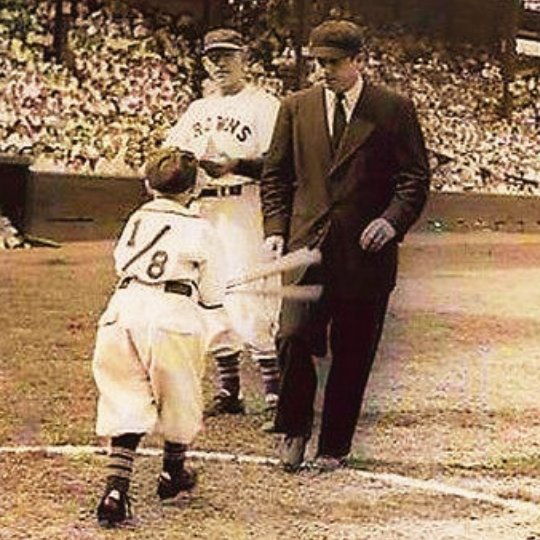
Gaedel popped out of the cake wearing a Browns uniform with the Number 1/8 (one-eighth) on it. The uniform belonged to Bill DeWitt Jr., the Browns' batboy, and the son of Bill DeWitt Sr., the Browns' general manager. The fans got a kick out of it.
Bill DeWitt Jr. wearing the unusual number

But that wasn't the end of it. In the bottom of the 1st inning, Gaedel walked to the plate, to pinch-hit for the alleged leadoff hitter, right fielder Frank Saucier. He was announced by the public-address announcer. The fans went wild -- although there were just 18,369 of them, so the stunt didn't get a big crowd.

The home plate umpire, Ed Hurley, wasn't having it. He called time-out, and looked over to Browns manager Zack Taylor. But Taylor was ready: He walked out, and took a rolled-up piece of paper from his pocket. It was Gaedel's contract, signed not only by him and by Veeck, but by the President of the American League, Will Harridge. Clearly, Harridge signed it with no idea that the player involved was 3-foot-7. The subject of signing a midget to a contract had never come up before. So the contract was real and official. Hurley had no choice: He had to allow the at-bat.
Note the height of the ball in the mitt, compared to Gaedel's.
Note also Gaedel's crouching stance.

With his height, and a crouching batting stance, Gaedel had the smallest strike zone in baseball history, not much larger than the ball itself. The idea was that the pitcher, Bob Cain, wouldn't come close to a strike, and that Gaedel would walk on 4 straight pitches.

Veeck told Gaedel that there was a sniper on the roof of Sportsman's Park, ready to shoot him if he swung at any pitch. Veeck never said whether there actually was a sniper. If there really was one, he never came forward and admitted it. And whether Gaedel took this threat seriously, only he knew.

What everyone else knew is that catcher Bob Swift got onto his knees, and told Cain, "Keep it low." Cain threw 4 pitches. The 1st 2 were serious attempts at strikes, and did get over the plate, but were too high. Realizing it was hopeless, Cain threw the last 2 at half-speed, still getting them over the plate, but at about the level of Gaedel's head.

After ball 4, Hurley told Gaedel, "Take your base," and Gaedel trotted to 1st base. Jim Delsing then ran out to pinch-run for him. Like a real major-league ballplayer, which he now was, Gaedel slapped Delsing on the rear and, and trotted off the field -- to a standing ovation.

Delsing remained in the game, played center field as former Yankee Cliff Mapes moved from center to right, and went 1-for-3. It was no use: The Tigers got a fine pitching performance from Cain, a home run from Jerry Priddy, and 3 hits each from George Kell and Pat Mullin, and completed the sweep, 6-2.

The next day, AL President Harridge publicly said that Veeck was making a mockery of the game, and voided Gaedel's contract. In response, Veeck, who always hated the New York Yankees, told the Chicago press that he was going to request an official ruling on whether Phil Rizzuto, the Yankees' shortstop and the previous season's AL Most Valuable Player, was "a short ballplayer or a tall dwarf." 

Rizzuto was listed at 5-foot-6, and that may have been generous by an inch. Nevertheless, he was also the best shortstop in baseball at that point, and had batted .324 the season before, getting 200 hits. And, while his 92 walks that season were a career high, that was hardly an extraordinary total, probably was not much aided by his lack of height. Rizzuto's reaction to Veeck's request is unrecorded, but it would probably have been something like, "Veeck, you huckleberry. Holy cow."

Nevertheless, Gaedel got paid for his appearance: $100, his standard fee at the time. (In 2026 money, it works out to about $1,290.) Some time later, he was a guest on the radio show of Chicago-based talk show host Louis "Studs" Terkel. He complained that "Mr. Veeck" wouldn't let him swing the bat, and that he wanted to do that, just once. Terkel, then 39 years old and not looking much like a man who had ever been any kind of athlete, consoled him by saying, "You are exactly what I wish I was: An ex-big-league ballplayer!"

(Terkel would later play Chicago sportswriter Hugh Fullerton in Eight Men Out, the film about the 1919 Black Sox Scandal, and be interviewed by Ken Burns, including on the subject of Gaedel, for his miniseries Baseball.)

Veeck had hoped to run the financially troubled Cardinals out of St. Louis. But, early in 1953, they were bought by Anheuser-Busch chairman Gussie Busch. With Busch's beer fortune behind them, Veeck knew the Browns could not afford to compete for St. Louis' baseball fans.

He didn't particularly care about St. Louis: He just wanted to eliminate the competition and be Number 1 in whatever city he was in, as he had been in Milwaukee and Cleveland. With that option no longer available in St. Louis, he tried to get the Browns moved to Baltimore. The other AL owners, seeing a chance to get rid of him, voted to approve the move, on the condition that Veeck sell the team. He did. But in 1959, he bought the Chicago White Sox.

On May 26, 1959, as Harvey Haddix of the Pittsburgh Pirates was pitching his perfect-but-then-not game, 90 miles to the north in Milwaukee, Eddie Gaedel worked for Bill Veeck again. A helicopter carrying Gaedel and 3 other dwarves dressed in spacesuits landed on the infield at Comiskey Park. They came bearing gifts: Ray guns. They gave these to White Sox stars Luis Aparicio (who was 5-foot-9) and Nellie Fox (5-foot-10). In a parody of the alien visitors' trope, "Take me to your leader," Gaedel told them, "I don't want to be taken to your leader. I've already met him." The White Sox won the Pennant that season.

On June 18, 1961, Gaedel was found dead in his bed by his mother, with bruises all over his body. He was just 36 years old. His killer has never been identified.

By this point, Veeck had sold the White Sox, to pay for his medical expenses, as he had been told he was dying. This turned out to be a misdiagnosis, as he recovered, and he later owned the White Sox again, from 1975 to 1980. He lived until 1986.

But as a result of his 1961 illness, he was unable to attend Eddie Gaedel's funeral. Indeed, only one person with any connection with baseball did: Bob Cain, the pitcher who faced him. They had never even formally met.

Catcher Bob Swift died in 1966. Umpire Ed Hurley lived until 1969. Will Harridge served as AL President from 1931 to 1959, and died in 1971. Browns manager Zack Taylor lived until 1974. Bob Cain lived until 1997. Pinch-runner Jim Delsing lived until 2006. Frank Saucier, for whom Gaedel pinch-hit, was 1 of the last 3 surviving former St. Louis Browns, along with Ed Mickelson and Billy Hunter. All 3 of those men died in 2025, Hunter turning out to be the last survivor of them.

Bill DeWitt Jr. donated his uniform, Gaedel's uniform, to the Baseball Hall of Fame in Cooperstown, New York. He later became the principal owner of the St. Louis Cardinals, and got the uniform back, where it is on display at the St. Louis Cardinals Hall of Fame and Museum, across Clark Avenue from the current Busch Stadium, which also features artifacts from the Browns and St. Louis-area natives who played for other teams, such as Yogi Berra. 

Officially, the shortest players in MLB history have been Edmund "Stubby" Magner, who played 13 games for the New York Highlanders (forerunners of the Yankees) in 1911; and Pompeyo "Yo-Yo" Davalillo, who played 19 games for the Washington Senators in 1953. Both were listed at 5-foot-3.

In 1978, in his 2nd go-round as White Sox owner, Veeck promoted Harry Chappas to the majors, telling the media that he was, after Gaedel, the shortest player in MLB history, at 5-foot-3. This was a lie, but, fittingly, a small one: He was really 5-foot-5, the same height as the man then considered the shortest in the majors, Freddie Patek of the Kansas City Royals. Magner, Davalillo, Chappas and Patek were all, by a quirk of fate, shortstops.

Jon Rauch appeared in the major leagues from 2002 to 2013, including for the Montreal Expos when they moved to become the Washington Nationals in 2004-05, and for the Minnesota Twins in 2009 and 2010, enabling him to appear in postseason play. Sean Hjelle made his big-league debut with the San Francisco Giants in 2022. Both are 6-foot-11, and thus the tallest players in MLB history. Loek van Mil, a 7-foot-1 native of the Netherlands, appeared in professional baseball from 2006 to 2018, but only got as high, if you'll pardon the choice of words, as Class AAA. All 3 of these men are relief pitchers.

Wednesday, October 11, 2023

October 11, 1948: The Cleveland Indians Win the World Series

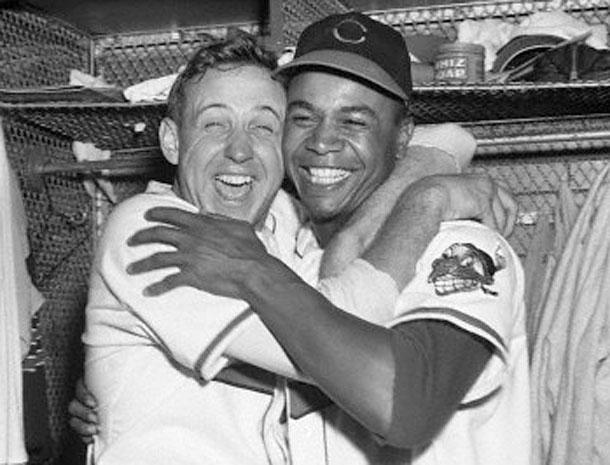
Steve Gromek (left) and Larry Doby

October 11, 1948, 75 years ago: The Cleveland Indians defeat the Boston Braves behind "rookie" 30-year-old knuckleballer Gene Bearden, 4-3 at Braves Field, and take Game 6 and win the World Series. It is their 2nd title, the 1st coming in 1920.

Team owner Bill Veeck had built this team. Larry Doby and Satchel Paige thus become the 1st black players to play on a World Series winner. Doby became the 1st black player to hit a home run in a World Series game. And Lou Boudreau, age 31, both shortstop and manager, becomes the last player-manager to win a World Series, or even a Pennant. Bob Feller would join Veeck, Doby, Paige and Boudreau in the Baseball Hall of Fame, although he ended up as the losing pitcher in both games the Indians lost in the Series: Game 1, to Johnny Sain; and Game 5, to another Hall-of-Famer, Warren Spahn.

A photograph of Doby being hugged by a white teammate, pitcher Steve Gromek, circulated, and was considered another step forward in black and white players working together.

The team has never won another World Series. They have had some close calls, some of them truly agonizing. And they're not even called the Indians anymore: In 2021, after years of complaints about their Native American name and its racist implications, they announced that, for the following season and thereafter, they would be named the Cleveland Guardians.

But at least they're still in Cleveland, despite a number of fears of having to move in the 1960s, '70s and '80s. In contrast, despite all their success in the 19th Century and winning Pennants in 1914 and 1948, that 1948 World Series Game 6 was the last late-season meaningful game the Boston franchise of the National League would ever play. The Braves would be in Milwaukee by the next time they reached the Series, in 1957.

The Indians' Eddie Robinson was the last surviving player from the 1948 World Series, living until 2021, age 100, 73 years later. Clint Conatser was the last survivor of the '48 Braves, living until 2019, at 98.

Friday, July 12, 2019

July 12, 1979: Disco Demolition Night

July 12, 1979, 40 years ago: A promotion between intended games of a Chicago White Sox doubleheader proves to be great sentiment, but lousy execution.

Bill Veeck was the owner of the Chicago White Sox, and baseball's master promoter. At the time, the ChiSox were losing, and Veeck was a big believer in the idea that, "You can fill more seats with losing baseball and a circus than you can with losing baseball and a long silence."

He had scheduled Teen Night at Comiskey Park, once billed as "the Baseball Palace of the World," but now a crumbling relic that, unlike the crosstown Cubs with Wrigley Field, the owners of the Sox (including in two different regimes, Veeck himself) could never afford to keep in good condition. Unlike teams such as the Yankees, Red Sox, Orioles, Dodgers and Phillies, he couldn't "sell the team" to the local fans. Unlike the Cubs, Yankees, Red Sox and Dodgers, he couldn't "sell the ballpark." So he did the best he could: He sold fun.

Veeck's son, Mike Veeck, assisted him in his promotions, and had heard disc jockey Steve Dahl on WLUP, 97.9 FM (not to be confused with the former WLUP, AM 1000, now the ESPN station in Chicago), "blowing up" disco records on the air, because disco sucked. Actually, this was one of the first occasions where people could, instead of "stinks," say "sucks" openly, in public, without fear of being told, "How dare you say such a filthy word like that!"

Most of the songs I don't like are the monotonous ones, the really repetitive ones. I was just turning 8 when the film Saturday Night Fever and its repulsive, Bee Gees-led soundtrack were released in late 1977. Whatever else you might think about him, we must praise the late Michael Jackson for this: Thriller replaced the SNF soundtrack as the biggest-selling album of all time.
John Travolta in Saturday Night Fever,
which premiered December 14, 1977

"Well, you can tell by the way I use my walk, I'm a woman's man... " Are you sure, Barry Gibb? Because in the way you walk, the way you dress, the way you style your hair, and the way you sing, you seem more like a man's woman. Except for the beard: If Barry and his brothers, the twins Robin and Maurice Gibb, didn't have beards, they would have been the most effeminate act in rock history to this point -- and this was after David Bowie did Ziggy Stardust, and in his case the gender-confusion was intentional!

"Stayin' Alive," as bad as it was, wasn't the worst song on the album. That was the incredibly limp "How Deep Is Your Love." I have hated that song for almost 44 years now. There's only one song I have hated longer, and that's because of my name: It's "Michael, Row the Boat Ashore." I don't know how much you'd have to pay me to get me to sing that song, but you are welcome to place a bid.

The Bee Gees were actually really good from 1967 to about 1972, then disappeared, then came back in 1975 as a disco act. There was nothing holy about this second coming. To make matters worse, little brother Andy Gibb also got big at this point.

Anyway, by the Summer of '79, disco was still dominant. Something had to be done. So Mike Veeck and Steve Dahl got together and did something.

The White Sox have played, since their 1901 inception, on the South Side: First at South Side Park (1901-10), then at the old Comiskey Park (1910-90), and since 1991 at the new Comiskey Park, renamed U.S. Cellular Field in 2003 and Guaranteed Rate Field, in 2016.

The South Side is the home of the electric blues (Willie Dixon, Muddy Waters, Howlin' Wolf, Koko Taylor), the home of Chicago soul (Jerry Butler, Curtis Mayfield, their former group the Impressions, the Chi-Lites, Earth Wind & Fire), and the home of some progressive rockers (Doors keyboardist Ray Manzarek, the band Chicago, Styx). While Jim Croce was from the Philadelphia area, he taught us, "Now, the South Side of Chicago is the baddest part of town."

Comiskey, which had hosted the Beatles in 1965, and an annual "Summer Jam" concert since the Veecks came back to town for the 1976 season, seemed like the right place to make a stand for good music.
Comiskey Park, during the 1978 Summer Jam concert

July 12, 1979 was a Thursday, with a doubleheader scheduled, between the White Sox and the Detroit Tigers. Anyone who brought in a disco album into Comiskey would be let in for 98 cents. That's right, 98 cents, because of WLUP's FM frequency, 97.9. Between games of the twinbill, the records would be taken out onto the field and blown up by Dahl and his assistants.

Comiskey Park seated about 44,000 people. Apparently, disco sucked so much that 75,000 people showed up on the troubled South Side to get in and voice their displeasure at disco. The official attendance was 47,795, so there must have been standees.

Harry Caray and Jimmy Piersall, then broadcasting for the ChiSox, mentioned "strange people." Mike Veeck would say the air was heavy with marijuana smoke. (Right, as if disco fans didn't smoke pot. Or use worse drugs: The disco era was the beginning of mass cocaine use in America.)

The Tigers won the first game, 4-1. Pat Underwood outpitched Fred Howard. There were no home runs.

Then the "demolition" was set up. The crate Dahl would use to blow up the records could hold 20,000. That left quite a few others, and people started flinging them like frisbees. When the records were blown up, everyone cheered.

Dahl and his people got off the field in a Jeep, and then fans rushed the field, chanting, "Disco sucks! Disco sucks! Disco sucks!" They tore up the field, as if the White Sox had just won the Pennant. Caray got on the public-address system and told everyone to get off the field. No one listened. The umpires decided the field was unplayable, and declared the 2nd game a forfeit to the Tigers -- after all, as the home team, the White Sox were responsible for making sure the field was playable.

Tiger outfielder Rusty Torres was a Yankee when fans rushed the field at Robert F. Kennedy Stadium in 1971, causing the Washington Senators' last home game to be forfeited to the Yanks. And he was a Cleveland Indian when Ten-Cent Beer Night turned out to be an even bigger disaster than this, resulting in an Indian forfeit to the Texas Rangers in 1974. This would be Torres' 3rd experience in a riot resulting in a forfeit. I seriously doubt anyone will break that record, even on steroids.

Arrests: 39. Injuries reported: 6. Deaths: None. In other words, despite everything, Comiskey Park may have been one of the safest spots in Chicago that night. Don't forget, the South Side was Al Capone's stomping grounds half a century earlier. And it could still be a shooting gallery at times.

No American League games have been forfeited since, and only one National League game has, at Dodger Stadium, when Dodger fans received free balls upon entry, and threw them onto the field to protest a bad call by an umpire. That's right, Walter O'Malley, your beloved Temple of Treason hosted baseball's last forfeit. Hot enough for ya down there, you slimy bastard?

Disco did turn out to be on the decline. "Disco Demolition Night" -- or "Disco Sucks Night," as some called it -- was a symptom of its demise, rather than the cause. After all, for those of us who loved baseball then (as well as for those of us who didn't), one of the big songs of the year was "We Are Family," by Sister Sledge. Although the group came out of Philadelphia, across the Commonwealth of Pennsylvania, and sang about "all my sisters and me" with no mention of "brothers," Willie Stargell, the portly slugger and captain of the Pittsburgh Pirates, took the song to heart, played it in the clubhouse, and even convinced the scoreboard operator at Three Rivers Stadium to play it as the Pirates took the field.

By the time the Pirates reached the Playoffs, the top of the home dugout at Three Rivers Stadium, instead of reading "PITTSBURGH PIRATES," read "THE FAMILY." Wonder what the local mobsters thought about that? They probably liked it once the Buccos won the World Series in October.

But aside from a few more skyrockets like "Funkytown," the Disco Period was pretty much over in a year. The Bee Gees would have a few more hits after 1979, Donna Summer would have a couple of post-disco smashes, but that was it: The Village People became the joke they always should have been treated as; Harry Wayne Casey, leader of KC & the Sunshine Band, was in an awful auto accident, hurting him badly enough that the group's momentum was gone, though he recovered enough to make them a big fixture on the oldies circuit; and punk had evolved into new wave, which would lead to the synthesizer-driven 1980s.

No, it wasn't the people chanting "Disco Sucks!" at Comiskey Park, or the music they liked, that killed disco. The actual cause of death was burnout, like so many other fads before and since.

"We Are Family" was a fun record. In fact, there were quite a few fun disco records, including a comeback by my fellow Essex County natives, Frankie Valli & the Four Seasons: "Who Loves You," "Swearin' to God," and "December 1963 (Oh What a Night)." Not to mention that when the musical Grease was turned into a film in 1978, Frankie sang a theme song written just for the film -- by Barry Gibb! It's disco, obviously not reflective of the late 1950s when Grease takes place, and Gibb clearly sings backup on it, by Frankie showed that a man can sing falsetto and still be masculine.

On the one hand, the vast majority of disco was terrible, and deserved a public demonstration against it.

On the other hand, disco was very inclusive, catering to a multiracial and gay-friendly clientele. In disco, all you had to do was be able to fool someone into thinking you were good-looking and able to dance. And, with all the booze and cocaine flying around in the discos, that wasn't that hard.

And at least going out to discos meant that you had to dress up. Unless you were going to a gay disco, in which case you would wear hardly anything. Not that I would know...

Anyway, if you look at most of the guys running onto the field that night, they were longhaired hard rock fans, probably stoners. "Ginkers," we called them in New Jersey. You know, like Kelso on "That '70s Show," Bender in "The Breakfast Club," and Jon Bon Jovi was before he realized that wearing a shirt was good. I think there was a racist aspect to the backlash against disco.

Throw in the fact that the '70s had seen some nasty fan-induced moments on ballfields -- the New York clinchers of 1969 to 1978, the tearing apart of Forbes Field in Pittsburgh and Connie Mack Stadium in Philadelphia after their last games, Ten Cent Beer Night in Cleveland -- and this was a disaster waiting to happen. It's a wonder more people didn't get hurt.

The sentiment of "Disco Sucks" was right, but the way it was carried out was awful.

Thursday, October 11, 2018

How Long It’s Been: The Cleveland Indians Won a World Series

October 11, 1948, 70 years ago: The Cleveland Indians defeat the Boston Braves behind "rookie" 30-year-old knuckleballer Gene Bearden, 4-3 at Braves Field, and take Game 6 and win the World Series. It is their 2nd title, the 1st coming in 1920.

The Indians have never won another World Series. They have had some close calls, some of them truly agonizing:

* Losing the World Series in 1954 (getting swept by the New York Giants despite winning 111 games, then an AL record), 1995 (in 6 games to the Atlanta version of the Braves), 1997 (blowing a 2-0 lead in the 9th inning of Game 7 and losing to the Florida Marlins in the 11th) and 2016 (nearly coming from behind to beat the Chicago Cubs in the 10th inning in Game 7, but falling just short).

* Losing the American League Championship Series in 1998 (blowing a 2-games-to-1 lead against the Yankees) and 2007 (blowing a 3-games-to-1 lead against the Boston Red Sox).

* Losing the AL Division Series in 1996 (to the Baltimore Orioles), 1999 (to the Red Sox), 2001 (blowing a 2-games-to-none lead against the Seattle Mariners), 2017 (blowing a 2-games-to-none lead against the Seattle Mariners) and 2018 (getting swept by the Houston Astros).

* Finishing 2nd in the single-division American League in 1951 (to the Yankees), 1952 (to the Yankees again, this time by just 2 games), 1953 (to the Yankees again), 1955 (to the Yankees again, but just 3 games), 1956 (to the Yankees again), and 1959 (to the Chicago White Sox).

* Being just a game out of 1st place in the AL Central Division when the Strike of '94 hit.

* And nearly 2 generations of never even being in a Pennant race from 1960 to 1993.

The Indians haven't won the World Series since October 11, 1948. That's exactly 70 years. How long has that been?

*

The Indians have changed ballparks since then, moving from Cleveland Municipal Stadium to Jacobs Field in 1994. The name was changed to Progressive Field in 2008. The team they beat was the Boston Braves. They've not only changed ballparks 4 times since then, they've changed cities twice since then, moving to Milwaukee in 1953 and Atlanta in 1966.

The Indians won the World Series in 6 games. The Braves won Games 1 and 5. Only 1 player from each roster is still alive: Eddie Robinson of the Indians (also the oldest living ex-Yankee) and Clint Conatser of the Braves. Each of them is 97 years old.

Larry Doby and Satchel Paige, who had both been stars in the Negro Leagues, became the 1st black men to play for an American League team in the World Series, and the 1st black men to play on a World Series winner. Doby became the 1st black man to hit a home run in a World Series game. Lou Boudreau, age 31, both shortstop and manager, becomes the last player-manager to win a World Series, or even a Pennant.

Boudreau, Doby, Paige, Bob Feller, Braves manager Billy Southworth and pitcher Warren Spahn were involved in this Series, and went on to the Baseball Hall of Fame.

Fenway Park in Boston and Wrigley Field in Chicago are the only major league ballparks in use then that are still in use now. There was a National League team in Boston, and there were American League teams in Philadelphia, Washington and St. Louis. St. Louis was the Western outpost of the major leagues; it, Cincinnati and Washington were as far south as MLB went.

Milwaukee, Baltimore, Kansas City, San Francisco, Los Angeles, Minneapolis, Houston, Atlanta, Oakland, Seattle, San Diego, Montreal, Dallas, Toronto, Denver, Miami, Phoenix and Tampa Bay all had minor league teams then. All would get major league teams; except for Montreal, they all still have them.

Briggs Stadium in Detroit -- it became Tiger Stadium in 1961 -- had just become the last ballpark in the AL with lights. Wrigley wouldn't get them for another 40 years. No ballparks had electronic, or even electric, scoreboards. None had artificial turf, or a dome, retractable or otherwise. There were only a few black players; the few Hispanic players were all clearly white; and as for Asian players, well, this was a shade over 3 years past V-J Day, so forget it.

Connie Mack was still managing the Philadelphia Athletics. Hugh Duffy, Cy Young, Honus Wagner, Ty Cobb, Nap Lajoie, Tris Speaker and Fred Merkle were still alive. Babe Ruth had just died, less than 2 months earlier. Walter Johnson, Joe Tinker, Johnny Evers, and Mordecai "Three-Finger" Brown had all died within the last 2 years.

The defining players of my childhood? Carl Yastrzemski was 9 years old, Willie Stargell 8, Pete Rose 7; Tom Seaver, Steve Carlton and Rod Carew were 3; Reggie Jackson was 2, Nolan Ryan was 1, Johnny Bench and Carlton Fisk were 10 months, and Mike Schmidt and George Brett hadn't been born yet. Of the managers and head coaches of the 9 New York Tri-State Area sports teams, none had yet been born. Terry Collins of the Mets would be born the following May.

The Indians had interrupted the Yankees' run of World Championships. The defending NFL Champions were the Chicago Cardinals -- now in Arizona, and they haven't won the title since. The defending NBA Champions were the Baltimore Bullets, who would go out of business in 1954, and have no connection to the 1963 version of that team, now known as the Washington Wizards. The holders of the Stanley Cup were the Toronto Maple Leafs. The Heavyweight Champion of the World was Joe Louis.

The Olympics had just been held in Britain, and have been again. They have also since been held in America 5 times; 3 times each in Canada, Italy and Japan; twice each in Norway, Australia, Austria, France, Russia and Korea; and once each in Finland, Mexico, Germany, Bosnia, Spain, Greece, China and Brazil.

Due to World War II, the World Cup had not been held since 1938. It has since been held twice each in Brazil, Germany and Mexico; and once each in America, England, Switzerland, Sweden, Chile, Argentina, Spain, Italy, France, Japan, Korea, South Africa and Russia.

There were 48 States in the Union, and 21 Amendments to the Constitution of the United States. There had not been a Civil Rights Act since 1875. Racial segregation was legal in much of the nation, and interracial marriage was illegal in some States. Children in public schools could be forced to recite a Christian (usually Protestant) prayer. There was no Medicare, no Medicaid, no Environmental Protection Agency. Feminism and gay rights? Be serious. Two-thirds of the Justices now on the U.S. Supreme Court, 6 of the 9, had not yet been born.

The President of the United States was Harry Truman, about to win a full term of his own, what amounted to a 2nd term. Former President Herbert Hoover and Grace Coolidge, the widow of Calvin Coolidge, were still alive. Edith Roosevelt, widow of Theodore, had died 11 days earlier.

Dwight D. Eisenhower had just become President -- of Columbia University. John F. Kennedy and Richard Nixon were about to be elected to their 2nd terms in the U.S. House of Representatives; Gerald Ford, to his 1st. Lyndon Johnson had just just been promoted from the House to the Senate in a very sketchy special election. Jimmy Carter was serving aboard a submarine in the U.S. Navy. Ronald Reagan was acting, and was being divorced by his 1st wife, actress Jane Wyman. George H.W. Bush was getting started in the oil industry. Bill Clinton, George W. Bush and Donald Trump were all 2 years old -- and Trump hasn't gotten any more mature. Barack Obama wasn't born yet.

The Governor of Ohio, the Indians' home State, was Thomas J. Herbert, although he was about to be defeated for re-election by Frank Lausche. The Mayor of Cleveland was Thomas A. Burke. Current Governor John Kasich had not yet been born, and current Mayor Frank G. Jackson was 2 years old.

The Mayor of the City of New York was William O'Dwyer. The Governor of the State of New York, and the Republican Party's nominee for President was Thomas E. Dewey, about to be stunned by Truman. The Governor of New Jersey was Alfred E. Driscoll, and he was working on getting the New Jersey Turnpike approved. Aside from the Pennsylvania Turnpike, there weren't really superhighways in America.

There were still living veterans of the American Civil War (on both sides), the Indian Wars, the Franco-Prussian War, the Zulu War and the Northwest Rebellion. The American and British governing bodies of the Society of Friends (a.k.a. the Quakers) were the holders of the Nobel Peace Prize. No Prize would be awarded in 1948, as the Norwegian Nobel Committee released an official statement saying, "There was no suitable living candidate," and the Prize cannot be awarded posthumously. This was widely taken to be a tribute to Mohandas Gandhi, who had been assassinated the preceding January 30. So why didn't they give it to Gandhi while he was alive?

The Pope was Pius XII. The current Pope, Francis, then Jorge Mario Bergoglio, was 11 years old. The Prime Minister of Canada was William Lyon Mackenzie King, although he was about to retire and hand the government over to Louis St. Laurent; and of Britain, Clement Attlee. The monarch of both nations was King George VI, but his battle with lung cancer meant that he had already begun to turn some duties over to his 22-year-old daughter and heir apparent, Princess Elizabeth. There have since been 13 Presidents, 2 British monarchs, and 7 Popes.

Arsenal were the holders of England's Football League title, and Manchester United of its FA Cup. In the season that was now underway, Portsmouth would win the League, and Wolverhampton Wanderers the Cup. There was, as yet, no European Cup, nor even the Latin Cup, and the other tournament considered a predecessor to the European Cup (now the UEFA Champions League), the Mitropa Cup, had not yet been reestablished in the postwar era.

Publishing their 1st novels in 1948 were Truman Capote with Other Voices, Other Rooms, and Norman Mailer with The Naked and the Dead. Gore Vidal published The City and the Pillar, one of the earliest American novels to treat a gay protagonist without condemnation, although he is hardly a sympathetic character.

Agatha Christie published The Witness for the Prosecution and Other Stories, Georgette Heyer The Foundling, Alan Paton Cry, the Beloved Country, Irwin Shaw The Young Lions, Evelyn Waugh The Loved One. In non-fiction, Dumas Malone published Jefferson and His Time, Richard Hofstadter The American Political Tradition, and Thomas Merton The Seven Storey Mountain.

J.R.R. Tolkien had published The Hobbit, but not yet any of the Lord of the Rings Trilogy. C.S. Lewis had published books, but none of the Chronicles of Narnia books were yet among them. Jack Kerouac and Allen Ginsberg had yet to be published. George R.R. Martin had just been born, and Stephen King was a year old.

Major films of the Autumn of 1948 included the Laurence Olivier version of Hamlet, the Orson Welles version of Macbeth, the Ingrid Bergman version of Joan of Arc, the Gene Kelly and Lana Turner version of The Three Musketeers, the John Wayne Western Red River, the Robert Mitchum Western Blood On the Moon, the musical Isn't It Romantic, the musical Road House (definitely not the Patrick Swayze film, and Ida Lupino sings "One for My Baby"), the murder mystery Rope (Alfred Hitchock's 1st color film), the murder mystery Sorry, Wrong Number, Johnny Belinda, June Bride, The Night Has a Thousand Eyes, The Red Shoes, and the James Cagney adaptation of William Saroyan's play The Time of Your Life.

Gene Roddenberry had just resigned as a pilot for Pan Am, so he could write full-time for the new medium of television. It wasn't working out, so he soon joined the Los Angeles Police Department, which would give him several good ideas -- but not the one for which he would become known. George Lucas was 4 years old, Stephen Spielberg 2.

Kirk Alyn of Wharton, Morris County, New Jersey had just become the 1st live-action Superman, in a film serial earlier in the year. Robert Lowery was filming the serial Batman and Robin. Ian Fleming was working for The Sunday Times, and had not yet published any books, let alone those about James Bond.

It was the dawn of network television. CBS became a national TV network, and New York's Channel 11, WPIX, and Chicago's Channel 9, WGN, debuted that year. So did Milton Berle's Texaco Star Theater, Candid Camera, and Toast of the Town, the CBS variety show that everyone quickly began calling by the name of its host. In 1955, CBS would give in to this, and officially rename it The Ed Sullivan Show. Robert Kardashian Sr. was 4 years old, and neither Bruce Jenner nor Kris Jenner had yet been born.

The Number 1 song in America was "A Tree in the Meadow" by Margaret Whiting. Al Jolson, who'd been a star for over 30 years, was voted Most Popular Male Vocalist in Variety -- and you thought the Grammys were behind the times. Columbia Records introduced the long-playing (LP) record, which revolved at 33 1/3rd revolutions per minute. This would be used for albums. Also developed that year was the 45 RPM single. Both would supplant the standard 78 RPM over the next 10 years. Patti Page became the 1st singer to use multi-track overdubbing. Perry Como prepared his 1st televised Christmas special.

Frank Sinatra was one of the biggest stars in both music and film, still in his initial run of success. But Elvis Presley was 13 years old, John Lennon and Ringo Starr 8, Bob Dylan 7, Paul McCartney 6, George Harrison 5, David Bowie and Elton John 1, and Billy Joel, Bruce Springsteen, Michael Jackson, Prince, Madonna and Bono had not yet been born.


Inflation was such that what $1.00 bought then, $10.33 would buy now. A U.S. postage stamp cost 3 cents, and the fare on the New York Subway had just gone up from 5 to 10 cents. Boston's had already been 10 cents, but an "exit fare" was added, leading to a song whose best-known version would be done in 1959 by the Kingston Trio: "M.T.A." In 1953, New York would solve the problem of how to collect both a nickel and a dime without building turnstiles to accommodate both, by inventing the subway token.

The average price of a gallon of gas was 22 cents, a cup of coffee 27 cents, a fast food meal (cheeseburger, fries and shake) 55 cents, a movie ticket 34 cents, a new car $1,250, and a new house $7,700. The Dow Jones Industrial Average closed that day at 182.41.

The tallest building in the world was the Empire State Building. The majority of American homes now had telephones, but hardly any had television sets. Commercial photocopying was not yet possible. Computers were in their infancy. Alan Turing was still alive, but Steve Jobs, Bill Gates and Tim Berners-Lee weren't born yet. There were no credit cards or automatic teller machines. A majority of American homes did not yet have air conditioning. Most of the places that did were either bars or movie theaters.


Telephone numbers were still based on "exchanges," based on the letters on a rotary dial. So a number that, today, would be (718) 293-6000 (this is the number for the Yankees' ticket office, so I’m not hurting anyone's privacy), would have been CYpress 3-6000. There were no ZIP Codes, either. They ended up being based on the old system: The old New York Daily News Building, at 220 East 42nd Street, was "New York 17, NY"; it became "New York, NY 10017."

An artificial kidney was possible, but not an artificial heart. Transplantation of organs was not possible. The distribution of antibiotics were still new. There was no polio vaccine. There was no birth control pill, but there was no Viagra, either.

Space travel? That was the stuff of movies. Fruit flies were, for the moment, the only living things flown past the boundary of "space." No one had yet put any object into orbit.

In the Autumn of 1948, the Berlin Airlift was flying in supplies past a Soviet blockade, turning the Cold War from a winning issue for the Republicans into a winning issue for the Democrats. The Democratic People's Republic of Korea, a.k.a. North Korea, was proclaimed. Israel, India and Pakistan were also new nations. An earthquake killed over 100,000 people in Soviet Turkmenistan and Iran.

Brandeis University was founded in the suburbs of Boston, and the University of the Andes was founded in Bogota, Colombia. In neighboring Venezuela, a military coup overthrew President Romulo Gallegos. Whittaker Chambers accused Alger Hiss of spying for the Soviet Union. Hiss denied it under oath, and sued Chambers for slander. Chambers produced evidence, and, with the statute of limitation for espionage past, Hiss was indicted for perjury. Chambers produced "The Pumpkin Papers" 15 days after the Presidential election. Had he done so before, it would have swung the election from Truman to Dewey.

Edvard Benes, and Baseball Hall-of-Famer Hack Wilson, and 1900s pitcher Al "The Curveless Wonder" Orth died. Gerry Adams, Avery Brooks, and Mickey Rivers were born.

October 11, 1948. The Cleveland Indians won the World Series. They had a good team and should have been contenders for a long time to come. And they were: After a down year in 1949, they averaged 93 wins a year over the next few years, winning the Pennant in 1954, and coming close to it in 1950, '51, '52, '55 and '59.

Then they didn't so much as get into a Pennant race again until 1994, didn't win another Pennant until 1995, and they have never won another World Series. They came within 2 games in 1995, and within 1 run in 1997 and 2016.

Can they do it in 2019? To do it, they would have to go through the Yankees, the Boston Red Sox, and the Houston Astros, and maybe other teams. It doesn't look good.

    Monday, February 1, 2016

    Top 5 Reasons You Can't Blame the St. Louis Browns for Moving to Baltimore


    The St. Louis Browns were bad. Historically bad. They existed for 52 seasons, 1902 to 1953. They won 1 American League Pennant, in 1944. They finished 2nd in 1902 (5 games behind the Philadelphia Athletics), 2nd again in 1922 (1 game behind the Yankees), 4th in 1908 (but just 6 1/2 behind the Detroit Tigers), 3rd in 1945 (6 behind the Tigers)... and that was pretty much it for their good seasons.

    They won 93 games in '22, and 89 in their '44 Pennant season. Only 12 of their 52 seasons were winning seasons, including just 3 of their last 22 and none of their last 8. In 8 seasons, they lost at least 100; 4 times, they lost at least 107; and in 1939, they bottomed out at 111 losses, an AL record 64 1/2 games behind the Yankees.

    They didn't even get the benefit of a sports-underdog movie, like the Washington Senators got with Damn Yankees. It was said, "Washington: First in war first in peace, and last in the American League." Because of its brewing and leather industries, the Mississippi River town was "St. Louis: First in shoes, first in booze, and last in the American League."

    They had Hall-of-Famers George Sisler and Bobby Wallace, but what they're most known for is 3 things: All their losing; played a one-armed man, Pete Gray, in 1945 due to World War II's manpower shortage; and team owner Bill Veeck trying anything to get fans to come out to Sportsman's Park, including sending Eddie Gaedel, a 3-foot-7 midget, up to pinch-hit in a 1951 game, drawing a 4-pitch walk and being immediately removed for a pinch-runner.

    Still, they shouldn't have just up and left their loyal fans, should they? They shouldn't have just moved -- and east, no less, rather than west! Right?

    Top 5 Reasons You Can't Blame the St. Louis Browns for Moving to Baltimore

    5. Demographics. The end of World War II should have meant that the troops would come back and resume their habit of going to games. But it also meant that they were taking advantage of the G.I. Bill, and buying houses in the suburbs.
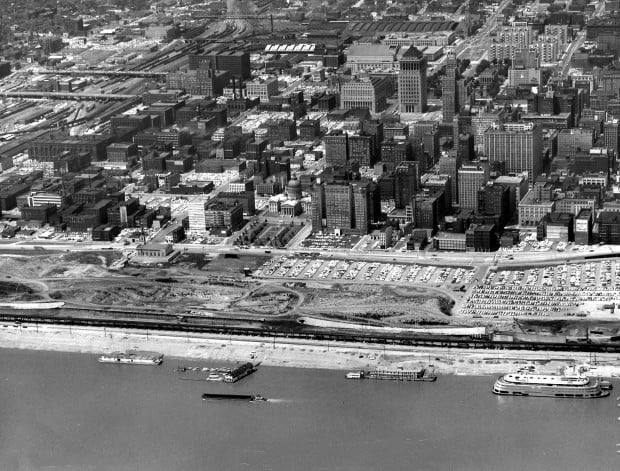
    St. Louis circa 1960, with an empty space along the river,
    where Interstate 44 and the Gateway Arch would be built.

    And cars. This meant that it would be harder for fans to drive in to the city for the games. And while Sportsman's Park was on a trolley line, highway access wasn't very good: What's now Interstates 44 and 70 were the closest highways, and they weren't close.

    Check out these per-game attendance figures for the St. Louis teams for the last 8 years of their coexistence, between the 1st postwar season and the last season that they were in St. Louis together:

    Year Browns Cardinals
    1946 6,749 13,613
    1947 4,162 16,207
    1948 4,330 14,434
    1949 3,496 18,580
    1950 3,209 14,294
    1951 3,815 13,161
    1952 6,694 11,859
    1953 3,860 11,452

    No, you're not reading that wrong: The Browns averaged three thousand, eight hundred sixty fans per home game in 1953. In 6 of their last 8 seasons, they didn't draw 5,000 a game. In none of them did they draw 7,000. In that '53 seasons, the 2 St. Louis teams combined couldn't draw 16,000 a game, enough to half-fill the ballpark they shared.

    And the economy was good at the time. And while the Korean War did take quite a few ballplayers (including the Yankees' Whitey Ford and Jerry Coleman, the Giants' Willie Mays and the Dodgers' Don Newcombe), it didn't take anywhere near as many men as did World War II, so that's not a viable excuse. And the Cards outdrew the Browns in every one of those seasons.

    What makes it even weirder is that, until 1953, the Browns owned Sportsman's Park, which they built in 1909, while the Cardinals had been their tenants since 1920. The key year was 1917, when the Browns fired Branch Rickey as general manager and the Cards hired him. By 1926, the Browns were no longer the top team in town, and the Cards began a run of 21 seasons with 9 Pennants.

    The Cards' average attendance went up in 1954, the 1st year they had the city to themselves, to 13,503, but stayed in the 11,000 to 15,000 range until the new Busch Memorial Stadium opened in 1966.

    The population of St. Louis City was 857,000 in 1950, its all-time peak. Adjoining, but separate, St. Louis County had 406,000. But just 10 years later, The City was down to 750,000, while the County was up to 703,000. Today, the City's population is a little over 300,000, while the County's population is around 1 million. The combined metropolitan area has about 2.9 million. Contrast that with the 2-team markets of today: New York has over 23 million, Los Angeles over 18 million, Chicago just under 10 million, and San Francisco over 8 million.

    No, St. Louis could never really support 2 Major League Baseball teams. Indeed, if the Cardinals hadn't become an iconic franchise through their radio network, long (but no longer) anchored by the powerful station KMOX, it's possible that the City might not even be able to support 1 MLB team.

    After all, they lost an NFL team, the Gunners, in 1934; lost an NBA team, the Bombers, in 1950; gained a new NBA team, the Hawks, in 1955, but lost them in 1968; gained a new NFL team, the football Cardinals, in 1960, but lost them in 1987; and gained 1 more NFL team, the Rams, in 1995, and just lost them. If the arena now known as the Scottrade Center hadn't opened in 1994, they probably would've lost the NHL's Blues, too. (UPDATE: It was renamed the Enterprise Center in 2018.)

    4. Rivalries. St. Louis vs. Chicago is a good rivalry in baseball's National League, Cardinals vs. Cubs. It's a good one in hockey, Blues vs. Blackhawks. It could have been one in football, but NFL Cardinals vs. Bears and Rams vs. Bears never worked out. In the American League, Browns vs. White Sox was never truly a rivalry.

    And while Cardinals vs. Royals worked in the 1985 World Series, and has in Interleague play, by the time the Philadelphia Athletics moved to Kansas City in 1955, the Browns were already gone. Then again, the Kansas City Chiefs never really had a rivalry with any St. Louis NFL team.

    Ah, but Baltimore vs. Washington? That didn't last long, but, geographically, it made sense. Baltimore vs. Philadelphia? That only lasted 1 year. Baltimore vs. New York? Now, you're talking. The Orioles, not the Red Sox, are the Yankees' closest AL opponents by distance. Baltimore vs. Boston? They're not a whole lot further apart than St. Louis and Chicago, and they've had September showdowns in a few AL Eastern Division races.

    3. Ballparks. There was a series of stadiums named Sportsman's Park, all of them made of wood and thus rickety firetraps, until a concrete-and-steel one was built in 1909. It seated 30,804 people, which wasn't enough. The access situation was bad. The parking situation was bad. And, by the 1950s, as white flight turned the North Side of St. Louis into a black neighborhood, white fans didn't feel safe going there. The Cardinals eventually lobbied for, and got, a downtown stadium. The Browns didn't have any pull with City Hall.
    Probably the best-known photograph of Sportsman's Park,
    renamed the 1st Busch Stadium in 1953

    In contrast, Baltimore was converting its 70,000-seat football facility, Municipal Stadium, into a 49,000-seat (eventually 54,000-seat) baseball-and-football facility, Memorial Stadium. It would open in its multipurpose configuration in April 1954, and was one of the few stadiums designed to host both sports that did well by both sports. And it had lots of parking (by the standards of the time).
    Memorial Stadium in 1966, the year of the 1st Oriole Pennant

    Moving to Baltimore gave the Browns/Orioles a city all to themselves (Washington is close, but they and Baltimore are not a single market), ready to love a major league team. And it gave them an up-to-date ballpark that fans could drive to. Okay, again, the highway access wasn't good, but at least nobody was afraid to drive there and park there.

    2. Baltimore. Charm City had been a National League powerhouse in the 1890s, and one of the most successful minor-league towns. In 1944, the year the Browns played the Cardinals in the World Series, the International League version of the Orioles attracted over 50,000 fans to Municipal Stadium (which wasn't even designed for baseball, but they had to use it because their ballpark burned down on the 4th of July that year) for the Junior World Series

    Fifty thousand people paying to watch a minor-league baseball game. That was almost twice as many as the real World Series was getting.

    Shortly before the Orioles arrived, the Colts did; shortly after, they became back-to-back NFL Champions. Baltimore athletes would also fill the ranks of the football and basketball teams of the University of Maryland, which won a National Championship in football in 1953; and of the basketball team at Washington's Georgetown University. Baltimore is a city that loves its sports.
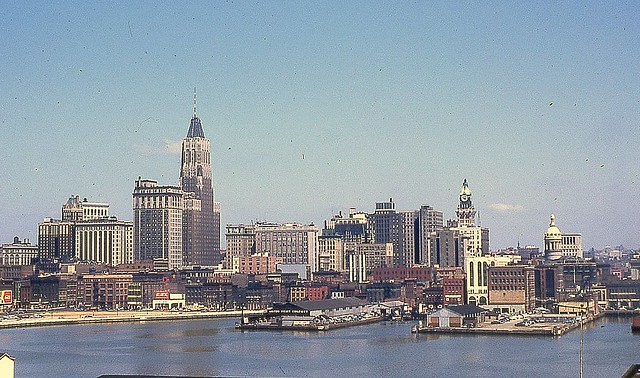
    Downtown Baltimore in the 1950s. As you can see, there's slums
    where the Inner Harbor attractions would later be built.

    If the Browns hadn't moved to Baltimore for 1954, some team would have moved there in the next few years. They had the stadium. They had the fan base. They were ready.

    Of course, something like this could have happened to the Cardinals, right? After all, their attendance wasn't too hot, either. And their stadium and their parking situation were exactly the same. And they nearly did move: Owner Fred Saigh was imprisoned for tax evasion, and according to MLB's rules, he had to sell the team. He came very close to selling the Cards to a group that was going to move them to Milwaukee for 1953. And Bill Veeck thought he and the Browns would soon have St. Louis all to themselves.

    Instead, a new owner was found:

    1. Gussie Busch. August Anheuser Busch Jr., grandson of Adolphus Busch and great-grandson of Eberhard Anheuser, founders of the St. Louis-based brewing company that bears their names, didn't particularly like baseball. But he liked being a bigshot, which sports team owners are. And he wanted to sell lots and lots of beer, under the brand he'd been selling it under, Budweiser, named for the Budweis region of Austria, from which Adolphus had come.

    Someone told him that the Cardinals were for sale, and that their radio network, which reached all over the Midwest and into the South, could be used to sell Budweiser. That was all Gussie needed to hear: He bought the Cardinals from Fred Saigh, and then bought Sportsman's Park from Bill Veeck.

    From that day onward, the Browns were doomed, because Gussie was rich as hell, and, like Tom Yawkey of the Boston Red Sox, and later George Steinbrenner of the Yankees, he wasn't afraid to spend big if he thought it would get him big results.

    He got them quickly. Not on the field. Not at the box office. In beer sales. In 1953, Budweiser was barely in the top 10 best-selling brands of beer in America. By the time the Cardinals won their next Pennant in 1964, Bud was Number 1, and several of those that had been in the top 10 had gone bust, or would in the coming years. Radio, TV and the Cardinals were what did it.

    And, along the way, Gussie became a baseball fan. Eventually, on special occasions such as Opening Day or the postseason, he would ride around the field at Busch Memorial Stadium in the famous Clydesdale-driven beer wagon, waving his feathered Cardinal-red cowboy hat to the fans. He became that rare thing in sports: An owner who was beloved. (He had some nasty flaws, but most Cardinal fans didn't care.)
    Dorrel Norman Elvert Herzog and August Anheuser Busch Jr.
    -- Whitey and Gussie -- celebrate a Pennant.

    Veeck? He knew the game was up. He applied to the AL to move the Browns to Baltimore for 1954. But the other owners hated his guts, and they voted to let the move happen, but only on the condition that Veeck sell the team to a Baltimore-based group. Ironically, it was a brewery that bought them: Gunther Brewing Company, led by Jerry Hoffberger. (In the 1950s, Baltimore was every bit a brewing town as St. Louis and Milwaukee.)

    It took a few years, but the results worked out well for both cities. Between 1964 and 1987, the last time the Cards reached the postseason before Gussie died, a total of 24 seasons, St. Louis won 6 Pennants and 3 World Series, and Baltimore did the exact same. Since the move, the Cardinals have made the postseason 17 times, the Orioles 12.
    The 2006 edition of Busch Stadium.
    This was never going to be the home of the St. Louis Browns.

    Today, both teams are strong on the field, financially secure, more popular than ever, and playing in exciting old-looking but relatively new downtown ballparks: The 3rd Busch Stadium, and Oriole Park at Camden Yards.
    Oriole Park at Camden Yards.
    Yes, the Browns/O's are better off.

    Oddly, since the '44 "Trolley Series" (as opposed to a "Subway Series"), the Cardinals and the Browns/Orioles have never faced each other in the World Series again. The closest call was in 1996, when each lost their respective League Championship Series.

    Veeck did get back into baseball, buying the Chicago White Sox in 1959, winning a Pennant. He had to sell them just 2 years later, thinking he was dying. But he was misdiagnosed, then properly diagnosed, and recovered. In 1975, he bought the ChiSox again, and brought fun back to the South Side, but not enough winning. As was the case when he owned the Browns, he just didn't have the money to compete, and sold the Pale Hose in 1980.

    Both the Cards in St. Louis, and the O's in Baltimore, have had their ups and downs since 1953. But the move worked out well for both teams. And while there is, to this day, 62 years after the move, a St. Louis Browns Historical Society, it's hard to argue that the franchise, or the City of St. Louis, would have been better off if the Cards had moved instead, and the Browns had stayed -- or if Veeck had tried to make a go of it there anyway.

    VERDICT: Not Guilty.

    Saturday, May 17, 2014

    How to Be a Yankee Fan In Chicago -- 2014 Edition Part II, White Sox

    For the first time, Interleague Play has presented the Yankees with a schedule that includes both Chicago teams on the same roadtrip: The Cubs at Wrigley Field next Tuesday and Wednesday, and the White Sox at U.S. Cellular Field (formerly new Comiskey Park) on Thursday, Friday, Saturday and Sunday. (Why two and four, instead of three and three? Who knows, but the schedulemaker has been getting worse and worse every season.)

    This is Part II, the White Sox portion.

    Hog Butcher for the World,
    Tool Maker, Stacker of Wheat,
    Player with Railroads and the Nation’s Freight Handler,
    Stormy, husky, brawling,
    City of the Big Shoulders:

    They tell me you are wicked and I believe them, for I have seen your painted women under the gas lamps luring the farm boys.

    And they tell me you are crooked and I answer: Yes, it is true I have seen the gunman kill and go free to kill again.

    And they tell me you are brutal and my reply is: On the faces of women and children I have seen the marks of wanton hunger.

    And having answered so I turn once more to those who sneer at this my city, and I give them back the sneer and say to them:

    Come and show me another city with lifted head singing so proud to be alive and coarse and strong and cunning.

    Flinging magnetic curses amid the toil of piling job on job, here is a tall bold slugger set vivid against the little soft cities;

    Fierce as a dog with tongue lapping for action, cunning as a savage pitted against the wilderness,

    Bareheaded, shoveling, wrecking, planning, building, breaking, rebuilding,
    Under the smoke, dust all over his mouth, laughing with white teeth,
    Under the terrible burden of destiny laughing as a young man laughs,
    Laughing even as an ignorant fighter laughs who has never lost a battle,
    Bragging and laughing that under his wrist is the pulse.
    And under his ribs the heart of the people, laughing!

    Laughing the stormy, husky, brawling laughter of Youth, half-naked, sweating, proud to be Hog Butcher, Tool Maker, Stacker of Wheat, Player with Railroads and Freight Handler to the Nation.

    -- Carl Sandburg, 1916.

    Sandburg knew. He was right then. He is still right now. And this legendary poem "Chicago" fits the White Sox much more than it does the Cubs.

    “If I was a colonel in some horrible war,” said Jean Shepherd, the legendary writer and radio show host, native of Hammond, Indiana, and hard-core White Sox fan, “and I needed volunteers for a suicide mission to take an enemy pillbox, I’d call out, ‘Any of you White Sox fans? Follow me!’ And those White Sox fans would follow me, and we’d take that pillbox! Because White Sox fans are special. Fifty years without a Pennant? A hundred years? Doesn't matter. We're loyal.”

    Shepherd said that in the 1987 documentary Chicago White Sox: A Visual History. It was an elaboration of something he'd said before: ”If I was going to storm a pillbox, going to sheer, utter, certain death, and the colonel said, ‘Shepherd, pick six guys,’ I’d pick White Sox fans, because they have known death every day of their lives, and it holds no terror for them.”

    White Sox fans hate the Cubs, and especially Cub fans, a lot more than Cub fans hate the White Sox and their fans. To a Cub fan, a White Sox fan is a greasy, dirty, uncouth hood who likes heavy metal and marijuana -- an image probably ingrained due to the South Side's gritty reputation and Disco Demolition Night in 1979. To a White Sox fan, a Cub fan is a prissy, effete intellectual who is willing to accept losing so long as he has his ivy and his beer -- and, occasionally, his marijuana. In other words, newspaper columnist and conservative TV news pundit George Will, who actually is a Cub fan... except for the substance abuse part.

    Jean Shepherd has been dead for a few years, but I'll bet he didn't like George Will. Will is still alive, and I'll bet he was never a Jean Shepherd fan, either.  Too much imagination.

    Disclaimer: While I have been to Chicago, and I have seen games at Wrigley Field, and I saw a game at the old Comiskey Park, I have not yet been to a game at the new Comiskey Park, now named U.S. Cellular Field. But much of this information is taken from the White Sox' website, and is believed to be accurate.

    Before You Go. These series will be played in the 2nd half of May. So ignore all the stories you’ve heard about Chicago being cold: You’re going to Wrigley to see the Yankees play the Cubs, not to Soldier Field to see the Giants or Jets play the Bears. More likely than not, it's going to be warm, with no cold blast of air coming in off Lake Michigan producing "Bear Weather."

    The Chicago Tribune is predicting temperatures to be in the high 70s or low 80s during daylight, and the high 50s or low 60s at night. They're also predicting thunderstorms for Tuesday and Thursday, which could present problems. The Chicago Sun-Times backs up its rivals' temperature predictions, but is more optimistic about the chance of rain.

    Wait until you cross into Illinois to change your clocks. Indiana is one of 2 States, Arizona being the other, where Daylight Savings Time is an issue; however, the State now uses it throughout. Once you approach the Chicago suburbs and edge cities such as Gary, you'll be moving from Eastern to Central Daylight Time.

    Tickets. In spite of the White Sox normally being the better team on the field, the Cubs have had the better attendance. This season, the Cubs are averaging 32,104 for home games, the White Sox just 21,919, even though the Sox are doing a little better than the Cubs at the moment.  (The Sox are 9 games under .500, the Cubs 12 games under.)

    In fact, the Cubs have had a higher attendance than the White Sox every season from 1994 onward, even though the Sox were then in a very good period and have actually won a Pennant and a World Series since: Even in their title season of 2005, the Sox trailed the Cubs in per-game attendance, 24,437 to 39,138. The Sox’ record is 36,511 in 2007, and the Cubs had 39,040 the same year.

    I think the Cub/Sox divide -- that is, the Sox fans hate the Cubs and their fans more than the Cub fans hate the Sox and their fans -- is partly due to the Cub-Cardinal rivalry. Cub fans have someone they hate more than they hate the White Sox. The move of the Milwaukee Brewers, considerably closer to Chicago than St. Louis is, to the National League has killed the Sox-Brewers rivalry, which was never all that strong, but neither has it made Cub fans hate the Brewers all that much. In contrast, Brewers fans have grown to hate Cub fans, mainly because they were probably already sick of hearing about Cub fans, Wrigley Field and Harry Caray on "Superstation" WGN.  (This may also be spillover from Chicago Bears vs. Green Bay Packers, although it's been a while since Chicago Bulls vs. Milwaukee Bucks, or even DePaul vs. Marquette, has meant much.)

    Hopefully, the White Sox' 2005-present resurgence, under (now former) manager Ozzie Guillen and general manager Kenny Williams will help them build rivalries with AL Central opponents Detroit, Cleveland and Minnesota, and they can have better attendance as a result of both the winning and the rivalries.

    But, for now, getting tickets for a White Sox game shouldn't be difficult: Essentially, you can probably get any seat you can afford. Gold Boxes will cost $94, Lower Boxes $65, Outfield Reserved $42, Upper Boxes $29, Upper Reserved $25, and Bleachers $40. For whatever reason (the Sox' website doesn't explain it), all of these prices will drop dramatically for the Sunday afternoon game.

    Getting There. Chicago is 789 land miles from New York. Knowing this, your first reaction is going to be to fly out there.

    Unlike some other Midwestern cities, this is a good idea if you can afford it. If you buy tickets online, you can get them for about $830 round-trip. O'Hare International Airport (named for Lt. Cmdr. Edward "Butch" O'Hare, the U.S. Navy's 1st flying ace who was nevertheless shot down over the Pacific in World War II), at the northwestern edge of the city, is United Airlines' headquarters, so nearly every flight they have from the New York area’s airports to there is nonstop, so it’ll be 3 hours, tarmac to tarmac, and about 2 hours going back.

    The Chicago Transit Authority (CTA) Blue Line train will take you from O’Hare to the downtown elevated (or “L”) tracks that run in “The Loop” (the borders of which are Randolph, Wells, Van Buren and Wabash Streets) in 45 minutes. From Midway Airport, the Orange Line train can get you to the Loop.  Both should take about 45 minutes.

    Bus? Greyhound’s run between the 2 cities, launched 5 times per day, is relatively easy, but long, averaging about 18 hours, and is $246 round-trip -- but can drop to as low as $156 on Advanced Purchase. Only 1 of the 5 runs goes straight there without requiring you to change buses: The one leaving Port Authority Bus Terminal at 10:15 PM (Eastern) and arriving at Chicago at 2:30 PM (Central). This includes half-hour rest stops at Milesburg, Pennsylvania and Elkhart, Indiana, and an hour-and-a-half stopover in Cleveland.

    The station is at 630 W. Harrison Street at Des Plaines Street. (If you’ve seen one of my favorite movies, Midnight Run, this is a new station, not the one seen in that 1988 film.) The closest CTA stop is Clinton on the Blue Line, around the corner, underneath the elevated Dwight D. Eisenhower Expressway.

    Train? Amtrak’s Lake Shore Limited (formerly known as the Twentieth Century Limited when the old New York Central Railroad ran it from Grand Central Terminal to Chicago's LaSalle Street Station) leaves New York's Penn Station at 3:40 every afternoon, and arrives at Union Station at 225 South Canal Street at Adams Street in Chicago at 9:45 every morning. It’s $286 round-trip. The closest CTA stop is Quincy/Wells, in the Loop, but that’s 6 blocks away – counting the Chicago River as a block; Union Station is, literally, out of the Loop.

    If you do decide to walk from Union Station to the Loop, don’t look up at the big black thing you pass. That’s the Willis Tower, formerly known as the Sears Tower, which, until the new World Trade Center was topped off, was the tallest building in North America, which it had officially been since it opened in 1974. If there’s one thing being in New York should have taught you, it’s this: “Don’t look up at the tall buildings, or you’ll look like a tourist.”

    But since you’ve come all this way, it makes sense to get a hotel, so take a cab from Union Station or Greyhound to the hotel – unless you’re flying in, in which case you can take the CTA train to within a block of a good hotel. There are also hotels near the airports.

    If you decide to drive, it’s far enough that it will help to get someone to go with you and split the duties, and to trade off driving and sleeping. The directions are rather simple, down to (quite literally) the last mile. You'll need to get into New Jersey, and take Interstate 80 West. You'll be on I-80 for the vast majority of the trip, through New Jersey, Pennsylvania and Ohio. In Ohio, in the western suburbs of Cleveland, I-80 will merge with Interstate 90. From this point onward, you won’t need to think about I-80 until you head home; I-90 is now the key.

    Note that the dividing line between Eastern and Central Time on I-80/90, the Indiana Toll Road, is between Exits 39 (in LaPorte County) and 31 (in Lake County).

    If you were not going for the entire 6-game Yankee set in Chicago, but only for the White Sox games, and were going directly to U.S. Cellular Field (not a good idea, as you should go to your hotel first), you’d take Exit 55A for 35th Street, merge onto LaSalle Street, and turn left on 35th Street. The ballpark is bounded by 35th Street (3rd base), Shields Avenue/Bill Veeck Drive and the Amtrak/Metra tracks (1st base), 37th Street (right field) and Wentworth Avenue (left field).

    If you do it right, you should spend about an hour and a half in New Jersey, 5 hours and 15 minutes in Pennsylvania, 4 hours in Ohio, 2 hours and 30 minutes in Indiana, and half an hour in Illinois before you reach the exit for your hotel. That’s 13 hours and 45 minutes. Counting rest stops, preferably halfway through Pennsylvania and just after you enter both Ohio and Indiana, and accounting for traffic in both New York and Chicago, it should be no more than 18 hours, which would save you time on both Greyhound and Amtrak, if not on flying.

    Once In the City. A derivation of a Native American name, "Chikagu" was translated as "Place of the onion," as there were onion fields there before there was a white settlement. Some have suggested the translation is a little off, that it should be "Place of the skunk." Others have said, either way, it means "Place of the big stink."


    Founded in 1831, so by Northeastern standards it's a young city, Chicago's long-ago nickname of "the Second City" is no longer true, as its population has dropped, and Los Angeles' has risen, to the point where L.A. has passed it, and Chicago is now the 3rd-largest city in America. But at 2.7 million within the city limits, and 9.5 million in the metropolitan area, it's still a huge city. And its legendary crime problem is still there, so whatever precautions you take when you're in New York, take them in Chicago as well.

    The "Loop" is the connected part of the Chicago Transit Authority (CTA)'s elevated railway (sometimes written as "El" or "L") downtown: Over Wells Street on the west, Van Buren Street on the south, Wabash Street on the east and State Street on the north. Inside the Loop, the east-west streets are Lake, Randolph, Washington, Madison, Monroe, Adams, Jackson and Van Buren; the north-south streets are Wells, LaSalle (Chicago's "Wall Street"), Clark, Dearborn, State and Wabash.
     The city's street-address centerpoint is in the Loop, at State & Madison Streets. Madison separates North from South, while State separates East from West. The street grid is laid out so that every 800 on the house numbers is roughly 1 mile. As Wrigley is at 1060 West Addison Street, and on the 3600 block of North Sheffield Avenue, now you know it's a little more than a mile west of State, and 4 1/2 miles north of Madison.

    The CTA's rapid-rail system is both underground (subway) and above-ground (elevated), although the El is better-known, standing as a Chicago icon alongside the Sears Tower, Wrigley Field, Michael Jordan, deep-dish pizza, and less savory things like municipal corruption, Mrs. O'Leary's cow and Al Capone. The single-ride fare is $2.25, a 1-day pass is $10, a 3-day pass (if you're going for an entire series) is $20, and a 7-day pass (if you're going for all 6 games) is $28.

    (By the way, the Great Chicago Fire of 1871 was more likely the result of Mr. O'Leary hosting a poker game in his barn, in which he, or one of his friends, dropped cigar ash, rather than Mrs. O'Leary's cow, knocking a lantern, onto some hay.)

    Illinois' State sales tax is 6.25 percent, but in the City of Chicago it's 9.25 percent -- higher than New York's. So don't be shocked when you see prices: Like New York, Boston and Washington, Chicago is an expensive city.

    Going In. To get to "The Cell" (or "The Phone Booth") from downtown, take the Red Line train to "Sox-35th." It’s about a 12-minute ride, making it twice as fast as from Midtown Manhattan to Yankee Stadium, 3 times as fast as from Midtown Manhattan to Citi Field.

    The area around the park, part of the Bridgeport neighborhood of the South Side, isn't as bad as it was in the 1960s, '70s, '80s and early '90s. It was in 1973 that Jim Croce, in "Bad, Bad Leroy Brown," called the South Side "the baddest part of town." But things have improved significantly. Nevertheless, take the L, and leave the car at the hotel -- not just because of the safety issue, but because it's just more convenient to train it. If you do insist upon driving, parking costs $25.

    The official address is 333 W. 35th Street. (Comiskey's was 324 W. 35th.) You’ll be most likely to enter by the home plate gate at 35th & Shields. Unlike Wrigley Field, the park is not surrounded by bars, famous or otherwise. Unfortunately, McCuddy's Tavern, the legendary saloon that was on the site, across from Comiskey Park, did not, as was promised to its owners, get rebuilt across the street. Instead, the site of old Comiskey is just a parking lot for the new one.

    Prior to a refit in time for the 2003 All-Star Game, new Comiskey looked a lot like the 1976-2008 edition of Yankee Stadium, with two decks of blue seats wrapping from the left field pole around home plate to the right field pole, with a white wall bracketing the outfield bleachers. But complaints about the place being a "Mallpark" -- especially after Camden Yards in Baltimore opened just one year later, making the White Sox' new home almost instantly obsolete -- led to some changes, including new green seats, more bleacher seats, removing the top couple of rows in the upper deck and replacing them with a slightly overhanging roof, and better concession stands. It does look better -- if a bit less like the park where I (and many of you) grew up.

    The ballpark faces southeast, away from downtown and the city’s skyscrapers; its predecessor had faced northeast, and the Sears Tower could be seen over the left field upper deck. The outfield distances are 330 feet to left, 335 to right, 375 to the power alleys and 400 to center -- much more of a hitters' park than old Comiskey was, but still not heavily favoring hitters. And the field is immaculate, as it usually was at old Comiskey, although that one was occasionally "tailored" for the home team. Capacity is officially 40,615.

    Joe Borchard, with the White Sox in 2004, hit the longest home run, 504 feet. The longest at the old Comiskey Park? It's hard to say. A few balls were hit over its roof. Jimmie Foxx, Mickey Mantle and Dick Allen cleared it in left field, and Ted Williams did it to right. These would have to be 525-foot shots, at least; Mickey's drive, in 1955, has been suggested at 550.

    Like its predecessor, U.S. Cellular Field has an "exploding scoreboard" that lights up, and shoots off fireworks, for a White Sox home run or a White Sox win. It's not a replica of either of the first two boards -- the original exploding scoreboard, at the old Comiskey, lasted from 1960 to 1982 and was replaced in time for the 1983 All-Star Game -- but it upholds the tradition. Legend has it that, upset by the "unprofessionalism" of the original 1960 board, Casey Stengel brought sparklers into the Yankee dugout, and when a Yankee homered, he had the sparklers lit, and the Yankees jumped up and down in the dugout in mock celebration.

    Food. As one of America’s greatest food cities, in Big Ten Country where tailgate parties are practically a sacrament, you would expect the Chicago ballparks to have lots of good options. The Cubs are rather disappointing in this regard.

    The White Sox? In fact, there may be no team with better food options than the Pale Hose. Hot dogs. Sausages. Sandwiches. Pizza. Ethnic varieties. Ice cream. And so much beer, you'll think you missed your exit and ended up in Milwaukee. Bill Veeck used to call the old Comiskey "the world's largest saloon," and the new park reflects this, even if it's not as dark and foreboding in the corridors. (The old one could have used better lighting, but, aside from that and being in poor condition when I visited, I loved it.)

    There's no equivalent to Boog's Barbecue at Camden Yards, where a team legend actually tends to the stand. But all over the park are stands, with hot dogs, bratwurst, Polish sausage and pizza, named for White Sox legends: Eddie Collins, Chico Carrasquel, Early Wynn, Nellie Fox, Jim Landis, Sherm Lollar, Al Lopez, Bill Melton, Dick Allen, Tony LaRussa, Ed Farmer, Ron Kittle, and, yes, Chicago native Greg Luzinski -- but if you want to see "the Bull" dishing out barbecue, you'll have to go to Philadelphia, where he made his baseball name.

    The ChiSox also have funnel cake stands at Sections 108, 155 & 533, and, in honor of their 1983 Division Champions, "Winning Ugly is Sweet Ice Cream" at Section 145.

    Team History Displays. As I said, I have not been inside the new Sox park. But the Sox do have notations honoring their Pennants (1901, 1906, 1917, 1919, 1959 and 2005) on the outfield light towers. The Sox also won Division titles in 1983 and 1993 in the old American League Western Division, and since moving to the AL Central in 1994 they've won them in 2000, 2005 and 2008 (and were in first place in 1994 when the strike began, thus ending the season with them leading, though MLB doesn't recognize this as a division title). All their postseason berths have been by finishing first, no Wild Cards. (They also had close calls for the Pennant in 1908, 1920, 1964 and 1967, and for the AL West in 1972 and 1977.)

    They have statues honoring some of their all-time greats: Founding owner Charlie Comiskey and the 1950s double-play combination of Luis Aparicio and Nellie Fox, behind Section 100 on the right side of center field; 1950s legends, left fielder Orestes "Minnie" Minoso and pitcher Billy Pierce, and 1980s catcher (also Red Sox legend) Carlton Fisk, behind Section 164 on the left side of center field; 1980s outfielder Harold Baines, behind Section 105 in right field; and 1990s first baseman Frank "Big Hurt" Thomas, behind Section 160 in left field.

    There are 2 blue seats in the outfield: One in Section 159 in left, where Paul Konerko's grand slam landed in Game 2 of the 2005 World Series; and one in Section 101 in right, where Scott Podsednik's walkoff homer landed in the same game. Twice in 2008, Jim Thome hit homers onto the center field Fan Deck, the only times it's been done, and a plaque marks the location of the first; the second provided the only run in a Playoff for the American League Central Division title.

    Outside Gate 4 is Champions Plaza, a display honoring the team's 2005 World Championship (the only one won by either Chicago team since World War I), featuring images (strictly speaking, not "statues") of 1st baseman Paul Konerko, the team's soon-to-retire legend, with 435 career home runs as I type this (all but 7 with the Sox); 3rd baseman Joe Crede, who homered in Games 1 and 3; 2nd baseman Geoff Blum, whose 14th-inning homer won Game 3, tied for the longest game in World Series history; shortstop Juan Uribe, who fielded an Orlando Palmeiro grounder for the clinching out; and our old friend Orlando Hernandez (though I'm not sure why they chose El Duque, as his role in the 2005 postseason was not especially notable). Why left fielder Podsednik, whose Game 2 homer is the only World Series walkoff ever hit by a Chicago player, is not included, I don't know.

    The team's retired numbers are depicted on the left field fence: Number 2, Fox; 3, Baines; 4, 1930s-40s shortstop Luke Appling; 9, Minoso; 11, Aparicio; 16, 1920s-30s pitcher Ted Lyons; 19, Pierce; 35, Thomas; and 72, Fisk.

    In addition, no uniformed personnel have worn 6 since the death of hitting instructor Charley Lau in 1984, except for one of his proteges, later hitting instructor Walt Hriniak. And no one has worn 56 since Mark Buehrle left via free agency. However, neither of these numbers has been officially retired.

    There is a Chicago White Sox Hall of Fame located somewhere in the park, and "Shoeless Joe" Jackson, the most famous of the "Eight Men Out" who supposedly threw the 1919 World Series to the Cincinnati Reds, though banned from the Baseball Hall of Fame in Cooperstown, is honored by the White Sox Hall of Fame. So is Bill Veeck, who owned the White Sox twice: 1959-61, selling them because he was sick, and misdiagnosed and thought he was dying; and again 1975-81, selling them because he couldn't keep up with the rising costs, saying, "It's not the high price of talent that bothers me, it's the high price of mediocrity."

    I can't find a full list of members, but, aside from those already mentioned, the following players are in the Baseball Hall of Fame in Cooperstown, New York, and were also White Sox for at least a significant portion of their careers: 1900s shortstop George Davis, 1900s pitcher Ed Walsh, 1910s-20s 2nd baseman Eddie Collins (better known for his time with the Philadelphia Athletics), 1910s-20s catcher Ray Schalk, 1920s outfielder Harry Hooper (better known for his time with the Boston Red Sox), 1920s pitcher Red Faber, 1960s pitcher Hoyt Wilhelm (better known for his time with  other teams), and, while we're talking about someone better known for playing with another team, 1972-76 pitcher Rich "Goose" Gossage.

    Walsh, Jackson, Collins and Wynn were named to The Sporting News' 100 Greatest Players in 1999. The fact that the White Sox have have only 1 player on that list who played for them after the Roaring Twenties is very telling.

    Stuff. Chicago Sports Depot stores are located on the first level of the park, behind home plate and at each outfield corner. The usual items that can be found at a souvenir store can be found there.

    Chicago is a great literary city, and while the Cubs have been seen as the more romantic team, there have been a lot of good books about the White Sox:

    Who's On 3rd? The Chicago White Sox Story, Richard Lindberg's tale that takes them from their 1901 founding up to the 1984 season.

    When Chicago Ruled Baseball: The Cubs-White Sox World Series of 1906, a 100th Anniversary tribute by Bernard A. Weisberger -- even in a Series where they beat the Cubs, the Sox don't get top billing!

    Eight Men Out: The Black Sox and the 1919 World Series, the definitive book on the greatest of all baseball scandals, by Eliot Asinof. It was made into the great 1988 film Eight Men Out, with John Sayles directing and playing legendary sportswriter Ring Lardner, the late Chicago icon Studs Terkel as Ring's colleague Hugh Fullerton, D.B. Sweeney as Shoeless Joe, and Chicago native John Cusack as the greatest victim of the scandal, 3rd baseman Buck Weaver. (When Ken Burns made his Baseball miniseries, he kind of gave both Chicago teams short shrift, but he interviewed Sayles and Terkel, and, reading accounts of the Series, Terkel and Cusack reprised their roles.)

    Minnie and the Mick: The Go-Go White Sox Challenge the Fabled Yankee Dynasty, 1951 to 1964, Bob Vanderberg's tale of growing up in Chicago in the Eisenhower and Kennedy years, with the irony of Minnie Minoso being away from the Sox for their one Pennant from 1919 to 2005, before returning. (Minoso returned by 1964, when the Yanks beat the Sox out for the Pennant by one game.)

    Go-Go to Glory: The 1959 Chicago White Sox, a 50th Anniversary tribute by Bill Nowlin.

    * South Side Hitmen: The Story of the 1977 Chicago White Sox, by Dan Helpingstine and Leo Bauby, about the first White Sox team I can remember and one that, for a brief time, made the Pale Hose cooler than the Cubbies.

    Stealing First in a Two-team Town: The White Sox from Comiskey to Reinsdorf, the aforementioned Richard Lindberg updating the story through the Sox' 1993 Division title.

    Sox and the City: A Fan's Love Affair with the White Sox from the Heartbreak of '67 to the Wizards of Oz, by Chicago Sun-Times film critic Richard Roeper, going up to the 2005 title.

    Available DVDs include White Sox Memories: The Greatest Moments in Chicago White Sox History, and the official 2005 World Series highlight film package. This is the only World Series the South Siders have won since official WS highlight films have been made.

    During the Game. White Sox fans can get a bit rough, and they do like to drink. However, if you don't antagonize them, they will probably give you no worse than a bit of verbal.

    The White Sox have a mascot, a big furry yellow thing called Southpaw, a reference to the team playing on the South Side. Their 1980s mascots, Ribbie and Rhubarb, are long gone.

    The White Sox have a theme song, "Go-Go White Sox," which is what their 1959 Pennant winners were called, and it's a pretty rousing number, certainly with better lyrics than either "Here Come the Yankees" or "Meet the Mets."

    The White Sox, led by organist Nancy Faust (who retired after the 2010 season), were the first team to use the 1969 Steam chart-topper "Na Na Hey Hey (Kiss Him Goodbye)" to serenade a pitcher getting knocked out of the game. And if they win, they will play, appropriate for the South Side, the blues standard "Sweet Home Chicago."

    After the Game. The neighborhood should be safe after a day game, but after a night game, with all that extra time to drink, it can get a little dodgy. As I said, leave them alone, and they'll probably leave you alone.

    If you want to be around other New Yorkers, I found listings of 4 Chicago bars where New York Giants fans gather: Red Ivy, just south of Wrigley at 3519 N. Clark Street at Eddy Street; The Bad Dog Tavern, 4535 N. Lincoln Avenue at Wilson Avenue (Brown Line to Western); Racine Plumbing Bar and Grill, 2642 N. Lincoln Avenue at Kenmore; and Trinity, at 2721 N. Halsted Street at Diversey Parkway (Brown or Purple Line to Diversey for either Racine or Trinity).

    And I found these 3 which show Jets games: Rebel Bar & Grill, also just south of Wrigley at 3462 N. Clark at Cornelia Avenue; Butch McGuire's, 20 W. Division Street at Dearborn Street (Red Line to Clark/Division); and Wabash Tap, at 1233 S. Wabash Avenue, at 12th Street. Red Line to Roosevelt.

    Note that all of these are a lot closer to Wrigley than to The Cell. But there are plenty of good places in the city to get a postgame meal, or just a pint.

    Sidelights. Chicago is one of the best sports cities, not just in America, but on the planet. Check out the following – but do it in daylight, as the city’s reputation for crime, while significantly reduced from its 1980s peak, is still there. For my thoughts on Wrigley Field, check out my post on the subject.

    * Site of old Comiskey Park. The longtime home of the White Sox, 1910 to 1990, was at 324 W. 35th Street at Shields Avenue (a.k.a. Bill Veeck Drive), and is now a parking lot, with its infield painted in. This was the home field of Big Ed Walsh (the pitcher supposedly helped design it to be a pitchers’ park), Eddie Collins, Shoeless Joe Jackson and the rest of the “Black Sox,” Luke Appling, the great double-play combination of Luis Aparicio and Nellie Fox of the ’59 “Go-Go White Sox,” Dick Allen, the 1977 “South Side Hit Men” of Richie Zisk and Oscar Gamble, and the 1983 Division Champions of Carlton Fisk, Ron Kittle, LaMarr Hoyt and Harold Baines.

    The old Comiskey was also where future Yankee stars Russell “Bucky” Dent and Rich “Goose” Gossage began their careers, and where, in the last game the Yankees ever played there, Andy Hawkins pitched a no-hitter – and lost, thanks to his own walks and 3 errors in the 8th inning.

    The NFL’s Chicago Cardinals played there from 1922 to 1959, and the franchise, now the Arizona Cardinals, won what remains their only NFL Championship Game (they didn’t call ‘em Super Bowls back then) there in 1947. And in 1979, during what was supposed to be intermission between games of a White Sox vs. Tigers doubleheader, was Disco Demolition Night. Today, it’s called a fiasco, but the sentiment was right: Disco really did suck. But the biggest music event there was the Beatles' concert on August 20, 1965.

    * Previous Chicago ballparks. The Cubs previously played at these parks:

    State Street Grounds, also called 23rd Street Grounds, 1874-77, winning the NL’s first Pennant in 1876, 23rd, State, and Federal Streets & Cermak Road (formerly 22nd Street), Red Line to Cermak-Chinatown.

    Lakefront Park, also called Union Base-Ball Grounds and White-Stocking Park (the Cubs used the name “Chicago White Stockings” until 1900, and the AL entry then took the name), 1878-84, winning the 1880, ’81 and ’82 Pennants, Michigan Avenue & Randolph Street in the northwest corner of what’s now Millennium Park, with (appropriately) Wrigley Square built on the precise site. Randolph/Wabash or Madison/Wabash stops on the Loop.

    West Side Park I, 1885-91, winning the 1885 and ’86 Pennants, at Congress, Loomis, Harrison & Throop Streets, now part of the campus of the University of Illinois at Chicago (UIC), Blue Line to Racine.

    South Side Park, 1891-93, just east of where the Comiskey Parks were built.

    West Side Park II, 1893-1915, winning the 1906 and 1910 Pennants and the 1907 and 1908 World Series, the only World Series the Cubs have ever won, at Taylor, Wood and Polk Streets and Wolcott Avenue, now the site of a medical campus that includes the Cook County Hospital, the basis for the TV show ER, Pink Line to Polk.  (Yes, the CTA has a Pink Line.)

    Prior to the original Comiskey Park, the White Sox played at a different building called South Side Park, at 39th Street (now Pershing Road), 38th Street, & Wentworth and Princeton Avenues, a few blocks south of the Comiskey Parks.

    * United Center and site of Chicago Stadium. From 1929 to 1994, the NHL’s Chicago Blackhawks played at Chicago Stadium, “the Madhouse on Madison,” at 1800 W. Madison Street at Wood Street. The NBA’s Bulls played there from 1967 to 1994. The United Center opened across the street at 1901 W. Madison at Honore Street.

    At the old Stadium, the Blackhawks won Stanley Cups in 1934, ’38 and ’61, and the Bulls won NBA Titles in 1991, ’92 and ’93. At the United Center, the Bulls won in 1996, ’97 and ’98 and the Blackhawks won the 2010 and '13 Cups -- and, as of this writing, have advanced to the Western Conference Finals for the 4th time in the last 6 seasons.

    The Democrats had their Convention at Chicago Stadium in 1932, ’40 and ’44, nominating Franklin D. Roosevelt each time; the Republicans also had their Convention there in ’32 and ’44, nominating Herbert Hoover and Thomas E. Dewey, respectively. The Democrats held court (or rink) at the United Center in 1996, renominating Bill Clinton in their first Convention in Chicago since the disaster of 1968. And Elvis Presley gave concerts at the Stadium on June 16 and 17, 1972 -- giving the last of these as burglars were breaking into the Watergate complex in Washington.

    Blue Line to Illinois Medical District (which can also be used to access the site of West Side Park II and ER), or Green or Pink Line to Ashland-Lake.

    * Soldier Field. The original version of this legendary stadium opened in 1924, and for years was best known as the site of the Chicago College All-Star Game (a team of graduating seniors playing the defending NFL Champions) from 1934 to 1976.

    It was the site of the 1927 heavyweight title fight between Jack Dempsey and Gene Tunney, the famed “Long Count” fight, which may have had what remains the greatest attendance ever for a U.S. sporting event, with figures ranging from 104,000 to 130,000, depending on who you believe. It definitely was the site of the largest football crowd ever, 123,000 to see Notre Dame play USC a few weeks after the Long Count; in spite of various expansions, the universities of Michigan and Tennessee and Penn State still can’t top this. The 1926 Army-Navy Game was played there, in front of over 100,000.

    Games of the 1994 World Cup and the 1999 Women's World Cup were also held at the old Soldier Field. MLS' Chicago Fire made it their 1st home ground, and 13 matches of the U.S. soccer team have been played on the site, most recently a 2013 win over Panama. The U.S. has won 6 of these games, lost 4 and tied 3. An NHL Stadium Series game was played there earlier this year, with the Blackhawks beating the Pittsburgh Penguins 5-1.

    Amazingly, the Bears played at Wrigley from 1921 to 1970, with the occasional single-game exception. The story I heard is that Bears founder-owner-coach George Halas was a good friend of both the Wrigley and Veeck families, and felt loyalty to them, and that’s why he stayed at Wrigley even though it had just 47,000 seats for football. But I heard another story that Halas was a Republican and didn’t like Chicago’s Democratic Mayor, Richard J. Daley (whose son Richard M. recently left office having broken his father’s record for longest-serving Mayor), and didn’t want to pay the city Parks Department a lot of rent. (This is believable, because Halas was known to be cheap: Mike Ditka, who nonetheless loved his old boss, said, “Halas throws nickels around like manhole covers.”) The real reason the Bears moved to Soldier Field in 1971 was Monday Night Football: Halas wanted the revenue, and Wrigley didn’t have lights until 1988.

    A 2002-03 renovation demolished all but the iconic (if not Ionic, they're in the Doric style) Greek-style columns that used to hang over the stadium, and are now visible only from the outside. It doesn’t look like “Soldier Field” anymore: One critic called it The Eyesore on the Lake Shore. Capacity is now roughly what it was in the last few years prior to the renovation, 61,500. And while the Bears won 8 Championships while playing at Wrigley (8 more titles than the Cubs have won there), they’ve only won one more at Soldier Field, the 1985 title capped by Super Bowl XX. The Monsters of the Midway have been tremendous underachievers since leaving Wrigley, having been to only 1 of the last 28 Super Bowls (and losing it).

    1410 S. Museum Campus Drive, at McFetridge and Lake Shore Drives, a bit of a walk from the closest station, Roosevelt station on the Green, Orange and Red Lines.

    * Site of Chicago Coliseum. There were 2 buildings with this name that you should know about. One hosted the 1896 Democratic National Convention, where William Jennings Bryan began the process of turning the Democratic Party from the conservative party it had been since before the Civil War into the modern liberal party it became, a struggle that went through the Woodrow Wilson and Franklin Roosevelt years before it finally lived up to its promise under John F. Kennedy and Lyndon Johnson.

    It was here that Bryan gave the speech for which he is most remembered, calling for the free coinage of silver rather than sticking solely to the gold standard: "You shall not press down upon the brow of labor this crown of thorns. You shall not crucify mankind upon a cross of gold."

    Now a part of Jackson Park, at 63rd Street & Stony Island Avenue. 63rd Street Metra (commuter rail) station.

    The other was home to every Republican Convention from 1904 to 1920. Here, they nominated Theodore Roosevelt in 1904, William Howard Taft in 1908 and 1912, Charles Evans Hughes in 1916 and Warren Harding in 1920. When TR was maneuvered out of the nomination to return to office at the 1912 Convention, he held his subsequent Progressive Party Convention was also held there.

    It was also the original home of the Blackhawks, from 1926 to 1929 and briefly again in 1932. In 1935, roller derby was invented there. In 1961, an NBA expansion team, the Chicago Packers, played there, becoming the Zephyrs in 1962 and moving to become the Baltimore Bullets in 1963 (and the Washington Bullets in 1973, and the Washington Wizards in 1997).

    The Coliseum hosted a few rock concerts before the Fire Department shut it down in 1971, and it was demolished in 1982. The Soka Gakkai USA Culture Center, a Buddhist institute, now occupies the site. East side of Wabash Avenue at 15th Street, with today’s Coliseum Park across the street. Appropriately enough, the nearest CTA stop is at Roosevelt Avenue, on the Red, Yellow and Green Lines.

    * Site of International Amphitheatre. Home to the Bulls in their first season, 1966-67, and to the World Hockey Association’s Chicago Cougars from 1972 to 1975, this arena, built by the stockyards in 1934, was home to a lot of big pro wrestling cards. Elvis sang here on March 28, 1957. The Beatles played here on September 5, 1964 and August 12, 1966.

    But it was best known as a site for political conventions. Both parties met there in 1952 (The Republicans nominating Dwight D. Eisenhower, the Democrats the man was then Governor of Illinois, Adlai Stevenson), the Democrats in 1956 (Stevenson again), the Republicans in 1960 (Richard Nixon), and, most infamously, the Democrats in 1968 (Hubert Humphrey), with all the protests. The main protests for that convention were in Grant Park and a few blocks away on Michigan Avenue in front of the Conrad Hilton Hotel, one of the convention headquarters (now the Chicago Hilton & Towers. 720 S. Michigan).

    The Amphitheatre, torn down in 1999, was at 4220 S. Halsted Street, where an Aramark plant now stands. Red Line to 47th Street. This location is definitely not to be visited after dark; indeed, unless you’re really interested in political history, I’d say, if you have to drop one item from this list, this is the one.

    * Northwestern University. Chicago’s Big Ten school is just north of the city, in Evanston. Dyche Stadium/Ryan Field, and McGaw Hall/Welsh-Ryan Arena, are at 2705 Ashland Avenue between Central Street and Isabella Street. (Purple Line to Central.)

    While Northwestern’s athletic teams have traditionally been terrible, the school has a very important place in sports history: The 1st NCAA basketball tournament championship game was held there in 1939, at Patten Gymnasium, at 2145 Sheridan Road: Oregon defeated Ohio State. The original Patten Gym was torn down a year later, and the school’s Technological Institute was built on the site. Sheridan Road, Noyes Street and Campus Drive. Purple Line to Noyes.

    Welsh-Ryan, under the McGaw name, hosted the Final Four in 1956: Bill Russell and K.C. Jones, soon to be Boston Celtics stars, led the University of San Francisco past Iowa. These are the only 2 Final Fours ever to be held in the Chicago area.

    * Toyota Park. MLS' Chicago Fire have played here since 2006. The U.S. soccer team has played here once, a 2008 win over Trinidad & Tobago. 7000 S. Harlem Avenue, Bridgeview, in the southwestern suburbs. Orange Line to Midway Airport, then transfer to the 379 or 390 bus.

    * National Italian-American Sports Hall of Fame. Appropriately in Chicago's Little Italy, west of downtown, it includes a state uf Yankee legend Joe DiMaggio.  Other New York native or playing baseball players honored include Joe Torre, Yogi Berra, Phil Rizzuto, Billy Martin, Vic Raschi, Tony Lazzeri, Dave Righetti, Frank Crosetti, Roy Campanella, Sal Maglie, Mike Piazza, Bobby Valentine, John Franco, Carl Furillo, Frank Viola, Jim Fregosi, Ralph Branca, Rocky Colavito, broadcaster Joe Garagiola, and the last active player to have been a Brooklyn Dodger, Bob Aspromonte, and his brother Ken Aspromonte. 1431 W. Taylor Street at Loomis Street.  Pink Line to Polk.

    * Museums. Chicago’s got a bunch of good ones, as you would expect in a city of 3 million people. Their version of New York’s Museum of Natural History is the Field Museum, just north of Soldier Field. Adjacent is the Shedd Aquarium. On the other side of the Aquarium is their answer to the Hayden Planetarium, the Adler Planetarium. And they have a fantastic museum for which there is no real analogue in New York, though the Franklin Institute in Philadelphia is similar: The Museum of Science & Industry, at 57th Street & Cornell Drive, near the University of Chicago campus; 56th Street Metra station. The Art Institute of Chicago is their version of the Metropolitan Museum of Art, at 111 S. Michigan Avenue, just off the Loop.

    * Ferris Bueller’s Day Off. If you’re a fan of that movie, as I am (see my 25th Anniversary retrospective, from June 2011), not only will you have taken in Wrigley Field, but you’ll recognize the Art Institute as where Alan Ruck focused on Georges Seurat’s painting A Sunday Afternoon on the Island of La Grande Jatte.

    Other sites visited by Ferris, Cameron and Sloane were the Sears Tower, then the tallest building in the world, 1,454 feet, 233 S. Wacker Drive (yes, the name is Wacker), Quincy/Wells station in the Loop; and the Chicago Mercantile Exchange, 335 S. La Salle Street, LaSalle/Van Buren station in the Loop. (That station is also where Steve Martin & John Candy finally reached Chicago in another John Hughes film, Planes, Trains and Automobiles). The von Steuben Day Parade goes down Lincoln Avenue every September, on or close to the anniversary of Baron von Steuben's birth, not in the spring as in the film.

    While the Bueller house was in Long Beach, California, the Frye house is in Highland Park, north of the city. Remember, it’s a private residence, and not open to the public, so I won’t provide the address. And the restaurant, Chez Quis, did not and does not exist.

    Nor did, nor does, Adam's Ribs, a barbecue joint made famous in a 1974 M*A*S*H episode of the same title. Today, there are 18 restaurants in America named Adam's Ribs, including two on Long Island, on Park Boulevard in Massapequa Park and on the Montauk Highway in Babylon; and another on Cookstown-Wrightstown Road outside South Jersey's Fort Dix and McGuire Air Force Base. But only one is anywhere near Chicago, in Buffalo Grove in the northwestern suburbs.

    Not far from that, in the western suburbs, is Wheaton, home town of football legend Red Grange and the comedic Belushi Brothers, John and Jim. John and Dan Aykroyd used Wrigley Field in The Blues Brothers, and Jim played an obsessive Cubs fan in Taking Care of Business. Their father, an Albanian immigrant, ran a restaurant called The Olympia Cafe, which became half the basis for John's Saturday Night Live sketch of the same name, better known as the Cheeseburger Sketch: "No hamburger! Cheeseburger, cheeseburger, cheeseburger, cheeseburger, cheeseburger... No fries, chips!... No Coke, Pepsi!"

    Don Novello, an SNL writer who played Father Guido Sarducci, said the other half of the inspiration was the Billy Goat Tavern, originally operated by Greek immigrant William "Billy Goat" Sianis, originator of the supposed Billy Goat Curse on the Cubs, across Madison Street from Chicago Stadium, from 1937 until 1963. At that point, Sianis moved to the lower deck of the double-decked Michigan Avenue, since it was near the headquarters of the city's three daily newspapers, the Tribune, the Sun-Times, and the now-defunct Daily News. Mike Royko, who wrote columns for each of these papers, made it his haunt and frequently mentioned it in his columns.

    Novello and Bill Murray, Chicagoans, were regulars at the Billy Goat, but John Belushi later said he'd never set foot in the place, so while the others may have drawn inspiration from it, his came from his father's restaurant.

    Sam Sianis, nephew of the original Billy, still serves up a fantastic cheeseburger (he was there when I visited in 1999), he deviates from the sketch: No Pepsi, Coke. It's open for breakfast, and serves regular breakfast food. It looks foreboding, being underneath the elevated part of Michigan Avenue, and a sign out front (and on their website) says, "Enter at your own risk." But another sign says, "Butt in anytime." 430 N. Michigan Avenue, lower deck, across from the Tribune Tower. Red Line to Grand. The original location near Chicago Stadium has effectively been replaced, at 1535 W. Madison Street.

    The Tribune Tower is a work of art in itself. Its building, Tribune publisher "Colonel" Robert R. McCormick, had stones taken from various famous structures all over the world: The Palace of Westminster in London, the Western Wall in Jerusalem, the Taj Mahal, the Great Wall of China, the Grand Canyon.  (He must've paid a lot of people off.) These can be seen at near ground level, but the building itself is so grand that it doesn't need it.

    The building is also the headquarters of the TV and radio station that McCormick named for his paper: WGN, "The World's Greatest Newspaper," a line that has long since disappeared from the paper's masthead. 435 N. Michigan Avenue. Red Line to Grand.

    The Wrigley Building is right across from it, at 400 N. Michigan. The block of North Michigan they're on is renamed Jack Brickhouse Way, and Brickhouse's statue is on the grounds of the Tribune Tower.

    You may notice some other film landmarks. The Chicago Board of Trade Building was used as the Wayne Tower in Christopher Nolan’s Batman films. And Chicago stood in for Metropolis in the Superman-themed TV series Lois & Clark, with the Wrigley Building and the Tribune Tower as standout landmarks.

    TV shows set in Chicago include The Untouchables, about Eliot Ness and his Depression-era crimebusters; Good Times, set in the infamous, now-demolished Cabrini-Green housing project; the related sitcoms Perfect Strangers and Family Matters (Great shows? Well, of course, they were, don't be ridiculous!); Married... with Children, Fox's longest-running non-cartoon (though the Bundy family was pretty darn cartoonish); the 1990s hospital dramas ER and Chicago HopeBoss, the current show with Kelsey Grammer as a corrupt Mayor; and The Bob Newhart Show, with Bob as psychiatrist Dr. Bob Hartley.

    Nearly every one of these shows was actually filmed in Los Angeles, and the exterior shots were also mostly L.A. sites, so don't bother going to look for them. However, a statue of Newhart is at the Navy Pier, near its amusement rides, between Grand Avenue & Illinois Street at the lake.

    No President has ever come from Chicago, and none has a Presidential Library anywhere near it -- Abraham Lincoln's is 200 miles away, in the State capital of Springfield -- although many have Presidential connections. Most notably, the 1st true Presidential Debate, between John F. Kennedy and Richard Nixon, was held on September 26, 1960, at the old CBS Studio, home to WBBM, 780 on your AM dial and Channel 2 on your TV. 630 N. McClurg Street. The building is no longer there. Red Line to Grand, then an 8-minute walk.

    In the early days of American politics, any temporary meeting structure was called a “Wigwam,” which is a Native American word for a temporary dwelling. Chicago’s first Wigwam was at what is now 191 N. Upper Wacker Drive, right where the Chicago River splits into north and south branches. Abraham Lincoln was nominated there at their 1860 Convention. A modern office building is on the site today. Clark/Lake station in the Loop.

    Another Wigwam stood at 205 East Randolph Street, in what was then called Lake Park, now Grant Park. The Democrats held their Convention there in 1892, nominating Grover Cleveland for the 3rd time. The Harris Theater is on the site today. Randolph/Wabash station in the Loop.

    In 1864, the Democrats nominated General George B. McClellan at The Amphitheatre, 1100 South Michigan Avenue. A Best Western Hotel is on the site today. Red Line to Roosevelt. In 1868, the Republicans nominated Ulysses S. Grant at Crosby’s Opera House, 1 West Washington Street. A modern office building is on the site today. Blue Line to Washington.

    The Interstate Industrial Exposition Building, a.k.a. the Glass Palace, was where the Republicans met and nominated James Garfield in 1880, and both parties met in 1884, the Republicans nominating James G. Blaine and the Democrats nominating Cleveland for the 1st time. 111 South Michigan Avenue. The aforementioned Art Institute of Chicago is on the site today. Adams/Wabash station in the Loop. And in 1888, the Republicans met at the Auditorium Building, 430 South Michigan Avenue. It still stands. Harold Washington Library station, a.k.a. State-Van Buren station, in the Loop.

    *

    Every American should visit Chicago. And with the Sox having the smaller attendances, you'll have an easier time getting into U.S. Cellular Field than into Wrigley. Have fun -- but remember, be smart, and don't go out of your way to antagonize anyone.