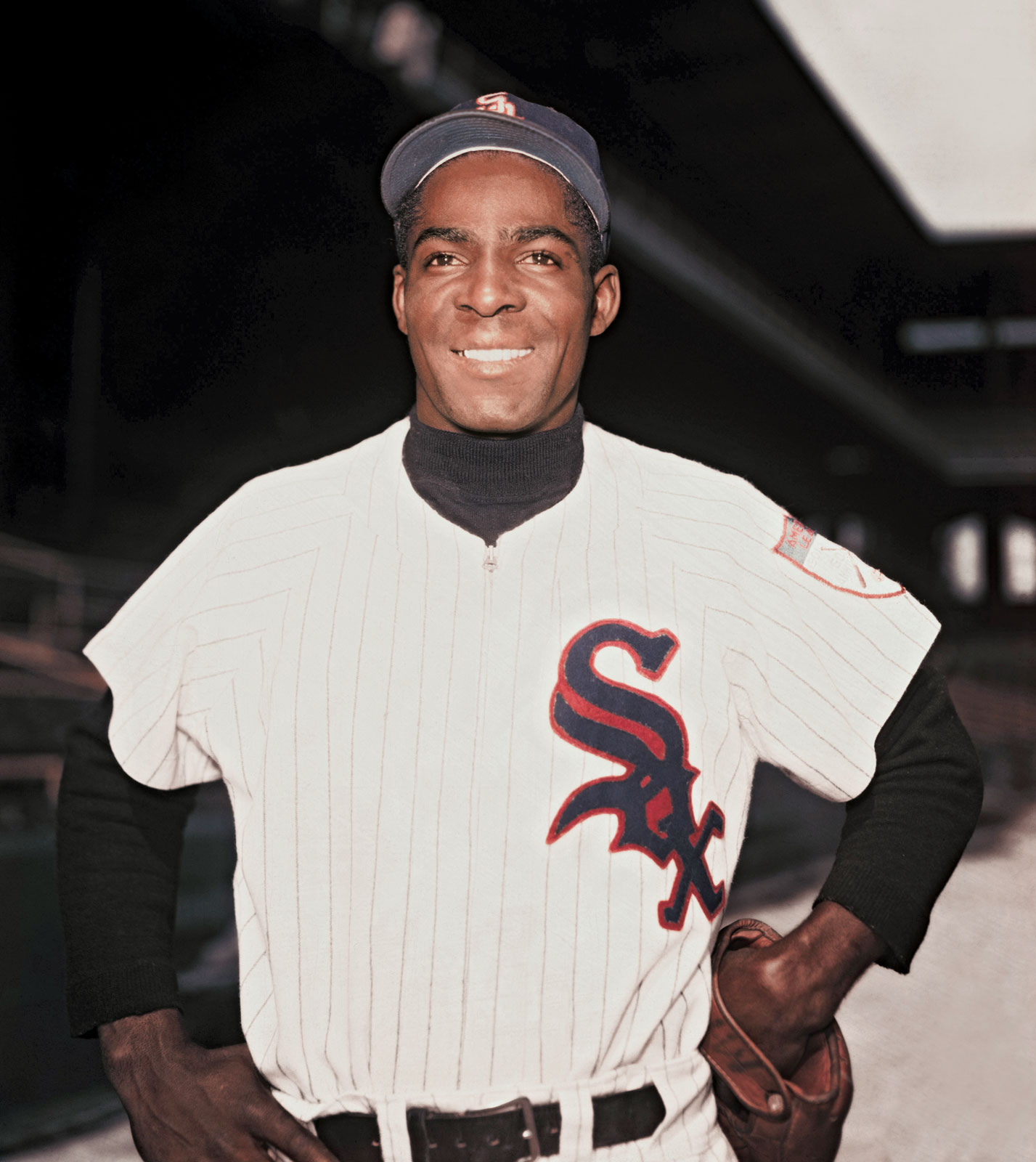
Showing posts with label minnie minoso. Show all posts

Saturday, September 12, 2026

September 12, 1976: A Hit for Minnie Miñoso -- at Age 53

September 12, 1976: The Chicago White Sox sweep a doubleheader from the California Angels at Comiskey Park, 2-1 and 5-1.

In the 10th inning of the opener, Sid Monge walked future Yankee Jim Spencer, and gave up a game-winning double to Brian Downing, making a winning pitcher out of future Yankee Rich "Goose" Gossage.

Minnie Miñoso, age 53, batted 9th as the designated hitter, and went 1-for-3, singling off Monge in the 2nd inning. He got the 2nd game off. A longtime player for the White Sox, he was coaching for them, and team owner Bill Veeck, seeing yet another opportunity to perk up publicity for his team, activated him. At the time, Miñoso was believed to be the oldest player ever to get a hit in a major league game.

This is because Charlie O'Leary, another coach briefly reactivated for a late-season game, in his case in 1934, was believed to have been born in 1882, so Miñoso got credit for breaking his record. Later, it was discovered that O'Leary was born in 1875, so he was just short of turning 59. So, while Miñoso's achievement was remarkable, it was not unprecedented.

In 1980, Veeck sent him up to bat again, making him a 5-decade player (1940s to 1980s), but he did not get a hit. So O'Leary remains the oldest player to come to bat, the oldest to get a hit, and the oldest to score a run.

Mexican lefthander Francisco Barrios went the distance for the win in the 2nd game. But his career would end tragically: In 1981, while still an active player, he injured his elbow, then, during the strike that season, he was arrested for cocaine possession in a Chicago bar owned by Chicago Bears player Doug Buffone.
He entered a rehab program, but the White Sox released him before the season ended. He signed with a team in the Mexican Pacific League, and pitched for them in 1982. The Milwaukee Brewers were interested in him. But he died of a heart attack, probably brought on by cocaine use. He was 28 years old.

September 12, 1976 was also the opening Sunday of an NFL season. Two new expansion teams made their regular-season debuts. The Tampa Bay Buccaneers lost to the Houston Oilers, 20-0 at the Astrodome in Houston. And the Seattle Seahawks lost to the football version of the St. Louis Cardinals, 30-24 at the Kingdome in Seattle.

The following week, the Buccaneers lost their 1st home game, 23-0 to the San Diego Chargers at Tampa Stadium. The Seahawks lost their 1st 5 games, before beating the Buccaneers in Tampa on October 17. They finished 2-12. The Bucs were worse: They went 0-14, and their drought stretched to 0-26 the next season, before finally beating the New Orleans Saints on December 11, 1977.

Monday, December 6, 2021

At Last: Six Men Long Overdue Get to Cooperstown

Yesterday, the Committee on Veterans elected 6 new members of the Baseball Hall of Fame. In chronological order:

* John "Bud" Fowler, a multi-position player who is the 1st member of the Hall who ever actually lived in the town where it is located, Cooperstown, New York. In 1877, he is known to have played for a professional baseball team, the 1st black player known to have done so. He eventually played for the Cuban Giants, an all-black team that would play in the Negro National League once that was established. His last known game was in 1898.

Born in 1858, Fowler died in 1913, never knowing that the Negro Leagues or the Baseball Hall of Fame would be founded, 6 years before the birth of Jackie Robinson.

* John "Buck" O'Neil, 1st baseman for the Kansas City Monarchs of the Negro Leagues, starring for them in the 1940s and managing them in the 1950s. In 1962, the Chicago Cubs made him the 1st black member of any major league team's coaching staff. He later scouted for the Kansas City Royals and helped found the Negro Leagues Baseball Museum in Kansas City.
He is best known for his interview for Ken Burns' 1994 baseball miniseries, introducing him to fans not old enough to remember the Negro Leagues, like me. The reason we didn't know about him is that he was not already in the Hall of Fame, as a few Negro League stars were. He died in 2006, still not a member. He is one now.

* Gil Hodges, the slugging, fine-fielding 1st baseman for the Dodgers, helping them win the World Series in Brooklyn in 1955 and in Los Angeles in 1959. He went on to manage the Mets to win the 1969 World Series, although the Hall doesn't combine playing and managing achievements. If they did, he might have been elected long ago. He died while still the Mets' manager in 1972, not quite 48 years old.
* Saturnino "Minnie" Miñoso, left fielder who played most of his career for the Chicago White Sox. In 1949, with the Cleveland Indians, he became the 1st black Hispanic player in the major leagues. He lasted in the majors until 1964, then became a coach with the White Sox.
White Sox owner Bill Veeck brought him back briefly in 1976, and got a hit in 8 at-bats. At the time, it was believed that he was 53 years old, making him the oldest player to get a hit in a major league game. As it turned out, he was 50, so he was the 4th-oldest. Veeck brought him back once more in 1980, pinch-hitting twice without a hit at 54, making him the 4th-oldest player ever, and 1 of 2 to play in 5 different decades. (The other was also a coach re-activated for publicity reasons, and 1 of the 3 who was older: Nick Altrock.)

He remained on the White Sox payroll, becoming known as Mr. White Sox, until his death in 2015.

* Jim Kaat, pitcher who debuted in 1959 with the "old" Washington Senators, and turned out to be the last active player from that team. He helped the Minnesota Twins win the 1965 American League Pennant. He later reached the Playoffs with the Philadelphia Phillies, and won 16 Gold Gloves for fielding the position of pitcher.
He pitched a season and a half for the Yankees, and finally won a World Series in 1982, with the St. Louis Cardinals, at age 43. He pitched 1 more season, finishing with 283 wins, and became one of the most respected broadcasters in the sport. He could have been elected to the Hall as a player, or been awarded its Ford Frick Award for broadcasters, but never was, until finally being elected now, at age 83.

* Tony Oliva, right fielder for the Minnesota Twins, an 8-time All-Star, a 3-time AL batting champion, and a Gold Glove winner in 1966. He was Kaat's teammate on the Twins' '65 Pennant winners and '69 and '70 Division titlists. Injuries cut his career short, forcing him to retire a couple of years sooner than he might ordinarily have had to, thus preventing him from boosting his career statistics to where his Hall election shouldn't have been an issue. He became a coach for the Twins, and if Miñoso was Mr. White Sox, then Oliva is Mr. Twin.
Falling 1 vote short of election was Dick Allen, who starred with the Philadelphia Phillies in the 1960s and the White Sox in the 1970s. One of the most feared sluggers of his era, he was also its most misunderstood player. He died last year (not from COVID), shortly after the COVID-induced postponement of the vote that was held yesterday. That he didn't get in this time, either, reduces the apparent injustice of his not getting in during his lifetime, but not by much. Like Kaat, he is finally honored at age 83.

But Fowler, O'Neil, Hodges, Miñoso, Kaat and Oliva are in. So the question could be asked: "If these men are worthy now, why weren't they worthy before?" Fowler last played 121 years ago; O'Neil, 66; Hodges, 58; Miñoso, 41; Oliva, 45; and Kaat, 38. None of them has faced, or thrown, a pitch in a game that counts in all that time. None of them has seen his career statistics change in all that time, not even due to a previously unknown error. What made them worthy now, if they weren't before?

They were always worthy. But there are different people voting on them now. Different people have different opinions. And as many people, some of the nasty bigots, will tell us, you can't think less of someone because they have a different opinion than you.

Of course you can. Some opinions are smart, and some opinions are stupid. And anybody whose opinion was that these men were not worthy of election to the Baseball Hall of Fame was just plain stupid.

*

Hours until the next Arsenal game: 1, at 3:00 this afternoon, New York time, away to Everton, the blue team of Liverpool.

Days until the New Jersey Devils again play a local rival: 2, this Wednesday night, home to the Philadelphia Flyers.

Days until the next game of the U.S. National Soccer Team: 12, on Saturday, December 18, at 8:00 PM Eastern Time, a friendly against Bosnia & Herzegovina (that's 1 country), at Dignity Health Sports Park, in the Los Angeles suburb of Carson, California, home of MLS' Los Angeles Galaxy.
Days until the next North London Derby: 41, on Sunday, January 16, 2022, at 11:30 AM New York time, at the new Tottenham Hotspur Stadium. Under 6 weeks. It had been scheduled for the day before, but TV programming moved it back.
Days until the 1st Baseball Hall of Fame election for which Alex Rodriguez and David Ortiz will be eligible, and we will know for sure whether steroid use keeps a player out, or if it's only being  a Yankee who's accused of it that does: 50, on Tuesday, January 25, 2022. About 7 weeks.
Days until the next Winter Olympics open in Beijing, China: 60, on Friday, February 4, 2022. Just 2 months.
Days until the next New York Red Bulls game: 82, on February 26, 2022, away to the San Jose Sharks. Under 3 months. As is usually the case, MLS has released the 1st 3 games of each team's next season schedule, before the full schedule.
Days until the Red Bulls again play a nearby rival: As yet unknown. None of the 1st 3 games are against New York City F.C., or the Philadelphia Union, or D.C. United, or the New England Revolution.
Days until the Yankees play another game that counts: 115, on March 31, 2022, away to the Texas Rangers. Under 4 months.
Days until the Yankees' home opener: 122, on Thursday, April 7, 2022, against the Boston Red Sox.
Days until the next Yankees series against the Boston Red Sox begins: See the previous answer.
Days until the next Rutgers University football game: 271, on Saturday, September 3, 2022, away to Boston College.

Days until the next East Brunswick High School football game: 277, on Friday, September 9, at 7:00 PM, against arch-rival Old Bridge. Hopefully, our home field, under renovation through the entire 2021 season, will be ready, so we don't have to go back to the purple pit.
Days until the next East Brunswick-Old Bridge football game: See the previous answer.
Days until the next elections for Congress and for Governor of most States, including New York and Pennsylvania: 337, on Tuesday, November 8, 2022. A little under a year.
Days until the next World Cup opens: 350, on Friday, November 21, 2022, in Doha, Qatar. Under a year.
Days until the next Rutgers-Penn State football game: 355, on the Saturday after Thanksgiving, November 26, at 12:00 noon, at SHI Stadium in Piscataway, New Jersey. Under a year. 
Days until the next Women's World Cup opens: 581, on Friday, July 10, 2023, jointly held in the neighboring nations of Australia and New Zealand. A little over a year and a half.
Days until the next Summer Olympic Games: 963, on Friday, July 26, 2024, in Paris, France. A little over 2 and a half years.
Days until the next Presidential election: 1,065, on Tuesday, November 5, 2024. Under 3 years.
Days until the next election for Governor of New Jersey and Mayor of New York City: 1,429, on Tuesday, November 4, 2025. Under 4 years.

Sunday, March 1, 2015

Minnie Miñoso, 1925-2015

Who is the greatest player not in the Baseball Hall of Fame? If you said Pete Rose, you need to get smacked: While he was one of the great team players in baseball history, his career OPS+ was just 118, he never topped 82 RBIs in a season, and the reason he is the only player to play at least 500 games at 5 different positions -- 1st base, 2nd base, 3rd base, left field and right field -- is because he wasn't very good at fielding any of them. (He won Gold Gloves in 1969 and '70, but those were rather dubious.)

It may be that the best all-around baseball player not in the Hall of Fame is an outfielder who played the bulk of his career for the Cleveland Indians and the Chicago White Sox. And, no, I don't mean Shoeless Joe Jackson. Come to think of it, Rocky Colavito would also qualify for that description (if you threw in the Detroit Tigers), but I don't mean him, either.

The best all-around baseball player not in the Hall of Fame may well be Minnie Miñoso. But now, he won't live to see his rightful election.

UPDATE: Minnie was finally elected in 2021.

*

Saturnino Orestes Armas Arrieta was born on November 29, 1925 in Perico, Cuba, near the capital of Havana. (Like a lot of Hispanic players, there is some dispute as to the year; 1922 has also been cited, but Baseball-Reference.com says 1925, so that's what I'm going with.) His father was his mother's 2nd husband; her 1st had been named Miñoso, and he later assumed the name so that he would have the same last name as his older half-brothers. He would later, in an American court, have his name legally changed to Orestes Miñoso.

He worked in Cuba's oppressively hot sugar cane fields like his father did. When he found out that, unlike some other sugar plantations, the one he was on didn't have a baseball team, he organized it himself. A righthanded hitter and thrower, he patterned himself after the greatest player Cuba had yet produced (and perhaps still has), Negro League star Martin DiHigo: He learned to play multiple positions, and to hit to the opposite field. Settling on mainly playing 3rd base, in 1946 he made his North American professional debut with the New York Cubans, a Negro League team that sometimes played home games at the Polo Grounds. One of their pitchers was a crafty lefty named Luis Tiant -- father of the twisty, mustachioed Boston Red Sox pitching legend.

The owner, a gangster from Cuba named Alex Pompez, had a working relationship with the New York Giants: The Cubans were the only Negro League team that was officially a farm team of a major league team; as a result, they were the only Negro League team that got compensated when a major league team raided its roster. The Kansas City Monarchs, the Newark Eagles, the Baltimore Elite Giants, and so on? They got nothing in exchange for Satchel Paige, Monte Irvin, Roy Campanella, et al.

Prior to Miñoso, there had been a few Cubans, Puerto Ricans and Mexicans playing in Major League Baseball -- one of the 1st Cubans was Armando Marsans, who became Minnie's 1st professional manager in Cuba -- but they had all been obviously white, primarily of Spanish heritage rather than native Carib "Indians" or descendants of African slaves. (Southern politicians, especially after they seceded and formed the Confederate States of America, wanted to purchase Cuba from Spain, because of the slave labor and the vast sums of money to be made from Cuban sugar and fruit.) The saying was that they were "pure bars of Castilian soap."

Harlem Globetrotters founder-owner Abe Saperstein, a big baseball fan, is said to have recommended Miñoso to Indians owner Bill Veeck, who had integrated the American League with Larry Doby, and by this point had also signed Paige. 

On April 19, 1949, "Minnie" Miñoso -- I can find no reference as to where the nickname came from -- made his major league debut, with the Indians, against the St. Louis Browns, at Sportsman's Park in St. Louis, becoming the 1st black Hispanic player in major league history. Wearing Number 18, he made one plate appearance, drawing a walk as a pinch-hitter in the 7th inning. The Browns lost, 5-1. He didn't play again until May 4, when he got his 1st hit off Alex Kellner of the Philadelphia Athletics, and the Indians won, 4-3. The next day, against the Boston Red Sox, he hit his 1st home run off Jack Kramer. (The pitcher, not the tennis player.)

But the Indians were loaded in the late Forties and all through the Fifties, and with All-Star Al Rosen entrenched at 3rd base, the Tribe really didn't have a place for Minnie. On April 30, 1951, they sent him to the White Sox in a 3-way trade involving some other interesting names. The ChiSox got Miñoso and Paul Lehner. The Indians got Lou Brissie, who reached the majors as a lefthanded pitcher despite a war wound that nearly cost him his right leg, and required that he wear a metal plate over the constantly-operated-on shin.  The A's got slugger Gus Zernial, pinch-hit expert Dave Philley (who would now be playing in "Philly," and would eventually play for the Phillies), Ray Murray and Sam Zoldak. (Have you ever seen another trade involving 2 players whose last name began with a Z -- in any sport?)

On May 1, 1951, Miñoso became the 1st black player in the history of Major League Baseball in Chicago. (The late Ernie Banks would become the Cubs' 1st black player 2 years later.) In his 1st at-bat for the South Siders, he hit a home run of Yankee pitcher Vic Raschi, driving in Lehner, with whom he was traded. Also hitting a home run in that game was a 19-year-old kid from Oklahoma, playing right field for the Yankees. It was his 1st in the majors. His name was Mickey Mantle. The Yankees won the game, 8-3, as Yogi Berra also homered.

Both Mantle and Miñoso were on their way to what should have been Hall of Fame careers. While Mantle's had the occasional sidetrack, he did get elected in his 1st year of eligibility. In that regard, Miñoso wasn't so lucky.

From then on, "the Cuban Comet" wore Number 9, and was mainly an outfielder, playing 1,509 of his 1,665 major league games (90.6 percent) in left field. The Gold Gloves weren't established until 1957, but he won them in 3 of the 1st 4 seasons in which they were presented -- the last one shortly before he turned 35.

From 1919 to 2005, the White Sox won just 1 Pennant -- and Minnie wasn't with them when they did. Indeed, they'd traded him back to the Indians on December 4, 1957, so not only did he miss that Pennant, he was on the team that finished 2nd! But, while he put up good numbers for the Indians, the ChiSox might not have won the Pennant if they hadn't made the trade: They sent Minnie and Fred Hatford for Al Smith (replacing Minnie in left field) and Early Wynn (who won 24 games at age 39, and won the Cy Young Award).

The White Sox traded to get him back in 1960, and in that season he became the last player to play in every game in a 154-game season. Before the 1962 season, they sent him to the St. Louis Cardinals, where he wore the same Number 9 that had been worn by Enos Slaughter, and would later be worn by Roger Maris, Joe Torre and Terry Pendleton before being retired for Slaughter. But he crashed into an outfield wall, fracturing his skull and his wrist, and ending his time as a productive player.

He spent 1963 with the Washington Senators, and returned to the White Sox in 1964, making 38 plate apperances, mainly as a pinch-hitter, at age 38, as the Sox finished just 1 game behind the Yankees.

Miñoso was a 7-time All-Star, His lifetime batting average was .298, with 8 seasons of .300 or better, topping out at .326 in 1951 his rookie season, when he finished 2nd in the American League Rookie of the Year voting to the Yankees' Gil McDougald. (Mantle didn't come close.) His OPS+ was 130 -- meaning he was 30 percent better at producing runs than the average batter of his time. Despite playing most of his career in Comiskey Park and Cleveland Municipal Stadium, great pitcher's parks, he hit 186 home runs, topping 20 4 times, peaking at 24 in 1958. Until 1974, his 135 home runs in a White Sox uniform were a team record. He had 4 100+ RBI seasons, peaking at 116 in 1954.

He led the AL in stolen bases in 1951, '52 and '53; in triples in 1951, '54 and '56; in total bases in 1954; in doubles in 1957; in hits in 1960; in sacrifice flies in 1960 and '61; and in hit-by-pitches 10 times. He was hit by 188 pitches, an AL record until it was broken by Don Baylor in 1985.

*

The Miñoso legend was just getting warmed up. He went to Mexico, both managing and playing 1st base. batting .360 in 1965 and .348 in 1966. The Mexican League, today, is classified as Triple-A, and was probably of the same quality then, so Minnie may well have still been able to hit in the majors. Alas, there was no designated hitter in those days. He continued to play in Mexico until 1973, when he was nearly 48 (or 51, depending on whose records you believe). Mexican fans called him El Charro Negro -- "The Black Cowboy."

Bill Veeck, who'd been the owner of the Indians who'd signed Miñoso and of the White Sox who traded to get him back in 1960, was owner of the White Sox again, and hired him as a base coach. Veeck even activated him, and on September 12, 1976, Miñoso got a hit off California Angels pitcher Sid Monge. He was advertised as the oldest player ever to get a hit in a big-league game: 53 years old. In fact, he was 50, and the 3rd-oldest.


(Don't worry: While he did wear the awful Pale Hose uniforms of the Second Veeck Era, he didn't actually play in the shorts, which were only worn for 3 games, before September call-ups made his place on the roster justifiable.)

In 1980, Veeck had him activated one more time, at age 54. This made him the 3rd-oldest player in major league history, behind Paige (59) and Nick Altrock (also an occasionally-reactivated coach, 57) -- and the only player besides Altrock ever to appear in major league games in 5 different decades. He made his last appearance on October 5, 1980, at Comiskey Park, in a game in which the White Sox beat the Angels, 5-3. As with his big-league debut, 41 years earlier, he pinch-hit in the 7th inning. He grounded to 3rd off Dave Schuler.

On September 30, 1990, the last game was played at Comiskey Park, and Miñoso -- by this point known as "Mr. White Sox," just as Ernie Banks was "Mr. Cub" -- presented the White Sox lineup card. In 1993 and again in 2003, Mike Veeck, Bill's son and the owner of the revived St. Paul Saints of the independent Northern League, signed him to make 1-day appearances, so that he could play professional baseball in a 6th and a 7th decade -- in the latter, drawing a walk and reaching base at age 77.

*

Minnie married twice, and had 4 children. In 1983, the White Sox retired his Number 9. In 2004, a statue in his honor was dedicated at U.S. Cellular Field (formerly named the new Comiskey Park). 

He first appeared on the Baseball Writers Association of America (BBWAA) Hall of Fame ballot in 1970, and didn't get enough support to stay on it. Last playing in 1980, he was restored to the ballot in 1986 (getting in the official waiting period of 5 full years), but never made it, and in 2000 his BBWAA eligibility expired. He was eligible in the Veterans Committee votes of 2011 and 2014, but didn't not get enough votes either time.

Baseball-Reference has a Hall of Fame Monitor, on which a score of 100 indicates a "Likely HOFer." Miñoso is at 87, which means he falls short. They also have a Hall of Fame Standards, on which a score of 50 represents the "Average HOFer." Miñoso is at 35, which means he falls well short. And they have Similar Batters, showing the 10 players most statistically similar to a player, weighted toward players who played the same position. The 10 players most similar to Minnie: Carl Furillo, Cy Williams, Ken Griffey Sr., Amos Otis, Gary Matthews Sr., Ben Chapman, Dixie Walker, Bob Watson, Gee Walker and Tony Oliva. None of those are in the Hall of Fame, although many people (including myself) think Oliva should be in. It's also worth pointing out that these stats are for hitting and running only, and do not take defense into account.

One of the arguments in Miñoso's favor is that he got a late start, due to the color line. Except that might not be true. For so long, it was presumed that he was born in 1922, making him 26 when he first stepped to the plate in a major league game, and that's much too late for a player of his talent. But if he really was born in 1925, as Baseball-Reference says, then he made his big-league debut at age 23, and that's hardly early by the standards of that era, especially since it was a lot harder for a major league team to find a worthy player, white or black, in Cuba or elsewhere in the Caribbean than it would have been to find one in the continental U.S. And while he was certainly good in the Negro Leagues, he didn't have the long record of being spectacular in them, as did Irvin and Doby, who got into the Hall based on a combination of performances from all-black and mostly-white baseball.

But considering what kind of performance Minnie Miñoso put up, playing just about every home game in a park that favored pitchers (or, in the case of his brief time in St. Louis' Sportsman's Park, favored lefthanded hitters rather than righthanded ones like himself), adding in his defense, adding in his Negro League tenure, and topping it off with his pioneer status, as the 1st black Hispanic in the major leagues, I think he belongs in the Hall of Fame.

Minnie Miñoso died today, having been found unresponsive in his car while he was getting gas. He was 89, and, like Star Trek actor Leonard Nimoy, who died on Friday, the cause appears to have been the lung ailment COPD.

The players who were stars in the 1950s are going fast. There aren't a whole lot left. A few of the Brooklyn Dodgers are still around, like Don Newcombe and Carl Erskine. The New York Giants are still represented by Irvin and Willie Mays. The Yankees still have Yogi Berra, but he has looked very frail the last couple of years. We need to treasure these people while we can.

Chicago had just lost Ernie Banks, and now they've lost Minnie Miñoso. They were treasures of their city. It is sad that, now, they will be buried treasures.

"Minnie may have been passed over by the Baseball Hall of Fame during his lifetime," said the world's leading White Sox fan, President Barack Obama, a permanent resident of Chicago's South Side, "but, for me, and for generations of black and Latino young people, Minnie's quintessentially American story embodies far more than a plaque ever could."

The Prez has a way with words, just as Minnie Miñoso had a way with baseball.

UPDATE: Minnie was cremated, so there is no gravesite.

Tuesday, April 12, 2011

The All-Space Baseball Team

April 12, 1961, 50 years ago today: The Space Age really began, with Yuri Gagarin orbiting Earth 3 times aboard Vostok 1. On May 5, 23 days later, the 1st U.S. citizen reached space, Alan Shepard.

In 1968, Gagarin was killed in the crash of a plane he was test-flying. He was just 34. Or... is that really what happened? For all we know, the Soviet Union's greatest living citizen might have been expressing decidedly non-Communist sympathies, and was hushed up. Is that what happened? Probably not, but with the Soviets, you never know.

April 12, 1981, 30 years ago today: The 1st space shuttle, Columbia, lifted off, carrying John Young and Robert Crippen.

Like Gagarin, Columbia would have a horrifying death, in 2003, with all 7 people aboard perishing.

The All-Space Baseball Team

Some have names connected to space, others share names of astronauts. Nicknames, like Sunny Jim Bottomley, Archie "Moonlight" Graham, John "Blue Moon" Odom, and Bill "Spaceman" Lee, do not count.

1B Cecil Cooper (ahead of Glenn Davis, due to having the last name, rather than first)
2B Eddie Collins (in honor of Michael Collins, the Apollo 11 pilot)
SS Arthur Irwin (1880s star, in honor of Apollo 15 Moonwalker James Irwin)
3B Jimmy Collins (also the manager of this team)
LF Saturnino Orestes Armas Minoso (better known as Minnie Minoso)
CF Marquis Grissom
RF Wally Moon
C Walker Cooper
SP Cy Young
SP Lee Grissom (Cincinnati Reds, 1937 All-Star)
SP Jack Armstrong (whose hometown has a space name: Neptune, New Jersey)
SP Chris Carpenter
RP Ed Mars (1 season, 1890 Syracuse Stars of American Association)
RP Marv Grissom (New York Giants, 1954 All-Star AND World Champion)
RP Sun-Woo Kim (1990s Boston Red Sox, I saw him pitch for the Trenton Thunder)

Wally Moon was mainly a left fielder, but I couldn't keep Minoso out, and Wally did play a lot of right field. If you think I'm cheating with "Saturnino," the left fielder could be either Dale Mitchell or Kevin Mitchell, in honor of Apollo 14 Moonwalker Edgar Mitchell.

For 2B, I could have named Glenn Beckert or Glenn Hubbard, in honor of John Glenn, but I wanted a last name, where possible. I almost named Dick McAuliffe, in memory of Challenger loss Christa McAuliffe. But while Dick McAuliffe was one of the best 2nd basemen of his time, Eddie Collins was one of the best 2nd basemen of all time.

Cy Young is included in honor of U.S. Navy Captain John Young, who flew on the first Gemini mission in 1965, commanded both Apollo 10 and Apollo 16 (in which he walked on the Moon and piloted a lunar rover), and commanded the first shuttle mission. John Young was the only Moonwalker to fly on a shuttle, and the first person to fly in space 5 times, later the first to do it 6 times.

Apollo 15 commander and Moonwalker David Scott could have led me to put George Scott at 1B or Mike Scott on the mound, but Scott is just too common a name.

Honorable Mention to Bert Shepard, no relation to Alan although the name is spelled the same way. Bert was the pitcher who lost a leg in a World War II plane crash, but returned to pitch in the majors thanks to a prosthesis, for 4 1/3 innings in a 1945 game for the Washington Senators. He was every bit the hero the astronauts were, and are.