Showing posts with label john kundla. Show all posts

Saturday, November 22, 2025

November 22, 1950: Pistons 19, Lakers 18

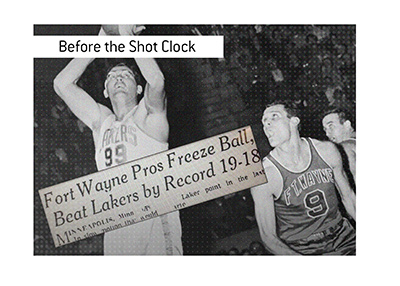
99: George Mikan. 9: Bob Harris.

November 22, 1950, 75 years ago: The worst game in NBA history is played. There were games that were sloppier, and games that had ugly brawls. But as far as quality of play is concerned, nothing will ever top this one -- or "bottom" it, if you prefer.

The Minneapolis Lakers were hosting the Fort Wayne Pistons at the Minneapolis Auditorium. The Lakers were representing Minnesota, the State known as "the Land of 10,000 Lakes," while the Pistons were owned by Fred Zollner, whose Fort Wayne, Indiana-based Zollner Corporation ran a foundry that manufactured pistons, primarily for car, truck and locomotive engines.

Both teams began play in the Midwest-based National Basketball League before entering the NBA. The Pistons won the NBL Championship in 1944 and 1945. The Lakers won it in 1948, then joined the NBA, and won their title in 1949 and 1950.

Coached by John Kundla, a Minneapolis native and University of Minnesota basketball star who wasn't much older than his players, the Lakers were led by George Mikan, at 6-foot-10 the professional game's 1st great big man. Before coming to the Lakers, he had helped Chicago's DePaul University win the NIT (then considered a more important competition than the NCAA Tournament) in 1944 and 1945. Earlier in 1950, despite being just 26 years old, the Associated Press named Mikan the greatest basketball player of the 1st half of the 20th Century.

(The AP's other honorees: Babe Ruth for baseball, Howie Morenz for hockey, Jack Dempsey for boxing, Bill Tilden -- despite his recent scandal -- for men's tennis, Suzanne Lenglen for women's tennis, Man o' War as the greatest racehorse; and Jim Thorpe for football and track and field, and as greatest athlete overall.)

Mikan wasn't fast or graceful: In 1969, longtime New York sportscaster Bill Mazer wrote, "He was more like a stampeding elephant"; while Boston Globe columnist Bob Ryan said on a 1996 ESPN panel, "Great player in his time. Deserved every accolade he ever got. But, today? He's Greg Kite with a hook shot."

The Lakers had other players who would make the Hall of Fame: Jim Pollard jumped around the court so much, he had the nickname "the Kangaroo Kid" years before Billy Cunningham of the Philadelphia 76ers did; while Slater Martin and Vern Mikkelsen were also among the best players in the game. Kundla would also eventually be elected to the Hall, and lived to be 100, outliving each of these players.

The Lakers' game was simple: Find an outside shot, and, if you can't, get the ball to Mikan and let him shoot over everybody. So, Pistons coach Murray Mendenhall decided that the only way to win the game was to make sure that Mikan doesn't get the ball. And the way to do that was to hold onto possession for as long as possible. In other words, or other word: Stall.

A crowd of 7,021 saw this: The Pistons leading 8-7 at the end of the 1st quarter, the Lakers leading 13-11 at the half, and the Lakers leading 17-14 at the end of the 3rd quarter. The crowd, hoping to see Mikan do his stuff, knew what the Pistons are trying, and they booed vociferously.

The Lakers scored only 1 point in the 4th quarter, but were still leading 18-17 with 6 seconds left in regulation, with Mikan having scored 15 of their points, including all of their field goals, 4 in 11 attempts. The rest came from 3 free throws: The other Lakers shot 0-for-6 from the field.

On the game's final play, unable to stall any longer, Pistons rookie Larry Foust took an inbounds pass, and laid it up over Mikan's outstretched arms. Mikan couldn't stop the shot, and it went in. Final score: Pistons 19, Lakers 18.

Point totals: Pistons: John Oldham 4, Curly Armstrong 4, Foust 3, Fred Schaus 3, John Hargis 2, Jack Kerris 2, Bob Harris 0, Ralph Johnson 0; Lakers: Mikan 15, Bob Harrison 2, Pollard 1, and none for Martin, Mikkelsen, Arnie Ferrin, Joe Hutton, and Bud Grant. Yes, football fans, the same Bud Grant who made the Pro Football Hall of Fame for leading the Minnesota Vikings into 4 Super Bowls (but losing them all).

Kundla told the sportswriters, "Play like that will kill professional basketball." But teams found the Lakers' weakness: Hold on to possession, and you can beat them. The 1950-51 NBA Championship was won by the Rochester Royals.

Kundla got his team to bounce back, winning the NBA Championship in 1952, 1953 and 1954. Then Mikan retired, and they didn't win another title until 1972 -- and not in Minneapolis.

Mikan's timing may have been absolutely right: For the 1954-55 season, the NBA adopted the 24-second shot clock. Stalling was no longer possible. Other teams, by necessity, needed faster players to copy the Lakers' now-useless fast break. For that reason, the aforementioned Bob Ryan said that 1954 is the demarcation line: When comparing great players and great teams in NBA history, you shouldn't put pre-1954 entries into the discussion, because they weren't really playing the same game.

The 19-18 game didn't kill pro hoops, but winning it didn't help the Pistons much. Although they reached the NBA Finals in 1955 and 1956, they didn't win either time. In 1957, accepting that Fort Wayne was too small a market in which to compete, Zollner moved the team to Detroit, the Motor City, where the Pistons name still made sense.

Murray Mendenhall lived until 1972, Fred Zollner until 1982, Larry Foust until 1984, and George Mikan until 2005.

Built in 1927, the Minneapolis Auditorium seated 10,545 people, and was home to the Lakers from 1947 to 1959. They played the 1959-60 season at the Minneapolis Armory, which still stands. After that season, they moved to Los Angeles, where the Lakers name didn't make sense. But they became L.A.'s most popular sports team, and remain so.

Since 1980, they have won 11 NBA Championships, the most of any team over that stretch. In total, in Minneapolis and Los Angeles combined, they have won 17, 2nd only to the Boston Celtics, with 18, for the most. One of those Laker titles came in 2002, when a questionable imbalance of fouls gave them the Western Conference title over the Sacramento Kings. That remains the closest the Kings franchise has come to the NBA Finals since... 1951, when they were the Rochester Royals, the team that briefly interrupted the Lakers' Minneapolis dynasty.

Since their respective moves, the Lakers and the Pistons have played each other in 3 NBA Finals. The Lakers won in 1988, the Pistons in 1989, and the Pistons in one of the great NBA Finals upsets in 2004.

Made obsolete by the construction of the Metropolitan Sports Center in suburban Bloomington in 1967, and more so by the plan to build the Target Center downtown (it opened in 1990), the Auditorium was demolished in 1988, and the Minneapolis Convention Center was built on the site. The Minnesota Timberwolves began play in 1989, playing their 1st season in the Metrodome before the Target Center was ready. They have not been a success: Only twice have they made the NBA Western Conference Finals, and they've lost both: 2004, to the Lakers; and 2024, to the Dallas Mavericks.

*

November 22, 1950 was a Wednesday, the day before Thanksgiving. Steven Van Zandt, who played guitar for Bruce Springsteen's E Street Band, and played consigliere Silvio Dante on The Sopranos, was born on this day.

There were 2 other games played in the NBA that night. The New York Knicks beat the Baltimore Bullets, 87-73 at the Baltimore Coliseum. And the Washington Capitols beat the Tri-Cities Blackhawks, 65-60 at the Uline Arena (now the Washington Coliseum).

Baseball was in the off-season. Football was in midweek. There were 2 NHL games played that night. The New York Rangers beat the Montreal Canadiens, 3-2 at the old Madison Square Garden. And the Toronto Maple Leafs beat the Chicago Black Hawks, 5-2 at Maple Leaf Gardens in Toronto. The Boston Bruins and the Detroit Red Wings were not scheduled.

In spite of the next day being Thanksgiving, a day on which the NBA generally doesn't play today, 5 games were played: New York 109, Washington 78; Philadelphia 89, Rochester 71; Boston 94, Tri-Cities 78; Indianapolis 92, Syracuse 85; and, in a rematch in Fort Wayne, Pistons 73, Lakers 63. So the 19-18 game was an aberration: The Pistons proved they could win while playing what then passed for normal basketball.

In the NHL on Thanksgiving 1950: Toronto 2, Detroit 1 in Detroit; and host Chicago 4, Boston 1. In the modern era, the NBA and the NHL avoid playing on Thanksgiving Day, so as not to compete with college and pro football, although there are usually some college basketball games on the day.

Among the college football games on T-Day '50: Number 12 Wyoming 42, the University of Denver 12 in Denver; Number 19 Washington & Lee 67, Richmond 7 in Richmond; Columbia 33, Brown 0 in Providence; Virginia Military Institute 27, Virginia Tech 0 in Roanoke; Missouri 20, Kansas 6 in Columbia; and Utah 46, Utah State 0 in Salt Lake City.

And in the NFL on T-Day '50: Detroit Lions 49, New York Yanks 14 at Briggs Stadium (Tiger Stadium) in Detroit; and Pittsburgh Steelers 28, Chicago Cardinals 17 at Comiskey Park in Chicago.

Tuesday, July 25, 2017

John Kundla, 1916-2017

It's hard to believe that there's a Hall of Fame coach out there who managed to outlive all of his Hall of Fame players.

There was. But not anymore.

John Albert Kundla was born on July 3, 1916 in Star Junction, Pennsylvania, outside Pittsburgh. He was of Slovak descent on his father's side, and Austrian on his mother's. When he was 5, his mother, who didn't like the drinking culture of the Pittsburgh area, moved John out to Minneapolis, hoping her husband would join them. He never did. Until the move, John spoke only Slovakian at home.

He adapted quickly, and happily lived in Minnesota for the rest of his life. He played baseball and basketball at the now-closed Minneapolis Central High School and at the University of Minnesota, winning the Conference title in basketball in 1937. He played minor-league baseball, but never got above Class D (which would be Class A under today's system). He coached high school basketball in Minnesota, served in the U.S. Navy in World War II, and later became the basketball coach at the College of St. Thomas in Minneapolis.

In 1947, the Minneapolis Lakers -- so named because Minnesota was known as "The Land of 10,000 Lakes" -- of the National Basketball League offered him $6,000 a season to be their head coach. This was twice what he was making at St. Thomas. (It's about $64,000 in today's money.) At 31 years of age, he was a pro basketball coach.

A month into the 1947-48 season, the Chicago American Gears folded, and their best player, the 6-foot-10 former DePaul University star George Mikan, became available. The Lakers snapped him up, and they won the NBL Championship. That got the notice of the rising Basketball Association of America, which became the NBA in 1950. They admitted the Lakers, beginning the league's 1st dynasty.

They won the title in 1949, beating the Washington Capitols, the 1st NBA team coached by Red Auerbach. Mikan and Jim Pollard were named to the All-NBA Team. Mikan was the defining player of that era, using his height to dominate the lane. And long before Philadelphia 76ers legend Billy Cunningham came along, Pollard, the star of Stanford University's 1942 National Championship squad, had the jumping ability to get him the nickname "The Kangarood Kid."

They also had Arnie Ferrin, who had led the University of Utah to the 1944 National Championship. (They also had a player named Johnny Jorgensen, not to be confused with the baseball player of the same name, nicknamed Spider, who helped the Brooklyn Dodgers win the National League Pennant in 1947 and '49.)

In 1950, they added Vern Mikkelsen, Slater Martin, and a Minnesota kid who also played a little football, Harry "Bud" Grant. Yes, Vikings fans, that Bud Grant. With a starting five of Ferrin and Martin at guard, Pollard and Grant as forwards, and Mikan at center, they beat the Syracuse Nationals in the Finals. To this day, 2/3rds of a century later, John Kundla remains the only man to win a Championship in his 1st 2 seasons as an NBA head coach.

In 1951, Mikan broke his ankle near the end of the regular season. Without him, they lost the Western Division Finals to the Rochester Royals -- meaning they were still a pretty good team without him, just not a championship team. The Royals then beat the Knicks in a tough 7-game series, the closest the Knicks would get to the title until 1970.

Some retooling was in order, and, with Grant choosing football, they needed another guard. The Royals had traded Frank "Pep" Saul, of Westwood, Bergen County, New Jersey and Seton Hall University, to the Baltimore Bullets. This was not the team that we know today as the Washington Wizards: They won the NBA title in 1948, but by this point, were losing money left and right, and when the Lakers flashed the cash, they sold Saul.

They also added Howie Schultz, a Minnesotan who had played for the Dodgers; and Myer "Whitey" Skoog, another Minnesota product, to their bench. The Lakers plowed through the NBA in 1951-52, and, while it took 7 games, they beat the Knicks in the Finals. In 1953, they won the title again, needing only 5 games to dust off the Knicks. And in 1954, with Skoog having taken Saul's place in the starting lineup, and Clyde Lovellette, star of the University of Kansas' 1952 National Championship, added as an obvious move to have a proper successor to Mikan before it was necessary, they beat the Syracuse Nationals in 7, making it 5 NBA Championships in 6 years.

To put that in perspective: That's nearly all the titles ever won by Minnesota major league teams. The Twins have won 2 World Series. The Vikings have won 4 NFC Championships, but never a Super Bowl. The Timberwolves and the Wild have each reached 1 Western Conference Final in their entire histories. The North Stars reached 2 Stanley Cup Finals, but lost them both.

After the 1954 season, the Lakers' fate was sealed, and the sport changed forever. The 24-second shot clock was added. The reason was a game on November 22, 1950, when the Fort Wayne Pistons beat the Lakers 19-18, with only 3 Pistons points to the Lakers' 1 scored in the 4th quarter. The Pistons wanted to keep the ball out of Mikan's hands, and so they only attempted 13 shots. This and other, similarly low-scoring games led to the shot clock's adoption.

This made the game considerably faster, and made the Lakers' game obsolete. In a 1969 book, New York sports-talk maven Bill Mazer said of Mikan, "He wasn't graceful. He was more like a stampeding elephant."

That was when Mikan was still a relatively recent player. In 1996, on an ESPN Classic panel discussing the greatest teams in NBA history in the wake of the Chicago Bulls' 72-win title season (and with Mikan very much still alive and having sat for an interview with the network), Bob Ryan of The Boston Globe said that you couldn't compare a great pro team, including before the NBA, from before the shot clock to one after it, citing Mikan, and the man who won the NBA's 1st scoring title and led the Philadelphia Warriors to the 1st Championship in 1946-47:

Before that, I don't think Jumpin' Joe Fulks makes it in today's NBA, except, maybe, as a 12th man. George Mikan? A good backup center. Greatest player of his time, deserved every accolade he ever got, but now? He's Greg Kite with a hook shot.

In case you've forgotten, Kite was Robert Parish's backup as center on the 1984 and '86 NBA Champion Boston Celtics. Ryan, who probably knows more about the Celtics than any living person now that Auerbach is dead (and more about the NBA's history than any person currently covering it), was suggesting that the NBA centers to come -- Bill Russell, Wilt Chamberlain, Willis Reed, Dave Cowens, Bill Walton, Kareem Abdul-Jabbar, Moses Malone, Parish, Hakeem Olajuwon and Shaquille O'Neal -- would have handled Mikan fairly easily.

Whether that means the other stars that Kundla coached, or Kundla as a coach, would have made it in the modern NBA, Ryan didn't say. But Mikan seemed to think he would have done just fine, telling Sports Illustrated in 1997:

He was a great coach, one who really understood the players. John wasn't a screamer, and was very mild-mannered, but he'd let loose when we deserved it. And, usually, I was the first one he bawled out. The message he sent was that no one on the team was above criticism.

Mikkelsen agreed, telling The St. Paul Pioneer Press in 1995, when he and Kundla were elected to the Basketball Hall of Fame together:

Our coach had to be the greatest psychologist who ever lived. There is only one ball. A lot of so-called superstars didn't get it as much as they would have liked, because George was the priority. But John kept everyone happy. John sold each of us on the importance of our individual roles.

Whitey Skoog also agreed, when interviewed for the same story as Mikkelsen:

John was an excellent coach. What I appreciated most, and the other ballplayers did too, was his willingness to put himself out there to help each ballplayer improve...

He was humble and positive. I really appreciated John’s ability to communicate. He was never negative about a player’s mistakes. He worked to find a way for the player to improve. He never criticized a player in the press, and gave the players the credit for the Lakers’ success.

But in a 2007 interview with SI, Kundla himself seemed to suggest that the game had passed him by:

I'm not sure I could coach professional basketball players today, and I'm not sure I'd want to. The players are younger, and don't play as much as a team. With agents, crowds, television and the big bucks, everyone involved is under so much more pressure. Pressure for us was still having some meal money left by the time dinner rolled around.

At first, the Lakers weren't affected too much by the institution of the shot clock. Although Mikan retired, only 30 years old but possibly having seen the writing on the wall, Mikkelsen, Martin, Pollard and Lovellette had enough left to get the Lakers to the Western Division Finals, before losing to the Pistons. They only dropped from 46-26 to 40-32. But Pollard then retired, and, despite a comeback by Mikan, they fell to 33-39 for 1956, a drop of 13 games in 2 years. Mikan then retired for good, Martin was traded. By 1958, they were 19-53.

After the 1958-59 season, Bob Short, a Democratic political operative from Minnesota, purchased the team. Despite having ties to Minnesota, he wanted to move them to Los Angeles. Kundla didn't want to go, and the University of Minnesota offered him a lifeline, hiring him as head coach of the program for which he once played. In 1960, Short moved the Lakers, and Minnesota was without an NBA team until the Timberwolves were expanded into existence in 1989. (The ABA had the Minnesota Muskies.)

Kundla was the 1st coach in any sport at UM to give scholarships to black players, among them future NBA All-Stars "Super" Lou Hudson and Archie Clark -- and got hate mail for it. Nonetheless, he remained their head coach until 1968, with his best season being 1965, going 19-5 and getting the Golden Gophers to 2nd in the Big Ten.

However, under the rules of the time, only a league champion could go to the NCAA Tournament, and Minnesota was stuck for years behind the Ohio State teams of Jerry Lucas and John Havlicek, and then behind the Michigan of Cazzie Russell. Kundla also taught physical education at UM, retiring from that post in 1981.

In 1995, 37 years after coaching his last professional game, Kundla was finally elected to the Basketball Hall of Fame. In 1996, as part of the NBA's 50th Anniversary celebration, he was named one of the NBA's 10 Greatest Coaches.

In 2002, his Laker team was honored on the 50th Anniversary of one of their titles, and he and the surviving players from the title teams were honored by the current Lakers at the Staples Center in Los Angeles. They, and the families of those who had died, were given championship rings, and a banner with the names of the Minneapolis Lakers' Hall-of-Famers was raised with the Los Angeles retired numbers: Pollard (Number 17), Mikkelsen (19), Martin (22, retired for Elgin Baylor), Lovellette (34, eventually retired for O'Neal), Mikan (99) and Kundla. It is powder-blue with gold trim, to match the Lakers' colors at the time.
Minneapolis Lakers banner at Staples Center,
next to the banner honoring broadcaster Chick Hearn

While in college, he met a woman named Marie. They married and had 6 children: Sons Tom, James, Jack and David, and daughters Kathleen Dahlman and Karen Rodberg. Marie died in 2007, and Jack did so the next year.

He had 6 grandchildren, including Isaiah Dahlman, Minnesota's Mr. Basketball in 2006, briefly the State's all-time scoring leader, and a player at Michigan State University. Noah Dahlman, who played basketball at Wofford College in South Carolina, and was voted 2010 Southern Conference Men's Basketball Player of the Year. And Rebekah Dahlman was Minnesota's Miss Basketball in 2013, and remains the State's all-time leading scorer in girls' basketball.

After his wife's death, he moved into an assisted living community in Minneapolis, and still followed the NBA on television. "It's unbelievable how big they've grown," he said in a New York Times interview shortly before his 100th birthday, July 3, 2016. "But there's still finesse in there, the way they handle that ball, pass it around."
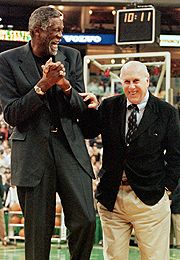
John Kundla, July 3, 2016, with a jersey given to him
by the University of Minnesota, in honor of his 100th Birthday.

John Kundla died on July 23, 2017, this past Sunday, at the age of 101. The current version of the Lakers paid tribute to the man who set the tone for the franchise, long before Bill Sharman coached Jerry West and Wilt Chamberlain, before Pat Riley coached Kareem Abdul-Jabbar and Magic Johnson, before Phil Jackson coached Shaquille O'Neal and Kobe Bryant. Whoever is in charge of the L.A. team's Twitter account wrote, "The Lakers family is saddened by the passing of our original coach, John Kundla. Our thoughts are with his family and friends."

Nor did the owner of the current Minnesota NBA team, the Timberwolves' Glen Taylor, let his passing go without tribute: "John was an incredible staple of Minnesota basketball, and he continued to be a fan of the local hoops scene well after he left coaching. Our condolences go out to the Kundla family during this time."
Of John Kundla's NBA Championship Minneapolis Lakers: Johnny Jorgensen died in 1973, Herm Schaefer in 1980, Billy Hassett in 1992; Jim Pollard, Edwin "Whitey" Kachan and Jack Dwan in 1993; Tony Jaros in 1995, Don Smith in 1996, Paul Napolitano in 1997, Don Carlson in 2004, George Mikan and Earl Gardner in 2005, Jim Holstein in 2007, Howie Schultz and Joe Hutton in 2009, Slater Martin and Lew Hitch in 2012, Vern Mikkelsen in 2013, and Clyde Lovellette in 2016.
There are 7 of them still alive: Donnie Forman (played on the 1949 title team, 91 years old), Arnie Ferrin (1949 and 1950, and if he makes it to this coming Saturday, he will be 92), Bud Grant (1950, 90), Bob Harrison (1950 and 1952, scheduled to turn 90 on August 12), Frank Saul (1952, 1953 and 1954, 93), Whitey Skoog (1952, 1953 and 1954, 90) and Dick Schnittker (1953 and 1954, 89).

UPDATE: Kundla's final resting place is unknown.

Sunday, July 3, 2016

Happy 100th Birthday, John Kundla!

It's hard to believe that there's a Hall of Fame coach out there who managed to outlive all of his Hall of Fame players.

There is at least one.

John Albert Kundla was born on July 3, 1916 in Star Junction, Pennsylvania, outside Pittsburgh. He was of Slovak descent on his father's side, and Austrian on his mother's. When he was 5, his mother, who didn't like the drinking culture of the Pittsburgh area, moved John out to Minneapolis, hoping her husband would join them. He never did. Until the move, John spoke only Slovakian at home.

He adapted quickly, and happily lived in Minnesota for the rest of his life. He played baseball and basketball at the now-closed Minneapolis Central High School and at the University of Minnesota, winning the Conference title in basketball in 1937. He played minor-league baseball, but never got above Class D (which would be Class A under today's system). He coached high school basketball in Minnesota, served in the U.S. Navy in World War II, and later became the basketball coach at the College of St. Thomas in Minneapolis.

In 1947, the Minneapolis Lakers -- so named because Minnesota was known as "The Land of 10,000 Lakes" -- of the National Basketball League offered him $6,000 a season to be their head coach. This was twice what he was making at St. Thomas. (It's about $64,000 in today's money.) At 31 years of age, he was a pro basketball coach.

A month into the 1947-48 season, the Chicago American Gears folded, and their best player, the 6-foot-10 former DePaul University star George Mikan, became available. The Lakers snapped him up, and they won the NBL Championship. That got the notice of the rising Basketball Association of America, which became the NBA in 1950. They admitted the Lakers, beginning the league's 1st dynasty.

They won the title in 1949, beating the Washington Capitols, the 1st NBA team coached by Red Auerbach. Mikan and Jim Pollard were named to the All-NBA Team. Mikan was the defining player of that era, using his height to dominate the lane. And long before Philadelphia 76ers legend Billy Cunningham came along, Pollard, the star of Stanford University's 1942 National Championship squad, had the jumping ability to get him the nickname "The Kangarood Kid."

They also had Arnie Ferrin, who had led the University of Utah to the 1944 National Championship. (They also had a player named Johnny Jorgensen, not to be confused with the baseball player of the same name, nicknamed Spider, who helped the Brooklyn Dodgers win the National League Pennant in 1947 and '49.)

In 1950, they added Vern Mikkelsen, Slater Martin, and a Minnesota kid who also played a little football, Harry "Bud" Grant. Yes, Vikings fans, that Bud Grant. With a starting five of Ferrin and Martin at guard, Pollard and Grant as forwards, and Mikan at center, they beat the Syracuse Nationals in the Finals. To this day, 2/3rds of a century later, John Kundla remains the only man to win a Championship in his 1st 2 seasons as an NBA head coach.

In 1951, Mikan broke his ankle near the end of the regular season. Without him, they lost the Western Division Finals to the Rochester Royals -- meaning they were still a pretty good team without him, just not a championship team. The Royals then beat the Knicks in a tough 7-game series, the closest the Knicks would get to the title until 1970.

Some retooling was in order, and, with Grant choosing football, they needed another guard. The Royals had traded Frank "Pep" Saul, of Westwood, Bergen County, New Jersey and Seton Hall University, to the Baltimore Bullets. This was not the team that we know today as the Washington Wizards: They won the NBA title in 1948, but by this point, were losing money left and right, and when the Lakers flashed the cash, they sold Saul.

They also added Howie Schultz, a Minnesotan who had played for the Dodgers; and Myer "Whitey" Skoog, another Minnesota product, to their bench. The Lakers plowed through the NBA in 1951-52, and, while it took 7 games, they beat the Knicks in the Finals. In 1953, they won the title again, needing only 5 games to dust off the Knicks. And in 1954, with Skoog having taken Saul's place in the starting lineup, and Clyde Lovellette, star of the University of Kansas' 1952 National Championship, added as an obvious move to have a proper successor to Mikan before it was necessary, they beat the Syracuse Nationals in 7, making it 5 NBA Championships in 6 years.

To put that in perspective: That's nearly all the titles ever won by Minnesota major league teams. The Twins have won 2 World Series. The Vikings have won 4 NFC Championships, but never a Super Bowl. The Timberwolves and the Wild have each reached 1 Western Conference Final in their entire histories. The North Stars reached 2 Stanley Cup Finals, but lost them both.

After the 1954 season, the Lakers' fate was sealed, and the sport changed forever. The 24-second shot clock was added. The reason was a game on November 22, 1950, when the Fort Wayne Pistons beat the Lakers 19-18, with only 3 Pistons points to the Lakers' 1 scored in the 4th quarter. The Pistons wanted to keep the ball out of Mikan's hands, and so they only attempted 13 shots. This and other, similarly low-scoring games led to the shot clock's adoption.

This made the game considerably faster, and made the Lakers' game obsolete. In a 1969 book, New York sports-talk maven Bill Mazer said of Mikan, "He wasn't graceful. He was more like a stampeding elephant."

That was when Mikan was still a relatively recent player. In 1996, on an ESPN Classic panel discussing the greatest teams in NBA history in the wake of the Chicago Bulls' 72-win title season (and with Mikan very much still alive and having sat for an interview with the network), Bob Ryan of The Boston Globe said that you couldn't compare a great pro team, including before the NBA, from before the shot clock to one after it, citing Mikan, and the man who won the NBA's 1st scoring title and led the Philadelphia Warriors to the 1st Championship in 1946-47:

Before that, I don't think Jumpin' Joe Fulks makes it in today's NBA, except, maybe, as a 12th man. George Mikan? A good backup center. Greatest player of his time, deserved every accolade he ever got, but now? He's Greg Kite with a hook shot.

In case you've forgotten, Kite was Robert Parish's backup as center on the 1984 and '86 NBA Champion Boston Celtics. Ryan, who probably knows more about the Celtics than any living person now that Auerbach is dead (and more about the NBA's history than any person currently covering it), was suggesting that the NBA centers to come -- Bill Russell, Wilt Chamberlain, Willis Reed, Dave Cowens, Bill Walton, Kareem Abdul-Jabbar, Moses Malone, Parish, Hakeem Olajuwon and Shaquille O'Neal -- would have handled Mikan fairly easily.

Whether that means the other stars that Kundla coached, or Kundla as a coach, would have made it in the modern NBA, Ryan didn't say. But Mikan seemed to think he would have done just fine, telling Sports Illustrated in 1997:

He was a great coach, one who really understood the players. John wasn't a screamer, and was very mild-mannered, but he'd let loose when we deserved it. And, usually, I was the first one he bawled out. The message he sent was that no one on the team was above criticism.

Mikkelsen agreed, telling The St. Paul Pioneer Press in 1995, when he and Kundla were elected to the Basketball Hall of Fame together:

Our coach had to be the greatest psychologist who ever lived. There is only one ball. A lot of so-called superstars didn't get it as much as they would have liked, because George was the priority. But John kept everyone happy. John sold each of us on the importance of our individual roles.

Whitey Skoog also agreed, when interviewed for the same story as Mikkelsen:

John was an excellent coach. What I appreciated most, and the other ballplayers did too, was his willingness to put himself out there to help each ballplayer improve...

He was humble and positive. I really appreciated John’s ability to communicate. He was never negative about a player’s mistakes. He worked to find a way for the player to improve. He never criticized a player in the press, and gave the players the credit for the Lakers’ success.

But in a 2007 interview with SI, Kundla himself seemed to suggest that the game had passed him by:

I'm not sure I could coach professional basketball players today, and I'm not sure I'd want to. The players are younger, and don't play as much as a team. With agents, crowds, television and the big bucks, everyone involved is under so much more pressure. Pressure for us was still having some meal money left by the time dinner rolled around.

At first, the Lakers weren't affected too much by the institution of the shot clock. Although Mikan retired, only 30 years old but possibly having seen the writing on the wall, Mikkelsen, Martin, Pollard and Lovellette had enough left to get the Lakers to the Western Division Finals, before losing to the Pistons. They only dropped from 46-26 to 40-32. But Pollard then retired, and, despite a comeback by Mikan, they fell to 33-39 for 1956, a drop of 13 games in 2 years. Mikan then retired for good, Martin was traded. By 1958, they were 19-53.

After the 1958-59 season, Bob Short, a Democratic political operative from Minnesota, purchased the team. Despite having ties to Minnesota, he wanted to move them to Los Angeles. Kundla didn't want to go, and the University of Minnesota offered him a lifeline, hiring him as head coach of the program for which he once played. In 1960, Short moved the Lakers, and Minnesota was without an NBA team until the Timberwolves were expanded into existence in 1989. (The ABA had the Minnesota Muskies.)

Kundla was the 1st coach in any sport at UM to give scholarships to black players, among them future NBA All-Stars "Super" Lou Hudson and Archie Clark -- and got hate mail for it. Nonetheless, he remained their head coach until 1968, with his best season being 1965, going 19-5 and getting the Golden Gophers to 2nd in the Big Ten.

However, under the rules of the time, only a league champion could go to the NCAA Tournament, and Minnesota was stuck for years behind the Ohio State teams of Jerry Lucas and John Havlicek, and then behind the Michigan of Cazzie Russell. Kundla also taught physical education at UM, retiring from that post in 1981.

In 1995, 37 years after coaching his last professional game, Kundla was finally elected to the Basketball Hall of Fame. In 1996, as part of the NBA's 50th Anniversary celebration, he was named one of the NBA's 10 Greatest Coaches.

In 2002, his Laker team was honored on the 50th Anniversary of one of their titles, and he and the surviving players from the title teams were honored by the current Lakers at the Staples Center in Los Angeles. They, and the families of those who had died, were given championship rings, and a banner with the names of the Minneapolis Lakers' Hall-of-Famers was raised with the Los Angeles retired numbers: Pollard (Number 17), Mikkelsen (19), Martin (22, retired for Elgin Baylor), Lovellette (34, eventually retired for O'Neal), Mikan (99) and Kundla. It is powder-blue with gold trim, to match the Lakers' colors at the time.

While in college, he met a woman named Marie. They married and had 6 children: Sons Tom, James, Jack and David, and daughters Kathleen Dahlman and Karen Rodberg. Marie died in 2007, and Jack did so the next year.

He had 6 grandchildren, including Isaiah Dahlman, Minnesota's Mr. Basketball in 2006, briefly the State's all-time scoring leader, and a player at Michigan State University. Noah Dahlman, who played basketball at Wofford College in South Carolina, and was voted 2010 Southern Conference Men's Basketball Player of the Year. And Rebekah Dahlman was Minnesota's Miss Basketball in 2013, and remains the State's all-time leading scorer in girls' basketball.

After his wife's death, he moved into an assisted living community in Minneapolis, and still followed the NBA on television. "It's unbelievable how big they've grown," he said in a New York Times interview shortly before his 100th birthday, July 3, 2016. "But there's still finesse in there, the way they handle that ball, pass it around."
John Kundla, a few weeks ago, with a jersey given to him
by the University of Minnesota, in honor of his 100th Birthday.

Of John Kundla's NBA Championship Minneapolis Lakers: Johnny Jorgensen died in 1973, Herm Schaefer in 1980, Billy Hassett in 1992; Jim Pollard, Edwin "Whitey" Kachan and Jack Dwan in 1993; Tony Jaros in 1995, Don Smith in 1996, Paul Napolitano in 1997, Don Carlson in 2004, George Mikan and Earl Gardner in 2005, Jim Holstein in 2007, Howie Schultz and Joe Hutton in 2009, Slater Martin and Lew Hitch in 2012, Vern Mikkelsen in 2013, and Clyde Lovellette this past March 9.

There are 7 of them still alive: Donnie Forman (played on the 1949 title team, 90 years old), Arnie Ferrin (1949 and 1950, about to turn 91), Bud Grant (1950, 89), Bob Harrison (1950 and 1952, about to turn 89), Frank Saul (1952, 1953 and 1954, 92), Whitey Skoog (1952, 1953 and 1954, 89) and Dick Schnittker (1953 and 1954, 88).

Tuesday, January 10, 2012

Do Mediocre Players Make the Best Coaches? NBA Edition

Part III of the series. I'll start with the beginning of the National Basketball Association, the 1946-47 season.

Remember: A player who never played in the pros, or for whatever reason did not pan out in the pros, is counted here as "mediocre" even if he was sensational in college.

1947 Philadelphia Warriors: Eddie Gottlieb. Never played, but organized the basketball team at the South Philadelphia Hebrew Association. The team was known by its initials, the SPHAs. The Warriors, a charter franchise of the NBA, grew out of this club, one of the leading pro teams of the 1930s. Gottlieb lived most of his life in Philadelphia, yet moved the Warriors to San Francisco in 1962.

1948 Baltimore Bullets: Harry "Buddy" Jeannette. A player-coach, and a Hall of Fame player.

1949 Minneapolis Lakers: John Kundla. A good college player, but never played in the pros.

1950 Lakers: Kundla.

1951 Rochester Royals: Les Harrison. Played semi-pro ball, never in the NBA or in a
pre-NBA league.

1952 Lakers: Kundla.

1953 Lakers: Kundla.

1954 Lakers: Kundla.

1955 Syracuse Nationals: Al Cervi. A pretty good player by the standards of the 1940s and early '50s.

1956 Warriors: George Senesky. A star by the standards of the time, he played on the Warriors' '47 title team.

1957 Boston Celtics: Arnold "Red" Auerbach. A good college player at George Washington University, but only played briefly in a pre-NBA league.

1958 St. Louis Hawks: Alex Hannum. A terrific player, he became player-coach and got the Hawks to the '57 Finals, then retired to stick to coaching and got them all the way the next season.

1959 Celtics: Auerbach.

1960 Celtics: Auerbach.

1961 Celtics: Auerbach.

1962 Celtics: Auerbach.

1963 Celtics: Auerbach.

1964 Celtics: Auerbach.

1965 Celtics: Auerbach.

1966 Celtics: Auerbach.

1967 Philadelphia 76ers: Hannum.

1968 Celtics: Bill Russell. Player-coach, and still one of the top 10 players in the history of the game.

1969 Celtics: Russell.

1970 New York Knicks: William "Red" Holzman. An All-Star, played on the '51 Royal titlists.

1971 Milwaukee Bucks: Larry Costello. Good player in the 1950s and '60s.

1972 Los Angeles Lakers: Bill Sharman. One of the best shooters in NBA history while playing for Auerbach's Celtics, and along with John Wooden and Lenny Wilkens one of 3 men who has been elected to the Hall as both a player and a coach -- no other sport does that. Having won the previous year's American Basketball Association title with the Utah Stars, Sharman is also the only man to coach an NBA Champion and an ABA Champion.

1973 Knicks: Holzman.

1974 Celtics: Tom Heinsohn. A really good player for Auerbach's Celtics.

1975 Golden State Warriors: Al Attles. A reserve player on the San Francisco Warriors' 1964 Western Division Champions, before they moved across the Bay to Oakland and became the Golden State Warriors.

1976 Celtics: Heinsohn.

1977 Portland Trail Blazers: Jack Ramsay. One of the greatest minds in basketball history -- he was the GM of the '67 76ers titlists -- he never played in college, let alone in the pros.

1978 Washington Bullets: Dick Motta. Never played in the pros, going straight from college into coaching.

1979 Seattle SuperSonics: Lenny Wilkens. Starred with the early Sonics and, before that, the St. Louis-era Hawks. In the Hall as a player and a coach.

1980 Lakers: Paul Westhead. Never played pro ball.

1981 Celtics: Bill Fitch. Never played pro ball.

1982 Lakers: Pat Riley. A decent reserve player with the Lakers' 1972 champions, can't really call him mediocre. Like Phil Jackson, might've been a better player in the expansion-diluted NBA in which he's coached.

1983 76ers: Billy Cunningham. A HOF player, was the rookie 6th man on the '67 76ers, and starred in both the NBA and the ABA. The Sixers have never won an NBA Championship without him -- at least, not since '55 when they were the Nationals.

1984 Celtics: K.C. Jones. Hall of Fame player with Auerbach's Celtics.

1985 Lakers: Riley.

1986 Celtics: Jones.

1987 Lakers: Riley.

1988 Lakers: Riley.

1989 Detroit Pistons: Chuck Daly. Went into the Army after college, and went into coaching after his discharge, never playing pro ball.

1990 Pistons: Daly.

1991 Chicago Bulls: Phil Jackson. A decent reserve player with the Knicks' 1973 champions, he was injured for the entirety of the 1970 title season. Probably a better player than Riley.

1992 Bulls: Jackson.

1993 Bulls: Jackson.

1994 Houston Rockets: Rudy Tomjanovich. A very good player for the Rockets, a member of their 1981 team that reached the NBA Finals.

1995 Rockets: Tomjanovich.

1996 Bulls: Jackson.

1997 Bulls: Jackson.

1998 Bulls: Jackson.

1999 San Antonio Spurs: Gregg Popovich. Graduated from the Air Force Academy, and while he played there, he served his commitment rather than play pro ball -- ironic, considering he coached David Robinson, who was allowed to curtail his Navy commitment.

2000 Lakers: Jackson.

2001 Lakers: Jackson.

2002 Lakers: Jackson.

2003 Spurs: Popovich.

2004 Pistons: Larry Brown. A scandal got him banned from playing in the NBA, but he became a star in the ABA. The ban was lifted, allowing him to coach, and no human being, living or dead, male or female, scholastic, collegiate or professional, has coached more wins than Larry Brown.

2005 Spurs: Popovich.

2006 Miami Heat: Riley.

2007 Spurs: Popovich.

2008 Celtics: Glenn "Doc" Rivers. An All-Star with the Atlanta Hawks and the Knicks.

2009 Lakers: Jackson.

2010 Lakers: Jackson.

2011 Dallas Mavericks: Rick Carlisle. A reserve on the '86 Celtics, but not a good player.

*

Great players: 7
Good players: 29
Mediocre players: 27

So good NBA players have been better at coaching than in MLB and the NFL. But great ones? Take out player-coaches Jeannette and Russell, and the outlook for future greats is grim.

Magic Johnson wasn't much of a coach. Larry Bird was all right at it. Michael Jordan apparently doesn't have enough patience.

I wonder if LeBron James will ever go into coaching? It may be his best chance to win a ring.