Showing posts with label 1950s. Show all posts

Tuesday, November 14, 2023

Top 10 Things About M*A*S*H That Don't Make Sense

I love M*A*S*H. The show, part comedy, part drama, set in a U.S. Army hospital during the Korean War in the early 1950s, might be the greatest TV show of all time. But there are some things about it that just don't make any sense.

And I'm not talking about continuity errors, such as which characters' family members were still alive or not, or consistency in what their names were, or where they might have lived. I'm talking about things that, had they happened in real life, would not have happened that way.

10. The Manpower Turnover Rate. Hawkeye, Margaret, Klinger, Father Mulcahy, and possibly some of the nurses seemed to be at that one unit for the duration of the war, 3 years. They each would have been transferred at least once.

9. Potter's Age. In one episode, he gave his age as 62. But in more than one, he mentioned that he was too young to serve in World War I, and thus lied about his age. This would have put him in his mid-50s. But he looked more like 62, or even older. At that age, it's unlikely that he would have been put in that particular command.

For the record, Harry Morgan played Potter from the age of 60 to 67.

8. The Hair. In that era, men would not have had hair as long as Hawkeye, B.J. and Klinger had. I'm also not sure they would have allowed B.J. to have that mustache.

7. Henry's Unfitness For Command. Aside from cheating on his wife, Henry Blake was a decent guy, and a good doctor. But, as was pointed out by Hawkeye on one side, and Margaret and Frank on the other, he was a bad choice to command any military unit, even a hospital. Potter was so much better suited to it.

And Henry knew it, too. Frank and Margaret "went over his head" so many times, "I've developed athlete's scalp!"

6. Klinger's Stunts. It wasn't just wearing the women's clothing. He tried all kinds of things to either escape from the Army (mostly early on) or convince Henry or Potter to give him a psychiatric discharge. It's shocking that he got away with it for as long as he did, without getting tossed in the stockade, and eventually getting a dishonorable discharge.

5. Hawkeye's Antics. No matter how good a surgeon he was, half of what he did would have gotten him court-martialed.

4. Frank Burns' Incompetence. If he was that bad a surgeon, that would have gone on the record, and he would have been transferred out of there.

And 5. and 4. both lead to...

3. The Frank & Margaret Affair. A couple of times, Hawkeye threatened to blow the whistle on them if they didn't back off on their threats. At some point, the good surgeons would have had enough, and ratted them out. Even if Hawkeye and Trapper, and later Hawkeye and B.J., weren't willing to do so, and Henry didn't have the spine to act like a true commanding officer on the subject, a man like Colonel Sherman T. Potter, M.D., U.S.A. would have.

The only way not doing so can be justified is their professional respect for Margaret as a nurse. They couldn't take Frank down without also ruining Margaret's career. But, at the very least, one threat to Frank should have scared him into leaving Hawkeye alone.

2. Hawkeye's Crackup. In the series finale, the war finally breaks him. While he and Sidney Freedman did reach a breakthrough, it was way too soon to be allowed back into action. It proved to be vital, but the real Army wouldn't have allowed it.

1. The Drinking. There is no way the Army would have let surgeons have a distillery in their quarters. At the rate they were going, surely, there must have been an occasion where they were already drunk when wounded came in. And there was one time when Hawkeye proved to be too hungover to operate. One time that we know of. Surely, there were more. That kind of drinking -- when he was always on call -- would have cost him not only his honorable discharge, but possibly also his civilian medical license.

Wednesday, June 26, 2019

Daily News Centennial, Part II: 1950-1969

Front entrance of the Daily News Building,
220 East 42nd Street, Midtown Manhattan

Part 2 of my series displaying front pages of the 1st 100 years of the New York Daily News.

October 2, 1950, another heartbreaking loss for the Dodgers:
November 2, 1950, after an attempt to assassinate President Truman failed:
February 19, 1951, a point-shaving scandal ends the glory days of college basketball in New York, less than a year after City College became the only team ever to win the NCAA and NIT in the same year:
October 4, 1951, after "The Giants win the Pennant!" on Bobby Thomson's home run:
October 11, 1951, after the Yankees ended "The Miracle of Coogan's Bluff":
October 8, 1952, Yankees make it 4 straight:
November 5, 1952, as Dwight D. "Ike" Eisenhower is elected President in a landslide:
December 1, 1952, Bronx native George Jorgensen becomes Christine Jorgensen -- as far as America knew at the time, the 1st person to undergo a sex change, or, as we would now call it, gender reassignment surgery:
June 20, 1953, following the execution for treason of Julius and Ethel Rosenberg:
July 28, 1953, after the Truce of Panmunjom ended the Korean War:
October 6, 1953, after the Yankees' never-before, and never-since, 5th straight World Series win:
January 15, 1954, The Yankee Clipper and the Blonde Bombshell:
May 18, 1954, after the Supreme Court overturns public school segregation laws:
October 3, 1954, after the Giants won the World Series, for the last time as a New York team:
October 5, 1954, as the Joe D-MM fairy tale ends:
September 24, 1955, following a refusal to grant the family of Emmett Till justice:
James Dean died in a car crash on September 30, 1955, at age 24. If the Daily News had a big headline about it, it isn't on Google Images.

October 5, 1955, after the Brooklyn Dodgers finally won a World Series:
October 9, 1956, after Don Larsen's World Series perfect game:
October 11, 1956, after the Yankees clinched that World Series:
December 31, 1956, Yankee Stadium becomes the home of the champions of baseball and football at the same time:
August 20, 1957, da Jints wuz da foist to go:
September 24, 1957, during the Little Rock school integration crisis:
October 5, 1957, after the launch of the world's 1st artificial satellite, the Soviet Union's Sputnik I:
October 9, 1957, for Brooklyn, the day the music died:
October 26, 1957, "The Boss of All Bosses" is whacked:
November 15, 1957, the raid of the Apalachin Meeting, which had been called to settle things in the wake of Anastaia's rubout:
January 29, 1958, more bad news for Dodger fans, as Roy Campanella is paralyzed in a car crash:
September 16, 1958, a train accident at Newark Bay kills 48 people, including former Yankee 2nd baseman George "Snuffy" Stirnweiss:
October 10, 1958, who won the World Series again?
December 29, 1958, Yankee Stadium hosts football's "Greatest Game Ever Played," but the Giants lose it in dramatic fashion:
January 2, 1959, after the Cuban Revolution:
October 14, 1960, after Bill Mazeroski stunned the Yankees:
November 10, 1960, it took a couple of days to be sure, but the News could confirm that John F. Kennedy was elected President, with a headline that would also have fit had the other guy won, leading me to believe it had been pre-selected:
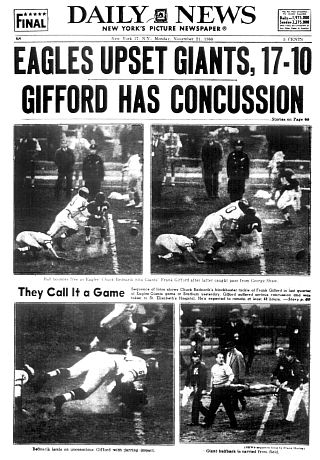
November 21, 1960, the Philadelphia Eagles' Chuck Bednarik clobbers the Giants' Frank Gifford:
April 21, 1961, after the failed Bay of Pigs invasion:
July 3, 1961, America's leading living writer lives no more:
October 2, 1961, as Roger Maris does "61 in '61":
October 10, 1961, after another Yankee World Series win:
There would be no Daily News coverage of the Yankees' 1962 World Series win, as it came during a citywide newspaper strike, which killed the New York Mirror, and contributed to the downfalls of the New York Herald-Tribune, the New York Journal-American, and the New York World-Telegram & Sun.

August 6, 1962:
October 23, 1962, when President John F. Kennedy revealed the Cuban Missile Crisis:
October 7, 1963, the News appearing to forget that the Dodgers were no longer Brooklyn's team, even if Brooklynite Sandy Koufax had pitched and won Games 1 and 4:
November 23, 1963:
February 26, 1964, Cassius Clay knocks Sonny Liston out, and soon becomes Muhammad Ali:
March 16, 1964, and Taylor and Burton were bigger than Brangelina and Kimye:
November 4, 1964, Lyndon Baines Johnson wins a term of his own as President, and I seriously doubt that this photo was originally in color:
February 22, 1965, after the assassination of Malcolm X at the Audubon Ballroom in Washington Heights, Manhattan:
August 16, 1965, The Beatles playing Shea Stadium did not top the Vietnam War as the lead story:
November 11, 1965, recovering from the big blackout:
January 1, 1966, John Lindsay sworn in as Mayor, and the transit union, led by Mike Quill, goes on strike, which lasts 11 days:
January 28, 1967, after the Apollo 1 fire:
May 15, 1967, Mickey's milestone:
April 5, 1968:
June 6, 1968:
January 13, 1969, and that's eyebrows above and eye-black underneath, as Broadway Joe Namath did not have a black eye:
June 9, 1969, coverage of Mickey Mantle Day:
June 23, 1969:
July 6, 1969, an early account of the raid and fightback at the Stonewall Inn on June 28, with a level of subtlety and sensitivity all too common for that era -- a reminder that the 1960s were revolutionary because they had to be:
July 20, 1969, the Chappaquiddick incident not only prevents Ted Kennedy from ever becoming President, but also means the family can't enjoy the Moon landing that JFK asked for 8 years earlier:
July 21, 1969:
August 10, 1969, after the murders committed by Charles Manson's "Family":
August 16, 1969, Woodstock: As Arlo Guthrie correctly said, "The New York State Thruway's closed, man!"
October 17, 1969, the Mets' Miracle:
Part 3 follows.