This coming Friday night, the University of Virginia, a.k.a. UVa, will play their arch-rivals, Virginia Polytechnic Institute, a.k.a. Virginia Tech, in football, at UVa's Scott Stadium in Charlottesville. The rivalry is nicknamed the Commonwealth Cup, for the trophy given to the winner.
Before You Go. Virginia is in the South. If this were Summer or early Autumn, heat might be an issue. But this will be Thanksgiving Weekend, so the weather won't be appreciably different from New York and New Jersey. It's predicted to be in the mid-50s on Friday afternoon, but the low 30s on Friday night. Bring a Winter jacket.
Virginia is in the Eastern Time Zone, so you won't have to adjust your timepieces. Despite Virginia being a former Confederate State, you will not have to bring a passport or change your money.
Tickets. UVa has been averaging 38,000 fans in a 61,500-seat stadium the last few years. But we're talking about the UVa-VT rivalry, so expect a sellout. The entire lower bowl will be $75, but most games are a lot cheaper: $58 on the sidelines, $43 in the end zone. In the upper deck, it will be $75 on the sidelines and $65 in the end zones, usually $43 and $23.
In contrast, Tech usually gets over 60,000 in their 65,632-seat stadium. So getting tickets for them will be tougher. For today's game against Pitt, right before kickoff, all they had left was $7 seats on StubHub.
Getting There. This will be Thanksgiving weekend. Due to demand, the amount of seats available and the prices you could expect to pay will not be as usual.
From Midtown Manhattan, it's 343 miles to Scott Stadium in Charlottesville, and 491 miles to Lane Stadium in Blacksburg. It's in that tricky range: Too close to fly, but too far to get there any other way. I wouldn't recommend flying, as neither Charlottesville nor Blacksburg is big enough to have a major airport with nonstop flights.
If you want to take Amtrak to either city, you'll have to go down the previous day -- in this case, Thanksgiving Day. Round-trip fare to Charlottesville is $196. The station is at 810 W. Main Street. To Blacksburg, however, you'll have to get off at Roanoke and switch to a bus, which will take an hour and 10 minutes. And, for some reason, the fare is almost double what it is to Charlottesville: $369. But it will drop you off at Tech's Squires Student Center, 291 Alumni Mall.
Greyhound doesn't go to Blacksburg. Their round-trip fare to Charlottesville is $272, but it can drop to $179 with advanced purchase. The address is 310 W. Main Street, just 3 blocks east of the Amtrak station.
If you drive down to Charlottesville, take the New Jersey Turnpike all the way down to the Delaware Memorial Bridge, then the Delaware Turnpike and the JFK Highway in Maryland, through Baltimore and to the Capital Beltway around Washington. Take Exit 49A onto Interstate 66. You won't get many kicks on this Route 66, though. Take Exit 43A to U.S. 29, which will go into Charlottesville.
Either way, you should spend about an hour and a half in New Jersey, 20 minutes in Delaware, an hour and 40 minutes in Maryland, and 2 hours in Virginia. That's about 4 and a half hours. Throw in a couple of rest stops, and it's about 6 hours.
The drive to Blacksburg is a bit different, as you'll bypass not just Philadelphia, but Baltimore and D.C. Take Interstate 78 West across New Jersey to Harrisburg, Pennsylvania. There, switch to Interstate 81 South through Pennsylvania, Maryland, West Virginia and into Virginia. Take Exit 118 to U.S. Route 460 North, turn right on Southgate Drive, and that will take you to the campus.
If you do it right, you should spend an hour and 15 minutes in New Jersey, 2 hours and 45 minutes in Pennsylvania, 15 minutes in Maryland, half an hour in West Virginia, and nearly 4 hours in Virginia. That's 8 hours and 45 minutes. Counting rest stops, it should be around 11 hours.
Once In the State. Today home to about 8.4 million people -- a little less than New York City, and a little less than New Jersey -- Virginia was settled by the English in the early 17th Century, but the plan for it was first filed in the late 16th Century, when the monarch was Queen Elizabeth I, who never married, and was thus known as the Virgin Queen. (We will probably never know for sure, unless some 400-year-old letters are found and can be authenticated. It's not like there were the portrait equivalent of sex tapes in those days.)
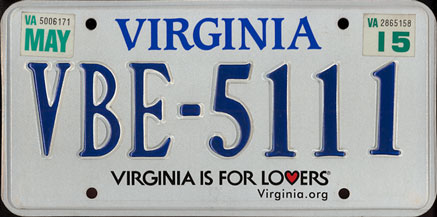
And yet, there's that slogan again, in use since 1968
and contradicting the State's very name.
The 1st settlement was in Jamestown in 1607, and it badly struggled, because the plague that nearly wiped out the Native tribes hadn't yet come. By the time the Pilgrims arrived at what's now Plymouth, Massachusetts in 1620, it had devastated what's now the Northeastern U.S.
Virginia was the largest of the 13 Colonies that became the 1st 13 States, and its contribution to America's founding era is incalculable: George Washington, Patrick Henry, George Wythe, Richard Henry Lee, his brother Francis Lightfoot Lee, their cousin Henry "Light-Horse Harry" Lee, Thomas Jefferson, James Madison, George Mason, and, if you want to stretch the timeline a little, James Monroe.
In fact, the reason Jefferson became more revered in history than Massachusetts' John Adams boils down to the fact that Adams told Jefferson that he should write the Declaration of Independence, for 3 reasons: He thought a Virginian should write it, based on the colony's moves toward independence to that point; he knew that Jefferson was considerably more popular among their colleagues; and he said that Jefferson could write 10 times better (an exaggeration, but he
was better).
Like Pennsylvania, Massachusetts and Kentucky, they officially call themselves not a "State," but a "Commonwealth": "The Commonwealth of Virginia." What's the difference? Officially, none: The federal government recognizes these 4 as "States," just as it does with the 46 that call themselves "States." Why do these 4 thus use "Commonwealth"? The story I heard is that the word seemed to suggest anti-monarchist sentiment. Pennsylvania, Massachusetts and Virginia were all among the Original 13, and Kentucky was essentially broken off from Virginia to become the 15th State.
Thus, there is both a Virginia State University, a "historically black" school in Petersburg; and a Virginia Commonwealth University, in Richmond. A nickname for Virginia is "The Old Dominion," and there's an Old Dominion University in Norfolk.
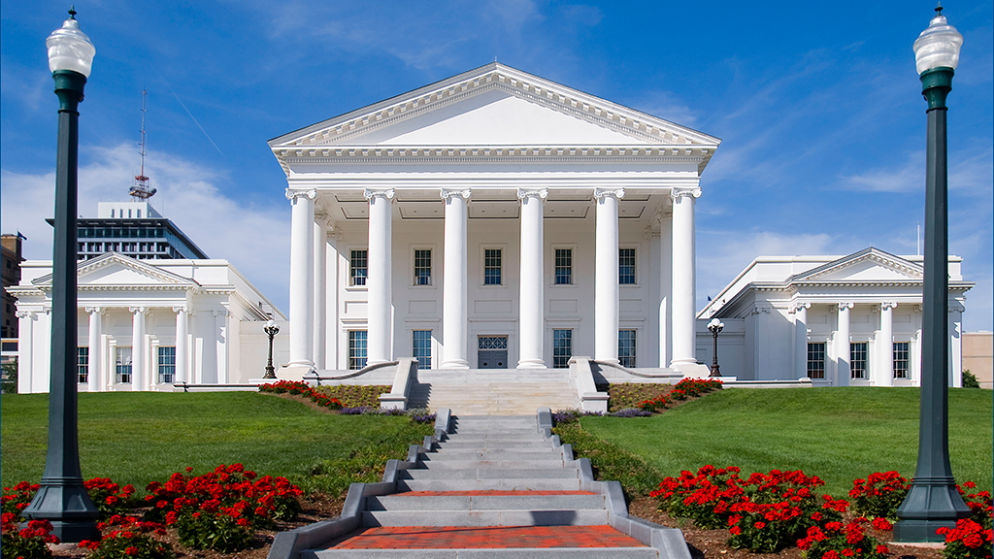
Unfortunately, Virginia was also a slave State, and its capital, Richmond -- with a State House designed by the architectural mind of Jefferson -- became the capitol building of the Confederate States of America, succeeding its counterpart in Montgomery, Alabama.
The State House in Richmond
And Virginia's contributions to the CSA were staggering: Robert E. Lee (son of Light-Horse Harry), Thomas "Stonewall" Jackson, James Ewell Brown "Jeb" Stuart, Thomas "Tex" Rosser, Jubal Early, George Pickett, "Prince" John Magruder, A.P. Hill, Joseph Johnston. Indeed, the "Independent City" (meaning it's not part of any County) of Williamsburg was both a hotbed of activity in the American Revolution period and the site of a Civil War battle.
The 10th State to ratify the Constitution, on June 25, 1788, Virginia didn't secede from the Union until April 17, 1861, 5 days after the attack on Fort Sumter (and exactly 100 years to the day before the Bay of Pigs invasion in Cuba), and they almost didn't: In no other Southern State was the vote as close. It is 1 of 4 States to have been both 1 of the Original 13 and 1 of the Seceding 11, the others being Georgia and both Carolinas.
General Ulysses S. Grant finally broke the Confederate lines outside Richmond on April 2, 1865, burned the capital, and got Lee to surrender on April 9, at Appomattox. On January 26, 1870, Virginia was readmitted to the Union. Lee lived long enough to see that happen, dying 9 months later.
Virginia has not had the same reputation for vicious racism as, say, South Carolina, Alabama, Mississippi or Arkansas. And, thanks to the suburbs of Washington, D.C. taking on people getting more affordable housing, the State has voted Democratic in each of the last 3 Presidential elections (after doing so only once between 1964 and 2008, and that was for a Southerner, Jimmy Carter in 1976).
And Charlottesville, a.k.a. C-ville, founded in 1762, named for the wife of King George III, home of 49,000 permanent residents and the University of Virginia, founded by Jefferson in 1819, is generally considered to be a liberal city. Which made the neo-Confederate and neo-Nazi march in Charlottesville this past August 12 so jarring. (UPDATE: Since 2017, the movement to get statues of Confederate heroes like Lee and Jackson removed from public places in Virginia has had some success, including in Richmond.)
Blacksburg, a.k.a. The 'Burg, is another matter. Founded in 1798, named for local landowner Samuel Black, home of 42,000 people and Virginia Polytechnic Institute and State University, a.k.a. Virginia Tech, founded in 1872, is within the Shenandoah Mountains, the Appalachian range that forms the spine of the State. It is country, and it is unmistakably Southern, in each case letting on much more so than does Charlottesville. But Blacksburg doesn't have a bigoted reputation.
But it is best known for a tragic event: On April 16, 2007, Seung-Hui Cho, a 23-year-old Korean immigrant and Tech student, shot 49 people, killing 32 of them, before killing himself. At the time, it was the deadliest mass shooting in American history. In the last 2 years, it has been surpassed by the shootings in Orlando and Las Vegas. The community rallied around the victims' families, and the Yankees even played a fundraising Spring Training game on campus in 2008.
ZIP Codes for Virginia start with the digits 220 to 246. For Charlottesville, 228 and 229. For Blacksburg and the Roanoke area, 240 to 243. The Area Code for Charlottesville is 434, and for Blacksburg 540. The State sales tax is 4.3 percent.
Prominent newspapers in the State include the
Richmond Times-Dispatch, the Norfolk-based
Virginian-Pilot, the Williamsburg-based
Virginia Gazette, the Charlottesville
Daily Progress, and, including the Blacksburg area, the
Roanoke Times.
Charlottesville's address dividers are Main Street for North and South, and 1st Street for East and West. Charlottesville Area Transit runs buses, with a single fare being 75 cents and a 24-hour pass being a bargain at $1.50. From Scott Stadium in Charlottesville, Washington, D.C. is 116 miles to the east, Richmond is 77 miles to the southeast, Colonial Williamsburg is 127 miles to the southeast, Norfolk is 169 miles to the southeast, and Virginia Beach is 183 miles to the southeast.
The Rotunda, like the State Capitol designed by
University of Virginia founder Thomas Jefferson.
You can see the similarity to his home, Monticello.
Notable
non-sports alumni of UVa include:
* Vice
President: Alben Barkley (Class of) 1900.
* Cabinet
members: Attorneys General Thomas Gregory 1884 and Robert F. Kennedy '51; Secretary
of Defense Louis A. Johnson 1913; Secretary of State Edward Stettinius '24; Secretary
of Transportation Alan Boyd '48; Secretary of the Treasury John W. Snow '65; FBI
Director Robert Mueller '73, Secretaries of Homeland Security Janet Napolitano '83 and Kirstjen Neilsen '99.
* Governors,
of Virginia unless otherwise stated:: Napolitano of Arizona, William Fishback
1855 of Arkansas, Henry Mathews 1856 of West Virginia, Samuel McEnery 1857 of
Louisiana, James Clarke 1878 of Arkansas, Joseph T. Robinson 1895 of Arkansas,
William P. Lane Jr. 1915 of Maryland, Charles Terry '22 of Delaware, Millard
Caldwell '24 of Florida, Lowell Weicker '57 of Connecticut, Brereton Jones '61
of Kentucky, Angus King '69 of Maine, Chuck Robb '73, George Allen '74, Mark
Sanford '88 of South Carolina.
* Senators,
representing Virginia unless otherwise stated: Clarke, McEnery, Robinson
(Majority Leader), Barkley of Kentucky (Majority Leader), Robb, Weicker, Allen,
Robert Hunter 1828, Robert Toombs 1830 of Georgia, Eppa Hunton 1843, Thomas
Turley 1867 of Tennessee, Nathan Bachman 1903 of Tennessee, John Stennis '28 of
Mississippi, Harry Byrd Jr. '36, William Spong '47, John Warner '53, Bobby
Kennedy of New York and Ted Kennedy '59 of Massachusetts, Kit Bond '63 of
Missouri, Bill Nelson '68 of Florida, John N. Kennedy '77 of Louisiana, Evan
Bayh '81 of Indiana, Sheldon Whitehouse '82 of Rhode Island, and John Cornyn '95 of Texas.
John N.
Kennedy is a Republican, and no relation to Jack, Bobby and Ted. Robert F.
Kennedy Jr. '82 is a lawyer and environmental activist. Harry Byrd Jr. was the
son of a Senator, the cousin of another (Robert of West Virginia), and the
cousin of polar explorer Richard Byrd. John Tunney was Ted Kennedy's roommate
at UVa, and the son of 1926-28 Heavyweight Champion Gene Tunney. George Allen
was the son of the Washington Redskins coach of the same name. Evan Bayh was
the son of Senator Birch Bayh. And John Warner was the 7th of the 8
husbands of Elizabeth Taylor.
* Business:
Dr. Charles T. Pepper 1855. According to the Dr Pepper Company, he's the
namesake.
* Science:
Walter Reed 1869, discovered how yellow fever was transmitted, and the U.S.
Army Medical Center in Washington, D.C. is named for him; Francis Collins '70,
director of the Human Genome Project; Alexis Ohanian and Steve Huffman, both '05, co-founders of Reddit (Ohanian is married to Serena Williams).
* Literature:
Louis Auchincloss '41, Henry S. Taylor '65, Linda Fairstein '72, Claudia
Emerson '79, Edward P. Jones '81, David Baldacci '86. Edgar Allan Poe attended,
but had to drop out.
* Journalism:
Virginius Dabney '21, Brit Hume '65, Fred Barnes '65, Tyler Mathisen '76 Katie
Couric '79, Michael Vitez '79, Ron Suskind '81, Thomas Frank '87, Lane DeGregory '89, Rich Lowry '90, Laura Ingraham '91, Kimberly Dozier '93, Whitney Casey '97, Margaret Brennan '02, Krystal Ball '03. If you count sports journalism,
add Melissa Stark '95.
Entertainment:
Actors Dylan Walsh '86, Tina Fey '92, Benjamin McKenzie '01, Sarah Drew '02,
Jen Lilley '07 and Sasheer Zamata '08; director Tom Shadyac '81; producers Paul
Junger Witt '63, Mark Johnson '71 and Andrew Scheinman '73.
Blacksburg's streets don't really run north-south or east-west, but on diagonals. Nevertheless, they use the designations on street names. Main Street divides addresses into East and West, and Roanoke Street into North and South. Blacksburg Transit runs buses, with 90 percent of its riders being Tech students and faculty. A single fare is 50 cents.
Burruss Hall, fronted by the memorial
to the victims of the 2007 Virginia Tech Massacre
From Lane Stadium, the closest thing resembling a major city is Roanoke, 41 miles to the east. Washington, D.C. is 270 miles to the northeast, Richmond is 203 miles to the east, Colonial Williamsburg is 255 miles to the east, Norfolk is 279 miles to the east, Virginia Beach is 312 miles to the east, and Charlotte, North Carolina is 174 miles to the south. The distance between Charlottesville and Blacksburg is 150 miles.
Blacksburg doesn't have a highway that serves as a "beltway." Charlottesville has 3 that sort of serve this purpose: U.S. Route 250 to the north and east, Interstate 64 to the south, and U.S. Route 29 to the west.
In addition to the main campus in Blacksburg, Tech has campuses in Richmond, Roanoke, its Northern Virginia Center in the D.C. suburb of Falls Church, its Southwest Center in Abingdon, and its Hampton Roads Centers in Newport News and Virginia Beach. Notable
VT graduates outside of sports include:
Politics:
Governors Lindsay Almond '23 of Virginia and Chet Culver '88 of Iowa; and, on
the not-so-savory side, Watergate burglar Frank Sturgis (dropped out in the
1940s) and Trump Administration advisor Steve Bannon '76.
Literature:
Homer Hickam '64 and Sharyn McCrumb '85.
Journalism:
Hoda Kotb '86, Brian Sullivan '93, Molly Line '99.
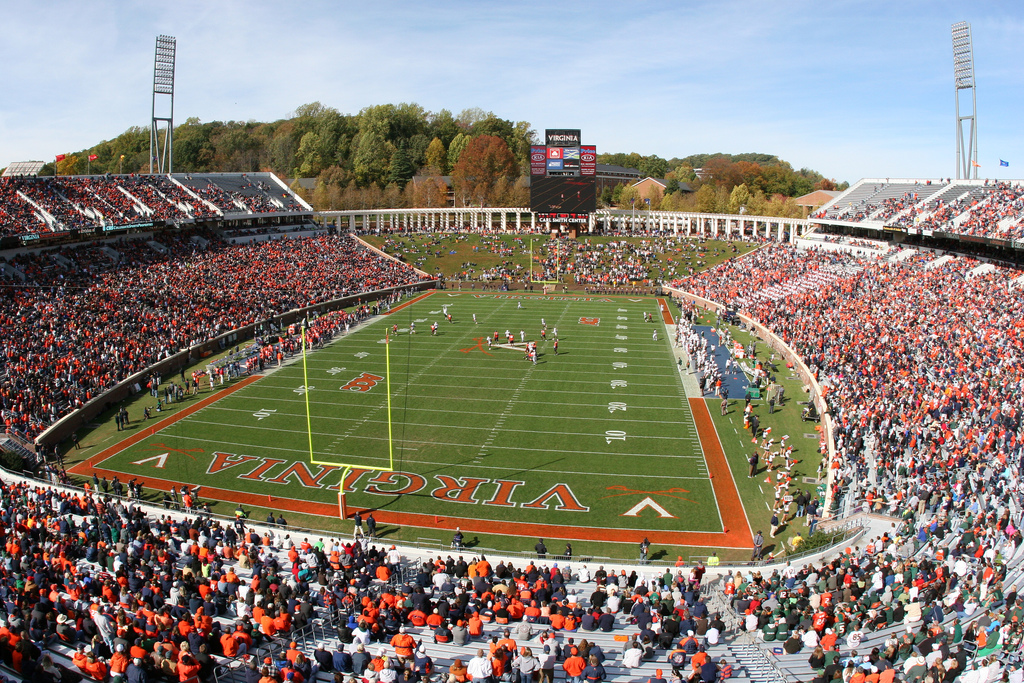
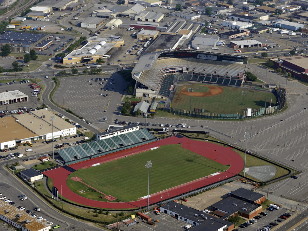
Going In. The official address of Scott Stadium is 1815 Stadium Road, about 2 miles west of downtown Charlottesville. Bus T goes to the stadium. If you drive in, parking is $10.
It opened in 1931 with a capacity of 22,000, rising to 26,500 in 1964, 42,073 in 1980, and 61,500 in 2000. The stadium is a horseshoe, open at the northwest, with the field running northwest-to-southeast. The field was switched to Astroturf in 1974, and back to real grass in 1995. The stadium has also hosted the NCAA soccer and lacrosse Final Fours, and Virginia has fine programs in both.
The colonnade and grass berm at the north end
The full name is the Carl Smith Center, Home of David A. Harrison III Field at Scott Stadium. That's a mouthful. Frederic Scott was a university rector. Harrison funded the restoration of the grass field. And Smith's donation allowed the 2000 expansion.
The official address of Lane Stadium is 185 Beamer Way, just to the west of downtown Blacksburg. Parking is a whopping $40. The field runs north-to-south, and has always been natural grass. The design is similar to the "two big dams facing each other" design also used at Wake Forest and Indiana in the 1960s.
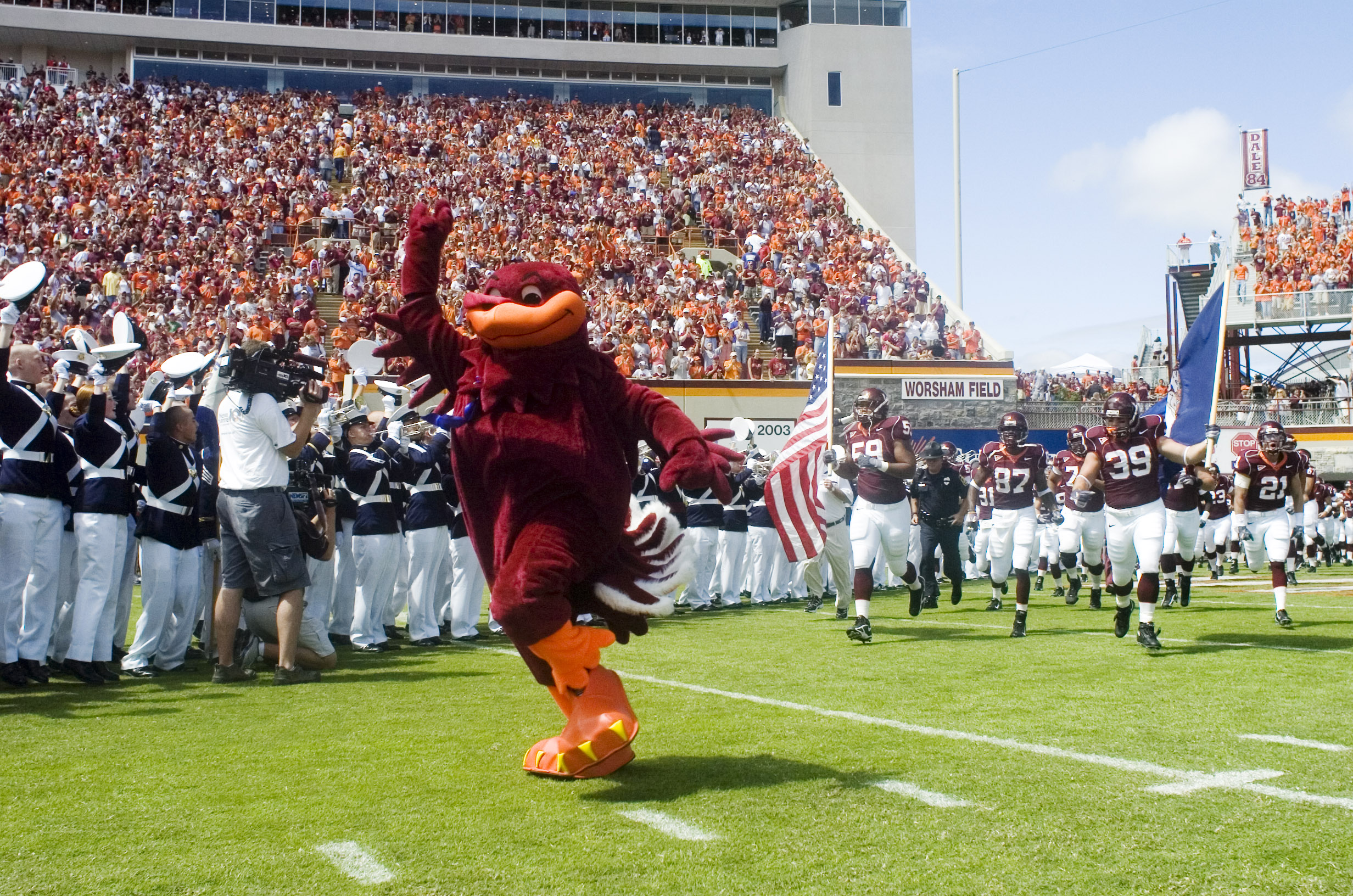
"The Terrordome" opened in 1965 with 35,050 seats, and was expanded to 52,500 in 1980 and its current 66,233 in 2004. It was named for Edward Hudson Lane, a local furniture magnate and a Tech graduate who headed an educational foundation project that helped fund the construction. In 1992, the playing surface was named Worsham Field, for Wes and Janet Worsham, who gave $1 million to the school.
This past October 6,
Thrillist compiled a list of their
Best
College Football Stadiums, the top 19 percent of
college football, 25 out of 129. Lane Stadium came in 8th, and the article calls it "the loudest venue in the ACC."
Technically (if you'll pardon the play on words), Virginia Tech had the highest attendance ever for a college football game, although officially it was a neutral site game: The Pilot Flying J Battle of Bristol. The City of Bristol straddles the State Line between Virginia and Tennessee, and on September 10, 2016, the Bristol Motor Speedway, on the Tennessee side, about halfway between Blacksburg and Knoxville, hosted a game between Virginia Tech and the University of Tennessee.
The Guinness Book of World Records only counted tickets scanned, 130,045, which exceeded all previous records, including Tennessee's games at 109,061-seat Neyland Stadium, Michigan's at 115,109-seat Michigan Stadium, and the 123,000 at the old Soldier Field in Chicago for Notre Dame's 1927 win over USC. But the total number of tickets sold was 156,990, in a stadium that supposedly seats 162,000.
Food. Unlike many of these rivalry games for which I've done 2-in-1 posts, the 2 Virginia schools have very detailed concessions information.
At Scott Stadium, Virginia serves hot dogs at stands outside Sections 105, 109, 117, 123, 127, 311, 315, 321, 503, 505, 509, 511, 514, 517, 520, 523, 526, 529, 531, 534, 535 and 537; barbecue sandwiches at 105, 109, 123, 127, 311, 321, 505, 509, 514, 517, 523, 526, 531 and 535; nachos at 105, 109, 123, 127, 311, 315, 321, 505, 509, 511, 514, 517, 520, 523, 526, 529, 531 and 534; Chick-Fil-A at 108 and 126; chicken tenders at 110, 123, 313, 317 and 520; French fry stands at 110, 123 and 520; hamburgers at 313, 317, 511 and 529; bratwursts at 313, 511 and 529; Italian sausages at 313, 317, 511 and 529; Papa John's pizza at 313, 319 and 519; salads at 315; Philly-style cheesesteaks at 317 and 520; turkey legs at 318 and 519; Buffalo chicken cheesesteaks at 520; and Mexican food on the Pergola Plaza behind the colonnade in the north end.
Drinks and desserts? Dippin' Dots at 101, 122 and 131; shaved ice (snow cones) at 105, 109, 123, 127, 313 and 321; lemonade at 106, 127 and 521; Ben & Jerry's ice cream at 108 and 521; funnel cakes and kettle corn at 110; and Sweets and Treats at 123.
At Lane Stadium, you can find Bavarian Pretzels at 1, 6, 104 and 504; Minute Maid Lemonade at 1, 8, 14, 21, 507 and J; Hethwood Market Sno Cones at 2; Papa John's pizza at 2, 5, 13, 19, 20 and 503; HokieFit health-food at 2, 7 and 33; Hethwood Market Kettle Corn at 2 and 19; Hokie Smokin' BBQ at 9 and 102; Hethwood Market Cheesesteaks at 102; VT Dairy Club Milkshakes at 14; and Smokin' Hokie Legs at 501 and 510.
If you're a Rutgers fan, you might appreciate the sale of turkey legs, but, as you'll see in "During the Game," this item may be more appropriate for UVa fans to eat than for VT.
Team History Displays. For most of the 20th Century, this would have been a sorry sight, as both schools were rather lackluster. In other sports, they'd done well; in football, not so much. By the 1980s, both had begun to turn it around.
Virginia won the Championship of the long-defunct South Atlantic Intercollegiate Athletic Association (SAIAA) in 1908. They didn't win another title until 1989, when they shared the Atlantic Coast Conference title with Duke. They won another Co-Championship in 1995, sharing with Florida State.
They didn't play in their 1st bowl game until New Year's Eve 1984, when they beat Purdue to win the Peach Bowl. They've also won the 1987 All-American Bowl, the 1994 Independence Bowl, the 1995 Peach Bowl, the 2002 and 2003 Continental Tire Bowl, the 2005 Music City Bowl. But they've only been to 1 major bowl, losing the 1991 Sugar Bowl 23-22 to Tennessee.
They've retired 6 numbers: 35, 1942 running back "Bullet" Bill Dudley; 97, 1949 running back Gene Edmonds (killed in a car crash driving home from a loss to Tulane despite his own touchdown); 48, 1951 guard Bill Palumbo; 24, 1968 running back Frank Quayle; 73, 1985 offensive tackle Jim Dombrowski; and 12, 1990 quarterback Shawn Moore, who got them into that '91 Sugar Bowl.
The UVa athletic department also has retired jerseys without the numbers thereon being retired, which "honors Virginia players who have significantly impacted the program." Among these honorees are the Barber twins, whose senior year was 1996: Cornerback Ronde, who won Super Bowl XXXVII with the Tampa Bay Buccaneers, and running back Tiki, whose 10,449 rushing yards in 10 seasons with the Giants remains a New York record. (Curtis Martin rushed for 14,101 yards, but 10,302 of those were with the Jets, making it a club record but not a Tri-State Area record.)
This honor was also bestowed on, among others, 1990 receiver Herman Moore, who starred with the Detroit Lions before wrapping his career up with the Giants in 2002; 1999 running back Thomas Jones, who rushed for over 10,000 yards in a career that included the 2007, '08 and '09 seasons with the Jets; 2004 tight end Heath Miller, who won 2 Super Bowls with the Pittsburgh Steelers; and 2007 defensive end Chris Long, now with the Philadelphia Eagles after winning last season's Super Bowl with the New England Patriots.
Dudley, Palumbo, Dombrowski and 1952 defensive end Tom Scott are in the College Football hall of Fame. So is George Welsh, who coached Virginia during its greatest era, 1982 to 2000, after coaching Navy, and before that serving as one of Joe Paterno's assistants at Penn State. So is Earle "Greasy" Neale, who coached at UVa in the 1920s after playing both baseball and football professionally, before coaching the Philadelphia Eagles to their 1948 and '49 NFL Championships. Dudley, Neale, and 1956 defensive tackle Henry Jordan are in the Pro Football Hall of Fame.
As for Tech, they've won 10 Conference Championships: The South Atlantic Conference in 1916 and 1918; the Southern Conference in 1963; the Big East in 1995, 1996 and 1999; and the ACC in 2004, 2007, 2008 and 2010. They've won the ACC Coastal Division, but lost the ACC Championships Game, in 2005, 2011 and 2016. They've also won the Lambert Trophy, annually awarded to "the best college football team in the East," in 1995 and 1999. (UVa has never won it.)
Their 1st bowl game was the 1947 Sun Bowl, losing to the University of Cincinnati. They've won the 1995 Sugar Bowl, the 2009 Orange Bowl, the 1986 and 2009 Peach Bowls, the 1993 and 2015 Independence Bowls, the 1998 Music City Bowl, the 2000 Gator Bowl, the 2002 San Francisco Bowl, the 2006 Gator Bowl, the 2012 Russell Athletic Bowl (beating Rutgers in Orlando), the 2014 Military Bowl, and the 2016 Belk Bowl. (They've also lost, among major bowl games, the 1996, 2008 and 2011 Orange Bowls; and the 2000, 2005 and 2012 Sugar Bowls.)
Tech's greatest player was defensive end Bruce Smith, winner of the 1984 Outland Trophy as the nation's best interior lineman. As Dennis Hopper would have said in one of his Nike commercials, You know what Bruce Smith did in the NFL? Bad things, man! I mean, bad things!
In 1999, Virginia Tech came to Rutgers with their much-hyped lefthanded-throwing, crazy-running quarterback Michael Vick. He lit RU's defense up like a pinball machine. But I was more impressed with the defense that head coach Frank Beamer built, led by defensive end Corey Moore. I'd never seen an amateur defense that was so fast. Tech won 58-20, and took the Number 5 ranking they had in that game and got it up to Number 2 and a date with Number 1 Florida State in the Sugar Bowl for the National Championship -- but the Seminoles gave them a taste of their own medicine, winning 46-29.
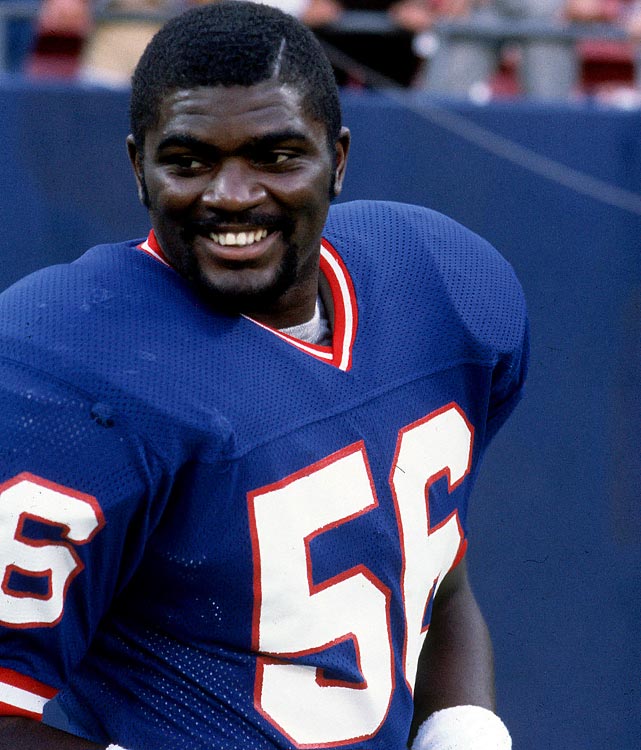
Moore didn't last long in the pros, only playing in 2000, for the Buffalo Bills. Vick was luckier, at first, getting the Atlanta Falcons to the 2004 NFC Championship Game, before his extracurricular activities back in the Norfolk area came to light. Talk about "bad things"... Smith is in the College and Pro Football Halls of Fame. His Number 78 and Moore's Number 56 have been retired. Vick, who wore 7 in Blacksburg and Atlanta, has not yet received any of those honors.
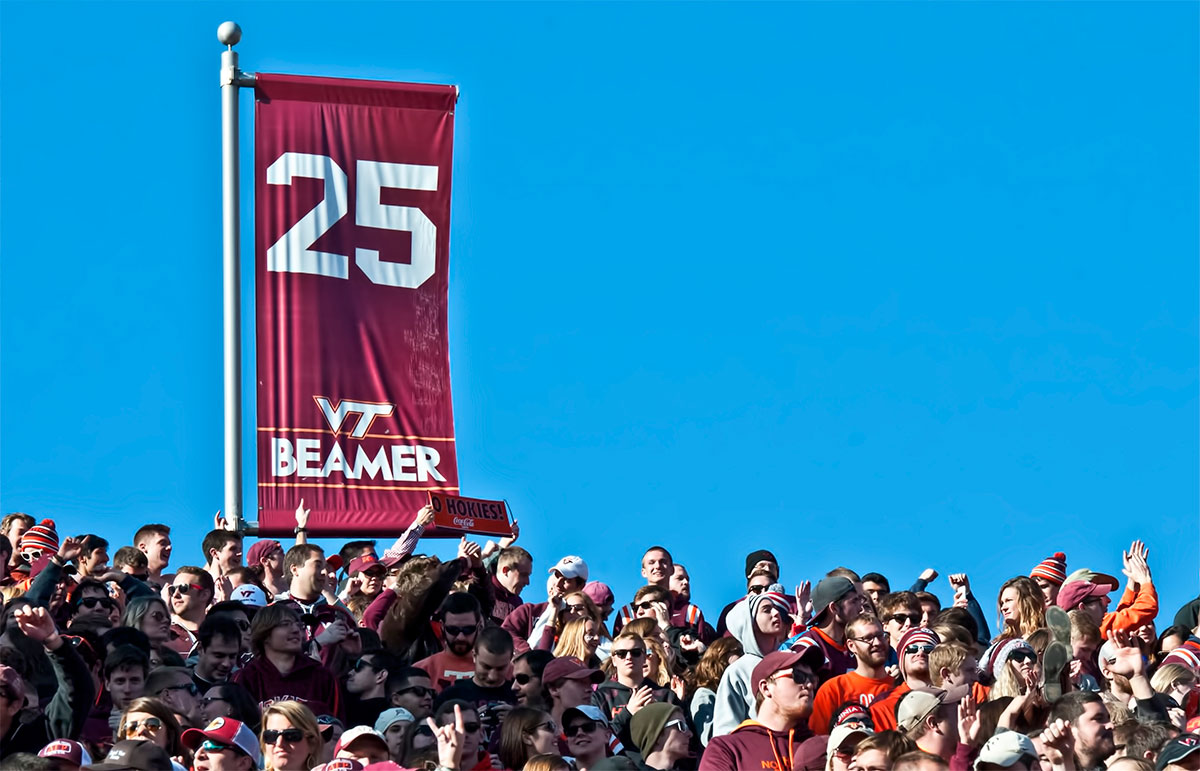
They've also raised a banner honoring former coach Frank Beamer's 25 years at the school, and named the street to the west of Lane Stadium Beamer Way.
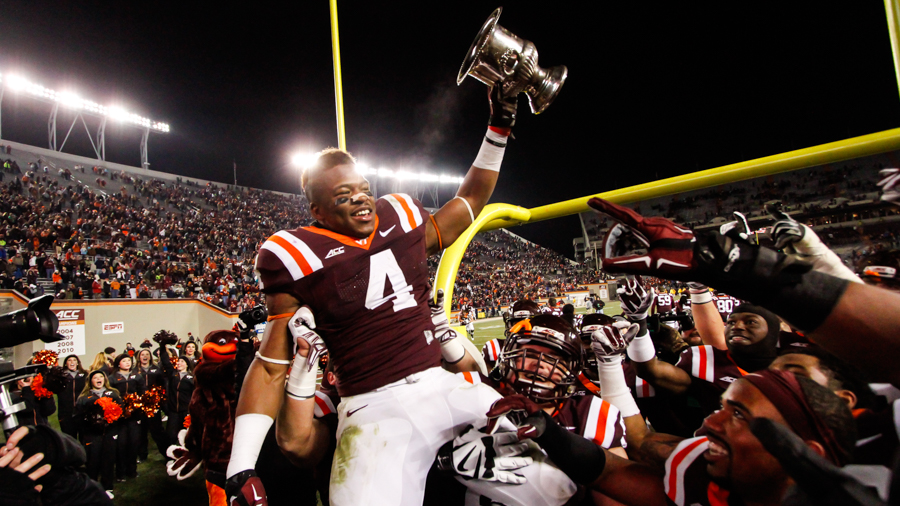
Clearly, Virginia and Virginia Tech are each other's biggest rivals, playing for the Commonwealth Cup. They've been playing each other since 1895, but annually only since 1970, and the Cup wasn't first awarded until 1996, making it one of the newer major trophies. Tech has won 13 straight times and 17 of the last 18, to take a 56-37-5 lead in the series.
J.C. Coleman with the 2014 Commonwealth Cup
UVa no longer plays Maryland due to the Terrapins' 2014 shift from the ACC to the Big Ten. The 2 schools still compete for talent from the Washington, D.C. area. Maryland leads the series 44-32-2. UVa does still play what's known as "The South's Oldest Rivalry," with North Carolina. It goes back to 1892, as does what Southeastern Conference fans consider the South's oldest rivalry, Georgia and Auburn; and they've played every year since 1919. Virginia won this year to break UNC's 7-game winning streak, but the Tar Heels still lead 63-55-4.
Due to conference commitments, Virginia vs. West Virginia, which would seem like a natural rivalry, has rarely been played, and not since the 2002 Continental Tire Bowl. Virginia Tech had a strong rivalry with West Virginia, for the Black Diamond Trophy, but until this season's Tech victory at the Washington Redskins' stadium in Landover, Maryland, they hadn't played since 2005, and aren't scheduled to do so again until 2021. Tech has won the last 3 meetings, and 13 of the last 18 (going back to 1989), but the Mountaineers still have a 28-23-1 lead.
UPDATE: Through the 2019 season, Virginia Tech leads Virginia 58-38-5, and North Carolina leads them 63-57-4.
Stuff. Virginia has Cavalier Team Shops on each side of Scott Stadium, outside Sections 108 on the East stand and 126 on the West. The University of Virginia Bookstore is at 400 Emmet Street South, about a 10-minute walk northeast of the stadium and a 5-minute walk west of the Rotunda.
Lane Stadium doesn't have an official team store. The Tech Bookstore is about a 5-minute walk north of the stadium, at 115 Kent Street.
There aren't many books about either program. In 2008, Jerry Ratcliffe published the coffee-table book University of Virginia Football Vault. In 2001, Fitzgerald Francis published Greatest Moments in Virginia Tech Football History. While it's way out of date (1995), Roland Lazenby and Doug Doughty published Hoos 'N' Hokies, the Rivlary: 100 Years of Virginia Tech-Virginia Football.
Each school came out with a DVD in 2008: The Cavs released Wahoowa: The History of Virginia Cavalier Football, and the Hokies released The Legends of Virginia Tech.
During the Game. Ordinarily, your safety would not be an issue. Neither UVa nor VT fans are known for getting rough. Tech fans can get very loud, making Lane Stadium one of the most intimidating home-field advantages in college football. But they won't start fights. But seeing as how they're playing each other, my usual advice for attending a rivalry game stands: Stick with the home team, and you'll probably be all right.
Both teams have rather odd nicknames. The official UVa mascot name comes from the original Virginia Cavaliers, named for the Royalists in the English Civil War of 1642-49, and who maintained their loyalty to the House of Stuart during the 11-year Cromwell Protectorate and the 28-year Stuart Restoration. Which makes it rather odd that the Cavalier would become the mascot of a University founded by the author of the Declaration of Independence, which faults both the British Parliament and King George III.
So what's a 'Hoo? It's short for Wahoo. What's a Wahoo? It has nothing to do with Chief Wahoo, the politically incorrect mascot of baseball's Cleveland Indians. In the 1890s, students at Washington & Lee University (named for George and Robert E.) in Lexington, Virginia, were quoted at a baseball game between the schools as calling UVa fans "a rowdy bunch of wahoos." The name stuck: "Wahooah" became the school's cheer, and "Wahoos" or "'Hoos" an unofficial nickname.
During the 1980s, UVa introduced a mascot called The 'Hoo, and it got booed off the field. So they've stuck to their Cavalier mascots: A guy in a big foam costume, and a costumed rider.
A few minutes prior to kickoff, on the Scott Stadium videoboard, The Adventures of Cavman is played. In this computer generated skit, the mascot of the opposing team is causing trouble on the Grounds of UVa, and the Cavalier slays him, then rides to the stadium via the Grounds. After the skit is over, the live Cavalier rides onto the field accompanied by orange and blue fireworks.
So what's a Hokie? In 1896, the Virginia Agricultural and Mechanical College changed its name to Virginia Polytechnic Institute, and student Oscar M. Stull made up a new cheer to celebrate, claiming "Hoki" (as he spelled it, with the E added later) was just something he made up as an attention-getter:
Hokie, Hokie, Hokie, Hy!
Tech, Tech, V.P.I.!
Solah-Rex, Solah-Rah!
Polytech Vir-gin-i-a!
Ray Rah, V.P.I.!
Team! Team! Team!
This cheer is followed by the approximation of a turkey's "gobbling" sound, since the teams were previously called the Fighting Gobblers. The Gobblers name is still around, though not as popular as the Hokies name. The mascot is known as HokieBird (one word), and, as was done for Mariano Rivera when he came out of the Yankee bullpen, the Tech band plays "Enter Sandman" by Metallica as the Bird leads the players onto the field. He also has a weight bench, and bench-presses his barbell once for every point the team has scored -- a variation on cheerleaders' push-ups.
Wild turkeys can fly. As WKRP in Cincinnati taught us,
farm-grown turkeys can't fly. The HokieBird can't fly,
but don't tell Tech fans that.
The Cavalier Marching Band plays the UVA alma mater, "The Good Old Song" (or "The Good Ole Song"), to the tune of "Auld Lang Syne"; and the fight song, "The Cavalier Song," which was written in 1923, with lyrics by Lawerence H. Lee Jr., and music by Fulton Lewis Jr., both students at the time. Regrettably, in the 1940s and '50s, Lewis went on to become perhaps the original Rush Limbaugh, a strident, deceitful, bigoted right-wing radio talk-show host. Tech's band, The Marching Virginians, plays the fight song "Tech Triumph."
After the Game. If you're looking for a postgame meal coming out of Scott Stadium, you will run into difficulty. About a 10-minute walk south of the stadium, Maury Avenue and Jefferson Park Avenue have a few places, Durty Nelly's Pub-Wayside Deli (2 joints in 1), at 2200 Jefferson Park Avenue.
After a game at Lane Stadium may be an even more difficult search. A few minutes' walk to the northwest is West End Market, at 720 Washington Street SW; and Deet's Place, a cafe that's part of Dietrick Convenience Store, on Ag-Quad Lane, across fro the preceding. In each case, other than that, your best bet may be to head back to the respective downtowns.
If you're a fan of a European soccer team, you're probably out of luck in both Charlottesville and Blacksburg. You'd be better off going to Gus' Bar & Grill in Richmond, or to one of the many such places in and around D.C. -- which might work, if your team is playing on Sunday instead of Saturday.
Sidelights. UVa opened the 14,593-seat John Paul Jones Arena in 2006. It is not named for the hot-blooded Scot who was the founding father of the U.S. Navy, but for a 1948 graduate of UVa's law school, the father of Paul Tudor Jones, a billionaire who donated $35 million toward its construction. Nevertheless, Paul is a big fan of the Admiral, and also donated paintings of him, and Jones' motto "I have not yet begun to fight!" is inscribed in the building's concrete. 295 Massie Road, to the north of the main campus.
It was built across the street from the previous home of Cavalier basketball, the 8,457-seat University Hall, which opened in 1965, with a design similar to those of the West Virginia Coliseum and Georgia Tech's Alexander Coliseum/McCamish Pavilion.
The Cavs have won Conference Championships in the regular season in 1922, 1981, 1982,1 983, 1995, 2007, 2014 and 2015; won the Conference Tournament in 1976 and 2014; and reached the NCAA Final Four in 1981 and 1984.
Notable players include Wally Walker (1976, 1979 NBA Champion Seattle SuperSonics), Marc Iavaroni (1978, 1983 NBA Champion Philadelphia 76ers), Ralph Sampson (1983 NCAA Player of the Year, 1986 NBA Western Conference Champion Houston Rockets and member of the Basketball Hall of Fame), Rick Carlisle (1984, 1986 NBA Championship as a Boston Celtics player and 2004 NBA Championship as coach of the Detroit Pistons) and Olden Polynice (1987, 14 years in the NBA).
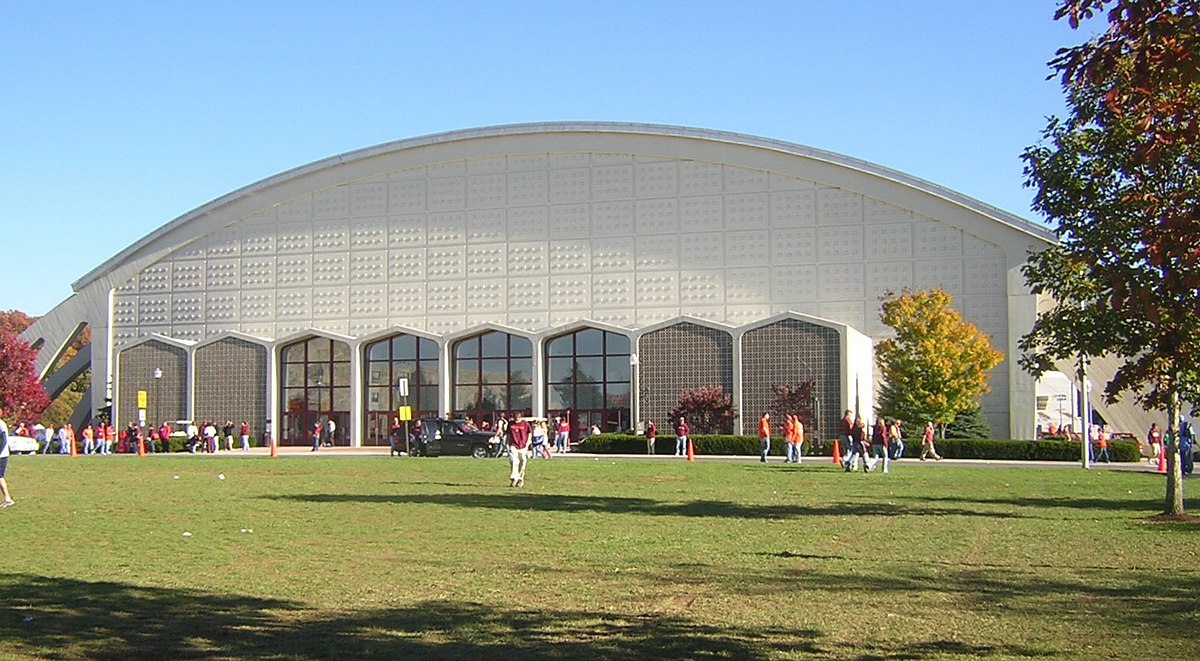
Tech opened the VPI Coliseum in 1962. In 1977, it was renamed Cassell Coliseum for Stuart K. Cassell, Tech's business manager, who had recently died. It seats 10,052. 675 Washington Street SW, just to the northwest of Lane Stadium.
Blacksburg has a few museums, most notably the Blacksburg Museum and Cultural Foundation, at 204 Draper Road SW, downtown. Charlottesville has the Fralin Museum of Art, owned by the University, at 155 Rugby Road; and the Virginia Discovery Museum, at 524 E. Main Street. Both are downtown. Of course, Charlottesville's most notable museums are Presidential, which I'll get to later.
The Carter Family Fold is a combination museum and performance venue near the home of the Carter Family, pioneers of country music. The founding couple was A.P. and Sara Carter. A.P. (Alvin Pleasant Delaney Carter) had a brother, Ezra, who also sang, and married Maybelle Addington. Ezra and "Mother Maybelle" had 3 daughters, one of whom was June Carter, who married Johnny Cash, and with Johnny's entry into the family, they were fully entrenched as "The First Family of Country Music."
Johnny Cash's last concert was at the Fold, on July 5, 2003, just 69 days before his death, and just 51 days after June's. Perhaps the least surprising thing about Johnny is that he died so soon after June did; the most surprising thing, given how bad his health was, is that she went first.
The Fold is at 3449 A.P. Carter Highway (Virginia Route 614), in Hiltons (formerly known as Maces Springs), in the Virginia Panhandle. It's about 150 miles southwest of Blacksburg. In fact, it's closer to the University of Tennessee in Knoxville, about 115 miles northeast. It's about 275 miles southwest of Charlottesville.
The Washington Redskins are easily the most popular NFL team among Virginians, partly due to their proximity to D.C., but also partly because the 'Skins have long had their training camp, Redskin Park, in the State, near Dulles International Airport. Nevertheless, Virginia's western Panhandle, like most of West Virginia, prefers the Pittsburgh Steelers.
The most popular NHL team in the State is easily the Washington Capitals. But baseball and NBA fans are mixed, tending to favor which teams are winning at the moment. Television exposure to their success makes most of Virginia susceptible to the Yankees, the Red Sox and the Braves. It's not until you approach the Virginia portion of the Capital Beltway that you get a strong presence of fans of the Washington Nationals, the Baltimore Orioles and the Washington Wizards.
Despite the Redskins' camp being in Virginia, and attempts to build new stadiums in the D.C. suburbs for a proposed MLB team (which eventually became the Nationals, but in Washington) and D.C. United (which also built a new stadium in the District), Virginia still has no major-league teams within its borders.
In minor-league baseball, the Triple-A International League has the Norfolk Tides (formerly the Tidewater Tides, a Mets farm team from 1969 to 2006 and for the Orioles ever since); the Double-A Eastern League has the Richmond Flying Squirrels (who replaced the former Triple-A team, the Richmond Braves); the Class A Carolina League has the Potomac Nationals (in Woodbridge, replacing the former Yankee farm team, the Prince William Cannons), the Lynchburg Hillcats and the Salem Red Sox; and the Rookie League-classed Appalachian League has the Bluefield Blue Jays, the Bristol Pirates, the Danville Braves, all in southern Virginia or the western Panhandle.
The Diamond, just outside downtown Richmond,
and Parker Field, a high school football stadium,
named for the minor-league ballpark that used to be
on The Diamond's site (1934-1984)
The closest team to Charlottesville is Lynchburg (slightly closer than Richmond), and the closest to Blacksburg is Salem.
Minor-league basketball has the Lynchburg Titans. Minor-league hockey has the Norfolk Admirals and the Roanoke Rail Yard Dawgs. Minor-league soccer has the Richmond Kickers, the Hampton Roads Piranhas and the Northern Virginia Royals. But the Kickers and the Piranhas also have women's teams.
There
are 4 historically black colleges and universities (HBCUs) in Virginia that
have won “the National Championship of black college football.” Hampton
University, north of Norfolk in Hampton, have won it 6 times: 1922, 1985, 1994, 2004, 2005 and 2006. Virginia State
University, in Ettrick, outside Petersburg, have won it 3 time: 1936, 1952 and 2014.
Virginia Union University, in Richmond, have won it twice: 1923 and 1981. And
Norfolk State University have won it once, in 2011.
The Beatles never played in Virginia. Elvis Presley did. He played in Norfolk, at the Municipal Auditorium, on May 15 and September 11 and 12, 1955, and February 12, 1956; and at the Scope arena on July 20, 1975. He also played in the Norfolk-Virginia Beach area in Newport News at the Paramount Theater on February 13, 1956. And he played in Hampton Roads at the Hampton Roads Coliseum on April 9, 1972, March 11, 1974, and July 31 and August 1, 1976.
He played in Richmond at the Mosque Theater on May 16 and November 29, 1955, on February 5, March 22, and June 30, 1956; at the Richmond Theater on September 18 and 19, 1955; and at the Richmond Coliseum on April 10, 1972, March 12 and 18, 1974, and June 29, 1976. He played in Roanoke at the American League Auditorium on May 18 and September 15, 1955; and at the Roanoke Civic Center on April 11, 1972, March 10, 1974, and August 2, 1976. He played in Danville at the Fairgrounds on September 20, 1955.
Virginia has so much history, it's hard to keep track. The 1st permanent European settlement in America was by Spain in St. Augustine, Florida on September 8, 1565, but the 1st English-speaking one was at Jamestown, Virginia on May 14, 1607. "Historic Jamestowne" is at 1368 Colonial Parkway. Colonial Williamsburg, the restored site of the former colonial capital, is at 101 Visitor Center Drive in Williamsburg, 10 miles to the northeast of Jamestown. Yorktown Battlefield, where the Revolution did not end, but victory in its war was all but secured on October 19, 1781, is at 1000 Colonial Parkway, 13 miles to the east of Williamsburg.
Both Virginia and Ohio claim to be "The Mother of Presidents." Virginia has 8 Presidential birthplaces, Ohio 7; but in terms of their political affiliation, Ohio leads 6-5, and, with the "election" of Donald Trump, New York tops them all with 7.
Presidential Birthplaces in Virginia: George Washington, house recreated, 1732 Popes Creek Road, Colonial Beach, 73 miles south of D.C.; Thomas Jefferson, house burned and never rebuilt, site at an unnamed road at around 2401 Richmond Road in Shadwell, near Charlottesville; James Madison, Belle Grove Plantion, house recreated, 336 Belle Grove Road, Middletown, 86 miles west of D.C.; James Monroe, house in ruins, 4460 James Monroe Highway, Colonial Beach, 9 miles northwest of Washington's Birthplace; William Henry Harrison, Berkeley Plantation (a mansion, not a log cabin as his 1840 campaign songs would have you believe), 12602 Harrison Landing Road, Charles City, 23 miles southeast of Richmond; John Tyler, Greenway Plantation, 10900 John Tyler Memorial Highway, 7 miles east of Berkeley Plantation; Zachary Taylor, probably (it's not certain) at Hare Forest Farm, 8369 Hare Forest Road, Orange, 33 miles northeast of Charlottesville; and Woodrow Wilson, at a parsonage that's been converted into his Presidential Library and Museum, 20 N. Coalter Street, Staunton (and that's pronounced STAN-ton, not STAWN-ton).
Harrison is now more identified with Ohio and Indiana, Taylor with Kentucky, and Wilson with South Carolina and Georgia, where he grew up with his traveling preacher father, and New Jersey, where he was President of Princeton University and then Governor. The other 5 are inextricably linked with Virginia.
George Washington's home of Mount Vernon, the very reason the national capital is now across the Potomac River, is still a working farm, and now has a George Washington Presidential Library. 3200 Mount Vernon Highway, 18 miles south of downtown Washington.
Bus service is available.
Thomas Jefferson's Monticello is at
931 Thomas Jefferson Parkway, 4 miles southeast of downtown Charlottesville. No bus service, and it's a bit too far to walk, especially since it will be uphill: Having an affinity for Italian things (food, wine, music, literature, and at least one girlfriend after his wife died), Jefferson named the home he built for the Italian word for "little mountain." There are taxi companies in Charlottesville, but they charge about $20. Each way.
James Monroe's Ash Lawn-Highland is about 3 miles south of Monticello, at 2050 James Monroe Parkway. And James Madison's Montpelier is about 28 miles northeast of Monticello (and Jefferson often stayed there on his way to and from D.C.), at 13425 Visitors Center Road in Orange, which is also about 10 miles southwest of Taylor's alleged birthplace.
John Tyler, hated by the Democrats because he joined the Whig ticket in 1840, and hated by the Whigs because he wouldn't let Secretary of State Daniel Webster tell him what to do after becoming President following William Henry Harrison's death in 1841, didn't run for re-election in 1844, because he knew he couldn't get either party's nomination. He said he felt like an outlaw, so he named his plantation after the Nottinghamshire home of Robin Hood, Sherwood Forest. 14501 John Tyler Memorial Highway in Charles City, about 4 miles east of the Greenway Plantation where he was born.
Richmond is heavy on the Confederate stuff, which is unfortunate, but it was the Confederate capital. The Capitol building that Jefferson designed opened in 1792, and succeeded Alabama's State House as the Confederate Capitol building on May 30, 1861. 1000 Bank Street. The Governor's Mansion is right across the street. The White House of the Confederacy, now the American Civil War Museum, is at 1201 E. Clay Street. All are downtown, and all were spared in the burning of Richmond.
About a mile west of downtown, on the James River, is Hollywood Cemetery. There are 3 Presidents buried here: James Monroe, John Tyler, and Confederate President Jefferson Davis. 412 S. Cherry Street.
The most important place in Virginia since Jefferson's 1826 death is the site of the Confederate surrender on April 9, 1865: Appomattox Court House National Historical Park. 111 National Park Drive. 60 miles south of Charlottesville, 111 miles east of Blacksburg, 94 miles west of Richmond, and 192 miles southwest of Washington.
The tallest building in Virginia is nowhere near Charlottesville or Blacksburg -- or Washington, and isn't all that close to Richmond, either. It's the 508-foot Westin Virginia Beach Town Center, 4535 Commerce Street, 9 miles west of the Boardwalk.
Television shows set in Virginia often have military or other governmental settings. JAG often used the Norfolk naval base and the Marine Corps headquarters at Quantico, and its spinoff NCIS still does. Major Dad also moved from the Marines' Camp Pendleton in Oceanside, California to Quantico after 1 season. The FBI is also HQ'ed at Quantico, and so the TV series Criminal Minds, Homeland and Quantico are set there, and The X-Files had several episodes set there.
Also set in Virginia have been The Waltons (fictitious Jefferson County is based on Schuyler in Nelson County), the Cosby Show spinoff A Different World (Cliff and Claire Huxtable's alma mater, Hillman College, is definitely in Virginia, and hints suggest the Norfolk area), the cartoon Doug (the fictional setting of Bluffington is said to be based on Richmond), and The Vampire Diaries (in fictional Mystic Falls).
Movies set in Virginia have often used colonial (such as the story of Pocahontas), Revolutionary, Civil War or present-day FBI settings. Two recent sports-themed films set there have been Remember the Titans (in the Washington suburb of Alexandria) and Secretariat (the eponymous horse was born at The Meadow, a farm in Ashland, outside Richmond). And bridging the gap between TV shows and movies is the iconic 1977 miniseries Roots, with the Reynolds plantation near Fredericksburg.
*
The Commonwealth of Virginia has more history than perhaps any other State. The University of Virginia and Virginia Tech have done their part to add to it. Their "Commonwealth Cup" rivalry has become a part of it.











.JPG)