Monday, July 21, 2025

Yanks Turn Hopeless Series vs. Braves Around

The Yankees began the official, if not numerical, 2nd half of the regular season with a 3-game Interleague series against the Atlanta Braves at Truist Park in suburban Cumberland, Georgia.

For the 1st 14 innings, it was a disaster.

Starting pitchers Gerrit Cole and Clarke Schmidt are out for the season. Luis Gil is only now making rehab appearances in the minor leagues.

General manager Brian Cashman hasn't seen fit to acquire a new starter, or to promote one from the minor leagues. And field manager Aaron Boone refused to accept that Will Warrem was on 4 days' rest, and Max Fried was on 5.

Put it all together, and the Friday night game was planned as a "bullpen game." And it was awful. Ian Hamilton allowed 3 runs in the 1st innings. Rico Garcia, 31 years old and newly selected off waivers from the Mets, made his Yankee debut, and allowed 3 runs in less than 2 innings.

A 7th-inning comeback was woefully sufficient, and the Braves won, 7-3.

The Saturday afternoon game began worse. Will Warren was okay for 3 innings, then fell apart. And nobody in the bullpen seemed to ha e anything, either. It was 5-0 Atlanta after 4 innings, and 7-2 after 5.

Then the Yankees once again proved that they can turn any stadium into a "little league field." Anthony Volpe hit 2 home runs, and homers were also hit by Cody Bellinger and, as a grand slam in the 9th, Trent Grisham. Yankees 12, Braves 9. Luke Weaver pitched a scorless inning and 2/3rds for the win.

Yesterday, Marcus Stroman had his best start of the season so far, allowing just 1 run over 6 innings. Aaron Judge hit his 36th home runs of the season, and the Yankees won, 4-2, to take a series that looked hopeless and make it 2 out of 3 on the road.

Judge's home run was the 351st of his career. That ties him for 6th on the Yankees' all-time list:

1. Babe Ruth 659
2. Mickey Mantle 536
3. Lou Gehrig 493
4. Joe DiMaggio 361
5. Yogi Berra 359
6. Aaron Judge 351
T. Alex Rodriguez 351

As broadcaster Michael Kay would say, Those are not just big names, those are iconic names.

*

The Yankees now head to Canada to play the Toronto Blue Jays, who lead them by 3 games in the American League Eastern Division, with 63 games to play. Here are the projected starting pitchers for the series, with all games having a scheduled starting time of 7:07 PM:

* Tonight: Carlos Rodón vs. Kevin Gausman.
* Tomorrow: Cam Schlittler (in his 2nd major league game) vs. Mark Scherzer (in his 472nd).
* Wednesday: Max Fried vs. Chris Bassitt.

Thursday will be an off day, and then the Yankees come home to face the Philadelphia Phillies, who are leading the National League East by a game over the Mets. So it doesn't get any easier.

July 21, 1925: The Scopes Monkey Trial

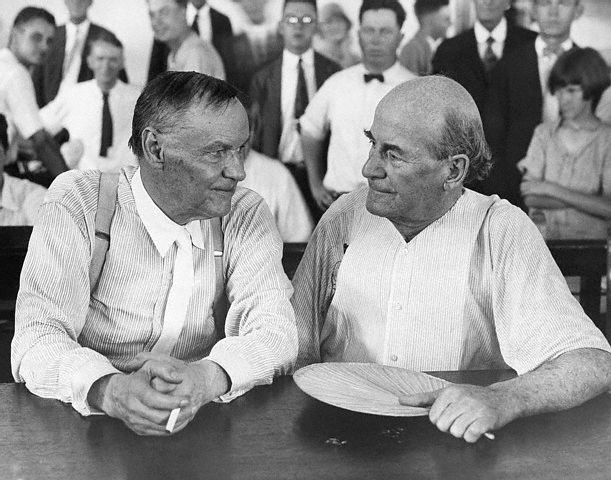
Clarence Darrow (left) and William Jennings Bryan

July 21, 1925, 100 years ago: A verdict is reached in the trial of The State of Tennessee vs. John Thomas Scopes, what has gone down in history as "The Scopes Monkey Trial."

Four months earlier, the Tennessee legislature passed the Butler Act, a law banning the teaching of evolution in its public schools, following news reports of children coming home from school and telling their parents, "The Bible is all nonsense." The law was named for its sponsor, State Representative John Washington Butler, who was also the head of the World Christian Fundamentals Association.

The American Civil Liberties Union chose to challenge this law. They found John Scopes, a 24-year-old Kentucky native who was teaching science and coaching football at Rhea County High School in Dayton, Tennessee, about 40 miles north of Chattanooga. Since the only penalty for teaching evolution in a public school in the State was a fine of $100 -- about $1,563 in today's money -- and he wouldn't be sent to prison, Scopes agreed to do it. On May 5, 1925, he was charged with violating the law.
John Scopes

Tom Stewart, a future U.S. Senator, was the lead prosecutor. Joining the prosecution team was William Jennings Bryan. The former Congressman from Nebraska had been nominated for President by the Democratic Party in 1896, 1900 and 1908, losing by a wider margin each time. He had served as Secretary of State in the 1st 2 years of Woodrow Wilson's Presidency, 1913-15.

In spite of an overall record that was very liberal for the time, he was a fundamentalist Presbyterian, and enthusiastically supported the law. His only misgiving was the fact that he hadn't tried a case in 36 years.

The ACLU needed a defense attorney. They wrote to H.G. Wells, the great science fiction writer, and a known Socialist and atheist. He wrote back and declined, saying that he had no legal training in his native Britain, let alone in America. John R. Neal, a professor at the University of Tennessee School of Law in Knoxville, volunteered.

But the ACLU thought he wasn't enough. So they called upon the foremost defense attorney of the day, Clarence Darrow. A year earlier, Darrow, a Chicago-based agnostic, had managed to save "thrill killers" Nathan Leopold and Richard Loeb from the death penalty for their brutal kidnapping and murder of a 14-year-old boy. The ACLU believed that, if he could argue effectively that the death penalty was wrong, they could argue that the law banning the teaching of evolution was wrong -- and that, while they were unlikely to win this case, they could later get the law overturned as unconstitutional.

Darrow was a brilliant man. At first, he turned them down, knowing that the Leopold-Loeb trial had become a media circus, and he didn't want the same thing to happen here. They talked him into realizing that this was a ship that had already sailed. The proceedings would be broadcast nationally on the new medium of radio.

Journalists had come from all over the world, including H.L. Mencken, the nationally-syndicated columnist from The Baltimore Sun, who had agreed to pay Scopes' legal fees. (But not his fine.) On the other hand, he had called the defendant "the infidel Scopes" in his column, and had also given the case the name it has had ever since: "The Monkey Trial."

Bryan, the foremost political speechmaker of his era -- an era that had certainly passed by this point -- decided to go with the circus atmosphere, as it suited his style. He mocked evolution as a theory, for teaching that humans were descended "not even from American monkeys, but from Old World monkeys."

As with the murderous Leopold and Loeb, Darrow knew that the nonviolent Scopes had, beyond any question, committed the crime for which he was charged. He knew there was no hope of winning the case -- in this round. But he understood the possibility of getting the Butler Act overturned as unconstitutional by a higher court.

So he went after it on that ground: He said that the Bible should be preserved in the realm of theology and morality, and not put into a course of science. Then he took the dramatic turn of attacking his opponent: He said that Bryan was waging "a duel to the death against evolution," and said, "There is never a duel with the truth."

On the 7th day of the trial, the Judge, John T. Raulston, ordered the proceedings moved to the lawn of the Rhea County Courthouse, because it was simply too hot inside: Air conditioning was still rare. On that day, Darrow took a truly radical step: He called Bryan, his opponent, to the stand, as "an expert on the Bible." Bryan made a key mistake: He accepted, mainly because his large ego had been bruised by Darrow's previous speech.

Darrow asked Bryan about some of the more fantastical stories in the Bible: Whether Eve was created from one of Adam's ribs, how their son Cain could have found a wife if Eve was still the only woman on Earth (Bryan: "I will leave the agnostics to hunt for her"), whether Joshua could make the Sun stand still in the sky, and so forth.

In 1955, Jerome Lawrence and Robert Edwin Lee wrote the play Inherit the Wind. Unfortunately, the best line from the play appears to have been made up for it, and didn't happen in real life. The Darrow character, named Henry Drummond, holds a rock, and asks the Bryan character, named Matthew Brady, how old the rock is. Brady says, "I am more interested in the Rock of Ages than in the age of rocks." 

In the play, Brady sticks to the "Biblical chronology" of the Irish archbishop James Ussher, who published a paper in 1654 stating that the Creation told in The Book of Genesis occurred in 4004 BC. Drummond said that the rock in question was not 6,000 years old, but millions of years old.

(For comparison's sake: Ussher said that Noah's Flood happened in 2348 BC, the Exodus in 1446 BC, and the death of King David and the accession of his son King Solomon in 970 BC. The most common date given for the destruction of Troy in the Trojan War is 1275 BC, and the founding of Rome is said to have been in 753 BC.)

After 2 hours of testimony, Bryan was looking forward to cross-examining Darrow, which, under most circumstances, he would have had the right to do. But Judge Raulston ruled that all the arguments against the Bible were immaterial to the case, and therefore irrelevant. He was right: Nothing that Darrow alleged in his statements and questions addressed the trial's central fact, which was whether or not Scopes broke the law as it then stood. The law's fairness was not at issue in the trial.

Bryan was furious: He had been denied his chance to make the speech of his life, surpassing even his pro-free silver "Cross of Gold" speech at the 1896 Democratic Convention in Chicago. Like so many old people -- he was now 65 -- he recognized that he had far more yesterdays than tomorrows, and was thinking more about death, and clinging more toward the hope that his religion gave him for an afterlife. As a result, he was now sounding more an more like a modern-day evangelical Republican than as the intellectual founding father of the modern Democratic Party, as he sometimes seems to be.

The trial took 8 days. The jury's deliberations took 9 minutes. They found Scopes guilty. Raulston ordered the $100 fine paid. He could have set the sentence aside, but he ordered it. Once he did, Scopes, who did not testify on his own behalf, spoke for the only time in the proceedings:

Your honor, I feel that I have been convicted of violating an unjust statute. I will continue in the future, as I have in the past, to oppose this law in any way I can. Any other action would be in violation of my ideal of academic freedom; that is, to teach the truth as guaranteed in our Constitution, of personal and religious freedom. I think the fine is unjust.

Nonetheless, the fine was levied. The ACLU, as they promised, paid it for him.

Over the next 5 days, Bryan delivered some speeches in Tennessee. But on July 26, 1925, he had a stroke, and died at his hotel in Dayton. Most people, at the time, thought that the trial had a deleterious effect on his health, although this was not proven, since there was no autopsy. He was buried at Arlington National Cemetery in Washington.

Darrow continued to practice law in Chicago until 1938, when he died of heart disease at age 80. Judge Raulston wanted to increase his political profile with the case, but was defeated for re-election in 1927. Representative Butler was also defeated for re-election in 1927. Neither ever won another office: Raulston ran for Governor and lost. He finally admitted that he no longer believed that the State should pass laws like the Butler Act. Butler died in 1952, Raulston in 1956.

Scopes lost his teaching career in the Great Depression, and he, his wife and 2 sons had to move in with his parents in Paducah. He entered politics, and ran for the State House of Representatives in 1932, as a Socialist, and lost. Then he did something very un-socialist: Having gotten a master's degree in geology, he worked, in Houston and later in Shreveport, Louisiana, for an energy company that would later be bought out by Pennzoil.

On October 10, 1960, he and two men claiming to be him were guests on the TV game show To Tell the Truth. Scopes was an ideal subject for that show: Since his fame came before the age of television, his name was well-known, but his face wasn't. He successfully stumped the panel of Don Ameche, Kitty Carlisle, Polly Bergen and Tom Poston.

In 1967, Gary Scott, a science teacher in Jacksboro, Tennessee, was fired for teaching evolution. He sued, following Darrow's idea that the law itself should one day be challenged as unconstitutional, and said that forbidding its teaching was a violation of the 1st Amendment's protection of speech. The school board got scared, and reinstated him. He didn't care: He went forward with his suit. Three days later, on May 18, 1967, 42 years after the Scopes Trial, the State legislature passed a law repealing the Butler Act. The same day, Governor Buford Ellington signed it into law. Scott dropped his suit.

Scopes' thoughts on the repeal are not recorded: He wrote a memoir, but it wasn't published until a few days after the repeal. He died of cancer in Shreveport in 1970, at 70.

As I mentioned, in 1955, the play Inherit the Wind was written, using a fictionalized version of the Scopes Trial as a critique of McCarthyism. Ironically, the title comes from the Bible: Proverbs 11:29 reads, "He that troubleth his own house shall inherit the wind, and the fool shall be servant to the wise of heart."

When it was first staged on Broadway, Darrow/Drummond was played by Paul Muni, and Bryan/Brady by Ed Begley Sr. A young Tony Randall was also in the cast. It was filmed in 1960 with Spencer Tracy and Fredric March. It was adapted for television in 1965, with Melvyn Douglas and Begley. (As far as I know, his son, Ed Begley Jr., has never appeared in a version of the play.)

A 1988 film for CBS had Jason Robards and Kirk Douglas. A 1996 Broadway revival had George C. Scott and Charles Durning. A 1999 movie airing on Showtime had Scott switching roles to play Bryan/Brady, and Jack Lemmon as Darrow/Drummond. A 2007 Broadway revival had Christopher Plummer and Brian Dennehy.

Thursday, July 17, 2025

July 17, 1975: The Apollo-Soyuz Mission

Back row, left to right: Tom Stafford and Alexei Leonov.
Front row, left to right: Deke Slayton, Vance Brand and Valeri Kubasov.

July 17, 1975, 50 years ago: For the 1st time, the only 2 nations that have yet sent human beings into space team up.

The 1972 arms talks between American President Richard Nixon and Soviet Premier Leonid Brezhnev, and the subsequent end of the Vietnam War, improved relations between the United States of America and the Union of Soviet Socialist Republics, a condition that became known as Détente, a French word meaning "relaxation."

But a meeting of American and Soviet spacecraft, in space? There were issues beyond politics. Engineering, for one. Each side had concerns over the way the others' craft were designed, and whether they could actually work together. By 1975, these concerns were alleviated, and the combined Apollo-Soyuz flight could go forward.

The American commander was Thomas P. Stafford, who had flown on Gemini 6 and Gemini 9, and commanded Apollo 10. The command module pilot was Vance Brand, making his 1st spaceflight. And the docking module pilot was Donald K. Slayton.

"Deke" Slayton had been one of the original Mercury 7, the only one who hadn't flown in Project Mercury, as he was grounded for health reasons. He was cleared for spaceflight in 1972, but, by then, Project Apollo was winding down, and he didn't fly on any of the Skylab missions, either.

The Soviet commander was Alexei Leonov. In 1965, aboard Voskhod 2, he became the 1st person to make a spacewalk. He was chosen to be the 1st "cosmonaut" on the Moon, but mechanical issues led to the cancellation of the Soviet Moon-landing program. The "flight engineer" was Valery Kubasov, who had flown on Soyuz 6.

Soyuz 19 launched on July 15, 1975, at 8:20 AM U.S. Eastern Time, from the Baikonur Cosmodrome in Kazahkstan. Apollo 18 launched from Cape Canaveral, Florida, at 3:50 PM the same day. On July 17, at 12:12 PM Eastern, the capsules docked. At 3:17, Stafford and Leonov entered their respective docking capsules, opened the door between them, and shook hands, with the docked craft over Metz, France.
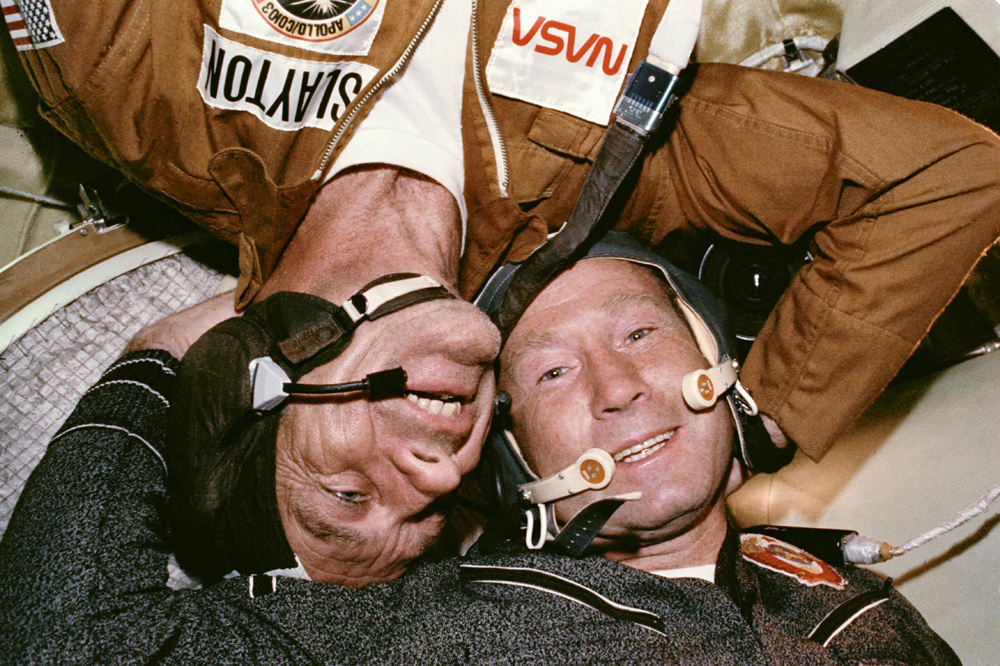
A few minutes later, Slayton and Leonov
posed for this zero-gravity picture.

Mission Control at the Lyndon B. Johnson Space Center in Houston patched in a phone call from President Gerald Ford. The Soviet equivalent read a message from Brezhnev. Music from each country was played: "Tenderness," a 1966 hit by Maya Kristalinskaya; and "Why Can't We Be Friends?" a recent hit with an ironic title by the funk band War.

Scientific experiments were conducted aboard each capsule, which couldn't have been easy, since each capsule had a seating capacity of three. Because of Stafford's drawl, Leonov said 3 languages were spoken on the mission: English, Russian and "Oklahomski."

They separated on July 19, both having stayed in Earth orbit without heading for the Moon. Soyuz 19 landed (the Soviets always landed on land) on July 21, and Apollo 18 splashed down (the Americans always landed on water) on July 24.

This was the end of Project Apollo. The decay of Skylab's orbit and delays on the Space Shuttle program meant that America did not return to spaceflight for 6 years.

The Apollo 18 command module is on display at the California Science Center, next-door to the Los Angeles Memorial Coliseum. The Space Shuttle Endeavour is also there. The Soyuz 19 descent module is at the RKK Energiya museum in Korolyov, outside Moscow. An Apollo module and a Soyuz module, but not the ones from this mission, are at the Smithsonian Institution's National Air and Space Museum in Washington.

In the 1983 film The Right Stuff, Slayton was played by Scott Paulin.

Kubasov was the only member of the Apollo-Soyuz crew who ever flew in space again, aboard Soyuz 36 in 1980. Slayton died in 1993, Kubasov in 2014, Leonov in 2019, Stafford in 2024. As of July 17, 2025, Brand is still alive, age 90. Stafford delivered one of the eulogies at Leonov's funeral.

July 17, 1955: Disneyland Opens

July 17, 1955, 70 years ago: Disneyland opens in Anaheim, California, 26 miles southeast of Los Angeles.

Walt Disney, head of the film studio that bore his name, based it on Henry Ford's Museum and Greenfield Village, in the Detroit suburbs, having enjoyed its Main Street concept and steamboat rides. He had also been inspired by such places as Colonial Williamsburg in Virginia and the 1939-40 New York World's Fair.

The opening day was a disaster. It was open only to invited guests and the media, but about half of the 28,000 people there had bought counterfeit tickets or climbed over the fence. Traffic to get in was as bad as for a major sporting event.

And the temperature was 101 degrees. (Most of Southern California had been desert before L.A. was built on it and then expanded out, after all.) The local plumbers' union was on strike. As a result, the water pressure was such that Disney was given a choice of having working drinking fountains or working public toilets. He chose the toilets, which was unquestionably the right move. But since Pepsi-Cola was one of the sponsors, having non-working drinking fountains made it look like a cynical move to sell more Pepsi.

And the vendors didn't have enough food. The heat also meant that some of the asphalt that had just been poured didn't have time to fully cool, and some women's high heels sank into it, tripping them up and injuring some.

Usually being media-savvy, Disney wanted the events televised nationwide, and got ABC to broadcast it, with some of his conservative Hollywood friends like Art Linkletter, Bob Cummings and... Ronald Reagan. But many guests tripped over the large TV camera cables of the era. Cummings was caught kissing a dancer. Linkletter tried an "over to you" to Cummings over and over again, but a technical issue made it impossible, and he ended up looking very foolish on live TV. (It was Linkletter's birthday, too: He was 43.)

For the rest of his life, Disney referred to the day as "Black Sunday," and accepted the next day, July 18, as Disneyland's "official birthday." After his death, though, the park began to restore the July 17 birthday.

The original park had 5 main sections, which have since been added onto. Main Street, U.S.A. was patterned after a typical Midwest town of the early 20th Century -- specifically, the one Disney himself grew up in, during the 1900s and 1910s: Marceline, in north-central Missouri, which now has a museum in Disney's honor. 

Adventureland was "designed to recreate the feel of an exotic tropical place in a far-off region of the world," as Disney put it, "far from civilization, in the remote jungles of Asia and Africa." Being in the Western U.S., and this being the early days of television, when Western movies were big, there pretty much had to be a Wild West-themed place, and it was named Frontierland.

Fantasyland was inspired by such Disney cartoon classics as their versions of the stories of Snow White and the Seven Dwarfs, Cinderella, Alice in Wonderland and Peter Pan. Its centerpiece, and the park's symbol, is the 77-foot-high Sleeping Beauty Castle. And Tomorrowland was especially inspired by New York 1939, as an idea of what the future would look like -- keeping in mind that, in 1955, space travel was still just a concept.

All of which allowed Disneyland to rebound from the lousy Day One to become what it billed itself as: "The Happiest Place On Earth," one that denied the existence of the troubles of post-World War II America: The Cold War, smog, suburban banality... and racial strife. It would be a while before Disneyland's employee roster was desegregated, and even longer before there was enough of a black middle class in America to provide enough of a black customer base.

On October 1, 1955, 76 days after Disneyland opened, The Honeymooners premiered on CBS. Formerly a sketch on The Jackie Gleason Show, Gleason spun the show off as a half-hour sitcom. The premiere episode featured Gleason's Ralph Kramden facing the demand of his wife Alice, played by Audrey Meadows, for something they did not yet have, but most families now seemed to: A television set. But Ralph hadn't even gotten a telephone -- or, something that always bugged my mother, a kid at the time, curtains for the kitchen window, the only window visible on the stage set.

Ralph told Alice he worked hard for his money -- no question about that, he was a bus driver in New York -- and that she should be lucky to live the way she does, in their small apartment in Brooklyn, without modern amenities. Alice went along with it, in the most sarcastic of fashions: "It's a regular Disneyland!"

She pointed out the window, at the tenements, and the laundry lines between them: "That's my Fantasyland!" She turned on the faucet of the kitchen sink. What came out of it? Water? Nope, just a weird knocking sound. "I never know what's going to happen with it," she said. "That's my Adventureland. That stove and that icebox: That's Frontierland. The only thing missing, Ralph, is The World of Tomorrow. I have nothing in my Disneyland from The World of Tomorrow!"

Ralph: "You want The World of Tomorrow? I'll show you The World of Tomorrow: You're going to the Moon!"

In 1966, two and a half miles to the east, across Interstate 5, what is now Angel Stadium of Anaheim opened, as the home of the baseball team then known as the California Angels, but now again called, as they originally were, the Los Angeles Angels. Jokes about the Angels playing "at Disneyland" have abounded ever since. But, between them, the Angels and Mickey Mouse have made the City of Anaheim grow by leaps and bounds, to the point where it's no longer just a giant suburb of L.A., but a real city in its own right, of 350,000 people.

*

October 1, 1971: Walt Disney World opens in Bay Lake, Florida, 15 miles southwest of Orlando.

Okay, why a 2nd park? Was "Uncle Walt" simply greedy? No: By 1959, he was seeing figures showing that, at the time, 75 percent of America's population lived east of the Mississippi River, but only 5 percent of Disneyland's visitors came from there. And he didn't like some of the businesses that were sprouting up near Disneyland. So he wanted a place convenient to the East, but with more land, so he could control what went up around it. If there's one thing that a powerful person desires more than money, it's control.

He had an idea he called "EPCOT": Experimental Prototype Community Of Tomorrow. In other words, while there would be a Main Street, U.S.A., a Fantasyland and a Frontierland as with Anaheim, the place would be more about tomorrow than yesterday.

The project was barely in the planning stage when Disney died from cancer on December 15, 1966. His brother Roy Disney saw it through, but only the original part of the park, known as the Magic Kingdom, opened in 1971.

"The Most Magical Place On Earth" was built over a series of tunnels that allowed employees or guests to move through the park out of sight. As with its California counterpart, the centerpiece is a castle, this one named Cinderella Castle, and reaching a higher peak, 189 feet.

All the water in the park is kept moving. Not having standing water nearly -- but not completely, as nothing is 100 percent effective -- eliminates one of the biggest problems with being in Florida: Disney World has hardly any mosquitoes.

Disney's Contemporary Resort also opened on the Magic Kingdom's opening day. It is a hotel, and a terminus for the park's monorail system.

November 17, 1973: On vacation, trying to get away from the troubles of the Watergate scandal, and staying at the Contemporary Resort, President Richard Nixon decides to hold a press conference. He gets mad at the questions about his integrity, and finally says, "I welcome this sort of examination, because people have gotta know whether or not their President is a crook! Well, I'm not a crook! I've earned everything I've got!"

The line becomes remembered as "I am not a crook." And, technically speaking, he wasn't a "crook." He was an arch-criminal. His recently-resigned Vice President, Spiro Agnew, forced out over charges of bribery and tax evasion? He met the definition of a crook.

October 1, 1982: Epcot, as Walt imagined it, finally opened, crowned by a "Spaceship Earth." It included several sections devoted to various countries around the world, inspired by the Busch Gardens theme parks in nearby Tampa and in Williamsburg, Virginia.

March 8, 1983: Another Republican President took time off to go to Orlando -- although the speech in question was not given at the Disney World complex. Addressing the National Association of Evangelicals, 28 years after the former actor had helped open Disneyland, Ronald Reagan gave a speech appealing to the anti-atheist, and therefore anti-Communist, views of the attendees, attacking the Soviet Union -- not with bombs, but with words:

I urge you to beware the temptation of pride, the temptation of blithely declaring yourselves above it all and label both sides equally at fault, to ignore the facts of history and the aggressive impulses of an evil empire, to simply call the arms race a giant misunderstanding and thereby remove yourself from the struggle between right and wrong, and good and evil.

Uncle Walt would have approved.

November 4, 1986: I visited Disney World with my family. My parents had wanted to go for a long time, and could now afford it. I wasn't crazy about the idea, but my sister was then 7 years old, so it was more for her than for anything else.

The place quickly grew on me, and, despite the distaste I eventually developed for Disney the man, it was a great experience. At one point, I lost my wallet, and it was found and returned within 2 hours. At the time, I was relieved. As time went by, I become very impressed with the efficiency of the place.

My parents noticed just how much of it had been bought by Disney from the 1964-65 New York World's Fair. My grandmother was with us, and kept saying, "That wasn't the real World's Fair," remembering the 1939-40 edition, But she enjoyed it, too. (We also visited nearby Sea World, the John F. Kennedy Space Center at Cape Canaveral -- my father and I, both science fiction fans, insisted -- and, at the other end of Florida, a cousin of my father's outside Tampa. While some members of my family have been to California, none of us has ever visited Disneyland.)

January 26, 1987: The day after the New York Giants won Super Bowl XXI, a commercial began airing. To the tune of "When You Wish Upon a Star," from the 1940 Disney cartoon Pinocchio, highlights of the game were shown, mostly of the game's Most Valuable Player, Giant quarterback Phil Simms.

Halfway through, an unseen announcer said, "Phil Simms: You've just won the Super Bowl! Now, what are you going to do?" And Simms looked into the camera and said, "I'm going to Disney World!" Sure enough, Simms and his teammates attended a parade in their honor at Disney World, and a tradition was born: Not just for Super Bowl MVPs, but for other sports stars. (Mark McGwire did it after breaking * Roger Maris' home run record in 1998.)

What I didn't know for several years was that 2 versions had been filmed, one for the East, and one for the West, in which Simms said, "I'm going to Disneyland!" Since the game was played at the Rose Bowl, on the other side of Los Angeles, they went to Disneyland first.

May 1, 1989: Disney's Hollywood Studios opens on Disney World land, to compete with the nearby Universal Studios theme park.

June 1, 1989: Disney's Typhoon Lagoon, a water park, opens.

November 4, 1989: Orlando becomes a major league sports city, with the debut of an NBA team. It is named in honor of the Magic Kingdom: The Orlando Magic. The team has made the Playoffs 16 times in its 1st 32 seasons, including 2 trips to the NBA Finals. But it has never explained what "one Magic" is called. Then again, neither have their Florida arch-rivals, the Miami Heat.

April 1, 1995: Disney's Blizzard Beach, a water park with a contradictory name, opens.

April 22, 1998: Disney's Animal Kingdom opens, based on the safari at Six Flags Great Adventure in Jackson, New Jersey and the nearby Busch Gardens park in Tampa.

Wednesday, July 16, 2025

July 16, 1950: Maracanazo

July 16, 1950, 75 years ago: The last game -- officially, not a "Final," since this edition was not a knockout tournament in the traditional sense -- of the World Cup is played at the Estádio do Maracanã in Rio de Janeiro, Brazil. Given the goal difference, all that hosts Brazil had to do was gain a draw, and they would be World Champions on home soil. Uruguay, on the other hand, had to win.

The 1st half ended scoreless. Shortly after play resumed, Albino Friaça put Brazil on the board. The gigantic crowd of 199,854 was ecstatic. Being 1-0 up in the 2nd half made it look like the tremendous pre-tournament and pre-game hype and confidence had been worth it.

But Uruguay's Captain, Obdulio Varela, was smart: He went to the referee, an Englishman named George Reader, and disputed the validity of the goal. Varela didn't speak English, and Reader didn't speak Spanish. An interpreter was found, and Reader learned Varela's objection: He believed (or said he did) that Friaça was offside. Reader called the linesman over, and the linesman denied it. Reader made his decision final: The goal stood.

Varela didn't get everything he wanted, but he got a big thing that he wanted: He stopped Brazil's momentum. They were standing around, waiting for play to be allowed to resume. Their fans had calmed down a bit. The home-field advantage had been dented. Reader handed the ball to Varela, who took it to the center of the field, and shouted to his teammates, "Now, it's time to win!"

And they did as he wanted: They attacked. Brazil didn't have a defense as good as their offense, and, in the 66th minute, Pepe Schiaffino equalized for Uruguay. That didn't matter much: If that 1-1 score had held, Brazil would still be World Champions.

In the 79th minute, Alcides Ghiggia ran down the right sideline, and fired a low shot that went under Brazilian goalkeeper Moacir Barbosa. It was Uruguay 2, Brazil 1. Every Brazilian -- on the pitch, in the stadium, and listening on the radio -- was in shock. Brazil attacked the rest of the way, but couldn't find the all-important equalizer. The home crowd was quiet.
Alcides Ghiggia

Shortly after 5:00, Reader blew his whistle to end the match. Uruguay had now won 2 of the 1st 4 World Cups. Brazil had lost the world championship of their national sport, in their national stadium.

In that stadium, 3 fans died from heart attacks. Another, who had brought a gun in, killed himself.

There was no public ceremony after the game. FIFA President Jules Rimet wisely chose to present the trophy that would later bear his name to Uruguay in their locker room. Brazil manager Flavio Costa had to leave the stadium in disguise -- as a nanny. Yes, like some deposed dictators have done, he left in drag, so as not to be recognized.

The loss was a blow to the national psyche of Brazil, so often wrapped up in this sport of soccer. It is known as Maracanazo in Spanish, Maracanaço in Portuguese: "The Agony of Maracanã." The 1950 World Cup was supposed to be a statement for Brazil, showing the world that it was a modern country, worthy of respect and admiration around the postwar world. This was the country's coming-out party, and it was ruined.

Minister of Sport Aldo Rebelo said, "Losing to Uruguay in 1950 not only impacted on Brazilian football, it impacted on the country's self-esteem." Instead of hating Uruguay for the ruination, Brazilians blamed themselves.

Brazil have gone on to win the World Cup a record 5 times: Beating Sweden in the Final in Sweden in 1958, beating Czechoslovakia in the Final in Chile in 1962, beating Italy in the Final in Mexico City in 1970, beating Italy in the Final again in the Rose Bowl in 1994, and beating Germany in Japan in 2002. They have also lost the Final to France in Paris in 1998.

You will notice that none of those 5 wins have been in Brazil. The World Cup has returned to that country only once, in 2014, and Brazil got to the Semifinal, but had an even more stunning loss at the Maracanã. It wasn't that they lost to Germany, who then beat Argentina in the Final. It wasn't even that they were looking forward to beating Argentina in the Final in the Maracanã themselves. The truly shocking part was the score: Germany beat Brazil, in the Maracanã, by a score of 7-1.
The Maracanã is 1 of 2 stadiums to have hosted 2 World Cup Finals, along with the Estadio Azteca in Mexico City. And it's 1 of 5 stadiums to have hosted a World Cup Final and be the main stadium for the Olympic Games. The Azteca is not 1 of the other 4: Although it was used during the 1968 Olympics, it was not the main stadium for those games. The others are the old Wembley Stadium in London, the Olympiastadions in Berlin and Munich, and  the Stade de France outside Paris.

Much as the 1980 and 2008 World Series wins have not fully erased the humiliation of the blown 1964 National League Pennant for Philadelphia Phillies fans, Brazilians still have not gotten over Maracanazo after 72 years, despite winning 5 World Cups and the admiration of the rest of the world.

Because of the soccer connection, it remains the most famous building on the entire continent. It is home to Rio’s 2 biggest teams, Flamengo and Fluminense, and "the Fla-Flu Derby" is the event of the year in Rio. (Aside from that whole Carnival business.)

Outside of soccer, in 1980, it hosted the largest crowd ever to watch a volleyball match, 95,000 to see the national teams of Brazil and the Soviet Union. It hosted the preaching of Billy Graham in 1960 and 1974, and Pope John Paul II in 1980, 1987 and 1997.

Frank Sinatra sang before 175,000 in 1980, and "Rock In Rio" brought more than that for Sting in 1987, Tina Turner in 1988, Paul McCartney in 1990, a-ha in 1991, Madonna in 1993, and the Rolling Stones in 1995.

In 1966, the stadium was officially renamed Estádio Jornalista Mário Filho, for a sportswriter who had just died, but everybody still calls it the Maracanã. A conversion to all-seater and renovations for the 2014 World Cup and the 2016 Olympics has reduced capacity to 78,838, making it still the largest stadium in South America.

July 16, 1945: The Trinity Test

July 16, 1945, 80 years ago: The Trinity test takes place. It is successful.

In June 1942, the U.S. Army Corps of Engineers started the Manhattan Project. This walled-off, super-secure facility in Los Alamos, New Mexico was kept as secret as they could, in order to keep Nazi Germany from knowing what they were doing. As it turned out, the real worry was with the Soviet Union, and their spies.

Due to the Allied bombings of German facilities, the Nazis never came close to developing an atomic bomb. They surrendered on May 8, 1945. But the new President, Harry Truman, wanted to avoid a full-scale invasion of the remaining enemy, Japan, if at all possible. The atomic bomb was the solution.

The Project's director was J. Robert Oppenheimer. He had a concern that the bomb might ignite the atmosphere and eliminate all life on Earth. But he said the chance of that happening was "near zero."
The first bomb was completed, and its test, codenamed "Trinity," was set for July 16, 1945, at what is now White Sands Missile Range, in a sparsely populated area outside Bingham, New Mexico. The detonation was at 5:29 AM Mountain Time, 7:29 U.S. Eastern Time. The test was successful. But every witness knew that this was both good news in the short term and, potentially, very bad news in the long run. They knew that America wouldn't have a monopoly on the bomb forever. Oppenheimer later said:

We knew the world would not be the same. A few people laughed, a few people cried. Most people were silent. I remembered the line from the Hindu scripture, the Bhagavad Gita. Vishnu is trying to persuade the Prince that he should do his duty, and, to impress him, takes on his multi-armed form, and says, "Now, I am become Death, the destroyer of worlds." I suppose we all thought that, one way or another.

On August 6, Truman ordered the dropping of the 1st available atomic bomb on Hiroshima, Japan. On August 9, he ordered another, dropped on Nagasaki. On August 14, Japan surrendered.

In 1949, the Soviets announced that they had successfully tested an atomic bomb.

Tuesday, July 15, 2025

A Lot of Ifs As Yankees Trudge Into the All-Star Break

Last Tuesday night, the Yankees started a homestand with 3 games against the Seattle Mariners. Will Warren took a shutout into the 6th inning. Jeff Hartlieb was awful in the 8th, otherwise the bullpen did well. Aaron Judge, Giancarlo Stanton and Aaron Wells hit home runs, and the Yankees won, 10-3.

Wednesday night marked the major league debut of Cam Schlittler. That's Cameron John Schlittler, a 24-year-old righthander from the Boston suburb of Walpole, Massachusetts, meaning he probably grew up as a Red Sox fan; with the even more unfortunate status of literally having "Hitler" in his name.

He was given the Number 31 formerly worn by Hall-of-Famers Dave Winfield and Tim Raines, pitched 5 1/3rd innings, and allowed 3 runs on 4 hits and 2 walks, striking out 7. Not bad, if you can score at least 4 runs for him. He got 4 runs just from Jazz Chisholm, who hit 2 home runs, and the Yankees won, 9-6.

Thursday night was a bit more complicated. Marcus Stroman allowed 2 runs over 5 innings. But Clayton Beeter allowed 3 over the next 2. Bryan Woo pitched a no-hitter through 7 innings, and had a 5-0 lead to work with.

Chisholm led off the bottom of the 8th with a single. Ben Rice singled him over to 3rd. Wells got him home with a sacrifice fly. Woo was relieved by Matt Brash. Anthony Volpe, still in a rotten slump, struck out.Stanton pinch-hit for Jorbit Vivas, and crushed one to make it 5-3.

Ian Hamilton held the Mariners off in the top of the 9th. Trent Grisham led off the bottom of the 9th with a single. Judge flew out. Cody Bellinger singled. Chisholm flew out. Rice walked to load the bases. Wells singled to right, scoring Grisham, and Bellinger made a fantastic slide to avoid the tag of Mariner catcher Cal Raleigh -- he of the 36 home runs and the nickname "Big Dumper." Tie ballgame.

Devin Williams held the M's off in the top of the 10th. With 1 out in the bottom of the 10th, Paul Goldschmidt was intentionally walked, Grisham was unintentionally walked to load the bases, and Judge hit a sacrifice fly to win it, 6-5, and complete the sweep.

*

The official, if not numerical, 1st half of the season ended with a home Interleague series against the Chicago Cubs, who are leading the National League Central Division. Carlos Rodón was brilliant on Friday night, pitching 8 shutout innings, allowing 4 hits and 1 walk, striking out 8. Cody Bellinger had a career night: 3-for-5 with 3 home runs, just missing a 4th on a great catch, with 6 RBIs. Paul Goldschmidt also went 3-for-5, with 2 RBIs. The Yankees won, 11-0.

The Yankees could have used some of those runs over the next 2 games. Max Fried had a blister on his thumb, and had to leave the Saturday game after 3 innings, allowing 4 runs. The bullpen allowed only 1 run in 6 innings, but, aside from Judge's 3 hits, including his 35th home run, the Yankees only had 3 other baserunners, and lost, 5-2.

On Sunday, Warren allowed 2 runs in 5 1/3rd innings. But Shota Imanaga, the Cubs' Japanese pitcher, was fantastic. The Yankees only got 2 hits: A home run from Stanton and a single by Wells. The Cubs won, 4-0.

*

The Yankees trudge into the All-Star Break at 53-43, a pace to go 89-73. They are 2 games behind the Toronto Blue Jays in the American League Eastern Division. If the current standings hold until the end of the season, they would have the 4th seed in the AL Playoffs.

They have reached this point despite having ace Gerrit Cole out for the season, with Tommy John surgery; having Number 2 starter Luis Gil out for the season thus far, though he is now making minor-league rehab appearances; having starter Clarke Schmidt on the Injured List twice, including now, for the season, with TJS; having starter Marcus Stroman also spend time on the Injured List; still not having a reliable closer, as neither Luke Weaver nor new acquisition Devin Williams having secured the job; having Giancarlo Stanton on the Injured List until recently; having to let DJ LeMahieu go, as his injuries have rendered him a shell of his former self, forcing a move of Chisholm from 3rd base to 2nd base, and leaving Oswald Peraza at 3rd; having Anthony Volpe in a terrible slump.

The Yankees start the 2nd half of the season on Friday, away to the Atlanta Braves. Which is lucky for All-Stars Judge, Chisholm and Rodón, since they can stay in Atlanta, without having to fly back to New York, and then fly to the next city with the team, because they're already in the next city. (Rodón was named to the AL All-Star Team to replace Fried.)

Since its formation in 1969, the average number of games needed to win the AL East -- that is to say, the average number of the team that finishes 2nd in the Division, plus one -- is 93. To get to 93 wins, the Yankees would, over the season's last 66 games, have to go 40-26, a 98-win pace.

Can they do it? If Gil comes back strong, if Stanton keeps up his current place, if Volpe snaps out of it, and if either Peraza starts hitting or general manager Brian Cashman gets a better player for 3rd base, maybe they can.

That's a lot of ifs.