Showing posts with label new york rangers. Show all posts

Sunday, September 13, 2026

September 13, 1926: Emile Francis Is Born

In the late 1960s and the early 1970s, Gil Hodges managed the Mets. Wilbur "Weeb" Ewbank coached the Jets. and William "Red" Holzman coached the Knicks. These men received everything they needed to win a World Championship, including a little bit of luck.

Emile Francis was the biggest man in New York hockey at the time. He had everything he needed -- except a little more luck.

Emile Percival Francis was born on September 13, 1926 is born in North Battleford, Saskatchewan, Canada. He tended goal in professional hockey from 1943 to 1960, including in the National Hockey League from 1947 to 1952. With the Chicago Black Hawks in 1948, he designed an improved goaltender's glove, based on a baseball catcher's mitt. He was a member of the New York Rangers team that reached the 1950 Stanley Cup Finals, losing to the Detroit Red Wings in 7 games. If that had been the extent of his contribution to the game, that would be enough to remember him.

After retiring as a player, "the Cat" went straight into coaching, and was named the Rangers' general manager in 1964, naming himself head coach in 1965. He built a team that included Eddie Giacomin in goal; defensemen Brad Park, Gary Doak, Dale Rolfe, Jim Neilson, Rod Seiling and Ab DeMarco; left wings Vic Hadfield, Glad Sather and Dave Balon; centers Jean Ratelle, Phil Goyette, Bobby Rousseau, Pete Stemkowski and Walt Tkaczuk; and right wings Rod Gilbert and Ron Stewart.

Gilbert remains the Rangers' all-time leading scorer. He, Ratelle and team Captain Hadfield formed "The GAG Line," short for "Goal-A-Game." All three of them, plus Park and Seiling, would be named to the "Team Canada" for the 1972 "Summit Series" with the Soviet Union. Gilbert, Ratelle, Park and Giacomin would join Francis in the Hockey Hall of Fame.

This team was good, and good enough to not play dirty. There were no thugs on the roster. Later goons like Nick Fotiu, Tie Domi and Ulf Samuelsson would have had no place on it.

On January 12, 1969, the Jets won Super Bowl III. On October 16, 1969, the Mets won the World Series. On May 8, 1970, and again on May 10, 1973, the Knicks won the NBA Championship. The pieces for the Rangers seemed to be in place: A smart builder, a strong and deep team, and a new Madison Square Garden with a passionate fan base to support them.

But it just didn't happen. There were too many other good teams at the time. In 1968, the 1st season of "The New Garden," the Rangers reached the Quarterfinals of the Stanley Cup Playoffs, but lost to the Black Hawks of Bobby Hull, Stan Mikita and Tony Esposito. In 1969, they got to the Quarterfinals again, but lost to the Montreal Canadiens of Jean Béliveau, Henri Richard and Yvan Cournoyer, who went on to win the Cup. In 1970, again, they got to the Quarterfinals, but were beaten by the Boston Bruins of Bobby Orr and Phil Esposito, Tony's brother, who went on to win the Cup.

In 1971, they beat the Toronto Maple Leafs in the Quarterfinals, the franchise's 1st Playoff series win in 21 years. They faced the Black Hawks, and in Game 6 at The Garden, Stemkowski scored in the 3rd overtime to win it. It became the franchise's "Where were you?" moment. But they lost Game 7 in Chicago.

In 1972, it looked like it was all coming together: They beat the defending Champion Canadiens in the Quarterfinals, then swept the Black Hawks in 4 straight in the Semifinals. But the Bruins were back, and were just too strong for them. Nobody spoke of a "curse" on the Rangers, and there was no great moment of calamity: Francis' Broadway Blueshirts were simply beaten by a better, stronger, more experienced team.

In 1973, the Rangers beat the Bruins in the Quarterfinals, and hope rose that this could be it. But they lost to the Black Hawks in the Semifinals. This was the 1st season for the expansion team in the suburbs of Long Island, the New York Islanders. In 1974, the Rangers beat the Canadiens in the Quarterfinals, as they were in a transition between the Béliveau-Richard years and the Guy Lafleur years, and goalie Ken Dryden took a year off to finish law school. But the Philadelphia Flyers were on the rise, and beat the Rangers in the Semifinals, then won the Cup by beating the Bruins.

In 1975, the 3rd-year Islanders shocked the Rangers in the 1st round of the expanded Playoffs. Suddenly, there was a new "team of the future," and the Rangers looked like a team of the past. Francis' transactions seemed to take on an air of desperation, a "The future is now" idea. His waiving of Giacomin to make room for the prospect John Davidson was right in the long term, but the public relations of it, and of the subsequent trade of Ratelle and Park to the Bruins for Phil Esposito and Carol Vadnais, earned himthe wrath of Ranger fans. It's been suggested that the change of Ranger fans from "the classiest fans in hockey" to the boors of "the Blue Seats" began at this time.

Francis was fired as head coach in late 1975, and as GM in early 1976. He later served as head coach and GM of the St. Louis Blues, helping find new owners that saved the team (Ralston Purina, who briefly had the St. Louis Arena renamed the Checkerdome); and of the Hartford Whalers.

He was elected to the Hockey Hall of Fame, and died on February 19, 2022, at the age of 95. Apparently, he and the Rangers made up, because they annually present the Emile Francis Award to a notable supporter of youth hockey. The Emile Francis Trophy is presented by the American Hockey League to the winner of its Atlantic Division.

His son, Bobby Francis, won the Jack Adams Award as NHL Coach of the Year with the 2002 Phoenix Coyotes. (Established for the 1973-74 season, Emile never won it.)

Emile Francis will never be as well-remembered in New York sports as Gil Hodges, Weeb Ewbank or Red Holzman -- or Billy Martin or Joe Torre, or Bill Parcells. He might be better-remembered than Mike Keenan, who walked out on the Rangers right after they finally won the Cup in 1994. He should be remembered as a man who gave everything had to build a hockey winner in New York.

While Emile Francis was their boss, the New York Rangers were good, if not quite good enough. Certainly, there was no reason to say they "sucked."

Monday, June 15, 2026

Stanley Cups Won by Current NHL Teams, as of 2026

Note that this counts all titles won by moved teams. Ties broken by Finals appearances, then by Conference Finals appearances:

1. 24 Cups, Montreal Canadiens: 1916, 1924, 1930, 1931, 1944, 1946, 1953, 1956, 1957, 1958, 1959, 1960, 1965, 1966, 1968, 1969, 1971, 1973, 1976, 1977, 1978, 1979, 1986, 1993; lost 10 Finals: 1917, 1925, 1947, 1951, 1952, 1954, 1955, 1967, 1989, 2021; 1919 Finals never completed

2. 13 Cups, Toronto Maple Leafs: 1918, 1922, 1932, 1942, 1945, 1947, 1948, 1949, 1951, 1962, 1963, 1964, 1967; lost 8 Finals: 1933, 1935, 1936, 1938, 1939, 1940, 1959, 1960

3. 11 Cups, Detroit Red Wings: 1936, 1937, 1943, 1950, 1952, 1954, 1955, 1997, 1998, 2002, 2008; lost 13 Finals: 1934, 1941, 1942, 1945, 1948, 1949, 1956, 1961, 1963, 1964, 1966, 1995, 2009 

4. 6 Cups, Boston Bruins: 1929, 1939, 1941, 1970, 1972, 2011; lost 14 Finals: 1927, 1930, 1943, 1946, 1953, 1957, 1958, 1974, 1977, 1978, 1988, 1990, 2013, 2019 

5. 6 Cups, Chicago Blackhawks: 1934, 1938, 1961, 2010, 2013, 2015; lost 7 Finals: 1931, 1944, 1962, 1965, 1971, 1973, 1992

6. 5 Cups, Edmonton Oilers: 1984, 1985, 1987, 1988, 1990; lost 4 Finals: 1983, 2006, 2024, 2025

7. 5 Cups, Pittsburgh Penguins: 1991, 1992, 2009, 2016, 2017; lost 1 Finals: 2008

8. 4 Cups, New York Rangers: 1928, 1932, 1940, 1994; lost 7 Finals: 1929, 1932, 1937, 1950, 1972, 1979, 2014 

9. 4 Cups, New York Islanders: 1980, 1981, 1982, 1983; lost 1 Finals: 1984

10. 3 Cups, New Jersey Devils: 1995, 2000, 2003; lost 2 Finals: 2001, 2012 

11. 3 Cups, Tampa Bay Lightning: 2004, 2020, 2021; lost 1 Finals: 2015

12. 3 Cups, Colorado Avalanche: 1996, 2001, 2022; never lost a Finals

13. 2 Cups, Philadelphia Flyers: 1974, 1975; lost 6 Finals: 1976, 1980, 1985, 1987, 1997, 2010

14. 2 Cups, Carolina Hurricanes: 2006, 2026; lost 1 Finals: 2002; lost 3 Conference Finals: 2009, 2019, 2023

15. 2 Cups, Los Angeles Kings: 2012, 2014; lost 1 Finals: 1993; lost 1 Conference Finals: 2013

16. 2 Cups, Florida Panthers: 2024, 2025; lost 1 Finals: 1996; never lost a Conference Finals

17. 1 Cup, Dallas Stars: 1999; lost 4 Finals: 1981, 1991 (both of those as Minnesota North Stars), 2000, 2020

18. 1 Cup, St. Louis Blues: 2019; lost 3 Finals: 1968, 1969, 1970

19. 1 Cup, Vegas Golden Knights: 2023; lost 2 Finals: 2018, 2025; lost 2 Conference Finals: 2020, 2021

20. 1 Cup, Calgary Flames: 1989; lost 2 Finals: 1986, 2004; never lost a Conference Finals

21. 1 Cup, Anaheim Ducks: 2007; lost 1 Finals: 2003; lost 3 Conference Finals: 2006, 2015, 2017

22. 1 Cup, Washington Capitals: 2018; lost 1 Finals: 1998; lost 1 Conference Finals: 1990

23. No Cups, but 3 WHA Championships, Utah Mammoth: 1976, 1978, 1979 as (original) Winnipeg Jets

24. No Cups, but 3 Finals, Vancouver Canucks: 1982, 1994, 2011

25. 2 Finals, Buffalo Sabres: 1975, 1999

26. 1 Finals, Nashville Predators: 2017

27. 1 Finals, San Jose Sharks: 2016

28. 1 Finals, Ottawa Senators: 2007

29. 1 Conference Finals, Winnipeg Jets (new version): 2018

30. 1 Conference Finals, Minnesota Wild: 2003

31. 1 Conference Semifinals, Seattle Kraken: 2023

32. 1 Conference Semifinals, Columbus Blue Jackets: 2020 

Stanley Cup Droughts, as of the 2026 Finals

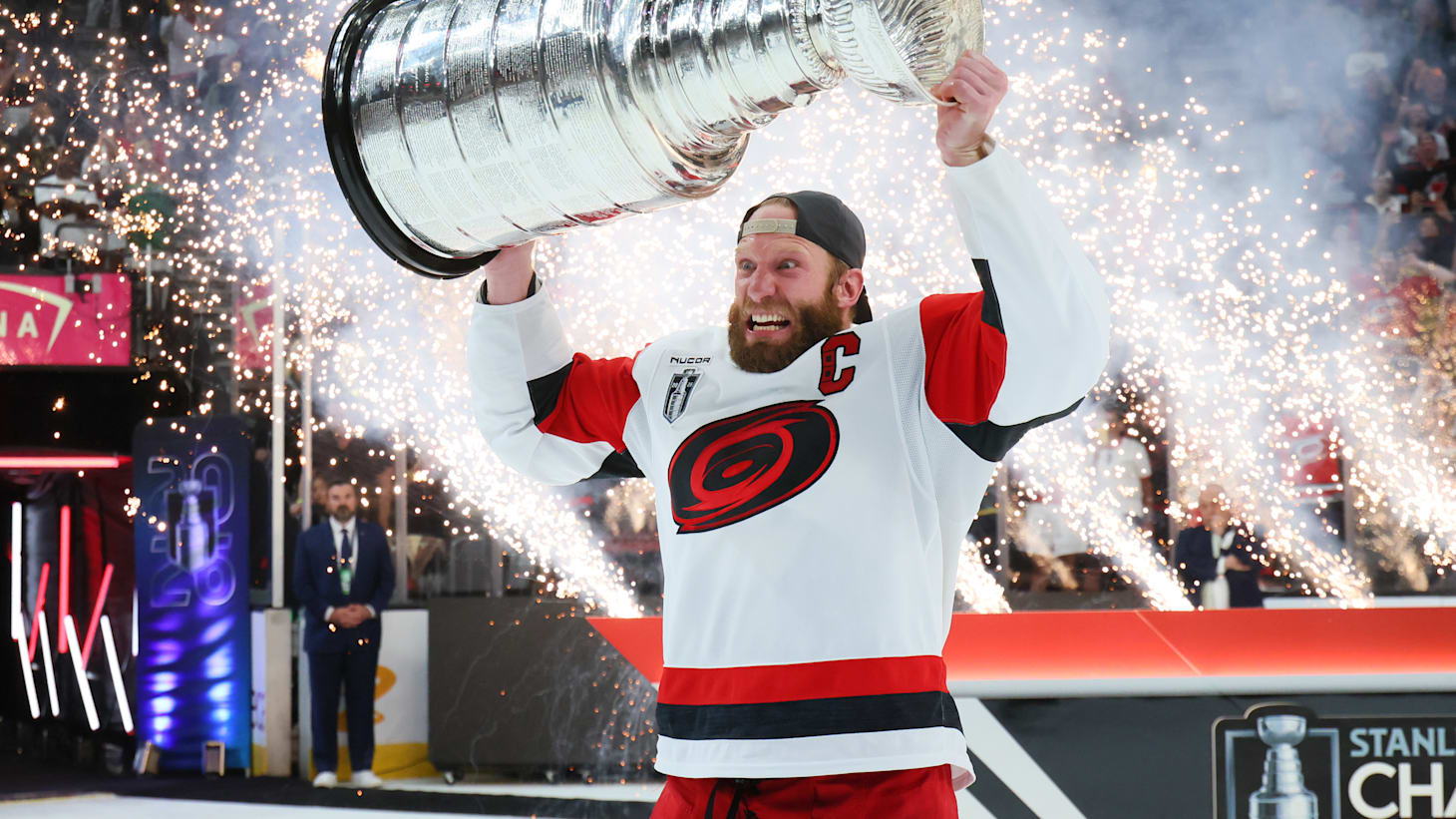
Congratulations to the Carolina Hurricanes, who won the Stanley Cup last night, defeating the Vegas Golden Knights in Game 6 of the Finals.

Teams ranked by their most recent title; then, for teams that have not won the title, fewest seasons without one:

1. Current Champions, Carolina Hurricanes, 2026
2. 1 year, Florida Panthers, 2025
3. 3 years, Vegas Golden Knights, 2023
4. 4 years, Colorado Avalanche, 2022
5. 5 years, Tampa Bay Lightning, 2021
6. 7 years, St. Louis Blues, 2019
7. 8 years, Washington Capitals, 2018
8. 9 years, Pittsburgh Penguins, 2017
9. 11 years, Chicago Blackhawks, 2015
10. 12 years, Los Angeles Kings, 2014
11. 15 years, Boston Bruins, 2011
12. 18 years, Detroit Red Wings, 2008
13. 19 years, Anaheim Ducks, 2007
14. 23 years, New Jersey Devils, 2003 
15. 27 years, Dallas Stars, 1999
16. 32 years, New York Rangers, 1994 
17. 33 years, Montreal Canadiens, 1993
18. 36 years, Edmonton Oilers, 1990
19. 37 years, Calgary Flames, 1989
20. 43 years, New York Islanders, 1983
21. 51 years, Philadelphia Flyers, 1975
22. 59 years, Toronto Maple Leafs, 1967
23. Never in 5 years, Seattle Kraken, joined NHL in 2021
24. Never in 26 years, Minnesota Wild, joined NHL in 2000
25. Never in 26 years, Columbus Blue Jackets, joined NHL in 2000
26. Never in 27 years, Winnipeg Jets, founded as Atlanta Thrashers in 1999; their city last won the Stanley Cup in 1902
27. Never in 28 years, Nashville Predators, joined NHL in 1998
28. Never in 34 years, Ottawa Senators, joined NHL in 1992; the original Senators last won the Stanley Cup in 1927
29. Never in 35 years, San Jose Sharks, joined NHL in 1991
30. Never in 47 years, Utah Mammoth, founded in WHA in 1972 as Winnipeg Jets, joined NHL in 1979
31. Never in 56 years, Vancouver Canucks, joined NHL in 1970; their city won the Stanley Cup in 1915
32. Never in 56 years, Buffalo Sabres, joined NHL in 1970

If I were ranking the teams that have not yet won titles by how close they have come:

23. Utah Mammoth, last won WHA Championship in 1979 as (original) Winnipeg Jets
24. Nashville Predators, last reached Finals in 2017
25. San Jose Sharks, last reached Finals in 2016
26. Vancouver Canucks, last reached Finals in 2011
27. Ottawa Senators, last reached Finals in 2007
28. Buffalo Sabres, last reached Finals in 1999
29. Winnipeg Jets (new version), best finish is in Conference Finals in 2018
30. Minnesota Wild, best finish is in Conference Finals in 2003
31. Seattle Kraken, best finish is in Conference Semifinals in 2023
32. Columbus Blue Jackets, best finish is in Conference Semifinals, last in 2020

Sunday, May 3, 2026

New York vs. Philadelphia In the Postseason

The New York Knicks won their 1st Round Playoff series, beating the Atlanta Hawks in 6 games, winning Game 6 by a Playoff-record-setting margin.

The Philadelphia 76ers won theirs, beating their arch-rivals, the Boston Celtics, in a Game 7 in Boston. Truly an epic achievement.

The Knicks and Sixers will now play each other in the NBA Eastern Conference Semifinals. They haven't been to the NBA Finals since 1999 and 2001, respectively. They haven't won an NBA Championship since 1973 (Knicks) and 1983 (76ers).

New York vs. Philadelphia In the Postseason

1905 World Series: New York Giants beat Philadelphia Athletics
1911 World Series: Athletics beat Giants
1913 World Series: Athletics beat Giants
1947 BAA Semifinals: Philadelphia Warriors beat New York Knicks
1950 World Series: New York Yankees beat Philadelphia Phillies
1968 NBA Eastern Division Semifinals: Philadelphia 76ers beat Knicks
1974 Stanley Cup Semifinals: Philadelphia Flyers beat New York Rangers
1975 Stanley Cup Semifinals: Flyers beat New York Islanders
1977 NBA Eastern Conference Semifinals: 76ers beat Knicks
1979 Stanley Cup Quarterfinals: Rangers beat Flyers
1979 NBA Eastern Conference 1st Round: 76ers beat New Jersey Nets
1980 Stanley Cup Quarterfinals: Flyers beat Rangers
1980 Stanley Cup Finals: Islanders beat Flyers
1981 NFC Wild Card Playoff: Philadelphia Eagles beat New York Giants
1982 NHL Patrick Division Semifinals: Rangers beat Flyers
1983 NHL Patrick Division Semifinals: Rangers beat Flyers
1983 NBA Eastern Conference Semifinals: 76ers beat Knicks
1984 NBA Eastern Conference 1st Round: Nets beat 76ers
1985 NHL Patrick Division Semifinals: Flyers beat Rangers
1985 NHL Patrick Division Finals: Flyers beat Islanders
1986 NHL Patrick Division Semifinals: Rangers beat Flyers
1987 NHL Patrick Division Semifinals: Flyers beat Rangers
1987 NHL Patrick Division Finals: Flyers beat Islanders
1989 NBA Eastern Conference 1st Round: Knicks beat 76ers
1995 NHL Eastern Conference Semifinals: Flyers beat Rangers
1995 NHL Eastern Conference Finals: New Jersey Devils beat Flyers
1997 NHL Eastern Conference Semifinals: Flyers beat Rangers
2000 NHL Eastern Conference Finals: Devils beat Flyers
2000 NFC Divisional Playoff: Giants beat Eagles
2004 NHL Eastern Conference Quarterfinals: Flyers beat Devils
2006 NFC Wild Card Playoff: Eagles beat Giants
2008 NFC Divisional Playoff: Eagles beat Giants
2009 World Series: Yankees beat Phillies
2010 NHL Eastern Conference Quarterfinals: Flyers beat Devils
2012 NHL Eastern Conference Semifinals: Devils beat Flyers
2014 NHL Eastern Conference Quarterfinals: Rangers beat Flyers
2018 MLS Cup Knockout Round: New York City FC beat Philadelphia Union
2019 NBA Eastern Conference 1st Round: 76ers beat Nets
2019 MLS Cup 1st Round: Union beat New York Red Bulls
2020 Stanley Cup 2nd Round: Islanders beat Flyers
2021 MLS Cup 1st Round: Union beat Red Bulls
2021 MLS Cup Eastern Conference Finals: City beat Union
2022 NFC Divisional Playoff: Eagles beat Giants
2022 MLS Cup Eastern Conference Finals: Union beat City
2023 NBA Eastern Conference 1st Round: 76ers beat Nets
2024 NBA Eastern Conference 1st Round: Knicks beat 76ers
2024 National League Championship Series: New York Mets beat Phillies
2025 MLS Cup Eastern Conference Semifinals: City beat Union

Note: For soccer, I counted only Major League Soccer. I would have counted the North American Soccer League, but the New York Cosmos and the Philadelphia Atoms never played each other in the Playoffs. Nor did the Cosmos and the later Philadelphia Fury. I did not count the U.S. Open Cup, because that's an in-season tournament, not postseason.

MLB: New York, 4-2
NFL: Philadelphia, 4-1
NBA: Philadelphia, 7-3
NHL: Philadelphia, 11-10
MLS: Tie, 3-3
TOTAL: Philadelphia 27-21.

Thursday, March 26, 2026

It WAS a Happy Opening Day!

So it was a Happy Opening Day after all.

Aaron Judge went 0-for-5 with 4 strikeouts last night, and the Yankee Haters are all talking about this.
But the Yankees broke out for 5 runs in the top of the 2nds inning. They tacked on 2 runs in the 4th. Trent Grisham and Ryan McMahon, both mocked for their poor hitting last season, each had 2 RBIs. Giancarlo Stanton and Austin Wells, power hitters but not contact hitters, each had 2 hits. The Yankees scored 7 runs with only 1 extra-base hit, a triple by Grisham. They were neither homer-dependent nor Judge dependent.

Max Fried took the mound, and, through 6 1/3rd innings, had allowed no runs on 2 hits and 1 walk, striking out 4.

How many Yankee pitchers does it take to pitch a 3-hit shutout? Apparently, with Brian Cashman doing his thinking for him, Aaron Boone decided that it took 4. After all, Fried had thrown 86 pitches. There was nobody on base when Boone replaced him with Jake Bird. Nevertheless, Bird got the last 2 outs in the 7th inning.

Nor was there any good reason not to let Bird pitch the 8th. But Boone brought in Brent Headrick. This almost didn't work: He allowed a hit and a walk. But he got out of it. Bringing in a new pitcher for the 9th was, thus, justified. Camilo Doval got the Giants out 1-2-3.

Yankees 7, San Francisco Giants 0. For the 1st time that counts in 169 days, as former Yankee radio announcer John Sterling would say, Ballgame over! Yankees win!
Yes, it's only one game. But when you win on Opening Day, everything looks better, everything sounds better, everything feels better, everything tastes better, everything even smells better.

Today is a day off, before the next game, at Oracle Park in San Francisco, tomorrow afternoon at 4:35 PM Eastern Time. Cam Schlittler starts against Robbie Ray.

*

Yesterday was also Happy Ranger Elimination Day, for people who root for the New Jersey Devils (like me) and the New York Islanders. The New York Rangers lost to the Toronto Maple Leafs, a loss that means they cannot qualify for the Stanley Cup Playoffs.

Both the Devils and the Isles are also unlikely to make the Playoffs, and all 3 teams seem to be going nowhere.

For the Devils, no Stanley Cups in 23 years. For the Islanders, 43 years. For the Rangers, 32 years, and 86 Years 1 Cup.

Maybe New York should stick to baseball.

Except, today, the Mets open, at home, against the Pittsburgh Pirates, a team that seems to have  only one player worth talking about, but it's Paul Skenes, who is probably the best pitcher in the National League right now. So there's a pretty good chance the Mets will start out 0-1.
I can.

*

I haven't done a countdown in almost exactly one year, since March 27, 2025. Here goes:

* Next U.S. soccer team game: 2, this Saturday, at 3:30 PM, vs. Belgium, at Mercedes-Benz Stadium in Atlanta.

* Next New Jersey Devils rivalry game: 5, on Tuesday, March 31, at 7:00 PM, away to the New York Rangers.

* Next Arsenal match: 9, on Saturday, April 4, at 3:00 PM U.S. Eastern Time, away to Southampton FC in the Quarterfinal of the FA Cup.

* Next New York Red Bulls game: 9, on Saturday, April 4, at 7:30 PM, home to FC Cincinnati.

* Next Yankees-Red Sox series: 26, on Tuesday, April 21, at 6:45 PM, at Fenway Park. Less than 4 weeks.

* Next Red Bulls "derby" game: 27, on Wednesday, April 22, at 7:30 PM, home to DC United.

* Next World Cup: 77, on Thursday, June 11, split between the U.S., Canada and Mexico. Just 11 weeks. The Final will be on July 19, at the Meadowlands. It's beginning to look like the U.S. wouldn't have qualified if we weren't a host nation.

* Next North London Derby: Unknown. Arsenal have already played, and beaten, Tottenham Hotspur twice in the Premier League this season. At the moment, we don't even know if "Spurs" will be in the Premier League next season. With 7 League games to go, they are 1 point over the relegation zone. If they manage to avoid it, the 1st game of the 2026-27 season will be on Saturday, August 15, which would be 142 days. But the teams never open the season against each other, so it will probably be longer than that. They have played each other in August, but it's usually once in October or November in N5, then once in February or March in N17, and the occasionally cup tie.

* Next East Brunswick High School football game: Unknown, but if last year's schedule is any indication, it will probably be on the last Friday in August, which would be August 28. That's 155 days, or a little over 5 months.

* Next Rutgers football game: 161, on Thursday, September 3, at 7:30 PM, home to the University of Massachusetts.

* Next East Brunswick-Old Bridge football game: Unknown, but if last year's schedule is any indication, it will probably be on Friday, September 26, at Vince Lombardi Field in Old Bridge. That would be 183 days, or 6 months.

* Next election for the U.S. Congress and for the Governor of New York: 222, on Tuesday, November 3. A little over 7 months. In New Jersey, polls are open from 6:00 AM to 8:00 PM. In New York, they're open from 6:00 AM to 9:00 PM. If Trump is to be held accountable for anything, the voters must give the Democratic Party control of each house of Congress.

* Next Rutgers-Penn State game: 240, on Saturday, November 21, at a time TBA, at Beaver Stadium in State College, Pennsylvania.

* Next Summer Olympics: 841, on July 14, 2028, in Los Angeles. A little over 3 years. Perhaps there will be another boycott. 

* Next election for the President of the United States: 957, on November 7, 2028. A little over 2 1/2 years, or under 32 months. Time to end the Trump Era for once and for all, and to make America good again.

* Next Inauguration for the President of the United States: 1,031, on January 20, 2029. A little under 3 years. And stay out, you fat Fascist son of a bitch.

* Next elections for the Governor of New Jersey and the Mayor of New York City: 1,321, on November 6, 2029. I am fully confident that Governor Mikie Sherrill can govern the State well enough to convince voters to re-elect her. I am not at all confident that Kid Mayor, Zohran Mamdani, who has already screwed up two blizzards, can keep himself popular enough to avoid a primary challenge. He might even open the door for a competent, though probably evil, Republican to win.

* Next Winter Olympics: 1,408, on February 1, 2030. Yes, I know, we just finished a Winter Olympics. The next ones will be in the French Alps, a region that has included the sites of the Winter Olympics in 1924, the 1st one, in Chamonix; 1968, Grenoble; and 1992, Albertville. In fact, a lot of the Winter Olympics have been held in the Alps: 1928 and 1948 in St. Moritz, Switzerland; 1936 in Garmisch-Partenkirchen, Germany; 1956 and 2026 in Cortina, Italy, with the Games that just ended being mainly in Milan but some events in Cortina; 1964 and 1976 in Innsbruck, Austria; and 2006 in Turin, Italy. Indeed, from Grenoble in the west to Milan in the east, it's only 230 miles, or roughly the distance between Midtown Manhattan and downtown Washington, D.C.

Monday, December 15, 2025

December 15, 1925: New York's 1st NHL Team & The Death of Battling Siki

"Bullet" Joe Simpson

December 15, 1925, 100 years ago: For the 1st time, a National Hockey League game is played in New York City. But the home team is not the New York Rangers. A few hours before the new, later "Old," Madison Square Garden held its 1st boxing card, it hosted a matinee of a brand-new hockey team, the New York Americans. In their 5th game, they lost to the Montreal Canadiens, 3-1.

The NHL began to expand into America the season before, with the Boston Bruins. This expansion continued in 1925-26, with the Americans and the Pittsburgh Pirates, who would also end up failing; then, in 1926-27, with the New York Rangers, the Detroit Red Wings and the Chicago Black Hawks.

The Americans' 1st game was on December 2, against the Pirates, at the Duquesne Gardens in Pittsburgh, and they won, 2-1, with Charlie Langlois scoring the winner, 3:10 into overtime.

The Americans were owned by Bill Dwyer, a bootlegger who was making money during Prohibition, and the hockey team became the toy he spent his money on. If that seems odd, let the record show that another major league sports team debuted in New York City that season: The football version of the New York Giants, and they were founded and owned by Tim Mara, who was a bookmaker at a time when that was legal in New York City.
Bill Dwyer

George "Tex" Rickard, builder and owner of the new version of Madison Square Garden -- eventually to be known as "The Old Garden" -- made so much money on the Americans' rent and concessions that he wanted his own team. The media called them "Tex's Rangers," and they immediately became more successful than the Americans. The Rangers became known as the "classy" team, while the Amerks were the "blue-collar" or "working man's" team.

When Prohibition ended in 1933, Dwyer's hockey ownership was doomed. The League took over ownership of the franchise in 1936, and let its head coach, one of their former players, run it: Norman "Red" Dutton. It didn't change the image of either team: The Rangers were seen as the team of classy people, the Americans the team of the working class, struggling through the Great Depression.

The Americans made the Playoffs for the 1st time in 1929, but lost -- to the Rangers. They didn't make it again until 1936, beating Chicago before losing to the Toronto Maple Leafs in the Semifinals, coming within 5 wins of the Stanley Cup. In 1938, the Americans beat the Rangers in the Quarterfinals, with Lorne Carr scoring in overtime to win the deciding Game 3, before losing to Chicago in the Semifinals, again coming within 5 games of the Cup. They made the Playoffs again in 1939, losing to Toronto; and in 1940, losing to Detroit.

As New York teams would later tend to do, the Americans became a haven for great players looking for one last payday, including Boston Bruins legend Eddie Shore. But they had some Hockey Hall-of-Famers that they could call their own: Center Billy Burch; left wing David "Sweeney" Schriner; defensemen Bullet Joe Simpson and the aforementioned Red Dutton;, and, at 5-foot-3 the shortest player in NHL history, and thus nicknamed "Shrimp," but the winner of the Hart Memorial Trophy as league Most Valuable Player in 1929, and the Vezina Trophy as best goaltender in 1931, Roy Worters.
Roy "Shrimp" Worters

By the 1939-40 season, Canadian players were going off to fight for the British Empire in World War II. The Americans missed the Playoffs in 1941. In 1941-42, still bogged down by lingering debt from the Dwyer era, Dutton had to sell off his best players for cash.
Red Dutton

At his wit's end, Dutton changed the team's name to the Brooklyn Americans. He intended to move the team to Brooklyn, but there was no arena in that borough suitable enough even for temporary use. As result, they continued to play their home games at The Garden, while practicing in Brooklyn. They barely survived the season, finishing dead last for the second year in a row with a record of 16–29–3.

St. Patrick's Day, March 17, 1942, was no lucky day for the New York Americans. New York City's original National Hockey League team loses to the Boston Bruins, 8-3 at the Boston Garden. Since the Amerks did not qualify for the Playoffs, this was their last game of the season. Two days earlier, they had played their last home game, at the old Madison Square Garden, and won, beating the Maple Leafs, 6-3. Murph Chamberlain scored a hat trick.

The Amerks suspended operations for The War's duration. In 1945, a group emerged willing to build a new arena in Brooklyn, and Dutton was ready to resume operations. But in 1946, the year Bill Dwyer died, the NHL reneged on previous promises to reinstate the Amerks, and canceled the franchise.

Legend has it that Dutton blamed the Rangers for canceling the Americans' franchise, and placed a curse on them, saying they would never win the Stanley Cup again for as long as he lived. They had won it in 1928, 1933 and 1940. Dutton died in 1987, and the Rangers had not won the Cup again. But the New York Islanders, founded as an expansion team in 1972, had won 4 straight Cups, from 1980 to 1983.

The Rangers finally won the Cup again in 1994. The New Jersey Devils, founded when the Colorado Rockies moved to the Meadowlands in 1982, won the Cup in 1995, 2000 and 2003. Since the Americans were cut off in 1942, the won-loss records of the New York Tri-State Area's teams in the Stanley Cup Finals -- keeping in mind that it was only the Rangers from 1942 to 1972 -- are 1-4 for the Rangers, 4-1 for the Islanders, and 3-2 for the Devils.

The Americans' records and trademarks are still owned by the NHL. The Islanders have never worn "throwback uniforms" in their style. I don't know if they've ever even asked for permission to wear them.

*

As I said, December 15, 1925 was the night that the 1st fight card was held at "The Old Garden," which became known as "The Mecca of Basketball," and "The Mecca of Boxing." Paul Berlenbach, the Light Heavyweight Champion of the World, won a decision over Jack Delaney. This Garden would be replaced in 1968.

Battling Siki would never get to fight at this Garden. The same night, he was found shot and killed on 42nd Street, where the Port Authority Bus Terminal would later be built. He was 28, and may have been shot by a policeman for drunk and disorderly conduct.

He was born as Louis Mbarick Fall on September 16, 1897 in Saint-Louis, in Senegal, the West African land that had been a French colony since 1677, during the reign of King Louis XIV. He began boxing at the age of 14. When World War I broke out in 1914, he joined the French Army, serving in the 8th Colonial Infantry Regiment. He was decorated for bravery in battle with the Croix de Guerre and the Médaille Militaire.

After the war, he moved to Amsterdam, the Netherlands, and resumed his boxing career, under the name Battling Siki. He was romantically involved with a Dutch woman, Lijntje van Appelteer, who became his common-law wife, and, in 1921, the mother of his son, Louis Fall Jr.

From 1919 to 1922, he was 43 out of 46 fights, with 1 loss and 2 draws. He earned a fight against the Light Heavyweight Champion of the World, a white Frenchman named Georges Carpentier, a war hero who had famously lost a bout for the Heavyweight Championship to Jack Dempsey in 1921.

The fight was set for September 24, 1922, at the Stade Buffalo in Paris. The venue, normally a cycling track or "velodrome," was named for Buffalo Bill Cody, who had brought his Wild West Show to the site many years before. Ernest Hemingway, not yet world-famous but already known to the Paris literati, was in attendance.

Siki claimed that he had agreed to take a dive, but when Carpentier knocked him down, he was outraged: Although he had agreed to throw the fight, he did not intend to get beat up doing so. In the 6th round, Siki hit Carpentier with a powerful right uppercut that appeared to put him down and out for the count.

The referee, however, claimed Siki had tripped Carpentier, and awarded the bout to the unconscious champion on a foul. Fearing a riot from the aroused crowd, the three ringside judges overruled the referee, and Siki was declared the champion.
Like many boxers before and after, Siki let his newfound fame go to his head. He would walk down the Avenue des Champs-Élysées in Paris, wearing a tuxedo and top hat, and walking a pet lion. His carousing in postwar Paris knew no bounds, and his appetites for champagne and white women seemed endless. Had he acted like that in America, as had the 1st black Heavyweight Champion, Jack Johnson, his end might have come sooner.

He refused offers to come to America and fight boxers such as Dempsey and Harry Greb. He stayed in Europe, and lost his 1st title defense, to Mike McTigue, in Dublin, Ireland on March 17, 1923. He had been the champ for less than 6 months.

Later that year, he came to America, fighting at the soon-to-be-replaced Madison Square Garden at 26th Street and Madison Avenue, and also in Philadelphia, Buffalo, Memphis, New Orleans, Minneapolis, Rochester, Columbus, Syracuse and Baltimore. His partying had badly caught up with him: In 25 fights in America, he went 9-15-1.

He also married Lillian Werner, a white artist from Memphis who was 7 years older. His friends were under the impression that he was still married to Lijntje. With America under Prohibition, he would go into speakeasies, refuse to pay his tab, and fight his way out.

On December 15, 1925, a policeman saw him drunkenly staggering down 42nd Street. He told the cop he was on his way home, and walked off. That was the cop's story. Later that night, Siki was found dead, shot twice in the back at close range. No one was ever arrested for the crime.

He was buried in Flushing Cemetery in Queens. In 1993, his remains were repatriated to Senegal, which gained its independence from France in 1960.

Friday, November 28, 2025

November 28, 1925: The "Old" Garden & the Grand Ole Opry

November 28, 1925, 100 years ago: Madison Square Garden, the 3rd building with the name, opens between 49th and 50th Streets, between 8th and 9th Avenues, in Midtown Manhattan, at the northern end of the Theater District. The front entrance is on 8th Avenue, topped by a marquee that will soon be world-famous.
The 1st Garden was built at the northeast corner of 26th Street and Madison Avenue, catty-corner from Madison Square Park, in 1879. It had no roof. It was replaced in 1890 with a Moorish-style building, designed by the renowned architect Stanford White, that not only had a roof, but a tower with a roof garden where shows were hosted, and an apartment for White atop that.

Atop that was a statue of Diana, the Roman goddess of the hunt. This statue, sculpted of gilt copper by Augustus Saint-Gaudens, was nude, and the hoity-toity critics of the day hated it. One of the nastiest reviews came from a Philadelphia newspaper. Ironically, when the 2nd Garden was demolished, the Diana statue was taken to the Philadelphia Museum of Art (you know, the one whose steps Rocky Balboa ran up), and is still there. A copy now stands in New York's equivalent, the Metropolitan Museum of Art.
For both versions, the bowstring has been lost.
Otherwise, they are intact.

White would take showgirls up to his rooftop apartment, for a pre-movies version of a "casting couch." One was Evelyn Nesbit, whom he then made a star. She left him for a man named Harry Thaw. On June 25, 1906, jealous over Evelyn still having feelings for "Stanny," Thaw went to the roof garden during a show, and shot White. Evelyn's star faded: Late in life, she said, "Stanny White died. My fate was worse: I lived."

The New York Life insurance company owned the mortgage on the 2nd Garden, and decided to tear it down to build their new headquarters. George "Tex" Rickard, the top boxing promoter of the era, decided to build his own arena, where he wouldn't have to worry about anybody else's whims. He was lucky that New York Life was willing to sell him the rights to the name "Madison Square Garden": It was already a valuable brand name, which is a big reason why the "new Garden" has never sold naming rights.

When his Garden proved successful, he decided to build 6 copies, all over America. It didn't work out that way: He built the Boston Madison Square Garden in 1928 -- soon, it became simply "The Boston Garden" -- but died early the next year. He had gone to Miami to escape the cold New York weather, and to make a deal on a prizefight featuring up-and-coming heavyweight Jack Sharkey (who would hold the title from mid-1932 to mid-1933), but came down with appendicitis. This was before antibiotics, and he was dead at age 59.

The 1st event at The Garden was a six-day bicycle race. It sounds ridiculous today, but this kind of competition was huge in the "Roaring Twenties," especially in Europe, where it's still popular 100 years later. Teams of 2 men take turns riding for 6 days straight, from 6:00 PM to 2:00 AM, and the winner is the team that completes the most laps.

The 1st prizefight was held on December 8, for the Light Heavyweight Championship of the World. Paul Berlenbach defended the title by winning a unanimous decision over Jack Delaney. The following July, Delaney took the title from Berlenbach in a rematch at Ebbets Field.

The Garden became known as "The Mecca of Boxing." Heavyweight Joe Louis, light heavyweight Archie Moore, middleweight Sugar Ray Robinson, lightweight Henry Armstrong, and more became internationally-known superstars from their fights at The Garden.

It would also be known as "The Mecca of Basketball," with collegiate doubleheaders starting in 1934. It became a secondary home court for the City's college teams: New York University (NYU), City College of New York (CCNY), Long Island University (LIU), Columbia, Fordham and St. John's.

It also hosted the annual National Invitational Tournament (NIT), starting in 1938. And it hosted what would now be called the NCAA Final Four in 1943, 1944, 1945, 1946, 1947, 1948 and 1950, the last of these won by CCNY, which also won the NIT that year, the only time this "double" was ever achieved. 

The point-shaving scandal the next year crippled college basketball in New York City, and not only led to St. John's, not accused in the scandal, being the only major program that has survived on that level, but the NCAA ruling that teams could no longer compete in both their tournament and the NIT. The Final Four did not return to the New York Tri-State Area until 1996, when it was held at the Meadowlands.

That scandal coincided with the 1st trip to the NBA Finals for the New York Knicks, who debuted at The Garden in 1946. The scandal may have saved the Knicks, and thus may also have saved the NBA: Hoop fans needed something to turn to.

Rickard, who didn't always do things on the up-and-up, offered use of The Garden to Big Bill Dwyer, a bootlegger, who founded a hockey team, the New York Americans. The 1st NHL team in New York debuted on December 15, 1925, losing to the Montreal Canadiens 3-1.

The "Amerks" did so well at the box office that Rickard, noting that New York had 3 Major League Baseball teams, decided that it could support 2 hockey teams. So he founded his own team, and when the media found out, they nicknamed the new team "Tex's Rangers." He decided to go with it, and the New York Rangers debuted at The Garden on November 16, 1926, beating the Montreal Maroons 1-0.

With Rickard's promotional skills, the Rangers proved even more successful than the Americans. World War II knocked the Amerks out, as the manpower drain caused by the American and Canadian military drafts forced them to suspend operations after the 1941-42 season, and they never returned.

But the Rangers, the Knicks, college basketball games, prizefights, circuses, musical performances, ice skating shows, rodeos, and an event that predated even the 1st Garden, the Westminster Kennel Club Dog Show, continued at The Garden through the 1930s, the '40s, and the '50s. Madison Square Garden was right up there with the Empire State Building and Grand Central Terminal as the most famous building in the City.

But poor sight lines, and the need for more space and more dates, proved the arena's undoing. In 1960, the Pennsylvania Railroad, desperate for money, sold the air rights above Pennsylvania Station, between 31st and 33rd Streets and 7th and 8th Avenues, to the Madison Square Garden Corporation. The plan was to build a new station on the site, and a new arena on top of that.

On the afternoon of February 11, 1968, the Rangers played their last game at "the Old Garden," a 3-3 tie with the Detroit Red Wings, which was followed by a final skate with several NHL legends, including the Wings' still-active Gordie Howe. That night, "the New Garden" opened with "The Night of the Century," a salute to the USO, the United Service Organizations, which since 1941 has worked with the armed forces to provide supplies and entertainment. The co-hosts were old film partners and golfing buddies Bob Hope and Bing Crosby.

The last event at the Old Garden was 2 days later, February 13, the Westminster Dog Show. Demolition soon began. The site became a parking lot while various parties haggled over what to build on the site. Finally, in 1989, the 778-foot office and residential tower Worldwide Plaza opened there. The Subway station at 50th Street includes a mural dedicated to the Old Garden.
Worldwide Plaza

*

On the same day, The Grand Ole Opry is first broadcast, on radio station WSM, 650 on the AM dial, in Nashville, Tennessee. The station itself was brand-new, having gone on the air the preceding October 5, its call letters standing for the slogan of its original owner, the National Life & Accident Insurance Company: "We Shield Millions."
The Opry stage at the Ryman

George Hay, an Indiana native, had been a reporter for what was then the largest-circulating newspaper in Tennessee, the Memphis-based The Commercial Appeal. When that paper founded a radio station in 1923 (many early radio stations were founded by newspapers), WMC, he was its first evening announcer. In 1924, he left for Chicago station WLS, and hosted a program titled National Barn Dance.

In 1925, he took the concept to Nashville and WSM. The original Opry, officially titled WSM Barn Dance, was a one-hour program, simulating a barn dance but broadcasting from a radio studio. The show's 1st performer was Uncle Jimmy Thompson, a fiddler, already 77 years old. In other words, he had been born in 1848, only 52 years after Tennessee had become a State. (He lived until 1931.)

Most of the early performers on the show wouldn't be recognizable names today, but among them was Bill Monroe, the fiddler considered the inventor of bluegrass music, who was still performing up until his death in 1996, and whose song "Blue Moon of Kentucky" would be on the B-side of "That's All Right," the 1st single release of Elvis Presley.

(Elvis only appeared on the Opry once, on October 2, 1954. The audience reacted politely, but Jim Denny, by then the show's manager, told him that his style did not suit the program. Also before becoming nationally known, Elvis made several appearances, and was received considerably better, on a well-known radio show out of Shreveport: The Louisiana Hayride.)

An early regular act was the Fruit Jar Drinkers, whom Hay wanted to close every show, because he liked their "red hot fiddle playing." They were led by a banjo player, Uncle Dave Macon, a.k.a. the Dixie Dewdrop. Music historian Charles Wolfe wrote, "If people call yodelling Jimmie Rodgers 'the father of country music,' then Uncle Dave must certainly be 'the grandfather of country music.'"

If you've ever wondered why, in his song "Blue Suede Shoes" (covered by Elvis), among the things he would forgive before he would accept you stepping on said footwear, Carl Perkins listed, "drink my liquor from an ole fruit jar," this was clearly a tribute to the Fruit Jar Drinkers.

In 1926, WSM joined the 1st American radio network, the National Broadcasting Company, or NBC. On December 10, 1927, after playing Music Appreciation Hour, a classical music show which, that night, had been playing selections from grand opera, WSM Barn Dance came on. And Hay introduced DeFord Bailey by saying, "For the past hour, we have been listening to music largely from grand opera. But, from now on, we will present 'The Grand Ole Opry.'" The name stuck, and has been used ever since.

The show became more popular, and made the City of Nashville synonymous with country music, and vice versa. People wanted to watch as they broadcast. The larger studio they built turned out not to be big enough. In 1934, they moved to the Hillsboro Theatre, so they could have a paying audience. They outgrew that, too. They moved to the Dixie Tabernacle in East Nashville in 1936. Then came the War Memorial Auditorium.

Finally, in 1943, they moved back downtown, to the 2,362-seat Ryman Auditorium, and it became known as "The Mother Church of Country Music."
It remained home to the show until 1974, when, due to cramped quarters, it was moved out to the new Grand Ole Opry House at the Opryland USA theme park. In 1997, the park closed, and the Opry Mills Mall was built on the site. All the while, the Opry House remained open.
The Ryman remained open, and was renovated with modern amenities in 1994. In 2010, the flooding of the Cumberland River damaged the Opry House, and the show temporarily moved back to the Ryman while repairs were made.

George Hay died in 1968, at the age of 72. The Opry lives on, sometimes alternating between the Ryman and the Opry House.

*

November 28, 1925 was a Saturday. The Army-Navy Game was played that day, at the Polo Grounds in Upper Manhattan. Army won, 10-3.

Friday, November 7, 2025

November 7, 1975: "The Trade" Between the Rangers and the Bruins

Phil Esposito

November 7, 1975, 50 years ago: The New York Rangers and the Boston Bruins make what quickly became known, and is still known in hockey, as "The Trade."

"The New Madison Square Garden Center" opened in 1968, on top of Penn Station, between 31st and 33rd Streets, and 7th and 8th Avenues. What became known as "the old Garden" was demolished right afterward, and a parking lot was put on the site until construction began on Worldwide Plaza, a skyscraper which opened in 1989.

The Rangers rose back to contention largely thanks to goalie Eddie Giacomin, defenseman Brad Park, and the "GAG Line," which stood for "Goal A Game": Jean Ratelle centering Vic Hadfield and Rod Gilbert. All are still alive; all but Hadfield are in the Hall of Fame, and Hadfield probably should be.

This was a bit of a golden age for New York sports: Between 1968 and 1973, although the Yankees and Giants were mediocre at best, World Championships were won by the Mets, the Jets, and the Knicks twice, with the Mets winning an additional Pennant and the Knicks reaching an additional NBA Finals.

The Rangers were a part of this, reaching the Finals in 1972, before losing in 6 games to the Boston Bruins of Bobby Orr and Phil Esposito.

This was in the NHL's big era of expansion, and the next season, the Islanders debuted, at the Nassau Coliseum in Hempstead. (The mailing address is Uniondale, but it's within the town of Hempstead.) For 2 years, they were terrible, but in 1975, just their 3rd season, they beat the Rangers in the Playoffs.

This was a stunning blow, and it was a transition period in New York sports: The Yankees were playing in Shea Stadium while the original Yankee Stadium was being renovated, the Mets began to decline, the Giants played first at the Yale Bowl in Connecticut and then at Shea while waiting for Giants Stadium to be finished, the Jets fell apart as did Namath's knees, and the Knicks got old and fell apart while watching the Nets win 2 ABA titles.

The hockey shift was the most noticeable of all. The Islanders began a dominant stretch that would eventually see them reach 5 straight Finals, winning 4 straight Cups.

But calendar year 1975 was the Rangers' annus horribilis. Ranger management, having already traded Hadfield, fired Emile Francis as head coach after the Playoff loss to the Isles, ending his tenure in that role after 11 years. He remained general manager a little longer, being relieved of duty the following January.

But before that, he made a few deals, including one in June with the St. Louis Blues that brought in young goalie John Davidson. That left the veteran Gilles Villemure as the odd man out in the net, and he asked to be traded, and was, to Chicago on October 28. Then, on Halloween, October 31, just 4 games into the new season, the Rangers waived the still-popular Giacomin, and he was picked up by the Detroit Red Wings.

As fate would have it, the Wings were the opponents in the Rangers' next home game, and on November 2, Ranger fans, showing that they knew more about hockey than their team's management, chanted, "Ed-die! Ed-die! Ed-die!" The Rangers lost, 6-4. It was probably the only time Ranger fans ever left The Garden happy about a defeat.

Five days later, on November 7, the Broadway Blueshirts made what became known in hockey as The Trade: Sending Park, by then the team Captain, Ratelle, and defenseman Joe Zanussi for Esposito and defenseman Carol Vadnais. None of those players had wanted to be traded. Asked in 2008 how long it took him to get over his anger at the Rangers, Park said, "I'm still ticked!"
To make matters worse, Espo demanded the Number 7 he'd worn in Boston, but Gilbert, who'd worn it for the Rangers since 1962 (like Bobby Hull, he started his career wearing 16), didn't want to give it up. Gilbert was already (and, to this day, remains) the Rangers' all-time leading scorer, and it didn't matter if you were a 2-time Stanley Cup winner; holder (at the time) of the single-season records for goals, assists and points; and a national hero in your homeland: You do not ask a club icon to give up his uniform number.

Gilbert held firm, and the team backed him up, so Espo took Number 77. In the next few years, as age caught up with Gilbert and he retired, Espo would win the fans over, big-time. But he got off to a very rocky start, and, yes, part of it was his fault.

The Rangers missed the Playoffs in that 1975-76 season, and the next. Fans got restless. The top level, the 400 sections, of The Garden had blue seats, and in those cheapest of seats, the passion began to boil over. The seats were blue, the jerseys were blue (although, at this point, home teams wore white in the NHL), the air was blue (smoking was still allowed in sports arenas at the time), and the language was getting bluer than ever.

The Rangers made the Playoffs in 1978, and then in 1979, they regained their local icon status, including a thrilling Stanley Cup Semifinal win over the Islanders, delaying the Nassau County club's rise to the top for one more year. Esposito won the fans over, and remains beloved in both New York and Boston. Park and Ratelle won Bruin fans over, helping them reach the Stanley Cup Finals in 1977 and '78, but did not win either time, so they remain respected there, but not loved.

November 7, 1975 was a Friday. This was also the day The New Original Wonder Woman, starring Lynda Carter, premiered on ABC.  

Monday, September 15, 2025

Eddie Giacomin, 1939-2025

Fans of hockey's New York Rangers are a nasty bunch. They'll say you suck even if you're not on the team they're playing tonight. They'll even turn on each other.

On November 2, 1975, they cheered on the opposing goalie. It was Eddie Giacomin.

Edward Giacomin (no middle name) was born on June 6, 1939 in Sudbury, Ontario, Canada. Like his older brother Rollie, he was a goaltender. A professional team was interested in Rollie, but he couldn't get out of his other job to take the tryout, so he suggested Eddie.

With only 6 teams in the NHL at the time, and most of the goalies then --  Jacques Plante in Montreal, Johnny Bower in Toronto, Terry Sawchuk in Detroit, Glenn Hall in Chicago, Eddie Johnston in Boston and Lorne "Gump" Worsley in New York -- playing pretty much every game, big-league jobs were hard to come by. Bower was emblematic of this: Despite starring in the minor leagues with the Cleveland Barons and, as Giacomin later would, with the Providence Reds, he didn't become an NHL starter until he was 34 years old, except for 1953-54 with the Rangers. Prior to becoming the Leafs' starter in 1959, he had played just 77 NHL games, all but 70 in that 1 season.

The Rangers acquired Giacomin from Providence, and he made his NHL debut on October 24, 1965, a 4-3 loss to the Montreal Canadiens at the old Madison Square Garden. He led all NHL goalies in games and minutes played in the seasons of 1966-67, 1967-68 (the year the Rangers, and the NBA's Knicks moved from the old Garden to the new one), 1968-69 and 1969-70. In 1970-71, he made his 5th straight All-Star Game, and won the Vezina Trophy as the NHL's top goaltender.

During that year's Stanley Cup Quarterfinals, Bobby Hull of the Chicago Black Hawks was unable to stop after Giacomin saved one of his shots, and his skate blade sliced right through Giacomin's glove. Giacomin left the ice, got the hand stitched up, got back in the game, and played the rest of the way. Ranger fans loved him for such determination, and would chant, "Ed-die! Ed-die! Ed-die!" when he made a save.

With Giacomin in goal, Brad Park and Rod Seiling on defense, and the "Goal-A-Game Line" or "GAG Line" of left wing Vic Hadfield, center Jean Ratelle and right wing Rod Gilbert, the Rangers reached the Stanley Cup Semifinals in 1971, losing to the Canadiens; the Finals in 1972, losing to the Boston Bruins; and the Semifinals in 1973, losing to the Black Hawks. (That season, he played in his 6th and last All-Star Game.) That was as close as the team would get to the Stanley Cup between their 7-game Finals loss in 1950 and finally winning the Cup in 1994.

By the start of the 1975-76 season, the Rangers' 50th Anniversary season, age and injuries were catching up with them. Giacomin was 36, and while plenty of goalies have played at a high level past that age, he'd also been hurt, and wasn't as effective. Ranger management went into rebuilding mode.

The Rangers went into rebuilding mode, acquiring Dunc Wilson and John Davidson, and promoting Doug Soetaert from their minor-league system. This left Giacomin and his 35-year-old backup, Gilles Villemure, as odd men out. Before the season began, they traded Villemure to the Black Hawks. And then, on October 29, they put Giacomin on waivers. On October 31, he was claimed by the Red Wings. Davidson was promoted to starting goalie.

According to legend, the Rangers' next game was against those very Red Wings. It's not true: On November 1, they played the Canadiens in Montreal, and lost, 4-0. But the next game, their 1st home game after the waiver claim, on November 2, was at The Garden against the Wings, and Davidson and Giacomin were the opposing starting goalies.
Wearing not the white jersey that NHL teams usually wore for home games at the time, but the red of Detroit, Ranger fans gave him a long standing ovation and chanted his name. It was a message to Ranger management: "You shouldn't have done that, and we are angry." They booed their own team when they took shots or scored on Giacomin, and chanted his name throughout the match. The Wings won, 6-4, and Ranger fans cheered at the end.

Just 9 days after The Giacomin Game, they would trade Brad Park, Jean Ratelle and Joe Zanussi to the Bruins for Phil Esposito and Carol Vadnais. The Rangers would miss the Playoffs in 1976 and '77, before bouncing back in '78 and reaching the Finals in '79.

Giacomin played 3 seasons in Detroit, before falling victim to another youth movement. He retired on January 17, 1978, with a career record of 289-208-97, a 2.82 goals against average, and 54 shutouts. Sensing a public-relations coup, the New York Islanders hired him as a broadcaster, and he was one of their announcers for their epic Stanley Cup Semifinal series against the Rangers in 1979. He became an assistant coach with the Isles before going back to Detroit and serving in the same role with the Wings, establishing his permanent home in suburban Birmingham, Michigan.

He was elected to the Hockey Hall of Fame in 1987. With new management coming in, the Rangers made peace with Eddie, hired him as a coach, and retired his Number 1 in 1989. In 2009, in their book 100 Ranger Greats, authors Adam Raider, Russ Cohen and John Halligan ranked him the 6th-greatest player in team history, behind Brian Leetch, Rod Gilbert, Mike Richter, Mark Messier and Jean Ratelle.
Eddie Giacomin died yesterday, September 14, 2025, at the age of 86, at his home in Birmingham, Michigan.

Wednesday, April 23, 2025

April 23, 1950: The Pete Babando Goal

April 23, 1950, 75 years ago: Only twice in the history of the Stanley Cup Finals has a Game 7 gone to overtime. They happened within 4 years of each other, and both were won by the Detroit Red Wings.

The Wings had won the Cup in 1936, 1937 and 1943. In 1946, a rookie named Gordie Howe arrived. The Wings reached the Finals again in 1948 and 1949, but lost both to the Toronto Maple Leafs. In 1950, they got back, and faced the New York Rangers.

There were 3 holdovers from 1943: Center and Captain Sid Abel, defenseman Jack Stewart, and right wing Joe Carveth. Abel centered a line with Howe on right wing and Ted Lindsay on left wing, which became known as "The Production Line," in honor of Detroit's automotive industry. Leonard "Red" Kelly and Marcel Pronovost were young defensemen. And in goal was Harry Lumley. All of these, except for Carveth, would make the Hockey Hall of Fame.

However, the Wings would have to go through the Finals without Howe: During the Semifinals against the Leafs, he attempted to check Ted "Teeder" Kennedy, but missed, and crashed into the boards, breaking bones in his face and putting his life in danger. He recovered, and became perhaps the greatest player the game had ever known, but would not be available for the Finals.

The Rangers had last made the Finals in 1940, which was also their most recent Cup win. They had no holdovers, but they had future Hall-of-Famers in centers Edgar Laprade and Buddy O'Connor, defenseman Allan Stanley, and goaltender Chuck Rayner.

(Two other Ranger players would be elected to the Hall, but in the "Builders" category: Bud Poile, for a long career as an NHL executive, including as the 1st general manager of the Philadelphia Flyers; and Fred Shero, who coached many of the players Poile acquired to the 1974 and 1975 Stanley Cups, and then coached the Rangers to the Finals in 1979.)

But the Rangers had a problem: No home-ice advantage. The biggest annual moneymaker for the Madison Square Garden corporation wasn't the Rangers, or the NBA's New York Knicks. It was the Ringling Brothers Barnum and Bailey Circus, which, in those days, came in April -- when the NBA and Stanley Cup Finals were both held.

At the time, arenas could not be configured to host a circus and a hockey game on the same day. And since the Circus made more money for The Garden than Playoff hockey (which is no longer the case), the Rangers were forced to play their "home games" elsewhere. They ended up playing Games 2 and 3 at Maple Leaf Gardens in Toronto, while all the other games of the Finals were played at the Wings' Olympia Stadium.

The Wings won Game 1, 4-1. The Rangers won Game 2, 3-1. The Wings won Game 3, 4-0. The Finals nearly became the Don Raleigh Show: Raleigh scored 8:34 into overtime, to win Game 4 for the Rangers, 4-3; and 1:38 into overtime, to win Game 5, 2-1.
Don Raleigh 

But it was not to be. The Wings won Game 6, 5-4. The next night, April 23, the Rangers took a 2-0 lead midway through Game 7, the 2nd goal being scored by Tony Leswick. But Pete Babando got the Wings on the board, and Abel tied the game just 21 seconds later. The teams exchanged goals later in the period, and there were no goals in the 3rd period. So, for the 1st time since the Stanley Cup Finals went to a best-4-out-of-7 format in 1939, its Game 7 went to overtime, 3-3.

The 1st overtime also saw no goals, making this the 1st Stanley Cup Final Game 7 to go to a 2nd overtime. Through the 2021 season, it remains the only one. At the 8:30 mark of the 2nd overtime, Babando backhanded a shot past Rayner, and it was over: Red Wings 4, Rangers 3. Detroit had won the Stanley Cup, and Babando had become the 1st player to win the Cup on a Game 7 goal in overtime.

Babando, approaching his 25th birthday, was born in Braeburn, Pennsylvania, outside Pittsburgh, making him one of the few American-born players in the NHL at the time. But, like the vast majority of the players, he was trained to play in Canada, as he grew up in Timmins, Ontario.

And how did the Wings' organization thank him for his 2 Game 7 goals, including the clincher? They traded him to the Chicago Black Hawks before the next season. (Since James E. Norris owned the Wings and the Chicago Stadium, and his son, James D. Norris, owned the Hawks, they made a lot of deals, especially to get a player one or the other didn't like away from him. And the NHL allowed this arrangement at the time.) After 3 seasons with the Hawks, he was traded to, of all teams, the Rangers. He continued to play professional hockey until 1967, and lived until 2020.

The Wings began a sort-of-dynasty in which they won 4 Cups in 6 seasons. But the Rangers didn't reach the Finals again until 1972. Blowing a 2-goal lead in 1950's Game 7 was the 1st of a long series of Ranger chokes from 1940 onward, until they finally won the Cup again in 1994. Which turned out to be not an ending but an interruption, as they have choked many times since.

Don Raleigh was born in Kenora, Ontario, famous for being the home of the 1907 Stanley Cup Champions, the Kenora Thistles; but lived most of his life in Winnipeg, Manitoba. He played for the Rangers from 1944 to 1956, made 2 All-Star Games, and was named to the Manitoba Sports Hall of Fame. He lived until 2012.

The next 3 years, the Knicks would also be hurt by The Garden's circus priority. They had to play Games 3, 4 and 6 of the 1951 NBA Finals at the 69th Regiment Armory, instead of the Garden. They lost Game 7 on the road, losing in overtime to the Rochester Royals. The same thing happened in 1952, when they lost Game 7 to the Minneapolis Lakers. It didn't get that far in 1953: They lost Games 3, 4 and 5 at the Armory, with the Lakers clinching in Game 5.

In 1954, Game 7 scorer Tony Leswick would be with the Wings, and become the 2nd, and so far last, man to score an overtime goal in the Game 7 of a Stanley Cup Finals. Others to score an overtime Cup-clincher:

* In Game 6: Bryan Hextall, 1940 Rangers; Henri Richard, 1966 Montreal Canadiens; Bobby Nystrom, 1980 New York Islanders; Brett Hull, 1999 Dallas Stars; Jason Arnott, 2000 New Jersey Devils; Patrick Kane, 2010 Blackhawks.

* In Game 5: Bill Barilko, 1951 Maple Leafs; Elmer Lach, 1953 Canadiens; Alec Martinez, 2014 Los Angeles Kings.

* In Game 4: Bill Cook, 1933 Rangers (before it was a best-of-7); Harold "Mush" March, 1934 Black Hawks (ditto); Hector "Toe" Blake, 1944 Canadiens; Bobby Orr, 1970 Bruins; Jacques Lemaire, 1977 Canadiens; Uwe Krupp, 1996 Colorado Avalanche.