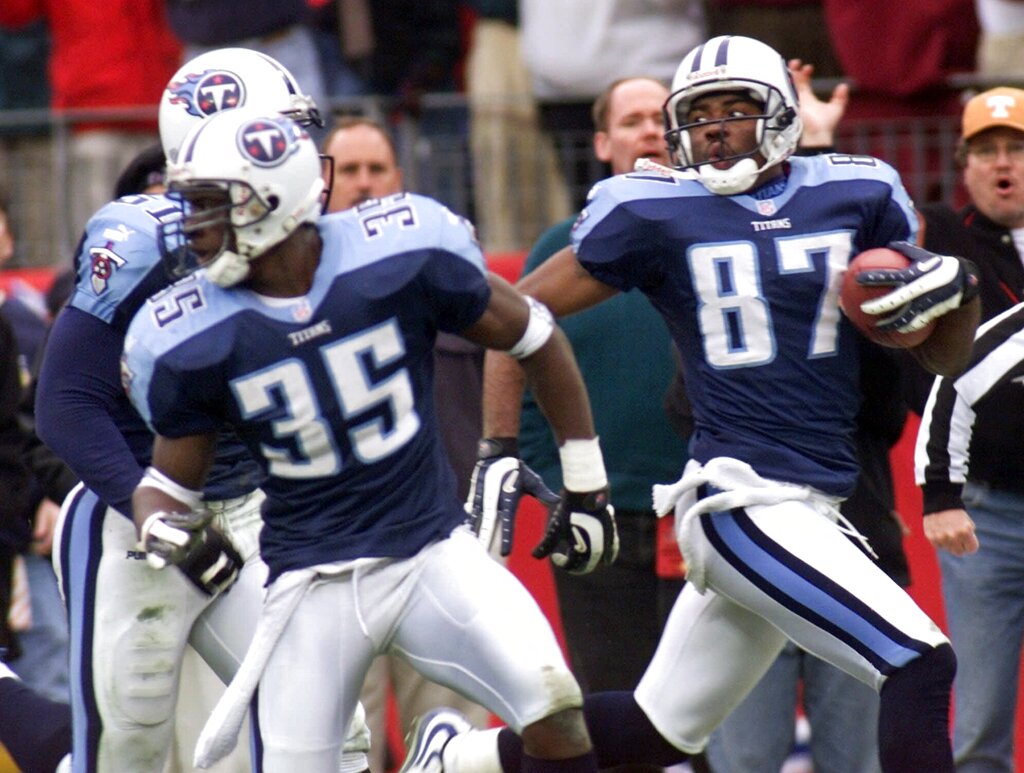
Running back John Henry Johnson played the 1966 season with the Oilers. Quarterback Ken Stabler played for them in 1980 and '81. Sammy Baugh was their head coach in 1964, Sid Gillman in 1973 and '74, and Dick LeBeau was an assistant coach for the Titans in 2015, '16 and '17. All 5 of these men are in the Hall, but all 5 are in for what they did with other teams.
Matthews was the 1st player in the Hall who ever suited up for the Titans. He has been joined by center Kevin Mawae (68, 2006-09, previously with the Jets), and 2 men who were with them for only 1 season: Receiver Randy (Moss (84, 2010) and guard Steve Hutchinson (73, 2012).
In 2000, on the franchise's 40th Anniversary, Bud Adams, the team's founder and still its owner, established the Titans/Oilers Hall of Fame. It includes all the retired number honorees, plus Blanda, Houston, George, McNair, 1989-93 general manager Mike Holovak, and 1995-2003 tight end Frank Wycheck (89). By a vote of the board of directors, not a decision by Adams himself, it also includes Adams. Therefore, counting only Tennessee Titans personnel, it includes only Adams, Matthews, McNair, Wycheck and George.
Nashville's a damn fine place to be, what with the music and the fantastic barbecue (no, it's not just Memphis) and the just-right amount of country. It's simultaneously small town and thriving city in the best possible way. It's going to be crushed when Marcus Mariota doesn't live up to the hype, but not THAT crushed because everyone cares way more about college, anyway.* Vanderbilt University. If there was an "Ivy League" for Southern schools, this school, founded by 19th Century railroad baron Cornelius Vanderbilt, would be one of them. It is superb academically, but those high standards have hurt it when recruiting athletes, who tend to go to less stringent schools, thus leaving Vandy, whose teams are called the Commodores after Cornelius' nickname, struggling within the Southeastern Conference in most sports. Their women's basketball team is an exception, but, even then, they are overshadowed by their neighbors in Knoxville, the University of Tennessee.
Dudley Field opened in 1922, but was demolished and replaced with Vanderbilt Stadium in 1981, although the playing surface is still called Dudley Field, for William F. Dudley, dean of the University's medical school and the founder of the precursor league to the SEC.
After leaving Houston following the 1996 season, the plan was for the Oilers to play at the Liberty Bowl in Memphis for 2 years, as the Tennessee Oilers, before moving to the new stadium in Nashville for 1999. But this was a public-relations disaster, as Memphians stayed away from Nashville's team in droves, heedless of the State's name on the team.
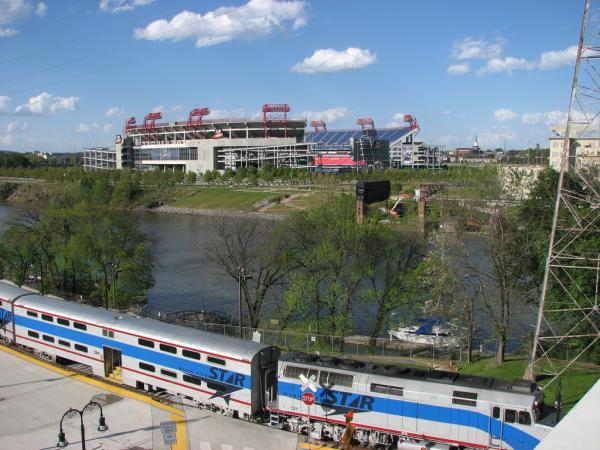
So after topping 32,000 in only 1 home game (the last, 50,677 seeing them beat the Pittsburgh Steelers to finish 8-8), and getting less than 18,000 in 2 of their games (the smallest NFL crowds since World War II, except for the Scab Year of 1987), Bud Adams took the hint, and swung a deal to play in Nashville a year early. Vanderbilt Stadium seated only 41,448 people, making it the smallest NFL stadium since the early 1960s, but they sold it out in 4 of their 8 games. The next year, they moved into what's now Nissan Stadium, and dropped the Oilers name to officially become the Tennessee Titans.
Vanderbilt Stadium is adjacent to Memorial Gymnasium, built in 1952 as a memorial to the servicemen and -women of World War II. It is unique in college basketball (although this was not he case when it opened) in that both teams' benches are behind one of the baskets. Other unusual touches, and its age (there are several Division I schools with older facilities still in use) have nicknamed it The Fenway Park of College Basketball. 210 25th Avenue South, about 2 miles west of downtown. Number 3 bus.
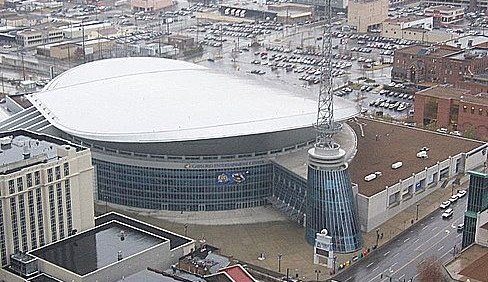
* Bridgestone Arena. The home of the NHL's Nashville Predators is downtown, with an official address of 501 Broadway, at 5th Avenue South. Across Broadway, on either side of 5th, are the Nashville Convention Center and the Ryman Auditorium, legendary home of
The Grand Ole Opry.
The Arena, easily identifiable with its sloping roof and its antenna at the north end, opened in 1996, with the generic name Nashville Arena. It was renamed the Gaylord Entertainment Center in 1999, after a locally-based media company that was a minority stockholder in the team. In 2005, Gaylord sold its stock, and in 2007 the arena was renamed the Sommet Center, after Sommet Group, a local company that oversaw software development and payroll services. But Sommet was a company built on fraud, its founder went to prison, and in 2010 locally-based tire company Bridgestone bought the naming rights, and holds them to this day.
The Arena has hosted Southeastern Conference Tournament, Ohio Valley Conference Tournament, and NCAA Tournament basketball -- in each case, both men's and women's. It hosted the Women's Final Four in 2014. The Country Music Association (CMA) Awards have been held there since 2006.
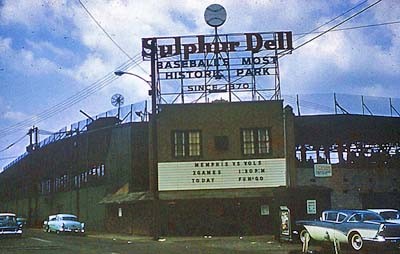
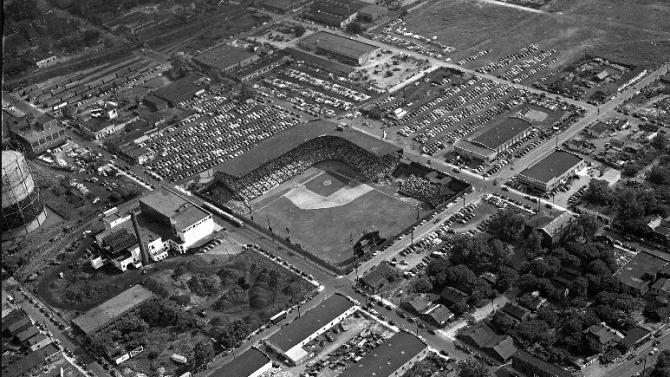
* First Tennessee Park and site of Sulphur Dell. The original home of Nashville baseball is its home once again. Sulphur Dell stood on the site from 1870 to 1969, but the original ballpark faced southwest, so the State House would be in view. This put the sun in the outfielders' eyes. Along with odors from a nearby dump wafting over, and the occasional flooding from the Cumberland River that forced some games to be moved to Vanderbilt University's field, this earned the stadium the nicknames "The Dump" and "Suffer Hell."
This wooden ballpark was demolished, and replaced with stadium of concrete and steel for the 1927 season. It seated 8,500 fans at its peak. But while the new park fixed the sun problem, it did nothing to get rid of the smell from the dump, and the shape of the plot of land forced a short right field fence with a terrace, much like Cincinnati's old Crosley Field and Houston's Minute Maid Park today. When the Yankees visited for an exhibition game, Babe Ruth refused to play his usual position of right field because of the little hill, and was moved to left field.

The team that played there the longest was called the Nashville Vols, short for "Volunteers," as the University of Tennessee (in Knoxville) calls its teams the Volunteers or the Vols, as Tennessee is known as the Volunteer State. They won Southern Association regular-season Pennants in 1901, 1902, 1908, 1916, 1940, 1943, 1948 and 1949; Playoffs for the SA title in 1939, 1940, 1941, 1942, 1943, 1944, 1949, 1950 and 1953; and the Dixie Series against the Champions of the Texas League in 1940, 1941, 1942 and 1949.

Hall-of-Famers who played for the Vols included Yankee pitcher Waite Hoyt and Pittsburgh Pirates slugger Kiki Cuyler. The 1940 Vols have been remembered as one of the greatest minor league teams. It featured future All-Star pitcher and Yankee World Champion Johnny Sain, former Detroit Tigers pitcher Cletus "Boots" Poffenberger going 26-9, and catcher Charles "Greek" George won the SA Most Valuable Player award. Unlike Sain, George he didn't play much in the major leagues, and after getting called up in 1945 due to the World War II manpower shortage, he punched an umpire during an argument and got unofficially blackballed from baseball. In his case, "Vol" might have been short for "Volatile."
The Negro Leagues' Nashville Elite Giants (who are best remembered today as the Baltimore Elite Giants, and that's pronounced EE-light, not El-EET) played at Sulphur Dell from 1920 to 1928, winning a Pennant in 1921.
The National Association, the governing body of minor league baseball, ordered that all leagues under its umbrella be desegregated for the 1962 season. Rather than comply, the Southern Association folded. The Vols, who valued staying in business over white supremacy, were inactive for 1962, but started again in the South Atlantic League for 1963. But they lost money, and folded.
Like the aforementioned Crosley Field, Sulphur Dell was used as a police impound lot, before being demolished in 1969 and being used as parking for State government buildings.
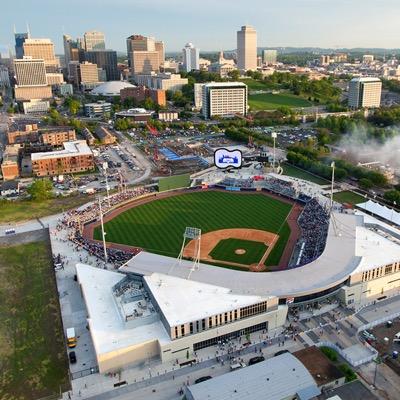
First Horizon Park, named for a bank, opened on the site in 2015, and the Nashville Sounds moved in. It seats 8,500 people, with grassy outfield seating pushing capacity to around 10,000. It has a view of downtown Nashville. And it copied the idea of a guitar-shaped scoreboard from Greer Stadium.
The old address was 900 5th Avenue North, but it's now listed as 19 Junior Gilliam Way, for the Nashville native who wore Number 19 as a Brooklyn/Los Angeles Dodgers player and coach. A mile from downtown, and several buses go there.
* Tom Wilson Park. Black businessman Thomas T. Wilson built a ballpark for the Elite Giants to use, and they did so from 1929 to 1934, before moving north. It seated 8,000 people, and was demolished sometime after 1946. 2nd Avenue S. and Chestnut Street, about a mile southeast of downtown. Bus 25.
* Herschel Greer Stadium. Named for the late former president of the Vols, this ballpark seats 10,300 people, with standing room pushing it to a possible 15,000, which made it one of the largest minor-league ballparks.
From 1978 to 2014, it was the home of the Nashville Sounds, who started out in the Double-A Southern Association, and moved to Triple-A, first to the American Association, and then, when that league was split up, to the Pacific Coast League. (Yes, I know, Tennessee is pretty far from the Pacific Coast.) The Sounds won Pennants there in 1979, 1982 and 2005, meaning that Nashville has won either a regular-season Pennant or a Playoff Pennant 17 times: 1901, '02, '08, '16, '39, '40, '41, '42, '43, '44, '48, '49, '50, '53, '79, '82 and 2005. (Compare this with Memphis' 10 and Knoxville's 3.)
The stadium was easily identifiable by its nod to Nashville being "Music City": A guitar-shaped scoreboard. But as Camden Yards and a series of new ballparks, in both the majors and the minors, rewrote the rules for what a baseball stadium should be in the 1990s, Greer Stadium began to be seen as outdated, and so a new park was built.
With the Sounds having moved out, its future is uncertain. 534 Chestnut Street, about a mile and a half south of downtown. The Adventure Science Center is next-door. Buses 8, 12 and 25 will get you to within a short walk.
The nearest Major League Baseball team is the Atlanta Braves, 246 miles away, with the Cincinnati Reds a little farther away at 272 miles. According to
an April 24, 2014 article in The New York Times, baseball fandom in Nashville is set by TV watching: The 3 most popular teams are the Braves, the Yankees and the Boston Red Sox, with some people rooting for the Braves and the Reds due to the comparative proximity.
The nearest NBA team is the Memphis Grizzlies, 213 miles away. But Nashvillians don't root for the Grizzlies, because of the inherent Intra-Tennessee rivalry. For those who care about the NBA at all,
according to a May 23, 2014 article in The New York Times, they tend to divide their fandom among the "cool teams": The Los Angeles Lakers, the Chicago Bulls, the Miami Former LeBrons, and the Cleveland Once-and-Again LeBrons.
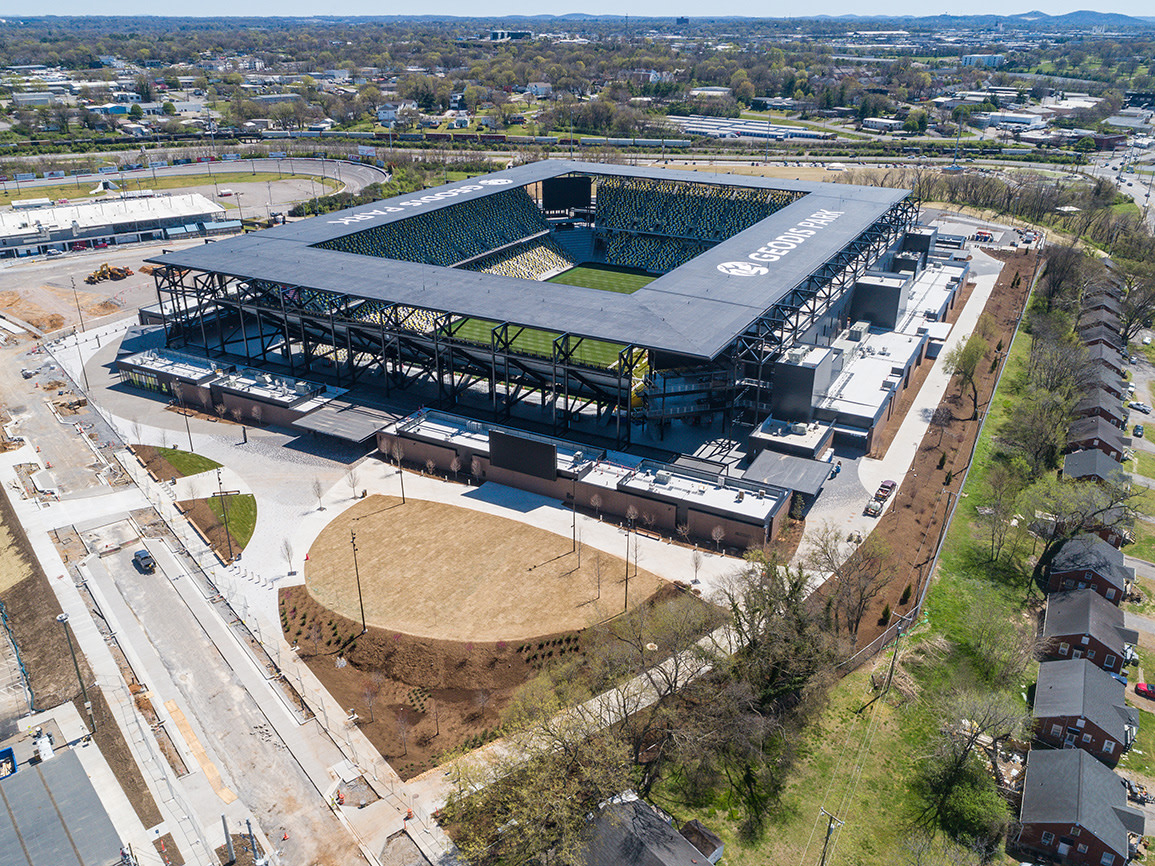
* Geodis Park. On December 20, 2017, Major League Soccer granted Nashville an expansion team. After playing the 2020 and '21 seasons as Nissan Stadium, this past May 1, Nashville SC (for "Soccer Club") moved into Geodis Park, a 27,500-seat stadium on the site of the Nashville Fairgrounds, 625 Smith Avenue, about 2 miles south of downtown. Bus 52 to Fairgrounds Station, then a half-mile's walk west on Walsh Road.
Previously, the city was home to Nashville FC, which played in the National Premier Soccer League, the 4th tier of American soccer, from 2014 to 2016, at Vanderbilt Stadium.
Don't expect Nashville to get teams in MLB or the NBA: The metro area would rank 28th in population among NBA markets, and it would rank 31st, dead last, in baseball.
* Tennessee State University. As with many of the South's historically black colleges and universities (HBCUs), Tennessee State was set up in a city that already had what was then an all-white school, Vanderbilt. Their teams are called the Tigers, and their women's track team the Tigerbelles. This team formed the bulk of the U.S. women's track teams at the Olympics in the 1950s and '60s, including Wilma Rudolph, winner of 3 Gold Medals in Rome in 1960.
TSU has won the National Championship of black college football 12 times: 1946, 1947, 1954, 1956, 1965, 1966, 1970, 1971, 1973, 1979, 1982 and 2013. In 1973, they were also NCAA College Division National Champions, what would later be called Division I-AA and is now the FCS, the Football Championship Subdivision. Their big names have included Pro Football Hall-of-Fame defensive ends Claude Humphrey and Richard Dent, 6-foot-9 Dallas Cowboys All-Pro defensive end Ed "Too Tall" Jones, and "Jefferson Street Joe" Gilliam, briefly the Pittsburgh Steelers' starting quarterback during a slump by Terry Bradshaw.
While they play 2 home games every season at the Titans' Nissan Stadium, their usual home field is the on-campus 10,000-seat Hale Stadium, named for the school's 1st president, William J. Hale. 3500 John A. Merritt Blvd., named for the man who coached both Jackson State (1952-62) and Tennessee State (from 1963 until his death in 1983). 3 miles west of downtown. Bus 60.
Since 1990, TSU have also played the annual Southern Heritage Classic against Mississippi's Jackson State University at the Liberty Bowl in Memphis -- which must have given Dent and his Chicago Bears teammate, Jackson State alumnus Walter Payton, some interesting conversations. Tennessee State leads the rivalry 17-9.
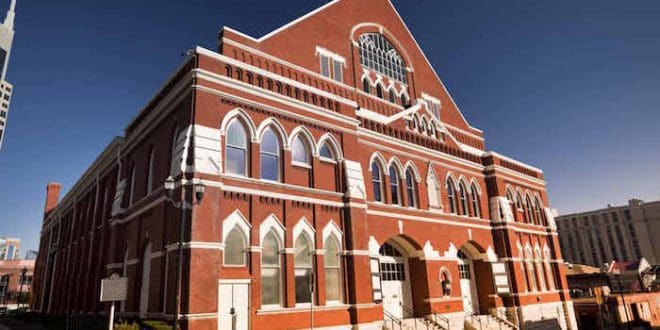
* Ryman Auditorium. If country music has a Yankee Stadium or a Madison Square Garden, this is it. The Mother Church of Country Music, a.k.a. the Carnegie Hall of the South, is easily the most 2nd-most famous building in the State of Tennessee, behind Graceland, the Memphis home of Elvis Presley, who performed at the Ryman very early in his career, on October 2, 1954. After this show, he went across the street and did another show at another famous musical institution, this one long owned by an established country star, the Ernest Tubb Record Shop, at 417 Broadway.
Opened in 1892, it began hosting the weekly Grand Ole Opry ("grand old opera") radio show on Nashville radio station WSM in 1943 (though the show had been broadcast since 1925). The Auditorium seats 2,362 people, and with stars announced ahead of time, there were occasions when thousands had to be turned away.
By the 1960s, the building had deteriorated, and complaints about the dressing rooms grew louder: The men had to share a small one, and the women had to use a restroom. Roy Acuff, often called the King of Country Music, bought an adjacent building just so he'd have a decent place to change. And a new house for the Opry was planned. A wooden circle was cut from the stage, and transplanted to the new Opry House, much like home plate or a square of sod is sometimes removed from an old ballpark and put in the new one.
"I never want another note of music played in that building," Acuff said. He had reason beyond his bitterness over the dressing room: He was a major stakeholder in Opryland USA. (He was a bit about the money: In 1948, he was the Republican nominee for Governor of Tennessee. He lost.) But he died in 1992, and, against heavy odds, the building survived him. Ed Gaylord of Gaylord Entertainment bought the building's parent company, and had it restored.
The Ryman reopened in 1994, with its main entrance moved from the west side on 5th Avenue to the east side on 4th, plus an addition that included, yes, suitable dressing rooms, and, for the first time in its 102-year history, air conditioning. In 2012, the original stage (all but a small portion of it, left for historical reasons) was replaced as part of new renovations.
The
Opry has returned every winter, while still broadcasting from its new home the rest of the year. ABC broadcast
The Johnny Cash Show live from the Ryman, and Cash -- whose birthday would have been today, February 26, were he still alive -- is among those country legends whose memorial service has been held there.
The revival of the Ryman has coincided with the revival of downtown Nashville, including the construction of the Arena, the Stadium, and the city's first real skyscrapers. 116 5th Avenue North.
* Nashville Municipal Auditorium. While Elvis had many recording sessions in Nashville, after 1954 he didn't give another concert in the city until July 1, 1973, a matinee and an evening show at the Municipal Auditorium.
Opened in 1962, it still hosts concerts and sporting events. It's hosted minor-league hockey, and had the Devils actually moved to Nashville for the 1995-96 season, it's likely they'd have played at the Auditorium for a year before what's now the Bridgestone Arena opened. 417 4th Avenue North, downtown, 3 blocks from the State House.
Elvis also performed in Eastern Tennessee at the City Auditorium in Paris on March 7, 1955; at the Civic Auditorium in Kingsport on September 22, 1955; and at the Stokely Athletic Center at the University of Tennessee in Knoxville on April 8, 1972; March 15, 1974; and May 20, 1977.
The Beatles never performed in Nashville as a unit, although individual members did so on their solo tours.
* Grand Ole Opry House. As with sports venues, the Opry decided in the 1960s to leave the city for the suburbs, and create a family atmosphere, even adding an amusement park. Opryland USA opened in 1972, and the Grand Ole Opry House in 1974. The oak circle from the Ryman stage was placed at center stage, and lead singers stand there.
The new theater (no longer so new) seats about 4,000, and had all the amenities that the Ryman did not yet have. I visited Nashville in 1991, before it became a major league sports city, and the group I was with visited Opryland USA and had a great time. But I wanted to see the Ryman. I knew I couldn't get inside, but I still wanted to reach out and touch the brick.
Of course, at this time, Camden Yards was rewriting the rules for stadium and arena construction, and cities took back their leadership role from the suburbs. Attendance dropped, and in 1997, Gaylord Entertainment closed the theme park. The Opry House remained in operation, and the Opry Mills shopping mall and the Opryland Resort & Convention Center opened on the site of the park in 2000.
When the Cumberland River flooded in 2010, my first concern should have been for the people -- and 31 people died, in 3 States -- but it was for the Ryman. Instead, it sustained only minor damage, while the Arena, the Stadium, and the Opry House all got socked, especially the Opry House. It was able to reopen in 6 months, while the show was broadcast from the Ryman and other Nashville locations. 433 Opry Mills Drive, about 9 miles east of downtown. Number 34 bus.
* Museums. Nashville isn't all about country music, although within a few steps of the Ryman (and the Arena) are museums dedicated to Johnny Cash (119 3rd Avenue S.) and George Jones (128 2nd Avenue N.), and the music in general at the Country Music Hall of Fame and Museum (222 5th Avenue S.).
The Tennessee State Museum depicts the State's history, including the Native America, colonial, early Statehood and Civil War periods. Its collection of Civil War memorabilia is one of the largest. It shares a downtown building with the Tennessee Performing Arts Center -- a boring-looking 1981 building that replaced its former home, the much more appropriate 1929 War Memorial Building. 505 Deaderick Street, between 5th & 6th Avenues.
There are 3 Presidents with connections to Tennessee. Al Gore should have made it 4, and he made enough mistakes that, if he had done any one of them differently, his rightful victory would have been too big to get stolen from him. But, like the 3 who actually did get into the White House, he wasn't born in Tennessee, but rather in Washington, D.C., when his father, Albert Sr., was a Congressman. (Both father and son would serve Tennessee in each house of Congress.)
As for the other 3, 2 were born in North Carolina, and the other might have been: Andrew Jackson was born somewhere near the Carolina State Line, although no one is sure precisely where, and both North and South Carolina claim him.
But the 7th President (serving from 1829 to 1837) and War of 1812 General nicknamed Old Hickory is best known, as far as his residences are concerned, for being one of the founding fathers of the State of Tennessee.
The Hermitage was a plantation he owned from 1804 until his death in 1845. On that property, he and his wife Rachel lived in a log cabin until the main house was completed in 1821. It burned in 1834, and he then had the current house built. Today, conspiracy theorists would have blamed Henry Clay or the Bank of the United States for the fire, even though Jackson himself didn't. (He did, however, blame his political opponents for the smears against both him and Rachel that gave her a heart attack that killed her between the 1828 election and the 1829 Inauguration.)
Aside from George Washington's Mount Vernon and Elvis' Graceland, it's the most-visited former private home in America. 4580 Rachels Lane, in the town of Hermitage, 12 miles east of downtown. It's on a section of the Cumberland River known as Old Hickory Lake. The Number 6 bus gets you to within a mile and a half, and the bus and the walk combined takes about an hour.
The State Capitol, which opened just before the Civil War in 1859, contains the tomb of James K. Polk, the 11th President (1845 to 1849), and his wife Sarah. The man who waged the Mexican-American War and gained us a huge chunk of our West, including all of California, he has been hailed as a visionary and assailed as a warmonger and a racist. He chose to serve only one term, and died just 3 months after leaving office, the shortest retirement of any ex-President. Sarah outlived him by 42 years, a record for a Presidential widow, and only Grover Cleveland's wife Frances, at 50 years, had a longer retirement from being First Lady. 600 Charlotte Avenue.
The other President with a Tennessee connection is Andrew Johnson, the 17th President, who succeeded to the office on the assassination of Abraham Lincoln in 1865, and was impeached for a ridiculous reason: He fired his Secretary of War (also Lincoln's), Edwin Stanton, without the permission of the Senate. He believed that the law barring him from doing so was unconstitutional, and when the aforementioned President Cleveland challenged it in 1886, the Supreme Court said they were both right. For all the good it did Johnson: Surviving his Senate trial by 1 vote, he knew he couldn't get elected on his own in 1868, got back into the Senate in 1874 (welcomed by the men who had tried him with a standing ovation), and died the next year.
He was an unrepentant racist, making it odd that Lincoln would choose him for the Vice Presidency in 1864 (it was because he was the only Southern Senator who stayed loyal to the Union when his State seceded), and he remains a contender for the title of worst President ever. His hometown of Greenville, Tennessee is 250 miles east of Nashville. His museum is at 67 Gilland Street. (Charlotte, North Carolina is actually the closest major league city to Greenville, but it's not close.)
There's actually a 4th President with a minor connection to Nashville: In 2008, Barack Obama and John McCain had the 2nd of their 3 debates at the Black Box Theatre at Belmont University. Compton Avenue at Belmont Blvd., about 3 miles southwest of downtown. Number 2 bus.
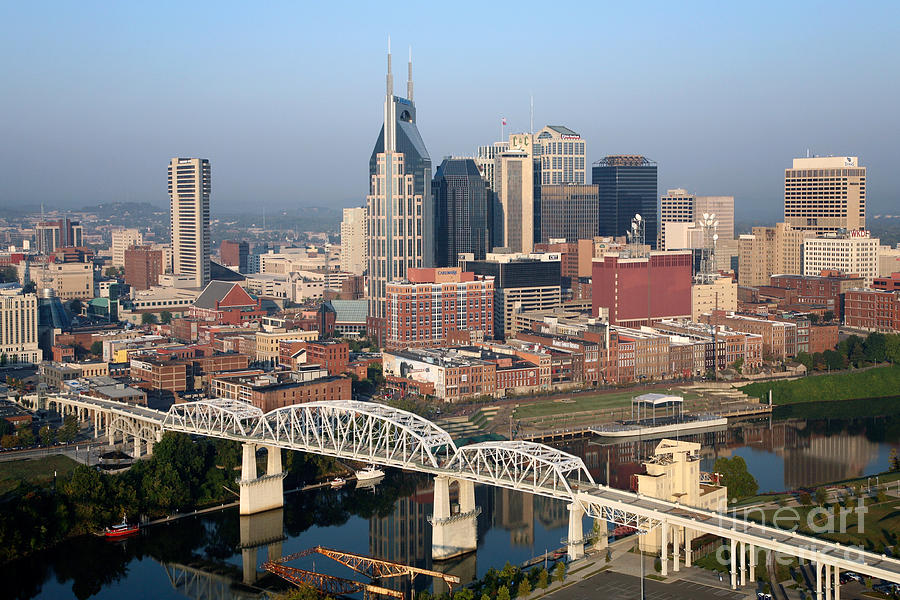
Five of the six tallest buildings in Tennessee are in Nashville, only one in the larger city (but not larger metro area) of Memphis. The tallest went up in 1994, but has already changed names with one phone-service company buying out another: The South Central Bell Building, the BellSouth Building, and now the AT&T Building. At 617 feet high, its twin-spired roof has led to it being nicknamed the Batman Building. 333 Commerce Street.
Many music-themed movies have used Nashville as both a setting and a film location, including biopics of Elvis (
Elvis, starring Kurt Russell), Patsy Cline (
Sweet Dreams, starring Jessica Lange) and Loretta Lynn (
Coal Miner's Daughter, starring Sissy Spacek). Each of these included the Ryman as a filming location. While the recent ABC TV drama
Nashville was filmed in Los Angeles, the 1975 film of the same title was filmed on location.
*