Showing posts with label 2020. Show all posts

Monday, September 26, 2022

How to Be a Red Bulls Fan In Columbus -- 2022 Edition

Next Sunday afternoon, the New York Red Bulls will go to Ohio to play the Columbus Crew. This was, for a time, not supposed to happen. The Crew's new ownership group wanted to move the team to Austin, Texas for the 2019 season.

But the #SaveTheCrew movement, well, #SavedTheCrew. On October 12, 2018, Cleveland Browns owner Jimmy Haslam announced that he was forming a group to buy the team, and MLS gave the Austin group an expansion team, Austin F.C. And the Crew won the 2020 MLS Cup.

This marks the 28th and last Trip Guide I needed for the 2022 MLS season. The circuit is complete.

Before You Go. Columbus can get really hot in the Summer, but this is late February, so, mid-Winter. The Columbus Dispatch website is predicting the low 70s for Saturday afternoon, dropping to the low 50s by nightfall. You won't need a jacket, but you might want to bring an umbrella: Rain is predicted for earlier in the day, but it should stop well before the 7:30 PM kickoff.

Columbus is in the Eastern Time Zone, so you won't have to set your clocks back.

Tickets. The Crew averaged only 14,162 fans per home game in 2019, the last pre-COVID season, which suggests that many fans still hadn't gotten over nearly losing the team. Which does beg the question: Why did Columbus get an MLS team? Why not Cleveland or Cincinnati, the more proven major league cities?

In the case of Cincinnati, it's probably because somebody thought that Cincinnati couldn't support a team by itself. As we have since seen with FC Cincinnati, that was a bad guess, for which MLS has now made up. As for Cleveland, native Drew Carey, a part-owner of MLS' Seattle Sounders, explained to me on Twitter (He is as nice as he seems to be on TV) that they didn't have a suitable stadium, and that they didn't want to have 50,000 empty seats in the Browns' new stadium.

Regardless of attendance, for the visiting fan, as at all MLS stadiums, a section is set aside for you. Fans of visiting teams are placed in Section 209, in the southwest corner of the upper deck. Tickets are $49.

Getting There. It's 536 miles from Times Square in New York to Capitol Square in Columbus, and 529 miles from Red Bull Arena to Lower.com Field. Flying may seem like a good option, but, this time, it's a bit expensive: To get a nonstop round-trip flight from Newark Liberty to John Glenn Columbus International Airport (formerly named Port Columbus International Airport) you'll have to shell out nearly $800. You could get it cheaper, but it wouldn't be nonstop.

Amtrak does not go to Columbus. Its main train station was demolished in 1979 to make way for the Columbus Convention Center (which is too bad, because it was just 2 blocks from where the Blue Jackets' Nationwide Arena ended up being built), and it is now the largest metropolitan area in America that doesn't have Amtrak access.

Greyhound's run between New York and Columbus is about 14 hours, with no change of buses necessary, costs $365, and dropping to as little as $212 with advanced-purchase. The station is at 111 E. Town Street, at 3rd Street, downtown, 2 blocks south of the State House.

If you decide to drive, it's far enough that it will help to get someone to go with you and split the duties, and to trade off driving and sleeping. You'll need to get on the New Jersey Turnpike. Take it to Exit 14, to Interstate 78. Follow I-78 west all the way through New Jersey, to Phillipsburg, and across the Delaware River into Easton, Pennsylvania. Continue west on I-78 until reaching Harrisburg. There, you will merge onto I-81. Take Exit 52 to U.S. Route 11, which will soon take you onto I-76. This is the Pennsylvania Turnpike, the nation's 1st superhighway, opening in 1940.

The Turnpike will eventually be a joint run between I-76 and Interstate 70. Once that happens, you'll stay on I-70, all the way past Pittsburgh, across the little northern pandhandle of West Virginia, and into Ohio all the way to Columbus.

If you do it right, you should spend about an hour and 15 minutes in New Jersey, 5 hours and 30 minutes in Pennsylvania, 15 minutes in West Virginia, and about 2 hours and 15 minutes in Ohio. That's about 9 hours and 15 minutes. Counting rest stops, preferably halfway through Pennsylvania and just after you enter Ohio, and accounting for traffic in both New York and Columbus, it should be no more than 11 hours, which would save you time on Greyhound, if not flying.

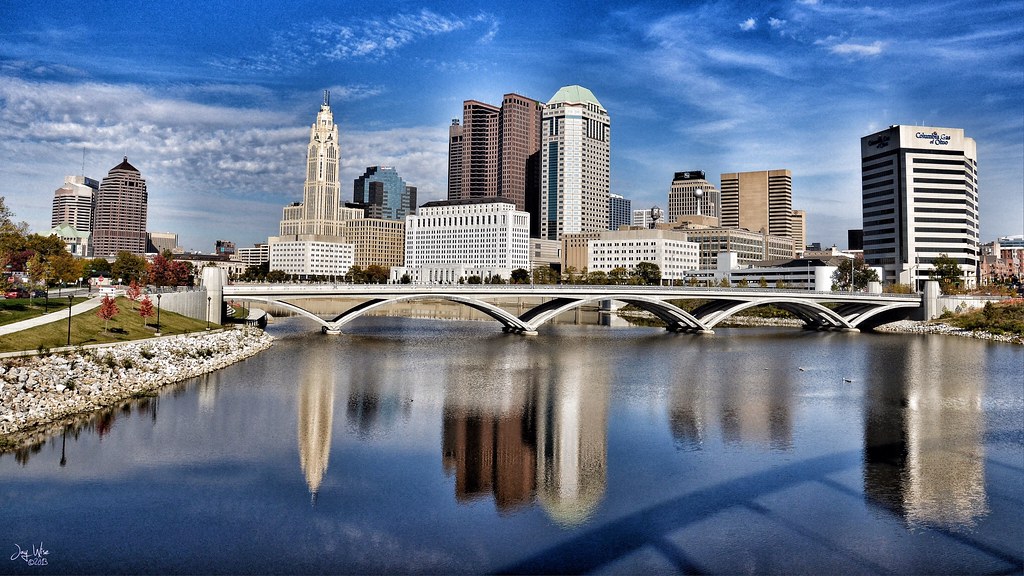
Once In the City. Founded in 1816, Columbus, named for Christopher Columbus, is easily the largest city in Ohio by population, with about 910,000 people, to a mere 381,000 for Cleveland and 309,000 for Cincinnati. But its metropolitan area has just 2.4 million people, still larger than Cincy's 3.0 million but considerably smaller than Cleveland's 3.6 million, because Cleveland has a much larger suburban area.

High Street is the street address divider between East and West, and Broad Street serving as the divider between North and South. The southeastern corner of High & Broad includes Capitol Square, with the State House. The sales tax in the State of Ohio is 5.75 percent, rising to 7.5 percent in Franklin County, including the City of Columbus.
The Ohio State House. No, I don't know why
they stopped building it before finishing the dome.

ZIP Codes in Columbus begin with the digits 432, and the Area Code is 614, with 380 overlaid. The Central Ohio Transit Authority (COTA) runs buses, with a $2.00 fare, but no rapid transit rail system: No subway, no elevated, no light rail, no commuter rail. Interstate 270 serves as a beltway, known as the Outerbelt or, for a local "sports" hero, the Jack Nicklaus Freeway.

The city government runs the electricity. The city is about 59 percent white, 28 percent black, 6 percent Hispanic and 4 percent Asian. Columbus has mostly been spared racial strife, although the nearby city of Springfield had race riots in 1904, 1906 and 1921.

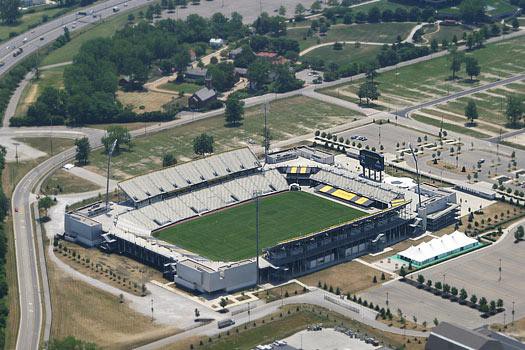
Going In. In 2021, Columbus Crew SC (Soccer Club) moved into the new Lower.com Field, named for a local real estate company. The address was 560 W. Nationwide Blvd., but has been relabeled 96 Columbus Crew Way, for the year of the team's founding. It's a mile and a half northwest of downtown, and is hard to reach by public transportation: Buses 1, 5 and 8 will get you to within half a mile of the stadium, but no closer. The stadium is 4 blocks west of the new minor-league baseball park, and 8 blocks west of the hockey arena. If you drive in, parking is $22.
Capacity is 20,371. As with Ohio Stadium and Historic Crew Stadium, the field is natural grass, and is aligned north-to-south. It's already hosted 2 matches of the U.S. men's national team, both wins in 2022 World Cup qualification matches: 2-1 over Costa Rica on October 13, 2021; and 1-0 over El Salvador on January 27, 2022. It's also hosted a match of the U.S. women's national team, a 9-1 win over Uzbekistan in a friendly on April 9, 2022.

Food. Being in Big Ten Country, where tailgate parties are practically a sacrament, you would expect the Columbus soccer stadium to have lots of good options. Unfortunately, the club website does not include a concessions map, so I can't tell you where these items are sold.

Levy Retail runs their concessions, as they do for all the athletic facilities at nearby Ohio State University. The stadium includes "Columbus staples": Schmidt's Sausage Haus, Jeni's Ice Cream, and Hot Chicken Takeover.

Team History Displays. The Crew won the MLS Cup in 2008 and 2020, and reached the Final in 2015. They won the Supporters' Shield in 2004, 2008 and 2009. They won the Lamar Hunt U.S. Open Cup in 2002, and reached the Final in 1998 and 2010. These achievements are shown in placards on the facing of the upper deck.
The Crew have no retired numbers, but for their 25th Anniversary, they chose an All-Time XI: Goalkeeper Will Hesmer; right back Robbie Rogers; centerbacks Chad Marshall and Mike Clark; left back Frankie Hejduk; midfielders Eddie Gaven, Brian Maisonneuve and Robert Warzycha; forwards Guillermo Barros Schelotto, Federico Higuain and Brian McBride; and coach Siegfried "Sigi" Schmid.

They have also featured several stalwarts of the U.S. national team, including McBride, Edson Buddle, Paul Caligiuri, John Harkes, Kyle Martino, and Brad Friedel, a goalkeeper from Ohio, who is also a member of the Greater Cleveland Sports Hall of Fame.

Lamar Hunt, one of the league's founders, and the Crew's founding owner (and, of course, better known as the founder of the American Football League and the Kansas City Chiefs), has a statue in his memory outside the stadium. As with the Chiefs, his son Clark Hunt now owns the Crew.
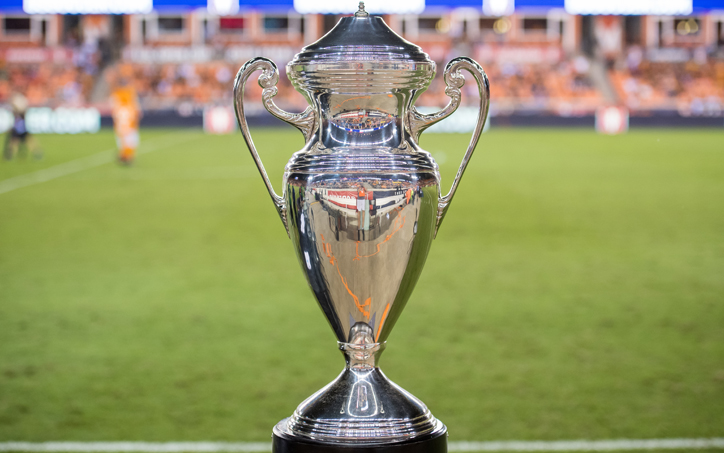
Because of Hunt's role in founding the league, the Crew, and FC Dallas, those 2 teams play each other for the Lamar Hunt Pioneer Cup. The Crew have won it 10 times to Dallas' 2.
The Lamar Hunt Pioneer Cup

Because the trillium is the State Flower of Ohio and the Provincial Flower of Ontario, the Crew and Toronto FC play each other for the Trillium Cup. The Crew have won it 8 times, TFC 7.
Columbus and Toronto players walk onto the field
past the Trillium Cup

With the entry of FC Cincinnati into MLS, there is now a cross-State rivalry, one which takes Southern Ohio out of the Crew's "market," which still includes Cleveland, and possibly, overcoming their States' usual antipathy toward Ohio, Pittsburgh and Detroit.

On June 13, 2017, FCC, then in the United Soccer League, played the Crew in a U.S. Open Cup match. Columbus fans heading down from the capital to the Queen City of the Midwest saw a sign at the side of the road on Interstate 71, reading, "HELL IS REAL."
The sign is real.

The Crew and their fans didn't go to Hell, but they did come home 1-0 losers in a game that meant far more to Cincinnati's fans. (Cincy got all the way to the Semifinals, losing to... the Red Bulls, who then lost the Final to Sporting Kansas City.)

Cincinnati won the 1st 2 regular-season MLS installments of the "Hell Is Real Derby," and the next was a tie. Cincinnati has not won since: The Crew now lead the rivalry, 5-2 with 4 ties.

Stuff. The Crew SC Shop is in the southeast corner of the stadium, in the Plaza, across from THE PUB. They sell the usual stuff you would find in an MLS team's gift shop, including jersey customization. Whether they sell yellow hard hats like the ones on their club badge, I don't know.

Unique among MLS teams -- unless you buy the San Jose Earthquakes' attempt to link themselves to previous teams that had that name, and even then, they're only the oldest in San Jose, not in the entire Bay Area -- the Crew are the oldest major league sports team in their metropolitan area. After more than a quarter of a century, they do have some history. 
Steve Sirk of The Columbus Dispatch has chronicled this in 2 books about the team: A Massive Season: Sirk's Notebook Chronicles the 2008 Columbus Crew; and Kirk Urso: Forever Massive: Memories from the 2012 Columbus Crew.

A DVD of the 2008 MLS Cup Final is also available -- but you don't want that, because the team they beat was the Red Bulls. (November 23, 2008, at what's now named the StubHub Center in Carson, California. It remains the furthest the Red Bulls have ever gone, though they have now matched that, and can beat it on Wednesday night.)

During the Game. The Cleveland-Cincinnati, the Cleveland-Pittsburgh, and the Ohio-Michigan rivalries do not come into play. (Indeed, the Pittsburgh Riverhounds are a Crew farm team.) In other words, a person living in Cleveland can have legitimate rivalries with Pittsburgh, and Cincinnati, and with Detroit/Ann Arbor, with no real inconsistency. But that's not that strange: A Yankee Fan can have Boston as a rival in baseball, Philadelphia in football -- and a Met fan can have it the other way around -- and another Tri-State Area team in hockey.

The Crew -- named in an attempt at both alliteration and the desire to appear "hard-working" -- do have regional rivalries with Cincinnati FC, the Chicago Fire and Toronto FC. But the Red Bulls aren't particularly rivals with the Crew. You should be safe in your club gear.

With their logo showing 3 men wearing hard hats, the Crew bill themselves as "America's Hardest Working Team." They are one of the few MLS teams to explain their badge on their club website. It's round, as are most German clubs' badges, due to Columbus' German heritage. It has an inner ring, making it look like an O for Ohio. It has diagonal stripes, to suggest upward movement. It has the number 96, to note their status as a charter MLS club in 1996. And it has a checkerboard pattern, as "a symbol of our passionate fans and their unwavering support."

(How a checkerboard pattern reflects that is a mystery to me. The University of Tennessee does that, but Columbus is pretty far from anywhere in Tennessee.)
Apparently, Crew Cat was a tomcat.

The Crew hold auditions for singing the National Anthem, as opposed to having a regular singer. For their 1st 19 seasons, their mascot was Crew Cat, but in 2015 he was replaced by S.C., who is billed as Crew Cat's son.
Previous mascot's son? Maybe. New? Definitely.
Improved? I don't know...

The north end of the stadium is home to the supporters' organizations, now collectively called the Nordecke -- German for "north corner." The groups include the Hudson Street Hooligans (HSH), the Crew Supporters Union (CSU), and La Turbina Amarilla (Spanish for "the Yellow Engine").

These groups tend to wave black and gold checkerboard flags, and also Ohio State Flags (not to be confused with Ohio State University flags) with the red, white and blue color scheme replaced with the Crew's black and gold.
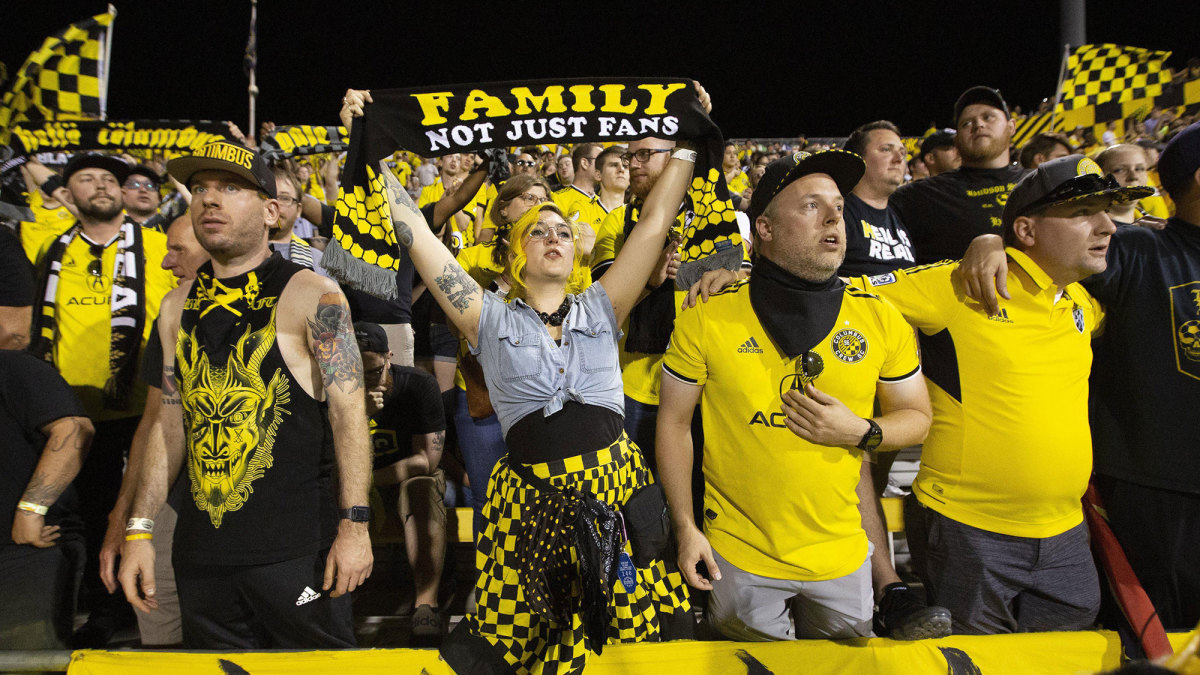
HSH are not actually hooligans, but they are, to borrow the word that first gained usage in Italy, "ultras." Their motto, "Ne Cum Pedicabo," is Latin for "Don't fuck with us." They spell it out on their website: "It is definitely an adult section, for the most diehard -- be warned." Message received: Visiting fans trying to "take" the section, as in the style of English hooligans of old, are in for an unpleasant surprise.

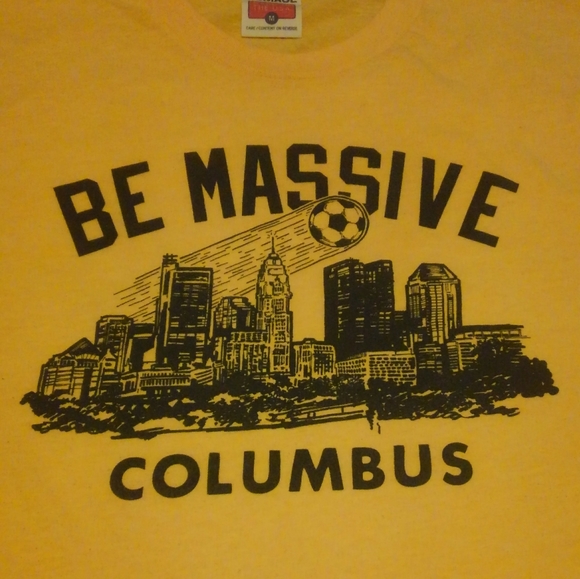
In 2003, at a time when Columbus was the smallest market in MLS, someone noted that Kevin Keegan, legendary as a Liverpool and Newcastle player but not so successful as a manager anywhere, had taken the Manchester City job and, in response to the hated Manchester United, called City "a massive club."

So Crew fans picked it up, and ran with the ironic word, until they won the 2008 MLS Cup and actually became, at least by North American standards, a massive club. Now, the word "Massive" goes on just about anything Crew-centric, and usually refers to the players' heart and the fans' passion.
Instead of the "O! H! I! O!" chant started at Ohio State, and picked up by funk band the Ohio Players and later by the Blue Jackets, the main chant is that of the city: "Co! lum! bus!" They do "When the Crew Go Marching In," "We love ya, we love ya, we love ya, and where you go we'll follow," "I Just Can't Get Enough," and a variation on a traditional English soccer chant: "I know I am, I swear I am, Columbus 'til I die!" And they roast their rivals, as many other teams do, to the tune of "My Darling Clementine":

Build a bonfire
build a bonfire
put Chicago on the top
put Toronto in the middle
and we'll burn the fucking lot!

They borrow from Elvis Presley with, "I can't help falling in love with Crew!" and the Beatles with, "We all cheer for the yellow soccer team!" and "Hey, Crew, don't make it bad... "

After the Game. The area is bounded by Interstate 670, a railroad, U.S. Route 33 and the Olentangy River. So it's not really in any neighborhood, much less a bad one. As long as you didn't instigate anything you (and, if you drove in, your car) should be safe.

As for where to go for a postgame meal or drink, you're better off walking a few blocks east, closer to the ballpark and the arena. If fast food isn't what you're looking for, you may have to get back to downtown Columbus.

The most famous bar, perhaps in the entire State of Ohio, is the Varsity Club, across from the OSU Ice Arena and 3 blocks north of Ohio Stadium. 278 W. Lane Avenue, at Tuttle Park Place. High Street, the eastern boundary of the OSU campus, has been described as "a zoo" on home football Saturdays, although that won't affect you as a visiting soccer fan.

I can find no references to places where New Yorkers gather in or around Columbus: The sites that usually list bars for football fans in exile don't seem to have references to where Yankees, Mets, Giants or Jets fans go when they live nearby.

Remember the York Steak House? There was one at the Brunswick Square Mall in East Brunswick, New Jersey, and I grew up a mile down the hill from it. There is only one left, and it is in Columbus. 4220 W. Broad Street, a.k.a. U.S. Route 40, at the interchange of I-270, across from the Westland Mall, 6 miles west of downtown. Bus 10.

If your Red Bulls visit to Columbus coincides with the European soccer season (this one doesn't), and you want to watch your favorite club while you're in town, you can try one of these:

* Manchester United, Chelsea and Bayern Munich: Fado, one of the few left in the chain. 4022 Townsfair Way. Number 16 bus. If you don't see your club listed (especially if it's not an English one), this is probably going to be your best shot.

* Arsenal: The Pointe Tavern, 1991 Riverside Drive, in Upper Arlington, 5 miles northwest of downtown. Bus 5 to 5th & Riverside, then a 10-minute walk.

* Liverpool: McClellan's Pub, 6694 Sawmill Road in Dublin, about 17 miles northwest of downtown. Bus 1, 2 or 11 to 5220 N. High Street, then Bus 33 to Dublin-Granville Road and Sawmill Road.

* Everton, Manchester City and Tottenham: Endeavor Brewing and Spirits (formerly named Zauber Brewing), 909 W. 5th Avenue at Delashmut Avenue. Number 5 bus.

Sidelights. Columbus may have only 1 major league team if you don't count MLS (and, by now, you should), but it's a decent sports town, and here's some of the highlights:

* Historic Crew Stadium. Formerly known as Columbus Crew Stadium and Mapfre Stadium, the 22,555-seat Columbus Crew Stadium when it opened in 1999. In 2014, naming rights were sold to a Spain-based insurance company. Mapfre the company (pronounced MAH-fray) doesn't spell its name in ALL CAPS, but the name of MAPFRE Stadium's name usually is. Capacity is now listed as 19,968. The Crew played their 1st 3 seasons (1996-98) before 90,000 empty seats at Ohio Stadium.
The official address is One Black and Gold Blvd., at 20th Avenue, about 3 1/2 miles north of downtown, near the Indianola Shopping Center. Number 4 bus, then a 15-minute walk: 2 blocks north on 4th Street, 2 blocks east on Hudson Street, then south on Silver Drive. 

America's 1st soccer-specific stadium, it was built at a cost of just $39.3 million -- and looks it. Ohio Stadium may have been vast, but it is an architectural marvel. MAPFRE Stadium is not: From the outside, and even a bit from the inside, it looks like an oversized high school football (gridiron) stadium. 

They won the MLS Cup in 2008, and reached the Final again in 2015, losing to the Portland Timbers despite playing at home. The Stadium also hosted the MLS Cup Final in 2001 (San Jose beating Los Angeles), 12 games of the U.S. National Team, and 6 games of the 2003 Women's World Cup (including a 3-0 U.S. win over North Korea). It's hosted the 2001 and 2003 NCAA men's soccer championships, high school football, and concerts.
Of those 12 USMNT games, 8 were wins, 3 were ties, and only 1 has been a loss. Of the 8 wins, 4 were against Mexico, all of them 2-0 or "Dos A Cero" wins. Unfortunately, the most recent USMNT game there was the 1 loss, to Mexico on November 11, 2016 in a World Cup Qualifying match that probably (and much too late) cost manager Jurgen Klinsmann his job. Previously, being 8-0-3 there, Columbus was a fortress for the Stars & Stripes, but arch-rival Mexico fears it no longer.
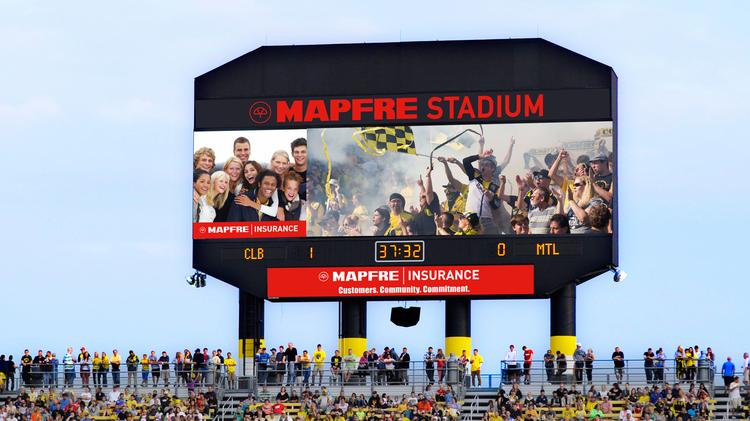
The U.S. women's team has played there 5 times, a draw against New Zealand and wins over North Korea, Japan, Thailand and, most recently, on March 1, 2018, Germany. It hosted 2 games of the 2009 CONCACAF Gold Cup. There have been 10 concerts at the stadium, 4 of them by country singer Kenny Chesney.

* Nationwide Arena. The Columbus Blue Jackets and their original home were inaugurated in 2000, about a mile northwest of the State House, in the Arena District, near the confluence of the Scioto and Olentangy Rivers, in an area that includes their minor-league ballpark and their Convention Center.
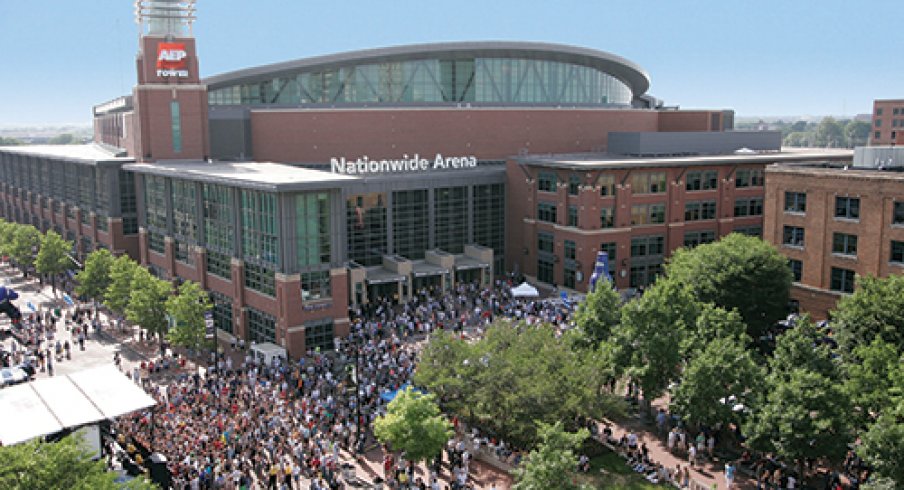
The Arena has hosted NCAA Tournament basketball, "professional wrestling" and concerts. Knowing of Ohio's pivotal role in national elections, President Barack Obama held one of his final 2012 campaign rallies, with Bruce Springsteen and Jay-Z performing.

Despite its youth, the Arena already has a tragic history. On March 16, 2002, 13-year-old Brittanie Cecil was struck in the head by a deflected puck during the Blue Jackets' game against the Calgary Flames, and died from her injuries 2 days later. As far as can be determined, she is the only fan in the NHL's nearly 100-year history to be killed in a game-related accident. As a result of her death, the NHL mandated safety netting around the goals in all its arenas.

The official address is 200 W. Nationwide Blvd. Several bus lines will get you there.

* Huntington Park. Just 2 blocks west of Nationwide Arena, at 330 Huntington Park Lane, this 10,100-seat stadium has been home to the International League's Columbus Clippers since 2009. Since moving in, they've won Pennants in 2010, 2011 and 2015, giving them a total of 10 Pennants.

* Cooper Stadium. Opened in 1932 as Red Bird Stadium, and renamed for Harold Cooper, the Franklin County Commissioner and team owner who kept professional baseball in the city in the 1950s, this stadium was one of the most successful ballparks in the minor leagues. It was also one of the largest, seating 17,500 people at its peak, and 15,000 in its last years.

Initially, it was home to the Columbus Red Birds, a farm team of the St. Louis Cardinals (also nicknamed the Redbirds), and to a Negro League team, the Columbus Blue Birds. The Red Birds won Pennants in 1933, 1934, 1937, 1941, 1942, 1943 and 1950.

The Cardinals moved them to Omaha in 1955, and a new team was brought in, the Columbus Jets, a farm club first of the Kansas City Athletics, then of the Pittsburgh Pirates. This led to the stadium being renamed Jets Stadium. They won the Pennant in 1961 and 1965, before being moved to Charleston, West Virginia after the 1970 season. The Pirates restored Columbus as their Triple-A team in 1977, the Yankees took over in 1979, the Washington Nationals in 2007, and the Cleveland Indians in 2009.

The Clippers were a Yankee farm team from 1979 to 2006, infamous as the bad end of "The Columbus Shuttle," George Steinbrenner's pipeline from Triple-A ball to the Yankees and back. As a Yankee farm team, they won IL Pennants in 1979, 1980, 1981, 1987, 1991, 1992 and 1996. All told, Columbus baseball teams have won 19 Pennants.

Cooper Stadium was closed after the 2008 season, but instead of being demolished, it has been converted into an auto racing facility. 1155 W. Mound Street, 3 miles west of downtown. Number 6 bus.

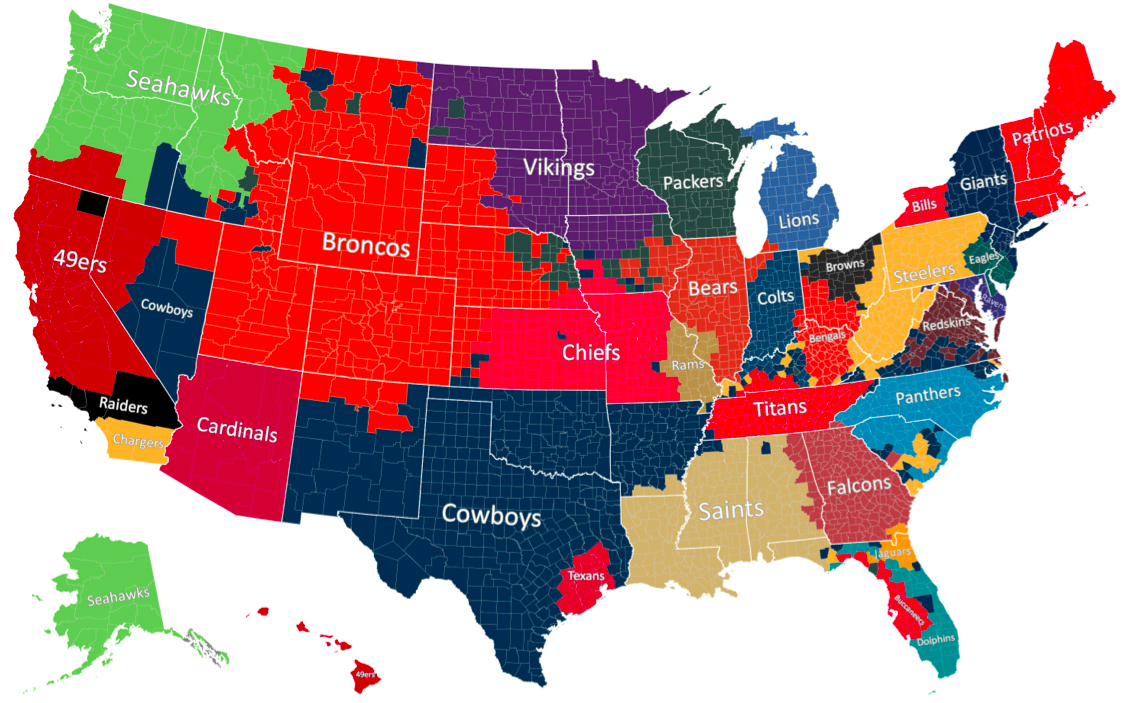
An April 24, 2014 article in The New York Times, showing baseball fandom by ZIP Code, shows that, despite being considerably closer to Cincinnati (107 miles) than to Cleveland (143 miles), the Indians still have a slight edge on baseball fandom in Columbus, on the average having 28 percent to the Reds' 22 percent. The September 2014 issue of The Atlantic Monthly had a similar map, showing that the Browns are more popular in Columbus than the Bengals.

Cincinnati is the nearest MLB and NFL city, while Cleveland is the nearest NBA city. If it had teams in those sports, Columbus would rank 29th in population in MLB, 26th in the NFL, and 25th in the NBA. So don't hold your breath.

* Ohio State. The most famous building in the State of Ohio is Ohio Stadium, or, as ABC Sports' legendary college football announcer Keith Jackson called it, The Big Horseshoe On the Olentangy -- home field of the school usually referred to as "THE... Ohio State University."

How big is it? The official seating capacity is currently listed as 104,944, making it the 4th-largest non-racing stadium in the world. 411 Woody Hayes Drive (formerly Woodruff Avenue), 3 1/2 miles north of downtown. Number 18 bus.
The Value City Arena at the Schottenstein Center opened in 1998, at 555 Borror Drive, across the Olentangy River from the Stadium. It hosted the NCAA's hockey Final Four, a.k.a. the Frozen Four, in 2005. On September 28, 2003, it hosted what turned out to be the last concert of The Three Tenors: Luciano Pavarotti, Placido Domingo and José Carreras. The Bill Davis Stadium (baseball) and the Jesse Owens Memorial Stadium (track & field) are part of this complex as well.

From 1956 to 1998, Ohio State played basketball at St. John Arena, across from the Stadium at 410 Woody Hayes Drive. It was at this arena that the Buckeyes played the 1959-60 season in which they won the National Championship. Coach Fred Taylor is in the Basketball Hall of Fame, along with 3 players on this team, although 1 is in as a coach: Jerry Lucas, John Havlicek, and "sixth man" Bob Knight.

It was also at St. John that Elvis Presley sang on June 25, 1974. Early in his carer, Elvis played 2 shows at the Franklin County Veterans Memorial Auditorium on May 26, 1956. Built in 1955, it was demolished in 2015, and the National Veterans Memorial and Museum has been built on the site. 300 W. Broad Street, on the Scioto River, at the foot of the Discovery Bridge, just across from downtown. (The Beatles played in Cleveland and Cincinnati, but not in Columbus.)

Columbus has never hosted an NCAA Final Four. Nor has any other Ohio city. The 13,435-seat University of Dayton Arena, built in 1969, 74 miles west of Columbus, has hosted more NCAA Tournament games than any other facility: 107.

* Indianola Park. Home ground of the Columbus Pandhandles, one of the 1st professional football teams, from 1901 to 1926, before the glut of early pro football doomed them. Along with the Canton Bulldogs, in the 1910s they dominated the Ohio League, one of the NFL's predecessors.

They are best remembered for the 7 Nesser brothers (sons of German immigrants, there were 8, but Pete, 1877-1954, the largest of them, didn't like football and didn't play; there were also 4 sisters): John (1875-1931), Phil (1880-1959), Ted (1883-1941), Fred (1887-1967), Frank (1889-1953), Al (1893-1967) and Ray (1898-1969).

Knute Rockne, who did play a little pro football before going back to Notre Dame to coach, said, "Getting hit by a Nesser is like falling off a moving train." In 1921, Ted's son Charlie (1903-1970) played with the Panhandles, marking the only time a father and son have played in the NFL at the same time, let alone for the same team.

The Indianola Shopping Center is now on the site, 3 miles north of downtown. 1900 N. 4th Street at 19th Avenue. Number 4 bus.

Currently without an NBA team, a May 12, 2014 article in The New York Times shows basketball allegiances in the Columbus area are mixed between the Cleveland Cavaliers and the Miami Heat. But once you get into the suburbs, it becomes more Cavs territory. My guess: Ohio State students from elsewhere, some of whom end up staying in Columbus, stick with their old home teams; while some stick with LeBron James (who's played for both the Cavs and the Heat), and some adopted the Cavs regardless of LeBron.

Ohio Village is a recreated 19th Century community, sort of an updated, Midwestern version of Colonial Williamsburg. 800 E. 17th Avenue, at Velma Avenue. Number 4 bus. The Columbus Museum of Art is at 480 E. Broad Street, at Washington Avenue. Number 10 bus. The Center of Science & Industry (COSI) is across from the Veterans Memorial Auditorium site, at 333 W. Broad Street, at Washington Blvd. Number 10 bus. The James Thurber House, home to the legendary author and humorist, is at 77 Jefferson Avenue, at N. 11th Street. Number 6 bus.

Farther afield -- with no public transportation available -- the Armstrong Air & Space Museum is in the hometown of Neil Armstrong, the late 1st man to walk on the Moon. 500 Apollo Drive in Wapakoneta, just off Interstate 75, 87 miles northwest of downtown Columbus.

No Presidents have come from Columbus, but Rutherford B. Hayes and William McKinley lived there while they were Governor of Ohio. Alas, there was no official Governor's Mansion during their times in that office. The Ohio Governor's Residence and Heritage Garden has only been the Governor's Mansion since 1957. 358 N. Parkview, in Bexley, about 4 miles northeast of downtown. Number 10 bus.

McKinley's historical sites are all in or near his hometown of Canton, and I'll discuss them in my Cleveland trip guides. Hayes' home, Spiegel Grove, and his grave and Presidential Library are in Fremont, 106 miles north of Columbus. Warren G. Harding's hometown of Marion is 51 miles north. Dying in office in 1923, he remains the last President to have lived in Ohio. As with both locations, there is no public transportation to there from any of Ohio's major cities.

Marion was also the official hometown of the Oorang Indians, a pro football team made up entirely of Native Americans, led by Hall-of-Famers Jim Thorpe and Joe Guyon. The problem wasn't that some of the players used their Native names, which included animal names like Ted Buffalo, Gray Horse, Big Bear, Eagle Feather and War Eagle. The problem is that they were party animals, not getting the rest they needed. As quarterback Leon Boutwell noted:

White people had this misconception about Indians. They thought they were all wild men, even though almost all of us had been to college and were generally more civilized than they were. Well, it was a dandy excuse to raise hell and get away with it when the mood struck us. Since we were Indians we could get away with things the whites couldn't. Don't think we didn't take advantage of it.

As a result of their wild ways, they went 3-6 in 1922, and 2-10 in 1923, and folded. I say Marion was their official hometown because they were a "traveling team," playing just 1 of their 21 games in Marion.

The Armstrong Air & Space Museum was built to honor Neil Armstrong, the 1st man to walk on the Moon, in his hometown of Wapakoneta, Ohio. The building is, naturally, shaped like a crescent moon. 500 Apollo Drive, 185 miles southwest of Cleveland, 93 miles southwest of Toledo, and 88 miles northwest of Columbus.

The tallest building in Columbus is the Rhodes State Office Tower, named for the longtime Governor who ordered the Ohio National Guard to fire on the protestors at Kent State University on May 4, 1970. Completed in 1974, it is 629 feet high, and every bit as ugly as the Administration it memorializes. 30 E. Broad Street, downtown, across from the State House.

While lots of movies have been shot and/or set in Ohio, Columbus hasn't been a popular location for them. There have been 3 TV shows set in Columbus: Family Ties, the 1982-89 NBC sitcom that introduced us to Michael J. Fox; Hope & Faith, a sitcom that ran on ABC, 2006-09; and Man Up!, an ABC sitcom set in nearby Gahanna that tanked and was canceled after 13 episodes in 2011.

Lima, the real town that was the setting for the Fox drama Glee, is 92 miles northwest of downtown Columbus. Further northwest, 152 miles from Columbus, is Sherwood, which was used as the setting for the film Heathers, with the oh-so-Middle American town's high school ironically named after Paul Westerburg, lead singer of the alternative rock band The Replacements. But both Glee and
Heathers were filmed completely in Southern California.

*

The Columbus Crew was the 1st franchise officially awarded by MLS, on May 10, 1994, beginning play in the league's 1st season, 1996. It has been saved for a 24th season, and beyond. They will continue to be a Red Bulls opponent for a long time to come.

As a Red Bulls fan, you can still go to Columbus, and have a Massive time.

Sunday, May 1, 2022

How to Be a New York Soccer Fan In Nashville -- 2022 Edition

As it happens, this season, neither of the New York Tri-State Area's Major League Soccer teams plays the new Nashville SC franchise. Not at home, nor away.

But I've never done a trip guide for Nashville SC: They began play in 2020, but neither team visited due to COVID restrictions. Nor did either team visit in 2021, because of the way the schedule worked out. But I'm doing it this time, and on this day, simply because many of the details will be the same as for the Grizzlies.

So, with their new stadium opening today, May 1, this guide will be a simulation of a proposed Red Bulls roadtrip to Nashville for this coming Saturday, May 7. Note that NSC currently have former Red Bulls star Dax McCarty on their roster.

Before You Go. Nashville is in the South. Not the Deep South, but the Mid-South. However, Tennessee rejoined the Union a long time ago, and you won't need to bring a passport or change your money.

If you were going to a baseball game, or an early-season football game, the heat might be an issue. But this will be at the beginning of December, so heat won't be a factor. The website of Nashville's main newspaper, The Tennessean, is predicting the low 70s for daylight and the mid-50s for night.  They're calling for rain the 3 days before the game, but not for the day of.

Nashville, like most (but not all) of Tennessee, is in the Central Time Zone, an hour behind us. Adjust your timepieces accordingly.

Tickets. NSC have never played a season unaffected by COVID, so the available attendance figures are completely unreliable. Fortunately, this is MLS, where seating sections are set aside for visiting fans. In their case, this will be in Section 212. Tickets will be $21.

Sections 120 to 127 are reserved for home supporters, so you'll want to stay away from those, even if you could get tickets there.

Getting There. It's 892 miles from Midtown Manhattan to downtown Nashville, and 876 miles from the Red Bull Arena to Geodis Park. So your first instinct would be to fly.

This looks like a good idea, because a round-trip flight could cost just a shade over $300. But it probably won't be nonstop: You will have to change planes, probably in Charlotte. Nashville International Airport is 8 miles east of downtown, and the Number 18 bus can get you to downtown in under half an hour. (The airport was originally named Berry Field, after Colonel Harry S. Berry, the Tennessee administrator for the New Deal's Works Progress Administration.)

You can't take Amtrak: It doesn't serve Nashville. Greyhound can get you from New York to Nashville in a little under 30 hours, for $634 round-trip, although it could drop to as little as $400 with advanced purchase -- on this occasion, more than flying -- although you'd have to change buses in Richmond. The Greyhound station is at 709 5th Avenue South, 5 blocks south of the arena.

If you do drive, it's far enough that you should get someone to go with you, to trade off, especially if one can sleep while the other drives. Get into New Jersey, take Interstate 78 West into Pennsylvania. At Harrisburg, get on Interstate 81 South, and take that down through Maryland, West Virginia and Virginia, into Tennessee, where it flows into Interstate 40 West. Take that halfway across Tennessee. Exit 210 is for downtown.

If all goes well, you should spend a little over an hour in New Jersey, 2 hours and 45 minutes in Pennsylvania, 15 minutes in Maryland, half an hour in West Virginia, 6 and a half hours in Virginia, and 2 hours and 45 minutes in Tennessee, for a total of 13 hours and 45 minutes. Given rest stops in Pennsylvania, one at each end of Virginia, and 1 in Tennessee, and we're talking about a trip of at least 17 hours -- each way.

Once In the City. Founded in 1779, and named for General Francis Nash, killed in the Battle of Brandywine outside Philadelphia in the War of the American Revolution, Nashville is in central Tennessee. It is the State capital, home to 716,000 people with a metropolitan area of just under 2 million.
The State House, formerly featured on Tennessee license plates.
That statue of Andrew Jackson, Tennessee pioneer,
has copies in Washington across from the White House,
and in downtown New Orleans.

"White flight" hasn't hurt Nashville nearly as much as it's hurt Memphis or many other cities, North and South alike. As late as 1970, Nashville was 80 percent white; in 1990, 74 percent. Now, it's about 56 percent white, 28 percent black, 10 percent Hispanic, 4 percent Asian and 1 percent Native American. While Nashville was spared the kind of post-Civil War racial violence that Memphis suffered in 1866, when Martin Luther King was assassinated in Memphis in 1968, Nashville suffered some looting.

The sales tax in Tennessee is 7 percent, and within Davidson County, including Nashville, 9.25 percent, even higher than New York's. ZIP Codes for the Nashville area start with the digits 370 to 374, and 384 and 385. The Area Code for Nashville is 615. Nashville Electric Service (NES) runs the utilities for most of Middle Tennessee.

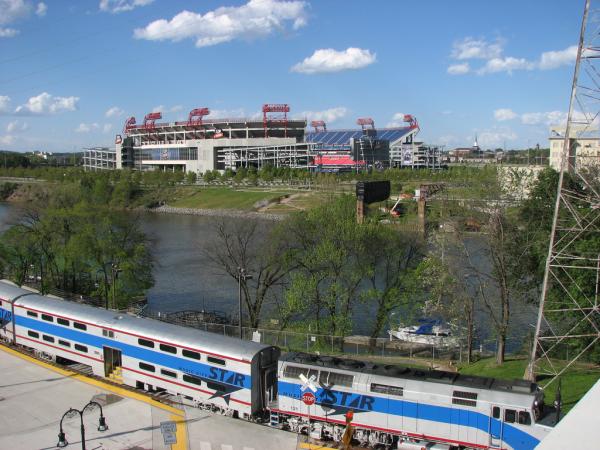
Address numbers on east-west streets increase away from the Cumberland River, and Broadway separates north from south. The The Nashville Metropolitan Transit Authority (NMTA) runs buses, with a $1.75 fare, and the Music City Star, a commuter rail service to the city's eastern suburbs, with a fare double that, $3.50.
The Music City Star, with Nissan Stadium,
home of the Titans, in the background

Going In. On December 20, 2017, Major League Soccer granted Nashville an expansion team. The main honor is publishing mogul John Ingram, although actress Reese Witherspoon and Tennessee Titans star Derrick Henry are also part-owners.

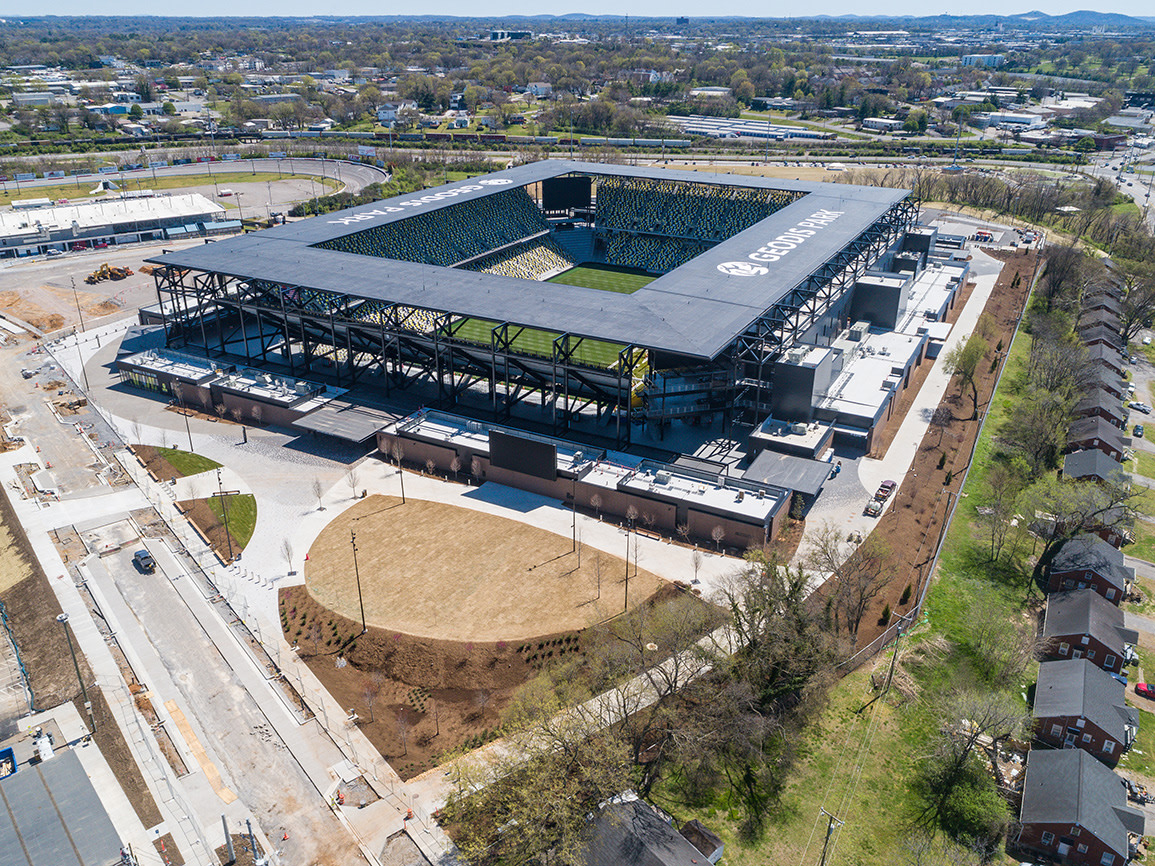
After playing the 2020 and 2021 seasons at Nissan Stadium, they are moving into GEODIS Park, a 30,000-seat stadium on the site of the Nashville Fairgrounds. The address is 625 Smith Avenue, about 2 miles south of downtown. Bus 52 to Fairgrounds Station, then a half-mile's walk west on Walsh Road. If you drive in, parking is $20.
GEODIS, a French-based logistics company, bought the naming rights in March 2020. The field runs north-to-south, and is natural grass.


Food. Memphis has a reputation as a city of fine Southern food, particularly barbecue. Nashville, less so: They're known for music first, and food, and everything else, somewhere down the line. Although, in the last few years, "Nashville Hot Chicken" has become popular nationwide.

The west stand of GEODIS Park appears to be all club seating, with no concession stands. The rest of the place has them, though:

* Sections 1C and 14S: Daddy's Dogs. Hot dogs.
* 2C, 10S and 22S: HIVE Cocktails.
* 3C, 8C, 10C, 14C and 4S: Heineken Bar.
* 4C and 18S: Rockin' Dough, which sounds like a baked goods/pastries stand.
* 5C: Gyros.
* 6C: Fat Bottom. This is a local beer.
* 7C, 12C and 11S: Lo Siento Tequila.
* 9C: Tender Love N' Cheese. Chicken tenders with cheese sauce? Sounds good to me.
* 11C and 23S: Tempo's Favorites. I have no idea of what this is.
* 13C: Mid TN Melts. This could be the "futuristic ice cream" also known as Dippin' Dots, Mini Melts, IttyBittz and Molli Cools.
* 15C and 7S: Central BBQ.
* 1S: The Sweet Note. Could be candy, could be ice cream, could be both.
* 2S: Nash Knots and Dogs. Garlic knots? Maybe. Pretzels? Maybe. Hot dogs? Probably.
* 3S and 17S: Alebrije Tacos.
* 5S, 8S and 13S: Mapco Market. Could be a general stand.
* 6S: Wedgewood Avenue Grill. Probably burgers and/or chicken.
* 9S: Prince's Hot Chicken. I'm presuming it has nothing to do with Prince the musician, who liked hot things, but was from Minneapolis.
* 12S: Corner Pub.
* 15S: Cumberland Crafts. It's a concession stand, selling craft beer, not "arts and crafts."
* 16S: Alebrije Frescos. Probably Mexican beer.
* 19S: Chivanada. Also sounds Mexican.
* 20S: The Global Stage. "Beers of the World," perhaps?
* 21S: Houston Street Grill. See 6S.

Team History Displays. Here's their history: They've played 2 seasons, and, in both, reached the Quarterfinals of the MLS Cup Playoffs.

Stuff. The Team Store is in the northeast corner of the stadium, between Gates B and C, on Benton Avenue.

While there are many books and films about life in Nashville, especially in regard to the country music industry, there are, as yet, none about Nashville SC.

During the Game. Nashville people don't like Memphis people. And Tennessee people don't like Arkansas, Alabama, and Florida people -- holdovers from college football rivalries. But Titans fans have nothing against Jets or Giants fans. So as long as you don't make any wiseguy remarks about this being a North vs. South game, you shouldn't face anything beyond the usual nonviolent "My team rocks, your team sucks" talk.

According to the Backline website: "The Backline is a collective of all the supporters groups that purpose to cheer on Nashville SC and grow soccer in Nashville. It is an organizing structure that allows us to host better tailgates, have better match day experiences, and communicate clearly with the club. We are the first supporters group to ever follow and support Nashville SC (then 'FC') and we are overjoyed to see so many joining the voice that is The Backline.

"This great tradition started when Jessica, one of The Roadies (a supporters' group), mistakenly thought one of the linesmen was named Gary. It stuck. We’ve confused many a linesman with this. Now all officials are named Gary, no matter their gender."

They do the familiar chant, "We love ya (3 times), and where you go, we'll follow (3 times)... " and the Spanish, "Vamos, vamos Nashville... " They also do the "Build a Bonfire" chant, and have chosen FC Cincinnati to put in the middle.

The mascot is Tempo the Coyote. There are auditions for National Anthem singers, instead of a regular. The organization have teamed up with the Nashville-based alternative rock band Judah & the Lion to create the official club anthem titled "Never Give Up On You."
After the Game. If there was an MLS team in Memphis, Nashville fans wouldn't like them. But they've never been known to turn on New Yorkers or New Jerseyans. Red Bulls (and NYCFC) fans shouldn't get any hassling, as long as they aren't the ones to bring it on.

Being in Nashville, there are plenty of places to go for a postgame libation. Just don't call it a "libation" when you're in one, or you might get some funny looks. And the Fairgrounds area is still in redevelopment, so you may have to go downtown to celebrate, or commiserate.

I could find no place in Nashville catering to fans of any Tri-State Area team: Not the Yankees, the Mets, the Giants, and so on... and certainly not the Red Bulls.

If you visit Nashville during the European soccer season, which we are now in, the best place to watch your local club is Fleet Street Pub, 207 Printers Alley, off Church Street between 3rd and 4th Streets downtown.

Sidelights. Nashville is about music 1st, Tennessee State government 2nd, and sports 3rd. But it's a good sports town, even though it's never had an MLB or an NBA team. On February 3, 2017, Thrillist made a list ranking the 30 NFL cities (New York and Los Angeles each having 2 teams), and Nashville came in 2nd. They said: 

Nashville's a damn fine place to be, what with the music and the fantastic barbecue (no, it's not just Memphis) and the just-right amount of country. It's simultaneously small town and thriving city in the best possible way. It's going to be crushed when Marcus Mariota doesn't live up to the hype, but not THAT crushed because everyone cares way more about college, anyway.

On November 30, 2018, 5 days after I posted this, Thrillist published a list of "America's 25 Most Fun Cities," and Nashville came in 16th. 

* Nissan Stadium, whose naming rights are currently owned by the Japanese carmaker, has been the home of the Tennessee Titans since it opened in 1999. It was known as the Adelphia Coliseum until 2002, simply The Coliseum until 2006, and LP Field until 2015.

The official address is 1 Titans Way, across the Cumberland River from downtown, bordered by Russell Street on the north, S. 2nd Street on the east, Victory Avenue on the south and Titans Way and the River on the west. There's no bus service, but it accessible from downtown by taking the Music City Star to Riverfront Station, and then walking across the John Siegenthaler Pedestrian Bridge, which makes for a great visual on Titans gamedays.
The 69,000-seat stadium has seen the Titans win the AFC Championship in its inaugural season, and nearly win Super Bowl XXXIV, and Division titles in 2000 (the old AFC Central), 2002 and 2008 (the new AFC South). Tennessee State University, a historically-black school in Nashville, splits its home games between the stadium and an on-campus facility. The stadium also hosts the annual Music City Bowl, and concerts, including the CMA Music Festival every June.

It's also been a soccer facility, including hosting the U.S. national team in a 1-0 loss to Morocco in a friendly on May 23, 2006; a 3-0 win over Trinidad and Tobago in a World Cup Qualifier on April 1, 2009; a 1-0 loss to Paraguay in a friendly on March 29, 2011; and a 4-0 win over Guatemala in a friendly on July 3, 2015. That game was riddled by operational and logistical issues, with the Twittersphere exploding with discussions of the stadium's inadequacy even before kickoff.

Since then, 2 more USMNT games and 1 U.S. women's national team (USWNT) game have been played there, without similar issues: A 1-1 draw with Panama in the CONCACAF Gold Cup on July 8, 2017, and a 1-0 in over arch-rival Mexico on September 11, 2018. The women's team played a game of the She Believes Cup there, beating France 1-0 on March 6, 2016.

It has now hosted the CONCACAF Gold Cup for 2 games in 2017, and 1 in 2019. The U.S. women's team played a SheBelieves Cup match there on March 2, 2019, a 2-2 draw with England. It has been selected by the U.S. Soccer Federation as a finalist to be one of the host venues for the 2026 World Cup.

* Vanderbilt University. If there was an "Ivy League" for Southern schools, this school, founded by 19th Century railroad baron Cornelius Vanderbilt, would be one of them. It is superb academically, but those high standards have hurt it when recruiting athletes, who tend to go to less stringent schools, thus leaving Vandy, whose teams are called the Commodores after Cornelius' nickname, struggling within the Southeastern Conference in most sports. Their women's basketball team is an exception, but, even then, they are overshadowed by their neighbors in Knoxville, the University of Tennessee.

Dudley Field opened in 1922, but was demolished and replaced with Vanderbilt Stadium in 1981, although the playing surface is still called Dudley Field, for William F. Dudley, dean of the University's medical school and the founder of the precursor league to the SEC.
Vanderbilt's athletic complex

After leaving Houston following the 1996 season, the plan was for the Oilers to play at the Liberty Bowl in Memphis for 2 years, as the Tennessee Oilers, before moving to the new stadium in Nashville for 1999. But this was a public-relations disaster, as Memphians stayed away from Nashville's team in droves, heedless of the State's name on the team.

So after topping 32,000 in only 1 home game (the last, 50,677 seeing them beat the Pittsburgh Steelers to finish 8-8), and getting less than 18,000 in 2 of their games (the smallest NFL crowds since World War II, except for the Scab Year of 1987), Bud Adams took the hint, and swung a deal to play in Nashville a year early. Vanderbilt Stadium seated only 41,448 people, making it the smallest NFL stadium since the early 1960s, but they sold it out in 4 of their 8 games. The next year, they moved into what's now Nissan Stadium, and dropped the Oilers name to officially become the Tennessee Titans.

Vanderbilt Stadium is adjacent to Memorial Gymnasium, built in 1952 as a memorial to the servicemen and -women of World War II. It is unique in college basketball (although this was not he case when it opened) in that both teams' benches are behind one of the baskets. Other unusual touches, and its age (there are several Division I schools with older facilities still in use) have nicknamed it The Fenway Park of College Basketball. 210 25th Avenue South, about 2 miles west of downtown. Number 3 bus.

* Bridgestone Arena. The home of the NHL's Nashville Predators is downtown, with an official address of 501 Broadway, at 5th Avenue South. Across Broadway, on either side of 5th, are the Nashville Convention Center and the Ryman Auditorium, legendary home of The Grand Ole Opry.
The Arena, easily identifiable with its sloping roof and its antenna at the north end, opened in 1996, with the generic name Nashville Arena. It was renamed the Gaylord Entertainment Center in 1999, after a locally-based media company that was a minority stockholder in the team. In 2005, Gaylord sold its stock, and in 2007 the arena was renamed the Sommet Center, after Sommet Group, a local company that oversaw software development and payroll services. But Sommet was a company built on fraud, its founder went to prison, and in 2010 locally-based tire company Bridgestone bought the naming rights, and holds them to this day.

The Arena has hosted Southeastern Conference Tournament, Ohio Valley Conference Tournament, and NCAA Tournament basketball -- in each case, both men's and women's. It hosted the Women's Final Four in 2014. The Country Music Association (CMA) Awards have been held there since 2006.

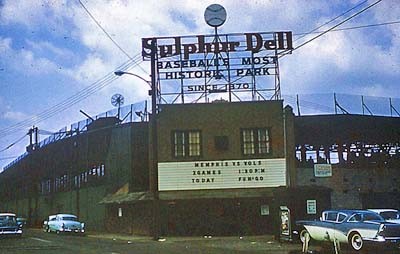
* First Horizon Park and site of Sulphur Dell. The original home of Nashville baseball is its home once again. Sulphur Dell stood on the site from 1870 to 1969, but the original ballpark faced southwest, so the State House would be in view. This put the sun in the outfielders' eyes. Along with odors from a nearby dump wafting over, and the occasional flooding from the Cumberland River that forced some games to be moved to Vanderbilt University's field, this earned the stadium the nicknames "The Dump" and "Suffer Hell."

This wooden ballpark was demolished, and replaced with stadium of concrete and steel for the 1927 season. It seated 8,500 fans at its peak. But while the new park fixed the sun problem, it did nothing to get rid of the smell from the dump, and the shape of the plot of land forced a short right field fence with a terrace, much like Cincinnati's old Crosley Field and Houston's Minute Maid Park today. When the Yankees visited for an exhibition game, Babe Ruth refused to play his usual position of right field because of the little hill, and was moved to left field.
The team that played there the longest was called the Nashville Vols, short for "Volunteers," as the University of Tennessee (in Knoxville) calls its teams the Volunteers or the Vols, as Tennessee is known as the Volunteer State. They won Southern Association regular-season Pennants in 1901, 1902, 1908, 1916, 1940, 1943, 1948 and 1949; Playoffs for the SA title in 1939, 1940, 1941, 1942, 1943, 1944, 1949, 1950 and 1953; and the Dixie Series against the Champions of the Texas League in 1940, 1941, 1942 and 1949.
Hall-of-Famers who played for the Vols included Yankee pitcher Waite Hoyt and Pittsburgh Pirates slugger Kiki Cuyler. The 1940 Vols have been remembered as one of the greatest minor league teams. It featured future All-Star pitcher and Yankee World Champion Johnny Sain, former Detroit Tigers pitcher Cletus "Boots" Poffenberger going 26-9, and catcher Charles "Greek" George won the SA Most Valuable Player award. Unlike Sain, George he didn't play much in the major leagues, and after getting called up in 1945 due to the World War II manpower shortage, he punched an umpire during an argument and got unofficially blackballed from baseball. In his case, "Vol" might have been short for "Volatile."

The Negro Leagues' Nashville Elite Giants (who are best remembered today as the Baltimore Elite Giants, and that's pronounced EE-light, not El-EET) played at Sulphur Dell from 1920 to 1928, winning a Pennant in 1921.

The National Association, the governing body of minor league baseball, ordered that all leagues under its umbrella be desegregated for the 1962 season. Rather than comply, the Southern Association folded. The Vols, who valued staying in business over white supremacy, were inactive for 1962, but started again in the South Atlantic League for 1963. But they lost money, and folded.

Like the aforementioned Crosley Field, Sulphur Dell was used as a police impound lot, before being demolished in 1969 and being used as parking for State government buildings.

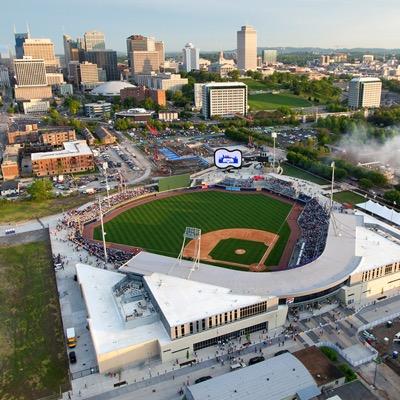
First Tennessee Park, named for a bank, opened on the site in 2015, and the Nashville Sounds moved in. It seats 8,500 people, with grassy outfield seating pushing capacity to around 10,000. It has a view of downtown Nashville. And it copied the idea of a guitar-shaped scoreboard from Greer Stadium. In 2020, it was renamed First Horizon Park.
The old address was 900 5th Avenue North, but it's now listed as 19 Junior Gilliam Way, for the Nashville native who wore Number 19 as a Brooklyn/Los Angeles Dodgers player and coach. A mile from downtown, and several buses go there.

* Tom Wilson Park. Black businessman Thomas T. Wilson built a ballpark for the Elite Giants to use, and they did so from 1929 to 1934, before moving north. It seated 8,000 people, and was demolished sometime after 1946. 2nd Avenue S. and Chestnut Street, about a mile southeast of downtown. Bus 25.

* Herschel Greer Stadium. Named for the late former president of the Vols, this ballpark seats 10,300 people, with standing room pushing it to a possible 15,000, which made it one of the largest minor-league ballparks.
From 1978 to 2014, it was the home of the Nashville Sounds, who started out in the Double-A Southern Association, and moved to Triple-A, first to the American Association, and then, when that league was split up, to the Pacific Coast League. (Yes, I know, Tennessee is pretty far from the Pacific Coast.) The Sounds won Pennants there in 1979, 1982 and 2005, meaning that Nashville has won either a regular-season Pennant or a Playoff Pennant 17 times: 1901, '02, '08, '16, '39, '40, '41, '42, '43, '44, '48, '49, '50, '53, '79, '82 and 2005. (Compare this with Memphis' 10 and Knoxville's 3.)

The stadium was easily identifiable by its nod to Nashville being "Music City": A guitar-shaped scoreboard. But as Camden Yards and a series of new ballparks, in both the majors and the minors, rewrote the rules for what a baseball stadium should be in the 1990s, Greer Stadium began to be seen as outdated, and so a new park was built.
With the Sounds having moved out, its future is uncertain. 534 Chestnut Street, about a mile and a half south of downtown. The Adventure Science Center is next-door. Buses 8, 12 and 25 will get you to within a short walk.

The nearest Major League Baseball team is the Atlanta Braves, 246 miles away, with the Cincinnati Reds a little farther away at 272 miles. According to an April 24, 2014 article in The New York Times, baseball fandom in Nashville is set by TV watching: The 3 most popular teams are the Braves, the Yankees and the Boston Red Sox, with some people rooting for the Braves and the Reds due to the comparative proximity.

The nearest NBA team is the Memphis Grizzlies, 213 miles away. But Nashvillians don't root for the Grizzlies, because of the inherent Intra-Tennessee rivalry. For those who care about the NBA at all, according to a May 23, 2014 article in The New York Times, they tend to divide their fandom among the "cool teams": The Los Angeles Lakers, the Chicago Bulls, the Miami Former LeBrons, and the Cleveland Once-and-Again LeBrons.

Before Nashville SC, Previously, the city was home to Nashville FC, which played in the National Premier Soccer League, the 4th tier of American soccer, from 2014 to 2016, at Vanderbilt Stadium. Until the MLS team begins play, the nearest Major League Soccer team is Atlanta United, 247 miles away.

Don't expect Nashville to get teams in MLB or the NBA: The metro area would rank 28th in population among NBA markets, and it would rank 31st, dead last, in baseball. 

* Tennessee State University. As with many of the South's historically black colleges and universities (HBCUs), Tennessee State was set up in a city that already had what was then an all-white school, Vanderbilt. Their teams are called the Tigers, and their women's track team the Tigerbelles. This team formed the bulk of the U.S. women's track teams at the Olympics in the 1950s and '60s, including Wilma Rudolph, winner of 3 Gold Medals in Rome in 1960.

TSU has won the National Championship of black college football 12 times: 1946, 1947, 1954, 1956, 1965, 1966, 1970, 1971, 1973, 1979, 1982 and 2013. In 1973, they were also NCAA College Division National Champions, what would later be called Division I-AA and is now the FCS, the Football Championship Subdivision. Their big names have included Pro Football Hall-of-Fame defensive ends Claude Humphrey and Richard Dent, 6-foot-9 Dallas Cowboys All-Pro defensive end Ed "Too Tall" Jones, and "Jefferson Street Joe" Gilliam, briefly the Pittsburgh Steelers' starting quarterback during a slump by Terry Bradshaw.

While they play 2 home games every season at the Titans' Nissan Stadium, their usual home field is the on-campus 10,000-seat Hale Stadium, named for the school's 1st president, William J. Hale. 3500 John A. Merritt Blvd., named for the man who coached both Jackson State (1952-62) and Tennessee State (from 1963 until his death in 1983). 3 miles west of downtown. Bus 60.

Since 1990, TSU have also played the annual Southern Heritage Classic against Mississippi's Jackson State University at the Liberty Bowl in Memphis -- which must have given Dent and his Chicago Bears teammate, Jackson State alumnus Walter Payton, some interesting conversations. Tennessee State leads the rivalry 17-9.

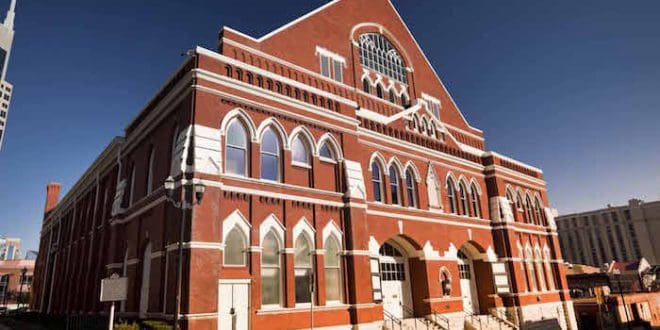
* Ryman Auditorium. If country music has a Yankee Stadium or a Madison Square Garden, this is it. The Mother Church of Country Music, a.k.a. the Carnegie Hall of the South, is easily the most 2nd-most famous building in the State of Tennessee, behind Graceland, the Memphis home of Elvis Presley, who performed at the Ryman very early in his career, on October 2, 1954. After this show, he went across the street and did another show at another famous musical institution, this one long owned by an established country star, the Ernest Tubb Record Shop, at 417 Broadway.

Opened in 1892, it began hosting the weekly Grand Ole Opry ("grand old opera") radio show on Nashville radio station WSM in 1943 (though the show had been broadcast since 1925). The Auditorium seats 2,362 people, and with stars announced ahead of time, there were occasions when thousands had to be turned away.

By the 1960s, the building had deteriorated, and complaints about the dressing rooms grew louder: The men had to share a small one, and the women had to use a restroom. Roy Acuff, often called the King of Country Music, bought an adjacent building just so he'd have a decent place to change. And a new house for the Opry was planned. A wooden circle was cut from the stage, and transplanted to the new Opry House, much like home plate or a square of sod is sometimes removed from an old ballpark and put in the new one.

"I never want another note of music played in that building," Acuff said. He had reason beyond his bitterness over the dressing room: He was a major stakeholder in Opryland USA. (He was a bit about the money: In 1948, he was the Republican nominee for Governor of Tennessee. He lost.) But he died in 1992, and, against heavy odds, the building survived him. Ed Gaylord of Gaylord Entertainment bought the building's parent company, and had it restored.

The Ryman reopened in 1994, with its main entrance moved from the west side on 5th Avenue to the east side on 4th, plus an addition that included, yes, suitable dressing rooms, and, for the first time in its 102-year history, air conditioning. In 2012, the original stage (all but a small portion of it, left for historical reasons) was replaced as part of new renovations.
The Opry has returned every winter, while still broadcasting from its new home the rest of the year. ABC broadcast The Johnny Cash Show live from the Ryman, and Cash -- whose birthday would have been today, February 26, were he still alive -- is among those country legends whose memorial service has been held there.

The revival of the Ryman has coincided with the revival of downtown Nashville, including the construction of the Arena, the Stadium, and the city's first real skyscrapers. 116 5th Avenue North.

* Nashville Municipal Auditorium. While Elvis had many recording sessions in Nashville, after 1954 he didn't give another concert in the city until July 1, 1973, a matinee and an evening show at the Municipal Auditorium.

Opened in 1962, it still hosts concerts and sporting events. It's hosted minor-league hockey, and had the Devils actually moved to Nashville for the 1995-96 season, it's likely they'd have played at the Auditorium for a year before what's now the Bridgestone Arena opened. 417 4th Avenue North, downtown, 3 blocks from the State House.

Elvis also performed in Eastern Tennessee at the City Auditorium in Paris on March 7, 1955; at the Civic Auditorium in Kingsport on September 22, 1955; and at the Stokely Athletic Center at the University of Tennessee in Knoxville on April 8, 1972; March 15, 1974; and May 20, 1977.

The Beatles never performed in Nashville as a unit, although individual members did so on their solo tours.

* Grand Ole Opry House. As with sports venues, the Opry decided in the 1960s to leave the city for the suburbs, and create a family atmosphere, even adding an amusement park. Opryland USA opened in 1972, and the Grand Ole Opry House in 1974. The oak circle from the Ryman stage was placed at center stage, and lead singers stand there.

The new theater (no longer so new) seats about 4,000, and had all the amenities that the Ryman did not yet have. I visited Nashville in 1991, before it became a major league sports city, and the group I was with visited Opryland USA and had a great time. But I wanted to see the Ryman. I knew I couldn't get inside, but I still wanted to reach out and touch the brick.

Of course, at this time, Camden Yards was rewriting the rules for stadium and arena construction, and cities took back their leadership role from the suburbs. Attendance dropped, and in 1997, Gaylord Entertainment closed the theme park. The Opry House remained in operation, and the Opry Mills shopping mall and the Opryland Resort & Convention Center opened on the site of the park in 2000.

When the Cumberland River flooded in 2010, my first concern should have been for the people -- and 31 people died, in 3 States -- but it was for the Ryman. Instead, it sustained only minor damage, while the Arena, the Stadium, and the Opry House all got socked, especially the Opry House. It was able to reopen in 6 months, while the show was broadcast from the Ryman and other Nashville locations. 433 Opry Mills Drive, about 9 miles east of downtown. Number 34 bus.

* Museums. Nashville isn't all about country music, although within a few steps of the Ryman (and the Arena) are museums dedicated to Johnny Cash (119 3rd Avenue S.) and George Jones (128 2nd Avenue N.), and the music in general at the Country Music Hall of Fame and Museum (222 5th Avenue S.).

The Tennessee State Museum depicts the State's history, including the Native America, colonial, early Statehood and Civil War periods. Its collection of Civil War memorabilia is one of the largest. It shares a downtown building with the Tennessee Performing Arts Center -- a boring-looking 1981 building that replaced its former home, the much more appropriate 1929 War Memorial Building. 505 Deaderick Street, between 5th & 6th Avenues.

There are 3 Presidents with connections to Tennessee. Al Gore should have made it 4, and he made enough mistakes that, if he had done any one of them differently, his rightful victory would have been too big to get stolen from him. But, like the 3 who actually did get into the White House, he wasn't born in Tennessee, but rather in Washington, D.C., when his father, Albert Sr., was a Congressman. (Both father and son would serve Tennessee in each house of Congress.)

As for the other 3, 2 were born in North Carolina, and the other might have been: Andrew Jackson was born somewhere near the Carolina State Line, although no one is sure precisely where, and both North and South Carolina claim him.

But the 7th President (serving from 1829 to 1837) and War of 1812 General nicknamed Old Hickory is best known, as far as his residences are concerned, for being one of the founding fathers of the State of Tennessee.

The Hermitage was a plantation he owned from 1804 until his death in 1845. On that property, he and his wife Rachel lived in a log cabin until the main house was completed in 1821. It burned in 1834, and he then had the current house built. Today, conspiracy theorists would have blamed Henry Clay or the Bank of the United States for the fire, even though Jackson himself didn't. (He did, however, blame his political opponents for the smears against both him and Rachel that gave her a heart attack that killed her between the 1828 election and the 1829 Inauguration.)

Aside from George Washington's Mount Vernon and Elvis' Graceland, it's the most-visited former private home in America. 4580 Rachels Lane, in the town of Hermitage, 12 miles east of downtown. It's on a section of the Cumberland River known as Old Hickory Lake. The Number 6 bus gets you to within a mile and a half, and the bus and the walk combined takes about an hour.

The State Capitol, which opened just before the Civil War in 1859, contains the tomb of James K. Polk, the 11th President (1845 to 1849), and his wife Sarah. The man who waged the Mexican-American War and gained us a huge chunk of our West, including all of California, he has been hailed as a visionary and assailed as a warmonger and a racist. He chose to serve only one term, and died just 3 months after leaving office, the shortest retirement of any ex-President. Sarah outlived him by 42 years, a record for a Presidential widow, and only Grover Cleveland's wife Frances, at 50 years, had a longer retirement from being First Lady. 600 Charlotte Avenue.

The other President with a Tennessee connection is Andrew Johnson, the 17th President, who succeeded to the office on the assassination of Abraham Lincoln in 1865, and was impeached for a ridiculous reason: He fired his Secretary of War (also Lincoln's), Edwin Stanton, without the permission of the Senate. He believed that the law barring him from doing so was unconstitutional, and when the aforementioned President Cleveland challenged it in 1886, the Supreme Court said they were both right. For all the good it did Johnson: Surviving his Senate trial by 1 vote, he knew he couldn't get elected on his own in 1868, got back into the Senate in 1874 (welcomed by the men who had tried him with a standing ovation), and died the next year.

He was an unrepentant racist, making it odd that Lincoln would choose him for the Vice Presidency in 1864 (it was because he was the only Southern Senator who stayed loyal to the Union when his State seceded), and he remains a contender for the title of worst President ever. His hometown of Greenville, Tennessee is 250 miles east of Nashville. His museum is at 67 Gilland Street. (Charlotte, North Carolina is actually the closest major league city to Greenville, but it's not close.)

There's actually a 4th President with a minor connection to Nashville: In 2008, Barack Obama and John McCain had the 2nd of their 3 debates at the Black Box Theatre at Belmont University. Compton Avenue at Belmont Blvd., about 3 miles southwest of downtown. Number 2 bus.

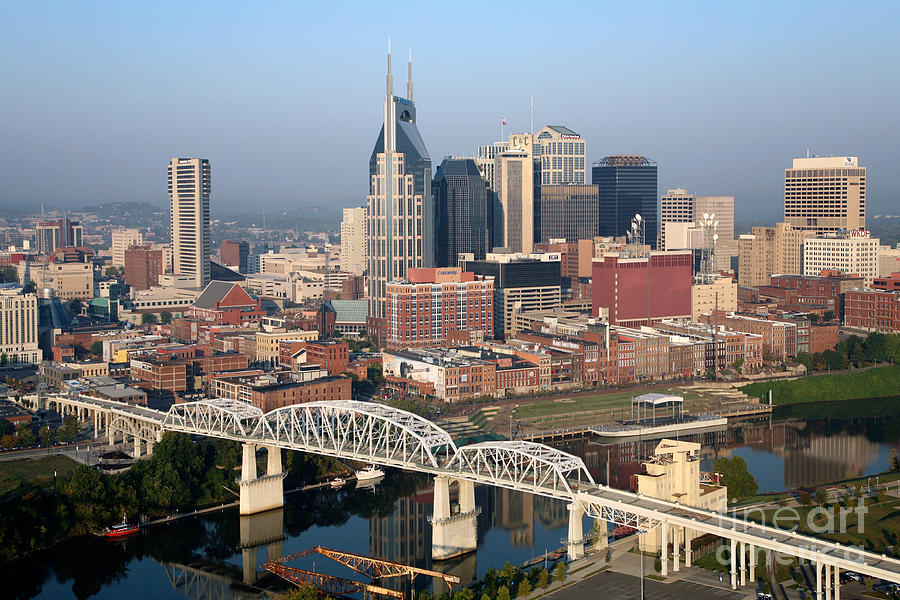
Five of the six tallest buildings in Tennessee are in Nashville, only one in the larger city (but not larger metro area) of Memphis. The tallest went up in 1994, but has already changed names with one phone-service company buying out another: The South Central Bell Building, the BellSouth Building, and now the AT&T Building. At 617 feet high, its twin-spired roof has led to it being nicknamed the Batman Building. 333 Commerce Street.

Many music-themed movies have used Nashville as both a setting and a film location, including biopics of Elvis (Elvis, starring Kurt Russell), Patsy Cline (Sweet Dreams, starring Jessica Lange) and Loretta Lynn (Coal Miner's Daughter, starring Sissy Spacek). Each of these included the Ryman as a filming location. While the recent ABC TV drama Nashville was filmed in Los Angeles, the 1975 film of the same title was filmed on location.

*

Nashville is more than history and music, as important as those things are. It's also the home of an NHL team that, while not yet very successful, is usually good, has developed quite a following among people you wouldn't think would take to hockey, and is now another good reason to visit this legendary city.

Wednesday, November 3, 2021

One Year Later

November 3, 2020, 1 year ago: I wrote, "This may turn out to be the most important day in American history. Vote like the whole world depends on it. Because it might."

Joe Biden was elected the 46th President of the United States, defeating Donald Trump. It wasn't called for 4 days, because several key States were close. It wasn't certified by Congress until January 6, 2021 -- which was supposed to happen, anyway, but this was one of the few times that it was ever in doubt. And there was an unprecedented attempt to prevent it. That attempt failed. It was finally made official on January 20, Inauguration Day, when Biden was sworn in as President.

Biden won 81,268,924 votes, to Trump's 74,216,154. Biden won 51.3 percent of the popular vote, to Trump's 46.9. Each candidate won 25 States, with Biden also winning the District of Columbia and 1 Electoral Vote in Nebraska; while Trump also won 1 Electoral Vote in Maine. (Maine and Nebraska allow their Congressional Districts to vote separately from the State as a whole.) Biden won 306 Electoral Votes, to Trump's 232.

Biden won nearly all the close States: Arizona by 10,457 votes, Georgia by 11,779, Wisconsin by 20,682, Nevada by 33,596,New Hampshire by 59,277, and Pennsylvania by 80,555. However, if Trump had won all of those States except Pennsylvania, with its 20 Electoral Votes, Biden still would have won.

Kamala Harris became the 1st female, the 1st African-American, and the 1st Asian-American Vice President of the United States. The Democrats kept control of the U.S. House of Representatives, and gained a 50-50 split in the U.S. Senate, which becomes a 51-50 majority in the Democrats' favor -- except 2 Democratic Senators, Joe Manchin of West Virginia and Kirsten Sinema of Arizona, have often stood in President Biden's way when it came to his agenda.

In the end, Biden didn't win because 250,000 Americans had died from COVID-19 -- a total since tripled, and it will increase further, though Biden's efforts will hold it down to less than it would have been if Trump had stayed in office. He won due to the get-out-the-vote effort in the key States, whose apparatus was already in place before COVID.

Biden won because he was the opposite of Trump. Because, while Trump appealed to bigotry and anger, Biden appealed to what Abraham Lincoln called "the better angels of our nature." Because he wanted to bring America healing, which is what America wanted. Because he spoke to "the soul of America." As he, a Catholic and a student of St. Francis of Assisi, is believed to have said:

Where there is hatred, let me sow love.
Where there is injury, pardon.
Where there is discord, union.
Where there is doubt, faith.
Where there is despair, hope.
Where there is darkness, light.
And where there is sadness, joy.

Conservatism, still led by Trump, is a darkness. Liberalism, currently led by Biden, is a light. And, for now, America wants light.

*

November 3, 1836: Vice President Martin Van Buren is elected the 8th President of the United States. He essentially rode the coattails of his friend and boss, President Andrew Jackson, to victory. It also helped that the Whig Party was regionally split: Van Buren won 170 Electoral Votes, William Henry Harrison 73, Hugh White 26, Daniel Webster 14, and Willie P. Mangum 11. So it was MVB 170, Whigs United 122.

Mangum won only South Carolina, Webster only his native Massachusetts, and White only Georgia and his native Tennessee -- which probably ticked fellow Tennesseean Jackson off.

In the popular vote, Van Buren won almost 51 percent, Harrison 36, White a little under 10, Webster less than 3, and Mangum wasn't actually on the ballot anywhere, but won South Carolina's Electoral Votes anyway.

November 3, 1868: Ulysses Simpson Grant, U.S. Secretary of War and the leading General of the Union during the American Civil War, is elected the 18th President of the United States. He defeats Horatio Seymour, a former Governor of New York. Grant won nearly 53 percent of the vote, Seymour 47. The Electoral Vote was not nearly as close, 214 to 80 in Grant's favor.

November 3, 1869: The Hamilton Football Club is founded in Hamilton, Ontario, Canada. This is the forerunner of the Hamilton Tigers, who in 1950 merged with the Hamilton Wildcats to become the Hamilton Tiger-Cats. This could, if you choose to define it this way, make the "Ticats" the oldest continuously operating professional sports team in North America.

Before the merger, the Tigers won 5 Grey Cups, the championship of Canadian football: 1913, 1915, 1928, 1929 and 1932. Since the merger, they've won 8: 1953, 1957, 1963, 1965, the Canadian Centennial Cup in 1967, 1972, 1986 and 1999. This is a total of 13. (The 1943 Grey Cup won by the Hamilton Flying Wildcats, as they were known during World War II since they were sponsored by the Royal Canadian Air Force, is generally not counted in the total.)

November 3, 1896, 125 years ago: Governor William McKinley of Ohio is elected the 25th President of the United States, defeating Congressman William Jennings Bryan of Nebraska. McKinley won 51 percent of the popular vote, and Bryan nearly 47. McKinley won 23 States to Bryan's 22. Those figures make the election sound close. But McKinley won bigger States than Bryan did, so he won the Electoral Vote 271-176.

The Panic of 1893, and the resulting depression, the nastiest the nation had yet suffered, doomed President Grover Cleveland's hopes of winning a 3rd term. But Bryan, at 36 the youngest major-party nominee ever, favored the free coinage of silver, as a means of ending the depression, rather than sticking to the gold standard.

At the Democratic Convention at the Chicago Coliseum, he said, "You shall not press down upon the brow of labor this crown of thorns. You shall not crucify mankind upon a cross of gold." Effectively, he was the Bernie Sanders of his time.

But that scared a lot of people, including a lot of Democrats. Cleveland refused to use whatever political capital he had left to endorse him, and a lot of "Gold Democrats" supported McKinley, who promised "a return to the full dinner pail." (The expression "a chicken in every pot" had been in existence for about 300 years.)

In addition, in the inner cities, and in smaller mill and mining towns, where lots of Catholics, many of them the sons of immigrants, worked in factories, many of them were told by their bosses, "If Bryan wins on Tuesday, don't come in on Wednesday" -- not that they would be fired, but that the factory would have to close.

*

November 3, 1901, 120 years ago: Frederick Lionel Hitchman is born in Toronto. After winning the 1923 Stanley Cup with the Ottawa Senators, Lionel Hitchman joined the Boston Bruins, and formed a great defensive pairing with Eddie Shore, captaining the team that won the 1929 Stanley Cup.

He served with the Royal Canadian Mounted Police in the off-season, and did so full-time after his 1934 retirement from hockey. Like a later Boston sports legend, Ted Williams, he became an accomplished fisherman, setting a record for largest salmon caught. He died in 1969. Although the Bruins retired his Number 3, and he was elected to the Ontario Sports hall of Fame, he has never been elected to the Hockey Hall of Fame.

November 3, 1908: William Howard Taft, Secretary of War, is elected the 27th President of the United States, defeating Bryan. Taft gets 51.6 percent of the popular vote, and wins the Electoral Vote 321 to 162.

Theodore Roosevelt chose not to run for what would have been a 3rd term, and chose Taft, who would really have preferred to have been named Chief Justice of the U.S. Supreme Court. TR warned Taft to not let the press take his picture on the golf course. Despite this warning, and his weight, which made him look ridiculous on the golf course, it happened, and TR called him onto the carpet.

Taft was a physical heavyweight, over 330 pounds, our heaviest President. He was no lightweight intellectually, either: A graduate of Yale, including of its law school. He stood up for himself, and said, "Mr. President, you play tennis. That's a more elitist sport than golf!" TR said, "Yes, but I don't let the press take my picture while I do it!"

Taft won anyway, mainly because Bryan was running for the 3rd time, and the issue that had first vaulted him to prominence, the free coinage of silver, was no longer as effective when there wasn't a depression on, as there was when he first ran in 1896. One of the Taft slogans was, "Vote for Taft this time. You can vote for Bryan anytime."

Taft would run his Presidency far from what TR had intended, and TR tried to regain it in 1912. But, as the incumbent, Taft controlled the party machinery. TR ran as a 3rd party candidate, and finished 2nd. They split the Republican vote, and Democrat Woodrow Wilson got elected as a plurality candidate. Wilson appointed Bryan his Secretary of State, but Bryan resigned in 1915, because he was a pacifist, Wilson seemed to be inching too closely to going to war.

Roosevelt and Taft patched things up, and Wilson's successor, Warren Harding, appointed Taft to be Chief Justice -- the only President to also have served on the Supreme Court. Today, "Teddy 26" and "Bill 27" are part of the Washington Nationals' "Racing Presidents."

Also on this day, Bronislau Nagurski is born in Rainy River, Ontario, and grows up in International Falls, Minnesota. "Bronko" wasn't big by today's standards, but, at 6-foot-3 and 230 pounds, he was enormous for his era. He could do it all: Block, run, catch, tackle, even throw every once in a while. He helped the Chicago Bears win the NFL Championship in 1932 and 1933, and, during the manpower shortage of World War II, came out of retirement to help them do it again in 1943.

He was a charter inductee into the Pro Football Hall of Fame in 1963. The University of Minnesota retired his Number 72, the Bears his Number 3. He was named to the NFL's 1930s All-Decade Team and its 75th Anniversary Team. As part of their 100th Season celebrations, the Bears named him to their 100 Greatest Players.

When John Madden named his "All-Madden All-Millennium Team" in 1999, the 1st 3 names he chose were Jim Thorpe, and the 1932 and '33 Chicago running tandem of Red Grange and Nagurski -- the prototypes, respectively, of the modern speedy halfback and the big, bruising fullback.

He was also heavyweight wrestling champion in the 1930s. Think of Dwayne "The Rock" Johnson sticking with football, and wrestling in the off-season. Although Bronko never became an actor, unless you count "professional wrestling" as acting, but Bronko was dead serious about it: He made more money at that than he did at football.

In a 1984 interview with Sports Illustrated writer Paul "Dr. Z" Zimmerman, when asked what position he would play if he were coming up in the present day, he said, "I would probably be a linebacker today. I wouldn't be carrying the ball 20 or 25 times a game."

The definitive Nagurski story tells of a touchdown he scored against the Washington Redskins at Wrigley Field. The Redskins didn't move to Washington until 1937, Nagurski's last season (not counting his war-induced 1943 comeback), and the teams didn't play at Wrigley in the regular season, only in the NFL Championship Game, and this story is not mentioned in connection with the title game, which leads me to think it's apocryphal: He brushed off 2 linebackers and practically ran through a cornerback and a safety, then bounced off a goalpost and, head still down, ran right through the end zone, headfirst into the brick wall of Wrigley's outfield. He got back to the huddle for the extra point, and said, "That last guy gave me a pretty good lick."

After his retirement from wrestling, he returned home to International Falls, and opened a service station. A local legend claims that Nagurski had the best repeat business in town because he would screw customers' gas caps down so tight after filling their tanks that no one else in town could unscrew them.

In spite of the roughness of his era, and how much he contributed to it (although he was never accused of playing dirty), he lived until 1990, age 81. His son, Bronko Nagurski Jr., played at Notre Dame, and won the 1963 and 1965 Grey Cups with the Hamilton Tiger-Cats.

Also on this day, soccer team Club Atlético Newell's Old Boys -- having an English name to attract some of the British sailors who had docked in Argentina, found the climate to their liking, and stayed there -- is founded in Rosario, in the province of Sante Fe. They have won 6 national league titles: In 1974, 1988, 1991, 1992, 2004 and 2003.

*

November 3, 1911, 110 years ago: John Joseph Keane is born in St. Louis. A shortstop, he was beaned in the minor leagues, and never reached the majors. Offered a chance to manage in the St. Louis Cardinals' farm system in 1938, he retired as a player. By 1959, he was a major league coach for them, and was named their manager in 1961. He led them to the World Championship in 1964.

But he feuded with management, and he came to believe that they were going to fire him after the season, no matter what. That is exactly what happened to the manager of the team he beat, Yogi Berra of the Yankees: Even if the Yankees had won, he was going to be fired. And they offered the job to Keane, who accepted and quit the Cardinals.

Keane was not well-suited to running the Yankees. The fall of the Dynasty was hardly his fault, as former general manager George Weiss had executed many trades sending multiple players to teams for a single player who could help the team win the Pennant that season. As a result, the farm system was nearly dry: Essentially, it was Bobby Murcer, Roy White, Mel Stottlemyre, and 100 guys named Steve Whitaker.

But Keane played his lousy hand badly, alienating veterans like Mickey Mantle, Whitey Ford and Roger Maris, but also upsetting younger players like Joe Pepitone and Jim Bouton. The Yankees finished 6th in 1965, and started the 1966 season just 4-16. He became the 1st Yankee manager fired in midseason in 56 years. He accepting a scouting post with the California Angels, but died at the start of 1967, before he could start the job. He was only 55, and the stress of his last 3 seasons as a manager, in St. Louis and New York, was what killed him.

Also on this day, the Chevrolet Motor Company is founded in Detroit. One founder, Louis Chevrolet, was a Swiss auto racing pioneer. The other, William C. Durant, had founded General Motors in 1908, but had been cast out of its management in 1910.

The two men had creative differences, and Chevrolet sold out to Durant in 1914, the year the company's familiar "bowtie" logo was introduced. Durant kept Chevrolet's name on the company, by 1917 had made so much money that he could also buy GM out and regain control. "Chevy" has been a GM brand ever since.

November 3, 1918: Robert William Andrew Feller is born in Van Meter, Iowa. "Rapid Robert" debuted with the Cleveland Indians in 1936, right after high school graduation. He soon struck out 17 batters in a game, tying the major league record. He struck out 17 at age 17. In 1938, just before turning 20, he struck out 18, which would remain a major league record for a 9-inning game until 1969.

He stayed through 1956, except for spending the entire 1942, '43 and '44 seasons, and most of '45, in the U.S. Navy during World War II. He was a "gun captain," and rose to the rank of Chief Petty Officer. Although he was in the Navy, the Army later named him an honorary Green Beret. As he put it, "Anybody who says sports is war has never been in a war."

Like Joe DiMaggio and Ted Williams, Bob Feller may have lost his best seasons in The War. These were the seasons when he was 23, 24, 25 and 26. In his last 3 seasons before, 1939 to '41, he went 76-33. In 9 games in his '45 return plus '46 and '47, he went 51-29. Even missing prime seasons, he won 266 games, losing just 162, and struck out 2,581 batters. He said he had no regrets about missing bigger numbers. The War was more important.

He pitched 3 no-hitters, in 1940, 1946 (against the Yankees) and 1951. In 1946, he struck out 348 batters, which was believed to be a major league record until someone discovered that Rube Waddell's 1904 count of 343 was wrong, and it was actually 349. He helped the Indians win the 1948 World Series, and another Pennant in 1954. The Indians also fell just short in 1940 and 1952 while he was there.

Williams, noted hater of pitchers (he liked to say, "All pitchers are dumb"), said Feller was "the fastest and best pitcher I saw during my career." Stan Musial said he was "probably the greatest pitcher of our era." He was elected to the Baseball Hall of Fame in 1962.

In 1999, The Sporting News ranked him 36th on their list of the 100 Greatest Baseball Players, 11th among pitchers, trailing Christy Mathewson, Grover Cleveland Alexander, Cy Young, Satchel Paige, Warren Spahn, Lefty Grove, Sandy Koufax, Steve Carlton, Bob Gibson and Tom Seaver. Only Spahn and Paige, the Negro League sensation who was his opponent on that 1945 tour and his teammate on the 1948 Indians, were in his generation. His Number 19 was the 1st one retired in all of Cleveland sports. A statue of him stands outside Progressive Field. He lived until 2010, 92 years old.

*

November 3, 1921, 100 years ago: Charles Dennis Buchinsky is born in Ehrenfeld, Pennsylvania, a tiny town east of Pittsburgh. We knew him as Charles Bronson. A Purple Heart recipient as a B-29 gunner in World War II, he had enough of being a tough guy, and spent the rest of his life only playing them. When his name came up in a question on the July 6, 1978 episode of Match Game, panelist Richard Dawson called him "one of the most gentle men I have ever met. And he plays such an animal. And he's a darling man."

"Animal"? He played the title 1930s gangster in Machine-Gun Kelly, Wild West gunman Bernardo O'Reilly in The Magnificent Seven, Lieutenant Danny Velinski in The Great Escape, Private Joseph Wladislaw in The Dirty Dozen, "Harmonica" in Once Upon a Time In the West, beans-spilling mobster Joseph Valachi in The Valachi Papers, Wild West gambler and gunman Wild Bill Hickok in The White Buffalo, and, most notably, urban vigilante Paul Kersey in the Death Wish films.

But he also played Francis Church, editor of the New York Sun, who in 1897 answered a child's letter with an editorial, in the 1991 film Yes, Virginia, There Is a Santa Claus. Maybe Dawson was right. Long married to actress Jill Ireland, and an activist against cancer during her illness and after her death, Bronson died in 2003.

*

November 3, 1933: Michael Stanley Dukakis is born in Brookline, Massachusetts. He played baseball, basketball and tennis, and ran cross-country, at Brookline High School. He was elected Governor of Massachusetts in 1974, lost his bid for re-election in 1978, regained the office in 1982, and won again in 1986.

In 1988, the Democratic Party nominated him for President. It looked like he was going to win. At their Convention at the Omni arena in Atlanta, he said, "This election is not about ideology. This election is about competence!"

And then he ran one of the most incompetent general election campaigns ever, and Vice President George H.W. Bush made it about ideology, and Dukakis got just 45.6 percent of the popular vote, and 111 Electoral Votes -- no Democratic nominee has done nearly so poorly since. (Four years later, Bill Clinton would get 43 percent of the vote in a 3-way race, but every Democratic nominee since has gotten at least 227 EVs.)

"The Duke" did not run for Governor again in 1990. Now 88 years old, he has since been a college professor and an advocate for improved public transportation. He was the 1st person I ever cast a vote for President for, and I remain proud of that vote.

November 3, 1945: Kenneth Dale Holtzman is born in St. Louis. Debuting with the Chicago Cubs in 1965, this Jewish lefthander was called "the new Sandy Koufax." In Koufax's 3rd-from-last regular-season appearance, on September 25, 1966, Ken Holtzman's Cubs beat Koufax's Dodgers, 2-1.

He didn't become the new Koufax, but he did go 174-150 in his career -- more wins than Koufax, although Koufax's career ended early due to elbow trouble. Included were 2 no-hitters (half as many as Koufax), in 1969 and 1971. He still holds the record for most games won by a Jewish pitcher.

He was a 2-time All-Star. With the Oakland Athletics, he won the World Series in 1972, '73 and '74. In the 1974 Series, he hit a home run, something only 1 pitcher has done in Series play since (Joe Blanton of the 2008 Phillies). He also won a Pennant with the Yankees in 1976 and another World Series with them in 1977. He later became an insurance salesman, and is still alive.

November 3, 1946, 75 years ago: Thomas Kenneth Heintzelman is born outside St. Louis in St. Charles, Missouri. The son of pitcher Ken Heintzelman, one of the oldest players on the 1950 Phillies "Whiz Kids," he was an infielder who layed for the Cardinals and the Giants from 1973 to 1978. His major league career had been delayed due to serving in the Vietnam War. He is still alive.

Also on this day, Garry Alton Hill is born in Rutherfordton, North Carolina, and grows up in nearby Charlotte. He itched in the minor leagues from 1967 to 1973, but  only appeared in 1 major league game. On June 12, 1969, he started for the Atlanta Braves gainst the Chicago Cubs, didn't get out of the 3rd inning, and left with a 15.43 earned run average. He died in 2017.

*

November 3, 1951, 70 years ago: Dwight Michael Evans is born in the Los Angeles suburb of Santa Monica, California. No, he's no relation to the preceding Michael Evans. The right fielder won 8 Gold Gloves for the Boston Red Sox, tied for the American League home run lead in the strike-shortened season of 1981, was a 3-time All-Star, and was a key member of the Sox' 1975 and 1986 Pennant winners.

Unfortunately for them, a beaning in 1978 left him with post-concussion syndrome, and he tried to come back too soon, and was practically useless down the stretch, to the point where the question of who would play left field, Carl Yastrzemski or Jim Rice, and who would play 1st base, Yaz or George Scott, was settled when Rice was moved over to right. In the Playoff game against the Yankees, "Dewey" only appeared as a pinch-hitter for Frank Duffy, flying to left for the 1st out in the 9th inning. (Jim Evans, no relation, was the 1st base umpire in that game.)

He hit 385 home runs in his career -- 3 more than Rice, who's in the Hall of Fame, and was not known as a good fielder. So why isn't Evans in the Hall of Fame?

You want to hear something even dumber than that? When I first visited Boston, I came out of South Station, and saw a sign for "Dewey Square." Not realizing it was named for George Dewey, the naval hero of the Spanish-American War, my first thought was, "Wow, this city is so crazy about its baseball team, they named a square after Dwight Evans."

November 3, 1953: Baseball's rules committee restores the pre-1939 rule which says that a sacrifice fly is not charged as a time at bat.

Also‚ the committee votes for the "no gloves on the field rule." Hank Greenberg‚ the Hall of Fame-to-be slugger who is now general manager of the Cleveland Indians, had proposed the change‚ saying, "Aside from the possibility of hindering the play‚ gloves on the field look sloppy." It also made it easy for opposing players to sneak creepy-crawly or otherwise disgusting things into the glove of an easily scared player, such as the Yankees' Phil Rizzuto.

The committee also makes a rule that any runner will be called out for deliberately running the bases backwards or even taking a lead off the base in the wrong direction.

A new balk rule is instituted which gives the batter an option: If he gets a hit after a balk is called‚ he has the option of accepting the outcome of the pitch‚ instead of being limited to the advance of the runner(s). This is the baseball equivalent of a football team that is the beneficiary of a penalty having the option to decline it, if the outcome of such is more advantageous to them than the outcome of the penalty.

Rule suggestions that are rejected include the re-legalization of the spitball‚ 2 bases for an intentional walk‚ and the option of declining ball 4.

November 3, 1954: The Yankees tour Japan, and draw a record crowd of 64‚000 when they play the 1st game against the All-Japan Stars at Nippon Life Stadium in Osaka. Andy Carey slugs 13 home runs‚ and catching prospect Elston Howard bats .468 on the 25-game tour. Each has thoroughly impressed the Yankee brass, and both get promoted to the Yankees for 1955 -- in Howard's case, making him the 1st black player for the Yankees in a regular-season game.

November 3, 1955: Phillip Martin Simms is born in Springfield, Kentucky, and grows up in nearby Louisville. His first few years as the Giants' quarterback were as rough -- with results and the fans' reactions -- as Terry Bradshaw's with the Pittsburgh Steelers. But, like that earlier "Blond Bomber," he led his team to a Super Bowl. In Super Bowl XXI, he threw 25 passes and completed 22 of them, an 88 percent completion percentage that remains a record for the NFL championship game under any name.

He got the Giants to the 1990 NFC Championship Game, but was injured in it, and it was Jeff Hostetler who led them to victory there and in Super Bowl XXV -- an injury that did not cost him a 2nd ring, but may well have cost him, thus far, election to the Pro Football Hall of Fame.

He is now a color commentator of CBS' NFL broadcasts. His son Chris Simms went into both family businesses, quarterbacking for the University of Texas and the Denver Broncos, and analyzing for CBS; and his son Matt Simms was a quarterback at the University of Tennessee and played last season for the Atlanta Falcons.

*

November 3, 1961, 60 years ago: The Blue Horizon opens, at 1314 North Broad Street, where Center City begins to turn into the North Philadelphia ghetto. The Ring magazine chose the 1,346-seat gym as the greatest boxing venue in the world. Philly boxers like Matthew Saad Muhammad, Tim Witherspoon and Bernard Hopkins trained there on the way to becoming champions. It was closed in 2010, but still stands.

Also on this day, The Twilight Zone airs the episode "It's a Good Life," adapted from a 1953 novel of the same title by Jerome Bixby. Charles William Mumy Jr., then billed as Billy Mumy, plays Anthony Fremont, a 6-year-old monster. Cloris Leachman, later a legend on The Mary Tyler Moore Show, plays his mother.

Bill Mumy, as he's been billed as an adult, is now best known for playing Will Robinson on Lost In Space. He also played Lennier, a Minbari Ambassador, on a later science fiction series, Babylon 5. In the 1983 film version of The Twilight Zone, "It's a Good Life" was 1 of the 4 segments produced, with Jeremy Licht as Anthony and Kathleen Quinlan as a teacher who helps to provide a considerably lighter, though not really "happy," ending.

In 2002, a revival of the show featured "It's Still a Good Life." Mumy and Leachman reprised their roles. Anthony is now middle-aged, having banished his father and his wife to the cornfield, and has a daughter named Audrey, played by Bill's daughter, Liliana Mumy, then 8. And not only has she inherited his powers, but she brings things he has banished back from the cornfield.

Jerome Bixby co-wrote the script for the 1966 science fiction film Fantastic Voyage, and 4 episodes of the original Star Trek series: "Mirror, Mirror," "By Any Other Name," "Day of the Dove" and "Requiem for Methuselah." He died in 1998, at age 74.

November 3, 1963: Ian Edward Wright is born in Woolwich, Southeast London. A son of Jamaican immigrants, he got off to a late start in his soccer career, not debuting in the Football League until 1985 with local club Crystal Palace. But he became one of the best strikers in England, and led them into the 1990 FA Cup Final, where they lost to Manchester United.

That got the attention of George Graham, the manager of Arsenal -- which also got their start in Woolwich, in 1886, before moving to Islington in North London in 1913. Wrighty helped Arsenal win the FA Cup and the League Cup in 1993 (England's 1st-ever "Cup Double"), the UEFA Cup Winners' Cup in 1994 (although he missed the Final due to yellow card accumulation), and the Double of the Premier League and the FA Cup in 1998 (again missing the Final, though he was in decline by this point).

He was one of the first English footballers to dance in celebration of his goals. He scored 185 of them for Arsenal, breaking the club record set by 1930s star Cliff Bastin, and has since been surpassed only by Thierry Henry.

He is now a pundit on BBC soccer broadcasts, but takes every opportunity to talk trash about the current Arsenal team. His sons Bradley Wright-Phillips and Shaun Wright-Phillips both played for the New York Red Bulls, and Bradley has become one of the biggest stars in Major League Soccer.

*

November 3, 1971, 50 years ago: Dwight Eversley Yorke is born in Canaan, Tobago. He helped Trinidad & Tobago win the 1989 Caribbean Cup at age 17, and played for his country in the 2006 World Cup at age 34. He won the League Cup with Birmingham-based Aston Villa in 1994 and 1996.

With Manchester United, he won the Premier League in 1999, 2000 and 2001, also winning the FA Cup and the UEFA Champions League in 1999, England's only "European Treble." With Sydney FC, he won the 2006 A-League title.

His brother Clint Yorke was a renowned cricket player in the West Indies. Dwight famously had a contentious relationship with model Katie Price, a.k.a. Jordan, and they have a son, Harvey, a special-needs child.

Also on this day, Unai Emery Extegoien is born in Hondarribia, in northeastern Spain's Basque Country, near the border with France. The son, nephew and grandson of pro soccer players, his own playing career didn't amount to much more than theirs. But as a manager, he won 3 straight UEFA Europa League titles with Sevilla.

This led to his being hired by Paris Saint-Germain, where he won the Coupe de France in 2017, and both the Coupe and Ligue 1 (the French league) for "The Double" in 2018. But PSG, desperate to win the UEFA Champions League, didn't get it, and when the manager's job at Arsenal opened up, they didn't lift a finger to try to keep him.

A small and stupid minority of Arsenal fans were glad to finally be rid of Arsène Wenger after 22 mostly successful years, and talked about the wonderful change at the club. In fact, things got worse: Emery alienated 2 of the key figures at Arsenal in recent years, centreback Laurent Koscielny and midfielder Aaron Ramsey, and both left after the 2019 season. He bought midfielders Lucas Torreira and Matteo Guendouzi, and proved he didn't have a clue as to how to use either one.

And he frequently refused to play Mesut Özil, Arsenal's best player, because "He doesn't fit the system." He never figured it out: If Mesut Özil doesn't fit your system, you need to change your system.

Emery had 5 chances to get Arsenal into the 2019-20 Champions League: The last 4 Premier League games of the 2019 season and the Europa League Final. Winning any one of those games would have done it. He won none of them. When Özil was substituted off in that Final, an embarrassing loss to Chelsea, he yelled at Emery, according to lip-readers, "Wallahi, you are no coach!" (A German-born Muslim of Turkish descent, Özil was using an Arabic word, essentially meaning, "I swear to God!")

Emery got Arsenal off to a horrendous start the next season. On November 29, 2019, following a run of 7 games without a win in all competitions, including a home loss to Eintracht Frankfurt in his beloved Europa League, he was fired.

Emery took Wenger's team, and built a side that finished 8th in 2020. Mikel Arteta, also Spanish but one of Wenger's players, took Emery's team, and won the 2020 FA Cup. Emery has gone back to Spain, hired as the manager of Villareal -- and, once again, won the Europa League.

*

November 3, 1981, 40 years ago: Jermaine Junior Jones is born in Frankfurt am Main, Hesse, Germany. The son of a German mother and a U.S. Army soldier stationed in Frankfurt, he grew up in his father's hometown of Chicago, before his parents divorced, and his mother took him back to Frankfurt.

A midfielder, he played in Germany for hometown club Eintracht Frankfurt, Bayer Leverkusen and Schalke; in England for Blackburn Rovers; and in America for the New England Revolution and the Colorado Rapids. He retired this year.

In 2009, having not yet chosen to play for Germany or America, he was eligible to play for either. He chose the U.S., and FIFA cleared him, opening the door for him to play for us in the 2010 World Cup. But an injury ruled him out, and he didn't make his senior U.S. debut until October 2010. He eventually played for the U.S. in the 2011 CONCACAF Gold Cup, the 2014 World Cup and the 2016 Copa América.

November 3, 1989: The NBA's expansion Minnesota Timberwolves play their 1st game. They lose 104-96 to the Seattle SuperSonics at Seattle Center Coliseum. Tyrone Corbin leads the T-Wolves with 20 points, while Dale Ellis of the Sonics leads all scorers with 33.
Also on this day, the Portland Trail Blazers retire the Number 32 of 1974-79 center Bill Walton. They beat the Sacramento Kings, 114-96 at the Portland Memorial Coliseum.

*

November 3, 1991, 30 years ago: The Vancouver Canucks retire the Number 12 of Stan Smyl, a.k.a. the Stanley Steamer. They beat the Edmonton Oilers 7-2 at the Pacific Coliseum.

November 3, 1992: The Yankees trade center fielder Roberto Kelly and 1st baseman Joe DeBerry to the Cincinnati Reds, in exchange for right fielder Paul O'Neill.

At the time, I thought this was a great trade for both teams. O'Neill was a good hitter and a good fielder, who had done well in Cincinnati, playing for an equally fiery right fielder, his manager, Yankee Legend Lou Piniella. (Sweet Lou doesn't have his Number 14 retired or a Plaque in Monument Park, but he helped the Yankees win 4 Pennants and the YES Network gave him a Yankeeography, so I'm calling him a Yankee Legend -- capital Y, capital L.) Playing in Yankee Stadium, with the short porch in right field, I figured O'Neill would hit more home runs than in the more neutral confines of Riverfront Stadium, and that Yankee Fans would love his intense personality.

I was right on both counts, as Paulie was our right fielder for the next 9 years, effectively taking the spot that many fans thought that Jay Buhner should have still had. In those 9 years, the Yankees made the Playoffs 7 times, winning 5 Pennants and 4 World Series. (He also won the Series with the Reds in 1990.) Although his Number 21 hasn't been officially retired, it's hardly been given out since. Last season, he got his Monument Park Plaque.

Jay Buhner for Ken Phelps has been mocked as a lousy trade. Think of it, instead, as Jay Buhner for Paul O'Neill: 5 Pennants for New York, none for Seattle.

I also figured that Kelly, a native of Panama and an All-Star in 1992, would find the Reds a better fit. He'd been held back by being a righthanded hitter in Yankee Stadium, where left-center and center fields, while not as pronounced as in the pre-renovation era, was known as Death Valley. Riverfront was not only friendlier to righthanders, but had artificial turf, accommodating his speed. I thought the Reds were getting a great player.

As it turned out, I was wrong on this count. Although he made another All-Star Team with the Reds in 1993, injuries plagued him, and while he was on postseason teams with the 1995 Los Angeles Dodgers, the 1997 Seattle Mariners, and the 1998 and 1999 Texas Rangers, he never played on a Pennant winner. In 2000, the Yankees brought him back, but released him in April, and he never played in the majors again.

A sad story? Not so fast. He managed in the minor leagues, and from 2008 to 2016 he was the 1st base coach and hitting instructor for the San Francisco Giants. With them, he won 3 World Series rings, only 2 fewer than O'Neill. Also on manager Bruce Bochy's staff were former Yankees Dave Righetti Hensley "Bam Bam" Meulens and Joe Lefebvre. How about that? Kelly now manages in the Mexican League.

Not that this gives the Reds any comfort: They still haven't won a Pennant, or even a National League Championship Series game, since 1990. "Curse of Paul O'Neill," Ohio Valley?

November 3, 1995: The NBA's expansion Toronto Raptors play their 1st game. Unlike the Timberwolves, their debut is at home, at the SkyDome (now named the Rogers Centre), and a win. They beat the New Jersey Nets, 94-79. Alvin Robertson scores 30 for the Raps, the only major league sports team ever named for a dinosaur.

Also on this day, after 48 seasons at the Boston Garden -- and a few games, early in their history, at what's now named the Matthews Arena -- the Boston Celtics play their 1st game at the FleetCenter, now named the TD Garden. They lose to the Milwaukee Bucks 101-100.

Also on this day, Kendall Nicole Jenner is born in Los Angeles, the daughter of former Olympic decathlon champion Bruce (now Caitlyn) Jenner and his wife Kris, and sister of Kourtney, Kim and Khloé Kardashian. She will be joined by sister Kylie Jenner 2 years later.

She is currently the world's highest-paid model. She is also the only one of the 5 Kardashian-Jenner sisters who has not yet had a child. She is also the only one who tends to keep her lovelife out of the spotlight. It would be unfair to say that the last 2 of these facts are connected, but it is interesting.

November 3, 1996, 25 years ago: Kobe Bryant makes his NBA debut at The Forum in Inglewood, California. He is just 18 years old, and the 2nd-youngest player in NBA history to that point. The son of former Philadelphia 76er Joe "Jellybean" Bryant plays just 6 minutes and does not score, nor does he record any assists, and grabs just 1 rebound.

He does, however, play on the winning side: Shaquille O'Neal, the former Orlando Magic star also playing his 1st game for the Lakers, drops 35 points on the Timberwolves, and the Lakers win 91-85.

*

November 3, 2001, 20 years ago: The Arizona Diamondbacks even the World Series at 3 games apiece with a 15-2 win over the Yankees in Game 6. Randy Johnson gets the win for Arizona, while Danny Bautista drives in 5 runs. Arizona knocks out a Series-record 22 hits‚ and scores 8 runs in the 3rd inning, knocking Andy Pettitte out of the box.
November 3, 2007: Having coached 1,499 NHL games, including 4 straight Stanley Cups with the New York Islanders from 1980 to 1983, Al Arbour returns to coach his 1,500th game, at the request of Islanders coach Ted Nolan, At age 75, he became the oldest man ever to coach an NHL game. The Islanders beat the Pittsburgh Penguins 3–2, giving Arbour his 740th win.

The 739-win banner honoring him was brought down from the Nassau Coliseum rafters, and was replaced with one with the number 1500.

Also on this day, a thriller of a football game is played in South Bend, Indiana. Navy beats host Notre Dame 46-44. It is the Midshipmen's 1st win over the Fighting Irish in 44 years. In the ensuing 43 games, only 7 times did Navy come within 8 points of winning.

November 3, 2009: Chris Christie, former U.S. Attorney for New Jersey, is elected Governor of New Jersey as a Republican, defeating the Democratic incumbent, Jon Corzine. I had hoped that he would be defeated in 2013, rendering my nickname for him, "The Four-Year Blimp," accurate. He wasn't.

Also on this day, having changed the law to allow him to run for one, Michael Bloomberg is elected to a 3rd term as Mayor of New York. I don't remember the troubled tenures of John Lindsay and Abe Beame, but I remember the Administrations of Ed Koch, David Dinkins and Rudy Giuliani, and now observe that of Bill de Blasio. I can say with full confidence that Mike Bloomberg is the worst Mayor of New York that I can remember.

Indeed, Bloomberg stands as the Republican proof that businessmen don't know anything about governing. Unfortunately for New Jersey, Corzine, a former Goldman Sachs executive who was a decent Senator before becoming a surprisingly weak Governor, stands as the Democratic proof.

November 3, 2012: The Nets make their Brooklyn debut, a little delayed due to Hurricane Sandy. The opponents are the Toronto Raptors, who played their 1st game at home to the Nets, 17 years to the day before.

This time, the Nets announce their freakin' presence with authority. Despite 28 points from the Raps' Kyle Lowry, the Nets win 107-100, led by 27 points from Brook Lopez. Attendance at the Barclays Center: 17,732.