Showing posts with label tennessee titans. Show all posts

Thursday, January 30, 2025

January 30, 2000: The Greatest Show On Turf

January 30, 2000, 25 years ago: The franchises I grew up knowing as the Los Angeles Rams and the Houston Oilers play each other in Super Bowl XXXIV, at the Georgia Dome in Atlanta.

But the Rams moved to become the St. Louis Rams in 1995, and the Oilers to Memphis in 1997, then to Nashville in 1998, and finally changed their name to the Tennessee Titans in 1999.

In midseason, the Rams, coached by former Philadelphia Eagles coach Dick Vermeil, replaced starting quarterback Trent Green with Kurt Warner, and the result became known as "The Greatest Show On Turf." Warner could throw passes to receivers Isaac Bruce, Torry Holt, Az-Zahir Hakim and Ricky Proehl, and to running back Marshall Faulk, who, in this 1999-2000 season, maybe have become the best all-around player in the game. Tackle Orlando Pace was then the best offensive lineman in the league.

It wouldn't have mattered much if they didn't also have a good defense, with tackles Ray Agnew and D'Marco Farr, ends Kevin Carter and Grant Wistrom, linebackers Lendon Fletcher and Mike Jones, and cornerbacks Dré Bly and Todd Lyght. So while the Rams had 9 games of at least 34 points, they also had 11 games of allowing 14 or fewer points.

They won 13 of their 1st 15, clinching the top seed on the NFC side of the Playoffs, before a meaningless loss away to the Philadelphia Eagles in their season finale. In the Playoffs, they won a 49-37 shootout over the Minnesota Vikings, and went the other way in the NFC Championship Game, winning a defensive struggle over the Tampa Bay Buccaneers, 11-6.

The Titans struggled in their 1st 2 seasons, as the Tennessee Oilers. But in their 1st season under the Titans name, their 1st season at the Adelphia Coliseum (now Nissan Stadium), coach Jeff Fisher's men were embraced by Nashville fans. The embracees included quarterback Steve McNair, running back Eddie George, receiver Kevin Dyson, tight end Frank Wycheck, center Bruce Matthews, defensive end Jevon Kearse (known as The Freak), safeties Blaine Bishop and Anthony Dorsett (son of Hall-of-Famer Tony), and ageless placekicker Al Del Greco.

The Titans weren't flashy, but they won 7 of their last 8 games, saving their biggest offensive outputs for their last 2, a 41-14 win over the Jacksonville Jaguars at home, and a 47-36 battle away to the Pittsburgh Steelers. A last-minute kickoff return, featuring a lateral from Wycheck to Dyson, beat the Buffalo Bills in the Wild Card Round, becoming known as the Music City Miracle. They beat Peyton Manning and the Indianapolis Colts away, 19-16, and then went to Jacksonville and beat the Jags again, 33-14, for the AFC Championship.

For the Rams, it was their 1st trip to the Super Bowl in 20 years, and they were looking for their 1st World Championship in 49 years, since Los Angeles beat Cleveland in the 1951 NFL Championship Game. For the Oilers/Titans franchise, it was their 1st trip to the Super Bowl ever. They had won the 1st 2 AFL Championships, in 1960 and '61, and also made it to the AFL Championship Game in '62 and '67. But except for back-to-back trips to the AFC Championship Game in '78 and '79, their NFL experience had been a bust. Until now.

For St. Louis as a city/metro area, there had not been a World Championship in over 17 years, since the Cardinals won the 1982 World Series. They had lost 2 World Series and a National League Championship Series in the interim. The NFL version of the Cardinals had moved to Arizona after the 1987 season. The NHL's Blues hadn't reached the Stanley Cup Finals since 1970. And there was no NBA team.

For Tennessee, this was all new. They'd had teams in "rebel leagues" like the ABA, the WFL and the USFL, but until now, with the NHL also adding the Nashville Predators for the 1997-98 season, they'd had nothing in the major leagues.

Vermeil had gotten the Eagles into Super Bowl XV, but they lost it. Before Super Bowl XXXIV, he got phone calls from many of his Eagle players, telling him they were pulling for him.

The Rams were favored by 7, possibly because the game would be played on artificial turf, which they usually played on at the Trans World Dome (now The Dome at America's Center), while the Titans played their home games on natural grass.

The 1st half was a defensive struggle. The Rams went 3-for-4 on field goal attempts, the Titans 0-for-1, and neither team could get into the end zone. The half ended with the Rams up, 9-0. On their opening drive of the 2nd half, the Rams blocked a Titan field goal attempt.

Finally, "The Greatest Show On Turf" took over, and Warner got the Rams going, leading to a 9-yard touchdown pass to Holt. It was 16-0 St. Louis. The Titans answered with a touchdown drive of their own, ending with a 1-yard run by George. They went for the 2-point conversion, but missed, and it was 16-6 Rams as the 3rd quarter ended.

The Titans forced the Rams to punt on their next drive. McNair took advantage of this by taking his team 79 yards in 13 plays, concluding with George running it in from 2 yards out. The Titans were now within 16-13, with 7:21 to go. The Titans forced the Rams to put again, and they got close enough for another field goal attempt by Del Greco. With 2:12 left, the game was tied, 16-16.

This was the 1st time a team had a lead of 16 or more points in a Super Bowl, and blown it. Could the Rams recover? Yes: On their next play from scrimmage, Warner threw a bomb to Bruce, who took it 73 yards for a touchdown. With 1:54 left, the Rams led, 23-16.

The Titans' last chance began at their own 12-yard line with 1:48 left. They were aided by a pair of dumb defensive penalties by the Rams, putting the ball on the Ram 40 with 59 seconds to go.

On a 3rd & 5, McNair escaped what looked like a sure sack, and passed to Dyson for a 1st down and the Ram 10. With 6 seconds left, the Titans called their last time-out. At this point, there had never been a Super Bowl go to overtime. Of course, if the Titans scored, and went for 2 instead of 1, there would be no overtime.

Fisher's plan for the last play (at least, of regulation time) was to have Wycheck run straight up the right side, as a decoy, to lure Jones away from Dyson. Dyson would then slant left through the middle and be open at around the 5-yard line. McNair would then pass to him for the touchdown that would make it no worse than 23-22.

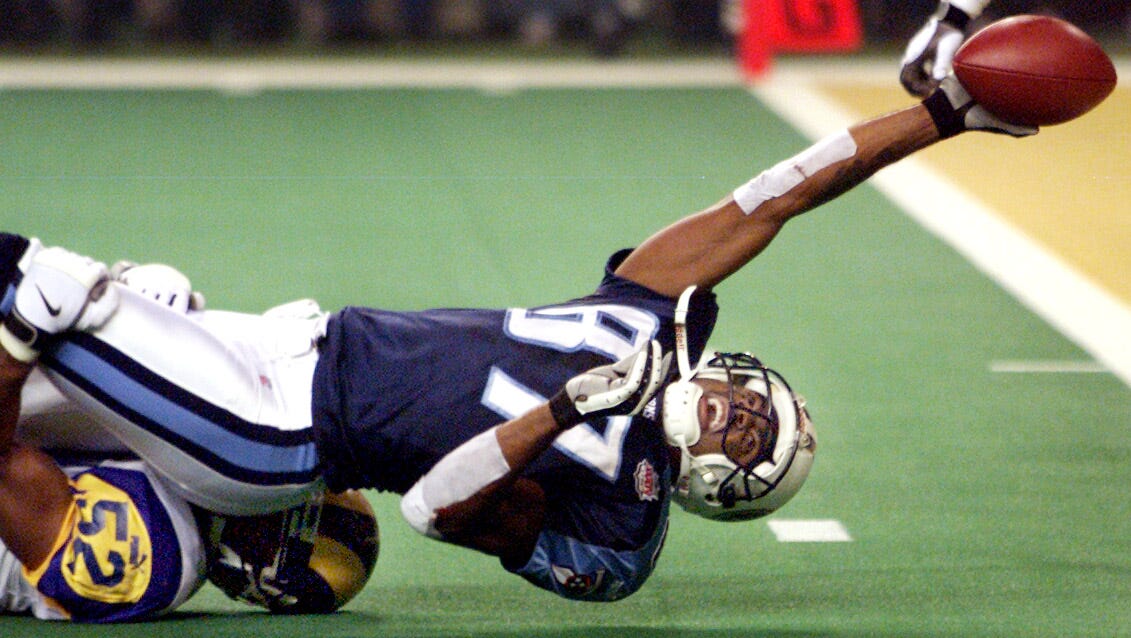
It didn't work. Jones saw Dyson getting ready to catch the ball. Jones ran toward Dyson, and wrapped is arms around Dyson's legs to tackle him, less than 3 yards short of the goal line. But Dyson knew he was not yet down, and he reached out with his arm, holding the ball, hoping to have it break the plane of the goal line for the touchdown. But the way that Jones tackled him, his shoulder hit the ground, ending the play, and the ball was still about one full foot away from the goal line.
It's become known as "The Tackle" and "The Longest Yard." The Titans had fought bravely, but were one yard short of, at the very least, being tied at the end of regulation of the Super Bowl. The Rams had blown a 16-point 2nd half lead in the Super Bowl, but were still World Champions. They also became the 1st team to win NFL Championships in 3 different cities: Cleveland in 1945, Los Angeles in 1951, and St. Louis in 1999-2000.

Warner's story of being a supermarket bagger and an Arena Football League quarterback in Iowa to winning the Most Valuable Player award in a Super Bowl was made into the recent movie American Underdog, starring Zachary Levi. And Dick Vermeil, once again crying tears of joy after a big win, finally got his ring.

After failing to repeat, the Rams got back to the Super Bowl in the 2001-02 season, but lost to the New England Patriots on a last-play field goal. Soon, "The Greatest Show On Turf" broke up, and the Rams became a mediocre team again. Warner went, ironically, to the former St. Louis football team, now the Arizona Cardinals, and got them into Super Bowl XLIII, but lost.

St. Louis lost interest in the Rams, and when they moved back to Los Angeles in 2016, there wasn't much of a fuss over it. The Rams got back to the Super Bowl in the 2019 season, but lost. They were back in for the 2021 season, and beat the Cincinnati Bengals in Super Bowl LVI in their new home, SoFi Stadium in Inglewood, California. (They had previously played Super Bowl XIV in the Rose Bowl, 14 miles from their home at the time, the Los Angeles Coliseum, but lost it to the Pittsburgh Steelers.)

The Titans reached the AFC Championship Game again in the 2002 season, but lost it to the then-Oakland Raiders, They were still a Playoff team as late as 2008, but fell apart. They have rebuilt, making the Playoffs in 4 of the last 5 seasons, including another AFC Championship Game in the 2019 season, which could have set up a Super Bowl rematch with the Rams, but they lost to the Kansas City Chiefs.

In 2019, a poll ranked this game 16th on a list of the 100 Greatest Games of the NFL's 1st 100 years.

Wednesday, January 8, 2025

January 8, 2000: The Music City Miracle

January 8, 2000, 25 years ago: The Music City Miracle takes place, one of the wildest and most controversial plays in NFL history.

The Houston Oilers moved in 1997, becoming the Tennessee Oilers. After 1 season at the Liberty Bowl in Memphis, they realized they weren't going to draw enough fans as a lame-duck team. All previous pro football teams in Tennessee had been based in Memphis, and, since Memphis and Nashville don't like each other, Nashvillians never really adopted the WFL's Memphis Southmen or the USFL's Memphis Showboats; and Memphis fans, knowing the Oilers would be in Nashville in 1999, rejected them.

So they moved to Nashville a year earlier than they'd intended, even though Vanderbilt Stadium seated only 41,000. After all, they weren't getting that much in Memphis.

In 1999, the Adelphia Coliseum -- now named Nissan Stadium -- opened, across the Cumberland River to the east of downtown Nashville. They changed their name again, to the Tennessee Titans, and adopted a new logo and new colors as well. The people of Nashville really took to them, because, for the first time, they had a true Nashville team to root for.

Winning helped: After going 8-8 in each of their 2 seasons as the Tennessee Oilers, head coach Jeff Fisher led the Titans to a record of 13-3, the best in the franchise's 40-season history. Ordinarily, this would be good enough to win the Division. But the Jacksonville Jaguars went 14-2 to win the AFC Central Division. So the Titans got into the Playoffs as a Wild Card.

But they would get the 1st round of the Playoffs at home. The franchise hadn't made the Playoffs in 6 years, since they were still in the Astrodome.

Their opponents were the Buffalo Bills. Although the Bills had won 4 straight AFC Championships from 1990 to 1993, including beating the Oilers in a Playoff game with the biggest comeback in NFL history, they lost 4 straight Super Bowls. A few players from those teams were still with them as they took the field at Adelphia.

The 1st quarter ended scoreless. Early in the 2nd quarter, Jevon Kearse, known as "The Freak" and winner of the NFL's Defensive Rookie of the Year, sacked Bills quarterback Ron Johnson in the end zone. It was 1 of 6 sacks on the day by the Titans, 1 of 2 by Kearse. Quarterback Steve McNair led the Titans down the field, and scored on a 1-yard run. That made it 9-0 Tennessee.

The next time the Titans had the ball, Al Del Greco attempted a 45-yard field goal, and missed. But the Bills committed a defensive penalty on the play, and Del Greco made the re-kick. The 1st half ended 12-0 in the Titans' favor.

Bills fans need to remember this: For much of the half, their team really wasn't in the game. The Titans held them to 64 yards, and they were penalized for almost as many: 44, after being penalized, how many times, Ed Rooney? "Nine times!"

But on the Bills' 1st play of the 2nd half, Antowain Smith ran for 44 yards. Four plays later, he scored from 4 yards out. On their next drive, Kearse made a big mistake with a roughing-the-passer penalty. This led to Smith scoring another touchdown, early in the 4th quarter, giving the Bills a 13-12 lead. But they couldn't make the 2-point conversion.

Del Greco kicked another field goal to put the Titans ahead 15-13 with 1:48 left in regulation. The Bills drove, and, with 20 seconds left, Steve Christie -- who had kicked the overtime winner in that comeback, 7 years and 5 days earlier -- kicked from 41 yards out, and it was 16-15 Buffalo.

The Bills treated the game as already won. Hall-of-Fame defensive end Bruce Smith was caught on film saying, "We got a win on the road, baby!" But the Bills still had to kick off, and hold the Titans off for another 16 seconds.

Perhaps some Tennessee fans were thinking of the ending of the 1982 California vs. Stanford game, which Cal won with a lateral-filled kickoff return known simply as "The Play." But Titans special teams coordinator Alan Lowry was thinking of a different play from the same year.

He was then an assistant coach with the Dallas Cowboys. Also in Dallas is Southern Methodist University -- both teams used the Cotton Bowl as their main home field from 1960 to 1971 -- and SMU used a trick play on a kickoff return to beat Texas Tech. Lowry made the Titans practice the play, which he called "Home Run Throwback," mixing his sports metaphors. They even used it once in the regular season, scoring a touchdown against the Atlanta Falcons.

Christie tried a "pooch kick," to make it harder to run the ball back. Lorenzo Neal picked the ball up. Right behind him was Frank Wycheck, and Neal handed him the ball. This was key: The Bills saw this, and keyed on Wycheck.

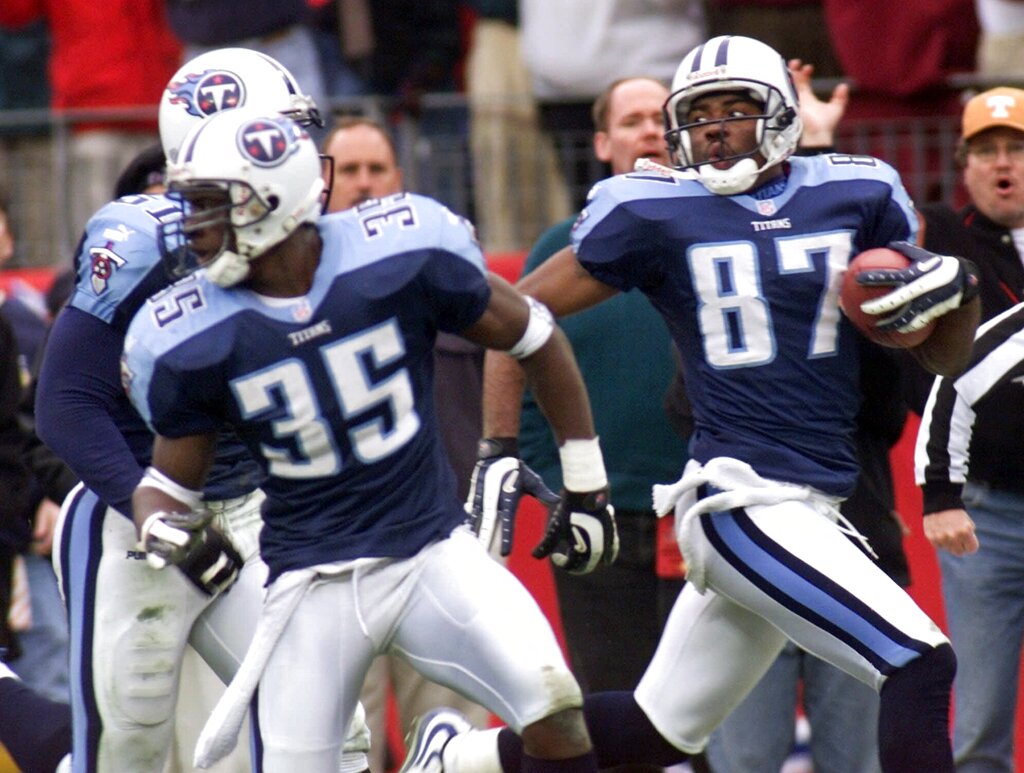
Wycheck then threw the ball across the field, to Kevin Dyson. Except for Christie, every Bills player was fooled. Dyson ran down the sideline 75 yards, and had every other Titan available to block every Bill player coming over, and scored a touchdown.

Titans broadcaster Mike Keith had the call:

Do the Titans have a miracle left in them, in what has been a magical season to this point? If they do, they need it now. Christie kicks it high and short. Gonna be fielded by Lorenzo Neal at the 25, pitches it back to Wycheck, he throws it across the field to Dyson, 30, 40, 50, 40, 30, 20, 10, 5, end zone! Touchdown, Titans! There are no flags on the field! It's a miracle! Tennessee has pulled a miracle! A miracle for the Titans!

On TV for ABC, Mike Patrick had a similar call: "Dyson's going to go all the way! And there is no flag!"

Why would there be a penalty flag? Because it looked to many people like Wycheck had thrown a forward pass on a kickoff, which is illegal. The referee agreed to review the play.

The referee was Phil Luckett. Twice, in the previous season, he had been involved in controversy. On Thanksgiving, he had flipped the coin for overtime, and heard the Pittsburgh Steelers' Jerome Bettis call "Heads" then change his mind to "Tails," and went with the initial call of "Heads." The coin landed tails, the Detroit Lions got the ball, and they kicked a field goal to win without the Steelers even getting the ball. The Steelers missed the Playoffs due in part to losing that game.

A few weeks later, Vinny Testaverde fell a foot short of the goal line on a 4th down play, but the ball was ruled to have crossed the plane of the goal line, giving the New York Jets a win they didn't really deserve against the Seattle Seahawks. Luckett wasn't the official who made the call, and it wasn't reviewable under the rules of that season; but as head official for the game, he got blamed. So, for the 1999 season, the NFL team owners voted to bring instant replay back, and this was the biggest reviewed play since that decision.

The rule for instant replay is that, in order for the call on the field to be overturned, it must be conclusively shown to have been wrong. The replay didn't conclusively show that Wycheck's throw was a forward pass. I've seen it many times, and have never had any doubt that it was a lateral, slightly (maybe a foot or two) backward. No one reviewing the play thought the throw was the slightest bit forward. The touchdown was allowed to stand.

There were still 3 seconds left on the clock when Dyson crossed the goal line. So this crazy game wasn't over yet. But the Bills didn't have a "miracle" of their own, and the Titans won, 22-16.

During the off-season, the NFL office hired a computer analyst to check the play. Once again, it was affirmed that the Wycheck throw was a lateral. After 25 years, Bills fans still disagree.

But, through 2 different broadcasters' use of the word "miracle," the play and the game have become known as the Music City Miracle.

The Titans went on to beat the Indianapolis Colts and the Jaguars, to win the franchise's 1st AFC Championship. As the Oilers, they had won the AFL Championship in 1960 and 1961, but had lost the AFL Championship Game in 1962 and 1967, and had lost the AFC Championship Game in 1978 and 1979. So this would be the franchise's 1st trip to the Super Bowl.

The Titans lost Super Bowl XXXIV to the St. Louis Rams, 24-17. On the game's final play, Dyson, who had scored the touchdown on the Music City Miracle, was tackled by Mike Jones, 1 yard short of a touchdown that, with an extra point, would have sent the game to overtime -- or, with a 2-point conversion, would have won Tennessee the World Championship.

The Titans made the Playoffs in 5 of the next 9 years, and lost another AFC Championship Game in 2002. Then they went into a down period. But they have rebuilt. They reached the AFC Championship Game again in 2019, made the Playoffs again in 2020. The Bills missed the Playoffs for the next 17 seasons in a row. But they, too, have built a contender, and reached the AFC Championship Game in 2020. 

Both teams were eliminated from the 2021-22 Playoffs in the Divisional round. The Titans then dropped off, but the Bills have stayed strong.

Frank Wycheck died on December 9, 2023, at the age of 52. He thought he had CTE, and he may have been right, because he died from falling and hitting his head.

The day after, the Bills got hit with a similar play against the Kansas City Chiefs, but it was nullified for offside. Like the Music City Miracle, the officials got the call correct. And the Bills won the game.

Monday, September 5, 2022

How to Be a New York Football Fan In Tennessee -- 2022 Edition

This coming Sunday afternoon, September 11, the New York Giants open their season in Nashville, against the Tennessee Titans.

Before You Go. Nashville is in the South. Not the Deep South, but the Mid-South. However, Tennessee rejoined the Union a long time ago, and you won't need to bring a passport or change your money.

If you were going to a baseball game, or an early-season football game, the heat might be an issue. But although this will be in mid-September, heat won't be much of a factor. What could be a factor is rain: The website of Nashville's main newspaper, The Tennessean, is predicting rain all day long. As for temperatures, they're talking the low 80s for daylight and the low 60s for night. You'll need an umbrella, but not a jacket.

Nashville, like most (but not all) of Tennessee, is in the Central Time Zone, an hour behind us. Adjust your timepieces accordingly.

Tickets. The Titans averaged 64,509 fans per home game in 2019, the last pre-COVID season, about 93 percent of capacity. Tickets might not be hard to get.

Only the upper level, the 300 sections, are available, as the rest goes to season-ticket holders. And those seats that are available are prohibitively expensive: Expect to pay over $150 no matter where you sit, maybe over $200. Between the weather and the prices, maybe this trip isn't worth it. Maybe you should wait for the next time your team plays the Titans away, which could be anywhere from 2 to 7 years, given the NFL's scheduling.

Getting There. It's 892 miles from Midtown Manhattan to downtown Nashville, and 881 miles from the Prudential Center to the Bridgestone Arena. So your first instinct would be to fly.

A round-trip flight could cost over $800. It could drop to a little over $500, but then it won't be nonstop. oNashville International Airport is 8 miles east of downtown, and the Number 18 bus can get you to downtown in under half an hour. (The airport was originally named Berry Field, after Colonel Harry S. Berry, the Tennessee administrator for the New Deal's Works Progress Administration.)

You can't take Amtrak: It doesn't serve Nashville. Greyhound can get you from New York to Nashville in a little under 30 hours, for $709 round-trip, although it could drop to as little as $427 with advanced purchase, although you'd have to change buses in Richmond. The Greyhound station is at 709 5th Avenue South, 5 blocks south of the arena.

If you do drive, it's far enough that you should get someone to go with you, to trade off, especially if one can sleep while the other drives. Get into New Jersey, take Interstate 78 West into Pennsylvania. At Harrisburg, get on Interstate 81 South, and take that down through Maryland, West Virginia and Virginia, into Tennessee, where it flows into Interstate 40 West. Take that halfway across Tennessee. Exit 210 is for downtown.

If all goes well, you should spend a little over an hour in New Jersey, 2 hours and 45 minutes in Pennsylvania, 15 minutes in Maryland, half an hour in West Virginia, 6 and a half hours in Virginia, and 2 hours and 45 minutes in Tennessee, for a total of 13 hours and 45 minutes. Given rest stops in Pennsylvania, one at each end of Virginia, and 1 in Tennessee, and we're talking about a trip of at least 17 hours -- each way.

Once In the City. Founded in 1779, and named for General Francis Nash, killed in the Battle of Brandywine outside Philadelphia in the War of the American Revolution, Nashville is in central Tennessee. It is the State capital, home to 684,000 people with a metropolitan area of about 1.9 million.
The State House, formerly featured on Tennessee license plates.
That statue of Andrew Jackson, Tennessee pioneer,
has copies in Washington across from the White House,
and in downtown New Orleans.

"White flight" hasn't hurt Nashville nearly as much as it's hurt Memphis or many other cities, North and South alike. As late as 1970, Nashville was 80 percent white; in 1990, 74 percent. Now, it's about 56 percent white, 28 percent black, 10 percent Hispanic, 4 percent Asian and 1 percent Native American. While Nashville was spared the kind of post-Civil War racial violence that Memphis suffered in 1866, when Martin Luther King was assassinated in Memphis in 1968, Nashville suffered some looting.

The sales tax in Tennessee is 7 percent, and within Davidson County, including Nashville, 9.25 percent, even higher than New York's. ZIP Codes for the Nashville area start with the digits 370 to 374, and 384 and 385. The Area Code for Nashville is 615. Nashville Electric Service (NES) runs the utilities for most of Middle Tennessee.

Address numbers on east-west streets increase away from the Cumberland River, and Broadway separates north from south. The The Nashville Metropolitan Transit Authority (NMTA) runs buses, with a $1.75 fare, and the Music City Star, a commuter rail service to the city's eastern suburbs, with a fare double that, $3.50.
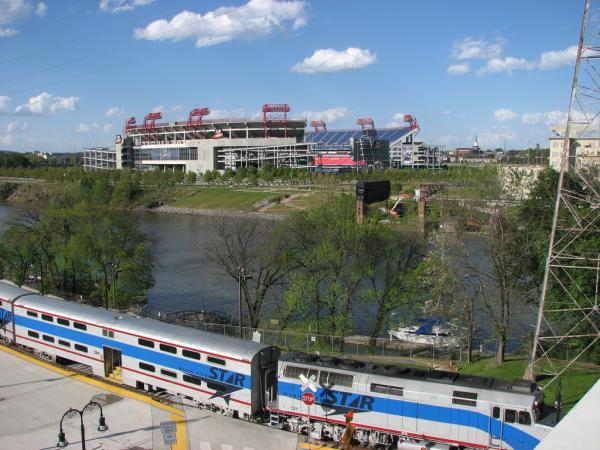
The Music City Star, with Nissan Stadium,
home of the Titans, in the background

Going In. Nissan Stadium, whose naming rights are currently owned by the Japanese carmaker, has been the home of the Tennessee Titans since it opened in 1999. It was known as the Adelphia Coliseum until 2002, simply The Coliseum until 2006, and LP Field until 2015.

The official address is 1 Titans Way, across the Cumberland River from downtown, bordered by Russell Street on the north, S. 2nd Street on the east, Victory Avenue on the south and Titans Way and the River on the west.
There's no bus service, but it accessible from downtown by taking the Music City Star to Riverfront Station, and then walking across the John Siegenthaler Pedestrian Bridge, which makes for a great visual on Titans gamedays. (Siegenthaler was a reporter for, and eventually the publisher of, The Tennessean. After his death in 2014, the former Shelby Street Bridge was renamed for him.) If you drive in, parking is $25.
Siegenthaler Bridge, with the stadium behind it

The field is aligned (roughly) north-to-south, and has been natural grass since it opened. The 69,000-seat stadium has seen the Titans win the AFC Championship in its inaugural season, and nearly win Super Bowl XXXIV, and Division titles in 2000 (the old AFC Central), 2002 and 2008 (the new AFC South). Tennessee State University, a historically-black school in Nashville, splits its home games between the stadium and an on-campus facility. The stadium also hosts the annual Music City Bowl, and concerts, including the CMA Music Festival every June.
It's also been a soccer facility, including hosting the U.S. national team in a 1-0 loss to Morocco in a friendly on May 23, 2006; a 3-0 win over Trinidad and Tobago in a World Cup Qualifier on April 1, 2009; a 1-0 loss to Paraguay in a friendly on March 29, 2011; and a 4-0 win over Guatemala in a friendly on July 3, 2015. That game was riddled by operational and logistical issues, with the Twittersphere exploding with discussions of the stadium's inadequacy even before kickoff.

Since then, 2 more USMNT games and 1 U.S. women's national team (USWNT) game have been played there, without similar issues: A 1-1 draw with Panama in the CONCACAF Gold Cup on July 8, 2017, and a 1-0 in over arch-rival Mexico on September 11, 2018. The women's team played a game of the She Believes Cup there, beating France 1-0 on March 6, 2016. It has now hosted the CONCACAF Gold Cup for 2 games in 2017, and 1 in 2019. The U.S. women's team played a SheBelieves Cup match there on March 2, 2019, a 2-2 draw with England. And MLS expansion team Nashville SC played home games at Nissan Stadium in 2020 and 2021.


During the Titans’ string of mediocre-to-dismal seasons, the team cut back on stadium personnel, leading to long lines to enter the stadium and purchase much-needed beers, despite dwindling attendance. Both the team and the crowds are improving, but the stadium is nearing the backside of its useful lifespan.

And on November 4, 2020, MoneyWise published an article ranking the Worst NFL Stadiums. Nissan Stadium came in 7th, making it 24th out of 30: "Nissan Stadium lacks modern amenities and has been described as bland. The juxtaposition with the glitzy surrounding area makes the stadium feel even more lackluster."

Food. Memphis has a reputation as a city of fine Southern food, particularly barbecue. Nashville, less so: They're known for music first, and food, and everything else, somewhere down the line. According to StadiumJourney.com:


Team History Displays. As the Houston Oilers, playing from 1960 to 1996, the franchise now known as the Tennessee Titans won the AFL Championship in 1960 and 1961; the AFL Eastern Division in those years, 1962 and 1967; the AFC Central Division in 1991 and 1993; an AFL Wild Card Playoff berth in 1969; and AFC Wild Card berths in 1978, 1979, 1980, 1987, 1988, 1989, 1990 and 1992.

They played in Memphis in 1997 and in Nashville in 1998 as the Tennessee Oilers. As the Tennessee Titans, they've won the 1999 AFC Championship, before losing a classic Super Bowl XXXIV that went down to the last play of regulation; the AFC Central in 2000; the AFC South in 2002, 2008, 2020 and 2021; and AFC Wild Card berths in 2003, 2007, 2017 and 2019.

The Titans have 8 retired numbers: 1, quarterback Warren Moon, 1984-93; 9, quarterback Steve McNair, 1995-2005; 27, running back Eddie George, 1996-2003; 34, running back Earl Campbell, 1978-84; 43, safety Jim Norton, 1960-68; 63, guard Mike Munchak, 1982-93; 65, defensive end Elvin Bethea, 1968-83; and 74, offensive tackle Bruce Matthews, 1983-2001, including 1997-2001 in Tennessee.

Moon, Campbell, Norton, Munchak and Bethea played their entire tenures with the franchise in Houston. George played the last season in Houston before moving to Tennessee, McNair the last 2. Matthews was the only one of these who spent at least 5 seasons in both places. Munchak was also head coach in Tennessee, 2011-13.

However, there is no sign or banner for any of their achievements or retired numbers, as Oilers or Titans, in the fan-viewable areas of Nissan Stadium. Looking for such, you'd never know this franchise was nearly 25 years old -- or over 60, depending on how you look at it.

There are 15 members of the Pro Football Hall of Fame who have played for the Oilers/Titans franchise, including Moon, Campbell, Munchak, Bethea and Matthews (but not Norton). Also in Canton due in part to their performances with the Oilers are quarterback-kicker George Blanda (16, 1960-66), safety Ken Houston (29, 1967-72), receiver Charlie Joiner (18, 1969-72), defensive tackler Curley Culp (78, 1974-80), linebacker Robert Brazile (52, 1975-84), and tight end Dave Casper (87, 1980-83).

Running back John Henry Johnson played the 1966 season with the Oilers. Quarterback Ken Stabler played for them in 1980 and '81. Sammy Baugh was their head coach in 1964, Sid Gillman in 1973 and '74, and Dick LeBeau was an assistant coach for the Titans in 2015, '16 and '17. All 5 of these men are in the Hall, but all 5 are in for what they did with other teams.

Matthews was the 1st player in the Hall who ever suited up for the Titans. He has been joined by center Kevin Mawae (68, 2006-09, previously with the Jets), and 2 men who were with them for only 1 season: Receiver Randy (Moss (84, 2010) and guard Steve Hutchinson (73, 2012).

In 2000, on the franchise's 40th Anniversary, Bud Adams, the team's founder and still its owner, established the Titans/Oilers Hall of Fame. It includes all the retired number honorees, plus Blanda, Houston, George, McNair, 1989-93 general manager Mike Holovak, and 1995-2003 tight end Frank Wycheck (89). By a vote of the board of directors, not a decision by Adams himself, it also includes Adams. Therefore, counting only Tennessee Titans personnel, it includes only Adams, Matthews, McNair, Wycheck and George.

Blanda, receiver Charlie Hennigan (87, 1960-66), guard Bob Talamini (61, 1960-67, later a member of the Jets' Super Bowl winners), cornerback Miller Farr (46, 1967-69) and linebacker George Webster (90, 1967-72) were named to the AFL's All-Time Team in 1970.

Ken Houston and Billy "White Shoes" Johnson (84, 1974-80) were named to the NFL's 75th Anniversary Team in 1994. Blanda, Houston and Campbell were named to The Sporting News' 100 Greatest Football Players in 1999. Campbell and Matthews were named to the NFL Network's 100 Greatest Players in 2010. Of course, except for Matthews, none of those players played so much as a down for Tennessee. Campbell, Matthews, Houston, Johnson and Moss were named to the NFL's 100th Anniversary Team in 2019.

The Tennessee Sports Hall of Fame is located at the Predators' Bridgestone Arena. Adams, McNair, George, Wycheck, Blaine Bishop (23, safety, 1993-2001, including 1997-2001 in Tennessee) and Jevon Kearse (90, defensive end, 1999-2003 and 2008-09) have been elected.

The Oilers/Titans franchise has had 6 Heisman Trophy winners on its roster. All but 1 have been running backs. Billy Cannon (1959 Louisiana State) was an original Oiler (1960-63). Earl Campbell (1977 Texas) may have been the greatest Oiler (1978-84). Mike Rozier (1983 Nebraska) might have had a good pro career if he didn't jump to the USFL first (Oilers 1985-90).

A previous Tennessee pro football team, the Memphis Southmen of the World Football League, had a Heisman winner: 1964 winner John Huarte of Notre Dame was their starting quarterback in the 1974 and '75 seasons, before the WFL folded in mid-1975.

Eddie George (1995 Ohio State) was with the team when they moved to Tennessee and a bit beyond (1996-2003). They had quarterback Marcus Mariota (2014 Oregon, 2015-19), and currently have running back Derrick Henry (2015 Alabama).

Geographically, it would make sense for the Titans' rivals to be another Southern team. But they don't really have an arch-rival yet, despite beating the Jacksonville Jaguars, now a fellow AFC South team, in the 1999 AFC Championship Game. Their biggest rival might be a different AFC South team, the team that replaced them in their former city, the Houston Texans. The Titans lead the series, 22-18.

Stuff. The Titans Locker Room is at the southeast corner of Nissan Stadium. There's also an outlet at the Rock Creek Mall, 1800 Galleria Blvd. in suburban Franklin, 16 miles south of downtown. No public transit.

As one of the NFL's newer teams (though not one of its newer franchises), there aren't many books about the Titans. Sara Gilbert (not the actress) wrote the Titans' edition of the NFL Today series of team books in 2013.

In 2008, NFL Films released a DVD titled Tennessee Titans: 3 Greatest Games. It includes the 1999 AFC Championship Game, the Playoff win over the Buffalo Bills that became known as the Music City Miracle, and a 2007 win over the Texans featuring a thrilling performance by Vince Young.

During the Game. A recent Thrillist article on the NFL's most obnoxious fans ranked Titans fans 30th -- the 3rd-least obnoxious:

You poor bastards almost won a championship your first season after moving from Houston. (Their third, actually.) But let's face it, those memories are as fleeting as Mike Munchak's and Mike Mularkey's tenures as head coach -- it might be time to try someone with a name that doesn't scream "evil high school P.E. teacher." Now, your lone claim to fame is “selling out” your stadium by dumping thousands of tickets on StubHub. And because most of you also wear Creamsicle orange on Saturday (meaning the Vols), America kinda feels bad for you. But thank you for not taking your disappointment out on us.
Nashville people don't like Memphis people. And Tennessee people don't like Arkansas, Alabama, and Florida people -- holdovers from college football rivalries. But Titans fans have nothing against Jets or Giants fans. So as long as you don't make any wiseguy remarks about this being a North vs. South game, you shouldn't face anything beyond the usual nonviolent "My team rocks, your team sucks" talk.

From September 1 to 7, 2017, at the height of the NFL National Anthem protest controversy,
FiveThirtyEight.com polled fans of the 32 NFL teams, to see where they leaned politically. Titans fans, within a fairly liberal city surrounded by very conservative, very Southern suburbs, were rated 1.1 percent more conservative than liberal. They were 1 of 6 teams whose fans were more conservative than liberal.

The Titans' mascot is T-Rac the Raccoon, because the raccoon is the State animal of Tennessee -- as in the coonskin cap, which really was worn by frontiersman, soldier and Congressman David Crockett -- even if he never called himself "Davy" like he's been called in popular culture since his death at the Battle of the Alamo in 1836.
After the Game. If there was an NFL team in Memphis, Nashville fans wouldn't like them. But they've never been known to turn on New Yorkers or New Jerseyans. Jets and Giants fans shouldn't get any hassling, as long as they aren't the ones to bring it on.

Being in downtown Nashville, there are plenty of places to go for a postgame libation. Just don't call it a "libation" when you're in one, or you might get some funny looks. Robert's Western World, at 416 Broadway, is a honky-tonk famed for cold beer, fried baloney sandwiches and live country bands. Across the street, Rippy's specializes in barbecue. And there are many others.

However, I could find no place in Nashville catering to fans of any Tri-State Area team: Not the Yankees, the Mets, the Giants, and so on... and certainly not the Devils. 

If you visit Nashville during the European soccer season, which we are now in, the best place to watch your local club is Fleet Street Pub, 207 Printers Alley, off Church Street between 3rd and 4th Streets downtown.

Sidelights. On November 30, 2018, Thrillist published a list of "America's 25 Most Fun Cities," and Nashville came in 16th. Nashville is about music 1st, Tennessee State government 2nd, and sports 3rd. But it's a good sports town, even though it's never had an MLB or an NBA team. On February 3, 2017, Thrillist made a list ranking the 30 NFL cities (New York and Los Angeles each having 2 teams), and Nashville came in 2nd. They said: 

Nashville's a damn fine place to be, what with the music and the fantastic barbecue (no, it's not just Memphis) and the just-right amount of country. It's simultaneously small town and thriving city in the best possible way. It's going to be crushed when Marcus Mariota doesn't live up to the hype, but not THAT crushed because everyone cares way more about college, anyway.

* Vanderbilt University. If there was an "Ivy League" for Southern schools, this school, founded by 19th Century railroad baron Cornelius Vanderbilt, would be one of them. It is superb academically, but those high standards have hurt it when recruiting athletes, who tend to go to less stringent schools, thus leaving Vandy, whose teams are called the Commodores after Cornelius' nickname, struggling within the Southeastern Conference in most sports. Their women's basketball team is an exception, but, even then, they are overshadowed by their neighbors in Knoxville, the University of Tennessee.

Dudley Field opened in 1922, but was demolished and replaced with Vanderbilt Stadium in 1981, although the playing surface is still called Dudley Field, for William F. Dudley, dean of the University's medical school and the founder of the precursor league to the SEC.
After leaving Houston following the 1996 season, the plan was for the Oilers to play at the Liberty Bowl in Memphis for 2 years, as the Tennessee Oilers, before moving to the new stadium in Nashville for 1999. But this was a public-relations disaster, as Memphians stayed away from Nashville's team in droves, heedless of the State's name on the team.

So after topping 32,000 in only 1 home game (the last, 50,677 seeing them beat the Pittsburgh Steelers to finish 8-8), and getting less than 18,000 in 2 of their games (the smallest NFL crowds since World War II, except for the Scab Year of 1987), Bud Adams took the hint, and swung a deal to play in Nashville a year early. Vanderbilt Stadium seated only 41,448 people, making it the smallest NFL stadium since the early 1960s, but they sold it out in 4 of their 8 games. The next year, they moved into what's now Nissan Stadium, and dropped the Oilers name to officially become the Tennessee Titans.

Vanderbilt Stadium is adjacent to Memorial Gymnasium, built in 1952 as a memorial to the servicemen and -women of World War II. It is unique in college basketball (although this was not he case when it opened) in that both teams' benches are behind one of the baskets. Other unusual touches, and its age (there are several Division I schools with older facilities still in use) have nicknamed it The Fenway Park of College Basketball. 210 25th Avenue South, about 2 miles west of downtown. Number 3 bus.

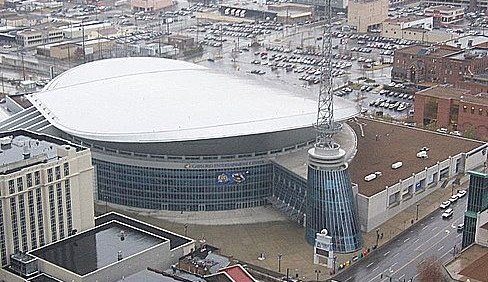
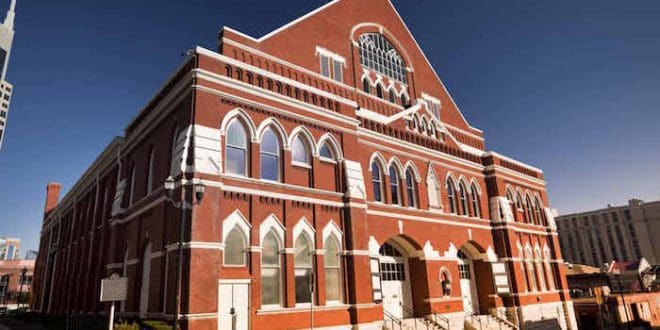
* Bridgestone Arena. The home of the NHL's Nashville Predators is downtown, with an official address of 501 Broadway, at 5th Avenue South. Across Broadway, on either side of 5th, are the Nashville Convention Center and the Ryman Auditorium, legendary home of The Grand Ole Opry.
The Arena, easily identifiable with its sloping roof and its antenna at the north end, opened in 1996, with the generic name Nashville Arena. It was renamed the Gaylord Entertainment Center in 1999, after a locally-based media company that was a minority stockholder in the team. In 2005, Gaylord sold its stock, and in 2007 the arena was renamed the Sommet Center, after Sommet Group, a local company that oversaw software development and payroll services. But Sommet was a company built on fraud, its founder went to prison, and in 2010 locally-based tire company Bridgestone bought the naming rights, and holds them to this day.

The Arena has hosted Southeastern Conference Tournament, Ohio Valley Conference Tournament, and NCAA Tournament basketball -- in each case, both men's and women's. It hosted the Women's Final Four in 2014. The Country Music Association (CMA) Awards have been held there since 2006.

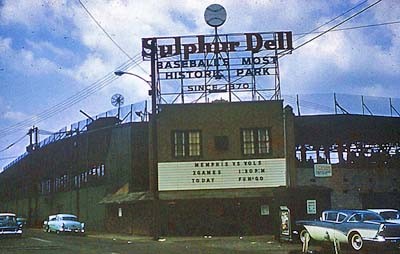
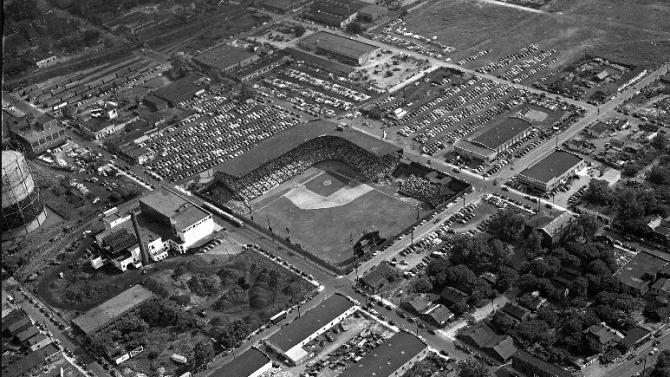
* First Tennessee Park and site of Sulphur Dell. The original home of Nashville baseball is its home once again. Sulphur Dell stood on the site from 1870 to 1969, but the original ballpark faced southwest, so the State House would be in view. This put the sun in the outfielders' eyes. Along with odors from a nearby dump wafting over, and the occasional flooding from the Cumberland River that forced some games to be moved to Vanderbilt University's field, this earned the stadium the nicknames "The Dump" and "Suffer Hell."

This wooden ballpark was demolished, and replaced with stadium of concrete and steel for the 1927 season. It seated 8,500 fans at its peak. But while the new park fixed the sun problem, it did nothing to get rid of the smell from the dump, and the shape of the plot of land forced a short right field fence with a terrace, much like Cincinnati's old Crosley Field and Houston's Minute Maid Park today. When the Yankees visited for an exhibition game, Babe Ruth refused to play his usual position of right field because of the little hill, and was moved to left field.
The team that played there the longest was called the Nashville Vols, short for "Volunteers," as the University of Tennessee (in Knoxville) calls its teams the Volunteers or the Vols, as Tennessee is known as the Volunteer State. They won Southern Association regular-season Pennants in 1901, 1902, 1908, 1916, 1940, 1943, 1948 and 1949; Playoffs for the SA title in 1939, 1940, 1941, 1942, 1943, 1944, 1949, 1950 and 1953; and the Dixie Series against the Champions of the Texas League in 1940, 1941, 1942 and 1949.
Hall-of-Famers who played for the Vols included Yankee pitcher Waite Hoyt and Pittsburgh Pirates slugger Kiki Cuyler. The 1940 Vols have been remembered as one of the greatest minor league teams. It featured future All-Star pitcher and Yankee World Champion Johnny Sain, former Detroit Tigers pitcher Cletus "Boots" Poffenberger going 26-9, and catcher Charles "Greek" George won the SA Most Valuable Player award. Unlike Sain, George he didn't play much in the major leagues, and after getting called up in 1945 due to the World War II manpower shortage, he punched an umpire during an argument and got unofficially blackballed from baseball. In his case, "Vol" might have been short for "Volatile."

The Negro Leagues' Nashville Elite Giants (who are best remembered today as the Baltimore Elite Giants, and that's pronounced EE-light, not El-EET) played at Sulphur Dell from 1920 to 1928, winning a Pennant in 1921.

The National Association, the governing body of minor league baseball, ordered that all leagues under its umbrella be desegregated for the 1962 season. Rather than comply, the Southern Association folded. The Vols, who valued staying in business over white supremacy, were inactive for 1962, but started again in the South Atlantic League for 1963. But they lost money, and folded.

Like the aforementioned Crosley Field, Sulphur Dell was used as a police impound lot, before being demolished in 1969 and being used as parking for State government buildings.

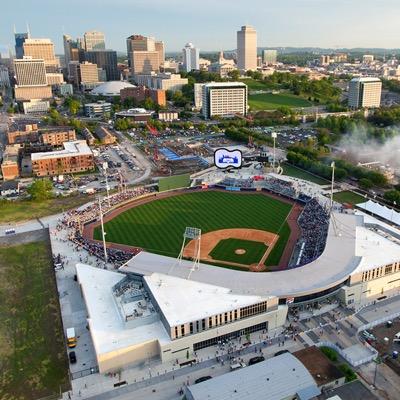
First Horizon Park, named for a bank, opened on the site in 2015, and the Nashville Sounds moved in. It seats 8,500 people, with grassy outfield seating pushing capacity to around 10,000. It has a view of downtown Nashville. And it copied the idea of a guitar-shaped scoreboard from Greer Stadium.
The old address was 900 5th Avenue North, but it's now listed as 19 Junior Gilliam Way, for the Nashville native who wore Number 19 as a Brooklyn/Los Angeles Dodgers player and coach. A mile from downtown, and several buses go there.

* Tom Wilson Park. Black businessman Thomas T. Wilson built a ballpark for the Elite Giants to use, and they did so from 1929 to 1934, before moving north. It seated 8,000 people, and was demolished sometime after 1946. 2nd Avenue S. and Chestnut Street, about a mile southeast of downtown. Bus 25.

* Herschel Greer Stadium. Named for the late former president of the Vols, this ballpark seats 10,300 people, with standing room pushing it to a possible 15,000, which made it one of the largest minor-league ballparks.
From 1978 to 2014, it was the home of the Nashville Sounds, who started out in the Double-A Southern Association, and moved to Triple-A, first to the American Association, and then, when that league was split up, to the Pacific Coast League. (Yes, I know, Tennessee is pretty far from the Pacific Coast.) The Sounds won Pennants there in 1979, 1982 and 2005, meaning that Nashville has won either a regular-season Pennant or a Playoff Pennant 17 times: 1901, '02, '08, '16, '39, '40, '41, '42, '43, '44, '48, '49, '50, '53, '79, '82 and 2005. (Compare this with Memphis' 10 and Knoxville's 3.)

The stadium was easily identifiable by its nod to Nashville being "Music City": A guitar-shaped scoreboard. But as Camden Yards and a series of new ballparks, in both the majors and the minors, rewrote the rules for what a baseball stadium should be in the 1990s, Greer Stadium began to be seen as outdated, and so a new park was built.
With the Sounds having moved out, its future is uncertain. 534 Chestnut Street, about a mile and a half south of downtown. The Adventure Science Center is next-door. Buses 8, 12 and 25 will get you to within a short walk.

The nearest Major League Baseball team is the Atlanta Braves, 246 miles away, with the Cincinnati Reds a little farther away at 272 miles. According to an April 24, 2014 article in The New York Times, baseball fandom in Nashville is set by TV watching: The 3 most popular teams are the Braves, the Yankees and the Boston Red Sox, with some people rooting for the Braves and the Reds due to the comparative proximity.

The nearest NBA team is the Memphis Grizzlies, 213 miles away. But Nashvillians don't root for the Grizzlies, because of the inherent Intra-Tennessee rivalry. For those who care about the NBA at all, according to a May 23, 2014 article in The New York Times, they tend to divide their fandom among the "cool teams": The Los Angeles Lakers, the Chicago Bulls, the Miami Former LeBrons, and the Cleveland Once-and-Again LeBrons.

* Geodis Park. On December 20, 2017, Major League Soccer granted Nashville an expansion team. After playing the 2020 and '21 seasons as Nissan Stadium, this past May 1, Nashville SC (for "Soccer Club") moved into Geodis Park, a 27,500-seat stadium on the site of the Nashville Fairgrounds, 625 Smith Avenue, about 2 miles south of downtown. Bus 52 to Fairgrounds Station, then a half-mile's walk west on Walsh Road.
Previously, the city was home to Nashville FC, which played in the National Premier Soccer League, the 4th tier of American soccer, from 2014 to 2016, at Vanderbilt Stadium.

Don't expect Nashville to get teams in MLB or the NBA: The metro area would rank 28th in population among NBA markets, and it would rank 31st, dead last, in baseball. 

* Tennessee State University. As with many of the South's historically black colleges and universities (HBCUs), Tennessee State was set up in a city that already had what was then an all-white school, Vanderbilt. Their teams are called the Tigers, and their women's track team the Tigerbelles. This team formed the bulk of the U.S. women's track teams at the Olympics in the 1950s and '60s, including Wilma Rudolph, winner of 3 Gold Medals in Rome in 1960.

TSU has won the National Championship of black college football 12 times: 1946, 1947, 1954, 1956, 1965, 1966, 1970, 1971, 1973, 1979, 1982 and 2013. In 1973, they were also NCAA College Division National Champions, what would later be called Division I-AA and is now the FCS, the Football Championship Subdivision. Their big names have included Pro Football Hall-of-Fame defensive ends Claude Humphrey and Richard Dent, 6-foot-9 Dallas Cowboys All-Pro defensive end Ed "Too Tall" Jones, and "Jefferson Street Joe" Gilliam, briefly the Pittsburgh Steelers' starting quarterback during a slump by Terry Bradshaw.

While they play 2 home games every season at the Titans' Nissan Stadium, their usual home field is the on-campus 10,000-seat Hale Stadium, named for the school's 1st president, William J. Hale. 3500 John A. Merritt Blvd., named for the man who coached both Jackson State (1952-62) and Tennessee State (from 1963 until his death in 1983). 3 miles west of downtown. Bus 60.
Since 1990, TSU have also played the annual Southern Heritage Classic against Mississippi's Jackson State University at the Liberty Bowl in Memphis -- which must have given Dent and his Chicago Bears teammate, Jackson State alumnus Walter Payton, some interesting conversations. Tennessee State leads the rivalry 17-9.

* Ryman Auditorium. If country music has a Yankee Stadium or a Madison Square Garden, this is it. The Mother Church of Country Music, a.k.a. the Carnegie Hall of the South, is easily the most 2nd-most famous building in the State of Tennessee, behind Graceland, the Memphis home of Elvis Presley, who performed at the Ryman very early in his career, on October 2, 1954. After this show, he went across the street and did another show at another famous musical institution, this one long owned by an established country star, the Ernest Tubb Record Shop, at 417 Broadway.

Opened in 1892, it began hosting the weekly Grand Ole Opry ("grand old opera") radio show on Nashville radio station WSM in 1943 (though the show had been broadcast since 1925). The Auditorium seats 2,362 people, and with stars announced ahead of time, there were occasions when thousands had to be turned away.

By the 1960s, the building had deteriorated, and complaints about the dressing rooms grew louder: The men had to share a small one, and the women had to use a restroom. Roy Acuff, often called the King of Country Music, bought an adjacent building just so he'd have a decent place to change. And a new house for the Opry was planned. A wooden circle was cut from the stage, and transplanted to the new Opry House, much like home plate or a square of sod is sometimes removed from an old ballpark and put in the new one.

"I never want another note of music played in that building," Acuff said. He had reason beyond his bitterness over the dressing room: He was a major stakeholder in Opryland USA. (He was a bit about the money: In 1948, he was the Republican nominee for Governor of Tennessee. He lost.) But he died in 1992, and, against heavy odds, the building survived him. Ed Gaylord of Gaylord Entertainment bought the building's parent company, and had it restored.

The Ryman reopened in 1994, with its main entrance moved from the west side on 5th Avenue to the east side on 4th, plus an addition that included, yes, suitable dressing rooms, and, for the first time in its 102-year history, air conditioning. In 2012, the original stage (all but a small portion of it, left for historical reasons) was replaced as part of new renovations.
The Opry has returned every winter, while still broadcasting from its new home the rest of the year. ABC broadcast The Johnny Cash Show live from the Ryman, and Cash -- whose birthday would have been today, February 26, were he still alive -- is among those country legends whose memorial service has been held there.

The revival of the Ryman has coincided with the revival of downtown Nashville, including the construction of the Arena, the Stadium, and the city's first real skyscrapers. 116 5th Avenue North.

* Nashville Municipal Auditorium. While Elvis had many recording sessions in Nashville, after 1954 he didn't give another concert in the city until July 1, 1973, a matinee and an evening show at the Municipal Auditorium.

Opened in 1962, it still hosts concerts and sporting events. It's hosted minor-league hockey, and had the Devils actually moved to Nashville for the 1995-96 season, it's likely they'd have played at the Auditorium for a year before what's now the Bridgestone Arena opened. 417 4th Avenue North, downtown, 3 blocks from the State House.

Elvis also performed in Eastern Tennessee at the City Auditorium in Paris on March 7, 1955; at the Civic Auditorium in Kingsport on September 22, 1955; and at the Stokely Athletic Center at the University of Tennessee in Knoxville on April 8, 1972; March 15, 1974; and May 20, 1977.

The Beatles never performed in Nashville as a unit, although individual members did so on their solo tours.

* Grand Ole Opry House. As with sports venues, the Opry decided in the 1960s to leave the city for the suburbs, and create a family atmosphere, even adding an amusement park. Opryland USA opened in 1972, and the Grand Ole Opry House in 1974. The oak circle from the Ryman stage was placed at center stage, and lead singers stand there.

The new theater (no longer so new) seats about 4,000, and had all the amenities that the Ryman did not yet have. I visited Nashville in 1991, before it became a major league sports city, and the group I was with visited Opryland USA and had a great time. But I wanted to see the Ryman. I knew I couldn't get inside, but I still wanted to reach out and touch the brick.

Of course, at this time, Camden Yards was rewriting the rules for stadium and arena construction, and cities took back their leadership role from the suburbs. Attendance dropped, and in 1997, Gaylord Entertainment closed the theme park. The Opry House remained in operation, and the Opry Mills shopping mall and the Opryland Resort & Convention Center opened on the site of the park in 2000.

When the Cumberland River flooded in 2010, my first concern should have been for the people -- and 31 people died, in 3 States -- but it was for the Ryman. Instead, it sustained only minor damage, while the Arena, the Stadium, and the Opry House all got socked, especially the Opry House. It was able to reopen in 6 months, while the show was broadcast from the Ryman and other Nashville locations. 433 Opry Mills Drive, about 9 miles east of downtown. Number 34 bus.

* Museums. Nashville isn't all about country music, although within a few steps of the Ryman (and the Arena) are museums dedicated to Johnny Cash (119 3rd Avenue S.) and George Jones (128 2nd Avenue N.), and the music in general at the Country Music Hall of Fame and Museum (222 5th Avenue S.).

The Tennessee State Museum depicts the State's history, including the Native America, colonial, early Statehood and Civil War periods. Its collection of Civil War memorabilia is one of the largest. It shares a downtown building with the Tennessee Performing Arts Center -- a boring-looking 1981 building that replaced its former home, the much more appropriate 1929 War Memorial Building. 505 Deaderick Street, between 5th & 6th Avenues.

There are 3 Presidents with connections to Tennessee. Al Gore should have made it 4, and he made enough mistakes that, if he had done any one of them differently, his rightful victory would have been too big to get stolen from him. But, like the 3 who actually did get into the White House, he wasn't born in Tennessee, but rather in Washington, D.C., when his father, Albert Sr., was a Congressman. (Both father and son would serve Tennessee in each house of Congress.)

As for the other 3, 2 were born in North Carolina, and the other might have been: Andrew Jackson was born somewhere near the Carolina State Line, although no one is sure precisely where, and both North and South Carolina claim him.

But the 7th President (serving from 1829 to 1837) and War of 1812 General nicknamed Old Hickory is best known, as far as his residences are concerned, for being one of the founding fathers of the State of Tennessee.

The Hermitage was a plantation he owned from 1804 until his death in 1845. On that property, he and his wife Rachel lived in a log cabin until the main house was completed in 1821. It burned in 1834, and he then had the current house built. Today, conspiracy theorists would have blamed Henry Clay or the Bank of the United States for the fire, even though Jackson himself didn't. (He did, however, blame his political opponents for the smears against both him and Rachel that gave her a heart attack that killed her between the 1828 election and the 1829 Inauguration.)

Aside from George Washington's Mount Vernon and Elvis' Graceland, it's the most-visited former private home in America. 4580 Rachels Lane, in the town of Hermitage, 12 miles east of downtown. It's on a section of the Cumberland River known as Old Hickory Lake. The Number 6 bus gets you to within a mile and a half, and the bus and the walk combined takes about an hour.

The State Capitol, which opened just before the Civil War in 1859, contains the tomb of James K. Polk, the 11th President (1845 to 1849), and his wife Sarah. The man who waged the Mexican-American War and gained us a huge chunk of our West, including all of California, he has been hailed as a visionary and assailed as a warmonger and a racist. He chose to serve only one term, and died just 3 months after leaving office, the shortest retirement of any ex-President. Sarah outlived him by 42 years, a record for a Presidential widow, and only Grover Cleveland's wife Frances, at 50 years, had a longer retirement from being First Lady. 600 Charlotte Avenue.

The other President with a Tennessee connection is Andrew Johnson, the 17th President, who succeeded to the office on the assassination of Abraham Lincoln in 1865, and was impeached for a ridiculous reason: He fired his Secretary of War (also Lincoln's), Edwin Stanton, without the permission of the Senate. He believed that the law barring him from doing so was unconstitutional, and when the aforementioned President Cleveland challenged it in 1886, the Supreme Court said they were both right. For all the good it did Johnson: Surviving his Senate trial by 1 vote, he knew he couldn't get elected on his own in 1868, got back into the Senate in 1874 (welcomed by the men who had tried him with a standing ovation), and died the next year.

He was an unrepentant racist, making it odd that Lincoln would choose him for the Vice Presidency in 1864 (it was because he was the only Southern Senator who stayed loyal to the Union when his State seceded), and he remains a contender for the title of worst President ever. His hometown of Greenville, Tennessee is 250 miles east of Nashville. His museum is at 67 Gilland Street. (Charlotte, North Carolina is actually the closest major league city to Greenville, but it's not close.)

There's actually a 4th President with a minor connection to Nashville: In 2008, Barack Obama and John McCain had the 2nd of their 3 debates at the Black Box Theatre at Belmont University. Compton Avenue at Belmont Blvd., about 3 miles southwest of downtown. Number 2 bus.

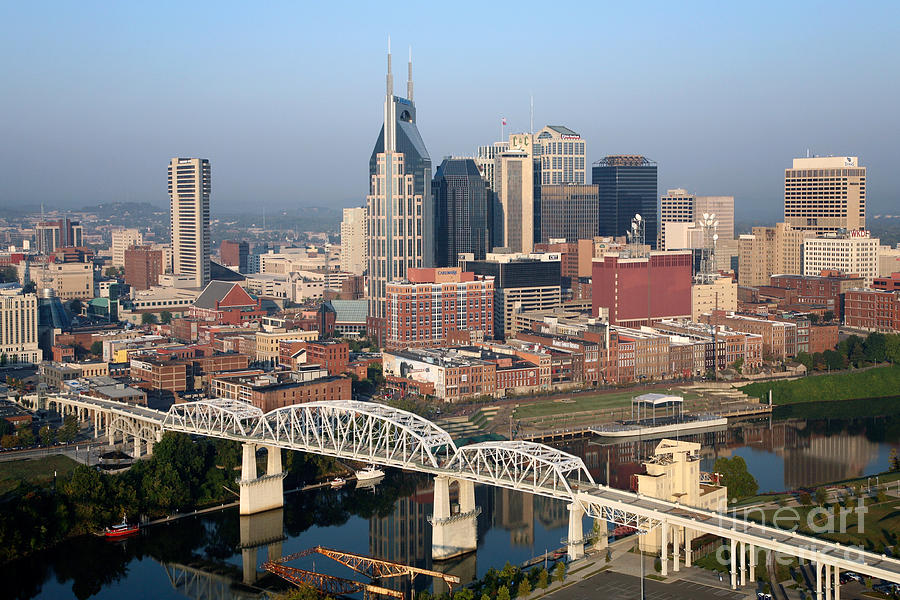
Five of the six tallest buildings in Tennessee are in Nashville, only one in the larger city (but not larger metro area) of Memphis. The tallest went up in 1994, but has already changed names with one phone-service company buying out another: The South Central Bell Building, the BellSouth Building, and now the AT&T Building. At 617 feet high, its twin-spired roof has led to it being nicknamed the Batman Building. 333 Commerce Street.

Many music-themed movies have used Nashville as both a setting and a film location, including biopics of Elvis (Elvis, starring Kurt Russell), Patsy Cline (Sweet Dreams, starring Jessica Lange) and Loretta Lynn (Coal Miner's Daughter, starring Sissy Spacek). Each of these included the Ryman as a filming location. While the recent ABC TV drama Nashville was filmed in Los Angeles, the 1975 film of the same title was filmed on location.

*

Nashville is more than history and music, as important as those things are. It's also the home of an NHL team that, while not yet very successful, is usually good, has developed quite a following among people you wouldn't think would take to hockey, and is now another good reason to visit this legendary city.

Wednesday, January 15, 2020

AFC & NFC Championship Game Appearances, 1970-2020

Note: This only counts Conference Championship Games from the 1970 merger onward, not earlier in the NFL or the AFL.

1. San Francisco 49ers, NFC, 16: 1970, 1971, 1981, 1983, 1984, 1988, 1989, 1990, 1992, 1993, 1994, 1997, 2011, 2012, 2013 and 2019. Thus do they surpass...

2. Pittsburgh Steelers, all in the AFC, 16: 1972, 1974, 1975, 1976, 1978, 1979, 1984, 1994, 1995, 1997, 2001, 2004, 2005, 2008, 2010 and 2016. Despite the fact that they lead their respective conferences, the 49ers and the Steelers have never played each other in a Super Bowl.

3. New England Patriots, AFC, 15: 1985, 1996, 2001, 2003, 2004, 2006, 2007, 2011, 2012, 2013, 2014, 2015, 2016, 2017 and 2018.

4. Dallas Cowboys, NFC, 14: 1970, 1971, 1972, 1973, 1975, 1977, 1978, 1980, 1981, 1982, 1992, 1993, 1994 and 1995.

5. Oakland/Los Angeles Raiders, AFC, 11: 1970, 1973, 1974, 1975, 1976, 1977, 1980, 1983, 1990, 2000 and 2002.

6. St. Louis/Los Angeles Rams, NFC, 10: 1974, 1975, 1976, 1978, 1979, 1985, 1989, 1999, 2001 and 2018.

7. Denver Broncos, AFC, 10: 1977, 1986, 1987, 1989, 1991, 1997, 1998, 2005, 2013 and 2015.

8. Minnesota Vikings, NFC, 9: 1973, 1974, 1976, 1977, 1987, 1998, 2000, 2009 and 2017.

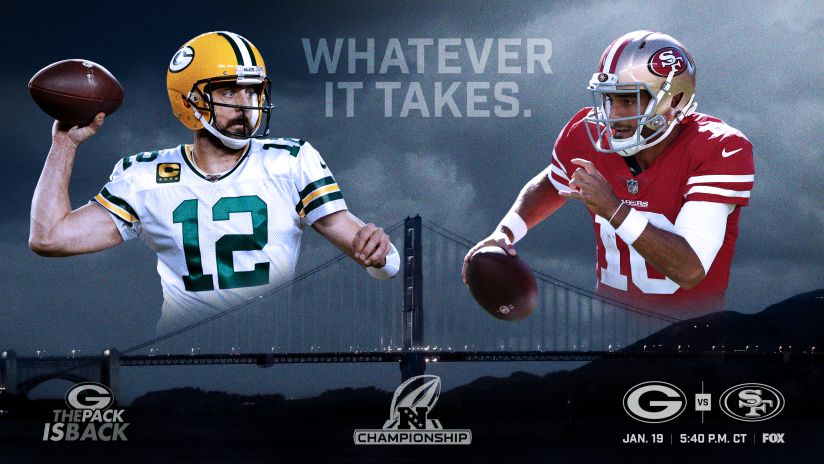
9. Green Bay Packers, NFC, 8: 1995, 1996, 1997, 2007, 2010, 2014, 2016 and 2019.

10. Philadelphia Eagles, NFC, 7: 1980, 2001, 2002, 2003, 2004, 2008 and 2017.

11. Baltimore/Indianapolis Colts, AFC, 7: 1970, 1971, 1995, 2003, 2006, 2009 and 2014.

12. Miami Dolphins, AFC, 7: 1971, 1972, 1973, 1982, 1984, 1985 and 1992.

13. Washington Redskins, NFC, 6: 1972, 1982, 1983, 1986, 1987 and 1991.

14. Houston Oilers/Tennessee Titans, AFC, 5: 1978, 1979, 1999, 2002 and 2019.

15. New York Giants, NFC, 5: 1986, 1990, 2000, 2007 and 2011.

16. Chicago Bears, NFC, 5: 1984, 1985, 1988, 2006 and 2010.

17. Buffalo Bills, AFC, 5: 1988, 1990, 1991, 1992 and 1993.

18. Atlanta Falcons, NFC, 4: 1998, 2004, 2012 and 2016.

19. Carolina Panthers, NFC, 4: 1996, 2003, 2005 and 2015.

20. Seattle Seahawks, 4: 1983 in the AFC; in the NFC, 2005, 2013 and 2014.

21. Baltimore Ravens, 4: 2000, 2008, 2011 and 2012.

22. New York Jets, AFC, 4: 1982, 1998, 2009 and 2010.

23. San Diego/Los Angeles Chargers, AFC, 4: 1980, 1981, 1994 and 2007.

24. Kansas City Chiefs, AFC, 3: 1993, 2018 and 2019.

25. New Orleans Saints, NFC, 3: 2006, 2009 and 2018.

26. Jacksonville Jaguars, AFC, 3: 1996, 1999 and 2017.

27. Tampa Bay Buccaneers, NFC, 3 1979, 1999 and 2002.

28. Cleveland Browns, AFC, 3: 1986, 1987 and 1989.

29. Arizona Cardinals, NFC, 2: 2008 and 2015.

30. Cincinnati Bengals, AFC, 2: 1981 and 1988.

31. Detroit Lions, NFC, 1: 1991.

32. Houston Texans, in the AFC, the only team that has never reached a Conference Championship Game.

*

If you count all leagues:

1. New York Giants, 19: NFL in 1933, 1934, 1935, 1938, 1939, 1941, 1944, 1946, 1956, 1958, 1959, 1961, 1962 and 1963; NFC in 1986, 1990, 2000, 2007 and 2011.

2. Cleveland Browns, 18: AAFC in 1946, 1947, 1948 and 1949; NFL in 1950, 1951, 1952, 1953, 1954, 1955, 1957, 1964, 1965, 1968 and 1969; AFC in 1986, 1987 and 1989.

3. Green Bay Packers, 17: NFL in 1936, 1938, 1939, 1944, 1961, 1962, 1965, 1966 and 1967; NFC in 1995, 1996, 1997, 2007, 2010, 2014, 2016 and 2019.

4. San Francisco 49ers, 17: AAFC in 1949; NFL in 1970, 1971, 1981, 1983, 1984, 1988, 1989, 1990, 1992, 1993, 1994, 1997, 2011, 2012, 2013 and 2019.

5. New England Patriots, 16: AFL (as "Boston Patriots") in 1963; AFC in 1985, 1996, 2001, 2003, 2004, 2006, 2007, 2011, 2012, 2013, 2014, 2015, 2016, 2017 and 2018.

6. Pittsburgh Steelers, 16: AFC in 1972, 1974, 1975, 1976, 1978, 1979, 1984, 1994, 1995, 1997, 2001, 2004, 2005, 2008, 2010 and 2016.

7. Chicago Bears, 16: NFL in 1932, 1933, 1934, 1937, 1940, 1941, 1942, 1943, 1946, 1956 and 1963; NFC in 1984, 1985, 1988, 2006 and 2010.

8. Dallas Cowboys, 16: NFL in 1967 and 1968; NFC in 1970, 1971, 1972, 1973, 1975, 1977, 1978, 1980, 1981, 1982, 1992, 1993, 1994 and 1995.

9. Cleveland/St. Louis/Los Angeles Rams, 15: NFL in Cleveland in 1945; NFL in Los Angeles in 1950, 1951 and 1955; NFC in Los Angeles in 1974, 1975, 1976, 1978, 1979, 1985 and 1989; NFC in St. Louis in 1999 and 2001; NFC back in Los Angeles in 2018.

10. Oakland/Los Angeles Raiders, 14: AFL in Oakland in 1967, 1968 and 1969; AFC in Oakland in 1970, 1973, 1974, 1975, 1976, 1977 and 1980; AFC in Los Angeles in 1983 and 1990; AFC in Oakland again in 2000 and 2002.

11. Boston/Washington Redskins, 12: NFL in Boston in 1936; NFL in Washington in 1937, 1940, 1942, 1943 and 1945; NFC in 1972, 1982, 1983, 1986, 1987 and 1991.

12. Minnesota Vikings, 11: NFL in 1968 and 1969; NFC in 1973, 1974, 1976, 1977, 1987, 1998, 2000, 2009 and 2017.

13. Philadelphia Eagles, 11: NFL in 1947, 1948, 1949 and 1960; NFC in 1980, 2001, 2002, 2003, 2004, 2008 and 2017.

14. Baltimore/Indianapolis Colts, 11: NFL in Baltimore in 1958, 1959, 1964 and 1968; AFC in Baltimore in 1970 and 1971; AFC in Indianapolis in 1995, 2003, 2006, 2009 and 2014.

15. Denver Broncos, 10: AFC in 1977, 1986, 1989, 1991, 1997, 1998, 2005, 2013 and 2015.


16. Houston Oilers/Tennessee Titans, 9: AFL in Houston in 1960, 1961, 1962 and 1967; AFC in Houston in 1978 and 1979; AFC in Nashville in 1999, 2002 and 2019.

17. San Diego/Los Angeles Chargers, 9: AFL in Los Angeles in 1960; AFL in San Diego in 1961, 1963, 1964 and 1965; AFC in San Diego in 1980, 1981, 1994 and 2007; not again since returning to Los Angeles.

18. Buffalo Bills, 8: AFL in 1964, 1965 and 1966; AFC in 1988, 1990, 1991, 1992 and 1993.

19. Miami Dolphins, 7: AFC in 1971, 1972, 1973, 1982, 1984, 1985 and 1992.

20. Portsmouth Spartans/Detroit Lions, 7: NFL in Portsmouth in 1932; NFL in Detroit in 1935, 1952, 1953, 1954 and 1957; NFC in 1991.

21. Dallas Texans/Kansas City Chiefs, 6: AFL in Dallas in 1962; AFL in Kansas City in 1966 and 1969; AFC in 1993, 2018 and 2019.

22. New York Jets, 5: AFL in 1968; AFC in 1982, 1998, 2009 and 2010.

23. Atlanta Falcons, 4: NFC in 1998, 2004, 2012 and 2016.

24. Carolina Panthers, 4: NFC in 1996, 2003, 2005 and 2015.

25. Chicago/St. Louis/Arizona Cardinals, 4: NFL in Chicago in 1947 and 1948; none in St. Louis; NFC in Arizona in 2008 and 2015.

26. Seattle Seahawks, 4: AFC in 1983; NFC in 2005, 2013 and 2014.

27. Baltimore Ravens, 4: AFC in 2000, 2008, 2011 and 2012.

28. New Orleans Saints, 3: NFC in 2006, 2009 and 2018.

29. Jacksonville Jaguars, 3: AFC in 1996, 1999 and 2017.

30. Tampa Bay Buccaneers, 3: NFC in 1979, 1999 and 2002.

31. Cincinnati Bengals, 2: AFC in 1981 and 1988.

32. Houston Texans: None.

Sunday, December 2, 2018

Tennessee's 10 Greatest Athletes

This coming Sunday, the New York Jets travel to Nashville to play the Tennesssee Titans.

Tennessee's 10 Greatest Athletes

Honorable Mention to Hall-of-Famers from former Tennessee teams: Larry Csonka and Paul Warfield of the World Football League's Memphis Southmen, Reggie White of the United States Football League's Memphis Showboats, and Mel Daniels and Roger Brown of the American Basketball Association's Memphis Sounds.

10. Mike Fisher, center, Nashville Predators, 2011-18. After 11 seasons with the Ottawa Senators, he asked to be traded to Nashville to be closer to the home of his wife, country singer Carrie Underwood -- which makes her married name "Carrie Fisher." He scored 111 of his 278 career goals with the Predators, and helped them reach the 2017 Stanley Cup Finals.

9. Frank Wycheck, tight end, Tennessee Oilers/Titans, 1997-2003 (plus 1995 and 1996 as the Houston Oilers). A 3-tie All-Pro, he will be forever remembered for his option pass to Kevin Dyson in the 1999 AFC Wild Card Game that became "the Music City Miracle."

8. Zach Randolph, forward, Memphis Grizzlies, 2009-17. A 2-time All-Star, the Grizzlies have announced that they will retire his Number 50 when he retires as a player. He is now with the Sacramento Kings.

7. Tony Allen, guard, Memphis Grizzlies, 2010-17. Although he never made an NBA All-Star Game, and his biggest achievement was helping the Boston Celtics win the 2008 NBA Championship, he made 3 All-Defensive First Teams and 3 All-Defensive Second Teams. Kobe Bryant autographed a pair of sneakers for him, calling him "the best defender I ever faced!" The Grizzlies have announced that they will retire his Number 9 when he retires as a player. That may be soon in coming, as he is currently without a team.

6. David Legwand, center, Nashville Predators, 1999-2014. He is the franchise's all-time leader with 210 goals, 356 assists and 566 points, and led them to their 1st Playoff series win in 2011.

5. Shea Weber, defenseman, Nashville Predators, 2006-16. A 6-time All-Star, he helped the Preds reach the 2017 Stanley Cup Finals. He is now the Captain of the Montreal Canadiens.

4. Marc Gasol, center, Memphis Grizzlies, 2008-present. A 3-time All-Star, he was named NBA Defensive Player of the Year in 2013. He is the franchise's all-time leader in points, 3-pointers and blocked shots, 2nd to Zach Randolph in rebounds, and 2nd to Mike Conley in assists.

3. Bruce Matthews, offensive tackle, Tennessee Oilers/Titans, 1997-2001 (plus 1983 to 1996 as the Houston Oilers). He made the Pro Bowl in his last 14 seasons, including the 5 he played in Tennessee, the last at age 40. He is a member of the Pro Football Hall of Fame, the Titans have retired his Number 74, and he was ranked 78th on the NFL Network's 2010 list of the 100 Greatest Players.

2. Steve McNair, quarterback, Tennessee Oilers/Titans, 1997-2005 (plus 1995 and 1996 as the Houston Oilers). A 3-time Pro Bowler, he led the Titans to the 1999 AFC Championship, and was named NFL Most Valuable Player in 2003. In a career that also included 2 seasons with the Baltimore Ravens, he passed for 31,304 yards and rushed for 3,590 more. Although it is not officially retired, the Titans have not given his Number 9 out since he retired.

1. Eddie George, running back, Tennessee Oilers/Titans, 1997-2003 (plus 1996 as the Houston Oilers). The 1995 Heisman Trophy winner at Ohio State, he was the 1996 NFL Rookie of the Year and a 4-time Pro Bowler. He rushed for 10,441 yards and 68 touchdowns. He also caught 268 passes for 2,227 yards and 10 touchdowns.

Although it is not officially retired, the Titans have not given his Number 27 out since he retired. It makes absolutely no sense that he is not in the Pro Football Hall of Fame.

Tennessee's 10 Greatest Teams

Today, the New York Jets play the Tennessee Titans in Nashville. In honor of the occasion, here are Tennessee's 10 greatest major league sports teams.

No, you can't count anything the Titans did in their previous incarnation, as the Houston Oilers. Nor can you count the Grizzlies in Vancouver, which wouldn't do you any good, anyway.

Honorable Mention to Tennessee college teams: The University of Tennessee Volunteers, the Vanderbilt University Commodores, the University of Memphis Tigers, and, especially due to their contributions to track & field, the Tennessee State University Tigers and Tigerbelles.

Honorable Mention to the Memphis Red Sox. This Negro League team played from 1923 to 1950, and won a Pennant in 1938.

Honorable Mention to the Memphis Mad Dogs. Originally, this was a proposal for an NFL expansion team, put up by William Dunavant, who owned the USFL's Memphis Showboats, and Elvis Presley Enterprises. They wanted to bank on the tenuous Elvis connection (the man had, after all, been dead since 1977), and call them the Memphis Hound Dogs. But when the vote on the 1995 expansion teams came in 1993, it went to Charlotte and Jacksonville.

Before they could decide what to do next, the Presley estate backed out, and the Hound Dogs name went with them. Instead, they became part of the Canadian Football League's brief U.S. experiment, and were renamed the Mad Dogs. They played 1 season at the Liberty Bowl, 1995, went a respectable 8-8, but missed the Playoffs, and were scrapped the next season.

Memphis would finally get the NFL in 1997, when the Houston Oilers became the Tennessee Oilers, playing at the Liberty Bowl. But everyone knew they were moving to Nashville for 1999, and Memphians hate Nashville, partly because it's the State capital and they hated their government, and partly because of the musical rivalry between the cities.

So the fans stayed away, and the Oilers left a year early, figuring they'd still get bigger crowds at the 41,000-seat Vanderbilt Stadium than they were getting in the Liberty Bowl. What's now Nissan Stadium opened the next year, and they've been the Tennessee Titans ever since.

Dishonorable Mention to the Memphis Maniax. They were in the 2001 XFL. They went 5-5, so they weren't a bad team. They were part of a bad idea.

Honorable Mention to the 1970-75 Memphis ABA Team. In 1970, the American Basketball Association moved the former New Orleans Buccaneers up the Mississippi River, and they became the Memphis Pros. In their 1st season, they reached the Playoffs, but got swept by the Indiana Pacers.

After missing the Playoffs in 1972, they were bought by Oakland Athletics owner Charles O. Finley, who redesigned their uniforms from patriotic red, white and blue to A's green and gold, and renamed them the Memphis Tams, for their Tri-State Area: T for Tennessee, A for Arkansas, M for Mississippi. Charlie O knew less about basketball than he did about baseball, going 24-60 and 21-63.

Finley sold the team in 1974, and the new owners made them the Memphis Sounds, redressing them in red and white. They were only 27-57, but that was enough to make the Playoffs, where they lost to the Kentucky Colonels. They folded after the season.

10. 2017 Tennessee Titans. They only went 9-7, but it was enough to make the Playoffs, where they beat the Kansas City Chiefs at Arrowhead, before losing to the New England Patriots at Foxboro. They're only 5-5 this season, so they might not be able to follow this up.

9. 2003-06 Memphis Grizzlies. After failing in their 1st 8 seasons in the NBA -- the 1st 6 in Vancouver, then 2 in Memphis -- the Grizz made the Playoffs 3 straight times, winning 50, 45 and 49 games. But they got swept in the 1st round all 3 times, by the San Antonio Spurs, the Phoenix Suns and the Dallas Mavericks. And they missed the Playoffs the next 4 years.

8. 1984-85 Memphis Showboats. The United States Football League team best known for having University of Tennessee star defensive end Reggie White went 7-11 in their 1st season, but 11-7 in their 2nd, beating the Denver Gold in the Quarterfinal before losing the Semifinal to the Oakland Invaders. We'll never know what they would have done in 1986 or beyond, in either the USFL or the NFL.

7. 2003-08 Nashville Predators. This one is a little tricky, because it's a period that includes the 2004-05 lockout. The 2003-04 season was the Preds' 1st Playoff berth, and they took the Detroit Red Wings to 6 games before losing in the 1st round. The 1st 3 seasons after the lockout, they finished 2nd in the NHL Central Division, but never got out of the 1st round, losing to the San Jose Sharks twice and then to the Red Wings.

6. 2007-08 Tennessee Titans. This didn't last long: A 10-6 season and a Wild Card berth, followed by a 13-3 season and an AFC South Division title, flanked by 8-8 season. They lost their 1st available Playoff game each time, away to the San Diego Chargers and home to the Baltimore Ravens.

5. 2009-12 Nashville Predators. After missing the 2009 Playoffs, the Preds bounced right back with the 3 straight berths. The 2011 season included their 1st Playoff series win, beating the Anaheim Ducks in 6 games, before losing the Western Conference Semifinals to the Vancouver Canucks in 6. The next year, they beat the Red Wings in 5, before losing to the Arizona Coyotes in 5.

4. 1974-75 Memphis Southmen. The World Football League had most of their teams owned by men who didn't know what they were doing. John Bassett was an exception. The Toronto businessman also owned a World Hockey Association team: The Ottawa Nationals, who became the Toronto Toros, and the Birmingham Bulls. He had also been a part-owner of the CFL's Toronto Argonauts.

He had originally wanted his WFL team to be the Toronto Northmen, and raided the 2-time defending Super Bowl winners, the Miami Dolphins, for running backs Larry Csonka and Jim Kiick, and receiver Paul Warfield. But Prime Minister Pierre Trudeau stepped in, and passed the Canadian Football Act through Parliament, prohibiting any U.S.-based league from operating a team in Canada. (It is still in place, although that's not why the Buffalo Bills didn't move to Toronto as threatened. It has been suggested that something could be worked out.)

So Bassett found a big city that loved football but didn't have an NFL team, and they became the Memphis Southmen. The helmet logo was a big brown bear, and local fans, not liking the Southmen nickname, started calling them the Memphis Grizzlies -- which turned out to be convenient for another team that started out in Canada and moved to Memphis, the NBA's Vancouver Grizzlies.

The Southmen went 17-3 in 1974, hanging 60 points on the Honolulu Hawaiians, 49 on the Chicago Fire, 47 on the Jacksonville Sharks, 46 on the Birmingham Americans, 45 on the Houston Texans (for whom the later NFL team would be named), and 37 on the Detroit Wheels. But they also got beat 58-33 by Birmingham, 46-15 by the Philadelphia Bell, and 26-25 by the Portland Storm. They got a bye into the Semifinals, but were beaten by the Orlando-based Florida Blazers, 18-15. The Blazers then beat Birmingham for the only WFL Championship.

The 1975 WFL season was an unmitigated disaster. Even the Southmen didn't escape unscathed: They started 6-1, but lost 3 of their last 4, before the league folded on October 21, 1975 -- a story most people missed because it came on the day of Game 6 of the World Series, the Carlton Fisk Game. The WFL couldn't even die with dignity.

Bassett would be back: He put the Tampa Bay Bandits in the USFL, and they may have been that league's best-run team.

3. 2010-17 Memphis Grizzlies.
 They made the Playoffs 7 straight seasons. In 2011, they won a Playoff series for the 1st time, beating the Spurs, before falling in 7 games to the Oklahoma City Thunder. In 2012, they lost in the 1st round to the Los Angeles Clippers. In 2013, they had what remains the franchise's best season: They won 56 games, then took down the Clippers in 6 games and the Thunder in 5, to reach their 1st Western Conference Finals. But the Spurs swept them.

They lost to the Thunder in the 1st round in 2014. In 2015, they beat the Portland Trail Blazers in the 1st round, before losing to the Golden State Warriors. They lost to the Spurs in the 1st round in both 2016 and 2017. And then, in 2018, they collapsed, going a terrible 22-60. They may be in the process of shaking that off this season.

2. 2014-18 Nashville Predators. After 2 straight misses, the Preds started a new run, 4 years and currently. They lost in the 1st round in 2015, to the Chicago Blackhawks. In 2016, they beat the Ducks before losing to the Sharks, both times in 7.

In 2017, despite squeaking into the Playoffs as the 8th seed in the West, they almost put it all together: They swept the Blackhawks, their 1st Playoff sweep; they beat the St. Louis Blues in 6; and they won their 1st Conference Championship by beating the Ducks in 6. They gave it a go in the Stanley Cup Finals, splitting the 1st 4 games with the Pittsburgh Penguins, before losing the next 2.

Last season, they won their 1st Central Division title, and beat the Colorado Avalanche in the 1st round, before losing to the Winnipeg Jets. They are currently among the leaders in the Western Conference, but they would have to get to at least a 2nd Finals to jump to Number 1 on this list, ahead of the Tennessee team that, for the moment, has come closer to winning a World Championship than any other:

1. 1999-2003 Tennessee Titans. The 1st 5 seasons in Nashville, 4 Playoff berths, 2 AFC Divisional titles (2000 in the Central, 2002 in the South), and the 1999 AFC Championship, coming oh so close to at least sending Super Bowl XXXIV to overtime. They managed to win postseason games at Indianapolis, Jacksonville and Baltimore, as well as home Playoff games over Buffalo (the Music City Miracle) and Pittsburgh.