Showing posts with label atlanta. Show all posts

Thursday, September 17, 2026

September 17, 1976: Bill Lucas Becomes the 1st Black GM In MLB

September 17, 1976, 50 years ago: The Atlanta Braves promote Bill Lucas to the office of general manager. This makes him the 1st black man to hold that position in Major League Baseball.

This came 2 years after Frank Robinson was appointed the 1st black manager, 14 years after Buck O'Neil became the 1st black coach, and 29 years after Jackie Robinson became the 1st black player since 1884.

William DeVaughn Lucas was born on January 25, 1936 in Jacksonville, graduated from the historically black Florida A&M University, and signed with the Milwaukee Braves in 1957 -- partly because his sister, Barbara, was married to Braves star Hank Aaron. (They later split up, and Aaron remarried.) An infielder, he never reached the major leagues, although he did miss 2 years as an officer in the U.S. Army. He joined the Braves' front office in 1965, as they were preparing their move to Atlanta for the next season.

In 1972, he was named director of their farm system, a common position from which teams have promoted men to the GM position. Atlanta was the hometown of Dr. Martin Luther King Jr., former Mayor William Hartsfield had billed it as "the City Too Busy to Hate," Maynard Jackson had been elected as its 1st black Mayor in 1973, and Aaron had broken the career home run record at Atlanta Stadium in 1974. (It was renamed Atlanta-Fulton County Stadium the following year.)

Lucas was in the process of building the team that would become the centerpiece of team owner Ted Turner's national "SuperStation TBS" over the next few years, including Dale Murphy, Bob Horner, Brett Butler and Steve Bedrosian.

But Lucas would not live to see his work come to fruition. On May 1, 1979, shortly after congratulating Braves ace Phil Niekro on his 200th career win (by phone, as Lucas was in Atlanta and the game was in Pittsburgh), he suffered a cerebral hemorrhage. He died 4 days later, only 43 years old.

Murphy said, "Bill's dream was for this organization to become a success. It is our sacred honor to be chosen to fulfill his dream." Maybe it would have been fulfilled had he lived. But it didn't happen: They won the National League Western Division title in 1982, and almost won another in 1983, but that's as close as they got. The Braves did not win a Pennant between 1958, when they were still in Milwaukee, and 1991, when a new GM, John Schuerholz, put together the team that dominated the NL in the 1990s.

For his contributions to their organization, the Braves named Lucas to their team Hall of Fame.

Monday, July 27, 2026

July 27, 1996: The Olympic Park Bombing

July 27, 1996, 30 years ago: The Olympic Park in Atlanta is bombed during a concert to celebrate the Olympic Games. One person was killed, 111 injured. While the Olympics have had plenty of controversies, rarely have the troubles of the outside world intruded on the Games. The 1972 Summer Games in Munich were touched by terrorism. So were the 1996 Summer Games in Atlanta.

At first, the FBI investigated Richard Jewell, the security guard who found the backpack containing the 3 pipe bombs. He had also helped to evacuate the area, keeping the deaths and injuries lower than they could have been. But, based on "psychological profiling," the FBI decided that he could have been the bomber, much as some people, including firemen, start fires so they can report them and be heroes.

It took nearly 3 months to clear his name, and he never recovered emotionally. The stress took a toll on his health, and, combined with diabetes and heart disease, led to his death in 2007. He was only 44 years old.

Finally, the FBI determined that this was the work of a man who'd committed 3 other bombings, in protest of America's abortion and gay rights policies. Eric Rudolph, a member of the radical "Christian Identity" movement, was finally caught in 2003, and pled guilty.
As of July 27, 2026, Rudolph is 59 years old, and remains incarcerated at the ADX Florence Supermax prison in Colorado. He is serving 2 consecutive life terms, and will never get out of prison except in a coffin. He has since written a letter from prison saying he now prefers the writings of Friedrich Nietzsche to the Bible.

Sunday, April 12, 2026

April 12, 1966: Atlanta: "The City Too Busy to Hate"

Atlanta, 1966

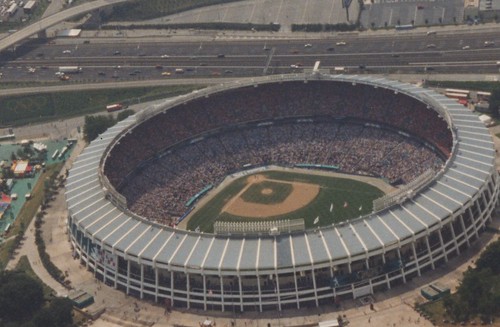
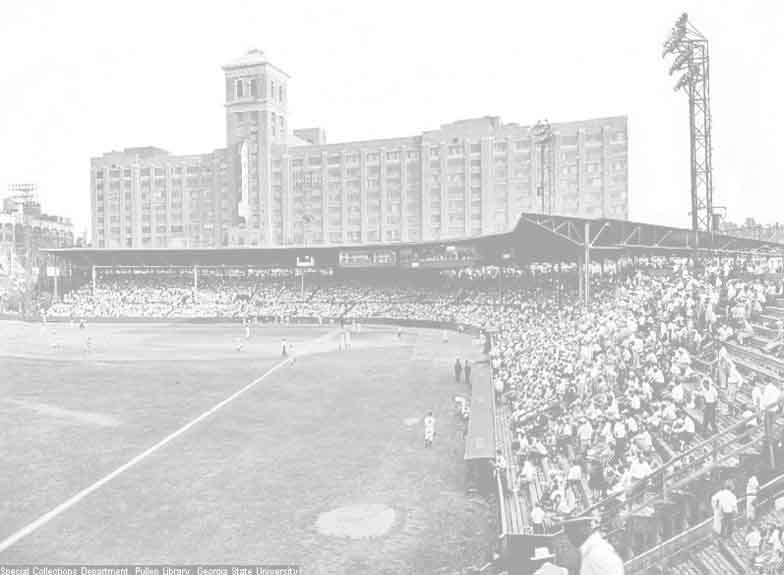
April 12, 1966, 60 years ago: The Braves play their 1st game in Atlanta. Joe Torre hits the 1st major league home run in Atlanta Stadium, but the Pittsburgh Pirates spoil the festivities in 13 innings, 3-1, on a home run by Willie Stargell. (The stadium was renamed Atlanta-Fulton County Stadium in 1975.)

The Braves announced their move to Atlanta in 1965. That year was the high-water mark of the Civil Rights Movement. The Voting Rights Act was signed into law. The Selma-to-Montgomery March had just happened. The Civil Rights Act had been signed into law the year before. The lunch-counter sit-ins, the Freedom Rides, the March On Washington for Jobs and Freedom, and the integrations of the universities of Georgia, Mississippi and Alabama had all taken place, with mixed success in some cases and total success in others. All this had happened within the last 5 years. And Dr. Martin Luther King Jr. was the current holder of the Nobel Peace Prize.

Dr. King was from Atlanta. The Mayor at the time was Ivan Allen Jr. He ran his father's office-supply company, and took it to new heights, making himself one of the South's richest men. He lived long enough to get an offer he couldn't refuse: Staples bought him out in 1999.

In 1961, Allen ran for Mayor against segregationist Lester Maddox, who would later be elected Governor of Georgia. Allen won, and began to build on the work of his predecessor, William Hartsfield, for whom the city's famous airport is named.

As a businessman, Allen understood that he had the chance to change the image of his city. More than that, he had the chance to help change perceptions of the State of Georgia and of the South itself. The city underwent its greatest construction phase since after its burning in the Civil War 100 years earlier. He built the Memorial (now the Woodruff) Arts Center, in effect Atlanta's version of New York's Lincoln Center. He created MARTA, the Metropolitan Atlanta Rapid Transit Authority, which reworked the city's bus system, and, after he left office, built its subway. He also got Interstate 285, a beltway, a.k.a. "The Perimeter" and "The O Around the A," built.

He got Atlanta Stadium (later Atlanta-Fulton County Stadium) built and, although it wouldn't open until after he left office, he got the Omni Coliseum approved. This enabled the city to go from no major league teams when he took office on January 1, 1962 to 3 of them when he left on January 1, 1970.
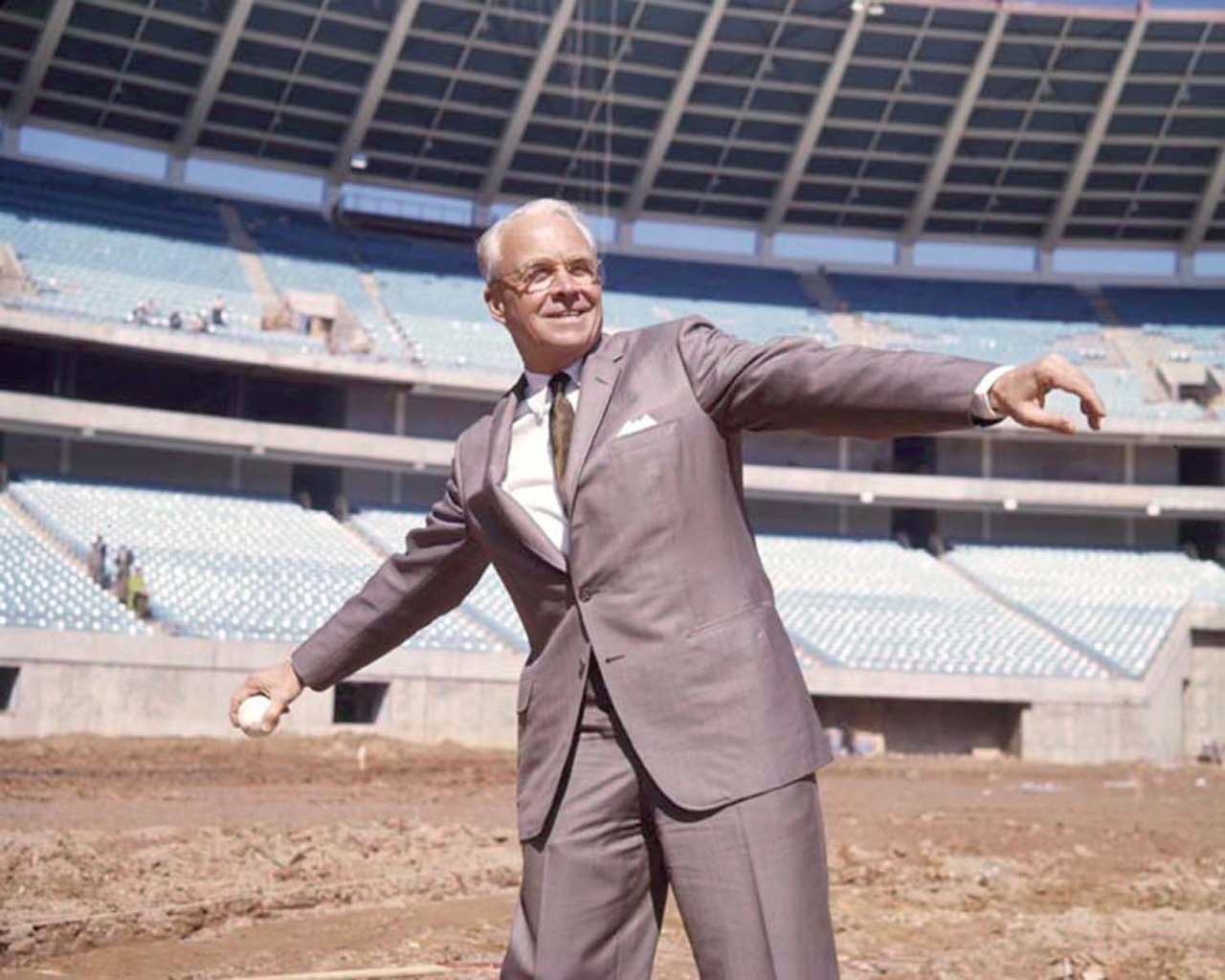
Allen posing inside the stadium his Administration was building, 1964.
It opened in 1965, and hosted the Beatles
before it hosted the Braves or the Falcons.

More low-income housing was built in his 8 years in office than in the previous 30. He needed to do this to alleviate the concerns of local black leaders, including Dr. Martin Luther King Sr., that he wasn't doing enough for the poor and was focusing too much on business, especially downtown -- a criticism since leveled at many urban mayors, black and white alike (including Newark's Sharpe James in the 1980s and '90s).

"It is wonderful to be idealistic and to speak about human values," Allen said, "but you are not going to be able to do one thing about them if you are not economically strong. If there is any one slogan I lived by as Mayor of Atlanta, that would be it."

So, with the concerns of both business and civil rights in mind, he brought the 2 concepts together. The day he was sworn in, he ordered all "WHITE" and "COLORED" signs removed from City Hall, and personally desegregated the City Hall cafeteria by dining with local black activists. He desegregated municipal hiring. He hired the city's first black firemen. He let it be known that black Atlanta policemen would be allowed to arrest white criminals. He desegregated the city's pools. By January 1964, 6 months before President Lyndon Johnson signed the Civil Rights Act into law, 14 Atlanta hotels had already desegregated themselves.

Allen billed Atlanta as "The City Too Busy to Hate." That made the sports establishments stand up and take notice. Atlanta also offered a bigger stadium, if not necessarily a better one, than Milwaukee County Stadium: 52,000 to 44,000. (Milwaukee County Stadium would later expand to 53,000.) Today, the Braves' team museum is named for Allen.

Atlanta-Fulton County Stadium was a multipurpose facility, designed to host both baseball and football, and it didn't do a good job with either one, so much so that, by 1997, both the Braves and the Falcons had gotten new stadiums and their 1st home was demolished. That process was repeated in 2017, as both teams abandoned their still relatively new stadiums for brand-new ones, the Falcons with a retractable-roof stadium next-door, the Braves for a "ballpark village" in the city's northwest suburbs.
Just another oversized concrete ashtray.
At least it had real grass, not artificial turf.

But Atlanta has seen little success. From 1966 to 1990, the Braves won just 2 Division titles and no Pennants. Then, they won their Division in every completed season from 1991 to 2005, and won 5 Pennants, but just 1 World Series. They eventually won another in 2021. The Falcons have been to just 2 Super Bowls, and lost both ignominiously.

The NBA's Hawks should be so lucky: They reached the Conference Finals their 1st 2 seasons after moving from St. Louis, 1968-69 and 1969-70; then didn't make the Conference Finals again until 2015, and again in 2021. They haven't made the NBA Finals since 1961, or won them since 1958, both times in St. Louis.

And the city has failed with 2 NHL teams: The Flames arrived in 1972 and moved to Calgary in 1980, and the Thrashers arrived in 1999 and moved to Winnipeg in 2011. A Sun Belt city that lost 2 teams to Canada: This is NHL Commissioner Gary Bettman's nightmare.

The city has had decent success with soccer. The Atlanta Chiefs won the North American Soccer League title in 1968, and reached the Final again in 1969. Atlanta United debuted in 2017, won the MLS Cup the next season, and won the U.S. Open Cup the year after that.

The Braves have a team Hall of Fame. Their inductees from their Atlanta years are: Players Hank Aaron, Rico Carty, Phil Niekro, Ralph Garr, Dale Murphy, Tom Glavine, John Smoltz, David Justice, Terry Pendleton, Javy López, Greg Maddux, Larry "Chipper" Jones, Andruw Jones (no relation) and Tim Hudson; plus managers Joe Torre and Bobby Cox, and coach Leo Mazzone; team owners Bill Bartholomay and Ted Turner; executives Bill Lucas, Paul Snyder and John Schuerholz; trainer Dave Pursley; and broadcasters Ernie Johnson Sr., Pete Van Wieren, Skip Caray, Don Sutton and Joe Simpson.

The Falcons have a Ring of Honor. Their inductees are: Tommy Nobis, Claude Humphrey, Jeff Van Note, Steve Bartkowski, Mike Kenn, William Andrews, Gerald Riggs, Jessie Tuggle, Deion Sanders, Todd McClure, Warrick Dunn, Roddy White, Matt Ryan, and team owner Arthur Blank.

The Hawks don't have a team Hall of Fame, but they do retire numbers: 9, for Bob Pettit from their St. Louis years; 21, Dominique Wilkins; 23, Lou Hudson; 44, Pete Maravich; and 55, Dikembe Mutombo. They have also witheld 40 from circulation since Jason Collier died as an active player. They also have banners honoring former owner Ted Turner and former Mayor Kasim Reed, who was involved in keeping the team from moving.

There is also a Georgia Sports Hall of Fame, in Macon. It honors State natives who excelled in sports, stars from colleges such as the University of Georgia and Georgia Tech, and these major league stars:

* Braves: Aaron, Nierko, Murphy, Smoltz, Glavine, both Joneses, Tim Hudson, Cox, Mazzone, Bartholomay, Turner, Lucas, Schuerholz, Johnson, Van Wieren, Caray, Bob Horner, Brian Jordan, Jeff Treadway (more for being a Georgia native than for being a Brave), Marquis Grissom, and executive Stan Kasten.

* Falcons: Nobis, Humphrey, Van Note, Bartkowski, Tuggle, Blank, Alfred Jenkins, Billy "White Shoes" Johnson, founding owner Rankin Smith, coach Mario Campbell, and coach Dan Reeves, elected more for being a Georgia native and a UGa player than for coaching the Falcons into their 1st Super Bowl.

* Hawks: Wilkins, Lou Hudson, Wayne "Tree" Rollins, and Shareef Abdur-Rahim.

* Through 2025, no Flames, Thrashers, Chiefs or Atlanta United have been honored.

Friday, July 4, 2025

July 4, 1985: The Rick Camp Game

July 4, 1985, 40 years ago: For anybody who watched this baseball game, it was a 4th of July that will never, ever be forgot.

The Atlanta Braves were hosting the New York Mets at Atlanta-Fulton County Stadium, and Braves owner Ted Turner, showman that he was, scheduled a postgame 4th of July fireworks show. Paid attendance at the 52,007-seat concrete ashtray just south of downtown Atlanta was 44,947.

But the game was delayed by rain, and didn't start until 9:04 PM. Rick Mahler started for the Braves, and the Mets hit him hard, and he didn't get out of the 4th inning. Dwight Gooden started for the Mets, and, in a year when he seemed to be touched by God, he was no better. A second rain delay came, and Met manager Davey Johnson -- who hit 41 home runs as a 2nd baseman for the Braves in 1973 -- didn't take any chances, and he took Doctor K out.

Did I say Davey didn't take any chances? When they came back from the rain delay, he let Roger McDowell, normally a late-inning reliever, finish the bottom of the 3rd inning. Terry Leach pitched the 4th through the 8th, but Davey brought in Doug Sisk, and he let the Braves score 4 runs in that inning to take the lead, 8-7. This included a Keith Hernandez home run. But future Hall-of-Famer Bruce Sutter blew it in the 9th, and the game went to extra innings. At one point, Davey got thrown out of the game.

The Braves got 2 men on with 1 out in the bottom of the 11th, but the Mets got out of it with a double play. In the top of the 13th, with 2 out, Ray Knight singled, and Howard Johnson hit a home run. 10-8 Mets. But in the bottom of the 13th, Tom Gorman -- the only reliever the Mets had left -- allowed a leadoff single to Rafael Ramirez. He struck out Dale Murphy and Gerald Perry, but then gave up a home run to Terry Harper. 10-10. More "free baseball."

Gene Garber walked Lenny Dykstra and Hernandez in the top of the 14th, but got out of it. Knight singled for the Mets in the top of the 15th, but got no farther than 1st base. With 2 out in the bottom of the 16th, Ken Oberkfell singled off Gorman, and Bruce Benedict drew a walk. But Gorman got out of it.

Rick Camp, the Braves' last remaining reliever, came into the game in the top of the 17th, and walked Gary Carter, but then struck out Darryl Strawberry and Gorman, and got Knight to ground into a force play. Ramirez singled with 2 outs in the bottom of the 17th, but Gorman got out of it.

Top of the 18th. HoJo led off with a single. Danny Heep bunted, and Camp rushed it, and threw it away. 1st and 3rd, nobody out. Dykstra hit a sacrifice fly, and it was 11-10 Mets. There was nothing that Braves manager Eddie Haas could do, as Camp was it: The only pitchers he had left were starters, the same as the Mets.

Bottom of the 18th. Perry and Harper grounded out. That brought up Camp, as Haas couldn't pinch-hit for him. He had nobody left to bat or pitch. This pudgy bearded guy, wearing Number 37 for his home-State team, came up to bat. He came into that game 10-for-168 for his career -- a lifetime batting average of .060. He was 0-for-his-last-13. He hadn't gotten a hit since September 1, 1984, 10 months earlier.

John Sterling, who became the main voice for the New York Yankees in 1989, but then doing games for the Braves, turned to his broadcast partner, Ernie Johnson -- who pitched for the Braves in Milwaukee and was the father of basketball announcer Ernie Johnson Jr. -- and said, "I'll tell you, Ernie: If hits a home run to tie this game, this game will be certified as absolutely the nuttiest in the history of baseball."

What do you think happened? Have you ever heard 8,000 people make as much noise as 50,000? You did if you were watching TBS -- or WOR-Channel 9 -- that middle-of-the-night. I was watching on WOR, but, because of Sterling's call, it's the TBS version that seems to have been preserved for posterity and shown on highlights.

Sterling:

And he hits it to deep left! Heep goes back! It is... GONE! Holy cow! Oh my goodness! I don't believe it! I don't believe it! Rick Camp! Rick Camp! I told you Ernie, if he hits it out... That certifies this game as the wildest, wackiest, most improbable game in history!

Mets 11, Braves 11. And to make matters worse, Gorman walked the next batter, Benedict. But he got Paul Runge to ground into a force play, and we went to the 19th inning. (This Paul Runge is not related to the umpire of the same name, whose father Ed and son Brian have also been MLB umpires.)

The Mets play a game this long every few years. In 1964, they went 23 innings in a loss to the San Francisco Giants -- in the 2nd game of a doubleheader. In 1965, they went 18 innings in Philadelphia against the Phillies, before the game was called due to a curfew, and it was replayed. In 1968, they went 24 innings in a loss to the Houston Astros. In 1974, they went 25 innings in a loss to the St. Louis Cardinals.

In 1986, they played what was then the longest game in NLCS history, going 16 innings in beating Houston to clinch the Pennant. They went 20 innings in a 2010 win in St. Louis, 20 in a 2013 loss to the Miami Marlins, 18 in a 2015 loss in St. Louis, and 18 in a 2019 loss in Milwaukee to the Brewers. The 2020 introduction of the "ghost runner" rule makes another such marathon unlikely.

At some point in all this, Ralph Kiner, the great Pittsburgh Pirates slugger who'd been broadcasting for the Mets since the franchise began in 1962 (and still did one game a week until he died in 2014), left the stadium, returned to his hotel, and turned on the TV. He saw the game, and during the next Met broadcast, said that he thought it was a recap. Nope, the game was still going on.

Finally, at about 3:30 in the morning, with only about 8,000 people left in the stands, the Mets decided enough was enough, that they'd had it with these mother-freaking Braves in this mother-freaking game. They pounded Camp, who could not be relieved. Carter led off with a single. John Christensen, who'd pinch-hit for Strawberry, bunted him over to 2nd.

Whoever was managing the Mets at that point -- it might have been 1st base coach Bill Robinson -- decided to let the next day's starter, Ron Darling, pitch the bottom of the 19th, and a few innings thereafter if necessary, since who knew if this game had another 9 innings in it, and sent Rusty Staub, playing one of his last games, up to pinch-hit for the exhausted Gorman.

Haas ordered Camp to walk Staub intentionally to set up a double play, but it didn't work: Knight doubled home Carter and sent Staub to 3rd.  (Daniel Joseph Staub was known as Rusty for his hair, and Montreal Expos fans called him "Le Grand Orange." He wasn't fast even before he turned into a flame-haired Fat Elvis -- or, as Sterling called him in this game, "Babe Ruth.") HoJo was intentionally walked, and that didn't work, either: Heep singled home Staub and Knight, and the throw from the outfield was mishandled, and HoJo scored, too. Dykstra flew out, getting Heep to 3rd, and Wally Backman singled Heep home, before Camp finally got Hernandez to ground out.

Mets 16, Braves 11. This was the mid-1980s Mets. Surely, these Mets could hold a 5-run lead. Surely, the Braves wouldn't score 6 runs and win it in the bottom of the 19th. Or, potentially worse, score 5 runs and send the game to a 20th inning!

They were determined to give it a good shot. Darling came out, and got the 1st out, a groundout by Paul Zuvella. But Claudell Washington hit a bouncer to 1st that Hernandez mishandled. (No, Kramer and Newman from Seinfeld were not in the stands to yell, "Nice game, pretty boy!") Claudell and his long neck got to 2nd.

No problem, Darling would get out of it, right? Sure enough, he got Ramirez to pop up. One more out. That left only the dangerous Murphy, the 1982 & '83 National League Most Valuable Player, and still one of the most dangerous hitters in the game. But what could he do? A home run would only make it 16-13.

But Darling walked him. And then he walked Perry. And now the bases were loaded for Harper, who had already homered. And Harper singled. Washington and Murphy scored. Perry was on 3rd. It was 16-13 Mets. Men on 1st and 3rd. A home run would tie the game. Again.

And who was up? Rick Camp. Surely, he wouldn't do it again...

He didn't: Darling struck him out on a high fastball. Finally, mercifully, at long last, ballgame over.

Camp was the losing pitcher, but he won something more important than a single baseball game. He won a place in baseball lore. After all these years, we're still talking about this mind-boggling game, and not about any other game in which he ever pitched.

Oh yeah: Although the game was over, the night wasn't. The game ended at 3:55 AM. At 4:00 on the dot, Ted Turner kept his promise: The fireworks went off. The 8,000 or so fans who hadn't left cheered.

People living near the stadium did not. They heard booms and saw flashes of light, and they called the police, thinking that Atlanta was under attack.

Incredibly, Camp got 2 more hits that season, for a batting average of .231. He closed his career 13-for-175, .074. On-base percentage, .109. Slugging percentage, .114. OPS, .224. OPS+, -39. RBIs, 7. Home runs, 1.

After leaving baseball, Camp became a lobbyist. He got into legal trouble in 2005, indicted by a federal grand jury for conspiring to steal over $2 million from a mental health agency. He was convicted, and served 3 years in prison. But everyone who met him seemed to say he was a wonderful guy. Is it possible that, like Denny McLain, a pitcher who went to prison on a similar charge, he simply got in with the wrong people?

Camp died in 2013. He was 59 years old. He gave baseball fans a memory they might cherish, or they might not, but it is one that they will never, ever forget.

Thursday, January 30, 2025

January 30, 2000: The Greatest Show On Turf

January 30, 2000, 25 years ago: The franchises I grew up knowing as the Los Angeles Rams and the Houston Oilers play each other in Super Bowl XXXIV, at the Georgia Dome in Atlanta.

But the Rams moved to become the St. Louis Rams in 1995, and the Oilers to Memphis in 1997, then to Nashville in 1998, and finally changed their name to the Tennessee Titans in 1999.

In midseason, the Rams, coached by former Philadelphia Eagles coach Dick Vermeil, replaced starting quarterback Trent Green with Kurt Warner, and the result became known as "The Greatest Show On Turf." Warner could throw passes to receivers Isaac Bruce, Torry Holt, Az-Zahir Hakim and Ricky Proehl, and to running back Marshall Faulk, who, in this 1999-2000 season, maybe have become the best all-around player in the game. Tackle Orlando Pace was then the best offensive lineman in the league.

It wouldn't have mattered much if they didn't also have a good defense, with tackles Ray Agnew and D'Marco Farr, ends Kevin Carter and Grant Wistrom, linebackers Lendon Fletcher and Mike Jones, and cornerbacks Dré Bly and Todd Lyght. So while the Rams had 9 games of at least 34 points, they also had 11 games of allowing 14 or fewer points.

They won 13 of their 1st 15, clinching the top seed on the NFC side of the Playoffs, before a meaningless loss away to the Philadelphia Eagles in their season finale. In the Playoffs, they won a 49-37 shootout over the Minnesota Vikings, and went the other way in the NFC Championship Game, winning a defensive struggle over the Tampa Bay Buccaneers, 11-6.

The Titans struggled in their 1st 2 seasons, as the Tennessee Oilers. But in their 1st season under the Titans name, their 1st season at the Adelphia Coliseum (now Nissan Stadium), coach Jeff Fisher's men were embraced by Nashville fans. The embracees included quarterback Steve McNair, running back Eddie George, receiver Kevin Dyson, tight end Frank Wycheck, center Bruce Matthews, defensive end Jevon Kearse (known as The Freak), safeties Blaine Bishop and Anthony Dorsett (son of Hall-of-Famer Tony), and ageless placekicker Al Del Greco.

The Titans weren't flashy, but they won 7 of their last 8 games, saving their biggest offensive outputs for their last 2, a 41-14 win over the Jacksonville Jaguars at home, and a 47-36 battle away to the Pittsburgh Steelers. A last-minute kickoff return, featuring a lateral from Wycheck to Dyson, beat the Buffalo Bills in the Wild Card Round, becoming known as the Music City Miracle. They beat Peyton Manning and the Indianapolis Colts away, 19-16, and then went to Jacksonville and beat the Jags again, 33-14, for the AFC Championship.

For the Rams, it was their 1st trip to the Super Bowl in 20 years, and they were looking for their 1st World Championship in 49 years, since Los Angeles beat Cleveland in the 1951 NFL Championship Game. For the Oilers/Titans franchise, it was their 1st trip to the Super Bowl ever. They had won the 1st 2 AFL Championships, in 1960 and '61, and also made it to the AFL Championship Game in '62 and '67. But except for back-to-back trips to the AFC Championship Game in '78 and '79, their NFL experience had been a bust. Until now.

For St. Louis as a city/metro area, there had not been a World Championship in over 17 years, since the Cardinals won the 1982 World Series. They had lost 2 World Series and a National League Championship Series in the interim. The NFL version of the Cardinals had moved to Arizona after the 1987 season. The NHL's Blues hadn't reached the Stanley Cup Finals since 1970. And there was no NBA team.

For Tennessee, this was all new. They'd had teams in "rebel leagues" like the ABA, the WFL and the USFL, but until now, with the NHL also adding the Nashville Predators for the 1997-98 season, they'd had nothing in the major leagues.

Vermeil had gotten the Eagles into Super Bowl XV, but they lost it. Before Super Bowl XXXIV, he got phone calls from many of his Eagle players, telling him they were pulling for him.

The Rams were favored by 7, possibly because the game would be played on artificial turf, which they usually played on at the Trans World Dome (now The Dome at America's Center), while the Titans played their home games on natural grass.

The 1st half was a defensive struggle. The Rams went 3-for-4 on field goal attempts, the Titans 0-for-1, and neither team could get into the end zone. The half ended with the Rams up, 9-0. On their opening drive of the 2nd half, the Rams blocked a Titan field goal attempt.

Finally, "The Greatest Show On Turf" took over, and Warner got the Rams going, leading to a 9-yard touchdown pass to Holt. It was 16-0 St. Louis. The Titans answered with a touchdown drive of their own, ending with a 1-yard run by George. They went for the 2-point conversion, but missed, and it was 16-6 Rams as the 3rd quarter ended.

The Titans forced the Rams to punt on their next drive. McNair took advantage of this by taking his team 79 yards in 13 plays, concluding with George running it in from 2 yards out. The Titans were now within 16-13, with 7:21 to go. The Titans forced the Rams to put again, and they got close enough for another field goal attempt by Del Greco. With 2:12 left, the game was tied, 16-16.

This was the 1st time a team had a lead of 16 or more points in a Super Bowl, and blown it. Could the Rams recover? Yes: On their next play from scrimmage, Warner threw a bomb to Bruce, who took it 73 yards for a touchdown. With 1:54 left, the Rams led, 23-16.

The Titans' last chance began at their own 12-yard line with 1:48 left. They were aided by a pair of dumb defensive penalties by the Rams, putting the ball on the Ram 40 with 59 seconds to go.

On a 3rd & 5, McNair escaped what looked like a sure sack, and passed to Dyson for a 1st down and the Ram 10. With 6 seconds left, the Titans called their last time-out. At this point, there had never been a Super Bowl go to overtime. Of course, if the Titans scored, and went for 2 instead of 1, there would be no overtime.

Fisher's plan for the last play (at least, of regulation time) was to have Wycheck run straight up the right side, as a decoy, to lure Jones away from Dyson. Dyson would then slant left through the middle and be open at around the 5-yard line. McNair would then pass to him for the touchdown that would make it no worse than 23-22.

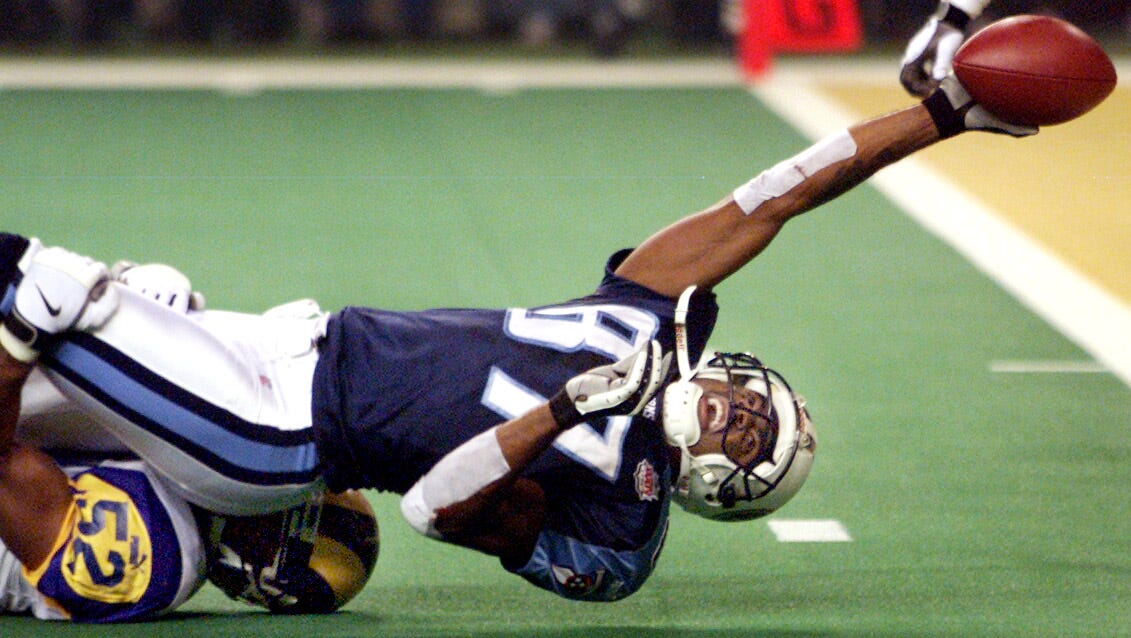
It didn't work. Jones saw Dyson getting ready to catch the ball. Jones ran toward Dyson, and wrapped is arms around Dyson's legs to tackle him, less than 3 yards short of the goal line. But Dyson knew he was not yet down, and he reached out with his arm, holding the ball, hoping to have it break the plane of the goal line for the touchdown. But the way that Jones tackled him, his shoulder hit the ground, ending the play, and the ball was still about one full foot away from the goal line.
It's become known as "The Tackle" and "The Longest Yard." The Titans had fought bravely, but were one yard short of, at the very least, being tied at the end of regulation of the Super Bowl. The Rams had blown a 16-point 2nd half lead in the Super Bowl, but were still World Champions. They also became the 1st team to win NFL Championships in 3 different cities: Cleveland in 1945, Los Angeles in 1951, and St. Louis in 1999-2000.

Warner's story of being a supermarket bagger and an Arena Football League quarterback in Iowa to winning the Most Valuable Player award in a Super Bowl was made into the recent movie American Underdog, starring Zachary Levi. And Dick Vermeil, once again crying tears of joy after a big win, finally got his ring.

After failing to repeat, the Rams got back to the Super Bowl in the 2001-02 season, but lost to the New England Patriots on a last-play field goal. Soon, "The Greatest Show On Turf" broke up, and the Rams became a mediocre team again. Warner went, ironically, to the former St. Louis football team, now the Arizona Cardinals, and got them into Super Bowl XLIII, but lost.

St. Louis lost interest in the Rams, and when they moved back to Los Angeles in 2016, there wasn't much of a fuss over it. The Rams got back to the Super Bowl in the 2019 season, but lost. They were back in for the 2021 season, and beat the Cincinnati Bengals in Super Bowl LVI in their new home, SoFi Stadium in Inglewood, California. (They had previously played Super Bowl XIV in the Rose Bowl, 14 miles from their home at the time, the Los Angeles Coliseum, but lost it to the Pittsburgh Steelers.)

The Titans reached the AFC Championship Game again in the 2002 season, but lost it to the then-Oakland Raiders, They were still a Playoff team as late as 2008, but fell apart. They have rebuilt, making the Playoffs in 4 of the last 5 seasons, including another AFC Championship Game in the 2019 season, which could have set up a Super Bowl rematch with the Rams, but they lost to the Kansas City Chiefs.

In 2019, a poll ranked this game 16th on a list of the 100 Greatest Games of the NFL's 1st 100 years.

Saturday, August 31, 2024

Major League Distances from ACC Cities

* Boston College, Chestnut Hill, Massachusetts. Red Sox, Patriots, Celtics, Bruins, Revolution.
MLB: Boston Red Sox 4.
NFL: New England Patriots 18.
NBA: Boston Celtics 6.
NHL: Boston Bruins 6.
MLS: New England Revolution 18.

* Syracuse University, Syracuse, New York. Blue Jays, Bills, Raptors, Sabres, Red Bulls.
MLB: Toronto Blue Jays 244, New York Yankees 252, New York Mets 260.
NFL: Buffalo Bills 155, Toronto Argonauts 242, New York Giants 242, New York Jets 242.
NBA: Toronto Raptors 244, New York Knicks 249, Brooklyn Nets 249.
NHL: Buffalo Sabres 152, New Jersey Devils 238, Toronto Maple Leafs 244, New York Rangers 249, New York Islanders 267.
MLS: New York Red Bulls 238, Toronto FC 242, New York City FC 252.

* University of Pittsburgh, a.k.a. Pitt, Pittsburgh, Pennsylvania. Pirates, Steelers, Cavaliers, Penguins, Crew.
MLB: Pittsburgh Pirates 4.
NFL: Pittsburgh Steelers 4.
NBA: Cleveland Cavaliers 135, Philadelphia 76ers 307, Toronto Raptors 319.
NHL: Pittsburgh Penguins 2.
MLS: Columbus Crew 190, Philadelphia Union 296, Toronto FC 317.

* University of Virginia, Charlottesville, Virginia. Nationals, Commanders, Wizards, Capitals, United.
MLB: Washington Nationals 119, Baltimore Orioles 151.
NFL: Washington Commanders 134, Baltimore Ravens 151, Carolina Panthers 270.
NBA: Washington Wizards 115, Charlotte Hornets 270.
NHL: Washington Capitals 115, Carolina Hurricanes 170.
MLS: D.C. United 119, Charlotte FC 270.

* Virginia Polytechnic Institute, a.k.a. Virginia Tech, Blacksburg, Virginia. Nationals, Panthers, Hornets, Hurricanes, Charlotte FC.
MLB: Washington Nationals 273, Baltimore Orioles 303, Cincinnati Reds 336.
NFL: Carolina Panthers 174, Washington Commanders 288, Baltimore Ravens 303, Cincinnati Bengals 336.
NBA: Charlotte Hornets 174, Washington Wizards 270.
NHL: Carolina Hurricanes 184, Washington Capitals 270.
MLS: Charlotte FC 174, D.C. United 273, Columbus Crew 304.

* Duke University, Durham, North Carolina. Nationals, Panthers, Hornets, Hurricanes, Charlotte FC.
MLB: Washington Nationals 265, Atlanta Braves 381.
NFL: Carolina Panthers 143.
NBA: Charlotte Hornets 143.
NHL: Carolina Hurricanes 21.
MLS: Charlotte FC 143.

* University of North Carolina, Chapel Hill, North Carolina. Nationals, Panthers, Hornets, Hurricanes, Charlotte FC.
MLB: Washington Nationals 272, Atlanta Braves 381.
NFL: Carolina Panthers 142.
NBA: Charlotte Hornets 142.
NHL: Carolina Hurricanes 21.
MLS: Charlotte FC 142.

* North Carolina State University, Raleigh, North Carolina. Nationals, Panthers, Hornets, Hurricanes, Charlotte FC.
MLB: Washington Nationals 281, Atlanta Braves 406.
NFL: Carolina Panthers 167.
NBA: Charlotte Hornets 167.
NHL: Carolina Hurricanes 5.
MLS: Charlotte FC 167.

* Wake Forest University, Winston-Salem, North Carolina. Braves, Panthers, Hornets, Hurricanes, Charlotte FC.
MLB: Atlanta Braves 321, Washington Nationals 340.
NFL: Carolina Panthers 82.
NBA: Charlotte Hornets 82.
NHL: Carolina Hurricanes 101.
MLS: Charlotte FC 82.

* Clemson University, Clemson, South Carolina. Braves, Falcons, Hawks, Hurricanes, United.
MLB: Atlanta Braves 123.
NFL: Atlanta Falcons 123, Carolina Panthers 137.
NBA: Atlanta Hawks 123, Charlotte Hornets 137.
NHL: Carolina Hurricanes 294, Nashville Predators 315.
MLS: Atlanta United 123, Charlotte FC 137.

* Georgia Institute of Technology, a.k.a. Georgia Tech, Atlanta, Georgia. Braves, Falcons, Hawks, Predators, United.
MLB: Atlanta Braves 123.
NFL: Atlanta Falcons 2.
NBA: Atlanta Hawks 2.
NHL: Nashville Predators 248, Carolina Hurricanes 398.
MLS: Atlanta United 2.

* Florida State University, Tallahassee, Florida. Rays, Jaguars, Magic, Lightning, Orlando City.
MLB: Tampa Bay Rays 259, Atlanta Braves 276.
NFL: Jacksonville Jaguars 166, Tampa Bay Buccaneers 242, Atlanta Falcons 264.
NBA: Orlando Magic 257, Atlanta Hawks 264.
NHL: Tampa Bay Lightning 276, Nashville Predators 489.
MLS: Orlando City 245, Atlanta United 264.

* University of Miami, Coral Gables, Florida. Marlins, Dolphins, Heat, Panthers, Inter Miami.
MLB: Miami Marlins 7.
NFL: Miami Dolphins 20.
NBA: Miami Heat 8.
NHL: Florida Panthers 36.
MLS: Inter Miami 39.

* University of Louisville, Louisville, Kentucky. Reds, Bengals, Pacers, Predators, FC Cincinnati.
MLB: Cincinnati Reds 102, St. Louis Cardinals 264.
NFL: Cincinnati Bengals 102, Indianapolis Colts 117, Tennessee Titans 171.
NBA: Indiana Pacers 117, Memphis Grizzlies 392.
NHL: Nashville Predators 173, Columbus Blue Jackets 209, St. Louis Blues 265.
MLS: FC Cincinnati 103, Nashville SC 175, Columbus Crew 209, St. Louis City 266.

* University of Notre Dame, South Bend, Indiana. White Sox, Bears, Bulls, Blackhawks, Fire.
MLB, Chicago White Sox 91, Chicago Cubs 104, Detroit Tigers 205.
NFL, Chicago Bears 94, Indianapolis Colts 151, Detroit Lions 205.
NBA, Chicago Bulls 97, Indiana Pacers 150, Detroit Pistons 216.
NHL, Chicago Blackhawks 97, Detroit Pistons 216.
MLS, Chicago Fire 94, Columbus Crew 256.

* Southern Methodist University, a.k.a. SMU, Dallas, Texas. Rangers, Cowboys, Mavericks, Stars, FC Dallas.
MLB: Texas Rangers 23.
NFL: Dallas Cowboys 23.
NBA: Dallas Mavericks 4.
NHL: Dallas Stars 4.
MLS: FC Dallas 24.

* University of California, a.k.a. Cal, a.k.a. Berkeley, Berkeley, California. A's, 49ers, Warriors, Sharks, Earthquakes.
MLB: Oakland Athletics 10, San Francisco Giants 13.
NFL: San Francisco 49ers 43.
NBA: Golden State Warriors 14, Sacramento Kings 77.
NHL: San Jose Sharks 46.
MLS: San Jose Earthquakes 32.

* Stanford University, a.k.a. The Farm, Palo Alto, California. A's, 49ers, Warriors, Sharks, Earthquakes.
MLB: Oakland Athletics 32, San Francisco Giants 37.
NFL: San Francisco 49ers 13.
NBA: Golden State Warriors 32, Sacramento Kings 122.
NHL: San Jose Sharks 17.
MLS: San Jose Earthquakes 21.

Wednesday, August 10, 2022

How to Be a Red Bulls Fan In Atlanta -- 2022 Edition

 
This coming Wednesday night, August 17, the New York Red Bulls travel to the unofficial capital of the South, to play Atlanta United.

Before You Go. Being well south of New York, Atlanta is usually warmer than we are. It also gets rather humid. They don't call it "Hot-lanta" just for its nightlife. However, this being early March, heat and humidity shouldn't be an issue.

Check the website of the Atlanta Journal-Constitution (used to be 2 papers, now 1) before you go. Temperatures are projected as being in the mid-80s on Wednesday afternoon, and the mid-60s at night. No rain is predicted for the day.

Although Georgia, a.k.a. The Heart of the South, seceded from the Union in 1861, it was readmitted in 1870. You do not need a passport, and you don't need to change your U.S. dollars into Confederate money. And it's in the Eastern Time Zone, so you don't have to fiddle with your watch or your phone clock. Do keep in mind, though: They think you talk as funny as you think they do.

Tickets. Mercedes-Benz Stadium has an official seating capacity of 71,000, supposedly expandable to 83,000 for the Super Bowl and the Final Four. Usually, the top deck is closed off for MLS matches, making it 42,500, but they do sometimes open it. As a result, Atlanta United averaged 52,611 fans per home game in 2019, the last pre-COVID season, leading MLS. Whatever jokes can be made about Atlanta teams' attendance do not yet apply here, as the novelty has not warn off.

So getting tickets could be a problem. Fortunately, soccer is the one sport that tries to put all the away fans together. At Mercedes-Benz Stadium, that area is in Section 229, in the northwest corner. Tickets are $32.

Getting There. It's 868 miles from Times Square in New York to Five Points, Atlanta's center of attention. Google Maps says the fastest way from New York to Atlanta by road is to take the Holland Tunnel to Interstate 78 to Harrisburg, then I-81 through the Appalachian Mountains, and then it gets complicated from there.

No, the best way to go, if you must drive, is to take the New Jersey Turnpike/I-95 all the way from New Jersey to Petersburg, Virginia. Exit 51 will put you on I-85 South, and that will take you right into Atlanta.

You'll be in New Jersey for about an hour and a half, Delaware for 20 minutes, Maryland for 2 hours, inside the Capital Beltway (Maryland, District of Columbia and Virginia) for half an hour if you're lucky (and don't make a rest stop anywhere near D.C.), Virginia for 3 hours, North Carolina for 4 hours, South Carolina for about an hour and 45 minutes, and Georgia outside I-285 (the beltway known as the Perimeter, the Atlanta Bypass or "the O around the A") for an hour and a half.

Throw in traffic in and around New York at one end, Washington in the middle, and Atlanta at the other end, and we're talking 16 hours. Throw in rest stops, preferably in Delaware, near Richmond, near Raleigh, and in South Carolina, and it'll be closer to 19 hours. Still wanna drive? Didn't think so.

Take the bus? Greyhound has plenty of service between the two cities, and round-trip fare is $401, but can be as low as $214 with advance purchase. But it can be up to 24 hours each way. At least the station is downtown, at 232 Forsyth Street at Brotherton Street, by the Garnett station on the subway.

Take the train? Amtrak's New York-to-New Orleans train, the Crescent, leaves Penn Station at 2:15 PM and arrives at Atlanta's Peachtree Station at 8:43 AM the next morning. Going back, it leaves at 8:04 PM (so you'd have to stay overnight) and arrives back in New York at 1:46 the next afternoon. The round-trip fare is $460. It's as long as driving and riding the bus, and costs a lot more than the bus. The station is at 1688 Peachtree Street NW at Deering Road, due north of downtown. From there, take the 110 bus into downtown.

WARNING: Can't do it this time. The Crescent isn't running on Tuesday.

Perhaps the best way to get from New York to Atlanta is by plane? Definitely, this time: A round-trip nonstop flight from Newark Liberty International Airport to Hartsfield-Jackson International Airport could set you back as little as $257. And under 3 hours each way beats the hell out of 18 or 24. The Metropolitan Atlanta Rapid Transit Authority (MARTA) Gold Line or Red Line subway from Hartsfield-Jackson to Five Points takes just half an hour.

(The airport is named for 2 Mayors. William B. Hartsfield served from 1942 to 1962, and got the airport built. Maynard H. Jackson Jr. was the city's 1st black Mayor, serving from 1974 to 1982, and again from 1990 to 1994, and he got a new terminal built at the airport.)

Once In the City. When you get to your hotel in Atlanta (and, let's face it, if you went all that way, you're not going down for a single 3-hour game and then going right back up the Eastern Seaboard), pick up a copy of the Journal-Constitution. It's a good paper with a very good sports section. The New York Times may also be available, but, chances are, the Daily News and the Post won't be.

Founded in 1837, and originally named "Terminus" because it was established as a railroad center, but later renamed because the railroad in question was the Atlantic-Pacific Railroad, Atlanta is a city of about 472,000 people (slightly less than Staten Island), in a metropolitan area of about 6.4 million (still less than 1/3rd the size of the New York Tri-State Area). The sales tax in Georgia is just 4 percent, but it's 5 percent in the City of Atlanta.
The State House

Be advised that a lot of streets are named Peachtree, which can confuse the hell out of you. Even worse, the city uses diagonal directions on its streets and street signs, much like Washington, D.C.: NW, NE, SE and SW. The street grid takes some odd angles, which will confuse you further. Five Points -- Peachtree Street, Marietta Street & Edgewood Avenue -- is the centerpoint of the city.

A building boom in the 1980s gave the city some pretty big skyscrapers, so, while it won't seem quite as imposing as New York or Chicago, it will seem bigger than such National League cities as Cincinnati and St. Louis. The building currently named Bank of America Plaza, a.k.a. the Pencil Building because of its shape, is the tallest in the State of Georgia, at 1,033 feet. It stands at 600 Peachtree Street NE at North Avenue.

ZIP Codes in Georgia start with the digits 30 and 31, with Atlanta and its suburbs using 300 to 307. The Area Code for Atlanta is 404, with 770 surrounding it, and 678 overlaid. Atlanta's electricity is supplied by Georgia Power Company.

Atlanta became majority-black in the 1960, and is now the 4th-largest majority-black city: About 51 percent black, 41 percent white, 4 percent Hispanic and 3 percent Asian. The northern half of the city is mostly white, the southern half mostly black. As a major center for both black filmmaking and hip-hop, Atlanta is, essentially, the Black Hollywood.

Both the Hispanic and the Asian populations of the city have more than doubled since 2000. And, with 12.8 percent of the population willing to classify themselves as gay or bisexual, Atlanta has the 3rd-highest gay percentage of any major city in America, behind San Francisco and Seattle.

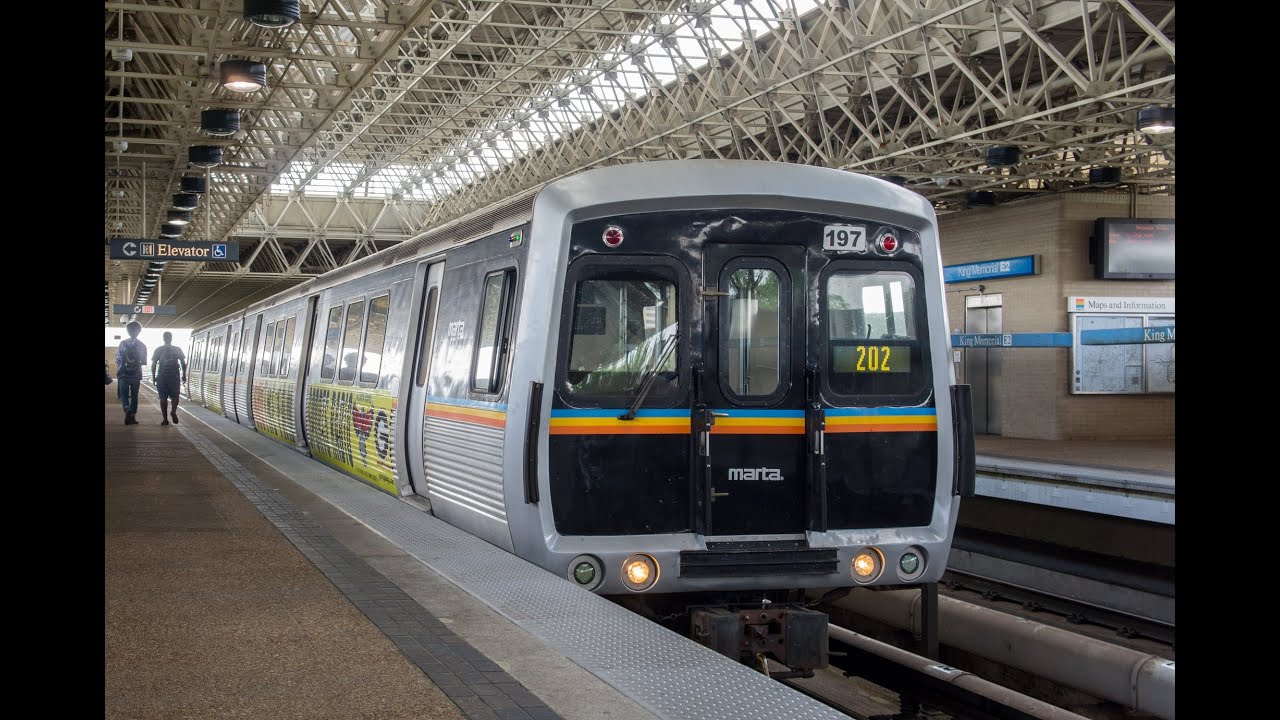
MARTA's 3-stripes logo of blue, yellow and orange is reminiscent of New Jersey Transit's blue, purple and orange. A single trip on any MARTA train is $2.50, now cheaper than New York's. A 10-trip is no bargain at $25. The subway started running with tokens in 1979, and switched to farecards known as Breezecards in 2006.
Atlanta has always been the cultural capital of the South, particularly of the "New South." In the 1950s, Mayor Hartsfield, knowing that he couldn't get investors in his city if it was believed to be racist, billed it as "the City Too Busy to Hate." And Atlanta is a majority-black city.

Nevertheless, it is still in Georgia, which is still the South. There's still old touches, including the fixation on Gone With the Wind, and the fact that the State Flag, even after several redesigns, still resembles the actual flag of the Confederate States of America, "the Stars and Bars" (not the "Southern Cross," that was the Confederate Battle Flag).
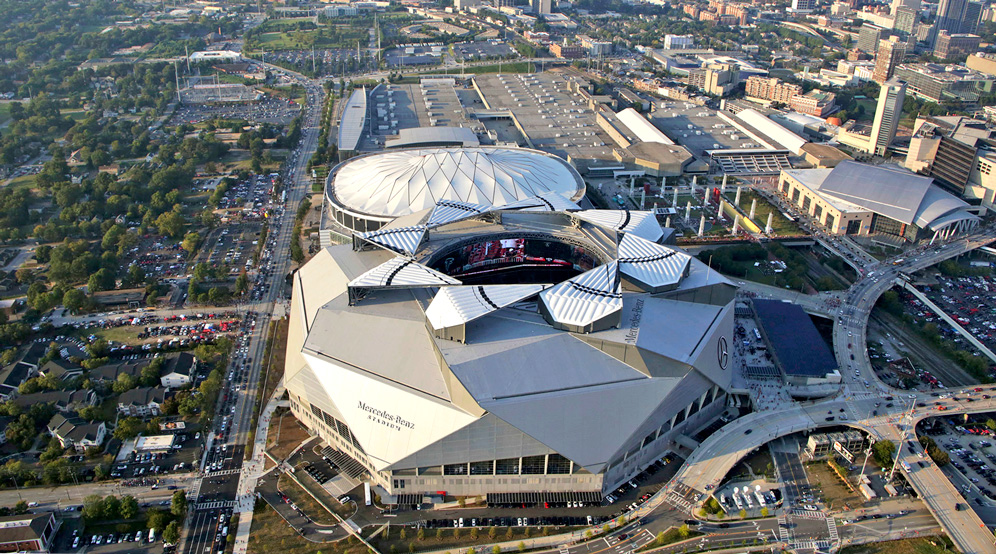
Going In. Mercedes-Benz Stadium, which opened last August 26, is at the northwestern edge of downtown, just south of the site of the now-demolished Georgia Dome, and to the southwest of the State Farm Arena and the CNN Center.
The stadium with the roof open. The since-demolished
Georgia Dome is to the left. State Farm Arena is to its right.

It is bounded on the north by the Dome site, the east by Andrew Young International Blvd., the south by Mitchell Street/Martin Luther King Jr. Drive, and the west by Northside Drive. The official address is 1 AMB Drive NW. (AMB standing for "America Mercedes-Benz.") Take MARTA's Blue or Green Line to Dome / GWCC / State Farm Arena / CNN Center station. If you drive in, this being the South, tailgating is not only permitted, but encouraged.

Atlanta United are tenants of the NFL's Atlanta Falcons, making them 1 of 6 MLS teams groundsharing with a professional football team, 4 in the U.S. In addition to those teams, it has begun to host the Southeastern Conference Championship Game and the Peach Bowl. The field is FieldTurf, and runs east-to-west. (AU had started on real grass at Grant Field.) The roof is retractable: The Falcons wanted to be able to play outdoors.

Although the top deck is usually closed off, this season's home opener, against D.C. United on March 11, attracted 72,035 fans, a new MLS record, since broken by the 1st home game of Charlotte F.C.
The 1st concert was held on October 12, 2017, by husband-and-wife country singers Garth Brooks and Trisha Yearwood. Although country singers would seem a natural fit -- Kenny Chesney will play there later this month -- they include other formats, as 2018 saw Taylor Swift, and then another husband-and-wife pair, Jay-Z and Beyoncé, play the place.

It has hosted the College Football Playoff National Championship on January 8, 2018, in which Alabama beat Georgia; and Super Bowl LIII on February 3, 2019, with the New England Patriots beating the Los Angeles Rams. It was scheduled to host the NCAA Final Four in 2020, before the entire Tournament was canceled due to the COVID epidemic. It could host it as soon as 2027, as 2023 through 2026 have already been awarded elsewhere. It has been selected by FIFA as one of the host venues for the 2026 World Cup.

Food. This being the South, you can expect good eating and good hospitality. Voice of the Fan Surveys ranked the new stadium 1st in both the NFL and MLS. Whether you agree is up to you.

You can find Miss D's Popcorn ("New Orleans Style," which probably isn't too popular in Atlanta, and "Made with much, much love," which probably is) at Sections 104, 122 and 214; Goose Island Carvery at 107 and 122; Capital Crust Pizza at 115, 131, 214 and 230; Jim 'N Nick's Bar-B-Q at 116 and 217 Bruster's Ice Cream at 116, 124, 221 and 246; Smoke and Pour at 117, Shock Top Brat at 121 and 202; Chick-fil-A at 123; Fries Up (including "Southern Poutine," and I do not want to know what that is) at 123; Papa John's at 123 and 248 Molly B's Kitchen at 133; Delia's Chicken Sausage at 133 and 221; Fox Bros. Bar-B-Q at 136 and 240; local hero chef Kevin Gillespie's GameChanger at 223; Farm Burger at 245; and Snackology 101 (organic, vegan and gluten-free options) at 348.

Team History Displays. They got rid of the "You ain't got no history" song quickly, winning the MLS Cup in only their 2nd season, 2018; and the U.S. Open Cup in their 3rd, 2019.

In 2017, before they ever played a competitive match, Atlanta United announced their 1st retired number: 17, for their fans, the number representing the year of their debut. Josef Martínez, usually the team's starting striker, wore 17 for Turin club Torino (even though it is considered a bad luck number in Italy, much as 13 is in the English-speaking world), but he agreed to switch to Number 7, saying that the symbolism of retiring the number for the fans is bigger than himself, his teammates, his coaches, or any other individual.

Stuff. The Atlanta United Team Store is located between Gates 3 and 4, on the southeast side of the stadium. As a new team, there are no books or videos about them.

During the Game. Atlanta United are still a new team. They do not yet seem to have decided who their arch-rivals are. Perhaps the recent arrivals of Nashville SC and Charlotte FC will settle that.

But this isn't a college football game, and it's not Atlanta Falcons vs. New Orleans Saints. With Atlanta United fans, if you leave them alone, they'll almost certainly leave you alone.

AUFC do not yet have a mascot. They hold auditions for National Anthem singers, instead of having a regular singer. AUFC fans do not, as Braves fans do, conclude the National Anthem not with " …and the home of the brave" but " …and the home of the Braves!" But they do replace "Gave proof through the night" with "Gave proof through the Knights," a tradition brought back from the minor-league hockey team the Atlanta Knights in the 1990s, and repeated in the 2000s for the now-departed Atlanta Thrashers. Yes, it's also dumb.

Their main supporters' clubs sit in the north end, Sections 112 to 119. Footie Mob and Resurgence (the latter symbolizing the city's rebirth after the Civil War) are holdovers from the previous minor-league team, the Atlanta Silverbacks. Terminus Legion (named for the city's original name) started in 2014, to coincide with MLS' official announcement of the team's establishment. The Faction is a family-friendly group, and is less likely to be involved in traditional soccer "ultra" activities. (So, no profane chants.)

To the tune of "The Ants Go Marching" -- it's the same tune as "When Johnny Comes Marching Home," but they can't cite that, because it's a Union song from the Civil War -- Terminus Legion sings:

We are Atlanta, we hold it down, A-Town, A-Town!
The city where the players play!
We ride on them things like every day!
We are Atlanta, and we hold it down!

Or, as we Red Bull fans sing, "Da-da, da-da, D.C. United takes it up the ass!"

To the tune of Atlanta-based OutKast's "Hootie Hoo," Footie Mob sings:

Hootie Hoo!
United on the left, United on my right!
Attacking all days, scoring always!
Hootie Hoo!

After the Game. You should have no trouble with AUFC fans on your way out. Atlanta does have a bit of a crime problem: While you'll probably be safe around the stadium and on the subway, you don't want to wander the streets late at night.

A good way to have fun would seem to be to find a bar where New Yorkers hang out. Unfortunately, the best ones I could come up with were all outside the city. Hudson Grille (sure sounds like a New York-style name), 6317 Roswell Road in Sandy Springs, is 15 miles north of Five Points. MARTA Red Line to Dunwoody, then transfer to Number 5 bus.

A recent Thrillist article on the best sports bars in each State listed The Midway Pub as the best in Georgia. It's about 3 1/2 miles east of downtown, at 552 Flat Shoals Avenue SE. Number 74 bus.

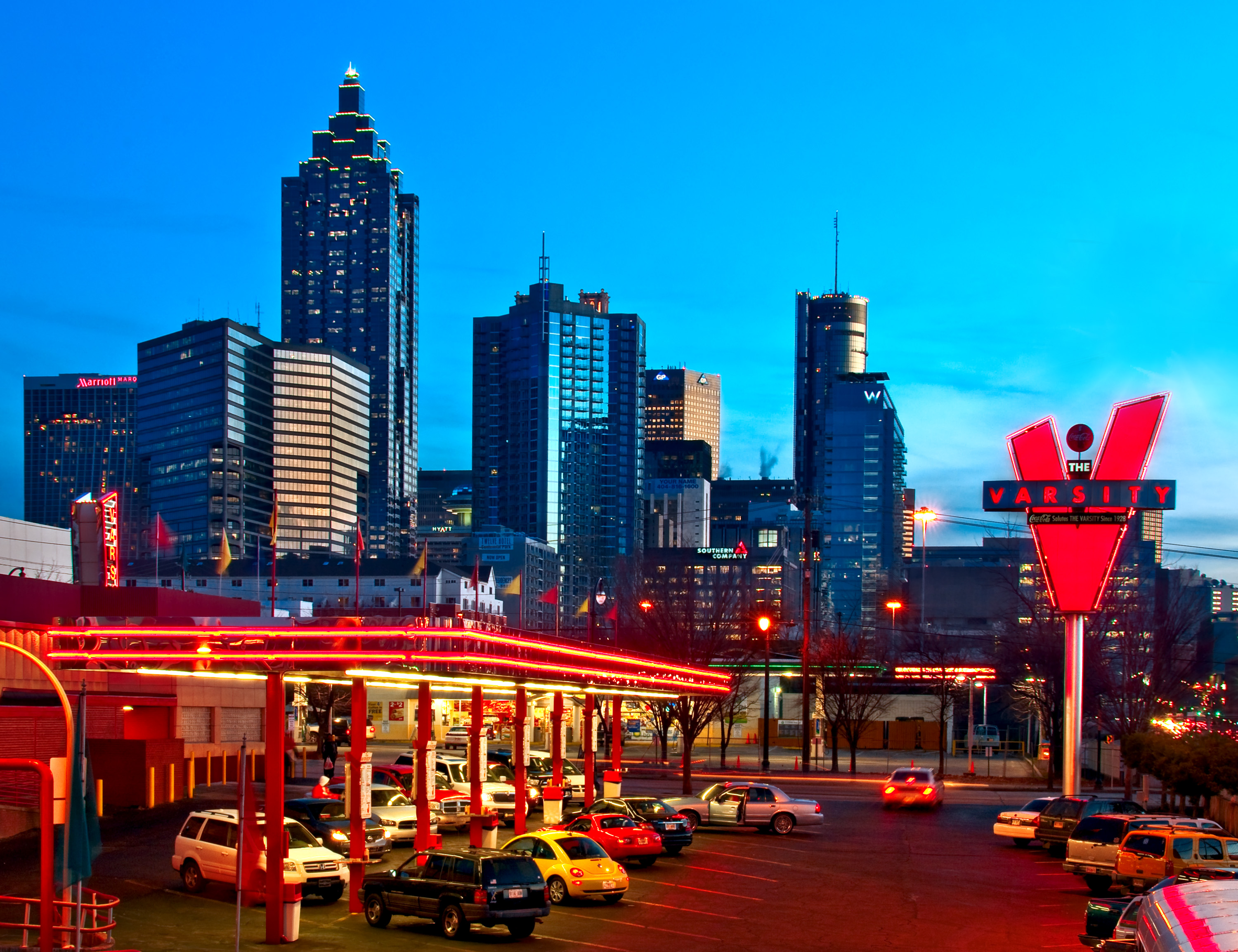
A few steps away from Georgia Tech's Grant Field, over the North Avenue Bridge (over I-75/85) at 61 North Avenue NW, highlighted by a huge neon letter V, is The Varsity. No visit to The A-T-L is complete without a stop at The Varsity. Basically, it's a classic diner, but really good. Be careful, though: They want to keep it moving, much like the Soup Nazi on Seinfeld and its real-life counterpart The Original Soup Man, and also Pat's Steaks in Philadelphia.

The place has a language all its own, and, when they ask, "What'll you have?", being a Met fan, you do not want to order what they call a Yankee Dog – or a Naked Dog, which, oddly, is the same exact thing: A hot dog whose only condiment is mustard (which hardly makes it "naked," but that's what they call it). Check out this link, and you'll get an idea of what to say and what not to say.

Mazzy's, at 2217 Roswell Road in Marietta, is the home of the local Jets fan club, but it's 20 miles north, and forget about reaching it by public transportation. There used to be a place called Bada Bing's, at 349 Decatur Street SE, just 1 stop east of Five Points on the MARTA Green Line (fitting), but they've gone out of business. Meehan's Public House is also said to be a Jet fans' hangout. 227 Sandy Springs Place, at the CityWalk shopping center, just outside I-285. MARTA Red Line to Dunwoody, transfer to the 87 bus.

A Facebook page titled "Mets Fans Living In Atlanta" was no help. Your best bet may be to research hotel chains, to find out which ones New Yorkers tend to like, and meet up with fellow N'Yawkuhs (or N'Jerseyans) there.

If your visit to Atlanta is during the European soccer season, which is now approaching its climax, your best bet to watch your favorite club is the Brewhouse Cafe, at 401 Moreland Avenue NE. MARTA Blue Line to Inman Park-Reynoldstown.

If your visit to Atlanta is during the European soccer season, which is now over except for the FA Cup and Champions League Finals, you can watch your favorite clubs at the following locations:

* Arsenal, Manchester City and Leicester City: Brewhouse Cafe, 401 Moreland Avenue NE. MARTA Blue Line to Inman Park-Reynoldstown, then Bus 6 to Euclid & Moreland.

* Liverpool, Chelsea, Manchester United, Celtic, Barcelona and Bayern Munich: Fado Irish Pub, at The Shops Buckhead Atlanta, 273 Buckhead Avenue, 6 miles north of downtown. Bus 110. As far as I know, this one and Philadelphia are the only Fado outlets left.

* Everton: Limerick Junction, 822 N. Highland Avenue NE. Bus 816.

* Tottenham Hotspur: Manny's Grant Park, 580 Woodward Avenue SE. Bus 21.

* Real Madrid: The Olde Blind Dog, 705 Town Blvd NE, 9 miles northeast of downtown. MARTA Gold Line to Brookhaven, then Bus 25 to Peachtree Road & Town Blvd.

If you don't see your club listed here, your best bets are Brewhouse Cafe or Fado.

Sidelights. On November 30, 2018, Thrillist published a list of "America's 25 Most Fun Cities," and Atlanta came in 9th. When the Thrashers moved to become the new Winnipeg Jets in 2011, it marked the 2nd time in 31 years that Atlanta had lost an NHL team. They still have teams in MLB, the NFL and the NBA, plus a Division I-A college which has been successful in several sports, the annual Southeastern Conference Championships for both football and basketball, an annual college football bowl game, the Peach Bowl -- and, now, MLS.

But that doesn't make Atlanta a great sports town. All of their major league teams have tended to have trouble filling their buildings.

Until Mercedes-Benz Stadium was ready, Atlanta United played its first few home games at Bobby Dodd Stadium at Historic Grant Field, home football stadium of the Georgia Institute of Technology, a.k.a. Georgia Tech.

The official address is 150 Bobby Dodd Way, with the former address being 177 North Avenue NW (yeah, another one of those), about a mile and a half north of downtown. MARTA Gold or Red to North Avenue. If you drive in, parking is $10.

The oldest stadium in the NCAA's Football Bowl Subdivision (formerly Division I-A)? It sure doesn't look it, having been modernized several times since its opening over 100 years ago, on September 27, 1913. Bobby Dodd, who played at the University of Tennessee and coached at Georgia Tech (first as an assistant to Bill Alexander, then as head coach), is one of only 3 people elected to the College Football Hall of Fame as both a player and a coach.
Previous soccer teams to play there were the Atlanta Apollos of the old North American Soccer League in 1973, and the Atlanta Beat of the Women's United Soccer Association in 2001. College football's Peach Bowl was played there in 1968, '69 and '70. The Falcons played a game there on October 5, 1969, against the Baltimore Colts, because the Braves unexpectedly qualified for the 1st-ever National League Championship Series against the Mets, and had dibs on what became Fulton County Stadium. (Atlanta lost both.)

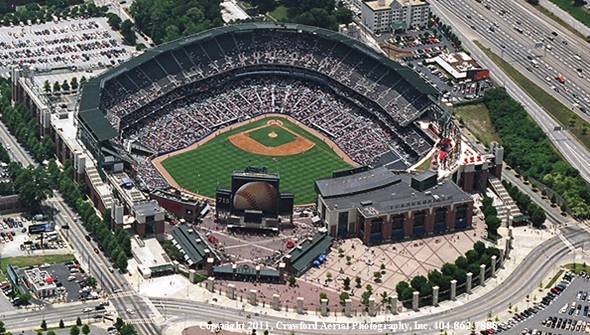
* Atlanta-Fulton County Stadium. Home to the Southern Association's Atlanta Crackers in their last season, 1965; to the Braves from 1966 to 1996; to the NFL Falcons from 1966 to 1991; and to the Atlanta Chiefs of the North American Soccer League (Champions 1968) from 1967 to 1973. Known simply as Atlanta Stadium until 1974, it was in what's now the parking lot north of Turner Field.
The old stadium hosted the World Series in 1991, 1992, 1995 and 1996, the last 3 games there being the Yankees' wins in Games 3, 4 and 5 of the '96 Series. It hosted NFC Playoff games in 1978 and 1991, the Peach Bowl from 1971 to 1991, the 2nd legs of the 1968 and 1971 NASL Finals hosted by the Chiefs, and 2 matches of the U.S. national soccer team: A win over India in 1968, and a win over China in 1977. It also hosted the Beatles shortly after its opening, on August 18, 1965.

In the Green Lot parking area north of the park, where Atlanta-Fulton County Stadium used to be, there is a chain-link fence about where the left-center-field fence was, and, at the approximate location of where it landed, then the Braves' bullpen, is the marker that used to be on the wall behind it, honoring Aaron's record-breaking 715th career home run, hit on April 8, 1974.

Fulton County Stadium was known as "The Launching Pad." Put it this way: If the field conditions there were the same as at Milwaukee County Stadium, Hank Aaron would still have hit over 600 home runs, but he wouldn't have gotten to 715. So the faraway distances at The Ted make it a balanced ballpark.

* Turner Field. The next home of the Braves was at the intersection of Capitol Street SE and Love Street SE, but the official address is 755 Hank Aaron Drive SE. Unfortunately, the MARTA subway doesn't get all that close to Turner Field. To make matters worse, the ballpark is separated from downtown Atlanta by the intersection of Interstates 20 and 75/85, so unless you had a hotel within a 10-minute walk of the ballpark, you weren't going to walk there. the Number 55 bus goes from Five Points Station, the centerpoint of MARTA, to Turner Field.

Turner Field opened in 1996, as the main venue for the Olympic Games held in Atlanta that year. After the Olympics, the north end was demolished, and replaced with the bleachers and main scoreboards, so that the 85,000-seat track & field stadium could become a proper 50,000-seat baseball stadium.

The Braves played the 1999 World Series there, and hosted the 2000 All-Star Game. But it never became as treasured as some of the other neo-retro stadiums, such as those in Baltimore, Cleveland and Philadelphia. And, while much of it retained features from Fulton County Stadium (such as the blue fence with the yellow line on top, and the yellow distance markers), the Braves didn't build up the same kind of history there: 10 Division titles to 7, but only 1 Pennant to its predecessor's 4, and no World Championships.

Instead of being completely demolished, the stadium has, once again, been converted, into a 30,000-seat football stadium for Atlanta-based Georgia State University, called Center Parc Stadium. Since they won't need as much parking, part of the parking lots are being converted into student housing and retail property. And the school's new baseball field is being built on the site of Fulton County Stadium, so that the Aaron 715 marker will be in the exact same place on the field that it was at the old stadium. The 1st Georgia State football game was played there last August 31.

* Truist Park. The new home of the Braves, named for a bank, opened last Spring in Cumberland, Cobb County, Georgia. It's in Atlanta's northwestern suburbs. The Braves have tried to justify the move by saying that this is "near the geographic center of the Braves' fan base." This may be true. But the move also got them out of the majority-black City of Atlanta and into the center of mostly-white, Tea Party-country Georgia. Gee, I wonder if there's a connection, especially now that the famously inclusive Ted Turner no longer owns the team? (Ironically, Tea Party groups opposed the building of the stadium, citing the taxes that would have to be implemented for it.)

Seriously, the Braves had it backwards: Whereas many teams in the various sports left the inner city for the suburbs, or at least for suburban parts of their cities, in the 1950s, 1960s and 1970s, and then came back downtown in the 1990s, 2000s and 2010s, the Braves built Fulton County Stadium downtown in 1965 (and then Turner Field downtown in 1996), and are going out to the suburbs in 2017. Do they really think this is going to increase their oft-mocked attendance? We shall see.

It is northwest of the interchange of Interstates 75 and 285, on Circle 75 Parkway, 13 miles northwest of Five Points. MARTA Gold to Arts Center, then transfer to Number 10 bus. The Braves use a "circulator" bus system to shuttle fans to and from the stadium.

* State Farm Arena, and sites of the Georgia Dome and The Omni. They're next-door to each other, at Martin Luther King Jr. Drive SW and Northside Drive NW (another confusing street name). From 1992 to 2017, the Georgia Dome hosted the Falcons, the Peach Bowl, and the SEC Championship Game.

It hosted the NCAA Final Four in 2002 (Maryland beating Indiana), 2007 (Florida beating Ohio State), and 2013 (Louisville over Michigan). It hosted the 2006 Sugar Bowl due to the Superdome still being unusable after Hurricane Katrina. It hosted Super Bowls XXVIII (Dallas over Buffalo) and XXXIV (St. Louis over Tennessee).

It hosted the NCAA Final Four in 2002 (Maryland beating Indiana), 2007 (Florida beating Ohio State), and 2013 (Louisville over Michigan). It also hosted the 1996 Olympic basketball games, several SEC basketball tournaments and the 2003 Women's Final Four. It's hosted 7 soccer games, including a recent CONCACAF Gold Cup loss by the U.S. men's team to Panama, a 2014 U.S. women's team win over Russia, and games by legendary club sides AC Milan, Manchester City and Mexican side Club America. And it was "home field" for Atlanta's Evander Holyfield when he defended the Heavyweight Championship of the World against Vaughn Bean on September 19, 1998.

Formerly the Philips Arena, the State Farm Arena has been home to the NBA's Hawks since 1999, and was the home of the NHL's Thrashers from 1999 to 2011. It was built on the site of the previous Atlanta arena, The Omni, a.k.a. the Omni Coliseum. That arena hosted the Hawks from 1972 to 1997, the NHL's Atlanta Flames from 1972 to 1980 (when they moved to Calgary), the 1977 NCAA Final Four (Queens native and ex-Knick Al McGuire leading Marquette over Dean Smith's North Carolina), a fight by Atlanta's own Evander Holyfield, defending the Heavyweight Championship of the World against Bert Cooper on November 23, 1991.

Elvis Presley sang there on June 21, 29, 30 and July 3, 1973; April 30, May 1 and 2, 1975; and June 4, 5, 6 and December 30, 1976. It also hosted the 1988 Democratic Convention, which nominated Michael Dukakis for President, which didn't work out too well.

The CNN Center is adjacent to the arena, and the College Football Hall of Fame just to the north of that, at 250 Marietta Street NW. MARTA Gold or Red to Dome-GWCC-Philips Arena stop.

With the loss of the Thrashers, the nearest NHL team to Atlanta is the Nashville Predators, 247 miles away. Atlanta would be 10th in population among NHL markets, but don't count on them ever getting another team after losing 2 within 31 years.

* Hank McCamish Pavilion. The Georgia Institute of Technology (a.k.a. Georgia Tech) has played basketball here at "the Thrillerdome" since 1956. Originally named the Alexander Memorial Coliseum, for legendary football coach Bill Alexander, the building underwent a renovation from 2010 to 2012, funded in large part by a donation from the McCamish family.

The Pavilion hosted the Hawks from their 1968 arrival from St. Louis to The Omni's opening in 1972, and again from 1997 to 1999 while Philips Arena was built on The Omni's site. The WNBA's Atlanta Dream will play their 2017 and '18 seasons there, due to renovations at Philips Arena. 965 Fowler Street NW. MARTA Gold or Red Line to Midtown.

In between Grant Field and the Thrillerdome is Russ Chandler Stadium, Tech's baseball facility. Although they've never won a National Championship, the list of players they've sent to the majors leagues includes Marty Marion, Marlon Byrd, Nomar Garciaparra, Jason Varitek and Mark Teixeira. 255 5th Street NW.

UGa's Sanford Stadium is 71 miles east of Five Points, at 100 Sanford Drive in Athens. Take I-85, or Megabus from MARTA Civic Center station.

* Site of Ponce de Leon Park. The Southern Association's Atlanta Crackers played at 2 stadiums with this name, from 1907 to 1923, and then, after a fire required rebuilding, from 1924 to 1964. The second park seated 20,000, a huge figure for a minor league park then -- and a pretty big one for a minor league park now.

"Crackers"? The term is usually applied to a poor white Southerner, and is, effectively, black people's response to what we now call "the N-word." It has also been suggested that the term referred to plowboys cracking a whip over their farm animals, or that it was a shortened version of an earlier team called the Firecrackers, or that it comes from the Gaelic word "craic," meaning entertaining conversation, or boasting, or bantering. (To make matters more confusing, the Negro Leagues had a team called the Atlanta Black Crackers.)

The team won a Pennant in 1895, before the 1st ballpark with the name was built. In the 1st park, they won Pennants in 1907, 1909, 1913, 1917 and 1919. In the 2nd, they won in 1925, 1935, 1938, 1945, 1954, 1956, 1957, 1960 and 1962. So, 15 in all. After that 1962 Crackers Pennant, Atlanta would not win another until the Braves finally did it 29 years later. All told, Atlanta has won 20 Pennants.

The park was known for a magnolia tree that stood in deep center field, until 1947 when Earl Mann bought the team and moved the fence in a bit, so that the tree was no longer in fair play. Although it never happened during a regular-season professional game, in exhibition games both Babe Ruth and Eddie Mathews hit home runs that hit the tree.

The park also hosted high school football and the occasional prizefight, including the last fight in the career of Jack Dempsey, in 1940, when he was 45 years old and beat pro wrestler Clarence "Cowboy" Luttrell.

The Southern Association, a Double-A League (since replaced by the Southern League) folded in 1961, rather than accept integrated teams. The Crackers, known (ironically, considering their location) as "the Yankees of the Minors," were accepted into the Triple-A American Association, and remained there until their final season, 1965, before the Braves arrived the next year. That last season, 1965, was played at what became Fulton County Stadium, its 52,000 seats making it the largest stadium ever to regularly host minor-league games, a record that would later be broken by the Denver Bears after Bears Stadium was expanded to 74,000 seats and became Mile High Stadium.

The Midtown Place Shopping Center is now on the site. Unlike the park, and the 1st shopping center that was on the site, before Midtown Place, the magnolia tree has never been torn down. 650 Ponce de Leon Avenue NE. MARTA Gold to North Avenue, then transfer to Number 2 bus.

* Dahlberg Hall. Formerly the Atlanta Municipal Auditorium, this structure opened in 1909, and was the longtime home of the Atlanta Symphony Orchestra until 1968, when Woodruff Arts Center opened. In 1970, it was the site of Muhammad Ali's return to boxing, after his legal exile. He knocked Jerry Quarry out in the 3rd round.

In 1979, Georgia State University bought the Auditorium, and converted it into their alumni hall, renaming it for alumnus Bill Dahlberg. Courtland Street & Auditorium Place SE. Just 5 blocks east of Five Points, and within walking distance.

Ty Cobb is buried in his family's mausoleum in Rose Hill Cemetery, in his hometown of Royston, 93 miles northeast of Atlanta. It can only be reached by car.

* Non-Sports Sites. There's the Atlanta Cyclorama and Civil War Museum, 800 Cherokee Avenue SE, which tells the true story of that fire you saw in Gone With the Wind. At the other end of the spectrum, giving all people their equal due, is the Martin Luther King Jr. National Historic Site at 449 Auburn Avenue NE, which includes the house that was Dr. King's birthplace and boyhood home, the Ebenezer Baptist Church where he and his father Martin Sr. preached, and his tomb. The King Memorial stop on MARTA's Blue and Green Lines serves both the King Center and the Cyclorama.

The Carter Center, housing Jimmy Carter's Presidential Library and Museum, and the Carter Center for Nonviolent Social Change, is at 453 Freedom Parkway. Bus 3 or 16 from Five Points stop on MARTA. The Carters have announced that, unlike most recent Presidents, they will not be buried at their Presidential Library, but rather in their hometown of Plains, 158 miles south of Atlanta.

From 1924 onward, Franklin D. Roosevelt had a retreat at Warm Springs, which became known as the Little White House when he became President in 1933. He died there on April 12, 1945. 401 Little White House Road, 73 miles southwest of Atlanta.

Atlanta also has museums honoring Gone With the Wind author and Atlanta native Margaret Mitchell, Atlanta's native drink Coca-Cola, and Atlanta's native news network CNN. And there's the city's major shopping district, Underground Atlanta, in the Five Points area.

Elvis sang at the historic Fox Theater early in his career, giving 6 shows in 2 days, March 14 and 15, 1956. 660 Peachtree Street NE at Ponce de Leon Avenue. MARTA Gold or Red Line to North Avenue. He topped that from June 22 to 24, giving 10 shows in 3 days (including a personal record 4 on the 23rd -- he was a lot younger then) at the Paramount Theater, next-door to the Loew's Grand Theater, famous for being the site of the world premiere of Gone With the Wind.

Both the Paramount and the Loew's Grand (which burned in a suspected insurance scam in 1978) have been demolished, and replaced by the Georgia-Pacific Tower. John Wesley Dobbs Avenue & Peachtree Street NE. MARTA Gold or Red Line to Peachtree Center.

In addition to the preceding, Elvis played 2 shows at the City Auditorium in Waycross on February 22, 1956. 865 Pendleton Street, 238 miles southeast, actually closer to Jacksonville. He played the Bell Municipal Auditorium in Augusta on March 20 and June 27, 1956. 712 Telfair Street, 148 miles east.

He played 2 shows at the Savannah Sports Arena on June 25, 1956. Since demolished, it stood at 2519 E. Gwinnett Street, 250 miles southeast. He played the Savannah Civic Center on February 17, 1977. 301 W. Oglethorpe Avenue. And he played the Macon Coliseum on April 15, 1972 (2 shows); April 24, 1975; and August 31, 1976 He was supposed to sing there again on April 2, 1977, but his lifestyle was catching up with him, and the show was postponed, and done on June 1. 200 Coliseum Drive, 84 miles south.

Atlanta is the home base of actor-writer-producer-director Tyler Perry, and all his TV shows and movies are set there. The house that stands in for the home of his most famous character, Mabel "Madea" Simmons, is at 1197 Avon Avenue SW, 3 miles southwest of downtown. MARTA Gold or Red Line to Oakland City, then a 10-minute walk north. I think it's a private home, so don't bother whoever lives there. Especially if there's somebody living there who's like Madea.

The most famous TV show set in Georgia was The Dukes of Hazzard. The State in which Hazzard County was located was never specified in the script, but the cars had Georgia license plates, and Georgia State Highway signs could be clearly seen. The first few episodes were filmed in Covington, about 37 miles southeast of Five Points. After returning from a Christmas break from filming in 1978-79, new sets were built in Southern California to mimic a small Southern town's courthouse square.

Years later, the TV version of In the Heat of the Night would also film in Covington. The movie version, like the TV version set in the fictional town of Sparta, Mississippi, was filmed in Tennessee and Illinois, as Sidney Poitier refused to cross the Mason-Dixon Line to film his scenes.

Atlanta has attracted the supernatural, including The Walking Dead, The Vampire Diaries and Teen Wolf. Much of Andy Griffith's ole-country lawyer show Matlock was filmed around the Fulton County Government Center and the State Capitol along MLK Drive, centered on Central Avenue.

But, for the most part, Matlock, like another Atlanta-based show, Designing Women, was filmed in L.A. The house that stood in for Julia Sugarbaker's home, at 1521 Sycamore Street in the show (the address does exist in neighboring Decatur), isn't even in Georgia: It's in Little Rock, Arkansas, hometown of series co-creator and writer Harry Thomason. (His co-creator and writer Linda Bloodworth-Thomason is from Poplar Bluff, Missouri.)

The most famous movie scene ever filmed in Georgia wasn't any scene in Gone With the Wind (that was filmed in Hollywood), but the town square scene in Forrest Gump. That was filmed in Chippewa Square, at Bull and Hull Streets, in Savannah, 250 miles southeast of Atlanta. The bench has been moved to the nearby Savannah History Museum, 303 Martin Luther King Jr. Blvd. Most of the movie was filmed in Beaufort, South Carolina, 42 miles to the northeast, 287 miles southeast of Atlanta, and 71 miles southwest of Charleston.

*

Atlanta is an acquired taste, especially for a New Yorker or a New Jerseyan. Is it worth going? Let me put it this way: If your mission is simply to have a good time in an unfamiliar city, and to "cross one more roadtrip off your list," then, by all means, go, stay safe, and have fun.

Wednesday, July 6, 2022

How to Be a Met Fan In Atlanta -- 2022 Edition

 
Next Monday, July 11, the Mets go down to the land of cotton to face the team their fans, in their usual amount of wisdom (rolleyes), used to consider their arch-rivals, the Atlanta Braves.

NOTE: Despite the recent name changes of baseball's Cleveland Guardians and football's Washington Commanders, the Braves have shown no indication that they will change their Native American-themed name.

Despite beating them in the 1st-ever National League Championship Series in 1969, the Mets and Braves were really only rivals for a brief time, roughly 1998 to 2001. In each of those seasons, the Braves won the NL Eastern Division and the Mets finished 2nd, just missing the Wild Card in '98, getting it before losing to the Braves in the NL Championship Series in '99, then catching a break in 2000 when the Braves lost to the St. Louis Cardinals, who then lost to the Mets. Who then, of course, lost the World Series to the Yankees.

Since the Phillies got good -- and even after they've fallen apart, and gotten good again, and after the Braves have gotten good again, too -- Met fans have, for the first time in their history, seen what a real rivalry is.

Before You Go. Being well south of New York, Atlanta is usually warmer than we are. It also gets rather humid. They don't call it "Hot-lanta" just for its nightlife.

Check the website of the Atlanta Journal-Constitution (used to be 2 papers, now 1) before you go. Temperatures are projected as being in the high 90s for the afternoons and the low 70s for the evenings. So stay hydrated. Rain might be an issue: "Scattered Thunderstorms" are predicted for Wednesday afternoon, and "Isolated Thunderstorms" for the evening. So at least one of these games could be postponed by the weather.

Although Georgia, a.k.a. The Heart of the South, seceded from the Union in 1861, it was readmitted in 1870. You do not need a passport, and you don't need to change your U.S. dollars into Confederate money. And it's in the Eastern Time Zone, so you don't have to fiddle with your watch or your phone clock. Do keep in mind, though: They think you talk as funny as you think they do.

Tickets. The Braves rarely sell out, except for the World Series (and they haven't even gotten that far since the 21st Century dawned -- even the Mets have, but the Braves haven't). Even during the 1999 NLCS, Met fans found it not so difficult to get tickets at Turner Field, its official capacity at its close being 49,586.

The Braves averaged 32,895 per home game in 2019, the last pre-COVID season, and that may have been for the novelty of the new Truist Park. So, for a regular-season game in the 6th season at their new 41,149-seat ballpark, even for a team that has contended for the Playoffs the last few years, it should be a snap. It should be, except, this time, the Monday game is already sold out.

Since the opponent is New York, premium pricing will be used. In the lower level, Dugout Infield seats (the closest) go for $101, Diamond Reserved for $44, and the Home Run Porch (Bleachers) for $34. The second deck (Terrace) is $48. By major league standards, the upper level is cheap: Vista Infield is $21, General Admission $18.

Getting There. It's 868 miles from Times Square in New York to Five Points, Atlanta's center of attention. Google Maps says the fastest way from New York to Atlanta by road is to take the Holland Tunnel to Interstate 78 to Harrisburg, then I-81 through the Appalachian Mountains, and then it gets complicated from there.

No, the best way to go, if you must drive, is to take the New Jersey Turnpike/I-95 all the way from New Jersey to Petersburg, Virginia. Exit 51 will put you on I-85 South, and that will take you right into Atlanta.

You'll be in New Jersey for about an hour and a half, Delaware for 20 minutes, Maryland for 2 hours, inside the Capital Beltway (Maryland, District of Columbia and Virginia) for half an hour if you're lucky (and don't make a rest stop anywhere near D.C.), Virginia for 3 hours, North Carolina for 4 hours, South Carolina for about an hour and 45 minutes, and Georgia outside I-285 (the beltway known as the Perimeter, the Atlanta Bypass or "the O around the A") for an hour and a half.

Throw in traffic in and around New York at one end, Washington in the middle, and Atlanta at the other end, and we're talking 16 hours. Throw in rest stops, preferably in Delaware, near Richmond, near Raleigh, and in South Carolina, and it'll be closer to 19 hours. Still wanna drive? Didn't think so.

Take the bus? Greyhound has plenty of service between the two cities, and costs $401 round-trip (though it can be as low as $251 on advanced purchase). But at 20 1/2 hours each way (including an hour-and-a-half stopover in Richmond, Virginia), it saves you no time. At least the station is downtown, at 232 Forsyth Street at Brotherton Street, by the Garnett station on the subway.

Take the train? Amtrak's New York-to-New Orleans train, the Crescent, leaves Penn Station at 2:15 PM and arrives at 8:43 AM the next morning. The return trip leaves Atlanta at 11:294 PM and arrives in New York the next evening at 6:08. The round-trip fare is $504. It's as long as driving and riding the bus, and costs a bit more than the bus. The station is at 1688 Peachtree Street NW at Deering Road, due north of downtown. From there, take the 110 bus into downtown.

Perhaps the best way to get from New York to Atlanta is by plane? If you book now, you can get nonstop round-trip flights from Newark Liberty International Airport to Hartsfield-Jackson International Airport for $628. True, that's a lot more expensive than the train, but 2½ hours each way beats the hell out of 18. The Metropolitan Atlanta Rapid Transit Authority (MARTA) Gold Line or Red Line subway from Hartsfield-Jackson to Five Points takes just half an hour.

(The airport is named for 2 Mayors. William B. Hartsfield served from 1942 to 1962, and got the airport built. Maynard H. Jackson Jr. was the city's 1st black Mayor, serving from 1974 to 1982, and again from 1990 to 1994, and he got a new terminal built at the airport.)

Once In the City. When you get to your hotel in Atlanta (and, let's face it, if you went all that way, you're not going down for a single 3-hour game and then going right back up the Eastern Seaboard), pick up a copy of the Journal-Constitution. It's a good paper with a very good sports section. The New York Times may also be available, but, chances are, the Daily News and the Post won't be.

Founded in 1837, and originally named "Terminus" because it was established as a railroad center, but later renamed because the railroad in question was the Atlantic-Pacific Railroad, Atlanta is a city of about 500,000 people (slightly more than Staten Island), in a metropolitan area of about 6.4 million (still less than 1/3rd the size of the New York Tri-State Area). The sales tax in Georgia is just 4 percent, but it's 5 percent in the City of Atlanta.
The State House

Be advised that a lot of streets are named Peachtree, which can confuse the hell out of you. Even worse, the city uses diagonal directions on its streets and street signs, much like Washington, D.C.: NW, NE, SE and SW. The street grid takes some odd angles, which will confuse you further. Five Points -- Peachtree Street, Marietta Street & Edgewood Avenue -- is the centerpoint of the city.

A building boom in the 1980s gave the city some pretty big skyscrapers, so, while downtown Atlanta won't seem quite as imposing as New York or Chicago, it will seem bigger than such National League cities as Cincinnati and St. Louis. The building currently named Bank of America Plaza, a.k.a. the Pencil Building because of its shape, is the tallest in the City of Atlanta, in the State of Georgia, and in the Southeast, at 1,023 feet. It stands at 600 Peachtree Street NE at North Avenue.

ZIP Codes in Georgia start with the digits 30 and 31, with Atlanta and its suburbs using 300 to 307. The Area Code for Atlanta is 404, with 770 surrounding it, and 678 overlaid. Atlanta's electricity is supplied by Georgia Power Company.

Atlanta became majority-black in the 1960, and is now the 4th-largest majority-black city: About 51 percent black, 41 percent white, 4 percent Hispanic and 3 percent Asian. The northern half of the city is mostly white, the southern half mostly black. As a major center for both black filmmaking and hip-hop, Atlanta is, essentially, the Black Hollywood.

Both the Hispanic and the Asian populations of the city have more than doubled since 2000. And, with 12.8 percent of the population willing to classify themselves as gay or bisexual, Atlanta has the 3rd-highest gay percentage of any major city in America, behind San Francisco and Seattle.

Which is not to say that Atlanta, and Georgia in general, have been free from strife. It's still the South. The Camilla Massacre in Camilla, southwest Georgia, on September 19, 1868 resulted in the deaths of 15 people, black and white alike, attempting to assist black people in voting during the post-Civil War period known as Reconstruction. Atlanta was struck by a race riot on September 22, 1906, killing 25 black people and 2 white people. A race riot struck Augusta, the eastern Georgia city that is home to the Masters golf tournament, on May 11, 1970, resulting in 6 deaths.

And, 15 miles east of Atlanta, Stone Mountain Park opened on April 14, 1865 -- 100 years to the day after Abraham Lincoln was shot, and that is no coincidence. In 1972, a sculpture was unveiled on its north face, showing Confederate President Jefferson Davis and Generals Robert E. Lee and Thomas "Stonewall" Jackson on horseback. The carving of these 3 traitors to the United States of America is larger than that of the 4 Presidents on Mount Rushmore in South Dakota.

One thing that people tend to forget: The movie Deliverance, with its psychopathic hillbillies, is often thought to take place in West Virginia. In fact, it's set in Georgia, and was filmed on the Chattooga River, which separates eastern Georgia from western South Carolina, and on both sides of the river.
MARTA's 3-stripes logo of blue, yellow and orange is reminiscent of New Jersey Transit's blue, purple and orange. A single trip on any MARTA train is $2.50, now cheaper than New York's. A 4-day pass is a bargain at $19. The subway started running with tokens in 1979, and switched to farecards known as Breezecards in 2006.
Atlanta has always been the cultural capital of the South, particularly of the "New South." In the 1950s, Mayor Hartsfield, knowing that he couldn't get investors in his city if it was believed to be racist, billed it as "the City Too Busy to Hate." And Atlanta is a majority-black city.

Nevertheless, it is still in Georgia, which is still the South. There's still old touches, including the fixation on Gone With the Wind, and the fact that the State Flag, even after several redesigns, still resembles the actual flag of the Confederate States of America, "the Stars and Bars" (not the "Southern Cross," that was the Confederate Battle Flag).
Going In. The new home of MLB's Braves -- unlike the Braves' previous stadiums, and the present and former venues for the NFL's Falcons, the NBA's Hawks, the NHL's Flames and Thrashers, MLS' Atlanta United, and Georgia Tech -- is nowhere near downtown Atlanta. It's not even in the city, but in Cumberland, in Cobb County, in Atlanta's northwestern suburbs. It opened in 2017, and it's already on its 2nd name: It opened as SunTrust Park, and was renamed Truist Park in 2020.

Despite not actually being in Atlanta, the official address is "755 Battery Avenue Southeast, Atlanta, GA 30339." The number, as with Turner Field's 755 Hank Aaron Drive before it, is a tribute to Aaron and his career home run total. (Aaron threw out the ceremonial first ball before the regular-season opener in 2017.) It is northwest of the interchange of Interstates 75 and 285, on Circle 75 Parkway, 12 miles northwest of Five Points.

There are several shopping centers around it, but let's not kid ourselves here: The Braves have got it seriously backwards. Whereas many teams in the various sports left the inner city for the suburbs, or at least for suburban parts of their cities, in the 1950s, 1960s and 1970s, and then came back downtown in the 1990s, 2000s and 2010s, the Braves built Fulton County Stadium downtown in 1965 (and then Turner Field downtown in 1996), and have gone out to the suburbs in 2017.

Do they really think this is going to increase their oft-mocked attendance? So far, yes: Average attendance was up by 6,000 from 2016 to 2017, although that may have been due to the novelty of the new stadium.

Why was Turner Field replaced after only 20 seasons? It wasn't in bad shape, right? Actually, it had a problem that Fulton County Stadium, on the plot of land just to the north, had, and also led to the early dooms for the Georgia Dome and The Omni: Atlanta's humid climate means that maintenance of such a building costs more than in most cities.

In Turner Field's case, a renovation to keep those costs down would have cost $150 million. The team said that "fan improvement renovations" would add another $200 million. That's $350 million, just to fix up an existing ballpark, an amount that (with inflation factored in) they might have to pay every 20 years. And the City of Atlanta wasn't willing to pay that, due to other priorities, like school and street upkeep.

The Braves also said that they didn't have control over the commercial development around Turner Field -- there really isn't any, given that it's blocked off from most of the city by freeways and parking lots. It wasn't quite unique among the multisport stadiums of the 1960s and '70s in that it was downtown (St. Louis also did that), but, despite being downtown, it didn't have nearby development that would have a cross-stream of revenue.

Finally, the Braves decided that Turner Field "doesn't match up with where the majority of our fans come from." Translation: Black people in Atlanta aren't paying to come to Braves games, white people from the northern and western suburbs are. Is that racist? Maybe not. Is that cynical? Oh, hell, yes.

But it does parallel Walter O'Malley's reasons for wanting out of Ebbets Field: In addition to being too small and not having enough parking, a big part of the Dodgers' fan base had taken advantage of the post-World War II veterans' benefits and moved out of the Brooklyn slums into Queens and the suburbs of Long Island, while the people who'd moved in couldn't yet afford to go to games.

It's the same with Atlanta, which, more than any other American city except Washington, has a large black middle class, but they don't seem to be buying Braves tickets in large numbers, either: Given the cost, the commercial opportunities, and the status of their fan base, the Braves concluded that it would be more economical in the long run to simply start over.

Ironically, this move into the center of the mostly-white, Tea Party-country of Georgia wouldn't have happened while the famously inclusive Ted Turner still owned the team. But, in another irony, Tea Party groups opposed the building of the stadium, citing the taxes that Cobb County would have to implement for it.
As you can see, there's now lots of
commercial development around Truist Park.

To get there by public transportation from downtown, take the MARTA subway Red or Gold Line to Arts Center, then transfer to the Number 10 bus. It should take a little over an hour. If you drive in, parking runs from $18 to $23, depending on the lot.

SunTrust was a banking company, whose corporate ancestor was founded in Atlanta in 1891, and merged with BB&T in 2020, to form Truist. Its downtown headquarters, the 869-foot Truist Plaza, is the 2nd-tallest building in the City and the State.

Capacity is 41,149. The field is natural grass, and points just to the east of due south. Field dimensions are very similar to those of Turner Field: 335 feet to left field (the same), 385 to left center (5 feet further), 400 to center (the same), 375 to right-center (15 feet closer), and 325 to right (5 feet further).
Like its 2 predecessors in Atlanta, Truist Park is a hitters' park, partly due to the heat and humidity, and partly due to Atlanta's elevation, which made it the highest city in the major leagues until Denver was expanded into MLB. This led to Fulton County Stadium's nickname: The Launching Pad. So far, the longest home run in the ballpark's brief history is 495 feet, by Ronald Acuña Jr., on September 25, 2020. This surpassed one going 477 feet, by current Yankee Giancarlo Stanton, then with the Miami Marlins, off former Met R.A. Dickey on August 4, 2017.

The longest home run at Turner Field was a 471-foot drive that Rickie Weeks hit on September 20, 2007. The longest ever hit at Fulton County Stadium was by Willie Smith of the Chicago Cubs in 1969, 475 feet. There was a seat in the upper deck in left field decorated with a hammer and the words AARON 557 -- not that the seat was 557 feet from home plate, but that it was where Hammerin' Hank Aaron's 557th career home run landed. Apparently, it wasn't longer than 475 feet.

In the batter's eye area in center field, there are 3 evergreen trees, a tribute to the magnolia tree at Atlanta's old minor-league stadium, Ponce de Leon Park. Like Angel Stadium in Anaheim and Coors Field in Denver, it includes boulders; like Coors Field and Kauffman Stadium in Kansas City, it includes a waterfall; like Kansas City, there's a sound sensor in the system, so that the water shoots higher the louder the fans get.

Home plate is the same one used at both previous Atlanta parks, therefore, they've been using the same one since 1966.
Food. Son, Ah say son, this bein' the South, y'all can expect good eatin' an' good hospitality. You want the usual ballpark fare, including hot dogs and beer? They got 'em an' they got 'em good. You want Southern specialties such as fried chicken an' barbecue? They got that, too.

They have Ballpark Classics stands behind Sections 116, 135, 146, 240, 312 and 326. They have pizza stand The Slice at 107, 150, 215, 239, 313 and 343; Braves Big Bits are at 113; 1871 Grill at 113, 141, 215, 239, 313, 331 and 343; Smokey Q (barbecue) at 113 and 343; Potato Cutter (fries) at 138; Field of Greens (Vegetarian) at 148; Centerfield Market at 149; Taco Factory at 151 and 313; Sandlot Sandwiches and H&F Burger at 155; Waffle House, a great Southern tradition, at 311; The Carvery (sandwiches) at 312; Dessert Dugout at 320 and 331; Fry Box at 320; and Sausage Haus at 347.

According to a recent Thrillist article on the best food at each big-league ballpark, the best food at Turner Field was the Buffalo chicken and waffles, which could only be had in the 755 Club, open only to season-ticket holders. Good. Who the hell eats chicken with waffles? (The article calls it "a Southern classic," but I've also heard it's popular in Ohio.)
Why in the name of Julia Child would anyone
from north of the Mason-Dixon Line eat this crap?

Team History Displays. Just to the foul side of the left field pole, on the facing of the stands, at roughly the same place in which they were placed at Turner Field, the Braves have placed their retired numbers:

* 3, Dale Murphy, 1980s outfielder.
* 6, Bobby Cox, 1990s and 2000s manager.
* 10, Larry Wayne Jones Jr., a.k.a. Chipper Jones, 1990s and 2000s 3rd baseman.
* 21, Warren Spahn, 1940s and '50s pitcher (Boston and Milwaukee).
* 29, John Smoltz, 1990s and 2000s pitcher.
* 31, Greg Maddux, 1990s and 2000s pitcher.
* 35, Phil Niekro, 1960s, '70s and '80s pitcher (mostly Atlanta, but was the last active Milwaukee Brave).
* 41, Eddie Mathews, 1950s and '60s 3rd baseman and '70s manager (the only man to play for the Braves in all 3 cities, including all 13 in Milwaukee).
* 44, Hank Aaron, 1950s, '60s and '70s right fielder.
* 47, Tom Glavine, 1990s and 2000s pitcher (known to Met fans as "the Manchurian Brave").
The Number 42 of Jackie Robinson is also displayed there. All of these except Murphy are now in the Baseball Hall of Fame. Andruw Jones is eligible, and I suspect that, if and when he is elected, the Braves will then retire his Number 25. which is not currently being worn.

Aaron and Spahn were named to the Major League Baseball All-Century Team in 1999, which was introduced in a ceremony at Turner Field before Game 2 of the World Series. That same year, they, Mathews and Maddux were named to The Sporting News' 100 Greatest Players. In 2006, Braves fans chose Aaron as their representative in the DHL Hometown Heroes series. In 2022, ESPN named its 100 Greatest Baseball Players. Among players who played significant time for the Braves, Aaron was ranked 3rd (behind Babe Ruth and Willie Mays), Maddux 14th, Spahn 47th, Mathews 64th, Chipper Jones 78th, Smoltz 93rd, and Niekro 99th.

Notations for the Braves' titles are on the light towers in right field: 1914, 1957, 1995 and 2021 World Champions; 1914, 1948, 1957, 1958, 1991, 1992, 1995, 1996, 1999 National League Champions (with their 12 Pennants won in Boston in the 19th Century not mentioned); 1969, 1982, 1991, 1992 and 1993 National League Western Division Champions; 1995, 1996, 1997, 1998, 1999, 2000, 2001, 2002, 2003, 2004, 2005, 2013 and 2018 National League Eastern Division Champions.
Red for World Series wins, navy blue for Pennants,
lighter blue for Division titles.

They began in Boston in 1871, moved to Milwaukee in 1953, moved to Atlanta in 1966, were put in the NL West in 1969, and in the NL East in 1994.

Inside the concourse, there are banners for the 3 World Series won, and the plaques for the members of the Ivan Allen Jr. Braves Museum and Hall of Fame (named for the Mayor who built Fulton County Stadium, allowing for the Braves' move).
The Hall's 35 members include the following:

* Boston-era players Spahn, Herman Long, Hugh Duffy, Charles "Kid" Nichols, Walter "Rabbit" Maranville, Tommy Holmes and Johnny Sain.

Not yet elected are several Boston-era members of the Baseball Hall of Fame, such as Harry Wright, George Wright, John Clarkson, Kid Nichols, Charles "Old Hoss" Radbourne, Frank Selee, Mike "King" Kelly, Tommy McCarthy, Billy Hamilton, Vic Willis, Jimmy Collins and Johnny Evers.

Also not yet elected are Wally Berger, who was selected for the 1st 4 All-Star Games, including being the only Brave selected for the 1st All-Star Game in 1933; and Bob Elliott, the only Boston Brave to be named NL Most Valuable Player, in 1947.

* Milwaukee-era (1953-65) players Spahn, Aaron, Mathews, Del Crandall, Joe Adcock, Joe Torre (who also managed them in Atlanta) and Ernie Johnson Sr. (father of basketball broadcaster Ernie Johnson Jr.). Not yet elected is the other Hall-of-Famer to have contributed to the 1957 World Championship, Red Schoendienst.

* Atlanta (1966-present) players Aaron, Niekro, Murphy, Maddux, Glavine, Smoltz, Chipper Jones, Terry Pendleton, Ralph Garr, David Justice, Javy Lopez, Andruw Jones and Tim Hudson.

* Non-players: Cox; team owners Bill Bartholomay and Ted Turner; team executives Bill Lucas (MLB's 1st black general manager), Paul Snyder and John Schuerholz; pitching coach Leo Mazzone; broadcasters Johnson, Skip Caray, Pete Van Wieren, Don Sutton and Joe Simpson; and trainer Dave Pursley. (Sutton and Simpson both played for the Dodgers against the Yankees in the 1977 and '78 World Series.)

There is no notation in the ballpark for the Pennants won by the Southern Association's old Atlanta Crackers. And, let's not forget, while the fact that most of the Braves' Atlanta flags came from 1991 to 2005, the relative dearth of them from 1966 (actually from 1959 if you count Milwaukee) to 1990 shows that the Braves haven't been nearly as successful a franchise as a person under the age of 35 might think.

True, in Boston, they were the greatest American sports franchise of the 19th Century; and they were at least in the Pennant race in nearly all of their 13 seasons in Milwaukee; but from 1899 to 1990, 92 seasons, they won only 4 Pennants – as many as the Mets had in their 1st 53 years, and a rate about as bad as the Chicago White Sox (5 in their 1st 104 years), Cleveland Guardians (5 in their 1st 115 and 3 in their 1st 94), and Philadelphia Phillies (5 in their 1st 125 and 4 in their 1st 110).

Behind home plate, Monument Garden includes statues of Aaron, Spahn, Niekro, Cox, and the greatest baseball player ever to come from Georgia, although he died before the Braves arrived: Ty Cobb. (Jackie Robinson was born in Georgia, but was just 1 year old when his mother moved him and his siblings to the Los Angeles area.) The Cox statue was dedicated with the new ballpark; the others were at Turner Field; the Cobb, Aaron and Niekro statues were placed outside Fulton County Stadium in 1965, 1982 and 1987, respectively. A 2nd statue of Aaron was added inside.

Incidentally, Cobb County was not named for Ty Cobb, but rather for Thomas W. Cobb, who served Georgia in both houses of Congress and was later a judge. Ty may have been a distant relative. The County Seat, Marietta, was named for Judge Cobb's wife.

There is a Georgia Sports Hall of Fame, but it's in Macon, 85 miles southeast of downtown Atlanta, and only reachable by car. So far, 16 Braves figures are in it: Aaron, Niekro, Murphy, Glavine, Smoltz, Bob Horner, Brian Jordan, Chipper Jones, Bartholomay, Schuerholz, Stallings (a Georgia native who managed the Braves in Boston), Cox, Skip Caray, Van Wieren, and Ernie Johnson Sr. and Jr.

It also includes 5 Yankees from Georgia: Spurgeon "Spud" Chandler, Johnny Mize, Harry "Suitcase" Simpson, Mark Teixeira and, ugh, Kevin Brown; 4 Brooklyn Dodgers: Jackie Robinson, Nap Rucker, Whitlow Wyatt and Hugh Casey; 2 Mets: Donn Clendenon and Ray Knight; and 6 Georgia natives in the Baseball Hall of Fame: Robinson, Mize, Cobb, Luke Appling, Josh Gibson, and Frank "Big Hurt" Thomas.

If you still consider Mets vs. Braves to be a "rivalry," the Braves lead it, 467-389.

Stuff. The Braves Clubhouse Store is inside the Right Field Gate. You can get pretty much anything you want, from T-shirts with names and numbers of long-gone players to team-oriented DVDs, in the souvenir stands. But do yourself a favor and do not buy a foam Tomahawk. That's a souvenir you just don't need.

There are quite a few good books about Hank Aaron, including his own memoir I Had a Hammer: The Hank Aaron Story, but it's now 25 years old. A more detailed one about the chase for 715, rather than Aaron's entire life, would be Tom Stanton's more recent Hank Aaron and the Home Run That Changed America.

Pete Van Wieren, who retired after the 2008 season and died in 2014, published Of Mikes and Men: A Lifetime of Braves Baseball. After the 1995 World Championship, he collaborated with longtime New York baseball writer Bob Klapisch on a comprehensive history of the team: The World Champion Braves: An Illustrated History of America's Team 1871-1995.

(During the team's run to the 1982 Playoffs, Turner tried to take the "America's Team" tag promoted by the Dallas Cowboys and use it to promote the Braves on TBS, which he then called his nationally-syndicated "superstation," giving the Braves a bit of popularity outside the South.)

Lang Whitaker, a writer for the NBA magazine SLAM!, has written In the Time of Bobby Cox: The Atlanta Braves, Their Manager, My Couch, Two Decades, and Me. And Glavine, Smoltz and Javy Lopez have written inside accounts of the Cox "dynasty."

If you want a look at the franchise's previous incarnations, there's John Klima's Bushville Wins! The Wild Saga of the 1957 Milwaukee Braves and the Screwballs, Sluggers, and Beer Swiggers Who Canned the New York Yankees and Changed Baseball. (Perhaps too long a title. No, Fiona Apple did not collaborate on it.) True, the success of the Braves and their big (for the time), automobile-accommodating ballpark led Walter O'Malley to lead the Dodgers out of first Ebbets Field and then, when he couldn't get a new stadium in Brooklyn, out of New York City entirely, and led him to con Horace Stoneham into doing the same with the Giants. But that did also pave the way for the union of Dodger and Giant fans into the Met alliance. And the Braves did beat the Yankees -- in one out of two World Series, anyway.

But William Povletich's Milwaukee Braves: Heroes and Heartbreak tells not only what happened in their rise, but in their fall, and the causes of the move to Atlanta. A big cause: The Minnesota Twins arrived in 1961, and took away about half of their population base, and the success of the Green Bay Packers from 1960 onward also distracted Wisconsinians.

Sportswriter Harold Kaese wrote The Boston Braves after their 1948 Pennant season. Late in his life, Warren Spahn worked with Kaese' estate to add an update.

There is, as yet, no DVD of The Essential Games of the Atlanta Braves, or The Essential Games of Atlanta-Fulton County Stadium or The Essential Games of Turner Field.

During the Game. A Thrillist article on "Baseball's Most Intolerable Fans," written before the move from Turner Field to SunTrust Park, put Braves fans near the middle of the pack, 13th:

Even when Maddux was dealing in his prime they couldn't always sell out Playoff games. Basically, if you aren't college football in Georgia, don't bother. Hell, even the Tomahawk Chop was ripped off from Florida State. This is the suburban strip mall of franchises, so it's all too appropriate that they'll soon be in the suburbs.

Atlanta can be a rough city, and Falcons, Hawks and Georgia Tech college football games might be good places to keep your guard up. But Braves fans are not going to pick fights with you. As I said, they barely care enough to show up. You do not have to worry about wearing Mets, or any other team's, gear in Turner Field. Braves fans will generally not act like New York, Philadelphia or Boston fans and get snippy (or worse, rough) because of it.

And if you're looking for famous Braves fans in the stands, don't bother. Turner, while no longer the owner, might be there; his ex-wife Jane Fonda, and former President Jimmy Carter and his wife Rosalynn, probably won't be. As for other celebrities, considering that Foxworthy is still hosting Are You Smarter Than a Fifth Grader? in Los Angeles, he won't be attending too many games, even though he's probably, aside from the preceding, the most famous Braves fan.

Every Friday night, the Braves have postgame fireworks, and wear red jerseys, and encourage their fans to wear red as well. All Sunday games have a postgame "kids run the bases" opportunity. Neither of those will apply this time, but the Monday game will have a replica World Series ring giveaway (with paste jewelry instead of diamonds), and Tuesday will be Tyler Matzek Bobblehead Night.

The Braves hold auditions for National Anthem singers, instead of having a regular singer. The National Anthem in Atlanta is "The Star-Spangled Banner," not "Dixie." As you might guess, Braves fans conclude the National Anthem not with " …and the home of the brave" but " …and the home of the Braves!" It's not as dumb as the Baltimore "O! say does that… " but it's bad enough.

What they do have is that annoying Tomahawk Chop and its song, the War Chant: "Oh, oh-whoa-oh-oh… whoa-oh-oh… oh-whoa-oh-oh…" It was brought to the Braves by outfielder Deion Sanders, who had played football at Florida State University before playing both baseball and football professionally.

Since FSU preceded the Braves into championship contention by a few years, this was a chance to latch onto something they thought was special, and, long after Deion's retirement from all sports and the 1996-97 move from Fulton County Stadium to Turner Field to SunTrust Park, the Chop and the Chant remain. If you're a real Met fan, you'll be very quickly reminded of how sick it made you feel during the Clinton Years.

The Braves have had a number of mascots over the years, including Chief Noc-a-Homa (knock a homer), a decidedly politically incorrect Native American whose tepee was located in Fulton County Stadium's left field stands, who would do a so-called Indian war dance after every Braves home run.
Levi Walker Jr., alias Chief Noc-a-Homa, and Hank Aaron

For a while, like some other MLB mascots, including Mr. Met's own Lady Met, the Chief got a girlfriend, Princess Win-a-Lotta. I swear, I am not making that up. I wish I was.
Anyway, having entertained fans since the Braves' 1966 arrival, Levi Walker Jr., who played the Chief, quit in 1986 after a salary dispute. Deciding this was as good a time as any to address the issue of whether the character was insulting to Native Americans, the Braves did not hire a new Chief, and let the character fade away.
The Chief's tepee, in left field at Fulton County Stadium

For a while, they had a green thing called the Bleacher Creature. Recently, they adopted a new mascot, named Homer the Brave. You might recognize him: He has a baseball head, much like Mr. Met, only he has eyeblack and a Braves uniform and cap. Is he as good as Mr. Met? Anybody who thinks so must've broken into the Dukes of Hazzard's moonshine stash.

But for this season, they retired Homer and replaced him with Blooper, who looks like what happened 9 months after the Phillie Phanatic and a female Honker from Sesame Street got drunk. And he has not proven popular, drawing comparisons to Whatizit, the hated mascot of the 1996 Olympics.
The Home Depot is based in Atlanta, and they sponsor a "mascot race": People dressed like tools. (Save your jokes.) A hammer, a saw, a paint brush and a power drill start from the warning track in right field and finish in front of the left field scoreboard.

They have a new race: "Beat The Freeze." It's a variation on the now-traditional minor-league race where a kid goes up against the mascot around the bases. It goes from foul pole to foul pole, and a fan gets a 200-foot head start on The Freeze, a.k.a. Braves grounds crew member Nigel Talton, a former high school track star in a neon green costume.
Unlike minor-league mascots racing kids,
where the kids have to be allowed to win,
The Freeze never loses.

The Braves use the "dying Pac-Man" sound after strikeouts, and "Kernkraft 400" by Zombie Nation as a postgame victory song. Win or lose, the play Ray Charles' version of "Georgia On My Mind."

After the Game. You should have no trouble with Braves fans on your way out, and you may even find a few of your fellow travelers ready to celebrate a Met win – or commiserate with you on a Met loss.

Atlanta does have a bit of a crime problem: While you'll probably be safe downtown, in Underground Atlanta, or on the subway, you don't want to wander the streets late at night.

Near Truist Park, there are shopping centers to the south (Cumberland Mall and Akers Mill Square) and west (Heritage Pavilion and Cumberland Square North), but if you're looking to get a postgame meal, these are likely to be closed by the time the game lets out.

There are a few restaurants adjacent to the ballpark's grounds. Beyond the right field gate are Terrapin Taproom and Fox Bros BBQ (apparently, that's 1 establishment, not 2), Yardhouse, and Antico Pizza Napoletano. 

To the west, U.S. Route 41, a.k.a. Cobb Parkway, and it has lots of familiar names: McDonald's, Burger King, Wendy's IHOP, Olive Garden, Red Lobster, Dunkin Donuts, Starbucks, Del Taco, Zaxby's, Steak & Shake, Applebee's, Panda Express.

A good way to have fun would seem to be to find a bar where New Yorkers hang out. The Hudson Grille (sure sounds like a New York-style name) is the home of the local Giants fan club, and is only a couple of blocks east of the arena, at 120 Marietta Street NW.

Mazzy's, at 2217 Roswell Road in Marietta, is the home of the local Jets fan club, but it's 20 miles north, and forget about reaching it by public transportation. There used to be a place called Bada Bing's, at 349 Decatur Street SE, just 1 stop east of Five Points on the MARTA Green Line (fitting), but they've gone out of business. Meehan's Public House is also said to be a Jet fans' hangout. 227 Sandy Springs Place, at the CityWalk shopping center, just outside I-285. MARTA Red Line to Dunwoody, transfer to the 87 bus.

A Facebook page titled "Mets Fans Living In Atlanta" was no help. Your best bet may be to research hotel chains, to find out which ones New Yorkers tend to like, and meet up with fellow N'Yawkuhs (or N'Jerseyans) there.

If your visit to Atlanta is during the European soccer season, which is now approaching its climax, your best bet to watch your favorite club is the Brewhouse Cafe, at 401 Moreland Avenue NE. MARTA Blue Line to Inman Park-Reynoldstown.

Sidelights. When the Thrashers moved to become the new Winnipeg Jets in 2011, it marked the 2nd time in 31 years that Atlanta had lost an NHL team. They still have teams in MLB, the NFL and the NBA, plus a new MLS team, a Division I-A college which has been successful in several sports, the annual Southeastern Conference Championships for both football and basketball, and an annual college football bowl game, the Peach Bowl.

But that doesn't make Atlanta a great sports town. All of their major league teams have tended to have trouble filling their buildings. Once the novelty wears off, this will happen to Atlanta United as well.

On November 30, 2018, Thrillist published a list of "America's 25 Most Fun Cities," and Atlanta came in 9th. 

* Atlanta-Fulton County Stadium. Home to the Southern Association's Atlanta Crackers in their last season, 1965; to the Braves from 1966 to 1996; to the NFL Falcons from 1966 to 1991; and to the Atlanta Chiefs of the North American Soccer League (Champions 1968) from 1967 to 1973. Known simply as Atlanta Stadium until 1974, it was in what's now the parking lot north of Turner Field.
The old stadium hosted the World Series in 1991, 1992, 1995 and 1996, the last 3 games there being the Yankees' wins in Games 3, 4 and 5 of the '96 Series. It hosted NFC Playoff games in 1978 and 1991, the Peach Bowl from 1971 to 1991, the 2nd legs of the 1968 and 1971 NASL Finals hosted by the Chiefs, and 2 matches of the U.S. national soccer team: A win over India in 1968, and a win over China in 1977. It also hosted the Beatles shortly after its opening, on August 18, 1965.

In the Green Lot parking area north of the park, where Atlanta-Fulton County Stadium used to be, there is a chain-link fence about where the left-center-field fence was, and, at the approximate location of where it landed, then the Braves' bullpen, is the marker that used to be on the wall behind it, honoring Aaron's record-breaking 715th career home run, hit on April 8, 1974.
Fulton County Stadium was known as "The Launching Pad." Put it this way: If the field conditions there were the same as at Milwaukee County Stadium, Hank Aaron would still have hit over 600 home runs, but he wouldn't have gotten to 715. So the faraway distances at The Ted made it a balanced ballpark.

* Turner Field. The next home of the Braves is at the intersection of Capitol Street SE and Love Street SE, but the official address is 755 Hank Aaron Drive SE. Unfortunately, the MARTA subway doesn't get all that close to Turner Field. To make matters worse, the ballpark is separated from downtown Atlanta by the intersection of Interstates 20 and 75/85, so unless you had a hotel within a 10-minute walk of the ballpark, you weren't going to walk there. the Number 55 bus goes from Five Points Station, the centerpoint of MARTA, to Turner Field.
Turner Field in its original configuration,
as the 1996 Olympic Stadium

Turner Field opened in 1996, as the main venue for the Olympic Games held in Atlanta that year. After the Olympics, the north end was demolished, and replaced with the bleachers and main scoreboards, so that the 85,000-seat track & field stadium could become a proper 50,000-seat baseball stadium.
As seen here, with the outline of the
original configuration still in place at the north end.

The Braves played the 1999 World Series there, and hosted the 2000 All-Star Game. But it never became as treasured as some of the other neo-retro stadiums, such as those in Baltimore, Cleveland and Philadelphia. And, while much of it retained features from Fulton County Stadium (such as the blue fence with the yellow line on top, and the yellow distance markers), the Braves didn't build up the same kind of history there: 10 Division titles to 7, but only 1 Pennant to its predecessor's 4, and no World Championships.

Instead of being completely demolished, the stadium is, once again, being converted, into a 30,000-seat football stadium for Atlanta-based Georgia State University. Since they won't need as much parking, part of the parking lots are being converted into student housing and retail property. And the school's new baseball field is being built on the site of Fulton County Stadium, so that the Aaron 715 marker will be in the exact same place on the field that it was at the old stadium.
Artist's rendering of the baseball complex

Construction on the converted facility, now Center Parc Stadium, began in February, and Georgia State began playing football there on August 31, 2017.
* Mercedes-Benz Stadium, State Farm Arena, and the sites of the Georgia Dome and The Omni. They're next-door to each other, at Martin Luther King Jr. Drive SW and Northside Drive NW (another confusing street name).

Mercedes-Benz Stadium, the new retractable-roof stadium for the Falcons, the SEC Championship Game, the Peach Bowl and MLS' Atlanta United, opened last Summer, just south of the Georgia Dome.

The new stadium hosted the College Football Playoff National Championship on January 7, 2018 (the "home field" did the University of Georgia no good, losing to the University of Alabama), and will host Super Bowl LIII on February 3, 2019, and the NCAA Final Four in 2020. It has been approved by FIFA as one of the host venues for the 2026 World Cup.

The Dome has now been demolished -- like Turner Field and The Omni, remarkably soon after its construction. It was home to the Falcons from 1992 to 2016, and hosted the SEC Championship Game and the Chick-fil-A Bowl (formerly the Peach Bowl). It hosted the 2006 Sugar Bowl due to the Superdome still being unusable after Hurricane Katrina. It hosted Super Bowls XXVIII (Dallas over Buffalo) and XXXIV (St. Louis over Tennessee). It hosted the NCAA Final Four in 2002 (Maryland beating Indiana), 2007 (Florida beating Ohio State), and 2013 (Louisville over Michigan).

It also hosted the 1996 Olympic basketball games, several SEC basketball tournaments and the 2003 Women's Final Four. It hosted 7 soccer games, including a 2015 CONCACAF Gold Cup loss by the U.S. men's team to Panama, a 2014 U.S. women's team win over Russia, and games by legendary club sides AC Milan, Manchester City and Mexican side Club America. And it was "home field" for Atlanta's Evander Holyfield when he defended the Heavyweight Championship of the World against Vaughn Bean on September 19, 1998.

Known as the Philips Arena until 2018, the State Farm Arena has been home to the NBA's Hawks since 1999, and was the home of the NHL's Thrashers from 1999 to 2011. It was built on the site of the previous Atlanta arena, The Omni, a.k.a. the Omni Coliseum.

That arena hosted the Hawks from 1972 to 1997, the NHL's Atlanta Flames from 1972 to 1980 (when they moved to Calgary), the 1977 NCAA Final Four (Queens native and ex-Knick Al McGuire leading Marquette over Dean Smith's North Carolina), a fight by Atlanta's own Evander Holyfield, defending the Heavyweight Championship of the World against Bert Cooper on November 23, 1991.

Elvis Presley sang at The Omni on June 21, 29, 30 and July 3, 1973; April 30, May 1 and 2, 1975; and June 4, 5, 6 and December 30, 1976. It also hosted the 1988 Democratic Convention, which nominated Michael Dukakis for President, which didn't work out too well.

The CNN Center is adjacent to the arena, and the College Football Hall of Fame just to the north of that, at 250 Marietta Street NW. MARTA Gold or Red to GWCC-CNN Center stop.

With the loss of the Thrashers, the nearest NHL team to Atlanta is the Nashville Predators, 247 miles away. Atlanta would be 11th in population among NHL markets, but don't count on them ever getting another team after losing 2 within 31 years.

* Hank McCamish Pavilion. The Georgia Institute of Technology (a.k.a. Georgia Tech) has played basketball here at "the Thrillerdome" since 1956. Originally named the Alexander Memorial Coliseum, for legendary football coach Bill Alexander, the building underwent a renovation from 2010 to 2012, funded in large part by a donation from the McCamish family.

The Pavilion hosted the Hawks from their 1968 arrival from St. Louis to The Omni's opening in 1972, and again from 1997 to 1999 while the State Farm Arena was built on The Omni's site. The WNBA's Atlanta Dream will play their 2017 and '18 seasons there, due to renovations at State Farm Arena. 965 Fowler Street NW. MARTA Gold or Red Line to Midtown.

* Bobby Dodd Stadium at Historic Grant Field. The oldest stadium in Division I-A college football? It sure doesn't look it, having been modernized several times since its opening a little over 100 years ago, on September 27, 1913. Dodd, who played at the University of Tennessee and coached at Georgia Tech (first as an assistant to Alexander, then as head coach), is one of only 3 people elected to the College Football Hall of Fame as both a player and a coach.

Grant Field also hosted a Falcons game in 1969, because the Braves made the Playoffs and had first dibs on Fulton County Stadium. It did them no good, as the Braves lost to the Mets, and the Falcons lost to the Baltimore Colts. It also hosted the first few home games of Atlanta United, as Mercedes-Benz Stadium wasn't ready.

Georgia Tech's teams have two nicknames, the Yellow Jackets and the Ramblin' Wreck. There is a 1930 Ford Model A called the Ramblin' Wreck that drives onto the field before every game, carrying the Tech cheerleaders, including Buzz the Yellow Jacket, with the team running behind it. Don't let the "Ramblin' Wreck" name fool you: They love their college traditions in the South, and this vee-hicle is kept in tip-top condition.

I would advise against going to Dodd/Grant when Tech plays their arch-rivals, the University of Georgia, as those games not only sell out, but have been known to involve fights. Other than that, the stadium has a great atmosphere. 177 North Avenue NW (yeah, another one of those). MARTA Gold or Red Line to North Avenue. (UGa's Sanford Stadium is 71 miles east of Five Points, at 100 Sanford Drive in Athens. Take I-85, or Megabus from MARTA Civic Center station.)

In between Grant Field and the Thrillerdome is Russ Chandler Stadium, Tech's baseball facility. Although they've never won a National Championship, the list of players they've sent to the majors leagues includes Marty Marion, Marlon Byrd, Nomar Garciaparra, Jason Varitek and Mark Teixeira. 255 5th Street NW.

A few steps away from Grant Field, over the North Avenue Bridge (over I-75/85) at 61 North Avenue NW, highlighted by a huge neon letter V, is The Varsity. No visit to The A-T-L is complete without a stop at The Varsity. Basically, it's a classic diner, but really good. Be careful, though: They want to keep it moving, much like the Soup Nazi on Seinfeld and its real-life counterpart The Original Soup Man, and also Pat's Steaks in Philadelphia.

The place has a language all its own, and, when they ask, "What'll you have?", being a Met fan, you do not want to order what they call a Yankee Dog – or a Naked Dog, which, oddly, is the same exact thing: A hot dog whose only condiment is mustard (which hardly makes it "naked," but that's what they call it). Check out this link, and you'll get an idea of what to say and what not to say.

* Site of Ponce de Leon Park. The Southern Association's Atlanta Crackers played at 2 stadiums with this name, from 1907 to 1923, and then, after a fire required rebuilding, from 1924 to 1964. The second park seated 20,000, a huge figure for a minor league park then -- and a pretty big one for a minor league park now.

"Crackers"? The term is usually applied to a poor white Southerner, and is, effectively, black people's response to what we now call "the N-word." It has also been suggested that the term referred to plowboys cracking a whip over their farm animals, or that it was a shortened version of an earlier team called the Firecrackers, or that it comes from the Gaelic word "craic," meaning entertaining conversation, or boasting, or bantering. (To make it even more confusing, the Negro Leagues had a team called the Atlanta Black Crackers.)
The team won a Pennant in 1895, before the 1st ballpark with the name was built. In the 1st park, they won Pennants in 1907, 1909, 1913, 1917 and 1919. In the 2nd, they won in 1925, 1935, 1938, 1945, 1954, 1956, 1957, 1960 and 1962. So, 15 in all. After that 1962 Crackers Pennant, Atlanta would not win another until the Braves finally did it 29 years later. All told, Atlanta has won 20 Pennants.
The park was known for a magnolia tree that stood in deep center field, until 1947 when Earl Mann bought the team and moved the fence in a bit, so that the tree was no longer in fair play. Although it never happened during a regular-season professional game, in exhibition games both Babe Ruth and Eddie Mathews hit home runs that hit the tree.

The park also hosted high school football and the occasional prizefight, including the last fight in the career of Jack Dempsey, in 1940, when he was 45 years old and beat pro wrestler Clarence "Cowboy" Luttrell.

The Southern Association, a Double-A League (since replaced by the Southern League) folded in 1961, rather than accept integrated teams. The Crackers, known (ironically, considering their location) as "the Yankees of the Minors," were accepted into the Triple-A American Association, and remained there until their final season, 1965, before the Braves arrived the next year. That last season, 1965, was played at what became Fulton County Stadium, its 52,000 seats making it the largest stadium ever to regularly host minor-league games, a record that would later be broken by the Denver Bears after Bears Stadium was expanded to 74,000 seats and became Mile High Stadium.

The Midtown Place Shopping Center is now on the site. Unlike the park, and the 1st shopping center that was on the site, before Midtown Place, the magnolia tree has never been torn down. 650 Ponce de Leon Avenue NE. MARTA Gold to North Avenue, then transfer to Number 2 bus.
* Dahlberg Hall. Formerly the Atlanta Municipal Auditorium, this structure opened in 1909, and was the longtime home of the Atlanta Symphony Orchestra until 1968, when Woodruff Arts Center opened. In 1970, it was the site of Muhammad Ali's return to boxing, after his legal exile. He knocked Jerry Quarry out in the 3rd round.

In 1979, Georgia State University bought the Auditorium, and converted it into their alumni hall, renaming it for alumnus Bill Dahlberg. Courtland Street & Auditorium Place SE. Just 5 blocks east of Five Points, and within walking distance.

Ty Cobb is buried in his family's mausoleum in Rose Hill Cemetery, at 468 Burch Street, in his hometown of Royston, 93 miles northeast of Atlanta. It can only be reached by car. There is a Ty Cobb Museum at 461 Cook Street, about a mile northwest of the cemetery.

Another Georgia baseball legend with his own museum is Johnny Mize, a distant cousin of Cobb's, who completed his Hall of Fame credentials by helping the Yankees win 5 straight World Series from 1949 to 1953. It is located on the campus of Piedmont College, at 280 Laurel Avenue, in his hometown of Demorest, 80 miles northeast of Atlanta. Also reachable only by car. But the Cobb and Mize Museums are about 40 miles apart, so they can both be done in a single morning (or afternoon).

* Non-Sports Sites. There's the Atlanta Cyclorama and Civil War Museum, 800 Cherokee Avenue SE, which tells the true story of that fire you saw in Gone With the Wind. At the other end of the spectrum, giving all people their equal due, is the Martin Luther King Jr. National Historic Site, at 449 Auburn Avenue NE, which includes the house that was Dr. King's birthplace and boyhood home. It also includes the Ebenezer Baptist Church, where he and his father Martin Sr. preached, and his tomb. The King Memorial stop on MARTA's Blue and Green Lines serves both the King Center and the Cyclorama.

The Carter Center, housing Jimmy Carter's Presidential Library and Museum, and the Carter Center for Nonviolent Social Change, is at 453 Freedom Parkway. Bus 3 or 16 from Five Points stop on MARTA. The Carters have announced that, unlike most recent Presidents, they will not be buried at their Presidential Library, but rather in their hometown of Plains, 158 miles south of Atlanta.

Whether they will be participating in any events at the Library during any of the Mets' visits this season, I don't know, but in spite of their ages, they do get around rather well.

From 1924 onward, Franklin D. Roosevelt had a retreat at Warm Springs, which became known as the Little White House when he became President in 1933. He died there on April 12, 1945. 401 Little White House Road, 73 miles southwest of Atlanta.

Atlanta also has museums honoring Gone With the Wind author and Atlanta native Margaret Mitchell, Atlanta's native drink Coca-Cola, and Atlanta's native news network CNN. And there's the city's major shopping district, Underground Atlanta, in the Five Points area.

Elvis sang at the historic Fox Theater early in his career, giving 6 shows in 2 days, March 14 and 15, 1956. 660 Peachtree Street NE at Ponce de Leon Avenue. MARTA Gold or Red Line to North Avenue. He topped that from June 22 to 24, giving 10 shows in 3 days (including a personal record 4 on the 23rd -- he was a lot younger then) at the Paramount Theater, next-door to the Loew's Grand Theater, famous for being the site of the world premiere of Gone With the Wind.

Both the Paramount and the Loew's Grand (which burned in a suspected insurance scam in 1978) have been demolished, and replaced by the Georgia-Pacific Tower. John Wesley Dobbs Avenue & Peachtree Street NE. MARTA Gold or Red Line to Peachtree Center.

In addition to the preceding, Elvis played 2 shows at the City Auditorium in Waycross on February 22, 1956. 865 Pendleton Street, 238 miles southeast, actually closer to Jacksonville. He played the Bell Municipal Auditorium in Augusta on March 20 and June 27, 1956. 712 Telfair Street, 148 miles east.

He played 2 shows at the Savannah Sports Arena on June 25, 1956. Since demolished, it stood at 2519 E. Gwinnett Street, 250 miles southeast. He played the Savannah Civic Center on February 17, 1977. 301 W. Oglethorpe Avenue. And he played the Macon Coliseum on April 15, 1972 (2 shows); April 24, 1975; and August 31, 1976 He was supposed to sing there again on April 2, 1977, but his lifestyle was catching up with him, and the show was postponed, and done on June 1. 200 Coliseum Drive, 84 miles south.

The Royal Peacock Club was a longtime hotspot for jazz and rhythm & blues. On November 29, 1964, soul singer Sam Cooke gave what turned out to be his last concert there. Now known as the Royal Peacock Lounge, it is billed as "Atlanta's oldest reggae club," in other words a dance club. 186 1/2 Auburn Avenue NE, at Piedmont Avenue, just northeast of downtown and a block north of the Georgia State campus. Bus 3.

Atlanta is the home base of actor-writer-producer-director Tyler Perry, and all his TV shows and movies are set there. The house that stands in for the home of his most famous character, Mabel "Madea" Simmons, is at 1197 Avon Avenue SW, 3 miles southwest of downtown. MARTA Gold or Red Line to Oakland City, then a 10-minute walk north. I think it's a private home, so don't bother whoever lives there. Especially if there's somebody living there who's like Madea.

From 2011 to 2017, comedian Steve Harvey hosted Family Feud in his hometown, at the Atlantic Civic Center, and then from 2015 onward at the Georgia World Congress Center. But his new TV talk show led him to move production back to Los Angeles.

The most famous TV show set in Georgia was The Dukes of Hazzard. The State in which Hazzard County was located was never specified in the script, but the cars had Georgia license plates, and Georgia State Highway signs could be clearly seen. The first few episodes were filmed in Covington, about 37 miles southeast of Five Points. After returning from a Christmas break from filming in 1978-79, new sets were built in Southern California to mimic a small Southern town's courthouse square.

Years later, the TV version of In the Heat of the Night would also film in Covington. The movie version, like the TV version set in the fictional town of Sparta, Mississippi, was filmed in Tennessee and Illinois, as Sidney Poitier refused to cross the Mason-Dixon Line to film his scenes.

Atlanta has attracted the supernatural, including The Walking Dead, The Vampire Diaries and Teen Wolf. Much of Andy Griffith's ole-country lawyer show Matlock was filmed around the Fulton County Government Center and the State Capitol along MLK Drive, centered on Central Avenue.

But, for the most part, Matlock, like another Atlanta-based show, Designing Women, was filmed in L.A. The house that stood in for Julia Sugarbaker's home, at 1521 Sycamore Street on the show (the address does exist, in neighboring Decatur), isn't even in Georgia: It's in Little Rock, Arkansas, hometown of series co-creator and writer Harry Thomason. (His wife, co-creator and writer, Linda Bloodworth-Thomason, is from Poplar Bluff, Missouri.)

The most famous movie scene ever filmed in Georgia wasn't any scene in Gone With the Wind (that was filmed in Hollywood), but the town square scene in Forrest Gump. That was filmed in Chippewa Square, at Bull and Hull Streets, in Savannah, 250 miles southeast of Atlanta. The bench has been moved to the nearby Savannah History Museum, 303 Martin Luther King Jr. Blvd. Most of the movie was filmed in Beaufort, South Carolina, 42 miles to the northeast of Savannah, 287 miles southeast of Atlanta, and 71 miles southwest of Charleston.

*

Atlanta is an acquired taste, especially for a Met fan. Is it worth going? Put it this way: At the rate both the Mets and the Braves are going, if your mission is to see the Mets "burn Atlanta" the way the Yankees of William Tecumseh Sherman did in 1864, you're out of luck. If it's to see the Mets do it the way the Yankees of Joe Torre did in 1996 and 1999, and the Mets themselves came close to doing in 1999, you've got a chance -- a better chance than you had from 2009 to 2014.

But if your mission is simply to have a good time in an unfamiliar city, and to "cross one more ballpark off your list," then, by all means, go, stay safe, and have fun.