Showing posts with label ted turner. Show all posts

Wednesday, May 6, 2026

Ted Turner, 1938-2026

Ted Turner once said, "There's a fine line between being colorful and being an asshole, and I hope I'm still just colorful."

Robert Edward Turner III was born on November 19, 1938 in Cincinnati, and grew up in Savannah, Georgia. Expelled from Ivy League school Brown University for being caught with a woman in his dorm, he enlisted in the U.S. Coast Guard, so he wouldn't be drafted to fight in Vietnam during the early phase of that war. He later admitted, "I like boats," and was "deployed to some pretty sweet places -- Charleston and Fort Lauderdale."

How much did he like boats? In 1964, he competed in the U.S. Olympic Trials for yacht racing. In 1974, he entered the defender's trials for the America's Cup. On September 18, 1977,  commanding
Courageous, Ted Turner won the America's Cup, defeating Australia in a 4-race sweep.

His father committed suicide in 1963, and 24-year-old Ted took over his father's business, producing advertising billboards. Like another young man who would become a baseball mogul, George Steinbrenner, he took his father's business and grew it far beyond anything his father had imagined, making it "the largest outdoor advertising company in the Southeast."

He began buying radio stations, and, in 1969, traded them for a struggling Atlanta TV statin, WJRJ-Channel 17. He changed the call sign to WTCG, for Turner Communications Group, although he advertised it as "Watch This Channel Grow."

Initially, the station ran old movies from prior decades, along with theatrical cartoons and bygone sitcoms and drama programs. As a better syndicated product fell off the VHF stations, Turner would acquire it for his station at a very low price. WTCG ran mostly second- and even third-hand programming of the time, including fare such as I Love LucyGilligan's Island and Star Trek.

In 1972, he bought the rights to broadcast the games of baseball's Atlanta Braves and the NBA's Atlanta Hawks. In 1976, he bought those teams outright, thinking that his broadcast revenue would allow him to buy better players, and the teams would help the station grow further

On May 2, 1976, Turner announced that, instead of their surnames, the Braves players would have their nicknames above their uniform numbers on their backs. Darrell Evans had "HOWDY." Darrel Chaney had "NORT." Jimmy Wynn's nickname, "The Toy Cannon" (because he was short but powerful), was too long to fit, so his was just "CANNON." And pitcher Andy Messersmith had "CHANNEL."

Bowie Kuhn, the Commissioner of Baseball, saw through this blatant attempt by Turner to advertise for his station, and prohibited it thereafter. Turner and Kuhn were now at odds, and would remain so. (Not that he was the only owner with whom Kuhn was at odds.) On January 3, 1977, Kuhn suspended Turner for a year, for his actions in signing free agent outfielder Gary Matthews. Turner appealed the suspension, and it was overturned.

On May 11, 1977, with the team mired in a 16-game losing streak, Turner sent manager Dave Bristol on a 10-day "scouting trip," and installed himself took over as interim manager. This made him the 1st owner/manager in the major leagues since Connie Mack stepped down as manager of the Philadelphia Athletics in 1950.
That night, the Braves lost 2-1 to the Pirates. Phil Niekro went the distance, and pitched well, but fell to 0-7 on the season. He would end it 16-20. John Candelaria held the Braves to 1 run on 8 hits, 3 of them by rookie outfielder Barry Bonnell, who ended up batting .300 for the season. Dave Parker hit a home run for the Pirates, and that made the difference. Willie Stargell went 1-for- 2 with 2 walks.

The next day, National League President Charles "Chub" Feeney ordered Turner to step down as manager, citing MLB's Rule 20(e), which prohibits managers from owning any stock in the team that employs them, unless specifically granted an exemption by the Commissioner. This rule was put in place in 1927, after a situation regarding Rogers Hornsby. Mack, and also John McGraw of the New York Giants, who owned stock in their teams, were "grandfathered in." Turner appealed to Kuhn, but was never going to get anywhere with him.

The next day, with 3rd base coach Vern Benson running the team, the Braves broke their 17-game losing streak, beating the Pirates, 6-1. Bristol returned for the next game, and the team finished 61-101, in 6th and last place in the NL Western Division, 37 games behind the Los Angeles Dodgers.

Turner fired Bristol after the season, and replaced him with New York Yankees coach Bobby Cox. He got nowhere with the Braves, but their next manager, Joe Torre, led them to the NL West title in 1982, and almost did it again in 1983.

That 1982 season was the year that made the Braves a national phenomenon: Not only had Turner changed Channel 17's call letters to WTBS, for "Turner Broadcasting System," but he'd made it a national "SuperStation." Like the Chicago Cubs on WGN, his games were now broadcast nationwide, and they got a national following, not just a regional one. He even billed the Braves as "America's Team," just as football's Dallas Cowboys had done. They lost the NL Championship Series to the St. Louis Cardinals, whose vast radio network had made them something like a national team.

Cox went on to the Toronto Blue Jays, and led them to their 1st Division title in 1985, but they lost the American League Championship Series to the Kansas City Royals.

In 1990, Turner lured away the Royals' general manager, John Schuerholz. He brought Cox back to the Braves, and the next year, they began one of the most successful runs in NL history. Not counting the strike-shortened 1994 season, the Braves won their Division -- the NL West through 1993, the NL East thereafter -- every season from 1991 to 2005. They won their 1st Pennant in Atlanta in 1991, and also won in 1992, 1995, 1996 and 1999. And they won the 1995 World Series, although they lost the others, including in 1996 and 1999 to the Yankees, who were managed by... Joe Torre.

In 1980, Turner founded CNN, Cable News Network, creating the 24-hour news cycle format. It revolutionized news broadcasting, in ways both positive and not-so-positive. Due to its role in covering the Persian Gulf War, Time magazine named Turner its Man of the Year for 1991.
He sold Turner Broadcasting, including CNN, in 1996, a year after the Braves finally won the World Series. He sold the Braves and the Hawks in 2007. He became one of the largest private landowners in America, and one of the country's leading conservationists.

Turner was married and divorced three times: To Judy Nye (1960–1964), Jane Shirley Smith (1965–1988), and actress Jane Fonda (1991–2001). He had five children: Laura Turner Seydel and Robert Edward Turner Jr., a.k.a. Eddy Turner, with Judy; and Beau Turner, Rhett Turner and Jennie Turner Garlington with Jane Smith. Generally, his children have followed in Ted's philanthropic and conservationist goals.
Turner and Fonda
In a 2018 interview on CBS Sunday Morning, Turner revealed his diagnosis of Lewy body dementia, which had led comedian-actor Robin Williams to commit suicide, and would also lead to the death of baseball legend Tom Seaver. It was Turner's last public appearance. He died today, May 6, 2026, at his home in Lamont, on the Florida Panhandle, at the age of 87.
In spite of their divorce, today, Fonda spoke well of Turner on Instagram:
MY IMMEDIATE THOUGHTS ABOUT TED He swept into my life, a gloriously handsome, deeply romantic, swashbuckling pirate and I've never been the same. He needed me. No one had ever let me know they needed me, and this wasn't your average human being that needed me, this was the creator of CNN, and Turner Classic Movies, who had won the America's Cup as the world's greatest sailor. He had a big life, a brilliant mind and a soaring sense of humor.
He could also take care of me. That was new as well. To be needed and cared for simultaneously is transformative. Ted Turner helped me believe in myself. He gave me confidence. I think I did the same for him, but that's what women are raised to do. Men like Ted aren’t supposed to express need and vulnerability. That was Ted's greatest strength, I believe.
He also taught me more than any other person or school classes, mostly about nature and wildlife, hunting and fishing (hunters and fishermen who follow the law are the best environmentalists), but also about business and strategy. Ted was supremely strategic. It was likely innate, but he studied the Classics in college, knew about the Peleponesian War inside and out and the strategies used by Alexander the Great and even Genghis Khan. And sailing big boats as he did further honed those strategic talents which he then brought into his businesses to much success. He could see around corners for sure.
Next to Katharine Hepburn, Ted was the most competitive person I have ever met and that was fascinating to witness. Whether it was who'd made the most ski runs at the end of the day, to acres of land owned (stewarded is the more fitting word for his relationship to land), who had the most billions, how many countries he'd made love to his prior lover in and could I match that, it was challenging. Ted was challenging, but I've always been up for a challenge, and with Ted it was almost always worth it.
As our friend, Ron Olson, said, "Ted was a great teacher, often by example. He challenged us to think big (he once asked me to draft a resolution for the UN and the US Congress to ban all nuclear weapons; I did) and act small (for the twenty years since meeting Ted, I too, pick up trash on my walks)."
I loved Ted with all my heart. I see him in heaven now with all the wildlife he helped bring back from extinction – the black footed ferrets, the prairie dogs, Big Horned sheep, Mexican Gray Wolf, the Yellowstone wolf pack, bison, the red cockaded woodpecker and so many more, they’re all gathered at the pearly gates applauding and thanking him for saving their species.
Five children survive him, five talented, complex kids who I had the privilege of becoming stepmother to. I had four stepmothers growing up and I know how important stepmothers can be, so we all did our best to build an extended, rag tag family, and I love them to this day. If it was complicated to be married to him, think how complicated it was being his child. And they are all doing fine.
Rest in Peace, dearest Ted. You are loved and you will be remembered.
Whatever caused them to split up, clearly, Jane Fonda thought Ted Turner was still, to use his word, "colorful" -- and, to use a too-often-used phrase, a great man.
If he had still been able to run CNN in 2015, I have no doubt that there would have been a proper journalistic investigation of Donald Trump. And that fat fascist son of a bitch would have been arrested by the FBI when he got to the bottom of the damn escalator. And, today, the world would be much better off.

Friday, July 4, 2025

July 4, 1985: The Rick Camp Game

July 4, 1985, 40 years ago: For anybody who watched this baseball game, it was a 4th of July that will never, ever be forgot.

The Atlanta Braves were hosting the New York Mets at Atlanta-Fulton County Stadium, and Braves owner Ted Turner, showman that he was, scheduled a postgame 4th of July fireworks show. Paid attendance at the 52,007-seat concrete ashtray just south of downtown Atlanta was 44,947.

But the game was delayed by rain, and didn't start until 9:04 PM. Rick Mahler started for the Braves, and the Mets hit him hard, and he didn't get out of the 4th inning. Dwight Gooden started for the Mets, and, in a year when he seemed to be touched by God, he was no better. A second rain delay came, and Met manager Davey Johnson -- who hit 41 home runs as a 2nd baseman for the Braves in 1973 -- didn't take any chances, and he took Doctor K out.

Did I say Davey didn't take any chances? When they came back from the rain delay, he let Roger McDowell, normally a late-inning reliever, finish the bottom of the 3rd inning. Terry Leach pitched the 4th through the 8th, but Davey brought in Doug Sisk, and he let the Braves score 4 runs in that inning to take the lead, 8-7. This included a Keith Hernandez home run. But future Hall-of-Famer Bruce Sutter blew it in the 9th, and the game went to extra innings. At one point, Davey got thrown out of the game.

The Braves got 2 men on with 1 out in the bottom of the 11th, but the Mets got out of it with a double play. In the top of the 13th, with 2 out, Ray Knight singled, and Howard Johnson hit a home run. 10-8 Mets. But in the bottom of the 13th, Tom Gorman -- the only reliever the Mets had left -- allowed a leadoff single to Rafael Ramirez. He struck out Dale Murphy and Gerald Perry, but then gave up a home run to Terry Harper. 10-10. More "free baseball."

Gene Garber walked Lenny Dykstra and Hernandez in the top of the 14th, but got out of it. Knight singled for the Mets in the top of the 15th, but got no farther than 1st base. With 2 out in the bottom of the 16th, Ken Oberkfell singled off Gorman, and Bruce Benedict drew a walk. But Gorman got out of it.

Rick Camp, the Braves' last remaining reliever, came into the game in the top of the 17th, and walked Gary Carter, but then struck out Darryl Strawberry and Gorman, and got Knight to ground into a force play. Ramirez singled with 2 outs in the bottom of the 17th, but Gorman got out of it.

Top of the 18th. HoJo led off with a single. Danny Heep bunted, and Camp rushed it, and threw it away. 1st and 3rd, nobody out. Dykstra hit a sacrifice fly, and it was 11-10 Mets. There was nothing that Braves manager Eddie Haas could do, as Camp was it: The only pitchers he had left were starters, the same as the Mets.

Bottom of the 18th. Perry and Harper grounded out. That brought up Camp, as Haas couldn't pinch-hit for him. He had nobody left to bat or pitch. This pudgy bearded guy, wearing Number 37 for his home-State team, came up to bat. He came into that game 10-for-168 for his career -- a lifetime batting average of .060. He was 0-for-his-last-13. He hadn't gotten a hit since September 1, 1984, 10 months earlier.

John Sterling, who became the main voice for the New York Yankees in 1989, but then doing games for the Braves, turned to his broadcast partner, Ernie Johnson -- who pitched for the Braves in Milwaukee and was the father of basketball announcer Ernie Johnson Jr. -- and said, "I'll tell you, Ernie: If hits a home run to tie this game, this game will be certified as absolutely the nuttiest in the history of baseball."

What do you think happened? Have you ever heard 8,000 people make as much noise as 50,000? You did if you were watching TBS -- or WOR-Channel 9 -- that middle-of-the-night. I was watching on WOR, but, because of Sterling's call, it's the TBS version that seems to have been preserved for posterity and shown on highlights.

Sterling:

And he hits it to deep left! Heep goes back! It is... GONE! Holy cow! Oh my goodness! I don't believe it! I don't believe it! Rick Camp! Rick Camp! I told you Ernie, if he hits it out... That certifies this game as the wildest, wackiest, most improbable game in history!

Mets 11, Braves 11. And to make matters worse, Gorman walked the next batter, Benedict. But he got Paul Runge to ground into a force play, and we went to the 19th inning. (This Paul Runge is not related to the umpire of the same name, whose father Ed and son Brian have also been MLB umpires.)

The Mets play a game this long every few years. In 1964, they went 23 innings in a loss to the San Francisco Giants -- in the 2nd game of a doubleheader. In 1965, they went 18 innings in Philadelphia against the Phillies, before the game was called due to a curfew, and it was replayed. In 1968, they went 24 innings in a loss to the Houston Astros. In 1974, they went 25 innings in a loss to the St. Louis Cardinals.

In 1986, they played what was then the longest game in NLCS history, going 16 innings in beating Houston to clinch the Pennant. They went 20 innings in a 2010 win in St. Louis, 20 in a 2013 loss to the Miami Marlins, 18 in a 2015 loss in St. Louis, and 18 in a 2019 loss in Milwaukee to the Brewers. The 2020 introduction of the "ghost runner" rule makes another such marathon unlikely.

At some point in all this, Ralph Kiner, the great Pittsburgh Pirates slugger who'd been broadcasting for the Mets since the franchise began in 1962 (and still did one game a week until he died in 2014), left the stadium, returned to his hotel, and turned on the TV. He saw the game, and during the next Met broadcast, said that he thought it was a recap. Nope, the game was still going on.

Finally, at about 3:30 in the morning, with only about 8,000 people left in the stands, the Mets decided enough was enough, that they'd had it with these mother-freaking Braves in this mother-freaking game. They pounded Camp, who could not be relieved. Carter led off with a single. John Christensen, who'd pinch-hit for Strawberry, bunted him over to 2nd.

Whoever was managing the Mets at that point -- it might have been 1st base coach Bill Robinson -- decided to let the next day's starter, Ron Darling, pitch the bottom of the 19th, and a few innings thereafter if necessary, since who knew if this game had another 9 innings in it, and sent Rusty Staub, playing one of his last games, up to pinch-hit for the exhausted Gorman.

Haas ordered Camp to walk Staub intentionally to set up a double play, but it didn't work: Knight doubled home Carter and sent Staub to 3rd.  (Daniel Joseph Staub was known as Rusty for his hair, and Montreal Expos fans called him "Le Grand Orange." He wasn't fast even before he turned into a flame-haired Fat Elvis -- or, as Sterling called him in this game, "Babe Ruth.") HoJo was intentionally walked, and that didn't work, either: Heep singled home Staub and Knight, and the throw from the outfield was mishandled, and HoJo scored, too. Dykstra flew out, getting Heep to 3rd, and Wally Backman singled Heep home, before Camp finally got Hernandez to ground out.

Mets 16, Braves 11. This was the mid-1980s Mets. Surely, these Mets could hold a 5-run lead. Surely, the Braves wouldn't score 6 runs and win it in the bottom of the 19th. Or, potentially worse, score 5 runs and send the game to a 20th inning!

They were determined to give it a good shot. Darling came out, and got the 1st out, a groundout by Paul Zuvella. But Claudell Washington hit a bouncer to 1st that Hernandez mishandled. (No, Kramer and Newman from Seinfeld were not in the stands to yell, "Nice game, pretty boy!") Claudell and his long neck got to 2nd.

No problem, Darling would get out of it, right? Sure enough, he got Ramirez to pop up. One more out. That left only the dangerous Murphy, the 1982 & '83 National League Most Valuable Player, and still one of the most dangerous hitters in the game. But what could he do? A home run would only make it 16-13.

But Darling walked him. And then he walked Perry. And now the bases were loaded for Harper, who had already homered. And Harper singled. Washington and Murphy scored. Perry was on 3rd. It was 16-13 Mets. Men on 1st and 3rd. A home run would tie the game. Again.

And who was up? Rick Camp. Surely, he wouldn't do it again...

He didn't: Darling struck him out on a high fastball. Finally, mercifully, at long last, ballgame over.

Camp was the losing pitcher, but he won something more important than a single baseball game. He won a place in baseball lore. After all these years, we're still talking about this mind-boggling game, and not about any other game in which he ever pitched.

Oh yeah: Although the game was over, the night wasn't. The game ended at 3:55 AM. At 4:00 on the dot, Ted Turner kept his promise: The fireworks went off. The 8,000 or so fans who hadn't left cheered.

People living near the stadium did not. They heard booms and saw flashes of light, and they called the police, thinking that Atlanta was under attack.

Incredibly, Camp got 2 more hits that season, for a batting average of .231. He closed his career 13-for-175, .074. On-base percentage, .109. Slugging percentage, .114. OPS, .224. OPS+, -39. RBIs, 7. Home runs, 1.

After leaving baseball, Camp became a lobbyist. He got into legal trouble in 2005, indicted by a federal grand jury for conspiring to steal over $2 million from a mental health agency. He was convicted, and served 3 years in prison. But everyone who met him seemed to say he was a wonderful guy. Is it possible that, like Denny McLain, a pitcher who went to prison on a similar charge, he simply got in with the wrong people?

Camp died in 2013. He was 59 years old. He gave baseball fans a memory they might cherish, or they might not, but it is one that they will never, ever forget.

Friday, April 26, 2013

Rick Camp, 1953-2013

Rick Camp died yesterday, from causes as yet unrevealed, though an early determination by the coroner in Rydal, Georgia suggests there was no foul play, nor a violent suicide -- apparently, natural causes. He was just short of his 60th birthday.

Rick Lamar Camp was born June 10, 1953, in Trion, Georgia, 95 miles northwest of Atlanta, grew up there, and pitched for his home-State Braves from 1976 to 1985. He had a career record of 56-49, with an ERA of 3.37, a WHIP of 1.386, and 57 saves.

His best year was the strike-shortened season of 1981, when he went 9-3, ERA 1.78, WHIP 1.053, and 17 saves for a 50-56 Braves team. He pitched for the Braves in the 1982 National League Championship Series, but got rocked in his only appearance, losing a game to the St. Louis Cardinals, and that was the closest he ever got to a World Series.

By 1985, he had lost his effectiveness, and on October 5 of that season he pitched his last major league game. But it was on the 4th of July that season -- or, more accurately, the 5th -- that he made himself a baseball legend.

*

The Braves were hosting the Mets at Atlanta-Fulton County Stadium, and owner Ted Turner, showman that he was (and is), scheduled a postgame 4th of July fireworks show. Paid attendance at the 52,007-seat concrete ashtray just south of downtown Atlanta was 44,947.

But the game was delayed by rain, and didn't start until 9:04 PM. Rick Mahler started for the Braves -- like Camp, he would also die young -- and the Mets hit him hard, and he didn't get out of the 4th inning. Dwight Gooden started for the Mets, and, in a year when he seemed to be touched by God, he was no better. A second rain delay came, and Met manager Davey Johnson didn't take any chances, and he took Doctor K out.

Did I say Davey didn't take any chances? When they came back from the rain delay, he let Roger McDowell, normally a late-inning reliever, finish the bottom of the 3rd inning. Terry Leach pitched the 4th through the 8th, but Davey brought in Doug Sisk, and he let the Braves score 4 runs in that inning to take the lead, 8-7. This included a Keith Hernandez home run. But future Hall-of-Famer Bruce Sutter blew it in the 9th, and the game went to extra innings. At one point, Davey got thrown out of the game.

The Braves got 2 men on with 1 out in the bottom of the 11th, but the Mets got out of it with a double play. In the top of the 13th, with 2 out, Ray Knight singled, and Howard Johnson hit a home run. 10-8 Mets. But in the bottom of the 13th, Tom Gorman -- the only reliever the Mets had left -- allowed a leadoff single to Rafael Ramirez. He struck out Dale Murphy and Gerald Perry, but then gave up a home run to Terry Harper. 10-10. More "free baseball."

Gene Garber walked Lenny Dykstra and Hernandez in the top of the 14th, but got out of it. Knight singled for the Mets in the top of the 15th, but got no farther than 1st base. With 2 out in the bottom of the 16th, Ken Oberkfell singled off Gorman, and Bruce Benedict drew a walk. But Gorman got out of it.

Camp, the Braves' last reliever, came into the game in the top of the 17th, and walked Gary Carter, but then struck out Darryl Strawberry and Gorman, and got Knight to ground into a force play. Ramirez singled with 2 outs in the bottom of the 17th, but Gorman got out of it.

Top of the 18th. HoJo led off with a single. Danny Heep bunted, and Camp rushed it, and threw it away. 1st and 3rd, nobody out. Dykstra hit a sacrifice fly, and it was 11-10 Mets. Nothing Braves manager Eddie Haas could do, as Camp was it: The only pitchers he had left were starters, same as the Mets.

Bottom of the 18th. Perry and Harper grounded out. That brought up Camp, as Haas couldn't pinch-hit for him. He had nobody left to bat or pitch. This pudgy bearded guy, wearing Number 37 for his home-State team, came up to bat. He came into that game 10-for-168 for his career -- a lifetime batting average of .060. He hadn't gotten a hit since September 1, 1984. He was 0-for-his-last-13.

John Sterling, now the main voice of the Yankees, but then doing games for the Braves, turned to his partner, Ernie Johnson -- who pitched for the Braves in Milwaukee and was the father of basketball announcer Ernie Johnson Jr. -- and said, "I'll tell you, Ernie: If hits a home run to tie this game, this game will be certified as absolutely the nuttiest in the history of baseball."

What do you think happened? Have you ever heard 8,000 people make as much noise as 50,000? You did if you were watching TBS -- or WOR-Channel 9 -- that middle-of-the-night.

Sterling:

And he hits it to deep left! Heep goes back! It is... GONE! Holy cow! Oh my goodness! I don't believe it! I don't believe it! Rick Camp! Rick Camp! I told you Ernie, if he hits it out... That certifies this game as the wildest, wackiest, most improbable game in history!

Mets 11, Braves 11. And to make matters worse, Gorman walked the next batter, Benedict. But he got Runge to ground into a force play, and we went to the 19th inning.

The Mets play a game this long every few years. In 1964, they went 23 innings in a loss to San Francisco. In 1965, they went 18 innings in Philadelphia before getting called due to a curfew, and it was replayed. In 1968, they went 24 innings in a loss to Houston. In 1974, they went 25 innings in a loss to St. Louis. In 1986, they played what was then the longest game in NLCS history, going 16 innings in beating Houston to clinch the Pennant. They had a few more 14+ inning games before their most recent marathon effort, a 2010 game in which they went 20 innings in beating St. Louis.

At some point in all this, Ralph Kiner, the great Pittsburgh Pirates slugger who'd been broadcasting for the Mets since the franchise began in 1962 (and still does one game a week at age 90), left the stadium, and returned to his hotel, and turned on the TV. He saw the game, and during the next Met broadcast, said that he thought it was a recap. Nope, the game was still going on.

Finally, at about 3:30 in the morning, with only about 8,000 people left in the stands, the Mets decided enough was enough, that they'd had it with these mother-freaking Braves in this mother-freaking game. They pounded Camp, who could not be relieved. Carter led off with a single. John Christensen, who'd pinch-hit for Darryl, bunted him over to 2nd.

Whoever was managing the Mets at that point -- it might have been 1st base coach Bill Robinson -- decided to let the next day's starter, Ron Darling, pitch the bottom of the 19th, and a few innings thereafter if necessary, since who knew if this game had another 9 innings in it, and sent Rusty Staub, playing one of his last games, up to pinch-hit for the exhausted Gorman.

Haas ordered Camp to walk Staub intentionally to set up a double play, but it didn't work: Knight doubled home Carter and sent Staub to 3rd.  (Staub wasn't fast even before he turned into a flame-haired Fat Elvis -- or, as Sterling called him in this game, "Babe Ruth.") HoJo was intentionally walked, and that didn't work, either: Heep singled home Staub and Knight, and the throw from the outfield was mishandled, and HoJo scored, too. Dykstra flew out, getting Heep to 3rd, and Wally Backman singled Heep home, before Camp finally got Hernandez to ground out.

Mets 16, Braves 11. Remember, this was the mid-1980s Mets, not today's joke of a club. These Mets were good. Surely, these Mets could hold a 5-run lead. Surely, the Braves wouldn't score 6 runs and win it in the bottom of the 19th. Or, potentially worse, score 5 runs and send the game to a 20th inning!

They were determined to give it a good shot. Darling came out, and got the 1st out, a groundout by Paul Zuvella.  But Claudell Washington hit a bouncer to 1st that Hernandez mishandled. (No, Kramer and Newman from Seinfeld were not in the stands to yell, "Nice game, pretty boy!") Claudell and his long neck got to 2nd.

No problem, Darling would get out of it, right? Sure enough, he got Ramirez to pop up. One more out. That left only the dangerous Murphy, the 1982 & '83 National League Most Valuable Player, and still one of the most dangerous hitters in the game. But what could he do? A home run would only make it 16-13.

But Darling walked him. And then he walked Perry. And now the bases were loaded for Harper, who had already homered. And Harper singled. Washington and Murphy scored. Perry was on 3rd. It was 16-13 Mets. Men on 1st and 3rd. A home run would tie the game. Again.

And who was up? Rick Camp.

Darling struck him out on a high fastball. Finally, mercifully, at long last, ballgame over.

Camp was the losing pitcher, but he won something more important than a baseball game. He won a place in baseball lore. It's 28 years later, and we're still talking about this mind-boggling game.

Oh yeah: Although the game was over, the night wasn't. The game ended at 3:55 AM. At 4:00 on the dot, Ted Turner kept his promise: The fireworks went off. The 8,000 or so fans who hadn't left cheered.

People living near the stadium did not. They heard booms and saw flashes of light, and they called the police, thinking that Atlanta was under attack.

*

Incredibly, Camp got 2 more hits that season, for a batting average of .231.  He closed his career 13-for-175, .074. On-base percentage, .109. Slugging percentage, .114. OPS, .224. OPS+, -39. RBIs, 7. Home runs, 1.

After leaving baseball, Camp became a lobbyist. He got into legal trouble in 2005, indicted by a federal grand jury for conspiring to steal over $2 million from a mental health agency. He was convicted, and served 3 years in prison. But everyone who met him seemed to say he was a wonderful guy. Is it possible that, like Denny McLain, who went to prison on a similar charge, he simply got in with the wrong people?
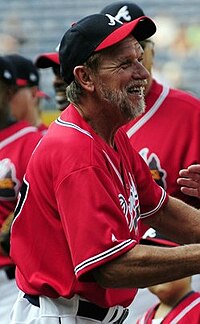
Camp at a 2011 old-timers' game

At any rate, rest in peace, Rick. You gave baseball fans a memory they might cherish, or they might not, but they will never, ever forget.

UPDATE: He was cremated, so there is no gravesite for him.