Thursday, February 9, 2023

The Nets Have Completely Surrendered

Left to right: Kevin Durant, smiling; James Harden, sort-of smiling;
and Kyrie Irving, not smiling. A metaphor for the "era"?

Wow. The Brooklyn Nets have completely surrendered in 3 days. Even by the standards of the biggest joke franchise in the NBA, this is embarrassing.

Assembling a "superteam" with the goal of winning the NBA title has worked before. It worked for the Boston Celtics, as Kevin Durant and Gary Payton were brought in to join Paul Pierce, and they won the NBA Championship in 2008. It worked for the Miami Heat, as Payton, LeBron James and Chris Bosh were brought in to join Dwyane Wade, and they won the Championship in 2012 and '13. And it worked for the Golden State Warriors, who brought Durant in to join Steph Curry, Draymond Green and Klay Thompson, and they won the Championship in 2017 and '18.

But assembling a superteam has also failed. It failed for the Los Angeles Lakers, as Payton (2 out of 3 ain't bad, I suppose) and Karl Malone were brought in to join Shaquille O'Neal and Kobe Bryant, and they lost the 2004 NBA Finals to a Detroit Pistons team which, at this writing, has seen only one of its players elected to the Basketball Hall of Fame: Ben Wallace.

The Nets -- on Long Island, in New Jersey, and now in Brooklyn -- have always been in the shadow of the New York Knicks, even when the Nets have been good and the Knicks have been bad. The Nets have a new arena in Brooklyn, the Barclays Center; and relatively new leadership in owner Joseph Tsai, general manager Sean Marks, and head coach Jacque Vaughn.

On July 6, 2019, the Nets signed Kyrie Irving as a free agent. Irving had helped LeBron and the Cleveland Cavaliers win the 2016 NBA Championship, but the 2 men fell out over Kyrie's bad attitude, and Kyrie was traded to the Celtics. There, too, he alternated between brilliance and mopery. When his contract ran out, they didn't lift a finger to re-sign him. The Nets signed him.

The very next day, the Nets got Durant from the Warriors in a trade. In addition to the 2017 and '18 titles with Golden State, Durant and James Harden had gotten the Oklahoma City Thunder into the 2012 NBA Finals, but lost to the Heat. With both Irving and Durant, the Nets were supposed to be contenders for the NBA Championship.

It didn't work out that way, although it wasn't all their fault. Durant was still dealing with the Achilles heel that cost the Warriors the 2019 Finals against the Toronto Raptors, and missed the entire 2019-20 season. Then, in March, that season was interrupted by the COVID pandemic. When the NBA started up again in August, it canceled the rest of the regular season, and went right to the Playoffs. Between the shutdown and earlier injuries, Irving only played 20 regular-season games. The Nets were the 7th seed in the Eastern Conference, and were swept by the Raptors in the 1st round.

Due to Durant's injury, the early exit wasn't totally unexpected. Durant would be back for 2020-21, and that was the season in which the Nets were supposed to go for it. They certainly tried: On January 13, 2021, they made a trade with the Houston Rockets, and got Harden, one of the game's top scorers at the time.

Now, the Nets had a "Big Three": Irving, Durant and Harden, with 7 Finals appearances and 3 titles between them. Surely, this combination would be enough to close a season with the 16 wins necessary to get through the Playoffs and win the NBA Championship.

Kyrie Irving, Kevin Durant and James Harden. They played a grand total of 16 games together. And it wasn't just due to injuries. With COVID still an issue, Irving refused to get vaccinated, and, by the law of the City of New York, the Nets could not even allow him in the arena. Then, after the law was lifted, Irving hurt his teammates by exposing them to him, and thus possibly to COVID, thus risking their lives.

This led Frank Isola, who covers the Nets for the New York Daily News, and is a regular panelist on ESPN's Around the Horn, to call Irving "the worst teammate in the history of sports." Given the circumstances, it's hard to argue. He made Stephon Marbury look like Magic Johnson.

And Irving couldn't get along with Harden. Still, the Nets got the 2nd seed in the East for the 2021 Playoffs. They beat the Celtics in 5 games, but then lost to the Milwaukee Bucks in 7 games. At first glance, it doesn't look particularly shameful. The Nets did win the 1st 2 games in Brooklyn, but, Cliché Alert, and this cliché is especially used in the NBA: The series isn't "over" until the home team loses at least once. Led by Giannis Antetokounmpo, the Bucks won the next 2 in Milwaukee.

The Nets won Game 5 in Brooklyn, and the Bucks won Game 6 in Milwaukee. But in Game 7, in Brooklyn, the Bucks won in overtime. Durant scored 48, but Giannis scored 40, and the Bucks were just a little bit better, and went on to win the title.

Losing to that Bucks team was not, by itself, a terrible thing. Certainly, pushing a team that eventually won the title to a Game 7 suggests both some talent and some character. But losing a Game 7 at home always looks bad, especially in regard to character.

Cliché Alert: The window was closing. Except Nets management didn't know it. Irving still couldn't get along with Durant. So, on February 10, 2022, the Nets made a "my headache for your headache trade." They sent Harden to the Philadelphia 76ers for a package that included the talented but troubled star Ben Simmons. Simmons had missed the entire season to that point, with a back injury and, it was suggested, mental health issues. (Only he knows for sure what was going on.) So now, the Nets' Big Three was Irving, Durant and Simmons. Except Simmons wasn't available for the 2022 Playoffs.

As in 2020, the Nets were missing one of their Big Three, and only got the 7th seed in the East. As in 2020, they were easily beaten by the Celtics. But for 2022-23, all 3 -- Irving, Durant and Simmons -- were supposed to be healthy and ready to go.

Except Irving was whining his way through the season again. As always, bursts of brilliance, which suggested that he knew he was in his "contract year," were followed by sloughs of indifference, which suggested that he didn't care -- not about his future earnings, not about where he wanted to play in 2023-24 and beyond, and certainly not about his current teammates. Durant had demanded to be traded. And the Nets were 32-22, 5th in the East.

Finally, Irving demanded a trade. There were suggestions from basketball media pundits that they shouldn't give in to his demand before today's trading deadline, and instead should put him on the spot. Instead, 3 days ago, the Nets caved: They sent Irving and Markieff Morris to the Dallas Mavericks for Spencer Dinwiddie, Dorian Finney-Smith, and 3 draft picks for 2027 or later.

And then, yesterday, the surrender was made complete: The Nets traded Durant to the Phoenix Suns. The Suns reached the Finals in 2021, and were one of the favorites to do so again this season. Now, they look like favorites for the title.

The Nets look like they might barely scrape into the Playoffs, and then be done for a while. Once again, they are vying with the NBA's other "little brother franchise," the Los Angeles Clippers, for the titles of the league's biggest underachiever and its biggest joke franchise.

The Nets didn't even get a Division title out of their superteam experiment. There's not one banner that can be hung in the rafters of the Barclays Center as a reminder of anything good that Big Three I (Irving-Durant-Harden) or Big Three II (Irving-Durant-Simmons) accomplished, because they didn't accomplish anything beyond a 2 seed. Ain't no banners, trophies or parades for that.

The Nets' most recent banner remains the one for their 2006 Atlantic Division title. That was 17 years ago. They were still playing home games at the Meadowlands. Not one member of that team is still playing, in any professional league, anywhere in the world.

And yet, the Nets remain the New York Tri-State Area's most recent pro basketball Finalist, having made it in 2003, to the Liberty's 2002 WNBA Finals berth and the Knicks' 1999 NBA Finals berth; and the last Area team to win a league title, having won the ABA in 1976, to the Knicks' 1973 and the Liberty's never.

Somebody asked online, "How did this become such a trainwreck? There was soooo much promise.... "

Bringing Kyrie in, all by itself, made it a promise they had no chance of keeping. I was a Nets fan for their entire 35 years in New Jersey. I left them after they left me, when they moved to Brooklyn in 2012. I knew they would fail in their superteam bid, because that's what the Nets always do: They fail. But I didn't know they would surrender so spectacularly, and so fast.

Today, on ESPN's First Take, Stephen A. Smith called the Nets "the biggest failure in NBA history." On Around the Horn, Isola once again called Irving "the worst teammate in the history of sports."

Around the Horn airs on ESPN weekdays at 5:00 PM Eastern Time. It is followed at 5:30 by Pardon the Interruption, and that show's co-hosts also weighed in last night. Tony Kornheiser is a native of Long Island, where the Nets played from 1968, when he was in college at the State University of New York at Binghamton, to 1977, when he covered the New York Nets for the local newspaper NewsdayHe compared the current Nets to mythology, citing both the Bible, calling what the team engaged in to "a sin of pride"; and the ancient Greeks, saying that, like Icarus, "They flew too close to the Sun, and got burned."

It was a great turn of phrase for Kornheiser, who often refers to having been an English major. But he got the cause of Icarus' death wrong: Icarus was the son of Daedalus, who made a set of wings, and flew, and the son asked the father to make him a set of wings, too. He did, but warned Icarus not to fly too high. He did, and as he got too close to the Sun, the wax holding the wings together melted, and Icarus fell to his death. So it is somewhat appropriate that Durant went to a team named the Suns.

And co-host Michael Wilbon, a Chicago native who covered a true superteam in the 1990s Chicago Bulls, and who, along with ESPN correspondent and former Boston Globe columnist Bob Ryan, probably knows more about basketball than any living person not a player or a coach, said of Irving, "He's a great basketball player when he feels like it, which is not all the time." Wilbon is known for his bluntness, so, by his standards, this was putting it politely.

Upon his arrival in Dallas, Irving said, "To me, personally, just sitting in this seat today, I just know I want to be places where I'm celebrated, and not just tolerated, or just kind of dealt with in a way that doesn't make me feel respected. And there were times throughout this process, when I was in Brooklyn, where I felt very disrespected."

These are the words of a man who refused to do what it took to make himself even eligible to literally show up. And then, when he became eligible again, he metaphorically refused to show up on many an occasion.

There have been 4,374 men who have played at least 1 regular-season game in the National Basketball Association since its founding in 1946. Of those, Kyrie Irving is the one with the least justification to talk about respect.

Brooklyn Nets fans -- if any of them are left after this debacle -- should not talk at all.

As for the Knicks: They currently hold the 7th seed in the East. They will probably make the Playoffs. They might do better in those Playoffs than the Nets do.

Sunday, February 5, 2023

John Adams, 1951-2023

I am a baseball fan. Perhaps not a prominent one. But when a prominent baseball fan leaves this mortal plane for that great ballpark in the sky, proper attention must be paid, and respect must be given.

John Joseph Adams was born on October 9, 1951 -- 6 days after the Bobby Thomson Game, and 1 day before Joe DiMaggio's last game -- in Cleveland, Ohio. He attended his 1st Cleveland Indians game in 1954, which would be the last season in which they won the American League Pennant for 41 years, not that he remembered.

At the age of 9, he began playing the drums. In 1975, he graduated from Cleveland State University with a bachelor's degree in English. By that point, he had already begun the activity by which he would be known away from the shore of Lake Erie.

On August 24, 1973, he asked the Indians for permission to bring a bass drum to Cleveland Municipal Stadium. He was told not to disturb anyone with it. He later told an interviewer, "The first time, I got a lot of stares, and a few comments, like, 'You're not going to play that thing, are you?'" But a drunken fan grabbed his arm and said, "You gonna bang on that drum? Well, then start hitting it."

He did. As he recalled, "Suddenly, I saw people clapping to the beat. When the game was over, people stopped me outside the stadium. They told me I had the opposing pitcher so rattled, that guys from the other team were looking all over for me." The Indians beat the Texas Rangers, 11-5. (It is not known whether he was there on June 4, 1974, when the Indians played the Rangers again, in an event remembered as Ten Cent Beer Night.)

The Indians' promotions director at the time, Jackie York, approached him and asked him to play at every game. He continued to do so, and as the Indians continued to play poorly, often filling fewer than 10,000 seats at the 85,000-seat stadium, Adams' drumming would echo from his seat, at the back of the center field bleachers, 513 feet from home plate, all around the stadium. It was easily heard on television broadcasts as well.

The players took notice. Boston Red Sox Hall-of-Famer Carl Yastrzemski said, "Every time we're here, all I hear is that damned pounding drum." Adams said, "Since then, when Boston's in, I play a little louder."

One Red Sox fan who took notice was Bob Wood. In 1985, he visited all 26 stadiums then in Major League Baseball. When he got to Municipal Stadium, he sought Adams out, and interviewed him for what became the book Dodger Dogs to Fenway Franks. He quoted Adams as saying, "I love this place, all of it, the city, the ballpark, the Indians. Haven't missed a game in 13 years."

Wood noted that Kathleen Murray, whom he met in the bleachers and married in 1978, reminded him that there were a few games he didn't get to. "Oh yeah," he corrected himself, "a couple of early season day games, when I couldn't get off work. Not many, though, only 9 or 10."

The marriage ended in divorce, and he had no children. But he did have a good job with AT&T, working for 40 years until his retirement in 2016. In 1994, the Indians moved from the lakefront Municipal Stadium to the downtown Jacobs Field, which was renamed Progressive Field in 2007. He still sat at the back of the bleachers, this time in left field under an enormous scoreboard.

In 1995, they won the American League Pennant for the 1st time in his drumming experience, and he got to drum at the World Series. He got another chance in 1997, and another in 2016. But the Indians all 3 Series, the last 2 in extra innings of Game 7, and the last one at home.

His status as a superfan was acknowledged when the team gave away bobblehead figures of him with a drum and movable arms at a home game in 2006. Six years later, the local brewery Great Lakes Brewing introduced Rally Drum Red Ale in his honor.

In 2021, the Indians changed their name to the Cleveland Guardians. If anybody ever connected his drumming with Native American war drums, that connection was now gone. In 2022, on the 49th anniversary of Mr. Adams’s first performance at a game, he was inducted into the Guardians' Distinguished Hall of Fame, as a "nonuniformed contributor." A sculptor created a bronze replica of the drum, which was affixed to Mr. Adams’s bleacher bench, and installed in the team's two-level Hall of Fame area beyond center field at Progressive Field. (The bleacher section was replaced.)

But John Adams never drummed for the Cleveland Guardians. Over the 2010s, he had undergone heart surgery and experienced broken ribs, a broken hip and other ailments, which, along with the COVID pandemic that shut baseball down for the 1st 2/3rds of the 2020 season, prevented him from thumping his drum at Progressive Field after the 2019 season. His last game, after about 3,700 of them, was the Indians' home finale on September 22, 2019. He died on January 30, 2023. He was 71 years old.

"There's nothing like being down at the ballpark," he once told mlb.com. "Because it's more than just the game: It's all the people around you, and all the people you see. It makes the experience of a baseball game way above just sitting at home."

Tuesday, January 31, 2023

Bobby Hull, 1939-2023

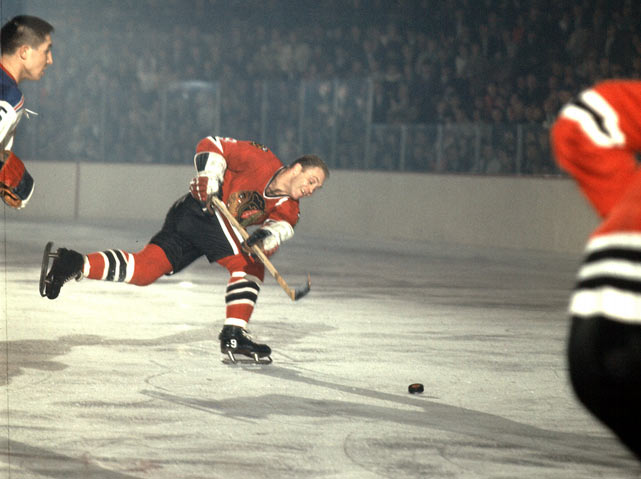
Before Sidney Crosby (give me a break), before Wayne Gretzky, before Bobby Orr, Bobby Hull was America's favorite hockey player.

Robert Marvin Hull was born on January 3, 1939 in Belleville, Ontario, Canada, about halfway between Toronto and Ottawa. (Not to be confused with Belleville, New Jersey, although there is also a town named Bloomfield, and another named Trenton, nearby.) He had a brother, Dennis Hull, who would later join him on the Chicago Black Hawks. After Bobby's son, Brett Hull, also became an NHL superstar, Dennis wrote a memoir titled The Third Best Hull: I Should Have Been Fourth, But They Wouldn't Let My Sister Maxine Play.

Before I go any further, let me point this out: The Chicago NHL team, since its founding in 1926, had always had its name written as two words: "Black Hawks." But in 1986, someone went through the team's records, and found their original NHL charter, which had the name listed as a single word, "Blackhawks." The team notified the NHL, and so, officially, they have been the "Chicago Blackhawks" ever since. But in Hull's era, they were the "Chicago Black Hawks."

The team's founding owner, Chicago coffee tycoon Frederic McLaughlin, had commanded the 333rd Machine Gun Battalion of the U.S. Army's 86th Infantry Division during World War I. Since it was based in Illinois, it was called the Blackhawk Division, after Black Hawk, a chief of the Sauk tribe in Illinois in the early 19th Century.

In 1955, Bobby Hull led the Woodstock Warriors to the Sutherland Cup, the amateur hockey championship of the Province of Ontario. In 1957, he was signed by the Black Hawks, and, that season, finished 2nd to Frank Mahovlich of the Toronto Maple Leafs for the Calder Memorial Trophy, the NHL's Rookie of the Year award.

In 1960, he made the 1st of his 12 NHL All-Star Games, and won the 1st of his 3 Art Ross Trophies as the NHL's leading scorer. In 1961, after years of struggling, the Hawks won the Stanley Cup, with a team featuring 4 future Hall-of-Famers: Hull at left wing, Stan Mikita at center, Pierre Pilote on defense, and Glenn Hall in goal.
Hull (left) and Jack "Tex" Evans with the 1961 Stanley Cup

Hull had worn Number 16 up to that point. For the next 2 seasons, he wore Number 7. From 1963 onward, he wore Number 9, like many other great scorers before him, including the recently-retired Maurice "the Rocket" Richard of the Montreal Canadiens, and the man then regarded as the best player in the game, Gordie Howe of the Detroit Red Wings.

Hull won the Ross Trophy again in 1962, scoring 50 goals, joining Richard and another Canadien, Bernie "Boom-Boom" Geoffrion, as the only players ever to do this. Geoffrion has been credited as the inventor of the slap shot, but Hull made it an art form, especially after curving the blade of his stick, in what became known as "the banana blade." This would be outlawed later in his career.

Despite his 50 goals in 1961-62, the Hawks couldn't make it back-to-back Cups, losing in the Finals to Mahovlich and the Leafs. In 1965, Hull won the Hart Memorial Trophy as the NHL's Most Valuable Player, and the Lady Byng Trophy as its "most gentlemanly player."

On March 12, 1966, Hull became the 1st NHL player to score more than 50 goals in a season, sending his 51st past Cesare Maniago of the New York Rangers at Chicago Stadium. He topped out at 54, and his 43 assists gave him 97 points on the season, breaking the record of 96 set by the Canadiens' Dickie Moore in 1959. He again won the Hart Trophy and the Ross Trophy.
The 51st goal. Note the curve on the stick blade.

By this point, he had surpassed Howe as the most popular player in America. He was the fastest skater in the League, timed at 29 miles per hour, and this speed, combined with his long, flowing blond hair, earned him the nickname "the Golden Jet." His brother Dennis joined the Hawks in 1964, wearing Number 10, and, as the 2nd-best brother became known as "the Silver Jet." Bobby also had the fastest-measured shot in hockey: 118 MPH.

In 1969, he set new personal bests with 58 goals and 107 points, but Phil Esposito of the Boston Bruins, a former Chicago teammate, shattered both records with 76 goals and 152 points. Still, the NHL awarded Hull the Lester Patrick Trophy, for contributions to hockey in America. He was only 30 years old.

On February 21, 1970, he blasted a shot past Eddie Giacomin of the New York Rangers, for his 500th career goal. Only Richard and Howe had reached the milestone before him. In a 1988 interview, Giacomin said that Hull’s slap shot "would rise or dip. You'd pull up when you should really be ducking. It played games with your mind."

But there was trouble on the horizon. His thinning hair, which eventually led to one of the most famous toupees in sports -- perhaps 2nd only to that of ABC sportscaster Howard Cosell -- soon became the least of his worries. And in the 1970 off-season, the NHL banned the banana blade, which cut down on his shooting ability. Still, he helped the Hawks reach the Stanley Cup Finals again in 1971, losing to the Canadiens.

In spite of all he had achieved, he was underpaid. So was every Black Hawk, even though the team's owner, William Wadsworth Wirtz, was filthy rich. Some of his wealth came from his family. But where he was really making money was as the owner of the traveling Holiday On Ice and Ice Follies shows.

Bill Wirtz was known as Dollar Bill, because he was cheap. He was also behind the times: He wouldn't let Black Hawks home games be televised, unless they were picked up by national broadcasters, which usually only happened for the Playoffs. He said broadcasting regular-season home games was unfair to season-ticket holders. He didn't realize that he could add to his fortune with the TV revenue.

In 1972, the World Hockey Association was founded. They wanted a big star to get fans and income. They asked Hull to jump the NHL and join them. He said he would -- for $1 million. (About $7.1 million in 2023 money.) He was joking.

They weren't: Ben Hatskin, majority owner of the WHA's Winnipeg franchise, who made his fortune in lumber and jukebox rentals, offered him a $1 million signing bonus, a contract worth $1.75 million over 10 years, the head coach's job, and a small share of ownership. Hatskin was even willing to name the team after him, sort of: The Winnipeg Jets. To borrow a line from the year's biggest film, The Godfather, it was an offer he couldn't refuse.

Hull signed with the Jets. The NHL sued to stop it, and the litigation prevented him from opening the season with them. In addition, because he had "defected" to the WHA, he was not permitted to play on the all-NHL "Team Canada" that would face the Soviet team in the "Summit Series." Dennis was selected, but threatened to boycott the team for keeping Bobby off. Bobby told him he should play anyway. Without Bobby Hull, and without Bobby Orr, who was injured, it took Canada the full 8 games beat the Soviets. To this day, aside from being the Golden Jet's brother, being a member of 1972 Team Canada is what Dennis Hull is best known for.

The Jets debuted on October 12, 1972, beating the New York Raiders, 6-4 at Madison Square Garden. On October 15, they played their 1st home game, losing 5-2 to the Alberta Oilers at the Winnipeg Arena. (After the 1st season, the Oilers switched from their Province's name to their City's name, becoming the Edmonton Oilers.)

Hull was finally able to join them on November 8, a 3-2 loss to the Quebec Nordiques at the Colisée de Québec. In spite of the late start, he was able to feast on the lesser assemblage of talent in the "rebel league," and also to take advantage of the fact that they allowed the banana blade, to score 51 goals, winning the Gary Davidson Trophy as the league's 1st Most Valuable Player. (Davidson was the league's founder, as he was for the ABA and the WFL.)

With Hull, the Jets reached the WHA Finals, but lost to the New England Whalers, then based in Boston. Without him, but with Mikita and goaltender Tony Esposito (Phil's brother), the Black Hawks reached the Stanley Cup Finals, again losing to the Canadiens. If Wirtz had paid Hull what he was worth, who knows?

After Howe joined the Houston Aeros and won the MVP for 1973-74, the award was renamed the Gordie Howe Trophy. Hull won it in 1975, then resigned as head coach after 3 seasons. The Jets beat the NHL to the idea of signing players from Sweden, signing Andres Hedberg, Ulf Nilsson and Lars-Erik Sjöberg. Hull, Hedberg and Nilsson formed "The Hot Line." The Jets won the WHA title 3 times: In 1976, 1978 and 1979. The other teams combined only won 4 titles. Hull made the All-Star Game in 5 of the league's 7 seasons.
In 1979, the Jets, the Oilers, the Nordiques and the Whalers were invited to join the NHL. By that point, Howe and his sons Mark and Marty had been sold by the bankrupt Aeros to the Whalers. The Whalers traded for Hull and former Maple Leafs star Dave Keon. With Howe already wearing Number 9 for the team, renamed the Hartford Whalers, he went back to his old Number 16. After the season, both Hull and Howe retired.
Bobby Hull (left) and Gordie Howe

The 8 goals Hull scored for the Jets and the Whalers in 1979-80 gave him 610 in NHL play. He scored another 303 in the WHA -- which matched the NHL total of his brother Dennis, who ended his career in 1978, with the Red Wings. In total, Bobby had 914 major league goals. Both the 610 and the 914 were then 2nd all-time to Howe.

Mikita retired in 1980. The Black Hawks made his Number 21 the 1st uniform number they retired. In 1973, they gave Number 9 to Dale Tallon, whom they'd acquired from the Vancouver Canucks, for whom he'd worn the number for 2 years. Tallon, a decent player who was one of the last players cut for the Summit Series, objected: "They forgot to add the decimal point." He played the 1st preseason exhibition game wearing 9, and the fans booed -- directed at team management more than at Tallon himself -- every time he touched the puck. The next game, he switched to 19, and spent 5 years mainly getting cheered in Chicago.

In 1983, Hull was elected to the Hockey Hall of Fame. He and Wirtz finally made peace, and on December 18 of that year, his Number 9 was rightfully retired. The Jets also retired his Number 9. In 2011, statues of Hull and Mikita were placed outside the Blackhawks' new arena, the United Center.
Hull was also elected to the Ontario and Manitoba Sports Halls of Fame, and the WHA Hall of Fame. In 1998, The Hockey News ranked him 8th, the highest-ranking left wing, on their list of the 100 Greatest Hockey Players. 

He married 3 times, and 2 of his wives alleged that he had assaulted them. His 3rd wife initially pressed charges, then dropped them. His daughter, Michelle Hull, was a champion figure skater as a child, but a knee injury led her to study law instead. As a result of how her father treated her mother, his 1st wife, she works with battered women.

Bobby had 4 sons. Bobby Hull Jr. won the Memorial Cup, the championship of junior hockey's Canadian Hockey League, with the 1980 Cornwall Royals. Bobby Jr. and Blake Hull won the Allan Cup, the championship of Canadian senior amateur hockey, in 1987 with the Brantford Mott's Clamatos. Bart Hull played college football at Boise State University, and played with the Canadian Football League's Ottawa Rough Riders and Saskatchewan Roughriders. (Yes, both teams had almost the same name.)

Most notably, Bobby's son Brett Hull joined him as the only father & son pair to both score 50 goals in a season, the only such pair to both score more than 600 (or even 400) goals in a career, the only such pair to win the Hart Trophy, the only such pair to win the Ross Trophy, and the only such pair to win the Lady Byng Trophy. And while there are a few father & son pairs in the Hockey Hall of Fame, including Bobby and Brett, they were the only such pair to both be named, in 2017, to the NHL's 100th Anniversary 100 Greatest Players.

After starring for years with the St. Louis Blues, Brett won the Stanley Cup in 1999 with the Dallas Stars (scoring the Cup-winning goal in controversial fashion) and in 2002 with the Red Wings. So "The Golden Brett" not only scored more goals in NHL play than his father, 741, but won more Cups, 2 to 1.

The Blues retired Brett's Number 16. In 1996, new owners moved the Jets to the Phoenix area, where they are now named the Arizona Coyotes. Toward the end of his career, they acquired Brett, and Bobby gave permission for his Number 9 to be unretired for him. In 1999, the Atlanta Thrashers entered the NHL as an expansion team, but in 2011, they moved to become the new Winnipeg Jets. They have honored the old Jets' retired numbers, although Evander Kane asked Bobby for permission to wear Number 9, and got it.

In 2007, Bill Wirtz died. The Blackhawks won the Stanley Cup since 1961, hadn't been to the Stanley Cup Finals since 1992, or even to the Conference Finals since 1995. Because of their owner's cheapness, they didn't even have a TV contract.

Mahovlich made a point that was indicative of the Hawks' struggles: He had won the Cup at Chicago Stadium 3 times, clinching there with the Leafs in 1962 and with the Canadiens in 1971 and 1973; while Hull had never clinched at home, since their 1961 win had been clinched in Detroit. (The Hawks had clinched at home in 1934, against Detroit; and in 1938, away to Toronto.)

I don't want to say that it's a good thing when anyone dies, but the death of Bill Wirtz was the best thing that could have happened to the Blackhawks. His son, William Rockwell "Rocky" Wirtz, became the owner, and followed a George Costanza-style "do the opposite" philosophy. He put the Hawks back on TV, fixed the team's scouting system, and made peace with former stars, including Hull.

He said, "When I assumed leadership of the organization upon my father's passing in 2007, one of my first priorities was to meet with Bobby to convince him to come back as an ambassador of the team. His connection to our fans was special and irreplaceable." The Hawks won the Cup in 2010, 2013 and 2015, and Bobby was part of the celebrations all 3 times.
In 2019, the NHL Winter Classic was played at Busch Stadium in St. Louis, between the Blues and the Blackhawks. Although the Blackhawks consider the Red Wings to be their historic arch-rivals, the Blues, in Missouri but across the Mississippi River from Illinois, consider their arch-rivals to be the Blackhawks. For this game, Bobby, representing Chicago, and Brett, representing St. Louis, were named honorary captains, and participated in the ceremonial opening face-off.
Left to right: Blackhawks Captain Jonathan Towes, Bobby Hull,
Brett Hull, Blues Captain Alex Pietrangelo

Bobby Hull died on January 30, 2023, at his home in Wheaton, Illinois, outside Chicago -- also the hometown of another Chicago sports legend, Bears pioneer Red Grange. He was 84 years old.

Yes, I know, he was a domestic abuser, an egomaniac, and left the NHL when they really needed him against the Soviets. But he still gave hockey fans a lot of great memories, not to mention a son who actually scored more goals in NHL play than he did.

With his death, there are now 3 surviving players from the 1961 Stanley Cup Champion Chicago Black Hawks: Glenn Hall, Bill Hay and Wayne Hicks.

UPDATE: Bobby Hull was cremated, and has no publicly known "final resting place." Bill Hay died on October 25, 2024; and Glenn Hall on January 7, 2026; leaving Wayne Hicks as the last survivor of the '61 Black Hawks. Dennis Hull died on May 30, 2026.

Finals Appearances by Cities, 1903-2023

Note: Includes only the big four: The World Series, 1903-2022; the NFL Championship Game, 1932-1965, and the Super Bowl, 1967-2023, but not the Championship Games of the AFL or any other football league, including the CFL: the NBA Finals, 1947-2022; and the Stanley Cup Finals since the founding of the NHL, 1918-2022. In the case of an intra-city finals, the city will be counted twice. Ties will be broken by most wins, then by most recent.

1. New York, 120: 69 MLB, 21 NHL, 20 NFL, 10 NBA
2. Boston, 70: 22 NBA, 20 NHL, 16 MLB, 12 NFL
3. Chicago, 51: 16 MLB, 15 NFL, 13 NHL, 7 NBA
4. Los Angeles, 52: 26 NBA, 13 MLB, 8 NFL, 5 NHL
5. Detroit, 46: 24 NHL, 11 MLB, 6 NFL, 5 NBA
6. Philadelphia, 41: 16 MLB, 9 NBA, 8 NFL, 8 NHL
7. Montreal, 37: 37 NHL
8. San Francisco, 32: 12 MLB, 11 NFL, 8 NBA, 1 NHL
9. St. Louis, 30: 20 MLB, 4 NBA, 4 NHL, 2 NFL
10. Toronto, 24: 21 NHL, 2 MLB, 1 NBA
11. Pittsburgh, 21: 8 NFL, 7 MLB, 6 NHL
12. Cleveland, 21: 10 NFL, 6 MLB, 5 NBA
13. Milwaukee (includes Green Bay), 19: 13 NFL, 3 MLB, 3 NBA
14. Washington, 19: 10 NFL, MLB 4, NBA 4, NHL 1
15. Baltimore, 15: 7 NFL, 6 MLB, 2 NBA
16. Dallas, 15: 8 NFL, 3 NHL, 2 MLB, 2 NBA
17. Minneapolis, 14: 5 NBA, 4 NFL, 3 MLB, 2 NHL
18. Denver, 12: 8 NFL, 3 NHL, 1 MLB
19. Miami, 12: 5 NFL, 4 NBA, 2 MLB, 1 NHL
20. Cincinnati, 12: 9 MLB, 3 NFL
21. Buffalo (includes Rochester & Syracuse), 11: 5 NBA, 4 NFL, 2 NHL
22. Kansas City, 9: 5 NFL, 4 MLB
23. Tampa Bay, 9: 5 NHL, 2 MLB, 2 NFL
24. Vancouver (includes Victoria), 9: 9 NHL
25. Seattle, 9: 3 NFL, 3 NBA, 3 NHL
26. Houston, 8: 4 MLB, 4 NBA
27. Atlanta, 8: 6 MLB, 2 NFL
28. San Antonio, 7: 7 NBA
29. Edmonton, 7: 7 NHL
30. Indianapolis (includes Fort Wayne), 5: 3 NBA, 2 NFL
31. Phoenix, 5: 3 NBA, 1 MLB, 1 NFL
32. Ottawa, 5: 5 NHL
33. Calgary, 4: 4 NHL
34. Charlotte (includes Raleigh), 4: 2 NFL, 2 NHL
35. Portland, 3: 3 NBA
36. San Diego, 3: 2 MLB, 1 NFL
37. Nashville (include Memphis), 2: 1 NFL, 1 NHL
38. Orlando, 2: 2 NBA
39. Salt Lake City, 2: 2 NBA
40. New Orleans, 1: 1 NFL
41. Oklahoma City, 1: 1 NBA
42. Jacksonville, none
43. Sacramento, none

Sunday, January 29, 2023

NFL Championship Game Appearances, 1932-2023

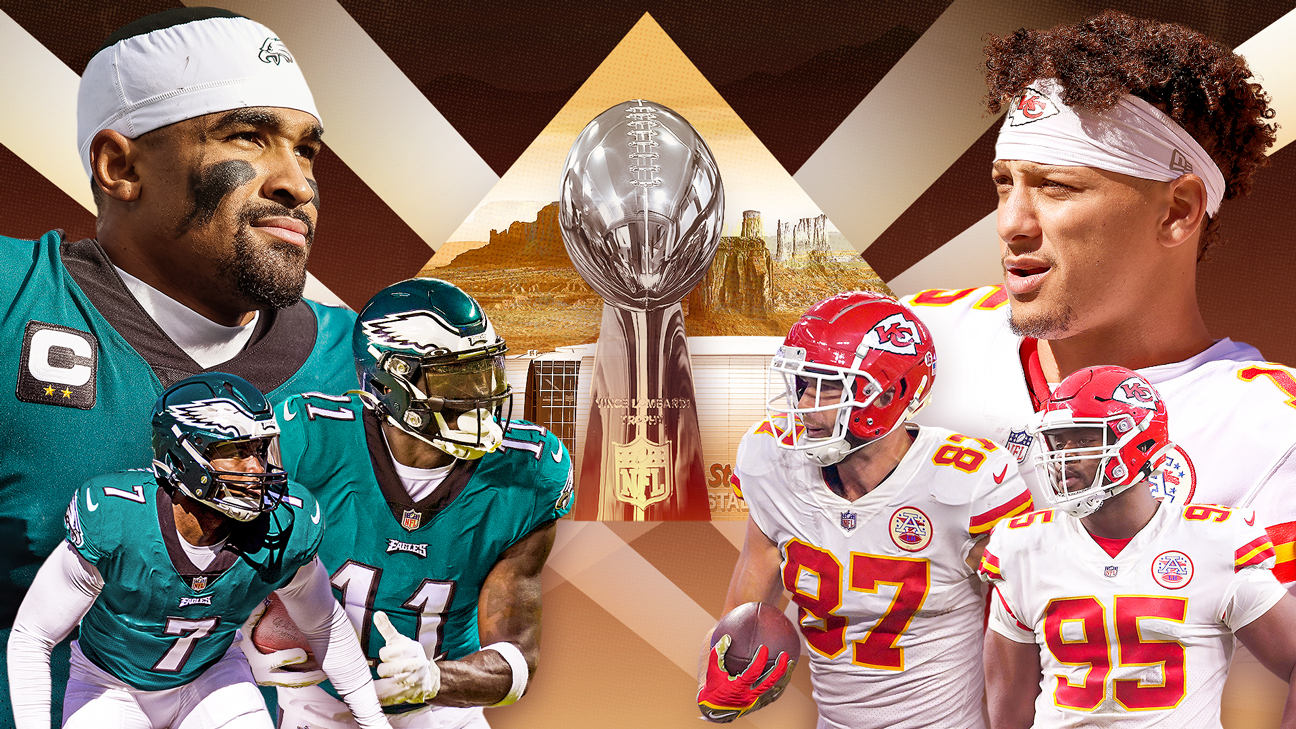
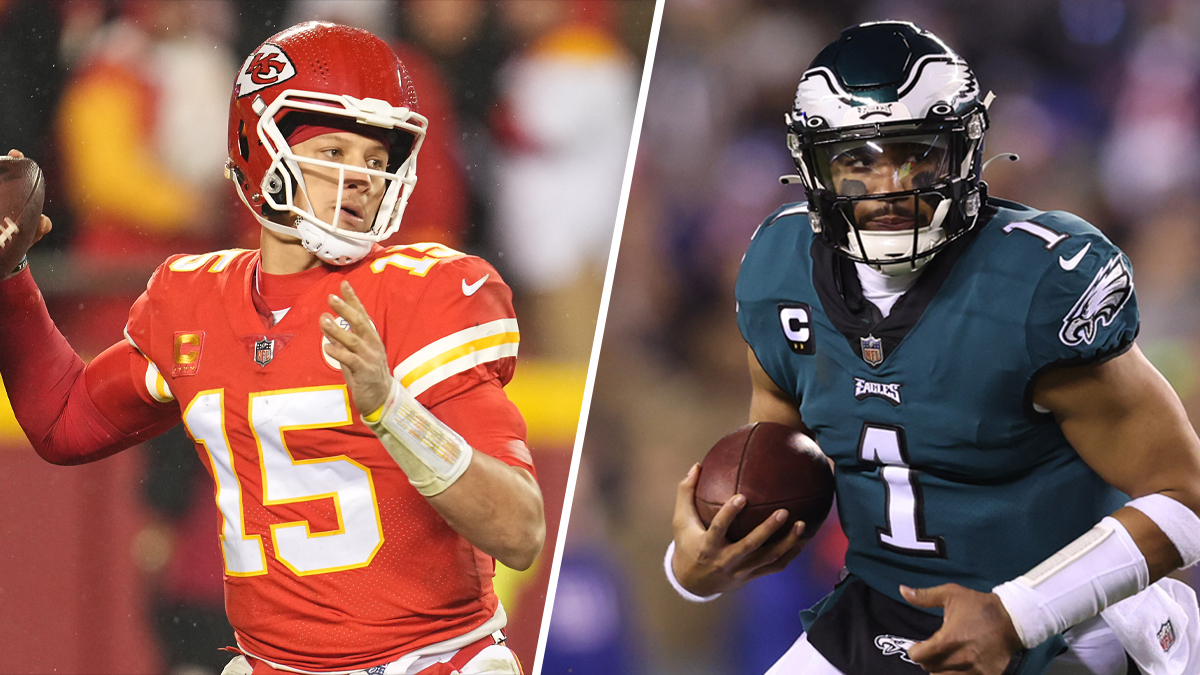
NFL Championship Game appearances, counting this season's, between the Philadelphia Eagles and the Kansas City Chiefs -- including from before the Super Bowl era, with all teams listed under their current names, and ties broken by most wins, and then by most recent:


1. New York Giants 19

2. Green Bay Packers 13

3. Chicago Bears 13

4. New England Patriots 11

5. Los Angeles Rams 10

6. Washington Commanders 10

7. Cleveland Browns 9

8. Pittsburgh Steelers 8

9. Dallas Cowboys 8

10. Philadelphia Eagles 8

11. Denver Broncos 8

12. San Francisco 49ers 7

13. Indianapolis Colts 7

14. Detroit Lions 6

15. Las Vegas Raiders 5

16. Kansas City Chiefs 5

17. Miami Dolphins 5

18. Buffalo Bills 4

19. Minnesota Vikings 4

20. Seattle Seahawks 3

21. Arizona Cardinals 3

22. Cincinnati Bengals 3

23. Tampa Bay Buccaneers 2

24. Baltimore Ravens 2

25. Atlanta Falcons 2

26. Carolina Panthers 2

27. New Orleans Saints 1

28. New York Jets 1

29. Tennessee Titans 1

30. Los Angeles Chargers 1
31. Jacksonville Jaguars none, but reached 3 AFC Championship Games
32. Houston Texans none, hasn't yet reached an AFC Championship Game

The Rams reached 1 as the Cleveland Rams, and 2 as the St. Louis Rams. The Commanders reached 1 as the Boston Redskins, the rest as the Washington Redskins. The Colts reached 5 as the Baltimore Colts. The Lions reached 1 as the Portsmouth Spartans. The Raiders reached 4 as the Oakland Raiders, and 1 as the Los Angeles Raiders. The Cardinals reached 2 as the Chicago Cardinals. The Chargers reached their 1 as the San Diego Chargers.

NFL and AFL Championships, including pre-title game wins, 1920-31:

1. Green Bay 13

2. Chicago 11 (Bears 9, Cardinals 2)

3. New York 9 (Giants 8, Jets 1)

4. Cleveland 9 (Browns 4, Canton Bulldogs 3, Rams 1, Akron Pros 1)

5. Pittsburgh 8

6. San Francisco Bay Area 8 (49ers 5, Oakland Raiders 1 in AFL & 2 SB)

7. New England 7 (Patriots 6, Providence Steam Roller 1)

8. Dallas 6 (Cowboys 5 NFL, Texans 1 AFL)

9. Washington 5

10. Philadelphia 5 (Eagles 4, Frankford Yellow Jackets 1)

11. Baltimore 5 (Colts 3, Ravens 2)

12. Detroit 4

13. Kansas City 4 (Chiefs 2 in AFL, 2 Super Bowls)

14. Los Angeles 3 (Rams 2, Raiders 1)

15. Tampa Bay 2

16. Denver 2

17. Miami 2

18. Buffalo 2 (Bills 1964 and 1965 in AFL)

19. Houston 2 (Oilers 1960 and 1961 in AFL)

20. Seattle 1

21. New Orleans 1

22. Indianapolis 1

23. St. Louis 1

24. San Diego 1 (Chargers 1963 in AFL)

25. Minnesota 1 (Vikings 1969 NFL, lost Super Bowl)

26. Arizona 0-1 in title games

27. Tennessee 0-1

28. Atlanta 0-2

29. Carolina 0-2

30. Cincinnati 0-3

31. Las Vegas none

32. Jacksonville none

Wednesday, January 25, 2023

January 25, 1998: The Denver Broncos Finally Win a Super Bowl

Terrell Davis and "The Mile High Salute"

January 25, 1998, 25 years ago: Super Bowl XXXII is played, at what was then known as Qualcomm Stadium in San Diego.

The NFC Champions were the Green Bay Packers. They had won the Super Bowl the year before, taking their 12th World Championship, leading all NFL teams. With an offense led by future Hall-of-Fame quarterback Brett Favre, and a defense led by future Hall-of-Famer Reggie White, they looked primed to repeat. Especially since the NFC had won 13 straight Super Bowls, going back to Super Bowl XVIII, won by the then-Los Angeles Raiders.

Another good sign for the Packers is that the AFC Champions were the Denver Broncos. This was their 5th trip to the Super Bowl, and they had lost the 1st 4. They had lost Super Bowl XII to the Dallas Cowboys, despite having a great defense known as the Orange Crush. They lost Super Bowl XXI to the New York Giants, Super Bowl XXII to the Washington Redskins, and Super Bowl XXIV to the San Francisco 49ers, all with John Elway as their quarterback and Dan Reeves as their head coach.

They had always sold out Mile High Stadium since 1977, the season of "Broncomania" that ended with the Super Bowl XII defeat. They were, far and away, the most popular sports team in the Rocky Mountain region, even thought the recently arrived Colorado Avalanche had won the 1996 Stanley Cup, for the region's 1st title; and the Colorado Rockies had sold more tickets than any team in Major League Baseball since their 1993 expansion debut.

They had some dramatic victories over the years, including their defeats of the Oakland Raiders in the 1977 AFC Championship Game, and of the Cleveland Browns in back-to-back AFC title games for the 1986 and 1987 seasons. But they couldn't win the big one.

Starting in 1968, the Broncos had worn orange jerseys (hence the "Orange Crush" nickname), and bright blue helmets with an orange D, with a charging white horse inside it. It was a hard logo to draw, but the whole thing was among the most distinctive uniform designs in sports.
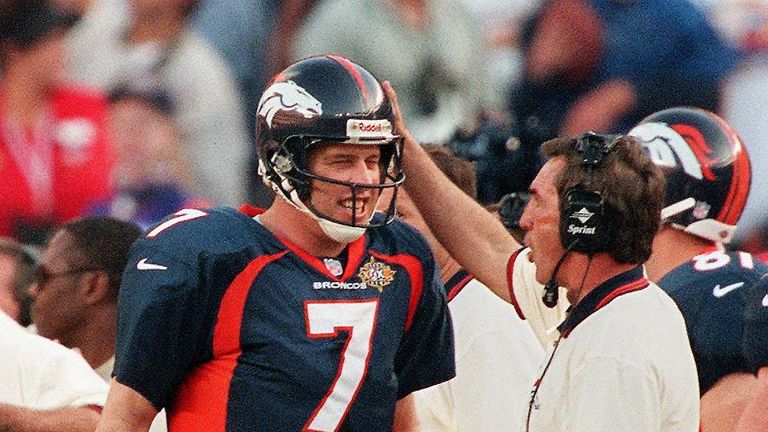
John Elway, 1987

For 1997, they scrapped that for a new design, with purple jerseys with a weird new number font, and purple helmets with a white horse's head. This, too, was distinctive. I didn't like the change in number font, but the helmet was much better.
Elway and head coach Mike Shanahan, 1997

But new uniforms wouldn't be enough. The Cincinnati Bengals found that out in 1981, when they switched to their striped helmets, and made the Super Bowl, only to lose it.

But head coach Mike Shanahan had revamped the team after the Reeves years. He built a new defense, with end Neil Smith, linebacker Bill Romanowski, former San Francisco cornerback Tim McKyer, and a holdover from the previous Bronco Super Bowls, safety Steve Atwater, possibly the hardest hitter in the game at the time.

But Shanahan was an offense-first coach. He got Elway something he'd never had before: A star running back, to take some of the pressure off him. He was a University of Georgia graduate named Terrell Davis, and he was exactly what Elway needed to remove his name from consideration, alongside Y.A. Tittle, Dan Marino and Jim Kelly, for the title of "greatest quarterback to never win a World Championship."

The Broncos went 12-4 in 1997. All 4 losses were on the road: By 3 to the Oakland Raiders, 2 to the Kansas City Chiefs, 11 to the Pittsburgh Steelers, and 17 to the San Francisco 49ers. However, they did have a 2-3 stretch toward the end of the season, followed by a win over the San Diego Chargers in the regular-season finale.

The season before, they had an ignominious Playoff defeat at the hands of the Jacksonville Jaguars. This time, they not only avenged that defeat with a 42-17 win over the Jags at Mile High, but they also went on the road and avenged 2 of their regular-season defeats: They beat the Chiefs 14-10 at Arrowhead Stadium, and then, in the AFC Championship Game, went to Three Rivers Stadium, and beat the Steelers, 24-21.

The Broncos had shown character. Elway was much more mature, much more patient, and much less reliant on his cannon of an arm that he had been in the 1980s. If any AFC team could dethrone the Packers as Champions, it was the '97 Broncos.

*

The Packers got the ball first, and scored on their opening drive, a 22-yard touchdown pass from Favre to Antonio Freeman. The Broncos immediately struck back, helped by a defensive holding penalty that nullified an Elway incompletion on 3rd down. Davis, a San Diego native playing in the stadium where he'd grown up rooting for the Chargers and baseball's San Diego Padres, scored from a yard out. This remains the only Super Bowl where both teams scored on their opening drives.

The Packers' next drive ended when Tyrone Braxton intercepted Favre in Green Bay territory. Elway took advantage, and scored himself on a 1-yard run. The Broncos had led 10-9 at the half in Super Bowl XXI, and 10-0 early in the 2nd quarter of Super Bowl XXII. Both of those games fell apart, as the opposition outscored them 30-10 and 42-0 the rest of the way. But, having watched those games, I sensed something was different this time.

David later claimed that he played the game with a migraine headache, to the point where, until he took some medication, he was blind. But the Broncos made their own breaks: When Atwater sacked Favre and forced a fumble that Smith recovered, Jason Elam kicked a 51-yard field goal, then the 2nd-longest in Super Bowl history, and it was 17-7 Denver.

Late in the half, the Packers began a drive from their own 5, and Favre ended it with a 6-yard pass to Mark Chmura. The Pack went into the locker room trailing 17-14, and felt like they had the momentum. Would this be another Bronco Super Bowl collapse?

Maybe: Davis fumbled on the opening drive of the 2nd half, and the Packers converted that into a game-tying field goal. But the Packers stalled, and Elway went to work. His drive included a 36-yard pass to Ed McCaffrey. On 3rd & 6 from the Packer 12, Elway ran for 8 yards, and was hit by the Packers' LeRoy Butler and Mike Prior, spinning him in midair. The play became known as "The Helicopter," and it showed that Elway, previously thought of as a privileged pretty boy who couldn't get the big joe done, had some toughness. Two plays later, Davis scored on another 1-yard run. It was 24-17 Denver.

Early in the 4th quarter, Favre threw another touchdown pass to Freeman, tying the game. It was still tied with 3:27 left in regulation, when the Broncos forced the Packers to punt and got the ball back at the Packer 49. On the next play, Darius Holland made what might be the biggest mistake in Packer history, a facemask penalty on Davis that cost Green Bay 15 yards.

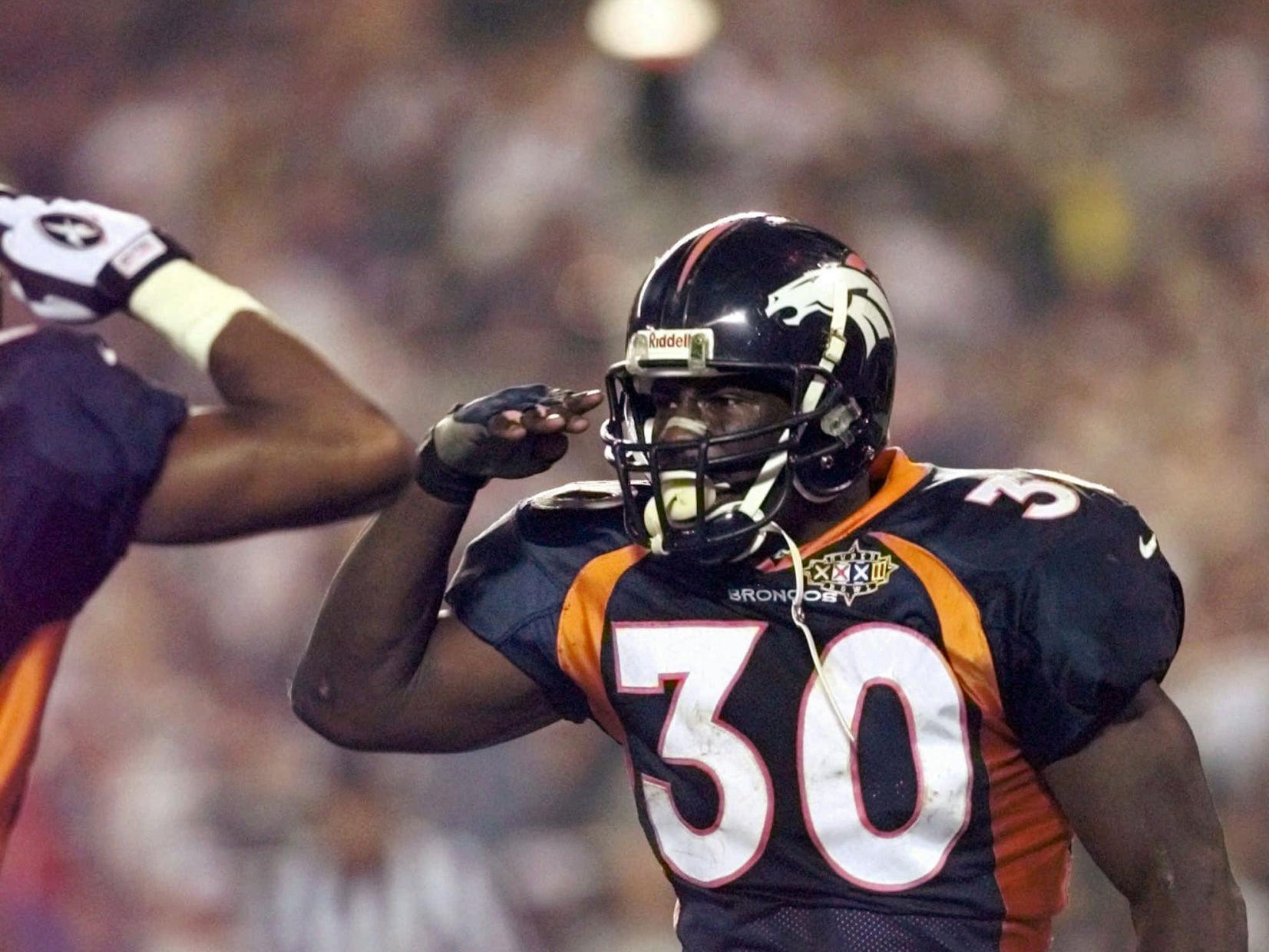
With 1:47 left, the Broncos were at 2nd & goal on the Packer 1. With 2 time-outs left, Packer coach Mike Holmgren told his players to let the Packers score, to give the offense enough time. Davis became the 1st player (and remains the only one) to rush for 3 touchdowns in a single Super Bowl. It was Broncos 31, Packers 24.

After each touchdown, Davis found the nearest teammate, and gave him a military-style salute. It became known as "The Mile High Salute."

There was 1:45 to go, with the Packers having 2 time-outs left. Freeman returned Elam's kickoff to the 30. Favre threw a screen pass to Dorsey Levens, who got to the Bronco 48 with 1:30 left. But the next play was also a screen pass to Levens. He caught it, but was stopped for no gain, and the Packers had to burn a time-out.

The Packers reached the Bronco 31, with 37 seconds to go. A field goal would do them no good. It was 3rd & 6. Favre threw to Brooks, who was covered by Randy Hilliard. Atwater also went for the ball, and his hit knocked out Brooks, Hilliard, and himself. NFL rules say that if players on both teams are injured and need medical attention on the field in the last 2 minutes of a game, both teams are charged with a time-out.

So it was 4th & 6 at the Bronco 31. There were 32 seconds left, and no time-outs. Favre looked for Chmura, but John Mobley broke it up, and the Broncos took over on down. Elway knelt on the ball for the last play of his greatest victory. After going 0-3 with Elway as quarterback, and 0-4 overall, the Denver Broncos were World Champions for the 1st time.

This broke a 13-year winning streak for the NFC. And a 37-year streak of failure for the Broncos to win the big one. It was John Elway's moment. But it wouldn't have happened without Terrell Davis, who, along with Atwater, tight end Shannon Sharpe, offensive tackle Gary Zimmerman, and team owner Pat Bowlen (but, thus far, not Shanahan), would join him in the Pro Football Hall of Fame.

Nine months later, Qualcomm Stadium became the only stadium ever to host the Super Bowl and the World Series in the same calendar year, as the Yankees beat the San Diego Padres. With no more groundsharing between MLB and professional football teams, it will likely never happen again. In the pre-Super Bowl era, the only stadiums hosting the World Series and the NFL Championship Game in the same year were in New York: The Polo Grounds in 1936; and Yankee Stadium in 1956, 1958 and 1962.

The Broncos went 15-1 the next season, and beat the Atlanta Falcons in Super Bowl XXXIII. Elway then retired.

Tuesday, January 24, 2023

Baseball Hall-of-Famers By Team, 2023 Edition

Scott Rolen has been elected to the Baseball Hall of Fame. He is the only honoree in today's election, voted on by the Baseball Writers' Association of America.
He will be inducted on July 23, at the Clark Sports Center outside Cooperstown, New York, along with Veterans' Committee inductee Fred McGriff.

Rolen was only player to get the necessary 75 percent of the vote: In his case, 76.3 percent. Todd Helton got 72, Billy Wagner 68, Andruw Jones 58, the steroid-tainted Gary Sheffield 55, the Astros-cheating-scandal tainted Carlos Beltrán 46, Jeff Kent 46, the steroid-tainted Alex Rodriguez 35, the steroid-tainted Manny Ramirez 33, the domestic-violence-tainted Omar Vizquel 19, and Andy Pettitte 17.

There have been 22,860 men who have played in Major League Baseball, between the 1st season of 1871 and the most recent season of 2022. There are now 236 of them in the Hall. That's 1.0323 percent -- or 1 out of every 96.8. That sounds pretty elite to me.

If we limited it to the top 1.00000000 percent, without going over, that would be 228. Which means we'd only have to kick 8 out. And if there was a year in which nobody was elected, chances are, to keep as close to 1.000 percent without going over, we'd probably have to let 1 of those 8 back in.

For the sake of this list, a player is counted as a Hall-of-Famer with the team if he played at least 4 seasons with them. However, there will be the occasional exception. Teams are ranked in order of most HOFers.

If there is a tie, it will be broken by which team has more players, as opposed to those who were elected in other categories. If there is still a tie, then I go to which has more non-broadcasters. If it's still a tie, which has more players whose contributions were mostly with that club. If it's still a tie, which team has played fewer seasons will be ranked ahead -- since, for example, 5 HOFers is more impressive for a team that's been around since 1977 than it would be for one that's been around since 1961.

Teams that no longer exist in that form will be listed in italics, and will be ranked behind current teams with the same number, regardless of composition.

Players are listed in chronological order of when they arrived at the club, then managers, then broadcasters.

1. New York Yankees, 42: It works out to a little over 1 for every Pennant the team has won:

Clark Griffith (the team's 1st manager, elected as a pitcher and he was still a solid pitcher while he was their manager), Willie Keeler, Jack Chesbro, Frank "Home Run" Baker, Waite Hoyt, Herb Pennock, Babe Ruth, Lou Gehrig, Tony Lazzeri, Earle Combs, Bill Dickey, Red Ruffing, Lefty Gomez, Joe DiMaggio, Joe Gordon, Phil Rizzuto, Yogi Berra, Johnny Mize, Whitey Ford, Mickey Mantle, Enos Slaughter, Jim "Catfish" Hunter, Reggie Jackson, Rich "Goose" Gossage, Dave Winfield, Rickey Henderson, Wade Boggs, Derek Jeter, Mariano Rivera and Mike Mussina.

Also, managers Miller Huggins, Joe McCarthy, Casey Stengel and Joe Torre; owner Jacob Ruppert; executives Ed Barrow and George Weiss; broadcasters Mel Allen, Red Barber, Joe Garagiola, Jerry Coleman (played for the Yankees but elected as a broadcaster, first for the Yankees, then for the Padres) and Tony Kubek (played for the Yankees but elected as a broadcaster).

Bucky Harris managed the Yankees to the 1947 World Championship, but was only their manager for 2 seasons (1947 & '48), so I'm not counting him with the Yankees. In this case, according to the rule I set, I have to count Rickey Henderson as a Yankee. If Lou Piniella is ever elected as a manager, I wouldn't be able to count him as a Yankee HOFer, since he wouldn't be elected as a player ,and only managed them for 3 seasons, none of them a title season.

Rizzuto was also a longtime broadcaster. Lee MacPhail was elected for what he did as American League President, not as Yankee general manager. Bernie Williams and Paul O'Neill have dropped off the writers' ballot. They, like Don Mattingly, will, in a few years, become eligible once again, through the Veterans' Committee -- but in all 3 cases, let's not kid ourselves.

And then there's Roger Clemens: Even if he does get in, would you want to count him as a Yankee? George Steinbrenner, now being dead, is now eligible through the Veterans' Committee.

Tim Raines was a Yankee for only 3 years, although 2 of them were title seasons. Iván Rodríguez was a Yankee for about 3 minutes. So neither of them can be included here.

Álex Rodríguez and Andy Pettitte are eligible. But because they are Yankees linked to PEDs, they will not get in. The Yankee Doodle Double Standard remains in effect.

2. St. Louis Cardinals, 34: Charlie Comiskey (played for them before managing and owning teams elsewhere), Jake Beckley, Roger Bresnahan, Rogers Hornsby (won a World Series as their player-manager), Jesse Haines, Grover Cleveland Alexander, Jim Bottomley, Charles "Chick" Hafey, Burleigh Grimes, Frankie Frisch (elected as a player, won a World Series as their player-manager), Dizzy Dean, Joe Medwick, Johnny Mize, Enos Slaughter, Stan Musial, Red Schoendienst (elected as player, also managed them to a title), Bob Gibson, Lou Brock, Orlando Cepeda, Steve Carlton (7 seasons), Jim Kaat, Ted Simmons, Bruce Sutter, Ozzie Smith, Lee Smith (4 seasons, so he qualifies here), Scott Rolen.

Also, Miller Huggins (manager, also played several years for the Cards), Billy Southworth (manager, also played for them), Whitey Herzog (manager-executive), Tony LaRussa (manager), Branch Rickey (executive), Harry Caray (broadcaster), Jack Buck (broadcaster), Joe Garagiola (broadcaster).

Jesse Burkett won a batting title with the Cards, but only played 3 seasons with them, so he just misses qualifying. On the other hand, Cepeda didn't even play 3 full seasons with the Cards, but his tenure included the 1967 title and the 1968 Pennant, and he, as much as Gibson, was a symbol of that team, and he may be better remembered as a Cardinal than as a Giants, so I'm bending the rule for him. Leo Durocher was a good player for the Cards, but was elected as a manager and never managed them, so he doesn't qualify here.

Larry Walker was only a Cardinal for a year and a half, so, although that time did include the only Pennant he ever won (2004), he doesn't count for the Cards. Mark McGwire and Jim Edmonds did not qualify on enough ballots, and won't be eligible again until they qualify under the Veterans Committee. Surprisingly, longtime owner Gussie Busch has never been elected.

3. Chicago Cubs, 28: Adrian "Cap" Anson, Mike "King" Kelly, Clark Griffith (elected as a pitcher for them, later a manager and owner elsewhere), Joe Tinker, Johnny Evers, Frank Chance (elected as a player but should have been elected as a manager instead), Mordecai "Three-Finger" Brown, Grover Cleveland Alexander, Hazen "Kiki" Cuyler, Lewis "Hack" Wilson, Charles "Gabby" Hartnett (also managed them to a Pennant), Rogers Hornsby, Billy Herman, Ernie Banks, Billy Williams, Ron Santo, Ferguson Jenkins, Bruce Sutter, Ryne Sandberg, Lee Smith, Andre Dawson, Greg Maddux (spent enough time with them).

Also, Al Spalding (elected as an executive but was also a great pitcher), Frank Selee (manager), Joe McCarthy (manager, managed them to a Pennant before going to the Yankees), Leo Durocher (manager), Jack Brickhouse (broadcaster), Harry Caray (broadcaster).

Sammy Sosa is eligible, but he's not getting in. If Lou Piniella is elected as a manager, I'll have to count him as a Cub HOFer, since he managed them for 4 seasons.

Lou Boudreau was a beloved broadcaster for the Cubs after his playing and managing career, but never played or managed for them, and so I can't count him as a Cub HOFer. Santo was also a longtime broadcaster. Surprisingly, longtime owner Phillip K. Wrigley is not in.

4. Chicago White Sox, 26Ed Walsh, George Davis, Eddie Collins, Ray Schalk, Red Faber, Ted Lyons, Luke Appling, Minnie Miñoso, Nellie Fox, Luis Aparicio, Early Wynn, Hoyt Wilhelm, Goose Gossage (5 years with them), Carlton Fisk, Harold Baines, Frank Thomas, Tim Raines, Jim Thome, Al Lopez (manager), Tony LaRussa (manager), Charlie Comiskey (owner), Bill Veeck (owner), Jack Brickhouse (broadcaster), Bob Elson (broadcaster), Harry Caray (broadcaster), Ken Harrelson (broadcaster).

Although Clark Griffith pitched for them in their 1st 2 seasons and won the 1st American League Pennant as their manager, those 2 seasons are not enough to qualify with the White Sox. Although Tom Seaver notched his 300th victory with the Pale Hose, he pitched for them in just 3 seasons, and can't be counted as one of their HOFers.

Thome was a White Sock for less than 4 full seasons, but did play for them in 4 seasons, so he counts with them.

New York Giants, 26: Roger Connor, Buck Ewing, Tim Keefe, Mickey Welch, John Montgomery Ward, Roger Bresnahan, Christy Mathewson, Joe McGinnity, George Davis, Richard "Rube" Marquard, Dave Bancroft, Ross Youngs, Frankie Frisch, George "Highpockets" Kelly, Fred Lindstrom, Travis Jackson, Bill Terry, Mel Ott, Carl Hubbell, Johnny Mize, Monte Irvin, Willie Mays, Hoyt Wilhelm.

Also, John McGraw (manager, also played for them), Leo Durocher (manager), Russ Hodges (broadcaster).

Casey Stengel played for the Giants, but was elected as a manager, so I can't count him as a Giant HOFer.  

Counting all figures who played or managed at least one game for the Giants, in New York and San Francisco, they have 76, more than any other team; however, many of those were with the club only briefly. But even by my definitions, they are ahead of the arch-rival Dodgers.

5. Boston Red Sox, 24: Jimmy Collins (elected as a player but also managed them to the 1st World Series title in 1903), Cy Young, Tris Speaker, Harry Hooper, Babe Ruth (6 seasons with Sox before going to Yanks), Herb Pennock (7 seasons before Yanks), Red Ruffing (also 7 seasons before Yanks), Joe Cronin (elected as a player, but also managed them to the 1946 Pennant, though unlike Collins had already retired as a player; was also longtime AL President), Rick Ferrell, Jimmie Foxx, Lefty Grove, Bobby Doerr, Ted Williams, Carl Yastrzemski, Carlton Fisk, Jim Rice, Dennis Eckersley, Wade Boggs, Pedro Martinez, David Ortiz.

Also, Dick Williams (manager, no relation to Ted), Tom Yawkey (owner), Curt Gowdy (broadcaster), and Ken Harrelson (broadcaster). "Hawk" only played 2 seasons for Boston, though 1 was the 1967 "Impossible Dream" Pennant season; but he broadcast for them for 7 years, so he counts here.

I am bending the rule slightly for Dick Williams, who only managed 3 seasons for the Red Sox, but 1 of them, 1967, was the most important season in the club's modern history. Luis Aparicio played 3 seasons for the Red Sox, so by my rule he is not eligible to be counted with them. Eckersley, however, played 7 seasons with them, so I have to count him with them, and with their living HOFers for as long as he lives.

It was long suspected that owner Jean Yawkey would become the 1st woman elected to the Hall of Fame, but Effa Manley, who owned the Negro Leagues' Newark Eagles, is in, while Mrs. Yawkey is still out.

Manny Ramirez (500 Home Run Club but known steroid cheat, and not as popular as Ortiz), Roger Clemens (300 Win and 3,000 Strikeout Clubs but suspected steroid cheat) and Curt Schilling (3,000 Strikeout Club but possible steroid cheat) are eligible, but not yet in.

6. Pittsburgh Pirates, 23: James "Pud" Galvin, Vic Willis, John "Honus" Wagner, Fred Clarke (elected as a player, also won Pennants as their manager), Jack Chesbro, Jake Beckley, Max Carey, Hazen "Kiki" Cuyler, Waite Hoyt (5 seasons with them), Harold "Pie" Traynor (also managed them), Paul Waner, Lloyd Waner ("Big Poison" and "Little Poison," though Lloyd was actually taller), Joseph "Arky" Vaughan, Al Lopez (elected as a manager but was an All-Star catcher for the Pirates), Ralph Kiner, Bill Mazeroski, Roberto Clemente, Willie Stargell, Bert Blyleven.

Also, Bill McKechnie (manager), Barney Dreyfuss (owner), Branch Rickey (executive), Bob Prince (broadcaster).

Blyleven was only a Pirate for 3 seasons, but I'm bending the rule because he was a key cog on their last World Championship team in 1979. Barry Bonds is eligible, but while the stance against steroid cheats is softening, he still, for the moment, falls under the category of, "Who's kidding who?"

Boston Braves, 22: Harry Wright (player and manager), George Wright, Al Spalding, Jim "Orator" O'Rourke, James "Deacon" White, Charlie "Old Hoss" Radbourne, Mike "King" Kelly, John Clarkson, Charles "Kid" Nichols, Cy Young, Hugh Duffy, Tommy McCarthy (he and Duffy were known as "the Heavenly Twins"), Billy Hamilton, Vic Willis, Jimmy Collins, Johnny Evers, Walter "Rabbit" Maranville, Dave Bancroft.

Also, Frank Selee (manager), Bill McKechnie (manager, though with no success with the Braves), Casey Stengel (ditto, also played for Braves), Billy Southworth (manager).

Brooklyn Dodgers, 22: Willie Keeler, Joe Kelley, Richard "Rube" Marquard, Zack Wheat, Burleigh Grimes, Charles "Dazzy" Vance, Joseph "Arky" Vaughan, Billy Herman, Joe "Ducky" Medwick, Harold "Pee Wee" Reese, Gil Hodges, Jackie Robinson, Edwin "Duke" Snider, Roy Campanella, Ned Hanlon (manager), Wilbert Robinson (manager), Leo Durocher (elected as a manager but was also a good player), Walter Alston (manager), Branch Rickey (owner), Walter O'Malley (owner), Red Barber (broadcaster), Vin Scully (broadcaster).

Casey Stengel played 6 seasons for the Dodgers, and was good, but not Hall of Fame good.  He managed 3 seasons for them; in spite of their poor performance under him, had he managed them for 1 more season, he would still qualify as one of theirs under my rule.  Dick Williams played 5 seasons for them, but was elected as a manager, and never managed the Dodgers. Owner Charles Ebbets is not in.

7. Philadelphia Phillies, 20: Billy Hamilton, Ed Delahanty, Sam Thompson, Grover Cleveland Alexander, Eppa Rixey, Dave Bancroft, Chuck Klein, Richie Ashburn, Robin Roberts, Jim Bunning, Jim Kaat, Steve Carlton, Mike Schmidt, Scott Rolen, Jim Thome, Roy Halladay, Harry Wright (manager), Pat Gillick (executive), By Saam (broadcaster), Harry Kalas (broadcaster).

Thome spent 3 seasons with them, then left, then returned for a 4th, so he counts here. Ashburn was also a longtime broadcaster for the Phils. If Curt Schilling gets in, he can be counted with the Phillies. Pete Rose, of course, is ineligible.

8. Cincinnati Reds, 19: Bid McPhee, Jake Beckley, Joe Kelley, Sam Crawford, Edd Roush, Eppa Rixey, Ernie Lombardi, Frank Robinson, Johnny Bench, Tony Perez, Joe Morgan, Tom Seaver (6 seasons with Reds), Barry Larkin, Ken Griffey Jr., Scott Rolen (5 seasons), Bill McKechnie (manager), Sparky Anderson (manager), Red Barber (broadcaster), Marty Brennaman (broadcaster).

Pete Rose, of course, is ineligible. John Franco is not yet in, but if he gets in, he pitched enough seasons with the Reds to qualify for this list. If Lou Piniella is elected as a manager, I'll count him as a Reds HOFer: He only managed them for 3 seasons, but 1 was a World Championship season. Miller Huggins played several years for the Reds, but was elected as a Yankee manager.

Longtime owner Powel Crosley and GM Bob Howsam should be in, but they're not. Waite Hoyt broadcast for the Reds, and was beloved in that role, but has not been given the Ford Frick Award, so I can't count him with the Reds.

And while 2 members of the 1st openly professional baseball team, the 1869-70 Cincinnati Red Stockings, are in the Baseball Hall of Fame, Harry and George Wright -- the other Wright Brothers who "invented" something important in American life -- that team was not the same team as the current Reds franchise, which began in the old American Association of 1882 and joined the NL in 1892.

9. Detroit Tigers, 18: Sam Crawford, Ty Cobb, Harry Heilmann, Henry "Heinie" Manush, Charlie Gehringer, Goose Goslin, Hank Greenberg (the last 3 nicknamed the "G-Men" in those early days of the FBI), Mickey Cochrane (elected as a player, also managed them to 2 Pennants), Hal Newhouser, George Kell, Al Kaline, Jim Bunning, Jack Morris, Alan Trammell, Iván Rodríguez, Hughie Jennings (manager, also played for the team), Sparky Anderson (manager), Ernie Harwell (broadcaster).

With Trammell getting in through the Veterans Committee, Lou Whitaker's chances of also doing so increase. Kaline and Kell were also longtime broadcasters. Longtime owners Frank Navin, Walter Briggs and John Fetzer are not yet in. Former executive Will Harridge is in, but for what he did as President of the AL, so I can't count him as a Tiger HOFer.

10. Cleveland Guardians, 18: Napoleon "Nap" Lajoie, Elmer Flick, Addie Joss, Tris Speaker (elected as player but also managed them to a title), Stan Coveleski, Joe Sewell, Earl Averill, Bob Feller, Lou Boudreau, Bob Lemon, Larry Doby, Early Wynn, Gaylord Perry, Jim Thome, Al Lopez (manager), Bill Veeck (owner), Jack Graney (broadcaster), Jimmy Dudley (broadcaster).

Barring a major shift in voters' attitudes, Manny Ramirez is probably out of luck. Satchel Paige reached the majors with the Indians, but only pitched 2 seasons for them. So, although I can count him with 3 different Negro League teams on this list, I can't count him with any major league team. Indeed, that fact is the reason I've included the Negro League teams on this list, along with moved and defunct major league teams.

11. Baltimore Orioles, 14: Brooks Robinson, Hoyt Wilhelm, Robin Roberts (4 seasons with O's), Luis Aparicio, Frank Robinson, Jim Palmer, Eddie Murray, Cal Ripken, Roberto Alomar, Harold Baines, Mike Mussina, Earl Weaver (manager), Chuck Thompson (broadcaster), Jon Miller (broadcaster).

Although he won his only World Series with the Orioles, we don't usually associate Aparicio with them, but he did play 5 seasons with them, so, by my own rule, I've got to count him here. Same with Robin Roberts, who played 4 seasons in Baltimore. Rafael Palmeiro is eligible, but he's not getting in.

Frank Cashen should be in as an executive. Dick Williams played enough seasons with the O's to qualify, but was elected as a manager and never managed them, so he doesn't qualify as an O's HOFer.

Philadelphia Athletics, 13: Eddie Plank, Rube Waddell, Frank "Home Run" Baker, Chief Bender, Eddie Collins, Herb Pennock, Al Simmons, Mickey Cochrane, Jimmie Foxx, Lefty Grove, George Kell, Connie Mack (owner-manager), By Saam (broadcaster).

12. Atlanta Braves, 11: Hank Aaron, Phil Niekro, Tom Glavine, Greg Maddux, John Smoltz, Chipper Jones, Fred McGriff, Bobby Cox (manager), Joe Torre (managed them in between Cox's 2 tenures there, also a player), John Schuerholz (general manager), Milo Hamilton (broadcaster).

Andruw Jones will be listed with them if he is elected. Don Sutton broadcast for the Braves, but can't be counted among their HOFers. Former owners Bill Bartholomay and Ted Turner are not in, nor do I ever expect them to be elected, but maybe they should be.

13. Los Angeles Dodgers, 11: Gil Hodges, Duke Snider, Don Drysdale, Sandy Koufax, Don Sutton, Mike Piazza, Walter Alston (manager), Tommy Lasorda (manager), Walter O'Malley (owner), Vin Scully (broadcaster), Jamie Jarrin (broadcaster).

Snider played 5 seasons after the move, Hodges 4, so both count in both Brooklyn and Los Angeles. Steve Garvey is not getting in. Pedro Martinez started out with the Dodgers, but only played 2 seasons for them.

14. New York Mets, 11: Nolan Ryan, Tom Seaver, Gary Carter, Mike Piazza, Tom Glavine (5 seasons), Pedro Martinez (4 seasons), Casey Stengel (manager, 4 seasons), Joe Torre (manager), Lindsey Nelson (broadcaster), Bob Murphy (broadcaster), Tim McCarver (broadcaster). So that's 3 broadcasters, 2 managers, and 6 players.

Still, you didn't realize the Mets had so many, did you? And that's without counting Ralph Kiner, who was elected as a Pirates' player, not as a Mets' broadcaster. Nor can you count Richie Ashburn, Duke Snider, Warren Spahn or Willie Mays. And, based on what they did while they were Mets, why would you want to count Eddie Murray, Rickey Henderson or Roberto Alomar?

Ryan did appear for the Mets in at least 1 game for 5 different seasons, including the 1969 World Championship season. So I have to count him here.

I had previously counted Yogi Berra, but while he managed them for 4 seasons, including winning a Pennant, he was elected to the Hall as a player, not as a manager, and so I can't count him as a Met HOFer. Nor can we count Gil Hodges: Though he did manage the team for 4 seasons, including their 1st World Series win, he was elected as a player, not a manager, and his playing for them was a painful end to his career.

As for Torre: Yes, he managed in 4 seasons for them. They were awful then, and there wasn't much he could do about it, but he counts as a Met Hall-of-Famer. Although I notice that, unlike Yogi and Willie, he wasn't invited to the farewell ceremony at Shea Stadium in 2008.

Frank Cashen should be in as an executive. If John Franco is ever elected, you can count him.

Washington Senators, 11: Walter Johnson, Stanley "Bucky" Harris (elected as a manager but was also a great player), Sam Rice, Henry "Heinie" Manush, Leon "Goose" Goslin, Joe Cronin (elected as a player but also managed them to a Pennant), Rick Ferrell, Early Wynn, Clark Griffith (owner), Arch McDonald (broadcaster), Bob Wolff (broadcaster).

No, you can't count Ted Williams as a manager.

15. San Diego Padres, 9: Dave Winfield, Ozzie Smith, Rollie Fingers, Goose Gossage, Tony Gwynn, Trevor Hoffman, Dick Williams (manager), Jerry Coleman (broadcaster), Dick Enberg (broadcaster).

Yes, the Wizard and the Goose each played 4 seasons in Mission Valley. Considering how many they have in a comparatively short history, you shouldn't also count Willie McCovey, Gaylord Perry or Roberto Alomar. Longtime owner Ray Kroc, who saved the team from being moved to Washington in 1974, is not in. Steve Garvey, who is not my Padre, is not getting in.

16. Oakland Athletics, 9: Jim "Catfish" Hunter, Reggie Jackson, Rollie Fingers, Rickey Henderson, Dennis Eckersley, Dick Williams (manager), Tony LaRussa (manager), Lon Simmons (broadcaster), Bill King (broadcaster).

Mark McGwire is eligible, but he's not getting in. Owner Charlie Finley is eligible, but I don't think he'll ever get in, either. I am bending the rule slightly for Williams, who only managed 3 seasons for the A's, but got them into the postseason in all 3, including 2 World Championships.

Kansas City Monarchs (Negro Leagues), 9: Jose Mendez, Leroy "Satchel" Paige, James "Cool Papa" Bell, Wilber "Bullet" Rogan, Norman "Turkey" Stearnes, Andy Cooper (also manager), Hilton Smith, John "Buck" O'Neil (also manager), J.L. Wilkinson (owner).

Bell played 3 seasons for them, but because Negro League players bounced around as much as international soccer players do, and also like club soccer there were often loan deals involved, I'll bend my 4-season rule. 

Jackie Robinson played his first season in professional baseball, 1945, with the Monarchs. They were also the first pro team of Ernie Banks. But neither was elected on the basis of anything he did in Kansas City.

Montreal Expos, 8: Gary Carter, Andre Dawson, Tim Raines, Larry Walker, Pedro Martinez, Vladimir Guerrero, Dick Williams (manager), Dave Van Horne (broadcaster). Duke Snider cannot be counted for the Expos, although he broadcast for them. He also played in Montreal for the Dodgers' farm team, the Montreal Royals, as did Tommy Lasorda.

Chicago American Giants (Negro Leagues), 8: Andrew "Rube" Foster (also manager and owner), Bill Foster (a.k.a. Willie Foster, Rube's brother), Cristobal Torriente, Pete Hill, George "Mule" Suttles, John Henry "Pop" Lloyd, Norman "Turkey" Stearnes, Willie Wells.

17. San Francisco Giants, 7: Willie Mays, Orlando Cepeda, Willie McCovey, Juan Marichal, Gaylord Perry, Lon Simmons (broadcaster), Jon Miller (broadcaster).

Barry Bonds is eligible, and his rising percentages suggest that he might get in despite his known cheating. And I'm surprised that longtime owner Horace Stoneham isn't in, and that neither is his son-in-law, Charles "Chub" Feeney, a Giant executive who became President of the NL.

18. Minnesota Twins, 7: Harmon Killebrew, Jim Kaat, Tony Oliva, Rod Carew, Bert Blyleven, Kirby Puckett, Herb Carneal (broadcaster).

Tom Kelly could be elected as a manager. No, you can't count Dave Winfield, Paul Molitor or Jack Morris: Although hometown heroes, none played 4 seasons with the Twins. Jim Thome played only 2 seasons with them. Founder Calvin Griffith is not in, nor should he be.

19. Houston Astros, 7: Joe Morgan, Nolan Ryan, Craig Biggio, Jeff Bagwell, Gene Elston (broadcaster), Milo Hamilton (broadcaster), Harry Kalas (broadcast 6 seasons for them before joining the Phillies' broadcast team).

Roger Clemens is eligible, but only played 3 seasons with the Astros, and, even with his legal exoneration, it's not clear that he will ever get in.

Homestead Grays (Negro Leagues), 7: Cumberland "Cum" Posey (pitcher, then manager, then owner), Smokey Joe Williams, Josh Gibson, Buck Leonard, James "Cool Papa" Bell, Jud Wilson, Ray Brown.

Oscar Charleston and Judy Johnson each played 2 seasons for them, but I'm not willing to bend the rules THAT much. Gibson was known as the Black Babe Ruth, Leonard as the Black Lou Gehrig, and together they were known as the Thunder Twins or the Dynamite Twins. Williams was sometimes known as Cyclone Joe, sometimes as Smokey Joe (but never as Smokin' Joe, like boxer Frazier).

As for Posey, "Cum" was short for "Cumberland," and it is possible that, like James "Pud" Galvin, his nickname was not considered sexually explicit in his time. As an athlete, he was probably better in football, and Wendell Smith, the leading black sportswriter of the between-the-wars years and a winner of the Hall's Taylor Spink Award for media work, called him "the smartest man in Negro baseball and certainly the most successful."

Newark Eagles (Negro Leagues), 7: George "Mule" Suttles, Ray Dandridge, Leon Day, James "Biz" Mackey (also manager), Monte Irvin, Larry Doby, Effa Manley (owner, the only woman in the Baseball Hall of Fame). Don Newcombe also played for the Eagles, and if his service there is counted, I believe that it makes him worthy of election to the Hall, but he hasn't been elected.

20. Los Angeles Angels of Anaheim, 6: Nolan Ryan, Rod Carew, Reggie Jackson, Bert Blyleven, Vladimir Guerrero, Dick Enberg (broadcaster). Jim Edmonds will have to wait for the Veterans Committee. Founder-owner Gene Autry is not in, but should be. All but Guerrero played for them under the "California Angels" name.

21. Milwaukee Brewers, 6: Robin Yount, Paul Molitor, Rollie Fingers, Ted Simmons, Bud Selig (owner), Bob Uecker (broadcaster). No, you can't count Hank Aaron, because, while he played 14 seasons in Milwaukee, only 2 of those were for the Brewers.

22. Toronto Blue Jays, 6: Fred McGriff, Roberto Alomar, Roy Halladay, Pat Gillick (executive), Tom Cheek (broadcaster), Tony Kubek (broadcaster). No, you can't count Dave Winfield, Rickey Henderson, Paul Molitor or Frank Thomas. Or Roger Clemens, if he ever gets in.

Baltimore Orioles, AA & NL 1882-1899, 6: John McGraw, Wilbert Robinson, Hughie Jennings, Willie Keeler, Joe Kelley, Ned Hanlon (manager).

While McGraw, Robinson and Jennings were all elected as managers, all could have been elected on the basis of their playing for the old Orioles. Indeed, to this day, McGraw has the highest lifetime batting average of any 3rd baseman, .334. Dan Brouthers played 2 seasons with them, the 1894 and '95 Pennant seasons, but can't be counted with them.

St. Louis Browns, 6: Bobby Wallace, George Sisler, Rogers Hornsby (also managed them), Rick Ferrell, Branch Rickey (executive), Bill Veeck (owner).

Rube Waddell, Goose Goslin, Heinie Manush and Satchel Paige just miss, each having played 3 seasons for the Browns. That was also the length of time that Veeck owned the team, but since he (and his one-at-bat midget Eddie Gaedel) are now the people most identified with this team, I'm bending the rule for him.

23. Texas Rangers, 5: Ferguson Jenkins, Gaylord Perry, Nolan Ryan, Iván Rodríguez, Eric Nadel (broadcaster). Bert Blyleven pitched just 2 seasons for them. Rafael Palmeiro and Juan Gonzalez are eligible, but who's kidding who? No, you can't count Ted Williams as a manager. And I sure hope former owner George W. Bush is never elected; but, since the team won nothing while he was in control, that seems safe.

Pittsburgh Crawfords (Negro Leagues), 5: Oscar Charleston, Satchel Paige, Josh Gibson, James "Cool Papa" Bell, WIlliam "Judy" Johnson.

24. Seattle Mariners, 4: Edgar Martinez, Randy Johnson, Ken Griffey Jr., Pat Gillick (executive). If Lou Piniella is elected as a manager, I'll have to count him as a Mariner HOFer.

25. Kansas City Royals, 4: George Brett, Whitey Herzog (manager), John Schuerholz (executive), Denny Matthews (broadcaster). Founder-owner Ewing Kauffman, surprisingly, is not in.

Milwaukee Braves, 4: Warren Spahn, Eddie Matthews, Hank Aaron, Red Schoendienst. Joe Torre began his playing career with them, but can't be counted here.

Buffalo Bisons (NL 1879-1885), 4: Dan Brouthers, Jim "Orator" O'Rourke, James "Deacon" White, James "Pud" Galvin.

Cuban Giants (Negro Leagues, based in New York), 4: Frank Grant, Sol White, Pete Hill, Bud Fowler. Unlike the later Cuban Stars and New York Cubans, both also based in New York, this 1880s-90s team had no Cubans: They were called "Cuban" so their all-black roster would be better accepted. Grant has been called the best black player of the 19th Century.

Lincoln Giants/Brooklyn Royal Giants (Negro Leagues), 3: Louis Santop, Smokey Joe Williams, John Henry "Pop" Lloyd. Imagine that, a Brooklyn team called the Giants. What the heck, from 1944 to 1948, the NFL had a Boston Yanks (defunct); and, in the 1961-62 season, the NBA had a Chicago team called the Packers (today's Washington Wizards).

Detroit Stars (Negro Leagues), 3: Pete Hill, Andy Cooper, Norman "Turkey" Stearnes. Stearnes now has a statue at Comerica Park, alongside several Tiger greats.

Indianapolis ABCs (Negro Leagues), 3: Oscar Charleston, Ben Taylor, James "Biz" Mackey (also managed them). A later team, the Indianapolis Clowns, was the first professional team of Hank Aaron.

Philadelphia Giants (Negro Leagues), 3: Sol White, Pete Hill, John Henry "Pop" Lloyd.

Philadelphila Hilldale (Negro Leagues), 3: Martin DiHigo, James "Biz" Mackey (also managed them), William "Judy" Johnson.

St. Louis Stars (Negro Leagues), 3: George "Mule" Suttles, James "Cool Papa" Bell, Willie Wells.

Cuban Stars (Negro Leagues, based in New York), 3: Jose Mendez, Martin Dihigo, Alex Pompez (owner).

26. Miami Marlins, 2: Felo Ramirez and Dave Van Horne (both broadcasters). Iván Rodríguez was only a Marlin for 1 season, although it was a World Championship season. If Gary Sheffield gets in, he can be counted as a Marlin, but I don't think he's getting in.

No, you can't count Miami native Andre Dawson, although he did close his career with the club and is now working in their front office. So is Tony Perez, who briefly managed the team, but you can't count him, either.

Baltimore Black Sox (Negro Leagues), 2: Jud Wilson, Ben Taylor. This team is not to be confused with the Elite Giants.

Washington/Baltimore Elite Giants (Negro Leagues), 2: James "Biz" Mackey (also manager), Roy Campanella. And that's pronounced EE-light, not the usual Eh-LEET.

Birmingham Black Barons (Negro Leagues), 2: George "Mule" Suttles, Satchel Paige. Willie Mays played his first professional season, 1948, for the Black Barons, but only that 1 season, so he can't be counted here.

Kansas City Stars (Negro Leagues), 2: James "Cool Papa" Bell, Willard Brown.

New York Cubans (Negro Leagues), 2: Martin DiHigo, Alex Pompez. Although DiHigo and Pompez were also involved with the Cuban Stars, and that team was also based in New York, it was not the same team as the New York Cubans. Like several of the Negro League owners, Pompez got some funding from the black organized crime bosses of the era, and eventually turned state's evidence to avoid prison. He later worked as an unofficial scout for the New York/San Francisco Giants, helping to sign Hispanic stars like Orlando Cepeda, Juan Marichal, and the Alou brothers.

Philadelphia Stars (Negro Leagues), 2: James "Biz" Mackey (also manager), Jud Wilson.

Providence Grays (NL 1878-1885), 2: John Montgomery Ward, Charlie "Old Hoss" Radbourn. Their 1879 Pennant was managed by original 1869 Cincinnati Red Stocking George Wright, but he only played with them for 2 seasons.

Cleveland Spiders (NL, 1887-1899), 2: Cy Young and Jesse Burkett.

Detroit Wolverines (NL, 1881-1888), 2: Sam Thompson, Ned Hanlon (elected as a manager but played 8 seasons for them). Dan Brouthers and Deacon White played 3 seasons for them.

27. Arizona Diamondbacks, 1: Randy Johnson. If Curt Schilling gets in, he can be counted with them.

28. Colorado Rockies, 1: Larry Walker.

29. Tampa Bay Rays, 1: Fred McGriff. With his election, every current MLB team now has at least 1 legitimate Hall-of-Famer.

30. Washington Nationals, 1: Frank Robinson, their 1st manager, was already in the Hall long before MLB returned to D.C., but he did manage for them for 5 years, 1 more than my rules require. But you can't count the HOFers from this franchise's previous incarnation, the Montreal Expos. So of the 30 current teams, they're the last team without a legitimate Hall of Fame player.

Bacharach Giants (Negro Leagues), 1: John Henry "Pop" Lloyd.  This team played its home games in Atlantic City, and were named for Harry Bacharach, who was that city's Mayor on and off from 1912 to 1935. He was played by John Rue on the TV series "Boardwalk Empire." Lloyd stayed in Atlantic City after he retired, died there, and a youth baseball facility there is named for him.

Harrisburg Giants (Negro Leagues), 1: Oscar Charleston.

San Antonio Black Bronchos (Negro Leagues, pronounced like Broncos), 1: Smokey Joe Williams. 

Kansas City Athletics, none: No player in the Hall of Fame was with the A's in their K.C. tenure for at least 4 seasons. Ken Harrelson played 5 seasons for them, but he was elected as a broadcaster, not a player, so he doesn't count as one of their Hall-of-Famers.