Showing posts with label bobby hull. Show all posts

Tuesday, January 31, 2023

Bobby Hull, 1939-2023

Before Sidney Crosby (give me a break), before Wayne Gretzky, before Bobby Orr, Bobby Hull was America's favorite hockey player.

Robert Marvin Hull was born on January 3, 1939 in Belleville, Ontario, Canada, about halfway between Toronto and Ottawa. (Not to be confused with Belleville, New Jersey, although there is also a town named Bloomfield, and another named Trenton, nearby.) He had a brother, Dennis Hull, who would later join him on the Chicago Black Hawks. After Bobby's son, Brett Hull, also became an NHL superstar, Dennis wrote a memoir titled The Third Best Hull: I Should Have Been Fourth, But They Wouldn't Let My Sister Maxine Play.

Before I go any further, let me point this out: The Chicago NHL team, since its founding in 1926, had always had its name written as two words: "Black Hawks." But in 1986, someone went through the team's records, and found their original NHL charter, which had the name listed as a single word, "Blackhawks." The team notified the NHL, and so, officially, they have been the "Chicago Blackhawks" ever since. But in Hull's era, they were the "Chicago Black Hawks."

The team's founding owner, Chicago coffee tycoon Frederic McLaughlin, had commanded the 333rd Machine Gun Battalion of the U.S. Army's 86th Infantry Division during World War I. Since it was based in Illinois, it was called the Blackhawk Division, after Black Hawk, a chief of the Sauk tribe in Illinois in the early 19th Century.

In 1955, Bobby Hull led the Woodstock Warriors to the Sutherland Cup, the amateur hockey championship of the Province of Ontario. In 1957, he was signed by the Black Hawks, and, that season, finished 2nd to Frank Mahovlich of the Toronto Maple Leafs for the Calder Memorial Trophy, the NHL's Rookie of the Year award.

In 1960, he made the 1st of his 12 NHL All-Star Games, and won the 1st of his 3 Art Ross Trophies as the NHL's leading scorer. In 1961, after years of struggling, the Hawks won the Stanley Cup, with a team featuring 4 future Hall-of-Famers: Hull at left wing, Stan Mikita at center, Pierre Pilote on defense, and Glenn Hall in goal.
Hull (left) and Jack "Tex" Evans with the 1961 Stanley Cup

Hull had worn Number 16 up to that point. For the next 2 seasons, he wore Number 7. From 1963 onward, he wore Number 9, like many other great scorers before him, including the recently-retired Maurice "the Rocket" Richard of the Montreal Canadiens, and the man then regarded as the best player in the game, Gordie Howe of the Detroit Red Wings.

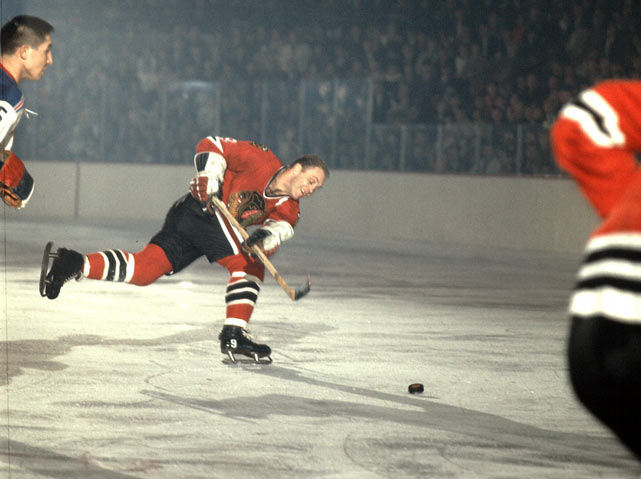
Hull won the Ross Trophy again in 1962, scoring 50 goals, joining Richard and another Canadien, Bernie "Boom-Boom" Geoffrion, as the only players ever to do this. Geoffrion has been credited as the inventor of the slap shot, but Hull made it an art form, especially after curving the blade of his stick, in what became known as "the banana blade." This would be outlawed later in his career.

Despite his 50 goals in 1961-62, the Hawks couldn't make it back-to-back Cups, losing in the Finals to Mahovlich and the Leafs. In 1965, Hull won the Hart Memorial Trophy as the NHL's Most Valuable Player, and the Lady Byng Trophy as its "most gentlemanly player."

On March 12, 1966, Hull became the 1st NHL player to score more than 50 goals in a season, sending his 51st past Cesare Maniago of the New York Rangers at Chicago Stadium. He topped out at 54, and his 43 assists gave him 97 points on the season, breaking the record of 96 set by the Canadiens' Dickie Moore in 1959. He again won the Hart Trophy and the Ross Trophy.
The 51st goal. Note the curve on the stick blade.

By this point, he had surpassed Howe as the most popular player in America. He was the fastest skater in the League, timed at 29 miles per hour, and this speed, combined with his long, flowing blond hair, earned him the nickname "the Golden Jet." His brother Dennis joined the Hawks in 1964, wearing Number 10, and, as the 2nd-best brother became known as "the Silver Jet." Bobby also had the fastest-measured shot in hockey: 118 MPH.

In 1969, he set new personal bests with 58 goals and 107 points, but Phil Esposito of the Boston Bruins, a former Chicago teammate, shattered both records with 76 goals and 152 points. Still, the NHL awarded Hull the Lester Patrick Trophy, for contributions to hockey in America. He was only 30 years old.

On February 21, 1970, he blasted a shot past Eddie Giacomin of the New York Rangers, for his 500th career goal. Only Richard and Howe had reached the milestone before him. In a 1988 interview, Giacomin said that Hull’s slap shot "would rise or dip. You'd pull up when you should really be ducking. It played games with your mind."

But there was trouble on the horizon. His thinning hair, which eventually led to one of the most famous toupees in sports -- perhaps 2nd only to that of ABC sportscaster Howard Cosell -- soon became the least of his worries. And in the 1970 off-season, the NHL banned the banana blade, which cut down on his shooting ability. Still, he helped the Hawks reach the Stanley Cup Finals again in 1971, losing to the Canadiens.

In spite of all he had achieved, he was underpaid. So was every Black Hawk, even though the team's owner, William Wadsworth Wirtz, was filthy rich. Some of his wealth came from his family. But where he was really making money was as the owner of the traveling Holiday On Ice and Ice Follies shows.

Bill Wirtz was known as Dollar Bill, because he was cheap. He was also behind the times: He wouldn't let Black Hawks home games be televised, unless they were picked up by national broadcasters, which usually only happened for the Playoffs. He said broadcasting regular-season home games was unfair to season-ticket holders. He didn't realize that he could add to his fortune with the TV revenue.

In 1972, the World Hockey Association was founded. They wanted a big star to get fans and income. They asked Hull to jump the NHL and join them. He said he would -- for $1 million. (About $7.1 million in 2023 money.) He was joking.

They weren't: Ben Hatskin, majority owner of the WHA's Winnipeg franchise, who made his fortune in lumber and jukebox rentals, offered him a $1 million signing bonus, a contract worth $1.75 million over 10 years, the head coach's job, and a small share of ownership. Hatskin was even willing to name the team after him, sort of: The Winnipeg Jets. To borrow a line from the year's biggest film, The Godfather, it was an offer he couldn't refuse.

Hull signed with the Jets. The NHL sued to stop it, and the litigation prevented him from opening the season with them. In addition, because he had "defected" to the WHA, he was not permitted to play on the all-NHL "Team Canada" that would face the Soviet team in the "Summit Series." Dennis was selected, but threatened to boycott the team for keeping Bobby off. Bobby told him he should play anyway. Without Bobby Hull, and without Bobby Orr, who was injured, it took Canada the full 8 games beat the Soviets. To this day, aside from being the Golden Jet's brother, being a member of 1972 Team Canada is what Dennis Hull is best known for.

The Jets debuted on October 12, 1972, beating the New York Raiders, 6-4 at Madison Square Garden. On October 15, they played their 1st home game, losing 5-2 to the Alberta Oilers at the Winnipeg Arena. (After the 1st season, the Oilers switched from their Province's name to their City's name, becoming the Edmonton Oilers.)

Hull was finally able to join them on November 8, a 3-2 loss to the Quebec Nordiques at the Colisée de Québec. In spite of the late start, he was able to feast on the lesser assemblage of talent in the "rebel league," and also to take advantage of the fact that they allowed the banana blade, to score 51 goals, winning the Gary Davidson Trophy as the league's 1st Most Valuable Player. (Davidson was the league's founder, as he was for the ABA and the WFL.)

With Hull, the Jets reached the WHA Finals, but lost to the New England Whalers, then based in Boston. Without him, but with Mikita and goaltender Tony Esposito (Phil's brother), the Black Hawks reached the Stanley Cup Finals, again losing to the Canadiens. If Wirtz had paid Hull what he was worth, who knows?

After Howe joined the Houston Aeros and won the MVP for 1973-74, the award was renamed the Gordie Howe Trophy. Hull won it in 1975, then resigned as head coach after 3 seasons. The Jets beat the NHL to the idea of signing players from Sweden, signing Andres Hedberg, Ulf Nilsson and Lars-Erik Sjöberg. Hull, Hedberg and Nilsson formed "The Hot Line." The Jets won the WHA title 3 times: In 1976, 1978 and 1979. The other teams combined only won 4 titles. Hull made the All-Star Game in 5 of the league's 7 seasons.
In 1979, the Jets, the Oilers, the Nordiques and the Whalers were invited to join the NHL. By that point, Howe and his sons Mark and Marty had been sold by the bankrupt Aeros to the Whalers. The Whalers traded for Hull and former Maple Leafs star Dave Keon. With Howe already wearing Number 9 for the team, renamed the Hartford Whalers, he went back to his old Number 16. After the season, both Hull and Howe retired.
Bobby Hull (left) and Gordie Howe

The 8 goals Hull scored for the Jets and the Whalers in 1979-80 gave him 610 in NHL play. He scored another 303 in the WHA -- which matched the NHL total of his brother Dennis, who ended his career in 1978, with the Red Wings. In total, Bobby had 914 major league goals. Both the 610 and the 914 were then 2nd all-time to Howe.

Mikita retired in 1980. The Black Hawks made his Number 21 the 1st uniform number they retired. In 1973, they gave Number 9 to Dale Tallon, whom they'd acquired from the Vancouver Canucks, for whom he'd worn the number for 2 years. Tallon, a decent player who was one of the last players cut for the Summit Series, objected: "They forgot to add the decimal point." He played the 1st preseason exhibition game wearing 9, and the fans booed -- directed at team management more than at Tallon himself -- every time he touched the puck. The next game, he switched to 19, and spent 5 years mainly getting cheered in Chicago.

In 1983, Hull was elected to the Hockey Hall of Fame. He and Wirtz finally made peace, and on December 18 of that year, his Number 9 was rightfully retired. The Jets also retired his Number 9. In 2011, statues of Hull and Mikita were placed outside the Blackhawks' new arena, the United Center.
Hull was also elected to the Ontario and Manitoba Sports Halls of Fame, and the WHA Hall of Fame. In 1998, The Hockey News ranked him 8th, the highest-ranking left wing, on their list of the 100 Greatest Hockey Players. 

He married 3 times, and 2 of his wives alleged that he had assaulted them. His 3rd wife initially pressed charges, then dropped them. His daughter, Michelle Hull, was a champion figure skater as a child, but a knee injury led her to study law instead. As a result of how her father treated her mother, his 1st wife, she works with battered women.

Bobby had 4 sons. Bobby Hull Jr. won the Memorial Cup, the championship of junior hockey's Canadian Hockey League, with the 1980 Cornwall Royals. Bobby Jr. and Blake Hull won the Allan Cup, the championship of Canadian senior amateur hockey, in 1987 with the Brantford Mott's Clamatos. Bart Hull played college football at Boise State University, and played with the Canadian Football League's Ottawa Rough Riders and Saskatchewan Roughriders. (Yes, both teams had almost the same name.)

Most notably, Bobby's son Brett Hull joined him as the only father & son pair to both score 50 goals in a season, the only such pair to both score more than 600 (or even 400) goals in a career, the only such pair to win the Hart Trophy, the only such pair to win the Ross Trophy, and the only such pair to win the Lady Byng Trophy. And while there are a few father & son pairs in the Hockey Hall of Fame, including Bobby and Brett, they were the only such pair to both be named, in 2017, to the NHL's 100th Anniversary 100 Greatest Players.

After starring for years with the St. Louis Blues, Brett won the Stanley Cup in 1999 with the Dallas Stars (scoring the Cup-winning goal in controversial fashion) and in 2002 with the Red Wings. So "The Golden Brett" not only scored more goals in NHL play than his father, 741, but won more Cups, 2 to 1.

The Blues retired Brett's Number 16. In 1996, new owners moved the Jets to the Phoenix area, where they are now named the Arizona Coyotes. Toward the end of his career, they acquired Brett, and Bobby gave permission for his Number 9 to be unretired for him. In 1999, the Atlanta Thrashers entered the NHL as an expansion team, but in 2011, they moved to become the new Winnipeg Jets. They have honored the old Jets' retired numbers, although Evander Kane asked Bobby for permission to wear Number 9, and got it.

In 2007, Bill Wirtz died. The Blackhawks won the Stanley Cup since 1961, hadn't been to the Stanley Cup Finals since 1992, or even to the Conference Finals since 1995. Because of their owner's cheapness, they didn't even have a TV contract.

Mahovlich made a point that was indicative of the Hawks' struggles: He had won the Cup at Chicago Stadium 3 times, clinching there with the Leafs in 1962 and with the Canadiens in 1971 and 1973; while Hull had never clinched at home, since their 1961 win had been clinched in Detroit. (The Hawks had clinched at home in 1934, against Detroit; and in 1938, away to Toronto.)

I don't want to say that it's a good thing when anyone dies, but the death of Bill Wirtz was the best thing that could have happened to the Blackhawks. His son, William Rockwell "Rocky" Wirtz, became the owner, and followed a George Costanza-style "do the opposite" philosophy. He put the Hawks back on TV, fixed the team's scouting system, and made peace with former stars, including Hull.

He said, "When I assumed leadership of the organization upon my father's passing in 2007, one of my first priorities was to meet with Bobby to convince him to come back as an ambassador of the team. His connection to our fans was special and irreplaceable." The Hawks won the Cup in 2010, 2013 and 2015, and Bobby was part of the celebrations all 3 times.
In 2019, the NHL Winter Classic was played at Busch Stadium in St. Louis, between the Blues and the Blackhawks. Although the Blackhawks consider the Red Wings to be their historic arch-rivals, the Blues, in Missouri but across the Mississippi River from Illinois, consider their arch-rivals to be the Blackhawks. For this game, Bobby, representing Chicago, and Brett, representing St. Louis, were named honorary captains, and participated in the ceremonial opening face-off.
Left to right: Blackhawks Captain Jonathan Towes, Bobby Hull,
Brett Hull, Blues Captain Alex Pietrangelo

Bobby Hull died on January 30, 2023, at his home in Wheaton, Illinois, outside Chicago -- also the hometown of another Chicago sports legend, Bears pioneer Red Grange. He was 84 years old.

Yes, I know, he was a domestic abuser, an egomaniac, and left the NHL when they really needed him against the Soviets. But he still gave hockey fans a lot of great memories, not to mention a son who actually scored more goals in NHL play than he did.

With his death, there are now 3 surviving players from the 1961 Stanley Cup Champion Chicago Black Hawks: Glenn Hall, Bill Hay and Wayne Hicks.

UPDATE: Bobby Hull was cremated, and has no publicly known "final resting place." Bill Hay died on October 25, 2024; and Glenn Hall on January 7, 2026; leaving Wayne Hicks as the last survivor of the '61 Black Hawks. Dennis Hull died on May 30, 2026.

Saturday, November 27, 2021

How to Be a Devils Fan In Winnipeg -- 2021-22 Edition

This coming Friday night, December 3, the New Jersey Devils will be in the capital of the Province of Manitoba to play the reborn Winnipeg Jets.

If this were a World Hockey Association game in the 1970s... well, it wouldn't be that big, since we'd be the New York Raiders, and we'd stink.

Before You Go. Winnipeg is in Canada. Read this before even planning a trip into the country.

Winnipeg is in Canada, so you're going to need to have, and bring, a valid passport. It's also in the Central Time Zone, 1 hour behind New York and New Jersey. Adjust your timepieces accordingly.

Do yourself another big favor: Change your money before you go. There are plenty of currency exchanges in New York City, including one on 42nd Street between 7th and 8th Avenue.

Leave yourself $50 in U.S. cash, especially if you're going other than by plane, so you'll have usable cash when you get back to your side of the border. At this writing, the exchange rate is US$1.00 = C$1.28, while C$1.00 = US 78 cents, so, for the moment, it really favors us.

Winnipeg is in Manitoba. Manitoba is in Canada. In the entire National Hockey League, only Edmonton and Calgary have arenas further north. It's early December. It's going to be cold.

The website for the Winnipeg Free Press is predicting temperatures in the mid-20s during the day, and the single digits at night. That's Fahrenheit. Don't look at the Celsius numbers: The ones you're used to are cold enough. Bundle up! Also, they're predicting "snow showers" for the Friday, so the streets and sidewalks could be tricky.

Tickets. At 15,321 seats, the Canada Life Centre has the smallest capacity of any current NHL arena. But the fans in Winnipeg are so thrilled to have their Jets back that they've sold out every seat since the re-premiere. Getting tickets might be tough.

The prices I'm citing are in Canadian dollars. Seats in the lower bowl, the 100 sections, are $143 throughout. Seats in the mezzanine, the 200 sections, are $143 between the goals and $120 behind them. Seats in the upper level, the 300 sections, are $97 between the goals and $72 behind them.

Getting There. It's 1,653 miles from Times Square to the Manitoba Legislative Building, the Province's capitol building; 1,648 miles from the Prudential Center in Newark to Bell MTS Place in Winnipeg; and 66 miles from the closest border crossing, at Pembina, North Dakota, to downtown Winnipeg.

Knowing this, your first instinct will be to fly. You may have to, as neither Amtrak nor Greyhound goes to Winnipeg anymore. At any rate, Winnipeg's Union Station is at 123 Main Street at Broadway.

Air Canada offers round-trip flights from Newark Liberty to Winnipeg's James Armstrong Richardson International Airport for as little as $874. (Richardson was a Member of Parliament, and Minister of Defence under Prime Minister Pierre Trudeau in the 1970s.) Unfortunately, you'd have to change planes in either Montreal or Toronto.

Or maybe driving would be better. Keep in mind, it's better to do this with 2 people, so 1 can drive while the other sleeps. And you'll both need passports. And make sure your companion isn't someone who would say or do some wiseass thing at Customs, like answer the question, "Do you have anything to declare?" with, "I declare that I'm proud to be an American."

The most direct route bypasses Buffalo, Hamilton and Toronto -- in fact, it doesn't go through Ontario at all.

You'll need to get into New Jersey, and take Interstate 80 West. You'll be on I-80 for the vast majority of the trip, through New Jersey, Pennsylvania and Ohio. In Ohio, in the western suburbs of Cleveland, I-80 will merge with Interstate 90. From this point onward, you won't need to think about I-80 until you head home; I-90 is now the key, through the rest of Ohio and Indiana.

Just outside Chicago, I-80 will split off from I-90, which you will keep, until it merges with Interstate 94. For the moment, though, you will ignore I-94. Stay on I-90 through Illinois, until reaching Madison, Wisconsin, where you will once again merge with I-94. Now, I-94 is what you want, taking it into Minnesota and the Twin Cities.

However, unless you want to make a rest stop actually in Minneapolis or St. Paul, you're going to bypass them entirely. Take Exit 249 to get on Interstate 694, the Twin Cities' beltway, until you merge with Interstate 494 to reform I-94. Crossing Minnesota into North Dakota, you'll take Exit 349B to get on Interstate 29 North. At Pembina, North Dakota, you'll reach Customs.

Assuming you have everything in order and don't do anything stupid, you'll be allowed to cross over into Emerson, Manitoba, and your highway will continue as Manitoba Route 29. This will soon flow into Manitoba Route 75, the Lord Selkirk Highway. Upon crossing Route 300, it will become Manitoba Route 42. Take that to Manitoba Route 62, and that will take you into downtown Winnipeg.

If you do it right, you should spend about an hour and a half in New Jersey, 5 hours and 15 minutes in Pennsylvania, 4 hours in Ohio, 2 and a half hours in Indiana, an hour and a half in Illinois, 2 and a half hours in Wisconsin, 4 and a half hours in Minnesota, 2 hours and 45 minutes in North Dakota, and a shade over an hour in Manitoba. That's 24 hours and 30 minutes.

Counting rest stops, preferably halfway through Pennsylvania and just after you enter both Ohio and Indiana, outside Chicago, halfway across Wisconsin, outside the Twin Cities, outside Grand Forks, and counting Customs, which should have a bathroom and vending machines, it should be no more than 33 hours, which would save you time on both Greyhound and Amtrak, if not on flying.

And, on October 14, 2016, President Obama finally ended the ban on bringing Cuban cigars into America. This also applies to rum, for which Cuba is also renowned. It is still considerably easier to buy these items in Canada than in America, but, now, you can bring them back over the border.

Once In the City. The name Winnipeg comes from the Western Cree words for "muddy waters." (As far as I know, there's no town nearby whose name is a tribal word meaning "howlin' wolf.") The region was a trading center for aboriginal peoples (usually called "First Nations" in Canada, rather than "Indians" or "Native Canadians") before the arrival of Europeans. French traders built the first fort on the site in 1738. A settlement was later founded by the Selkirk settlers in 1812, the nucleus of which was incorporated as the City of Winnipeg in 1873.
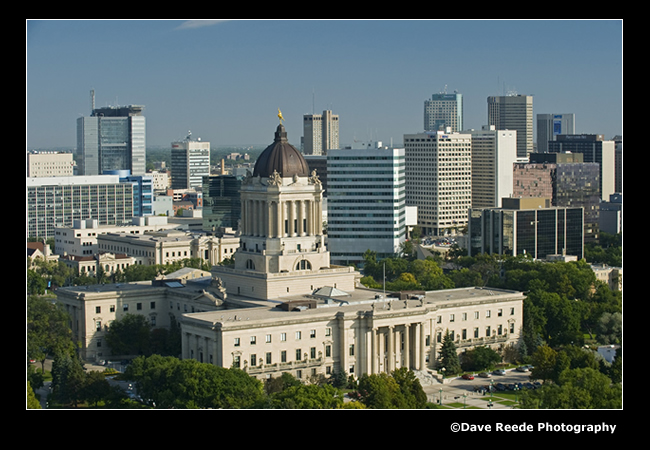
The Manitoba Legislative Building,
equivalent to a State Capitol or State House

According to the figures I have, Winnipeg has a population of 705,000, more than fellow NHL cities Washington, Boston, Las Vegas, Detroit, Vancouver, Raleigh, Miami, Minneapolis, Tampa, Anaheim, Newark, St. Louis, Pittsburgh and Buffalo -- but only 778,000 in its metropolitan area, meaning their "suburbs" add up to only 67,000 people. The people are about 68 percent white, 13 percent East Asian, 11 percent Aboriginal, 4 percent South Asian, 3 percent black, 1 percent Hispanic and 1 percent Middle Eastern.

Nevertheless, with all the fuss over having its team taken away once, plus the sellouts since they got their team back, the chances of having its team taken away twice are very long.

Since Canada is in the British Commonwealth, there are some subtle differences. Every measurement will be in the metric system. Dates are written not as Month/Day/Year, as we do it, but as Day/Month/Year as in Britain and in Europe. So the game is played for us on "December 3, 2021," but for them on "3 December 2021" -- we write it as 12/3/21, they write it as 3/12/21.

They also follow British custom in writing time: This game is scheduled to start at 6:00 PM, and will be listed as 1800. (Those of you who have served in the military, you will recognize this as, in the words of M*A*S*H's Lt. Col. Henry Blake, "all that hundred-hours stuff.") And every word we would end with -or, they will end with -our; and some (but not all) words that we would end with -er, they end with -re, as in the arena's former name, "MTS Centre."

Another thing to keep in mind: Don't ask anyone where the "bathroom" is -- ask for the "washroom." This difference was a particular pet peeve of mine the first time I visited Toronto, although it wasn't a problem in Montreal as I knew the signs would be in French.

Every measurement will be in the metric system: Temperatures will be in Celsius, not Fahrenheit; distances will be in "kilometres," not miles (including speed limits, so don't drive 100 thinking it's miles); and gas prices will be per "litre," not per gallon (so don't think you're getting cheap gas, because a liter is a little more than a quart, so multiply the price by 4, and you'll get roughly the price per gallon, and it will be more expensive than at home, not less). Better to get gas at one of your rest stops before going into Canada.

Manitoba's sales tax is 13 percent -- in 2010, this replaced the former Provincial sales tax of 5 percent and the federal GST (Goods & Services Tax) of 8 percent. In other words, the Conservative Party government of Prime Minister Stephen Harper wanted Canadians to think he'd killed the hated GST, when, in fact, Manitobans are paying pretty much the same taxes that they did before. See how stupid it is to vote for conservative candidates? It doesn't work in any country, as Canada recently admitted by dumping Harper and his Tories for Justin Trudeau and his Liberals.

The Red River divides street addresses into east and west, and the Assiniboine River divides the city into north and south. There's no freeway "beltway." Winnipeg also doesn't have a subway, and its buses are $2.50 cash and $2.15 for a prepaid ticket. Again, that's in Canadian dollars, making it cheaper than New York's MTA or New Jersey Transit.

The drinking age in Manitoba is 18. Postal Codes in Manitoba begin with the letter R. The Area Codes are 204 and 431. Utilities are run by Manitoba Hydro.

Going In. The Canada Life Centre is downtown. The official address is 300 Portage Avenue, at Donald Street. If your hotel is downtown, you can walk there, and you won't need a bus. If you drove all the way in, and aren't staying in Winnipeg overnight, most parking in downtown Winnipeg is $10 or less.
The arena under its former name, the Bell MTS Centre

The arena was originally named the True North Centre. By the time it opened in 2004, it was named the MTS Centre, for Manitoba Telecom Services. In 2017, Bell Canada acquired MTS, and the naming rights to the arena, which thus became Bell MTS Place. Earlier this year, the naming rights were sold to Canada Life.

The arena was built in the hopes of attracting a moved or expansion team to the former city of the team now known as the Arizona Coyotes. In the meantime, the minor-league Manitoba Moose played at the old Winnipeg Arena from 1996 to 2004, and at the new arena from 2004 to 2011.

One of the first events held there was the 2005 Juno Awards, Canada's equivalent of the Grammys. After a few preseason exhibition games, including one by the ex-Jets (then named the Phoenix Coyotes), the Atlanta Thrashers made the move, and played their 1st regular-season home game as the new Winnipeg Jets on October 9, 2011.
The rink is laid out north-to-south. The Jets attack twice toward the south end.

Food. Centerplate operates the arena's concessions. Among the chains with stands there are Canadian favorites Pizza Pizza, behind Sections 214, 221 and 319; Bella Pasta, at 307; and that hockey-connected must-have of Canada, Tim Hortons, at 210, 221, 305 and 319.

The arena also has the "jet"-themed Aviators Grill at 203, 216 and 314; the Runway Bar at 212, behind the west goal; and the Observation Deck Bar & Buffet at 329, behind the east goal.

Team History Displays. In their 1st 6 seasons back in Winnipeg, the new Jets only made the Playoffs once, in 2015, and got swept in the 1st Round by the Anaheim Ducks. But they made the Playoffs again in 2018, and reached the Western Conference Finals, beating the Minnesota Wild and the Nashville Predators before falling to the Vegas Golden Knights. To put it another way: Between the old Jets (1979-96) and the new Jets (2011-17), the team won 19 Playoff games in the NHL. They've made the Playoffs every season since, winning 16 Playoff games.

But they haven't won the Stanley Cup, nor the Conference, nor even the Central Division, though the revived version of the team has finished 2nd 3 times. And the old Jets won nothing in the NHL, not even a Division title, so there's no banners to hang. They do hang banners for the old Jets' WHA Championships of 1976, 1978 and 1979.
True North Enterprises, which had owned the Manitoba Moose, have kept the Moose's banners up: The retired Number 12 of Mike Keane, a Winnipeg native whose 1st pro team was the Winnipeg Monarchs of junior hockey, and played the last 5 seasons of his career after 16 years in the NHL, Stanley Cups in 1993 with the Montreal Canadiens, 1996 with the Colorado Avalanche, and 1999 with the Dallas Stars; Division Championships in 2007 and 2009, the 2009 regular-season league title and the 2009 Conference Championship.
Along the side of the east stands, in front of the luxury boxes, the Jets show the retired numbers of the old Jets: 9, left wing Bobby Hull; 10, center Dale Hawerchuk; 25, right wing Thomas Steen; and 27, defenseman Teppo Numminen. Wayne Gretzky's universally-retired 99 is also up there.
These numbers were kept semi-retired by the Phoenix/Arizona Coyotes, who also added the 7 of center Keith Tkachuk, whose number, as yet, isn't shown at the Canadian Life Centre. (The Coyotes also added the 97 of center Jeremy Roenick, who never played for the Jets/Coyotes franchise in Winnipeg.)

Left wing Evander Kane wore 9 with the Atlanta Thrashers, and, when they became the new Jets, he asked Hull for permission to continue wearing it. He got it. He's now gone, but Andrew Copp has it. Brandon Tanev now wears the 13 with which Teemu Selanne began in Winnipeg. The Coyotes haven't retired it, but the Ducks have retired 8 for him.
Bobby Hull holding up a modern mockup
(note the Canadian flag on the label)
of his 1970s Jets jersey, with son Brett,
wearing that franchise's Number 9 in Arizona, 2005.

While the Thrashers didn't have any officially retired numbers, they had withdrawn 37 from circulation following the car crash death of Dan Snyder. The Jets kept it out of circulation until 2016, but it has now been given to Connor Hellebuyck. Rick Rypien, who was with the Coyotes, had suffered from clinical depression, and committed suicide before the franchise could make its Winnipeg debut. His Number 11 hasn't been retired, but it hasn't been returned to circulation, either.

Hull, Hawerchuk, Serge Savard (a Jet for only 2 years at the end of his career), Phil Housley (a Jet for only 3 years in the middle of his career) and Brian Mullen represent the old Jets in the Hockey Hall of Fame. The new Jets are represented by Marian Hossa (2005-08), Mark Recchi (2007-08) and Chris Chelios (briefly in 2010).

Hedberg, Housley and Numminen have been elected to the International Ice Hockey Federation (IIHF) Hall of Fame. Hull, Housley and Mullen have received the Lester Patrick Trophy for contributions to hockey in America.

The Manitoba Hockey Hall of Fame is located at the Canadian Life Centre. Its inductees include original Jets founder Ben Hatskin; old Jets Hull, Hawerchuk, Anders Hedberg, Ulf Nilsson (the last 2 being ex-Rangers) and Randy Carlyle; and Manitoba-born NHL legends, including Terry Sawchuk, Bobby Clarke, and ex-Rangers Murray Murdoch, Babe Pratt, Ivan "Ching" Johnson, Art Coulter, Bryan Hextall, Alex Shibicky, Chuck Rayner, Andy Bathgate, Pete Stemkowski and coach Fred Shero. (Hextall's sons, Bryan Jr. and Dennis, have also been elected; Bryan Jr.'s son Ron has not yet been.)

Hull, Hedberg and Ulf Nilsson, the old "Hot Line," were the 1st inductees into the Jets' team Hall of Fame. They have since added Steen, Hawerchuk, Selanne, Numminen, Carlyle (Number 8), Lars-Erik Sjoberg (4) and Ab McDonald (another 14).

Hull, Hedberg, Nilsson, Sjoberg, Kent Nilsson, Joe Daley, Danny Lawson, Ernie Wakely, Ted Green and Terry Ruskowski were named to the WHA's All-Time Team. Hull was the only Jet named to The Hockey News' 100 greatest Players in 1998. He and Selanne were named to the NHL's 100th Anniversary 100 Greatest Players in 2017. Dave Silk and Dave Christian from the 1980 U.S. Olympic team played for the old Jets. Since his death, a statue of Hawerchuk has been announced, and Dale Hawerchuk Way has been dedicated outside the arena.

Stuff. The Jets Gear Authentic Team Store calls itself "the best place in Winnipeg to pick up authentic Winnipeg Jets merchandise. With 3 locations to serve you, and open year-round, we're looking forward to outfitting every Winnipeg Jets fan."

There aren't yet any good books about the revived Jets, but there are some about the old ones. Curtis Walker and Timothy Gassen wrote Winnipeg Jets: The WHA Years Day By Day. And Curtis Walker wrote the next chapter: Coming Up Short: The Comprehensive History of the NHL's Winnipeg Jets (1979-1996).

Videos on the Jets are in short supply. The only one I could find on Amazon.com was a rivalry piece on the WHA version of the Jets and the Houston Aeros, Bobby Hull vs. Gordie Howe. Between them, in the 7 seasons the WHA existed, one of those teams was in the Finals every season -- and, in 1976, they both were, as the Jets' ended the Aeros' 2-year dominance of the league.

During the Game. A November 19, 2014 article on The Hockey News' website ranked the NHL teams' fan bases, and listed the Jets' fans 7th, 5th among Canadian teams: "Jet fans pay through the nose but come out in droves despite no playoff games." The novelty of having the NHL back in town has not yet worn off. It remains to be seen if 'Peg fans will come out to watch a team that has disappointed them repeatedly.

You do not need to fear wearing Devils gear to a Jets game at the Canada Life Centre. Their rivals are the Toronto Maple Leafs, the Ottawa Senators, the Edmonton Oilers (due to the WHA connection) and, to a lesser but understandable extent, the Arizona Coyotes. They don't care any more about the Devils than they would about any other team. You will be safe.

Stacey Nattress is the Jets' regular singer for the National Anthems. She teaches music at a local high school. As far as I know, she is not related to former NHL defenseman Ric Nattress. 
Since "True North" is the name of the company that owns the team and the arena, the fans shout those words during the line, "With glowing hearts, we see thee rise, the true north, strong and free." The Jets use Primal Fear's "Higher Power" as their fight song and the Isley Brothers' "Shout!" as their goal song.

Jet fans are noted for their creative chants. When the Buffalo Sabres came in with Ryan Miller, the goalie for the U.S. team that finished 2nd to Canada at the 2010 Winter Olympics, the Winnipeggers showed some Hoser pride by chanting, "SIL-ver ME-dal!" When the Washington Capitals came in with Alexander Ovechkin, they invoked the other chosen superstar of this generation of NHL players, the Pittsburgh Penguins' Sidney Crosby, and chanted,"CROS-by's BET-ter!" When the San Jose Sharks came in last year, having just stripped Joe Thornton of the captaincy, they chanted, "WHO'S your CAP-tain?"

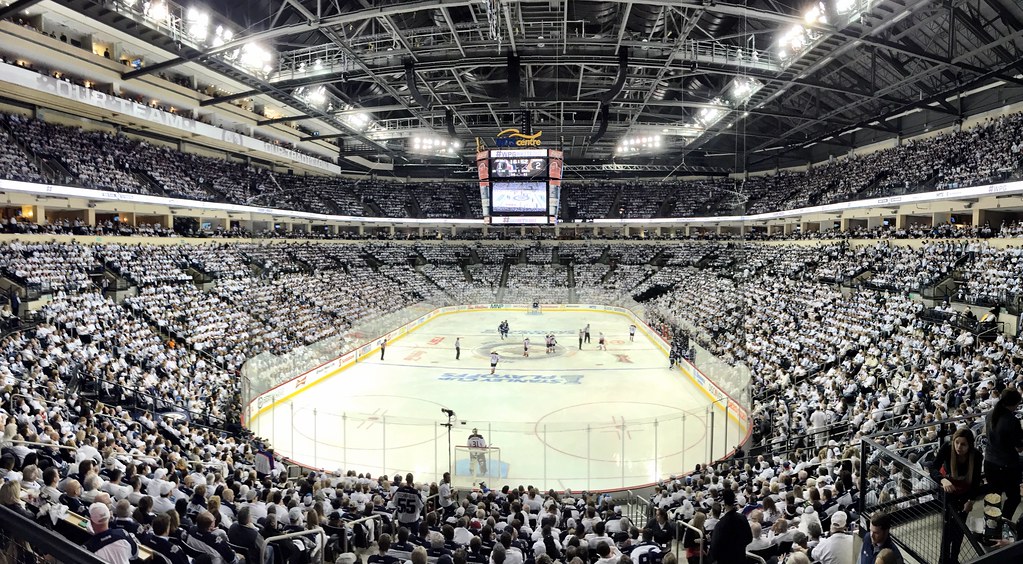
The Winnipeg White Out is a hockey tradition that dates back to 1987, when fans were asked to wear white clothing to home Playoff games, creating a very intimidating effect and atmosphere. It was created as a response to the "C of Red" created by fans of the Calgary Flames, who the Jets were facing in the 1st round of the Playoffs. The Jets eliminated the Flames in 6 games, and fans wore white for every home playoff game thereafter. Marketing for the team during the Playoffs referred to the "charge of the white brigade." Fans of the now relocated AHL Manitoba Moose (now the St. John's Ice Caps in St. John's, Newfoundland) also continued this tradition, as did fans of the continuing Jets/Coyotes franchise in Phoenix.
The Winnipeg White Out. That looks like a lot of snow and ice.

True North Enterprises, which owns the Jets and Bell MTS Place, kept the Moose' mascot, Mick E. Moose. Obviously a play on "Mickey Mouse," he had averaged over 100 community appearances per season for the past 15 years in Winnipeg and rural Manitoba. Slight modifications to the costume were made, including a Jets jersey with Number 00 on the back, and a vintage leather aviator helmet, one that far preceded jet airplanes.
Mick E. and our own N.J. Devil pose
with a Devils fan at the NHL's All-Star FanFest.

After the Game. Winnipeg is a city, but it's a Canadian city. You're going to be safer than in most American cities. And while Canadians like to drink, the fact that the Devils and the Jets have no rivalry means that, if you behave yourself and don't antagonize anyone, the home fans will do the same.

The Canada Life Centre is downtown, so there are plenty of places to get a postgame meal or drink. A bar named Tavern United and a Japanese restaurant named Portage Samurai are across Hargrave Street on the arena's west side. A restaurant called The Allen is across Donald Street on the arena's east side, although it looks more like "fine dining" than "postgame meal" territory.

There is unlikely to be a bar in Winnipeg that caters to expatriate or visiting New Yorkers and New Jerseyans. Your best bet is to look for red or white Devils jerseys, see which fans look like they've been there before, presume that they know what they're doing, and follow them.

If your visit to Winnipeg is during the European soccer season, as we are now in, your best bet to watch your club is at The King's Head Pub, at 120 King Street, downtown.

Sidelights. Despite Winnipeg's hockey struggles after leaving the WHA, they've actually got a decent sports history.

There was a 3-building complex at 1430 Maroons Road, at the corner of Empress Street. This included the Winnipeg Arena, Winnipeg Stadium and the Polo Park horse racing track.

The Arena was home to the Winnipeg Warriors of the Western Hockey League from its opening in 1955 until 1961, the Winnipeg Jets of the Western Canada Hockey League from 1967 to 1972, the orginal WHA/NHL Jets from 1972 to 1996, and the Manitoba Moose of the International Hockey League and the American Hockey League from 1996 to 2004, when the MTS Centre Opened.
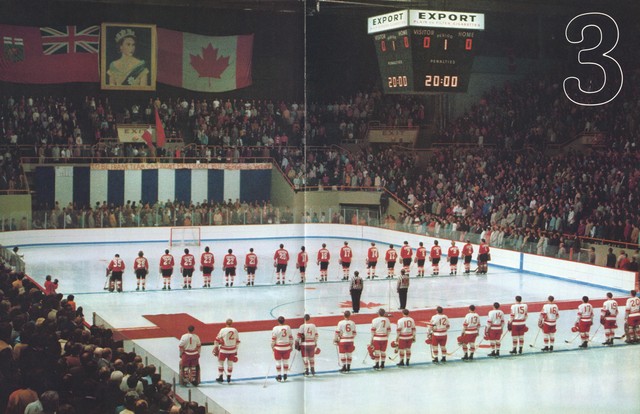
It also hosted Game 3 of the 1972 Canadian-Soviet "Summit Series," even though Winnipeg was, at the time, not an NHL city, and was, in fact, pandering to the WHA. This was awkward because Team Canada only included players from the NHL, barring defectors to the WHA like Bobby Hull (Chicago to Winnipeg), Bernie Parent (Toronto to Philadelphia, before Philly again in the NHL) and Gerry Cheevers (Boston to Cleveland).

That, plus Bobby Orr's injury, made the series a down-to-the-last-minute-of-the-last-game affair. Had Hull been allowed and Orr able to play, the legend of the great Red Army team might have been strangled in the crib.
Note the steep stands, and the portrait of
Canada's head of state, Queen Elizabeth II.

Like the Colisee de Quebec, 10,000 seats was enough for the WHA, but not for the NHL. So, like their WHA bretheren the Nordiques, they expanded their Louis St. Laurent-era arena to 15,000 seats. Unfortunately, also like the Nords, the Jets found the NHL rough going from 1979 onward, losing the core of their WHA dynasty in a dispersal draft, and setting a league record in 1980-81 for longest winless streak: 30 games (23 losses, 7 ties), and earning the nickname "Loseipeg."

Also like the Nords, they got better in the 1980s, and made the Playoffs again in the 1990s. But, again, like the Nords, it was too late, as the combination of a bad exchange rate and an outdated arena led to them moving. Like Winnipeg, Quebec City now has a new arena, too, so, like the Jets, the Nords could come back, too.

Winnipeg Stadium stood at 1465 Maroons Road, and was home to the Canadian Football League's Winnipeg Blue Bombers from 1953 to 2012. The Bombers have won 10 Grey Cups, 7 of them on Maroons Road: 1958, 1959, 1961, 1962, 1984, 1988 and 1990. It was also home to baseball's Winnipeg Whips in 1970 and '71. Another baseball team, the Winnipeg Goldeyes, played there from 1954 to 1964, as a farm team of the St. Louis Cardinals, winning Northern League Pennants in 1957, 1959 and 1960. The new version of the Goldeyes played there from 1994 to 1998.

The Stadium seated about 33,000 at its peak, although temporary seating for the 1991 Grey Cup raised it to 51,985. In 2000, a hotel chain bought the naming rights, and it became Canad Inns Stadium for the rest of its existence.

The Arena and the Stadium did not share space with Polo Park for long. Polo Park hosted thoroughbred racing from 1925 to 1956, and was demolished shortly thereafter. The Polo Park Mall opened in 1959. Today, an industrial site sits across Maroons Road from the mall, where the Arena and the Stadium once stood. Bus 11 from downtown.

Today, the Blue Bombers play at Investors Group Field. Opening in 2013 on the campus of the University of Manitoba, it is a 33,500-seat facility that can be expanded to 40,000. It hosted the 2015 Grey Cup (Edmonton beat Ottawa), and 7 games of the 2015 Women's World Cup, including the U.S.' win over Australia and draw with Sweden en route to winning the Cup.

It is also home to Valour FC, a team in the Canadian Premier League that began play in 2019, owned by, and groundsharing with, the Blue Bombers.

Taylor Swift played its 1st concert, but its 1st sold-out concert was by then 71-year-old Paul McCartney. (For comparison's sake: When Taylor Swift was born in 1989, Paul was 47, on one of his biggest tours and was still making the U.S. Top 40. Taylor should be so lucky in 2036.) The King and Queen of recent pop music, Jay-Z and Beyonce, played it in 2014, 1 of only 2 Canadian venues on their tour (the other being the Rogers Centre in Toronto). In 2016, it hosted the NHL Heritage Classic, but the Jets lost 3-0 to the Edmonton Oilers.

315 Chancellor Matheson Road at University Crescent, about 6 miles south of downtown. Number 60 bus.

The University of Manitoba Bisons won the Memorial Cup, the championship of Canadian junior hockey, in 1923. Other Manitoba-based teams to do so were the 1921 Winnipeg Junior Falcons; the 1931 Elmwood Millionaires; the 1935, 1937 and 1946 Winnipeg Monarchs; the 1938 St. Boniface Seals; the 1941 and 1943 Winnipeg Rangers; the 1942 Portage la Prairie Terriers; the 1957 Flin Flon Bombers; and the 1959 Winnipeg Braves.

Prior to the construction of Winnipeg Stadium, the Blue Bombers played at Osborne Stadium from 1935 to 1952, winning the Grey Cup in 1935, 1939 and 1941. A baseball team called the Winnipeg Reo Rods also called it home. Opened in 1932, with just 7,800 seats it was too small for CFL play. It was demolished in 1956, and the Great-West Life Assurance Building now stands on the site. 60 Osborne Street at Granite Way, across from the Manitoba Legislative Building.

The current version of the Winnipeg Goldeyes has played at Shaw Park since it opened in 1999. Formerly named CanWest Global Park, it seats 7,461, making it ideal for independent leagues like the current version of the American Association (not to be confused with the longtime Triple-A league or the 1880s major league of the same name).

These Goldeyes have won 9 division titles, and Pennants in 1994 and 2012, making for 5 Pennants for Winnipeg baseball teams. "The Fishbowl" stands at 1 Portage Avenue East, at Waterfront Drive along the Red River. Number 1 or 10 bus from downtown.

From 1909 to 1955, Winnipeg's hockey center (or, should I say, "centre") was Shea's Auditorium. For many years, it held Canada's only artificial ice surface between Toronto and Vancouver. The University of Winnipeg Library now stands on the site, although their hockey rink, the Duckworth Centre, is adjacent. 515 Portage Avenue, 6 blocks west of Bell MTS Place. In other words, when the new arena opened in 2004, Winnipeg hockey was coming home, even if it took the Jets a little longer.

Winnipeg has won the Stanley Cup 3 times. Did you know that? But it was a really long time ago. In fact, they've gone longer without winning the Cup than any city that has actually won it: 114 years. The Winnipeg Victorias won it in 1896, 1901 and 1902. The Victorias played at the Winnipeg Auditorium, at Garry Street and York Avenue, downtown. The Auditorium was destroyed by a fire in 1926. A bank and a parking deck now stand on the site of the greatest achievement in the history of Manitoba sports.

The Manitoba Sports Hall of Fame is at 145 Pacific Avenue at Lily Street. Number 20 bus.

Minneapolis is both the closest MLB city and the closest NBA city to Winnipeg: 456 miles away. Don't count on Winnipeg ever getting a team in either league: It would rank dead last in metropolitan area population. It already ranks last in the NHL, and still would if Quebec City returns, although not if Hamilton, Ontario gets a team as it has tried to do for the last 30 years. Even in the CFL, the Blue Bombers, at least in terms of metro population, have a "Borg ranking": 7 of 9, ahead of only the Hamilton Tiger-Cats and the Regina-based Saskatchewan Roughriders.

According to an article in the May 12, 2014 New York Times, the most popular NBA team in the city of Winnipeg is the Miami Heat, but in the suburbs, it's the Los Angeles Lakers. I don't know why there's a difference.

Like most major (or major-wannabe) cities, Winnipeg has museums. The Canadian Museum for Human Rights is at 85 Israel Asper Way, at York Avenue, across Pioneer Avenue from Shaw Park. Number 1 or 10 bus. Across Asper Way and the railroad tracks is the Winnipeg Railroad Museum. The Manitoba Planetarium and Science Gallery is at 190 Rupert Avenue at Main Street. Number 20 bus.

Adjacent to the Museum for Human Rights is The Forks, named for the splitting of the Red and Assiniboine Rivers. Because of this confluence, it was a meeting place for early Aboriginal peoples (Indians/Native Canadians/First Nations), European fur traders, hunters, riverboat and railway workers, and Manitoba's immigrants.

The complex now includes the Forks Market, in effect Winnipeg's South Street Seaport, Reading Terminal Market, Harborplace or Faneuil Hall/Quincy Market. 1 Forks Market Road, at Israel Asper Way. The Manitoba Children's Museum is also part of the complex, at 45 Forks Market Road. Number 1 or 2 bus.

Arthur Meighen, who served briefly twice (1920-21 and for a few weeks in 1926), is the only Prime Minister of Canada to have represented a riding (district) in Manitoba, in his case the nearby town of Portage La Prairie. There is no historical site in his honor, though.

The tallest building in Winnipeg is 201 Portage, standing a mere 420 feet at the intersection of Portage Avenue and Main Street, 3 blocks from Bell MTS Place. It looks nice, but it's no skyscraper.

Any TV shows set in Winnipeg would only be shown on Canadian television, and wouldn't be familiar to Americans. There have, however, been major films that you would recognize shot in and around Winnipeg.

Many of these have been Westerns, or more recent period pieces that take advantage of the surrounding prairies, such as The Assassination of Jesse James by the Coward Robert Ford (set in 1882 Missouri) and Capote (set in 1959 Kansas while Truman Capote was researching the murders that became the basis of his book In Cold Blood). Other movies with scenes filmed in Winnipeg include K-19: The Widowmaker, Shall We Dance, The Constant Gardener and The Haunting In Connecticut (despite the title).

*

Winnipeg is not very big city, and it's far away, with little to attract the local hockey fan besides hockey. But once you're there, it turns out to be a much more interesting place. Give it a go, whether you're a hockey fan or not. 

Wednesday, June 3, 2020

Top 5 Reasons You Can't Blame Marty McSorley for the Los Angeles Kings Losing the 1993 Stanley Cup

June 3, 1993: The Los Angeles Kings lead the Montreal Canadiens 2-1, late in the 3rd period of Game 2 of the Stanley Cup Finals, at the Montreal Forum. The Kings, in the Finals for the 1st time in their 26-year history, are mere minutes away from taking a 2-games-to-0 lead back to Los Angeles (well, Inglewood, to their own Forum). And they are doing so on the home ice of the greatest franchise in hockey, playing in their 34th Stanley Cup Finals -- having already won a record 23.

But Jacques Demers, head coach of the Canadiens, notices something. During a break in the action, with 1:45 left in regulation, he asks to speak to the referee. He asks them to measure the curve of the stick used by Kings defenseman Marty McSorley.

In the 1960s, players such as Bobby Hull used what became known as the "banana blade," a stick whose blade curved by up to 3 inches. These curves made the puck faster and more erratic. Since most goaltenders didn't yet use facemasks, this scared them. By 1967, most were using masks, but shots off the banana blade were still dangerous. So the NHL made a rule, limiting stick blade curves to 3/4 of an inch.

McSorley was a part of the Edmonton Oilers' dynasty of the 1980s, led by Wayne Gretzky. At this point, Gretzky was leading the Kings. In addition to McSorley, he was joined by fellow ex-Oilers Jari Kurri and Paul Coffey.

McSorley's stick is measured, and is found to have too great a curve. He is given a 2-minut minor penalty for "unsportsmanlike conduct." The Canadiens will have a power play for the rest of regulation. So Demers pulls goalie Patrick Roy, to give the Habs a 6-on-4 advantage.

And defenseman Eric Desjardins, who had already scored, scores again, to force overtime. And just 51 seconds into overtime, Desjardins scores again, to give the Canadiens a 3-2 win. This made him the 1st defenseman ever to score a hat trick in a Stanley Cup Finals game. He remains the only one.

It was all Canadiens from that point on. They blew a 3-0 lead in Game 3, but won on an overtime goal by John LeClair. Game 4 was similar: Montreal blew a 2-0 lead, but LeClair won it with another overtime goal. Game 5 was back in Montreal, and this one did not go to overtime: The Canadiens won 4-1, and clinched their 24th Stanley Cup on home ice.

If McSorley had simply obeyed the rules, the Kings would have been up 2-0 and been in great position to win the Cup. He blew it for them. They didn't win the franchise's 1st Cup until 2012.

McSorley can't be blamed for the Kings' failure to win until 2012. But he can certainly be blamed for blowing their 1st Finals in 1993, right?

Top 5 Reasons You Can't Blame Marty McSorley for the Los Angeles Kings Losing the 1993 Stanley Cup

5. Bobby Hull. True, the Golden Jet had been retired since 1980, and had never been involved with the Kings franchise. But he's the one who made the curved blade popular.

Even in this picture, with his Chicago Blackhawks teammate Stan Mikita at the left, you can see that Hull's stick blade is curved much more than its modern counterparts. And when the World Hockey Association was founded in 1972, and Hull was its 1st big signing -- he even became a part-owner of the team, and it was kind of named for him, the Winnipeg Jets -- they didn't have a rule against the curve, and he restored it, and feasted off the WHA's lesser goalies.
The curved blade was so popular among players, especially on the U.S.-based teams then in existence -- the Blackhawks, the Detroit Red Wings, the New York Rangers and the Boston Bruins -- because Hull was the most popular hockey player America had ever known, until Bobby Orr came along.
Before Hull, the most popular U.S.-based player
was Gordie Howe of Detroit. Here, he contemplates the banana blade,
and you can really see the difference.

If Hull hadn't popularized the banana blade, and hadn't scored so many goals with it, it wouldn't have been banned. McSorley wouldn't have broken the rule. Not just because the rule wouldn't have existed, but because no one would have considered it. McSorley wouldn't have taken an advantage that he didn't know existed.

4. Barry Melrose. A head coach is supposed to keep his team disciplined. If he sees a player breaking a rule, he has to take him aside and tell him to stop, lest he get caught and it hurts the team.

Melrose, now a familiar NHL studio pundit, but then head coach of the Kings, either didn't notice that McSorley was in violation of the rule, or did, and didn't care. Either he was incompetent or, worse, complicit.
The man. The pose. The mullet.
The goatee would come later.

President Harry Truman had a sign on his desk reading, "The buck stops here." Meaning, "I'm the boss, therefore, I'm the one responsible, and I can't pass the buck. If something goes wrong, blame me." Melrose either passed the buck, or didn't see the buck.

3. Kelly Hrudey. The former New York Islander goalie had been decent in getting the Kings this far, but he had been kind of shaky in the Conference Finals against the Toronto Maple Leafs -- a series the Leafs probably should have won, and another for the "Top 5 Reasons You Can't Blame" file.
For most of the 1st 2 games in the Finals, Hrudey allowed only 2 goals. But from the last 2 minutes of Game 2 onward, he allowed 13 goals in a little over 3 games. That is not a clutch performance. Contrast that with Patrick Roy: Over the same stretch, he allowed just 6 goals.
Which leads us to...

2. The Kings choked. They led 2-1 in Montreal in Game 2, having already won Game 1 in Montreal. They had overtime and home-ice advantage in Game 3. They had overtime and home-ice advantage in Game 4. If they win any one of those games, the series at least goes back to Inglewood for a Game 6. They had their chances, even after McSorley got busted. But they blew it.

Or maybe, just maybe, this series wasn't blown. Maybe it was taken, by the better team:

1. The Canadiens were better. Yes, the Kings had Gretzky, Kurri and Coffey, as well as Dave Taylor, Luc Robitaille, Darryl Sydor, Rob Blake and Tony Granato.

But the Canadiens had lots of players with Playoff experience. Roy and Guy Carbonneau were holdovers from the Canadiens team that won the 1986 Stanley Cup. They, and also Desjardins, LeClair, Donald Dufresne, Benoit Brunet, Lyle Odelein, Mike Keane, Ed Ronan, Mathieu Schneider, Sean Hill and Stephan Lebeau were members of their 1989 team that reached the Finals before losing to the Calgary Flames.

Rob Ramage was a member of those '89 Flames that beat the Canadiens, and the '86 Flames that the Habs beat in the Finals. Denis Savard was a Playoff perennial with the Chicago Blackhawks. Kirk Muller was the Captain of the New Jersey Devils team that reached the 1988 Conference Finals. (And, yes, we called him "Captain Kirk.") Others, such as Vincent Damphousse, Mathieu Schneider, Patrice Brisebois and Jean-Jacques Daigneault would go on to prove themselves to be among the game's best players.

Maybe the Canadiens couldn't match the Kings for star power -- except for Roy, who might have been the greatest goalie in hockey history, and certainly outplayed Hrudey -- but, top-to-bottom, they were a better team.
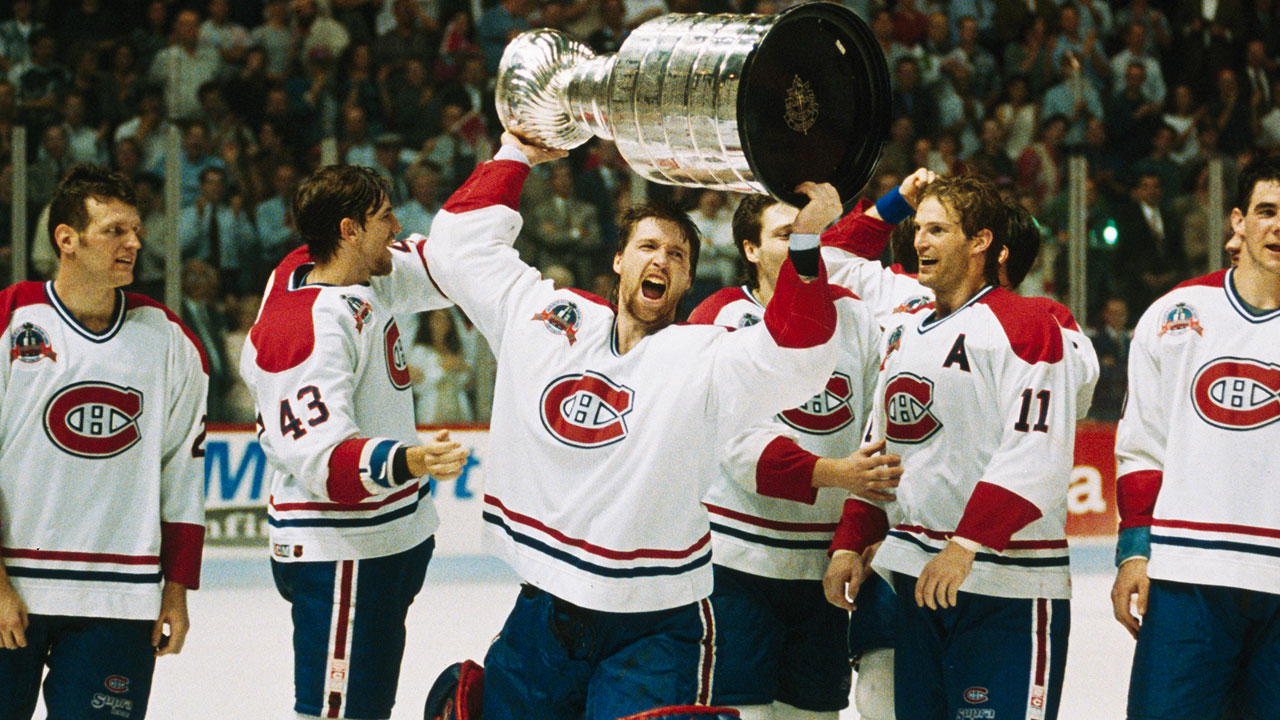
June 9, 1993, Montreal Forum: Patrick Roy lifts the Stanley Cup.

VERDICT: Not Guilty. McSorley was a thug, and, on this occasion, he was a fool. And, yes, the series was a lot closer than its 5-game result would suggest. But he was not the sole reason the Kings lost the Finals. He wasn't even the biggest reason.

Wednesday, October 30, 2019

How to Be a Devils Fan In Winnipeg -- 2019-20 Edition

This coming Tuesday night, the Devils will be in the capital of the Province of Manitoba to play the reborn Winnipeg Jets.

If this were a World Hockey Association game in the 1970s... well, it wouldn't be that big, since we'd be the New York Raiders, and we'd stink.

Before You Go. Winnipeg is in Manitoba. Manitoba is in Canada. In the entire National Hockey League, only Edmonton and Calgary have arenas further north. It's mid-November. It's going to be cold.

The website for the Winnipeg Free Press is predicting temperatures in the 20s during the day, and the teens at night. That's Fahrenheit. Don't look at the Celsius numbers, the ones you're used to are cold enough. Bundle up! Also, they're predicting snow for the day before, so the streets and sidewalks could be tricky.

Winnipeg is in Canada, so you're going to need to have, and bring, a valid passport. It's also in the Central Time Zone, 1 hour behind New York and New Jersey. Adjust your timepieces accordingly.

Do yourself another big favor: Change your money before you go. There are plenty of currency exchanges in New York City, including one on 42nd Street between 7th and 8th Avenue.

Leave yourself $50 in U.S. cash, especially if you're going other than by plane, so you'll have usable cash when you get back to your side of the border. At this writing, the exchange rate is US$1.00 = C$1.32, while C$1.00 = US 76 cents, so, for the moment, it really favors us.

Tickets. At 15,016 seats, Bell MTS Place has the smallest capacity of any current NHL arena, smaller than even the Barclays Center in Brooklyn. But the fans in Winnipeg are so thrilled to have their Jets back that they've sold out every seat since the re-premiere. Getting tickets might be tough.

The prices I'm citing are in Canadian dollars. Seats in the lower bowl, the 100 sections, are $160 between the goals, $117 behind them. Seats in the mezzanine, the 200 sections, are $158 between the goals and $99 behind them. Seats in the upper level, the 300 sections, are $81 between the goals and $55 behind them.

Getting There. It's 1,653 miles from Times Square to the Manitoba Legislative Building, the Province's capitol building; 1,648 miles from the Prudential Center in Newark to Bell MTS Place in Winnipeg; and 66 miles from the closest border crossing, at Pembina, North Dakota, to downtown Winnipeg.

Knowing this, your first instinct will be to fly. Air Canada offers round-trip flights from Newark Liberty to Winnipeg's James Armstrong Richardson International Airport for as little as $750. (Richardson was a Member of Parliament, and Minister of Defence under Prime Minister Pierre Trudeau in the 1970s.) Unfortunately, you'd have to change planes in either Montreal or Toronto.

Greyhound no longer goes to Winnipeg. You can't get from New York to Winnipeg directly by train, either. The train schedule is screwed-up. You'd have to leave New York on Sunday morning to get to Toronto by Sunday night, which would get you to Winnipeg on Tuesday morning, 11 hours before puck-drop. So far, so good. But the first train leaving Winnipeg for Toronto after the Tuesday night game is at 10:30 PM on Wednesday, over 24 hours from the final horn. So the train is out. At any rate, Winnipeg's Union Station is at 123 Main Street at Broadway.

Or maybe driving would be better. Keep in mind, it's better to do this with 2 people, so 1 can drive while the other sleeps. And you'll both need passports. And make sure your companion isn't someone who would say or do some wiseass thing at Customs, like answer the question, "Do you have anything to declare?" with, "I declare that I'm proud to be an American."

The most direct route bypasses Buffalo, Hamilton and Toronto -- in fact, it doesn't go through Ontario at all.

You'll need to get into New Jersey, and take Interstate 80 West. You'll be on I-80 for the vast majority of the trip, through New Jersey, Pennsylvania and Ohio. In Ohio, in the western suburbs of Cleveland, I-80 will merge with Interstate 90. From this point onward, you won't need to think about I-80 until you head home; I-90 is now the key, through the rest of Ohio and Indiana.

Just outside Chicago, I-80 will split off from I-90, which you will keep, until it merges with Interstate 94. For the moment, though, you will ignore I-94. Stay on I-90 through Illinois, until reaching Madison, Wisconsin, where you will once again merge with I-94. Now, I-94 is what you want, taking it into Minnesota and the Twin Cities.

However, unless you want to make a rest stop actually in Minneapolis or St. Paul, you're going to bypass them entirely. Take Exit 249 to get on Interstate 694, the Twin Cities' beltway, until you merge with Interstate 494 to reform I-94. Crossing Minnesota into North Dakota, you'll take Exit 349B to get on Interstate 29 North. At Pembina, North Dakota, you'll reach Customs.

Assuming you have everything in order and don't do anything stupid, you'll be allowed to cross over into Emerson, Manitoba, and your highway will continue as Manitoba Route 29. This will soon flow into Manitoba Route 75, the Lord Selkirk Highway. Upon crossing Route 300, it will become Manitoba Route 42. Take that to Manitoba Route 62, and that will take you into downtown Winnipeg.

If you do it right, you should spend about an hour and a half in New Jersey, 5 hours and 15 minutes in Pennsylvania, 4 hours in Ohio, 2 and a half hours in Indiana, an hour and a half in Illinois, 2 and a half hours in Wisconsin, 4 and a half hours in Minnesota, 2 hours and 45 minutes in North Dakota, and a shade over an hour in Manitoba. That's 24 hours and 30 minutes.

Counting rest stops, preferably halfway through Pennsylvania and just after you enter both Ohio and Indiana, outside Chicago, halfway across Wisconsin, outside the Twin Cities, outside Grand Forks, and counting Customs, which should have a bathroom and vending machines, it should be no more than 33 hours, which would save you time on both Greyhound and Amtrak, if not on flying.

And, on October 14, 2016, President Obama finally ended the ban on bringing Cuban cigars into America. This also applies to rum, for which Cuba is also renowned. It is still considerably easier to buy these items in Canada than in America, but, now, you can bring them back over the border.

Once In the City. The name Winnipeg comes from the Western Cree words for "muddy waters." (As far as I know, there's no town nearby whose name is a tribal word meaning "howlin' wolf.") The region was a trading center for aboriginal peoples (usually called "First Nations" in Canada, rather than "Indians" or "Native Canadians") before the arrival of Europeans. French traders built the first fort on the site in 1738. A settlement was later founded by the Selkirk settlers in 1812, the nucleus of which was incorporated as the City of Winnipeg in 1873.
The Manitoba Legislative Building,
equivalent to a State Capitol or State House

According to the figures I have, Winnipeg has a population of 663,000, more than fellow NHL cities Denver, Boston, Washington, Nashville, Vancouver, Raleigh, Miami, Minneapolis, Tampa, Anaheim, St. Louis, Pittsburgh, Newark and Buffalo -- but only 730,000 in its metropolitan area, meaning their "suburbs" add up to only 67,000 people. The people are about 68 percent white, 13 percent East Asian, 11 percent Aboriginal, 4 percent South Asian, 3 percent black, 1 percent Hispanic and 1 percent Middle Eastern.

Nevertheless, with all the fuss over having its team taken away once, plus the sellouts since they got their team back, the chances of having its team taken away twice are very long.

Since Canada is in the British Commonwealth, there are some subtle differences. Every measurement will be in the metric system. Dates are written not as Month/Day/Year, as we do it, but as Day/Month/Year as in Britain and in Europe. So the game is played for us on "November 12, 2018," but for them on "12 November 2018" -- we write it as 11/12/18, they write it as 12/11/18.

They also follow British custom in writing time: This game is scheduled to start at 6:00 PM, and will be listed as 1800. (Those of you who have served in the military, you will recognize this as, in the words of M*A*S*H's Lt. Col. Henry Blake, "all that hundred-hours stuff.") And every word we would end with -or, they will end with -our; and some (but not all) words that we would end with -er, they end with -re, as in the arena's former name, "MTS Centre."

Another thing to keep in mind: Don't ask anyone where the "bathroom" is -- ask for the "washroom." This difference was a particular pet peeve of mine the first time I visited Toronto, although it wasn't a problem in Montreal as I knew the signs would be in French.

Every measurement will be in the metric system: Temperatures will be in Celsius, not Fahrenheit; distances will be in "kilometres," not miles (including speed limits, so don't drive 100 thinking it's miles); and gas prices will be per "litre," not per gallon (so don't think you're getting cheap gas, because a liter is a little more than a quart, so multiply the price by 4, and you'll get roughly the price per gallon, and it will be more expensive than at home, not less). Better to get gas at one of your rest stops before going into Canada.

Manitoba's sales tax is 13 percent -- in 2010, this replaced the former Provincial sales tax of 5 percent and the federal GST (Goods & Services Tax) of 8 percent. In other words, the Conservative Party government of Prime Minister Stephen Harper wanted Canadians to think he'd killed the hated GST, when, in fact, Manitobans are paying pretty much the same taxes that they did before. See how stupid it is to vote for conservative candidates? It doesn't work in any country, as Canada recently admitted by dumping Harper and his Tories for Justin Trudeau and his Liberals.

The Red River divides street addresses into east and west, and the Assiniboine River divides the city into north and south. There's no freeway "beltway." Winnipeg also doesn't have a subway, and its buses are $2.50 cash and $2.15 for a prepaid ticket. Again, that's in Canadian dollars, making it cheaper than New York's MTA or New Jersey Transit.

The drinking age in Manitoba is 18. Postal Codes in Manitoba begin with the letter R. The Area Codes are 204 and 431. Utilities are run by Manitoba Hydro.

Going In. Bell MTS Place is downtown. The official address is 300 Portage Avenue, at Donald Street. If your hotel is downtown, you can walk there, and you won't need a bus. If you drove all the way in, and aren't staying in Winnipeg overnight, most parking in downtown Winnipeg is $10 or less.
The arena is named for Manitoba Telecom Services, and opened in 2004, as the MTS Centre, with the name being changed this past May 30, when Bell Canada acquired MTS. It was built in the hopes of attracting a moved or expansion team to the former city of the team now known as the Arizona Coyotes. In the meantime, the minor-league Manitoba Moose played at the old Winnipeg Arena from 1996 to 2004, and at the MTS Centre from 2004 to 2011.

UPDATE: The arena was renamed the Canada Life Centre in 2021.

One of the first events held there was the 2005 Juno Awards, Canada's equivalent of the Grammys. After a few preseason exhibition games, including one by the ex-Jets (then named the Phoenix Coyotes), the Atlanta Thrashers made the move, and played their 1st regular-season home game as the new Winnipeg Jets on October 9, 2011.
The rink is laid out north-to-south. The Jets attack twice toward the south end.

Food. Centerplate operates the arena's concessions. Among the chains with stands there are Canadian favorites Pizza Pizza, behind Sections 214, 221 and 319; Bella Pasta, at 307; and that hockey-connected must-have of Canada, Tim Hortons, at 210, 221, 305 and 319.

The arena also has the "jet"-themed Aviators Grill at 203, 216 and 314; the Runway Bar at 212, behind the west goal; and the Observation Deck Bar & Buffet at 329, behind the east goal.

Team History Displays. In their 1st 6 seasons back in Winnipeg, the new Jets only made the Playoffs once, in 2015, and got swept in the 1st Round by the Anaheim Ducks. But they made the Playoffs again in 2018, and reached the Western Conference Finals, beating the Minnesota Wild and the Nashville Predators before falling to the Vegas Golden Knights. To put it another way: Between the old Jets (1979-96) and the new Jets (2011-17), the team won 19 Playoff games in the NHL until last season, when they won 9.

But they didn't win the Stanley Cup, or the Conference, or even the Central Division. And the old Jets won nothing in the NHL, not even a Division title, so there's no banners to hang. They do hang banners for the old Jets' WHA Championships of 1976, 1978 and 1979.

True North Enterprises, which had owned the Manitoba Moose, have kept the Moose's banners up: The retired Number 12 of Mike Keane, a Winnipeg native whose 1st pro team was the Winnipeg Monarchs of junior hockey, and played the last 5 seasons of his career after 16 years in the NHL, Stanley Cups in 1993 with the Montreal Canadiens, 1996 with the Colorado Avalanche, and 1999 with the Dallas Stars; Division Championships in 2007 and 2009, the 2009 regular-season league title and the 2009 Conference Championship.
Along the side of the east stands, in front of the luxury boxes, the Jets show the retired numbers of the old Jets: 9, left wing Bobby Hull; 10, center Dale Hawerchuk; 25, right wing Thomas Steen; and 27, defenseman Teppo Numminen. Wayne Gretzky's universally-retired 99 is also up there.
These numbers were kept semi-retired by the Phoenix/Arizona Coyotes, who also added the 7 of center Keith Tkachuk, whose number, as yet, isn't shown at Bell MTS Place. Ben Ciarot is wearing 7 for the new Jets. (The Coyotes also added the 97 of center Jeremy Roenick, who never played for the Jets/Coyotes franchise in Winnipeg.)

Left wing Evander Kane wore 9 with the Atlanta Thrashers, and, when they became the new Jets, he asked Hull for permission to continue wearing it. He got it. He's now gone, but Andrew Copp has it. Brandon Tanev now wears the 13 with which Teemu Selanne began in Winnipeg. The Coyotes haven't retired it, but the Ducks have retired 8 for him.
Bobby Hull holding up a modern mockup
(note the Canadian flag on the label)
of his 1970s Jets jersey, with son Brett,
wearing that franchise's Number 9 in Arizona.

While the Thrashers didn't have any officially retired numbers, they had withdrawn 37 from circulation following the car crash death of Dan Snyder. The Jets kept it out of circulation until 2016, but it has now been given to Connor Hellebuyck. Rick Rypien, who was with the Coyotes, had suffered from clinical depression, and committed suicide before the franchise could make its Winnipeg debut. His Number 11 hasn't been retired, but it hasn't been returned to circulation, either.

Hull, Hawerchuk, Serge Savard (a Jet for only 2 years at the end of his career), Phil Housley (a Jet for only 3 years in the middle of his career) and Brian Mullen are in the Hockey Hall of Fame. Hedberg, Housley and Numminen have been elected to the International Ice Hockey Federation (IIHF) Hall of Fame. Hull, Housley and Mullen have received the Lester Patrick Trophy for contributions to hockey in America.

The Manitoba Hockey Hall of Fame is located at Bell MTS Place. Its inductees include original Jets founder Ben Hatskin; old Jets Hull, Hawerchuk, Anders Hedberg, Ulf Nilsson (the last 2 being ex-Rangers) and Randy Carlyle; and Manitoba-born NHL legends, including Terry Sawchuk, Bobby Clarke, and ex-Rangers Murray Murdoch, Babe Pratt, Ivan "Ching" Johnson, Art Coulter, Bryan Hextall, Alex Shibicky, Chuck Rayner, Andy Bathgate, Pete Stemkowski and coach Fred Shero. (Hextall's sons, Bryan Jr. and Dennis, have also been elected; Bryan Jr.'s son Ron has not yet been.)

Hull, Hedberg and Ulf Nilsson, the old "Hot Line," were the 1st inductees into the Jets' team Hall of Fame. They have since added Carlyle, Steen, Ab McDonald, Lars-Erik Sjoberg and Dale Hawerchuk. 

Hull, Hedberg, Nilsson, Sjoberg, Kent Nilsson, Joe Daley, Danny Lawson, Ernie Wakely, Ted Green and Terry Ruskowski were named to the WHA's All-Time Team. Hull was the only Jet named to The Hockey News' 100 greatest Players in 1998. He and Selanne were named to the NHL's 100th Anniversary 100 Greatest Players in 2017. Dave Silk and Dave Christian from the 1980 U.S. Olympic team played for the old Jets. Since his death, Hawerchuk has had a statue dedicated and a street named outside the arena.

Stuff. The Jets Gear Authentic Team Store calls itself "the best place in Winnipeg to pick up authentic Winnipeg Jets merchandise. With 3 locations to serve you, and open year-round, we're looking forward to outfitting every Winnipeg Jets fan."

There aren't yet any good books about the revived Jets, but there are some about the old ones. Curtis Walker and Timothy Gassen wrote Winnipeg Jets: The WHA Years Day By Day. And Curtis Walker wrote the next chapter: Coming Up Short: The Comprehensive History of the NHL's Winnipeg Jets (1979-1996).

Videos on the Jets are in short supply. The only one I could find on Amazon.com was a rivalry piece on the WHA version of the Jets and the Houston Aeros, Bobby Hull vs. Gordie Howe. Between them, in the 7 seasons the WHA existed, one of those teams was in the Finals every season -- and, in 1976, they both were, as the Jets' ended the Aeros' 2-year dominance of the league.

During the Game. A November 19, 2014 article on The Hockey News' website ranked the NHL teams' fan bases, and listed the Jets' fans 7th, 5th among Canadian teams: "Jet fans pay through the nose but come out in droves despite no playoff games." The novelty of having the NHL back in town has not yet worn off. It remains to be seen if 'Peg fans will come out to watch a team that has disappointed them repeatedly.

You do not need to fear wearing Devils gear to a Jets game at Bell MTS Place. Their rivals are the Toronto Maple Leafs, the Ottawa Senators, the Edmonton Oilers (due to the WHA connection) and, to a lesser but understandable extent, the Arizona Coyotes. They don't care any more about the Devils than they would about any other team. You will be safe.

Stacey Nattrass is the Jets' regular singer for the National Anthems. She teaches music at a local high school. Since "True North" is the name of the company that owns the team and the arena, the fans shout those words during the line, "With glowing hearts, we see thee rise, the true north, strong and free." The Jets use Primal Fear's "Higher Power" as their fight song and the Isley Brothers' "Shout!" as their goal song.
Stacey Nattrass

Jet fans are noted for their creative chants. When the Buffalo Sabres came in with Ryan Miller, the goalie for the U.S. team that finished 2nd to Canada at the 2010 Winter Olympics, the Winnipeggers showed some Hoser pride by chanting, "SIL-ver ME-dal!" When the Washington Capitals came in with Alexander Ovechkin, they invoked the other chosen superstar of this generation of NHL players, the Pittsburgh Penguins' Sidney Crosby, and chanted,"CROS-by's BET-ter!" When the San Jose Sharks came in last year, having just stripped Joe Thornton of the captaincy, they chanted, "WHO'S your CAP-tain?"

The Winnipeg White Out is a hockey tradition that dates back to 1987, when fans were asked to wear white clothing to home Playoff games, creating a very intimidating effect and atmosphere. It was created as a response to the "C of Red" created by fans of the Calgary Flames, who the Jets were facing in the 1st round of the Playoffs. The Jets eliminated the Flames in 6 games, and fans wore white for every home playoff game thereafter. Marketing for the team during the Playoffs referred to the "charge of the white brigade." Fans of the now relocated AHL Manitoba Moose (now the St. John's Ice Caps in St. John's, Newfoundland) also continued this tradition, as did fans of the continuing Jets/Coyotes franchise in Phoenix.
The Winnipeg White Out. That looks like a lot of snow and ice.

True North Enterprises, which owns the Jets and Bell MTS Place, kept the Moose' mascot, Mick E. Moose. Obviously a play on "Mickey Mouse," he had averaged over 100 community appearances per season for the past 15 years in Winnipeg and rural Manitoba. Slight modifications to the costume were made, including a Jets jersey with Number 00 on the back, and a vintage leather aviator helmet, one that far preceded jet airplanes.
Mick E. and our own N.J. Devil pose
with a Devils fan at the NHL's All-Star FanFest.

After the Game. Winnipeg is a city, but it's a Canadian city. You're going to be safer than in most American cities. And while Canadians like to drink, the fact that the Devils and the Jets have no rivalry means that, if you behave yourself and don't antagonize anyone, the home fans will do the same.

Bell MTS Place is downtown, so there are plenty of places to get a postgame meal or drink. A bar named Tavern United and a Japanese restaurant named Samurai are across Hargrave Street on the arena's west side. A restaurant called The Allen is across Donald Street on the arena's east side, although it looks more like "fine dining" than "postgame meal" territory.

There is unlikely to be a bar in Winnipeg that caters to expatriate or visiting New Yorkers and New Jerseyans. Your best bet is to look for red or white Devils jerseys, see which fans look like they've been there before, presume that they know what they're doing, and follow them.

If your visit to Winnipeg is during the European soccer season, as we are now in, your best bet to watch your club is at The Pint, at 274 Garry Street, downtown.

Sidelights. Despite Winnipeg's hockey struggles after leaving the WHA, they've actually got a decent sports history.

There was a 3-building complex at 1430 Maroons Road, at the corner of Empress Street. This included the Winnipeg Arena, Winnipeg Stadium and the Polo Park horse racing track.

The Arena was home to the Winnipeg Warriors of the Western Hockey League from its opening in 1955 until 1961, the Winnipeg Jets of the Western Canada Hockey League from 1967 to 1972, the orginal WHA/NHL Jets from 1972 to 1996, and the Manitoba Moose of the International Hockey League and the American Hockey League from 1996 to 2004, when the MTS Centre Opened.
It also hosted Game 3 of the 1972 Canadian-Soviet "Summit Series," even though Winnipeg was, at the time, not an NHL city, and was, in fact, pandering to the WHA. This was awkward because Team Canada only included players from the NHL, barring defectors to the WHA like Bobby Hull (Chicago to Winnipeg), Bernie Parent (Toronto to Philadelphia, before Philly again in the NHL) and Gerry Cheevers (Boston to Cleveland).

That, plus Bobby Orr's injury, made the series a down-to-the-last-minute-of-the-last-game affair. Had Hull been allowed and Orr able to play, the legend of the great Red Army team might have been strangled in the crib.
Note the steep stands, and the portrait of
Canada's head of state, Queen Elizabeth II.

Like the Colisee de Quebec, 10,000 seats was enough for the WHA, but not for the NHL. So, like their WHA bretheren the Nordiques, they expanded their Louis St. Laurent-era arena to 15,000 seats. Unfortunately, also like the Nords, the Jets found the NHL rough going from 1979 onward, losing the core of their WHA dynasty in a dispersal draft, and setting a league record in 1980-81 for longest winless streak: 30 games (23 losses, 7 ties), and earning the nickname "Loseipeg."

Also like the Nords, they got better in the 1980s, and made the Playoffs again in the 1990s. But, again, like the Nords, it was too late, as the combination of a bad exchange rate and an outdated arena led to them moving. Like Winnipeg, Quebec City now has a new arena, too, so, like the Jets, the Nords could come back, too.

Winnipeg Stadium stood at 1465 Maroons Road, and was home to the Canadian Football League's Winnipeg Blue Bombers from 1953 to 2012. The Bombers have won 10 Grey Cups, 7 of them on Maroons Road: 1958, 1959, 1961, 1962, 1984, 1988 and 1990. It was also home to baseball's Winnipeg Whips in 1970 and '71. Another baseball team, the Winnipeg Goldeyes, played there from 1954 to 1964, as a farm team of the St. Louis Cardinals, winning Northern League Pennants in 1957, 1959 and 1960. The new version of the Goldeyes played there from 1994 to 1998.

The Stadium seated about 33,000 at its peak, although temporary seating for the 1991 Grey Cup raised it to 51,985. In 2000, a hotel chain bought the naming rights, and it became Canad Inns Stadium for the rest of its existence.

The Arena and the Stadium did not share space with Polo Park for long. Polo Park hosted thoroughbred racing from 1925 to 1956, and was demolished shortly thereafter. The Polo Park Mall opened in 1959. Today, an industrial site sits across Maroons Road from the mall, where the Arena and the Stadium once stood. Bus 11 from downtown.

Today, the Blue Bombers play at Investors Group Field. Opening in 2013 on the campus of the University of Manitoba, it is a 33,500-seat facility that can be expanded to 40,000. It hosted the 2015 Grey Cup (Edmonton beat Ottawa), and 7 games of the 2015 Women's World Cup, including the U.S.' win over Australia and draw with Sweden en route to winning the Cup.

It will also be home to Valour FC, a team in the new Canadian Premier League that will begin play in Spring 2019, owned by, and groundsharing with, the Blue Bombers.

Taylor Swift played its 1st concert, but its 1st sold-out concert was by then 71-year-old Paul McCartney. (For comparison's sake: When Taylor Swift was born in 1989, Paul was 47, on one of his biggest tours and was still making the U.S. Top 40. Taylor should be so lucky in 2036.) The King and Queen of recent pop music, Jay-Z and Beyonce, played it in 2014, 1 of only 2 Canadian venues on their tour (the other being the Rogers Centre in Toronto). In 2016, it hosted the NHL Heritage Classic, but the Jets lost 3-0 to the Edmonton Oilers.

315 Chancellor Matheson Road at University Crescent, about 6 miles south of downtown. Number 60 bus.

The University of Manitoba Bisons won the Memorial Cup, the championship of Canadian junior hockey, in 1923. Other Manitoba-based teams to do so were the 1921 Winnipeg Junior Falcons; the 1931 Elmwood Millionaires; the 1935, 1937 and 1946 Winnipeg Monarchs; the 1938 St. Boniface Seals; the 1941 and 1943 Winnipeg Rangers; the 1942 Portage la Prairie Terriers; the 1957 Flin Flon Bombers; and the 1959 Winnipeg Braves.

Prior to the construction of Winnipeg Stadium, the Blue Bombers played at Osborne Stadium from 1935 to 1952, winning the Grey Cup in 1935, 1939 and 1941. A baseball team called the Winnipeg Reo Rods also called it home. Opened in 1932, with just 7,800 seats it was too small for CFL play. It was demolished in 1956, and the Great-West Life Assurance Building now stands on the site. 60 Osborne Street at Granite Way, across from the Manitoba Legislative Building.

The current version of the Winnipeg Goldeyes has played at Shaw Park since it opened in 1999. Formerly named CanWest Global Park, it seats 7,461, making it ideal for independent leagues like the current version of the American Association (not to be confused with the longtime Triple-A league or the 1880s major league of the same name).

These Goldeyes have won 9 division titles, and Pennants in 1994 and 2012, making for 5 Pennants for Winnipeg baseball teams. "The Fishbowl" stands at 1 Portage Avenue East, at Waterfront Drive along the Red River. Number 1 or 10 bus from downtown.

From 1909 to 1955, Winnipeg's hockey center (or, should I say, "centre") was Shea's Auditorium. For many years, it held Canada's only artificial ice surface between Toronto and Vancouver. The University of Winnipeg Library now stands on the site, although their hockey rink, the Duckworth Centre, is adjacent. 515 Portage Avenue, 6 blocks west of Bell MTS Place. In other words, when the new arena opened in 2004, Winnipeg hockey was coming home, even if it took the Jets a little longer.

Winnipeg has won the Stanley Cup 3 times. Did you know that? But it was a really long time ago. In fact, they've gone longer without winning the Cup than any city that has actually won it: 114 years. The Winnipeg Victorias won it in 1896, 1901 and 1902. The Victorias played at the Winnipeg Auditorium, at Garry Street and York Avenue, downtown. The Auditorium was destroyed by a fire in 1926. A bank and a parking deck now stand on the site of the greatest achievement in the history of Manitoba sports.

The Manitoba Sports Hall of Fame is at 145 Pacific Avenue at Lily Street. Number 20 bus.

Minneapolis is both the closest MLB city and the closest NBA city to Winnipeg: 456 miles away. Don't count on Winnipeg ever getting a team in either league: It would rank dead last in metropolitan area population. It already ranks last in the NHL, and still would if Quebec City returns, although not if Hamilton, Ontario gets a team as it has tried to do for the last 30 years. Even in the CFL, the Blue Bombers, at least in terms of metro population, have a "Borg ranking": 7 of 9, ahead of only the Hamilton Tiger-Cats and the Regina-based Saskatchewan Roughriders.

According to an article in the May 12, 2014 New York Times, the most popular NBA team in the city of Winnipeg is the Miami Heat, but in the suburbs, it's the Los Angeles Lakers. I don't know why there's a difference.

Like most major (or major-wannabe) cities, Winnipeg has museums. The Canadian Museum for Human Rights is at 85 Israel Asper Way, at York Avenue, across Pioneer Avenue from Shaw Park. Number 1 or 10 bus. Across Asper Way and the railroad tracks is the Winnipeg Railroad Museum. The Manitoba Planetarium and Science Gallery is at 190 Rupert Avenue at Main Street. Number 20 bus.

Adjacent to the Museum for Human Rights is The Forks, named for the splitting of the Red and Assiniboine Rivers. Because of this confluence, it was a meeting place for early Aboriginal peoples (Indians/Native Canadians/First Nations), European fur traders, hunters, riverboat and railway workers, and Manitoba's immigrants.

The complex now includes the Forks Market, in effect Winnipeg's South Street Seaport, Reading Terminal Market, Harborplace or Faneuil Hall/Quincy Market. 1 Forks Market Road, at Israel Asper Way. The Manitoba Children's Museum is also part of the complex, at 45 Forks Market Road. Number 1 or 2 bus.

Arthur Meighen, who served briefly twice (1920-21 and for a few weeks in 1926), is the only Prime Minister of Canada to have represented a riding (district) in Manitoba, in his case the nearby town of Portage La Prairie. There is no historical site in his honor, though.

The tallest building in Winnipeg is 201 Portage, standing a mere 420 feet at the intersection of Portage Avenue and Main Street, 3 blocks from Bell MTS Place. It looks nice, but it's no skyscraper.

Any TV shows set in Winnipeg would only be shown on Canadian television, and wouldn't be familiar to Americans. There have, however, been major films that you would recognize shot in and around Winnipeg.

Many of these have been Westerns, or more recent period pieces that take advantage of the surrounding prairies, such as The Assassination of Jesse James by the Coward Robert Ford (set in 1882 Missouri) and Capote (set in 1959 Kansas while Truman Capote was researching the murders that became the basis of his book In Cold Blood). Other movies with scenes filmed in Winnipeg include K-19: The Widowmaker, Shall We Dance, The Constant Gardener and The Haunting In Connecticut (despite the title).

*

Winnipeg is not very big city, and it's far away, with little to attract the local hockey fan besides hockey. But once you're there, it turns out to be a much more interesting place. Give it a go, whether you're a hockey fan or not.