Showing posts with label qualcomm stadium. Show all posts

Tuesday, September 1, 2026

September 1, 2016: Colin Kaepernick Takes a Knee

September 1, 2016, 10 years ago: The San Francisco 49ers beat the San Diego Chargers, 31-21 at Qualcomm Stadium in San Diego, in their last preseason game. Like any preseason game, the result doesn't matter. This time, it mattered less than ever.

Instead of standing while the National Anthem, "The Star-Spangled Banner," was played before the game, 49er quarterback Colin Kaepernick got down on one knee for the duration of the song.

He did this in protest of the many recent cases of police brutality. This earned him a bit of praise, and also a lot of nasty blowback from racists, who said he was "disgracing the Anthem" and "disgracing the American flag."

These people were not idiots, though many of the people they pander to are: They were liars. His gesture didn't have a damned thing to do with the flag. It had to do with white cops murdering unarmed black suspects who have been convicted of nothing, and knowing they will get away with it, because the men in power let them get away with it.

But they managed to redefine his protest, so that people didn't get the message that police brutality was a problem.

As a result, nothing changed. That was my only problem with the gesture: It didn't work. But he kept on doing it long after it became obvious that racist cops were still going to beat, and sometimes even murder, unarmed black people.

The people who attacked Kaepernick for his protest were not only disrespecting the 1st Amendment, one of the biggest things for which the flag stands. If they didn't respect his right, then the flag they claimed to love so much means nothing. By attacking Kaepernick for his protest, they were endorsing the cold-blooded murder of unarmed black people by white cops.

See? That's an extreme way to put it, but such a thing works both ways. If Kap is "un-American," then those people were racist. Or, they could have simply admitted that Kap has a point, and try to take that point away from him, by taking steps to solve the problem. That way, everybody would have won. Except the actual racists.

The 49ers went on to have a horrible season, going 2-14. Statistically, Kaepernick wasn't much below what he had previously done, including taking the 49ers to Super Bowl XLVII in the 2012 season. In 2016, he completed 59.2 percent of his passes, for 2,241 yards, 16 touchdowns and only 4 interceptions. He also rushed for 468 yards. The position of quarterback was not the 49ers' problem.

Their defense was the problem: Following a 28-0 win over the Los Angeles Rams in their regular-season opener, they allowed the 6-10 Carolina Panthers to score 46, the 7-9 Buffalo Bills to score 45, the 7-9 New Orleans Saints and the Atlanta Falcons to each score 41, the Seattle Seahawks to score 37, the Tampa Bay Buccaneers to score 34, the Arizona Cardinals to score 33, the Miami Dolphins to score 31, and the New England Patriots to score 30.

Their only other win came near the end of the season, also over the 4-12 Rams, on Christmas Eve. Of their 14 losses, only 5 were within 7 points, so even if they'd won all of those, they still would have been 7-9 and missed the Playoffs. Head coach Chip Kelly and general manager Trent Baalke were both fired.

On New Year's Day, January 1, 2017, with Donald Trump, who called Kapernick "that son of a bitch" in a public speech, having ridden a wave of bigotry -- and Russian meddling -- to become President-elect, the 49ers lost their season finale to the Seahawks, 25-23. Kaepernick completed 17 out of 22 passes, for 215 yards, throwing a touchdown pass, and no interceptions. He was 29 years old, hardly old for a quarterback.

He has never thrown another professional pass, in any league on Earth. You see, in the NFL, you can do anything you want, as long as you don't embarrass your team or the League. Once you do that, they are done with you. And Kaepernick had embarrassed the National Football League. Other leagues, such as the Canadian Football League, didn't want him to do the same to theirs, so they didn't sign him, either.

He wasn't officially banned. He was -- pardon the choice of word, which originally had nothing to do with race -- blackballed. As Mike Lupica insinuated in his column in the New York Daily News, every single team organization in the NFL, some of whom desperately needed improvement at the position of quarterback, was sending a message: "We would rather go 0-16 for what would have been the rest of Colin Kapernick's career than have him play for our team."

A corollary to that message could have been, "We would rather have bigots pay for tickets, parking, food, souvenirs, etc. than take the money of Kaepernick's supporters." But even that didn't really enter into it. Every bigot is an asshole, but not every asshole is a bigot. For the team owners, this wasn't about money. If there is one thing that a rich person values more than money, it is control.

And the NFL team owners could not control Colin Kaepernick. So they acted as though he didn't even exist. They could not control him, so they denied him.

On February 2, 2020, with Jimmy Garoppolo as quarterback, the 49ers played in Super Bowl LIV, losing to the Kansas City Chiefs, 31-20. On January 20, 2023, the 49ers were in the NFC Championship Game, playing the Philadelphia Eagles at Lincoln Financial Field in Philadelphia. In the 2022 season opener, Trey Lance was their starting quarterback, but he got hurt on September 18. From then until December 4, it was Garoppolo, but he was injured. From then onward, it was Brock Purdy, but he was injured early in that Championship Game. They had signed a previous quarterback, Josh Johnson, as an emergency backup after the December 4 game, and he stepped in for the NFC Championship, but left the game with a concussion in the 3rd quarter. Purdy was pressed back in for emergency duty, and threw 4 passes, completing them all, but for a total of 23 yards. The Niners lost, 31-7.

Colin Kaepernick was 35 years old. He should still have been the starting quarterback for the San Francisco 49ers, a team that has won 5 Super Bowls. If he had been, they might have won a 6th Super Bowl, and even a 7th.

On November 3, 2026, barring a medical calamity, he will turn 39. To put that in perspective: Aaron Rodgers, now with the Pittsburgh Steelers, is 42; Joe Flacco, now with the Cincinnati Bengals, is 41; and the aforementioned Josh Johnson, also now with the Bengals, is 40. Matthew Stafford of the Los Angeles Rams and Kirk Cousins of the Las Vegas Raiders are both expected to start for their teams this season, at 38.

If Kaepernick wanted to make a comeback now, and were permitted to do so, he would be very rusty, but he wouldn't be the oldest quarterback in the NFL.

Tuesday, April 9, 2024

April 9, 1974: The Chicken Debuts and the Padres Lay an Egg

April 9, 1974, 50 years ago: The San Diego Padres begin the new baseball season. They were very close to beginning it elsewhere. They may have wished they had.

After 5 seasons in the National League, all in last place, all losing money, founding owner C. Arnholdt Smith reached an agreement to sell the Padres to Joseph Danzansky, who was going to move the team to Washington, D.C., which had lost the Senators 2 years earlier.

New uniforms were designed. A choice of new names was down to 2: Washington Stars or Washington Nationals. There were even baseball cards produced by Topps, showing "SAN DIEGO" replaced by "WASHINGTON NAT'L LEA." -- but also a backup sheet, keeping the Padres name, just in case the deal fell apart.
As if seeing the recently-acquired "Stretch" in any uniform 
other than that of the San Francisco Giants wasn't weird enough.
This was one of those post-trade "Topps airbrush jobs."

It did fall apart: The sale became tied up in lawsuits, and on January 25, 1974, Smith instead sold the team to Ray Kroc, CEO of fast-food chain McDonald's, for $12 million. And he decided to keep the Padres right where they were.

On April 9, 1974, the Padres opened the season at home, at San Diego Stadium. The Padres started Steve Arlin. Having gone 9-19, 10-21 and 11-14 the last 3 years, he was the closest thing the Padres had to an ace. The opponents were the Houston Astros. They started their ace, Larry Dierker. A crowd of 39,083 people came out to a stadium whose capacity was then listed as 47,634.

Among the figures on the field for the pregame ceremony were Kroc, team president and former Los Angeles Dodgers general manager Emil J. "Buzzie" Bavasi, and... the KGB Chicken. No, not a Soviet spy. KGB was a San Diego radio station, 1360 on the AM dial. (In 2020, the former KFMB, at 760 AM, became KGB, and has an all-sports format.)

KGB broadcast football and basketball games for San Diego State University, and hired Ted Giannoulas, a 20-year-old journalism student at the school, to wear a chicken suit with the letters K G B (spread-out, possibly so people in that very patriotic city, home to a major naval base, wouldn't make the "Commie" connection), to distribute Easter eggs at the famed San Diego Zoo. This having worked well, the station made a deal with the Padres to make him a mascot.

Kroc spoke to the fans before the game, saying, "With your help, and God's help, we'll give 'em hell tonight." He and Bavasi then moved to the owner's box to watch the game together.

They may have been better off going to a McDonald's. Certainly, they would have ended up less salty. The Astros scored 3 runs in the 1st inning, and 3 more in the 2nd. The Padres scored single runs in the 2nd and 3rd, but 6-2 was as close as they would get. In the 4th, with the bases loaded and 1 out, Bobby Tolan popped up to the catcher. Thinking that was the 3rd out, Matty Alou -- mind you, entering his 15th big-league season, and, as it turned out, his last -- walked off 2nd base, and was doubled off. Then, in a stadium not yet 7 years old, a pipe burst in a concession stand, flooding the area. So things were also going badly off the field.

The Padres allowed a run in the 5th. In the top of the 8th, Padre reliever Mike Corkins allowed another run, on a single by César Cedeño. With Bob Watson up, he thought he could pick Cedeño off 1st base. Instead, he threw the ball away, and Cedeño got all the way to 3rd base. Watson then hit a sacrifice fly to make the score 9-2 Houston.

That really burned Kroc's sesame seed buns. He sent aide Dennis Walsh to the public address announcer's booth, manned by John DeMott, to ask DeMott if he could address the crowd. DeMott said yes, and, in the middle of the 8th inning, Kroc, whose voice was also carried over the radio, said, "Ladies and gentlemen, I suffer with you. I've never seen such stupid ball playing in my life!"
Ray Kroc

And then a streaker jumped onto the field, with security officers pursuing him. Still on the mike, Kroc yelled, "Get that man out of here! Arrest him!"

The Astros mounted a minor comeback, but the game ended Astros 9, Padres. 5. Willie McCovey, the newly-acquired former (and future) San Francisco Giants slugger, told Kroc he'd gone too far, and that the players were going to boycott the next game. Kroc wrote an apology, and asked McCovey to read it to the players. He did, and the boycott didn't happen.

McCovey told the reporters, "I've never heard anything like that in my 19 years in baseball. None of us likes being called stupid. We're pros, and we're doing the best we can. His words will ring in the players' ears for a long time." But Padre fans, having had 5 horrible seasons of poor play and seemingly apathetic ownership, knew they now had an owner who cared.

On June 15, 1974, having a 1-7 record and a 5.91 ERA, Steve Arlin was traded to the Cleveland Indians for pitchers Brent Strom and Terry Ley. Ley, as it turned out, had pitched his only 6 games in the majors for the New York Yankees in 1971, and never got out of the minors again. Strom gave the Padres decent seasons in 1975 and '76, then faded. Arlin pitched 11 times for the Indians over the rest of 1974, and never appeared in another major league game. So the Padres came out slightly ahead in that trade.

The Padres finished 60-102, their exact same record from the year before, again finishing 6th and last in the NL Western Division. To his credit, Kroc was willing to pay big if he thought it could bring big results. He tried picking up the pieces of the dismantled Oakland Athletics dynasty, signing relief ace Rollie Fingers and 1st baseman Gene Tenace, and nearly signing slugging right fielder Reggie Jackson before the Yankees' owner, George Steinbrenner, reminded Reggie that, while Kroc was offering a higher salary, Reggie could make more money in endorsements in New York than in San Diego.

The 1978 Padres featured 4 future Hall-of-Famers: Fingers, Gaylord Perry in a Cy Young Award-winning season, Dave Winfield just entering his prime, and a young shortstop named Ozzie Smith. They also had slugger Oscar Gamble, speedy Gene Richards, a briefly revitalized Mickey Lolich, and established Padre ace Randy Jones. Despite all this talent, they only managed a franchise-best 84-78. And they were mocked for having some of the worst uniforms in baseball history.

They did not win an NL West title, or an NL Pennant, until 1984. By that point, they had almost a completely different team, now led by batting champion Tony Gwynn. Kroc had died earlier in the year. In 1990, his widow, Joan Kroc, sold the team to Tom Werner, later a part-owner of the Boston Red Sox. He sold them to John Moores in 1994.

Seeking a new ballpark, Moors threated a move to, yes, Washington. But the team's 1998 Pennant led to a favorable vote on a bond issue that built Petco Park, so the Padres have stayed put. In 2005, the Montreal Expos moved to the nation's capital, and took on the name Washington Nationals.

The Padres are the only team left in San Diego: They had lost the NBA's Rockets in 1971, lost the ABA's Sails in 1975, lost the WHA's Mariners in 1977, gained the NBA's Clippers in 1978 but lost them in 1984, and lost the NFL's Chargers in 2017.

San Diego Stadium opened in 1967, for the AFL's San Diego Chargers. The Padres debuted there in 1969. In 1980, it was renamed Jack Murphy Stadium, in honor of the San Diego Union sportswriter who had so long advocated for the city to reach the major leagues. A statue of him was placed outside the stadium. His brother was Bob Murphy, the Hall of Fame broadcaster for the New York Mets.

In 1997, the stadium was renamed Qualcomm Stadium. In 1998, it hosted Super Bowl XXXII, with the Denver Broncos beating the Green Bay Packers; and the World Series, with the Padres losing to the New York Yankees. This made it the only stadium to host the Super Bowl and the World Series in the same calendar year.

(The Metrodome, in Minneapolis, hosted both events and the NCAA Final Four between October 1991 and April 1992, but not all in the same calendar year. Prior to the Super Bowl era, the Polo Grounds hosted both the World Series and the NFL Championship Game in the same calendar year in 1936; Cleveland Municipal Stadium did it in 1954; and Yankee Stadium in 1956, 1958 and 1962.)

The Padres moved into Petco Park in 2004. The NFL's San Diego Chargers played there until 2016, then moved to Los Angeles. The football team at San Diego State University continued to play there until 2019. In 2020, the stadium was torn down, and San Diego State's new home, Snapdragon Stadium, opened on the site in 2021.

As for the Chicken: Giannoulas became an indelible fixture on the San Diego sports scene. On the film of the 1978 Chargers-Raiders game, he can be seen, in his original costume, fainting in disbelief in the stands over what became known as the "Holy Roller" play.

In 1979, KGB fired Giannoulas, and they hired a new man to wear the Chicken suit. Fans knew it wasn't the same guy, and they booed him. In June, Giannoulas won a lawsuit, which allowed him to resume performing in a chicken suit, on the conditions that it wasn't the same suit, and that it made no reference to radio station KGB.

On June 29, a full house of 47,000 people came out to see his "grand opening." A giant egg was brought onto the field. As Also Sprach Zarathustra (a.k.a. the theme from 2001: A Space Odyssey) was played, it hatched, and Giannoulas emerged in his new costume, to a standing ovation.

Now known officially as "The Famous Chicken," but usually called "The San Diego Chicken" or just "The Chicken," he had surpassed Mr. Met and the Phillie Phanatic as baseball's most popular mascot. In 1981, he joined the cast of NBC's children's show The Baseball Bunch, hosted by Johnny Bench, with remote guest appearances by Dodger manager Tommy Lasorda as "The Dugout Wizard."

Bench liked the Chicken in real life, but, as characters on the show, they had a rivalry. Lasorda hated all mascots, and eventually had tussles with both the Chicken and the Phanatic. To this day, the Dodgers have never had an on-field mascot.

Since 1996, the Padres have had a costumed representation of their "Swinging Friar" logo as their regular mascot. In 2016, though long past his peak of popularity, but still very much in demand all over the country, Giannoulas gave an interview in which he said he was cutting back on appearances. He said, "It's not the end, but I can see it from here." As the 2024 season dawns, he still performs, at age 70.

Wednesday, January 25, 2023

January 25, 1998: The Denver Broncos Finally Win a Super Bowl

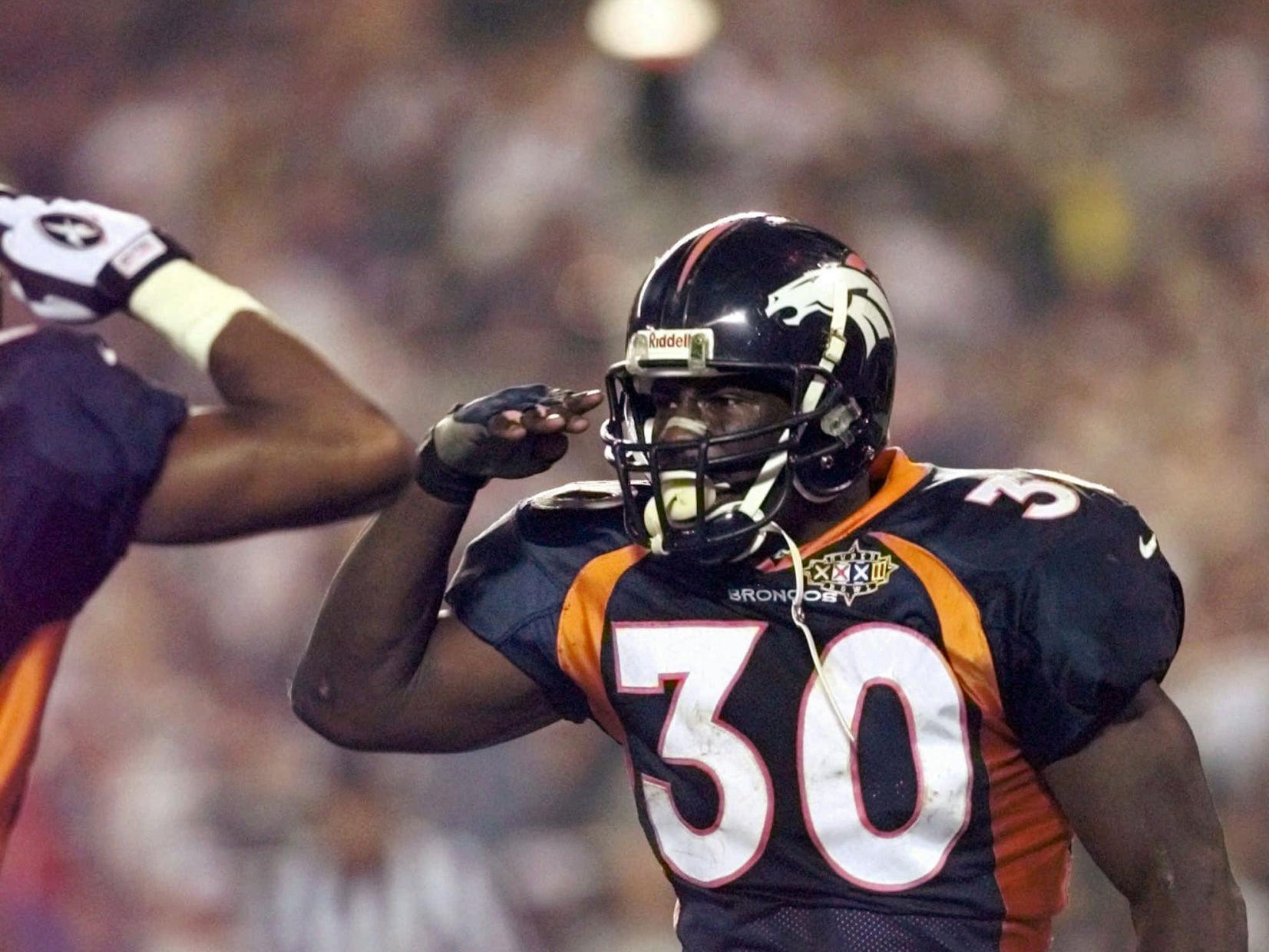
Terrell Davis and "The Mile High Salute"

January 25, 1998, 25 years ago: Super Bowl XXXII is played, at what was then known as Qualcomm Stadium in San Diego.

The NFC Champions were the Green Bay Packers. They had won the Super Bowl the year before, taking their 12th World Championship, leading all NFL teams. With an offense led by future Hall-of-Fame quarterback Brett Favre, and a defense led by future Hall-of-Famer Reggie White, they looked primed to repeat. Especially since the NFC had won 13 straight Super Bowls, going back to Super Bowl XVIII, won by the then-Los Angeles Raiders.

Another good sign for the Packers is that the AFC Champions were the Denver Broncos. This was their 5th trip to the Super Bowl, and they had lost the 1st 4. They had lost Super Bowl XII to the Dallas Cowboys, despite having a great defense known as the Orange Crush. They lost Super Bowl XXI to the New York Giants, Super Bowl XXII to the Washington Redskins, and Super Bowl XXIV to the San Francisco 49ers, all with John Elway as their quarterback and Dan Reeves as their head coach.

They had always sold out Mile High Stadium since 1977, the season of "Broncomania" that ended with the Super Bowl XII defeat. They were, far and away, the most popular sports team in the Rocky Mountain region, even thought the recently arrived Colorado Avalanche had won the 1996 Stanley Cup, for the region's 1st title; and the Colorado Rockies had sold more tickets than any team in Major League Baseball since their 1993 expansion debut.

They had some dramatic victories over the years, including their defeats of the Oakland Raiders in the 1977 AFC Championship Game, and of the Cleveland Browns in back-to-back AFC title games for the 1986 and 1987 seasons. But they couldn't win the big one.

Starting in 1968, the Broncos had worn orange jerseys (hence the "Orange Crush" nickname), and bright blue helmets with an orange D, with a charging white horse inside it. It was a hard logo to draw, but the whole thing was among the most distinctive uniform designs in sports.
John Elway, 1987

For 1997, they scrapped that for a new design, with purple jerseys with a weird new number font, and purple helmets with a white horse's head. This, too, was distinctive. I didn't like the change in number font, but the helmet was much better.
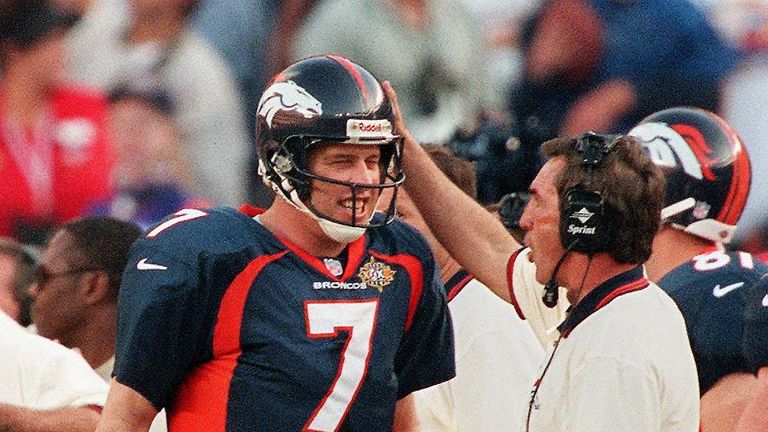
Elway and head coach Mike Shanahan, 1997

But new uniforms wouldn't be enough. The Cincinnati Bengals found that out in 1981, when they switched to their striped helmets, and made the Super Bowl, only to lose it.

But head coach Mike Shanahan had revamped the team after the Reeves years. He built a new defense, with end Neil Smith, linebacker Bill Romanowski, former San Francisco cornerback Tim McKyer, and a holdover from the previous Bronco Super Bowls, safety Steve Atwater, possibly the hardest hitter in the game at the time.

But Shanahan was an offense-first coach. He got Elway something he'd never had before: A star running back, to take some of the pressure off him. He was a University of Georgia graduate named Terrell Davis, and he was exactly what Elway needed to remove his name from consideration, alongside Y.A. Tittle, Dan Marino and Jim Kelly, for the title of "greatest quarterback to never win a World Championship."

The Broncos went 12-4 in 1997. All 4 losses were on the road: By 3 to the Oakland Raiders, 2 to the Kansas City Chiefs, 11 to the Pittsburgh Steelers, and 17 to the San Francisco 49ers. However, they did have a 2-3 stretch toward the end of the season, followed by a win over the San Diego Chargers in the regular-season finale.

The season before, they had an ignominious Playoff defeat at the hands of the Jacksonville Jaguars. This time, they not only avenged that defeat with a 42-17 win over the Jags at Mile High, but they also went on the road and avenged 2 of their regular-season defeats: They beat the Chiefs 14-10 at Arrowhead Stadium, and then, in the AFC Championship Game, went to Three Rivers Stadium, and beat the Steelers, 24-21.

The Broncos had shown character. Elway was much more mature, much more patient, and much less reliant on his cannon of an arm that he had been in the 1980s. If any AFC team could dethrone the Packers as Champions, it was the '97 Broncos.

*

The Packers got the ball first, and scored on their opening drive, a 22-yard touchdown pass from Favre to Antonio Freeman. The Broncos immediately struck back, helped by a defensive holding penalty that nullified an Elway incompletion on 3rd down. Davis, a San Diego native playing in the stadium where he'd grown up rooting for the Chargers and baseball's San Diego Padres, scored from a yard out. This remains the only Super Bowl where both teams scored on their opening drives.

The Packers' next drive ended when Tyrone Braxton intercepted Favre in Green Bay territory. Elway took advantage, and scored himself on a 1-yard run. The Broncos had led 10-9 at the half in Super Bowl XXI, and 10-0 early in the 2nd quarter of Super Bowl XXII. Both of those games fell apart, as the opposition outscored them 30-10 and 42-0 the rest of the way. But, having watched those games, I sensed something was different this time.

David later claimed that he played the game with a migraine headache, to the point where, until he took some medication, he was blind. But the Broncos made their own breaks: When Atwater sacked Favre and forced a fumble that Smith recovered, Jason Elam kicked a 51-yard field goal, then the 2nd-longest in Super Bowl history, and it was 17-7 Denver.

Late in the half, the Packers began a drive from their own 5, and Favre ended it with a 6-yard pass to Mark Chmura. The Pack went into the locker room trailing 17-14, and felt like they had the momentum. Would this be another Bronco Super Bowl collapse?

Maybe: Davis fumbled on the opening drive of the 2nd half, and the Packers converted that into a game-tying field goal. But the Packers stalled, and Elway went to work. His drive included a 36-yard pass to Ed McCaffrey. On 3rd & 6 from the Packer 12, Elway ran for 8 yards, and was hit by the Packers' LeRoy Butler and Mike Prior, spinning him in midair. The play became known as "The Helicopter," and it showed that Elway, previously thought of as a privileged pretty boy who couldn't get the big joe done, had some toughness. Two plays later, Davis scored on another 1-yard run. It was 24-17 Denver.

Early in the 4th quarter, Favre threw another touchdown pass to Freeman, tying the game. It was still tied with 3:27 left in regulation, when the Broncos forced the Packers to punt and got the ball back at the Packer 49. On the next play, Darius Holland made what might be the biggest mistake in Packer history, a facemask penalty on Davis that cost Green Bay 15 yards.

With 1:47 left, the Broncos were at 2nd & goal on the Packer 1. With 2 time-outs left, Packer coach Mike Holmgren told his players to let the Packers score, to give the offense enough time. Davis became the 1st player (and remains the only one) to rush for 3 touchdowns in a single Super Bowl. It was Broncos 31, Packers 24.

After each touchdown, Davis found the nearest teammate, and gave him a military-style salute. It became known as "The Mile High Salute."

There was 1:45 to go, with the Packers having 2 time-outs left. Freeman returned Elam's kickoff to the 30. Favre threw a screen pass to Dorsey Levens, who got to the Bronco 48 with 1:30 left. But the next play was also a screen pass to Levens. He caught it, but was stopped for no gain, and the Packers had to burn a time-out.

The Packers reached the Bronco 31, with 37 seconds to go. A field goal would do them no good. It was 3rd & 6. Favre threw to Brooks, who was covered by Randy Hilliard. Atwater also went for the ball, and his hit knocked out Brooks, Hilliard, and himself. NFL rules say that if players on both teams are injured and need medical attention on the field in the last 2 minutes of a game, both teams are charged with a time-out.

So it was 4th & 6 at the Bronco 31. There were 32 seconds left, and no time-outs. Favre looked for Chmura, but John Mobley broke it up, and the Broncos took over on down. Elway knelt on the ball for the last play of his greatest victory. After going 0-3 with Elway as quarterback, and 0-4 overall, the Denver Broncos were World Champions for the 1st time.

This broke a 13-year winning streak for the NFC. And a 37-year streak of failure for the Broncos to win the big one. It was John Elway's moment. But it wouldn't have happened without Terrell Davis, who, along with Atwater, tight end Shannon Sharpe, offensive tackle Gary Zimmerman, and team owner Pat Bowlen (but, thus far, not Shanahan), would join him in the Pro Football Hall of Fame.

Nine months later, Qualcomm Stadium became the only stadium ever to host the Super Bowl and the World Series in the same calendar year, as the Yankees beat the San Diego Padres. With no more groundsharing between MLB and professional football teams, it will likely never happen again. In the pre-Super Bowl era, the only stadiums hosting the World Series and the NFL Championship Game in the same year were in New York: The Polo Grounds in 1936; and Yankee Stadium in 1956, 1958 and 1962.

The Broncos went 15-1 the next season, and beat the Atlanta Falcons in Super Bowl XXXIII. Elway then retired.

Sunday, October 14, 2018

How Long It's Been: The San Diego Padres Won a Pennant

October 14, 1998, 20 years ago: The San Diego Padres beat the Atlanta Braves, 5-0 at Turner Field in Atlanta, in Game 6 of the National League Championship Series, and win the Pennant.

The Padres had won the 1st 3 games of the series, but the Braves had won the next 2, making some people think this might be the 1st time a Major League Baseball team could drop the 1st 3 games of a postseason series and win 4 straight to win it anyway.

But Sterling Hitchcock, pitching on short rest, pitched 5 shutout innings, allowing only 2 hits, and the San Diego bullpen pitched hitless ball over the last 4. Hitchcock would be named NLCS Most Valuable Player.

It is the 2nd Pennant for the Friars, the 1st coming in 1984. If you should ever meet a Chicago Cubs fan, do not mention this to him.

The Padres lost the ensuing World Series to the Yankees, but the run to the Pennant got the voters of San Diego County to vote, as a banner at Qualcomm Stadium asked, "YES ON C." This led to the team being able to leave what's now named SDCCU Stadium, and move into Petco Park for the 2004 season.

That saved major league sports in San Diego. They've never had an NHL team, and their WHA team, the San Diego Mariners, folded in 1977. In basketball, the ABA's San Diego Sails folded in 1975, and the NBA's Clippers moved to Los Angeles in 1984. And, following the City of San Diego's refusal to build them a new stadium to replace San Diego/Jack Murphy/Qualcomm/SDCCU Stadium, the city's original major league sports team, the AFL/NFL's Chargers, moved back to Los Angeles after 56 seasons in San Diego.

The Padres are all that's left. They were a rough expansion team from 1969 to 1974. Since then, they've rarely been outright bad, and they've won the National League Western Division in 1984, 1996, 1998, 2005 and 2006, and lost a Playoff for the NL Wild Card in 2007. But they've only won 2 Pennants, and are 1-8 in World Series play, having won Game 2 in San Diego against the Detroit Tigers in 1984, and getting swept by the Yankees in 1998.

That Pennant won on October 14, 1998 remains their last. That's 20 years. How long has that been?

*

The 1998 team was easily the most talented in the Padres' 1st half-century of existence. Manager Bruce Bochy had 2 future Hall-of-Famers: Right fielder Tony Gwynn, an 8-time NL batting champion and soon to be a member of the 3,000 Hit Club; and Trevor Hoffman, later to be the major leagues' all-time saves leader and still the NL's all-time leader.

There are also All-Stars in pitchers Kevin Brown, Mark Langston and Randy Myers; 1st baseman Wally Joyner, 3rd baseman and 1996 NL MVP Ken Caminiti, and outfielders Greg Vaughn and Steve Finley.

This was the 1st season of play for the Arizona Diamondbacks and the Tampa Bay Rays (or Devil Rays, as they were then known). Due to these new teams coming in, realignment meant that the Milwaukee Brewers were moved from the American League to the National League. The Houston Astros have since moved from the NL to the AL. And the Montreal Expos have since moved to become the Washington Nationals.

Half of all MLB teams, 15 out of 30, have since built new ballparks: The Seattle Mariners in 1999; the Detroit Tigers, the Houston Astros and the San Francisco Giants in 2000; the Milwaukee Brewers and Pittsburgh Pirates in 2001; the Cincinnati Reds in 2003, both the Padres and the Philadelphia Phillies in 2004, the St. Louis Cardinals in 2006, the Nationals in 2008, both New York teams in 2009, the Minnesota Twins in 2010, the Miami Marlins in 2012 and the Atlanta Braves in 2017.

The Boston Red Sox had not won the World Series in 80 years, the Chicago White Sox in 81, the Chicago Cubs in 90; the Giants since moving to San Francisco; the Diamondbacks, the Los Angeles Angels and the Astros, never. The Diamondbacks, the Angels, the Astros, the Colorado Rockies, the Rays and the Texas Rangers had never won a Pennant. The Diamondbacks, and the Expos/Nationals franchise, had never won a Division title in a full season, or even made the Playoffs in one.

All of those things were then true, but are no longer.

The following players were already in the Baseball Hall of Fame, and were still alive, but are no longer: Joe DiMaggio, Bob Feller, Bobby Doerr, Monte Irvin, Lou Boudreau, Enos Slaughter, Hal Newhouser, Ted Williams, Early Wynn, Pee Wee Reese, Phil Rizzuto, Bob Lemon, Stan Musial Larry Doby, Warren Spahn, Red Schoendienst, Ralph Kiner, Yogi Berra, Duke Snider, Robin Roberts, Al Lopez, Eddie Mathews, Hoyt Wilhelm, Ernie Banks, Harmon Killebrew, Jim Bunning, Willie Stargell, Catfish Hunter. Also manager Earl Weaver, and former American League President Lee MacPhail.

Gwynn, Gary Carter and Kirby Puckett were not yet in. Nor were managers Dick Williams and Sparky Anderson, nor umpire Doug Harvey, nor former Commissioner Bowie Kuhn. They all lived long enough to see themselves elected, but have also since died.

As I said, Gwynn and Hoffman were then active, and were later elected to the Hall of Fame. So were Dennis Eckersley, Paul Molitor, Tim Raines, Rickey Henderson, Cal Ripken, Wade Boggs, Barry Larkin, Greg Maddux, Tom Glavine, Roberto Alomar, Craig Biggio, Randy Johnson, John Smoltz, Ken Griffey Jr., Frank Thomas, Jeff Bagwell, Ivan Rodriguez, Jim Thome, Mike Piazza, Pedro Martinez, Trevor Hoffman, Chipper Jones and Vladimir Guerrero.

They will almost certainly be joined over the next few years by Yankees Mariano Rivera, Derek Jeter, Mike Mussina, and possibly Andy Pettitte and Curt Schilling. As for steroid-clouded active-1998 players like Mark McGwire, Sammy Sosa, Barry Bonds, Roger Clemens, Manny Ramirez, Gary Sheffield and Rafael Palmeiro, your guess is as good as mine. But it would be the height of hypocrisy if, upon both of them becoming eligible in 2022, David Ortiz (debuted in 1997) got in but Alex Rodriguez (1994) didn't.

In 1998, current Padres manager Andy Green was at the University of Kentucky. Aaron Boone of the Yankees was playing for the Cincinnati Reds. Mickey Callaway was playing in the Devil Rays' farm system.

Barry Trotz of the Islanders had just become the 1st head coach of the Nashville Predators. Pat Shurmur of the Giants was the offensive coordinator at Stanford University. Todd Bowles of the Jets was the defensive coordinator at Grambling State University in Louisiana. David Fizdale of the Knicks was an assistant coach at the University of San Diego. John Hynes of the Devils was an assistant coach at Boston University. David Quinn of the Rangers was an assistant coach at the University of Nebraska at Omaha (not to be confused with the main campus in Lincoln). Kenny Atkinson of the Nets was playing in the Spanish basketball league. Speaking of Spain, Domenec Torrent of NYCFC was managing Palafrugell in Girona, Catalonia. And Jesse Marsch of the Red Bulls was helping the Chicago Fire go from MLS expansion team to MLS Cup and U.S. Open Cup "Double" winners in just 1 season.

The defending World Champions were the Florida Marlins, the Denver Broncos, the Chicago Bulls, the Detroit Red Wings, and D.C. United. The Heavyweight Champion of the World was Evander Holyfield. Arsenal had won England's Premier League and its FA Cup, for a Double, while Real Madrid broke a 32-year drought to win the UEFA Champions League.

The Olympic Games have since been held in America, Australia, Greece, Italy, China, Canada, Britain, Russia, Brazil and Korea. The World Cup had just been won by France, on home soil, and has since been held in Japan, Korea, Germany, South Africa, Brazil and Russia.

Only 3 Justices then on the U.S. Supreme Court are still on it now: Clarence Thomas, Ruth Bader Ginsburg and Stephen Breyer. The idea that corporations were people, and entitled to the rights thereof, was ridiculous -- but then, so was the idea that people of the same gender could marry, and get all the rights and protections thereof.

The President of the United States was Bill Clinton, and he was under an impeachment inquiry for things far less serious than Donald Trump is under investigation for now. Trump was then married to his 2nd wife, Marla Maples. Barack Obama was a State Senator in Illinois. George W. Bush was running for re-election as Governor of Texas. Former Presidents Gerald Ford, Jimmy Carter, Ronald Reagan and George H.W. Bush, their wives, and the widow of Lyndon B. Johnson were all still alive.

The Mayor of San Diego was Susan Golding, the city's 1st Jewish Mayor, a Republican but one who was pro-choice, pro-environmental protection, pro-affirmative action and pro-gay rights, flying in the face of a previous Mayor, then running out the string as Governor of California, Pete Wilson, about to be succeeded by Gray Davis. She is now the CEO of the Child Abuse Prevention Foundation.

Current Mayor Kevin Faulconer was then a public relations executive -- which helps in governing, and definitely in elections. Jerry Brown, about to leave the Governorship for the 2nd time, was launching his political comeback, about to be elected Mayor of Oakland.

The Governor of the State of New York was George Pataki. The Mayor of the City of New York was Rudy Giuliani. The Governor of New Jersey was Christine Todd Whitman. As for the current holders of those posts: Andrew Cuomo was U.S. Secretary of Housing & Urban Development, Bill de Blasio was one of his aides, and Phil Murphy was running the Asia office of Goldman Sachs out of Hong Kong.

There were still living veterans of World War I, the Bolshevik Reovlution, the Balkan Wars of 1912-13, and the Mexican Revolution of 1910-20. There were still survivors of the 1900 Galveston Hurricane, the 1904 General Slocum fire, the 1911 Triangle Shirtwaist Factory fire, and the sinkings of the Titanic and the Lusitania.

The Nobel Peace Prize had just been awarded to John Hume and David Trimble, for their work on the Good Friday Accord that ended "The Troubles" in Northern Ireland after 30 years. The Pope was John Paul II. Pope Francis, the current Pontiff, Jorge Mario Bergoglio, was the Archbishop of Buenos Aires.

The Prime Minister of Canada was Jean Chrétien, and of Britain Tony Blair. The monarch of each was Queen Elizabeth II -- that hasn't changed. There have since been 4 Presidents, 4 Prime Minister of Britain, and 3 Popes.

Major novels of 1998 included Blood Work by Michael Connelly, About a Boy by Nick Hornby, and Giles Foden's dramatization of Uganda's dictator Idi Amin, then still alive, The Last King of Scotland. All would be made into major motion pictures. Alexander McCall Smith's The No. 1 Ladies' Detective Agency would become a TV series. Stephen King published Bag of Bones, J.K. Rowling
Harry Potter and the Chamber of Secrets, and George R.R. Martin A Clash of Kings.

No one had yet heard of Ash Ketchum, Robert Langdon, Master Chief, Rick Grimes, Wynonna Earp, Lisbeth Salander, Bella Swan or Katniss Everdeen.

Notable films of the Autumn of 1998 included Rush Hour, Ronin, What Dreams May Come, Beloved, Bride of Chucky, Practical Magic, Apt Pupil, Life Is Beautiful, Pleasantville, American History X, Elizabeth, Gods and Monsters, and the football film The Waterboy.

George Lucas was working on Star Wars, Episode I: The Phantom Menace. If anyone told him, "Wait a minute... " about any part of it, he didn't listen. Steven Spielberg was about to release Saving Private Ryan. The Next Generation cast was filming Star Trek: Insurrection.

Pierce Brosnan was playing James Bond, Dean Cain had recently wrapped up playing Superman, George Clooney (with help from director Joel Schumacher) had nearly ruined Batman, Lynda Carter was still the last live-action Wonder Woman, and Nicholas Hammond still the last live-action Spider-Man. And Paul McGann's one-shot deal was the only appearance of The Doctor since 1989.

Whose Line Is It Anyway?, That '70s Show, Total Request Live, The King of Queens, Felicity, The Hughleys, Sports Night, Martial Law, V.I.P, Seven Days, the original versions of Will & Grace and Charmed, and the cartoons The Wild Thornberrys, Pokemon and Rolie Polie Olie, and the disastrous The Secret Diary of Desmond Pfeiffer had recently premiered. The Famous Jett Jackson, Becker, Jay Jay the Jet Plane and The Powerpuff Girls soon would.

No one had yet heard of Tony Soprano, Jed Bartlet, Jack Bauer, Omar Little, Leroy Jethro Gibbs, Michael Bluth, Michael Scott, Don Draper, Walter White, Jax Teller, Richard Castle, Leslie Knope, Sarah Manning or Jane "Eleven" Hopper.

The Number 1 song in the country was "The First Night," by Monica Arnold, who went by only her first name, and, by this point, was the only Monica anyone wanted to hear about. Cher was about to release her 22nd studio album; Britney Spears, her 1st. Frank Sinatra had recently died. So had Linda McCartney, wife of ex-Beatle Paul. Bob Dylan was touring in support of his album Time Out of Mind, and Michael Jackson had just become the father of Paris Jackson.

Inflation was such that what $1.00 bought then, $1.54 would buy now. A U.S. postage stamp cost 32 cents, and a New York Subway ride $1.50. The average price of a gallon of gas was $1.12, a cup of coffee $1.86, a McDonald's meal (Big Mac, fries, shake) $5.69, a movie ticket $4.58, a new car $20,238, and a new house $181,500. The Dow Jones Industrial Average closed that day at 7,968.79.

The tallest building in the world was the Petronas Towers in Kuala Lumpur, Malaysia. Mobile phones had become common, but they didn't yet have Internet connections. There was no Wikipedia, no Skype, no MySpace, no Facebook, no YouTube, no Twitter, no Tumblr, no Pinterest, no Instagram. There was no iPod, no iPhone, no iPad. The Nintendo PlayStation was the leading home video game system.

In the Autumn of 1998, a Swissair MD-11 crashed off the coast of Nova Scotia, killing 229 people. An oil pipeline explosion in kills over 1,000 people in Nigeria. Hurricane Mitch kills 11,000 people in Central America. The Iranian government retracted its fatwa against novelist Salman Rushdie. Europol was founded. Prime Minister John Howard and his Liberal Party were re-elected in Australia -- a country whose conservative party is named the Liberal Party. Former Chilean President Augusto Pinchoet was arrested for war crimes in Britain.

In America, Matthew Shepard was tortured and murdered, giving the gay rights movement its 1st true martyr since Harvey Milk, 20 years earlier. And Google was founded.

George Wallace, and Doak Walker, and Florence Griffith Joyner died. So did baseball figures Gene Autry, Dan Quisenberry, and Mark Belanger. And championship New York head coached William "Red" Holzman and Wilbur "Weeb" Ewbank. Nolan Gould, and Trae Young, and Christian Pulisic were born.

October 14, 1998. The San Diego Padres won the National League Pennant. They have never won another.

Might another one be soon in coming? They lost 96 games in 2018, and 91 the year before that, which doesn't suggest much. We shall see.

Thursday, October 2, 2014

How to Be a New York Football Fan In San Diego -- 2014 Edition

NOTE: This was written before the Chargers moved back to Los Angeles.

Between things happening in the real world, I neglected to do this one until it was nearly too late: The Jets' game away to the San Diego Chargers is this Sunday afternoon.

Before You Go. Unlike the Seattle and San Francisco Bay Areas, but like the Los Angeles area, the San Diego area has very consistent weather. It’s a nice place to visit, and there's little threat of earthquakes, mudslides and smog -- but there have been wildfires, including one that led to a Chargers home game being moved to Phoenix a few years ago.

The website of the San Diego Union-Tribune (yet another paper that, not that long ago, used to be two separate papers), is predicting low 80s by day, mid-60s by night, and, as you might expect for San Diego, no precipitation for the entire weekend. A short-sleeve shirt should be enough, no jacket necessary. Just in case, you may want to bring sunscreen.

San Diego is in the Pacific Time Zone, 3 hours behind New York. Adjust your timepieces accordingly.

If you're planning on making a side trip to Tijuana, Mexico, 25 miles south of downtown San Diego, be sure to bring your passport. If you don't have a passport, it's too late to get one for this trip, so if you're going to San Diego, do not attempt to cross the Border.

The bright-red San Diego Trolley runs between its namesake city and the San Ysidro stop, which sits adjacent to the pedestrian bridge leading to the Tijuana border-crossing station. Tourists also can drive down to the border on I-5 south and park their cars in one of the long-term lots on the U.S. side before walking across the bridge into Mexico and returning the same way.

Myriad companies also offer bus tours from San Diego to Tijuana and back if you're looking for a guided experience. Frommer's recommends Baja California Tours as well as Gray Line San Diego and Five Star Tours for such services.

Alternatively, you can drive to Tijuana after passing through the highway inspection gate at the border. However, I've been informed that if you drive into Mexico, you must get Mexican auto insurance first. They don't accept U.S. insurance, and if you get into an accident in Mexico without insurance, they can put you in jail. Also, the border crossing, especially on the way back into the U.S., might have as big a traffic backup as the George Washington Bridge at rush hour. Make sure you have enough gas before you leave San Diego -- or buy gas in Tijuana.

Tickets. The Chargers averaged 64,205 fans per home game last season, about 90 percent of capacity. There were 10 NFL teams with lower attendance, but only 6 with a lower percentage. This is one of the reasons the team is in danger of having to move. But it will make getting tickets easier than for most teams. (Indeed, of the Chargers' 6 remaining home games, only the one against the New England Patriots is sold out at this writing.)

Field Level seats are $120-130, Plaza Level $98-130, Loge Level $98, Lower View Level & View Sideline $79, View Level Endzone West $65, and View Level Endzone East $52.

Getting There. It’s 2,803 miles from Times Square in New York to downtown San Diego. In other words, if you’re going, you’re flying. And not just because I waited too long to post this to make driving, Amtrak or Greyhound possible.

After all, even if you get someone to go with you, and you take turns, one drives while the other one sleeps, and you pack 2 days’ worth of food, and you use the side of the Interstate as a toilet, and you don’t get pulled over for speeding, you’ll still need over 2 full days. Each way.

But, if you really, really want to, well, in order to get there in time for this series, you're too late to see the whole thing. So, for future reference... You’ll need to get on the New Jersey Turnpike. Take it to Exit 14, to Interstate 78. Follow I-78 west all the way through New Jersey, to Phillipsburg, and across the Delaware River into Easton, Pennsylvania. Continue west on I-78 until reaching Harrisburg. There, you will merge onto I-81. Take Exit 52 to U.S. Route 11, which will soon take you onto I-76. This is the Pennsylvania Turnpike, the nation’s first superhighway, opening in 1940.

The Turnpike will eventually be a joint run between I-76 and Interstate 70. Once that happens, you’ll stay on I-70, all the way past Pittsburgh, across the little northern panhandle of West Virginia, and then across Ohio, Indiana and Illinois, into Missouri.

At St. Louis, take Exit 40C onto Interstate 44 West, which will take you southwest across Missouri into Oklahoma.  Upon reaching Oklahoma City, take Interstate 40 West, through the rest of the State, across the Texas Panhandle and New Mexico, into Arizona.  At Flagstaff, take Interstate 17 South, which will take you into Phoenix.  Take Interstate 10 West to Exit 112 for Arizona Route 85 South, to Gila Bend, right on Arizona route 238 West, which will flow into Interstate 8 West. This will take you across Arizona and California to San Diego.

If you do it right, you should spend about an hour and 15 minutes in New Jersey, 5 hours and 30 minutes in Pennsylvania, 15 minutes in West Virginia, 3 hours and 45 minutes in Ohio, 2 hours and 45 minutes in Indiana, another 2 hours and 45 minutes in Illinois, 5 hours in Missouri, 6 hours in Oklahoma, 3 hours in Texas, 6 hours and 15 minutes in New Mexico, 6 hours in Arizona, and 3 hours in California.  That’s about 45 hours and 30 minutes. Counting rest stops, you're probably talking about 57 hours.

That’s still faster than Greyhound (about 70 hours, changing buses anywhere from 2 to 4 times, $570 round-trip, station at 1313 National Avenue at Commercial Street -- 3 blocks from the ballpark!) and Amtrak (71 hours, 40 minutes, $776 round-trip, Santa Fe Depot at 1050 Kettner Blvd. at Broadway). But flights to San Diego International Airport, also known as Lindbergh Field, will be a lot more expensive, and will usually involve changing planes in Chicago.

Public transportation in San Diego is pretty good, with buses, trolleys and light rail readily available. Petco Park is accessible on the Orange Line at Gaslamp Quarter station, and on the Orange and Blue Lines at 12th & Imperial Transit Center station. The fare is $2.50.

Once In the City. San Diego was founded by Spain as a mission, San Diego of Alcalá (Saint Didacus in Latin), in 1769, and well into the 19th Century was larger than San Francisco, and even at the dawn of the 20th Century was larger than Los Angeles. Being (just about literally) tucked away in a corner of the country, it was pretty much bypassed, but World War II led to the U.S. Navy base being built there, and its population took off again, to where it was major-league capable by the 1960s.

Today, 1.35 million people live within the city limits, and 3.1 million in the metro area. Front Street is the delineator between streets with East and West as prefixes, while Broadway is that for those running North and South. The city does not have a beltway, although Interstate 8 (north), Interstate 805 (east), California Route 54 (south) and Harbor Drive (west) could be said to fit that function.

Sales tax is a minimum 7.5 percent in the State of California, and 8 percent in San Diego County, which includes, but is not contiguous with, the City of San Diego. ZIP Codes in the San Diego area start with the digits 919, 920 and 921, and the Area Codes are 619, 760 and 858.

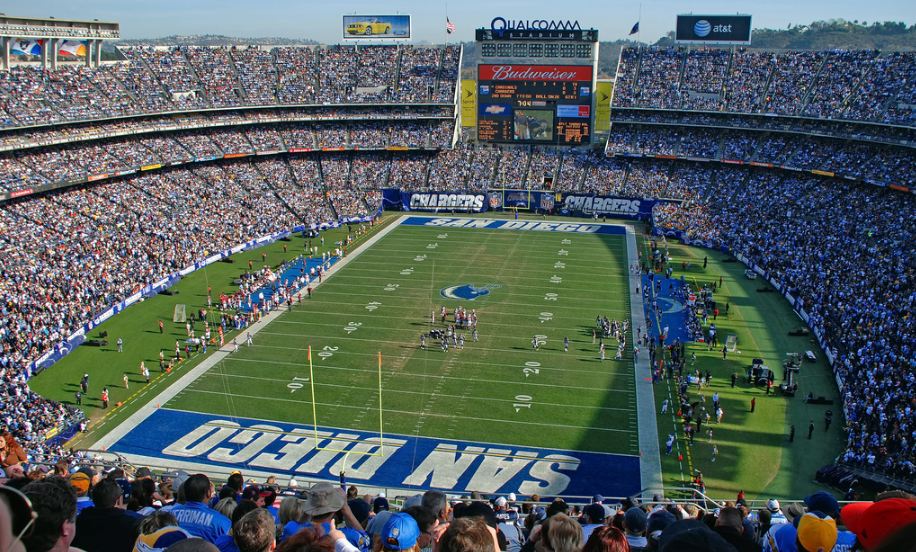
Going In. Qualcomm Stadium -- naming rights are owned by the locally-headquartered semiconductor company -- is about 7 miles northeast of downtown. Take the Green Line trolley from the 12th & Imperial Transit Center downtown, to Qualcomm Stadium Station. The ride is 31 minutes, and costs $2.50 each way.
Jack Murphy Stadium, before its 1990s expansion

If you're driving in from downtown (say, from your hotel), take 11th Street north until it becomes the Cabrillo Freeway (California Route 163), to Exit 3B for Friars Road. The stadium will be 2 1/2 miles ahead on the right. It should take about 15 minutes to get from downtown into the parking lot. The address is 9449 Friars Road, near the intersection of Interstates 8 and 15.
Qualcomm Stadium, after the expansion

On their website, the Chargers say that the parking lot opens 4 hours prior to kickoff, and recommends that driving fans arrive at least 2 hours before, because the lot can be expected to reach capacity and close an hour before kickoff. Following this instruction should give you time to tailgate, should you desire to do so. Parking in the Inner Ring is $45, and $25 in the Outer Ring. Tailgate parties in San Diego frequently include Mexican food, including the dreaded fish tacos.

Built in 1967 as San Diego Stadium, and from 1980 to 1996 named Jack Murphy Stadium, for the San Diego Union sportswriter (and brother of Mets broadcaster Bob Murphy) who so long lobbied, finally successfully, for San Diego to get MLB and pro football teams, The Q has circular ramps at its corners, much like Giants Stadium did. What can I say: Stadium and arena architecture, unlike sports itself, seemed to have been influenced by the drug culture of the late 1960s and the '70s. Capacity is 70,561.
Being in the California sunshine, the field has always been natural grass, and has nearly always looked good. Unlike most football stadiums, the field is (more or less) aligned east-to-west. However, the stadium is tall enough that the upper reaches make sunlight less of an issue than it would ordinarily be.

Despite being the 3rd-oldest stadium in the NFL (only Green Bay's Lambeau Field and the Oakland Coliseum are older), Qualcomm Stadium is in decent shape. However, it doesn't have the revenue-driving modern luxury boxes that team owners want, and Chargers owner Alex Spanos wants a new stadium very badly. And San Diego City and San Diego County voters, generally conservative, don't seem to want to have their tax dollars spent to build it. So it now seems less like if the Chargers will move, probably up the coast to Los Angeles from whence they came in 1961, and more like when.

The Q has hosted 3 Super Bowls: XXII, 1988, Washington over Denver; XXXII, 1998, Denver over Green Bay; and XXXVII, 2003, Tampa Bay over Oakland. Without sufficient luxury suites, it will never hold another; if San Diego is ever to host another Super Bowl, it will have to be in a new stadium.

There is no mention at The Q of the 7 games played there by the U.S. national soccer team. The most recent was on July 5, 2013, a win over Guatemala.

Food. Being just 15 miles from the Mexican border, you might expect Qualcomm Stadium to feature Mexican and Southwestern-style food. Your expectations would be somewhat fulfilled, as there are nacho stands all over the place, a Tortilla Junction stand is at Plaza Level Section 34, and a Margarita Beach Bar at Plaza Level Section 28.

Wannaburger and San Diego Smokehouse stands are all over the stadium. Oggi's Pizza and Juma's Café (featuring ice cream and Starbucks-style drinks) have multiple stands. And, while San Diego is not known for barbecue (unlike, say, Kansas City, or Texas, or Memphis, or the Carolinas), a Sweet Baby Ray's stand is at Plaza Level Section 20.

Team History Displays. There are no displays in the seating area at Qualcomm for the Chargers' 1963 American Football League Championship, their 1994 AFC Championship, or for their Division Championships of 1960 (spending their 1st season in Los Angeles), 1961, 1963, 1964, 1965, 1979, 1980, 1981, 1992, 1994, 2004, 2006, 2007, 2008 and 2009. Nor is there any viewable display for their 3 retired numbers: Dan Fouts' 14, Lance Alworth's 19 and Junior Seau's 55. (UPDATE: They have since added LaDainian Tomlinson's 21.)

However, the members of the San Diego Chargers Hall of Fame can now be viewed in a Ring of Honor, on the press level on the visiting team's side. There are currently 37 members, as follows:

* From their 1960 and '61 Division titles (but not their 1963 AFL title): Linebacker Bob Laraba, Number 53.

* From their 1963 AFL Championship, the only time any San Diego major league team has gone as far as the rules of the time allowed them to go: Team founder-owner Barron Hilton; minority owner George Pernicano; head coach Sid Gillman; quarterback John Hadl, Number 21; running backs Paul Lowe, Number 23, and Keith Lincoln, Number 27; receiver Lance Alworth, Number 19; tight end Jacque MacKinnon, Number 38; guard Walt Sweeney, Number 78; offensive tackle Ron Mix, Number 74; defensive tackle Ernie Ladd, Number 77; defensive end Earl Faison, Number 86; linebackers Chuck Allen, Number 50, Frank Buncom, Number 55, and Emil Karas, Number 56. The 1963 team as a whole has also been inducted.

(William Barron Hilton named the team after the credit card he founded, Carte Blanche. He's also the son of hotel magnate Conrad Hilton, the brother of Elizabeth Taylor's 1st husband Conrad Nicholson Hilton Jr. a.k.a. Nicky Hilton, and the grandfather of Paris and Nicky Hilton. He is about to turn 87 years old, and, although he no longer has anything to do with the team, he is the last surviving member of "The Foolish Club," the 8 original AFL owners, following the recent deaths of Ralph Wilson of the Buffalo Bills and Bud Adams of the Houston Oilers/Tennessee Titans.)

* From their 1964 and '65 Division titles (but not their 1963 AFL title): Cornerback Leslie "Speedy" Duncan, Number 45.

* From the dark days between their 1965 and 1978 Playoff berths: Receiver Gary "the Ghost" Garrison, Number 27.

* From their 1978, '79, '80 and '81 Playoff teams: Head coach Don Coryell; quarterback Dan Fouts, Number 14; receivers Charlie Joiner, Number 18, and Wes Chandler, Number 89; tight end Kellen Winslow, Number 80; center Don Macek, Number 62; guards Doug Wilkerson, Number 63, and Ed White, Number 67; offensive tackle Russ Washington, Number 70; defensive tacklers Louie Kelcher, Number 74, and Gary "Big Hands" Johnson, Number 79; defensive end "Mean" Fred Dean, Number 71; and placekicker Rolf Benirschke, Number 6. Gene Klein, the car-dealership, movie theater and insurance mogul who owned the team in this period, has not yet been inducted.

* From their 1992 Division title (but not their 1994 AFC title): Cornerback Gill Byrd, Number 22.

* From their 1994 AFC Championship, leading to their only Super Bowl berth to date: Head coach Bobby Ross, the former Georgia Tech coach who beat Barry Switzer of Oklahoma and Dallas by 1 year to becoming the first coach to win a college National Championship and coach in a Super Bowl (though Switzer topped him by winning both); quarterback Stan Humphries, Number 12; linebacker Junior Seau, Number 55; and defensive end Leslie O'Neal, Number 91, who just became the newest member of this Ring of Honor.

* From their 1995 Playoff appearance (but not 1994): Punter Darren Bennett, Number 2.

As yet, no one has been inducted from their 2000s AFC West titles. But several players from their 2007 team that reached the AFC Championship Game were named in 2010 to their 50th Anniversary team, including 4 players still with the club: Quarterback Philip Rivers, center Nick Hardwick, tight end Antonio Gates and punter Mike Schifres. Running back LaDainian Tomlinson, who finished his career with the Jets, also made that 50th Anniversary Team, but not yet their team Hall of Fame/Ring of Honor.

Alworth and Winslow were named to the NFL's 75th Anniversary Team in 1994. They, Fouts and Joiner were named to The Sporting News' 100 Greatest Football Players in 1999. Alworth, Winslow and LaDainian Tomlinson were named to the NFL Network's 100 Greatest Players in 2010. Alworth, Mix, Lowe, Sweeney, running back Bob Scarpitto, tight end Dave Kocourek, cornerback Miller Farr and safety Kenny Graham were named to the AFL All-Time Team.

Outside the stadium is a statue of Jack Murphy, with his dog Abe immortalized along with him. While Qualcomm retains naming rights through 2017, officially, the playing surface has been named Jack Murphy Field, and many locals still call the stadium The Murph.
The Chargers have had 4 Heisman Trophy winners play for them: Running back Mike Garrett (USC 1965, Chargers 1970-73), running back Johnny Rodgers (Nebraska 1972, 1977-78), running back John Cappelletti (Penn State 1973, 1980-83), and quarterback Doug Flutie (Boston College 1984, 2001-04).

The Chargers' big rivalry is with the Raiders, and this was true in both Oakland and Los Angeles. The Raiders lead it, 59-48-2. (UPDATE: Through the 2017 season, the Chargers' 1st back in L.A., it's 63-52-2.)

Stuff. The Chargers Team Store is located at Gate G, and is open year-round. On game days, a game ticket is required to enter, and it closes one hour after the game ends.

The Chargers arrived in San Diego in 1961, predating any other major-league (or "major-league") team in the city, including the major-league version of the Padres by 8 years. They have surpassed their 50th Anniversary, so they do have some history, however spotty. The NFL has released a History of the San Diego Chargers DVD, going up to their 50th Anniversary season of 2010, so there will be some current players on it.

There aren't many books about the team, and the best is probably the rather unimaginatively titled The Story of the San Diego Chargers, by Jim Whiting, which takes you up through the 2012 season.

UPDATE: In 2015, Dave Steidel, who previously wrote Remember the AFL, published The Uncrowned Champs: How the 1963 San Diego Chargers Would Have Won the Super Bowl. Lance Alworth wrote the forward. Steidel had someone run a computer simulation showing how a game against the 1963 NFL Champion Chicago Bears -- "Super Bowl -III," if you will -- would have gone. It's not exactly a spoiler to tell you the result: Like Death of a Salesman, The Man Who Shot Liberty Valance and Kill Bill, the ending is in the title.

During the Game. The Chargers' greatest rivals, as you might guess, are the closest AFC team, the Oakland Raiders. The rivalry was especially intense from 1982 to 1994, when the Raiders were in Los Angeles. But you are not Raider fans, so the locals should fit the reputation of the laid-back Southern Californian: No one is going to fight you.

Although the team was named for Barron Hilton's Carte Blanche credit card, the logo frequently combined 2 other meanings of "charger": A lightning bolt and a horse. Only the lightning bolt has ever been on the team's helmets, although in their AFL days the player's uniform number was underneath it. While a horse mascot might make sense, instead, the "Bolts" have "Boltman," a lightning bolt caricature wearing a blue jersey.

Ted Giannoulas, known in costume as The Famous Chicken, began as the KGB Chicken. No, he wasn't a Russian spy. He was a student at San Diego State University, working for a San Diego radio station, KGB-FM. San Diego State has also used San Diego Stadium/the Murph/Q since it opened. Ted can be seen in his original costume on NFL Films' production of the 1978 Charger-Raider "Holy Roller" game, feigning passing out at the successful result of the Raiders' blatant cheating. Following a contract dispute with the station, he got a new costume (one not copyrighted by the station) and was reborn, or rather hatched out of a giant egg, on the field at San Diego Stadium before a Padres game in June 1979 as "the San Diego Chicken."

Starting in 1981, he was part of the cast of NBC's Saturday pregame show The Baseball Bunch, starring Johnny Bench, where he was referred to as simply "The Chicken." He became so much in demand that he could no longer belong only to his hometown, and began going everywhere. He and the Phillie Phanatic have done more to elevate the sports mascot to icon status than anyone, including Mr. Met and college sports mascots. But don't expect to see him at a Chargers game these days. (According to his website, he has no activity listed for this weekend.)

The theme song "San Diego Super Chargers," recorded in 1979 in the closing days of disco and the opening days of their "Air Coryell" attack, has a very disco feel, but even in 2014 is played after every Chargers score and every Chargers win.


After the Game. San Diego has had its crime issues, but The Q isn't in a bad neighborhood -- it's an island in a sea of parking, so it's not in any neighborhood. That might help.

What won't help is that it's pretty far from downtown. If you want to get a postgame meal or drink, your best bet is probably to head downtown. San Diego's Gaslamp District has plenty of nightspots, so finding a good place for a postgame meal or drink shouldn't be too hard. And although the city has a reputation for gang violence -- as Met fans, you may have heard San Diegan Kevin Mitchell tell horror stories about it -- downtown is very safe.


If you're looking for New Yorker-friendly establishments, Henry's Pub, at 618 5th Avenue between G & Market Streets, is the home of the local Jets fan club. It is 6 blocks from Petco Park, home of the Padres. I have heard of 2 separate bars as being home of local Giants fan clubs. The Knotty Barrel is at 844 Market Street at 9th Avenue, 5 blocks from Petco. And the U-31 Cocktail Lounge is at 3112 University Avenue at 31st Street, however, it is 6 miles northeast of the ballpark -- a bit closer to Qualcomm.

I have heard that Slater's 50/50 is a Yankee Fan hangout. 2750 Dewey Road at Historic Decatur Road, just off NTC Park. Green Line to Old Town Transit Center, transfer to Bus 28. 

If you visit San Diego during the European soccer season, which is currently underway, the main "football pub" in town is Shakespare Pub & Grill. 3701 India Street and Winder Street, in the Five Points area, about 3 miles northwest of downtown. Green Line to Washington Street.

Sidelights. San Diego has produced more native sons (and daughters) who were great athletes than its teams have. As a result, there isn't a lot of glory associated with these teams. Some have suggested that there's a curse on the city, with the most common story being the selling of the city's first great major league star, Chargers receiver Lance Alworth, to the Dallas Cowboys. Alworth, a.k.a. Bambi, won Super Bowl VI with the Cowboys, but no San Diego major league team has gone as far as the rules allowed them to do since Alworth and the 1963 Chargers, AFL Champions, who did not get to play that year's NFL Champions, the Chicago Bears, in a Super Bowl.

* Lane Field. Home to the PCL Padres from 1936 to 1957, including the 1937 PCL Pennant that featured a 19-year-old San Diego kid named Ted Williams. By the time the Padres won another Pennant in 1954, the 8,000-seat pitcher's park, on the waterfront, with a Spanish-style entrance and faraway fences except at the right field pole, was termite-ridden and had to be abandoned.

Broadway, Harbor Drive and Pacific Highway. The Santa Fe Depot and the USS Midway Museum (a retired WWII-era aircraft carrier) are adjacent to the site.  Number 7 bus.  The Maritime Museum of San Diego is 3 blocks to the north.


* Westgate Park.  The PCL Padres' next home was in Mission Valley, at (appropriately enough) Friars Road and the Cabrillo Freeway. This park seated only a few more than Lane Field, but unlike its predecessor, which had no roof to protect fans from the hot, nearly-Mexican sun, Westgate had a roof covering the entire seating area.


Supposedly, it was expandable to 40,000, in the event that San Diego could do what Los Angeles and San Francisco had done, and bring in a major league team, through move or expansion. But the Chargers wanted a modern stadium, too, so one stadium was built for both teams. The Padres won Pennants at Westgate in 1962, 1964 and 1967, their last season there. The Fashion Valley Mall is now on the site. Fashion Valley Transit Center station on the Green Line.

* Petco Park. After playing at San Diego/Jack Murphy/Qualcomm Stadium from their 1969 debut through 2003, including National League Pennants in 1984 and 1998 and an NL Western Division title in 1996, the Padres moved to this 42,000-seat downtown retro ballpark in 2004. They've reached the postseason there in 2005 and 2006, and lost a play-in game for the National League Wild Card in 2007. 100 Park Blvd., between 7th and 10th Avenues and K Street, with 7th being renamed Tony Gwynn Drive.

* Balboa Park and the San Diego Zoo. After starting in the AFL at the Los Angeles Coliseum in 1960, the Chargers moved to San Diego for 1961. The existing Balboa Stadium, built in 1914 in Balboa Park (named for the Spanish explorer who was the first European to see the Pacific Ocean), was expanded to 34,000 seats for the Chargers. While it had a lot of atmosphere, including a columned front gate, and was home to the Chargers' 1963 AFL Championship team, it was too small for the proposed AFL-NFL merger, so what's now Qualcomm Stadium was built.
In 1965, at Balboa Stadium, Jim Ryun became the first American high schooler to break the 4-minute mile. On August 28, 1965, the Beatles played there. The old stadium was demolished and replaced in 1978, and now hosts high school football and track. Russ Blvd. & 16th Street.
  
Balboa Park is also home to the famed San Diego Zoo. My mother says her favorite day in her life was the day she spent at the Zoo. Park Road & Zoo Place. The Park is also home to the Timken Museum of Art, and the Reuben H. Fleet Science Center. The Number 7 bus takes you to the Park and places you within a short walk of all its sites.

Adjacent is the Federal Building, which hosts the San Diego Hall of Champions, honoring area natives such as Ted Williams, Bill Walton and 1970s Yankee star Graig Nettles, as well as stars from area teams. Padres honored are Nettles, Jones, Winfield, Fingers, Gwynn, Bavasi and Gossage. Of additional interest to Yankee Fans might be Don Larsen, and the father-and-son combo of Ray and Bob Boone -- grandfather and father, respectively, of Aaron (and Bret).  But not, as yet, Larsen's fellow graduate of nearby Point Loma High School, and fellow pitcher of a perfect game for the Yankees, David Wells.

* San Diego Sports Arena. Built in 1966, this was the home of the NBA's San Diego Rockets from 1967 to 1971, until they moved to Houston; the NBA's San Diego Clippers from 1978 to 1984, until they moved to Los Angeles; and the World Hockey Association's San Diego Mariners from 1974 to 1977. The Mariners made the Playoffs all 3 seasons, and their Andre Lacroix was named to the WHA All-Time Team. San Diego native Walton played for the Clippers (although he was injured most of that time), and was named to the NBA's 50th Anniversary 50 Greatest Players.

It hosted the 1975 NCAA Final Four, which included John Wooden's last 2 games as head coach at UCLA, winning his 10th and final National Championship. Elvis Presley sang here on November 9, 1970; April 26, 1973; and April 24, 1976.


The Arena was recently renamed the Valley View Casino Center, although it is not a casino. 3500 Sports Arena Blvd. at Kemper Street. Blue Line light rail to Old Town, then transfer to the Number 9 bus, which drops off outside.

Elvis had previously sung in San Diego on April 4 and 5, and June 6, 1956, at the San Diego Arena, a.k.a. the Glacier Gardens, home of the San Diego Skyhawks, 1949 Pacific Coast Hockey League Champions. Built in 1939, the Sports Arena made it obsolete, and it was torn down in 1966. 8th Street and Harbor Drive, adjacent to the site of the Convention Center, and across Harbor Drive and the railroad from where Petco Park went up. 

San Diego seems not to have forgiven the Clippers for leaving, and after 30 years of the Lakers nearly always the better team, they are easily the most popular NBA team in town. According to a May 12, 2014 article in the New York Times, the Lakers take about 40 percent of the San Diego area's NBA fandom. The Los Angeles teams, playing in the Staples Center, remain the closest NBA teams, 123 miles from downtown San Diego, while the Anaheim Ducks are the closest NHL team, 93 miles away, and are more popular in the San Diego area than the Los Angeles Kings (also in the Staples Center).

Until San Diego builds a new arena -- unlikely, since they appear unwilling to build a new stadium to save the Chargers -- don't count on the city getting a new team for an arena. But, population-wise, they could probably support it: They'd rank 20th among NBA markets and 19th in the NHL.

* Devore Stadium. This facility, on the campus of Southwestern College, hosted a U.S. soccer team match, a draw with Iceland on April 24, 1994. Only 3,017 fans attended. To show you how much progress has been made by the team since: In the last match at The Q, the attendance was 50,234. 900 Otay Lakes Road, Chula Vista. Blue Line Trolly to H Street station, transfer to Number 709 bus.

The closest Major League Soccer team to San Diego is the Los Angeles Galaxy, 117 miles away.

San Diego isn't known for its skyscrapers, not for height (as is L.A.) nor for style (as is San Francisco). The tallest building in town, and then just barely (2 others are within 3 feet of it) is One America Plaza, 500 feet even, at 600 West Broadway at Keltner Blvd. downtown.

Between San Diego's naval base and the Marines' Camp Pendleton, 40 miles up the coast in Oceanside, several TV shows with a military theme have been set in or near San Diego, including Gomer Pyle, U.S.M.C.; C.P.O. Sharkey; and Major Dad, which was set at Camp Pendleton in its 1st season before being moved to Marine Corps headquarters in Quantico, Virginia.

Simon & Simon (which launched Gerald McRaney to stardom before he starred on Major Dad) was set in San Diego. So were John from Cincinnati and the Disney Channel series Drake & Josh. Veronica Mars was set in Neptune, a fictional town said to be a suburb of San Diego.

Queen of Swords, about a female version of Zorro, was set in colonial California in the 1810s, the years before Mexico's independence from Spain, and San Diego was said to be the nearest city to the show's fictional setting of Santa Helena. Fox tried to copy the success of their Wisconsin-based That '70s Show by setting That '80s Show in San Diego in 1984, the year the Padres first won the Pennant, but it bombed, worse than the Padres did in the World Series.

San Diego has been much more successful as a location for movie settings, especially military-themed ones: Sands of Iwo Jima (John Wayne's troops train at Pendleton), Hellcats of the Navy (the one and only film that Ronald Reagan and his wife, still billed as "Nancy Davis," ever made together), Top Gun and its parody Hot Shots!Flight of the Intruder and Antwone Fisher.

Then there was the 1978 horror-film parody Attack of the Killer Tomatoes, the cheerleading-themed Bring It On, the drug movie Traffic, and a movie about a different kind of drug, alcohol: Sideways. But the movie most associated with the city is Anchorman: The Legend of Ron Burgundy, with Will Ferrell's signoff: "Stay classy, San Diego!"

If the Zoo wasn't enough for you, San Diego, like Orlando and San Antonio, has a Sea World. 500 Sea World Drive at Mission Bay Drive. Green Line to Old Town Transit Center, then transfer to the Number 9 bus.

San Diego hasn't had a lot of history, good or bad, happen within its limits. No President has come from the area, so there's no Presidential Birthplace or Library nearby. The closest you can come is Richard Nixon's La Casa Pacifica, a.k.a. the Western White House, 57 miles up the coast in San Clemente. It's still a private residence, and not open to tours, so if you're interested, just take a glance (and/or a picture), and leave them alone.

There are 3 Presidential connections to the city, and they all came in 1996. Sort of: Pete Wilson, Governor of California, former Senator, and the city's former Mayor, launched his campaign in 1995, but he barely made it into 1996. The Republican Convention nominated Senator Bob Dole for President, and former pro quarterback, former Congressman from Buffalo, and former Secretary of Housing & Urban Development Jack Kemp for Vice President. That Convention was at the San Diego Convention Center, at 111 W. Harbor Drive, across the railroad and Harbor Drive from the ballpark. And Dole had his 2nd and last debate with President Bill Clinton at the Shiley Theatre on the campus of the University of San Diego. 5998 Alcala Park Way at Marian Way. Green Line to Morena Vista station.

*

So, if you can afford it, go on out and join your fellow Jet fans in going coast-to-coast, and enjoy the matchup with the Chargers, and enjoy the sights and sounds of what Pete Wilson, while he was Mayor, called "America's Finest City." Even if the game isn't good, the weather will be.

UPDATE: San Diego/Jack Murphy/Qualcomm/SDCCU Stadium was demolished in early 2021. San Diego State's new Aztec Stadium is set to open in September 2022. SDSU will play its 2021 home games at Dignity Health Sports Park in the Los Angeles suburb of Carson, California.  

Monday, June 16, 2014

Tony Gwynn, 1960-2014

Cancer is a bastard. Cancer doesn't care if you're white or black, rich or poor, young or old, straight or gay, or what god you pray to in order to rid yourself of your suffering. It certainly doesn't care if you've got 3,000 hits and 8 batting titles.

We've made great strides in the treatment of cancer over the last half-century. But not in time to save Tony Gwynn.

Anthony Keith Gwynn was born on May 9, 1960 in Los Angeles, and grew up in neighboring Long Beach, where he attended Polytechnic High School, starring in baseball, football and basketball.

Other grads of Poly, which was used in the films The Craft, American Beauty and American Pie, include: Tony's brother and former San Diego Padre teammate Chris Gwynn, Giants pitcher Randy Moffitt, Moffitt's sister and tennis icon Billie Jean King, former Los Angeles Dodger All-Star Milton Bradley, Philadelphia Phillies All-Star Chase Utley; football players Gene Washington, Tony Hill, Mark Carrier, Tony Hill, Willie McGinest and DeSean Jackson; football player turned actor Carl Weathers; basketball star Tyus Edney; actress and Leo Durocher ex-wife Laraine Day; actors Van Heflin and Cameron Diaz; singers Marilyn Horne and Jo Stafford; quirky bandleader Spike Jones; jazz drumming legend Buddy Rich; metal guitarist Lita Ford; and rappers Snoop Dogg and Nate Dogg (who were first cousins).

Tony Gwynn starred in baseball and basketball at San Diego State University, where their baseball field has been renamed Tony Gwynn Stadium. He was actually better in basketball at SDSU, setting school records for assists in a game, a season and a career. He was drafted by both the San Diego Padres and the NBA's San Diego Clippers -- who moved to Los Angeles in 1984.

Thinking baseball would be less physical, he signed with the Padres, and made his major league debut on July 19, 1982, at Jack Murphy Stadium (now Qualcomm Stadium). Batting 5th and playing center field, he went 2-for-4, with an RBI on a sacrifice fly in his first plate appearance, helping to knock Mike Krukow out of the box in the 2nd inning. But John Curtis couldn't hold the lead, and the Phillies ended up winning, 7-6.

For most of his career, Gwynn played right field, a position previously held in San Diego by Dave Winfield -- who thus ended up maybe the 2nd-best player in team history, but also its 2nd-best right fielder. Gwynn won 5 Gold Gloves. (Like Gwynn, Winfield had also been a baseball and basketball star in college, at the University of Minnesota, and was drafted in both sports.)

But it's his hitting that people will remember. He won 8 National League batting titles, a feat previously achieved only by Honus Wagner, and in the American League only by Ty Cobb (who won 12). A 15-time All-Star, his career batting average was .338, the highest of any player who debuted after 1939.

He collected 3,141 hits, including 543 doubles, 85 triples and 135 home runs. Only once did he top 90 RBIs, getting 119 in 1997, which was also his peak year for home runs, with 17. (The Murph/The Q was a pitcher's park.) As a singles hitter, he was the successor to Rod Carew, but with a little more power. In spite of not being a slugger, his career OPS+ was 132. He never struck out more than 40 times in a season.

In 1984, he batted .351. He was just getting warmed up. In 1987, he batted .370. In 1994, he was batting .394 and generating what remains baseball's last serious discussion of whether a player can bat .400 for the 1st time since Ted Williams in 1941, when the strike hit. Not to rest on his laurels, over the next 3 seasons, he batted .368, .353 and .372. In any ballpark, those numbers are outstanding; in a pitcher's park like The Murph/The Q, they're mind-boggling.

"People can say what they want to say about me," he said in 1991. "I know I've never driven in a lot of runs. That stat never has been that important to me. But who in this league is better at putting the bat on the ball? Nobody."

And when he said it, nobody accused him of being arrogant. Because it was generally agreed that he was right, and that he had a good perspective on his own talent: He may have been one-dimensional as far as offense went (although that's not completely fair: Despite his weight, he is the Padres' all-time stolen base leader with 319), but, at the time, nobody else was better at that one dimension, with the possible exception of Wade Boggs -- and Gwynn did say "in this league"; Boggs was in the American League.

Like Williams, Gwynn was known for his keen eyesight. He used that sight to constantly study videotape, of his swing, and of pitchers' tendencies. This earned him the nickname Captain Video, after a science-fiction TV show of the 1950s.

He was a one-club man, playing only for the Padres over 20 seasons, wearing only Number 19. The Padres never reached the postseason without him until 2005. With him, they won their 1st Pennant in 1984, their 2nd in 1998, and won another NL Western Division title in 1996. They've never gone all the way, but don't blame Gwynn: He batted .306 in postseason play, including a home run into the short porch at the old Yankee Stadium in Game 1 of the 1998 World Series.

Before that game, he was filmed walking through Monument Park, and paying his respects to the Yankee Legends -- due to Interleague play being a brand-new thing, and never having played in the AL, he had never faced the Yankees before. Between that, and living his entire life in Southern California, it was the first time he had ever set foot in Yankee Stadium. As accomplished as he was, he was in awe.

Plagued by a knee injury that required 8 surgeries during his career, he announced his retirement during the 2001 season, as did Cal Ripken, but he didn't get nearly the hype that Cal got. This is probably because Cal had the aura of his streak, and of playing in the MLB city closest to the nation's capital at the time (Washington not getting a team again until 2005), and thus having the D.C. intelligentsia going up the Baltimore-Washington Parkway (or MARC or Amtrak) and fawning over him; while Gwynn played in comparatively isolated San Diego, as Hollywood types could stay in L.A. and watch the Dodgers, instead of making the 2-hour trip to Mission Valley to watch the Padres at Qualcomm.

Oh, in that last season? He only made 112 plate appearances, but at the age of 41, he still batted .324. Indeed, aside from his rookie season (an otherwise-fine .289), he never batted under .300, a feat he shares with Cobb.

Dick Williams, his 1st manager and himself a Hall-of-Famer, said, "I don't think I've ever had a player who worked harder, cared more and was more deserving of his awards."

Those awards included election to the Hall of Fame in his first year of eligibility in 2007, nomination to the Major League Baseball All-Century Team in 1999, being ranked Number 49 on The Sporting News' 100 Greatest Baseball Players the same year, election to the San Diego Hall of Champions, having his Number 19 retired by the Padres, having a statue erected in his honor outside the Padres' new home, Petco Park, and having that stadium nicknamed "The House That Gwynn Built," even though he never played in it -- because the 1998 Pennant run he led helped pass the ballot initiative that paid for it. The base of the statue includes the words "Mr. Padre."

When his playing career ended, it coincided with the retirement of his college coach, Jim Dietz. He wanted the job, and got it. He took the Aztecs to the NCAA Regionals once, and, after a reduction in scholarships because the program did not meet academic standards, improved in that regard for 5 years straight through 2012.

But he had to take a leave of absence after that season, because he was diagnosed with oral cancer, having a salivary gland removed. He blamed it -- almost certainly correctly -- on his own use of chewing tobacco. Which may have also caused the death of Yankee star and broadcaster Bobby Murcer.

It was a bit ironic: I was concerned about his weight, which had ballooned to 330 pounds, making me think of the weight-driven health issues that killed Minnesota Twins Hall-of-Famer Kirby Puckett when he was only 45 -- yet it was cancer that plagued Gwynn, causing him to lose 80 pounds. In spite of his illness, he attended every Hall of Fame induction ceremony since his own.

"The whole experience was traumatic because I thought I had it beat," Gwynn said during an Induction Weekend visit. "And, dang, it came back." Cancer has a habit of doing that. Like I said, it's a bastard -- something Tony Gwynn never was.

At least, not that we ever saw. On and off the field, he generated respect. Even on those occasions when he was criticized -- a few teammates criticized him for his weight gain -- he didn't strike back. He was a class act.

His death was announced earlier today. He was 54. He leaves his wife, Alicia, who runs a record label, Base Hit Records.

Their daughter is a singer for that label, who professionally uses the names "Anisha Nicole" and "Nee-Nee Gwynn." Her 1st album is titled 19, after her father's uniform number. Anisha is married to a ballplayer, Kennard Jones, who's gotten to Triple-A ball, but not yet to the majors. (UPDATE: He played in the minor leagues from 2002 to 2013, but never reached the major leagues.)

Their son, Tony Gwynn Jr., is also a major league outfielder, currently with the Phillies, where one of his teammates is another son of a pretty good hitter, John Mayberry Jr. Tony Jr. was born near the end of his father's 1st big-league season, 1982, and like his father his 1st big-league hit was a double. He is married with 3 daughters.

UPDATE: Tony Gwynn Sr. was buried at Dearborn Memorial Park in Poway.