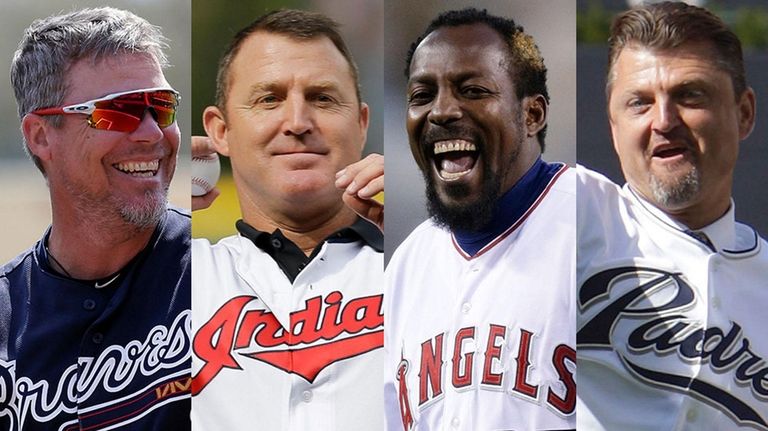
What does it take to get a relief pitcher elected to the Hall of Fame?
With the election this week of Trevor Hoffman, there are currently 6 pitchers who were elected to the Hall based mainly on what they did as relievers:
* Hoyt Wilhelm, who pitched from the mid-1950s to the early 1970s, and was both a starer and a reliever until the early 1960s. He was the master of the knuckleball, and the 1st pitcher to appear in as many as 1,000 regular-season games (breaking Cy Young's long-standing record of 906).
* Rollie Fingers, at his peak in the 1970s and early 1980s. He was known for his handlebar mustache, reminiscent of silent-film villains, and very villainous to hitters, though not known to hit batters on purpose, and, by all accounts, a nice guy off the mound.
* Bruce Sutter, who had a relatively short peak, from the late 1970s to the early 1980s. He was the 1st pitcher to make a name for himself with the split-fingered fastball, though Elroy Face used its predecessor, the forkball, with much relief success a generation earlier.
* Rich "Goose" Gossage, a relief star from the mid-1970s all the way to the mid-1990s. One of the fastest pitchers who ever lived, like Fingers, he eventually developed his own iconic mustache.
* Dennis Eckersley, a fine starter in the late 1970s and early 1980s (pitched a no-hitter in 1977 and won 20 in 1978), who was converted to a reliever in the mid-1980s and was one of the best ever into the mid-1990s. The Eck was the original Ninth Inning Man, also with an iconic look, his long hair and thin mustache earning him the nickname "the King of Spades." And...
* Trevor Hoffman, at his peak in the late 1990s and all through the 2000s. The 1st man to 500 saves, the 1st man to 600 saves, and still the National League's all-time record holder with 601.
As a note that may not mean anything here, Sutter and Hoffman are currently the only pitchers ever elected to the Hall who never started a game, either regular-season or postseason. Presuming that hasn't changed once Mariano Rivera gets in, it still won't due to his election: He arrived in the major leagues as a starter in 1995.
*
What does the election of these 5 pitchers tell us about what gets a reliever in?
Keep in mind: In Wilhelm's time, there weren't big save totals like we would see in the era of Fingers and Gossage; and the totals in their time would be frequently surpassed by the time Eck became a closer. As Wikipedia's entry on Fingers says:
When Fingers reached the major leagues, the role of relief pitchers was limited, as starting pitchers rarely left games while holding a lead; but as team offense increased following the 1968 season, and especially with the American League's introduction of the designated hitter in 1973, managers became more willing to replace starters in the late innings with a lead in order to forestall any late rallies by opponents.
Through the 1960s, both leagues' annual saves leaders tended toward totals of 20–25 saves; few pitchers remained in the role more than two or three years, with significant exceptions such as Roy Face and knuckleballer Hoyt Wilhelm. But in the 1970s, in an era allowing for greater opportunities for closers than had previously been available, Fingers' excellence in relief allowed him to gradually increase his annual saves totals past 30. In 1980 he broke Wilhelm's record of 227 saves, and eventually finished with 341, a record that stood until Jeff Reardon passed it in 1992.
Case in point: The Yankees won 5 straight American League Pennants in the early 1960s, but had a different main reliever each year: Art Ditmar in 1960, Luis Arroyo in 1961, Marshall Bridges in 1962, Hal Reniff in 1963 and Pete Mikkelsen in 1964.
Also, until Oakland Athletics manager Tony LaRussa made Eck essentially a 9th-inning-only guy, presaging the way Yankee manager Joe Torre would use Mariano Rivera, which pretty much made every manager (including Torre's successor, Joe Girardi) want a setup reliever, an 8th-inning-only guy, and a 9th-inning-only guy, relievers were expected to pitch more than 1 inning -- sometimes several more.
In the 1978 Playoff for the AL Division title against the Boston Red Sox, Yankee manager Bob Lemon brought Gossage in to relieve Ron Guidry in the 7th inning. The year before, in the AL Championship Series against the Kansas City Royals, Lemon's predecessor, Billy Martin, brought Sparky Lyle in to pitch in the 6th in Game 3 and the 4th in Game 4, going the rest of the way both times. And then to pitch the 8th and 9th in the deciding Game 5. (There was no Most Valuable Player award for the LCS at that time; if there was, he would have been an easy choice.) That was Lyle's Cy Young Award season, and he's not in the Hall of Fame.
And in 1974, with the A's in trouble in Game 1 of the World Series against the Los Angeles Dodgers, manager Alvin Dark brought Fingers in for the 5th, and let him go until relieving him with a starter, Catfish Hunter, in the 9th. The A's won, and won the Series in 5. (Fingers would be named MVP of that Series.)
So saves, and various related stats, might not be that reliable.
Also, coming in earlier in the old days meant that some relievers had a better chance to get wins than pitchers in the 1980s or later. ERA (earned run average), ERA+ (ERA relative to the League, with park effect somehow factored in), and WHIP (Walks + hits, per innings pitched) should also be considered.
Strikeouts, and related stats like K/9 IP and K/BB ratio, should not: While strikeouts are spectacular, they don't count for any more than a groundout or an out in the air. It's not like for starters, where 3,000 strikeouts over a career really is impressive. And, of course, winning is important: Did the pitcher's performance help his team win?
For the sake of argument, let us suppose that Mariano Rivera, eligible next season, gets in. Because even hardcore Red Sox fans won't suggest that he doesn't belong. So, here we go:
Saves: Rivera has a record 652 saves, Hoffman 601, Eckersley 390, Fingers 341, Gossage 310, Sutter 300, Wilhelm 227.
Wins Plus Saves: Mo a record 734, Hoffman 662, Eck 587, Fingers 455, Goose 434, Wilhelm 370, Sutter 368.
ERA: Mo 2.21 (lowest of any pitcher, starter or reliever, in the post-1920 Lively Ball Era), Wilhelm 2.52, Sutter 2.83, Hoffman 2.87, Fingers 2.90, Goose 3.01, Eck 3.50 (that high because he was a starter for 12 years, literally half his career).
ERA+: Mo a record 205, Wilhelm 147, Hoffman 141, Sutter 136, Goose 126, Fingers 120, Eck 116.
WHIP: Mo 1.000 (actually, 1.00026), Hoffman 1.058, Wilhelm 1.125, Sutter 1.140, Fingers 1.156, Eck 1.161, Goose 1.232.
Postseason appearances: Mo 16, Eck 8 (counting the 1978 Red Sox -- they did, after all, play a 163rd game that season), Fingers 7 (counting the 1981 Milwaukee Brewers in the strike-forced split-season Playoff format), Goose 5, Wilhelm 2 (as a rookie with the 1954 New York Giants and a veteran with the 1969 Atlanta Braves, although he did not appear in the NLCS against the Mets), Sutter only 1 (but was cheated out of another when the split-season format denied the St. Louis Cardinals the 1981 NL East title even though they had the best overall record in the Division, and another, possibly another ring, when the Cards traded him after the 1984 season despite tying Dan Quisenberry's record of 45 saves in a season).
World Series wins: Mo has 5 (1996, 1998, 1999, 2000 and 2009 Yankees), Fingers 3 (1972, 1973 and 1974 Oakland Athletics), Wilhelm 1 (as a rookie with the 1954 New York Giants), Sutter 1 (1982 St. Louis Cardinals), Eckersley 1 (1989 A's), Hoffman none (1 Pennant, with the 1998 San Diego Padres).
*
So what does this tell us? It means that 300 saves is a minimum consideration; that Wilhelm doesn't have 300 saves, but his other stats show him to be in, at the least, the same class as the other 4; that the Eck, because of his starting for half his career, is the only one with an ERA over 3.01 and an ERA+ under 120; and that, while Hoffman proves that postseason success isn't required to get in, a pitcher should have at least 1 ring. It also tells us that having a career losing record wasn't enough to keep either Fingers, Sutter or Hoffman out (although Sutter had to wait a lot longer to get in).
So let's use the following as our minimums: 300 saves, which all but Wilhelm had; with that established, 368 wins + saves; an ERA of 3.00 or lower, with the Goose slightly over and the Eck well over because he wasn't always a reliever; an ERA+ of 120 or higher, with the Eck an outlier; and a WHIP of 1.240 or lower, with the Goose being the highest. Once those are established, we should look at postseason berths and titles.
There are currently 28 pitchers with at least 300 career saves. Minus Rivera, Hoffman, Eckersley, Fingers, Gossage and Sutter, that leaves 22:
Lee Smith, 478; Francisco Rodriguez, a.k.a. K-Rod, 437 and counting; John Franco, 424; Billy Wagner, 422; Joe Nathan, 377; Jonathan Papelbon, 368; Jeff Reardon, 367; Troy Percival, 358; Randy Myers, 347; John Wetteland, 330; Francisco Cordero, 329; Roberto Hernandez, 326; Huston Street, 324 and counting; Jose Mesa, 321; Todd Jones, 319; Rick Aguilera, 318; Robb Nen, 314; Tom Henke, 311; Jeff Montgomery, 304; Doug Jones, 303; Fernando Rodney, 300 and counting; and Jason Isringhausen, 300.
Let's not kid ourselves: We can eliminate both Doug and Todd Jones, Isringhausen, Rodney, Montgomery, Henke, Nen, Aguilera, Mesa, Hernandez and Cordero.
That leaves Smith, Franco, Wagner, Nathan, Papelbon, Reardon, Percival, Myers, Wetteland, and the still-active K-Rod and Street. Keep in mind, this is not about whether they'll get in through the Writers: Some have already dropped off, and can only get in later through the Veterans Committee. This is about, based on who's already in, who else belongs.
We've been over 300 saves. This raises it to 330. But we've also established 368 wins + saves. So, of these 11, that leaves Smith with 549, Franco 514, K-Rod 489, Wagner 469, Nathan 441, Reardon 440, Papelbon 409, Percival 393, Myers 391, Wetteland 378 -- Street 366, but he's still active, and only needs 2 more to meet the threshold.
Also with an ERA of 3.00 or lower? Wagner 2.31, Papelbon 2.44, K-Rod 2.86, Nathan 2.87, Franco 2.89, Wetteland 2.93, Street 2.95 -- Smith 3.03, Reardon 3.16, Percival 3.17, Myers 3.19.
Also with an ERA+ of 120 or higher? Wagner 187, Papelbon 177, Nathan 151, Wetteland 148, K-Rod 148, Percival 146, Street 141, Franco 138, Smith 132, Myers 123, Reardon 122.
Also with a WHIP of 1.240 or lower? Wagner 0.998, Street 1.066, Percival 1.108, Papelbon 1.043, Nathan 1.120, Wetteland 1.135, K-Rod 1.155, Reardon 1.199 -- Smith 1.256, Myers 1.304, Franco 1.333.
Meeting all 4: Wagner, Nathan, Papelbon, Wetteland, and, for all intents and purposes, Street.
Meeting 3 of the 4: Franco, K-Rod, Reardon, Percival.
Meeting only 2: Smith, Myers. So we can eliminate those 2.
But here's another way to look at it: The old IYGA argument: "If you gotta ask... " In other words, if you hear his name, and you don't automatically say, "He should be in the Baseball Hall of Fame," then he shouldn't be.
K-Rod may be the all-time leader in saves by a lefthander. Franco, the recordholder before him. And Wetteland, he's a hero of the 1996 Yankees. But can you really say any of those get in?
I can't.ce those are established, we should look at postseason berths and titles.
Friday, January 26, 2018
How to Be a New York Basketball Fan In Milwaukee -- 2018 Edition
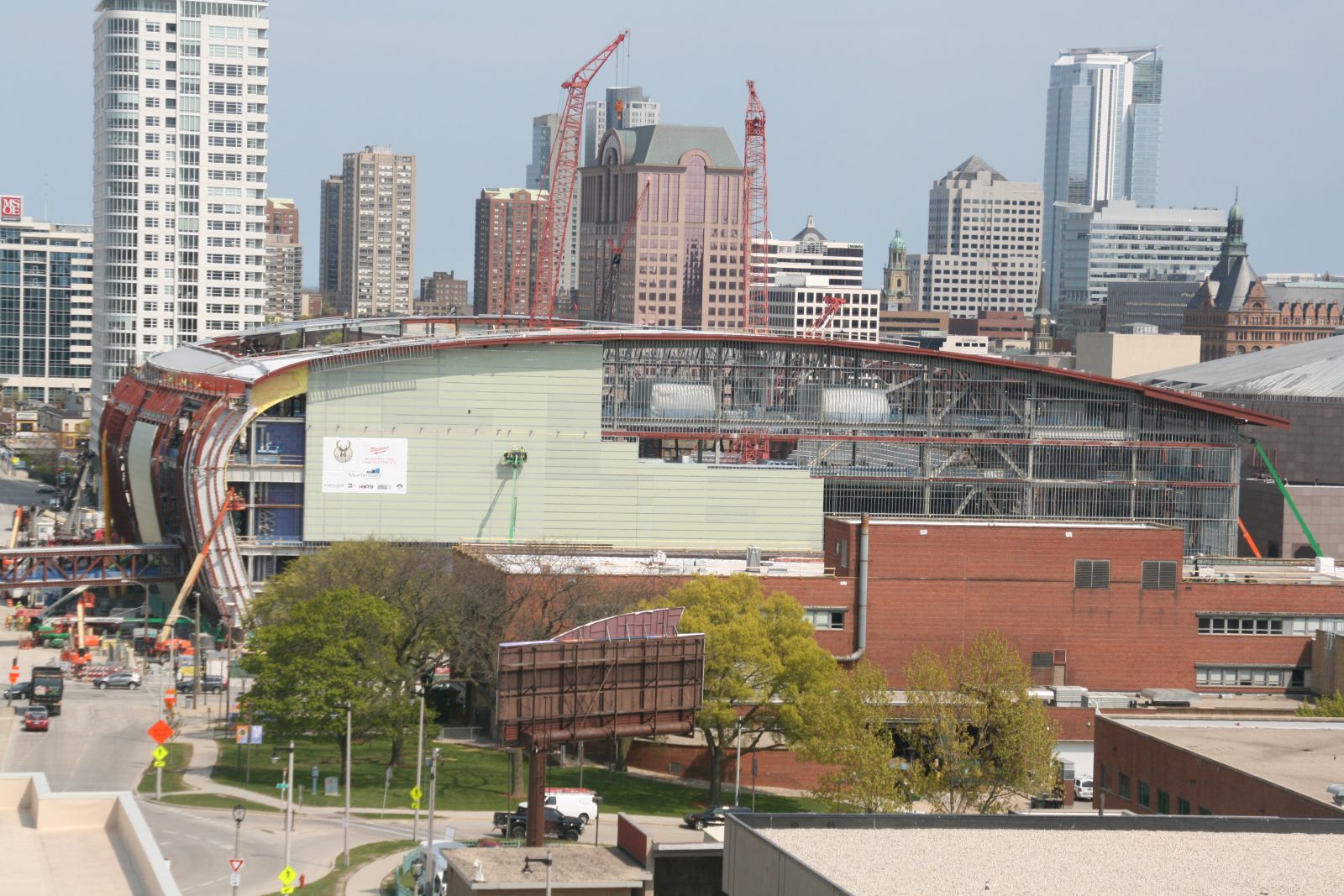
Barring a Playoff matchup, these will be the last games the New York teams will play at the Bradley Center. In the Autumn of 2018, the Bucks will move into a new arena.
Before You Go. Milwaukee is on Lake Michigan. It's not Green Bay, but it is still Wisconsin. It gets chilly in the Autumn, let alone in the Winter. Since this will be early February, the weather could be an issue. Although the game will be indoors, you still have to get to it.
The Milwaukee Journal Sentinel website is predicting high teens for Friday afternoon, and about 10 for the evening. Bundle up!
Milwaukee is in the Central Time Zone, an hour behind New York. Adjust your various timepieces accordingly.
Tickets. After nearly 2 full generations of sustained contention, the Bucks have fallen on hard times, and this is reflected in their attendance. This season, they are averaging 16,359 fans per game, 25th out of the 30 NBA teams, only 87 percent of capacity.
In 2013-14, they were even worse: 13,487 per game, dead last in the 30-team NBA. While the deal to build a new arena means that the Bucks won't have to move within the next few years, getting tickets won't be a problem.
In the Lower Level, the 200 sections, they have seats for $133 between the baskets and $66 behind; and, in the Upper Level, the 400 sections, $39 between and $23 behind.
Getting There. Downtown Milwaukee is 892 land miles from Times Square. Knowing this, your first reaction is going to be to fly out there.
At first, unlike some other Midwestern cities, this seems like a good idea if you can afford it. Most airlines can fly you there for around, or even under, $400 round-trip. However, there is a catch: There are few non-stops between any of the New York area airports and General Mitchell International Airport in Milwaukee. You will almost certainly have to change planes, most likely in Chicago, and you'll spend nearly as much time on the ground at O'Hare as you do in the air. The GRE bus will get you downtown in a little over half an hour. (Billy Mitchell was a Milwaukee-area native and an early advocate for air power.)
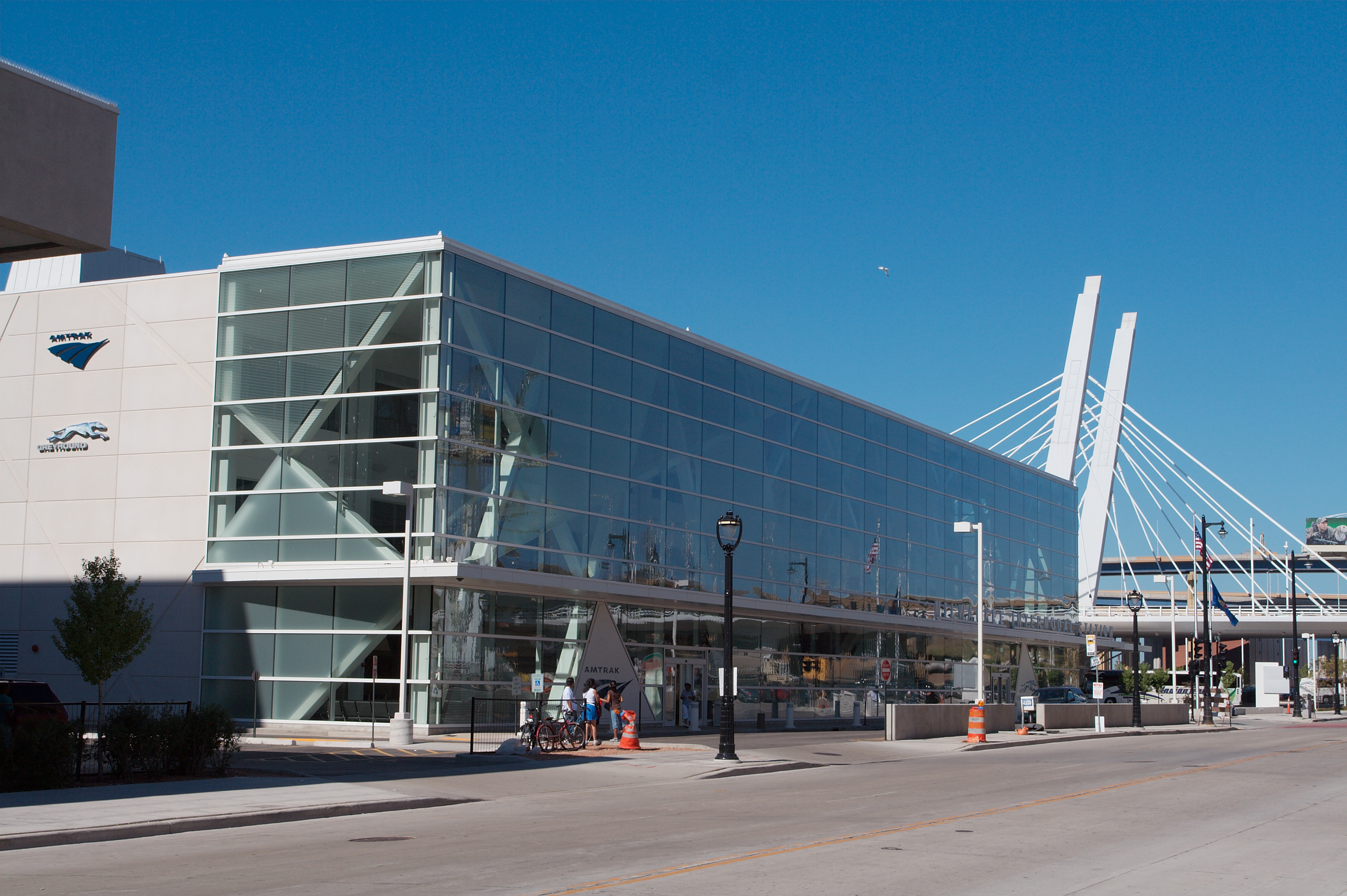
The Milwaukee Intermodal Station, which serves both Greyhound and Amtrak, is at 433 W. St. Paul Avenue, at 5th Street. There are 4 daily Greyhound runs that will get you from New York to Milwaukee. Two require 2 changeovers. The one that only requires 1 leaves Port Authority at 10:15 PM, and includes rest stops at Milesburg, Pennsylvania; Cleveland, and Elkhart, Indiana, before arriving in Chicago at 2:30 the next afternoon (Central Time). There's an hour's wait before leaving Chicago at 3:30 and arriving in Milwaukee at 5:35. That's 20 hours and 20 minutes, counting the time change. Round-trip fare is $406, but you can get it for $270 if you get a Web-Only Fare.
Milwaukee Intermodal Station
Amtrak's Lake Shore Limited (formerly known as the Twentieth Century Limited when the old New York Central Railroad ran it from Grand Central Terminal to Chicago's LaSalle Street Station) leaves New York's Penn Station at 3:40 every afternoon, and arrives at Union Station at 225 South Canal Street in Chicago at 9:45 (Central Time) every morning. From there, you have to wait until 1:05 PM to get on "Hiawatha Service," which will bring you to Milwaukee at 2:34. That's 23 hours, 49 minutes. Round-trip fare is $268 -- this time, cheaper than Greyhound.
If you decide to drive, it's far enough that it will help to get someone to go with you and split the duties, and to trade off driving and sleeping. You'll need to get into New Jersey, and take Interstate 80 West. You'll be on I-80 for the vast majority of the trip, through New Jersey, Pennsylvania and Ohio. In Ohio, in the western suburbs of Cleveland, I-80 will merge with Interstate 90.
From this point onward, you won't need to think about I-80 until you head home; I-90 is the key, until it merges with Interstate 94, which will merge with Interstate 43. Stay on I-43 after I-94 splits off south of downtown. Take Exit 73A onto Wisconsin Route 145, which will become N. 6th Street. Take that to State Street, and the Bradley Center will be on the left.
If you do it right, you should spend about an hour and a half in New Jersey, 5 hours and 15 minutes in Pennsylvania, 4 hours in Ohio, 2 hours and 30 minutes in Indiana, an hour and a half in Illinois, and just under an hour in Wisconsin. That's about 15 hours and 45 minutes. Counting rest stops, and accounting for traffic in both New York and Chicago, it should be no more than 20 hours, which would save you time on both Greyhound and Amtrak, if not on flying.
Once In the City. As Alice Cooper taught us in the film version of Wayne's World, Milwaukee gets its name from a Native American word meaning "the good land." But this may not be correct: Another version says the name comes a word meaning "Gathering place by the water."
Whichever version is true, both descriptions are accurate: The land of Wisconsin is good for farming, and Milwaukee is based on a confluence of 3 rivers that flow into Lake Michigan: The Milwaukee, the Menomonee, and the Kinnickinnic; so there's plenty of water. The Milwaukee River separates the city's streets into North and South, and the other 2 rivers separate them into East and West.
Milwaukee's historic City Hall
Founded in 1846, the city has about 600,000 people, making it the 3rd-largest in the Great Lakes region behind Chicago and Detroit. But the metropolitan area has only about 2 million, making it 27th among the 30 NBA teams, ahead of only Memphis, Oklahoma City and New Orleans.
Milwaukee was about 72 percent white as recently as 1980, but is now about 42 percent black, 37 percent white, 17 percent Hispanic, and 4 percent Asian. The German presence that established the city as a major brewing center is still in places, about 21 percent, or more than half of the white population. Poles make up about 9 percent, Irish 6 percent, Italian 3 percent, with some of mixed heritage. Most of the Hispanics, as is the case with most Midwestern cities, are Mexican.
In 2002, Jet magazine called Milwaukee "the most segregated city in the United States." In 2011, a University of Michigan study backed this up. North of the Menomonee River, but west of the Milwaukee River, the city is mostly black. North of the Menomonee, but east of the Milwaukee, and in the suburbs, it's mostly white. South of the Menomonee River, it's mostly Hispanic.
In 2015, the news site 24/7 Wall Street labeled Milwaukee "the worst place for African-Americans to live," despite the Sheriff of Milwaukee County being black. But that Sheriff was David Clarke, an arch-conservative and a Trump ally, who said that the Black Lives Matter group had to be "eradicated."
ZIP Codes in Wisconsin start with the digits 53 and 54, and for the Milwaukee area, 530, 531 and 532. The Area Code is 414 for the city and 262 for the suburbs. Milwaukee does not have a "beltway."
Going In. The official address of the BMO Harris Bradley Center is 1001 N. 4th Street, just across the river, to the west of downtown. It's bounded by 4th, 6th and State Streets and Highland Avenue. Parking is $11.
The arena was paid for by funds donated by Jane Bradley Pettit and her husband Lloyd Pettit, in memory of her father, factory-equipment magnate Harry Bradley. Lloyd Pettit was the Hall of Fame broadcaster for the Chicago Blackhawks, and the owner of the Milwaukee Admirals of the American Hockey League.
Ironically, Harry Bradley was a big donor to conservative causes, but, for most of the arena's existence, its main tenant, the Bucks, were owned by Herb Kohl, a very liberal U.S. Senator. BMO Harris Bank bought naming rights in 2012.
It has been home to the Bucks, the Admirals, and Marquette University basketball since 1988. Milwaukee might be able to support an NHL team, as its metropolitan area population, even without adding Green Bay and Madison to its "market," would rank 26th in the NHL. But support for the Bucks is dropping, so it's unlikely that it can support an NBA team and an NHL team.
It's also hosted arena football's Milwaukee Mustangs and indoor soccer's Milwaukee Wave. Although Milwaukee has never had a major league hockey team (not in the NHL or in the WHA), the NCAA has used it as the site of its National Championships, the Frozen Four, in 1993, 1997 and 2006. It's also hosted NCAA Tournament basketball games in the rounds of 64 & 32, and 16 & 8, including the 2013-14 season.
The court is laid out east-to-west. Although it's modern in most senses, one big complaint is that it doesn't have enough luxury suites -- and that, as much as Milwaukee being a small market and the decline in attendance among non-corporate guests, led to the new owners successfully lobbying for a new arena for the Bucks and Marquette.
It is under construction, and it will open just to the northwest, at 5th Street & Highland Avenue, in the Autumn of 2018. This should end up securing the team's future in Milwaukee. Naming rights have not yet been sold.
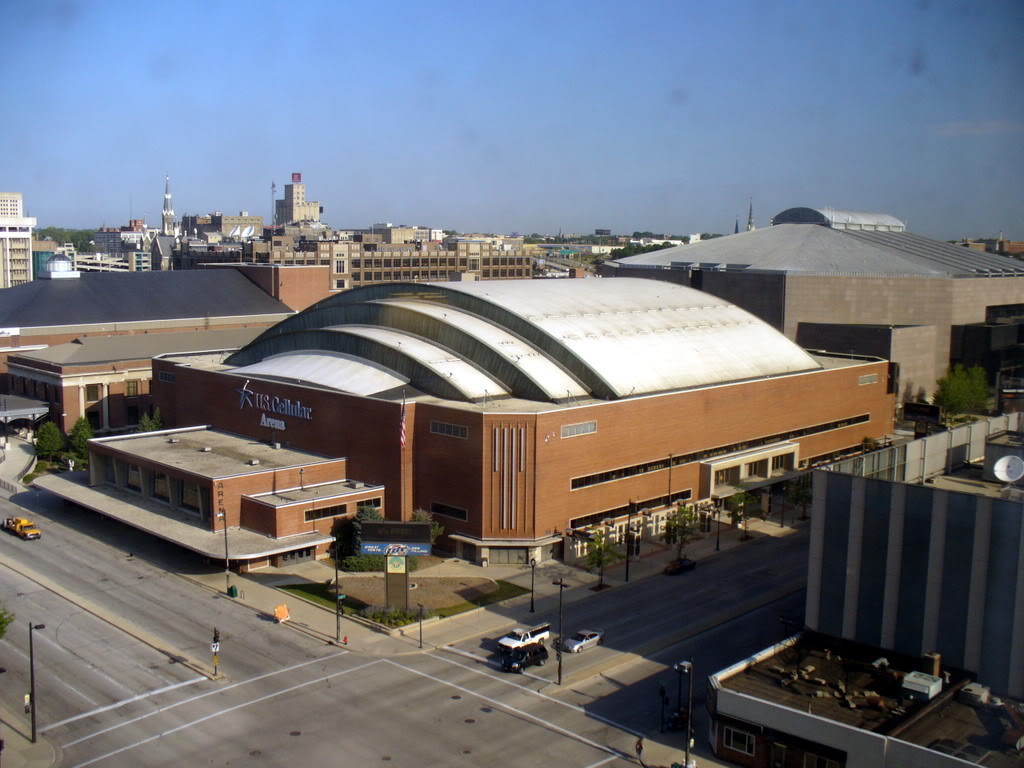
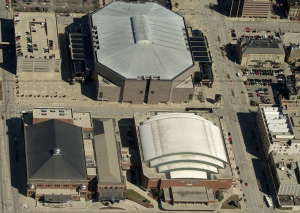
Across State Street, at 400 W. Kilbourn Avenue, is the previous home of the Bucks, the Admirals, and Marquette (back then, they were known as the Warriors, not the Golden Eagles). Built in 1950 as the Milwaukee Arena, it became part of a complex known as the Milwaukee Exposition Convention Center & Arena, or MECCA.
The old Arena, then using the name U.S. Cellular Arena.
Behind it to the left, the Milwaukee Auditorium.
Behind it to the right, the Bradley Center.
The Bucks had to move out, as it seated only 10,783 and had no luxury boxes at all. Now known as the UW-Milwaukee Panther Arena, it holds 12,700 fans, and the University of Wisconsin at Milwaukee plays its home basketball games there. Before the Bucks played there from 1968 to 1988, it was home to the Milwaukee Hawks from 1951 to 1955, when they moved to St. Louis, and then in 1968 to Atlanta.
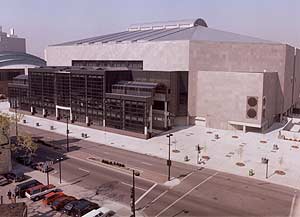
Overhead shot. Top: Bradley Center.
Bottom: Milwaukee Theatre and MECCA.
Elvis Presley sang at the old arena on June 28, 1974 and April 27, 1977. The Beatles played there on September 4, 1964. The inductees to the Wisconsin Athletic Hall of Fame are honored there in a Wisconsin Athletic Walk of Fame, which includes stars from the Bucks, the Milwaukee Brewers, the Green Bay Packers, the University of Wisconsin Badgers, and State natives who made it big elsewhere.
Food. In Big Ten Country, where tailgate parties are practically a sacrament, you would expect the Milwaukee arena to have lots of good options. It certainly does. Levy Restaurants runs the concessions.
According to the BMO Harris Bradley Center's website, "No matter where your seats are, The Carvery featuring Jake's Deli and the TapHouse are the place to go for a fresh-cut sandwiches and the largest selection of premium craft brews at the BMOHBC. Located outside Section 207, The Carvery and the TapHouse are the first premium club-like experiences open to all BMOHBC guests."
The 200 Level has a Grill Stand and Usinger's. Usinger's alone features:
* The Oktoberfest: Footlong bratwurst, whole grain mustard, Bavarian kraut, caramelized onions, pretzel bun.
* Milwaukee's Best: Cheddar jalapeno bratwurst with cheese sauce, and chili crispy jalapenos.
* The Fowl: Chicken bratwurst with blue cheese coleslaw and crispy bacon.
* Beer Deli Sammy: Salami and beer mustard sandwich served on a pretzel hoagie.
* Sausage Smasher: Summer sausage, Swiss cheese, sweet onion and warm apple jam.
* Po' Boy: Polish sausage, hot sauce, crispy potatoes. (What happens when you mix Polish sausage and Louisana hot sauce, I am not about to find out.)
* Fred's Original Liverwurst: Liverwurst on rye with red onion and yellow mustard.
* Kraut Dog: Bavarian wiener with yellow mustard, Bavarian sauerkraut, crispy onions.
* Bavarian pretzel.
* Usinger's sausage and cheese plate.
* Beer battered cheese curds.
In other words, check with your doctor before going on a roadtrip to Milwaukee, to see if your heart is healthy enough to eat there.
The Leinenkugel Leinie Lodge is outside Section 205, with as many beer selections as you would imagine that the town that beer made famous would have. There's a gluten-free stand outside Section 217. Section 225: Saz's Barbecue. Section 211: Wisconsin Cheesesteaks. Section 204: A Qdoba stand. Section 203: ColdStone Creamery. Section 224: Cedar Crest Ice Cream. Sections 204, 218 and 425: Dippin Dots.
And you thought the TV show set in Milwaukee was called Happy Days because it was set during the 1950s? Nope: It was because of the food! Why do you think they all hung out at Arnold's? Why do you think the Fonz was always telling "Mrs. C" how wonderful her cooking was? Because it was.
Team History Displays. While the Bucks have usually been good, they haven't reached the NBA Finals since 1974 (at the MECCA), or even the Conference Finals since 2001 (at the Bradley Center).
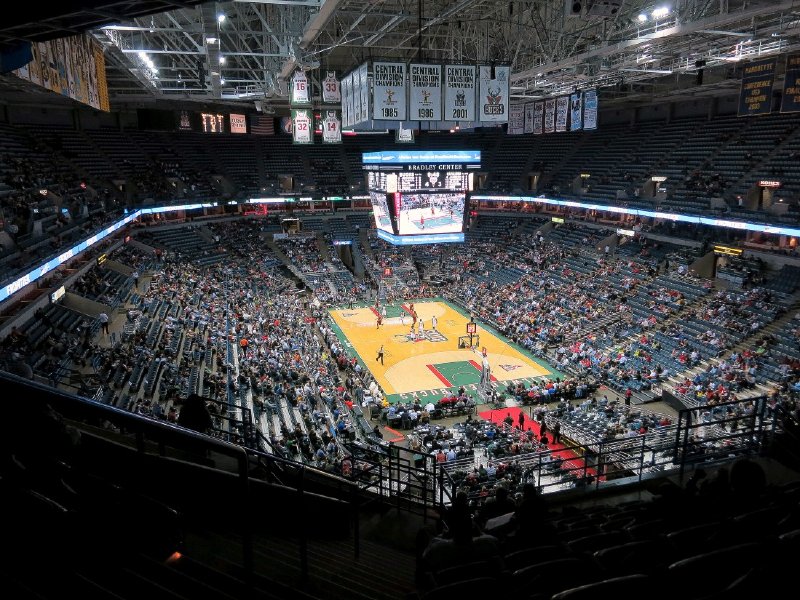
However, the Bucks have enough banners to surround the center scoreboard. This included the 1971 and 1974 Western Conference titles, and Division titles in 1971, 1972, 1973, 1974, 1976 1980, 1981, 1982, 1983, 1984, 1985, 1986 and 2001.
Their 1971 World Championship banner is surrounded by 4 retired number banners: 1, guard Oscar Robertson; 4, guard Sidney Moncrief; 33, center Kareem Abdul-Jabbar, who was still using his birth name of Lew Alcindor when the Bucks won their 1971 title; and 14, guard and now broadcaster Jon McGlocklin. The other retired numbers are: 2, forward Ulysses "Junior" Bridgman; 10, forward Bob Dandridge; 16, center Bob Lanier; and 32, guard Brian Winters.
Oscar, Kareem and Lanier were elected to the Basketball Hall of Fame and the NBA's 50th Anniversary 50 Greatest Players in 1996. Kareem was also named to the NBA's 35th Anniversary All-Time Teamin 1980. Oscar, Jon, Kareem and Bob Dandridge played on the title team; Junior, Sid, Brian and Bob Lanier came afterward. However, there are no honorees who played for the team after 1990 (Moncrief). That should show you how it's gone for this team in the last quarter-century.
It's almost the exact opposite of what you would expect from an expansion team: After a weak 1st season, 1968-69, they won the coin flip with the Phoenix Suns for the 1st pick in the Draft, selected Alcindor, and got a title out of it in just 2 seasons. Then, they were a very good team for the next 20 years, but not so much in the last 25. In contrast, the Suns, who also started play in the fall of 1968, have been a respectable team for most of their history, but have never won a title, the difference between their zero and the Bucks' one being a lot bigger than the Bucks' one and, say, the Philadelphia 76ers' two.
Originally, the retired numbers' banner was patterned after the Boston Celtics' retired banners, with 7 numbers (at the time, with room for 1 more) placed in 1 banner. During the team's 40th Anniversary celebrations in 2008, that banner was replaced by individual player banners, designed to the style of the Bucks jerseys they wore during their playing careers. In the ceremonies, the players' numbers were retired again to the rafters, and in the process were given framed Bucks jerseys in the current uniform design.
Robertson, Bridgman, McGlocklin, Moncrief, Herb Kohl, previous owner Jim Fitzgerald, and Jane Bradley Pettit ave been honored in the Wisconsin Athletic Hall of Fame. As I said, it's across the street at the MECCA. Also honored are Marquette basketball figures Al McGuire, George Thompson and Johnny Sisk. So is Shirley Martin, one of the earliest stars of women's basketball.
The Admirals hang banners for their 1976 U.S. Hockey League title; their International Hockey League regular season titles of 1983, 1993, 1995 and 1996; their 2004 and 2006 AHL Conference Championships; and their 2004 AHL regular season and Calder Cup titles.
They also hang 7 retired number banners, including 2 retired for 2 players each: 9, 1970s center Phil Wittliff; 14, 1980s center Fred Berry and 1990s center Mike McNeill; 26, 1990s-2000s center Tony Hrkac; 27, 1970s-80s left wing Danny Lecours; and 27, 1980s defenseman Kevin Willison and 1990s center Gino Cavallini. Aside from Cavallini, none of them made much of an impact in the NHL.
Marquette also hangs banners at the Bradley Center: Their 1977 National Championship; their Final Four berths of 1974, 1977 and 2003; their regular-season conference titles of 1994, 2003 and 2013; and their 1997 conference tournament win. The 1974 and 1977 achievements were won while their home court was the MECCA; from 1988 onward, the Bradley Center.
Marquette has retired the numbers of 8 players: 3, Dwyane Wade; 14, former Knick Dean Meminger; 15, former Knick Butch Lee; 20, Maurice Lucas; 24, George Thompson; 31, for both former Knick Doc Rivers and Bo Ellis; and 43, Earl Tatum. They've also retired 11 in honor of the Apollo 11 crew (even though Milwaukee native Jim Lovell flew on Apollo 8 and Apollo 13 and has a street renamed for him), 38 for trainer Bob Weingart, and 77 for coach Al McGuire for the 1977 title. Al, of course, grew up in Far Rockaway, Queens, as did his brother Dick, and both played for the Knicks in the 1950s; Dick is in the Hall as a Knick player, Al as Marquette coach.
The University of Wisconsin, in Madison, is the only other Wisconsin school to reach the Final Four, and that was all the way back in 1941, although they've reached hockey's version, the Frozen Four, many times, including 6 National Championships: 1973, 1977, 1981, 1983, 1990 and 2006.
Stuff. The Milwaukee Pro Shop, selling both Bucks and Admirals items, has 4 permanent stores inside the Bradley Center, located oustide of Sections 200, 214, 400, and 422. Jersey Junction, a custom pro-jersey shop, is located outside of Section 206. And there are several portable kiosks, with locations varying by event.
The Bucks have been around for over 40 years now, but because Milwaukee, as a city, gets lost in the shadows not only of Chicago, with the far more noteworthy Bulls 90 miles to the south, but the smaller yet higher-profile city of Green Bay, with the legendary Packers 115 miles to the north, the Bucks tend to get forgotten. They trail not only the Packers, but also the football team at the University of Wisconsin in popularity among Badger State teams. (They may even trail that school's very successful hockey program, even though Milwaukee doesn't have an NHL team.)
It doesn't help that they haven't reached the NBA Finals in 40 years, and their 1971 title seems so far back that it might as well have been won by a team that moved away and has since been replaced, as with Minneapolis and the Lakers.
As a result of this, there aren't many good books about the Bucks. As part of the NBA's A History of Hoops series, Nate Leboutillier wrote The Story of the Milwaukee Bucks in 2006; Shane Frederick wrote an update that was published this past January. Back in 1978, Marv Fishman and Tracy Dodds wrote Bucking the Odds: The Birth of the Milwaukee Bucks, chronicling their rather successful early years. Forget about DVDs: There is no collection showing the 1971 Finals or a "Greatest Games" series.
During the Game. A November 13, 2014 article on DailyRotoHelp ranked the NBA teams' fan bases, and listed the Bucks' fans in 20th place. This is meant to suggest not that they are unpleasant, but that they are disengaged, that not enough show up, and that not enough of those who do show up generate much of an atmosphere.
Bucks fans, as you might expect in America's foremost brewing city, like to drink. If this were a Packer game and you were wearing Chicago Bears or Minnesota Vikings gear, you might be in trouble. If this were a UW game and you were wearing University of Minnesota gear, you might be in trouble. If this were a Brewers-Cubs game, and you were wearing Cubs gear, you might be in trouble. But this is a Bucks game, and even if you were wearing Chicago Bulls or Minnesota Timberwolves gear, you'd probably be safe.
Neither of the Bucks' home games against the Knicks will feature a promotion. The April 5 game against the Nets is Retro Pennant Night, with replicas of old-time Bucks pennants given to the 1st 10,000 fans.
Former Nets star, and head coach in their 1st season in Brooklyn, Jason Kidd was recently fired as the Bucks' head coach. And... that's about the most interesting thing about the Bucks these days. Despite their slogan, you won't need to "Fear the Deer."
The Bucks' official mascot is Bango the Buck, presently performed by Kevin Vanderkolk. The word "Bango" was originally coined by Eddie Doucette, the the longtime play-by-play announcer for the Bucks. Doucette used the word whenever a Bucks player connected on a long-range basket, much like old-time Knicks announcer Marty Glickman used "Swish" for a shot that was nothing but net. It was often used for sharpshooter Jon McGlocklin. When it came time for the Bucks to choose a name for their new mascot, the name "Bango" won the contest.
Bango has been the Bucks' official mascot for more than 36 years. He made his official debut on October 18, 1977, which was Milwaukee's home opener of the 1977-78 season. (Those of you who are Yankee Fans will recognize the date as the night that Reggie Jackson hit 3 home runs in Game 6 to clinch the World Series.) In addition to the date being Bango's home debut, the game itself pitted Milwaukee against former Bucks center Kareem Abdul-Jabbar and his Los Angeles Lakers at the MECCA. The Bucks won, 117-112.
Bango has worked hard to become popular with Bucks fans all throughout the State of Wisconsin over the years, appearing at schools, parades, and festivals as a goodwill ambassador for the team. His high-flying acrobatic layups, daring rebounds, and other entertaining antics still play an important role in energizing Bucks fans at the Bradley Center.
Since 2001, Bango has also made perennial appearances at the NBA All-Star Game, although he tore an ACL during a stunt at the 2009 All-Star Weekend in Phoenix, and missed the rest of the season. He bounced back, and in 2010 was named NBA Mascot of the Year.
The Bucks do not have a regular National Anthem singer. Instead, they hold auditions. They've replaced their 1977 theme song "Green and Growing (The Bucks Don't Stop Here)" with a 2013 theme, "King of the Court." As far as I can tell, there are no traditional chants at Bucks games. Nor does there appear to be a postgame victory song.
After the Game. Milwaukee has some rough neighborhoods, but downtown is safe. Although Milwaukeeans like to drink, this is not a Packers or Badgers game, so you should be fine on your way out.
Unfortunately, I can find no reference to any Milwaukee bar or restaurant that caters to New York expatriates. However, downtown has plenty of places to get a postgame meal, or just a pint. Major Goolsby's, at 340 W. Kilbourn, across 4th from the MECCA, is one of the most famous sports bars in the country. Across 4th from the Bradley Center is Turner Hall, and Usinger's, the source for all that good stuff in the arena, is 1030 N. 3rd Street, a block east of the arena on the Milwaukee River.
If you visit Milwaukee during the European soccer season (which we are now in), the best place to watch your favorite club is the Highbury Pub, at 2322 S. Kinnickinnic Avenue at Lincoln Avenue, about 3 miles south of downtown. Bus 15. Named for the former stadium of Arsenal Football Club, which was named for the North London neighborhood it was in, there is also a bar by that name in Brooklyn.
Sidelights. Milwaukee's sports history is long, but not especially successful, especially when you consider the distance between the city and the State's most successful sports team, the Green Bay Packers.
* Miller Park and site of Milwaukee County Stadium. The old ballpark was located behind the home plate entrance to the new one, which was built across center field from its predecessor. The Braves played at County Stadium from 1953 to 1965, the Brewers from 1970 to 2000, and the Packers played several home games there from 1953 to 1994, first 2 out of their 6 (when the NFL had a 12-game schedule), then 2 of their 7 (14), and finally 3 of their 8 (16), plus a preseason game (an another preseason game at the University of Wisconsin's Camp Randall Stadium).
The Packers played a Playoff game against the Los Angeles Rams at County Stadium in 1967, before winning the NFL Championship against the Dallas Cowboys at Lambeau Field on New Year's Eve, the famed Ice Bowl.
County Stadium hosted the only game, to date, played by the U.S. national soccer team in Wisconsin. It was on July 28, 1990, against East Germany, in one of that foul country's last games before being reunited with their Federal Republic (West German) brothers. We lost.
The address of Miller Park is 1 Brewers Way. The Number 10 bus goes down Wisconsin Avenue, but its closest point is a little over a mile from the stadium. You'd need to get off at the intersection of Wisconsin Avenue and 44th Street, under I-94, to Selig Drive. You'd make a right on Selig, and on your left will be Miller Park, and on your right is a baseball field on the site of its predecessor, Milwaukee County Stadium. Make a left on Brewers Way and proceed to the home plate gate.
Lambeau Field in Green Bay is 116 miles from downtown Milwaukee. But the Packers' arch-rivals, the Chicago Bears, are actually closer: Soldier Field is 96 miles away. The Chicago Blackhawks are the closest NHL team, 91 miles. The University of Wisconsin is in the State capital of Madison, 80 miles away.
The closest Major League Soccer team is the Chicago Fire, 101 miles away. Wisconsin's highest-ranking soccer team is Milwaukee Bavarians, which is only at the 5th level of the U.S. soccer pyramid, although they have been in business since 1929. They play at the 2,000-seat Heartland Value Fund Stadium. 700 W. Lexington Blvd. in Glendale, 6 miles north of downtown. Bus 15.
* Borchert Field. The minor-league Milwaukee Brewers played here from 1888 to 1952, at a wooden park originally named Athletic Park and renamed for former owner Otto Borchert. These Brewers were the first pro baseball team owned by Bill Veeck, from 1941 to 1945, before he moved on to the major leagues.
It was at "Borchert's Orchard" that he first tried his promotional stunts, and it made Milwaukee one of the most successful minor-league markets, not just on the field but at the box office. The Brewers won 8 Pennants there, including 3 straight under Veeck, and in their last 2 seasons of existence before the Braves came in.
The Milwaukee Bears of the Negro Leagues also played here, as did the Milwaukee Badgers of the NFL from 1922 to 1926, and the Packers played the occasional Milwaukee game here from 1933 to 1952. Actually, the place was better for football than for baseball: Like the Polo Grounds, it had a distant center field but foul poles that were much too close, 267 feet. An overhanging roof that covered the infield stands didn't help matters.
As Veeck himself put it, "Borchert Field, an architectural monstrosity, was so constructed that the fans on the first-base side of the grandstand couldn't see the right fielder, which seemed perfectly fair in that the fans on the third-base side couldn't see the left fielder. 'Listen,' I told them. 'This way you'll have to come back twice to see the whole team.'"
Borchert stood between North 7th & 8th Streets, and Burleigh & Chambers Streets. The entire land area is now occupied by Interstate 43, the North-South Freeway, and entrance-and-exit ramps. It's in a bit of a rough neighborhood, so unless you're just that into baseball history, if you have to cross one item off your list, this is the one. Number 50 bus to Holton & Burleigh, then Number 60 bus, or walk 12 blocks west.
* Milwaukee Mile. This racetrack, on the grounds of the Wisconsin State Fair in suburban West Allis, is the oldest continuously-operating auto racetrack in the world. "But Mike," you say, "auto racing is not a sport. Why are you talking about it?" Because the track's infield was used as the Packers' main Milwaukee-area home from 1934 to 1951. Seating 45,000, the stadium was nicknamed the Dairy Bowl for Packer games, including the 1939 NFL Championship Game, in which the Packers beat the Giants, 27-0. The Milwaukee Chiefs of the 1940-41 version of the American Football League also played here.
I don't know if this is the earliest remaining stadium to have hosted an NFL game (1933), but it's almost certainly the oldest site (racing began there in to 1903). 7722 W. Greenfield Avenue at 77th Street. Number 60 bus to 60th & Vliet Streets, then transfer to Number 76 bus.
Horlick Field opened in 1907, and hosted the Racine Legion from 1919 to 1924 (including 1922 to '24 in the NFL), the NFL's Racine Tornadoes in 1926, and the Racine Belles of the All-American Girls Professional Baseball League from 1943 to 1950. The current 8,500-seat stadium on the site hosts high school sports. 1648 N. Memorial Drive in Racine, Wisconsin, 29 miles south of downtown Milwaukee, and 70 miles north of Chicago's Loop. Amtrak from either to Sturtevant, then Bus 8.
The Kenosha Maroons played in the NFL in 1924, at Nash Field. The 5,000-seat stadium also hosts high school sports. 5909 56th Street in Kenosha, Wisconsin. Even though it's closer to Milwaukee (34 miles as opposed to 60), it can only be reached by public transportation from Chicago, riding the train from the Ogilvie Transportation Center (the former Northwestern Station) to Kenosha, then Bus 2.
The Sheboygan Red Skins played pro basketball from 1933 to 1952, winning the National Basketball League title in 1943 (making them, technically, if not officially recognized by the NBA, World Champions in the sport), and were merged into the NBA for the 1949-50 season.
Due to Sheboygan's small size (about 50,000 people, smaller even than since-abandoned NBA cities Syracuse, Rochester and Fort Wayne), the rest of the league wanted them out, and got their wish. They lasted only 2 years in their new league, and folded. But they are still winners of a World Championship. They played at the 3,974-seat Sheboygan Municipal Auditorium and Armory, 58 miles north of Milwaukee (Bus 916) and 67 miles south of Green Bay.
The Oshkosh All-Stars began in 1929, entered the NBL in 1937, and won 2 NBL titles, in 1941 and 1942. But they folded in 1949. Unlike the Red Skins, they weren't even welcomed into the merged NBA, despite coming from a larger city (66,000). At least the Red Skins had a decent venue by the standards of the time. The All-Stars played at the Recreation Gym. 425 Division Street, 88 miles northwest of Milwaukee, and 51 miles southwest of Green Bay.
Wisconsin, let alone Milwaukee, has never produced a President -- although, in 2012, Congressman Paul Ryan was the Republican nominee for Vice President, and he's pretty young by political standards, so he could run for President in the future. But the Milwaukee Theatre, formerly, the Milwaukee Auditorium, built in 1909 at 500 W. Kilbourn Avenue downtown (across from the MECCA), has been one of the city's most historic sites. It's where Theodore Roosevelt, running to return to the Presidency on the Progressive Party ticket in 1912, gave a speech on October 14. For an hour and a half. After having been shot. The shooting happened a block away, at the Hotel Gilpatrick, now the Hyatt, at 333 W. Kilbourn. He recovered, and finished 2nd to Democratic nominee Woodrow Wilson, but ahead of incumbent Republican William Howard Taft.
Other Presidents, and men who tried to be, spoke at the 4,000-seat building now named the Milwaukee Theatre: Taft in 1911, Wilson in 1916, Wendell Willkie in 1944, John F. Kennedy in 1960, Michael Dukakis in 1988, and the George Bushes, the father in 1991 and the son in 2000. Martin Luther King gave a noted speech there in 1964.
Elvis sang there on June 14, and 15, 1972, even though the MECCA was already an established arena. Other Wisconsin arenas to have been played by Elvis were the Mary E. Sawyer Auditorium in La Crosse on May 14, 1956; the Dane County Coliseum in Madison on October 19, 1976 and June 24, 1977; and the Brown County Veterans Memorial Arena in Green Bay on April 28, 1977.
* Happy Days. Airing from 1974 to 1984 but taking place in Milwaukee from 1955 to 1965, this ABC sitcom did as much to make Milwaukee famous as beer and the Braves did. A statue of Henry Winkler as Arthur "Fonzie" Fonzarelli -- a.k.a. The Bronze Fonz -- is at 117 E. Wells Street, on the Riverwalk, across from the 1895-built, 353-foot-high City Hall, which will be recognized by fans of Happy Days' spinoff series, Laverne & Shirley, although the sign saying, "WELCOME MILWAUKEE VISITORS" is long-gone.
The Cunningham house was said to be at 565 North Clinton Drive, an address which does not actually exist in the Milwaukee area. The exterior was shot in Los Angeles, near the Paramount Pictures studios. Both the original building used as the exterior for Arnold's, in the Milwaukee suburbs, and its replacement, in Los Angeles, have been demolished. The exterior shot for Richie and Joanie's alma mater, Jefferson High School, was filmed at Milwaukee's Washington High at 2525 N. Sherman Blvd.
Milwaukee doesn't have museums on the level of New York, Philadelphia or Chicago, but of note is the Milwaukee Public Museum, at 800 W. Wells Street, at 8th Street downtown.
The tallest building in Wisconsin is the U.S. Bank Center, formerly the First Wisconsin Center, at E. Wisconsin Avenue & N. Van Buren Street. Opening in 1973, it is 601 feet high. It's not much to look at, unlike the building it replaced as the tallest in town, City Hall.
If you want to go on a brewery tour, be my guest -- or, rather, put your money down and be their
guest. But I have no interest in it, so you'll have to look up your own info.
*
Milwaukee may not be one of America's biggest cities, but it's one of the most fun. And sports, including basketball, is a big part of it. A Bucks game is a good time, and a tasty time, whether the team is good or not.
Labels:
1968,
1971,
1988,
bango the buck,
bradley center,
brooklyn nets,
knicks,
milwaukee,
milwaukee bucks,
nba,
wisconsin
Top 10 Athletes From Michigan
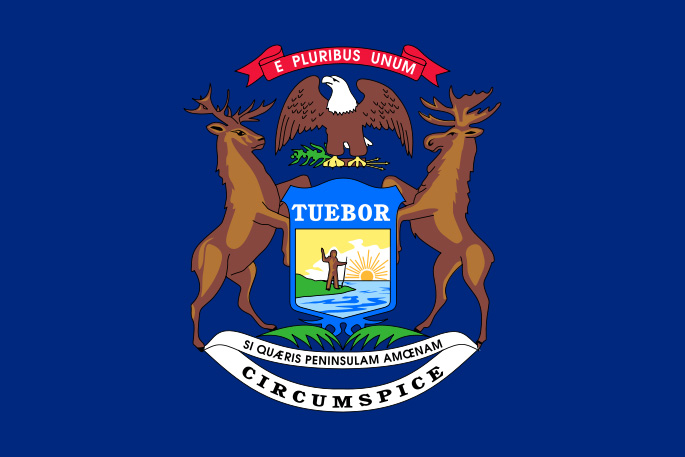
January 26, 1837: Michigan is admitted to the Union as the 26th State.
Top 10 Athletes From Michigan
Michigan is a big State, with almost 10 million people, and one of the largest metropolitan areas in the country, Detroit -- although a noticeable chunk of that metro area is across the Detroit River in Windsor, Ontario, Canada, and anyone from there is thus ineligible for this list.
Baseball. Football. Basketball. Hockey. Boxing. You could limit Michigan's Top 10 Athletes to any of those 5 sports, and come up with a list that could stand alongside 40 of the 50 States' Top 10.
Honorable Mention to Baseball Hall-of-Famers Hazen "Kiki" Cuyler of Harrisville, Hal Newhouser of Detroit, and John Smoltz of the Detroit suburb of Warren.
Honorable Mention to Jim Kaat of the Grand Rapids suburb of Zeeland. As both his name and his hometown's suggest, he is part of the large Dutch-American community in Michigan. He is not in the Hall of Fame, but he should be -- as either a player or a broadcaster. He was a 3-time All-Star, and won 16 Gold Gloves.
He won 283 games, including Pennants 17 years apart, in the American League with the 1965 Minnesota Twins, and in the National League with the 1982 St. Louis Cardinals, winning the World Series. When he retired the following year, he was the last active player who had played for the original Washington Senators (1901-60).
Honorable Mention to Kirk Gibson of the Detroit suburb of Pontiac. He played both baseball and football at Michigan State University. (So did Steve Garvey, but he's from Tampa.) He helped MSU's football team win the 1978 Big Ten Championship, then became a World Series hero in both leagues, for the 1984 Detroit Tigers and the 1988 Los Angeles Dodgers (following a regular season that won him the National League MVP).
Injuries cut short what could have been a Hall of Fame career, but still hit 255 home runs. In 2011, he was named NL Manager of the Year for getting the Arizona Diamondbacks to the NL Western Division title.
Honorable Mention to Orel Hershiser of Detroit. He was born in Buffalo, but was living in Detroit when he learned how to pitch, before moving to Toronto, and then to the Philadelphia suburb of Cherry Hill, New Jersey for high school. He had a 204-150 record over 18 seasons, reaching the postseason with the Los Angeles Dodgers in 1983, 1985 and 1988; the Cleveland Indians in 1995 and 1997; the San Francisco Giants in 1998; and the Mets in 1999.
A 3-time All-Star, his annus mirabilis was 1988: He won 23 games, set a new major league record with 59 consecutive scoreless innings pitched, won a Gold Glove and the National League Cy Young Award, and was named Most Valuable Player of both the NL Championship Series and, after winning Game 2 and the clinching Game 5, the World Series. In 1995, helping the Indians won the American League Pennant, he became the 1st (and still only) man to win LCS MVPs in both leagues.
He is not yet in the Hall of Fame, but he could be. He is now one of the game's most respected broadcasters.
Honorable Mention to Jim Abbott of Flint. Born without a hand on his right arm, he nonetheless learned how to pitch with his left, and to then switch his glove from his right wrist to his left hand and field his position. He won the 1987 James E. Sullivan Memorial Award as the nation's outstanding amateur athlete, for his pitching at the University of Michigan.
The team then known as the California Angels took a chance on him, and he reached the major leagues. Over 11 seasons, he had a record of 87-108, including a no-hitter with the Yankees in 1993.
Dishonorable Mention to Derek Lowe of the Detroit suburb of Dearborn. He went 176-157with 86 saves in a 17-season career as a major league pitcher. He reached the postseason with the Boston Red Sox in 1998, 1999, 2003 and 2004; the Los Angeles Dodgers in 2008; the Atlanta Braves in 2010; and the Yankees in 2012.
A 2-time All-Star, he led the AL in saves in 2000 and the NL in wins in 2006, a rare combination. He pitched a no-hitter for the Red Sox in 2002. And he was a beneficiary of their steroid-induced cheating that helped them win the 2004 World Series, which led to Lowe's inclusion with his teammates as Sports Illustrated's Sportspeople of the Year. The Red Sox have elected him to their team Hall of Fame.
Somewhat Honorable Mention to George Gipp of Laurium. The way the University of Notre Dame handled him then would get them put on probation now, with the gambling and the womanizing and the barely showing up for class (and, worse from their perspective, the barely showing up for Mass), and for not doing anything about it.
But, by the standards of the time, he was a great runner, a great passer, a great punter, a great defensive back, and a great kick returner. He helped Notre Dame win the National Championship in 1919 and 1920. In 2008, ESPN named ranked him 22nd on their list of the Top 25 College Football Players of All Time.
He might have been the ideal guy to be the 1st great star of the newly-founded NFL, except he got strep throat, which developed into pneumonia, and died on December 14, 1920 -- almost certainly not telling head coach Knute Rockne to tell the team to "Win one for the Gipper" on his deathbed, as seen in the 1940 film Knute Rockne, All-American, with Ronald Reagan as Gipp and Pat O'Brien as Rockne.
As it is, despite not having played pro ball -- that we know of, lots of athletes in that era played it under assumed names to protect their eligibility, Jim Thorpe being the most notable one to get caught -- he remains the greatest athlete from Michigan's Upper Peninsula.
Honorable Mention to Bennie Oosterbaan of Muskegon. Baseball, football and basketball: He played, and coached, all 3 sports at the University of Michigan. In 1928, he led the league that became known as the Big Ten in batting average and in basketball scoring.
But football was his best sport. A 2-way end, he became the 1st great receiver in the Big Ten, taking passes from Benny Friedman -- the "Benny-to-Bennie" combination. (Friedman was from Ohio, although this is not as ironic as it sounds, as Ohio State was not then considered the Wolverines' big rival.) Michigan went 20-4 with 2 league titles while he played for them, despite Red Grange then being at Illinois. The school would eventually retire his Number 47.
But he never played any sport professionally, which is why I can't place him any higher. He went right into coaching, spending 20 years as a Michigan assistant, before becoming head coach in 1948 -- and winning the National Championship and Coach of the Year in his 1st season. He won the Big Ten in his 1st, 2nd and 3rd seasons. His record was 63-33-4.
Honorable Mention to Heisman Trophy winners Pete Dawkins of the Detroit suburb of Bloomfield Hills (1958) and Mark Ingram Jr. of the Detroit suburb of Grand Blanc (2011).
Honorable Mention to Reggie Williams of Flint. A star linebacker at Dartmouth College, he played 14 seasons for the Cincinnati Bengals, helping them win AFC Championships in 1981 and 1988. His charitable work earned him 2 different NFL "Man of the Year" awards, and a share of Sports Illustrated's "Athletes Who Care" Sportspeople of the Year in 1987. He later served a term on the City Council in Cincinnati.
Honorable Mention to Mel Daniels of Detroit, who is in the Basketball Hall of Fame. Don Nelson of Muskegon is in, but as a coach. Rudy Tomjanovich of Hamtramck is not yet in as either a player or a coach; most likely, he will be elected as a coach. Dan Majerle of Traverse City and Chris Webber of Detroit could be elected as players.
Honorable Mention to Hockey Hall-of-Famers Mark Howe of Detroit (son of Red Wings legend Gordie), Pat LaFontaine of Waterford, and Mike Modano of the Detroit suburb of Livonia. Craig Patrick of Detroit, son of Lynn and grandson of Lester, is in the Hall of Fame, but for his executive achievements, not his playing.
Honorable Mention to Ken Morrow of the Flint suburb of Davison and Mark Wells of the Detroit suburb of St. Clair Shores. Members of the U.S. hockey team that won the Gold Medal at the 1980 Winter Olympics, along with their teammates, they were named Sportsmen of the Year by Sports Illustrated. Wells never got out of the minor leagues, but Morrow went right to the New York Islanders and helped them win their 4 straight Stanley Cups.
Honorable Mention to New Jersey Devils Stanley Cup Winners: Brian Rolston of Flint (1995, beating his home-State Red Wings in the Finals), Shawn Chambers of the Detroit suburb of Sterling Heights (also 1995, won another with the 1999 Dallas Stars), Danton Cole of the Detroit suburb of Pontiac (also 1995), and Brian Rafalski of the Detroit suburb of Dearborn (2000 and 2003, won another with the Wings in 2008).
Honorable Mention to members of the U.S. team that won the 1996 World Cup of Hockey: LaFontaine, Modano, Rolston, Chambers, Doug Weight of the Detroit suburb of Warren (he had played for the New York Islanders, and is now their head coach and general manager), and the brothers Derian and Kevin Hatcher of the Detroit suburb of Sterling Heights.
Honorable Mention to Tim Thomas of Flint, who won the 2011 Conn Smythe Trophy for MVP of the Stanley Cup Playoffs, winning the Cup with the Boston Bruins.
Honorable Mention to Kate Sobrero of the Detroit suburb of Bloomfield Hills. Now Kate Markgraf, she was a member of the U.S. soccer team that won the 1999 Women's World Cup, and was, with her teammates, named to Sports Illustrated's Sportswomen of the Year. She also won Olympic Gold Medals in Sydney in 2000 and Athens in 2004.
Honorable Mention to William Bonthron of Detroit. He won the 1934 Sullivan Award as a middle-distance runner, and for 2 years held the world record in the 1,500 meters. But he fell short of qualifying for the 1936 Olympics.
Honorable Mention to James "Lights Out" Toney of Grand Rapids. He first held a World Championship in 1991, the IBF Middleweight Championship; and last did so in 2003, the IBF Cruiserweight Championship. The Ring magazine named him Fighter of the Year in 1991 and 2003 -- 12 years apart. In the 2001 film Ali, with Will Smith as The Greatest, "The Dark Emperor" played Joe Frazier.
Honorable Mention to Vernon Forrest of Marquette. "The Viper" was Welterweight Champion of the World from 2001 to 2003, and Super Welterweight Champion from 2007 to 2009. The Ring magazine named him Fighter of the Year in 2002.
Dishonorable Mention to Floyd Mayweather Jr. of Grand Rapids. You've heard of "The Good, the Bad, and the Ugly"? Well, here it is:
The good: The son of a fine boxer and the nephew of 2 others, the man nicknamed "Pretty Boy" after 1930s gangster Pretty Boy Floyd and "Money" because his skill made him "money in the bank" first won a World Championship in 1998, WBC Super Featherweight Championship. He most recently held a title in 2005 -- 17 years later -- the WBA and WBC Welterweight Championships.
He was The Ring's Fighter of the Year in 1998 and 2007. He beat such fighters as Arturo Gatti, an aging but still tough Oscar De La Hoya, Ricky Hatton, Victor Ortiz and Miguel Cotto. His career record is 50-0, with 27 knockouts.
The bad: Although he was 1 of 2 contenders for the title of best fighter, pound-for-pound, in the world during the 2000s, he spent years ducking the other such contender, Manny Pacquiao. In 2010, it appeared the fight would finally happen, with Mayweather 33 years old and Pacquiao 31, both still very much in their prime. But Mayweather kept ducking him and making excuses for it, until 2015, when, after Pacquiao had already lost 2 additional fights, and at 36 was the younger of the fighters. Mayweather won an easy decision.
The ugly: He was convicted of misdemeanor battery against a woman in 2002, against 2 women in 2004, against a man in 2005, and against another woman in 2011. So, until things were ironed out, he wasn't willing to fight the boxer then considered the most likely to ruin his undefeated record, but he was willing to hit women.
Now, the Top 10:
10. Paul Krause of the Flint suburb of Burton. He scored 54 points in a high school basketball game, and also lettered in baseball and track. He played baseball and football, as a receiver and a safety, at the University of Iowa. He was considered a legitimate MLB prospect until an injury.
But he made his professional mark in football. A 9-time All-Pro, he led the NFL in interceptions as a rookie with the 1964 Washington Redskins. He was traded to the Minnesota Vikings, and helped them win the 1969 NFL Championship and reach 4 Super Bowls. Although he is the only player ever to both intercept a pass in a Super Bowl (IV) and recover a fumble in another (IX), the Vikings lost all 4.
He is the NFL's all-time leader in interceptions, with 81. The old record of 79 was also held by an Iowa player, Emlen Tunnell. He also recovered 19 fumbles. Think about that: He personally had a turnover ratio of +100. He was named to the 70 Greatest Redskins, the Vikings Ring of Honor, and the Pro Football Hall of Fame.
9. George Gervin of Detroit. "The Iceman" came out of Eastern High School (now named for Martin Luther King) and Eastern Michigan University to become one of the most exciting players in pro basketball. He was a 12-time All-Star, 3 in the ABA and 9 in the NBA, including winning the All-Star Game MVP in 1980.
He led the NBA in scoring 4 times, his finger-roll becoming as much of a trademark in those days as Kareem Abdul-Jabbar's skyhook. Unfortunately for him, he never had a great team around him, and the closest he got to a League title was the 1976 ABA Semifinals (losing to the New York Nets) and 3 NBA Western Conference Finals, all with the San Antonio Spurs.
The Spurs retired his Number 44. He was named to the ABA All-Time Team and the NBA's 50th Anniversary 50 Greatest Players, 1 of 5 players so honored. Hall-of-Famer Gary Payton and Heisman Trophy-winning quarterback Ty Detmer, a San Antonio native, have called him their favorite athlete of all time.
8. Stanley Ketchel of Grand Rapids. A son of Polish immigrants, the man born Stanisław Kiecal and nicknamed the Michigan Assassin was, in the words of boxing historian Bert Sugar, "half animal."
As Jack Dempsey later would, he went around the American West, getting fights wherever he could. Officially, he would build a pro record of 51-4-4. As for the fights he got paid for that haven't been counted, who knows.
He became Middleweight Champion of the World in 1908. He was known for his 4 fights with Billy Papke, winning 3. He frequently fought guys who were much bigger, beating Light Heavyweight Champion Philadelphia Jack O'Brien.
He and Heavyweight Champion Jack Johnson were friends, in spite of the racial difference. They agreed to fight each other, in spite of Johnson's tremendous size advantage. The deal was, it would go the distance, 20 rounds, and thus there would be no decision, and they would split the film rights to the fight 50-50. But Ketchel got carried away, forgot the deal, and knocked Johnson down. Big mistake: Johnson got up, and knocked out both Ketchel and some of his teeth.
Ketchel was training for a rematch with Johnson on a ranch in Missouri when he was shot and killed by a ranch hand on October 15, 1910. He was only 24. He is in the International Boxing Hall of Fame, and his hometown of Grand Rapids put up a statue of him. Nat Fleischer, founder and editor of The Ring magazine, called him the greatest middleweight fighter ever.
7. Jerome Bettis of Detroit. "The Bus" starred at Notre Dame, and moved with the Los Angeles Rams to St. Louis, before becoming a mainstay with the Pittsburgh Steelers. A 6-time Pro Bowler, he rushed for 13,664 yards and 91 touchdowns, and caught 200 passes for 1,457 yards and 3 touchdowns.
He closed his career in his hometown, as the Steelers won Super Bowl XL at Ford Field. The Steelers named him to their Hall of Honor, and have unofficially retired his Number 36. He is in the Pro Football Hall of Fame.
6. Charlie Gehringer of the Detroit suburb of Fowlerville. Mickey Cochrane, the catcher and manager of the Detroit Tigers in the mid-1930s, said, "Charlie says, 'Hello' on Opening Day, 'Goodbye' on closing day, and, in between, hits .350." His taciturnity, letting his bat and his glove do the talking, led to his nickname "The Mechanical Man."
There were no Gold Gloves in his day, and the All-Star Game didn't start until 1933, his 10th major league season. But he was the American League's starting 2nd baseman in the 1st 6 Games. He led the AL in stolen bases in 1929 and batting average in 1937, winning the Most Valuable Player that year. He helped the Tigers win Pennants in 1934, 1935 and 1940, winning the World Series in 1935.
He finished with a batting average of .320 and 2,839 hits. Following a barnstorming tour with a white team against a team of Negro Leaguers, Satchel Paige called him the best white hitter he ever pitched against. The Tigers retired his Number 2, and he was elected to the Baseball Hall of Fame. In 1999, The Sporting News chose him as one of their 100 Greatest Baseball Players.
5. Dave DeBusschere of Detroit. He pitched for the Chicago White Sox in the 1962 and '63 seasons, but he was also a basketball star in his home town, first for the University of Detroit, then for the Pistons, where he became the youngest head coach in NBA history, at 24, from 1964 to 1967.
He is 1 of only 12 athletes to have played in both Major League Baseball and the National Basketball Association (or its predecessor, the Basketball Association of America).
For a long time, Madison Square Garden would host NBA doubleheaders, with the Knicks playing the nightcap but not the opener. When the new Garden opened on February 14, 1968, Dave DeBusschere, playing for the Pistons, scored the new building's 1st basket.
The Knicks traded Walt Bellamy to the Pistons to get DeBusschere, already with a reputation as one of the league’s best defensive players. He led the defense that helped the Knicks win the NBA Championship in 1970 and 1973. He later served as head coach and general manager of the Knicks, and his Number 22 has been retired. He was elected to the Basketball Hall of Fame, and named to the NBA’s 50th Anniversary 50 Greatest Players.
My generation knows DeBusschere best as the Knick GM who won the 1st pick in the 1st-ever NBA Draft Lottery in 1985, selecting Patrick Ewing. Sadly, the great Double D suffered a heart attack and died in 2003, age 63.
4. Thomas Hearns of Detroit. The "Hit Man," also known as the "Motor City Cobra," first won a World Championship in 1980, the WBA Welterweight Championship. He last held a title in in 1992, the WBA Light Heavyweight Championship. In between, he was one of the most feared boxers in the world, being named Fighter of the Year by The Ring magazine in 1980 and 1984.
He lost a unification bout for the Middleweight Championship to Sugar Ray Leonard in 1981, but Leonard was barely hanging on before knocking Hearns out. After that, Hearns beat Wilfred Benitez and knocked out Roberto Duran. He got clobbered by Marvin Hagler, but it says something about him that even his 2 most notable defeats were fights in which he got in some great licks. His final record was 61-5-1.
3. Derek Jeter of Kalamazoo. His roots are in New Jersey. Born in Pequannock, Morris County, he lived in West Milford, Passaic County until age 4, when he moved with his parents to "Kazoo," about halfway between Chicago and Detroit. But because his grandparents still lived in North Arlington, Bergen County, he stayed a Yankee Fan.
His 2,747 games and 20 seasons are Yankee records. A 14-time All-Star and (contrary to the stories you may have been told about his bad fielding) a 5-time Gold Glove winner, he was AL Rookie of the Year in 1996, as the new Yankee Dynasty began. World Championships were won in 1996, 1998, 1999, 2000 and 2009. Additional Pennants were won in 2001 and 2003. In only 3 of his 20 seasons -- 1 of the 1st 18 -- did the Yankees fail to make the Playoffs.
In 2000, he became the 1st (and still only) player to be named Most Valuable Player of the All-Star Game and the World Series in the same season. However, he was never named a regular-season MVP, finishing in the top 3 in the voting in 1998, 2006 and 2009. In 2009, Sports Illustrated named him Sportsperson of the Year.
He finished with a .310 lifetime batting average, and 3,465 hits -- more than any person born after 1941 -- 260 of them home runs. The Yankees have retired his Number 2, and dedicated a Plaque for him in Monument Park. He will be eligible for the Hall of Fame in the election whose results will be announced in January 2020. He is now a part-owner of the Miami Marlins.
2. Earvin "Magic" Johnson of Lansing. He led Michigan State University to the 1979 National Championship, beating an Indiana State team led by Larry Bird. Magic was named the NCAA Tournament's Most Outstanding Player. This game, still the most-watched in college basketball history, is credited with launching the sport to a new level. It also started a professional and personal rivalry between Magic and Larry, although it never got nasty.
Magic was drafted by the Los Angeles Lakers, who already had Kareem Abdul-Jabbar, forcing him to switch from Number 33 to 32. The Lakers reached the 1980 NBA Finals, and when Kareem was hurt for Game 6, Magic, though 6-foot-9 was by then short for a center, moved from point guard, and torched the Philadelphia 76ers for 42 points on their own court, and won the title.
He also helped the Lakers win the NBA Championship in 1982 (again against the 76ers), 1985 (against Bird's Celtics), 1987 (against Bird again) and 1988 (against the Detroit Pistons). He was named Finals MVP (now named the Bill Russell Award) in 1980, 1982 and 1987. They also reached the Finals in 1983, 1984, 1989 and 1991. He became the all-time assists leader, a record since broken by John Stockton. He was a 12-time All-Star, and a 2-time All-Star Game MVP.
Now I come to the elephant in the room. Just before the 1991-92 season could begin, Magic announced he was retiring, because he'd been diagnosed with HIV, the virus that causes AIDS. He was nonetheless selected to that season's All-Star Game, and showed he still had his A-game, and was named the Game's MVP. He was named to the "Dream Team" that stormed to victory at the 1992 Olympics in Barcelona. Even then, he couldn't stay away, briefly coaching the Lakers in 1994 (not well) and briefly returning as a player in 1996 (ditto).
Michigan State retired his Number 33. The Lakers retired his Number 32 and dedicated a statue of him outside the Forum, since moved to the Staples Center. He was named to the Basketball Hall of Fmae and the NBA's 50th Anniversary 50 Greatest Players.
More than that, before he retired, he was already investing wisely, and had founded a chain of movie theaters, all in historically black neighborhoods, including on Harlem's iconic 125th Street. Not long before his diagnosis was announced, but right after Michael Jordan had led the Chicago Bulls to their 1st NBA Championship (beating Magic and the Lakers in the Finals), Magic said, "If Michael were doing what I'm doing, he really would own the world."
Magic's holdings now include a minority share of the Lakers, and the majority ownership of baseball's Los Angeles Dodgers, now defending National League Champions. Earvin Johnson still has a magic touch.
A man would have to be not just great at his sport, but a shaper of the world, to be ahead of Magic on this list. And the man at Number 1 was:
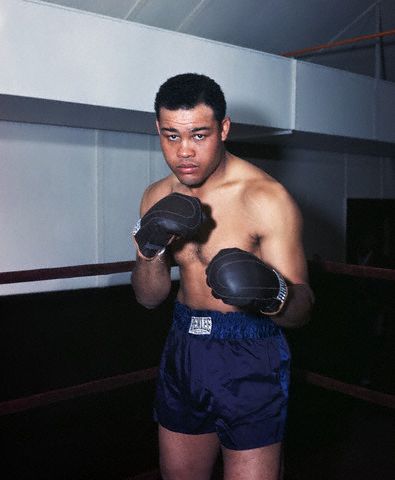
1. Joe Louis of Detroit. Born in Alabama as Joseph Louis Barrow, but trained to fight in Detroit, "the Brown Bomber" was the Motor City's 1st great fighter. By 1935, he was challenging men who had been Heavyweight Champion of the World, and winning. In 1936, he lost for the 1st time, to former Champion Max Schmeling.
But he recovered, won 6 more fights, and got a title shot against Champion Jim Braddock, knocking him out at Comiskey Park in Chicago on June 22, 1937. This completed an era in which the Detroit Tigers won back-to-back American League Pennants and a World Series, the Lions won an NFL Championship, and the Red Wings won back-to-back Stanley Cups. Detroit became the 1st city ever to call itself "the City of Champions," and they were right.
There were 5 men who were Heavyweight Champion in the 1930s before Louis, and he had beaten 4 of them: Braddock, Max Baer, Primo Carnera and Jack Sharkey. But he said he wouldn't consider himself the real champ until he beat Schmeling.
Schmeling had previously been rather popular in America, partly because he looked a bit like 1920s Champion Jack Dempsey, and partly because, although heavily accented, he spoke fluent English. And while Germans were despised in America during World War I, that was no longer the case during Schmeling's title-hold, 1930 to 1932.
But at this point, Nazi Germany was holding Schmeling up as an example of "Aryan supremacy." Schmeling didn't like that. He wasn't a bigot. And, with his dark complexion, dark hair, and thick eyebrows, he looked more like one of the Jews that the Nazis hated than a blond, blue-eyed Aryan Übermensch. Even when World War II came, and he was a paratrooper in the German army -- thus forcing him to swear an oath of loyalty to Adolf Hitler -- he was never a member of the National Socialist Party.
They fought at Yankee Stadium, the same site as their 1st fight, on June 22, 1938. President Franklin D. Roosevelt had told Louis he had to win for all America. He did: The fight lasted 2 minutes and 4 seconds. Joseph Goebbels, the Nazi propaganda minister, ordered the radio network broadcasting the fight throughout the Third Reich to stop broadcasting before Schmeling could be counted out.
Louis was now a hero to all America, white and black alike. He defended the Heavyweight Championship more times than anyone, 25. He held it continuously longer than anyone, 12 years. His fights with "Two Ton" Tony Galento, Light Heavyweight Champion Billy Conn, and Jersey Joe Walcott became legend. The Ring magazine named him Fighter of the Year in 1936, 1938, 1939 and 1941.
He retired after his 2nd fight with Walcott in 1948, and Ezzard Charles won the "elimination tournament" to become the new Champion in 1949. But Joe needed money, and came out of retirement, and it was a disaster. Charles beat him, and then rising contender Rocky Marciano knocked him out in 1951, ending his career with a record of 69-3. Still needing money, he became a pro wrestler. He wasn't good at it. And his last years saw him plagued by illness as well as debt. He died in 1981.
President Ronald Reagan, noting that Louis had served in the Army during World War II, ordered that he be buried at Arlington National Cemetery (which his family approved). His original hometown of Lafayette, Alabama erected a statue of him. Detroit erected an arena with his name on it, and a monument in his memory, a giant bronze arm with a clenched fist outside their City Hall.
Muhammad Ali called himself "The Greatest," but the generation that remembers Joe Louis as Heavyweight Champion may go to their eternal rests convinced that Louis was the best ever.
Top 10 Athletes From Michigan
Michigan is a big State, with almost 10 million people, and one of the largest metropolitan areas in the country, Detroit -- although a noticeable chunk of that metro area is across the Detroit River in Windsor, Ontario, Canada, and anyone from there is thus ineligible for this list.
Baseball. Football. Basketball. Hockey. Boxing. You could limit Michigan's Top 10 Athletes to any of those 5 sports, and come up with a list that could stand alongside 40 of the 50 States' Top 10.
Honorable Mention to Baseball Hall-of-Famers Hazen "Kiki" Cuyler of Harrisville, Hal Newhouser of Detroit, and John Smoltz of the Detroit suburb of Warren.
Honorable Mention to Jim Kaat of the Grand Rapids suburb of Zeeland. As both his name and his hometown's suggest, he is part of the large Dutch-American community in Michigan. He is not in the Hall of Fame, but he should be -- as either a player or a broadcaster. He was a 3-time All-Star, and won 16 Gold Gloves.
He won 283 games, including Pennants 17 years apart, in the American League with the 1965 Minnesota Twins, and in the National League with the 1982 St. Louis Cardinals, winning the World Series. When he retired the following year, he was the last active player who had played for the original Washington Senators (1901-60).
Honorable Mention to Kirk Gibson of the Detroit suburb of Pontiac. He played both baseball and football at Michigan State University. (So did Steve Garvey, but he's from Tampa.) He helped MSU's football team win the 1978 Big Ten Championship, then became a World Series hero in both leagues, for the 1984 Detroit Tigers and the 1988 Los Angeles Dodgers (following a regular season that won him the National League MVP).
Injuries cut short what could have been a Hall of Fame career, but still hit 255 home runs. In 2011, he was named NL Manager of the Year for getting the Arizona Diamondbacks to the NL Western Division title.
Honorable Mention to Orel Hershiser of Detroit. He was born in Buffalo, but was living in Detroit when he learned how to pitch, before moving to Toronto, and then to the Philadelphia suburb of Cherry Hill, New Jersey for high school. He had a 204-150 record over 18 seasons, reaching the postseason with the Los Angeles Dodgers in 1983, 1985 and 1988; the Cleveland Indians in 1995 and 1997; the San Francisco Giants in 1998; and the Mets in 1999.
A 3-time All-Star, his annus mirabilis was 1988: He won 23 games, set a new major league record with 59 consecutive scoreless innings pitched, won a Gold Glove and the National League Cy Young Award, and was named Most Valuable Player of both the NL Championship Series and, after winning Game 2 and the clinching Game 5, the World Series. In 1995, helping the Indians won the American League Pennant, he became the 1st (and still only) man to win LCS MVPs in both leagues.
He is not yet in the Hall of Fame, but he could be. He is now one of the game's most respected broadcasters.
Honorable Mention to Jim Abbott of Flint. Born without a hand on his right arm, he nonetheless learned how to pitch with his left, and to then switch his glove from his right wrist to his left hand and field his position. He won the 1987 James E. Sullivan Memorial Award as the nation's outstanding amateur athlete, for his pitching at the University of Michigan.
The team then known as the California Angels took a chance on him, and he reached the major leagues. Over 11 seasons, he had a record of 87-108, including a no-hitter with the Yankees in 1993.
Dishonorable Mention to Derek Lowe of the Detroit suburb of Dearborn. He went 176-157with 86 saves in a 17-season career as a major league pitcher. He reached the postseason with the Boston Red Sox in 1998, 1999, 2003 and 2004; the Los Angeles Dodgers in 2008; the Atlanta Braves in 2010; and the Yankees in 2012.
A 2-time All-Star, he led the AL in saves in 2000 and the NL in wins in 2006, a rare combination. He pitched a no-hitter for the Red Sox in 2002. And he was a beneficiary of their steroid-induced cheating that helped them win the 2004 World Series, which led to Lowe's inclusion with his teammates as Sports Illustrated's Sportspeople of the Year. The Red Sox have elected him to their team Hall of Fame.
Somewhat Honorable Mention to George Gipp of Laurium. The way the University of Notre Dame handled him then would get them put on probation now, with the gambling and the womanizing and the barely showing up for class (and, worse from their perspective, the barely showing up for Mass), and for not doing anything about it.
But, by the standards of the time, he was a great runner, a great passer, a great punter, a great defensive back, and a great kick returner. He helped Notre Dame win the National Championship in 1919 and 1920. In 2008, ESPN named ranked him 22nd on their list of the Top 25 College Football Players of All Time.
He might have been the ideal guy to be the 1st great star of the newly-founded NFL, except he got strep throat, which developed into pneumonia, and died on December 14, 1920 -- almost certainly not telling head coach Knute Rockne to tell the team to "Win one for the Gipper" on his deathbed, as seen in the 1940 film Knute Rockne, All-American, with Ronald Reagan as Gipp and Pat O'Brien as Rockne.
As it is, despite not having played pro ball -- that we know of, lots of athletes in that era played it under assumed names to protect their eligibility, Jim Thorpe being the most notable one to get caught -- he remains the greatest athlete from Michigan's Upper Peninsula.
Honorable Mention to Bennie Oosterbaan of Muskegon. Baseball, football and basketball: He played, and coached, all 3 sports at the University of Michigan. In 1928, he led the league that became known as the Big Ten in batting average and in basketball scoring.
But football was his best sport. A 2-way end, he became the 1st great receiver in the Big Ten, taking passes from Benny Friedman -- the "Benny-to-Bennie" combination. (Friedman was from Ohio, although this is not as ironic as it sounds, as Ohio State was not then considered the Wolverines' big rival.) Michigan went 20-4 with 2 league titles while he played for them, despite Red Grange then being at Illinois. The school would eventually retire his Number 47.
But he never played any sport professionally, which is why I can't place him any higher. He went right into coaching, spending 20 years as a Michigan assistant, before becoming head coach in 1948 -- and winning the National Championship and Coach of the Year in his 1st season. He won the Big Ten in his 1st, 2nd and 3rd seasons. His record was 63-33-4.
Honorable Mention to Heisman Trophy winners Pete Dawkins of the Detroit suburb of Bloomfield Hills (1958) and Mark Ingram Jr. of the Detroit suburb of Grand Blanc (2011).
Honorable Mention to Reggie Williams of Flint. A star linebacker at Dartmouth College, he played 14 seasons for the Cincinnati Bengals, helping them win AFC Championships in 1981 and 1988. His charitable work earned him 2 different NFL "Man of the Year" awards, and a share of Sports Illustrated's "Athletes Who Care" Sportspeople of the Year in 1987. He later served a term on the City Council in Cincinnati.
Honorable Mention to Mel Daniels of Detroit, who is in the Basketball Hall of Fame. Don Nelson of Muskegon is in, but as a coach. Rudy Tomjanovich of Hamtramck is not yet in as either a player or a coach; most likely, he will be elected as a coach. Dan Majerle of Traverse City and Chris Webber of Detroit could be elected as players.
Honorable Mention to Hockey Hall-of-Famers Mark Howe of Detroit (son of Red Wings legend Gordie), Pat LaFontaine of Waterford, and Mike Modano of the Detroit suburb of Livonia. Craig Patrick of Detroit, son of Lynn and grandson of Lester, is in the Hall of Fame, but for his executive achievements, not his playing.
Honorable Mention to Ken Morrow of the Flint suburb of Davison and Mark Wells of the Detroit suburb of St. Clair Shores. Members of the U.S. hockey team that won the Gold Medal at the 1980 Winter Olympics, along with their teammates, they were named Sportsmen of the Year by Sports Illustrated. Wells never got out of the minor leagues, but Morrow went right to the New York Islanders and helped them win their 4 straight Stanley Cups.
Honorable Mention to New Jersey Devils Stanley Cup Winners: Brian Rolston of Flint (1995, beating his home-State Red Wings in the Finals), Shawn Chambers of the Detroit suburb of Sterling Heights (also 1995, won another with the 1999 Dallas Stars), Danton Cole of the Detroit suburb of Pontiac (also 1995), and Brian Rafalski of the Detroit suburb of Dearborn (2000 and 2003, won another with the Wings in 2008).
Honorable Mention to members of the U.S. team that won the 1996 World Cup of Hockey: LaFontaine, Modano, Rolston, Chambers, Doug Weight of the Detroit suburb of Warren (he had played for the New York Islanders, and is now their head coach and general manager), and the brothers Derian and Kevin Hatcher of the Detroit suburb of Sterling Heights.
Honorable Mention to Tim Thomas of Flint, who won the 2011 Conn Smythe Trophy for MVP of the Stanley Cup Playoffs, winning the Cup with the Boston Bruins.
Honorable Mention to Kate Sobrero of the Detroit suburb of Bloomfield Hills. Now Kate Markgraf, she was a member of the U.S. soccer team that won the 1999 Women's World Cup, and was, with her teammates, named to Sports Illustrated's Sportswomen of the Year. She also won Olympic Gold Medals in Sydney in 2000 and Athens in 2004.
Honorable Mention to William Bonthron of Detroit. He won the 1934 Sullivan Award as a middle-distance runner, and for 2 years held the world record in the 1,500 meters. But he fell short of qualifying for the 1936 Olympics.
Honorable Mention to James "Lights Out" Toney of Grand Rapids. He first held a World Championship in 1991, the IBF Middleweight Championship; and last did so in 2003, the IBF Cruiserweight Championship. The Ring magazine named him Fighter of the Year in 1991 and 2003 -- 12 years apart. In the 2001 film Ali, with Will Smith as The Greatest, "The Dark Emperor" played Joe Frazier.
Honorable Mention to Vernon Forrest of Marquette. "The Viper" was Welterweight Champion of the World from 2001 to 2003, and Super Welterweight Champion from 2007 to 2009. The Ring magazine named him Fighter of the Year in 2002.
Dishonorable Mention to Floyd Mayweather Jr. of Grand Rapids. You've heard of "The Good, the Bad, and the Ugly"? Well, here it is:
The good: The son of a fine boxer and the nephew of 2 others, the man nicknamed "Pretty Boy" after 1930s gangster Pretty Boy Floyd and "Money" because his skill made him "money in the bank" first won a World Championship in 1998, WBC Super Featherweight Championship. He most recently held a title in 2005 -- 17 years later -- the WBA and WBC Welterweight Championships.
He was The Ring's Fighter of the Year in 1998 and 2007. He beat such fighters as Arturo Gatti, an aging but still tough Oscar De La Hoya, Ricky Hatton, Victor Ortiz and Miguel Cotto. His career record is 50-0, with 27 knockouts.
The bad: Although he was 1 of 2 contenders for the title of best fighter, pound-for-pound, in the world during the 2000s, he spent years ducking the other such contender, Manny Pacquiao. In 2010, it appeared the fight would finally happen, with Mayweather 33 years old and Pacquiao 31, both still very much in their prime. But Mayweather kept ducking him and making excuses for it, until 2015, when, after Pacquiao had already lost 2 additional fights, and at 36 was the younger of the fighters. Mayweather won an easy decision.
The ugly: He was convicted of misdemeanor battery against a woman in 2002, against 2 women in 2004, against a man in 2005, and against another woman in 2011. So, until things were ironed out, he wasn't willing to fight the boxer then considered the most likely to ruin his undefeated record, but he was willing to hit women.
Now, the Top 10:
10. Paul Krause of the Flint suburb of Burton. He scored 54 points in a high school basketball game, and also lettered in baseball and track. He played baseball and football, as a receiver and a safety, at the University of Iowa. He was considered a legitimate MLB prospect until an injury.
But he made his professional mark in football. A 9-time All-Pro, he led the NFL in interceptions as a rookie with the 1964 Washington Redskins. He was traded to the Minnesota Vikings, and helped them win the 1969 NFL Championship and reach 4 Super Bowls. Although he is the only player ever to both intercept a pass in a Super Bowl (IV) and recover a fumble in another (IX), the Vikings lost all 4.
He is the NFL's all-time leader in interceptions, with 81. The old record of 79 was also held by an Iowa player, Emlen Tunnell. He also recovered 19 fumbles. Think about that: He personally had a turnover ratio of +100. He was named to the 70 Greatest Redskins, the Vikings Ring of Honor, and the Pro Football Hall of Fame.
9. George Gervin of Detroit. "The Iceman" came out of Eastern High School (now named for Martin Luther King) and Eastern Michigan University to become one of the most exciting players in pro basketball. He was a 12-time All-Star, 3 in the ABA and 9 in the NBA, including winning the All-Star Game MVP in 1980.
He led the NBA in scoring 4 times, his finger-roll becoming as much of a trademark in those days as Kareem Abdul-Jabbar's skyhook. Unfortunately for him, he never had a great team around him, and the closest he got to a League title was the 1976 ABA Semifinals (losing to the New York Nets) and 3 NBA Western Conference Finals, all with the San Antonio Spurs.
The Spurs retired his Number 44. He was named to the ABA All-Time Team and the NBA's 50th Anniversary 50 Greatest Players, 1 of 5 players so honored. Hall-of-Famer Gary Payton and Heisman Trophy-winning quarterback Ty Detmer, a San Antonio native, have called him their favorite athlete of all time.
8. Stanley Ketchel of Grand Rapids. A son of Polish immigrants, the man born Stanisław Kiecal and nicknamed the Michigan Assassin was, in the words of boxing historian Bert Sugar, "half animal."
As Jack Dempsey later would, he went around the American West, getting fights wherever he could. Officially, he would build a pro record of 51-4-4. As for the fights he got paid for that haven't been counted, who knows.
He became Middleweight Champion of the World in 1908. He was known for his 4 fights with Billy Papke, winning 3. He frequently fought guys who were much bigger, beating Light Heavyweight Champion Philadelphia Jack O'Brien.
He and Heavyweight Champion Jack Johnson were friends, in spite of the racial difference. They agreed to fight each other, in spite of Johnson's tremendous size advantage. The deal was, it would go the distance, 20 rounds, and thus there would be no decision, and they would split the film rights to the fight 50-50. But Ketchel got carried away, forgot the deal, and knocked Johnson down. Big mistake: Johnson got up, and knocked out both Ketchel and some of his teeth.
Ketchel was training for a rematch with Johnson on a ranch in Missouri when he was shot and killed by a ranch hand on October 15, 1910. He was only 24. He is in the International Boxing Hall of Fame, and his hometown of Grand Rapids put up a statue of him. Nat Fleischer, founder and editor of The Ring magazine, called him the greatest middleweight fighter ever.
7. Jerome Bettis of Detroit. "The Bus" starred at Notre Dame, and moved with the Los Angeles Rams to St. Louis, before becoming a mainstay with the Pittsburgh Steelers. A 6-time Pro Bowler, he rushed for 13,664 yards and 91 touchdowns, and caught 200 passes for 1,457 yards and 3 touchdowns.
He closed his career in his hometown, as the Steelers won Super Bowl XL at Ford Field. The Steelers named him to their Hall of Honor, and have unofficially retired his Number 36. He is in the Pro Football Hall of Fame.
6. Charlie Gehringer of the Detroit suburb of Fowlerville. Mickey Cochrane, the catcher and manager of the Detroit Tigers in the mid-1930s, said, "Charlie says, 'Hello' on Opening Day, 'Goodbye' on closing day, and, in between, hits .350." His taciturnity, letting his bat and his glove do the talking, led to his nickname "The Mechanical Man."
There were no Gold Gloves in his day, and the All-Star Game didn't start until 1933, his 10th major league season. But he was the American League's starting 2nd baseman in the 1st 6 Games. He led the AL in stolen bases in 1929 and batting average in 1937, winning the Most Valuable Player that year. He helped the Tigers win Pennants in 1934, 1935 and 1940, winning the World Series in 1935.
He finished with a batting average of .320 and 2,839 hits. Following a barnstorming tour with a white team against a team of Negro Leaguers, Satchel Paige called him the best white hitter he ever pitched against. The Tigers retired his Number 2, and he was elected to the Baseball Hall of Fame. In 1999, The Sporting News chose him as one of their 100 Greatest Baseball Players.
5. Dave DeBusschere of Detroit. He pitched for the Chicago White Sox in the 1962 and '63 seasons, but he was also a basketball star in his home town, first for the University of Detroit, then for the Pistons, where he became the youngest head coach in NBA history, at 24, from 1964 to 1967.
He is 1 of only 12 athletes to have played in both Major League Baseball and the National Basketball Association (or its predecessor, the Basketball Association of America).
For a long time, Madison Square Garden would host NBA doubleheaders, with the Knicks playing the nightcap but not the opener. When the new Garden opened on February 14, 1968, Dave DeBusschere, playing for the Pistons, scored the new building's 1st basket.
The Knicks traded Walt Bellamy to the Pistons to get DeBusschere, already with a reputation as one of the league’s best defensive players. He led the defense that helped the Knicks win the NBA Championship in 1970 and 1973. He later served as head coach and general manager of the Knicks, and his Number 22 has been retired. He was elected to the Basketball Hall of Fame, and named to the NBA’s 50th Anniversary 50 Greatest Players.
My generation knows DeBusschere best as the Knick GM who won the 1st pick in the 1st-ever NBA Draft Lottery in 1985, selecting Patrick Ewing. Sadly, the great Double D suffered a heart attack and died in 2003, age 63.
4. Thomas Hearns of Detroit. The "Hit Man," also known as the "Motor City Cobra," first won a World Championship in 1980, the WBA Welterweight Championship. He last held a title in in 1992, the WBA Light Heavyweight Championship. In between, he was one of the most feared boxers in the world, being named Fighter of the Year by The Ring magazine in 1980 and 1984.
He lost a unification bout for the Middleweight Championship to Sugar Ray Leonard in 1981, but Leonard was barely hanging on before knocking Hearns out. After that, Hearns beat Wilfred Benitez and knocked out Roberto Duran. He got clobbered by Marvin Hagler, but it says something about him that even his 2 most notable defeats were fights in which he got in some great licks. His final record was 61-5-1.
3. Derek Jeter of Kalamazoo. His roots are in New Jersey. Born in Pequannock, Morris County, he lived in West Milford, Passaic County until age 4, when he moved with his parents to "Kazoo," about halfway between Chicago and Detroit. But because his grandparents still lived in North Arlington, Bergen County, he stayed a Yankee Fan.
His 2,747 games and 20 seasons are Yankee records. A 14-time All-Star and (contrary to the stories you may have been told about his bad fielding) a 5-time Gold Glove winner, he was AL Rookie of the Year in 1996, as the new Yankee Dynasty began. World Championships were won in 1996, 1998, 1999, 2000 and 2009. Additional Pennants were won in 2001 and 2003. In only 3 of his 20 seasons -- 1 of the 1st 18 -- did the Yankees fail to make the Playoffs.
In 2000, he became the 1st (and still only) player to be named Most Valuable Player of the All-Star Game and the World Series in the same season. However, he was never named a regular-season MVP, finishing in the top 3 in the voting in 1998, 2006 and 2009. In 2009, Sports Illustrated named him Sportsperson of the Year.
He finished with a .310 lifetime batting average, and 3,465 hits -- more than any person born after 1941 -- 260 of them home runs. The Yankees have retired his Number 2, and dedicated a Plaque for him in Monument Park. He will be eligible for the Hall of Fame in the election whose results will be announced in January 2020. He is now a part-owner of the Miami Marlins.
2. Earvin "Magic" Johnson of Lansing. He led Michigan State University to the 1979 National Championship, beating an Indiana State team led by Larry Bird. Magic was named the NCAA Tournament's Most Outstanding Player. This game, still the most-watched in college basketball history, is credited with launching the sport to a new level. It also started a professional and personal rivalry between Magic and Larry, although it never got nasty.
Magic was drafted by the Los Angeles Lakers, who already had Kareem Abdul-Jabbar, forcing him to switch from Number 33 to 32. The Lakers reached the 1980 NBA Finals, and when Kareem was hurt for Game 6, Magic, though 6-foot-9 was by then short for a center, moved from point guard, and torched the Philadelphia 76ers for 42 points on their own court, and won the title.
He also helped the Lakers win the NBA Championship in 1982 (again against the 76ers), 1985 (against Bird's Celtics), 1987 (against Bird again) and 1988 (against the Detroit Pistons). He was named Finals MVP (now named the Bill Russell Award) in 1980, 1982 and 1987. They also reached the Finals in 1983, 1984, 1989 and 1991. He became the all-time assists leader, a record since broken by John Stockton. He was a 12-time All-Star, and a 2-time All-Star Game MVP.
Now I come to the elephant in the room. Just before the 1991-92 season could begin, Magic announced he was retiring, because he'd been diagnosed with HIV, the virus that causes AIDS. He was nonetheless selected to that season's All-Star Game, and showed he still had his A-game, and was named the Game's MVP. He was named to the "Dream Team" that stormed to victory at the 1992 Olympics in Barcelona. Even then, he couldn't stay away, briefly coaching the Lakers in 1994 (not well) and briefly returning as a player in 1996 (ditto).
Michigan State retired his Number 33. The Lakers retired his Number 32 and dedicated a statue of him outside the Forum, since moved to the Staples Center. He was named to the Basketball Hall of Fmae and the NBA's 50th Anniversary 50 Greatest Players.
More than that, before he retired, he was already investing wisely, and had founded a chain of movie theaters, all in historically black neighborhoods, including on Harlem's iconic 125th Street. Not long before his diagnosis was announced, but right after Michael Jordan had led the Chicago Bulls to their 1st NBA Championship (beating Magic and the Lakers in the Finals), Magic said, "If Michael were doing what I'm doing, he really would own the world."
Magic's holdings now include a minority share of the Lakers, and the majority ownership of baseball's Los Angeles Dodgers, now defending National League Champions. Earvin Johnson still has a magic touch.
A man would have to be not just great at his sport, but a shaper of the world, to be ahead of Magic on this list. And the man at Number 1 was:
1. Joe Louis of Detroit. Born in Alabama as Joseph Louis Barrow, but trained to fight in Detroit, "the Brown Bomber" was the Motor City's 1st great fighter. By 1935, he was challenging men who had been Heavyweight Champion of the World, and winning. In 1936, he lost for the 1st time, to former Champion Max Schmeling.
But he recovered, won 6 more fights, and got a title shot against Champion Jim Braddock, knocking him out at Comiskey Park in Chicago on June 22, 1937. This completed an era in which the Detroit Tigers won back-to-back American League Pennants and a World Series, the Lions won an NFL Championship, and the Red Wings won back-to-back Stanley Cups. Detroit became the 1st city ever to call itself "the City of Champions," and they were right.
There were 5 men who were Heavyweight Champion in the 1930s before Louis, and he had beaten 4 of them: Braddock, Max Baer, Primo Carnera and Jack Sharkey. But he said he wouldn't consider himself the real champ until he beat Schmeling.
Schmeling had previously been rather popular in America, partly because he looked a bit like 1920s Champion Jack Dempsey, and partly because, although heavily accented, he spoke fluent English. And while Germans were despised in America during World War I, that was no longer the case during Schmeling's title-hold, 1930 to 1932.
But at this point, Nazi Germany was holding Schmeling up as an example of "Aryan supremacy." Schmeling didn't like that. He wasn't a bigot. And, with his dark complexion, dark hair, and thick eyebrows, he looked more like one of the Jews that the Nazis hated than a blond, blue-eyed Aryan Übermensch. Even when World War II came, and he was a paratrooper in the German army -- thus forcing him to swear an oath of loyalty to Adolf Hitler -- he was never a member of the National Socialist Party.
They fought at Yankee Stadium, the same site as their 1st fight, on June 22, 1938. President Franklin D. Roosevelt had told Louis he had to win for all America. He did: The fight lasted 2 minutes and 4 seconds. Joseph Goebbels, the Nazi propaganda minister, ordered the radio network broadcasting the fight throughout the Third Reich to stop broadcasting before Schmeling could be counted out.
Louis was now a hero to all America, white and black alike. He defended the Heavyweight Championship more times than anyone, 25. He held it continuously longer than anyone, 12 years. His fights with "Two Ton" Tony Galento, Light Heavyweight Champion Billy Conn, and Jersey Joe Walcott became legend. The Ring magazine named him Fighter of the Year in 1936, 1938, 1939 and 1941.
He retired after his 2nd fight with Walcott in 1948, and Ezzard Charles won the "elimination tournament" to become the new Champion in 1949. But Joe needed money, and came out of retirement, and it was a disaster. Charles beat him, and then rising contender Rocky Marciano knocked him out in 1951, ending his career with a record of 69-3. Still needing money, he became a pro wrestler. He wasn't good at it. And his last years saw him plagued by illness as well as debt. He died in 1981.
President Ronald Reagan, noting that Louis had served in the Army during World War II, ordered that he be buried at Arlington National Cemetery (which his family approved). His original hometown of Lafayette, Alabama erected a statue of him. Detroit erected an arena with his name on it, and a monument in his memory, a giant bronze arm with a clenched fist outside their City Hall.
Muhammad Ali called himself "The Greatest," but the generation that remembers Joe Louis as Heavyweight Champion may go to their eternal rests convinced that Louis was the best ever.
Thursday, January 25, 2018
Living Members of the Baseball Hall of Fame as of January 25, 2018
Left to right: St. Louis Cardinals Hall-of-Famers Whitey Herzog,
Ozzie Smith, Red Schoendienst, Bob Gibson and Lou Brock.
Red, about to turn 95, is the oldest living Hall-of-Famer.
With the new elections, and the deaths of some, it is time to update this list.
A player is counted as a Hall-of-Famer with the team if he played at least 4 seasons with them. Teams are ranked in order of most HOFers.
1. St. Louis Cardinals, 9: Red Schoendienst (elected as player, also managed them to a title), Bob Gibson, Lou Brock, Orlando Cepeda, Steve Carlton (7 seasons), Bruce Sutter, Ozzie Smith, Whitey Herzog (manager-executive), Tony LaRussa (manager).
2. Atlanta Braves, 9: Hank Aaron, Phil Niekro, Tom Glavine, Greg Maddux, John Smoltz, Chipper Jones, Bobby Cox (manager), Joe Torre (managed them in between Cox's 2 tenures there, also a player), John Schuerholz (executive).
3. Baltimore Orioles, 8: Brooks Robinson, Luis Aparicio, Frank Robinson, Jim Palmer, Eddie Murray, Cal Ripken, Roberto Alomar, Jon Miller (broadcaster).
4. Cincinnati Reds, 8: Frank Robinson, Johnny Bench, Tony Perez, Joe Morgan, Tom Seaver (6 seasons with Reds), Barry Larkin, Ken Griffey Jr., Marty Brennaman (broadcaster).
5. Chicago White Sox, 7: Luis Aparicio, Goose Gossage (5 years with them), Carlton Fisk, Frank Thomas, Tim Raines, Jim Thome (4 years), Tony LaRussa (manager).
6. New York Yankees, 8: Whitey Ford, Reggie Jackson, Rich "Goose" Gossage, Dave Winfield, Rickey Henderson, Wade Boggs, Joe Torre (manager) and Tony Kubek (broadcaster).
7. Boston Red Sox, 6: Carl Yastrzemski, Carlton Fisk, Jim Rice, Dennis Eckersley, Wade Boggs, Pedro Martinez.
8. Chicago Cubs, 6: Billy Williams, Ferguson Jenkins, Bruce Sutter, Ryne Sandberg, Andre Dawson, Greg Maddux.
9. New York Mets, 6: Tom Seaver, Mike Piazza, Tom Glavine (5 seasons), Pedro Martinez (4 seasons), Joe Torre (manager), Tim McCarver (broadcaster).
10. San Francisco Giants, 6: Willie Mays, Orlando Cepeda, Willie McCovey, Juan Marichal, Gaylord Perry, Jon Miller (broadcaster).
11. Los Angeles Dodgers, 6: Sandy Koufax, Don Sutton, Mike Piazza, Tommy Lasorda (manager), Vin Scully (broadcaster), Jamie Jarrin (broadcaster).
12. San Diego Padres, 5: Dave Winfield, Ozzie Smith, Rollie Fingers, Goose Gossage, Trevor Hoffman. Dick Enberg died a few weeks ago.
13. Los Angeles Angels of Anaheim, 5: Nolan Ryan, Rod Carew, Reggie Jackson, Bert Blyleven, Vladimir Guerrero. Again, Dick Enberg died a few weeks ago.
14. Detroit Tigers, 5: Al Kaline, Jim Bunning, Jack Morris, Alan Trammell, Ivan Rodriguez.
15. Oakland Athletics, 5: Reggie Jackson, Rollie Fingers, Rickey Henderson, Dennis Eckersley, Tony LaRussa (manager).
17. Texas Rangers, 5: Ferguson Jenkins, Gaylord Perry, Nolan Ryan, Ivan Rodriguez, Eric Nadel (broadcaster).
18. Milwaukee Brewers, 5: Robin Yount, Paul Molitor, Rollie Fingers, Bud Selig (owner), Bob Uecker (broadcaster).
Montreal Expos, 5: Andre Dawson, Tim Raines, Pedro Martinez, Vladimir Guerrero, Dave Van Horne (broadcaster).
19. Houston Astros, 4: Joe Morgan, Nolan Ryan, Craig Biggio, Jeff Bagwell.
20. Kansas City Royals, 4: George Brett, Whitey Herzog (manager), John Schuerholz (executive), Denny Matthews (broadcaster).
21. Seattle Mariners, 3: Randy Johnson, Ken Griffey Jr., Pat Gillick (executive).
22. Toronto Blue Jays, 3: Roberto Alomar, Pat Gillick (executive), Tony Kubek (broadcaster).
Milwaukee Braves, 2: Hank Aaron, Red Schoendienst.
24. Cleveland Indians, 2: Gaylord Perry, Jim Thome.
26. Miami Marlins, 2: Felo Ramirez and Dave Van Horne (both broadcasters).
New York Giants, 1: Willie Mays.
Brooklyn Dodgers, 1: Vin Scully (broadcaster).
Washington Senators, 1: Bob Wolff (broadcaster).
27. Arizona Diamondbacks, 1: Randy Johnson.
28. Washington Nationals, 1: Frank Robinson (manager).
29. Tampa Bay Rays, none.
30. Colorado Rockies, none.
Baseball Hall-of-Famers By Team, 2018 Edition
Left to right: Chipper Jones, Jim Thome,
Vladimir Guerrero and Trevor Hoffman.
With the announcement of the elections of Chipper Jones, Vladimir Guerrero, Jim Thome, Trevor Hoffman, Jack Morris and Alan Trammell, it is time to update this list.
Ford Frick Award winner Bob Costas will not be added to this list, since he has never been a broadcaster for any single team.
A player is counted as a Hall-of-Famer with the team if he played at least 4 seasons with them. However, there will be the occasional exception. Teams are ranked in order of most HOFers.
If there is a tie, it will be broken by which team has more players, as opposed to those who were elected in other categories. If there is still a tie, then I go to which has more non-broadcasters. If it's still a tie, which has more players whose contributions were mostly with that club. If it's still a tie, which team has played fewer seasons will be ranked ahead -- since, for example, 5 HOFers is more impressive for a team that's been around since 1977 than it would be for one that's been around since 1961.
Teams that no longer exist in that form will be listed in italics and in the position where they would be ranked if they still did.
Players are listed in chronological order of when they arrived at the club, then managers, then broadcasters.
1. New York Yankees, 39: It almost works out to 1 for every Pennant the team has won:
Clark Griffith (the team's first manager, elected as a pitcher and he was still a solid pitcher while he was their manager), Willie Keeler, Jack Chesbro, Frank "Home Run" Baker, Waite Hoyt, Herb Pennock, Babe Ruth, Lou Gehrig, Tony Lazzeri, Earle Combs, Bill Dickey, Red Ruffing, Lefty Gomez, Joe DiMaggio, Joe Gordon, Phil Rizzuto, Yogi Berra, Johnny Mize, Whitey Ford, Mickey Mantle, Enos Slaughter, Jim "Catfish" Hunter, Reggie Jackson, Rich "Goose" Gossage, Dave Winfield, Rickey Henderson, Wade Boggs.
Also, managers Miller Huggins, Joe McCarthy, Casey Stengel and Joe Torre; owner Jacob Ruppert; executives Ed Barrow and George Weiss; broadcasters Mel Allen, Red Barber, Joe Garagiola, Jerry Coleman (played for the Yankees but elected as a broadcaster, first for the Yankees, then for the Padres) and Tony Kubek (played for the Yankees but elected as a broadcaster).
Bucky Harris managed the Yankees to the 1947 World Championship, but was only their manager for 2 seasons (1947 & '48), so I'm not counting him with the Yankees. In this case, according to the rule I set, I have to count Rickey Henderson as a Yankee. If Lou Piniella is ever elected as a manager, I wouldn't be able to count him as a Yankee HOFer, since he wouldn't be elected as a player and only managed them for 3 seasons.
Rizzuto was also a longtime broadcaster. Lee MacPhail was elected for what he did as American League President, not as Yankee general manager. Bernie Williams and Paul O'Neill have dropped off the writers' ballot. They, like Don Mattingly, will, in a few years, become eligible once again, through the Veterans' Committee -- but in all 3 cases, let's not kid ourselves.
And then there's Roger Clemens: Even if he does get in, would you want to count him as a Yankee? George Steinbrenner, now being dead, is now eligible through the Veterans' Committee.
Tim Raines was a Yankee for only 3 years, although 2 of them were title seasons. Ivan Rodriguez was a Yankee for about 3 minutes. So neither of them can be included here.
Mike Mussina is eligible. Mariano Rivera and Andy Pettitte become eligible next year. Derek Jeter, the year after that. Alex Rodriguez, in 2022 -- the same year as David Ortiz, who hit a lot fewer home runs, was not the runner or fielder that A-Rod was, and, unlike A-Rod, is known to have flunked a steroid test. Bet you any money you like, Ortiz gets in in his 1st year of eligibility, and A-Rod goes through his entire 10-year BBWAA eligibility without getting in.
At any rate, all 5 of those Yankees have the stats to get in. Mo and Derek will, the 1st tie around. Moose will get in within the next couple of years. Andy and A-Rod are big question marks, but will probably, at least for a while, become victims of the Yankee Doodle Double Standard.
2. St. Louis Cardinals, 30: Charlie Comiskey (played for them before managing and owning teams elsewhere), Jake Beckley, Roger Bresnahan, Rogers Hornsby (won a World Series as their player-manager), Jesse Haines, Grover Cleveland Alexander, Jim Bottomley, Charles "Chick" Hafey, Burleigh Grimes, Frankie Frisch (elected as a player, won a World Series as their player-manager), Dizzy Dean, Joe Medwick, Johnny Mize, Enos Slaughter, Stan Musial, Red Schoendienst (elected as player, also managed them to a title), Bob Gibson, Lou Brock, Orlando Cepeda, Steve Carlton (7 seasons), Bruce Sutter, Ozzie Smith.
Also, Miller Huggins (manager, also played several years for the Cards), Billy Southworth (manager, also played for them), Whitey Herzog (manager-executive), Tony LaRussa (manager), Branch Rickey (executive), Harry Caray (broadcaster), Jack Buck (broadcaster), Joe Garagiola (broadcaster).
Jesse Burkett won a batting title with the Cards, but only played 3 seasons with them, so he just misses qualifying. On the other hand, Cepeda didn't even play 3 full seasons with the Cards, but his tenure included the 1967 title and the 1968 Pennant, and he, as much as Gibson, was a symbol of that team, and he may be better remembered as a Cardinal than as a Giants, so I'm bending the rule for him. Leo Durocher was a good player for the Cards, but was elected as a manager and never managed them, so he doesn't qualify here.
Mark McGwire and Jim Edmonds did not qualify on enough ballots, and won't be eligible again until they qualify under the Veterans Committee. Surprisingly, longtime owner Gussie Busch has never been elected.
About to turn 95, Schoendienst is the oldest and earliest-playing living Hall-of-Famer. Having managed the Cardinals to the 1967 World Championship, he is also the earliest living manager of a Pennant winner.
New York Giants, 26: Roger Connor, Buck Ewing, Tim Keefe, Mickey Welch, John Montgomery Ward, Roger Bresnahan, Christy Mathewson, Joe McGinnity, George Davis, Richard "Rube" Marquard, Dave Bancroft, Ross Youngs, Frankie Frisch, George "Highpockets" Kelly, Fred Lindstrom, Travis Jackson, Bill Terry, Mel Ott, Carl Hubbell, Johnny Mize, Monte Irvin, Willie Mays, Hoyt Wilhelm.
Also, John McGraw (manager, also played for them), Leo Durocher (manager), Russ Hodges (broadcaster).
Casey Stengel played for the Giants, but was elected as a manager, so I can't count him as a Giant HOFer.
Counting all figures who played or managed at least one game for the Giants, in New York and San Francisco, they have 76, more than any other team; however, many of those were with the club only briefly. But even by my definitions, they are ahead of the arch-rival Dodgers.
3. Chicago Cubs, 27: Adrian "Cap" Anson, Mike "King" Kelly, Clark Griffith (elected as a pitcher for them, later a manager and owner elsewhere), Joe Tinker, Johnny Evers, Frank Chance (elected as a player but should have been elected as a manager instead), Mordecai "Three-Finger" Brown, Grover Cleveland Alexander, Hazen "Kiki" Cuyler, Lewis "Hack" Wilson, Charles "Gabby" Hartnett (also managed them to a Pennant), Rogers Hornsby, Billy Herman, Ernie Banks, Billy Williams, Ron Santo, Ferguson Jenkins, Bruce Sutter, Ryne Sandberg, Andre Dawson, Greg Maddux (spent enough time with them).
Also, Al Spalding (elected as an executive but was also a great pitcher), Frank Selee (manager), Joe McCarthy (manager, managed them to a Pennant before going to the Yankees), Leo Durocher (manager), Jack Brickhouse (broadcaster), Harry Caray (broadcaster).
Sammy Sosa is eligible, but he's not getting in. Lee Smith is eligible, but now that he's no longer the all-time saves leader, the biggest reason for electing him is gone. If Lou Piniella is elected as a manager, I'll have to count him as a Cub HOFer, since he managed them for 4 seasons.
Lou Boudreau was a beloved broadcaster for the Cubs after his playing and managing career, but never played or managed for them, and so I can't count him as a Cub HOFer. Santo was also a longtime broadcaster. Surprisingly, longtime owner Phillip K. Wrigley is not in.
4. Pittsburgh Pirates, 23: James "Pud" Galvin, Vic Willis, John "Honus" Wagner, Fred Clarke (elected as a player, also won Pennants as their manager), Jack Chesbro, Jake Beckley, Max Carey, Hazen "Kiki" Cuyler, Waite Hoyt (5 seasons with them), Harold "Pie" Traynor (also managed them), Paul Waner, Lloyd Waner ("Big Poison" and "Little Poison," though Lloyd was actually taller), Joseph "Arky" Vaughan, Al Lopez (elected as a manager but was an All-Star catcher for the Pirates), Ralph Kiner, Bill Mazeroski, Roberto Clemente, Willie Stargell, Bert Blyleven.
Also, Bill McKechnie (manager), Barney Dreyfuss (owner), Branch Rickey (executive), Bob Prince (broadcaster).
Blyleven was only a Pirate for 3 seasons, but I'm bending the rule because he was a key cog on their last World Championship team in 1979. Barry Bonds is eligible, but while the stance against steroid cheats is softening, he still, for the moment, falls under the category of, "Who's kidding who?"
5. Chicago White Sox, 23: Ed Walsh, George Davis, Eddie Collins, Ray Schalk, Red Faber, Ted Lyons, Luke Appling, Nellie Fox, Luis Aparicio, Early Wynn, Hoyt Wilhelm, Goose Gossage (5 years with them), Carlton Fisk, Frank Thomas, Tim Raines, Jim Thome, Al Lopez (manager), Tony LaRussa (manager), Charlie Comiskey (owner), Bill Veeck (owner), Jack Brickhouse (broadcaster), Bob Elson (broadcaster), Harry Caray (broadcaster).
Although Clark Griffith pitched for them in their 1st 2 seasons and won the 1st American League Pennant as their manager, those 2 seasons are not enough to qualify with the White Sox. Although Tom Seaver notched his 300th victory with the Pale Hose, he pitched for them in just 3 seasons, and can't be counted as one of their HOFers.
Thome was a White Sock for less than 4 full seasons, but did play for them in 4 seasons, so he counts with them.
Boston Braves, 22: Harry Wright (player and manager), George Wright, Al Spalding, Jim "Orator" O'Rourke, James "Deacon" White, Charlie "Old Hoss" Radbourne, Mike "King" Kelly, John Clarkson, Charles "Kid" Nichols, Cy Young, Hugh Duffy, Tommy McCarthy (he and Duffy were known as "the Heavenly Twins"), Billy Hamilton, Vic Willis, Jimmy Collins, Johnny Evers, Walter "Rabbit" Maranville, Dave Bancroft.
Also, Frank Selee (manager), Bill McKechnie (manager, though with no success with the Braves), Casey Stengel (ditto, also played for Braves), Billy Southworth (manager).
5. Boston Red Sox, 22: Jimmy Collins (elected as a player but also managed them to the 1st World Series title in 1903), Cy Young, Tris Speaker, Harry Hooper, Babe Ruth (6 seasons with Sox before going to Yanks), Herb Pennock (7 seasons before Yanks), Red Ruffing (also 7 seasons before Yanks), Joe Cronin (elected as a player, but also managed them to the 1946 Pennant, though unlike Collins had already retired as a player; was also longtime AL President), Rick Ferrell, Jimmie Foxx, Lefty Grove, Bobby Doerr, Ted Williams, Carl Yastrzemski, Carlton Fisk, Jim Rice, Dennis Eckersley, Wade Boggs, Pedro Martinez.
Also, Dick Williams (manager, no relation to Ted), Tom Yawkey (owner), Curt Gowdy (broadcaster).
I am bending the rule slightly for Dick Williams, who only managed 3 seasons for the Red Sox, but 1 of them, 1967, was the most important season in the club's modern history. Roger Clemens and Curt Schilling are eligible, although I don't know if they will ever get in, despite being members of the 3,000 Strikeout Club, and Clemens is also a member of the 300 Win Club.
Luis Aparicio played 3 seasons for the Red Sox, so by my rule he is not eligible to be counted with them. Eckersley, however, played 7 seasons with them, so I have to count him with them, and with their living HOFers for as long as he lives.
It was long suspected that owner Jean Yawkey would become the first woman elected to the Hall of Fame, but Effa Manley, who owned the Negro Leagues' Newark Eagles, is in, while Mrs. Yawkey is still out.
Brooklyn Dodgers, 21: Willie Keeler, Joe Kelley, Richard "Rube" Marquard, Zack Wheat, Burleigh Grimes, Charles "Dazzy" Vance, Joseph "Arky" Vaughan, Billy Herman, Joe Medwick, Pee Wee Reese, Jackie Robinson, Duke Snider, Roy Campanella, Ned Hanlon (manager), Wilbert Robinson (manager), Leo Durocher (elected as a manager but was also a good player), Walter Alston (manager), Branch Rickey (owner), Walter O'Malley (owner), Red Barber (broadcaster), Vin Scully (broadcaster).
Casey Stengel played 6 seasons for the Dodgers, and was good, but not Hall of Fame good. He managed 3 seasons for them; in spite of their poor performance under him, had he managed them for 1 more season, he would still qualify as one of theirs under my rule. Dick Williams played 5 seasons for them, but was elected as a manager and never managed the Dodgers. Owner Charles Ebbets is not in.
7. Detroit Tigers, 18: Sam Crawford, Ty Cobb, Harry Heilmann, Henry "Heinie" Manush, Charlie Gehringer, Goose Goslin, Hank Greenberg (the last 3 nicknamed the "G-Men" in those early days of the FBI), Mickey Cochrane (elected as a player, also managed them to 2 Pennants), Hal Newhouser, George Kell, Al Kaline, Jim Bunning, Jack Morris, Alan Trammell, Ivan Rodriguez, Hughie Jennings (manager, also played for the team), Sparky Anderson (manager), Ernie Harwell (broadcaster).
With Trammell getting in through the Veterans Committee, Lou Whitaker's chances of also doing so increase. Kaline and Kell were also longtime broadcasters. Longtime owners Frank Navin, Walter Briggs and John Fetzer are not yet in. Former executive Will Harridge is in, but for what he did as President of the AL, so I can't count him as a Tiger HOFer.
Pete Rose, of course, is ineligible. John Franco is not yet in, but if he gets in, he pitched enough seasons with the Reds to qualify for this list. If Lou Piniella is elected as a manager, I'll count him as a Reds HOFer: He only managed them for 3 seasons, but 1 was a World Championship season. Miller Huggins played several years for the Reds, but was elected as a Yankee manager.
Longtime owner Powel Crosley and GM Bob Howsam should be in, but they're not. Waite Hoyt broadcast for the Reds, and was beloved in that role, but has not been given the Ford Frick Award, so I can't count him with the Reds.
And while 2 members of the 1st openly professional baseball team, the 1869-70 Cincinnati Red Stockings, are in the Baseball Hall of Fame, Harry and George Wright -- the other Wright Brothers who "invented" something important in American life -- that team was not the same team as the current Reds franchise, which began in the old American Association of 1882 and joined the NL in 1892.
9. Cleveland Indians, 17: Napoleon "Nap" Lajoie, Elmer Flick, Addie Joss, Tris Speaker (elected as player but also managed them to a title), Stan Coveleski, Joe Sewell, Earl Averill, Bob Feller, Lou Boudreau, Bob Lemon, Larry Doby, Early Wynn, Gaylord Perry, Jim Thome, Al Lopez (manager), Bill Veeck (owner), Jimmy Dudley (broadcaster).
Barring a major shift in voters' attitudes, Manny Ramirez is probably out of luck. Satchel Paige reached the majors with the Indians, but only pitched 2 seasons for them; although I can count him with 3 different Negro League teams on this list, I can't count him with any major league team. Indeed, that fact is the reason I've included the Negro League teams on this list, along with moved and defunct major league teams.
10. Philadelphia Phillies, 17: Billy Hamilton, Ed Delahanty, Sam Thompson, Grover Cleveland Alexander, Eppa Rixey, Dave Bancroft, Chuck Klein, Richie Ashburn, Robin Roberts, Jim Bunning, Steve Carlton, Mike Schmidt, Jim Thome, Harry Wright (manager), Pat Gillick (executive), By Saam (broadcaster), Harry Kalas (broadcaster).
Thome spent 3 seasons with them, then left, then returned for a 4th, so he counts here. Ashburn was also a longtime broadcaster for the Phils. If Curt Schilling gets in, he can be counted with the Phillies. Pete Rose, of course, is ineligible.
Philadelphia Athletics, 13: Eddie Plank, Rube Waddell, Frank "Home Run" Baker, Chief Bender, Eddie Collins, Herb Pennock, Al Simmons, Mickey Cochrane, Jimmie Foxx, Lefty Grove, George Kell, Connie Mack (owner-manager), By Saam (broadcaster).
11. Baltimore Orioles, 12: Brooks Robinson, Hoyt Wilhelm, Robin Roberts (4 seasons with O's), Luis Aparicio, Frank Robinson, Jim Palmer, Eddie Murray, Cal Ripken, Roberto Alomar, Earl Weaver (manager), Chuck Thompson (broadcaster), Jon Miller (broadcaster).
Although he won his only World Series with the Orioles, we don't usually associate Aparicio with them, but he did play 5 seasons with them, so, by my own rule, I've got to count him here. Same with Robin Roberts, who played 4 seasons in Baltimore. Rafael Palmeiro is eligible, but he's not getting in.
Mike Mussina should be in. Frank Cashen should be in as an executive. Dick Williams played enough seasons with the O's to qualify, but was elected as a manager and never managed them, so he doesn't qualify as an O's HOFer.
No, you can't count Ted Williams as a manager.
12. Los Angeles Dodgers, 10: Duke Snider (played 5 seasons for them in L.A.), Don Drysdale, Sandy Koufax, Don Sutton, Mike Piazza, Walter Alston (manager), Tommy Lasorda (manager), Walter O'Malley (owner), Vin Scully (broadcaster), Jamie Jarrin (broadcaster).
Steve Garvey is not getting in. Pedro Martinez started out with the Dodgers, but only played 2 seasons for them.
13. Atlanta Braves, 10: Hank Aaron, Phil Niekro, Tom Glavine, Greg Maddux, John Smoltz, Chipper Jones, Bobby Cox (manager), Joe Torre (managed them in between Cox's 2 tenures there, also a player), John Schuerholz (general manager), Milo Hamilton (broadcaster).
Fred McGriff and Andruw Jones will be listed with them if they are elected. Don Sutton broadcasts for the Braves, but can't be counted among their HOFers. Former owners Bill Bartholomay and Ted Turner are not in, nor do I ever expect them to be elected.
14. New York Mets, 10: Tom Seaver, Gary Carter, Mike Piazza, Tom Glavine (5 seasons), Pedro Martinez (4 seasons), Casey Stengel (manager, 4 seasons), Joe Torre (manager), Lindsey Nelson (broadcaster), Bob Murphy (broadcaster), Tim McCarver (broadcaster). So that's 3 broadcasters, 2 managers, and 5 players.
Still, you didn't realize the Mets had so many, did you? And that's without counting Ralph Kiner, who was elected as a Pirates' player, not as a Mets' broadcaster. Nor can you count Richie Ashburn, Duke Snider, Warren Spahn, Willie Mays or Nolan Ryan -- and why would you want to count Eddie Murray, Rickey Henderson or Roberto Alomar as Mets?
I had previously counted Yogi Berra, but while he managed them for 4 seasons, including winning a Pennant, he was elected to the Hall as a player, not as a manager, and so I can't count him as a Met HOFer.
As for Torre: Yes, he managed in 4 seasons for them. They were awful then, and there wasn't much he could do about it, but he counts as a Met Hall-of-Famer. Although I notice that, unlike Yogi and Willie, he wasn't invited to the farewell ceremony at Shea Stadium in 2008.
Frank Cashen should be in as an executive. If John Franco is ever elected, you can count him.
15. San Diego Padres, 9: Dave Winfield, Ozzie Smith, Rollie Fingers, Goose Gossage, Tony Gwynn, Trevor Hoffman, Dick Williams (manager), Jerry Coleman (broadcaster), Dick Enberg (broadcaster).
Yes, the Wizard and the Goose each played 4 seasons in Mission Valley. Considering how many they have in a comparatively short history, you shouldn't also count Willie McCovey, Gaylord Perry or Roberto Alomar. Longtime owner Ray Kroc, who saved the team from being moved to Washington in 1974, is not in. Steve Garvey, who is not my Padre, is not getting in.
Mark McGwire is eligible, but he's not getting in. Owner Charlie Finley is eligible, but I don't think he'll ever get in, either. I am bending the rule slightly for Williams, who only managed 3 seasons for the A's, but got them into the postseason in all 3, including 2 World Championships.
Chicago American Giants (Negro Leagues), 8: Andrew "Rube" Foster (also manager and owner), Bill Foster (a.k.a. Willie Foster, Rube's brother), Cristobal Torriente, Pete Hill, George "Mule" Suttles, John Henry "Pop" Lloyd, Norman "Turkey" Stearnes, Willie Wells.
Kansas City Monarchs (Negro Leagues), 8: Jose Mendez, Leroy "Satchel" Paige, James "Cool Papa" Bell, Wilber "Bullet" Rogan, Norman "Turkey" Stearnes, Andy Cooper (also manager), Hilton Smith, J.L. Wilkinson (owner).
Bell played 3 seasons for them, but because Negro League players bounced around as much as international soccer players do, and also like club soccer there were often loan deals involved, I'll bend my 4-season rule. John "Buck" O'Neil, 1st baseman and manager, is not in the Hall of Fame, a terrible oversight, especially given that his contributions to the game include what he did in the last 15 or so years of a very long life.
Jackie Robinson played his first season in professional baseball, 1945, with the Monarchs. They were also the first pro team of Ernie Banks. But neither was elected on the basis of anything he did in Kansas City.
17. Houston Astros, 8: Joe Morgan, Nolan Ryan, Craig Biggio, Jeff Bagwell, Gene Elston (broadcaster), Milo Hamilton (broadcaster), Harry Kalas (broadcast 6 seasons for them before joining the Phillies' broadcast team).
Roger Clemens is eligible, but only played 3 seasons with the Astros, and, even with his legal exoneration, he may never get in.
Homestead Grays (Negro Leagues), 7: Cumberland "Cum" Posey (pitcher, then manager, then owner), Smokey Joe Williams, Josh Gibson, Buck Leonard, James "Cool Papa" Bell, Jud Wilson, Ray Brown.
Oscar Charleston and Judy Johnson each played 2 seasons for them, but I'm not willing to bend the rules THAT much. Gibson was known as the Black Babe Ruth, Leonard as the Black Lou Gehrig, and together they were known as the Thunder Twins or the Dynamite Twins. Williams was sometimes known as Cyclone Joe, sometimes as Smokey Joe (but never as Smokin' Joe, like boxer Frazier).
As for Posey, "Cum" was short for "Cumberland," and it is possible that, like James "Pud" Galvin, his nickname was not considered sexually explicit in his time. As an athlete, he was probably better in football, and Wendell Smith, the leading black sportswriter of the between-the-wars years and a winner of the Hall's Taylor Spink Award for media work, called him "the smartest man in Negro baseball and certainly the most successful."
Newark Eagles (Negro Leagues), 7: George "Mule" Suttles, Ray Dandridge, Leon Day, James "Biz" Mackey (also manager), Monte Irvin, Larry Doby, Effa Manley (owner, the only woman in the Baseball Hall of Fame). Don Newcombe also played for the Eagles, and if his service there is counted, I believe that it makes him worthy of election to the Hall, but he hasn't been elected.
18. San Francisco Giants, 7: Willie Mays, Orlando Cepeda, Willie McCovey, Juan Marichal, Gaylord Perry, Lon Simmons (broadcaster), Jon Miller (broadcaster).
Barry Bonds is eligible, but who's kidding who? And I'm surprised that longtime owner Horace Stoneham isn't in, and that neither is his son-in-law, Chub Feeney, a Giant executive who became President of the NL.
Montreal Expos, 7: Gary Carter, Andre Dawson, Tim Raines, Pedro Martinez, Vladimir Guerrero, Dick Williams (manager), Dave Van Horne (broadcaster). If Larry Walker gets in, they can be counted with the Expos. Duke Snider could not, although he broadcast for the Expos and had played in Montreal for the Dodgers' farm team, the Montreal Royals. So did Tommy Lasorda.
19. Los Angeles Angels of Anaheim, 6: Nolan Ryan, Rod Carew, Reggie Jackson, Bert Blyleven, Vladimir Guerrero. Dick Enberg (broadcaster). Jim Edmonds will have to wait for the Veterans Committee. Founder-owner Gene Autry is not in, but should be.
Baltimore Orioles, AA & NL 1882-1899, 6: John McGraw, Wilbert Robinson, Hughie Jennings, Willie Keeler, Joe Kelley, Ned Hanlon (manager).
19. Los Angeles Angels of Anaheim, 6: Nolan Ryan, Rod Carew, Reggie Jackson, Bert Blyleven, Vladimir Guerrero. Dick Enberg (broadcaster). Jim Edmonds will have to wait for the Veterans Committee. Founder-owner Gene Autry is not in, but should be.
Baltimore Orioles, AA & NL 1882-1899, 6: John McGraw, Wilbert Robinson, Hughie Jennings, Willie Keeler, Joe Kelley, Ned Hanlon (manager).
While McGraw, Robinson and Jennings were all elected as managers, all could have been elected on the basis of their playing for the old Orioles. Indeed, to this day, McGraw has the highest lifetime batting average of any 3rd baseman, .334. Dan Brouthers played 2 seasons with them, the 1894 and '95 Pennant seasons, but can't be counted with them.
St. Louis Browns, 6: Bobby Wallace, George Sisler, Rogers Hornsby (also managed them), Rick Ferrell, Branch Rickey (executive), Bill Veeck (owner).
Rube Waddell, Goose Goslin, Heinie Manush and Satchel Paige just miss, each having played 3 seasons for the Browns. That was also the length of time that Veeck owned the team, but since he (and his one-at-bat midget Eddie Gaedel) are now the people most identified with this team, I'm bending the rule for him.
Pittsburgh Crawfords (Negro Leagues), 5: Oscar Charleston, Satchel Paige, Josh Gibson, James "Cool Papa" Bell, WIlliam "Judy" Johnson.
20. Texas Rangers, 5: Ferguson Jenkins, Gaylord Perry, Nolan Ryan, Ivan Rodrgiuez. Eric Nadel (broadcaster). Bert Blyleven pitched just 2 seasons for them. Rafael Palmeiro and Juan Gonzalez are eligible, but who's kidding who? No, you can't count Ted Williams as a manager. And I sure hope former owner George W. Bush is never elected; since the team won nothing while he was in control, that seems safe.
21. Minnesota Twins, 5: Harmon Killebrew, Rod Carew, Bert Blyleven, Kirby Puckett, Herb Carneal (broadcaster).
Tom Kelly could be elected as a manager, but Tony Oliva seems unlikely to ever be elected as a player, having missed in the most recent Vets' Committee election by a single vote.
No, you can't count Dave Winfield, Paul Molitor, or, if he ever gets in, Jack Morris: Although hometown heroes, none played 4 seasons with the Twins. Jim Thome played only 2 seasons with them. Founder Calvin Griffith is not in, nor should he be.
22. Milwaukee Brewers, 5: Robin Yount, Paul Molitor, Rollie Fingers, Bud Selig (owner), Bob Uecker (broadcaster). No, you can't count Hank Aaron, because, while he played 14 seasons in Milwaukee, only 2 of those were for the Brewers.
Milwaukee Braves, 4: Warren Spahn, Eddie Matthews, Hank Aaron, Red Schoendienst. Joe Torre began his playing career with them, but can't be counted here.
Buffalo Bisons (NL 1879-1885), 4: Dan Brouthers, Jim "Orator" O'Rourke, James "Deacon" White, James "Pud" Galvin.
23. Kansas City Royals, 4: George Brett, Whitey Herzog (manager), John Schuerholz (executive), Denny Matthews (broadcaster). Founder-owner Ewing Kauffman, surprisingly, is not in.
Lincoln Giants/Brooklyn Royal Giants (Negro Leagues), 3: Louis Santop, Smokey Joe Williams, John Henry "Pop" Lloyd. Imagine that, a Brooklyn team called the Giants. What the heck, from 1944 to 1948, the NFL had a Boston Yanks (defunct); and, in the 1961-62 season, the NBA had a Chicago team called the Packers (today's Washington Wizards).
Cuban Giants (Negro Leagues, based in New York), 3: Frank Grant, Sol White, Pete Hill. Unlike the later Cuban Stars and New York Cubans, both also based in New York, this 1880s-90s team had no Cubans: They were called "Cuban" so their all-black roster would be better accepted. Grant has been called the best black player of the 19th Century.
Detroit Stars (Negro Leagues), 3: Pete Hill, Andy Cooper, Norman "Turkey" Stearnes. Stearnes now has a statue at Comerica Park, alongside several Tiger greats.
Indianapolis ABCs (Negro Leagues), 3: Oscar Charleston, Ben Taylor, James "Biz" Mackey (also managed them). A later team, the Indianapolis Clowns, was the first professional team of Hank Aaron.
Philadelphia Giants (Negro Leagues), 3: Sol White, Pete Hill, John Henry "Pop" Lloyd.
Philadelphila Hilldale (Negro Leagues), 3: Martin DiHigo, James "Biz" Mackey (also managed them), William "Judy" Johnson.
St. Louis Stars (Negro Leagues), 3: George "Mule" Suttles, James "Cool Papa" Bell, Willie Wells.
Cuban Stars (Negro Leagues, based in New York), 3: Jose Mendez, Martin Dihigo, Alex Pompez (owner).
25. Seattle Mariners, 3: Randy Johnson, Ken Griffey Jr., Pat Gillick (executive). Edgar Martinez is eligible, and next year is his last year of eligibility via the Writers. If he doesn't get in, he'll probably get in through the Veterans Committee. If Lou Piniella is elected as a manager, I'll have to count him as a Mariner HOFer.
Providence Grays (NL 1878-1885), 2: John Montgomery Ward, Charlie "Old Hoss" Radbourn. Their 1879 Pennant was managed by original 1869 Cincinnati Red Stocking George Wright, but he only played with them for 2 seasons.
Cuban Stars (Negro Leagues, based in New York), 3: Jose Mendez, Martin Dihigo, Alex Pompez (owner).
25. Seattle Mariners, 3: Randy Johnson, Ken Griffey Jr., Pat Gillick (executive). Edgar Martinez is eligible, and next year is his last year of eligibility via the Writers. If he doesn't get in, he'll probably get in through the Veterans Committee. If Lou Piniella is elected as a manager, I'll have to count him as a Mariner HOFer.
Cleveland Spiders (NL, 1887-1899), 2: Cy Young and Jesse Burkett.
Detroit Wolverines (NL, 1881-1888), 2: Sam Thompson, Ned Hanlon (elected as a manager but played 8 seasons for them). Dan Brouthers and Deacon White played 3 seasons for them.
26. Miami Marlins, 2: Felo Ramirez and Dave Van Horne (both broadcasters). Ivan Rodriguez was only a Marlin for 1 season, although it was a World Championship season. If Gary Sheffield gets in, he can be counted as a Marlin, but I don't think he's getting in. No, you can't count Miami native Andre Dawson, although he did close his career with the club and is now working in their front office. So is Tony Perez, who briefly managed the team, but you can't count him, either.
Baltimore Black Sox (Negro Leagues), 2: Jud Wilson, Ben Taylor. This team is not to be confused with the Elite Giants.
Washington/Baltimore Elite Giants (Negro Leagues), 2: James "Biz" Mackey (also manager), Roy Campanella. And that's pronounced EE-light, not the usual Eh-LEET.
Birmingham Black Barons (Negro Leagues), 2: George "Mule" Suttles, Satchel Paige. Willie Mays played his first professional season, 1948, for the Black Barons, but only that 1 season, so he can't be counted here.
Kansas City Stars (Negro Leagues), 2: James "Cool Papa" Bell, Willard Brown.
New York Cubans (Negro Leagues), 2: Martin DiHigo, Alex Pompez. Although DiHigo and Pompez were also involved with the Cuban Stars, and that team was also based in New York, it was not the same team as the New York Cubans. Like several of the Negro League owners, Pompez got some funding from the black organized crime bosses of the era, and eventually turned state's evidence to avoid prison. He later worked as an unofficial scout for the New York/San Francisco Giants, helping to sign Hispanic stars like Orlando Cepeda, Juan Marichal, and the Alou brothers.
Philadelphia Stars (Negro Leagues), 2: James "Biz" Mackey (also manager), Jud Wilson.
27. Arizona Diamondbacks, 1: Randy Johnson. If Curt Schilling gets in, he can be counted with them.
28. Washington Nationals, 1: Frank Robinson, their 1st manager, was already in the Hall long before MLB returned to D.C., but he did manage for them for 5 years, 1 more than my rules require. But you can't count the HOFers from this franchise's previous incarnation, the Montreal Expos.
Bacharach Giants (Negro Leagues), 1: John Henry "Pop" Lloyd. This team played its home games in Atlantic City, and were named for Harry Bacharach, who was that city's Mayor on and off from 1912 to 1935. He was played by John Rue on the TV series "Boardwalk Empire." Lloyd stayed in Atlantic City after he retired, died there, and a youth baseball facility there is named for him.
Harrisburg Giants (Negro Leagues), 1: Oscar Charleston.
San Antonio Black Bronchos (Negro Leagues, pronounced like Broncos), 1: Smokey Joe Williams.
29. Tampa Bay Rays, none: If Fred McGriff gets in, he can be counted with them. Wade Boggs cannot. Nor, if he is ever elected as a manager, can Lou Piniella.
30. Colorado Rockies, none: If Larry Walker gets in, he can be counted with them.
Kansas City Athletics, none: No player in the Hall of Fame was with the A's in their K.C. tenure for at least 4 seasons.
Subscribe to:
Posts (Atom)