Showing posts with label george gipp. Show all posts

Monday, December 14, 2020

December 14, 1920: George Gipp Dies

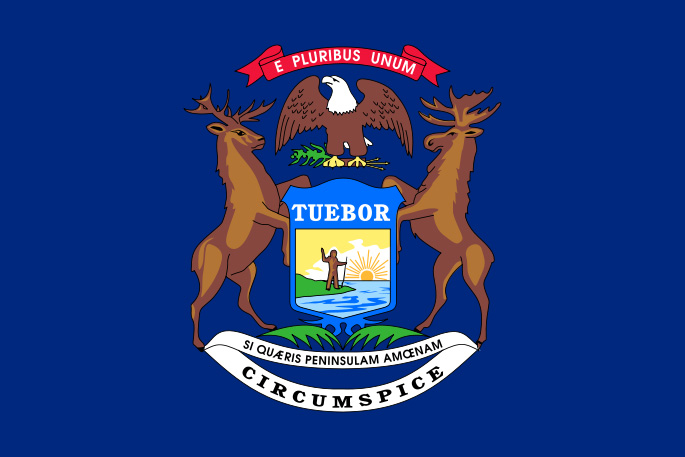
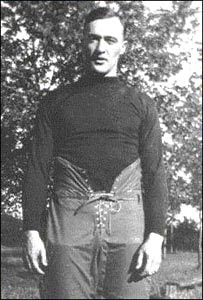
December 14, 1920, 100 years ago: George Gipp dies of pneumonia, possibly related to a streptococcus infection, at St. Joseph's Hospital in South Bend, Indiana, seat of the University of Notre Dame, where he was a student. He was 25 years old.

He was born on February 18, 1895, 13 days after Babe Ruth, and 16 days after George Halas, in Laurium, on the Upper Peninsula of Michigan. He went to Notre Dame hoping to play baseball. But their head coach, Knute Rockne, thought he would be a good back, both offensive and defensive, in football. Gipp had never played the sport before, but tried it anyway.

Rockne proved to be right: Gipp was named an All-American for the 1920 football season, as Notre Dame went undefeated, 9-0:

* October 2: Beat Kalamazoo College at home, 39-0. (They are now in NCAA Division III.)
* October 9: Beat Western State at home, 42-0. (Also based in Kalamazoo, they are now named Western Michigan University.)
* October 16: Beat Nebraska in Lincoln, 16-7.
* October 23: Beat Valparaiso at home, 28-3. (Valparaiso is based in the Indiana town of the same name.)
* October 30: Beat Army at West Point, 27-17.
* November 6: Beat Purdue at home, 28-0.
* November 13: Beat Indiana at Washington Park in Indianapolis, 13-10.
* November 20: Beat Northwestern in Evanston, 33-7.
* November 25, Thanksgiving Day: Beat Michigan Agricultural in East Lansing, 25-0. (Now known as Michigan State.)

Notre Dame outscored its opponents 251-44, for an average of 29-5. And Gipp was a major reason why, on both sides of the ball. There were no official National Championships in those days, but, retroactively, some sources have listed Notre Dame as such. (Other sources awarded it to Harvard or the University of California.) 

So how did he get sick? Most likely, he was giving punting lessons in cold weather. Being in northeastern Indiana, the cold weather is the reason that the Notre Dame-USC game is played in October when it's the Fighting Irish's turn to host it, and on Thanksgiving Saturday when it's USC's turn to host in Los Angeles.

The more popular version, but the less likely one, is that Gipp, a known carouser, returned to campus after curfew one night, and found his residence hall locked. He went to Washington Hall, the campus' theatre building, because he knew the back door was often unlocked, and spent many post-curfew nights in the hall. This time, the door was locked, so he slept outside, and that's how he got pneumonia.

This story is believable because Gipp was a carouser. He was a gambler, a womanizer, and a drunkard. He was a cardplayer and a pool hustler. He would bet on anything. He even bet on his own team, just like Pete Rose would decades later. He also tended to not show up for classes (mandatory) or Mass (equally mandatory for a Catholic school in those days).

And the University, including Rockne himself, covered up for him. Under modern NCAA rules, Gipp might have singlehandedly gotten Notre Dame put on probation.

At any rate, there were no antibiotics available then. Had there been, he could have recovered quickly, spent a nice Christmas at home on the U.P., and played in the early National Football League and become a star, making bundles of money. He, rather than Red Grange of Illinois and the Chicago Bears a few years later, could have become the NFL's 1st real star. (Or maybe its 2nd, after Jim Thorpe, who was already playing for the Canton Bulldogs.) Alas, in those pre-antibiotic days, you really could die from something as simple as "strep throat."

He was buried in Lake View Cemetery, outside Calumet, Michigan. Laurium put up a monument to him.

On November 10, 1928, Notre Dame played Army at Yankee Stadium. A crowd of 78,188 saw the Cadets lead the Fighting Irish 6-0 at halftime. It wasn't that surprising: Army was undefeated, 6-0, while Notre Dame was only 4-2.

In his halftime pep talk, instead of discussing strategy, Rockne told his players, who would have been in junior high school in 1920, about George Gipp. As Rockne told it, he went to see Gipp on his deathbed, and Gipp told him: 

I've got to go, Rock. It's all right. I'm not afraid. Some time, Rock, when the team is up against it, when things are wrong, and the breaks are beating the boys, ask them to go in there with all they've got, and win just one for the Gipper. I don't know where I'll be then, Rock. But I'll know about it, and I'll be happy.

Having told the 1928 players that story, Rockne concluded by saying, "Gentlemen, this is that game." And the players left the locker room in tears, and came from behind, and beat Army 12-6.

That's the story. But it makes no sense. First of all, why choose this game? Because it was in New York? Because it was against Army? Certainly, Rockne didn't need to be afraid of losing his job: He was already an icon in South Bend.

Second of all, they were only down by 6 points. Maybe if they needed a much bigger effort, to overcome a 2-touchdown deficit, such a speech might be warranted.

Third of all, like I said, those players were just kids when Gipp died. They never saw him play. It's not like there was television back then. The newsreels probably never showed Gipp. For all they knew, Rockne could have been lying, and Gipp could have walked into the room at that moment, and they wouldn't have recognized him. (Another coach, Edward "Slip" Madigan of St. Mary's in the San Francisco Bay Area, allegedly once tearfully told his players about his sick son, and said to win the game for him, when the son walked in, just fine.) Gipp's legend shouldn't have had any effect on the 1928 Fighting Irish.

And fourth of all, if the locker room speech did happen, Rockne probably made it up. As one sportswriter put it, decades later, If Gipp said anything to Rockne as he was dying on December 14, 1920, it was probably more along the lines of, "Put a hundred bucks on the 4 horse in tomorrow's 7th race at Arlington for me."

Rockne was killed in a plane crash near Bazaar, Kansas on March 31, 1931. So, whatever the truth of the final meeting between Gipp and Rockne was, it died with Rockne.

On October 4, 1940, the film Knute Rockne, All-American premiered. Pat O'Brien played the coach. Ronald Reagan, who had played guard at Eureka College in Illinois, now an NCAA Division III school, played Gipp, and played the speech scene straight.
Reagan as Gipp

As Reagan went into politics in the 1960s, and was elected President in 1980, he often played up his connection to Notre Dame. At the 1988 Republican Convention, at the Superdome in New Orleans, knowing he couldn't run for a 3rd term, he told the new nominee, his Vice President, George H.W. Bush (who played baseball at Yale), "Go out there, and win one for the Gipper!" Meaning himself. Bush did win the election.

As Reagan fell victim to Alzheimer's disease, and could no longer make public appearances, campaign signs reading, "WIN ONE FOR THE GIPPER" appeared at rallies for Bob Dole in 1996 and George W. Bush in 2000. Reagan died in 2004, and during Bush's re-election campaign, there were more "Gipper" signs than ever before. They still come up, every 4 years: For John McCain in 2008, for Mitt Romney in 2012, and for Donald Trump in 2016 and 2020.

Reagan's political career was built on many, many lies. The "Win one for the Gipper" story was the first. If the truth about Gipp had been widely known in 1966, when Reagan was making his 1st run for public office, for Governor of California, he might never have won an election. After all, the other movie people tended to remember him for was Bedtime for Bonzo, where he worked with a chimpanzee.

George Gipp was a real person, and he really was a great football player. But the thing everybody remembers about him almost certainly isn't true. But, like Reagan's campaign promises, Rockne's Gipper speech was a fraud -- or, as the actual Irish would say, it was blarney -- that worked very well.

Friday, January 26, 2018

Top 10 Athletes From Michigan

January 26, 1837: Michigan is admitted to the Union as the 26th State.

Top 10 Athletes From Michigan

Michigan is a big State, with almost 10 million people, and one of the largest metropolitan areas in the country, Detroit -- although a noticeable chunk of that metro area is across the Detroit River in Windsor, Ontario, Canada, and anyone from there is thus ineligible for this list.

Baseball. Football. Basketball. Hockey. Boxing. You could limit Michigan's Top 10 Athletes to any of those 5 sports, and come up with a list that could stand alongside 40 of the 50 States' Top 10.

Honorable Mention to Baseball Hall-of-Famers Hazen "Kiki" Cuyler of Harrisville, Hal Newhouser of Detroit, and John Smoltz of the Detroit suburb of Warren.

Honorable Mention to Jim Kaat of the Grand Rapids suburb of Zeeland. As both his name and his hometown's suggest, he is part of the large Dutch-American community in Michigan. He is not in the Hall of Fame, but he should be -- as either a player or a broadcaster. He was a 3-time All-Star, and won 16 Gold Gloves.

He won 283 games, including Pennants 17 years apart, in the American League with the 1965 Minnesota Twins, and in the National League with the 1982 St. Louis Cardinals, winning the World Series. When he retired the following year, he was the last active player who had played for the original Washington Senators (1901-60).

Honorable Mention to Kirk Gibson of the Detroit suburb of Pontiac. He played both baseball and football at Michigan State University. (So did Steve Garvey, but he's from Tampa.) He helped MSU's football team win the 1978 Big Ten Championship, then became a World Series hero in both leagues, for the 1984 Detroit Tigers and the 1988 Los Angeles Dodgers (following a regular season that won him the National League MVP).

Injuries cut short what could have been a Hall of Fame career, but still hit 255 home runs. In 2011, he was named NL Manager of the Year for getting the Arizona Diamondbacks to the NL Western Division title.

Honorable Mention to Orel Hershiser of Detroit. He was born in Buffalo, but was living in Detroit when he learned how to pitch, before moving to Toronto, and then to the Philadelphia suburb of Cherry Hill, New Jersey for high school. He had a 204-150 record over 18 seasons, reaching the postseason with the Los Angeles Dodgers in 1983, 1985 and 1988; the Cleveland Indians in 1995 and 1997; the San Francisco Giants in 1998; and the Mets in 1999.

A 3-time All-Star, his annus mirabilis was 1988: He won 23 games, set a new major league record with 59 consecutive scoreless innings pitched, won a Gold Glove and the National League Cy Young Award, and was named Most Valuable Player of both the NL Championship Series and, after winning Game 2 and the clinching Game 5, the World Series. In 1995, helping the Indians won the American League Pennant, he became the 1st (and still only) man to win LCS MVPs in both leagues.

He is not yet in the Hall of Fame, but he could be. He is now one of the game's most respected broadcasters.

Honorable Mention to Jim Abbott of Flint. Born without a hand on his right arm, he nonetheless learned how to pitch with his left, and to then switch his glove from his right wrist to his left hand and field his position. He won the 1987 James E. Sullivan Memorial Award as the nation's outstanding amateur athlete, for his pitching at the University of Michigan.

The team then known as the California Angels took a chance on him, and he reached the major leagues. Over 11 seasons, he had a record of 87-108, including a no-hitter with the Yankees in 1993.

Dishonorable Mention to Derek Lowe of the Detroit suburb of Dearborn. He went 176-157with 86 saves  in a 17-season career as a major league pitcher. He reached the postseason with the Boston Red Sox in 1998, 1999, 2003 and 2004; the Los Angeles Dodgers in 2008; the Atlanta Braves in 2010; and the Yankees in 2012.

A 2-time All-Star, he led the AL in saves in 2000 and the NL in wins in 2006, a rare combination. He pitched a no-hitter for the Red Sox in 2002. And he was a beneficiary of their steroid-induced cheating that helped them win the 2004 World Series, which led to Lowe's inclusion with his teammates as Sports Illustrated's Sportspeople of the Year. The Red Sox have elected him to their team Hall of Fame.

Somewhat Honorable Mention to George Gipp of Laurium. The way the University of Notre Dame handled him then would get them put on probation now, with the gambling and the womanizing and the barely showing up for class (and, worse from their perspective, the barely showing up for Mass), and for not doing anything about it.

But, by the standards of the time, he was a great runner, a great passer, a great punter, a great defensive back, and a great kick returner. He helped Notre Dame win the National Championship in 1919 and 1920. In 2008, ESPN named ranked him 22nd on their list of the Top 25 College Football Players of All Time.

He might have been the ideal guy to be the 1st great star of the newly-founded NFL, except he got strep throat, which developed into pneumonia, and died on December 14, 1920 -- almost certainly not telling head coach Knute Rockne to tell the team to "Win one for the Gipper" on his deathbed, as seen in the 1940 film Knute Rockne, All-American, with Ronald Reagan as Gipp and Pat O'Brien as Rockne.

As it is, despite not having played pro ball -- that we know of, lots of athletes in that era played it under assumed names to protect their eligibility, Jim Thorpe being the most notable one to get caught -- he remains the greatest athlete from Michigan's Upper Peninsula.

Honorable Mention to Bennie Oosterbaan of Muskegon. Baseball, football and basketball: He played, and coached, all 3 sports at the University of Michigan. In 1928, he led the league that became known as the Big Ten in batting average and in basketball scoring.

But football was his best sport. A 2-way end, he became the 1st great receiver in the Big Ten, taking passes from Benny Friedman -- the "Benny-to-Bennie" combination. (Friedman was from Ohio, although this is not as ironic as it sounds, as Ohio State was not then considered the Wolverines' big rival.) Michigan went 20-4 with 2 league titles while he played for them, despite Red Grange then being at Illinois. The school would eventually retire his Number 47.

But he never played any sport professionally, which is why I can't place him any higher. He went right into coaching, spending 20 years as a Michigan assistant, before becoming head coach in 1948 -- and winning the National Championship and Coach of the Year in his 1st season. He won the Big Ten in his 1st, 2nd and 3rd seasons. His record was 63-33-4.

Honorable Mention to Heisman Trophy winners Pete Dawkins of the Detroit suburb of Bloomfield Hills (1958) and Mark Ingram Jr. of the Detroit suburb of Grand Blanc (2011).

Honorable Mention to Reggie Williams of Flint. A star linebacker at Dartmouth College, he played 14 seasons for the Cincinnati Bengals, helping them win AFC Championships in 1981 and 1988. His charitable work earned him 2 different NFL "Man of the Year" awards, and a share of Sports Illustrated's "Athletes Who Care" Sportspeople of the Year in 1987. He later served a term on the City Council in Cincinnati.

Honorable Mention to Mel Daniels of Detroit, who is in the Basketball Hall of Fame. Don Nelson of Muskegon is in, but as a coach. Rudy Tomjanovich of Hamtramck is not yet in as either a player or a coach; most likely, he will be elected as a coach. Dan Majerle of Traverse City and Chris Webber of Detroit could be elected as players.

Honorable Mention to Hockey Hall-of-Famers Mark Howe of Detroit (son of Red Wings legend Gordie), Pat LaFontaine of Waterford, and Mike Modano of the Detroit suburb of Livonia. Craig Patrick of Detroit, son of Lynn and grandson of Lester, is in the Hall of Fame, but for his executive achievements, not his playing.

Honorable Mention to Ken Morrow of the Flint suburb of Davison and Mark Wells of the Detroit suburb of St. Clair Shores. Members of the U.S. hockey team that won the Gold Medal at the 1980 Winter Olympics, along with their teammates, they were named Sportsmen of the Year by Sports Illustrated. Wells never got out of the minor leagues, but Morrow went right to the New York Islanders and helped them win their 4 straight Stanley Cups.

Honorable Mention to New Jersey Devils Stanley Cup Winners: Brian Rolston of Flint (1995, beating his home-State Red Wings in the Finals), Shawn Chambers of the Detroit suburb of Sterling Heights (also 1995, won another with the 1999 Dallas Stars), Danton Cole of the Detroit suburb of Pontiac (also 1995), and Brian Rafalski of the Detroit suburb of Dearborn (2000 and 2003, won another with the Wings in 2008).

Honorable Mention to members of the U.S. team that won the 1996 World Cup of Hockey: LaFontaine, Modano, Rolston, Chambers, Doug Weight of the Detroit suburb of Warren (he had played for the New York Islanders, and is now their head coach and general manager), and the brothers Derian and Kevin Hatcher of the Detroit suburb of Sterling Heights.

Honorable Mention to Tim Thomas of Flint, who won the 2011 Conn Smythe Trophy for MVP of the Stanley Cup Playoffs, winning the Cup with the Boston Bruins.

Honorable Mention to Kate Sobrero of the Detroit suburb of Bloomfield Hills. Now Kate Markgraf, she was a member of the U.S. soccer team that won the 1999 Women's World Cup, and was, with her teammates, named to Sports Illustrated's Sportswomen of the Year. She also won Olympic Gold Medals in Sydney in 2000 and Athens in 2004.

Honorable Mention to William Bonthron of Detroit. He won the 1934 Sullivan Award as a middle-distance runner, and for 2 years held the world record in the 1,500 meters. But he fell short of qualifying for the 1936 Olympics.

Honorable Mention to James "Lights Out" Toney of Grand Rapids. He first held a World Championship in 1991, the IBF Middleweight Championship; and last did so in 2003, the IBF Cruiserweight Championship. The Ring magazine named him Fighter of the Year in 1991 and 2003 -- 12 years apart. In the 2001 film Ali, with Will Smith as The Greatest, "The Dark Emperor" played Joe Frazier.

Honorable Mention to Vernon Forrest of Marquette. "The Viper" was Welterweight Champion of the World from 2001 to 2003, and Super Welterweight Champion from 2007 to 2009. The Ring magazine named him Fighter of the Year in 2002.

Dishonorable Mention to Floyd Mayweather Jr. of Grand Rapids. You've heard of "The Good, the Bad, and the Ugly"? Well, here it is:

The good: The son of a fine boxer and the nephew of 2 others, the man nicknamed "Pretty Boy" after 1930s gangster Pretty Boy Floyd and "Money" because his skill made him "money in the bank" first won a World Championship in 1998, WBC Super Featherweight Championship. He most recently held a title in 2005 -- 17 years later -- the WBA and WBC Welterweight Championships.

He was The Ring's Fighter of the Year in 1998 and 2007. He beat such fighters as Arturo Gatti, an aging but still tough Oscar De La Hoya, Ricky Hatton, Victor Ortiz and Miguel Cotto. His career record is 50-0, with 27 knockouts.

The bad: Although he was 1 of 2 contenders for the title of best fighter, pound-for-pound, in the world during the 2000s, he spent years ducking the other such contender, Manny Pacquiao. In 2010, it appeared the fight would finally happen, with Mayweather 33 years old and Pacquiao 31, both still very much in their prime. But Mayweather kept ducking him and making excuses for it, until 2015, when, after Pacquiao had already lost 2 additional fights, and at 36 was the younger of the fighters. Mayweather won an easy decision.

The ugly: He was convicted of misdemeanor battery against a woman in 2002, against 2 women in 2004, against a man in 2005, and against another woman in 2011. So, until things were ironed out, he wasn't willing to fight the boxer then considered the most likely to ruin his undefeated record, but he was willing to hit women.

Now, the Top 10:

10. Paul Krause of the Flint suburb of Burton. He scored 54 points in a high school basketball game, and also lettered in baseball and track. He played baseball and football, as a receiver and a safety, at the University of Iowa. He was considered a legitimate MLB prospect until an injury.

But he made his professional mark in football. A 9-time All-Pro, he led the NFL in interceptions as a rookie with the 1964 Washington Redskins. He was traded to the Minnesota Vikings, and helped them win the 1969 NFL Championship and reach 4 Super Bowls. Although he is the only player ever to both intercept a pass in a Super Bowl (IV) and recover a fumble in another (IX), the Vikings lost all 4.

He is the NFL's all-time leader in interceptions, with 81. The old record of 79 was also held by an Iowa player, Emlen Tunnell. He also recovered 19 fumbles. Think about that: He personally had a turnover ratio of +100. He was named to the 70 Greatest Redskins, the Vikings Ring of Honor, and the Pro Football Hall of Fame.

9. George Gervin of Detroit. "The Iceman" came out of Eastern High School (now named for Martin Luther King) and Eastern Michigan University to become one of the most exciting players in pro basketball. He was a 12-time All-Star, 3 in the ABA and 9 in the NBA, including winning the All-Star Game MVP in 1980.

He led the NBA in scoring 4 times, his finger-roll becoming as much of a trademark in those days as Kareem Abdul-Jabbar's skyhook. Unfortunately for him, he never had a great team around him, and the closest he got to a League title was the 1976 ABA Semifinals (losing to the New York Nets) and 3 NBA Western Conference Finals, all with the San Antonio Spurs.

The Spurs retired his Number 44. He was named to the ABA All-Time Team and the NBA's 50th Anniversary 50 Greatest Players, 1 of 5 players so honored. Hall-of-Famer Gary Payton and Heisman Trophy-winning quarterback Ty Detmer, a San Antonio native, have called him their favorite athlete of all time.

8. Stanley Ketchel of Grand Rapids. A son of Polish immigrants, the man born Stanisław Kiecal and nicknamed the Michigan Assassin was, in the words of boxing historian Bert Sugar, "half animal." 

As Jack Dempsey later would, he went around the American West, getting fights wherever he could. Officially, he would build a pro record of 51-4-4. As for the fights he got paid for that haven't been counted, who knows.

He became Middleweight Champion of the World in 1908. He was known for his 4 fights with Billy Papke, winning 3. He frequently fought guys who were much bigger, beating Light Heavyweight Champion Philadelphia Jack O'Brien.

He and Heavyweight Champion Jack Johnson were friends, in spite of the racial difference. They agreed to fight each other, in spite of Johnson's tremendous size advantage. The deal was, it would go the distance, 20 rounds, and thus there would be no decision, and they would split the film rights to the fight 50-50. But Ketchel got carried away, forgot the deal, and knocked Johnson down. Big mistake: Johnson got up, and knocked out both Ketchel and some of his teeth.

Ketchel was training for a rematch with Johnson on a ranch in Missouri when he was shot and killed by a ranch hand on October 15, 1910. He was only 24. He is in the International Boxing Hall of Fame, and his hometown of Grand Rapids put up a statue of him. Nat Fleischer, founder and editor of The Ring magazine, called him the greatest middleweight fighter ever.

7. Jerome Bettis of Detroit. "The Bus" starred at Notre Dame, and moved with the Los Angeles Rams to St. Louis, before becoming a mainstay with the Pittsburgh Steelers. A 6-time Pro Bowler, he rushed for 13,664 yards and 91 touchdowns, and caught 200 passes for 1,457 yards and 3 touchdowns.

He closed his career in his hometown, as the Steelers won Super Bowl XL at Ford Field. The Steelers named him to their Hall of Honor, and have unofficially retired his Number 36. He is in the Pro Football Hall of Fame.

6. Charlie Gehringer of the Detroit suburb of Fowlerville. Mickey Cochrane, the catcher and manager of the Detroit Tigers in the mid-1930s, said, "Charlie says, 'Hello' on Opening Day, 'Goodbye' on closing day, and, in between, hits .350." His taciturnity, letting his bat and his glove do the talking, led to his nickname "The Mechanical Man."

There were no Gold Gloves in his day, and the All-Star Game didn't start until 1933, his 10th major league season. But he was the American League's starting 2nd baseman in the 1st 6 Games. He led the AL in stolen bases in 1929 and batting average in 1937, winning the Most Valuable Player that year. He helped the Tigers win Pennants in 1934, 1935 and 1940, winning the World Series in 1935.

He finished with a batting average of .320 and 2,839 hits. Following a barnstorming tour with a white team against a team of Negro Leaguers, Satchel Paige called him the best white hitter he ever pitched against. The Tigers retired his Number 2, and he was elected to the Baseball Hall of Fame. In 1999, The Sporting News chose him as one of their 100 Greatest Baseball Players.

5. Dave DeBusschere of Detroit. He pitched for the Chicago White Sox in the 1962 and '63 seasons, but he was also a basketball star in his home town, first for the University of Detroit, then for the Pistons, where he became the youngest head coach in NBA history, at 24, from 1964 to 1967.

He is 1 of only 12 athletes to have played in both Major League Baseball and the National Basketball Association (or its predecessor, the Basketball Association of America).

For a long time, Madison Square Garden would host NBA doubleheaders, with the Knicks playing the nightcap but not the opener. When the new Garden opened on February 14, 1968, Dave DeBusschere, playing for the Pistons, scored the new building's 1st basket.

The Knicks traded Walt Bellamy to the Pistons to get DeBusschere, already with a reputation as one of the league’s best defensive players. He led the defense that helped the Knicks win the NBA Championship in 1970 and 1973. He later served as head coach and general manager of the Knicks, and his Number 22 has been retired. He was elected to the Basketball Hall of Fame, and named to the NBA’s 50th Anniversary 50 Greatest Players.

My generation knows DeBusschere best as the Knick GM who won the 1st pick in the 1st-ever NBA Draft Lottery in 1985, selecting Patrick Ewing. Sadly, the great Double D suffered a heart attack and died in 2003, age 63.

4. Thomas Hearns of Detroit. The "Hit Man," also known as the "Motor City Cobra," first won a World Championship in 1980, the WBA Welterweight Championship. He last held a title in in 1992, the WBA Light Heavyweight Championship. In between, he was one of the most feared boxers in the world, being named Fighter of the Year by The Ring magazine in 1980 and 1984.

He lost a unification bout for the Middleweight Championship to Sugar Ray Leonard in 1981, but Leonard was barely hanging on before knocking Hearns out. After that, Hearns beat Wilfred Benitez and knocked out Roberto Duran. He got clobbered by Marvin Hagler, but it says something about him that even his 2 most notable defeats were fights in which he got in some great licks. His final record was 61-5-1.

3. Derek Jeter of Kalamazoo. His roots are in New Jersey. Born in Pequannock, Morris County, he lived in West Milford, Passaic County until age 4, when he moved with his parents to "Kazoo," about halfway between Chicago and Detroit. But because his grandparents still lived in North Arlington, Bergen County, he stayed a Yankee Fan.

His 2,747 games and 20 seasons are Yankee records. A 14-time All-Star and (contrary to the stories you may have been told about his bad fielding) a 5-time Gold Glove winner, he was AL Rookie of the Year in 1996, as the new Yankee Dynasty began. World Championships were won in 1996, 1998, 1999, 2000 and 2009. Additional Pennants were won in 2001 and 2003. In only 3 of his 20 seasons -- 1 of the 1st 18 -- did the Yankees fail to make the Playoffs.

In 2000, he became the 1st (and still only) player to be named Most Valuable Player of the All-Star Game and the World Series in the same season. However, he was never named a regular-season MVP, finishing in the top 3 in the voting in 1998, 2006 and 2009. In 2009, Sports Illustrated named him Sportsperson of the Year.

He finished with a .310 lifetime batting average, and 3,465 hits -- more than any person born after 1941 -- 260 of them home runs. The Yankees have retired his Number 2, and dedicated a Plaque for him in Monument Park. He will be eligible for the Hall of Fame in the election whose results will be announced in January 2020. He is now a part-owner of the Miami Marlins.

2. Earvin "Magic" Johnson of Lansing. He led Michigan State University to the 1979 National Championship, beating an Indiana State team led by Larry Bird. Magic was named the NCAA Tournament's Most Outstanding Player. This game, still the most-watched in college basketball history, is credited with launching the sport to a new level. It also started a professional and personal rivalry between Magic and Larry, although it never got nasty.

Magic was drafted by the Los Angeles Lakers, who already had Kareem Abdul-Jabbar, forcing him to switch from Number 33 to 32. The Lakers reached the 1980 NBA Finals, and when Kareem was hurt for Game 6, Magic, though 6-foot-9 was by then short for a center, moved from point guard, and torched the Philadelphia 76ers for 42 points on their own court, and won the title.

He also helped the Lakers win the NBA Championship in 1982 (again against the 76ers), 1985 (against Bird's Celtics), 1987 (against Bird again) and 1988 (against the Detroit Pistons). He was named Finals MVP (now named the Bill Russell Award) in 1980, 1982 and 1987. They also reached the Finals in 1983, 1984, 1989 and 1991. He became the all-time assists leader, a record since broken by John Stockton. He was a 12-time All-Star, and a 2-time All-Star Game MVP.

Now I come to the elephant in the room. Just before the 1991-92 season could begin, Magic announced he was retiring, because he'd been diagnosed with HIV, the virus that causes AIDS. He was nonetheless selected to that season's All-Star Game, and showed he still had his A-game, and was named the Game's MVP. He was named to the "Dream Team" that stormed to victory at the 1992 Olympics in Barcelona. Even then, he couldn't stay away, briefly coaching the Lakers in 1994 (not well) and briefly returning as a player in 1996 (ditto).

Michigan State retired his Number 33. The Lakers retired his Number 32 and dedicated a statue of him outside the Forum, since moved to the Staples Center. He was named to the Basketball Hall of Fmae and the NBA's 50th Anniversary 50 Greatest Players.

More than that, before he retired, he was already investing wisely, and had founded a chain of movie theaters, all in historically black neighborhoods, including on Harlem's iconic 125th Street. Not long before his diagnosis was announced, but right after Michael Jordan had led the Chicago Bulls to their 1st NBA Championship (beating Magic and the Lakers in the Finals), Magic said, "If Michael were doing what I'm doing, he really would own the world."

Magic's holdings now include a minority share of the Lakers, and the majority ownership of baseball's Los Angeles Dodgers, now defending National League Champions. Earvin Johnson still has a magic touch.

A man would have to be not just great at his sport, but a shaper of the world, to be ahead of Magic on this list. And the man at Number 1 was:

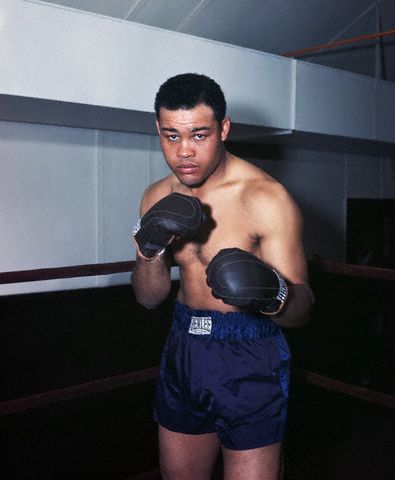
1. Joe Louis of Detroit. Born in Alabama as Joseph Louis Barrow, but trained to fight in Detroit, "the Brown Bomber" was the Motor City's 1st great fighter. By 1935, he was challenging men who had been Heavyweight Champion of the World, and winning. In 1936, he lost for the 1st time, to former Champion Max Schmeling.

But he recovered, won 6 more fights, and got a title shot against Champion Jim Braddock, knocking him out at Comiskey Park in Chicago on June 22, 1937. This completed an era in which the Detroit Tigers won back-to-back American League Pennants and a World Series, the Lions won an NFL Championship, and the Red Wings won back-to-back Stanley Cups. Detroit became the 1st city ever to call itself "the City of Champions," and they were right.

There were 5 men who were Heavyweight Champion in the 1930s before Louis, and he had beaten 4 of them: Braddock, Max Baer, Primo Carnera and Jack Sharkey. But he said he wouldn't consider himself the real champ until he beat Schmeling.

Schmeling had previously been rather popular in America, partly because he looked a bit like 1920s Champion Jack Dempsey, and partly because, although heavily accented, he spoke fluent English. And while Germans were despised in America during World War I, that was no longer the case during Schmeling's title-hold, 1930 to 1932.

But at this point, Nazi Germany was holding Schmeling up as an example of "Aryan supremacy." Schmeling didn't like that. He wasn't a bigot. And, with his dark complexion, dark hair, and thick eyebrows, he looked more like one of the Jews that the Nazis hated than a blond, blue-eyed Aryan Übermensch. Even when World War II came, and he was a paratrooper in the German army -- thus forcing him to swear an oath of loyalty to Adolf Hitler -- he was never a member of the National Socialist Party.

They fought at Yankee Stadium, the same site as their 1st fight, on June 22, 1938. President Franklin D. Roosevelt had told Louis he had to win for all America. He did: The fight lasted 2 minutes and 4 seconds. Joseph Goebbels, the Nazi propaganda minister, ordered the radio network broadcasting the fight throughout the Third Reich to stop broadcasting before Schmeling could be counted out.

Louis was now a hero to all America, white and black alike. He defended the Heavyweight Championship more times than anyone, 25. He held it continuously longer than anyone, 12 years. His fights with "Two Ton" Tony Galento, Light Heavyweight Champion Billy Conn, and Jersey Joe Walcott became legend. The Ring magazine named him Fighter of the Year in 1936, 1938, 1939 and 1941.
He retired after his 2nd fight with Walcott in 1948, and Ezzard Charles won the "elimination tournament" to become the new Champion in 1949. But Joe needed money, and came out of retirement, and it was a disaster. Charles beat him, and then rising contender Rocky Marciano knocked him out in 1951, ending his career with a record of 69-3. Still needing money, he became a pro wrestler. He wasn't good at it. And his last years saw him plagued by illness as well as debt. He died in 1981.

President Ronald Reagan, noting that Louis had served in the Army during World War II, ordered that he be buried at Arlington National Cemetery (which his family approved). His original hometown of Lafayette, Alabama erected a statue of him. Detroit erected an arena with his name on it, and a monument in his memory, a giant bronze arm with a clenched fist outside their City Hall.
Muhammad Ali called himself "The Greatest," but the generation that remembers Joe Louis as Heavyweight Champion may go to their eternal rests convinced that Louis was the best ever.
Thursday, August 31, 2017

How to Go to a Notre Dame Football Game -- 2017 Edition

"There are Notre Dame fans, and there are Notre Dame haters. And, frankly, they're both a pain in the ass." -- Dan Devine, Notre Dame head coach, 1975-80

And there are plenty of both. For better or for worse, even more so than The Catholic University of America, located in Washington, D.C., the University of Notre Dame (Latin for "Our Lady") is the Catholic university of America. And a lot of people of other religions admire it, too.

Academically and athletically, there is reason for this. On the other hand, I've seen lists of the Top 10 (including my own), 20 (Bleacher Report), 31 (Buzzfeed), 111 (a University of Michigan fan's blog), and even 303 (radio show host and University of Alabama fan Paul Finebaum's book) Reasons to Hate Notre Dame.

This Sunday, they open their season at home, facing Philadelphia's Temple University.

Before You Go. As a Midwestern city, with 45 miles of a Great Lake (Lake Michigan), South Bend can get pretty cold in the Autumn and winter. That shouldn't be a problem if you go early enough in the season. This weekend, for example, the weather is forecast as being in the mid-70s in the afternoon, and the high 50s at night. If this is your weekend to go, you shouldn't need a jacket. But for October and November, you should wear one.

The time zone situation in Indiana has long been screwy, but South Bend is in the Eastern Time Zone, so you won't have to fiddle with your timepieces.

Tickets. Good luck. Notre Dame has had 6 home games every season of this decade, except for 2010 when they had 7, and all of these games had a listed attendance of 80,795.

Ticketmaster has a few resale tickets available for $70 to $75, but most of what's available from them and other such outlets goes for twice that, or more.

I wonder what the Catholic teaching on ticket scalping is.

Getting There. It's 705 miles from Times Square in Midtown Manhattan to Notre Dame Stadium in South Bend, Indiana. Your first reaction will be to fly. There is a South Bend International Airport, but it's very hard to get a round-trip nonstop flight there from New York, and harder still to get one for under $1,000. Perhaps you could fly to Chicago, rent a car at O'Hare, and drive the last 111 miles.

Amtrak's Lake Shore Limited leaves Penn Station in New York every day at 3:40 PM, and arrives at South Bend at 8:49 AM. It leaves South Bend just before midnight at 11:59 PM, and returns to New York the next evening at 6:23 PM. Round-trip fare is $210. The Amtrak station is at 2702 W. Washington Street. But you'd have to walk half a mile south on Meade Street to get to Western Avenue, then take Bus 10 to South Street, and switch to Bus 7 to the campus. Between them, the buses should take about 20 minutes.

Greyhound has 3 departures every day from Port Authority Bus Terminal, and round-trip fare is $418, but it can drop to $388 with advanced purchase. The Greyhound station is at 4671 Progress Drive, at the airport, but even though it's further away from the campus than the train station, getting there is easier: The Airport SuperSaver bus can get you to the campus in half an hour.

If your choice is to drive, the directions are rather easy. Take Interstate 80 West until it merges with Interstate 90. Once it becomes the Indiana Toll Road, take Exit 77 to Douglas Road, and turn right on Business U.S. Route 31, Michigan Street. Soon, the campus will be on your left.

If you do it right, you should spend about an hour and 15 minutes in New Jersey, 5 hours and 15 minutes in Pennsylvania, 4 hours in Ohio and 2 hours in Indiana. That's 12 and a half hours. With rest stops, preferably 1 in Pennsylvania, 1 in Ohio, and another near the State Line of both, that's about 15 hours.

Once In the City. Located in St. Joseph County, on the St. Joseph River, in north central Indiana, South Bend is home to a little over 100,000 people, but would be a wholly unremarkable place if not for the University of Notre Dame. Founded in 1865, it is the 4th largest city in the state and the economic hub of northern Indiana.

Street addresses are divided into East and West by Michigan Street, which is also known as Martin Luther King Jr. Blvd. (and also, essentially, the River), and into North and South by Washington Street.

The sales tax in the State of Indiana is 7 percent. ZIP Codes in South Bend start with the digits 465, and the Area Code is 574. The leading newspaper is the South Bend Tribune. The South Bend Public Transportation Corporation, or "South Bend Transpo," runs buses with a base fare of just $1.00. The city has no freeway "beltway." South Bend is about 59 percent white, 27 percent black, 13 percent Hispanic and 1 percent Asian. Indiana Michigan Power runs the electricity.

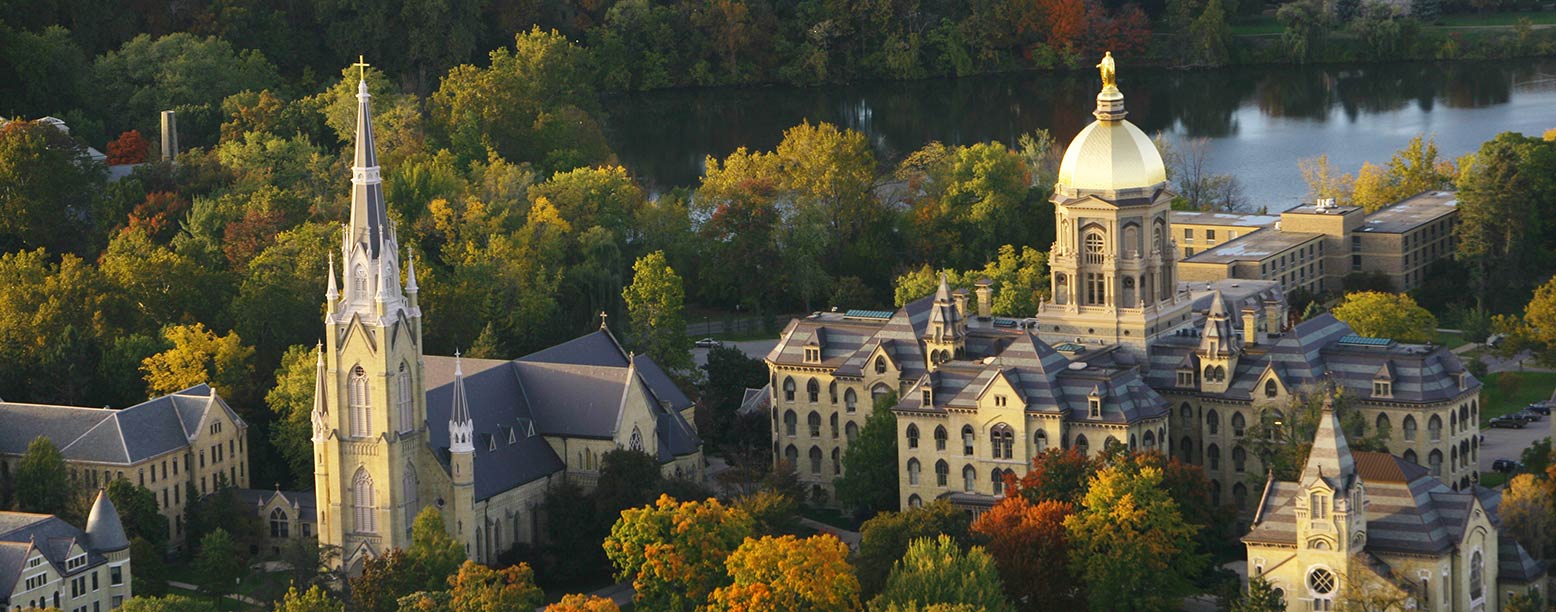
Once On the Campus. Although a County Seat, the city is dominated by the University of Notre Dame, founded in 1842. The school's most familiar feature is the Main Administration, a.k.a. the Main Building or the Golden Dome. As a result, Notre Dame students are often called Domers. The 1st one was built in 1844, burned down in 1879, and was then replaced by the current structure. They also have a reproduction of the Grotto of Our Lady of Lourdes, in Lourdes, France, to dovetail with the school's name. (Again: "Notre Dame" is French for "Our Lady.")
The Grotto

Aside from that Dome, the Grotto and the Stadium, the most familiar structure on the campus is the Theodore M. Hesburgh Library. Opened in 1963 as simply the Memorial Library, it was renamed for Father Hesburgh, who served as the University's President from 1952 to 1987, and got it built.

The Library towers over the north end of the Stadium, separated from it by a reflecting pool, and is dominated by a 134-foot-high mural officially named The Word of Life. Since the building was a library, Hesburgh wanted a mural that would depict Christian thinkers and scholars throughout history. He got it, from painter Millard Sheets, who put Christ, who was called "Rabbi" ("Teacher") by his followers in his time, top and center, with his arms outstretched.

But since the mural is easily visible from the stadium, and Jesus' arms are raised, the figure is known as known as "Touchdown Jesus." Certainly, Hesburgh wanted to win football games, but this was far from his vision for the library he built. To make matters worse, the Stadium's 1996 expansion obscures the lower half of the mural, so that most of the "scholars" and "thinkers" aren't visible, and only Jesus' "touchdown signal" can be seen.

True, The Apostle's Creed states of Jesus, "He shall come to judge the quick and the dead," but no dogma of any religion says anything about its messiah officiating at sporting events.
Long preferring to stay independent in sports, Notre Dame is now a member of the Atlantic Coast Conference in all sports, except hockey, where it is a member of the Big Ten; and football, where it remains an independent. The reason they chose to remain independent in football, despite playing some of the Big Ten schools every year (Michigan, Michigan State, Purdue, and frequently Northwestern), is that they did not want to split the bowl money they got with their conference opponents.

That was the official story. Some people have suggested that they did not want to play Michigan and Ohio State every year; and then, once Penn State and then Nebraska came into the Big Ten, making it 4 major powers, perhaps the Fighting Irish lost some of their fight, and were, indeed cowards.

As for that nickname: Like Loyola University of Chicago, Notre Dame originally called its teams the Ramblers. It wasn't until ND alumnus Francis Wallace began using the phrase "Fighting Irish" in his New York Daily News columns in the 1920s that anybody thought to call them that. In 1927, the University President, the Rev. Matthew Walsh, made it official. (At least Walsh was Irish.)

How accurate is the "Irish" nickname? Well, Frank Leahy, coach of their 5 National Championship teams of the 1940s, was Irish. So was Ned Joyce, the administrator for whom their indoor sports arena is named. So were two of the members of the legendary mid-1920s backfield, the Four Horsemen: Jim Crowley and Elmer Layden. So were George Gipp, Johnny "Blood" McNally, Leon Hart, George Connor, Johnny Lattner, Terry Hanratty, Mike McCoy, Tom Clements, Dan Devine, Ken McAfee, Dave Casper, Brady Quinn, and current head coach Brian Kelly.

But, ahem. Knute Rockne, who helped establish the team (more about that in "Team History Displays"), was Norwegian. Moose Krause, the basketball coach whose name graces the road surrounding the athletic complex? Lithuanian. Father Hesburgh? German.

The other two Horsemen? Don Miller was English, and Harry Stuhldreher was German. Wayne Millner, Paul Hornung, Joe Theismann, Lou Holtz, and Daniel Ruettiger Jr., a.k.a. "Rudy"? All German. Angelo Bertelli, Ralph Guglielmi, Nick Buoniconti and Joe Montana? Italian. Johnny Lujack, Emil Sitko, Bill Wolski, Walt Patulski? Polish. Chris Zorich? Half-black, half-Croatian. John Huarte? An anglicization of the French name Huard. Curly Lambeau? Also French. Ara Parseghian, who just died a few weeks ago? Until Kim Kardashian came along, he was easily the most famous American of Armenian descent.

And that's before you factor in black stars like Zorich, Alan Page, Ross Browner, Vagas Ferguson, Allen Pinkett, Tim Brown, Tony Rice, Raghib "Rocket" Ismail, Ricky Watters, and Jerome Bettis, and the Samoan Manti Te'o.

An old joke: What do you call five Italians, three Poles and three black guys? "The Fighting Irish." Another old joke is that if it wasn't for Italian and Polish guys from Chicago and environs, there wouldn't be much fight in the Fighting Irish.

Yet if someone is Irish, and especially Irish Catholic, rooting against Notre Dame is "against your religion." Oy vey. Well, if Boston College football, and Georgetown and Villanova basketball, are any indication, there's a lot of Catholics who haven't drunk the South Bend Kool-Aid. Some of them have even got to be Irish (particularly at BC).

Notable Notre Dame athletes in sports other than football: 

* Baseball: Red Murray Class of 1906, Cy Williams 1912, Ron Reed '65 (also played in the NBA), Craig Counsell '92, Aaron Heilman '01, John Axford '05. Cap Anson, Louis Sockalexis, Carl Yastrzemski, Jeff Samardzija and Brad Lidge also attended Notre Dame, but did not graduate.

* Basketball: Ray Meyer '38 (later the longtime DePaul University head coach) Gary Brokaw '74 (from New Brunswick, New Jersey), Adrian Dantley '76, Bill Laimbeer '79, Kelly Tripucka '81 (from Bloomfield, New Jersey, son of pro quarterback Frank Tripucka), Orlando Woolridge '81, John Paxson '83, LaPhonso Ellis '92, Pat Garrity '98, Luke Harangody '10, Ben Hansbrough '11. Austin Carr also played at Notre Dame, but did not graduate.

* Hockey: Bill Nyrop '74 (played on Montreal Canadiens' 4 straight Stanley Cup winners 1976-79).

* Soccer: Joseph Lapira '08, Matt Besler '08, Kerri Hanks '09.

* Olympic Gold Medalists: Vince Boryla, basketball, 1948; Shannon Boxx and Kate Markgraf, women's soccer, 2004; Mariel Zaguins, women's fencing, 2004 and 2008.

* Sportscasters: Don Criqui '62, Hannah Storm '83.

* Sportswriters: Red Smith '27.

Notable Notre Dame graduates in other fields include: 

* Business: Edward J. DeBartolo Sr. '31 and Jr. '68, shopping mall developers and sports team owners, Sr. owning the Pittsburgh Penguins, Jr. the San Francisco 49ers, and brother-in-law of current 49ers owner and ND grad John York '71; Jim Fitzgerald, owned the NBA's Milwaukee Bucks and later the Golden State Warriors; Larry Dolan '56, cable-TV pioneer and owner of the Cleveland Indians; Vince Naimoli '59, owner of the Tampa Bay Rays; Joe Garagiola Jr. '72, lawyer, baseball team executive, and son of the catcher-turned-broadcaster.

* Entertainment: Regis Philbin '53, talk- and game-show host; Don Ohlmeyer '67, longtime NBC executive and TV producer; Richard Riehle '70, one of those "Oh yeah, uh... him!" actors you recognize but can never remember his name; and the entire membership of the band Umphrey's McGee, composers and performers of the theme song for ESPN's Around the Horn; all ND Class of '98: Brendan Bayliss, Joel Cummins, Mike Mirro and Ryan Stasik. George Wendt of Cheers attended Notre Dame, but did not graduate.

* Journalism: Phil Donahue '57, Mark Shields '59, Terence Smith '60, Anne Thompson '79.

* Literature: Edwin O'Connor '93, Nicholas Sparks '88.

* Religion: John Francis O'Hara, President of Notre Dame from 1934 to 1945, and Archbishop of Philadelphia from 1951 until his death in 1960; and William Donald Borders '47, Archbishop of Baltimore. Interestingly, both Cardinals were Archbishops when their cities' most successful teams to that point left town: O'Hara with the Athletics in 1954, and Borders with the Colts in 1984.

Political figures who graduated from Notre Dame:

* Senators: Edward Carville 1909 of Nevada, Joe Donnelly '77 of Indiana, and Jeffrey Chiesa '87 of New Jersey (briefly in 2013, between the death of Frank Lautenberg and the election of Cory Booker),  

* Congressmen: William E. Miller '35, Representative from New York (Western), and Republican nominee for Vice President in 1964; Peter King '68, Representative from New York (Long Island) and hater of terrorism unless it's Irish.

* Governors: Carville; Harry Kelly 1917 of Michigan, John McKiernan '34 of Rhode Island, John Gilligan '43 of Ohio, Thomas Judge '57 of Montana, Bruce Babbitt '60 of Arizona (ran for President in 1988), Joe Kernan '68 of Indiana, and Bob McDonell '76 of Virginia.

* Cabinet members: Richard V. Allen '82 was National Security Adviser under President Ronald Reagan; the aforementioned Bruce Babbitt was Secretary of the Interior under President Bill Clinton; Condoleeza Rice '75 was National Security Adviser under President George W. Bush.

* Big-city Mayors: Peter Flaherty '51 of Pittsburgh.

No President of the United States has attended Notre Dame, although Josiah "Jed" Bartlet, the fictional President from the TV show The West Wing, was ND Class of '64; and Reagan famously played George Gipp before going into politics. Jose Napoleon Duarte '48 was President of El Salvador, guilty of terrible war crimes during their 1980s civil war, and supported by the Reagan Administration. Ernesto Perez Balladares '67 was elected President of Panama. 

Going In. Notre Dame Stadium, "The House That Rockne Built," opened in 1930 -- which, as it turned out, was Knute Rockne's last year as head coach. He died in a plane crash in 1931, in Kansas to visit his sons at a boarding school there. He was only 43 years old, but the footage we have of him, all black and white, makes him look much older.
Notre Dame Stadium will never have a corporate sponsor on its name, because the name "Notre Dame" is, itself, able to generate enough revenue, a brand name every bit as much as the name "Yankee Stadium."

From the beginning, the seating capacity of Notre Dame was 59,075. A renovation in 1996 expanded it to 80,795, a new one just completed raised it to about 84,000 (they haven't released an official tabulation yet), and the demand for tickets still far exceeds supply. As you can see in this photo, from the south end, with the Hesburgh Library and Touchdown Jesus behind the north end, the visiting school's students and band, in this case those of the University of Michigan, are put in the northwest corner.
The stadium itself is not an architectural marvel. Indeed, the greatest thing about it is usually the team. There are no great columns like at Ohio Stadium, or Memorial Stadium in Illinois, or at Soldier Field in Chicago. Like Michigan Stadium, it's pretty much just a big stadium with an incredibly successful team in it. The field runs north to south, and was always natural grass until 2014, when it was replaced with FieldTurf. It didn't host a night game until temporary lights were brought in for a 1982 game, and it didn't get permanent lights until the 1996-97 expansion.
The north end, with the Golden Dome
and the Hesburgh Library behind it.
Photo taken September 1, 2007.
Georgia Tech beat them 33-3.

UPDATE: On October 6, 2017, Thrillist compiled a list of their Best College Football Stadiums, the top 19 percent of college football, 25 out of 129. Notre Dame Stadium was ranked 7th: 

Sure, the Fighting Irish haven’t won a title in over 25 years, but ask any college football fan for their stadium bucket list, and South Bend comes up every time. Can’t make it there for a game? Ryan McGee says you’re still in luck. “Game days are great,” he says, “but the $10 off-season tour might be even better.”

The official address of the stadium is Moose Krause Circle, about 2 miles northeast of downtown South Bend. Bus 7 will get you from downtown to the Hesburgh Library, and from there it's a short walk to the Stadium. If you drive in, parking is $30.

Edward Walter Kriaučiūnas, alias Ed "Moose" Krause, played football and basketball at Notre Dame in the early 1930s, and was the basketball coach and an assistant football coach in the 1940s. Moose Krause Circle surrounds not only the Stadium, but, to the east of it, the Edmund P. Joyce Convocation Center, with its 2 white domes, including the basketball arena, a hockey rink and an aquatic center.
Notre Dame Stadium and the Joyce Center

The arena, built in 1968 as The Athletic & Convocation Center, was renamed in 1987, as a tribute to Joyce, long a vice president of the University. As Hesburgh said: "Father Ned Joyce was my right-hand man for the entire 35 years that I was president of Notre Dame. It would be impossible to recount, even in cursory fashion, all the great things he did for Notre Dame during his 35 years as executive vice president. Without him, both the University and I would have been much diminished. 

The Joyce Center is a house of upsets: UCLA's record 88-game winning streak was bookended by losses there in 1971 and 1974. (Never, ever mention that 1974 game to Bill Walton, in the event you should meet him.) In addition to those wins, Notre Dame also upset the basketball team then ranked Number 1 in the nation in 1977 (San Francisco), 1980 (DePaul), 1987 (North Carolina), 1991 (UCLA again), 2012 (Syracuse), and 2016 (North Carolina again).

Elvis Presley sang at the Joyce Center, under its original name, on September 30 and October 1, 1974, and again on October 20, 1976. The Beatles did not play in South Bend on any of their North American tours.

Previously, they played at the Notre Dame Fieldhouse, which stood from 1900 to 1968 in what's now Fieldhouse Mall, to the west of Hesburgh Library. The basketball team was retroactively awarded National Championships for the 1927 and 1936 seasons, but they've only made the NCAA Final Four once, in 1978. The women's team, under head coach Ann "Muffet" McGraw, who just got elected to the Basketball Hall of Fame, has been far more successful, winning the National Championship in 2001.

To the east of the Joyce Center is practice fields and the soccer and track facilities. This was the site of Cartier Field, where Notre Dame played football prior to the opening of the current stadium, and George Gipp and the Four Horsemen did their stuff. To the south of the Stadium and the Joyce Center are Compton Family Ice Arena, built in 2011 as the new home of the hockey team; and Frank Eck Baseball Stadium. (UPDATE: Compton Arena has held the Final of the Big Ten Hockey Tournament since 2018.)

Notre Dame Stadium will host the NHL Winter Classic on New Year's Day, January 1, 2019, between a pair of "Original Six" teams from a pair of notably Irish cities: The Chicago Blackhawks, the "hosts"; and the Boston Bruins. (UPDATE: The Bruins won, 4-2.)

Food. This is the Midwest, Big Ten Country (though Notre Dame is not in the Big 10 for any sport except hockey), where food at sporting events is essential, and tailgating is -- although I hesitate to use this word when the subject is Notre Dame -- a sacrament. But Notre Dame Stadium is one college football ground where you may have better options than tailgating, or pubgoing before and/or after the game.

Being a college stadium, beer and other alcoholic beverages are not sold. There are what they call "Traditional Concession Fare" stands all over the Stadium, with hot dogs, bratwurst, nachos, jumbo pretzels, popcorn, candy, soft drinks, coffee and hot chocolate. But there are also specialty stands.

Under Section 7 in the lower level and 101 in the upper deck, is Domer Deli, with premium hand-carved sandwiches, turkey and prime rib, served with homemade chips. Under Sections 13 and 31 in the lower level is Gold Grill, with cheeseburgers, grilled chicken sandwiches, chicken tenders and fries. Under Sections 4, 9, 23 27 and 31 in the lower level are stands serving pot roast sandwiches. Under Section 12 is BBQ Nachos. Under Section 18 is a pizza-by-the-slice stand. Under Section 30 is Prime Rib Nachos. And Section 31 is the Specialty Sausage Stand.

Team History Displays. Perhaps even more than the Yankees and the Montreal Canadiens, Notre Dame football likes to remind you of its history. They'd probably like you to think of them as "the Yankees of College Football," especially given how many games they've played at Yankee Stadium. They beat Army at the new one in 2010, after playing 24 games at the old one, going 15-6-3.

Most notable were the 1928 and 1946 games against Army. In 1928, they trailed 6-0 at halftime, and Rockne told the team about George Gipp, who helped them win the 1920 National Championship, but soon died. In those pre-antibiotic days, you really could die from something as simple as strep throat.

As Rockne told it, Gipp told him on his deathbed, "Sometime, when the team is up against it, and the breaks are beating the boys, tell them to go out there with all they've got, and and win just one for the Gipper. I don't know where I'll be then, Rock, but I'll know, and I'll be happy." And then he told them, "Gentlemen, this is that game." And the players left the locker room in tears, and came from behind, and beat Army 12-6.

The truth? George Gipp was an alcoholic. He was a womanizer. He attended classes about as often as the Pope lit a menorah. He hardly ever showed up for Mass, too. And he was a compulsive gambler, who bet on anything, including his own team. If he said anything to Rockne as he was dying on December 14, 1920, it was probably more along the lines of, "Put a hundred bucks on the 4 horse in tomorrow's 7th race at Arlington for me." 

In spite of all that, because he was the best football player Notre Dame had yet seen, Knute Rockne got the administration to keep him on the team. But this was the dawn of mass media. The movie about Rockne and Gipp hadn't been made yet. These players would have been about 10 years old when Gipp played. So, presuming Rockne did give the speech -- regardless of whether he made it up or it was true -- it wouldn't have had much of an effect. But it makes a great story!

The 1946 game was billed as "The Game of the Century," because Notre Dame went into it ranked Number 2, Army was Number 1, and Army hadn't lost since Notre Dame beat them in 1943, and Notre Dame was undefeated as well, and they had won the last 3 National Championships between them, and whoever won this one would make it 4. It was broadcast coast-to-coast on radio. Network TV was still a year away, but it would have been huge on that, too. But the game didn't live up to the hype, and ended 0-0. Notre Dame got the National Championship anyway, just as they did 20 years later after their famous tie with Michigan State.

Notre Dame doesn't retire uniform numbers. They've won 7 Heisman Trophies: Quarterback Angelo Bertelli in 1943, quarterback Johnny Lujack in 1947, end Leon Hart in 1949, running back Johnny Lattner in 1953, quarterback Paul Hornung in 1956, quarterback John Huarte in 1964, and receiver Tim Brown in 1987. Bertelli and Lattner would see their pro careers cut short by military service. Lujack (now the oldest and earliest living Heisman winner) and Hart would have decent pro careers. Huarte turned out to be a bust. Hornung, moved to running back, and Brown are in the Pro Football Hall of Fame.

Other Pro Football Hall of Fame members to have played at Notre Dame are: 1920s Chicago Bears center George Trafton, 1930s Green Bay Packers running back Johnny "Blood" McNally, 1940s Washington Redskins end Wayne Millner, 1950s  Bears linebacker George Connor, 1970s Minnesota Vikings defensive end Alan Page, 1970s Miami Dolphins linebacker Nick Buoniconti, 1970s Oakland Raiders tight end Dave Casper, 1980s San Francisco 49ers quarterback Joe Montana, 1990s Pittsburgh Steelers running back Jerome Bettis, and, although they weren't elected as players, longtime Packer coach Curly Lambeau and 49ers owner Eddie DeBartolo.

If you must know: At Notre Dame, Rockne, Lambeau and Gipp played before uniform numbers were worn; Montana wore 3; Layden, Hornung, Hanratty and Te'o, 5; Bettis, 6; Huarte and Theismann, 7; Rice, 9; Watters, 12; Lattner, 14; Miller, 16; Crowley, 18; Pinkett, 20; McNally, 24; Ismail, 25; Stuhldreher, Lujack and Ferguson, 32; Millner, 40; Ruettiger, 45; Bertelli, 48; Zorich, 50; Buoniconti, 64; Connor, Page and Brown, 81; Hart, 82; Casper, 87; and Browner, 89.

If they were to retire numbers, then, to keep it from getting out of control, like with the Yankees, the Canadiens, and that other title-laden team with a leprechaun mascot, the Boston Celtics, the best guideline would be to only do it for players who won both the Heisman Trophy and the National Championship. Therefore: 14 for Lattner, 48 for Bertelli, and 82 for Hart -- and that's it. Not 3 for Montana, 5 for Hornung, or 5, 16, 18 or 32 for the Horsemen.

Notre Dame has been awarded 12 National Championships: 1920, 1924, 1929, 1930, 1943, 1946, 1947, 1949, 1966, 1973, 1977 and 1988. By a weird string of events, Rockne (1920), Leahy (1943), Parseghian (1966), Devine (1977) and Holtz (1988) each won it in his 3rd season as head coach. (Don't get any ideas: Current coach Brian Kelly is starting his 8th season in South Bend.)
But the most important part of Notre Dame's football history isn't their National Championships. It's a game that was played on November 1, 1913, and if there is surviving film of it, it has never been released to the public.

Notre Dame, then just another of what we would now call the "mid-majors" among Catholic universities in the Midwest -- also including Xavier University in Cincinnati, the University of Detroit Mercy, DePaul and Loyola in Chicago, Marquette in Milwaukee and Saint Louis University -- did what Jim Thorpe, coach Pop Warner, and the Carlisle Indian School of Pennsylvania had famously done the season before: Upset Army. And they did it at West Point, no less.

They did it with the forward pass, which had been legalized 7 years earlier, but hardly used. Under head coach Jesse Harper, who would be replaced by Rockne in 1918, quarterback Charles "Gus" Dorias threw 17 passes to Rockne, completing 14, for 243 yards and 3 touchdowns. Notre Dame won, 35-13. Army wouldn't at West Point again for another 2 years. This made the forward pass worth noticing and trying, and it made Notre Dame a household name, before Rockne, as head coach, began cultivating the press and making it legend.

(Rockne and Dorais would briefly play in the pros, for the Massillon Tigers in Ohio, before the founding of the NFL. Dorais became the longtime head coach at Detroit Mercy. The Four Horsemen had brief pro careers as well, the NFL not really being a viable option in those days. Not until the 1950s did Notre Dame players begin to have great pro careers.)
Statue of the Four Horsemen inside the stadium.
Left to right: Jim Crowley, Elmer Layden,
Don Miller and Harry Stuhldreher.

Outside the stadium, there are statues of Rockne, Leahy, Parseghian, Devine and Holtz. Holtz is still alive, while Parseghian and Devine lived long enough to see their statues dedicated. There's also an equestrian statue inside the stadium, recreating the famous photo of the Four Horsemen.
With the Four Horsemen plowing through Stanford, Notre Dame won the 1925 Rose Bowl. Then they didn't accept another bowl berth until the 1969 season, which may have hurt them in National Championship consideration, especially since they didn't have a Conference whose Championship they could win.

They've now been to 34, winning 16, including the aforementioned 1925 Rose Bowl; the 1971, 1978, 1979, 1993 and 1994 Cotton Bowls; the 1974 and 1992 Sugar Bowls; the 1975 and 1990 Orange Bowls; and the 1989 Fiesta Bowl. Notre Dame was the 1st of 6 schools to have won all 5 major bowls, achieving it in 1989. The others: Penn State in 1994, Ohio State in 1998, Miami in 2001, Texas in 2004 and Oklahoma in 2010.

Notre Dame has a few rivalries. They play both Army and Navy regularly. They lead Army 39-8-4, and haven't lost to them since 1958, having beaten them 15 straight times since 1965, including 2010 at Yankee Stadium and last year at the Alamodome in San Antonio. It was played locally on the West Point campus from 1913 to 1922, and again in 1973; at the old Yankee Stadium 1925-29, 1931-46, and 1969; at Ebbets Field in 1923, at the Polo Grounds in 1924, at Shea Stadium in 1965, and at Giants Stadium in 1977, 1983 and 1995. It's also been played at JFK Stadium in Philadelphia (then Municipal Stadium) and the old Soldier Field in Chicago.

The Navy rivalry is even more lopsided. It has been played every season since 1927, and Notre Dame leads 74-13-1, including winning every year from 1964 to 2006, 43 straight, an NCAA rivalry record. Navy has won 4 of the last 10, however. (UPDATE: Notre Dame now leads 76-13-1.)

This game was usually played at Baltimore's Municipal Stadium, and at its replacement, Memorial Stadium, in 1954, 1956, 1958, 1986 and 1988; and at the Ravens' M&T Bank Stadium in 2002, 2006 and 2008. The game was played at Soldier Field in 1928; Cleveland Municipal Stadium 11 times between 1932 and 1978; Giants Stadium in 1980, 1982, 1984, 1990, 1992 and 2004, and MetLife Stadium in 2010; in Philadelphia 8 times at JFK Stadium and in 1993 at Veterans Stadium; the Redskins' FedEx Field in 1998 and 2014; Orlando in 2000 and Jacksonville last year; and 1996 and 2012 in Ireland. (I'll get to that in a moment.)

Notre Dame has rivalries with some of the Big Ten schools. Although they've only rarely played Ohio State and Penn State, they have a 48-28-1 lead over Michigan State, and a 58-26-2 lead over Purdue, but trail Michigan 24-17-1. (UPDATE: Now 25-18-1.) The rivalry win the University of Miami has cooled off since the "Catholics vs. Convicts" days of the 1980s, and they now meet only once every 3 years.

The matchup with Jesuit school Boston College is known as the Holy War, and BC's upset in 1993, just 1 week after Notre Dame upset Florida State in yet another "Game of the Century," killed the Irish's National Championship hopes. Notre Dame leads 14-9 in a rivalry that didn't begin until 1975, winning the last 5 games (2009-15), although BC won the 6 before that (2001-08). They didn't play last year, but will play in Chestnut Hill, Massachusetts this year. (UPDATE: It's now 16-9.)

Notre Dame's most notable rivalry is with the University of Southern California. Supposedly, USC was looking to boost their reputation outside the West with a national rival. Notre Dame was playing Nebraska on Thanksgiving Day 1926 (the Cornhuskers beat the Irish 17-0), and USC athletic director Gywnn Wilson and his wife attended. With travel costs a big factor at the time, Rockne rejected the idea, but Mrs. Wilson told Mrs. Rockne that a trip to sunny L.A. every other year was better than one to frigid Lincoln.

And so, in every even-numbered year since December 4, 1926, they have played each other at the Los Angeles Memorial Coliseum. And, every odd-numbered year, Notre Dame has hosted, first in 1927 and 1929 at Soldier Field, and then since 1931 at Notre Dame Stadium. After the 1959 game, which was very cold, Notre Dame's hostings have been in mid-October, while USC's remain on the Saturday after Thanksgiving, a prime-time matchup on ABC. Notre Dame's home games, of course, are contractually held on NBC, leading to the nickname "The Notredame Broadcasting Company."

Notre Dame leads the series 46-37-5 (UPDATE: Now 49-37-5), counting the controversial 2005 USC win that was later forfeited due to an NCAA penalty. They play for a trophy called the Jeweled Shillelagh. It has brass shamrocks and Trojan heads on it. Although there may be a reason why it's not generally shown in public.
No one has the guts to call
the winning team "the cock of the walk."

Since 2009, Notre Dame has had the Shamrock Series of away games combined with alumni activities in the week before the games. They have done this in San Antonio in 2009 and '16; New York (Yankee Stadium) in 2010; Washington in 2011; Chicago and Dublin, Ireland (Aviva Stadium) in 2012; Dallas in 2013; Indianapolis in 2014; Boston (Fenway Park) in 2015. The 2017 game will be in Miami on November 11, against the University of Miami at whatever the Dolphins are calling their stadium this season. (Hard Rock Stadium.)

Stuff. The Notre Dame Varsity Shop is not in the stadium, but next-door, at the northern end of the Joyce Center. The Hammes Notre Dame Bookstore is in the Eck Visitors Center, on Notre Dame Avenue to the west of the Stadium.

No college football team has more books written about it than Notre Dame. A chronological sampling:

* The Notre Dame Football Encyclopedia, by Michael R. Steele, complete through the 2011 season.

* Shake Down the Thunder: The Creation of Notre Dame Football, by Murray A. Sperber.

* Coach for a Nation: The Life and Times of Knute Rockne, by Jim Lefebvre -- not the 1960s Dodger.

* The Gipper: George Gipp, Knute Rockne, and the Dramatic Rise of Notre Dame Football, by Jack Cavanaugh.

* Loyal Sons: The Story of the Four Horsemen and Notre Dame Football's 1924 Champions, also by Lefebvre. As with Shake Down the Thunder, this book's title borrows a line from "The Notre Dame Victory March."

* Leahy's Lads: The Story of the Famous Notre Dame Football Teams of the 1940s, by Jack Connor.

* Resurrection: The Miracle Season That Saved Notre Dame, by Jim Dent, author of The Junction Boys, telling of the 1964 season when Parseghian arrived and brought the program back, only to be denied the National Championship in his 1st season because he lost to USC in the last game.

* Ara's Knights: Ara Parseghian and the Golden Era of Notre Dame Football, by Frank Pomarico and Ray Serafin.

* The Devine Years: Notre Dame Football History From 1975-80, by Dan Flaherty.

* Unbeatable: Notre Dame's 1988 Championship and the Last Great College Football Season, by Jerry Barca. Because, of course, a college football season simply cannot be great unless Notre Dame wins the National Championship. (Rolleyes)

* Under the Tarnished Dome: How Notre Dame Betrayed Ideals for Football Glory, by Don Yaeger and Douglas C. Looney, which tells the stories the South Bend mythmakers don't want told, from Gipp's carousing to, and focusing on, the crimes committed on Holtz's watch.

* Natural Enemies: Major College Football's Oldest, Fiercest Rivalry -- Michigan vs. Notre Dame, by John Kryk.

A 2006 DVD tells The History of Notre Dame Football, while there are others that tell of specific eras, and others devoted to specific games.

During the Game. Notre Dame is in Big Ten Country, but not in the Big Ten. They know they have more people who hate them than people whom they hate. No visitor, not even from an opposing team, has any reason to fear, so long as he doesn't antagonize anyone.

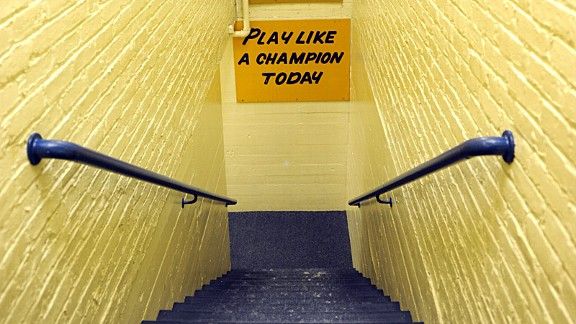
Before every game, the helmets are sprayed with paint of 23.9 karat gold. (Pure gold is 24 karats.) The helmets are always blank, without even a center stripe. Coming out of the locker room, the players slap a sign that reads "Play Like a Champion Today."
This is not Anfield, it is South Bend.

On your visit, you will notice something: Most of the people there are not from South Bend, or even from Indiana. Notre Dame has a national profile, and, as a result, a national student body. But it's more than that: For decades, Catholics all over America, including those who couldn't (or could but didn't) go to college, or who went to a small college without a football team, or even who went to a school that did have a football team and then threw them overboard for Notre Dame, have been Notre Dame fans. And a lot of these people have never set foot in Indiana, much less in South Bend.

The ones from New York City, because they would take the Subway to Yankee Stadium to see Notre Dame play Army, were nicknamed "Subway Almuni." Cities with large Irish populations became lousy with them, whether they had a subway system or not: Boston, Philadelphia, Baltimore, Pittsburgh, Detroit, Chicago, San Francisco.

Of course, a factor in this was some of these cities not having a major football-playing college. By the 1950s, NYU and Fordham were no longer serious football programs. Of Philadelphia's "Big 5," none played what Rutgers would later call "big-time college football"; even now, only Temple plays in Division I-A (and that, barely). Boston had Boston College, but from World War II until the arrival of Doug Flutie in the early 1980s, BC was a nonfactor; BU, Holy Cross and UMass were Division I-AA, and Harvard was the Ivy League.

Blue-collar Baltimore didn't have such a team: The nearest schools were the University of Maryland, which is closer to Washington, and the Naval Academy, which is, literally, elitist. Neither Michigan nor Michigan State is within an hour's drive of Detroit. Chicago had Northwestern, which was long terrible, and the University of Illinois was well Downstate. Are you getting the picture? For people in these cities, Notre Dame was it.

When the team takes the field, the loudspeakers will play the chant, "Here come the Irish!" and the band will play "The Notre Dame Victory March," with its chorus of "Cheer, cheer for old Notre Dame." Between the 3rd and 4th quarters, the band will play Pyotr Tchaikovsky's 1812 Overture. Long before the Boston Celtics got one, Notre Dame had a live leprechaun mascot, usually a gymnast who could do flips. 
From 1960 to 2014, during the 4th quarter, the crowd would go silent, and then hear Sgt. Tim McCarthy of the Indiana State Police read out a driving safety message, beginning, "May I have your attention, please. Football fans, After the game, your number one priority is to get home safe and sound." But he would close with an atrocious pun. "Monkey around in traffic, and you may end up in a cage." "Drive like a musician: C sharp, or B flat." "A drinking driver is like a gun: Both are dangerous when loaded." "Drive like a happy doctor: Have a lot of patience." "Driving half-lit is not very bright." "The reason we hammer at safety is to prevent you from getting nailed." "Remember: No one relishes a pickled driver." McCarthy has been succeeded, but he's the kind of man who can't be replaced.

At the conclusion of every home game, win or lose, the team turns to the student section, and salutes them by raising their helmets in the air. The band then plays the Alma Mater, "Notre Dame, Our Mother."
After the Game. Legends of Notre Dame restaurant is a University-owned and University-themed restaurant at 54801 Juniper Road, a block south of the Stadium. Three blocks further to the south, Eddy Street Commons is an enclosed shopping center at 1234 N. Eddy Street. It includes McAlister's Deli and Brothers Bar & Grill. Across Eddy Street are O'Rourke's Public House, a Cajun restaurant named Yats, Chipotle, Five Guys, and an Italian restaurant named Barbici.

Fiddler's Hearth Pub is the place to see your favorite European soccer team in action, but it's downtown, across the river and away from the campus. 127 N. Main Street, at Columbus Court.

Sidelights. Aside from Notre Dame, there is one sports site in South Bend worth discussing. The 5,000-seat Four Winds Field at Coveleski Stadium, opened in 1987, is home to a team in the Class A Midwest League. "The Cove" was named for Stan Coveleski, the Hall of Fame pitcher for the 1920s Cleveland Indians, who retired to South Bend. And then, in 2013, for Four Winds Casino.
The team that plays there was named the South Bend White Sox when they arrived in 1988, the South Bend Silver Hawks in 1994, became an Arizona Diamondbacks farm team in 1998, and back to its Chicago alignment when they became the South Bend Cubs in 2015. They've won 12 Division titles, most recently in 2008; and 6 Pennants: 1989, 1991, 1993, 1997, 2001 and 2005. 501 W. South Street.

According to various polls, the MLB team with the largest grip on fandom in South Bend is the Cubs with 48 percent, followed by the White Sox with 12 percent, and the Yankees with 7 percent. The White Sox play 91 miles to the northwest, the Cubs 102 miles to the northwest, and the next-closest team, the Detroit Tigers, 218 miles to the northeast.

The All-American Girls Professional Baseball League featured a team called the South Bend Blue Sox. From 1943 to 1945, they played at Bendix Field. South Bend International Airport expanded onto the site. 4477 Progress Drive, about 3 1/2 miles northwest of downtown. Bus SSL

From 1946 to 1954, they played at Playland Park. In 1951 and 1952, they won the Pennant. In 1961, the ballpark was torn down to make way for a golf course. Notre Dame may be a Catholic school, but replacing a ballpark with a golf course is against my religion. Housing for the South Bend campus of Indiana University is now on the site. 1825 Titan Drive, about 2 1/2 miles southeast of downtown. Bus 11 to Milburn & Ironwood, then 7 blocks north.

Despite the City and the University being in Indiana, Chicago has a greater hold on the South Bend sports imagination than Indianapolis, possibly due to Chicago being closer, and probably due to the teams simply being older, and thus more ingrained.

In the NFL, the Chicago Bears, 95 miles away, are more popular than the Indianapolis Colts, 150, or the Detroit Lions, 218. In the NBA, the Chicago Bulls, 97, are more popular than the Indiana Pacers, 150, or the Detroit Pistons, 218. In the NHL, the Chicago Blackhawks, 97, are more popular than the Detroit Red Wings, 218. And in MLS, the Chicago Fire, 100, are more popular than the next-closest team, the Columbus Crew, 254.

Knute Rockne is buried in Highland Cemetery, at Lathrop and Olive Streets, 3 miles northwest of downtown and 3 miles west of the campus. Bus 4 to Bus 16. Snite Museum of Art is at 100 Moose Krause Circle, across from the northwestern corner of the Stadium. George Gipp is buried near his Michigan hometown; Harry Stuhldreher, a native of Massillon, Ohio, in Pittsburgh; Don Miller near his native Cleveland; Jim Crowley, from Chicago, in Scranton, Pennsylvania, to which he had retired; and Elmer Layden, from Davenport, Iowa, in Chicago.

The movies Knute Rockne, All-American (1940) and Rudy (1993) were filmed partly on campus, and both had their premieres in South Bend. In the former, Pat O'Brien played Rockne; legendary coaches Amos Alonzo Stagg, Pop Warner and Howard Jones played themselves; Ronald Reagan played Gipp, earning him the eternal nickname "The Gipper," and reminding us that if he had played the real, rather than the sanitized, Gipp, he never would have won an election; and future TV Superman George Reeves as one of the players who cries over Rockne's speech.

On The West Wing, President Jed Bartlet (played by Martin Sheen) is a 1964 Notre Dame graduate. The 2000 episode "The Portland Trip" takes place on the eve of the Michigan-Notre Dame game, and he and his Chief of Staff, Michigan graduate Leo McGarry (John Spencer), trash-talk each other's teams. (In real life, the schools did not play each other that season.)

Later in the episode, we learn that Danny Concannon (Timothy Busfield), White House correspondent for The Washington Post in the show's fictional world, is also a Notre Dame graduate. And White House Press Secretary C.J. Cregg (Allison Janney) asks him why he, a brilliant kid from New Hampshire who was accepted into the much-closer Harvard and Yale, went to Notre Dame. "I thought about becoming a priest." Why didn't he? "I met Abbey."

Given that he graduated high school in 1960, before Notre Dame went co-ed, the future President would have met the future Dr. Abigail Bartlet (Stockard Channing) when she was attending the women's college in South Bend, St. Mary's College, which is still in business.

*

The Notre Dame experience is likely to be better than the game itself, regardless of whether you "Cheer, cheer for old Notre Dame" or "Send a volley cheer on high" for the opposition. Love it or hate it, Notre Dame football is an American classic.