Showing posts with label dennis eckersley. Show all posts

Monday, September 10, 2018

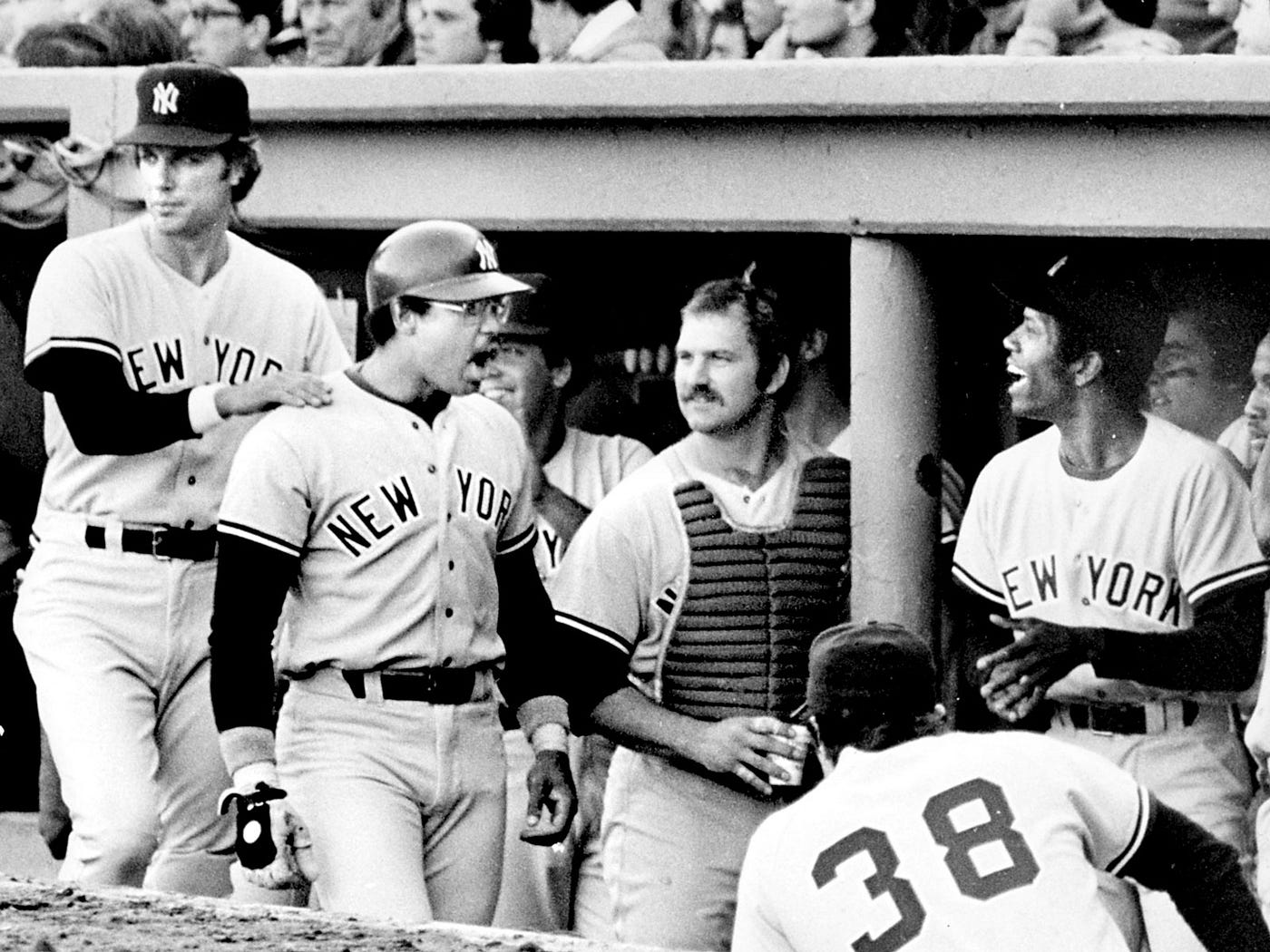
September 7, 8, 9 and 10, 1978: The Boston Massacre

Many of the quotes you're going to read in this post come from This Date In New York Yankees History, written after the 1978 season, by Nathan Salant. Ironically, he has a degree from Boston University (Doctor of Law). He also has an undergraduate degree from the State University of New York at Albany, and, in 1978, through his work, was personally acquainted with many of the players involved.

September 7, 1978, 40 years ago: The Yankees go into Fenway Park on this Thursday night for a 4-game series against the Boston Red Sox, who lead them by 4 games in the American League Eastern Division -- having led them by 14 games on July 20. This 1st game was a makeup of the rainout of July 4.

It is generally agreed at the time that, to really make it a race, the Yankees will have to win 3 out of 4. Sox fans are confident their boys can take 3 out of 4 and finish the hated Yankees off.

But, just as the Yankees had been riddled with injuries in June and July, their bench barely keeping their heads above water, now, it was Boston's turn to see if they could overcome injuries. Carlton Fisk was catching with bad ribs. Butch Hobson was playing 3rd base with bone chips in his elbow, leading the former rocket-armed University of Alabama quarterback to made an alarming 43 errors before he finally got benched.

1st baseman George Scott, known as Boomer for his usual heavy hitting, was playing with a bad finger. 2nd baseman Jerry Remy, a particular pain in the neck in games with the Yankees earlier in the season, was out with a hand injury.

And right fielder Dwight Evans had been beaned, and was having what we would now call post-concussion syndrome. This forced the moving of the Sox' Most Valuable Player candidate, Jim Rice from left field to right field, and the team's greatest legend among active players, Carl Yastrzemski, away from the 1st base-designated hitter platoon he'd been in with Scott, and back to his former position of left field. And he was wearing a back brace.

The Yankees' biggest star at the time, Reggie Jackson, said:

It's hard to explain, but, somehow, we all seemed to believe we would win up there. Sure, we had our work cut out for us, and we knew it wouldn't be easy. But there was something in the air which made everyone even more confident.

On the 2nd play of the game, Hobson makes a throwing error. This leads to the Yankees scoring 2 runs in the 1st inning, 3 in the 2nd, 2 in the 3rd, and 5 in the 4th, knocking out Mike Torrez, who'd signed with the Sox in the off-season, after being one of the Yankees' own heroes in the previous year's World Championship season.

Yankee catcher Thurman Munson collects 3 singles and an RBI, and 2nd baseman Willie Randolph reaches base 3 times, all before Hobson, the 9th and last man in the Sox batting order, even comes to bat for the 1st time.

In spite of a 12-0 lead going into the bottom of the 4th, manager Bob Lemon, himself a Hall of Fame pitcher, takes Catfish Hunter out, due to a pulled groin muscle. Ken Clay relieves, and gets the win despite giving up a home run to Fisk. Yankees 15, Red Sox 3. The Yankees are now 3 games back.

What the heck, it's only one game, right? As Salant put it, imagining what a Sox fan would think, "After all, 15-3 losses were made to be laughed at. It couldn't happen again... "

*

September 8, 1978: Friday night at Fenway. The injury bug has hit the Boston pitching staff as well, as unheralded Jim Wright starts for the Red Sox. But the Yankee starter doesn't seem to be much better: Rookie Jim Beattie. But Sox fans are calm: Surely, the Yankees can't unleash another 15-3 beating like they did the next before.

Close enough: The Yankees scored 2 runs in the 1st inning, and 6 in the 2nd. Wright is chased in the 2nd, and Tom Burgmeier is brought in to pitch. He gives up a home run to Reggie Jackson -- incredibly, the only home run the Yankees hit in this series, in which they instead singled and doubled the Sox to death.
This was the Seventies. It wasn't yet considered permissible to say the word "sucks" in public. "Stinks" was the preferred term. Yet, whenever Mr. October came to the plate, the Fenway bleachers rang out with a chant of "Reggie sucks!" As Salant put it, "One of the more printable mouthings, I might add." Eventually, the Bleachers at Yankee Stadium would resound, countering the Fenway chant of "Yankees suck!" by delivering "Boston sucks!" And considerably cringier chants than that.

As with the night before, a Yankee hitter, in this case Mickey Rivers, gets 3 hits before Hobson can make his 1st plate appearance. This time, Mick the Quick also does so before the 8th hitter, Scott, can do it.

Ordinarily quite the power hitter, Scott is in the middle of a slump that will eventually reach 0-for-36. When asked about it after the game, he says, "Some of these guys are choking, man." And the word "choke" becomes forever associated with the Red Sox. Even the events of October 2004 couldn't remove them, as the events of September 2011 would prove.

(Scott batted .233 in 1978. Take out the 0-for-36, and it would have been .255.)

In contrast, Beattie cruises, pitching what turns out to be the best game of his life, allowing 2 runs, both unearned, and only needs Ron Davis to get the last out.

Yankees 13, Red Sox 2. The Yankees are now 2 games out, after being down 14 on July 20.

*

September 9, 1978: Red Sox fans weren't shaken up yet. They were up for this Saturday NBC Game of the Week. They were excited about the pitching matchup between the two leading winners in the American League that season, Ron Guidry (who came into the game with a record of 20-2) and Dennis Eckersley (16-6). As Salant put it:

The talk in Boston was that all the Sox had to do was win the next two, and the Yankees would have wasted all those runs and hits for nothing. Besides, today the "Eck" was on the mound, 3-0 against the Yankees in 1978. Sure, Guidry was tough, but he was a lefthander about to get his first start in Fenway, with that nice, close leftfield wall. And, the Sox were due to wake up with the bats, weren't they?

Well, for the 1st 3 innings, the game lived up to its billing: No runs. Then came the top of the 4th, and this might have been the decisive inning of the entire season, the one that showed the Sox and their fans that the 1st 2 games of the series were no fluke, and that there was no longer any reason for the Yankees to be afraid of even the Sox, not even of their ace.

Munson led off with a single. Then Reggie flew to left, and Carl Yastrzemski threw back to the infield, and doubled Munson off. It seemed as though the threat was over.

It wasn't. Chris Chambliss doubled. With 1st base open and 2 outs, Sox manager Don Zimmer ordered that Graig Nettles be intentionally walked. As Salant put it, "That made no sense, because the next batter was the Red Sox killer himself, Lou Piniella." Sweet Lou had already proven himself a big clutch hitter in the previous season, against the Sox in September, the Kansas City Royals in the American League Championship Series, and the Los Angeles Dodgers in the World Series.

Now, he delivered the sequel. He took advantage of that big space in Fenway's right field, and of Jim Rice's lead feet and his inexperience out there. (Rice was the usual left fielder, while the aging Yaz and Scott had platooned between 1st base and designated hitter. But, here, he was subbing for the injured Evans). Piniella smacked one that Rice could only hold to a double, scoring Chambliss. (Salant blamed Lynn, for not moving with the crack of the bat.)

It could have been worse had Piniella not also been slow: Although always hustling, as Reggie put it, "Lou Piniella runs like a dump truck." And this was before he became a fat manager.

With 1st base again open, Roy White was intentionally walked. As Salant put it, "A good move because White is second to Piniella as a Sox-smasher." And because the next man up was the Yankees' good-fielding, but barely-slap-hitting shortstop, Russell Earl "Bucky" Dent. Surely, he wouldn't cause trouble at Fenway Park. Little did they know...

Dent singled to left, scoring Nettles and Piniella, making it 3-0 New York. Given the emotional impact that this game had, this might have been the Yankees' most important hit of the season, never mind Dent's most important RBI hit of the season at Fenway Park. And Dent got to 2nd on an error. Rivers singled home White and Dent. 5-0. With Randolph up, Eckersley threw a wild pitch that advanced the runners. Randolph drew a walk. The Yankees had batted around. Munson singled Rivers home.

Finally, Zimmer took Eckersley out of the game. One of the best starters in baseball at the time -- he had gone 14-13, including a no-hitter, for an awful Cleveland Indians team the year before, but had to be traded, for reasons that I won't get into here -- he had already developed a drinking problem that would nearly ruin him. Eventually, he would be turned into one of the best relief pitchers ever, finishing a Hall of Fame career with 197 wins and 390 saves. But now, he had to be removed.

Zimmer brought the lefthanded Burgmeier in, to face the lefty Reggie, and, if he got on base, the lefty Chambliss. A good reliever who would make the All-Star Team in 1980, here he was betrayed by the injury to Fisk, who allowed a passed ball that scored Randolph. That might have rattled him, because he walked Reggie. But he settled down, and got Chambliss to fly to center.

This inning was the Red Sox' season in a nutshell: Seemingly getting into and out of trouble, and then, after there were already 2 outs, came 7 runs, on 5 hits, 3 walks (not counting the last, to Reggie), an error, a wild pitch, and a passed ball.

Meanwhile, Guidry cruised, pitching as well as he had all year. He allowed 2 singles in the 1st 3 at-bats of the game, to Rick Burleson and Rice, and then allowed no hits and just 4 walks the rest of the way.

Yankees 7, Red Sox 0. The Yankees were now only 1 game back.

This game inspired 2 legendary quotes, for both of which I was unable to find a source. Supposedly, a sportswriter wrote, "This was the first time that a first-place team had been eliminated from a pennant race."

And, supposedly, someone stood up in a Boston bar, and said, "They killed our grandfathers, they killed our fathers, and now, the sons of bitches are coming for us." Meaning the Yankees had taken the heart of the 1910s Red Sox champions for their own 1920s champions, they'd broken New England hearts in the 1949 AL Pennant race, and now, it was their own generation's turn.

*

September 10, 1978: On this Sunday morning, Red Sox fans could have been forgiven for feeling like the narrator of Kris Kristofferson's 1969 country music classic, best known for its version by Johnny Cash:

Well, I woke up Sunday morning
with no way to hold my head that didn't hurt.
And the beer I had for breakfast wasn't bad

so I had one more for dessert.
Then I fumbled in my closet through my clothes

and found my cleanest dirty shirt.
Then I washed my face and combed my hair

and stumbled down the stairs to meet the day...
On a Sunday morning sidewalk
I'm wishing, Lord, that I was stoned.
'Cause there's something in a Sunday
that makes a body feel alone.
And there's nothing short of dying
that's half as lonesome as the sound
of a sleeping city sidewalk
and Sunday morning coming down.

For the Yankees: A share of 1st place was on the line. For the Red Sox: Keeping themselves in good position to keep their best chance at a World Championship for the Red Sox in 60 years.

Legend has it that, before the Sunday afternoon game, Yaz, as team Captain, went into Zimmer's office, and begged him to start Bill Lee against the Yankees.

Lee, part pitching ace and part mad philosopher, was known as the Spaceman. He used a sinking fastball to go 12-5 vs. the Yankees in his career. And he was a lefthander, and, thanks to the Kansas City Royals in the previous year's AL Championship Series, the word had gotten around that, "The Yankees can't hit lefthanded pitching."
It was also suggested that Luis Tiant, also with with a good record against the Yankees, start, but he was 37, and would have been on 3 days' rest.

Zim refused to start Lee, and, to explain why, reached into his desk, and showed Yaz a bunch of newspaper clippings he had saved, in which Lee had insulted him, calling him things like "the Designated Gerbil." Zim said he was sticking with his established choice for the game, Bobby Sprowl, a 22-year-old from Sandusky, Ohio with 1 major league game (7 innings) under his belt. To be fair, Sprowl was also a lefthander. Zim said he was told by Sox scouts that Sprowl "has icewater in his veins."
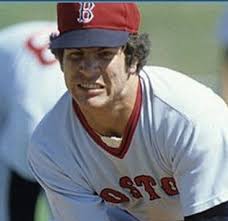
I ask you: Does this look like somebody
with icewater in his veins?

Sprowl got knocked out of the box in the 1st inning, and the Yankees took a 5-0 lead. Ed Figueroa pitched well, and Goose Gossage stopped a Sox rally in the 9th. Yankees 7, Red Sox 4.

In 4 games, the Yankees had outscored the Red Sox 42-9. The sweep was completed, and the teams were tied for 1st place, with 20 games to go, including 3 more between them, the following weekend at Yankee Stadium.
Zimmer, Fisk and Burleson

The series became known as the Boston Massacre, after the 1770 event outside what's now known as the Old State House in downtown Boston, often considered the beginning of the American Revolution.

What happened to Sprowl? The kid with "icewater in his veins" made 1 more appearance for the Sox in '78, was traded to the Houston Astros, made 3 major league appearances for them in '79, 1 more in '80, and 15 more in '81, spent the next 3 seasons in the minor leagues, and threw his last professional pitch before turning 30. He's now a college coach in Alabama.

It's become accepted Red Sox lore that Zimmer kept Lee out of the starting rotation out of spite; and that, if he'd started Lee instead, Lee would have beaten the Yankees. The truth? Rather than being the answer to the hole in the rotation that Sprowl couldn't fill, Lee was the hole in the rotation.

On July 15, 1978, Lee was 10-3, and a big reason why the Sox had a big Division lead. From then until September 7, the start of the Boston Massacre series, he'd made 9 appearances, pitching 48 1/3rd innings. He was 0-7. His ERA was 5.96 -- and that doesn't count 5 unearned runs during that stretch. And 3 of those losses were by 1 or 2 runs. Had Lee been just a little bit better in any one of those 3 games, there never would have been a Bucky Dent Game.

Throw in that blooper pitch that Tony Pérez turned into a home run in Game 7 of the 1975 World Series, and Bill Lee may be more responsible for the Red Sox not winning the World Series from 1975 until 2004 than any single person. And yet, he is celebrated by Sox fans, because no Sox player ever hated the Yankees more.

And if Zim was keeping Lee out of games due to spite, why would he have brought him in to relieve in Game 2 of the Massacre series, the 13-2 Yankee win? He went 7 innings, and allowed only 1 earned run -- although he allowed 4 others that were charged to starter Jim Wright. If you had a must-win game, would you trust the start to a guy who pitched 7 innings only 2 days ago, no matter how good he was? I wouldn't. Don Zimmer didn't.

By the way, Zim did bring Lee in during that September 10 game. He pitched 2 1/3rd innings, allowing no runs -- but the game was already lost. And pitching 2 1/3rd innings effectively isn't the same as pitching 7 or more. There's no guarantee that Lee would have been the right choice to start, even if he hadn't gone 7 just 2 days before. So, obviously, Zim was willing to put his personal feelings about Lee aside.

*

The Yankees also took the 1st 2 games of the next weekend's series, to rise to 3 1/2 games ahead. In just 2 months, they'd gained 17 1/2 games. But the Sox won the Sunday game, with Eckersley beating Beattie.

And that's when things turned around again. The Sox won 10 of their last 12, including their last 8. The Yankees won their next-to-last game, against the Indians, with Figueroa becoming the 1st (and still only) Puerto Rican-born pitcher to win 20 games in a season. But on October 1, they lost the season finale, with Rick Waits, one of those lefthanded pitchers they supposedly couldn't hit, shutting them down.

The Sox beat the Toronto Blue Jays, 5-0, on a shutout by Luis Tiant. The Fenway scoreboard put up, "THANK YOU RICK WAITS." 
Did you think I was kidding?
Did you think the Red Sox wouldn't be that petty?

There would be a Playoff game the next day. The Red Sox won a coin flip, and the game would be at Fenway Park.

The Sox felt like everything they'd done from April 8 to September 6 was wasted. The Yankees must've felt the same about everything they'd done from July 20 to September 30. Now, the regular season was over, and both teams had 99 wins... and neither team was guaranteed a berth in the postseason proper.

It would come down to 9 innings on an Autumn Monday afternoon at Fenway Park. And the story would get no less wild than it had already been.

Friday, January 26, 2018

What Does It Take to Elect a Reliever to the Baseball Hall of Fame?

What does it take to get a relief pitcher elected to the Hall of Fame?

With the election this week of Trevor Hoffman, there are currently 6 pitchers who were elected to the Hall based mainly on what they did as relievers:

* Hoyt Wilhelm, who pitched from the mid-1950s to the early 1970s, and was both a starer and a reliever until the early 1960s. He was the master of the knuckleball, and the 1st pitcher to appear in as many as 1,000 regular-season games (breaking Cy Young's long-standing record of 906).

* Rollie Fingers, at his peak in the 1970s and early 1980s. He was known for his handlebar mustache, reminiscent of silent-film villains, and very villainous to hitters, though not known to hit batters on purpose, and, by all accounts, a nice guy off the mound.

* Bruce Sutter, who had a relatively short peak, from the late 1970s to the early 1980s. He was the 1st pitcher to make a name for himself with the split-fingered fastball, though Elroy Face used its predecessor, the forkball, with much relief success a generation earlier.

* Rich "Goose" Gossage, a relief star from the mid-1970s all the way to the mid-1990s. One of the fastest pitchers who ever lived, like Fingers, he eventually developed his own iconic mustache.

* Dennis Eckersley, a fine starter in the late 1970s and early 1980s (pitched a no-hitter in 1977 and won 20 in 1978), who was converted to a reliever in the mid-1980s and was one of the best ever into the mid-1990s. The Eck was the original Ninth Inning Man, also with an iconic look, his long hair and thin mustache earning him the nickname "the King of Spades." And...

* Trevor Hoffman, at his peak in the late 1990s and all through the 2000s. The 1st man to 500 saves, the 1st man to 600 saves, and still the National League's all-time record holder with 601.

As a note that may not mean anything here, Sutter and Hoffman are currently the only pitchers ever elected to the Hall who never started a game, either regular-season or postseason. Presuming that hasn't changed once Mariano Rivera gets in, it still won't due to his election: He arrived in the major leagues as a starter in 1995.

*

What does the election of these 5 pitchers tell us about what gets a reliever in?

Keep in mind: In Wilhelm's time, there weren't big save totals like we would see in the era of Fingers and Gossage; and the totals in their time would be frequently surpassed by the time Eck became a closer. As Wikipedia's entry on Fingers says:

When Fingers reached the major leagues, the role of relief pitchers was limited, as starting pitchers rarely left games while holding a lead; but as team offense increased following the 1968 season, and especially with the American League's introduction of the designated hitter in 1973, managers became more willing to replace starters in the late innings with a lead in order to forestall any late rallies by opponents.

Through the 1960s, both leagues' annual saves leaders tended toward totals of 20–25 saves; few pitchers remained in the role more than two or three years, with significant exceptions such as Roy Face and knuckleballer Hoyt Wilhelm. But in the 1970s, in an era allowing for greater opportunities for closers than had previously been available, Fingers' excellence in relief allowed him to gradually increase his annual saves totals past 30. In 1980 he broke Wilhelm's record of 227 saves, and eventually finished with 341, a record that stood until Jeff Reardon passed it in 1992.

Case in point: The Yankees won 5 straight American League Pennants in the early 1960s, but had a different main reliever each year: Art Ditmar in 1960, Luis Arroyo in 1961, Marshall Bridges in 1962, Hal Reniff in 1963 and Pete Mikkelsen in 1964.

Also, until Oakland Athletics manager Tony LaRussa made Eck essentially a 9th-inning-only guy, presaging the way Yankee manager Joe Torre would use Mariano Rivera, which pretty much made every manager (including Torre's successor, Joe Girardi) want a setup reliever, an 8th-inning-only guy, and a 9th-inning-only guy, relievers were expected to pitch more than 1 inning -- sometimes several more.

In the 1978 Playoff for the AL Division title against the Boston Red Sox, Yankee manager Bob Lemon brought Gossage in to relieve Ron Guidry in the 7th inning. The year before, in the AL Championship Series against the Kansas City Royals, Lemon's predecessor, Billy Martin, brought Sparky Lyle in to pitch in the 6th in Game 3 and the 4th in Game 4, going the rest of the way both times. And then to pitch the 8th and 9th in the deciding Game 5. (There was no Most Valuable Player award for the LCS at that time; if there was, he would have been an easy choice.) That was Lyle's Cy Young Award season, and he's not in the Hall of Fame.

And in 1974, with the A's in trouble in Game 1 of the World Series against the Los Angeles Dodgers, manager Alvin Dark brought Fingers in for the 5th, and let him go until relieving him with a starter, Catfish Hunter, in the 9th. The A's won, and won the Series in 5. (Fingers would be named MVP of that Series.)

So saves, and various related stats, might not be that reliable.

Also, coming in earlier in the old days meant that some relievers had a better chance to get wins than pitchers in the 1980s or later. ERA (earned run average), ERA+ (ERA relative to the League, with park effect somehow factored in), and WHIP (Walks + hits, per innings pitched) should also be considered.

Strikeouts, and related stats like K/9 IP and K/BB ratio, should not: While strikeouts are spectacular, they don't count for any more than a groundout or an out in the air. It's not like for starters, where 3,000 strikeouts over a career really is impressive. And, of course, winning is important: Did the pitcher's performance help his team win?

For the sake of argument, let us suppose that Mariano Rivera, eligible next season, gets in. Because even hardcore Red Sox fans won't suggest that he doesn't belong. So, here we go:

Saves: Rivera has a record 652 saves, Hoffman 601, Eckersley 390, Fingers 341, Gossage 310, Sutter 300, Wilhelm 227.

Wins Plus Saves: Mo a record 734, Hoffman 662, Eck 587, Fingers 455, Goose 434, Wilhelm 370, Sutter 368.

ERA: Mo 2.21 (lowest of any pitcher, starter or reliever, in the post-1920 Lively Ball Era), Wilhelm 2.52, Sutter 2.83, Hoffman 2.87, Fingers 2.90, Goose 3.01, Eck 3.50 (that high because he was a starter for 12 years, literally half his career).

ERA+: Mo a record 205, Wilhelm 147, Hoffman 141, Sutter 136, Goose 126, Fingers 120, Eck 116.

WHIP: Mo 1.000 (actually, 1.00026), Hoffman 1.058, Wilhelm 1.125, Sutter 1.140, Fingers 1.156, Eck 1.161, Goose 1.232.

Postseason appearances: Mo 16, Eck 8 (counting the 1978 Red Sox -- they did, after all, play a 163rd game that season), Fingers 7 (counting the 1981 Milwaukee Brewers in the strike-forced split-season Playoff format), Goose 5, Wilhelm 2 (as a rookie with the 1954 New York Giants and a veteran with the 1969 Atlanta Braves, although he did not appear in the NLCS against the Mets), Sutter only 1 (but was cheated out of another when the split-season format denied the St. Louis Cardinals the 1981 NL East title even though they had the best overall record in the Division, and another, possibly another ring, when the Cards traded him after the 1984 season despite tying Dan Quisenberry's record of 45 saves in a season).

World Series wins: Mo has 5 (1996, 1998, 1999, 2000 and 2009 Yankees), Fingers 3 (1972, 1973 and 1974 Oakland Athletics), Wilhelm 1 (as a rookie with the 1954 New York Giants), Sutter 1 (1982 St. Louis Cardinals), Eckersley 1 (1989 A's), Hoffman none (1 Pennant, with the 1998 San Diego Padres).

*

So what does this tell us? It means that 300 saves is a minimum consideration; that Wilhelm doesn't have 300 saves, but his other stats show him to be in, at the least, the same class as the other 4; that the Eck, because of his starting for half his career, is the only one with an ERA over 3.01 and an ERA+ under 120; and that, while Hoffman proves that postseason success isn't required to get in, a pitcher should have at least 1 ring. It also tells us that having a career losing record wasn't enough to keep either Fingers, Sutter or Hoffman out (although Sutter had to wait a lot longer to get in).

So let's use the following as our minimums: 300 saves, which all but Wilhelm had; with that established, 368 wins + saves; an ERA of 3.00 or lower, with the Goose slightly over and the Eck well over because he wasn't always a reliever; an ERA+ of 120 or higher, with the Eck an outlier; and a WHIP of 1.240 or lower, with the Goose being the highest. Once those are established, we should look at postseason berths and titles.

There are currently 28 pitchers with at least 300 career saves. Minus Rivera, Hoffman, Eckersley, Fingers, Gossage and Sutter, that leaves 22:

Lee Smith, 478; Francisco Rodriguez, a.k.a. K-Rod, 437 and counting; John Franco, 424; Billy Wagner, 422; Joe Nathan, 377; Jonathan Papelbon, 368; Jeff Reardon, 367; Troy Percival, 358; Randy Myers, 347; John Wetteland, 330; Francisco Cordero, 329; Roberto Hernandez, 326; Huston Street, 324 and counting; Jose Mesa, 321; Todd Jones, 319; Rick Aguilera, 318; Robb Nen, 314; Tom Henke, 311; Jeff Montgomery, 304; Doug Jones, 303; Fernando Rodney, 300 and counting; and Jason Isringhausen, 300.

Let's not kid ourselves: We can eliminate both Doug and Todd Jones, Isringhausen, Rodney, Montgomery, Henke, Nen, Aguilera, Mesa, Hernandez and Cordero.

That leaves Smith, Franco, Wagner, Nathan, Papelbon, Reardon, Percival, Myers, Wetteland, and the still-active K-Rod and Street. Keep in mind, this is not about whether they'll get in through the Writers: Some have already dropped off, and can only get in later through the Veterans Committee. This is about, based on who's already in, who else belongs.

We've been over 300 saves. This raises it to 330. But we've also established 368 wins + saves. So, of these 11, that leaves Smith with 549, Franco 514, K-Rod 489, Wagner 469, Nathan 441, Reardon 440, Papelbon 409, Percival 393, Myers 391, Wetteland 378 -- Street 366, but he's still active, and only needs 2 more to meet the threshold.

Also with an ERA of 3.00 or lower? Wagner 2.31, Papelbon 2.44, K-Rod 2.86, Nathan 2.87, Franco 2.89, Wetteland 2.93, Street 2.95 -- Smith 3.03, Reardon 3.16, Percival 3.17, Myers 3.19.

Also with an ERA+ of 120 or higher? Wagner 187, Papelbon 177, Nathan 151, Wetteland 148, K-Rod 148, Percival 146, Street 141, Franco 138, Smith 132, Myers 123, Reardon 122.

Also with a WHIP of 1.240 or lower? Wagner 0.998, Street 1.066, Percival 1.108, Papelbon 1.043, Nathan 1.120, Wetteland 1.135, K-Rod 1.155, Reardon 1.199 -- Smith 1.256, Myers 1.304, Franco 1.333.

Meeting all 4: Wagner, Nathan, Papelbon, Wetteland, and, for all intents and purposes, Street.

Meeting 3 of the 4: Franco, K-Rod, Reardon, Percival.

Meeting only 2: Smith, Myers. So we can eliminate those 2.

But here's another way to look at it: The old IYGA argument: "If you gotta ask... " In other words, if you hear his name, and you don't automatically say, "He should be in the Baseball Hall of Fame," then he shouldn't be.

K-Rod may be the all-time leader in saves by a lefthander. Franco, the recordholder before him. And Wetteland, he's a hero of the 1996 Yankees. But can you really say any of those get in?

I can't.ce those are established, we should look at postseason berths and titles.

Thursday, April 24, 2014

The Yankee Doodle Double Standard: It's Not Cheating If the Red Sox Do It

If David Ortiz did what O.J. Simpson did -- stabbed his ex-wife and her friend to death -- instead of police chasing him down the freeway, Major League Baseball would give him an escort to Logan Airport, and fly him out of America's jurisdiction on their own dime.

Let's tell the truth: There is one set of rules for the Boston Red Sox, and another set of rules for everybody else. It's the Yankee Doodle Double Standard.

Yes, Michael Pineda was caught using pine tar last night, and he was thrown out of the game, and will likely be suspended for it -- meaning he'll miss 2 or 3 starts. Yes, it was stupid.

But the Red Sox complaining about cheating is like that idiot rancher in Nevada calling anyone else a "freeloader." This is only partially about the steroids used by Ortiz, and previously by Manny Ramirez, and who knows how many other Red Sox scofflaws. (Ah, but if the law isn't applied, how easy it is for them to scoff at it!)

Jon Lester had that green goop on his glove during last year's World Series. Was he punished? Was he so much as investigated? No.

Clay Buchholz got caught with white goop on his arm last May. Was he punished? Was he so much as investigated? No. Jack Morris, now broadcasting for that night's opponents, the Toronto Blue Jays, called Buchholz out on it. And on ESPN, Hall-of-Famer Dennis Eckersley (a former Red Sox pitcher), said, "I think Jack Morris should zip it. I feel sorry for Buchholz to even have to deal with this."

Hey, Eck: If you don't want to deal with what happens if you get caught breaking the rules, don't break the rules. Buchholz got caught by Morris... and he got away with it, because he's a goddamned Red Sock.

When Pineda pitched against the Red Sox last week, some of them knew he'd been using pine tar, but backed away from accusing him of cheating:

* Pitcher Chris Capuano: "In in my mind, there is a difference between doctoring the ball to make it do something funny, versus to get a grip."

* Catcher David Ross: "Maybe it's cheating, but I don't really look at it that way."

* Even Ortiz himself, the most blatant, unrepentant and dishonest cheater in baseball history, said of Pineda that night, "Everybody uses pine tar in the league. It's not a big deal."

He's probably wrong about "everybody" using it. But he may be right about a lot of pitchers using it. And by saying, "It's not a big deal," he may be sticking up for a fellow Dominican, much like those jackasses who held up banners and Dominican flags in the old Yankee Stadium's bleachers for Pedro Martinez when he pitched his 17-strikeout one-hitter in 1999.

(You want to do that, fine, but don't do it in the bleachers. Those seats are for people who want the Yankees to win, and don't give a damn about the nationality of either side's players: The uniform is the flag.)

Sox manager John Farrell got cute: "Guys look to create a grip, but, typically, you're not looking to be as blatant as him." (Meaning Pineda.)

Oh, I see: Farrell's not mad that Pineda "cheated." He's mad that Pineda got caught.

Why? Why is getting caught cheating worse than the actual cheating? And, if it is, why, then, play David Ortiz, who cheated, lied about it, got caught, and lied about it again -- just like Pineda? Apparently, what's good for Pinstriped goose (not to be confused with Rich Gossage) isn't good for the Red-Socked gander.

Maybe Farrell's just pissed that, now, the umpires will be looking at Sox pitchers, to see if they're cheating.

Yeah, don't bet on the umps investigating Sox pitchers the same way. He's still new to this rivalry, and may not know: A Red Sox player can do whatever he wants, because the Red Sox winning is good for Major League Baseball's profits. Whereas a Yankee player can't do anything that looks to the Red Sox like it's "unfair," because, apparently -- the evidence since 1996 to the contrary -- the Yankees winning isn't good for MLB's profits.

Funny, I didn't see Pete Rozelle and Paul Tagliabue getting upset when the Dallas Cowboys won. Or David Stern when the Chicago Jordans, the Los Angeles Kobes and the Miami LeBrons won. Or Gary Bettman when the Pittsburgh Crosbys and the 2 Los Angeles teams (the Anaheim Ducks in 2007 and the L.A. Kings in 2012) won.

*

Oh yes, there was a game last night. Whatever Pineda was doing last night, clearly, it wasn't working, because the Sox already led 2-0 when he got tossed. Joe Girardi leafed through his Binder, and sent David Phelps out to replace him, and he allowed 2 more runs. Matt Thornton, Preston Claiborne and Adam Warren were more or less fine from then on.

But it didn't matter, because the fried-chicken-gulping, beer-swilling bastard John Lackey shut the Yankee bats down. Aside from an RBI single by Alfonso Soriano in the 6th, the Yankees didn't get any runs home. They left 7 men on base.

Red Sox 5, Yankees 1. WP: Lackey (3-2). No save. LP: Pineda (2-2).

The series concludes tonight, with CC Sabathia opposed by Felix Doubront. How will the Red Sox try to game the system this time? Probably by hiding CC's pregame meal, so he's hungry.

That's fine, of course. So says MLB. After all, it's not "cheating" if the Red Sox do it.

UPDATE: Right after I first posted this, MLB's decision came down: Pineda has, indeed, been suspended for 10 games. He'll miss starts at home to Seattle, and either home to Tampa Bay or away to Anaheim.

Monday, March 31, 2014

Oakland's All-Time Baseball Team

When I was growing up, it always seemed like the Yankees' August trips to the Pacific Coast -- to Anaheim to play the team then known as the California Angels, Oakland to play the Athletics, and Seattle to play the Mariners -- would end up doing them in.

In 1977 and '78, they provided speed bumps that were eventually overcome on the way to World Championships. But in the '80s, and even in the '90s until Joe Torre came along, such trips always seemed to hit us in July and August, and turn a team fighting for first place into a team struggling just to make third.

All too often, it would be a Borg Roadtrip: The Yankees would lose 7 of 9, and resistance was futile.

While the A's have been more successful than the Giants (and are thus ranked higher here), the regional team for San Francisco is much better than the one for the East Bay. But this team would cause a few problems for opponents as well.

8. Oakland’s All-Time Baseball Team

This pool of players comes from the following California Counties: Alameda, which includes Oakland itself; Contra Costa, Sacramento, San Joaquin, Solano, Stanislaus and Yolo. (Yes, Yolo. It doesn't mean "You Only Live Once," it was the name of a local Indian chief.) And, of course, the players involved don't have to have grown up while the A's have been in Oakland, since 1968.

1B Willie Stargell of Alameda. Born in Earlsboro, Oklahoma, graduated from Alameda's Encinal High School. He hit the longest home runs ever measured at Veterans Stadium in Philadelphia, Fulton County Stadium in Atlanta, both Jarry Park and the Olympic Stadium in Montreal, and the first 2 homers hit out of Dodger Stadium in Los Angeles -- but, strangely, he did not hit the longest at either Forbes Field (Babe Ruth) or Three Rivers Stadium (Greg Luzinski, which is only fair since "Pops" hit the longest ever at the Vet).

He was elected to the Hall of Fame, hit 475 homers, and won 2 rings with Pittsburgh Pirates, who retired his Number 8. Pops joined Honus Wagner and his former teammates Bill Mazeroski and Roberto Clemente as being honored with a statue outside PNC Park. When The Sporting News announced its 100 Greatest Baseball Players in 1999, he came in at Number 81.

2B Joe Morgan of Oakland. Born in Bonham, Texas, he graduated from Oakland's Castlemont High. He is the best 2nd baseman of my lifetime, and that includes Ryne Sandberg, Lou Whitaker, Craig Biggio, Roberto Alomar and Jeff Kent.

He had a 132 career OPS+, his 268 home runs made him the all-time leader among 2nd basemen (since surpassed by Sandberg and Kent), 2,517 hits, 689 stolen bases (9 straight seasons with at least 40, including 3 of at least 60), 6 times reached the postseason including 3 Pennants and the 1975 and '76 World Championships with the Cincinnati Reds, seasons in which he was also the National League’s Most Valuable Player.

The Reds have retired his Number 8, and he's in the Hall of Fame. When The Sporting News announced its 100 Greatest Baseball Players in 1999, he came in at Number 60. All this despite being just 5-foot-7. As for his broadcasting, well…

Honorable Mention to Steve Sax of West Sacramento. His 1st manager, Tommy Lasorda, said of him, "He plays like my wife shops: All day long." I think that meant he hustled all game long. He was the National League Rookie of the Year in 1982, even though he'd been up with the Los Angeles Dodgers long enough to be on the postseason roster the year before, winning the World Series. He also helped them win it all in 1988, and to win the NL Western Division title in 1983 and '85. He was a 5-time All-Star, including in 1986 when he batted .332.

He came to the Yankees in 1989 and batted .315, and the stories of him "developing the yips" were in the past: While he made 30 errors in 1983, in 3 seasons in Pinstripes, he made 10, 10 and 7 errors, hardly outrageous totals for a modern 2nd baseman.

Honorable Mention to Dustin Pedroia of Woodland. He's a Red Sock, so I can't stand him. But the achievements don't lie -- at least, not without a steroid outing, which I don't think is coming. Like Cal Ripken, he was AL Rookie of the Year one season, MVP the next, 2007-08.

He's been an All-Star 4 times and a Gold Glove 3. In his MVP year, he led the AL in hits and doubles (with 54). He's 30, and his "lifetime" batting average is .302, his OPS+ 117. He's helped the Red Sox reach 4 postseason berths, including the 2007 * and 2013 * World Championships.

SS Jimmy Rollins of Alameda. Like Stargell, he's a graduate of Encinal H.S. Amazingly, a lot of Phillies stars have come from the East Bay, including also Larry Bowa of Sacramento, whose 5 All-Star appearances, 2 Gold Gloves, and sparkpluggery of 6 postseason teams including the 1980 World Champions make him an Honorable Mention here.

But J-Roll has surpassed him as the greatest shortstop in the history of Philadelphia baseball. The 2007 NL MVP, 3 All-Star appearances, 4 Gold Gloves, 2,175 hits, 199 homers (already not a bad career total for a shortstop) and 425 stolen bases, and Captain of the 2008 World Champions.  If the Phils don’t eventually retire his Number 11, and if he doesn’t make the Hall of Fame, I will be genuinely shocked.

Honorable Mention to Dick Bartell of Alameda. "Rowdy Richard" was born in Chicago, so I missed him the 1st time I made this team out. He had 6 .300+ seasons, collected 2,165 hits including 442 doubles, and made the 1st All-Star Game in 1933, and another in 1937. He only played 1 game for the Pirates in their 1927 Pennant season, but won Pennants with the 1936 and '37 Giants and the 1940 Detroit Tigers.

Honorable Mention to Derrel McKinley "Bud" Harrelson of Hayward, still the best shortstop the Mets have ever had (unlike Rey Ordonez and Jose Reyes, he did not get substantially worse in September or October), and who ended up traded to… the Phillies. And to Chris Speier of Alameda (another Encinal grad), a 3-time All-Star for the San Francisco Giants.

3B Harry "Cookie" Lavagetto of Oakland. He made 4 All-Star teams with the Brooklyn Dodgers, including 1941 when they broke a 21-year Pennant drought. He probably would have had a much better career if he hadn't lost the next 4 seasons to serving in World War II.

Such was his popularity that a Dodger fan named Fierce Jack Pierce used to buy 2 tickets, 1 for himself and 1 for a helium tank that he'd put in the next seat, and he'd blow up balloons with "COOKIE" on them, chanting, "Cooooooookie! Cooooooookie!" all the way, and the balloons would be batted around Ebbets Field like beach balls.

Cookie is best known now for his last career hit, which won Game 4 of the 1947 World Series, breaking up the no-hitter of Bill Bevens of the Yankees with 1 out to go. In the famous photo of Ralph Branca face down on the steps after giving up Bobby Thomson's Shot Heard 'Round the World, Cookie is the man sitting next to him, by then a Dodger coach, looking forlorn with a burning cigarette in his hand. He went on to become one of the first coaches for the Mets.

Honorable Mention to Andy Carey of Alameda – but of Alameda H.S., not Encinal. In 9 years with the Yankees, including leading the AL in triples in 1955, he appeared in 4 World Series. Also to John Vukovich of Sutter Creek, another Phillie – in fact, between playing, coaching and managing, Vuk and Bowa share the record for most seasons in a Phils' uniform.

Honorable Mention to Ed Sprague of Castro Valley. The son of Ed Sprague Sr., a 1970s pitcher, Ed Jr. played on the Toronto Blue Jays' back-to-back World Champions of 1992-93, hitting a home run in the Jays' Game 2 victory over Atlanta in 1992 despite making only 50 plate appearances in the regular season.

In 1996, he hit 36 homers with 101 RBIs, and in 1999, by then with the Pirates, he was named an All-Star (probably because every team had to have one and the Bucs were otherwise pathetic). Retiring in 2001, he went back to the East Bay as the head coach at the University of the Pacific in Stockton. He and his wife are both Olympic Gold Medalists: Ed in baseball in 1988, Kristen Babb-Sprague in synchronized swimming in 1992.

LF Rickey Henderson of Oakland. Like Dick Bartell, he was born in Chicago, so I nearly missed him when I first did this team. But he grew up in Oakland, went to Oakland Technical H.S., and had 4 separate stints with his hometown A's. He's not easy to sum up, but here goes:

He had a career OPS+ 127. He set records for stolen bases in a season, 130 in 1982, and in a career, 1,405 and no one else is even over 1,000. (But he also set the records for caught stealing, 42 in a season and 335 in his career.) He had 6 .300 seasons. He hit 297 homers, including the most leadoff homers. He was an 11-time All-Star. He won 1 Gold Glove. He was named the 1990 AL MVP.

He is the all-time leader in runs scored with 2,295. Briefly, before being surpassed by Barry Bonds, he was the all-time leader in walks with 2,190. (But he's also among the leaders in strikeouts with 1,694.) He reached postseason with the A's in 1981, '89, '90 and '92, the Toronto Blue Jays in '93, the Padres in '96 and the Mets in '99, winning rings with the '89 A's and the '93 Jays. 3,000 Hit Club.

Hall of Fame. The A's retired his Number 24.When The Sporting News announced its 100 Greatest Baseball Players in 1999, he came in at Number 51. He may have been the most egotistical ballplayer of all time, but there was plenty of reason for it: As Bill James, King of the Statheads, says, if you split Rickey Henderson in 2, you could have 2 Hall-of-Famers.

Honorable Mention to Charles "Chick" Hafey of Berkeley. A sinus condition led him to become one of the earliest prominent players to wear glasses on the field, and insured that his last productive season came at age 31 and that he was finished 34.

But anyone calling him "Four-Eyes" had better have also called him "Sir." He had a lifetime batting average of .317, OPS+ of 133, collected a hit in an NL record 10 straight at-bats in 1929, was the 1931 NL batting champ at .349, in 8 full seasons never batted below .293, 3 times had at least 100 RBIs. He helped the St. Louis Cardinals win the 1926 and '31 World Series, also winning Pennants in '28 and '30. He was selected for the 1st All-Star Game in 1933 and got the Game's 1st hit. He also had one of the best outfield arms of his era.

He is rightfully in the Hall of Fame, and he did live long enough to see it happen, but the Cards have never retired a number for him – in fact, they traded him away before they ever started wearing uniform numbers.

Honorable Mention to Greg Vaughn of Sacramento. He was saddled at the start of his career with a weak Brewer team and a not-very-hitter-friendly Milwaukee County Stadium, but he moved on to the San Diego Padres and helped them win the NL West in 1996 and the Pennant in 1998. A 4-time All-Star, he finished with 355 home runs.

CF Willie McGee of Richmond, Contra Costa County. On October 21, 1981, the Yankees traded him to the Cardinals for pitcher Bob Sykes. This was a stupid thing to do: Sykes was 26, but an injury meant he would never play again; while McGee, just 22, nearly became the next year's NL Rookie of the Year, and helped the Cards win the 1982 World Series, and the 1985 and 1987 NL Pennants, and then helped the A's win the 1990 AL Pennant, and then nearly helped the Giants win the 1993 NL West title (and they were leading the next year when the strike hit), and returned to the Cardinals and got them to within 1 win of the 1996 NL Pennant.

He won 2 Gold Gloves and the 1985 NL MVP, and batting titles in 1985 and 1990, and made a bunch of great catches. He finished with a .295 batting average, 2,254 hits, 350 doubles, and 352 stolen bases. The Cards have not officially retired his Number 51, but neither have they handed it back out.

Honorable Mention to Dave Henderson of Dos Palos, Merced County. Considering how Red Sox fans now treat David Ortiz, Curt Schilling, and several other members of the 2004, 2007 and 2013 tainted champions, just imagine if they'd gotten that last out in 1986. Hendu, who hit the home run to put them ahead in the top of the 10th in Game 6 of the World Series, and also hit the home run that saved them from being eliminated in Game 4 of the ALCS, would be a god in New England today.

The Sox didn't hang on to him. But he was one of these guys that "get followed around by winning teams." He helped the Giants win the Division in 1987, then went across the Bay to Oakland, winning the AL West in 1988, '89, '90 and '92; the Pennant in '88, '89 and '90; and the '89 Series. A knee injury knocked him out at 35, but had several good seasons, and was oh… so… close… to being the biggest hero in New England baseball history.

It seems weird that the Oakland area is very solid at left field, and positively loaded at right field, but McGee, a borderline case for the Hall of Fame, is the best they can do in center – mainly because the DiMaggio brothers, Joe and older brother Vince, were moved by their parents from Martinez to San Francisco at a young age, and younger brother Dom was born there and they all grew up there, thus making them ineligible for the Oakland team I'm setting up here.

RF Frank Robinson of Oakland. Although born in Beaumont, Texas, Robinson grew up in West Oakland. Think about this: McClymonds High School had, at the same time, in the early 1950s: Frank Robinson, the only baseball player to be MVP in each League, and the 1st black manager in each League; Bill Russell, the keystone of the Boston Celtic dynasty, and the 1st black head coach in modern major league sports; and Ron Dellums, who served 27 years in Congress, became Chairman of the House Armed Services Committee, and served a term as Mayor of Oakland.

Just a little bit later, the school produced Vada Pinson, another All-Star ballplayer and Robinson's Cincinnati Reds teammate for a few years; a few years after that, star NBA player and coach Paul Silas, and Jim Hines, the first sprinter to break the 10-second barrier in the 100 meters, winning the Gold Medal in the 1968 Olympics and holding the record for 15 years at 9.95.

Frank Robinson hit 586 home runs, fell just 57 hits short of 3,000, led the Reds to their 1st Pennant in 21 years, led the Baltimore Orioles to their first Pennant and World Championship ever (unless you count the old NL version, in which case it was their first in 70 years), and is essentially the greatest ballplayer you don't think of right away. From his generation, 4 right fielders made the Hall of Fame. The other 3 are Hank Aaron, Roberto Clemente and Al Kaline; yet all get remembered sooner, and, sometimes, so do Roger Maris and Rocky Colavito, who didn't make the Hall.

Nevertheless, both the Reds and the Orioles retired Frank's Number 20 – in fact, he was the 1st Oriole to have his number retired. Growing up in Dayton, Ohio, and rooting for the Reds, Mike Schmidt wore 20 in honor of Frank. Along with teammate Brooks Robinson, was part of the 1st induction class into the team's Hall of Fame. When The Sporting News announced its 100 Greatest Baseball Players in 1999, he came in at Number 22.

Oh, and to answer the question on that cover in the photo, Fritz Pollard had already been pro football's 1st black coach, in the NFL's 1st season, 1920, with the Akron Pros. But the NFL might not really have been a "major league" then, so the 1st real black head coach in the NFL would have been... Art Shell of the Oakland Raiders, in 1989.

Honorable Mention to Jackie Jensen of Oakland. With the University of California at Berkeley, he won the first College World Series in 1947. In the regional final, he outpitched future Hall of Fame quarterback Bobby Layne of Texas. In the national final, Cal defeated a Yale team that had future President George H.W. Bush.

He also played football at Cal, becoming their 1st 1,000-yard rusher, and saved them in a 4th-and-31 situation by rushing for 32 yards in "the Big Game" against arch-rival Stanford. They went undefeated and won the title in the league now known as the Pac-12, but lost the Rose Bowl to Northwestern.

He was signed by the Yankees, and in 1950 became the 1st (and still only) man to play in the Rose Bowl, the College World Series and the regular World Series. (The only other man to play in the Rose Bowl and the World Series is Chuck Essegian, for Stanford in 1952 and the Dodgers in 1959, respectively.) The Yankees had too many outfielders, so he was traded, eventually ending up on the Red Sox.

He won the AL MVP in 1958, reached 3 All-Star teams, won a Gold Glove, had 5 100-RBI seasons, led the AL in RBIs 3 times, and had 1,463 hits and 199 homers… in just 11 seasons. He retired in 1960 and again in 1962, aged just 34. Not because of injuries, but because… he was afraid to fly, and expansion had made that necessary. His wife, Zoe Ann Olsen, was a Silver Medalist in diving at the 1948 Olympics. He is in the Bay Area, Boston Red Sox and College Football Halls of Fame.

Honorable Mention to Von Hayes of Stockton, another Phillie on this list. Best known for the December 9, 1982 trade in which the Cleveland Indians sent him to Philly and got back 5 players, the best known of which were 2nd basemen Manny Trillo (a great player on the way down) and Julio Franco (a great player on the way up). That Franco was still playing in the majors 25 years later seems to have rankled Phils fans, who called Hayes "Five-for-One" and suggested his uniform number, usually 9, be "541."

But he had a lifetime OPS+ of 113, and in 1986 led the NL in both doubles and runs scored, and 5 times he hit at least 15 home runs (peaking at 26 in 1989) despite Veterans Stadium not exactly being a hitter's park (Mike Schmidt and Greg Luzinski to the contrary).

He has since become a minor-league manager, winning Manager of the Year in the Class A California League with his home-region Modesto in 2004 and in the Class AA Texas League with Midland in 2005. He managed in the Philly area, having managed the Lancaster Barnstormers and now the Camden Riversharks, both of the independent Atlantic League.

Honorable Mention to Jermaine Dye of Vacaville. In 2009, at 36, he hit 27 homers with 81 RBIs -- and then nobody picked him up for 2010. He appears not to have been hurt, and he wasn't suspended for steroid use -- in fact, there's no record of him even been accused of it.

For his career, he hit 325 homers and 363 doubles. He had 4 100-RBI seasons, was a major force in the A's reaching the postseason in 2001, '02 and '03; and was the MVP of the 2005 World Series for the White Sox, the only Series won by a Chicago team in the last 97 years. He also had one of the best outfield arms of his era, although he only got 1 Gold Glove.

DH... or is that DL? Nick Johnson of Sacramento. Has it really been so long since he was capable of batting .290 with 23 homers and 77 RBIs in 628 plate appearances? In one season, not 2 or 3? It was 2006, with the Washington Nationals.  Only once after that did he appear in at least 100 games, and he retired after the 2012 season, with an OPS+ of 123, but only 95 home runs.

C Ernie Lombardi of Oakland. Another McClymonds High graduate, he was one of the guys who make people who call Mike Piazza "the best-hitting catcher ever" look incredibly stupid. He batted .300 10 times. His career OPS+ is 125. He was the NL's MVP in 1938, a 7-time All-Star, and led the Reds to the 1939 Pennant and the 1940 World Series (although he was injured and didn't play in the '40 Series).

Unfortunately, he was known for some unpleasant things, including a large nose and a play in the '39 Series where he got knocked out in a home-plate collision with Charlie Keller of the Yankees, which allowed Joe DiMaggio to, essentially, achieve an inside-the-park home run – together, these led to Lombardi being "known for his Schnozz and his Snooze." He did not live to be elected to the Baseball Hall of Fame, but he was eventually elected.

SP Dutch Ruether of Alameda. He went 137-95 for his career, including 19-6 with the 1919 World Champion Reds, 18-7 for the 1925 AL Champion Washington Senators (he was with the Dodgers during the Senators' '24 World Championship season), and 13-6 for the 1927 World Champion Yankees. After 1927, Ruether returned to his native Pacific Coast League, because he could make more money there, pitching until 1933.

SP Monte Pearson of Oakland. He went 18-13 for the Cleveland Indians in 1934, but just 8-13 in 1935. The Tribe then traded him and lefty pitcher Steve Sundra to the Yankees for pitcher Johnny Allen. This isn't the best trade the Yankees have ever made, nor the worst the Indians have made, which should tell you a lot about both franchises.

In Pearson's 1st 4 years with the Yankees, he went 19-7, 9-3, 16-7 and 12-5, and was the winning pitcher in a World Series game each time, with a Series ERA of 1.10 and the Yanks winning all 4. He was an All-Star twice, and on August 27, 1938, he pitched the first no-hitter in Yankee Stadium history. Guess who the opponent was. You got it, the team that traded him away, the Indians.

SP Dave Stewart of Oakland. He is 1 of only 2 players on this list to go from growing up in Oakland to starring for the A's. From 1987 to 1990, he won at least 20 games 4 years in a row; for the latter 3 of those, the A's won the Pennant. He was the MVP of the 1989 World Series, the only Oakland title since the Reggie/Catfish years. He won another ring with the Blue Jays in 1993.

Unfortunately, the A's retired Number 34 for Catfish Hunter, so when he came back to the A's, he had to switch to 35. Other teams have retired 1 number for 2 guys, so why not the A's? He won 168 games, and became one of the game's top pitching coaches. He is now a sports agent, and his clients include Dodger sensation Matt Kemp.

SP Randy Johnson of Livermore. His hometown was the site of the Altamont concert that cast a cloud over rock and roll in 1969, and the 6-foot-10 "Big Unit" sure looked like baseball's equivalent to a Hell’s Angel. He had the worst hat-hair in the history of sports. And he was one of the meanest SOBs you'll ever see.

But he's (quite possibly for good) the last pitcher win 300 games (303, peaking at 24 for the 2002 Arizona Diamondbacks), the all-time strikeout leader among lefthanders (4,875), has a career WHIP of just 1.171, an ERA+ of 136, made 10 All-Star teams, won 5 Cy Young Awards (4 in a row from 1999 to 2002), led the league in strikeouts 9 times (including 372 in 2001, the most ever except for Nolan Ryan and Sandy Koufax) and ERA 4 times (lowest was 2.32 in 2002).

He reached the postseason with 4 teams: The Seattle Mariners (1995 and '97), the Astros (1998), the Diamondbacks (1999, 2001 and '02) and the Yankees (2005 and '06). He pitched 2 no-hitters, including a perfect game for the D-backs against the Braves in 2005. He became the 1st lefthander to strike out 19 batters in an AL game, then did it again, then became the 1st lefty in either league to strike out 20 in a game.

He was one of the all-time great Yankee Killers, due to his performances in the 1995 ALDS with Seattle, the 2001 World Series with Arizona, and the 2005 and '06 ALDS with… the Yankees: He put up 2 of the most useless 17-win seasons you’ll ever see, then, each time, choked in Game 3 of the ALDS. He will be eligible for the Hall of Fame next year.

SP Carsten Charles "CC" Sabathia of Vallejo. The Big Fella is 33, and he's a lefty, so his career shouldn't even be close to being over. Here's what he's done thus far: Won 205 games (currently tied with Tim Hudson as the active leader) against only 115 defeats, 2,389 strikeouts (also the active leader there, by over 200 more than the runner-up, ex-teammate A.J. Burnett), a career ERA+ of 121, a WHIP of 1.232, 6 All-Star appearances, the 2007 AL Cy Young Award with the Indians, postseason appearances for 3 different teams (the Indians in 2001 and '07, the Brewers in '08 and the Yankees in 4 times), and was the MVP of the '09 ALCS.

In 5 seasons as a Yankee, 51 starts, he is 88-42. Not bad for a man listed at 290 pounds (and 6-foot-7). The heaviest Yankee ever sure does a good job of throwing his weight around. I'm thinking something else heavy is in his future: A Monument Park Plaque.

Honorable Mention to the Forsch brothers of Sacramento. Ken won 114 games, and younger brother Bob won 168. They are the only brothers to both pitch no-hitters: Ken threw one for the Astros on April 7, 1979, the earliest in a calendar year one had ever been thrown (a record tied by Jack Morris in 1984 but broken by Hideo Nomo on April 4, 2001). Bob pitched 2, in 1978 and 1983, the only no-hitters ever thrown at Busch Stadium II (the one that stood from 1966 to 2005).

Ken never appeared in a World Series, although he got into LCS with the Astros in 1980 and the California Angels in 1982 and '86. Bob appeared in 3 with the Cardinals, winning in '82 despite pitching poorly in that Series.

Honorable Mention also to Dick Ruthven of Fremont, yet another Phillie on this team. He went 17-10 as the Phils’ 2nd starter behind Steve Carlton in their 1980, first-ever World Championship season, and was on the mound when they clinched their first Pennant in 30 years. He later became one of several ex-Phillies, including Bowa and Ryne Sandberg, who was plucked away by his former manager, then Cubs GM, Dallas Green. He won 123 games.

RP Dennis Eckersley of Fremont. Born in Oakland, along with Stewart he went from that to the A’s. He pitched a no-hitter for the Indians in 1977, but, in another brain-surgeon Tribe trade, they sent him to the Red Sox, for whom he won 20 games in 1978. Drinking ended his effectiveness as a starter, but the A's got him in 1987, and manager Tony LaRussa converted him into a reliever, redefining the role from one-or-more innings "fireman" to 9th-inning-only "closer."

A 6-time All-Star, the AL's MVP and Cy Young Award in 1992, he won 197 games and saved 390 others – a starter/reliever combination no one can beat. He reached the postseason with the Cubs in 1984, the A's in '88, '89, '90 and '92, the Cards in '96, and in a return to the Red Sox in '98, but only won one ring, with the '89 A's, though he was on the mound for the clincher. He didn't win with the A's in '88, largely because he gave up a home run to Kirk Gibson to lose Game 1. After which, Eck coined the phrase "walkoff homer."

But he has walked into the Hall of Fame, and the Bay Area Sports Hall of Fame, and the A's retired his Number 43. When The Sporting News announced its 100 Greatest Baseball Players in 1999, he came in at Number 98.

Honorable Mention to Warren Brusstar of Napa, yet another member of the 1980 World Champion Phillies – and yet another that Dallas Green took from South Philly to the North Side of Chicago. He only won 28 games and saved 14 in his career, but was a key figure on 5 postseason teams, 4 with the Phils and 1 with the Cubs.

MGR Billy Martin of Berkeley. He was no slouch as a player, either. He batted .257 for his career, but that was in the regular season. In World Series play, 5 tries, he batted .333 with 5 homers and 19 RBIs, including 12 hits (tying what was then the record) in 1953, the last driving home the run that won the clinching game. That year, he hit 15 homers with 75 RBIs as a righthanded hitter in the pre-renovation Yankee Stadium. He made the All-Star Team in 1956.

In his 1st season as a manager, 1969, he led the Minnesota Twins to the 1st AL West title. In his 1st full season with the Tigers, 1972, he led them to the AL East title. In his 1st full season with the Texas Rangers, 1974, he led them to 2nd place, the highest finish in the history of the franchise to that point.

In his 1st full season with the Yankees, 1976, he won the Pennant; in his 2nd, 1977, he won the World Series. In his 1st 2 seasons with the A's, he got them from 108 losses in 1979 to 2nd place in '80, and the AL West title in '81. And with a patchwork pitching staff, he got the Yankees to 97 wins in 1985, not getting knocked out until the next-to-last game of the season.

But there were 2 reasons he never stayed anywhere for long: He was an alcoholic, and he had a persecution complex. Put them together, and he was always fighting -- sometimes his teams' owners figuratively, sometimes his players and others literally.

He was set in his ways, nearly ruining the Yankees' 1977 chances by not batting Reggie Jackson 4th because it would "mess up my running game." He had Reggie Jackson, Thurman Munson, Graig Nettles, Lou Piniella and Chris Chambliss: He didn't need no stinkin' running game. George Steinbrenner told him, "Bat Reggie 4th, or you're fired." He batted Reggie 4th, and they went 40-15 the rest of the way.

Then he messed things up again in '78, and resigned 1 step ahead of George's axe, while new manager Bob Lemon brought them all the way back and won the Series. So, really, his greatest achievement is not the '77 title, because it wasn't really his. His greatest achievements are the '76 Pennant, and possibly saving the A's from getting moved in '80.

Still, George kept bringing him back, partly because he did win, partly because he was so popular with Yankee Fans, partly because George genuinely liked him on a weird level, and partly because George was always a sucker for a redemption story, thinking, this time, he and Billy and the Yankees could make it better. Five times -- 1975-78, '79, '83, '85 and '88 -- Billy managed the Yankees. It's believed by many that Billy was going to be brought back again for 1990, but then he was killed in a truck crash on Christmas Day 1989.

The Yankees retired his Number 1 and gave him a Plaque in Monument Park on August 10, 1986. I was there. Billy said, "I may not have been the greatest Yankee, but I am the proudest."

Tuesday, July 6, 2010

Oakland's All-Time Baseball Team

The Yankees began a weeklong Pacific Coast trip last night, and beat the Oakland Athletics, 3-1 at the Oakland-Alameda County Coliseum. Another good start for Javier Vazquez, another home run for Mark Teixeira.

When I was growing up, it always seemed like those Coast trips -- Anaheim to play the team then known as the California Angels, Oakland to play the A's, and Seattle to play the Mariners -- would hurt the Yankees. In 1977 and '78, they provided speed bumps that were eventually overcome on the way to World Championships.

But in the '80s, and even in the '90s until Joe Torre came along, such trips always seemed to hit us in July and August, and turn a team fighting for first place into a team struggling just to make third.

All too often, it would be a Borg Roadtrip: The Yankees would lose 7 of 9, and resistance was futile.

This time, it's only a 7-game trip, not 9 or 10, and some of the Yankees can stay on the Coast for the All-Star Game, a week from tonight in Anaheim. Unfortunately, the Angels are the one Coast team the Yankees will not be facing on this trip, meaning those players who make the team will still have to get on a plane.

Tonight, CC Sabathia starts against Trevor Cahill. CC's name will come up again later in this post.

*

All-time "native" team time again. This time, for the A's, the Yanks' opponents at the moment.

Oakland’s All-Time Baseball Team

This pool of players comes from the following California Counties: Alameda, which includes Oakland itself; Contra Costa, Sacramento, San Joaquin, Solano and Stanislaus. And, of course, the players involved don't have to have grown up while the A's have been in Oakland, since 1968.

1B Willie Stargell of Alameda. Born in Earlsboro, Oklahoma, graduated from Alameda's Encinal High. Hit the longest home runs ever measured at Veterans Stadium in Philadelphia, Fulton County Stadium in Atlanta, both Jarry Park and the Olympic Stadium in Montreal, and the first 2 homers hit out of Dodger Stadium in Los Angeles -- but, strangely, did not hit the longest at either Forbes Field (Babe Ruth) or Three Rivers Stadium (Greg Luzinski, which is only fair since "Pops" hit the longest ever at the Vet).

Hall of Fame, 475 homers, 2 rings with Pittsburgh Pirates, who retired his Number 8. Pops joined Honus Wagner and his former teammates Bill Mazeroski and Roberto Clemente as being honored with a statue outside PNC Park.

Honorable Mention to Bill Buckner of Napa. He played in 4 different decades (starting in 1969 and ending in 1990), 7 times (almost 8) batted .300, collected 2,715 hits, and appeared in 2 World Series. One of these, of course, was in 1986, but he hit 18 home runs and drove in 102 runs that season. Yes, it was in Fenway Park, but he was a lefty, not hitting over the Green Monster. The Boston Red Sox would not have won the Pennant if not for him.

2B Joe Morgan of Oakland. Born in Bonham, Texas, graduated from Oakland's Castlemont High. The best 2nd baseman of my lifetime, and that includes Ryne Sandberg, Lou Whitaker, Craig Biggio, Roberto Alomar and Jeff Kent.

A 132 career OPS+, his 268 home runs made him the all-time leader among 2nd basemen (since surpassed by Sandberg and Kent), 2,517 hits, 689 stolen bases (9 straight seasons with at least 40, including 3 of at least 60), 6 times reached postseason including 3 Pennants and the 1975 and '76 World Championships with the Cincinnati Reds, seasons in which he was also the National League's Most Valuable Player.

The Reds have retired his Number 8, and he's in the Hall of Fame. All this despite being just 5-foot-7. As for his broadcasting, well…

Honorable Mention to Billy Martin of Berkeley. He batted .257 for his career, but that was in the regular season. In World Series play, 5 tries, he batted .333 with 5 homers and 19 RBIs, including 12 hits (tying what was then the record) in 1953, the last driving home the run that won the clinching game. That year, he hit 15 homers with 75 RBIs as a righthanded hitter in the pre-renovation Yankee Stadium. He made the All-Star Team in 1956.

Billy is also the manager of this team, but he was no slouch as a player. The Yankees retired his Number 1 and gave him a Plaque in Monument Park. Also, Honorable Mention to Steve Sax and Fernando Vina, both of Sacramento.

SS Jimmy Rollins of Alameda. Like Stargell, a graduate of Encinal H.S. Amazingly, a lot of Phillies stars have come from the A's' region, including also Larry Bowa of Sacramento, whose 5 All-Star appearances, 2 Gold Gloves, and sparkpluggery of 6 postseason teams including the 1980 World Champions make him an Honorable Mention here.

But J-Roll has surpassed him as the greatest shortstop in the history of Philadelphia baseball. The 2007 NL MVP, 3 All-Star appearances, 3 Gold Gloves, 1,653 hits (as of last night), 150 homers (already not a bad career total for a shortstop) and 328 stolen bases, and Captain of the 2008 World Champions. And he’s only 31. If the Phils don't eventually retire his Number 11, and if he doesn't make the Hall of Fame, I will be genuinely shocked.

UPDATE: He tailed way off, and as of the conclusion of the 2016 season was hanging on, and did not have career stats worthy of the Hall of Fame.

Honorable Mention to Derrel McKinley "Bud" Harrelson of Hayward, still the best shortstop the Mets have ever had (unlike Rey Ordonez and Jose Reyes, he did not get substantially worse in September or October), and who ended up traded to… the Phillies. And to Chris Speier of Alameda (another Encinal grad), a 3-time All-Star for the San Francisco Giants.

3B Harry "Cookie" Lavagetto of Oakland. He made 4 All-Star teams with the Brooklyn Dodgers, including 1941 when they broke a 21-year Pennant drought. Probably would have had a much better career, but lost the next 4 seasons to serving in World War II.

Such was his popularity that a Dodger fan named Fierce Jack Pierce used to buy two tickets, one for himself and one for a helium tank that he'd put in the next seat, and he'd blow up balloons with "COOKIE" on them, chanting, "Cooooooookie! Cooooooookie!" all the way, and the balloons would be batted around Ebbets Field like beach balls.

Cookie is best known now for his last career hit, which won Game 4 of the 1947 World Series, breaking up the no-hitter of Bill Bevens of the Yankees with one out to go. In the famous photo of Ralph Branca face down on the steps after giving up Bobby Thomson’s Shot Heard 'Round the World, Cookie is the man sitting next to him, looking forlorn with a burning cigarette in his hand. He went on to become one of the first coaches for the Mets.

Honorable Mention to Ed Sprague of Castro Valley. The son of Ed Sprague Sr., a 1970s pitcher, Ed Jr. played on the Toronto Blue Jays' back-to-back World Champions of 1992-93, hitting a home run in the Jays' Game 2 victory over Atlanta in 1992 despite making only 50 plate appearances in the regular season. In 1996, he hit 36 homers with 101 RBIs, and in 1999, by then with the Pirates, he was named an All-Star (probably because every team had to have one and the Bucs were otherwise pathetic).

Retiring in 2001, he went back to the East Bay as the head coach at the University of the Pacific in Stockton. He and his wife are both Olympic Gold Medalists: Ed in baseball in 1988, Kristen Babb-Sprague in synchronized swimming in 1992.

Also to Andy Carey of Alameda – but of Alameda H.S., not Encinal. Played 9 years with the Yankees, including leading the AL in triples in 1955, he appeared in 4 World Series. Also to John Vukovich of Sutter Creek, another Phillie – in fact, between playing, coaching and managing, Vuk and Bowa share the record for most seasons in a Phils' uniform.

LF Rickey Henderson of Oakland. Born in Chicago, so I missed him when I first did this team, but grew up in Oakland, went to Oakland Technical H.S., and had 4 separate stints with his hometown A's. Not easy to sum up, but here goes:

Career OPS+ 127. Records for stolen bases in a season, 130 in 1982, and in a career, 1,405 and no one else is even over 1,000. (But he also set the records for caught stealing, 42 in a season and 335 in his career.) Had 6 .300 seasons. Hit 297 homers, including the most leadoff homers. An 11-time All-Star. One Gold Glove. 1990 AL MVP. All-time leader in runs scored with 2,295. Briefly, before being surpassed by Barry Bonds, the all-time leader in walks with 2,190. (But also among the leaders in strikeouts with 1,694.) 3,000 Hit Club.

Reached the postseason with the A's in 1981, '89, '90 and '92, the Toronto Blue Jays in '93, the San Diego Padres in '96 and the Mets in '99 (infamously playing poker in the dugout during the clinching Game 6); winning rings with the '89 A's and the '93 Jays.

Hall of Fame. A's retired his Number 24. Perhaps the most egotistical ballplayer of all time. Yet as Bill James, King of the Statheads, says, if you split him in 2, you could have 2 Hall-of-Famers.

Honorable Mention to Charles "Chick" Hafey of Berkeley. A sinus condition led him to become one of the first prominent players to wear glasses, and insured that his last productive season game at age 31 and finished him at 34.

But anyone calling him "Four-Eyes" had better have also called him "Sir." Lifetime batting average of .317, OPS+ of 133, collected a hit in an NL record 10 straight at-bats in 1929, was the 1931 NL batting champ at .349, in 8 full seasons never batted below .293, 3 times had at least 100 RBIs. Helped the St. Louis Cardinals win the 1926 and '31 World Series, also winning Pennants in '28 and '30. Selected for the 1st All-Star Game in 1933, and got the Game's 1st hit. Also had one of the best outfield arms of his era.

He is rightfully in the Hall of Fame, and he did live long enough to see it happen, but the Cards have never retired a number for him – in fact, they traded him away before they ever started wearing uniform numbers.

Honorable Mention to Greg Vaughn of Sacramento. Saddled at the start of his career with a weak Brewer team and a not-very-hitter-friendly Milwaukee County Stadium, he moved on to the San Diego Padres and helped them win the NL West in 1996 and the Pennant in 1998. A 4-time All-Star, he finished with 355 home runs.

CF Darren Lewis of Hayward. It seems weird that the Oakland area is very solid at left field, and positively loaded at right field, but this is the best they can do in center – mainly because the DiMaggio brothers, Joe and older brother Vince, were moved by their parents from Martinez to San Francisco at a young age, and younger brother Dom was born there and they all grew up there, thus making them ineligible for the Oakland team I'm setting up here.

Lewis was a good player, but not exactly the luckiest of players: He debuted with his "hometown" A's in 1990, but didn't make it onto the World Series roster. He then played 4 seasons for the cross-bay Giants, just missing a postseason berth in 1993 and getting socked with the Strike of '94, when the Giants had another good shot. In 1995, he was traded to the Reds, and made the Playoffs, but got swept by the Braves in the NLCS. He reached the Playoffs with the Red Sox in 1998 but they got swept by the Cleveland Indians, and in 1999 but they got embarrassed by the Yankees, themselves, and their boorish drunken fans in the ALCS. But he did win a Gold Glove in 1994.

RF Frank Robinson of Oakland. Although born in Beaumont, Texas, Robinson grew up in West Oakland. Think about this: McClymonds High School had, at the same time, in the early 1950s: Frank Robinson, the only baseball player to be MVP in each League, and the 1st black manager in each League; Bill Russell, the keystone of the Boston Celtic dynasty, and the 1st black head coach in modern major league sports; and Ron Dellums, who served 27 years in Congress, became Chairman of the House Armed Services Committee, and is now Mayor of Oakland. Just a little bit later, the school produced Vada Pinson, another All-Star ballplayer and Robinson's Cincinnati Reds teammate for a few years. A few years after that, McClymonds produced star NBA player and coach Paul Silas, and Jim Hines, the 1st sprinter to break the 10-second barrier in the 100 meters, winning the Gold Medal in the 1968 Olympics and holding the record for 15 years at 9.95.

Frank Robinson hit 586 home runs, fell just 57 hits short of 3,000, led the Reds to their 1st Pennant in 21 years, led the Baltimore Orioles to their 1st Pennant and World Championship ever (unless you count the old NL version, in which case it was their 1st in 70 years), and is essentially the greatest ballplayer you don't think of right away. From his generation, 4 right fielders made the Hall of Fame. The other 3 are Hank Aaron, Roberto Clemente and Al Kaline; yet all get remembered sooner, and, sometimes, so do Roger Maris and Rocky Colavito, who didn't make the Hall.

Nevertheless, both the Reds and the Orioles retired Frank’s Number 20 – in fact, he was the 1st Oriole to have his number retired, and, along with teammate Brooks Robinson, was part of the 1st induction class into the team's Hall of Fame.

Honorable Mention to Jackie Jensen of Oakland. With the University of California at Berkeley, he won the 1st College World Series in 1947. In the regional final, he outpitched future Hall of Fame quarterback Bobby Layne of Texas; in the national final, defeated a Yale team that had future President George H.W. Bush. He also played football at Cal, becoming their 1st 1,000-yard rusher, and saved them in a 4th-and-31 situation by rushing for 32 yards in "the Big Game" against arch-rival Stanford. They went undefeated and won the title in the league now known as the Pac-10, but lost the Rose Bowl to Northwestern.

He was signed by the Yankees, and in 1950 became the 1st (and still only) man to play in the Rose Bowl, the College World Series and the regular World Series. (The only other man to play in the Rose Bowl and the World Series is Chuck Essegian, for Stanford in 1952 and the Dodgers in 1959, respectively.) The Yankees had too many outfielders, so he was traded, eventually ending up on the Red Sox. He won the AL MVP in 1958, reached 3 All-Star teams, won a Gold Glove, had 5 100-RBI seasons, led the AL in RBIs 3 times, and had 1,463 hits and 199 homers… in just 11 seasons.

Retired in 1960 and again in 1962, aged just 34. Not because of injuries, but because… he was afraid to fly, and expansion had made that necessary. His wife, Zoe Ann Olsen, was a Silver Medalist in diving at the 1948 Olympics. He is in the Bay Area, Boston Red Sox and College Football Halls of Fame.

Honorable Mention to Jermaine Dye of Vacaville. I don't know why nobody picked him up for this season: He may be 36 now, but last season, he hit 27 homers with 81 RBIs. For his career, he's got 325 homers and 363 doubles. He's had 4 100-RBI seasons, was a major force in the A's reaching the postseason in 2001, '02 and '03; and was the MVP of the 2005 World Series for the White Sox, the only Series won by a Chicago team in the last 93 years. He's probably still got something, so somebody should pick him up for the 2010 stretch drive.

Another Honorable Mention to Von Hayes of Stockton, another Phillie on this list. Best known for the December 9, 1982 trade in which the Cleveland Indians sent him to Philly and got back 5 players, the best known of which were second basemen Manny Trillo (a great player on the way down) and Julio Franco (a great player on the way up). That Franco was still playing in the majors 25 years later seems to have rankled Phils fans, who called Hayes "Five-for-One" and suggested his uniform number, usually 9, be "541."

But he had a lifetime OPS+ of 113, and in 1986 led the NL in both doubles and runs scored, and 5 times he hit at least 15 home runs (peaking at 26 in 1989) despite Veterans Stadium not exactly being a hitter's park (Mike Schmidt and Greg Luzinski to the contrary).

He has since become a minor-league manager, winning Manager of the Year in the Class A California League with his home-region Modesto in 2004 and in the Class AA Texas League with Midland in 2005. He has moved to the Philly area, having managed the Lancaster Barnstormers and now the Camden Riversharks, both of the independent Atlantic League.

DH... or is that DL? Nick Johnson of Sacramento. Has it really been so long since he was capable of batting .290 with 23 homers and 77 RBIs in 628 plate appearances? In one season, not 2 or 3? It was 2006, with the Washington Nationals. Now back with the Yankees, supposedly to be their designated hitter, but who's kidding who?

C Ernie Lombardi of Oakland. Another McClymonds High graduate, he was one of the guys who make people who call Mike Piazza "the best-hitting catcher ever" look incredibly stupid. He batted .300 10 times. His career OPS+ is 125. He was the NL's MVP in 1938, a 7-time All-Star, and led the Reds to the 1939 Pennant and the 1940 World Series (although he was injured and didn't play in the '40 Series).

Unfortunately, he was known for some unpleasant things, including a large nose and a play in the '39 Series where he got knocked out in a home-plate collision with Charlie Keller of the Yankees, which allowed Joe DiMaggio to, essentially, achieve an inside-the-park home run – together, these led to Lombardi being "known for his Schnozz and his Snooze." He did not live to be elected to the Baseball Hall of Fame, but he was eventually elected.

SP Dutch Ruether of Alameda. Went 137-95 for his career, including 19-6 with the 1919 World Champion Reds, 18-7 for the 1925 AL Champion Washington Senators (he was with the Dodgers during the Senators' 1924 World Championship season), and 13-6 for the 1927 World Champion Yankees. After 1927, Ruether returned to his native Pacific Coast League, because he could make more money there, pitching until 1933.

SP Monte Pearson of Oakland. Went 18-13 for the Cleveland Indians in 1934, but just 8-13 in 1935. The Tribe then traded him and lefty pitcher Steve Sundra to the Yankees for pitcher Johnny Allen. This isn't the best trade the Yankees have ever made, nor the worst the Indians have made, which should tell you a lot about both franchises.

In Pearson's 1st 4 years with the Yankees, he went 19-7, 9-3, 16-7 and 12-5, and was the winning pitcher in a World Series game each time, with a Series ERA of 1.10 and the Yanks winning all 4. He was an All-Star twice, and on August 27, 1938, he pitched the 1st no-hitter in Yankee Stadium history. Guess who the opponent was. You got it, the team that traded him away, the Indians.

SP Dave Stewart of Oakland. From 1987 to 1990, he won at least 20 games 4 years in a row; for the latter 3 of those, the A's won the Pennant. Was the MVP of the 1989 World Series, the only Oakland title since the Reggie/Catfish years. Won another ring with the Blue Jays in 1993. 

Unfortunately, the A's retired Number 34 for Catfish Hunter, so when he came back to the A's, he had to switch to 35. Other teams have retired 1 number for 2 guys, so why not the A's? Won 168 games, and has since become one of the game's top pitching coaches.

SP Randy Johnson of Livermore. His hometown was the site of the Altamont concert that cast a cloud over rock and roll in 1969, and the 6-foot-10 "Big Unit" sure looked like baseball's equivalent to a Hell's Angel. He had the worst hat-hair in the history of sports. And one of the meanest SOBs you'll ever see.

But he's (quite possibly for good) the last pitcher win 300 games (303, peaking at 24 for the 2002 Arizona Diamondbacks), the all-time strikeout leader among lefthanders (4,875), has a career WHIP of just 1.171, an ERA+ of 136, made 10 All-Star teams, won 5 Cy Young Awards (4 in a row from 1999 to 2002), led the league in strikeouts 9 times (including 372 in 2001, the most ever except for Nolan Ryan and Sandy Koufax) and ERA 4 times (lowest was 2.32 in 2002).

He reached the postseason with 4 teams: The Seattle Mariners (1995 and '97), the Astros (1998), the Diamondbacks (1999, 2001 and '02) and the Yankees (2005 and '06). He pitched 2 no-hitters, including a perfect game for the D-backs against the Braves in 2005. Became the 1st AL lefthander to strike out 19 batters in a game, then did it again, then became the 1st lefty in either league to strike out 20 in a game.

He was one of the all-time great Yankee Killers, due to his performances in the 1995 ALDS with Seattle, the 2001 World Series with Arizona, and the 2005 and '06 ALDS with… the Yankees: He put up 2 of the most useless 17-win seasons you'll ever see, then, each time, choked in Game 3 of the ALDS. He retired this past January, and will be eligible for the Hall of Fame in 2015.

SP Carsten Charles "CC" Sabathia of Vallejo. He'll turn 30 later this month, and here's what he's done thus far: Won 146 games against only 84 defeats, 1,683 strikeouts, a career ERA+ of 121, 3 All-Star appearances, the 2007 AL Cy Young Award with the Indians, postseason appearances for 3 different teams (the Indians in 2001 and '07, the Brewers in '08 and the Yankees in '09), and was the MVP of the '09 ALCS.

In a year and a half as a Yankee, 51 starts, he is 29-11. Not bad for a man listed at 290 pounds (and 6-foot-7). The heaviest Yankee ever, but he sure does a good job of throwing his weight around. I'm thinking something else heavy is in his future: A Monument Park Plaque.

Honorable Mention to the Forsch brothers of Sacramento. Ken won 114 games, and younger brother Bob won 168. They are the only brothers to both pitch no-hitters: Ken threw one for the Astros on April 7, 1979, the earliest in a calendar year one had ever been thrown (a record tied by Jack Morris in 1984 but broken by Hideo Nomo on April 4, 2001). Bob pitched 2, in 1978 and 1983, the only no-hitters ever thrown at Busch Stadium II (the one that stood from 1966 to 2005).

Ken never appeared in a World Series, although he got into LCS with the Astros in 1980 and the California Angels in 1982 and '86. Bob appeared in 3 with the Cardinals, winning in '82 despite pitching poorly in that Series.

Honorable Mention also to Dick Ruthven of Fremont, yet another Phillie on this team. Went 17-10 as the Phils' 2nd starter behind Steve Carlton in their 1980, 1st-ever World Championship season, and was on the mound when they clinched their first Pennant in 30 years. Later became one of several ex-Phillies, including Bowa and Ryne Sandberg, who was plucked away by his former manager, then Cubs GM, Dallas Green. Won 123 games.

RP Dennis Eckersley of Fremont. Born in Oakland, along with Henderson and Stewart went from that to the A's. Pitched a no-hitter for the Indians in 1977, but, in another brain-surgeon Tribe trade, they sent him to the Red Sox, for whom he won 20 games in 1978.

Drinking ended his effectiveness as a starter, but the A's got him in 1987, and manager Tony LaRussa converted him into a reliever, redefining the role from one-or-more innings "fireman" to 9th-inning-only "closer." A 6-time All-Star, the AL's MVP and Cy Young Award in 1992, won 197 games and saved 390 others – a starter/reliever combination no one can beat.

Reached the postseason with the Cubs in 1984, the A's in '88, '89, '90 and '92, the Cards in '96, and in a return to the Red Sox in '98, but only won 1 ring, with the '89 A's, on the mound for the clincher. Didn't win with the A's in '88, largely because he gave up a home run to Kirk Gibson to lose Game 1. After which, Eck coined the phrase "walkoff homer." But he has walked into the Hall of Fame, and the A's retired his Number 43.

Honorable Mention to Warren Brusstar of Napa, yet another member of the 1980 World Champion Phillies – and yet another that Dallas Green took from South Philly to the North Side of Chicago. Only won 28 games and saved 14 in his career, but was a key figure on 5 postseason teams, 4 with the Phils and 1 with the Cubs.