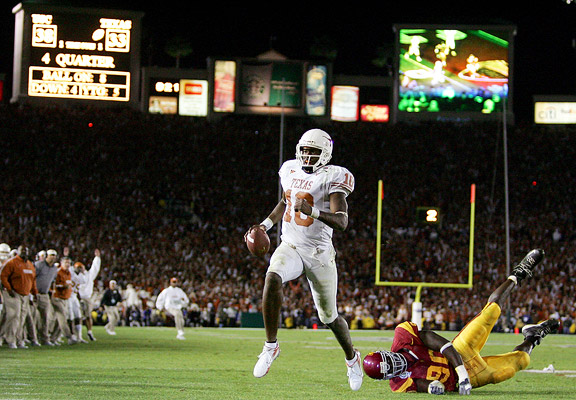
January 4, 2006, 20 years ago: The Rose Bowl game is held in the stadium of the same name, in the Los Angeles suburb of Pasadena, California.
Traditionally, the Rose Bowl features the Champions of the league currently known as the Pacific-12 (or Pac-12) Conference against those of the Big Ten Conference. But the drive to a Playoff to determine a true National Champion for college football has tweaked that: After 55 consecutive seasons, all on New Year's Day except for years in which January 1 fell on a Sunday, moving the game to January 2, with a Big 10 vs. PCC/AAWU/Pac-8/Pac-10 matchup, those leagues' newly-crowned titlists were not paired up in the Rose Bowl games of calendar years 2002, 2005, 2006, 2011, 2015, 2018 and 2021.
The shattering of the Pac-12 in 2023 ended the idea forever, especially with 4 of their teams joining the Big 10 -- although the Playoff system now in place made an Ohio State vs. Oregon Rose Bowl in the 2025 Quarterfinal possible. (Ohio State won.)
As I said, the 2006 game was one of them. True, the University of Southern California, winners of more titles in that league than any other team, winners of more Rose Bowls than any other team, and winners of more National Championships than any team in that league, had won the Pac-12 title again. And they had won the National Championship in each of the last 2 seasons, led by the last 2 Heisman Trophy winners, quarterback Matt Leinart and running back Reggie Bush. And they finished the regular season ranked Number 1 in every poll, including the Bowl Championship Series rankings.
But their opponents, the team that finished Number 2 in every poll, including the BCS, would not be the Big 10 Champions. That would be Pennsylvania State University, a.k.a. Penn State, who were ranked Number 3 in the BCS, and went on to win the Orange Bowl in Miami against Florida State University, the Atlantic Coast Conference Champions, on January 3.
No, the Number 2 team was the University of Texas. The most successful team in the since-concluded history of the Southwest Conference, they were now the Champions of the Big 12 Conference, formed in 1996 when half of the SWC teams were absorbed into the former Big Eight Conference. Texas was led by a spectacular quarterback, Vince Young, who could run and throw with equal aplomb.
Under head coach Pete Carroll, the USC Trojans had been Number 1, wire to wire, going 12-0. They had scored 70 at home to Arkansas, 66 at home to arch-rival and then-Number 11 UCLA, 63 away to Hawaii, 55 at home to Washington State, 51 away to Washington, 51 at home to Stanford, 50 at home to then-Number 16 Fresno State, 45 away to then-Number 24 Oregon, 42 at home to Arizona, 38 away to then-Number 14 Arizona State, 35 at home to the University of California, and 34 away to then-Number 9 Notre Dame. The Notre Dame game was a nationally-televised thriller, ending 34-31, and that was the only real close game the Trojans had all season.
Under head coach Mack Brown, the Texas Longhorns also came into the game 12-0, and were ranked Number 2 the entire season. The offense that Young led was every bit as impressive as USC's: They hung 66 on Kansas at home, 62 on Baylor University away, 60 on Louisiana-Lafayette at home, 52 on then-Number 10 Texas Tech at home, 51 on Rice at home, 51 on Missouri away, 47 on Oklahoma State away, 45 on Oklahoma on neutral ground in Dallas, 42 on then-Number 24 Colorado at home, and 40 on arch-rival Texas A&M away.
What's more, the Longhorns had a bigger win than USC did. On September 10, they traveled to Ohio State, then Number 4, and beat them 25-22. The Buckeyes were the only team that stayed within 10 points of Texas. In the Big 12 Championship Game in Houston, the 'Horns throttled Colorado, 70-3.
No question about it, if there was any team that could give USC a run for its money, it was Texas. USC had won 34 straight games. Texas had won 19 straight. Something had to give.
These were 2 of the titans of college football. USC had, to this point, won 35 Conference Championships. They also claimed 17 National Championships, but only 5 of these have been definitive under the current poll system, which has been in place since 1936: 1962, 1967, 1972, 2003 and 2004. (In 1978, the polls were split: UPI took USC, and the AP took Alabama.) Texas claimed 31 Conference Championships, and 8 National Championships, but only 1963 and 1969 were officially recognized by the NCAA.
This game was being hyped as "The Game of the Century," as had a few others in college football history. But this was the 21st Century, so there wasn't a previous game to live up to, unless you want to count Ohio State's dethroning of the University of Miami in the 2003 Fiesta Bowl.
A crowd of 93,988 crammed into the Rose Bowl stadium. An estimated 36 million more, making it the most-watched college football game ever, watched on ABC as Keith Jackson (who was calling his last game, and picked a great way to go out) and Pro Football Hall of Fame quarterback Dan Fouts, himself a Pac-8 veteran (University of Oregon), called the action. LeAnn Rimes sang the National Anthem.
Texas kicked off. USC couldn't do much on their opening possession. But they got the ball right back on a Texas fumble, and took a 7-0 lead to the end of the 1st quarter. Early in the 2nd quarter, Bush tried a lateral pass, but no one was there to receive it, and Texas recovered, leading to a field goal that made it 7-3.
A USC interception led to a Texas drive that ended in a lead-changing touchdown, although the extra point had been missed. Texas scored another touchdown, and USC added a field goal to make it 16-10 Texas at the half.
In the 3rd quarter, a USC drive ended with a LenDale White touchdown, and put the Trojans up 17-16. But Young led the 'Horns back, and scored himself, and Texas had a 23-17 lead. USC gambled on a 4th-and-1 from the Texas 12, and White scored again. That made it 24-23, and near the end of the 3rd quarter, Texas missed a field goal attempt.
Bush scored a touchdown early in the 4th quarter. The USC defense held Texas on their next possession, resulting in a field goal that made it 31-26 Trojans. USC scored again to make it 38-26 with 6 minutes and 42 seconds left, and it looked like they had done something no team had ever done: Win 3 straight NCAA Division I-A football championships.
Young refused to give up, leading a touchdown drive that made it 38-33 USC with 3:58 left. Now, it was the Longhorn defense's turn to be heroes, and they held USC to just 1 1st down. With 2:13 to go, USC faced 4th-and-2 at the Texas 45. Carroll decided to go for it. Leinart handed off to White, and he was held to 1 yard. (To the dismay of Seattle fans, this would not remain Carroll's greatest coaching blunder.) With 2:09 left, Texas needed to go 56 yards. (A field goal would only have made it 38-36.)
Young drove the Longhorns into Trojan territory. They got a big boost from a foolish face-mask penalty. They got to the 9-yard line, on 4th-and-5. A 1st down could have been gained without scoring a touchdown. The Longhorns went into their preferred formation, the shotgun. Young took the snap. His receivers were covered. He ran for the right sideline, got a key block from Justin Blalock, turned the corner, and dashed into the end zone with his 3rd rushing touchdown of the game. He got into the end zone again for the 2-point conversion. It was 41-38 Texas.
USC got the ball back with only 16 seconds left. It wasn't enough to for them to get into range for a tying field goal. Leinart only got them to the Texas 43. Had he time for 1 more play, a field goal from there would have been 60 yards.
But the clock had run out, and Texas were the undisputed National Champions for the 1st time in 36 years. The 2006 Rose Bowl, the 21st Century's 1st real Game of the Century, had lived up to the hype.
Soon, it would come out that USC had engaged in all kinds of recruiting violations. The NCAA vacated their last 2 wins of the 2004 season, all 12 in 2005, and both National Championships. They also revoked Bush's Heisman Trophy, the only time that has ever happened. The Trojans have since won the Pac-10 in 2006, '07 in '08, and the Pac-12 in 2017. But their mystique took a major hit. In 2024, USC became one of the Pac-12 teams that moved to the Big 10.
Texas won the Big 12 again in 2009. They advanced to the National Championship Game, but lost to Alabama. They won the Big 12 again in 2023, but lost the Sugar Bowl/Playoff Semifinal to the University of Washington. They had gotten into in roughly the same position as USC: Usually one of the better teams in the country, but not up to their previous standards. In 2024, Texas moved from the Big 12 to the Southeastern Conference.
Reggie Bush had a decent pro career, but Matt Leinart turned out to be an injury-plagued journeyman. Both went into network studio work. Vince Young saw his career damaged by poor management by his coaches and by his own struggles with mental illness. He now works for the University of Texas athletic department.
Of the coaches: Pete Carroll went on to win a Super Bowl with the Seattle Seahawks, joining Paul Brown, Jimmy Johnson and Barry Switzer as the only head coaches to win both a National Championship and a World Championship. But he will be forever remembered for his play-calling in the next year's Super Bowl, which cost the Seahawks back-to-back titles. Mack Brown, who had rebuilt the program at North Carolina before moving on to Texas, has gone back to North Carolina and done it again. He has now retired.


No comments:
Post a Comment