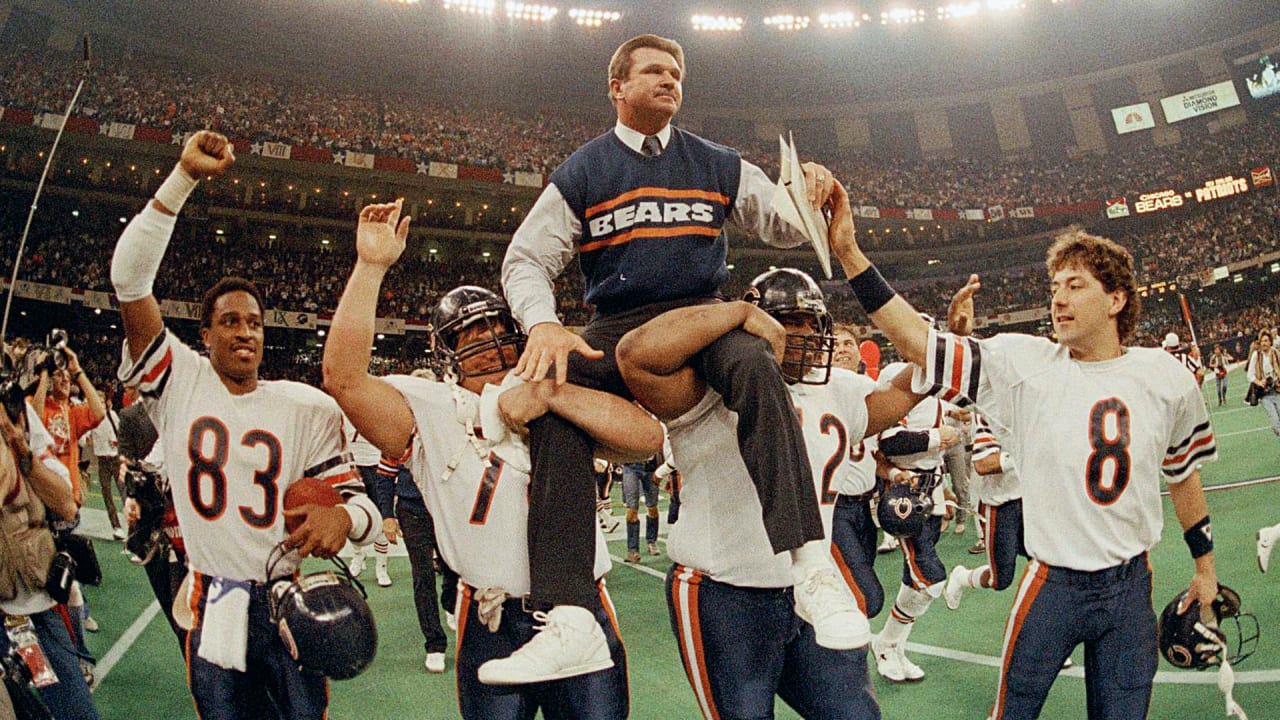
January 26, 1986, 40 years ago: Super Bowl XX is played at the Superdome in New Orleans. It was meant to be a coronation for the Chicago Bears, who had put together one of the greatest seasons in NFL history. All they had to do was outscore the New England Patriots for 60 minutes.
Just 1 minute and 19 seconds into the game, the Patriots took the lead. That wasn't in the script.
*
Let's go back to early 1982. George Halas, the 86-year-old founding owner of the Bears, fired head coach Neill Armstrong, no relation to the similarly-named first man on the Moon. The Bears' defensive players all signed a letter to Halas, asking that he keep Armstrong's defensive coordinator, James "Buddy" Ryan.
So when Halas made his last hire -- "Papa Bear" died on October 31, 1983 -- Ryan was the only holdover on the coaching staff. And he and the man Halas hired as head coach never got along.
That man was Mike Ditka. One of the earliest great tight ends in football history, the native of Aliquippa, Pennsylvania, a small steel-mill city outside Pittsburgh, had starred with the Bears, making 5 Pro Bowls and helping them win the 1963 NFL Championship -- or, if you prefer, "Super Bowl -III." He later played for the Dallas Cowboys, helping them win Super Bowl VI. Head coach Tom Landry made him assistant head coach, and the Cowboys, with both Landry and Ditka, won Super Bowl XII.
Ditka inherited a team with an already legendary running back, Walter Payton, but not much else. He and general manager Jerry Vainisi began to build a champion. In 1984, his 3rd season in charge, the Bears went 10-6, winning the NFC Central Division, their 1st 1st-place finish since 1963, and their 1st Playoff berth in 7 years.
They beat the Washington Redskins in the Divisional Playoff. But in the NFC Championship Game, not only did the San Francisco 49ers beat them 23-0, but they rubbed it in: Head coach Bill Walsh had guard Guy McIntyre play as a blocking running back. Ditka remembered that.
So the Bears began the 1985 season with this lineup:
* Offense. Quarterback: Jim McMahon. Running backs: Walter Payton and Matt Suhey. Receivers: Willie Gault and Dennis McKinnon. Line: Center Jay Hilgenberg, guards Mark Bortz and Tom Thayer, tackles Jim Covert and Keith Van Horne, and tight end Emery Moorehead.
* Defense. Line: Ends Dan Hampton and Richard Dent, and tackles Steve McMichael and William Perry. Linebackers: Mike Singletary, Otis Wilson and Wilber Marshall. Secondary: Cornerbacks Mike Richardson and Leslie Frazier, and safeties Gary Fencik and Dave Duerson.
* Special Teams: Placekicker Kevin Butler, punter Maury Buford, and whatever players had most impressed Ditka in practice. Ditka had been a great special teams player himself once, and had coached it in Dallas. He liked to say, "A man without fear belongs in an insane asylum. Or on special teams."
The Bears lost their 1st 3 preseason games, before winning the last. It didn't show during the regular season. The 1st 5 games were a home-and-home sweep of the Tampa Bay Buccaneers, a home win over the Patriots (20-7, which gave no indication as to how the season would end), a win away to the Minnesota Vikings, and a home win over the Redskins.
The next game was against the 49ers, at Candlestick Park in San Francisco on October 13. The 49ers were 3-2, having already lost 1 more game than in all of the previous season. Joe Montana may have been the greatest quarterback who ever lived, but the Bears sacked him 7 times. The Bears won, 26-10.
Late in the game, Ditka sent the rookie Perry in -- as a running back. With McIntyre the year before in mind, he even let Perry -- so fat and seemingly full of food, his nickname was "The Refrigerator" -- carry the ball twice, and he rushed for 4 yards. This had no real effect on the game, but Ditka had sent a message. (This would be the Bears' last win away to the 49ers for 29 years.)
The Perry experiment probably should have ended there: Ditka had made his point to Walsh. But Ditka wanted to make a point to Ryan as well: Contrary to what Ryan believed, Perry could play. And the next game, on October 21, on ABC's Monday Night Football, against the Green Bay Packers, the oldest arch-rivalry in the NFL, would have the entire country watching. (Theoretically, the oldest rivalry is between the Bears and the Arizona Cardinals, who played in Chicago from 1920 to 1959, but since the Cards left Chicago, the teams have cared little about each other.)
During what turned out to be a 23-7 victory, the Bears had a 1st and goal on the Packer 1-yard line. Ditka sent out a formation with Perry looking as though he was going to block for Payton, already the NFL's all-time leading rusher. Instead, McMahon handed the ball to Perry, and he broke through the Packer line to get into the end zone.
At 335 pounds, he became the heaviest player ever to score an offensive touchdown in the NFL. That is, there had been heavier defensive players who picked up a fumble and returned it, or recovered a fumble in the end zone. But Perry was the heaviest player who had been sent in for an offensive play to score a touchdown on said play.
The next week, the Bears beat the Vikings. Perry played, but did not appear on offense. The next week, on November 3, the Bears went to Lambeau Field for a rematch against the Packers. Perry was sent in for 1st and goal on the Packer 4, and moved out to become an eligible receiver. McMahon threw him the ball, and Perry took it in for a touchdown. It gave the Bears a 7-3 lead in a game they would win 16-10.
Now, the Bears were 9-0, and Perry had become a folk hero. He starred in a commercial for McDonald's, ordering 4 McDLTs, 2 large fries, and a Diet Coke. Yes, a Diet Coke, as if that would have made a difference. The tagline, over Perry's huge smile with one missing front tooth, was, "McDonald's: Where The Refrigerator stocks up."
The Bears beat the Detroit Lions at home, to go 10-0. The next week, with McMahon injured and Steve Fuller quarterbacking, the Bears went to Texas and beat the Dallas Cowboys 44-0. Perry rushed for 1 yard, but not a touchdown. The next week, they hosted the Atlanta Falcons, and Perry rushed for another 1-yard touchdown.
The 12-0 Bears' bid for an undefeated season was ruined the following week at the Orange Bowl, losing 38-24 to the Miami Dolphins, who in 1972 became the only undefeated Super Bowl Champions to this day. This remains the most-watched game in Monday Night Football history. Perry did not appear on offense.
Timing is everything: That game was played on December 2, the day before the scheduled release of a song and video the Bears, including Perry, Payton and McMahon, had recorded: "The Super Bowl Shuffle." It made the Bears, including "Fridge" (until the video, most people hadn't heard the shortened version of his nickname), bigger stars than any NFL team had ever been.
Their complacency shattered, the Bears went to work, winning their last 3 games to finish 15-1: Wins over the Indianapolis Colts at home, the New York Jets at the Meadowlands, and the Lions at the Pontiac Silverdome.
Perry was not sent in on offense again, but was proving to his critics, including Ryan, that he was a capable defensive lineman. He ended up starting 9 of the 16 regular-season games. He even recovered 2 fumbles and returned them for a total of 66 yards.
Having gone 15-1, the Bears had matched the previous year's 49ers for most wins in an NFL regular season. When the Dolphins went undefeated in 1972, it was a 14-game season. But there was still that 1 loss on their record. It wouldn't matter much, though, if they won the Super Bowl.
In the Divisional Round, their opponents were the NFC East Champions, the Giants. Bill Parcells' G-Men had their own devastating defense, led by Lawrence Taylor. But the game would be at Soldier Field, right on Lake Michigan, with a Winter wind blasting in. No problem for the Giants, right? Giants Stadium had a wind that swirled around, and they were used to cold and wind.
They were not used to the '85 Bears, or to their wind. Early in the game, Sean Landeta dropped the ball to punt, and the wind blew it so that it just sort of glanced off the side of his foot. It was a 5-yard punt, and Shaun Gayle was right there to pick it up and take it into the end zone. That touchdown, and Butler's point-after, were the only scoring in the 1st half, but the Giants were already dead. Two touchdown passes from McMahon to McKinnon made it 21-0, with the Giants having only 32 rushing yards. Phil Simms had been sacked 6 times for 60 yards.
Next was the NFC Championship Game, at home, against the NFC West Champions, the Los Angeles Rams. As a Southern California team (by this point, they were playing home games in Anaheim), the Rams were not used to cold weather. They had Eric Dickerson, who, the season before, had set a new NFL record for rushing yards in a season. The Bears limited him to 46 yards, and the Rams' offense as a whole to 130 yards. The Bears won, 24-0. For the 1st time since the NFL Championship Game became known as the Super Bowl, they were in it.
There was controversy. Ditka and Ryan were still feuding. At age 45 and 54, respectively, they should have been well past the need for the verbal equivalent of a dick-waving contest. Rumors were swirling that Ryan would get one of the inevitable head coaching vacancies in the NFL. McMahon was feuding with NFL Commissioner Pete Rozelle, over advertising on the headbands he wore under his helmet. And he was feuding with the media, over remarks he allegedly made over the personal lives of the women of New Orleans, site of the game.
But on Super Sunday, January 26, the Bears seemed to be set to be all business, against a Patriots team coached by Raymond Berry, the Hall of Fame receiver for the Baltimore Colts of the 1950s and '60s. The Pats had done something no other team had done in a single postseason: Win 3 Playoff games on the road. The Bears were favored by 10 points, an unusually high point spread, but the Pats looked like, at the least, they belonged on the same field as the franchise once, and again, known as "The Monsters of the Midway."
*
This game should have been the Bears' crowning achievement. It should have been Payton's crowning achievement, finally playing in the big game after 11 seasons. But he fumbled in the 1st minute of the game, and the Patriots shocked the football world by taking a 3-0 lead on a field goal by Tony Franklin. Remember: The Bears hadn't allowed so much as a point in their 1st 2 postseason games.
The Bears tied it on a Butler field goal. Figuring he was going to win the game anyway, Ditka went against his tough-guy "Iron Mike" image, and decided to get cute. At the Patriot 3-yard line, he sent Perry in. McMahon tossed the ball back to him, and Perry raised his arm for an option pass. NBC announcer Dick Enberg spoke for all of us when he said, with shock in his voice, "It's Perry, he's gonna throw the ball!"
But, never having done this in an actual game, the Fridge hesitated, couldn't find an open receiver, and had to run it himself, and was tackled for a 1-yard loss. The man who had become the biggest name on a defense that included future Hall-of-Famers Singletary, Hampton, Dent and McMichael, and All-Pros Marshall, Wilson, Duerson and Fencik, had become, for all intents and purposes, a sack victim. And the game was still tied, 3-3.
But, as with after the loss in Miami, the Bears woke up. They punished the Patriots. They humiliated them. (Keep in mind, Bill Belichick was then an assistant coach for the Giants, and Tom Brady was 8 years old. Neither of them could cheat to help the Pats.) Butler kicked a field goal, and, in the last minute of the 1st quarter, Suhey ran 11 yards for a touchdown. Chicago 13, New England 3.
Midway through the 2nd quarter, McMahon ran the ball himself, got flipped, and landed on his head. He was not immediately injured. A few plays later, with the ball on the Patriot 2-yard line, he lowered his head, got clobbered, and still took the ball in for a touchdown. On the last play of the 1st half, Butler kicked another field goal. Chicago 23, New England 3.
Midway through the 3rd quarter, McMahon got the ball to the Patriot 1. Instead of giving Payton the ball to give him his Super Bowl touchdown, McMahon took it in himself. A little over a minute later, with Berry having replaced starting quarterback Tony Eason -- who thus became the 1st starting quarterback in a Super Bowl to fail to complete a pass -- with the team's longtime former starter, Steve Grogan, Reggie Phillips intercepted a Grogan pass, returning it 28 yards for a touchdown.
It was 37-3 when Ditka sent Perry in again with the ball at the 1. Ditka could have had Perry block for Payton, to give "Sweetness" his Super Bowl touchdown. Instead, Ditka had McMahon hand the ball to Perry, who jumped over the line, and fell into the end zone. Touchdown. The Bears led, 44-3. With 3:48 left in the 3rd quarter.
With 13 minutes left, Grogan found some consolation, with an 8-yard touchdown pass to Irving Fryar. With 5:36 left, and the "46 Defense" replaced by their reserves, Henry Waechter sacked Grogan in the end zone, for a safety. The Patriots were limited to just 123 yards from scrimmage.
The game ended 46-10, and, for the 1st time in 22 seasons, the Chicago Bears were NFL Champions. Dent was named the game's Most Valuable Player. They could have given it to McMahon. At least they didn't give it to Perry: For the most part, he did his job, but giving him the MVP would have been a terrible example of pandering.
*
At the end of the game, before the Patriots' body was even cold, the resentments in the team began to show. The offensive players picked Ditka up and carried him off the field. They did so quickly, because they saw that the defensive players were running over to do the same for Ryan. And some players were bitter that Ditka chose to give Perry, not Payton, the greatest player in the Bears' proud history, the chance to score the last touchdown, or any touchdown. Payton carried the ball 22 times for 61 yards, but didn't get his touchdown.
The next day, the Bears got a championship parade in Chicago. They were also set to go to the White House, to be honored by President Ronald Reagan. But the day after the parade, the Space Shuttle Challenger blew up shortly after launch, killing all 7 astronauts aboard. The Bears' White House celebration was canceled.
Between the message the defense sent by carrying Ryan off the field, the complaints about Perry and Payton, and the inability to be honored by the President, the 1985 Chicago Bears, one of the greatest teams in football history, foreshadowed a scene from the 1988 baseball-themed movie Bull Durham: A kid is pitching well, and his veteran catcher criticizes him anyway. The pitcher asks, "Can't you just let me enjoy the moment?" And the catcher says, "Moment's over."
Sure enough, just 3 days after the Super Bowl, Ryan quit, and accepted an offer to become the head coach of the Philadelphia Eagles, where he failed to understand that he had Randall Cunningham, a man known as "the Ultimate Weapon," as his quarterback. He never saw another Super Bowl except on television.
Not having to deal with Ryan should have been the best thing that could have happened to both Ditka and Perry. It wasn't: The Bears were still one of the best teams in the NFL, but never again were they the best team.
They lost in the Divisional Playoffs in the 1986 and 1987 seasons, after which Payton retired. They lost in the NFC Championship Game (at home, to the 49ers) in 1988, missed the Playoffs in 1989, lost in the Divisional Round in 1990, lost in the Wild Card Round in 1991, and missed the Playoffs in 1992, at which point Ditka was fired. He had won 106 regular-season games, 6 Division titles, and 6 postseason games, but only 1 NFC Championship Game and 1 Super Bowl.
The Bears became the NFL equivalent of the New York Mets: All that talent in the 1980s, all those memorable characters, and all that hype, from both local and national media machines; and they ended up only going to their sport's final once, winning just the once. The Mets won their World Series 9 months after the Bears won their Super Bowl, and didn't learn the right lessons.
Not only did both franchises fail to win another title and eventually get broken up, but neither one has ever won another title. The Bears have only been to 1 more Super Bowl, the Mets to only 2 more World Series, all lost.
Still, the '85 Bears became not just a historic team, but an iconic one. They were mentioned in the 1987 film Planes, Trains and Automobiles. From 1991 to 1997, "The Chicago Superfans" was a sketch on Saturday Night Live, with beefy men copying Ditka's look -- caps with the Bears' "Wishbone C" logo, aviator sunglasses, and big bushy mustaches -- and raising their mugs of beer to toast "Da Bearssss!" (Once Michael Jordan started winning titles, "Da Bullssss!" was added to the sketch.) And Chicago native Michael Wilbon frequently drops mentions of the team as co-host of ESPN's Pardon the Interruption.
Singletary later served as head coach of the 49ers, Frazier of the Vikings, backup safety Jeff Fisher took the Tennessee Titans to Super Bowl XXXIV, and backup linebacker Ron Rivera took the Carolina Panthers to Super Bowl 50.
In 2011, on the 25th Anniversary of their win, President Barack Obama, who's lived his adult life in Chicago (but was in the opposing metropolitan area, attending Harvard Law School, when that Super Bowl was played), decided to give the '85 Bears the White House visit they never got from Illinois native and former small-college football player Reagan.
But not all was well. Those Bears suffered for their profession, suffered for their art. Payton, who was both one of the most graceful, and one of the toughest, players of his generation, died of liver disease in 1999. Duerson killed himself in 2011, a few months before the White House visit. He wanted his brain donated to science, to see if his struggles in retirement were caused by brain damage, caused by football. It was determined that they were. McMahon has reported memory issues, and believes he also has CTE. Given some of Ditka's statements the last few years, people have wondered about him, too. And McMichael developed amyotrophic lateral sclerosis, the paralytic condition known as Lou Gehrig's disease. (He lived just long enough to see himself elected to the Pro Football Hall of Fame.)
Yes, this Bears team was a lot of fun. But beneath the level of fun was trouble that we never saw coming. And, unlike a lot of troublesome football teams of that era and since, it had little to do with steroids, stickum, or (despite having Ryan as defensive coordinator) "bounties."
There's one other thing to note: The Bears' cheerleaders, the Honey Bears, had their contract run out after that Super Bowl. Team owner Virginia Halas McCaskey, who inherited the team from her father, chose not to negotiate a new one. She didn't like the idea of cheerleaders. The Bears haven't had them since. The Bears have been to just one Super Bowl since, and lost it.
In 2026, not having won the title in 40 years, just once in 64 years, the Bears are 1 of the last 8 teams standing. We shall see.


No comments:
Post a Comment