Friday, October 31, 2025

October 31, 2015: Horse Racing's 1st "Grand Slam"

October 31, 2015, 10 years ago: American Pharoah wins the Breeders' Cup Classic, the highlight of the annual Breeders' Cup meet, held this year at Keeneland Race Course in Lexington, Kentucky.

On May 2, 2015, at Churchill Downs in Louisville, Kentucky, at 3-1 odds, American Pharoah won the Kentucky Derby, in 2 minutes, 3.02 seconds, by 1 length over Firing Line. Two weeks later, on May 16, at Pimlico Race Course in Baltimore, at 9-10 odds, he won the Preakness Stakes, in 1 minute, 58.46 seconds, by 7 lengths over Tale of Verve.

Since Affirmed won the Triple Crown in 1978, there had been several near-misses, horses winning the Derby and the Preakness, but not the Belmont Stakes, the mile-and-a-half "True Test of Champions." Spectacular Bid had failed in 1979, Pleasant Colony in 1981, Alysheba in 1987, Sunday Silence in 1989, Silver Charm by 3/4 of a length in 1997, Real Quiet in a photo finish in 1998, Charismatic due to an in-race injury in 1999, War Emblem in 2002, Funny Cide in 2003, Smarty Jones by 1 length in 2004, Big Brown due to an in-race injury in 2008, I'll Have Another scratched from the Belmont due to an injury in 2012, and California Chrome due to an in-race injury in 2014. Racing fans were wondering if they would ever see another winner.

On June 6, American Pharoah was loaded into the paddock at Belmont Park in Elmont, Long Island, New York, just over the City Line from Queens, at odds of 3-4. There was no injury, no fade, and not even any drama: He won by 5 1/2 lengths over Frosted, in a time of 2 minutes, 26.65 seconds.

The idea for the Breeders' Cup was proposed at the 1982 awards luncheon for the Kentucky Derby Festival by pet food heir John R. Gaines, a leading Thoroughbred owner and breeder who wanted to clean up the sport's image.

The event was created as a year-end championship for North American thoroughbred racing, and also attracts top horses from other parts of the world, especially Europe. The Cup was initially faced with much skepticism in the racing community, but with the vocal support of legendary trainer John Nerud and others, the event was carried out for the 1st time in 1984, and subsequently experienced tremendous popularity domestically and abroad.

The feature race is the Breeders' Cup Classic, a mile and a quarter like the Kentucky Derby. Usually, it is won by a horse that has won at least 1 of the Triple Crown races, although the 1st winner, Wild Again, didn't even enter any of those races, but held off 1983 Three-Year-Old Male Champion Slew o' Gold and 1984 Preakness winner Gate Dancer at Hollywood Park outside Los Angeles.

American Pharoah was the 1st Triple Crown winner to whom the Classic was available. On Halloween, October 31, 2015, at Keeneland in Lexington, Kentucky -- practically home soil -- he won by 5 1/2 lengths, in 2 minutes, 0.07 seconds, by 6 1/2 lengths over Effinex. Thus, he became the 1st winner of an American thoroughbred racing "Grand Slam." Through the 2025 Classic -- taking place tomorrow, but with no Triple Crown winner -- he remains the only one.

It was his last race. Unlike many 3-year-old champions, he did not have a money-making 4-year-old season, and was immediately retired to stud. As of October 31, 2025, American Pharoah stands at Ashford Stud farm in Kentucky. Most of his descendants who have gone on to race have done so outside the United States, winning races in Britain, Europe and Australia.

October 31, 1950: The NBA's 1st Black Player

Earl Lloyd

October 31, 1950, 75 years ago: The Rochester Royals defeat the Washington Capitols, 78-70, at the Edgerton Park Arena in Rochester. (It was demolished in the late 1950s.) Arnie Risen scores 20 for the home team, as they begin a season that will bring their 1st NBA Championship.

They had previously won the title in the National Basketball League in 1945. They will become the Cincinnati Royals in 1957, the Kansas City Kings in 1972, and the Sacramento Kings in 1985. Their long-term future in Sacramento is now settled, as they've opened a new arena.


Earl Lloyd, a forward wearing Number 11, scores 2 baskets and 2 free throws for the Capitols, for a total of 6 points. It doesn't sound like much, but his mere presence in the game makes him the NBA's 1st black player.
Chuck Cooper had been the 1st black player drafted, by the Boston Celtics. But, the way the schedule worked out, Earl beat him to the court by 1 day. Chuck should not be confused with another early black star, Charles "Tarzan" Cooper, who played for the New York Renaissance (a.k.a. the Rens) in the 1930s. 
Chuck Cooper
Nat "Sweetwater" Clifton, formerly of the Rens and the Harlem Globetrotters, had been the 1st black player actually signed to a contract, by the New York Knicks, but Earl beat him to the court by 4 days. So, in a way, the NBA had 3 "Jackie Robinsons."
Nat Clifton

Earl Lloyd was born on April 3, 1928 in Alexandria, Virginia, across the Potomac River from Washington, D.C. His hometown team, having fired coach Red Auerbach in 1949, was 10-25 on January 9, 1951, and folded, leaving the nation's capital without an NBA team for the next 22 years. Lloyd was then drafted, and served in the Korean War.

Discharged in 1952, "the Big Cat" (also the nickname of Baseball Hall-of-Famer Johnny Mize, then wrapping up his career with the Yankees) played for the Syracuse Nationals until 1958, and the Detroit Pistons from then until his retirement in 1960. He averaged 8.4 points per game in his 9 NBA seasons. The Pistons then hired him as a scout.
In 1968, they named him the 1st black assistant coach in the NBA. In 1972, they named him the 2nd black head coach, after Bill Russell of the Celtics, and the 1st non-playing black head coach. But the Pistons were awful then, and his career coaching record was just 22-55.
He worked for the Detroit school system, helping students find jobs, then did the same thing for a company run by Pistons Hall-of-Famer Dave Bing. He retired to Tennessee. In 2003, the Basketball Hall of Fame elected him as a "contributor," for his historical prominence.
In 2007, T.C. Williams High School, the integrated Alexandria school into which his former all-black school, Parker-Gray, had been consolidated (a tale told, with considerable dramatic license taken, in the football-themed film Remember the Titans), named their new gym's court after him. He was also elected to the Virginia Sports Hall of Fame, and died on February 26, 2015, a few weeks short of his 87th birthday.

Thursday, October 30, 2025

October 30, 1995: The Close Call of the Quebec Referendum

Prime Minister Jean Chrétien, leading the "Non" side

October 30, 1995, 30 years ago: The Quebec sovereignty referendum fails by a razor-thin margin, with 2,362,648 people, or 50.58 percent, voting "Non"; and 2,308360, or 49.42 percent, voting "Oui."
The number of "spoiled ballots," unusable for whatever reason, is said to be greater than the margin of victory. Nevertheless, it is a win not for Quebec nationalism, but Canadian nationalism, and for Prime Minister Jean Chrétien, who, though a Francophone from Quebec, wanted the Province to stay.
Despite the anger of the separatists, angry over their perception of victimization at the hands of the federal government in Ottawa and the English-speaking establishment – an absolutely ridiculous notion, since the Provincial government has been dominated by the ethnic and linguistic French for most of the last 100 years – the Province will remain a part of Canada, but there is still bitterness on both sides.
The Parti Québécois, dedicated to the Province's independence, held the Provincial government from 1976 to 1985, and lost a referendum in 1980, 60 percent to 40. They held the government again from 1994 to 2003, launching the nearly successful 2nd referendum. After launching the referendum and failing, Jacques Parizeau resigned as Premier and as PQ Leader. He died in 2015.
The PQ held a minority government from 2012 to 2014, and knew they couldn't get a 3rd referendum to pass, so they didn't launch one.
Splits in the party, including defections to new parties on both the left and the right, have dropped the PQ, or "Péquistes," to a mere 7 seats in the 125-seat National Assembly. The current government is led by the conservative Coalition Avenir Québec, and its Leader, Premier François Legault, has said that there will never be a sovereignty referendum launched by his party.
It's just as well: Would you be the one who has to tell the Montreal Canadiens, the greatest cultural institution in Quebec, that they had to change their name? 

Tuesday, October 28, 2025

October 28, 1995: The South Rises In the World Series

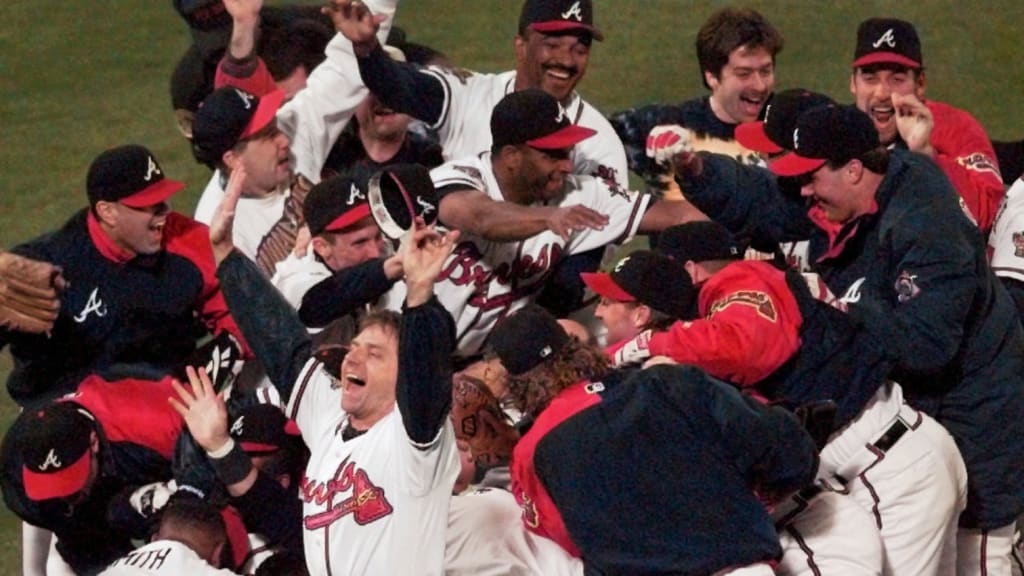
October 28, 1995, 30 years ago: The Atlanta Braves win Game 6 of the World Series, beating the Cleveland Indians, 1-0‚ on a combined 1-hitter by Tom Glavine and Mark Wohlers.

David Justice's 6th-inning home run accounts for the game's only run. Having noticed that Cleveland's Jacobs Field (renamed Progressive Field in 2007) seemed a lot louder in Games 3, 4 and 5 than Atlanta-Fulton County Stadium had in Games 1 and 2, Justice called on the Braves' fans to be louder for Game 6. They were, especially when he hit his homer.
Catcher Tony Peña's leadoff single in the 6th was Cleveland's only hit. The Indians, who won 100 games in the strike-shortened 144-game season, and won their 1st American League Pennant in 41 years, led the majors in homers and runs scored. But in this Series, they batted just .179‚ the lowest average for a 6-games series since 1911.

This was the 1st time that two of the "Big Four" sports' titles were held by Southern teams. The Houston Rockets had won the NBA title in June.

In winning‚ the Braves become the 1st team to win World Championships representing 3 different cities: Boston in 1914‚ Milwaukee in 1957‚ and Atlanta in 1995. It was their 30th season in Atlanta, and despite having had such talents as Hank Aaron, Phil Niekro and Dale Murphy, they mostly struggled through their 1st 25 years, winning Division titles in 1969 and 1982.

They won the National League Pennant in 1991 and 1992, but lost the World Series both times. They lost the NL Championship Series in 1993, and the 1994 season was cut short by a strike. In 1995, they won it all, led by their pitching "Big Three": Glavine went 16-7, Greg Maddux went 19-2, and John Smoltz went 16-7. Justice, Fred McGriff, Chipper Jones, Ryan Klesko and Javy López led the attack. And so, the Braves became the 1st team from a former Confederate State to win a World Series.

How key for the Braves was Justice? The following season, the Braves won the Pennant again, but he was injured for the World Series, and they lost it to the New York Yankees. Foolishly, the Braves let him go, to the Indians, and he helped them win the Pennant in 1997. He later helped the Yankees win the AL Pennant in 2000 (winning the World Series) and 2001 (losing it). Although he fell short of career stats for the Baseball Hall of Fame -- 1,571 hits, 305 of them home rums -- he was one of the top clutch performers of his era.

Monday, October 27, 2025

Nick Mangold, 1984-2025

I am not a fan of the New York Jets, but yesterday was a big day for them, for reasons both good and bad.

The bad was the loss of one of their all-time greats.

Nicholas Alan Mangold was born on January 13, 1984 in Centreville, Ohio, outside Dayton. He went to Archbishop Alter High School in Kettering. Other notable alumni include basketball stars John and Jim Paxson, and David Bradley, inventor of the keyboard combination Control-Alt-Delete. He went to Ohio State University, and missed their 2002 National Championship season as a redshirt, but helped them win the Big Ten Conference title as a senior in 2005.

Center might be the least glamorous position on the football field, even though it's literally in contact with the most glamourous, quarterback. He was rated the best center in the 2006 NFL Draft, and the Jets became the 1st team in 31 years to choose 2 offensive linemen in the 1st Round: Tackle D'Brickashaw Ferguson with the 28th pick, and Mangold with the 29th.

The Jets had cut Kevin Mawae, who was headed to the Pro Football Hall of Fame, but was 35. He ended up making 2 more Pro Bowls with the Tennessee Titans. Instead of this turning out to be a typically boneheaded Jets move, Mangold made sure they didn't miss him, making 7 Pro Bowls in his 11 seasons.

He anchored a line that included Alan Faneca and Brandon Moore as guards, and Ferguson and Damien Woody as tackles. Blocking for quarterback Mark Sanchez and running back Thomas Jones, they helped the Jets reach the AFC Championship Game in the 2009 and '10 seasons, although they were unable to take the next step and win those games and reach a Super Bowl.

An ankle injury late in the 2016 season led the Jets to cut Mangold. After sitting out the 2017 season, he signed a one-day contract in 2018, and retired as a Jet.

He married his high school girlfriend, Jennifer Richmond, and had 4 children, settling in Madison, Morris County, New Jersey, not far from the Jets' practice facility in East Hanover. He coached youth football, and was involved with local charities. The Jets inducted him into their Ring of Honor in 2022.

Although he has been eligible for the Pro Football Hall of Fame since that year, he has not been elected. That is not surprising: Offensive linemen often get short shrift, due to the lack of available statistics by which to measure them. Only 13 centers have been elected, and 5 of those were from the era when players played on both offense and defense. Only 3 centers have been elected since the dawn of the 21st Century: Mawae, Mick Tinglehoff of the 1970s Minnesota Vikings, and Dermontti Dawson of the 1990s Pittsburgh Steelers.

Mangold was diagnosed with chronic kidney disease in 2006, his rookie season, and played his entire career while dealing with it. It took his life on Saturday, October 25, 2025, at the age of 41.

Yesterday, the news got around the NFL, and reached the Jets, who hadn't won a game all season, their 1st under new head coach Aaron Glenn, who had played 8 seasons as a cornerback for them, including 1998 when they reached the AFC Championship Game, although he was gone by the time Mangold arrived.
The Jets were 0-7, but were more frustrating than pathetic. They'd opened the season by losing 34-32 at home to the Pittsburgh Steelers. They'd lost 29-27 away to the Tampa Bay Buccaneers. They'd lost 27-21 away to the Miami Dolphins. They'd lost 13-11 to the Denver Broncos at the Tottenham Hotspur Stadium in London. (Jokes comparing them to Tottenham, a.k.a. Spurs, and that the Jets were "Spursy," were easy.) And they lost 13-6 at home to the Carolina Panthers. They'd lost 4 games by a total of 17 points.

Finally, yesterday, against the Cincinnati Bengals at Paycor Stadium (formerly Paul Brown Stadium) in Cincinnati, they put it all together. They fell behind 10-0 in the 1st quarter, and were down 31-16 after 3 quarters. But they scored 23 points in the 4th quarter, including an option pass from Breece Hall to Mason Taylor with 1:54 to go, and a final defensive stop, to win the game, 39-38. Hall had also rushed for 2 touchdowns, and quarterback Justin Fields threw for 244 yards an a touchdown, with no interceptions.

The New York Giants weren't so lucky. Having dealt their geographical rivals, the defending World Champion Philadelphia Eagles, their 1st loss of the season, they had a chance to sweep them for the 1st time since the 2007 season, a Super Bowl-winning season.

But the Eagles, having recovered nicely from a 2-game slump that began with that loss to the Giants, had had enough of that, and again punished the Giants for their willingness to give up on Saquon Barkley, who ran for 150 yards, including a touchdown, and the Eagles won, 38-20. It was a typical Jalen Hurts game: The Eagles' "QB1" completed 15 of 20 passes, playing it smart instead of spectacular. The Eagles are now 51-22 with Hurts as a starter.

The Giants are now 2-6 under head coach Brian Daboll. They have improved, going 2-1 in the 1st 3 games started at quarterback by Jaxson Dart, but have lost their last 2. And the awful ankle injury to running back Cam Skattebo, likely rendering him out for the season, will only make things worse, especially given that he's been described as Dart's best friend on the team.

New York's NFL teams have been as collectively bad as they've ever been, and, unless Glenn can use yesterday's win as a springboard for recovery, it looks like this will continue for some time.

Sunday, October 26, 2025

October 26, 2005: A World Series Won by Chicago

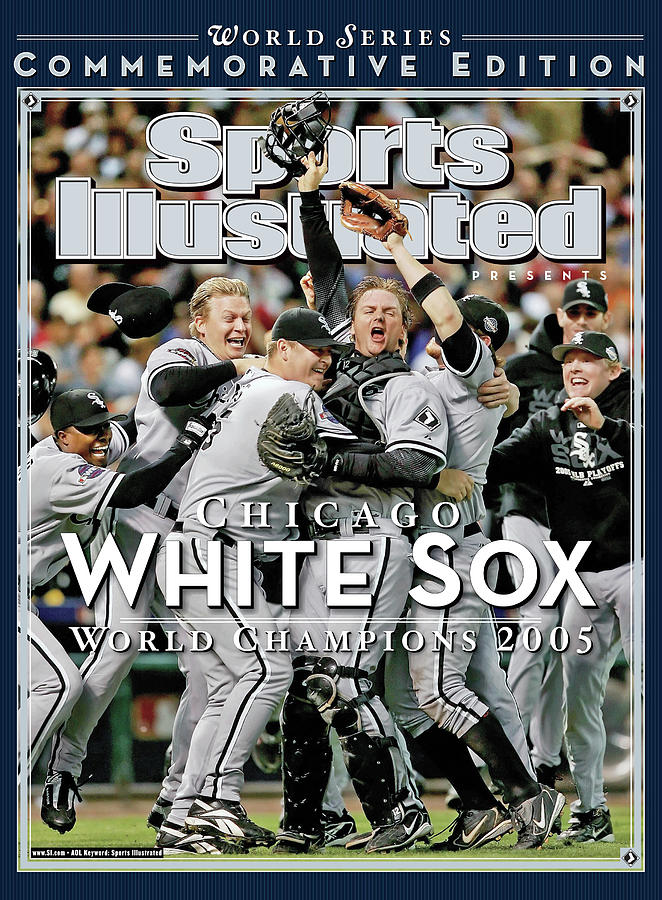
October 26, 2005, 20 years ago: The Chicago White Sox shut out the Houston Astros‚ 1-0 at Minute Maid Park (now Daikin Park) in Houston‚ to sweep the World Series, and win their 1st World Championship since 1917, 88 years earlier. It is the 1st World Series win for either Chicago team in that time.

The White Sox won the 1st American League Pennant, in 1901. They won the 1st intracity World Series, beating the Chicago Cubs in 1906. They won the World Series in 1917. Then they lost the World Series in 1919. The following year, it got out that 7 players on the team had "thrown" the Series, to get money from gamblers, since team owner Charlie Comiskey was underpaying them. It took 40 years to win another Pennant, as "The Go-Go White Sox" did it in 1959.

Over the years, the South Siders had some close calls. They missed the Pennant by 1 game in 1964, and 3 games in 1967. They missed the AL Western Division title by 5 1/2 games in 1972, and led the Division as late as August 8 in 1977, before drifting to 12 games back. They won the Division in 1983, but lost the AL Championship Series to the Baltimore Orioles. In 1990, the last season at the old Comiskey Park, they stayed close to the Oakland Athletics most of the season, before 9 back.

In 1993, they won the AL West, but lost the ALCS to the Toronto Blue Jays. In 1994, they led the newly-created AL Central Division when the Strike hit. In 2000, they won the Division, but lost the AL Division Series to the Seattle Mariners.

And so their drought after 1959 turned out to be longer than the one they had from 1919 to 1959. What's more, the crosstown Cubs, who hadn't won a Pennant since 1945 and the World Series since 1908, and the Boston Red Sox, who hadn't won the World Series since 1918 -- one year more recently than the White Sox -- were celebrated for their seemingly "cursed" close calls. The White Sox? They didn't have a litany of bizarre incidents down the years that could seemingly be ascribed to a curse. They just... lost.

And with the Cubs having gotten the WGN Superstation to broadcast their games, and the White Sox not, and the Cubs and the Red Sox both having literati write lots of books about their woe-is-us status, it was as if the baseball world didn't care that the White Sox hadn't won the World Series for longer than the Red Sox. Even when the Red Sox finally won it in 2004 *, the attention that was on them didn't shift to the White Sox. If anything, the Cubs got even more.

Finally, the Pale Hose won the AL Central Division again in 2005. They swept the defending World Champion * Red Sox in 3 straight games in the AL Division Series. They lost Game 1 of the AL Championship Series to the team then known as the Los Angeles Angels of Anaheim, and looked likely to lose Game 2 before a controversial call led to the winning run in the bottom of the 9th.

They never lost another game, tying the 1999 New York Yankees' record for best postseason record in the 1995-present Division Series Era, 11-1. On October 16, trailing Game 5, 3-2 after 6 innings, they won, 6-3, to win the Pennant for the 1st time in 46 years and 24 days.

The White Sox hadn't won the World Series in 88 years. The Houston Astros were in it for the 1st time in their 44 seasons of play. Something had to give. Baseball fans can look at a written record of what happened, and figure that the White Sox had it easy. That was far from the case.

Each team's manager had previously played for them. Ozzie Guillén, like Luis Aparicio and Chico Carrasquel before him, had come from Venezuela to play shortstop for the White Sox, made the move from the old Comiskey Park to the new one in 1990 (the stadium was renamed U.S. Cellular Field in 2003, and would be renamed Guaranteed Rate Field in 2016 and Rate Field in 2025), and was a member of their Playoff team of 1993. He won a Pennant with the Atlanta Braves in 1999.

As a player, Guillén was a slick fielder and a 3-time All-Star, who could run well and hit a little. There was little to suggest that he would one day become a successful manager, and even less to suggest the wild personality that would one day become known.

Phil Garner was a 2nd baseman who, like Guillén, made 3 All-Star Games. He won the World Series with the Oakland Athletics in 1973 and 1974, and with the Pittsburgh Pirates in 1979, before helping the Astros win the NL West title in 1986. Despite the nickname "Scrap Iron," he was not as argumentative, or as controversial, as Guillén.

The White Sox won Game 1 at U.S. Cellular Field, 5-3. Game 2, also at home, was a wild one, before Scott Podsednik hit a home run in the bottom of the 9th to win it. Game 3, at Minute Maid Park in Houston, went 14 innings, tying what was then a World Series record. Geoff Blum, a once-and-future Astro, and now a broadcaster for them, hit a home run for the White Sox in the top of the 14th inning, putting them 1 win away from the title.

Game 4 was played in Houston. Freddy Garcia, formerly the ace of the Seattle Mariners, started for the White Sox, Brandon Backe for the Astros, and both pitched 7 shutout innings, dispatching major threats along the way.

But Garner made a mistake, bringing closer Brad Lidge in for the 8th inning. Willie Harris singled off him, and was moved over by a bunt from Podsednik and a groundout by Carl Everett. Jermaine Dye singled Harris home, and was be named the Series' Most Valuable Player.

The Astros threatened in the bottom of the 8th, but ChiSox reliever Neal Cotts got out of it. For the 9th, Guillén brought in Bobby Jenks, the closer he called "The Big Boy." He allowed a single to Jason Lane, who was bunted over by Brad Ausmus. Chris Burke came up: His 18th-inning home run clinched the Division Series for the Astros, so there was concern. He hit a foul pop-up, of which Juan Uribe made a great catch for the 2nd out.

Orlando Palmeiro grounded to Uribe, who made another great play, and the ball just barely hit the glove of 1st baseman Paul Konerko in time. It was 11:01 PM Central Time on October 26, 2005 -- 12:01 AM Eastern on October 27 -- and, for the 1st time in 88 years and 9 days, the World Championship of baseball belonged to a team based in Chicago.

In Chicago in the interim:

* The NFL had been founded, the Bears had won 9 NFL Championships, including a Super Bowl; and the Cardinals had won 2 Championships, and moved to St. Louis, and then to Phoenix.

* The NBA had been founded, 2 Chicago-based teams and a few other professional basketball teams had failed, before the Bulls began play, eventually winning 6 NBA Championships in 8 years; DePaul University had won the NIT, when that was still considered college basketball's National Championship, and Loyola University had won an NCAA Tournament, and (7 months earlier) the University of Illinois had reached an NCAA Final.

* The NHL had been founded, and the Blackhawks had won 3 Stanley Cups; while the World Hockey Association had run its course, including the Chicago Cougars having reached but lost a Finals.

* The North American Soccer League had gone through its entire existence, with the Chicago Sting winning 2 titles, including the last; and Major League Soccer had been founded, with the Fire winning an MLS Cup and a U.S. Open Cup in the same year, "doing the Double."

* And the original Soldier Field, the Chicago Stadium, and the International Amphitheatre had all been built, hosted all kinds of events, and been torn down and replaced by new buildings.

In the world at large: Radio broadcasting, television, photocopiers, computers, the Internet and smart phones had all been invented. Penicillin had been synthesized, the polio vaccine had been created, smallpox had been eradicated, AIDS had developed and treatments for it had been created, and it had become possible to transplant major organs. Humanity had developed rockets, been to the Moon, and had sent unmanned probes to all 7 of the other bodies then officially classified as "planets."

And there had been 8 Popes, 16 Presidents and 11 Mayors of Chicago, 2 of them (including the incumbent) named Richard Daley and living within walking distance of the home of the White Sox.

A Chicago team had won the World Series. And it wasn't the Cubs. Still, the Cubs had better attendance over the next few years. And when the Cubs finally won it all again in 2016, it was celebrated as a great moment for Chicago and environs, and White Sox fans were all, "Uh, hello? We did it first!"

Guillén had become the 1st foreign-born manager to win a World Series. The Astros would not win another Pennant until 2017, finally winning a World Series -- dubiously, as it turned out.

October 26, 2000: Yankees Have Scoreboard for All Time

Note: I wrote this on the 20th Anniversary. Today is the 25th Anniversary, and I'm posting it again, with some updates. It's my blog. I can do that.

Has it really been 25 years since the Subway Series?

Remember: It's not a "Subway Series" unless it's a World Series. Nobody ever called regular-season games between the New York Giants and the Brooklyn Dodgers a "Subway Series."

There had been exhibition games between the Yankees and the Mets from the Mets' 1962 debut onward. There had been preseason games, and the midseason "Mayor's Trophy" games. But they didn't count. Met fans thought they did. They didn't. In 1997, Interleague Play began, and the New York media called it a "Subway Series," but who was kidding who?

The 1985 season was the 1st time the Yankees and the Mets both stayed in their Divisional races until the last week of the regular season. The 1999 season was the 1st time that both made the Playoffs. Lots of people in New York, New Jersey and Connecticut were sure that was going to be it. The Yankees held up their end of the bargain. The Mets didn't hold theirs up.

Now, after 39 years of hoping, wishing, praying for a chance to beat the Yankees in a World Series, Met fans finally had that chance. And they were sure they were going to win it.

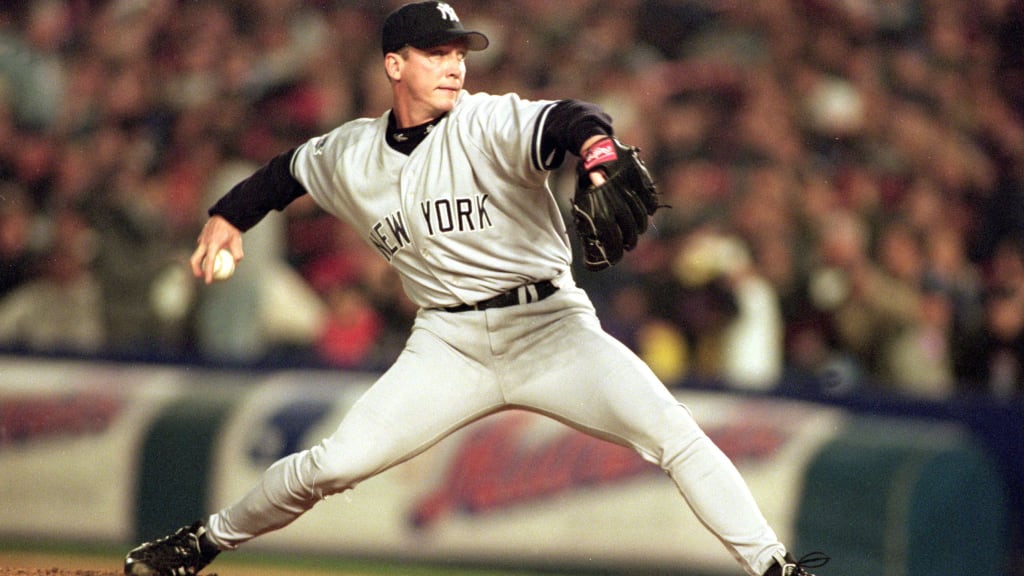
After all, Al Leiter was going to start Games 1 and 5, and Mike Hampton was going to start Games 2 and 6. And, as everybody knows, "The Yankees can't hit lefthanded pitching. Especially in the postseason." I guess Met fans, the Flushing Heathen, hadn't noticed how the Yankees beat all pitchers, left and right alike, in winning the Series in 1996, '98 and '99, and winning another Pennant to put them in this Series.

Still, Met fans always wanted this chance. In the immortal words of Leonard Nimoy -- who, being a Bostonian, probably knew just how illogical baseball can be -- "You may find that having is not so pleasing a thing, after all, as wanting."

*

October 21, 2000: Game 1 of the 1st Subway Series since 1956 is played at the original Yankee Stadium. Billy Joel, who was the first singer to sell out the Stadium, and later played the last concert at Shea, sang the National Anthem. Don Larsen threw out the ceremonial first ball to Yogi Berra, evoking memories of that 1956 Series, when the Yankees beat the Brooklyn Dodgers, including Larsen's perfect game in Game 5, and Yogi's 2 homers in Game 7.

Game 1 of the 2000 World Series came on the 25th Anniversary of the Carlton Fisk Game, and on the 20th Anniversary of the Philadelphia Phillies' 1st World Series win. It turns out to be, quite possibly, the greatest game I've ever seen. At the least, it was the most nerve-wracking game I've ever seen.

(Note: I realize I'm going back and forth between using present tense and past tense. As I've already alluded to, baseball is often illogical, and so is writing.)

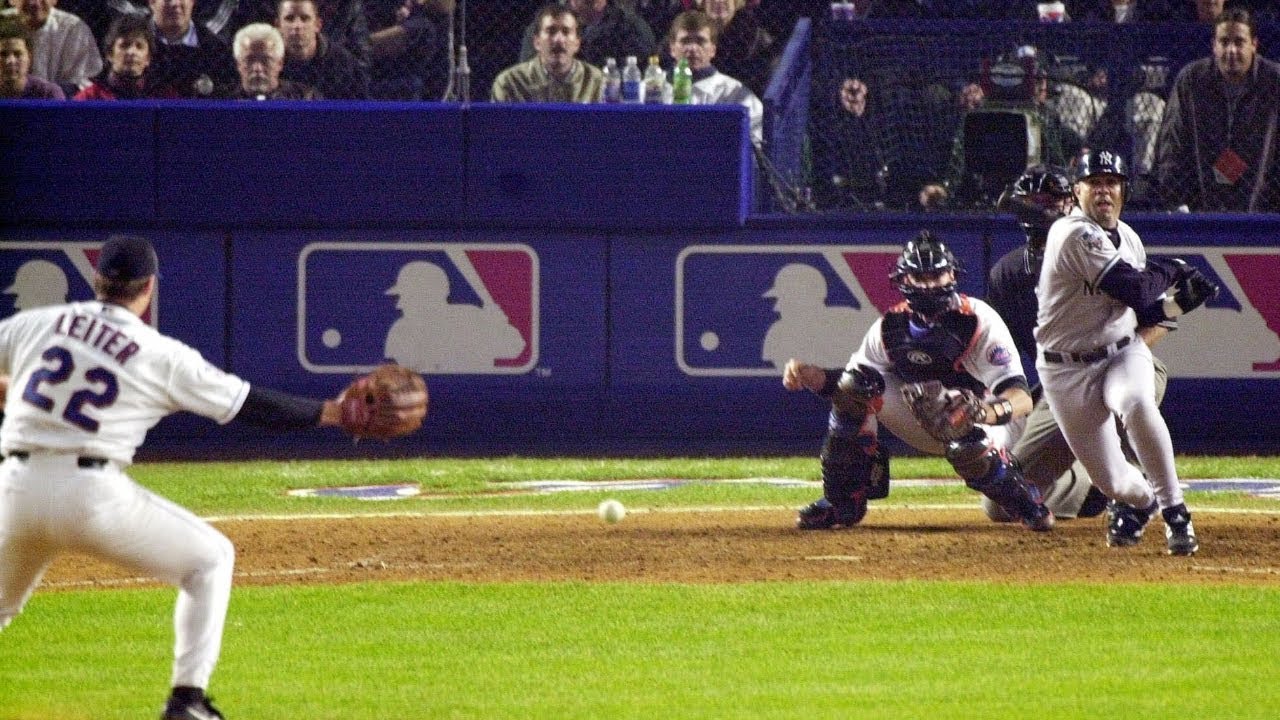
Leiter outpitches Andy Pettitte, but 4 baserunning blunders by the Mets leave the score 3-2 in the Mets' favor entering the bottom of the 9th. Still, to be able to take Game 1 at Yankee Stadium would be a huge boost to the Mets.

Manager Bobby Valentine brings in his closer. Unfortunately for him, it's Armando BenítezPaul O’Neill fouls off pitch after pitch, and finally draws the most clutch walk in baseball history. The Yankees bring him around to score on DH Chuck Knoblauch's sacrifice fly, and the game goes into extra innings.

It goes to the bottom of the 12th, and to 1:04 AM. With 1 out, Tino Martinez singles off Turk Wendell. Jorge Posada doubles, but Tino doesn't run well, and has to hold at 3rd. O'Neill is walked again, this time intentionally, to set up the double play. Luis Sojo pops up. And a Met castoff, José Vizcaino, playing 2nd base because Knoblauch is not fielding well, singles home the winning run.

José Vizcaino

Yankees 4, Mets 3. Essentially, the World Series that Met fans had waited their whole lives for has been decided in Game 1. Had the Mets won this game, the Series would have been very, very different.

Maybe the Yankees would have been shaken by the events of Game 1, and instead of just holding the Mets off in Game 2, 6-5, they would have fully blown that lead. The Mets won Game 3, and their idiot fans would have been thinking sweep.

Would the Yankees still have won Game 4? It was pretty shaky in the 5th inning. Would they still have won Game 5? It was tied in the 9th. Would they have won a Game 6? Would they have completed the ultimate comeback in Game 7, 4 years before the Red Sox did it to them?

*

October 22, 2000: Game 2 is one of the most bizarre contests in baseball history. It begins with Robert Merrill, the Brooklyn-born singer for the Metropolitan Opera Company whose recording of "The Star-Spangled Banner" had been the one the Yankees had used since 1967, singing it in person. (He died in 2004.) 

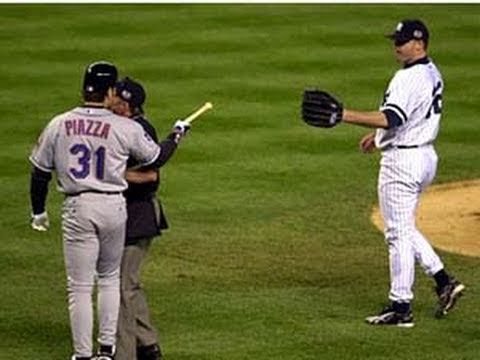
In the top of the 1st, with 2 out and a man on, Mike Piazza bats for the Mets against Roger Clemens of the Yankees. Piazza had hit some long home runs off Clemens, and in July, in an Interleague game also at Yankee Stadium, Clemens had nailed Piazza on the helmet with a fastball, giving him a concussion.

This time, Piazza hits a foul ball, and breaks his bat. The barrel of the bat comes back to Clemens, and... he throws the jagged-edged bat barrel across the 1st-base foul line. Right in Piazza's path, and Piazza almost steps into it.

We may never know what was going on in the head of the Rocket, but what's going on in the head of Piazza is rage. He thinks Clemens was throwing the sharp object at him. Piazza moves toward Clemens, and both benches empty. For one of the few times in his career, there's an on-field controversy with Clemens on the field, and Clemens is not the most insane man involved.
The umpires restore order, and Clemens finishes the at-bat by getting Piazza to ground to 2nd. He pitches 8 strong innings, and the Yankees pound Mike Hampton, and take a 6-0 lead into the 9th.

But the bullpen can't hold it, and the Mets come to within 6-5, including home runs by Piazza (the 1st-ever World Series homer for the alleged "greatest-hitting catcher ever") and Jay Payton, before Joe Torre has enough and brings in the Hammer of God, Mariano Rivera, to slam the door and keep it 6-5. The Yankees take a 2-games-to-0 lead in the Series, which now heads across town to Shea.

Clemens will be fined $50,000 for his what-the-hell moment. But Met fans have never gotten this into their thick skulls: Clemens was not throwing the bat at Piazza. If there's one thing that Roger Clemens made perfectly clear many times in his playing career, it's this: If he wants to throw something at someone with the intention of hitting him, that person will get hit. If he wanted to throw the bat at
Piazza, that bat would have hit Piazza.

And now, the question needs to be asked: Which of these men was on steroids, warping their perceptions of what was happening? Was it Clemens? Was it Piazza? Was it both? Until either man, or both men, decide to change their stories, we may never know for sure.

As it turned out, both men played their last game in 2007, meaning that both became eligible for the Baseball Hall of Fame in the election of January 2013. Piazza was elected in 2016. Clemens is still waiting. That did, however, avoid what would have been the most awkward induction ceremony in the Hall's history.

*

October 24, 2000: The World Series moves to Shea Stadium for Game 3. NSYNC sing the National Anthem. The Mets defeat the Yankees‚ 4-2‚ behind the pitching of Rick Reed and their bullpen. Benny Agbayani's 8th inning double is the key hit for the Mets as they cut the Yankees Series lead to 2-games-to-1.

Orlando "El Duque" Hernández strikes out 12, a Series record for a Yankee pitcher, but loses a postseason game for the 1st time after 8 wins. John Franco, the senior Met, is the winning pitcher.
Benítez, having blown Game 1, saves Game 3.

The loss ends the Yankees' record streak of 14 consecutive wins in World Series action. This would be the last World Series game won by the Mets until Game 3 in 2015.

*

October 25, 2000: Bobby Valentine chooses Bobby Jones as the Mets' Game 4 starter, and he's not especially good. However, the Yankees will have to choose between an aging and struggling David Cone, a struggling Denny Neagle, and Andy Pettitte on 3 days' rest.

This bodes well for the Mets, and if they win this one, then the Series is tied, and they've really got momentum. In Game 5, also at Shea, Al Leiter can outpitch Pettitte as he did in Game 1, and maybe this time the bullpen won't blow it; after all, after blowing the save in Game 1, Armando Benítez got it in Game 3.

Then the Mets only have to win 1 of 2 at Yankee Stadium to win the Subway Series, and reclaim New York from the Yankees. The Yanks will start Roger Clemens in Game 6, and after the bat-throwing incident in Game 2, the Mets will be loaded for bear, and Mike Hampton can't possibly have as bad a start in Game 6 as he had in Game 2, right? And if it still goes to Game 7, it'll be Rick Reed against Orlando Hernández again, and Reed showed in Game 3 he could outpitch "El Duque."

So, at this point, if you're a Met fan, you don't have a lot of reason to be confident of ultimate victory. But your position is quite defensible, your team is hardly in deep trouble following the Game 3 win, and, as the one man who has ever managed both these teams to Pennants, Yogi Berra, has said, "It ain't over 'til it's over." This World Series is far from over, and if you're a Met fan, at this point, you do have some reason to be optimistic.

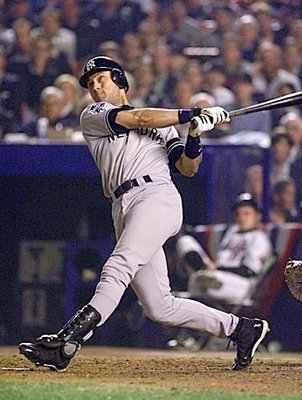
Sheryl Crow sings the National Anthem, Game 4 begins, and that reason lasts all of one pitch. The 1st pitch of the game is from Jones to Derek Jeter, who knocks it over the left-field fence for a home run. The kind of hit that, once he was named team Captain in 2003, earned him the nickname "Captain Clutch."
Neagle struggles in the 5th, and manager Joe Torre plays a huge hunch, bringing Cone, once a superb Met starter, out of the bullpen to face the dangerous Mike Piazza with the bases loaded. I have to admit, I was sure he was going to either walk a run home, or serve up a gopher ball for a grand slam.

Instead, Cone gets Piazza to pop up, ending the threat. Cone never throws another postseason pitch, and he never throws another pitch for the Yankees. But he got the job done. (Dwight Gooden, back with the Yankees, had appeared in the ALCS, but was left off the World Series roster, and got a nice hand at Shea went introduced. He then retired.)
David Cone

The Yankees hang on to win the game, 3-2, and take a 3 games to 1 lead in the Series. They can wrap it up tomorrow night. Met fans, who began the day feeling like it was still possible, are no longer using Tug McGraw’s old rallying cry of "Ya Gotta Believe!" Now, they're using another familiar rallying cry, that of "Yankees Suck!"

But all is not good news in Yankeeland. Darryl Strawberry, who was introduced to stardom and drug as a Met, and has been one of George Steinbrenner's reclamation projects, is arrested and jailed, after leaving a treatment center following a weekend drug binge.

*

October 26, 2000, 20 years ago: The Euro, the currency of the European Union, which had started, on January 1, 1999, at $1.10 in comparison to the American dollar, drops to 83 cents. This remains its all-time low. Its all-time high is $1.60, achieved on July 15, 2008.

More importantly for me, on this day, Game 5 of the World Series is played at Shea Stadium. Marc Anthony, a New Yorker of Puerto Rican descent and a Met fan, sang the National Anthem. Jeter and Bernie Williams homer off Al Leiter. Pettitte and Leiter give it their all. The game is tied 2-2 in the top of the 9th. Two outs. Posada on 2nd, Scott Brosius on 1st. Not great speed on the basepaths. 

Luis Sojo, playing 2nd base because Knoblauch's fielding difficulties limited him to DH status, is coming up to bat. Leiter had thrown 141 pitches. A number that would not have caused Catfish Hunter and Tom Seaver to flinch, but by the standards of the 1990s and 2000s, a lot.

Met Manager Bobby Valentine's choices are not good:

* A: Stick with an exhausted Leiter. He would be pitching on brains, courage and fumes, and pray that he gets the out that sends it to the bottom of the 9th still tied.
* B: Put in Armando Benítez. He led the National League in saves that year and saved Game 3, but also blew Game 1 for Leiter, and also blew a Division Series game against the Giants (which the Mets ended up winning anyway), and had previously messed up 2 ALCS games against the Yankees for the Orioles (including the Jeffrey Maier Game). Or...
* C: Put in John Franco. He was the winning pitcher in Game 3, and also pitched well in Game 4, but would be pitching for the 3rd day in a row. And he was 39: There was a reason Valentine had taken the closer's job from Franco and given it to Benítez.

Valentine decided a tired Leiter was better than an aging, potentially tired Franco or an inconsistent, unreliable Benítez. Although I frequently accused Valentine of overmanaging, and sometimes outright stupidity, I can't fault him for this choice. If he had put in the very popular New York native Franco and lost anyway, he might have gotten away with it. But if he had put in the already suspicious Benítez and he blew yet another game, Valentine would have been run out of Flushing on the Long Island Railroad.


Leiter throws his 142nd pitch to Sojo. He knocks it up the middle. A Met fan once told me that Rey
Ordóñez would have stopped this grounder. This Met fan was a fool: Ordóñez would not have gotten it. Mike Bordick was the shortstop that night, and he was a good shortstop, and he couldn't quite get it.
Base hit for Sojo. Posada comes around 3rd. Center fielder Jay Payton's throw... never makes it to Mike Piazza at the plate, instead hitting Posada in the back and getting away, toward the backstop. This enables not only Posada to score the tiebreaking run, but also Brosius to score an insurance run as well. Yankees 4, Mets 2.
Bottom of the 9th. Two out. The Mets get a man on. Piazza comes up to the plate. If you're a Met fan, this is the man you want up: The best offensive player the Mets have ever had (cough-steroids-cough), one of the best fastball hitters of his time, power hitter against power pitcher, Mariano Rivera.

But if you're a Yankee Fan, there’s no one you'd rather have on the mound, and there's no one you’d rather get as the final out. It was similar to the final matchup of the 1978 Boston Tie Party, with Carl Yastrzemski, one of the greatest fastball hitters ever, and the most beloved player in his franchise's history (remember, Sox fans didn't always love Ted Williams), coming up to try to save his club against one of the fastest and most fearsome pitchers ever, Rich "Goose" Gossage.

Yaz popped up to end that game in victory for the Yankees; 22 years later, Piazza gets considerably better wood on his pitch, and hits one deep to straightaway center field.

For a moment, many of us, including myself -- and, years later, on the YES Network broadcast of a Yanks-Mets regular-season game, the entire announcing team of Michael Kay, Paul O'Neill and David Cone -- think, "Uh-oh!" Translation, at least in my case: "No! Tie game! The Mets will go on to win it, and take the next 2 in The Bronx, and the Yanks will have choked it away!"

Because we had grown up with the Mets as the team that won and the Yanks as the team that fell short. We had the arrogance of Yankee Fans of old, but deep down, in places we don't like to talk about at parties, we had the fears that came so easily to fans of the team then known as the Cleveland Indians, the pre-2004 Red Sox, the pre-2007 Phillies, the pre-2016 Cubs -- and the post-2006 Mets.

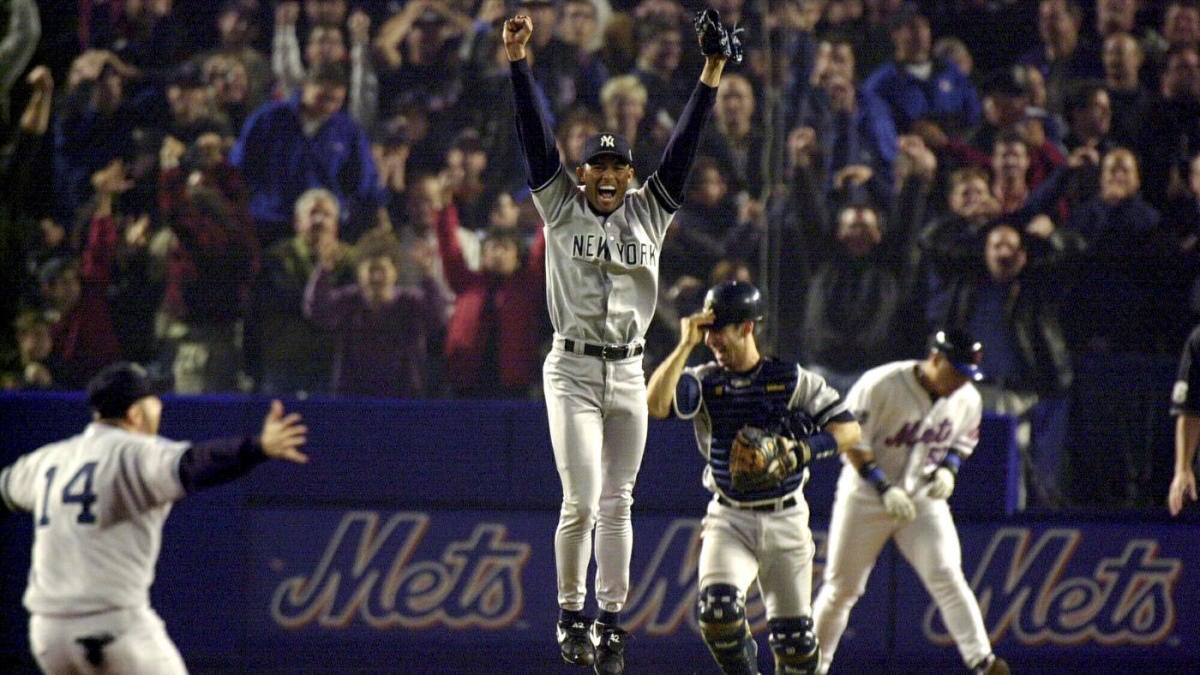
But Piazza had juuuust gotten under it. The ball has too much height and not enough distance. As the clock strikes 12:00 Midnight, Bernie stands on the warning track, settles under it, makes the easy catch, and it's over.

As Yankee broadcaster John Sterling said: "Ballgame over! World Series over! Yankees win! Theeeeeeee Yankees win!"
Jeter becomes the 1st player ever to be named Most Valuable Player of the All-Star Game and the World Series in the same season. Still, he would never be named MVP of a regular season. At the site of his 1st game as a manager, 23 years earlier, Torre is picked up by his grateful players, and carried off the field.
There were 25,000 people at Shea chanting "Let's Go Yankees!" and "We're Number 1!" Eventually, the owner came out to talk to the press, and he and the announcers couldn't talk, because the Yankee Fans were so loud, chanting "Thank you, George!" Imagine that, thousands of people saluting George Steinbrenner at Shea Stadium.

I loved it. October 26, 2000 – actually, the final out came just before Midnight, so it was really October 27 that we celebrated – remains my favorite moment as a sports fan.

For the 1st time, the Mets had the chance -- their first, their best, maybe their last -- to beat the Yankees in a Subway Series, and to irrevocably "take over New York." And while they had their chances and fought hard, in the end, the better team won.

The Yankees have beaten the Mets in a World Series. The other way around has never happened. And it never will. Never, never, never. Or, in the words of Flushing's own Fran Drescher, "It begins with an N and ends with an A: Nev-a." 


This was the 26th World Championship. And for those of us who grew up as Yankee Fans during the Mets' "glory" years of 1984 to 1990, the Dynasty That Never Was -- or, as Michael Wilbon of The Washington Post and ESPN's Pardon the Interruption would say, a Dynasty of One -- and had to deal with the unearned arrogance of the Flushing Heathen, the filthy bastards, delusional that their 2 titles outweighed our 22 (until 1996; now 27), damn fools to believe that the 1986 Mets could have beaten the Yankees of 1927, 1938, 1941, 1953, 1961 and 1978, and eventually even the 1998 juggernaut... for us, this was the greatest, sweetest moment of them all.


We beat the Mets. And it wasn't close. All 5 games were close, so it wasn't domination. But winning in 5 games is definitive, beyond any question. And we clinched at their place, on their field, at the William A. Shea International Airport, at the Flushing Toilet.


This was the 13th World Series game played at Shea. An unlucky 13th. It was also the last, which no one (not even a wiseass Yankee Fan like me) could have predicted at the time.

To the Flushing Heathen: I'd tell you to go to Hell, but you're already Met fans. So, instead, you and your 2 long-ago rings can kiss my Pinstriped ass. Or you can kiss my 27 rings, 7 of which came since your '69 title and 5 of which came after you got lucky in '86. Yes, you got lucky that the Red Sox had their choke of chokes against you in Game 6.

Sure, the Yankees have had luck. But they have earned all their victories. That's why every Yankee Fan can, on occasion, say the words of Yankee legend Lou Gehrig: "Today, I consider myself the luckiest man on the face of the Earth."


After all, we could have had worse luck, and it would have been all our own fault.


We could have chosen to be Met fans. We chose Yankees. We chose greatness.

No matter how bad the 2004 ALCS was, losing the 2000 World Series to the Mets would have been 10 times worse.

As we saw in 2015, we don't have to live around very many Red Sox fans with their cheated-for arrogance, but we do have to live around Met fans with their unearned arrogance.

How arrogant are Met fans? Some insist that 2000 and the other World Series the Yankees have won since 1978 don't count, because they used steroids; therefore, the count since 1986 is 1 to 0, and the count since 1962 is 2-2. These fans are idiots: We have more evidence against the 2000 Mets (Piazza) than we do against the 1996-2009 Yankees. So if 1996, 1998, 1999, 2000 and 2009 don't count for the Yankees, then 2000 doesn't count for the Mets, either.

For the moment, the count remains 27 to 2, and 5 to 0 since 1986.

I once saw a Met fan with a cap that had the 2000 World Series logo on the side, but razored off, with some of the stitching still visible. That's how much it bothers them. It should bother them: It basically erased their team's reason to exist.

As we've seen, the Yankees are (depending on your point of view: again, or still) the better team now. And let us not pretend that any Met World Series win -- be it 1969, 1986, or any future win -- is better than all of the Yankees' World Series wins.

Most of all, winning the 2000 World Series means that, as Paul Louis, a Yankee Fan and a Facebook Friend who was my age -- but, sadly, passed away during the latter stages of the COVID pandemic in 2021 -- said then, "The Yankees have scoreboard over the Mets for all time."

For all time.

Since then, the Yankees and the Mets have both reached the postseason in 2006, 2015, 2022 and 2024. But a Subway Series hasn't happened again.

The Yankees still have scoreboard over the Mets. For all time.

October 26 & 27, 1985: The Don Denkinger Game & the Cardinal Meltdown

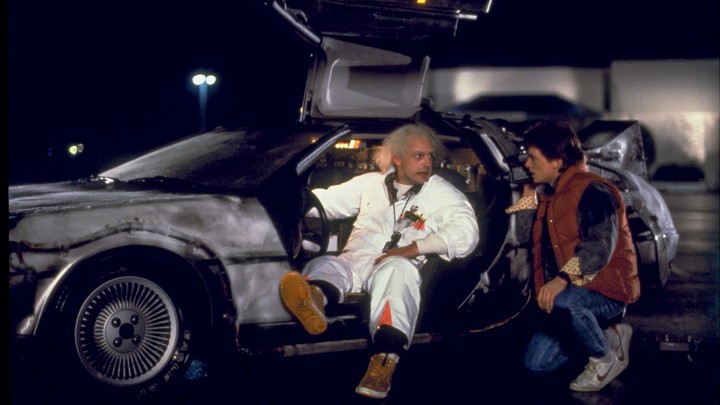
October 26, 1985, 40 years ago: Time travel is first demonstrated at the Twin Pines Mall (or is that the Lone Pine Mall?) in the Los Angeles suburb of Hill Valley, California -- or, rather, is dramatized in the film Back to the Future, which had been released the preceding July 3.
The demonstration by Dr. Emmett Brown (Christopher Lloyd) and Marty McFly (Michael J. Fox) was actually filmed at the Puente Hills Mall in City of Industry, California, about 20 miles east of downtown Los Angeles. Most of the trilogy's scenes were filmed in Los Angeles County, although the Courthouse Square area was a movie set that, for whatever reason, has frequently been struck, not by lightning, but by fire.

Just before the terrorist attack that forces Marty to get in the DeLorean and accidentally get sent back to 1955, Doc Brown tells Marty that he's going 25 years into the future: "I'll get to see who wins the next 25 World Series! Wouldn't that be a nice gift to have for my old age!"

For the record, due to the Strike of '94, he would have gotten to see only 24, won by the following teams: The Kansas City Royals, the New York Mets, the Minnesota Twins, the Los Angeles Dodgers, the Oakland Athletics, the Cincinnati Reds, the Twins again, the Toronto Blue Jays, the Jays again, the Atlanta Braves, the New York Yankees, the Florida Marlins, the Yankees again, the Yankees again, the Yankees again, the Arizona Diamondbacks, the Anaheim Angels, the Marlins again, the Boston Red Sox, the Chicago White Sox, the St. Louis Cardinals, the Red Sox again, the Philadelphia Phillies, and the Yankees again.

*

Perhaps Marty or Doc should have warned the St. Louis Cardinals about what was going to happen in Game 6 of the 1985 World Series, starting at Royals Stadium (now Kauffman Stadium) in Kansas City, about 19 hours after his trip back into time.


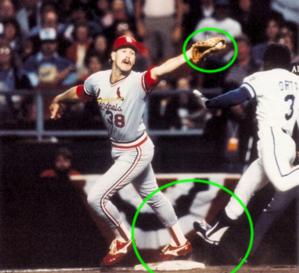
The Cards lead the cross-State Kansas City Royals 1-0, and need just 3 more outs to win the World Series. Jorge Orta hits a ground ball to 1st baseman Jack Clark. Clark flips to reliever Todd Worrell, who is covering the base. Orta is unquestionably out. The instant replay cameras and the photograph above confirm this.

Except 1st base umpire Don Denkinger blows the call, and calls Orta safe.


The next batter, Steve Balboni, pops up, and Clark can't handle it, and Balboni singles on his next swing. A passed ball by Darrell Porter, a Royal postseason hero from 1980 but now the Cardinal catcher (having been their postseason hero in 1982), makes it men on 2nd and 3rd, and Hal McRae is intentionally walked. Dane Iorg, another former Cardinal, steps up, and singles home Orta and Balboni, and the Royals have a 2-1 walkoff win to force a Game 7 at home.

The Cardinals are furious. So are their fans. Understandably so. They all think Denkinger stole the World Series from them. They still think so, 37 years later.

There's just one problem with this theory: There was still 1 game to go. If the Cardinals had won Game 7, Denkinger's blown call would have been just a footnote.


So Cardinal manager Whitey Herzog should have taken his team into the clubhouse and said, "Men, we got screwed tonight, but there's nothing we can do about it now. So let's win this thing tomorrow, and what happened tonight won't matter." Instead, the White Rat whined about the call to the media, and let it get into his head, and into his team's heads.
October 27, 1985: The Royals rout the Cardinals, 11-0, to win their 1st World Championship, and the 1st All-Missouri World Series since the Cardinals-Browns matchup of 1944.

They become only the 6th team to rally from a 3-1 deficit and win the Series. (Only the 2016 Chicago Cubs have done it since.) Series MVP Bret Saberhagen pitches the shutout, while Cardinals ace John Tudor allows 5 runs in just 2 1/3 innings.

The Royals had won the American League Pennant, but lost the World Series, in 1980; and had won the AL Western Division, but lost the AL Championship Series, in 1976, 1977, 1978 and 1984. This time, the Royals were crowned.

The Cards were still upset over the blown call by 1st base umpire Don Denkinger, which they believed cost them Game 6. And, 37 years later, despite 5 Pennants and 3 World Series wins, they and their fans are still upset about it.

According to Baseball-Reference.com,if the right call had been made, giving the Cardinals an out, they would have had an 87 percent chance of winning the game. Even with the call blown, they had an 66 percent chance -- just under a 2/3rds chance. They still should have won it. And they still could have won Game 7.

Whitey Herzog wasn't the first postseason manager to, as they say in English soccer, lose the plot, and let it carry over to his players. He certainly hasn't been the last. He could have told his players, "We got screwed, but if win tomorrow night, we're the World Champions. So let's forget tonight's result, and get it done tomorrow night.

Instead, Whitey was still fuming, and his team followed his lead, and allowed it to affect their performances and their minds for Game 7.

To make matters worse, for Game 7, Denkinger was the home plate umpire. Tudor believed that Denkinger was "squeezing" him, shrinking the strike zone. After being lifted from the game‚ Tudor punched an electric fan in the clubhouse, and severely cut his hand.

Herzog replaced him with fellow 20-game winner Joaquín Andújar. The Dominican, for whom English was a second language, was once quoted as saying, "You can sum up the game of baseball in one word: Youneverknow." He also thought Denkinger was squeezing him during Kansas City's 6-run 5th inning, and ended up waving his arms and screaming at Denkinger, who ejected him. Herzog also argued, and was also tossed.

The Cardinals finished the World Series with a .185 team batting average‚ lowest ever for a 7-game Series. There's the reason they lost: They didn't hit.

The Cardinals had won the World Series in 1982, then traded Keith Hernandez to the New York Mets the next year. The Cards lost the World Series in 1985, and again in 1987, blew a 3-games-to-1 lead in the 1996 National League Championship Series, got swept by the formerly "cursed" Boston Red Sox in the 2004 World Series, and also lost in the Playoffs in 2000, 2001, 2002 and 2005. St. Louis fans began to speak of a "Curse of Keith Hernandez." But they won the World Series in 2006, just 24 years after their last Series win, so that put an end to "curse" talk.

It took the Royals 29 years to even reach the Playoffs again, and I began to wonder if they were cursed. But they won the Pennant in 2014, and went all the way in 2015, so if they were cursed, the curse was broken.

The shock isn't that the Cards lost Game 7 by a whopping 11-0. The shock is that the Royals won it by only 11 runs. It is the biggest blowout in Game 7 history, previously reached only by, oddly enough, the Cardinals, when they beat the Detroit Tigers in 1934 (the Joe Medwick Game).

So, "Cardinal Nation": Instead of blaming Denkinger for costing you the World Series, how about blaming your manager for not getting your team to shake it off? Or how about blaming your lineup for not hitting a lick? The umpire didn’t cost your team a World Championship: Your team did.

According to Baseball-Reference.com, when Orta came to bat, the Cardinals had an 80 percent chance of winning the game. If the right call had been made, giving the Cardinals an out, they would have had an 87 percent chance. Even with the call blown, they had an 66 percent chance -- just under a 2/3rds chance. They still should have won it.

In other baseball news on this day, Billy Martin was fired by the New York Yankees for an unprecedented 4th time (not counting all those firings in 1977 that didn't take), and was replaced by former Yankee outfielder Lou Piniella‚ who had been the team's hitting instructor since retiring as a player in 1984. Billy would be hired a 5th time in 1988, and fired before June was out.

Don Denkinger was still respected enough by the baseball establishment to be put behind the plate for the 1987 All-Star Game, and named crew chief for the 1988 American League Championship Series, the 1991 World Series, and the 1992 ALCS, before retiring in 1998 after 30 season in the majors, 22 as a crew chief. He died in 2023.
The Cardinals have since won 2 World Series, in 2006 and 2011. For those among their fans who have not yet done so, it's time to move on.

October 26, 1825: The Erie Canal Opens

October 26, 1825, 200 years ago: The Erie Canal opens, connecting Buffalo on the Niagara River with Albany on the Hudson River, and thus connecting the Great Lakes to New York City. It has been called America's first superhighway.

It means that no longer must goods be delivered over land, through the Appalachian Mountains that separate what's now known as the Northeastern U.S. and the Midwestern U.S. It cut delivery time by several days.

This goes on to make the City of New York the biggest and richest City in the country, and (at least, for the rest of the 19th Century) the State of New York the biggest and richest State in the country. It also enriches Great Lakes cities like Buffalo, Cleveland, Detroit and Chicago. It also makes the sports teams eventually founded in those cities commercially viable.

A canal from the Hudson River to the Great Lakes was first proposed in the 1780s, but a formal survey was not conducted until 1808. The State legislature authorized construction in 1817. Political opponents of the canal, referencing its lead supporter, Governor DeWitt Clinton, denigrated the project as "Clinton's Folly" and "Clinton's Big Ditch." But the canal saw quick success upon opening on October 26, 1825, with toll revenue covering the State's construction debt within the 1st year of operation.
DeWitt Clinton
DeWitt Clinton was born on March 2, 1769 in what is now New Windsor, Orange County, about 65 miles north of Midtown Manhattan, He served as secretary to his uncle, Governor George Clinton, who became the longest-serving Governor of any State in the Union to this day, and would serve as Vice President in the 2nd term of Thomas Jefferson and the 1st term of James Madison.
He appointed DeWitt to head the Council of Appointments. Under the law of the time, this allowed him to control patronage in the State, including allowing him to appoint the Mayor of New York City and County Sheriffs, as these were not elective offices at the time. He used this position to stall the political career of the man who preceded his uncle as Vice President, Aaron Burr, who wanted to succeed Uncle George as Governor.
DeWitt Clinton served in both houses of the State legislature, and for nearly 2 years in the U.S. Senate. He served as Mayor from 1803 (appointing himself) until 1807, and again from 1808 to 1810. He was elected Lieutenant Governor in 1810, on the ticket of Daniel Tompkins. When Tompkins was elected Vice President under Madison in 1812 -- because Uncle George had died in office, the 1st Vice President to do so -- DeWitt became Governor, despite having been nominated by the Federalist Party for President, and having lost that election to Madison. As Governor, he pushed the Canal through the legislature. He served through 1822, and was elected again in 1824. He died in office on February 11, 1828.
At the time, the 363-mile length made the canal was the 2nd-longest in the world, after the Grand Canal in Chia. Initially 40 feet wide and 4 feet deep, it was expanded several times, most notably from 1905 to 1918, when the "Barge Canal" was built, and over half the original route was abandoned. The modern Barge Canal measures 351 miles long, 120 feet wide, and 12 feet deep. It has 34 locks, including the Waterford Flight, the steepest locks in the United States.
The Erie Canal's peak year was 1855, when 33,000 commercial shipments took place. It continued to be competitive with railroads, including the New York Central Railroad and the Boston & Albany Railroad, until about 1902, when tolls were abolished. Commercial traffic declined heavily in the latter half of the 20th Century due to competition from trucking and the 1959 opening of the larger St. Lawrence Seaway. The canal's last regularly scheduled hauler, the Day Peckinpaugh, ended service in 1994.
Today, the Erie Canal is mainly used by recreational watercraft. It has also become a tourist attraction in its own right, as several parks and museums are dedicated to its history.

Friday, October 24, 2025

October 24, 1945: The United Nations & Gene Monahan

October 24, 1945, 80 years ago: The Charter of the United Nations is ratified by the original 5 permanent members of the United Nations Security Council: America, Britain, France, China and the Soviet Union, and by a majority of the other signatories. 

The Charter established the purposes, governing structure and overall framework of the UN system, including its 6 principal organs: The Secretariat, the General Assembly, the Security Council, the Economic and Social Council, the International Court of Justice, and the Trusteeship Council.

In commemoration of the event, the General Assembly celebrates United Nations Day every October 24, and schedules its annual gathering for the days leading up to the date.

Also on this day, Vidkun Quisling is executed by firing squad in the Norwegian capital of Oslo. The fascist leader of Norway during World War II, allied with the Nazis, was 58 years old. The word "quisling" has become synonymous with "traitor."
And Gene Monahan, trainer for the New York Yankees from 1973 to 2011, was born in Miami. "Geno" tended to the bumps, bruises, and other injuries of Yankee players from Bobby Murcer to Derek Jeter.
He handled Mel Stottlemyre's and Catfish Hunter's shoulders, Thurman Munson's various aches and pains, Goose Gossage's thumb, Dave Winfield's and Don Mattingly's back injuries, Mariano Rivera's knee, and Alex Rodriguez's wounded pride. With him, the Yankees made 21 postseason appearances, won 18 Division titles, 11 Pennants and 7 World Series.