Showing posts with label quebec. Show all posts

Sunday, July 19, 2026

July 19, 1976: Nadia Comăneci Is Perfect

July 19, 1976, 50 years ago: For the 1st time, a gymnast scores a perfect 10 in Olympic competition. Her name was Nadia Comăneci, she was 14 years old, and she was from Onești, Romania.

For people who only follow gymnastics at Olympic time, this may have been a surprise. For people who follow the sport regularly, it was not. The previous year, at the World Championships in Skien, Norway, she had won 4 Gold Medals: In the All-Around competition, the uneven bars, the balance beam and the vault.

In March 1976, she competed in the American Cup at Madison Square Garden in New York. She achieved the 1st perfect 10s that any gymnast had ever received, in any sanctioned competition, for her vault in the preliminary stage and her floor exercise in the final, leading to her winning the all-around.

So when the Olympics were held in Montreal, Quebec, Canada, she was, despite her age, fully ready for the world stage. She scored 7 perfect 10s: 4 on the uneven bars, 3 on the balance beam. She ended up winning 3 Gold Medals: The All-Around, the uneven bars and the balance beam; a Silver Medal, for Romania in the Team competition; and a Bronze Medal, in the Floor Exercise. She had totally stolen the spotlight from the gymnastic heroine of the previous Olympics, Ukrainian star Olga Korbut, who nonetheless helped the Soviet team win the team Gold Medal.

For its Olympic coverage, ABC used an instrumental titled "Cotton's Dream" as background music for highlights of her performances. She never used it as performance music, but it became known as "Nadia's Theme." Ironically, the song was already being used as the theme song for a show on another network, CBS' soap opera The Young and the Restless. The composers, Barry De Vorzon and Perry Botkin Jr., released it under their own names, under the title of "Nadia's Theme," and it hit Number 8 on the U.S. charts.

Nadia became one of the biggest stars in the world, and a big propaganda tool for her home country and its Communist government. In 1980, she competed in the Olympics again, in Moscow, winning Golds in the balance beam and the floor exercise, and Silvers in the team and the all-around.

On a 1981 tour of the U.S. by Romanian gymnasts, she met American gymnast Bart Conner for the 3rd time -- but, now being 19, this was the 1st time she really noticed him. Her coaches, Béla and Márta Károlyi, defected from the tour. With typical Communist paranoia, the Romanian government kept her under tight control. While they did not join the Warsaw Pact boycott of the 1984 Olympics in Los Angeles, they only let her go as an observer, not a competitor. Conner was part of the U.S. team that won the men's Gold Medal.

On November 27, 1989, about a month before the revolution that finally toppled and executed dictator Nicolae Ceaușescu, Nadia was part of a group of Romanians that crossed the border at Cenad, into Hungary, made their way to Austria, and got on a plane to America. (Just 1 month later, on Christmas Day, rebels executed Ceaușescu and his wife, and Romania was free. But she has no regrets about her timing.)
She settled in Oklahoma, teaching at Conner's gymnastics school. In 1996, they went to Romania together for their wedding, and she was welcomed back as a national hero. Their son Dylan was born in 2006. As of July 19, 2026, they are still together.

Also on July 19, 1976, English actor Benedict Cumberbatch was born. In the Marvel Cinematic Universe, he played Dr. Strange. Robert Downey Jr. played Iron Man. Each of them had played a version of Sherlock Holmes. I think the Marvel writers missed an opportunity: Neither actor had the chance in any Marvel film to say to the other, "No shit, Sherlock!" 

Friday, March 27, 2026

March 27, 1926: The Death of Georges Vézina

March 27, 1926, 100 years ago: Georges Vézina dies of tuberculosis in his hometown of Chicoutimi, Quebec, Canada. The greatest goaltender the sport of hockey had yet seen, he was only 39 years old.

Joseph Georges Gonzague Vézina was born on January 21, 1887 in Chicoutimi, since absorbed into the city of Saguenay, in the Saguenay–Lac-Saint-Jean region of Quebec, 125 miles north of Quebec City and nearly 300 miles northeast of Montreal. He dropped out of school at age 14 to work in his father's bakery.

In 1908, he married Marie-Adélaïde-Stella Morin. A story spread by his later boss, Montreal Canadiens part-owner Leo Dandurand, said that the couple had 22 children, and that Georges spoke no English. Although both parts were plausible -- the Catholic Church in Quebec heavily encouraged big families, to overcome the Anglophone dominance of their Province through "the revenge of the cradles," and rural Quebec was almost entirely Francophone -- neither part was true: They had just 2 children, and Georges did speak some English.

At the time, transportation and media links being what they were, Chicoutimi was so remote that there was only one way for a player for the Chicoutimi Hockey Club, nicknamed the Saguenéens, could get noticed by those larger cities, and that was to tour the Province of Quebec, playing exhibition games.

The Montreal Canadiens were founded in 1909, and, in their 1st season, on February 17, 1910, they played the Chicoutimi Hockey Club. They lost, and their goaltender, Joseph Cattarinich (later to be a part-owner with Dandurand) suggested that they offer Vézina a tryout. Vézina refused. Later in the year, the teams played each other again, and Chicoutimi won again. Again, the Canadiens offered Vézina a tryout. He accepted on the condition that they also try out his brother Pierre. They did, although Pierre didn't make the team. Georges did, and made his professional debut on December 31, 1910, a 5-3 loss to the Ottawa Silver Seven (the original Ottawa Senators).

It took a while for the Canadiens to get good. In 1914, they finished tied for 1st in the National Hockey Association, with the Toronto Blueshirts, and lost a Playoff for the title and the right to play the Pacific Coast Hockey Association Champions for the Stanley Cup. The Blueshirts ended up beating the Victoria Aristocrats.

In 1916, the Canadiens won the NHA title outright, and beat the PCHA Champion Portland Rosebuds for their 1st Stanley Cup. This was also the 1st time an American-based team had played for the Cup. In 1917, the Canadiens were NHA Champions again, but lost the Stanley Cup Finals to the Seattle Metropolitans, the 1st U.S. team to win the Cup.

The Canadiens joined the new National Hockey League for the 1917-18 season. On February 18, 1918, the Canadiens beat the Toronto Arenas, 9-0, and Vézina became the 1st NHL goalie to record a shutout. On December 28, 1918, again against Toronto, he became the 1st NHL goalie to be credited with an assist, when Édouard "NewsyLalonde, the Canadiens' best attacking player, took a rebound from one of his saves, took the puck up the ice, and scored. The Canadiens won the NHL title, but the worldwide influenza epidemic rebounded in the Spring of 1919, killing Canadiens defenseman Joe Hall, and forcing the abandonment of the Finals between the Canadiens and the Metropolitans.

The Canadiens won the NHL Championship again in 1924, and beat the Vancouver Millionaires for their 2nd Cup. They won the NHL Championship again in 1925, but lost the Finals to the Victoria Cougars, Champions of what was now known as the Western Hockey League. The Cougars became the last team from outside the NHL to win the Cup, as the WHL collapsed after 1 more season, making the Cup an all-NHL affair.

From 1917 to 1925, in NHL play, Vézina won 103 games, lost 81, and had a goals-against average of 3.28. At the time, that was the lowest in the League's young history. What's more, he had played every minute of every game. The attempt to do so was not rare, but actually doing it was. In fact, the Canadiens hadn't played a league (NHA or NHL) game without him since December 1910 -- almost 15 full seasons. He was seen as unflappable on the ice, "cool as a cucumber," and was nicknamed "the Chicoutimi Cucumber."

But when he reported to training camp for the 1925-26 season, he was noticeably ill. He made no mention of it. The season opened on November 28, against an expansion team, the Pittsburgh Pirates. (Named for the city's baseball team, they only lasted through the 1930 season, and have no connection to the Pittsburgh Penguins.) In the intervening 6 weeks, he had lost 35 pounds. When he reported for the opening game, he had a fever of 102 degrees. He insisted upon playing.

He got through the 1st period without allowing a goal. But upon his return to the locker room, he began to vomit blood, a sure sign of tuberculosis. Today, it is curable with antibiotics; but, then, the treatments were not very effective. For the rest of the game, he was replaced by Alphonse Lacroix. Despite his French name, he was an American, and had played for the U.S. in the 1st Winter Olympics in Chamonix, France the year before. The Canadiens lost, 1-0.

Vézina never played again, and the Canadiens finished last in the NHL for 1925-26. Nevertheless, knowing that he was dying and the family couldn't afford his medical expenses otherwise, the team paid his full salary of $6,000 (Canadian). He died on March 27, 1926, just 39.

*

At the start of the 1926-27 season, the Canadiens donated the Vezina Trophy to the NHL, to be awarded to the goaltender of the team that allowed the fewest goals during the regular season. (Note that the Trophy's name does not have the accent over the E in "Vézina.") George Hainsworth, whom the Canadiens signed from the Saskatoon Crescents, one of the teams that went out of business with the Western Hockey League the season before, won the Trophy the 1st 2 times it was awarded.
In 1981, the NHL changed the format: The Vezina Trophy went to the winner of a poll for the best goalie of the year, while the Jennings Trophy was instituted, to go to the goalie with the fewest goals allowed.
Jacques Plante holds the record for most Vezina Trophies won: 7, 6 with the Canadiens and 1 with the St. Louis Blues. Although the Canadiens have retired some uniform numbers for more than one player, they have retired Number 1, the traditional number for a goalie, only for Plante, not for fellow Vezina Trophy winners Hainsworth, Bill Durnan, Charlie Hodge or Gump Worsley; nor for Vézina himself, who became the 1st NHL player to wear Number 1. (Later Canadiens' Vezina Trophy winners have not worn 1: Ken Dryden wore 29, Patrick Roy wore 33, José Théodore wore 60, and Carey Price wore 31.)

In 1945, Vézina and Charlie Gardiner of the Chicago Black Hawks, who also died while still an active player, became the 1st 2 goalies elected to the Hockey Hall of Fame. In 1965, his hometown of Chicoutimi recognized Vézina, as the 1st professional athlete to come from there, by renaming their arena the Centre Georges-Vézina.

In 1998, The Hockey News ranked Vézina 75th on their list of the 100 Greatest Players. In 2017, the NHL named its 100th Anniversary 100 Greatest Players. Vézina was the earliest player selected.

Wednesday, March 11, 2026

March 11, 1996: The Montreal Forum Closes

Five Montreal Canadiens legends. Left to right:
Guy Carbonneau, Guy Lafleur, Jean Béliveau,
Maurice Richard and Pierre Turgeon.

March 11, 1996, 30 years ago: The last hockey game is played at the Montreal Forum, the greatest of all hockey arenas.

It had opened on November 29, 1924. The Montreal Canadiens defeated the Toronto St. Patricks, the team that would become the Toronto Maple Leafs, 7-1. Billy Boucher scored the arena's 1st goal. He was 1 of 4 brothers in the NHL. Frank was the original star of the New York Rangers. Georges "Buck" Boucher starred for the Ottawa Senators. Frank and Buck both made the Hockey Hall of Fame. Billy was known for his rough play with the Canadiens, and Bobby Boucher (not to be confused with Adam Sandler's character in The Waterboy) barely played in the NHL, also for the Canadiens.
Originally, the Forum wasn't meant to be the Canadiens' home. It was meant to be the home of the Montreal Maroons, a newly-founded team, while the Canadiens continued to play home games at the Mount-Royal Arena. The Maroons' 1st game at the Forum came on December 3, but they lost to the Hamilton Tigers, 2-0.

The Maroons won the Stanley Cup in 1926. For the next season, the Canadiens moved in, and the Forum was busier than ever: Its 9,300 seats played host to the Canadiens or the Maroons every Thursday and Saturday, the Quebec Senior Hockey League on Wednesdays and Saturdays, the Quebec Junior Hockey League on Mondays, the Bank League on Tuesdays, and the Railways and Telephone League on Fridays.

The Canadiens' famed "CH" logo has confused people for over a century. It is short for the team's official name, le Club de hockey Canadien. Madison Square Garden president George "Tex" Rickard, boxing promoter and founder of the Rangers, probably without knowing the truth, told a reporter that the "H" stood for "Habitant," a term used to describe farmers in early Quebec. Ever since, the Canadiens have been known as Les Habitants, or the Habs for short. The chant became, "Go, Habs, go!"

The Canadiens won the Stanley Cup in 1916 and 1924, before the Forum opened. They won it in 1930 and 1931, led by Howie Morenz, the man eventually known as "the Babe Ruth of Hockey." In 1937, Morenz broke his leg during a game, was hospitalized, and died of a heart attack in the hospital. A benefit game was played at the Forum, between a combined team of Canadiens and Maroons against a team made up of players from the rest of the League. A few months later, at the end of the 1937-38 season, the Maroons went out of business, due to the Great Depression.

In 1942, Maurice Richard arrived on the Canadiens' roster. "The Rocket" led them to 8 Stanley Cups. In 1953, along came Jean Béliveau, and he led them to 10. Richard's last 5 and Béliveau's 1st 5, from 1956 to 1960, were the only instance ever of 5 straight Cup wins.

They followed the 1955 season, in which an incident in Boston led to Richard's suspension for the Playoffs, which led to a riot inside the Forum that spilled out into the streets. French-Canadians, for whom the Canadiens, and Richard in particular, were a point of pride were angry at Clarence Campbell, the NHL's Anglophone President, suspending him, thinking he was trying to fix the Cup for an Anglophone team. Richard went on radio and told the fans to stop, that he would take his punishment, support the team to win the Cup this time, and play to win it in the future.

They lost the Finals to the Detroit Red Wings, but with Richard joined by his brother Henri, Béliveau, defenseman Doug Harvey and goalie Jacques Plante, won those next 5 Cups. Henri actually topped his brother, and Béliveau, by being a member of 11 Cup-winning teams. In all of North American sports, only Bill Russell of the NBA's Boston Celtics matched Henri Richard's 11 World Championships.

In 1968, the Forum was seriously renovated, and expanded, to a seating capacity of 16,259, plus 1,700 in standing room, for a total of 17,959. The support poles were removed. One thing that was retained: Whereas most arenas used a horn to signal the end of a period, the Forum used a high-pitched siren, which was kept after the move to the Bell Centre.
In 1972, the Forum hosted the 1st game of the 8-game "Summit Series" between Canada and the Soviet Union, which the Soviets won in a 7-3 shocker. Canada would win the series with dramatic wins in Moscow in Games 6, 7 and 8.

From 1976 to 1979, the Canadiens had a run of 4 straight Cups, led by a slew of Hall-of-Famers: Forwards Guy Lafleur, Yvan Cournoyer, Steve Shutt and Jacques Lemaire; defensemen Larry Robinson, Serge Savard and Guy Lapointe; and goaltender Ken Dryden.

Between them, Morenz, Maurice Richard, Béliveau and Lafleur were, effectively, the Mount Rushmore of hockey. They were a foursome that could only be matched in North American sports by the Yankees' Babe Ruth, Lou Gehrig, Joe DiMaggio and Mickey Mantle. (The Celtics? Bill Russell and Larry Bird, but who are the other two? Bob Cousy and John Havlicek? Not the same. No football team can match it, either.)

From 1956 to 1979, the Canadiens won 15 of the 24 available Stanley Cups. Their 1979 Cup was their 22nd, matching the Yankees for the most World Championships in North American sports. They won a 23rd in 1986 and a 24th in 1993. The Yankees didn't win their 24th World Series until 1998, surpassing them with a 25th in 1999.

In the 1976 Olympics, the Forum hosted basketball, boxing, volleyball, handball, and gymnastics, including Nadia Comaneci registering the 1st perfect 10 in Olympic history -- 7 of them.

The Beatles played the Forum on September 8, 1964. Other notable concerts there included Bob Dylan's Rolling Thunder Revue in 1975, Bob Marley in 1978, and, all in separate shows in 1981, Rush, Queen, and the Jacksons.

But there was only so much that could be done with a 1924-built arena. So construction began on a new arena. And on March 11, 1996, the Forum's final game was played, against the Dallas Stars. They were chosen as the opponent because their Captain was a former Canadiens' Captain, Guy Carbonneau. Maurice Richard, Béliveau and Lafleur participated in a ceremonial puck-drop with Carbonneau and Canadiens Captain Pierre Turgeon.

Turgeon opened the scoring, Mark Recchi made it 2-0, Derian Hatcher got the Stars on the board, Saku Koivu scored, and the last goal at the shrine of hockey was scored by... Andrei Kovalenko, a Russian right wing of Ukrainian descent, at the 13:56 mark of the 3rd period. Final score: Canadiens 4, Stars 1.

In the Canadiens' locker room, replicated at the new arena, the lockers were topped by the faces of the team's members of the Hockey Hall of Fame. On each side, one in English and one in French, are words from Canadian Army doctor John McCrae's World War I poem In Flanders Fields: "To you from failing hands we throw the torch; be yours to hold it high." (En Francais: Nos bras meurtris vous tendent le flambeau; a vous toujours de la porter bien haut.)

After the last game at the Forum, a symbolic torch was passed from the earliest living Canadiens Captain, Butch Bouchard, to each succeeding Captain: Bouchard, Maurice Richard, Jean Béliveau, Henri Richard, Yvan Cournoyer, Serge Savard, Bob Gainey, Carbonneau, up to Turgeon. (Kirk Muller and Mike Keane, each serving as Captain between Carbonneau and Turgeon, were playing with other teams, and thus unavailable.)

When Rocket Richard, the most popular player in Canadien history, was introduced, he got a standing ovation that brought him to tears. Given the uniform number he made famous, it was appropriate that it lasted for 9 minutes.

The Canadiens played an away game on March 13, a 1-1 draw with the New Jersey Devils at the Meadowlands, before going back to Montreal to play the 1st game at the Molson Centre, since renamed the Bell Centre, about a mile to the east, in Centre-Ville (downtown). In a special pregame ceremony, Turgeon took the torch from the last game, and lit a new one inside the arena. With Vincent Damphousse scoring the 1st and 3rd goals in the new arena, the Canadiens beat the New York Rangers, 4-2.

Over the next 4 years, a construction company owned by 1950s Canadien Hall-of-Famer Dickie Moore converted the Forum into retail space, including a shopping mall and a movie theater. A small bleacher section, and a bench with a statue of Maurice Richard, are roughly where center ice was. 

The repurposing of the Forum helped to inspire a similar construction job at Maple Leaf Gardens in Toronto, after it closed in 1999. Those arenas still stand, unlike the other "Original Six" arenas: The old Madison Square Garden was torn down in 1968, the Olympia Stadium in Detroit in 1986, the Chicago Stadium in 1995, and the Boston Garden in 1998.

Tuesday, December 2, 2025

December 2, 1995: The Curse of St. Patrick

December 2, 1995, 30 years ago: In an NHL "Original Six" matchup, the Detroit Red Wings beat the Montreal Canadiens, 11-1 at the Montreal Forum. Vyacheslav Kozlov scored 4 of those Detroit goals. Mark Recchi had the lone tally for the Habs.

This was the game in which Canadiens' goalie Patrick Roy was infamously hung out to dry by Canadiens management. General manager Réjean Houle told head coach Mario Tremblay to leave Roy in the net. He left Roy there until 11:57 of the 2nd period, after the Canadiens' defense, strong enough to win the Stanley Cup 2 1/2 years earlier, had collapsed to the point where he'd allowed 9 goals in that time.

Roy skated over to where team president Ronald Corey was sitting, and said, "It's my last game in Montreal." Roy was suspended, and, 4 days later, came "Le Trade": Roy and team Captain Mike Keane, a right wing who had also been feuding with Tremblay, were traded to the Colorado Avalanche for goaltender Jocelyn Thibault, left wing Martin Ručinský and right wing Andrei Kovalenko.

Ironically, until the season before, the Avalanche had been the Quebec Nordiques. Roy was from Quebec City, and had grown up loving the Nords and hating the Habs, before winning 3 Vezina Trophies and helping them win 3 Stanley Cups. 

He helped the Avs win the Cup that season, and again in 2001. In addition to the '96 Cup with the Avs, Keane would win the Cup again with the Dallas Stars in 1999. What did the Habs get? Not much, although Kovalenko did score the last goal at the Forum, as the team was preparing to move into the new Molson Centre (now the Bell Centre).

Canadien fans took Roy's side in the dispute. They let their displeasure be known all season long, including into the move, with the new arena having room for an additional 3,300 fans. It took until 2008 for Roy and the team to reconcile enough to get him to come for the retirement of his Number 33.

The winningest team in hockey history took until 2021 to return to the Stanley Cup Finals, losing it to the Tampa Bay Lightning. It is known as "The Curse of St. Patrick," even if, as he has proven in his subsequent coaching and management career, Roy is no saint. He had helped them win their 23rd and 24th Stanley Cups. They are still looking for their 25th.

Thursday, October 30, 2025

October 30, 1995: The Close Call of the Quebec Referendum

Prime Minister Jean Chrétien, leading the "Non" side

October 30, 1995, 30 years ago: The Quebec sovereignty referendum fails by a razor-thin margin, with 2,362,648 people, or 50.58 percent, voting "Non"; and 2,308360, or 49.42 percent, voting "Oui."
The number of "spoiled ballots," unusable for whatever reason, is said to be greater than the margin of victory. Nevertheless, it is a win not for Quebec nationalism, but Canadian nationalism, and for Prime Minister Jean Chrétien, who, though a Francophone from Quebec, wanted the Province to stay.
Despite the anger of the separatists, angry over their perception of victimization at the hands of the federal government in Ottawa and the English-speaking establishment – an absolutely ridiculous notion, since the Provincial government has been dominated by the ethnic and linguistic French for most of the last 100 years – the Province will remain a part of Canada, but there is still bitterness on both sides.
The Parti Québécois, dedicated to the Province's independence, held the Provincial government from 1976 to 1985, and lost a referendum in 1980, 60 percent to 40. They held the government again from 1994 to 2003, launching the nearly successful 2nd referendum. After launching the referendum and failing, Jacques Parizeau resigned as Premier and as PQ Leader. He died in 2015.
The PQ held a minority government from 2012 to 2014, and knew they couldn't get a 3rd referendum to pass, so they didn't launch one.
Splits in the party, including defections to new parties on both the left and the right, have dropped the PQ, or "Péquistes," to a mere 7 seats in the 125-seat National Assembly. The current government is led by the conservative Coalition Avenir Québec, and its Leader, Premier François Legault, has said that there will never be a sovereignty referendum launched by his party.
It's just as well: Would you be the one who has to tell the Montreal Canadiens, the greatest cultural institution in Quebec, that they had to change their name? 

Monday, March 17, 2025

March 17, 1955: The Rocket Richard Riot

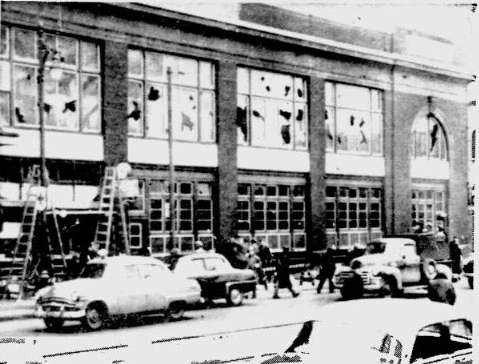
The Forum, the next morning

March 17, 1955, 70 years ago: A riot breaks out on the streets of Montreal -- not due to anything the government has done, or the police, but in support of a hockey player.

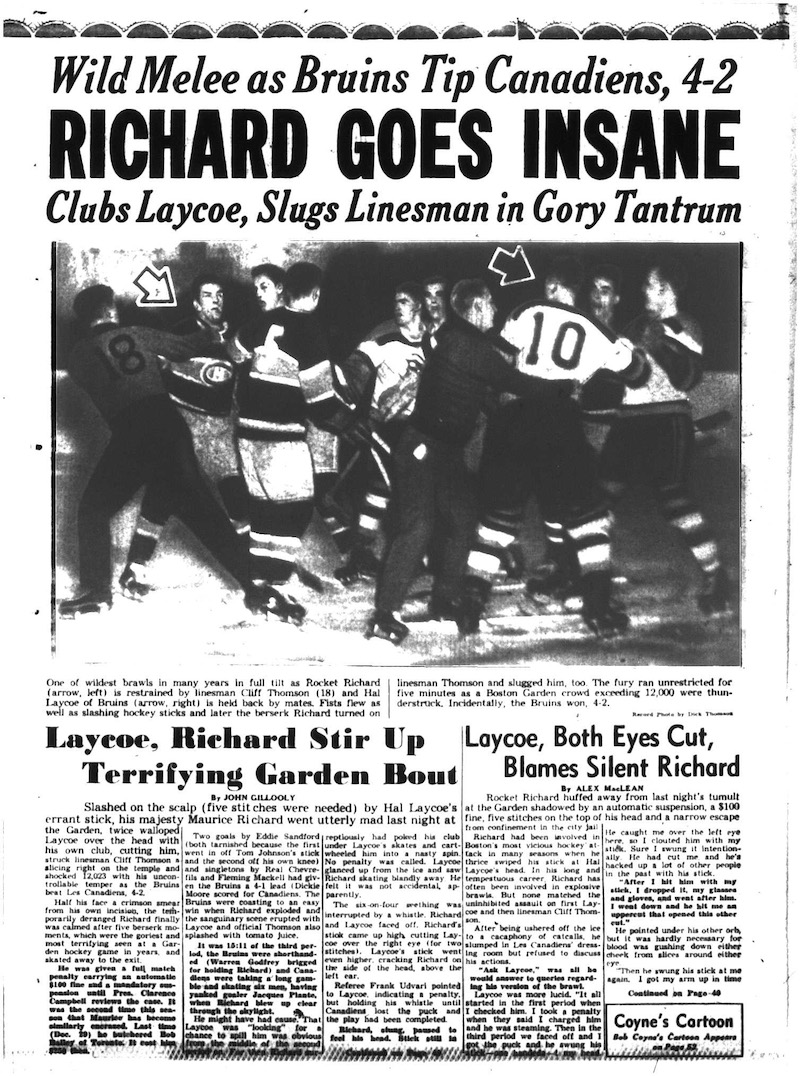
Four days earlier, on March 13, the Boston Bruins beat the Montreal Canadiens, 4-2 at the Boston Garden. The Bruins' Hay Laycoe hit the Canadiens' Maurice Richard in the head with his stick. In retaliation, Richard, known as the Rocket, did the same.

No member of the officiating crew saw Laycoe hit Richard -- or so they said. Linesman Cliff Thompson saw Richard hit Laycoe, and tried to intervene. Thinking he was another Bruin player, Richard punched him.

That's one thing you can never do, in any sport: Hit an official. Boston police tried to arrest Richard, but Bruins general manager Lynn Patrick -- son of former New York Rangers head coach and GM Lester Patrick, and himself a Hall of Fame player -- tells the cops to let the Rocket go, because the NHL office will handle the situation.

On March 15, with 3 games left in the regular season, NHL President Clarence Campbell announced that Richard was suspended, for the remainder of the regular season, 3 games -- 2 against the Detroit Red Wings, home and away, and 1 at home to the Rangers -- and for the entirety of the Playoffs.

This decision would cost Richard the Art Ross Trophy as the NHL's leading scorer, as his teammate, Bernie "Boom-Boom" Geoffrion, would finish with 37 assists to Richard's 36, and both had 38 goals, so Boom-Boom finished with 75 points to the Rocket's 74.

But there was a far bigger effect than that. Richard was considered the league's best player at the time. At the least, he was considered 2nd behind the Red Wings' Gordie Howe, also a right wing. (In each case, that's by position on the ice, not by politics.)
The most familiar photograph of Richard.
The eyes make him look a little crazy.

So the team known as Les Habitantes, or "The Habs," would be losing him when they were in a dogfight with the Wings for 1st place overall in the League, knowing full well that, a year earlier, the Wings had beaten them in the Finals, with Game 7 being at the Olympia Stadium in Detroit, won by an overtime goal by Tony Leswick. They did not want to cede home-ice advantage, especially in a potential Game 7, again.

This wasn't the first time that Campbell had sanctioned Richard. There was a great bias against French-Canadian players -- because they were both French-speaking and Catholic -- among the League's Anglophone and Protestant base in the rest of Canada, including the League office in Toronto, home of the Habs' greatest rivals, the Toronto Maple Leafs.

Leafs boss Conn Smythe, of English descent, a veteran of both World Wars, and an intense Canadian nationalist, despised Richard, whose broken ankle kept him out of the Canadian Army in World War II. And Campbell was often seen as Smythe's puppet.

And so, opposing players would go after Richard, knowing that the threat came not from what referees or Campbell would do to them, but what Richard would do to them. Like Howe, and later like Bobby Orr -- but not Wayne Gretzky, Mario Lemieux or Sidney Crosby -- Richard didn't need goons to protect him. He did his own fighting, and usually won, and relished beating the thugs at their own game. So they had reason to be afraid of Richard. They frequently fought that fear, and went after him anyway.

Campbell had fined Richard many times, for fighting back. At one point, Richard, like many other great athletes of the pre-television era, had a ghostwritten column in a local newspaper, in this case a French-language publication, Samedi-Dimanche (Saturday-Sunday). One time, he used the column to criticize Campbell's treatment, not just of himself, but of French players in general, giving them bigger fines and longer suspensions than their Anglophone counterparts. For this, Campbell forced Richard to post a $1,000 "good-behaviour bond."
Cartoon in a French-language newspaper:
Richard writes, "I will not call Mr. Campbell a dictator again."

This was the Original Six Era. Six teams, and six bosses: Smythe in Toronto, general manager Frank Selke in Montreal, team president William M. Jennings in New York, owner Weston Adams in Boston, James D. Norris in Detroit, and team president Bill Tobin of the Chicago Black Hawks. (The spelling was changed to one word, "Blackhawks," in 1986.) Actually, it was 5 bosses: Norris owned the Hawks' arena, the Chicago Stadium, and Tobin was essentially his puppet. So, he was the 2nd-most powerful man in the League, behind Smythe, the power behind Campbell's throne.

The thing was, the American teams' bosses knew that their cities had heavy Catholic populations, if not heavy French populations. And they knew that, at the time, Richard was the biggest drawing card in the sport. And so, while Selke may not have held much sway with Campbell, the others -- Jennings, Adams and Norris -- had, combined, every bit as much over him as Smythe did. And so, Campbell may have held back a bit on punishing Richard on previous occasions.

This time, he couldn't: Richard hadn't just hit another player over the head with his stick, in self-defense from having the same thing done to him. That was understandable, if wrong. He had hit an official. That was inexcusable, even if he thought he was defending himself against another opposing player. Richard was lucky this wasn't a time when ESPN would have shown the incident over and over again, many times a day: He might have gotten suspended for all of the next season, too.

The media in English Canada, from St. John's to Vancouver, almost unanimously praised Campbell for suspending Richard for the rest of the season. French Canada was furious: They considered it not merely a personal insult, to Richard and his fellow Québécois, but also an attempt by Campbell to fix the chase for the Stanley Cup.
This is actually an American paper, the Providence Journal,
for whom the Bruins were "the home team."
Not an English Canadian paper.

The Rangers and Black Hawks were deep in 5th and 6th place, respectively, and weren't going to make the Playoffs. The Maple Leafs and Bruins were likely to finish 3rd and 4th (though not necessarily in that order), and one was going to play the Canadiens in the Semifinals, and the other was going to play the Red Wings. Neither Toronto nor Boston was considered likely to win.

So a Finals rematch of 1954 -- and 1952, when the Wings swept the Habs in 4 straight -- was considered likely. And whoever had home ice for Games 1, 2, 5 and 7 was likelier to win. And now, especially with Richard out for 2 games between the Habs and Wings, the Wings were likelier to get that home ice.

Letters and telegrams came in to Campbell's Toronto office. Angry ones. Including death threats. So Campbell made a terrible decision: He decided to attend the next Canadiens game, against the Wings at the Montreal Forum.

(In Campbell's defense: He was not a mere puppet of Smythe. He was a man of substance. He was a former NHL referee, and a lawyer. In World War II, he rose to the rank of Lieutenant Colonel in the Canadian Army. He served with the No. 1 Canadian War Graves Investigation Unit, helping to get his country's war dead home. He was awarded the Order of the British Empire. And he was a prosecutor at the trials of some Nazi war criminals, although not the most famous ones, at Nuremberg.)

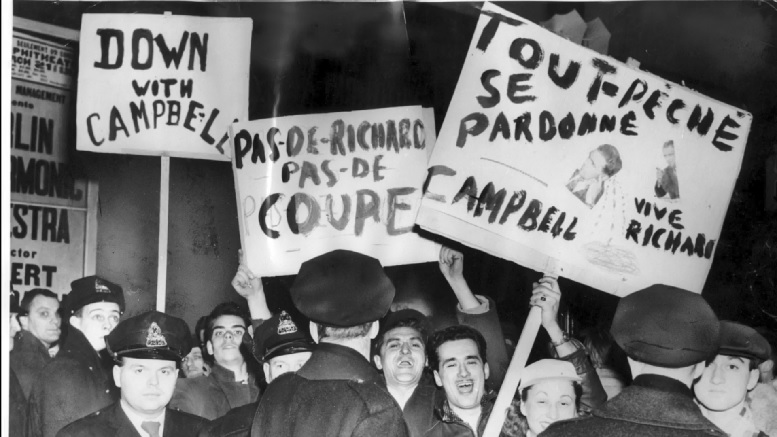
March 17, 1955: Tensions are high on this Thursday night. The French people of Montreal are angry. It's St. Patrick's Day, and the Irish people of the city, who also see the English establishment as their traditional enemies, are standing with their French brethren against Campbell. The Irish may not speak French, but they are fellow Catholics, and also full of revolutionary fervor.

Nevertheless, Campbell attends. So does Richard, in a suit and coat, behind his team's bench. Campbell didn't own the Forum, so he couldn't ban Richard from the building.
Canadien fans saw Campbell in his seat --with his wife, Phyllis, no less -- and threw things at him, including vegetables and eggs. At the end of the 1st period, with the Wings leading 4-1, someone threw a tear gas bomb. It missed Campbell, but landed on the ice. The building was evacuated. Campbell declared the game conditions to be unplayable, and, since it was the Canadiens' responsibility to make the conditions playable, he declared the game forfeited to the Red Wings.

A mob of over 20,000 people were outside, on Rue Sainte-Catherine. They rioted, smashing in windows at the Forum and nearby businesses. Nobody died, but 37 people were hospitalized, 70 were arrested, and damage was estimated at $100,000 Canadian -- about $1 million U.S. in today's money.

The next day, Richard spoke (in French) on the radio, and asked the people to stop: "Do no more harm. Get behind the team in the Playoffs. I will take my punishment, and come back next year, and help the club and the younger players to win the Cup." They heeded his call, and the night of March 18 was quiet.
CKVL 690, CKAC 730 and CHLP 1410 (now defunct) were French.
CJAD 800 and CFCF 940 (now CINW) were English.

The night after that, the suspended game was replayed from the beginning, and the Canadiens beat the Rangers, 4-2 at the Forum. But the following night, in Detroit, they lost to the Wings, 6-0. While it is not surprising that, without Richard, they only scored 2 goals against the Wings -- who did have Hall-of-Fame defensemen Red Kelly and Marcel Pronovost -- it is shocking that they would allow 10 goals.

It was true that Richard was not regarded as a great defensive player, but that shouldn't have made it easier for the Wings' "Production Line" of Alex Delvecchio centering Howe and left wing Ted Lindsay to score so much.

But it could be that the Canadiens were simply disheartened by the whole process. They beat the Bruins 4 games to 1 in the Semifinals. But, sure enough, the home team won every game in the Finals: Detroit won 4-2 in Game 1 and 7-1 in Game 2; Montreal won 6-2 in Game 3 and 5-3 in Game 4; Detroit won 5-1 in Game 5; Montreal won 6-3 in Game 6; and, in Game 7 at the Olympia, the Wings won 3-1.

In 1954, with Richard, the Canadiens scored 12 goals in the 7 games, and won Games 2 and 5 in Detroit; but lost Games 3 and 4 in Montreal, before losing Game 7 in Detroit. In 1955, without Richard, the Canadiens scored more goals: 22, including 6 each in Games 3 and 6, and 5 in Game 4. But they only scored 1 in the key Game 7.

The following off-season, Selke fired head coach Dick Irvin Sr., a once-great player, whose son Dick Jr. would become a great broadcaster for the Canadiens. Selke hired Hector "Toe" Blake, who, with Richard and Elmer Lach, formed the Punch Line, winning the Cup in 1944 and 1946.

Selke brought up several young stars, including left wing Dickie Moore, and a promising center, Richard's much younger brother Henri, known due to his short stature as "the Pocket Rocket." The Rocket and Boom-Boom continued their assaults on NHL nets. Doug Harvey remained the greatest defenseman in the game, a two-way threat, Orr before there was Orr. Center Jean Béliveau and goaltender Jacques Plante came into their own.

The Canadiens won the next 5 Cups, something not done before or since. They avenged their defeat to the Wings in the 1956 Finals, and the Wings didn't win another cup until 1997. They beat Boston in the Finals in '57 and '58, and Toronto in '59 and '60.
Having won 8 Cups, including the last 5 in a row with his brother Henri, become the 1st player with 500 goals in NHL regular-season play, and not causing any more incidents to get him fined or suspended, Maurice Richard then retired. Until Orr and then Wayne Gretzky came along, he was the most popular player in hockey history.

By his own admission -- "I wasn't a great player. I was a great scorer." -- Howe was a better all-around player, but the Rocket was more popular. Even English Canada accepted his greatness.
Near the end of his life, the Richard Trophy was created.
While the Ross Trophy goes to the NHL's leading scorer,
goals and assists combined, this one goes to the leading goalscorer.

Campbell, who had been named President of the NHL in 1946, remained in that office until 1977, following legal and health setbacks. Instances of his being unfair to French-Canadian players seemed to happen less often after 1955. Perhaps he and Richard both learned lessons from the whole sordid thing.

Clarence Campbell died on June 24, 1984. He was a few days short of his 79th birthday. Hardly anybody noticed.

Maurice Richard died on May 27, 2000. He was the same age, 78 going on 79. Former Prime Minister Pierre Trudeau died later that same year. He and the Rocket were the 2 most popular people in Quebec. Their funerals were held at the same cathedral. The Rocket's drew more people.

Monday, March 3, 2025

March 3, 1875: The Premiere of "Carmen" & The 1st Indoor Hockey Game

Georges Bizet

March 3, 1875, 150 years ago: Carmen, an opera by French composer Georges Bizet, premieres, at the Opéra-Comique in Paris. It is based on the 1845 novella of the same title, by French writer Prosper Mérimée. He died in 1870, and so did not live to see the opera.

The opera is not comic: It is set in southern Spain in 1820, in the wake of the country's devastating defense of itself against Napoleon in the Peninsular War, and with the loss of its Latin American colonies in progress.

Don José, a naïve soldier, is seduced by the wiles of the fiery Romani woman Carmen. (She is referred to as a "gypsy," but that term for the Romani is now considered a slur.) He abandons his childhood sweetheart, and deserts from his military duties, but loses Carmen's love to the bullfighter Escamillo, after which José kills her in a jealous rage.

The depictions of proletarian life, immorality, and lawlessness, and the tragic death of the main character on stage, broke new ground in French opera, and were highly controversial. It has become part of the trope that every opera is a tragedy, which is far from true.

Bizet died just 3 months after the premiere, on June 3, 1875, at 36, from a lingering fever and 2 heart attacks.

Just as most 20th Century Americans came to know "The March of the Swiss Soldiers," the end of the the Overture to Gioachino Rossini's 1829 opera William Tell as the theme from the 1949-57 TV show The Lone Ranger, many Americans came to know the songs "Habanera" and "The Toreador Song" from their inclusion in the 1976 baseball film The Bad News Bears.

*

On the exact same day, across the Atlantic Ocean, but also in a French-speaking city, the first recorded indoor ice hockey game took place.

Just as a young man named James Creighton was the 1st great pitcher in baseball, before a bizarre injury took his life at the age of 21, another James Creighton organized the 1st indoor hockey game. He put it together at the Victoria Skating Rink in Montreal, between a local team and the Victoria Skating Club, a team captained by Creighton.

The game featured 9 players on each side, as opposed to the modern 6. And here is the entire report of the game, from the next day's Montreal Gazette -- originally a single run-on sentence, but I've added paragraphs for easier reading, although this writer uses the term "shinty" instead of the more common "shinny":

HOCKEY – At the Rink last night a very large audience gathered to witness a novel contest on the ice. The game of hockey, though much in vogue on the ice in New England and other parts of the United States, is not much known here, and in consequence the game of last evening was looked forward to with great interest.

Hockey is played usually with a ball, but last night, in order that no accident should happen, a flat block of wood was used, so that it should slide along the ice without rising, and thus going among the spectators to their discomfort. The game is like Lacrosse in one sense – the block having to go through flags placed about 8 feet apart in the same manner as the rubber ball – but in the main the old country game of shinty gives the best idea of hockey.

The players last night were eighteen in number – nine on each side – and were as follows: – Messrs. Torrance (captain), Meagher, Potter, Goff, Barnston, Gardner, Griffin, Jarvis and Whiting. Creighton (captain), Campbell, Campbell, Esdaile, Joseph, Henshaw, Chapman, Powell and Clouston.

The match was an interesting and well-contested affair, the efforts of the players exciting much merriment as they wheeled and dodged each other, and notwithstanding the brilliant play of Captain Torrance's team Captain Creighton's men carried the day, winning two games to the single of the Torrance nine. The game was concluded about half-past nine, and the spectators then adjourned well satisfied with the evening's entertainment.
Artist's depiction of the game

What the Gazette didn't report was that there was a fight after the game -- not between players, as would become so common in the sport, but between the players and the fans, as some members of the Skating Club didn't like that their rink, so used to the leisure of skating, was being used for a competitive sport, and causing damage to the ice.

Creighton went on to become the law clerk for the Canadian Senate in Ottawa, and lived until 1930. 
The Victoria Skating Rink opened in 1862, on a block bordered by Drummond Street, St. Catherine Street, Stanley Street and Dorchester Boulevard (now Boulevard René-Léveseque). In 1886, it became the home of the 1st amateur hockey league, the Amateur Hockey Association of Canada. In 1894, it was the location of the 1st Stanley Cup Playoff games. (The Cup was a challenge trophy, and when the Montreal Amateur Athletic Association won the AHAC title in 1893, no champion of another league challenged them, so there was no playoff that 1st season.)

Moving the sport indoors forced, for the 1st time, a standardized rink size, which became 200 feet long by 85 feet wide. On March 3, 1925, 50 years to the day after the 1st game, the last game was held there, a tournament semifinal for an amateur league. But times had changed: The Rink was in bad shape, and, a mile to the west, the Montreal Forum had opened the previous November. The Rink was soon demolished, and a parking garage was built in its place. The garage still stands.
No, it doesn't look much like a historical site. But, while not the place where hockey was "invented," it can legitimately be called "the place where hockey as we know it was born."

Friday, November 29, 2024

November 29, 1924: The Montreal Forum Opens

November 29, 1924, 100 years ago: The Montreal Forum opens. The Montreal Canadiens, holders of the Stanley Cup, defeat the Toronto St. Patricks, 7-1. Billy Boucher scored the arena's 1st goal. And its 2nd. And its 3rd. In addition to this hat trick, Aurèle Joliat scored 2, and Sylvio Mantha and Howie Morenz each scored 1.

The only Toronto goal against the Canadiens' Georges Vézina was scored by Jack Adams, later to be the longtime head coach and general manager of the Detroit Red Wings. The St. Patricks wore green, but in 1927, they would be renamed the Toronto Maple Leafs, and switch to blue. They and the Canadiens have been the NHL's greatest rivalry ever since.

Originally, the Forum wasn't meant to be the Canadiens' home. It was meant to be the home of the Montreal Maroons, a newly-founded team, while the Canadiens continued to play home games at the Mount-Royal Arena. The Maroons' 1st game at the Forum came on December 3, but they lost to the Hamilton Tigers, 2-0.

The Maroons won the Stanley Cup in 1926. For the next season, the Canadiens moved in, and the Forum was busier than ever: Its 9,300 seats played host to the Canadiens or the Maroons every Thursday and Saturday, the Quebec Senior Hockey League on Wednesdays and Saturdays, the Quebec Junior Hockey League on Mondays, the Bank League on Tuesdays, and the Railways and Telephone League on Fridays.

The Canadiens' famed "CH" logo has confused people for over a century. It is short for the team's official name, le Club de hockey Canadien. Madison Square Garden president George "Tex" Rickard, boxing promoter and founder of the New York Rangers, probably without knowing the truth, told a reporter that the "H" stood for "Habitant," a term used to describe farmers in early Quebec. Ever since, the Canadiens have been known as Les Habitants, or the Habs for short. The chant became, "Go, Habs, go!"

The Canadiens won the Stanley Cup in 1916 and 1924, before the Forum opened. They won it in 1930 and 1931, led by Morenz, the man eventually known as "the Babe Ruth of Hockey." In 1937, Morenz broke his leg during a game, was hospitalized, and died of a heart attack in the hospital. A benefit game was played at the Forum, between a combined team of Canadiens and Maroons against a team made up of players from the rest of the League. A few months later, at the end of the 1937-38 season, the Maroons went out of business due to the Great Depression.

In 1942, Maurice Richard arrived on the Canadiens' roster. "The Rocket" led them to 8 Stanley Cups. In 1953, along came Jean Béliveau, and he led them to 10. Richard's last 5 and Béliveau's 1st 5, from 1956 to 1960, were the only instance ever of 5 straight Cup wins.

They followed the 1955 season, in which an incident in Boston led to Richard's suspension for the Playoffs, which led to a riot inside the Forum that spilled out into the streets. French-Canadians, for whom the Canadiens, and Richard in particular, were a point of pride were angry at Clarence Campbell, the NHL's Anglophone President, suspending him, thinking he was trying to fix the Cup for an Anglophone team. Richard went on radio and told the fans to stop, that he would take his punishment, support the team to win the Cup this time, and play to win it in the future.

They lost the Finals to the Detroit Red Wings, but with Richard joined by his brother Henri, Béliveau, defenseman Doug Harvey and goalie Jacques Plante, won those next 5 Cups. Henri actually topped his brother, and Béliveau, by being a member of 11 Cup-winning teams. In all of North American sports, only Bill Russell of the NBA's Boston Celtics matched Henri Richard's 11 World Championships.

In 1968, the Forum was seriously renovated, and expanded, to a seating capacity of 16,259, plus 1,700 in standing room, for a total of 17,959. The support poles were removed. One thing that was retained: Whereas most arenas used a horn to signal the end of a period, the Forum used a high-pitched siren, which was kept after the move to the Bell Centre.
In 1972, the Forum hosted the 1st game of the 8-game "Summit Series" between Canada and the Soviet Union, which the Soviets won in a 7-3 shocker. Canada would win the series with dramatic wins in Moscow in Games 6, 7 and 8.

From 1976 to 1979, the Canadiens had a run of 4 straight Cups, led by a slew of Hall-of-Famers: Forwards Guy Lafleur, Yvan Cournoyer, Steve Shutt and Jacques Lemaire; defensemen Larry Robinson, Serge Savard and Guy Lapointe; and goaltender Ken Dryden.

Between them, Morenz, Maurice Richard, Béliveau and Lafleur were, effectively, the Mount Rushmore of hockey. They were a foursome that could only be matched in North American sports by the Yankees' Babe Ruth, Lou Gehrig, Joe DiMaggio and Mickey Mantle. (The Celtics? Bill Russell and Larry Bird, but who are the other two? Bob Cousy and John Havlicek? Not the same. No football team can match it, either.)

From 1956 to 1979, the Canadiens won 15 of the 24 available Stanley Cups. Their 1979 Cup was their 22nd, matching the Yankees for the most World Championships in North American sports. They won a 23rd in 1986 and a 24th in 1993. The Yankees didn't win their 24th World Series until 1998, surpassing them with a 25th in 1999.

In the 1976 Olympics, the Forum hosted basketball, boxing, volleyball, handball, and gymnastics, including Nadia Comaneci registering the 1st perfect 10 in Olympic history -- 7 of them.

The Beatles played the Forum on September 8, 1964. Other notable concerts there included Bob Dylan's Rolling Thunder Revue in 1975, Bob Marley in 1978, and, all in separate shows in 1981, Rush, Queen, and the Jacksons.

But there was only so much that could be done with a 1924-built arena. So the Molson Centre, now the Bell Centre, was built a mile to the east, in Montreal's downtown (Centre-ville). On March 11, 1996, the Forum's final game was played, a 4-1 win over the Dallas Stars. They were chosen as the opponent because their Captain was as former Canadiens' Captain, Guy Carbonneau. Maurice Richard, Béliveau and Lafleur participated in a ceremonial puck-drop with Carbonneau and Canadiens Captain Pierre Turgeon.

In the Canadiens' locker room, replicated at the new arena, the lockers were topped by the faces of the team's members of the Hockey Hall of Fame. On each side, one in English and one in French, are words from Canadian Army doctor John McCrae's World War I poem In Flanders Fields: "To you from failing hands we throw the torch; be yours to hold it high." After the game, a symbolic torch was passed from the earliest living Canadiens Captain, Butch Bouchard, to each succeeding Captain, including both Richards, Béliveau and Carbonneau, up to Turgeon.

Over the next 4 years, a construction company owned by 1950s Canadien Hall-of-Famer Dickie Moore converted the building into retail space, including a shopping mall and a movie theater. A small bleacher section, and a bench with a statue of Maurice Richard, are roughly where center ice was. 
The Forum remains an entertainment destination at its Centennial. 

Wednesday, August 24, 2022

How to Be a Red Bulls Fan in Montreal -- 2022 Edition

Next Wednesday night, August 31, the New York Red Bulls cross the U.S.-Canadian border to visit the team now named CF Montréal.

Note: From this point onward, I will be using the French name with the accent mark for the City, Montréal; and for the ProvinceQuébec. The exceptions will be for when using it for things where the official name -- say, on a building or for a newspaper -- doesn't have the accent mark.

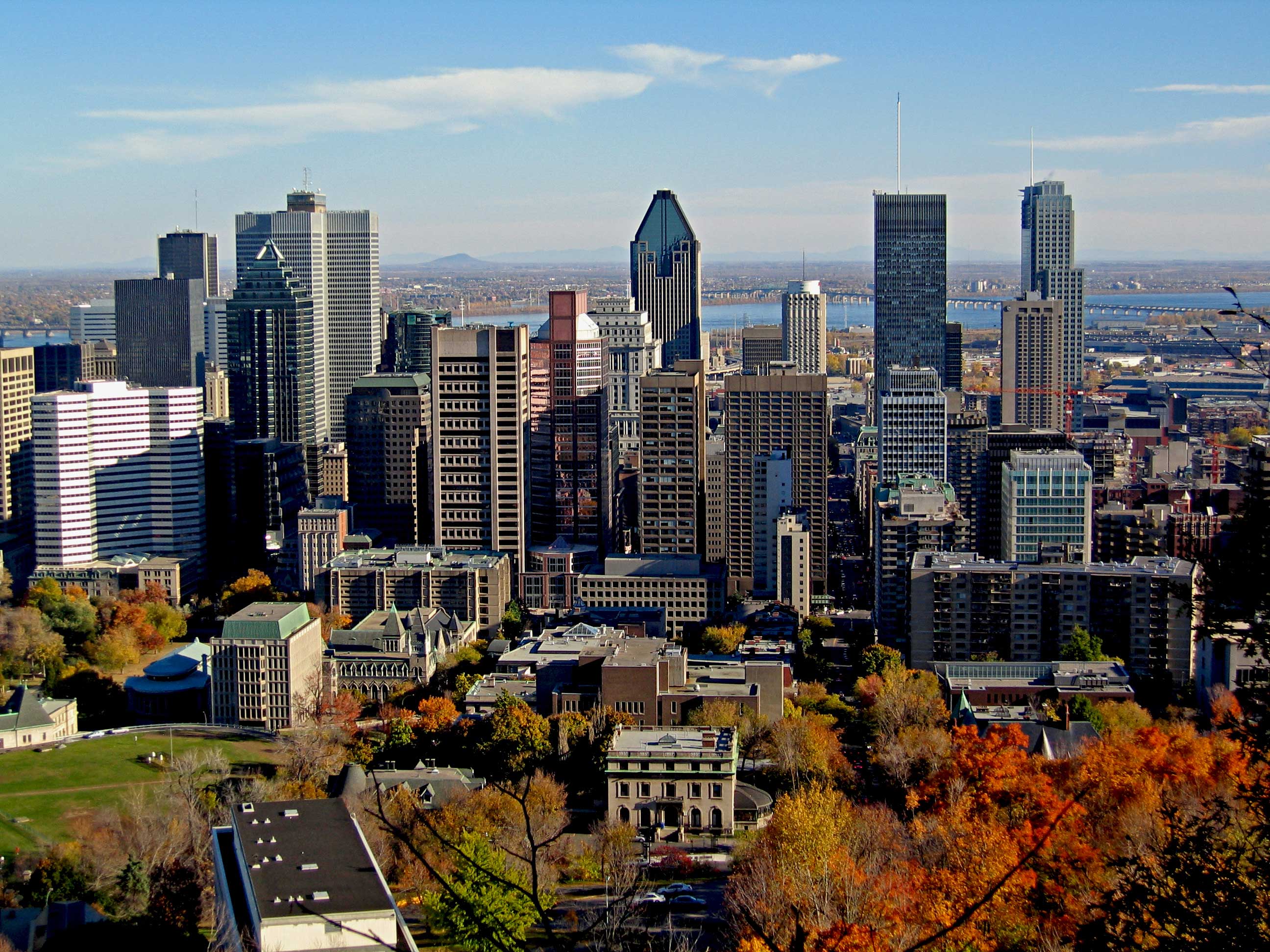
And if it seems like I love this city, your perception is correct. Aside from New York, Montréal is my favorite city in the world. They are a lot alike: Each is a big, multicultural city of islands, bound by a subway system, ethnic food and love of sports -- including a shared dislike for both Toronto and Boston. The differences between the cities make the similarities all the more interesting.

Before You Go. This is Canada, the Great White North, but we're in Summer, so the traditional cold won't be a problem. I
t won't be cold enough for you to say, "Sainte merde!" (That's French for "Holy shit!") According to the Montreal Gazette website, they're predicting the low 70s for Wednesday afternoon, and the mid-50s for the evening. They're predicting rain for the morning, but things should dry up by kickoff.

Canada is as serious about COVID as they are about guns: If you're not fully vaccinated, you're not getting past Customs.

Being in a foreign country has its particular challenges -- and, yes, for all its similarities to America, Canada is still a foreign country. The French influence makes Montréal and Québec City seem more foreign even than Toronto, the only city and metropolitan area in Canada with more people than Montréal.

Make sure you call your bank and tell them you're going. After all, Canada may be an English-speaking country (at least co-officially, with French, although Québec is French-first), and a democracy (if a parliamentary one), and a country with teams in America's major leagues, but it is still a foreign country. If your bank gets a record of your ATM card making a withdrawal from any country other than the U.S., it may freeze the card, and any other accounts you may have with them. So be sure to let them know that you will, in fact, be in Canada for a little while.

As of June 1, 2009, you have to have a valid, up-to-date passport to cross the U.S.-Canadian border. You should also bring your driver's license (or other State-issued photo ID). If you don't have a valid passport, you will need a valid photo ID and a copy of your birth certificate. This is not something you want to mess with. Canadian Customs officials do not fuck around: They care about their national security, too.


Do yourself another big favor: Change your money before you go. There are plenty of currency exchanges in New York City, including one on 42nd Street between 7th and 8th Avenue. There are also a few in New Jersey: Travelex has exchange centers at Newark Liberty International Airport, and at 4 malls: Garden Sate Plaza in Paramus, Jersey Gardens in Elizabeth, Menlo Park Mall in Edison and Bridgewater Commons. 


Leave yourself $50 in U.S. cash, especially if you're going other than by plane, so you'll have cash on your side of the border. I was actually in Montréal on the day when it most favored the U.S.: January 18, 2002, $1.60 to $1.00 in our favor. As of tonight, August 24, US$1.00 = C$1.30, and C$1.00 = US 77 cents.

The multi-colored bills were confusing on my first visit, although we have those now, too:

* The $5 is blue, and features Wilfrid Laurier, Prime Minister, 1896-1911.

* The $10 is purple, and used to feature John A. Macdonald, the 1st Prime Minister, 1867-1873 and again 1878-1891. Essentially he's their George Washington, without having fought a war for independence. Now, it features Viola Desmond, the 1st black person, and the 1st woman other than Queen Elizabeth, to appear on Canadian banknotes. She was a businesswoman who, in 1946, challenged racially segregated seating in a movie theater in her native Halifax, Nova Scotia. Essentially, she was Canada's Rosa Parks, 9 years before Mrs. Parks became our Mrs. Desmond.
* The $20 is green, and features the nation's head of state, Britain's Queen Elizabeth II.
* The $50 is red, and features William Lyon Mackenzie King, the longest-serving Prime Minister, 1921-1926, 1926-1930, 1935-1948, including World War II.
* And the $100 is yellow, and features Robert Borden, Prime Minister 1911-1920, including World War I.

The tricky part is going to be the coins – and you'll thank me for telling you this, but keep your U.S. coins and your Canadian coins separate, for the simple reason that their penny, nickel, dime and quarter are all the same colors and just about the same size as our respective coins. (To make matters more confusing, as we recently did with our States, they had a Provincial quarter series.)

All coins have Queen Elizabeth's portrait on the front, as the monarch of Great Britain remains the monarch of all British Commonwealth nations, including Canada. But she's been Queen since 1952, and depending on how old the coin is, you might get a young woman, or her current 92-year-old self, or anything in between. You might even get a penny or a nickel old enough to feature her father, King George VI. Such a coin is still legal tender, however.

On the backs, the penny has maple leaves, the nickel a beaver, the dime a sailboat, and the quarter an elk. 
They have a $1 coin, copper-colored, bigger than a quarter, and 11-sided, with a bird on the back. This bird is a loon – not to be confused with the people lunatic enough to buy Maple Leafs season tickets. The coin is thus called the "loonie," although they don't say "ten loonies": They use "buck" for "dollar" the way we would. In fact, the term is connected to Canada: Their first English settlers were the Hudson's Bay Company, and they set the value of a dollar to the price of the pelt of a male beaver, the male of the species being called, as are those of a deer and a rabbit, a buck. (And the female, a doe.) The nation's French-speakers (Francophones) use the French word for loon, and call it a "huard."


Then there's the $2 coin, or "toonie." It's not just two dollars, it's two-toned, and even two-piece. It's got a copper center, with the Queen on the front and a polar bear on the back, and a nickel ring around it. This coin is about the size of the Eisenhower silver dollars we used to have. This is the coin that drives me bonkers when I'm up there.

My suggestion is that, when you first get your money changed before you begin your trip, ask for $1 coins but no $2 coins. It's just simpler. I like Canada a lot, but their money, yikes, eh?

Montréal is in the Eastern Time Zone, so you won't have to fiddle with your timepieces. And while a working knowledge of French will help considerably, it is not necessary: Just about everybody in Montréal understands and speaks English.


And most signs shouldn't be too hard to read, as they'll look like the signs in the U.S. (EXIT signs read SORTIE but look like EXIT signs, STOP signs are still eight-sided and red, etc.) However, from experience, I can tell you this: As Québec is Francophone, if you check your phone messages, your signal may get beamed to a Canadian satellite, and you may hear your message in French. And, if you don't understand spoken French, that could be a problem.

Tickets. CF 
Montréal averaged 16,078 fans per home game in 2019, the last pre-COVID season. That's about 89 percent of capacity at Saputo Stadium. While they play early-season games (due to the weather) and Playoff games (due to the, well, impact) at the 61,000-seat Olympic Stadium, getting tickets at Saputo will be hard.

Fortunately, soccer is the one major sport in North America where visiting fans are segregated, with a section set aside for them. In Saputo's case, it's at the top of Section 112, in what is officially the northeast corner, but is geographically the northwest corner, as Montreal's streets are cockeyed from the compass. This will put you in view of the Olympique Tower, which was designed to support the roof of the Olympic Stadium. Tickets here are C$40 (about US$30.80).

Getting There. It's 367 miles from Times Square to downtown Montréal, and 373 miles from Red Bull Arena to the Olympic Stadium and Saputo Stadium (which are both part of the Olympic Park complex). That's in that difficult range where it's a little too close to fly, but too far to get there any other way. Downtown Montréal is 43 miles from Lacolle Inspection Station, at Lacolle, Québec and Champlain, New York, the usual border crossing for travelers between New York and Montréal.

Air Canada runs flights out of Newark Liberty, John F. Kennedy and LaGuardia International Airport, and the flight to Montréal-Pierre Elliott Trudeau International Airport (formerly known as Dorval International Airport, for the suburban town it's in) takes about an hour and a half. Book on Air Canada today, and it will cost about US$475. Most American carriers will cost roughly the same, but getting a nonstop flight will be harder. From the airport, at the western edge of the city, a bus (appropriately, Number 747) will take about half an hour to get downtown.

Greyhound runs 5 buses a day from Port Authority Bus Terminal to Autobus Greyhound, at 1717 Rue Berri at Boulevard de Maisonneuve. (Countries in the British Commonwealth, including Canada, call a local bus a bus and an inter-city bus a "coach.") The ride averages about 8 hours, and is $292 round-trip, but can drop to as low as $170 on advanced purchase.

In fact, if you don't want to spring for a hotel room, you can leave Port Authority at 12:01 AM, arrive in Montréal at 8:20 AM, leave again at 11:45 PM, and arrive back home at 7:40 AM.

The terminal is big and clean, and you shouldn't have any difficulties with it. If you made the mistake of not changing your money yet, there is an exchange window there. It's got a stairway leading to the Berri-UQAM (University of Québec at Montréal) Metro station. 1717 Rue Berri at Blvd. de Maisonneuve.
Montreal's bus terminal, with its towering parking decks

Amtrak, however, is currently not running trains to Montreal, due to COVID restrictions. Even under normal conditions, it runs just one train, the Adirondack, in each direction each day between New York and Montréal, in cooperation with Canada's equivalent, VIA Rail. This train leaves Pennsylvania Station at 8:15 AM and arrives at Gare Centrale (Central Station) at 7:11 PM, a trip of almost 11 hours. The return trip leaves Montréal at 10:20 AM and gets back to Penn Station at 8:50 PM. And since Wednesday night's game starts at 7:30, you'd have to take the trip on Tuesday to get there on time, and spend not 1 but 2 nights in a hotel.

So, while Gare Centrale, bounded by Rue de la Gauchetiere, Rue University, Rue Belmont and Rue Mansfield, is in the heart of the city, taking Amtrak/VIA to Montréal is not particularly convenient. Especially since the Adirondack, with its views of the Hudson River and Lake Champlain, is one of Amtrak's most popular routes, and it could sell out. If you still want to try it, it's $154 round-trip.

If you're driving, if you live close to the Garden State Parkway, take it across the State Line to the New York State Thruway, Interstate 87. If you live near New Jersey Route 17, take that up to the Thruway. Same with Interstate 287. Once you get to the Thruway/I-87, remain on it through Albany, after which it becomes the Adirondack Northway, all the way up to the border.
Champlain, New York to Lacolle, Québec

When you get to the border, you'll be asked your citizenship, and you'll have to show your passport and your photo ID. You'll be asked why you're visiting Canada. Your going up just to seeing a Red Bulls vs. Impact game might strike them as being a little odd, but they won't keep you out of their country based on that alone. But they will keep you out if you don't have a COVID vaccination card.

If you're bringing a computer with you (counting a laptop, but probably not counting a smartphone), you don't have to mention it, but you probably should. Chances are, you won't be carrying a large amount of food or plants; if you were, depending on how much, you might have to declare them.

Chances are, you won't be bringing alcohol into the country, but you can bring in ONE of the following items duty-free, and anything above or in addition to this must have duty paid on it: 1.5 litres (53 ounces) of wine, or 8.5 litres (300 ounces or 9.375 quarts) of beer or ale, or 1.14 litres (40 ounces) of hard liquor. If you have the slightest suspicion that I'm getting any of these numbers wrong, check the Canada Customs website. Better yet, don't bring booze in. Or out.

As for tobacco, well, you shouldn't use it. But, either way over the border, you can bring up to 200 cigarettes, 50 cigars, and 200 grams (7 ounces) of manufactured tobacco. As for Cuban-made cigars, last year, President Obama loosened the embargo so that you can import up to $100 worth of Cuban-made tobacco per traveler.


On October 14, 2016, President Obama finally ended the ban on bringing Cuban cigars into America. This also applies to rum, for which Cuba is also renowned. It is still considerably easier to buy these items in Canada than in America, but, now, you can bring them back over the border.)

If you've got anything in your car (or, if going by bus or train, in your luggage) that could be considered a weapon, even if it's a disposable razor or nail clippers, tell them. And while Canada does have laws that allow you to bring in firearms if you're a licensed hunter (you'd have to apply for a license to the Province where you plan to hunt), the country has the proper attitude concerning guns: They hate them. They go absolutely batshit insane if you try to bring a firearm into their country. Which, if you're sane, is actually the sane way to treat the issue.

You think I'm being ridiculous? How about this: Of the 46 U.S. Presidents -- 9 counting the Roosevelts, Theodore after he was President and Franklin right before -- 7 have faced assassins with guns, 6 got hit and 4 died; but none of the 23 people (including 1 woman) to serve as Prime Minister of Canada has ever faced an assassination attempt. John Lennon recorded "Give Peace a Chance" in Montréal and gave his first "solo concert" in Toronto, but he got shot and killed in New York. In fact, the next time I visit, I half-expect to see a bumper sticker that says, "GUNS DON'T KILL PEOPLE, AMERICANS WITH GUNS KILL PEOPLE."


(Another note about weapons: I'm a fan of the TV show NCIS, which airs in Canada on Global Network TV. If you are also a fan of this show, and you usually observe Gibbs Rule Number 9, "Never go anywhere without a knife," this time, forget it, and leave it at home.  If you really think you're going to need it -- as a tool -- mention the knife to the border guard, and show it to him, and tell him you have it to use as a tool in case of emergency, and that you do not plan to use it as a weapon. Do not mention the words "Rule Number 9" or quote said rule, or else he'll observe his Rule Number 1: Do not let this jackass into your country, eh?)

And if you can speak French, don't try to impress the Customs officials with it. The locals might appreciate that you're trying to speak to them in their primary language, but they won't be especially impressed by any ability to speak it, and any such ability won't make it any easier for you to get through Customs.

When crossing back into the U.S., in addition to what you would have to declare on the way in (if you still have any of it), you would have to declare items you purchased and are carrying with you upon return, items you bought in duty-free shops or (if you flew) on the plane, and items you intend to sell or use in your business, including business merchandise that you took out of the United States on your trip. There are other things, but, since you're just going for hockey, they probably won't apply to you. Just in case, check the Canadian Customs website I linked to above.

After going through Customs, I-87 will become Autoroute 15, which will take you right into the Montréal area. 
If you're going to a downtown hotel, take Exit 53 to Pont Champlain (the Champlain Bridge), which will take you to Autoroute 10, the Bonaventre Expressway, across the St. Lawrence River and right into downtown -- or, as they say, Centre-ville. If you're going only for the game, and going directly to the stadium, do not take the exit for the Champlain Bridge, but keep going, which will have you on Autoroute 20, and take Exit 8 for Pont Jacques-Cartier, across the river to Avenue de Lorimier.  Turn right on Rue Sherbrooke, which will get you right to the stadium.

If you make 2 rest stops – I would recommend at or near Albany, and count Customs, where they will have a restroom and vending machines – and if you don't do anything stupid at Customs, such as fail to produce your passport, or flash a weapon, or say you watch South Park (a show with a vendetta against Canada for some reason), or say anything unkind about the late Maurice "Rocket" Richard, the trip should take about 8 hours.

Though that could become 9, because Montreal traffic is pretty bad, though not as bad as Toronto, which is every bit as bad as traffic in New York, Boston and Washington.

Once In the City. Montréal is one of the oldest cities in North America, founded by France in 1642. Seeing a big hill in the middle of the island will tell you where the name came from: "Mont Real," "Royal Mountain." In some instances, things in the city are spelled as "Mont Royal."

With 1.7 million people, Montréal has more people than any American city except New York, Los Angeles, Chicago and Houston. There are 4.2 million people in the metro area.


Since Canada is in the British Commonwealth, there are certain subtle differences. Dates are written not as Month/Day/Year, as we do it, but as Day/Month/Year as in Britain and in Europe. So while we would write the date of the game as "August 31, 2022," they would write it as "31 August 2022." Not 8/31/22, but 31/8/22. They also follow the British custom in writing time: A game starting at 7:30 PM would be listed as 1930. (Those of you who have served in the military, you will recognize this as, in the words of M*A*S*H's Lt. Col. Henry Blake, "all that hundred-hours stuff.")


And every word we would end with -or, they will end with -our; and some (but not all) words that we would end with -er, they end with -re, as in "Bell Centre." Every measurement will be in the metric system: Temperatures will be in Celsius, not Fahrenheit; distances will be in "kilometres" (including speed limits), and gas prices will be per "litre," not per gallon. 
Speaking of which: Gas prices will be not just in Canadian dollars, but will be per "litre." So, if you're driving, get your gas here in New Jersey, where it's currently running about half as much as it would be there. 

When you arrive, I would recommend buying The Gazette and The Globe and Mail. The former newspaper is the city's predominant English-language paper, the latter is national, and both are liberal enough to suit my sensibilities (or, should I say, sensible enough to suit my liberalism). And The Gazette has a very good sports section, and does a superb job covering the Canadiens, and nearby minor-league, collegiate and "junior" hockey teams no matter what time of year it is.

I would advise against buying French-language papers like La PresseLe Journal de Montreal and Le Devoir -- The Press, The Journal, and The Duty -- unless you really know French cold. Especially since Le Devoir is the local paper of Québec nationalism and even separatism. If The Gazette and The Globe and Mail are too liberal for you, The National Post may be more to your liking. Either the bus or the train terminal will have out-of-town papers, including The New York Times, and possibly also the Daily News or the New York Post.

Like New York, Montréal is a city of islands, with a main island in the center -- except, unlike Manhattan, you won't cross a State Line (or, in this case, a Province Line) by going over a bridge or into a tunnel. Like New York, Montréal is international and multiethnic: In spite of French being the largest ethnic group, there are significant Irish, Italian and Jewish communities, and, for linguistic reasons, a large and growing community of immigrants from France's former African colonies, and also from its former Middle Eastern colonies like Lebanon, Syria and Iran, places where French is still widely spoken.


The city is about 67 percent white, 9 percent black, 7 percent East Asian, 7 percent Middle Eastern, 4.2 percent Hispanic, 3.3 percent South Asian, 2.5 percent Aboriginal. (Canada calls its "Native Americans" the "First Nations.") About 66 percent of the city say their first language is French, 13 percent English, but nearly everybody speaks both to some degree, because they have to in order to get by in this city.

Montréal doesn't have a highway "beltway," and it doesn't really have a centerpoint. (Centrepoint? pointe du centre?) To make matters even more confusing, while they have East and West (Est et Ouest) on street names, like Manhattan, the main island is not perfectly north-south. Indeed, it's actually more than a 45-degree angle, so what's east is more north, and what's west is more south. Boulevard St-Laurent, known as The Main in English and Le Main (pronounced "leh man" in French), is the official east-west divider, where the address numbers on each side start at 1, while the river is the starting point for north-south-running streets.

The further west you go in the city, the more likely you are to hear English; the further east, the more likely you will be to hear only French. In fact, in Montréal's East End, you might see several buildings flying only the Provincial flag, the Fleurdelyse, the blue flag with the white cross and the white lilies in the cantons. These people who fly only the Provincial flag, not the red-white-red tricolor with the red Maple Leaf in the center, are separatists, who consider Québec a separate nation and want Anglophone Canada to "Let my people go." The separatist tide has faded since the nearly successful referendum of October 30, 1995, but there is still strong separatist sentiment in the East End, and this increases the closer you get to the Provincial capital, Québec City.

Roger Doucet, an opera singer who sang the National Anthem at Expos and Canadiens games in the 1970s before his death from cancer in 1981, would acknowledge this divide: He would begin the anthem in French, and face the east side of of Parc Jarry, Stade Olympique or the Forum; then, in mid-song, turn and face the west side of the structure, and conclude in English.

Société de Transport de Montréal runs a subway, opened in 1966 and known as "Le Metro," just like that of Paris. When I first visited, they didn't use tokens or farecards. They used actual tickets. Very small tickets, an inch by an inch and a half. Thankfully, they now use a farecard, called an Opus Card. They charge $3.25 for 1 trip, $6.00 for 2, $26.50 for 10, $10.00 for a one-day card, and $13.00 for an "Unlimited Week-end" running from 6 PM Friday to 5 AM Monday. With the exchange rate, the prices are (especially when you factor in the new-MetroCard fee) roughly comparable to the New York Subway.

Reading the Metro map shouldn't be too much trouble, even if you don't know French. Until 2014, the trains, regardless of the color of the line, were all blue. But, like their contemporaries, New York's "Redbirds," they've been replaced by silver cars.
Postal Codes in Montréal and its suburbs begin with the letter H. The Area Codes are 514 for the main island and 450 for the suburbs, with 438 as an overlay. Hydro-Québec runs the electricity for the Province.

Just as Minneapolis tried to beat the cold by building a skywalk system downtown, Montréal went in the other direction, creating "Underground Montreal." (In French, La Ville Souterraine.) Every day, about half a million people use this system that has over 20 miles of tunnels spread over 4.6 square miles. They connect things like shopping malls, hotels, banks, office buildings, museums, universities, apartment buildings, the bus terminal, Gare Central and Gare Windsor, 7 Metro stations, and the Bell Centre.

The Provincial sales tax for Québec is 9.975 percent. The legal drinking age in Québec is 18. And if you're staying overnight, and wake up with a craving, and you can't find a Tim Hortons, you can look for a dépanneur. The word means "to help out of difficulty," is sometimes shortened to "dep," and is what we would call a convenience store. Like 7-Eleven or Wawa or Quik Chek. (There's now an eatery named Dépanneur in Brooklyn.)


Going In. I seriously recommend not driving to the stadium. If you did drive to Montréal, leave your car at the hotel's parking deck. Getting to the Parc Olympique complex by public transportation is easy. The Green Line goes to Station Pie-IX (pronounced "pee noof," and named for Pope Pius IX, who reigned 1846-78), and is used for the entirety of the park because of Montréal's cold weather, although going 1 station further, to Viau, would be better for Saputo Stadium.

The Montreal Impact were founded in 1993, entered Major League Soccer in 2012, and rebranded as Club de Foot Montréal in 2021. I guess they were tired of their rivals, Toronto F.C., calling them not "L'Impact" but "Limp Act."

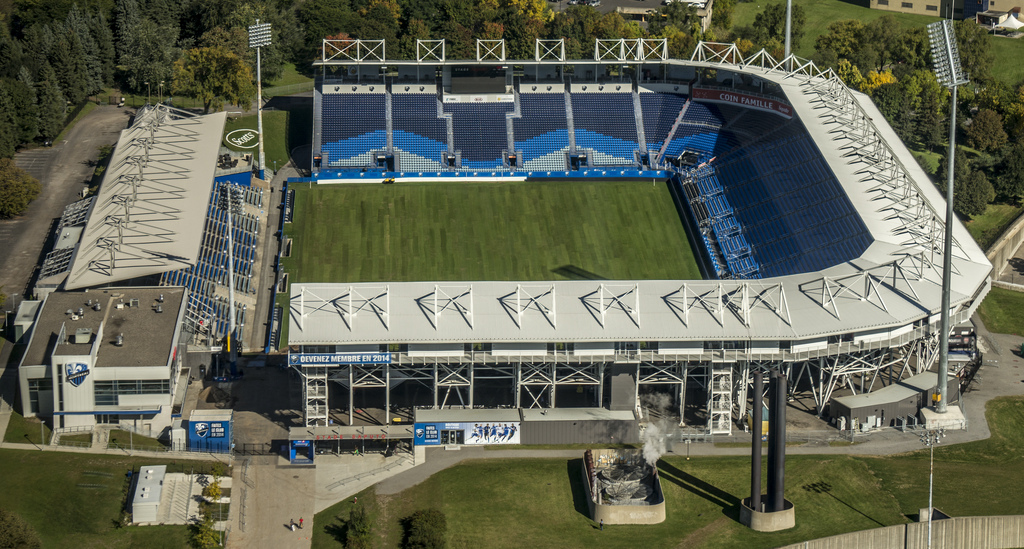
They play most of their games at 20,081-seat Saputo Stadium (Stade Saputo), just to the north of the Olympic Stadium, at 4750 Rue Sherbrooke, about 4 1/2 miles east of downtown. Despite its Japanese-sounding name, Saputo is a Montréal-based dairy company, which, like the team, is owned by its Italian-Canadian founder, Joey Saputo. He also owns Italian club Bologna F.C.
Its field runs north-to-south, and, unlike most outdoor facilities in Canada, is natural grass. The stadium opened in 2008. 
Interior photo, with Olympic Tower in the background

Parc Olympique also includes the Olympic Stadium; an arena named for Canadiens great Maurice Richard, with a statue of him outside; the Velodrome cycling center, now a nature museum called the Biodome; the Montreal Botanical Garden and the Montreal Insectarium. But you don't want to see a museum devoted to bugs.

In 2019, the Canadian Premier League, Canada's attempt at a "top flight" soccer league, began play, but there is no Montréal team in it, not even CFM's top farm team, CF Montréal Academie.

Food. Montréal is a great food city, but there are 2 things of which you should beware. One is Montréal-style hot dogs. This is a problem since hot dogs are a staple of sporting events. They call their hot dogs steamé, stimé or Steamies, and top them with mustard, chopped onion or sauerkraut. Sounds like New York-style, right? But they also put this weird relish on it, and that ruins it. Do yourself a favor, and order your Steamie without relish.

(Incidentally, in spite of my suggestions of similarities between Montréal and New York, don't expect to see hot dog carts on the streets: The city banned street food carts in 1947.)

The other food you will want to avoid is poutine. It's French fries topped with brown gravy. Sounds great, right? Not so fast: They also top it with curd cheese. As they would say in the city's Jewish neighborhood, "Feh!" Poutine, like French fries (they call them patates frites, "fried potatoes," as they know that the item originated in Belgium, not France), is available at McDonald's, but stay away from it. Trust me.

If you're a fan of the film Pulp Fiction, you should be aware that, regardless of what it's called in Paris, in Montréal, a Quarter Pounder with Cheese is called "un quarte de livre avec fromage." Literally, "a quarter of a pound with cheese." Not "a royale with cheese."

Neverthless, Saputo Stadium has standard stadium food, and, although none of it is great, most of it upsets Canadian stomachs far less than does Gary Bettman. One staple of Montréal food that is definitely worth it is viande fumée -- smoked meat sandwiches. Think New York's (sadly, now closed) Carnegie Deli, only cheaper and better. Yum, yum.


Team History Displays. Unlike the Canadiens across town, who never cease to remind you of their unbelievable history (because their present is so hit-and-miss), CFM don't have much history. They've won the Voyageurs Cup, Canada's equivalent of the FA Cup, in 2008, 2013, 2014, 2019 and 2021, and lost the Final in 2015. They reached the Final of the 2015 CONCACAF Champions League, and were MLS Eastern Conference Runners-Up in 2016. That's it.

Montréal native and former head coach Mauro Biello was a forward for the original version of the Impact. His Number 20 has been retired by the club. They've also retired 12 for the fans, "the 12th Man." But there is no display for either these numbers or the Cup wins in the playing area of either Saputo Stadium or the Olympic Stadium.
Mauro Biello

The most heralded player in Impact history was Didier Drogba, the Ivory Coast forward who made his name as a pathetic (but very successful) diver at West London's Chelsea. He played for the Impact in the 2015 and 2016 seasons.
A rare photo of Drogba not diving

There is no trophy awarded to the annual winner of the 401 Derby between TFC and CF Montréal, named for the highway connecting Canada's 2 largest cities. Therefore, this rivalry should be judged by games won, rather than seasons won: Toronto 27, Montréal 18, 11 draws. If you do go by seasons won, then it's Toronto 9, Montréal 4, with 1 split. The Impact knocked TFC out of the Playoffs in 2015, but Toronto returned the favor in 2016.

Stuff. The CF Montréal Boutique is inside Saputo Stadium, and should be open on matchday even when the game is at the Olympic Stadium. As for the latter, there should be souvenir stands around the concourse.

As a young team, there are no team videos for CFm. And Amazon.com doesn't seem to have any books about them.

During the Game. You do not need to fear wearing your Red Bulls gear to the Olympic Stadium or Saputo Stadium. Fans visiting from Toronto, maybe. Vancouver, possibly. Any other team, no way: Aside from Montreal's international, multiethnic status, and the experience some of their fans may have gotten in Europe, Africa or Latin America, as long as you don't start any rough stuff, neither will they.

The rivalry with Toronto may actually be nastier than Canadiens-Maple Leafs, and certainly more so than Alouettes-Argonauts. During the 2016 season, a section of TFC fans -- the Inebriatti (more about whom later), insist it was not them -- raised a tifo (banner) showing a woman in Montréal blue kneeling before a man in Toronto red (the opposite colors from hockey and football), suggesting that she was, um, providing him with a naughty service. The perpetrators were identified, and their season tickets revoked.

In 2017, Montréal got its revenge, hanging a banner reading "FUCK TORONTO." Again, the guilty parties were punished. Later in the season, another banner was raised, with a homophobic slur against Toronto star Sebastian Giovinco.

As with the largely Irish, Italian and Hispanic Bleacher Creatures at Yankee Stadium, the French fans of Montreal may be letting the conservative side of Catholicism take hold. When your excuse for bigotry is your religion, maybe it's time to take a second look at your religion.

Since you're in Canada, there will be two National Anthems sung. "The Star-Spangled Banner" will probably be sung by about half of the few hundred Red Bulls fans who show up, but "O Canada" will be sung by the home fans with considerable gusto. The Impact hold auditions for anthem singers, rather than have a regular.

When I'm at a sporting event where the opposing team is Canadian, I like to sing "O Canada" in French. Canadiens fans like this when I do it at the Prudential Center. Fans of the other Canadian NHL teams just think it's weird. But then, they root for the Blue Jays, and I root for the Yankees, so I'd rather have their opinion of me than my opinion of them.

Announcements are made in English and French. The Impact have a mascot, a dog named Tac-Tik. He's world-class, at both making a pass and scoring.
You dog, you.

The Impact's main supporters group is called Ultras Montréal, also known as UM02, because it was founded in 2002. They sit in Sections 132 and 133 of Saputo Stadium, the south end one, just like the Red Bull ultras (almost down to the exact section numbers). They sing all their songs in French, especially their big song, "Montréal, Allez, Allez." They follow the Impact on away games against the Red Bulls, NYCFC, the Philadelphia Union, the New England Revolution, DC United and Toronto FC.
UM02, waving the city flag, which has a French lily,
an English rose, a Scottish thistle and an Irish shamrock,
for Montréal's classic 4 ethnic groups.

127 Montréal was formed in 2011, and they follow the Impact on occasional away games. 1642MTL, named for the year the city was founded, began in 2015, and sits in Section 114 at Saputo.

The North Star is a bell, 5 feet high, 44 inches wide, weighing 1,576 pounds. It was acquired by 1642MTL as a goal and victory celebration. It was inaugurated on October 25, 2015 by Mayor Denis Coderre, and it was rung twice in an Impact victory over Toronto.

Since then, numerous famous Montrealers have been invited to ring the bell, similar to raising the 12th Man Flag at Seattle Seahawks games. Among the Montrealers who've done it have been soccer player Josée Bélanger and mixed martial artist Georges St-Pierre. The bell is taken from Saputo to the Olympic Stadium when the Impact play there, but is not taken on the road.
After the Game. Montréal is an international city, every bit as much as New York is, and some of these people may be immigrants who cut their teeth as sports fans in European soccer. But we're not talking about hooligans here. Maybe if you were coming out of a hotly-contested game against the Toronto or Vancouver, but not against a New York Tri-State Area team -- not even fellow Jean-come-latelies NYCFC.

If you want to go out for a postgame meal, or even just a pint, you're out of luck as far as the Olympic Park area goes. Better to go downtown. This game being a 7:00 start, it should be over by 9:00, but you should be able to find a place with an open kitchen.


The Rue Crescent neighborhood, centered around that west-of-downtown street and roughly bordered by Rue Sherbrooke, Rue Peel, Boulevard René-Lévesque and Rue Guy (that's "gee" with a hard G, not "guy" rhyming with "high"), is, more or less, Montréal's "Greenwich Village." You should be able to find a place that will serve you even if you order in English. Be advised, though, that you must remove your hat when you walk into a Montréal pub. They insist.

Madisons New York Grill & Bar is at 5222 Rue Sherbrooke Est, a 5-minute walk from the Olympic Park that includes the Olympic and Saputo stadiums, and is renowned for its chicken tenders. However, there is no evidence that this is a particular place that New Yorkers visiting, or ex-New Yorkers living in, Montréal tend to go to. Plus, I've been told it's more of a "restaurant" than a "bar," and that it's "kind of like a nicer TGI Friday's." If that's true, expect mediocre food at too-high prices and lousy service.


If all you need is a snack and coffee, your best bet may be Tim Hortons. (Note that there is no apostrophe: It's "Hortons," not "Horton's," because Bill 101, Québec's ridiculous protect-the-French-language law, prohibits apostrophes, and the company wanted to keep the same national identity.) They have a 62 percent share of the Canadian coffee market (Starbucks has just 7 percent), and 76 percent of the Canadian baked goods market. They also sell sandwiches, soup, chili, and even (some of you will perk up faster than if you'd drunk their coffee) New York-style cheesecake. It's fast food, but good food. I rate them behind Dunkin Donuts, but ahead of Starbucks.

"Timmy's" (in the diminutive, people do use the apostrophe) has Montréal outlets even though namesake Tim Horton, a hockey defenceman (that's how it's "spelt" up there), played most of his career for the hated Maple Leafs. He and businessman Ron Joyce started the doughnut/coffee shop chain in 1964, while in the middle of the Maple Leafs' 1960s dynasty. He played a couple of years for the Rangers, then went to the Buffalo Sabres and opened a few outlets in the Buffalo area. He was still playing at age 44, and the only thing that stopped him was death. Specifically, a 100-MPH, not-wearing-a-seat-belt crash on the Queen Elizabeth Way over Twelve Mile Creek in St. Catharines, Ontario.


And if Canada's answer to Dunkin Donuts isn't your cup of tea (or coffee), there's always the dépanneurs. And if you really, really want Dunkin Donuts, there is one in the Place Ville-Marie mall, at Rue Mansfield and Blvd. René-Lévesque, 4 blocks from the Bell Centre, although it may not be open after the game.

You should stay away from Bar St. Laurent Frappé at 3900 Blvd. St-Laurent, as that the home bar of the FCM ultras. It's one thing to visit it when it's not your team playing FCM; it's another thing altogether when it is.

If your visit to Montréal is during the European soccer season, which is back underway, you should be able to find a place to watch your team. Note that not every big club -- or even "big club" -- has a presence in Montréal:


Arsenal, Chelsea and Manchester City: Gooners, Blues and Sky Blues meet at The Burgundy Lion, 2496 Notre-Dame Ouest & Charlevoix. Orange Line to Lionel-Groulx.

* Liverpool, Bayern Munich and Borussia Dortmund: Fans of the Mersey Reds, Die Roten and Die Schwarzgelben meet at the Irish Embassy, 1234 Rue Bishop and Rue Ste-Catherine. Red Line to Lucien-L'Allier.

* Manchester United: Man U fans usually meet at Station Des Sports, 2051 Rue Ste-Catherine Ouest. Green Line to Atwater. But it is temporarily closed.

Tottenham Hotspur: Those dumb demented Spuds meet at Kelly's Pub, 88 Avenue Donegani and Avenue King. Bus 204. Their New York counterparts also once met at a Kelly's, on the Lower East Side, before moving to their current location, Flannery's in Chelsea.

* Celtic: Bhoys meet at Le Cordon, 150 Rue Notre-Dame Ouest, in the suburb of Lachine. Orange Line to Lionel-Groulx, then transfer to Bus 90 to Saint-Pierre.

* Paris Saint-Germain: PSG fans meet at L'Barouf, 4171 Rue St-Denis. Orange Line to Mont-Royal.

Olympique de Marseille: L'OM fans meet at La Massillia (an Italian restaurant?), 4543 Avenue du Parc. Orange Line to Mont-Royal, then Bus 97.

* Real Madrid: Not sure where Madridistas meet, but it could be at Club Espagnol, where fans of the Spain national side meet. 4388 Blvd. Saint-Laurent. Orange Line to Mont-Royal, then a bit of a walk.

* Barcelona: Cules meet at Champs, 3956 Blvd. St-Laurent, just a short walk from Club Espagnol. Orange Line to Sherbrooke, then a bit of a walk.

* Juventus: Juventini meet at Bruno Sport Bar, 313 Rue Beaubien Est, near Jarry Park. Orange Line to Beaubien.

* AC Milan: Milanisti meet at CioCiaro, 8868 Blvd. Langelier, in the suburb of Saint-Léonard. Green Line to Langelier, then Bus 33 to Lacoursiere.

* Internazionale Milano: Interisti meet at Café Milano, 5188 Rue Jarry Est, also in Saint-Léonard. Green Line to Cadillac, then transfer to Bus 32 to Jarry.

* Other Italian teams: Cafe Olympico is said to be a home for fans of the Italian national team. 124 Rue St-Viateur Ouest, off Rue Waverly. Orange Line to Rosemont, then a bit of a walk. 

Ajax Amsterdam: Not sure if it's official for Ajacieden, but fans of the Dutch national team meet at Taverne Normand, 1550 Avenue du Mont-Royal Est. Orange Line to Mont-Royal, then Bus 97.

If you don't see your club listed here, try either the Burgundy Lion or the Irish Embassy.

Sidelights. Montréal is much cleaner than most American cities, mainly because Canada believes in using government for, you know, essential services, including proper sanitation, rather than in giving kickbacks to corporations that claim to create jobs but don't. But the city does have some bad neighborhoods. Still, you should be okay if you stay out of the East End -- or, if you really must go there, are willing to speak French there and give lip service to the separatist cause. In the meantime, check out these locations:

* Olympic Stadium. Also at Parc Olympique, the official address of Stade Olympique (also known as the Big O, for the Big Owe for the 30 years it took to pay off its construction) is 4141 Avenue Pierre-de Coubertin. Since it was built for the 1976 Olympics, the street was renamed for the French baron who founded the modern Olympic Games in 1896. (I can't find a record of what it was named before.) The stadium famously looks like a flying saucer. The Olympic Tower, at 574 feet the tallest inclined tower in the world, supports the cables that hold the fabric roof in place.
It was built for the 1976 Olympics, and for baseball's Montreal Expos, who played here from 1977 to 2004. The Canadian Football League's Montreal Alouettes did so from 1976 to 1986, and again in 1996 and 1997, and have played their Playoff games here since 1998. It was also home to the Montreal Manic of the old North American Soccer League from 1981 to 1983, and the Montreal Machine of the World League of American Football in 1991 and 1992.

Roberto Duran defeated Sugar Ray Leonard for the Welterweight Championship here in 1980, 4 years after Leonard won an Olympic Gold Medal at the Forum. (Leonard got his revenge 5 months later at the Superdome in New Orleans.) Pope John Paul II held a youth rally here in 1984, and many concerts have been held here. It hosted games of the 2015 Women's World Cup, including the U.S. team's Semifinal win over Germany.

It has held preseason games here, on the last weekend before the regular season starts, for 4 straight years, to show current Commissioner Rob Manfred that his predecessor, Bud Selig, got it wrong, and that the city can support a Major League Baseball team.

The field is artificial (naturally, since it's under a meant-to-be-permanent roof), and runs north-to-south.
North America won a joint bid to host the 2026 World Cup. But FIFA only approved BMO Field in Toronto and BC Place in Vancouver as Canada's sites, and not the Olympic Stadium.

* Victoria Rink. Opened on Christmas Eve, December 24, 1862, and named for Queen Victoria, it was described at the dawn of the 20th Century as "one of the finest covered rinks in the world." On March 3, 1875, it hosted what is believed to be the very first indoor hockey game, anywhere in the world, complete with 9 men on a side, goaltenders (not a first but still unusual at that point), a referee, a puck rather than any kind of stone (as could be found in curling, then as now a popular sport in Canada), and both rules and time predetermined -- 60 minutes, as with today's hockey, although no separation into periods.

The Victoria Skating Club played a team made up of students of nearby McGill University -- often considered Canada's answer to Harvard, and the year before it had played Harvard in a game that was vital to the development of football in North America -- and the Victorias won, 2-1.

The Montreal Hockey Club (or the Montreal Amateur Athletic Association, or "Montreal AAA") was awarded the 1st Stanley Cup in 1893, and it hosted the 1st Cup playoff games in 1894. The Victoria Hockey Club won the Cup while playing there in 1895, 1897, 1898 and 1899. The Montreal Shamrocks defeated them for the Cup in 1899 (more than one "challenge series" could be held per year in those days), and won it again in 1900. The rink also hosted some of North America's first figure skating competitions.


It was torn down in 1925, and a parking garage was built on the site. Rue Drummond & Blvd. René-Lévesque Ouest, adjacent to a Sheraton hotel. Metro: Lucien-L'Allier.

* Jubilee Arena. This building didn't last too long, built in 1909 and burning down in 1919, a year after the fire that destroyed Westmount Arena, forcing the Canadiens, who started here, move to Mount Royal Arena. This arena's construction led to the founding of both the Canadiens and the National Hockey Association, the precursor to the National Hockey League. 3100 Rue St-Catherine Est at Rue Moreau. Bus 34.


* Mount Royal Arena. Home to the Canadiens from 1920 to 1926, the Habs won the 1924 Stanley Cup while playing there. It only seated 6,000, so when they were offered the chance to move into the larger Forum, they jumped at it. Mount Royal Arena was converted into a concert hall and then a commercial building, before burning down in 2000. A supermarket is now on the site. 50 Avenue du Mont-Royal Ouest & Rue Saint-Urbain. Bus 55.


* Montreal Forum and Westmount Arena. The Yankee Stadium of hockey, the Forum opened on November 29, 1924, and the Canadiens played there from 1926 until 1996, winning 22 of their 24 Stanley Cups in that span. (They won 2 before moving in, in 1916 and 1924.) The Montreal Maroons also played there, winning the Stanley Cup in 1926 and 1935.


The Canadiens clinched on home ice in 1930, 1931, 1944, 1946, 1953, 1956, 1957, 1959, 1965, 1968, 1979 and 1993; and on the road in 1958, 1960, 1966, 1969, 1971, 1973, 1976, 1977, 1978 and 1986. Famously, the Canadiens never had an opponent clinch the Cup on Forum ice until 1989, when the Calgary Flames did it, the reverse of 1986 when the Habs clinched in Calgary. The Rangers clinched the 1928 Cup on Forum ice against the Maroons, who hung on through the Great Depression for as long as they could, but finally went out of business in 1938.
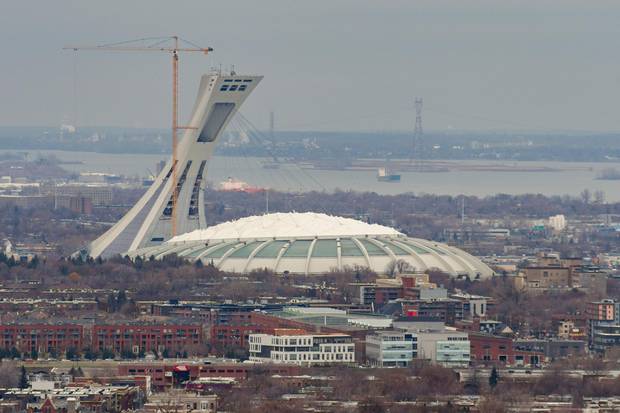

In 1937, the Forum hosted the funeral of Howie Morenz. the Canadiens star known as "The Babe Ruth of Hockey," and later that year hosted the Howie Morenz Memorial Game as a benefit for his family, between a combined Canadiens-Maroons team and players from the other 6 teams then in the NHL, including New York's Rangers and Americans.


Elvis Presley never performed in Montréal -- or anywhere in Canada except shows in Toronto, Ottawa and Vancouver early in his career, in 1957 -- but The Beatles played at the Forum on September 8, 1964. In 1976, it hosted the Olympic gymnastic events, and it was there that Nadia Comaneci performed the 1st perfect 10 routine in Olympic history, having already gotten the 1st perfect 10 anywhere earlier in the year at what was still being called "the new Madison Square Garden."


In 1972, the Forum hosted Game 1 of the "Summit Series" between Canada and the Soviet Union, and the Soviets' shocking 7-3 win turned the hockey world upside-down before Canada won Games 6, 7 and 8 in Moscow to take the series. However, as I said earlier, on New Year's Eve, December 31, 1975, CSKA Moscow, a.k.a. the Central Red Army team, with many of the players from the Summit Series, began a North American tour at the Forum, and what were then the 2 best club hockey teams on the planet played to a stirring 3-3 tie that effectively launched the Habs on a streak of 4 straight Cups, 1976-79, which stand alongside their 5 straight of 1956-60 -- not as many consecutive Cups, but 16 consecutive series won as opposed to 10.


The original seating capacity was 9,300 -- which was considered huge for an indoor stadium in the 1920s, before the building boom that the Forum helped start, leading to that era's incarnations of Madison Square Garden and the Boston Garden, Maple Leaf Gardens in Toronto, Chicago Stadium and the Olympia in Detroit. Capacity became 13,551 in 1949, and a 1968 renovation expanded it to a capacity of 16,259, pushed to 17,959 with 1,700 standees, with the tradition of the standees being let in first and rushing for position.


After an emotional closing ceremony on March 11, 1996, 20 years ago this Friday, the Forum was converted into a mall, complete with restaurants, a bowling alley and a movie theater. Roughly where the rink was, hockey markings have been painted onto the floor of the main walkway, and there's a small bleacher with sculptures of fans and a bench with a statue of Maurice Richard, waiting to take the ice one more time. So, unlike the original Yankee Stadium and the original Boston Garden, the Montreal Forum still stands and is still being used, although not for its original purpose. 2313 Rue St-Catherine Ouest, at Avenue Atwater.

The Forum today

Atwater used to be the city line between Montréal and Westmount, before mostly-Anglophone Westmount was incorporated into the "megacity" of Montréal in 2002. The Westmount Arena, right across from the Forum but in a separate city, was sometimes known as the Montreal Arena for prestige purposes, and was designed specifically for hockey, a rarity at the time, and was perhaps the first ice rink in the world to have the rounded corners we have come to expect from hockey. It opened on New Year's Eve, December 31, 1898, and was the home of several teams.


The Montreal AAA team won the Stanley Cup there in 1902 and 1903, making it 4 Cups, and by 1906 it was an amateur team that lasted until 1961. The Montreal Wanderers played there, winning the Stanley Cup in 1906, 1907, 1908 and 1910. The Canadiens started playing there in 1911, and won the Cup there in 1916.


On January 2, 1918, 19 years to the week after it opened, a fire started in, ironically, the arena's ice-making plant, and burned it to the ground. No one died, but the Canadiens had to move back to Jubilee Arena, and the Wanderers went out of business. A shopping center, Place Alexis-Nihon, is now on the site. Both that shopping center and the Forum can be accessed by Atwater station on the Metro.


* Bell Centre. Originally the Molson Centre, now renamed for Canada's national phone company, the Canadiens moved into this arena adjacent to Windsor Station, 5 days after closing the Forum, on March 16, 1996. It seats 21,288, and the Canadiens have never played to an unsold seat in those 20 years.
The original address was 1100 Rue de la Gauchetière. For the team's 100th Anniversary in 2009, it was relisted as 1909 Avenue des Canadiens-de-Montréal. Lucien-L'Allier or Bonaventure station on the Orange Line.

The tour is fantastic -- and, if you're a Devils fan as I am, you'll see that it, along with the new Philadelphia arena, served as a stylistic model for the Prudential Center. The tour price is C$24.

* Windsor Hotel. Often called Canada's first grand hotel and billing itself as "the best in all the Dominion," it stood from 1875 to 1981. The National Hockey League was founded here on November 26, 1917, with 5 teams: The Montreal Canadiens and Wanderers, the Toronto Arenas (forerunners of the Maple Leafs), the Ottawa Senators (not the team that uses the name today), and the Quebec Bulldogs. By 1934, all but the Habs and the Leafs would be out of business.

Following a fire in 1957, the hotel went into decline, and the North Annex is all that remains, now an office building and banquet complex called Le Windsor. 1170 Rue Peel at Rue Cypress. Metro: Peel or Bonaventure.


* Parc Jarry. Jarry Park Stadium was the original home of the Expos, from April 14, 1969 to September 26, 1976. It was meant as a temporary facility, seated only 28,456, and had a pool beyond right field that was the resting place for a few long home runs. Expos pitcher Bill Stoneman pitched the 2nd of his no-hitters there, and in the park's last MLB game, the Phillies clinched their first 1st-place finish in 26 years.

Now known as Stade Uniprix, in 1995 it was converted into a tennis stadium, with one end still recognizable as the home-plate seating area from Jarry Park. 285 Rue Faillon Ouest at Rue Gary-Carter. (Carter played his 1st 2 seasons there.) Metro: Parc. (Not to be confused with the Metropark train station on the Woodbridge-Edison border back in New Jersey.)


With the Expos gone, the closest MLB team to Montréal is, surprise, not the other Canadian team, the Toronto Blue Jays, 343 miles away; but the Boston Red Sox, 309 miles away. Likewise, the Boston Celtics are the closest NBA team, 307 miles away. If Montréal did get a new team, the metro area would rank 20th in MLB population.

According to an article in the May 12, 2014 New York TimesMontréal basketball fans divide their fandom between the Celtics, the Los Angeles Lakers, and the Miami Heat. How LeBron James' return to the Cleveland Cavaliers affected that, I don't know. But his move to the Lakers probably changes things a lot.

* Site of Delorimier Stadium. Home of the Montreal Royals from 1928 to 1960, and the Alouettes from 1946 to 1953, this 20,000-seat stadium was one of the best facilities in the minor leagues, and was Jackie Robinson's 1st home field in "organized ball." It was demolished in 1971 and replaced by a school, with a plaque honoring Robinson and the Royals. 2101 Rue Ontario Est & Avenue de Lorimier. Bus 125.


* Percival Molson Memorial Stadium. Built in 1915, this stadium has been the home field for McGill University athletic teams, and was used by the Alouettes from 1947 to 1967, and again since 1998, although with only 25,012 seats, they still need to move into the Olympic Stadium for their Playoff games. It also hosted the 2014 edition of Canada's National Championship for college football, the Vanier Cup, with the Université de Montréal (UdeM) defeating McMaster University of Hamilton, Ontario.


It was named for Captain Percival Molson, a former McGill sports star and member of the Molson brewing family (which, for a time, owned the Canadiens), who was killed in action in World War I. 475 Avenue des Pins (Pine Avenue) at Rue University. Metro: McGill.

* Autostade site. The Autostade was built as part of Expo '67, the World's Fair that announced the city's entry into the modern world (and gave the baseball team its name). It opened in 1966, and the Alouettes played there from 1968 to 1976.

But it was not a popular venue, due less to its weird look (the Sixties were a great decade for many things, but architecture was not one of them) than to its location, on an island in the St. Lawrence River, making it cold even in the summer. The Als moved to the Olympic Stadium for the 1977 season, and the Autostade was demolished shortly thereafter. Rue de Irlandais and Chemin de Moulins, southeast corner. Bus 168.

* Queen Elizabeth Hotel. Opened in 1958, its namesake -- and her namesake, the widow of King George VI that our generation knew as the Queen Mother -- stayed here, as have other monarchs, Presidents, Prime Ministers and legendary entertainers. From May 26 to June 2, 1969, John Lennon and Yoko Ono staged their "Bed-In For Peace" at Room 1742, and recorded "Give Peace a Chance" there. 900 Blvd. René-Lévesque Ouest at Rue University. Metro: Bonaventure.

(René Lévesque was Premier of Québec from 1976 to 1985, leading the Parti Québecois, attempting to get the Province to become independent from Anglophone Canada. His 1980 referendum fell well short, he lost power in 1985, and he died in 1987 without getting another chance. For the better part of a decade, he and Prime Minister Pierre Trudeau waged an epic battle for the hearts and minds of Québec for the better part of a decade. The street now named for Lévesque was previously named Dorchester Street.)


* Historic sites. Canada's Prime Ministers don't have the kind of building equivalent to a Presidential Library. Of Canada's 15 deceased Prime Ministers, 2 are buried in or near Montréal. John Abbott was PM for only a year and a half in 1891 and 1892, and is buried at Mount Royal Cemetery. In contrast, Pierre Trudeau was PM for all but 9 months between April 1968 and June 1984, and is, depending on your stance on the role of government and the status of Québec, either the most-loved or the most-hated head of government in Canada's history. He is buried at Saint-Remi Cemetery, about 20 miles southwest of the city in Saint-Remi.


George-Etienne Cartier was Premier of "Canada East" prior to Confederation (their first step toward independence) in 1867, and along with the Anglophone Sir John A. Macdonald of "Canada West" was essentially the Francophone "Founding Father" of Canada. (They call their Founding Fathers "the Fathers of Confederation.") Essentially, the Fathers were afraid that, with America's Civil War over, their country would be next -- an understandable belief, since attempts to take Canada from Britain by force had been made during the American Revolution and the War of 1812, and had also been threatened in the 1840s. Cartier's home is a National Historic Site, at 458 Rue Notre-Dame Est at Rue Berri. Metro: Champ-de-Mars.

Also accessible by Champ-de-Mars station is Place Jacques-Cartier, where the French explorer of that name -- no relation to George-Etienne -- discovered the islands that became the city. It is the gateway to Old Montreal (Vieux-Montréal), and unlike New York, which is actually older (founded 1624 as opposed to 1642), a lot of 17th and 18th Century Montréal buildings remain.

* Museums. The city's version of the Museum of Natural History, Pointe-à-Callière, is at 350 Place Royale at Rue de la Commune Ouest. Metro: Place-d'Armes. Their equivalent to the Metropolitan Museum of Art, the Montreal Museum of Fine Arts, is at 1380 Rue Sherbrooke Ouest at Rue Crescent, just off the Concordia University campus. Metro: Peel or Guy-Concordia.


The McCord Museum of Canadian History is at 690 Rue Sherbrooke Ouest at Rue University. Metro: McGill, although its relative proximity to the Museum of Fine Arts allows you to do one right after the other.

* Delis. That wonderful smoked meat, Montréal's take on the classic bagel, and other delicatessen delicacies, can be picked up in lots of places, but 2 stand out: Schwartz's, 3895 Blvd. Saint-Laurent at Rue Milton, Metro: Sherbrooke; and Wilensky's Light Lunch, immortalized in Mordecai Richler's novel The Apprenticeship of Duddy Kravitz, and with scenes from the Alan Arkin movie based on it filmed there, 34 Avenue Fairmount Ouest at Rue Clark, Metro: Laurier and then a 10-minute walk. I've been to both, and recommend them highly.


Sadly, the legendary Bens, the oldest deli in the city, with its Art Deco entrance at 990 Blvd. de Maisonneuve Ouest at Rue Metcalfe (Metro: McGill or Peel), closed in 2006 and was demolished in 2008. Some of its memorabilia is now at the McCord Museum. An effort was made to preserve it as a historic site, but it failed.)


The tallest building in Montréal is 1000 de la Gauchetière, a.k.a. "Le Mille," at the corner of Rue de la Cathédrale. At 673 feet and 51 floors, it reaches the maximum height approved by the city, the elevation of Mount Royal. A popular feature of this building is its atrium which holds a large ice skating rink.

1250 Blvd. René-Lévesque, also known as the IBM-Marathon Tower, 3 blocks away, has a roof 653 feet high, but its spire rises to 741 feet. There are currently 7 buildings of at least 400 feet under construction in the city, but none will rise higher than "Le Mille" or "Douze Cinquante."
Most TV shows filmed or set in Montréal have only been shown in Canada, and thus wouldn't be familiar to most Americans. Movies filmed and/or set there include the original 1958 version of The Fly, Agnes of God, Eddie and the Cruisers II, Jesus of Montreal, The Whole Nine Yards, the Angelina Jolie crime thriller Taking Lives, the figure-skating parody Blades of Glory, 90 percent of the shooting for The Day After Tomorrow, and the films made from the novels of Mordecai Richler, including The Apprenticeship of Duddy Kravitz and Barney's Version.

The Olympic Stadium was used as a stand-in for the Baltimore Ravens' stadium as the site of the Super Bowl destroyed by a terrorist bomb in The Sum of All FearsAnd Casino de Montréal served as the exterior shot for the arena for both Blades of Glory and the 2002 remake of Rollerball.

*

Montréal is a great North American and world city. So if you feel like taking in soccer with a French flair, make sure your passport is in order, and head on up. Vive La Différence!