Showing posts with label triple crown. Show all posts

Monday, June 1, 2026

June 1, 1946: Assault Wins the Triple Crown

June 1, 1946, 80 years ago: We tend to think of horse racing as a sport with grace, rather than a contact sport full of violence. Yet, on this day, a horse named Assault won the Triple Crown.

Assault was foaled at King Ranch in south Texas, a son of 1936 Kentucky Derby and Preakness States winner Bold Venture. His maternal grandfather was Equipoise, the 1932 and 1933 Horse of the Year despite not winning any of the Triple Crown races. And he was a great-grandson of a sister of Man o' War, making him a cousin of both War Admiral and Seabiscuit.

Perhaps the true "assault" was the amount of injuries inflicted on him as a foal. He stepped on what was believed to have been a surveyor's stake, driving it through his front right hoof. The hoof was permanently deformed, and the colt developed a limp to accommodate the odd shape of his foot. However, the "Club-footed Comet," as he was later dubbed, showed no signs of abnormality when he was at a full gallop. Throughout his career, Assault also overcame kidney, splint bone, fetlock, knee and bleeding problems.

Trained by Max Hirsch, and ridden by Warren Mehrtens, he won only 2 races as a 2-year-old. One of them was a genuine rarity, a four-horse photo finish, in the perhaps aptly-named Flash Stakes at Saratoga Race Course in Upstate New York.

As a 3-year-old, he won the Wood Memorial, one of the major prep races for the Kentucky Derby, at Aqueduct Racetrack in New York's Queens, but ran badly in the Derby Trial Stakes, and was not considered a favorite for the 1946 Kentucky Derby, run on May 4.

Yet he ran "the Run for the Roses" in 2 minutes, 6 and 3/5ths seconds, and tied what was then the race record by winning by 8 lengths. The Preakness was run a week later, on May 11. With a furlong (1/8th of a mile) to go, he led by 4 lengths, but he tired, and ended up winning by only a neck over Lord Boswell.

At a mile and a half, the longest major stakes race in America, the Belmont Stakes is known as "The True Test of Champions." Although it had happened only once to that point -- Pensive finished 2nd in 1944 -- no fewer than 19 horses have won the Derby and the Preakness, but come up short in the Belmont between then and 2014. (From 1932 to 2026, 3 other Triple Crown potentials did not run in the Belmont due to injury concerns.)

So it was thought by racing experts that Assault would not hold up in the long distance at Belmont Park, just outside New York City in Elmont, Long Island, and Lord Boswell was the betting favorite for the Stakes on June 1.

The experts were wrong: Almost the exact opposite of what they expected happened. Assault stumbled out of the gate, and trailed almost the whole way. But it was the other 6 horses in the race that got tired, and Assault made a run with 200 yards to go, and won by 3 lengths, in 2:30 and 4/5ths. Natchez finished 2nd, and Lord Boswell faded to 5th. Assault had won the Triple Crown.

Injuries and illness troubled Assault for the rest of the year. Hirsch replaced Mehrtens with Eddie Arcaro, and he rode Assault to victory in both the Pimlico Special back in Baltimore and the Westchester Stakes at Belmont. He won 5 out out his 7 races as a 4-year-old, and, unusual for a major thoroughbred, was raced until he was 7.

Assault failed at stud, and lived until 1971. Jockey Warren Mehrtens lived until 1997. 

Friday, October 31, 2025

October 31, 2015: Horse Racing's 1st "Grand Slam"

October 31, 2015, 10 years ago: American Pharoah wins the Breeders' Cup Classic, the highlight of the annual Breeders' Cup meet, held this year at Keeneland Race Course in Lexington, Kentucky.

On May 2, 2015, at Churchill Downs in Louisville, Kentucky, at 3-1 odds, American Pharoah won the Kentucky Derby, in 2 minutes, 3.02 seconds, by 1 length over Firing Line. Two weeks later, on May 16, at Pimlico Race Course in Baltimore, at 9-10 odds, he won the Preakness Stakes, in 1 minute, 58.46 seconds, by 7 lengths over Tale of Verve.

Since Affirmed won the Triple Crown in 1978, there had been several near-misses, horses winning the Derby and the Preakness, but not the Belmont Stakes, the mile-and-a-half "True Test of Champions." Spectacular Bid had failed in 1979, Pleasant Colony in 1981, Alysheba in 1987, Sunday Silence in 1989, Silver Charm by 3/4 of a length in 1997, Real Quiet in a photo finish in 1998, Charismatic due to an in-race injury in 1999, War Emblem in 2002, Funny Cide in 2003, Smarty Jones by 1 length in 2004, Big Brown due to an in-race injury in 2008, I'll Have Another scratched from the Belmont due to an injury in 2012, and California Chrome due to an in-race injury in 2014. Racing fans were wondering if they would ever see another winner.

On June 6, American Pharoah was loaded into the paddock at Belmont Park in Elmont, Long Island, New York, just over the City Line from Queens, at odds of 3-4. There was no injury, no fade, and not even any drama: He won by 5 1/2 lengths over Frosted, in a time of 2 minutes, 26.65 seconds.

The idea for the Breeders' Cup was proposed at the 1982 awards luncheon for the Kentucky Derby Festival by pet food heir John R. Gaines, a leading Thoroughbred owner and breeder who wanted to clean up the sport's image.

The event was created as a year-end championship for North American thoroughbred racing, and also attracts top horses from other parts of the world, especially Europe. The Cup was initially faced with much skepticism in the racing community, but with the vocal support of legendary trainer John Nerud and others, the event was carried out for the 1st time in 1984, and subsequently experienced tremendous popularity domestically and abroad.

The feature race is the Breeders' Cup Classic, a mile and a quarter like the Kentucky Derby. Usually, it is won by a horse that has won at least 1 of the Triple Crown races, although the 1st winner, Wild Again, didn't even enter any of those races, but held off 1983 Three-Year-Old Male Champion Slew o' Gold and 1984 Preakness winner Gate Dancer at Hollywood Park outside Los Angeles.

American Pharoah was the 1st Triple Crown winner to whom the Classic was available. On Halloween, October 31, 2015, at Keeneland in Lexington, Kentucky -- practically home soil -- he won by 5 1/2 lengths, in 2 minutes, 0.07 seconds, by 6 1/2 lengths over Effinex. Thus, he became the 1st winner of an American thoroughbred racing "Grand Slam." Through the 2025 Classic -- taking place tomorrow, but with no Triple Crown winner -- he remains the only one.

It was his last race. Unlike many 3-year-old champions, he did not have a money-making 4-year-old season, and was immediately retired to stud. As of October 31, 2025, American Pharoah stands at Ashford Stud farm in Kentucky. Most of his descendants who have gone on to race have done so outside the United States, winning races in Britain, Europe and Australia.

Wednesday, August 13, 2025

August 13, 1995: The Death of Mickey Mantle

August 13, 1995, 30 years ago: Mickey Mantle dies. The most iconic and popular (if, by his own admission, not the greatest) baseball player of his generation was just 63.

Born in the same calendar year in which he announced his retirement, I never got to see him play. But I did get to see him a few times, including in uniform on some Old-Timers Days.

He was born on October 20, 1931 in Spavinaw, Oklahoma, and grew up in nearby Commerce. He debuted with the New York Yankees in 1951, and was overwhelmed by the big city, falling into bad habits, encouraged by his teammates through what would later be called "toxic masculinity."

He would later say, "Playing baseball was the easy part." It sure looked like it: 20 All-Star Games, 3 American League Most Valuable Player awards, a Triple Crown in 1956, 12 AL Pennants and 7 World Series wins. He hit 536 home runs, both lefthanded and righthanded, as far as anyone had ever seen.

All those World Series appearances made Mantle baseball's 1st "television superstar," and, more so than his contemporaries Willie Mays and Hank Aaron, who had better career statistics, what his Monument Park plaque called him: "The most popular player of his era."

He retired at the start of Spring Training 1969, realizing that the desire to keep playing wasn't worth the physical effort. "Baseball has been very good to me," he said on Mickey Mantle Day, June 8, 1969, with his Number 7 being retired and a Plaque in his honor dedicated, "and playing 18 years in Yankee Stadium for you folks is the greatest thing that could ever happen to a ballplayer."

He spent the next 24 years as a "professional legend." Like his predecessor as the Yankees' center fielder, Joe DiMaggio, the most money he had made as a player was $100,000 a year. Also like DiMaggio, Mantle could make more money than that at a single appearance at a baseball memorabilia convention, signing autographs and telling old stories. (DiMaggio, fiercely guarding his privacy, would sign, but kept his stories to himself.) He also made a lot of money doing TV commercials, often with Mays, with whom, along with DiMaggio, he was constantly compared.
But heavy drinking, to deal with the injuries and other struggles of his life, doomed Mantle. His drinking and womanizing became a poorly-kept secret. A restaurant with his name on it was at 42 Central Park South in Manhattan from 1987 to 2012, and radio "shock jock" Don Imus joked that your meal was free if, after Midnight, you could guess what table Mickey was under. The death of his old running-around buddy Billy Martin on Christmas Day 1989 -- ironically, as the result of someone else's drinking -- shook him.

Mickey later admitted that he was telling the same old stories, and saw how much he had been drinking in them, and realized they weren't funny anymore. He saw that his wife, Merlyn, and their 4 seasons -- Mickey Jr., Billy (named for Martin), Danny and David -- had also become alcoholics. Finally, late in 1993, a doctor told him that his next drink might be his last.

Inspired by his sons' recoveries, Mickey went to rehab at the Betty Ford Center in early 1994, but it was too late: He developed liver cancer, got a transplant, and became an advocate for organ donation. But the cancer spread, and he died on August 13, 1995, at Baylor University Medical Center in his adopted hometown of Dallas. At 63, he was older than Babe Ruth and Lou Gehrig lived to be, but while his life was full, it wasn't a full life.

That day, the Yankees went ahead with their game, at home to the Cleveland Indians. WPIX-Channel 11 had no opening montage, just a camera on Mickey's retired Number 7 in Monument Park. Bobby Murcer and a choked-up Phil Rizzuto did their best to share their feelings about their ex-teammate, and then Eddie Layton played "Amazing Grace" on the Stadium organ, while Bob Sheppard asked for a moment of silence, and then a memorial montage was played on the scoreboard.

The first batter of the game? Kenny Lofton, the Indians' center fielder, wearing Number 7. He flew out to Bernie Williams, the Yankees' center fielder. Appropriate. Paul O'Neill hit a home run, David Cone pitched well, and the Yankees won, 4-1.

But as Art LaFleur, playing the ghost of Babe Ruth in the film The Sandlot, pointed out, "Heroes get remembered, but legends never die." Mickey Mantle will always be with us.

Or, as Bob Costas put it, delivering Mantle's eulogy, "In the last year of his life, Mickey Mantle, always so hard on himself, finally came to accept and appreciate the distinction between a role model and a hero. The first, he often was not. The second, he always will be. And, in the end, people got it."

So many of those people were the Baby Boomers, to whom Mantle would forever be a hero. If the death of Elvis Presley, 18 years to the week earlier, was the first sign to that generation that they were no longer young, the death of Mickey Mantle was the first sign that they were now growing old.

Saturday, May 17, 2025

May 17, 1875: The 1st Kentucky Derby

May 17, 1875, 150 years ago: The 1st Kentucky Derby is run, at Churchill Downs in Louisville, Kentucky. It was a mile and a half, with 15 horses, 13 of whom were ridden by black men. The winning horse, by 2 lengths, was named Aristides, in 2 minutes, 37.75 seconds. His jockey, Oliver Lewis, then 19, was black. (Lewis lived until 1924, not quite to the 50th Anniversary of the event.)
The Derby has been run every year since, usually on the 1st Saturday in May. (The 1875 race was on a Monday.) In 1896, the length of the race was shortened to a mile and a quarter, which it has remained ever since. It became the 1st leg of the "Triple Crown" of American thoroughbred racing, along with the Preakness Stakes in Baltimore, held on the 3rd Saturday in May; and the Belmont Stakes, just outside New York City, held on the 1st Saturday in June.

Churchill Downs was built in 1875, by Colonel Meriwether Lewis Clark Jr., grandson of explorer William Clark. It was built on land leased to them by his uncles, John and Henry Churchill. The famous twin spires were built in 1895. In 2005, luxury boxes were built. This "Millionaire's Row" now dwarfs the spires, and ruins the perspective of one of the most historic sports venues in America. The grandstand seats about 50,000 people. Only on Derby Day is the infield opened, giving it a seating capacity of 170,000.
The Kentucky Derby -- and, in America, if someone says simply "The Derby," this is what they mean -- is billed as "The Most Exciting Two Minutes in Sports." Two horses have won it in less than 2 minutes: Secretariat in 1973, in 1:59 and 2/5ths (traditionally, the Triple Crown races were measured in fifths of a second); and Monarchos, in 2001, just under, in 1:59.97.

Every horse in the race was born 3 calendar years before. Every horse carries exactly 126 pounds, including the jockey. If the jockey weighs more than 126 pounds, he is disqualified from the race. If he weighs less than 126, weights are added to the horse, so that every horse, at least in theory, is equal.

Every year since 1932 -- when the Derby became the 1st sporting event ever broadcast live on radio around the world, and Burgoo King, named for a local stew, won it -- The Governor of Kentucky and the Chairman of Churchill Downs, Inc. present the winning horse with a blanket of 554 red roses. Hence, the race is nicknamed "The Run for the Roses."
1997 Winners Silver Charm and Gary Stevens, with the garland

The Preakness is "The Run for the Black-Eyed Susans." The Belmont is "The Run for the Carnations." Los Angeles Times sports columnist Jim Murray had lost some friends to fatal crashes at the Indianapolis 500, and called America's most famous auto race "The Run for the Lilies," as in the flowers often seen at funerals. He also turned the traditional introduction, "Gentlemen, start your engines!" into, "Gentlemen, start your coffins!"

Among the traditions of the Derby are dressing up, including women wearing the fanciest hats this side of a British royal wedding; the drinking of mint juleps, an iced drink of bourbon, mint and sugar syrup, introduced at the 1938 Derby; and the singing of "My Old Kentucky Home," the State Song, written in 1852 by Stephen Foster.

(According to the International Bartenders' Association, this is the official recipe for a mint julep: 2 fluid ounces of bourbon whiskey, 4 mint sprigs, 1 teaspoon of powdered sugar, and 2 teaspoons of water, served over crushed ice.)

Eddie Arcaro won 5 Kentucky Derbies as a jockey: 1938 aboard Lawrin, 1941 aboard Whirlaway, 1945 aboard Hoop Jr., 1948 aboard Citation, and 1952 about Hill Gail. That record was tied by Bill Hartack: 1957 aboard Iron Liege, 1960 aboard Venetian Way, 1962 aboard Decidedly, 1964 aboard Northern Dancer, and 1969 aboard Majestic Prince. But it has never been broken.

Ben A. Jones trained 6 winners, between 1938 and 1952. That record hasn't been broken, but it has been tied by Bob Baffert, between 1997 and 2020. Calumet Farm is the leading owner, with 8 wins, from 1941 to 1968.

The longest shot to win the race has been Donerail, 91-1 in 1913. Since then, the longest has been Rich Strike, 80-1 in 2022. Three fillies have won: Regret in 1915, Genuine Risk in 1980, Winning Colors in 1988.

The Kentucky Derby is the oldest continuously-run professional sporting event in America. It was not suspended for World War I. It was not suspended for the Great Depression. It was not suspended for World War II. The Indianapolis 500 can be delayed by rain, but if it rains on Derby Day, the race is run on the sloppy track, anyway. Even in 2020, when COVID restrictions meant that it couldn't be run on May 2, it was postponed to the 1st Saturday of another month, September 5. The winner was named Authentic.

Friday, March 21, 2025

Notable Last Survivors -- 2025 Sports Other Than Baseball Edition

Bob Cousy. He's 96 years old. He could probably still make a free throw.

I first did this series in 2021, and again in 2023. Significant updates need to be made.

Notable last survivors of occurrences in sports other than baseball:

* June 4, 1939: Reginald Welch, 87, the last survivor of the winners of the 1st FA Cup Final, the 1872 Wanderers. He was also the last surviving player from the England team that played Scotland to a 0-0 draw in the 1st international football (soccer) match, the same year. 67 years.

* August 15, 1939: George H. Large, 88, the last surviving player in the 1st American football game, New Brunswick, Middlesex County, New Jersey, November 6, 1869. Nearly 70 years. The native of Readington, Hunterdon County played on the Rutgers side, and in 1888 served as President of the State Senate, making him the Acting Governor on a few occasions.

* May 24, 1942: Billy MacKinnon, 90, the last surviving player in the 1st international football match, at Hamilton Crescent in Partick, Scotland, November 30, 1872. 70 years. He and all of his Scotland teammates played their "club football" for Queen's Park of Glasgow.

* August 6, 1943: Tom Garrett, 85, the last surviving player from the 1st official cricket test match, at the Melbourne Cricket Ground, on March 15, 1877. 66 years. He was a bowler, and remains the youngest Australian to play in a senior cricket match against England. Australia, which would not achieve independence for another 24 years, defeated England 245-196. Garrett is the great-grandfather of Peter Garrett, lead singer of Australian rock band Midnight Oil.

* July 14, 1951: Sammy Jones, 89, the last surviving player from the Australia cricket team that beat England in what became known as the 1st "Ashes" competition, August 29, 1882. 69 years.

* September 26, 1951: H. Montagu Allan, 90, the last surviving original inductee into the Hockey Hall of Fame in Toronto, in 1945. 6 years. He was the only original inductee who was alive at all. A major businessman in Montreal, in the early 20th Century, he was not a player. Instead, he was elected in the "Builders" category, for his donation of the Allan Cup, awarded annually to the national senior amateur champions of Canada.

Bob Pulford, a defenseman for the original Ottawa Senators, back when they were still called the Silver Seven, lived until 1940, making him the last 9 players who were original inductees.

* November 17, 1955: Bob Holmes, 88, the last surviving player from the 1st Champions of England's Football League, the 1888-89 Preston North End team. 66 years.

* May 15, 1961: Tommy Gorman, 74, the last surviving original owner in the NHL, owner and general manager of the Ottawa Senators in 1917. 44 years. He managed the Senators to the Stanley Cup in 1920, '21 and '23; the Chicago Blackhawks in 1934; the Montreal Maroons in 1935; and the Montreal Canadiens in 1944 and '46.

* February 14, 1963: Billy Barlow, 92, the last surviving player from the 1st Stanley Cup winners, the 1893 Montreal Amateur Athletic Association team. 70 years.

* March 17, 1965: Amos Alonzo Stagg, 102, the last surviving member of the 1st All-American college football team, 1889, an end at Yale University. 74 years. He became better known as a coach who introduced many of the things football fans now take for granted, including the playbook, the huddle, the center snap, the placekick, the onside kick, the position of linebacker, pads (for players and goalposts), the tackling dummy, uniform numbers and varsity letters.

* January 23, 1967: Holcombe Ward, 88, the last surviving member of the U.S. tennis team that won the 1st Davis Cup, at the Longwood Cricket Club in Boston, August 8-10, 1900. 67 years. Ward also won the U.S. Open in 1904, and was elected to the International Tennis Hall of Fame.

The tournament was original known as the International Lawn Tennis Challenge, but was almost immediately nicknamed the Davis Cup, named for Dwight F. Davis, a member of that 1900 U.S. team, who came up with the idea for a U.S. selection to challenge a British team. Soon, the tournament was expanded to other countries. 

* July 1, 1968: Dr. Ernest Hildner, 94, the last surviving player in the 1st basketball game, Springfield, Massachusetts, December 21, 1891. 76 years.

* September 2, 1969: Ray Nesser, 71, the last survivor of the 6 football-playing Nesser brothers from Columbus, Ohio, playing for the Columbus Panhandles in 1915. 54 years.

* February 15, 1970: Dimitrios Loundras, 84, the last surviving competitor in the 1st modern Olympic Games, in Athens, Greece, April 15, 1896. 74 years.

* February 25, 1977: Billy Coutu, 84, the last surviving player from the 1st NHL game, a 7-4 win for Coutu and the Canadiens over the Ottawa Senators in Ottawa on December 22, 2017. 59 years.

* August 22, 1977: Roy Large, 84, the last surviving player from the Carlisle Indian School team, led by Jim Thorpe, that upset the Army football team at West Point, New York, November 9, 1912. 65 years.

* January 21, 1982: Edward S. "Ned" Irish, 76, the last surviving original NBA owner, the founding owner of the New York Knicks, 1946. A little more than 35 years. He also led the building of the current version of Madison Square Garden, opening in 1968.

* October 31, 1983: George Halas, 88, the last surviving original NFL owner from 1920. 63 years. As the founding owner of the Chicago Bears, and (for all intents and purposes) the founder of the NFL, he was the 1st man elected to the Pro Football Hall of Fame, in 1963.

* July 3, 1984: Ernesto Mascheroni, 76, the last surviving player from the Uruguay team that won the 1st World Cup Final, July 30, 1930. 54 years. He was then a left back for Montevideo team Olimpia, and later played for Internazionale Milano in Italy before coming home and playing for Montevideo team Peñarol.

* January 15, 1986: Jim Crowley, 83, the last survivor of the backfield known as the Four Horsemen of Notre Dame, winners of the Rose Bowl, January 1, 1925. 61 years. Harry Stuhldreher died in 1965, Elmer Layden in 1973, and Don Miller in 1979.

* February 22, 1986: Tom Bradshaw, 82, the last surviving player from the Scotland team, the "Wembley Wizards," that upset England at the original Wembley Stadium in London on March 31, 1928. 58 years. At the time, though, he was playing his "club football" for an English team, Liverpool.

* May 11, 1986: Frederick "Fritz" Pollard, 92, the last surviving player from the 1st NFL Champions, the 1920 Akron Pros. 66 years.

* September 6, 1989: Jimmy Ruffell, 89, the last surviving player from the 1st game at the old Wembley Stadium in London, the 1923 FA Cup Final. 66 years. He played for East London team West Ham United, who lost to Manchester area team Bolton Wanderers, 2-0.

* April 17, 1990: Angelo Schiavio, 84, the last surviving player from the Italy team that won the World Cup on June 10, 1934. 56 years. He was a forward, played his entire career for Bologna, and at the time of the World Cup was also their manager.

* January 28, 1991: Harold "Red" Grange, 87, the charter inductee into both the College and the Pro Football Halls of Fame, who was the last survivor of "The Golden Age of Sports," a group of athletes considered the best of the 1920s. 71 to 61 years. Of the others: Baseball's Babe Ruth died in 1948, tennis' Bill Tilden in 1953, golf's Bobby Jones in 1971 (the people coming up with the "Golden Age" nickname considered golf a sport, but I don't), track's Paavo Nurmi in 1973, and boxing's Jack Dempsey in 1983.

* July 18, 1991: Magnus Goodman, 93, the last surviving player from the 1st Olympic Gold Medalists in hockey, the Canada team that won in Antwerp, Belgium in 1920. 71 years.

* October 12, 1996: René Lacoste, 92, the last survivor of the "Four Muskteers" from France who, along with America's Bill Tilden, dominated international tennis in the late 1920s and early 1930s. Their 1st major title was in 1924, 72 years earlier.

Jacques "Toto" Brugnon died in 1978, Henri Cochet died in 1987, and Jean Borotra died in 1994. Lacoste was nicknamed the Crocodile, and it became the emblem of the Lacoste tennis shirt, which he introduced in 1929, expanding it into a vast sporting goods empire.

* May 26, 1997: Ralph Horween, 100, the last surviving player from the NFL's pioneer era, a fullback for the Chicago Cardinals from 1921 to 1923. 74 years. He is also believed to be the 1st former NFL player to live to be 100.

* September 23, 1998: Ray Bowden, 89, the last surviving player for Arsenal under manager Herbert Chapman, who died in 1934. 64 years. Bowden played for Arsenal's League Champions of 1934 and '35, and their 1936 FA Cup winners.

* February 23, 2000: Stanley Matthews, 85, the last surviving player from the England soccer team which, while it did not play in the World Cup, took on its winners, Italy, at the home stadium of Arsenal Football Club in North London, November 14, 1934. 65 years.

At the time, he was an outside right (today, we would call his position "right winger") for Stoke City. He would still be playing in England's top division in 1965, at age 50, and remains the only British footballer ever knighted while still an active player. He was also the last England player in their matches with Germany at White Hart Lane in North London in 1935 and in Berlin in 1938.

* September 13, 2000: Duane Swanson, 87, the last surviving player from the 1st Olympic Gold Medalists in basketball, the U.S. team that won in Berlin in 1936. 64 years.

* May 17, 2001: Murray Murdoch, 96, the last surviving original New York Ranger from 1926. 75 years. He was also the last survivor from their 1928 Stanley Cup winners. 73 years.

* February 6, 2002: Jack Hurst, 87, the last surviving player from the Burnden Park Disaster, at Bolton, Greater Manchester, where 33 people died in an FA Cup Quarterfinal between Hurst's Bolton Wanderers and Stoke City, March 9, 1946. 56 years.

* August 7, 2002: Charles "Ookie" Miller, 92, the last surviving player from the Chicago Bears team that won the 1st NFL Championship Game, regardless of whether you consider that to be the unofficial one on December 18, 1932, at Chicago Stadium, a 9-0 win over the Portsmouth Spartans (they became the Detroit Lions in 1934); or the official one on December 17, 1933, at Wrigley Field, a 23-21 win over the New York Giants. 70 or 69 years. Either way, he played the position of center.

* November 4, 2003: Philip Slone, 96, the last surviving player from the U.S. team at the 1st World Cup, in 1930. 73 years. They reached the Semifinal, making them still the most successful U.S. men's World Cup team ever. Slone attended New York's High School of Commerce right after Lou Gehrig did, and was a midfielder on such early U.S. professional teams as the All-Jewish New York Hakoah and Brookhattan. He only played 1 game for the U.S. team, but it was in the 1930 World Cup.

* November 30, 2003: Jesus Correia, 79, the last of Lisbon soccer team Sporting Clube de Portugal's Cinco Violinos (Five Violins) that won 7 League titles from 1944 to 1953. 59 years.

* April 27, 2005: George "Red" Horner, 95, the last surviving player from the Ace Bailey Benefit Game, often called the 1st NHL All-Star Game, at Maple Leaf Gardens in Toronto, February 14, 1934. 71 years. He was also the last surviving player from the Howie Morez Memorial Game, at the Montreal Forum, November 2, 1937. 68 years. At the time of each game, he was a defenseman for the Toronto Maple Leafs.

* June 1, 2005: George Mikan, 80, the last surviving original inductee into the Basketball Hall of Fame in Springfield, Massachusetts, established in 1959. 46 years. (Its original building did not open until 1968.)

* October 26, 2005: George Swindin, 90, the last surviving player from George Allison's Arsenal teams, which ended with Allison's retirement in 1947. 58 years. He played for their League Champions 1938, '48 and '53, and their 1950 FA Cup winners.

* December 27, 2005: John Druze, 91, the last surviving member of the 1936-38 Fordham University line (offensive and defensive) known as the Seven Blocks of Granite, best known for their scoreless tie with the University of Pittsburgh at the Polo Grounds in New York -- which could retroactively be considered one of the periodic "Games of the Century" -- on October 16, 1937. 68 years.

* November 5, 2006: Pietro Rava, 90, the last surviving player from the "Rest of Europe" team that played England in the Football Association 75th Anniversary Game at Wembley Stadium, October 26, 1938. 68 years. A left back for Turin-based Juventus, he had helped Italy win the 1936 Olympics and the 1938 World Cup (the last survivor of each team), although he was not yet a regular for their 1934 World Cup win.

The last surviving England player was Stan Cullis, a centre-half for Wolverhampton Wanderers, who later became their greatest manager, living until February 28, 2001. 62 years.

* November 27, 2007: Bill Willis, 86, the last of pro football's "Four Jackie Robinsons" who desegregated the sport in 1946. 61 years. Willis, a guard, and Marion Motley, a running back, played for the Cleveland Browns in the All-America Football Conference, and eventually in the NFL.

Running back Kenny Washington and end Woody Strode, both of whom had played at UCLA, returned to the Los Angeles Coliseum to desegregate the NFL with the 1946 Los Angeles Rams. Washington died in 1971, Strode in 1994, Motley in 1999.

* October 27, 2008: Vladimir Savdunin, the last survivor of the Dynamo Moscow team that dominated Soviet soccer in the 1940s, and toured England in 1945 after World War II. 63 years.

* December 17, 2008: Sammy Baugh, 94, the last surviving original inductee into the Pro Football Hall of Fame in Canton, Ohio, September 8, 1963. 45 years. He played quarterback, cornerback and punter for the Washington Redskins from 1937 to 1952.

* January 27, 2009: Aubrey Powell, 90, the last surviving player from the Wales soccer team that beat England at the Hawthorns on October 20, 1945. 63 years.

* September 10, 2009: Lou Bender, 99, the last surviving player from "The Original Celtics," the 1st great pro basketball team, which dominated the sport in the 1920s. They were disbanded in 1927, so, 82 years.

* November 22, 2009: Juan Carlos Muñoz, 90, the last survivor of the Buenos Aires, Argentina team River Plate known as La Maquina (The Machine) that revolutionized South American soccer, winning league titles in 1941, 1942, 1945 and 1947. 68 years.

* January 21, 2010: Irwin Dambrot, 81, the last surviving player from the 1950 City College of New York basketball team, 60 years. They are the only team from New York City ever to win the NCAA Championship. They are also the only team ever to win the NCAA and the NIT in the same season. But he was also part of the point-shaving scandal that insured that such a "double" would never happen again, and ended New York basketball's glory days.

* December 23, 2011: James "Pappy" Ricks, 68, the last surviving player from the New York Renaissance Five, or "the New York Rens," the legendary all-black pro basketball team of the 1930s. He last played for them in 1936, so, 55 years.

* February 28, 2013: Ford "Moon" Mullen, 96, the last surviving basketball player from the 1st NCAA Tournament Champions, the University of Oregon, March 27, 1939. 74 years.

* July 22, 2013: Lawrie Reilly, 84, the last survivor of the "Famous Five" for Edinburgh team Hibernian, a.k.a. Hibs, winning the Scottish league title in 1951 and '52. 62 years.

* July 30, 2013: Oscar "Ossie" Schechtman, 94, the last surviving player from the 1st NBA game, the New York Knicks' 66-64 win over the Toronto Huskies at Maple Leaf Gardens, on November 1, 1946. 67 years.

* January 11, 2015: Jenő Buzánszky, 89, the last surviving player from Hungary's "Magnificent Magyars" that stunned England at the old Wembley in 1953, and then advanced to the 1954 World Cup Final before losing. 64 and 63 years.

* February 26, 2015: Earl Lloyd, 86, the last of the NBA's "Three Jackie Robinsons" at the start of the 1950-51 season. Almost 64 years. Chuck Cooper of the Boston Celtics was the 1st black player drafted by an NBA team, and he died in 1984. Nat "Sweetwater" Clifton of the New York Knicks was the 1st black player signed, and he died in 1990. But, as it worked out, Lloyd was the 1st player to get into a game, with the Washington Capitols.

* May 27, 2015: John Siegal, 97, the last surviving player from the Chicago Bears team that beat the Washington Redskins 73-0, the biggest blowout in NFL history, in the NFL Championship Game, at Griffith Stadium in Washington, December 8, 1940. 75 years. He played end on both offense and defense.

* July 16, 2015: Alcides Ghiggia, 88, the last surviving player from the Uruguay team that won the World Cup, shocking Brazil in the Final at the Estadio do Maracana, an event remembered in Brazil as the Maracanazo, July 16, 1950. 65 years.

* March 14, 2016: Davy Walsh, 92, the last surviving player from the Republic of Ireland team that upset England at Goodison Park in Liverpool, home of Everton Football Club, September 21, 1949. 66 years. At the time, he was a forward for Birmingham-area team West Bromwich Albion.

* October 21, 2016: Jerry Rullo, 93, the last surviving member of the 1st NBA Champions, the 1947 Philadelphia Warriors. 69 years.

* June 18, 2018: Walter Bahr, 91, the last surviving player from the U.S. soccer team that defeated England at the World Cup in Belo Horizonte, Brazil, June 29, 1950. 68 years. His sons Matt and Chris went on to become Super Bowl-winning placekickers. He barely outlived the last England player from that game, Roy Bentley, who died on April 20.

* September 19, 2019: Barron Hilton, 92, the last survivor of "The Foolish Club," the 8 rich men who decided to blow their fortunes on teams in the American Football League, at the AFL's founding meeting in Chicago, August 14, 1959, 60 years. He named his team the Los Angeles Chargers, but has always denied that he named them after the credit card he'd founded, Carte Blanche. (Why didn't he named them the Barons?)

He was a son of hotel magnate Conrad Hilton. And he was a brother of Conrad Nicholson Hilton Jr., a.k.a. Nicky Hilton, making him briefly a brother-in-law of Elizabeth Taylor.

Even weirder: His mansion in the Los Angeles suburb of Pasadena, California -- not far from the Rose Bowl, the house used as Wayne Manor on Batman, and the house used as the Governor's Mansion on Benson -- was used for exterior shots of the Carrington Mansion on Dynasty. That show was set in Denver. The main character, Blake Carrington, played by John Forsythe, was based on oil tycoon Marvin Davis. In 1978, and again in 1980, Davis tried to buy the Oakland Athletics and move them to his hometown of Denver. Davis' grandson was Brandon Davis, who, for a time, dated Barron's granddaughter Paris Hilton.

* January 15, 2020: Bobby Brown, 96, the last surviving player from the Scotland team that beat England 1-0 at Hampden Park in Glasgow on April 13, 1946. 74 years.

* May 16, 2020: Gene Rossides, 92, the last surviving player from Columbia University's 1947 upset of Army, which hadn't lost in 4 years, a game nown as "the Miracle of Morningside Heights." 73 years.

* August 8, 2020: Gabriel Ochoa Uribe, 90, the goalkeeper and last surviving player from Colombian soccer team Millonarios de Bogotá's Ballet Azul (Blue Ballet) that won league titles in 1949, '51, '52 and '53. 71 years.

* November 8, 2020: Howie Meeker, 97, the last surviving player from the 1st official NHL All-Star Game, at Maple Leaf Gardens in Toronto, October 13, 1947. 73 years. He was a right wing for the Toronto Maple Leafs, and is also the last surviving player for their Stanley Cup-winning teams of 1947, 1948, 1949 and 1951. At the time of his death, he was also the earliest surviving player for a Stanley Cup winner. He was elected to the Hockey Hall of Fame, as a broadcaster.

* December 5, 2020: Viktor Ponedelnik, 83, the last surviving player from the Soviet Union soccer team that won the 1st European Championship, beating Yugoslavia 2-1 at Parc des Princes in Paris, on July 10, 1960. 60 years.

* December 24, 2020: Jack Myers, 96, the last surviving player from the Philadelphia Eagles' 1948 and 1949 NFL Champions. 72 and 71 years.

* April 19, 2021: Viktor Shuvalov, 97, the last surviving player from the 1st Soviet team to win an Olympic Gold Medal, at Cortina d'Ampezzo, Italy in 1956. 65 years.

* January 18, 2022: Francisco "Paco" Gento, 88, the last surviving player from the 1st European Cup Final, at Parc des Princes, Paris, June 13, 1956. 66 years. He was also the last survivor from the 1957 Final, and remains the only man to win 6 European Cups, all with Real Madrid.

* May 10, 2022: Walter Hirsch, 92, the last surviving member of the University of Kentucky basketball program's "Fabulous Five" that won the 1948 National Championship. He was also the last survivor of Kentucky's 1949 National Champions.

* June 17, 2022: Hugh McElhenny, 93, the last surviving player from the San Francisco 49ers' 1954-56 "Million Dollar Backfield," the only entire backfield elected to the Pro Football Hall of Fame. 68 years. He was a halfback. Fullback Joe "the Jet" Perry and halfback John Henry Johnson died within a few weeks of each other in 2011. Quarterback Y.A. Tittle died in 2017.

* October 19, 2022: Charlie Trippi, 100, the last survivor of the Chicago Cardinals' "Million Dollar Backfield" that won the last NFL Championship for what is now the Arizona franchise, in 1947. 75 years. Quarterback Paul Christman died in 1970, halfback Pat Harder in 1992, halfback Elmer Angsman in 2002, halfback Marshall Goldberg in 2006.

* March 24, 2023: Jerry Green, 95, was the last surviving sportswriter who had covered every Super Bowl. He wrote for the Detroit News, covering the 1st 56 Super Bowls for them, but was too ill to cover Super Bowl LVII, and died a few weeks later. Jerry Izenberg, 94, of the Newark Star-Ledger, is still alive, but stopped covering them after Super Bowl LIII.

* July 25, 2023: Johnny Lujack, 98, was the last surviving player from the 1946 Army-Notre Dame "Game of the Century" at the old Yankee Stadium, a 0-0 tie between the teams then ranked Number 1 and Number 2 in the country. 77 years. The Notre Dame quarterback won the 1947 Heisman Trophy, and played 4 seasons for the Chicago Bears.

*

Alive as of March 21, 2025:

* Steve Wochy (born Wojciechowski), 102, is the oldest and earliest surviving NHL player. A right wing, he played 49 games for the Detroit Red Wings in the 1944-45 season, and 5 more in 1946-47. He had a much longer career in the minor leagues during the comparatively closed "Original Six" era.

* Neil Harvey, 94, is the last surviving player from the 1948 Australia cricket team that beat England in their regular "Ashes" series, known as "The Invincibles" because they are the only cricket team ever to tour England without losing a test match. June 10 to August 18, 1948. 75 years.

While Donald Bradman, often regarded as the greatest batsman in cricket history, was undergoing his farewell tour, Harvey was a rookie, on his 1st tour. Domestically, he played for Victoria (the State of Australia that includes Melbourne) from 1946 to 1957, and for New South Wales (the State that includes Sydney) from then until his retirement from the sport in 1963.

* Charles Coste, 101, is the earliest surviving Olympic Gold Medalist. A cyclist competing for France, he won in team pursuit in London in 1948. (UPDATE: He died on October 29, 2025. The earliest is now Gábor Benedek, 98, who won the modern penathlon at Helsinki in 1952.)

* George "Gabby" Sims, 97, is the oldest and earliest surviving NFL player. A two-way back, he played for the Los Angeles Rams in 1949 and 1950, losing the NFL Championship Game in both seasons, but served in the Korean War, missed their 1951 title season, and never played pro ball again.

* Bob Cousy, 96, is the last surviving player from the 1st NBA All-Star Game, at his home court, the Boston Garden, March 2, 1951. 74 years.

* Cliff Hagan, 93, is the earliest surviving player for an NCAA Championship team, the University of Kentucky, beating Kansas State at Williams Arena in Minneapolis on March 27, 1951. 74 years.

* Alex Delvecchio, 93, is the earliest surviving player for a Stanley Cup winner, the 1952 Detroit Red Wings. 73 years. (UPDATE: He died on July 1, 2025. That means the distinction of the earliest is shared by Phil Goyette and André Pronovost, the last survivors of the 1957, 1958, 1959 and 1960 Montreal Canadiens. Goyette died on January 17, 2026, leaving Pronovost.)

* Frank Blunstone, 90, is the earliest surviving player for a Football League title team, Chelsea FC, who clinched at home at Stamford Bridge against Yorkshire side Sheffield Wednesday, 3-0, on April 23, 1955. 70 years.

* Ken Rosewall, 90, is the earliest surviving winner of a tennis major. He won the 1953 French Open. He also won in his native Australia in 1953, 1955, 1971 and 1972; the U.S. in 1956 and 1970; and France again in 1968. But he never won Wimbledon.

The earliest women's winner is Angela Mortimer, 92, winner of the 1955 French Open. The Englishwoman also won Australia in 1958 and Wimbledon in 1961, but never won the U.S. Open.

* Sam Palumbo, 92, is the earliest surviving member of an NFL Championship team, the 1955 Cleveland Browns.

* Jackie Moore, 92, is the earliest surviving player for an NBA Championship team, the Philadelphia Warriors, who beat the Fort Wayne Pistons in 5 games, April 7, 1956. 69 years.

* Bill Leivers, 93, is the earliest surviving player for an FA Cup winner, Manchester City, who beat Birmingham City at Wembley Stadium, 3-1, on May 5, 1956. 67 years.

* Ray Swallow, 89, is the last surviving players from the Arsenal teams managed by Tom Whittaker, who died in office on October 24, 1956. 67 years. He did not win a trophy with Arsenal.

* Rosey Grier, 92, is the last surviving player from the New York Giants' 1956 NFL Champions, 68 years. Grier, a defensive tackle, is also the last survivor of the Los Angeles Rams' 1960s defensive line known as the Fearsome Foursome. End Lamar Lundy died in 2007, Tackle Merlin Olsen in 2010, and end Deacon Jones in 2013.

* There are 4 living survivors of the Munich Air Disaster that killed 23 people, including 8 members of the Manchester United soccer team on its way back from a European Cup Quarterfinal in Belgrade, Yugoslavia (now Serbia), February 6, 1958, 67 years: Stewardess Rosemary Cheverton; Eleanor Miklos, wife of travel agent Bela Miklos, who was killed; Vera Lukić, the wife of a Yugoslav diplomat; and her daughter, Vesna Lukić

As Vesna was a baby, she is likely to end up as the last survivor. Vera was pregnant with her son Zoran, and some sources list him as one of the survivors as well.

Bobby Charlton was the last surviving player who survived, living until 2023.

* The earliest surviving winners of the European Cup -- the tournament now known as the UEFA Champions League -- are 2 players from the 1958 Real Madrid team, 65 years: José Santamaría, 95; and Juan Santisteban, 88. They are also the last 2 survivors of Real Madrid's 1959 winners, and 2 of the 6 survivors of Real Madrid's 1960 winners.

* Pete Dawkins, 87, is the earliest surviving Heisman Trophy winner, for the Naval Academy in 1958. 67 years.

* Jerry Lucas, 85, is the earliest surviving Sports Illustrated Sportsman of the Year. He won in 1961, for helping Ohio State's basketball team to the 2nd of 3 straight NCAA Finals (but they only won the 1st, in 1960), and for being a scholar-athlete. He went on to a Hall of Fame career in the NBA.

Amarildo Tavares da Silveira, known by just his first name as Brazilian soccer players tend to be (or by a nickname), is the earliest surviving World Cup winner, as the last surviving player from the Brazil team that won the 1962 World Cup, beating Czechoslovakia at the Estadio Nacional de Chile in Santiago on June 17, 1962, 63 years.

Dino Sani, Moacir, José Altafini and José "Pepe" Macia are still alive, and were on the Brazil team that won the 1958 World Cup; while Pepe, Mengálvio and Jair da Costa are still alive from the 1962 team. In each case, the player in question did not play in the Final.

* Ismael Laguna, 81, is the earliest surviving World Champion in boxing. The Panamanian became Lightweight Champion on April 10, 1965, 60 years. He held the title for only 8 months, but regained it for 6 months in 1970.

* Geoff Hurst, 83, is the last surviving player from the England team that won the World Cup, beating West Germany at the old Wembley on July 30, 1966, 59 years. Terry Paine and Ian Callaghan were also on that team, and are also still alive, but neither played in the Final.

* There are 4 surviving participants in "The Cleveland Summit," gathered in support of Muhammad Ali after he was stripped of the Heavyweight Championship of the World for refusing to be drafted, June 4, 1967, 58 years: Football players Curtis McClinton, John Wooten and Walter Beach, all of whom were current or former Cleveland Browns; and basketball player Kareem Abdul-Jabbar (then still using his birth name of Lew Alcindor).

* Harry Sinden, 92, is the earliest surviving head coach of a Stanley Cup winner, the 1970 Boston Bruins, 55 years. Scotty Bowman, who won more Stanley Cups than any head coach, 10, 1st reached the Finals with the 1968 St. Louis Browns, 57 years, and is the earliest surviving head coach of a team that reached the Finals.

* Earl Ingarfield, 90, was the 1st head coach of the New York Islanders, in 1972, 51 years, and is also their earliest surviving head coach. Craig Patrick, about to turn 79, is the earliest surviving head coach of the New York Rangers, in 1979, 46 years. Doug Carpenter, 82, is the earliest surviving 1st head coach of the New Jersey Devils, in 1984, 40 years.

* Dick Motta, 93, is the earliest living head coach of an NBA Champion, the 1978 Washington Bullets, 47 years. Bobby Knight, 84, is the earliest living head coach of a college basketball National Champion, 1988 University of Kansas, 37 years. Kevin Loughery, 84, is the earliest living former head coach for the franchise now known as the Brooklyn Nets, 1973, 52 years. Hubie Brown, 91, is the earliest living former New York Knicks head coach, 1982, 43 years.

* Larry Holmes, 75, is the earliest surviving Heavyweight Champion of the World, first winning the WBC version of the title on June 9, 1978. 47 years. I had to change this one at the last minute, because it was announced on March 21, 2025 that George Foreman, who first won the title on January 22, 1973, had died at age 76.

* Tom Flores, 88, is the earliest head coach to take a team to win, or even into, a Super Bowl, winning Super Bowl XV with the Oakland Raiders on January 25, 1981. 44 years. Lou Holtz, 88, is the earliest living former New York Jet head coach, 1976, 49 years. Bill Parcells is the earliest living former New York Giant head coach, 1983, 42 years.

* Silver Charm, 31, is the earliest surviving horse to have won the Kentucky Derby, having won it in 1997.

Friday, June 9, 2023

June 9, 1973: Secretariat Wins the Triple Crown

June 9, 1973, 50 years ago: The Belmont Stakes is held at Belmont Park, just over the New York City line in Elmont, Nassau County, New York. The big story: Secretariat is going for the Triple Crown.

Secretariat was born on March 30, 1970, at Meadow Stud in Caroline County, Virginia, the son of Something Royal and Bold Ruler, winner of the 1957 Preakness Stakes. (Being a son of Bold Ruler also made Secretariat an uncle of Kentucky Derby winners Dust Commander, Cannonade, Foolish Pleasure, Bold Forbes, Seattle Slew and Spectacular Bid; and of Ruffian, the leading filly of the 1970s.) He was born with a "star" with a narrow stripe on his nose, and 3 of his 4 legs had "white socks."

Meadow Stud's owner, Penny Chenery, asked her secretary, Elizabeth Ham, for suggestions for a name. Mrs. Ham was an old lady who had worked at the Secretariat of the League of Nations -- the failed attempt at a peacekeeping organization after World War I, which led to the United Nations being founded after World War II, and it has its own Secretariat -- and she suggested "Secretariat." So that's what was chosen.

But Secretariat grew to be a big horse, with a gorgeous dark brown coat that looked red from a distance. So "Big Red" was an obvious nickname.

He made his 1st race on July 4, 1972 at Aqueduct Racetrack in Queens, New York City, and finished 4th. But 11 days later, he ran at Aqueduct again, and won. After 2 races with Paul Feliciano aboard, he was given a new jockey, a 31-year-old French-Canadian named Ron Turcotte. He wore the colors of Meadow Stud: Blue and white checks on the body, blue and white stripes down the sleeves.

Secretariat ran 7 more races as a 2-year-old, winning all but 1, missing that 1 by just 2 lengths. He entered 1973 as the leading 3-year-old horse in the country, a favorite to win the "Triple Crown" races.

Those races are the Kentucky Derby, traditionally run on the 1st Saturday in May at Churchill Downs, in Louisville, Kentucky, a mile and one-quarter; the Preakness Stakes, usually run 2 Saturdays later at Pimlico Race Course, in Baltimore, a mile and three-sixteenths; and the Belmont Stakes, usually run on the 1st Saturday in June at Belmont Park, known due to its distance, a mile and a half, as "the true test of champions."

In 1919, Sir Barton became the 1st horse to win all 3 in a single year, and it became known as "the Triple Crown of American thoroughbred racing." For fillies, each of those tracks hosts a race the day before, known as the Triple Tiara: The Kentucky Oaks, the Black-Eyed Susan Stakes, and the Acorn Stakes.

Secretariat began his 3-year-old season at Aqueduct, winning the Bay Shore Stakes on March 17 and the Gotham Stakes on April 7, but only finished 3rd, 4 lengths back, at the Wood Memorial on April 21. Along with the Florida Derby at Gulfstream Park outside Miami, and the Santa Anita Derby at Santa Anita Park outside Los Angeles, the Wood is considered one of the major warmups for the Triple Crown races. Each of the 3 is a mile and one-eighth, a little shorter than the Kentucky Derby, but slightly longer than the Preakness. And Secretariat hadn't won it.

So, on May 5, 1973, he went into the paddock at Churchill Downs, wearing Number 1A, as a joint entry with another Meadow Stud horse, Angle Light, as the favorite with odds of 3-2 (or one and a half to one). He won the race in 1 minute, 59 and 2/5ths seconds. Each quarter-mile was faster than the last: Secretariat was running faster at the end. Runner-up Sham was 2 1/2 lengths back.

It wasn't just a record: It was the 1st time the Kentucky Derby, the most famous American horse race, billing itself as "The Most Exciting Two Minutes In Sports," had been run in under 2 minutes since its mile-and-a-quarter length was set. It would take until 2001 before another horse ran the Derby in under 2 minutes, Monarchos. Secretariat's record still stands.

On May 19, Secretariat went into the Preakness as a 3-10 favorite, wearing Number 3. He won it in 1:53, a new record. Again, Sham was 2 1/2 lengths behind, and also broke the previous record.

Horse racing had been in a bit of a slump. It used to be that the 3 biggest sports in America were baseball, boxing, and horse racing, "the Sport of Kings." It helped that there had been 6 Triple Crown winners in 19 years between 1930 and 1948. But there hadn't been any since.

It took a while for the Triple Crown to become a big deal: Man o' War, considered the greatest racehorse of all time when he ran in 1920, only competed in one of them, the Belmont, winning it. (He ran 21 races, and won 20. The horse that beat him was named Upset, but the term "upset" for an unexpected win in sport was already in common use, so it wasn't named after the horse.)

The Triple Crown was won again by Gallant Fox in 1930, Omaha in 1935, War Admiral in 1937, Whirlaway in 1941, Count Fleet in 1943, Assault in 1946, and Citation in 1948. Citation, in particular, had been so dominant, that when racing fans were asked to name the greatest thoroughbred of all time, he was the 1st one to seriously challenge Man o' War for the title.

From 1949 to 1972, there were 7 horses that won the Kentucky Derby and the Preakness, but not the Belmont: Tim Tam in 1958, Carry Back in 1961, Northern Dancer in 1964, Kauai King in 1966, Forward Pass in 1968, Majestic Prince in 1969, and Cañonero II in 1971.

It had been 25 years since Citation did it. Could it be done again? Secretariat was big, and he was fast, and he loved to run. But he had never run a mile and a half before. (Then again, most Derby and Preakness contenders, let alone winners, don't run that far until they get to the Belmont. And somebody has to win the mile-and-a-half race.) The story got huge, made bigger by the fact that Belmont Park is just outside New York City, so the New York media got involved.

The national media got involved: Secretariat's bid for the Triple Crown became a nice distraction from the growing national scandal of Watergate, and the unsatisfying end to the Vietnam War. But could he do it?

On June 9, 1973, wearing Number 2 -- an omen that he would finish 2nd, not 1st? -- Ron Turcotte mounted Secretariat, and guided him into the paddock at Belmont. There were only 5 horses in the field. The odds were 1-10: Secretariat was considered so likely to win the race, a 10-dollar bet would win you only 1 dollar.

A crowd of 69,138 packed into the stands. Millions more watched on CBS. The weather was warm, but not hot. The Sun was out. The track was fast. The gates were opened, and, as expected, Secretariat and Sham were the fastest, Secretariat on the inside. The 1st quarter-mile was run in 23 and 3/5th seconds; the 2nd, in 22 and 3/5ths. Together, they were 10 lengths ahead of the other horses.

In the 3rd quarter-mile, Sham began to lag, and would finish last. Secretariat, on the other hand, picked up speed. Charles "Chic" Anderson, describing the race for CBS, delivered the most famous commentary in the history of any race, be it man, animal or automobile:

They're on the turn, and Secretariat is blazing along! The first three-quarters of a mile are 1:09 and 4/5ths! Secretariat is widening now! He is moving like a tremendous machine! Secretariat by 12! Secretariat by 14 lengths on the turn!

Secretariat broke the Belmont Stakes 1st-mile record set by his father, Bold Ruler, in 1957: 1 minute, 34 and 1/5th second. Except Bold Ruler conked out and finished 3rd. Secretariat did not: Anderson yelled, "Secretariat is all alone! He's out there, almost a sixteenth of a mile away from the other horses!"

Looking at the footage now, from a 21st Century perspective, following some racing tragedies, including that of Barbaro in the 2004 Preakness, it's easy to think, "Don't break down. You're doing this magnificent thing, don't ruin it by breaking down. Please, God, don't let him break down."

Secretariat did not break down. He kept going and going. When he crossed the finish line, Anderson said he'd won by 25 lengths. That would have matched the record set by Triple Crown winner Count Fleet in 1943. In fact, it was 31 lengths. The time was 2 minutes, 24 seconds even. That's an average speed of 37.5 miles per hour. The greatest race any horse has ever run.

The performance was so spectacular, the fact that he'd just won the 1st Triple Crown in a quarter of a century became secondary. It's like asking someone who remembers the 1956 World Series, "Who won it?" and being told about Don Larsen's perfect game in Game 5, before being told the Yankees won it in 7.

Did I say, "perfect"? That night, Jack Whitaker, part of CBS' broadcast team, received a phone call from Jack Nicklaus, preparing to defend his title at golf's U.S. Open the following weekend, at Oakmont Country Club outside Pittsburgh. (Johnny Miller ended up winning it.)

Nicklaus: "Jack, I gotta tell you, when I saw Secretariat running, I had tears in my eyes."
Whitaker: "That's because you've been pursuing perfection your whole life, and you finally saw it."

How can you follow up something like that? You couldn't. Not then: There would be no Breeders' Cup until 1984. Secretariat ran 6 more races, before retiring at the end of that season. He won 4 of them: The Arlington Invitational outside Chicago, the Marlboro Cup and the Man o' War Stakes back at Belmont, and the Canadian International at Woodbine in Toronto. His career record: 21 races, 1st in 16, 2nd in 3, 3rd in 1, 4th in 1. Earnings: $1,316,808 -- a little under $9 million in 2023 money.

The Triple Crown was subsequently won by Seattle Slew in 1977 and Affirmed in 1978. Another long drought with several near-misses (horses winning the Derby and the Preakness, but not the Belmont) followed, until the Triple Crown was again won by American Pharoah in 2015 and Justify in 2018.

Unlike his father, Bold Ruler, Secretariat did not have many champion descendants. His grandson, A.P. Indy, won the Belmont Stakes and the Breeders' Cup Classic in 1992; Indy's son Rags to Riches won the Belmont in 2007; and Indy's great-grandson California Chrome won the Kentucky Derby and the Preakness in 2014.

Secretariat had been retired to stud at Claiborne Farm, outside Paris, Kentucky. He developed a hoof infection called laminitis, and did not respond to a month's worth of treatment. He was euthanized on October 4, 1989, at the age of 17. He was buried at Claiborne.

(Barring such infections, an average lifespan for a racehorse is between 25 and 28. Silver Charm, winner of the Kentucky Derby and the Preakness in 1997, is the oldest living winner of either of those races, at 29. The oldest living winner of any of the 3 is Editor's Note, 30, winner of the 1996 Belmont.)

In 2005, ESPN ranked the Top 20 greatest individual sports performances ever. Secretariat's Belmont win came in 2nd, behind Wilt Chamberlain's 100-point game in 1962. ESPN also estimates that Secretariat has had more streets in the United States named after him than any other athlete: 263. (There are probably more streets named Ruth, including a Ruth Street in my hometown of East Brunswick, New Jersey, but most of those are not named for Babe Ruth.)

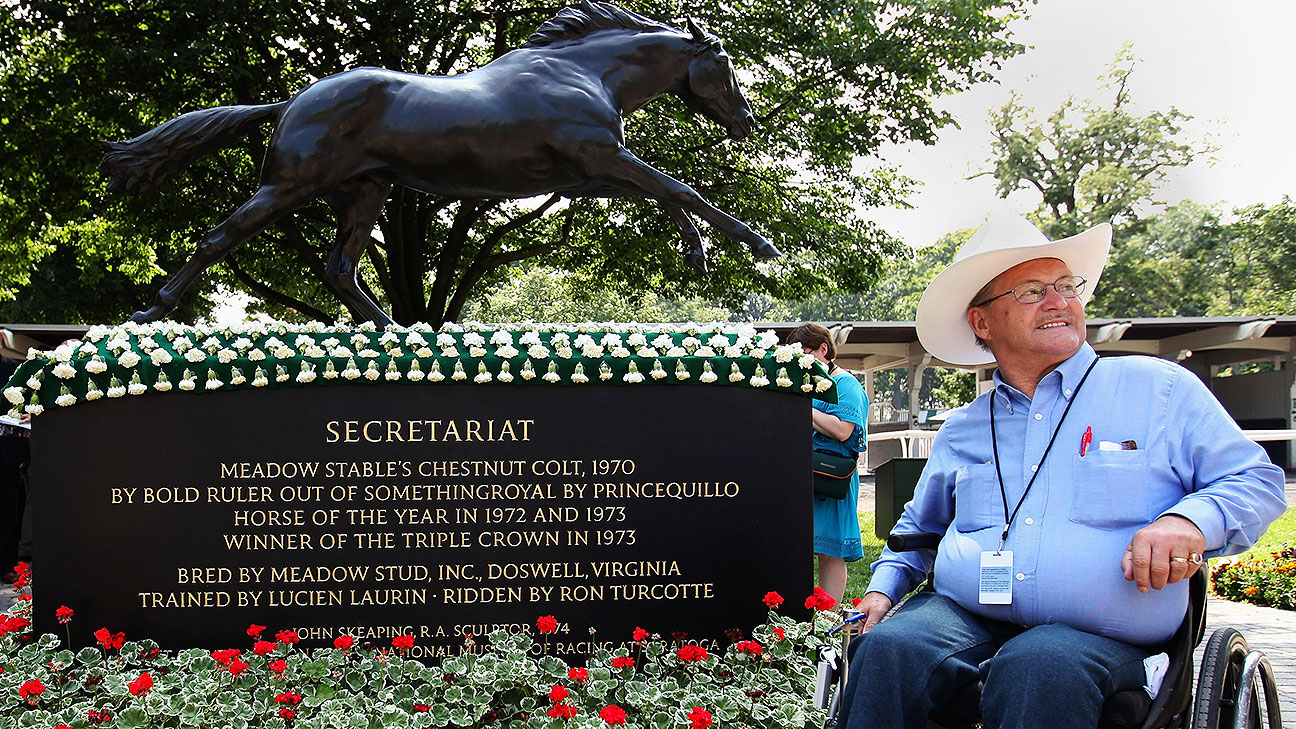
Statues of Secretariat now stand outside the National Museum of Racing and Hall of Fame at Saratoga Race Course in Saratoga, New York; the Kentucky Horse Park and Keeneland Race Course, both in Lexington, Kentucky; and, with Turcotte aboard, in Turcotte's hometown of Grand Falls, New Brunswick, Canada.

Unfortunately, Turcotte himself had a grand fall: During a 1978 race at Belmont, he fell from his mount, and was paralyzed. As of June 9, 2023, he is 81 years old, still lives in Grand Falls, and is an advocate for disability research.
Turcotte at Secretariat's statue at the Kentucky Horse Park

In 1975, Sports Illustrated horse racing writer William Nack, who covered every race "Big Red" ever ran, published Secretariat: The Making of a Champion. In 2010, it served as the basis for the film Secretariat. Diane Lane starred as Penny Chenery, real-life jockey Otto Thorwarth played Turcotte, Kevin Connolly played Nack, and the horse that played Secretariat was not identified. 

Saturday, May 6, 2023

Notable Last Survivors -- 2023 Sports Other Than Baseball Edition

Bob Cousy. He's 95 years old. He could probably still make a free throw.
 
Notable last survivors of occurrences in sports other than baseball:

* June 4, 1939: Reginald Welch, 87, the last survivor of the winners of the 1st FA Cup Final, the 1872 Wanderers. He was also the last surviving player from the England team that played Scotland to a 0-0 draw in the 1st international football (soccer) match, the same year. 67 years.

* August 15, 1939: George H. Large, 88, the last surviving player in the 1st American football game, New Brunswick, Middlesex County, New Jersey, November 6, 1869. Nearly 70 years. The native of Readington, Hunterdon County played on the Rutgers side, and in 1888 served as President of the State Senate, making him the Acting Governor on a few occasions.

* May 24, 1942: Billy MacKinnon, 90, the last surviving player in the 1st international football match, at Hamilton Crescent in Partick, Scotland, November 30, 1872. 70 years. He and all of his Scotland teammates played their "club football" for Queen's Park of Glasgow.

* August 6, 1943: Tom Garrett, 85, the last surviving player from the 1st official cricket test match, at the Melbourne Cricket Ground, on March 15, 1877. 66 years. He was a bowler, and remains the youngest Australian to play in a senior cricket match against England. Australia, which would not achieve independence for another 24 years, defeated England 245-196. Garrett is the great-grandfather of Peter Garrett, lead singer of Australian rock band Midnight Oil.

* July 14, 1951: Sammy Jones, 89, the last surviving player from the Australia cricket team that beat England in what became known as the 1st "Ashes" competition, August 29, 1882. 69 years.

* September 26, 1951: H. Montagu Allan, 90, the last surviving original inductee into the Hockey Hall of Fame in Toronto, in 1945. 6 years. He was the only original inductee who was alive at all. A major businessman in Montreal, in the early 20th Century, he was not a player. Instead, he was elected in the "Builders" category, for his donation of the Allan Cup, awarded annually to the national senior amateur champions of Canada.

* November 17, 1955: Bob Holmes, 88, the last surviving player from the 1st Champions of England's Football League, the 1888-89 Preston North End team. 66 years.

* May 15, 1961: Tommy Gorman, 74, the last surviving original owner in the NHL, owner and general manager of the Ottawa Senators in 1917. 44 years. He managed the Senators to the Stanley Cup in 1920, '21 and '23; the Chicago Blackhawks in 1934; the Montreal Maroons in 1935; and the Montreal Canadiens in 1944 and '46.

* February 14, 1963: Billy Barlow, 92, the last surviving player from the 1st Stanley Cup winners, the 1893 Montreal Amateur Athletic Association team. 70 years.

* March 17, 1965: Amos Alonzo Stagg, 102, the last surviving member of the 1st All-American college football team, 1889, an end at Yale University. 74 years. He became better known as a coach who introduced many of the things football fans now take for granted, including the playbook, the huddle, the center snap, the placekick, the onside kick, the position of linebacker, pads (for players and goalposts), the tackling dummy, uniform numbers and varsity letters.

* January 23, 1967: Holcombe Ward, 88, the last surviving member of the U.S. tennis team that won the 1st Davis Cup, at the Longwood Cricket Club in Boston, August 8-10, 1900. 67 years. Ward also won the U.S. Open in 1904, and was elected to the International Tennis Hall of Fame.

The tournament was original known as the International Lawn Tennis Challenge, but was almost immediately nicknamed the Davis Cup, named for Dwight F. Davis, a member of that 1900 U.S. team, who came up with the idea for a U.S. selection to challenge a British team. Soon, the tournament was expanded to other countries. 

* July 1, 1968: Dr. Ernest Hildner, 94, the last surviving player in the 1st basketball game, Springfield, Massachusetts, December 21, 1891. 76 years.

* September 2, 1969: Ray Nesser, 71, the last survivor of the 6 football-playing Nesser brothers from Columbus, Ohio, playing for the Columbus Panhandles in 1915. 54 years.

* February 15, 1970: Dimitrios Loundras, 84, the last surviving competitor in the 1st modern Olympic Games, in Athens, Greece, April 15, 1896. 74 years.

* February 25, 1977: Billy Coutu, 84, the last surviving player from the 1st NHL game, a 7-4 win for Coutu and the Canadiens over the Ottawa Senators in Ottawa on December 22, 2017. 59 years.

* August 22, 1977: Roy Large, 84, the last surviving player from the Carlisle Indian School team, led by Jim Thorpe, that upset the Army football team at West Point, New York, November 9, 1912. 65 years.

* January 21, 1982: Edward S. "Ned" Irish, 76, the last surviving original NBA owner, the founding owner of the New York Knicks, 1946. A little more than 35 years. He also led the building of the current version of Madison Square Garden, opening in 1968.

* October 31, 1983: George Halas, 88, the last surviving original NFL owner from 1920. 63 years. As the founding owner of the Chicago Bears, and (for all intents and purposes) the founder of the NFL, he was the 1st man elected to the Pro Football Hall of Fame, in 1963.

* July 3, 1984: Ernesto Mascheroni, 76, the last surviving player from the Uruguay team that won the 1st World Cup Final, July 30, 1930. 54 years. He was then a left back for Montevideo team Olimpia, and later played for Internazionale Milano in Italy before coming home and playing for Montevideo team Peñarol.

* January 15, 1986: Jim Crowley, 83, the last survivor of the backfield known as the Four Horsemen of Notre Dame, winners of the Rose Bowl, January 1, 1925. 61 years. Harry Stuhldreher died in 1965, Elmer Layden in 1973, and Don Miller in 1979.

* February 22, 1986: Tom Bradshaw, 82, the last surviving player from the Scotland team, the "Wembley Wizards," that upset England at the original Wembley Stadium in London on March 31, 1928. 58 years. At the time, though, he was playing his "club football" for an English team, Liverpool.

* May 11, 1986: Frederick "Fritz" Pollard, 92, the last surviving player from the 1st NFL Champions, the 1920 Akron Pros. 66 years.

* September 6, 1989: Jimmy Ruffell, 89, the last surviving player from the 1st game at the old Wembley Stadium in London, the 1923 FA Cup Final. 66 years. He played for East London team West Ham United, who lost to Manchester area team Bolton Wanderers, 2-0.

* April 17, 1990: Angelo Schiavio, 84, the last surviving player from the Italy team that won the World Cup on June 10, 1934. 56 years. He was a forward, played his entire career for Bologna, and at the time of the World Cup was also their manager.

* January 28, 1991: Harold "Red" Grange, 87, the charter inductee into both the College and the Pro Football Halls of Fame, who was the last survivor of "The Golden Age of Sports," a group of athletes considered the best of the 1920s. 71 to 61 years. Of the others: Baseball's Babe Ruth died in 1948, tennis' Bill Tilden in 1953, golf's Bobby Jones in 1971 (the people coming up with the "Golden Age" nickname considered golf a sport, but I don't), track's Paavo Nurmi in 1973, and boxing's Jack Dempsey in 1983.

* July 18, 1991: Magnus Goodman, 93, the last surviving player from the 1st Olympic Gold Medalists in hockey, the Canada team that won in Antwerp, Belgium in 1920. 71 years.

* October 12, 1996: René Lacoste, 92, the last survivor of the "Four Muskteers" from France who, along with America's Bill Tilden, dominated international tennis in the late 1920s and early 1930s. Their 1st major title was in 1924, 72 years earlier.

Jacques "Toto" Brugnon died in 1978, Henri Cochet died in 1987, and Jean Borotra died in 1994. Lacoste was nicknamed the Crocodile, and it became the emblem of the Lacoste tennis shirt, which he introduced in 1929, expanding it into a vast sporting goods empire.

* May 26, 1997: Ralph Horween, 100, the last surviving player from the NFL's pioneer era, a fullback for the Chicago Cardinals from 1921 to 1923. 74 years. He is also believed to be the 1st former NFL player to live to be 100.

* September 23, 1998: Ray Bowden, 89, the last surviving player for Arsenal under manager Herbert Chapman, who died in 1934. 64 years. Bowden played for Arsenal's League Champions of 1934 and '35, and their 1936 FA Cup winners.

* February 23, 2000: Stanley Matthews, 85, the last surviving player from the England soccer team which, while it did not play in the World Cup, took on its winners, Italy, at the home stadium of Arsenal Football Club in North London, November 14, 1934. 65 years.

At the time, he was an outside right (today, we would call his position "right winger") for Stoke City. He would still be playing in England's top division in 1965, at age 50, and remains the only British footballer ever knighted while still an active player. He was also the last England player in their matches with Germany at White Hart Lane in North London in 1935 and in Berlin in 1938.

* September 13, 2000: Duane Swanson, 87, the last surviving player from the 1st Olympic Gold Medalists in basketball, the U.S. team that won in Berlin in 1936. 64 years.

* May 17, 2001: Murray Murdoch, 96, the last surviving original New York Ranger from 1926. 75 years. He was also the last survivor from their 1928 Stanley Cup winners. 73 years.

* February 6, 2002: Jack Hurst, 87, the last surviving player from the Burnden Park Disaster, at Bolton, Greater Manchester, where 33 people died in an FA Cup Quarterfinal between Hurst's Bolton Wanderers and Stoke City, March 9, 1946. 56 years.

* August 7, 2002: Charles "Ookie" Miller, 92, the last surviving player from the Chicago Bears team that won the 1st NFL Championship Game, regardless of whether you consider that to be the unofficial one on December 18, 1932, at Chicago Stadium, a 9-0 win over the Portsmouth Spartans (they became the Detroit Lions in 1934); or the official one on December 17, 1933, at Wrigley Field, a 23-21 win over the New York Giants. 70 or 69 years. Either way, he played the position of center.

* November 4, 2003: Philip Slone, 96, the last surviving player from the U.S. team at the 1st World Cup, in 1930. 73 years. They reached the Semifinal, making them still the most successful U.S. men's World Cup team ever. Slone attended New York's High School of Commerce right after Lou Gehrig did, and was a midfielder on such early U.S. professional teams as the All-Jewish New York Hakoah and Brookhattan. He only played 1 game for the U.S. team, but it was in the 1930 World Cup.

* November 30, 2003: Jesus Correia, 79, the last of Lisbon soccer team Sporting Clube de Portugal's Cinco Violinos (Five Violins) that won 7 League titles from 1944 to 1953. 59 years.

* April 27, 2005: George "Red" Horner, 95, the last surviving player from the Ace Bailey Benefit Game, often called the 1st NHL All-Star Game, at Maple Leaf Gardens in Toronto, February 14, 1934. 71 years. He was also the last surviving player from the Howie Morez Memorial Game, at the Montreal Forum, November 2, 1937. 68 years. At the time of each game, he was a defenseman for the Toronto Maple Leafs.

* June 1, 2005: George Mikan, 80, the last surviving original inductee into the Basketball Hall of Fame in Springfield, Massachusetts, established in 1959. 46 years. (Its original building did not open until 1968.)

* October 26, 2005: George Swindin, 90, the last surviving player from George Allison's Arsenal teams, which ended with Allison's retirement in 1947. 58 years. He played for their League Champions 1938, '48 and '53, and their 1950 FA Cup winners.

* December 27, 2005: John Druze, 91, the last surviving member of the 1936-38 Fordham University line (offensive and defensive) known as the Seven Blocks of Granite, best known for their scoreless tie with the University of Pittsburgh at the Polo Grounds in New York -- which could retroactively be considered one of the periodic "Games of the Century" -- on October 16, 1937. 68 years.

* November 5, 2006: Pietro Rava, 90, the last surviving player from the "Rest of Europe" team that played England in the Football Association 75th Anniversary Game at Wembley Stadium, October 26, 1938. 68 years. A left back for Turin-based Juventus, he had helped Italy win the 1936 Olympics and the 1938 World Cup (the last survivor of each team), although he was not yet a regular for their 1934 World Cup win.

The last surviving England player was Stan Cullis, a centre-half for Wolverhampton Wanderers, who later became their greatest manager, living until February 28, 2001. 62 years.

* November 27, 2007: Bill Willis, 86, the last of pro football's "Four Jackie Robinsons" who desegregated the sport in 1946. 61 years. Willis, a guard, and Marion Motley, a running back, played for the Cleveland Browns in the All-America Football Conference, and eventually in the NFL.

Running back Kenny Washington and end Woody Strode, both of whom had played at UCLA, returned to the Los Angeles Coliseum to desegregate the NFL with the 1946 Los Angeles Rams. Washington died in 1971, Strode in 1994, Motley in 1999.

* October 27, 2008: Vladimir Savdunin, the last survivor of the Dynamo Moscow team that dominated Soviet soccer in the 1940s, and toured England in 1945 after World War II. 63 years.

* December 17, 2008: Sammy Baugh, 94, the last surviving original inductee into the Pro Football Hall of Fame in Canton, Ohio, September 8, 1963. 45 years. He played quarterback, cornerback and punter for the Washington Redskins from 1937 to 1952.

* January 27, 2009: Aubrey Powell, 90, the last surviving player from the Wales soccer team that beat England at the Hawthorns on October 20, 1945. 63 years.

* September 10, 2009: Lou Bender, 99, the last surviving player from "The Original Celtics," the 1st great pro basketball team, which dominated the sport in the 1920s. They were disbanded in 1927, so, 82 years.

* November 22, 2009: Juan Carlos Muñoz, 90, the last survivor of the Buenos Aires, Argentina team River Plate known as La Maquina (The Machine) that revolutionized South American soccer, winning league titles in 1941, 1942, 1945 and 1947. 68 years.

* January 21, 2010: Irwin Dambrot, 81, the last surviving player from the 1950 City College of New York basketball team, 60 years. They are the only team from New York City ever to win the NCAA Championship. They are also the only team ever to win the NCAA and the NIT in the same season. But he was also part of the point-shaving scandal that insured that such a "double" would never happen again, and ended New York basketball's glory days.

* December 23, 2011: James "Pappy" Ricks, 68, the last surviving player from the New York Renaissance Five, or "the New York Rens," the legendary all-black pro basketball team of the 1930s. He last played for them in 1936, so, 55 years.

* February 28, 2013: Ford "Moon" Mullen, 96, the last surviving basketball player from the 1st NCAA Tournament Champions, the University of Oregon, March 27, 1939. 74 years.

* July 22, 2013: Lawrie Reilly, 84, the last survivor of the "Famous Five" for Edinburgh team Hibernian, a.k.a. Hibs, winning the Scottish league title in 1951 and '52. 62 years.

* July 30, 2013: Oscar "Ossie" Schechtman, 94, the last surviving player from the 1st NBA game, the New York Knicks' 66-64 win over the Toronto Huskies at Maple Leaf Gardens, on November 1, 1946. 67 years.

* January 11, 2015: Jenő Buzánszky, 89, the last surviving player from Hungary's "Magnificent Magyars" that stunned England at the old Wembley in 1953, and then advanced to the 1954 World Cup Final before losing. 64 and 63 years.

* February 26, 2015: Earl Lloyd, 86, the last of the NBA's "Three Jackie Robinsons" at the start of the 1950-51 season. Almost 64 years. Chuck Cooper of the Boston Celtics was the 1st black player drafted by an NBA team, and he died in 1984. Nat "Sweetwater" Clifton of the New York Knicks was the 1st black player signed, and he died in 1990. But, as it worked out, Lloyd was the 1st player to get into a game, with the Washington Capitols.

* May 27, 2015: John Siegal, 97, the last surviving player from the Chicago Bears team that beat the Washington Redskins 73-0, the biggest blowout in NFL history, in the NFL Championship Game, at Griffith Stadium in Washington, December 8, 1940. 75 years. He played end on both offense and defense.

* July 16, 2015: Alcides Ghiggia, 88, the last surviving player from the Uruguay team that won the World Cup, shocking Brazil in the Final at the Estadio do Maracana, an event remembered in Brazil as the Maracanazo, July 16, 1950. 65 years.

* March 14, 2016: Davy Walsh, 92, the last surviving player from the Republic of Ireland team that upset England at Goodison Park in Liverpool, home of Everton Football Club, September 21, 1949. 66 years. At the time, he was a forward for Birmingham-area team West Bromwich Albion.

* October 21, 2016: Jerry Rullo, 93, the last surviving member of the 1st NBA Champions, the 1947 Philadelphia Warriors. 69 years.

* June 18, 2018: Walter Bahr, 91, the last surviving player from the U.S. soccer team that defeated England at the World Cup in Belo Horizonte, Brazil, June 29, 1950. 68 years. His sons Matt and Chris went on to become Super Bowl-winning placekickers. He barely outlived the last England player from that game, Roy Bentley, who died on April 20.

* September 19, 2019: Barron Hilton, 92, the last survivor of "The Foolish Club," the 8 rich men who decided to blow their fortunes on teams in the American Football League, at the AFL's founding meeting in Chicago, August 14, 1959, 60 years. He named his team the Los Angeles Chargers, but has always denied that he named them after the credit card he'd founded, Carte Blanche. (Why didn't he named them the Barons?)

He was a son of hotel magnate Conrad Hilton. And he was a brother of Conrad Nicholson Hilton Jr., a.k.a. Nicky Hilton, making him briefly a brother-in-law of Elizabeth Taylor.

Even weirder: His mansion in the Los Angeles suburb of Pasadena, California -- not far from the Rose Bowl, the house used as Wayne Manor on Batman, and the house used as the Governor's Mansion on Benson -- was used for exterior shots of the Carrington Mansion on Dynasty. That show was set in Denver. The main character, Blake Carrington, played by John Forsythe, was based on oil tycoon Marvin Davis. In 1978, and again in 1980, Davis tried to buy the Oakland Athletics and move them to his hometown of Denver. Davis' grandson was Brandon Davis, who, for a time, dated Barron's granddaughter Paris Hilton.

* January 15, 2020: Bobby Brown, 96, the last surviving player from the Scotland team that beat England 1-0 at Hampden Park in Glasgow on April 13, 1946. 74 years.

* May 16, 2020: Gene Rossides, 92, the last surviving player from Columbia University's 1947 upset of Army, which hadn't lost in 4 years, a game nown as "the Miracle of Morningside Heights." 73 years.

* August 8, 2020: Gabriel Ochoa Uribe, 90, the goalkeeper and last surviving player from Colombian soccer team Millonarios de Bogotá's Ballet Azul (Blue Ballet) that won league titles in 1949, '51, '52 and '53. 71 years.

* November 8, 2020: Howie Meeker, 97, the last surviving player from the 1st official NHL All-Star Game, at Maple Leaf Gardens in Toronto, October 13, 1947. 73 years. He was a right wing for the Toronto Maple Leafs, and is also the last surviving player for their Stanley Cup-winning teams of 1947, 1948, 1949 and 1951. At the time of his death, he was also the earliest surviving player for a Stanley Cup winner. He was elected to the Hockey Hall of Fame, as a broadcaster.

* December 5, 2020: Viktor Ponedelnik, 83, the last surviving player from the Soviet Union soccer team that won the 1st European Championship, beating Yugoslavia 2-1 at Parc des Princes in Paris, on July 10, 1960. 60 years.

* December 24, 2020: Jack Myers, 96, the last surviving player from the Philadelphia Eagles' 1948 and 1949 NFL Champions. 72 and 71 years.

* April 19, 2021: Viktor Shuvalov, 97, the last surviving player from the 1st Soviet team to win an Olympic Gold Medal, at Cortina d'Ampezzo, Italy in 1956. 65 years.

* January 18, 2022: Francisco "Paco" Gento, 88, the last surviving player from the 1st European Cup Final, at Parc des Princes, Paris, June 13, 1956. 66 years. He was also the last survivor from the 1957 Final, and remains the only man to win 6 European Cups, all with Real Madrid.

* May 10, 2022: Walter Hirsch, 92, the last surviving member of the University of Kentucky basketball program's "Fabulous Five" that won the 1948 National Championship. He was also the last survivor of Kentucky's 1949 National Champions.

* June 17, 2022: Hugh McElhenny, 93, the last surviving player from the San Francisco 49ers' 1954-56 "Million Dollar Backfield," the only entire backfield elected to the Pro Football Hall of Fame. 68 years. He was a halfback. Fullback Joe "the Jet" Perry and halfback John Henry Johnson died within a few weeks of each other in 2011. Quarterback Y.A. Tittle died in 2017.

* October 19, 2022: Charlie Trippi, 100, the last survivor of the Chicago Cardinals' "Million Dollar Backfield" that won the last NFL Championship for what is now the Arizona franchise, in 1947. 75 years. Quarterback Paul Christman died in 1970, halfback Pat Harder in 1992, halfback Elmer Angsman in 2002, halfback Marshall Goldberg in 2006.

* March 24, 2023: Jerry Green, 95, was the last surviving sportswriter who had covered every Super Bowl. He wrote for the Detroit News, covering the 1st 56 Super Bowls for them, but was too ill to cover Super Bowl LVII, and died a few weeks later. Jerry Izenberg, 92, of the Newark Star-Ledger, is still alive, but stopped covering them after Super Bowl LIII.

*

Alive as of May 6, 2023:

* Steve Wochy (born Wojciechowski), 100, is the oldest and earliest surviving NHL player. A right wing, he played 49 games for the Detroit Red Wings in the 1944-45 season, and 5 more in 1946-47. He had a much longer career in the minor leagues during the comparatively closed "Original Six" era.

* William "Dub" Jones, 98, is the oldest and earliest surviving professional football player. He is also the last surviving player from the All-America Football Conference, which ran from 1946 (77 years) to 1949. He's also the last surviving player from the 1950 Cleveland Browns vs. Philadelphia Eagles "merger game," the last survivor of the Browns' 1950 NFL Champions, the last from their 1954 NFL Champions, 1 of 3 from their 1955 NFL Champions, and the father of 1970s Baltimore Colts All-Pro quarterback Bert Jones.

* Johnny Lujack, 98, is the earliest surviving Heisman Trophy winner, for Notre Dame in 1947. 76 years. He's also the last surviving player from the 1946 Army-Notre Dame "Game of the Century" at the old Yankee Stadium, a 0-0 tie between the teams then ranked Number 1 and Number 2 in the country. 77 years.

Since Jones' pro debut was in the AAFC in 1946, and Lujack's was in the NFL in 1948, Jones is the earliest surviving pro player, but Lujack is the earliest surviving NFL player.

* Neil Harvey, 94, is the last surviving player from the 1948 Australia cricket team that beat England in their regular "Ashes" series, known as "The Invincibles" because they are the only cricket team ever to tour England without losing a test match. June 10 to August 18, 1948. 75 years.

While Donald Bradman, often regarded as the greatest batsman in cricket history, was undergoing his farewell tour, Harvey was a rookie, on his 1st tour. Domestically, he played for Victoria (the State of Australia that includes Melbourne) from 1946 to 1957, and for New South Wales (the State that includes Sydney) from then until his retirement from the sport in 1963.

* Bob Harrison, 95, is the earliest surviving player for an NBA Championship team, the Minneapolis Lakers, who beat the Syracuse Nationals in 6 games, April 23, 1950. 73 years.

* Cliff Hagan, 91, and Guy Strong, 92, are earliest surviving players for an NCAA Championship team, the University of Kentucky, beating Kansas State at Williams Arena in Minneapolis on March 27, 1951. 72 years.

* Marty Pavelich, 95, is the earliest surviving player for a Stanley Cup winner, the 1950 Detroit Red Wings. 73 years. He is also 1 of 4 survivors from the Wings' 1952 Cup winners, 1 of 4 from their 1954 Cup winners, and 1 of 4 from their 1955 Cup winners.

* Bob Cousy, 94, is the last surviving player from the 1st NBA All-Star Game, at his home court, the Boston Garden, March 2, 1951. 72 years.

* Don Gibson, 93, is the earliest surviving player for a Football League title team, Manchester United, who clinched at home at Old Trafford against North London team Arsenal, April 26, 1952. 71 years.

Ágnes Keleti, 102, is the earliest surviving Olympic Gold Medalist. A gymnast competing for Hungary, she won 1 in Helsinki in 1952, and 4 in Melbourne in 1956. (UPDATE: She died on January 2, 2025, at 103.)

* Vic Seixas, 99, is the earliest surviving winner of a tennis major. He won Wimbledon in 1953 and the U.S. Open in 1954. (UPDATE: He died on July 5, 2024, at age 100. The next earliest surviving winner of a major is Ken Rosewall, winner of the 1953 French Open. The earliest women's winner is Angela Mortimer, winner of the 1955 French Open.)

* Bill Leivers, 91, is the earliest surviving player for an FA Cup winner, Manchester City, who beat Birmingham City at Wembley Stadium, 3-1, on May 5, 1956. 67 years.

* Ray Swallow, 87, the last surviving players from the Arsenal teams managed by Tom Whittaker, who died in office on October 24, 1956. 67 years. He did not win a trophy with Arsenal.

* Rosey Grier, about to turn 91, the last surviving player from the New York Giants' 1956 NFL Champions, 67 years. Grier, a defensive tackle, is also the last survivor of the Los Angeles Rams' 1960s defensive line known as the Fearsome Foursome. End Lamar Lundy died in 2007, Tackle Merlin Olsen in 2010, and end Deacon Jones in 2013.

* There are 5 living survivors of the Munich Air Disaster that killed 23 people, including 8 members of the Manchester United soccer team on its way back from a European Cup Quarterfinal in Belgrade, Yugoslavia (now Serbia), February 6, 1958, 65 years: United player Bobby Charlton (83); stewardess Rosemary Cheverton; Eleanor Miklos, wife of travel agent Bela Miklos, who was killed; Vera Lukić, the wife of a Yugoslav diplomat; and her daughter, Vesna Lukić. (UPDATE: Charlton died on October 21, 2023, leaving 4 survivors.)

As Vesna was a baby, she is likely to end up as the last survivor. Vera was pregnant with her son Zoran, and some sources list him as one of the survivors as well.

* The earliest surviving winners of the European Cup -- the tournament now known as the UEFA Champions League -- are 2 players from the 1958 Real Madrid team, 65 years: José Santamaría, 93 Juan Santisteban, 86. They are also the last 2 survivors of Real Madrid's 1959 winners, and 2 of the 6 survivors of Real Madrid's 1960 winners.

* Mário Zagallo, 91, the last surviving player from the Brazil team that won the World Cup, beating host Sweden at Råsundastadion in the Stockholm suburb of Solna on June 29, 1958, 65 years. Dino Sani, Moacir, José Altafini and José "Pepe" Macia are still alive, but did not play in the Final.

There are 2 surviving players from the Brazil team that won the World Cup, beating Czechoslovakia at the Estadio Nacional de Chile in Santiago on June 17, 1962, 61 years: Mario Zagallo and Amarildo. Pepe, Mengálvio and Jair da Costa are still alive, but did not play in the Final.

* Jerry Lucas, 83, is the earliest surviving Sports Illustrated Sportsman of the Year. He won in 1961, for helping Ohio State's basketball team to the 2nd of 3 straight NCAA Finals (but they only won the 1st, in 1960), and for being a scholar-athlete. He went on to a Hall of Fame career in the NBA.

* Ismael Laguna, 79, is the earliest surviving World Champion in boxing. The Panamanian became Lightweight Champion on April 10, 1965, 58 years. He held the title for only 8 months, but regained it for 6 months in 1970.

* There are 2 surviving players from the England team that won the World Cup, beating West Germany at the old Wembley on July 30, 1966, 57 years: Bobby Charlton and Geoff Hurst. Terry Paine, Ian Callaghan and George Eastham are still alive, but did not play in the Final. (UPDATE: Bobby Charlton died on October 21, 2023, leaving just Hurst from the game; and Hurst, Paine, Callaghan and Eastham from the team at large. Only 4 left.)

* There are 5 surviving participants in "The Cleveland Summit," gathered in support of Muhammad Ali after he was stripped of the Heavyweight Championship of the World for refusing to be drafted, June 4, 1967, 56 years: Football players Jim Brown, Curtis McClinton, John Wooten and Walter Beach, all of whom were current or former Cleveland Browns; and basketball player Kareem Abdul-Jabbar (then still using his birth name of Lew Alcindor). (UPDATE: Jim Brown died on May 18, 2013, lowering the number to 4.)

* Harry Sinden, 90, is the earliest surviving head coach of a Stanley Cup winner, the 1970 Boston Bruins, 53 years. Scotty Bowman, who won more Stanley Cups than any head coach, 10, 1st reached the Finals with the 1968 St. Louis Browns, 55 years, and is the earliest surviving head coach of a team that reached the Finals.

* Earl Ingarfield, 88, was the 1st head coach of the New York Islanders, in 1972, 51 years, and is also their earliest surviving head coach. Jean-Guy Talbot, 90, is the earliest surviving head coach of the New York Rangers, in 1977, 46 years. Billy MacMillan, 80, was the 1st head coach of the New Jersey Devils, in 1982, 41 years, and is also their earliest surviving head coach.

* George Foreman, 74, is the earliest surviving Heavyweight Champion of the World, first winning the title on January 22, 1973. 50 years.

* Al Attles, 86, is the earliest living head coach of an NBA Champion, the 1975 Golden State Warriors, 48 years. Bobby Knight, 82, is the earliest living head coach of a college basketball National Champion, 1976 Indiana University, 47 years. Lou Carnesecca, 98, is the earliest living former head coach for the franchise now known as the Brooklyn Nets, 1970, 53 years. He was born on January 5, 1925, one day after Johnny Lujack. Hubie Brown, 89, is the earliest living former New York Knicks head coach, 1982, 41 years.

* Tom Flores, 86, is the earliest head coach to take a team to win, or even into, a Super Bowl, winning Super Bowl XV with the Oakland Raiders on January 25, 1981. 42 years. Charley Winner is the earliest living former New York Jet head coach, 1974, 49 years. Bill Parcells is the earliest living former New York Giant head coach, 1983, 40 years.

* Silver Charm, 29, is the earliest surviving horse to have won the Kentucky Derby, having won it in 1997.