American Pharoah won the Belmont Stakes today, completing the Triple Crown of thoroughbred horse racing.
On May 2, at Churchill Downs in Louisville, Kentucky, he won the Kentucky Derby. I didn't watch it.
On May 16, at Pimlico Race Course in Baltimore, he won the Preakness Stakes. I was taking a beach day, and hadn't intended to watch it, but found myself inside Caesar's Atlantic City, and watched it.
Today, June 6, 2015 -- the 71st Anniversary of D-Day -- he won the Belmont, known for its mile-and-a-half length, and for 37 years of horses being unable to complete the Triple Crown, as "the true test of champions." This time, I watched.
I saw him leading halfway through, at the three-quarter-mile mark. I got a bad feeling, because leading the whole way is a bad sign, especially at the Belmont.
When the horses rounded the final turn, and entered the last straightaway, he was keeping the three-quarters-of-a-length lead he'd held most of the way, and I was thinking of how Smarty Jones was leading at that point in the 2004 Belmont, and blew it, and I said, "Don't blow it, don't blow it, don't blow it... " As if the horse could hear me through the TV, and over the yelling of the fans -- and could understand English.
When he began to increase that lead, making it all but impossible for him to be caught, I began thinking of Barbaro, who won the Kentucky Derby in 2006, but was injured in the Preakness Stakes, and, despite prolonged medical efforts, had to be put to sleep. So I said to the TV, "Don't break down, don't break down, don't break down... "
He didn't. He won the race in 2 minutes, 25.65 seconds. I pumped my fist and yelled, "Yes!" as he crossed the finish line, well in front, and with no sign of injury.
He is trained by Bob Baffert, and was ridden in all 3 races by Victor Espinoza, a 43-year-old Mexican jockey who thus won his 1st Belmont, and had won the Derby and the Preakness twice each before American Pharoah made it 3 each. It's important to remember that not only had no horse done it in a long time, but neither had any jockey, nor any trainer.
American Pharoah is the 12th horse to win the Triple Crown. Here they are, as follows:
1. 1919: Sir Barton, ridden by Johnny Loftus, trained by Guy Bedwell.
2. 1930: Gallant Fox, ridden by Earl Sande, trained by "Sunny Jim" Fitzsimmons.
3. 1935: Omaha, son of Gallant Fox, ridden by Willie "Smokey" Saunders, trained by Fitzsimmons, the only man to train 2. Both Gallant Fox and Omaha, the only father-son combo to do it, were owned by, born, raised and trained at Belair Stud.
4. 1937: War Admiral, ridden by Charley Kurstinger, trained by George H. Conway. A year later, WAar Admiral famously lost a match race to Seabiscuit, who did not compete in any of the Triple Crown races at age 3 in 1936, because he was then so lightly regarded, and didn't blossom until age 4, much like 1950s horse Kelso and 1980s horse John Henry.
War Admiral was the son of Man o' War, who ran in 1919 and 1920, and famously lost only 1 of the 21 races he ran, to a horse whose name has, ever since, been applied to any event where the expected winner did not win: Upset. But since the Triple Crown wasn't yet a big thing, even in the wake of Sir Barton, the drive to win all 3 wasn't there. Man o' War did win the 1920 Belmont, but did not run in the other 2. In 1922, Pillory won the Preakness and the Belmont, but couldn't run in the Derby, as it was held on the same day of the Preakness.
5. 1941: Whirlaway, ridden by Eddie Arcaro, trained by Ben A. Jones.
6. 1943: Count Fleet, ridden by Johnny Longden, trained by Don Cameron.
7. 1946: Assault, ridden by Warren Mehrtens, trained by Max Hirsch.
8. 1948: Citation, ridden by Arcaro, the only man to ride 2, trained by Jimmy Jones. Citation was a product of Calumet Farm, as was Whirlaway, making Calumet and Belair the only 2 "homes" of 2 Triple Crown winners. Then there was a 25-year drouht, until...
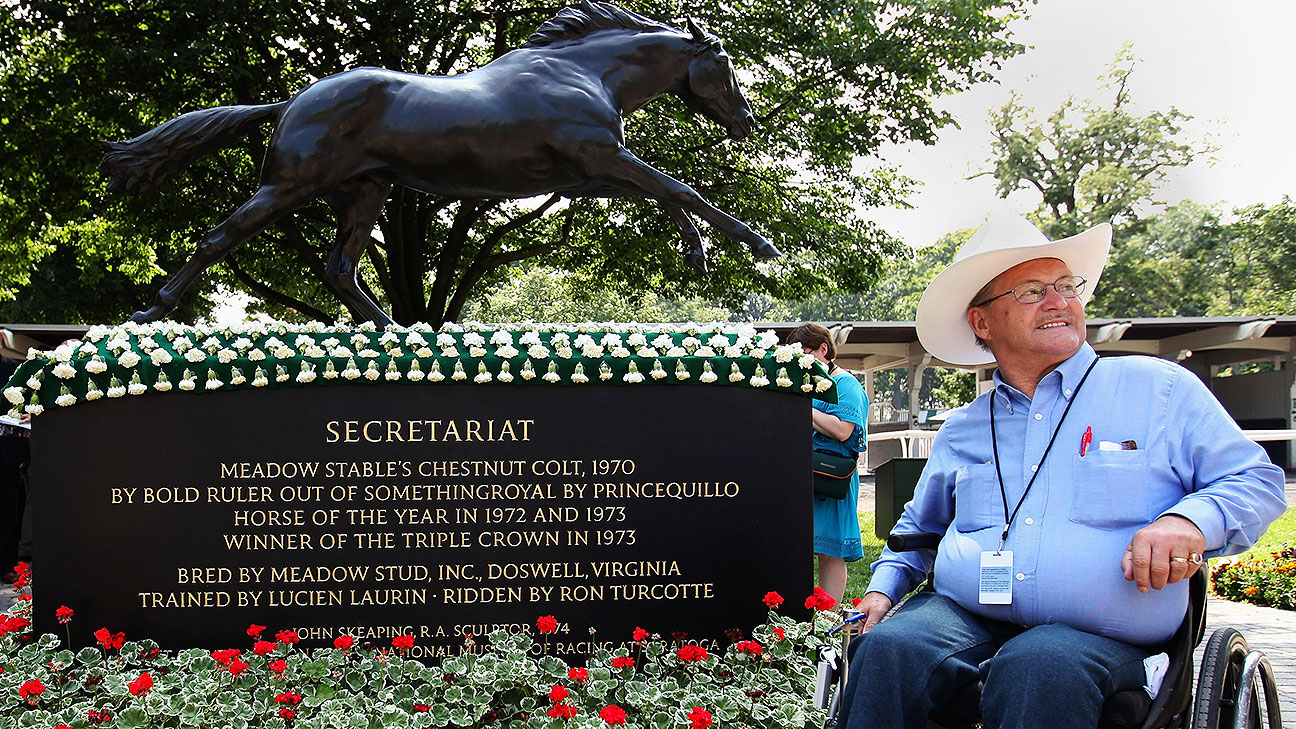
9. 1973: Secretariat, ridden by Ron Turcotte, trained by Lucien Laurin. Secretariat not only won all 3, but set records in all 3. His records for the Derby and the Belmont still stand. He famously won the Belmont by a whopping 31 lengths. I'm waiting for Kanye West to say, "Yo, American Pharoah, I'm-a let you finish, but Secretariat ran the greatest Belmont ever!"
10. 1977: Seattle Slew, ridden by Jean Cruget, trained by William H. Turner Jr. I was only 3 years old when Secretariat ran, so Seattle Slew was the first Triple Crown winner I can remember.
11. 1978: Affirmed, ridden by Steve Cauthen, trained by Laz Barrera. Later in the year, in the only races ever to match 2 Triple Crown winners, Seattle Slew beat Affirmed, and all other horses in the races, twice. In 1980, Affirmed's sister, Genuine Risk, became the 1st filly to win the Derby in 75 years. After Affirmed, there was a drought of 37 years, until...
12. 2015: American Pharoah, ridden by Victor Espinoza, trained by Bob Baffert. At 43, Espinoza is the oldest jockey to achieve the feat. The horses have all been 3 years old.
23 horses have won the Derby and the Preakness, but not the Belmont, 13 of them between Affirmed and American Pharoah:
* In 1979, Spectacular Bid allegedly stepped on a safety pin on the morning of the Belmont, and finished 3rd.
* In 1981, Pleasant Colony finished a close 3rd.
* In 1987, Alysheba finished 4th.
* In 1989, Sunday Silence finished a distant 2nd to his much-hyped rival, Easy Goer.
* In 1997, Silver Charm finished just 3/4 of a length behind Touch Gold, the closest any horse had yet come to winning it without doing so.
* In 1998, Real Quiet came even closer, a photo finish showing him coming in just a nose behind Victory Gallop.
* In 1999, Charismatic broke his leg late in the Belmont, losing to Lemon Drop Kid by a length and a half. Jockey Chris Antley, seeing something was wrong, chose to pull him up and, possibly, save the horse's life, rather than push him onward and have a Triple Crown winner euthanized right there on the track. Antley had a drug addiction that would kill him not long afterward, but he saved the life of a champion. After 3 straight near-misses, people began wondering if the Belmont was jinxed. Sports fans can be superstitious people, and horse racing fans are not only no exception, but more so than most.
* In 2002, War Emblem stumbled coming out of the gate, and finished 8th. Sarava won the race with the longest odds of any Belmont winner ever: 70-1.
* In 2003, Funny Cide finished 3rd.
* In 2004, Smarty Jones led most of the way, but ran out of gas, and lost to Birdstone by a length.
* In 2008, Big Brown was pulled up, finishing last, but his life was saved.
* In 2012, I'll Have Another was found to have a tendon injury the day before the race, and was scratched.
* In 2014, just last year, California Chrome was stepped on by another horse coming out of the gate, and ran the race with an injured heel, finishing 4th.
If there
was a jinx, American Pharoah ended it today.
*
The last Triple Crown winner in thoroughbred racing was Affirmed, who beat Alydar (father of the aforementioned Alysheba) in all 3 races, by less each time. Affirmed died in 2001, and Seattle Slew a year later, so for 13 years there have been no living Triple Crown winners.
Affirmed completed his Triple Crown on June 3, 1978. That's 37 years and 3 days. How long has that been?
Horse racing was still a relatively healthy sport then. Interest had been jacked up by 3 Triple Crown winners in the past 6 seasons, plus the tragic 1975 match race at Belmont Park that left Ruffian, who won the fillies' version of the Triple Crown, injured and humanely put down, against Foolish Pleasure, who had won the Derby but finished 2nd in the other 2 races.
The thought of horse racing becoming a minor sport, and being in serious financial trouble, was then inconceivable. Today, many racetracks, including the Meadowlands and Monmouth Park here in New Jersey, have legalized casino-style gambling, as well as simulcasting from other tracks, allowing for extra betting. Pimlico, site of the Preakness, is in danger of having to close, meaning that the race would have to be moved.
(Major horse races usually don't get moved. A notable exception is one of the major harness races, the Hambletonian Stakes, which has been run since 1926, but has had multiple sites, until settling at the Meadowlands in 1981.)
The defending World Champions in the major sports were the Yankees in baseball, the Dallas Cowboys (ew) in the NFL, the Montreal Canadiens in hockey, and the Portland Trail Blazers in the NBA. Four days after Affirmed completed his Triple Crown, the Washington Bullets (now Wizards) won their 1st NBA title. (While the Yankees, Cowboys and Canadiens have combined for 12 titles since, neither the Blazers nor the Bullets/Wizards have ever won again.) The Heavyweight Champion of the World was Leon Spinks, who had recently taken it from Muhammad Ali, but Ali would soon take it back.
Few of the great athletes of today had yet been born. Notable baseball players yet born who are still active today include LaTroy Hawkins (the current oldest, at 42), Bartolo Colon, Ichiro Suzuki and R.A. Dickey. From the NBA, Tim Duncan, Manu Ginobli, Kevin Garnett and Paul Pierce, all still active today, had been born. Hockey player Jaromir Jagr was 6 years old. Peyton Manning was 2, Tom Brady was 10 months old.
The managers and head coaches of the New York teams in question? Yankees, Billy Martin; Mets, Joe Torre -- yes, that Joe Torre; Giants, John McVay (not John McKay); Jets, Walt Michaels; Knicks, Willis Reed was in his one-season interruption of the long tenure of Red Holzman; Rangers, Jean-Guy Talbot; and Islanders, Al Arbour. The New Jersey Devils were still the original hockey version of the Colorado Rockies.
What were the current Tri-State Area managers and head coaches doing in June 1978? Tom Coughlin of the Giants was the offensive coordinator at Syracuse University; Lionel Hollins of the Nets was starring for the defending NBA Champion Trail Blazers; Terry Collins of the Mets was a shortstop in the minor-league system of the Pittsburgh Pirates; Alain Vigneault of the Rangers was in high school at a defenseman with the "major junior" hockey team the Hull Olympiques, outside Ottawa; Todd Bowles of the Jets was at Elizabeth High School in New Jersey; Joe Girardi of the Yankees and Jack Capuano of the Islanders were in junior high school; Derek Fisher of the Knicks was about to turn 4; and John Hynes of the Devils was 3. (Yes, I will be doing a piece on new Devils hire Hynes, hopefully within the next few days.)
The World Cup was about to be held in Argentina, and has since been held in Spain, Mexico, Italy, America, France, Japan, Korea, Germany, South Africa and Brazil. The Olympics have since been held in America 3 times, Canada and Russia twice each, Bosnia, Korea, France, Spain, Norway, Japan, Australia, Greece, Italy, China and Britain.
There were 26 Amendments to the Constitution of the United States. (There are now 27.) The idea that corporations were "people" and thus entitled to the rights and protections thereof, was ridiculous -- but so was the idea that two people of the same gender could get married and half the rights and protections of marriage. The U.S. Supreme Court has since changed both.
The President of the United States was Jimmy Carter. Gerald Ford and Richard Nixon, their wives, and the widows of Lyndon Johnson, John F. Kennedy, Dwight D. Eisenhower and Harry Truman were all still alive.
Ronald Reagan and George H.W. Bush were out of office, and preparing campaigns for the Presidency in 1980. Bill Clinton was Attorney General of the State of Arkansas, and running for Governor. George W. Bush was making his 1st run for public office, for Congress from his home district in Texas. Barack Obama was in high school.
The Governor of the State of New York was Hugh Carey. The Mayor of the City of New York was Ed Koch. Both were at Belmont that day. The Governor of New Jersey was Brendan Byrne. Andrew Cuomo was attending Fordham University, while Bill de Blasio and Chris Christie were in high school.
The monarch of Great Britain was Queen Elizabeth II -- that hasn't changed -- but the Prime Minister was James Callaghan, and of Canada, Pierre Trudeau. England's Football League had just been won in an upset by Brian Clough's Nottingham Forest, and the FA Cup in an equally surprising result by Bobby Robson's Ipswich Town, over Arsenal.
Amnesty International was the current holder of the Nobel Peace Prize. The Pope, in the last few weeks of his reign and life, was Paul VI. The current Pope, Francis, was Bishop Jorge Mario Bergoglio, the provincial superior of the Society of Jesus (a.k.a. the Jesuits) in his native Argentina. There
have since been 6 Presidents of the United States, 6 Prime Ministers of
Britain, and 5 Popes.
Major novels of 1978, all of which became major motion pictures, included
Eye of the Needle by Ken Follett,
The Year of Living Dangerously by Christopher Koch, and a pair of eventual Robin Williams vehicles:
The World According to Garp by John Irving and
What Dreams May Come by Richard Matheson. Stephen King published
The Stand, and William Luther Pierce III, under the pen name Andrew Macdonald, published
The Turner Diaries, imagining a white supremacist uprising that takes over the United States and exacts revenge against blacks and Jews.
Like most right-wing literature, it's not only abominable sociology, it's bad writing. (By a weird retroactive coincidence, Pierce was born on a September 11, and, already dying of cancer, praised the perpetrators of the 9/11 attacks.)
Stephen King was about to publish
The Stand. George R.R. Martin was writing
Sandkings. J.K. Rowling was about to turn 13. No one had yet heard of literary characters Arthur Dent, Jason Bourne, Hannibal Lecter, Kinsey Millhone, Celie Harris, Forrest Gump, Jack Ryan, Alex Cross, Bridget Jones, Harry Potter, Robert Langdon, Lisbeth Salander, Bella Swan or Katniss Everdeen. Comic book characters V, Deadpool and Rick Grimes had yet to debut.
Dallas and
Fantasy Island all recently debuted on American TV. They didn't have much in common, although with Dr. David Banner, J.R. Ewing, and Mr. Roarke, I don't think you wanted to make any of them angry. Shows getting ready to premiere in the fall included the original version of
Battlestar Galactica, Taxi, WKRP in Cincinnati, Diff'rent Strokes, The White Shadow, and
Mork & Mindy, starring the aforementioned Robin Williams.
The Carol Burnett Show, The Bob Newhart Show, Maude, Columbo, Baretta, and both
The Six Million Dollar Man and its spinoff
The Bionic Woman, had aired their last first-run episodes.
The panelists on the episode of Match Game that aired that week were Gary Burghoff, Brett Somers, Charles Nelson Reilly, Hope Lange (the star of the late 1960s sitcom The Ghost & Mrs. Muir, which also had Reilly as a regular), Richard Dawson and Patti Deutsch. Kris Houghton was about to marry Robert Kardashian, and (as far as I know), neither of them had ever met Bruce Jenner.
No one had yet heard of such TV icons as Sam Malone, Christine Cagney & Mary Beth Lacey, Zack Morris, Hayden Fox, Dale Cooper, the Seinfeld Four, Buffy Summers, Fox Mulder, Andy Sipowicz, Ross Geller & Rachel Greene, Doug Ross, Xena, Carrie Bradshaw, Tony Soprano, Jed Bartlet, Jack Bauer, Omar Little, Leroy Jethro Gibbs, Michael Bluth, Michael Scott, Don Draper, Walter White, Jax Teller, Richard Castle, Ceslie Knope or Sarah Manning.
Nor had anyone yet heard of animation or video game legends such as Mario, He-Man, the Teenage Mutant Ninja Turtles, Goku, the Thundercats, Bart Simpson, Ash Ketchum or Master Chief.
Christopher Reeve was about to debut in film as Superman, and CBS had Lynda Carter as Wonder Woman, Nicholas Hammond as Spider-Man, Lou Ferrigno as the Hulk, and Reb Brown as Captain America. But Adam West was still the most recent live-action Batman, with Olan Soule voicing him on Super Friends (which also had Danny Dark as Superman and Shannon Farnon as Wonder Woman). Roger Moore was playing James Bond, and Tom Baker The Doctor.
No one had yet heard of Mad Max, Jason Voorhees, Ash Williams, John Rambo, the Terminator, the Ghostbusters, Freddy Kreuger, Marty McFly, Robocop, John McClane, Jay & Silent Bob, or Austin Powers.
Gene Roddenberry, having heard that Paramount Pictures had shut down its idea for a 4th major TV network, had begun turning his previously accepted idea for an anchor series, Star Trek: Phase II, into Star Trek: The Motion Picture. George Lucas had begun working on Star Wars, Episode V: The Empire Strikes Back. Stephen Spielberg was filming John Belushi in the war-themed comedy 1941, and it would be one of the few flops that either would have.
Michael Jackson was playing the Scarecrow in a film version of The Wiz, a black version of The Wizard of Oz, with Diana Ross as Dorothy and Richard Pryor as The Wiz. Elvis Presley had died a year earlier. Frank Sinatra had recently organized a star-studded benefit in Las Vegas for ailing former Heavyweight Champion Joe Louis. The Number 1 song in America was "Too Much, Too Little, Too Late," a duet between veteran Johnny Mathis and newcomer Deniece Williams. Within days, Bob Dylan would release his album Street-Legal.
The Buddy Holly Story, starring Gary Busey as the rock and roll pioneer, had just been released to theaters. John Belushi and Dan Aykroyd had recently debuted The Blues Brothers on Saturday Night Live, having previously tried the idea out as The Killer Bees, which Belushi hated. A parody of the Beatles, The Rutles: All You Need Is Cash, and Ringo Starr's special Ringo had both aired on NBC. George Harrison had assisted with each. What John Lennon and Paul McCartney thought of either, I don't know. Paul and his band Wings had a Number 1 hit with "With a Little Luck," while John was still in his self-imposed "househusband" exile from music.
Inflation was such that what
$1.00 bought then, $3.66 would buy now. A U.S. postage stamp cost 15 cents, and
a New York Subway ride 50 cents. The average price of a gallon of gas was 65 cents, a cup of
coffee 74 cents, a McDonald's meal (Big Mac, fries, shake) $1.65, a
movie ticket $2.33, a new car $4,645, and a new house $61,600. The Dow Jones Industrial Average
closed the day before (a Friday) at 847.54.
The tallest building in the world was the Sears Tower in Chicago. Hardly anybody had mobile telephones, and they were huge. Automatic teller machines were still a relatively
new thing, and many people had never seen one. There were heart transplants, liver transplants
and lung transplants, and artificial kidneys, but no artificial hearts. There were birth control pills, but no Viagara.
Pong was widely available, but the Atari 2600 video game system hadn't yet caught on. Space Invaders was about to turn arcades from pinball-dominated to video-game-dominated. Personal computers were just beginning, with the Commodore VIC-20 still the leader. Apple was way off. Most people had never heard of Steve Jobs or Bill Gates, and almost no one outside his inner circle had heard of Tim Berners-Lee.
In the Spring of 1978, Italy's former Prime Minister Aldo Moro was found, assassinated. A coup took place in the African nation of Comoros. Despite being 53 years old, Mavis Hutchinson became the 1st woman to run across America, doing it in 69 days. Atlantic City's 1st legal casino opened, Resorts International, in the former Haddon Hall hotel. (It still stands, at 1133 Boardwalk, under the name Resorts Casino Hotel, and, in a nod to when the first building in the complex was built, has a Roaring Twenties theme.) In baseball, Pete Rose collected his 3,000th career hit. His 44-game hitting streak was yet to begin.
Aram Khachaturian, and Robert Menzies, and Lucius Clay died. Maria Menounos, and Brian Urlacher, and Dirk Nowitzki were born.
June 3, 1978. Affirmed, with Steve Cauthen aboard, won the Belmont Stakes, and with it the Triple Crown.
Now, American Pharoah has done it again, after 37 years. Let's hope we don't have to wait 37 years for another -- or even 25 years, like it was between Citation in 1948 and Secretariat in 1973.