Sunday, August 13, 2023

Aaugh!

Today was the 118th game of the Yankees' season. It ended with them at 60-58, their worst record at that stage in 31 years. They are 12 1/2 games behind the Baltimore Orioles in the American League Eastern Division. They are 5 games, 4 in the all-important loss column, behind the Toronto Blue Jays for the 3rd and final AL Wild Card Playoff berth.

During today's broadcast on the YES Network, Michael Kay made the point that, out of the 5 men the Yankees intended to have in their starting rotation, only Gerrit Cole has not spent any time on the Injured List. Of those 5, 3 are on it now: Nestor Cortés, Carlos Rodón and Frankie Montas. The other, Luis Severino, has been awful. And one of the pitchers filling those holes in the rotation, Domingo Germán, is out for the season on alcohol rehab.

This leaves the Yankees with a rotation of Cole, Severino, Clarke Schmidt, and rookies Jhony Brito and Randy Vásquez. The talk now is of trying to stretch reliever Michael King into a starter, when his longest outing this season has been 3 1/3rd innings, and he hasn't gone as many as 4 innings since July 3, 2021.

Then there's the hitting, and the lack of it. These are not batting averages, they are on-base percentages, all correct as of the end of today's game: Aaron Judge .415, Gleyber Torres .337, Anthony Rizzo (currently on the IL) .328, Billy McKinney .326, Isiah Kiner-Falefa .321, DJ LeMahieu .315, Harrison Bader .301, Jake Bauers .295, Anthony Volpe .291, Giancarlo Stanton .282, Kyle Higashioka .275, Orlando Cabrera .265, Ben Rortvedt .263, Jose Trevino (currently on the IL) .257, Josh Donaldson (on the IL for the season) .225.

And the bullpen isn't very good, and there's no definitive closer. Not Clay Holmes, not Michael King, not Ron Marinaccio, not Albert Abreu, and certainly not Wandy Peralta. Jonathan Loáisiga recently returned from the IL, but he's not ready to be the closer yet.

Which brings us today's game, the finale of a 3-game series at LoanDepot Park in Miami. The Yankees had won on Friday night, while the Miami Marlins had won yesterday afternoon. Today, Cole got the start, and, as usual, he was terrific, going 6 innings, allowing 2 runs on 6 hits and 2 walks, striking out 6. He was backed by home runs from Rortvedt and Volpe.

Leave him in for the 7th inning, right? According to common sense, right. According to manager Aaron Boone, duh, let me check with my boss first. According to his boss, general manager Brian Cashman, no, he's thrown 99 pitches, take him out. And according to his boss, team owner Hal Steinbrenner, whatever you decide is okay by me, Brian.

So Wandy Peralta was brought into pitch the 7th, and he allowed a run. They newly acquired Keynan Middleton had to come in and get the last 2 outs in the 8th. So leave him in, right? Wrong: Boone sent Holmes out to pitch the 9th, to protect a 4-run lead.

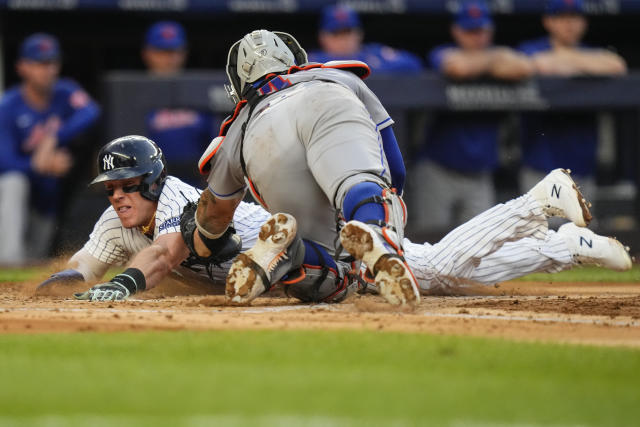
Holmes allowed a double, got a strikeout, allowed an infield single and a bases-loading walk, then fielded a grounder himself and made an error trying to throw the runner out at the plate, game-tying triple by Luis Arraez, who was hitting over .400 not that long ago, but has slumped to .367. Tommy Kahnle was brought in, and he allowed a game-losing single. Marlins 8, Yankees 7.

Some Charlie Brownisms come to mind: Aaugh! Rats! I can't stand it! Good grief! My stomach hurts! Not to mention a Lucyism: You blockheads!

Back in 2002, Boston Red Sox president Larry Lucchino called the Yankees "The Evil Empire," bringing up comparisons to the Galactic Empire in Star Wars. Well, if the Yankees really were the Empire, today, Darth Cole would have Force-choked Holmes.

Next, the Yankees have to go to play the team with the best record in baseball, the Atlanta Braves. After 3 games there, and a day off on Thursday, they come home on Friday to play the Red Sox. By the time they take the field to play The Scum, they could be under .500.

*

Days until the Yankees' next series against the Boston Red Sox begins: 5, this Friday night, at Yankee Stadium II.

Days until the next New York Red Bulls game: 7, next Sunday night, at 7:30 PM, home to D.C. United.

Days until the Red Bulls again play a nearby rival: See the previous answer.

Days until the next Arsenal match: 8, at 3:00 PM on Monday, August 21, away to South London team Crystal palace. The Arsenal opened the Premier League season yesterday, beating Nottingham Forest, 2-1 at home.

Days until the next East Brunswick High School football game: 19, on Friday, September 1, at 7:00 PM, home to Somerset County school Hillsborough. Under 3 weeks. That's on Labor Day Weekend.

Days until the next Rutgers University football game: 21, on Sunday, September 3, at 12:00 Noon, home to Northwestern University. Just 3 weeks. This is also on Labor Day Weekend. Why they're playing on a Sunday, I don't know.

Days until the next game of the U.S. National Soccer Team: 27, on Saturday, September 9, at 5:30 PM New York time, an international friendly, home to the former Soviet "republic" of Uzbekistan, at the new CityPark in St. Louis, home to MLS expansion team St. Louis City FC.

Days until the next East Brunswick-Old Bridge game: 40, on Friday, September 22, at 7:00 PM, at home at Jay Doyle Field. Under 6 weeks.

Days until the next North London Derby: 41, on Saturday, September 23, at the Emirates Stadium. Under 6 weeks.

Days until the New Jersey Devils play again: 60, on Thursday night, October 12, home to the Detroit Red Wings. Just 3 months.

Days until the New Jersey Devils again play a local rival: 68, on Friday night, October 20, away to the New York Islanders.

Days until the next Rutgers-Penn State football game: 97, on Saturday, November 18, 2023, at 12:00 Noon, at Beaver Stadium in State College, Pennsylvania. A little over 3 months.

Days until the next Summer Olympic Games: 348, on Friday, July 26, 2024, in Paris, France. Under 1 year, or under 12 months.

Days until the next Presidential election: 450, on Tuesday, November 5, 2024. Under s year and a half, or under 15 months.

Days until the next elections for Governor of New Jersey and Mayor of New York City: 814, on Tuesday, November 4, 2025. Under 2 1/2 years.

Days until the next Winter Olympics open in Milan, Italy: 908, on Friday, February 6, 2026. Under 2 1/2 years.

Days until the next World Cup opens: 1,030, on Monday, June 8, 2026. Under 3 years.

Wednesday, August 9, 2023

Top 10 Most Tenuous Superhero Secret Identities

Note: I'm limiting this to DC Comics. Most Marvel heroes seem to have had their identities exposed at some point, some by their own choice.

Honorable Mention: Aquaman. Although he has a civilian name, Arthur Curry, he doesn't really have a civilian life. So the fact that he doesn't wear any kind of mask doesn't really affect his secret identity: He doesn't need to keep it a secret.

10. Tie: Starfire and Beast Boy/Changeling. These 2 members of the Teen Titans (or just "The Titans") have a distinct disadvantage, having unusual skin color: Starfire, a.k.a. Princess Koriand'r of Tamaran, has orange skin and bright green eyes, like all Tamarans. Her civilian identity of model Kory Anders tries to get around this by appeared to have used too many tanning beds. But Garfield "Gar" Logan seems never to have found a way to hide his green skin.

The TV show Titans mostly got around this. Kory was played by a black actress, Anna Diop, and her natural color was kept; so her hair, always drawn as a different shade of orange from the character's skin, didn't seem so odd. Gar was played by Ryan Potter, and given an appearance similar to the Joker: Green hair, and skin that, while not fully white, was whiter than what we normally call Caucasians. But that could be explained by his simply being a kid who dyed his hair.

9. Robin and...

8. Batman. Even on the 1966-68 TV series, the connection was made: Batman needs a lot of money to fund his gadgets, therefore he must be a rich guy, around a certain age, living in Gotham City. Narrow it down to that, and see which ones are especially motivated to fight crime. Bruce Wayne was a kid when his (at least, locally) famous parents were murdered right in front of him. There you go.

It's easy to rationalize that, even with that motivation, Bruce might not be Batman, he might only be funding him. Still, if you were to find a way to neutralize Bruce Wayne, then you can go some ways in neutralizing Batman, even if you don't know they're the same guy. The Joker did this in the recent Joker War storyline. (He knows the dual identity in some versions, but not others.)

Also, Bruce Wayne has a teenage ward, Dick Grayson. Batman has a teenage sidekick, Robin. Dick eventually left the role, leading to a series of Robins. Still, if you already suspect that Bruce has a direct connection to Batman, a succession of Robins could be easy to match to a succession of children, surrogate (Dick, Jason Todd, Tim Drake) or biological (Damian Wayne).

7. Green Lantern. Yes, Hal Jordan wears a mask, but he also always wears the power ring. He never takes it off.

As for the other Earth-based GLs: Alan Scott, Kyle Rayner, Simon Baz and Jo Mullein wear masks; Guy Gardner and John Stewart don't; and Jessica Cruz wears a Green Lantern tattoo over her right eye when she's in costume, making for a half-mask.

6. Wonder Woman. In "man's world," she uses the name "Diana Prince." Anyone who already knows that Wonder Woman is Princess Diana of Themiscyra (known in pre-Crisis continuity as "Paradise Island") will be able to make the connection.

In the 1975-79 TV series starring Lynda Carter, Wonder Woman wore glasses as Diana Prince, and this was carried over into the comics, both before and after Crisis. But it shouldn't have worked for her any more than it did for Superman. And in the DCEU, both in Wonder Woman 1984 and in Justice League, set in 2017, Gal Gadot's version doesn't use glasses.

And, like the 1977-79 version of Lynda Carter's character, she didn't adopt a new name at a point when the Diana Prince of the previous era should have been too old to look so young. There is a big difference between 1918 and 1984 (DCEU, so "the two Diana Princes" could have been believed to be grandmother and granddaughter), but not so much between 1945 and 1977 (TV), or between 1984 and 2016 (DCEU). Batman found a 1918 photo of her, and made the connection. You don't have to be "the world's greatest detective" to do that.

Honorable Mention: Wonder Girl. Neither of the women who've used that name and been trained by Wonder Woman, Donna Troy and Cassandra "Cassie" Sandsmark, have worn masks.

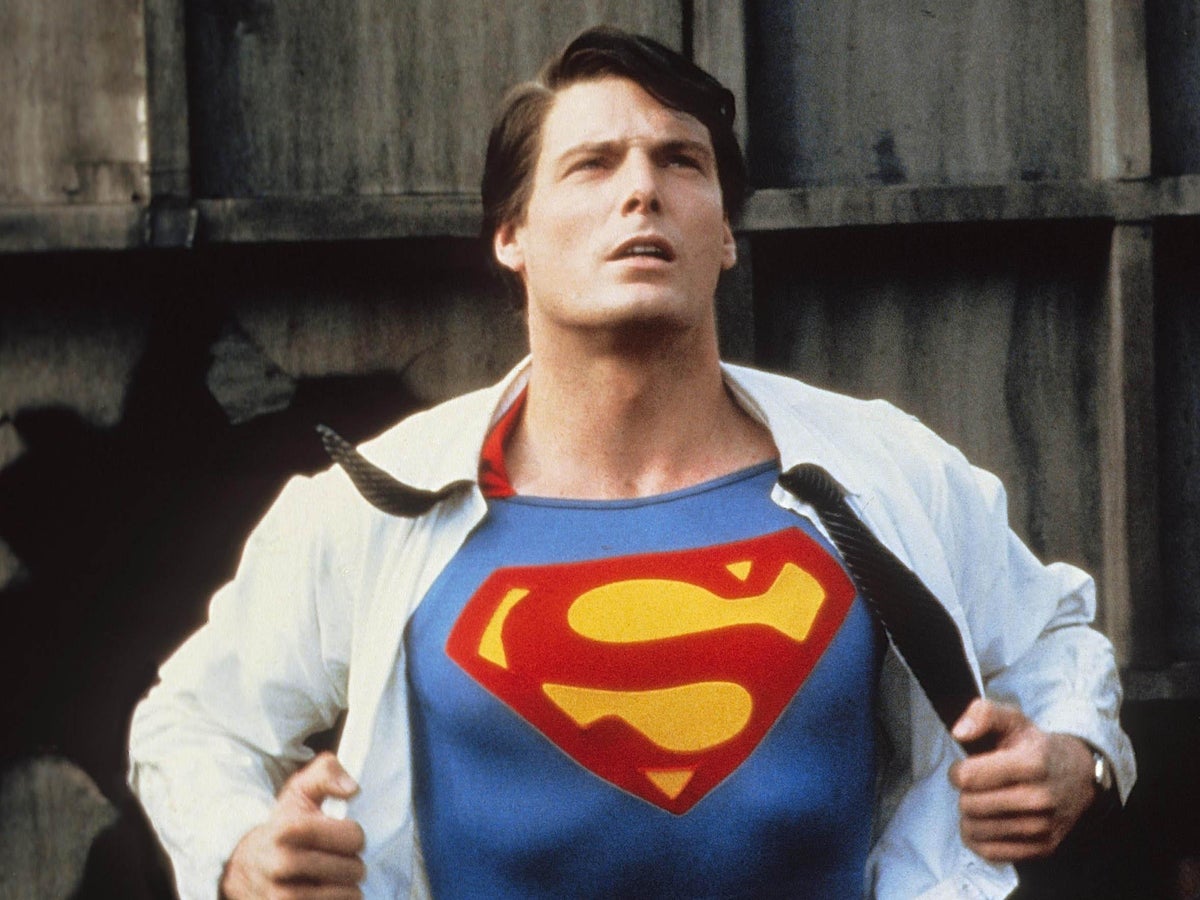
5. Superman. Honorable Mention: Supergirl. This is the most-cited example: Glasses shouldn't be enough. The early writers tried to get around this by making Superman raise his voice an octave while playing Clark Kent, and by slouching, so that Clark seems shorter than Superman.

But in post-Crisis continuity, Clark is less "mild-mannered," and more assertive. On Lois & Clark, Teri Hatcher's Lois noticed that Dean Cain's Clark was pretty buff, but it still took her 2 full seasons to make the connection.

The comics have further explanation for why people don't make the connection. One is that most people don't realize that Superman even has a secret identity. Another is that, when he knows he's facing still or television cameras, Superman uses an identity-obscuring trick he learned from...

4. The Flash of Earth-2. Jay Garrick doesn't even wear glasses, let alone a mask. Just a hat. He hides his identity by vibrating his face so fast that nobody can get a clear photograph of him. But all anybody needs is for him to forget to do that once, and his cover is blown.

(UPDATE: In the 2025 Superman film, the superheroes in the Justice Gang know Superman's true identity. Green Lantern Guy Gardner, played by Nathan Fillion, suggests that, as Clark, he wears "hypno-glasses," to make people see Clark and Superman as 2 different people.)

3. Mary Marvel. Saying, "Shazam!" ages her from teenager to adult, as with her foster brother (biological brother in pre-Crisis continuity) Billy Batson, a.k.a. Captain Marvel, a.k.a. Shazam. And it makes her physically stronger and more fit. But it doesn't alter her appearance beyond that. And she literally uses her real name in her superhero codename. That's very risky.

Marvel Comics have had characters named Ms. Marvel since 1977, but neither DC nor the Shazam Family's previous publisher, Fawcett Comics, ever thought to call Mary "Miss Marvel."

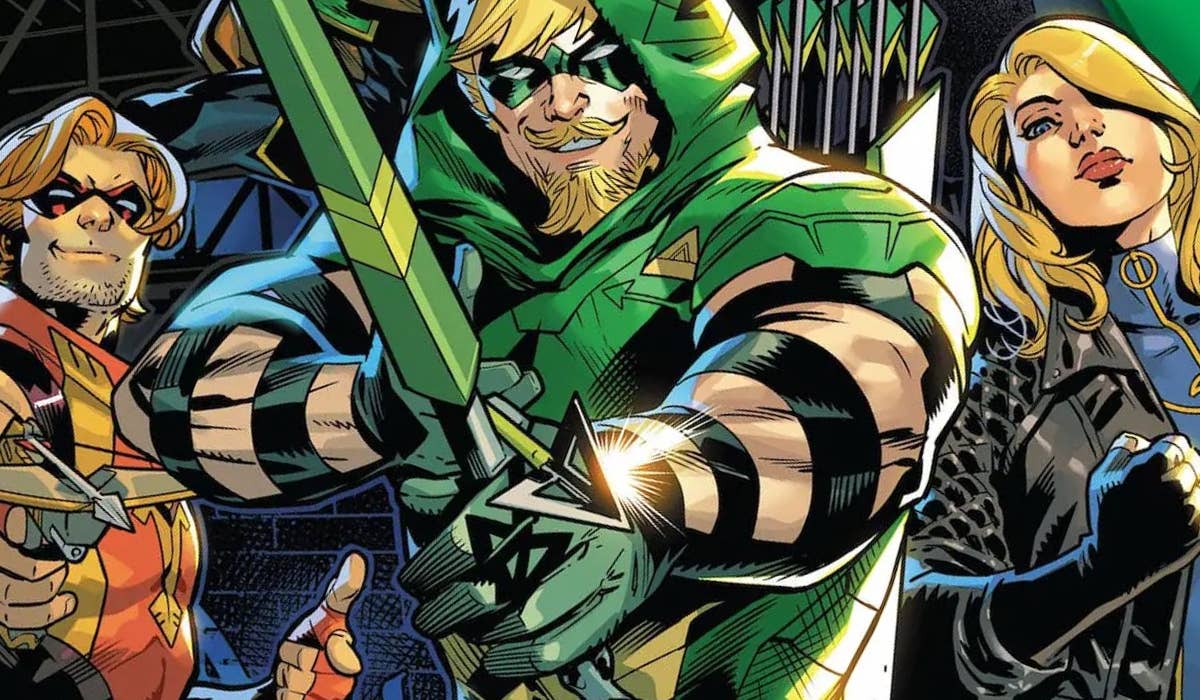
2. Black Canary. Dinah Lance doesn't wear a mask, a hat, or a hood. Her only concession to her secret identity is a blonde wig, as she's a natural brunette.

It is somewhat appropriate that the only DC hero whose secret identity is more tenuous is that of the hero she romanced and eventually married:

1. Green Arrow. Aside from his modus operandi, that of being an archer, what's GA best known for? His blonde Van Dyke beard, first drawn by Neal Adams in 1969, in the same story where GA started dating Black Canary. Oliver Queen, prominent Star City businessman (who, in some versions, has even served as the city's Mayor), has a Van Dyke beard. Hello?
The CW's Arrowverse came close to getting around this: While Stephen Amell's Ollie had a beard, it wasn't as distinctive as a Van Dyke; and wearing a hood instead of a Robin Hood-style cap, as GA has usually done post-Crisis, did more to disguise his identity. And he tended to operate mainly at night, like every version of Batman but the 1966-68 TV version, with darkness helping to obscure his identity. Still, anybody who met both Ollie and Green Arrow wouldn't have had to think too hard to make the connection.

This is my biggest problem with the current Superman & Lois TV series: Tyler Hoechlin never seems to shave. Superman shouldn't have stubble. Yet he has it, as both Clark and Superman. 

Risky mistake, and a rookie mistake, from a guy who's clearly been at this game long enough to have been Superman for a few years before marrying Lois Lane, and to now have sons old enough to drive (and fly).

Thursday, August 3, 2023

Top 10 Myths About the Roaring Twenties

August 2, 1923, 100 years ago: President Warren G. Harding dies. When the 1920s began, he was elected President as a good-looking, charismatic man who would lead the nation into a new era of "normalcy," while, at the same time, letting us have as much fun as he was having behind the scenes.

By the time the 1920s were over, he had been posthumously exposed as an idiot, a womanizer, and the head of a really corrupt Administration. His reputation crashed every bit as hard as the stock market did.

His image was well-crafted, especially since he was seen as nice and healthy, unlike the physically and politically paralyzed outgoing President, Woodrow Wilson. Little did anyone know that Harding was, like Wilson before his 1919 stroke, already a lot sicker than he let on by the time his candidacy began.

So let's look at some myths about the uproarious decade, and see how close they were to the truth:

Top 10 Myths About the Roaring Twenties

1. Babe Ruth saved baseball. That is, his home runs in 1920 and onward made the nation forget about the Black Sox Scandal, which would have destroyed baseball otherwise.
Warren Gamaliel Harding and George Herman Ruth Jr.

Baseball had survived scandals and down periods before. Certainly, Ruth helped. But the scandal didn't break until the end of the 1920 season, nearly a year after the fixed World Series, and Ruth was already destroying previous home run records. Without it, baseball might have taken longer to bounce back, but it would have happened.

And if you had asked the Babe himself, he would admit that he hadn't "saved baseball," that baseball didn't need "saving." It didn't after the Black Sox Scandal, it didn't after the Strike of '81, it didn't after the Strike of '94, and it doesn't now.

*

2. Warren Harding was one of the worst Presidents. Did the 29th President of the United States get a bum rap? This website advertises "6 Major Accomplishments of Warren G. Harding." Let's check them out, and see if they hold water:

1. Before embarking on a political career as an ambitious Republican, he built a successful newspaper, The Marion Star. He did this, but that's hardly a major accomplishment, and it wasn't something he did as President. So we can't count it.

2. Warren Harding was the first sitting U.S. Senator to win the Presidency. This is true. Is it a major accomplishment? Certainly: Winning the Presidency is one, regardless of how you did it, unless you cheated -- and, as far as we can tell, he didn't. But it's not an accomplishment as President.

3. One of his earliest successes was the Washington Naval Conference in 1921–22. He managed to bring the major nations with significant naval might to agree on what was called the naval limitations program. The program was in place for a decade.

This could be considered a major accomplishment. Or, it could be attributable to his Secretary of State, Charles Evans Hughes, much as the Louisiana Purchase was less Thomas Jefferson than his negotiator, James Monroe; the Monroe Doctrine was less Monroe than Secretary of State (and successor as President) John Quincy Adams; and the Alaska Purchase was less Andrew Johnson than Secretary of State William Seward. But we can count it in Harding's favor.

4. Warren Harding passed the federal child welfare program, the first of its kind. He managed to lower taxes, increased the tax base, raised tariffs to create employment and he also managed to successfully negotiate with striking workers in mining and railroad companies, particularly the crisis in Blair Mountain and the Great Railroad Strike in 1922.

This is actually 4 separate actions. The child welfare program was, unquestionably, a good thing. But lowering taxes doesn't increase the tax base: By definition, it lowers it. Raising tariffs doesn't create employment, it reduces it. These things helped to set up the Great Depression of the 1930s.

And he had little to do with the Blair Mountain Crisis -- which wrecked the United Mine Workers for a decade. So that's 1 plus, 2 major minuses, and 1 flat-out lie that would have been a minus had it been true.

5. Warren Harding was vocal against lynching and the violence meted out to African Americans. He did bring in the anti-lynching bill only to see it fail at the hands of the Congress. Harding's Republican Party had control both houses of Congress, so, while his heart was in the right place, he failed as a leader on this issue.

6. President Harding signed a peace treaty with Austria and Germany post World War I. Big deal. Whoever was President was going to do that. It was a formality, since the war had ended 3 years earlier, and the Congress of Versailles had already happened. No one counts the proclamation officially ending World War II that he signed on December 31, 1946 -- 16 months after V-J Day -- as one of the accomplishments of Harry Truman. Ending the war in victory for the Allies, yes; the New Year's Eve '46 treaty, no.

So, to tally up: 9 actions, resulting in 2 major accomplishments, 1 piece of window dressing, 1 embarrassing failure, 2 harmful actions, and 3 actions that were not accomplishments of his Presidency at all.

And, yes, his economic policies, guided by Secretary of the Treasury Andrew Mellon, helped to set up the Great Depression. And, yes, the Teapot Dome scandal was the biggest piece of executive branch malfeasance ever, and would remain so for another half a century.

In other words: In 2 1/2 years in office, 2 big pluses, 1 very little plus, 3 minor minuses, 1 big minus, and 1 humongous minus.

Was America better off on August 2, 1923, when Harding left the Presidency through death, than it was on March 4, 1921, when he entered the Presidency? Yes. How responsible was he for that? Not much. And, by March 4, 1931, the 10th Anniversary of his Inauguration, it was obvious that he was one of the worst Presidents the country had ever had. That we have since had Herbert Hoover, Richard Nixon, Ronald Reagan, George W. Bush and Donald Trump, each of whom was even worse, by no means elevates Harding in history.

*

Let's move on:

3. The Great Gatsby symbolizes the good times of "The Jazz Age." This one is pure baloney. Both the 1925 novel by F. Scott Fitzgerald and the films based on it, including the Robert Redford version in 1974 and the Leonardo DiCaprio one in 2013, show that all the parties and other good times were hollow -- or, to use the expression I used for Harding's treaty "ending the war," window dressing -- and did nothing but take people's minds off the difficulties of life.
F. Scott Fitzgerald

A director with guts could easily do a version of Gatsby and set it over half a century later, in the Disco Period.

4. Charles Lindbergh was the 1st man to fly across the Atlantic Ocean. He was the 1st to do it solo, and the 1st to do it from the North American continent to the European continent. Certainly, that was worth celebrating. Perhaps not as much as it was celebrated in what a documentary about the 1920s called "The Age of Ballyhoo." But worth some celebration.
Lindbergh and his plane, Spirit of St. Louis

But Lindbergh wasn't the 1st to fly across the Atlantic, or even the 2nd. On June 15, 1919, British pilots John Alcock and Arthur Brown made the 1st air crossing of the Atlantic. To be fair to Lindbergh and his achievement, Alcock and Brown did not go full continent-to-continent. They chose the closest possible route: From St. John's, Newfoundland, the easternmost city in the Western Hemisphere, to the west coast of Ireland, the westernmost point in Europe.
Arthur Brown (left) and John Alcock

5. The Jazz Singer was the 1st "Talking Picture." It wasn't: Its star, Jolson, already a Broadway and recording legend, had sung in a much shorter film the year before. But it was the 1st feature-length motion picture with a synchronized recorded music score, and the 1st feature-length motion picture with lip-synchronous speech and singing.
6. "Coolidge Prosperity." Yes, there was an economic boom that began under Harding, ending the postwar drop under Wilson, which was definitely a recession and has been termed a "depression" by some. And it continued under Coolidge.
Calvin Coolidge

But looks can be deceiving. Using the Dow Jones Industrial Average as a guide: It was 64 on August 22, 1921. Not 6,400: Sixty-four. It reached 100 in October 1922, was at 87 when Harding died in August 1923, and was at 120 at the end of 1924, Coolidge's 1st full year in office. Proportionally speaking, that's significant improvement.

At the end of 1925, it was at 156. In September 1926, it reached 164, before dropping a little by the end of the year. It broke 200 at the end of 1927. The real surge began in July 1928, just as Hoover was running on "Republican prosperity." It hit 292 on November 26, 1928. After a drop in early December, it reached 300 on New Year's Eve. On June 10, 1929, it was 303. On September 3, it had surged to 381.17.

Then it started going down. The "Crash of '29" seems to have happened in a hurry, but, on October 23, the Dow was already down to 305.85. On the 24th, "Black Thursday," it fell to 299.47, and would have been worse if not for a late stock buy made by the famous "walk across the floor" of the New York Stock Exchange by J.P. Morgan banker Thomas W. Lamont. On Friday, the 25th, there was a slight rise, to 301.22.

But the weekend, as it frequently has in tough times since, bred worry. On Monday the 28th, the Dow fell to 260.64. The 29th was "Black Tuesday," and the Dow fell to 230.07. The chickens hatched by Harding, Coolidge and Mellon had come home to roost. As a poem of the time went:

Hoover blew the whistle
Mellon rang the bell
Wall Street gave the signal
and the country went to hell!

What about the other major gauge of how well the economy is doing, the unemployment rate? Here it is, at the end of each calendar year in the 1920s:

* 1920: 4.0 percent
* 1921: 11.9
* 1922: 7.6
* 1923: 3.2

Looks like the Harding-Mellon policy of cutting taxes is working. Let's see what the Coolidge of policy of "do nothing, because the business of America is business" does:

* 1924: 5.5
* 1925: 4.0
* 1926: 1.9

Is that for real? Or was somebody cooking the books? Let's continue:

* 1927: 4.1
* 1928: 4.4
* 1929: 3.2

In other words, while the Crash happened late in 1929, the Depression wasn't yet getting noticed around the country. But then:

* 1930: 8.9

That's bad, but not as bad as the hangover from the Wilson years. But it got much, much worse thanks to the Harding-Mellon-Coolidge-Hoover policies:

* 1931: 15.9
* 1932: 23.6
* 1933: 24.9

Yeah. America needed a new deal, capitalized or otherwise. Harding died, and Coolidge did "not choose to run for President in 1928." So they escaped the blame of "early drafts of history," and Hoover was "left holding the bag." It just seemed too convenient, just as it was to blame CBS for the collapse of the Yankees in 1965, without considering what harm selling owners Dan Topping and Del Webb had already done.

Calvin Coolidge was, at least domestically, the most conservative President America has ever had. Not a radical right-winger like Reagan, George W. Bush or Trump, but conservative in the old sense of the word. America paid the price for this, but he didn't.

7. Prohibition turned America into a giant gangland shooting gallery. The homicide rate did rise in the 1920s, but context is needed. A lot of potential murderers, and murder victims, were in the service in 1917 and 1918.

But there's no sign that Prohibition or organized crime accounted for most, or even much, of it. Hijackings of cars and trucks smuggling liquor was common, but the robbers usually didn't find it necessary to kill the drivers. Why cause more trouble than you need?

8. "Flappers" were women of loose morals. Smoking. Drinking. Showing skin, with the age of the corset being over.

There was no study done at the time to prove that flappers had more sex than their predecessors. They did have more opportunity for pre-marital sex, as well as an increasing knowledge of contraceptive practices. The easier access to cars carried young adults away from parental eyes to socials, parties, sporting events, and theaters, while Hollywood productions portrayed, and simultaneously manufactured, this modern courting culture.

But there seems to have been no major rise in pregnancies, births, abortions, or sexually-transmitted diseases. If there was, it's been kept quiet. And if you wonder how something can be kept quiet for 100 years, let the record show that I didn't find out about the Tulsa Massacre of 1921 until around 2000 or so, and didn't find out about the Ocoee Massacre in Florida in 1920 until its 100th Anniversary. And we still don't know what caused Babe Ruth's "Bellyache Heard 'Round the World" in 1925.

9. The Stock Market Crash of 1929 led to mass suicides. Since then, whenever there's a dip in the stock market, demonstrators go to the New York Stock Exchange at Broad and Wall Streets, and yell, "Jump! Jump! Jump!" Because they think that's what happened during and after the Crash of '29.

There is no record of a single stockbroker suicide, let alone one via jumping out of a window, in the wake of the Crash. In what remains the definitive book about the Crash, The Great Crash 1929, Pulitzer Prize-winning economist John Kenneth Galbraith wrote, "In the United States the suicide wave that followed the stock market is also part of the legend of 1929. In fact, there was none."

One of the more famous photos connected with the Crash is this one, showing Walter Thornton. He was one of the most successful male models of the early 20th Century. Today, though, he is best known for this photo, trying to sell his very nice car, a 1929 Chrysler Imperial 75 Roadster, for $100 -- about $1,784 in today's money.
Did Thornton get $100 for his car? I can find no reference to an answer. But he did return to his previous career, modeling, and soon started a modeling agency, and gained a new fortune from that. He lived until 1990.

10. The Crash of 1929 caused the Great Depression. That was part of it, but by no means all of it. The end of World War I meant that farmers, having lost a big chunk of their market, had already been in a depression since the Armistice, 11 years earlier.
The famous headline in
the film industry's "trade paper"

In his nationally-syndicated newspaper column, Will Rogers spent much of the "Roaring Twenties" saying how, for farmers, the decade didn't roar so much as mumble. He pointed out that the economic boom wasn't universal for the cities, either: In 1928, about a year before the Crash, he wrote, "Wall Street has never been better off, but Eighth Avenue has never been worse off."

When he was President, John F. Kennedy quoted an old saying: "A rising tide lifts all boats." Not a boat with a hole in it. And, of course, in the 1920s as now, some people didn't have boats, and some people couldn't even swim.

Even with the Crash, the Depression might have been sharp, but relatively short, if not for the Smoot-Hawley Tariff Act, which President Herbert Hoover signed into law on June 17, 1930. Named for its sponsors, Senator Reed Smoot of Utah and Representative Willis Hawley of Oregon, both Republicans, the law raised U.S. tariffs on over 20,000 imported goods.
Willis Hawley (left) and Reed Smoot

This prompted retaliatory tariffs by other countries against America. As a result, between 1929 and 1933, American exports dropped 61 percent, and American imports dropped by 66 percent. Between 1929 and 1932, real Gross Domestic Product fell 17 percent worldwide, and 26 percent in the United States.

Unemployment was 8 percent when the Act was passed. It doubled to 16 percent in 1931 -- already higher than any of the "recessions" since the Depression -- and 25 percent in 1932. It is suspected that, when FDR took office on March 4, 1933, it may have been as high as 31 percent. If the Crash was the biggest cause, Smoot-Hawley was a strong second.

The Roaring Twenties did roar. But not quite the way history tends to remember it.

Wednesday, August 2, 2023

August 2 & 3, 1923: The Death of Warren Harding -- and the Struggle to Inaugurate Calvin Coolidge

August 2, 1923, 100 years ago: Warren Gamaliel Harding, the 29th President of the United States, dies in office, halfway through the 3rd year of his term. He was 57 years old.

The former newspaper editor was a U.S. Senator from Ohio when he was elected President in a landslide in 1920. He was handsome, charming, and promised "a return to normalcy" after the turbulent Progressive Era, World War I, and its difficult aftermath. Actually, he never used the words "return to normalcy" in any speech. What he said was:

America's present need is not heroics, but healing; not nostrums, but normalcy; not revolution, but restoration; not agitation, but adjustment; not surgery, but serenity; not the dramatic, but the dispassionate; not experiment, but equipoise; not submergence in internationality, but sustainment in triumphant nationality.

Things had considerably calmed down in America during his time in office, and he was still popular in the Summer of 1923. He even posed for a photo with the biggest star in baseball, the Yankees' Babe Ruth.
Legend has it that Ruth, whose many alliterative nicknames could have included the Imperator of Informality, once asked the President of the United States, "Hot as hell, ain't it, Prez?" It's not clear whether the President in question was Harding, who might have appreciated it, or his successor, Calvin Coolidge, who certainly would not have.

So he was still popular in the Summer of 1923, when the Teapot Dome scandal broke out. Unlike such later scandals as Richard Nixon's Watergate, Ronald Reagan's Iran-Contra, Bill Clinton's relationship with Monica Lewinsky, and the many scandals of George W. Bush and Donald Trump, this one was, and remains, a bit complicated.

Teapot Dome was an oil reserve in Wyoming, one of three set aside for the use of the U.S. Navy in the event of a national emergency. In May 1921, Harding signed an executive order transferring control of the reserves from the Department of the Navy to the Department of the Interior. Secretary of the Navy Edwin Denby agreed to this, and Secretary of the Interior Albert Fall now had control.

In July 1921, California-based oilman Edward Doheny offered Fall a bribe of $100,000 -- about $1.7 million in today's money -- for permission to drill at Teapot Dome. The weird part is, after Harding was gone, Fall was convicted of accepting this bribe in 1929 -- the 1st Cabinet member ever to go to prison for actions in office -- but Doheny was acquitted of offering it in 1930.
Teapot Rock, above Teapot Dome

The scandal had begun to break, and Harding's bid for re-election was less than a year and a half away. He called his Secretary of Commerce into his office. He asked the Secretary, if he were President, and knew of a scandal in his Administration, what would he do? The Secretary said he would come completely clean. The Secretary's name was Herbert Hoover, and he would eventually become President. He didn't have a scandal like Teapot Dome in his Administration. He should have been no more unlucky than that.

Harding did not come clean. Instead, he ran away. No, he didn't resign. He went on what he called a "Voyage of Understanding," a train trip all over the continent. He became the 1st sitting President to visit Canada, and then the 1st to visit Alaska, which would still be a Territory until gaining Statehood in 1959.

On his way back south, he visited Seattle, and gave a speech at the University of Washington on July 27. That night, he called his doctor, Charles E. Sawyer, complaining of abdominal pain. Sawyer diagnosed an "acute gastrointestinal attack," and that's what the press was told. Somehow, it got out that Harding had eaten some tainted crabmeat in Alaska.

On July 29, Harding arrived in San Francisco, and checked into the Palace Hotel, and had a relapse. It wouldn't be publicly revealed until after his death, but, like his immediate predecessor, Woodrow Wilson, Harding was already a sick man when he became President, with a few years of heart problems, which were flaring up again. His wife, Florence, known as "The Duchess," was with him, and she wasn't very healthy, either, with a chronic kidney condition.
At 7:30 PM Pacific Time, in their room at the Palace, Florence was reading a flattering article about him, published by The Saturday Evening Post: "A Calm Review of a Calm Man." She paused, and he said, "That's good. Go on, read some more." She did, for a few seconds, until she noticed him twisting and gasping for air. She called the doctors, but it was too late: He was dead. 

Mrs. Harding did not permit an autopsy for her husband. A rumor got around that she had poisoned him -- possibly to protect him from the rising scandal; or possibly out of revenge for something the public didn't know at the time, his voracious womanizing, including an affair that resulted in the only child he would ever have.

That wouldn't be known for a few years. At first, the country was deeply saddened by the death of a popular President. But before the Harding Tomb could be completed in 1929, it had all come out, and he became regarded as one of the worst Presidents the country had ever had: As scandalous as Richard Nixon, as dumb as George W. Bush, and as horny as Bill Clinton.

Whatever Mrs. Harding knew, she took to the grave, on November 21, 1924, less than a year and a half after her husband, and just after he would have had to face the voters again.

*

Harding died at 10:30 PM Eastern Time. Now, a new President of the United States must be sworn in. It becomes the most difficult Inauguration in the office's history. Not because of any external threat, real or imagined. And not because of any resistance to the peaceful transfer of power. But because of simple logistics, and the technology of the time.

The Secret Service had to find the Vice President, Calvin Coolidge, former Governor of Massachusetts. Like Harding, he was escaping the Summer heat of Washington, D.C., staying at his family's homestead in Plymouth, Vermont, where he had been born on July 4, 1872. (This makes him, to this day, the only person born on the nation's birthday to become President.)

This was 1923, and less than half of all American homes had telephones. And the Coolidge Homestead did not have a telephone. But it shouldn't have been that hard to send a telegram. Well, they couldn't reach the Coolidge Homestead by telegram, either.

So, Secret Service Agents had to drive up from Boston, and knock on the front door of the Coolidge Homestead in the middle of the night. The unwitting new President's father, John Coolidge, a former Vermont State Senator, a notary public, and a justice of the peace, answered the door. The Agents discovered that this rural home -- 150 miles northwest of Boston, 100 miles northeast of Albany, and 100 miles southeast of Vermont's largest city, Burlington -- didn't even have electricity. The ceremony had to be conducted by candlelight.

At 2:47 AM Eastern Time -- meaning that, less than 100 years ago, there was a time when the nation didn't have a working President for over 4 hours -- Calvin Coolidge was administered the Oath of Office by his father, becoming the 30th President of the United States. 
Artist's depiction of the Inauguration. There was no photographer present.

When John was asked by a reporter a few days later how he knew he could swear his son in, he said, "I didn't know that I couldn't." The legal basis for him being the person to swear the President in is a bit vague: He wasn't actually a judge, and every other person who has ever sworn a President in has been, at the very least, a judge.

Most have been the Chief Justice of the United States. This includes Salmon Chase, swearing in Andrew Johnson after the assassination of Abraham Lincoln in 1865; Harlan Stone, swearing in Harry Truman after the death of Franklin Roosevelt in 1945; and Warren Burger, swearing in Gerald Ford after the resignation of Richard Nixon in 1974. The others:

* April 30, 1789, George Washington, Federal Hall, New York: Robert Livingston, Chancellor of New York. In other words, the State's Chief Justice. There wasn't yet a Chief Justice of the country, because there wasn't yet a Supreme Court, because the Justices of that Court hadn't yet been appointed by the President, because there wasn't yet a President.

* April 6, 1841, John Tyler, Indian Queen Hotel, Washington: William Cranch, Chief Judge of the U.S. Circuit Court of the District of Columbia.

* July 10, 1850, Millard Fillmore, House of Representatives Chamber, U.S. Capitol, Washington: Cranch again.

* September 20, 1881, Chester Arthur, his apartment, New York: John R. Brady, a Justice of the Supreme Court of the State of New York.

* September 14, 1901, Theodore Roosevelt, Ansley Wilcox House, Buffalo, New York: John R. Hazel, Judge of the U.S. District Court for the Western District of New York.

* November 22, 1963, Lyndon Johnson, aboard Air Force One, Love Field, Dallas: Sarah T. Hughes, Judge of the U.S. District Court for the Northern District of Texas. She remains the only woman to administer the Oath of Office to an incoming President.

Thus sworn in by his father, President Calvin Coolidge went back to bed, helping to feed the legend that he slept too much while he was President. The next morning, Coolidge was driven to Rutland, Vermont, where he took a train to Boston, and then another to Washington, where, just to be on the safe side, he was sworn in again, by a federal Judge, Adolph A. Hoehling Jr.

Calvin Coolidge ran for a term of his own in 1924, and, untainted by the Teapot Dome scandal that had engulfed Harding, won easily. On March 4, 1925, at the Capitol, he got a proper Inauguration, sworn in by the Chief Justice, himself a former President, William Howard Taft.

Would Harding have been re-elected, given the booming economy, even with Teapot Dome and the subsequent scandal in the U.S. Department of Justice, which sent his Attorney General and former campaign manager, Harry Daugherty, to prison? Maybe, because the Democrats were badly divided.

But since Coolidge wasn't involved in the scandals at all, he cruised to an easy victory, as the nation decided to follow the Republican slogan, "Keep Cool and Keep Coolidge."

John Coolidge died in 1926. Calvin Coolidge did not run for a 2nd full term in 1928, and left office on March 4, 1929, with the Inauguration of Herbert Hoover. He died on January 5, 1933. His Presidency had so little drama, and Coolidge himself had so little personality, that, when the writer Dorothy Parker was informed that he had died, she said, "How can you tell?"

Friday, July 28, 2023

Where Yanks & Mets Stand After Splitting With Each Other

It's July 28, 2023. We are 112 games into a 162-game regular season. Just short of 70 percent. Where do the New York baseball teams stand?

This season, the Mets and an injury-plagued Yankees split 4 games. The Mets are 48-54, 17 games out of 1st place in the National League Eastern Division, and 7 games out of the last NL Playoff berth. The Yankees are 54-48, 8 games out of 1st place in the American League East, and 2 1/2 games out of the last AL Playoff berth.

Steve Cohen is the richest team owner in baseball, Met fans said. He's gonna spend us to a World Series win, they said. We're gonna be better than the Yankees, they said. We're taking over New York, they said.

Today, they traded reliever David Robertson, a former Yankee, to the Miami Marlins, for 2 minor-leaguers in Rookie League. The team with a $380 million payroll are sellers.

Who's next? Their elderly aces, Justin Verlander and Max Scherzer, have contracts bigger than their ages, and can't be moved. Of their top 7 hitters, 6 have what amount to no-trade clauses, and the 7th is Pete Alonso, the face of their team right now. They can't move any of those guys.

Are the Yankees a disappointment? Yes. Are they a failure? Yes. But, divided by preseason talk, the Mets are everything Bill Plaschke of the Los Angeles Times said they were on today's ESPN (well, ESPN2) broadcast of Around the Horn: "Perhaps the biggest disappointment in baseball history. No team has ever spent more money than them, and they're the 5th-worst team in the National League. They're an embarrassment."

Tonight, Aaron Judge returns to the lineup for the 1st time since his toe injury in Los Angeles on June 3. They were 19-23 without him -- but only 35-25 with him. He can make a difference, all by himself -- but enough of one?

The next 10 games will likely tell the story for the rest of the season: 3 games away to the new 1st place team in the AL East, the Baltimore Orioles; 3 games home to the former 1st place team, the team that dominated the 1st half, the Tampa Bay Rays; and 4 games home to the cheating Houston Astros.

Are you looking forward to this? Should I be? I can't answer the 1st question for you. I have my answer for the 2nd question.

Tuesday, July 25, 2023

Johnny Lujack, 1925-2023

Western Pennsylvania has produced many great quarterbacks. In reverse chronological order, they include Terrelle Pryor, Rich Gannon, Jim Kelly, Jeff Hostetler, Joe Montana, Dan Marino, Chuck Fusina, Terry Hanratty, Joe Namath, Johnny Unitas, Willie Thrower, Babe Parilli and George Blanda.

The first was Johnny Lujack.

John Christopher Lujack was born on January 4, 1925, outside Pittsburgh in Connellsville, Pennsylvania. His brother Aloysius, or Al Lujack, starred in basketball, playing for Georgetown University and the NBA's Washington Capitols.

At Connellsville High School, Johnny Lujack lettered in football, baseball, basketball and track; and was also the senior class president and valedictorian. The school wanted him to go to the U.S. Military Academy, thinking it would keep him out of World War II, at least at first. But radio broadcasts and the influence of the Catholic Church made him a fan of the University of Notre Dame.

After 2 seasons in South Bend, he enlisted in the U.S. Navy, and Ensign Lujack hunted Nazi submarines. In 1946, he returned, and Army, having lost out on him twice (to Notre Dame and to the Navy), faced Notre Dame in "the Game of the Century" at Yankee Stadium. Both schools came in undefeated, Army ranked Number 1 and not having lost in 3 years, Notre Dame ranked Number 2 and the last team to beat Army. The game did not live up to its hype, and ended 0-0.

Lujack became only the 3rd person to win "monograms" (they didn't call them "varsity letters") in 4 different sports at Notre Dame, and led them to back-to-back National Championships in 1946 and 1947 (in the latter year, sharing with Michigan, whom they did not play that season).

In 1947, he was named Associated Press Athlete of the Year, and won the Heisman Trophy, beating out such contenders as Michigan running back Bob Chappuis, Southern Methodist running back Doak Walker (who won it the next year), Mississippi quarterback Charlie Conerly, Texas quarterback Bobby Layne, and University of Pennsylvania center and linebacker Chuck Bednarik.

He was the 1st Polish-American to win the Heisman. Only one has followed him: Vic Janowicz of Ohio State, in 1950.

In 1949, Lujack married Patricia Schierbrock of Davenport, Iowa, and they had 3 children: Mary, Jeff, and Carol.

He was drafted by the Chicago Bears, intended to replace the great Sid Luckman as their starting quarterback. In 1949, he led the NFL in passing yards and passing touchdowns. In the season finale, on December 11, the bears pounded their crosstown rivals, the Chicago Cardinals, 52-21. Lujack through 6 touchdown passes, and threw for 468 yards. That was an NFL record, although it stood for only 2 years: In 1951, Norm Van Brocklin of the Los Angeles Rams passed for 554 yards in a game, and that remains the record.

Very unusual for a 20th Century quarterback, Lujack actually led the NFL in rushing touchdowns in 1950, with 11. And, in those days, he also played in the defensive backfield. He made the Pro Bowl in 1950 and 1951.

And that was it. He only played 4 seasons in the NFL. He returned to Notre Dame, as an assistant coach to his former head coach, Frank Leahy. Together, they won a National Championship in 1953. Leahy then retired, and wanted Lujack to succeed him. But university president Theodore Hesburgh instead appointed Terry Brennan, one of Lujack's teammates at Notre Dame, who was then coaching the freshman team. It was a reasonable choice, and it was a good choice in 4 out of 5 seasons: He went 9-1, 8-2, 2-8, 7-3 and 6-4.

Lujack joined his father-in-law's Chevrolet dealership, and ran it until 1988. In 1958, CBS teamed him with Chris Schenkel on New York Giants broadcasts. But in 1962, Ford became a sponsor, and, since Lujack ran a Chevy dealership, he was fired. But this turned out to be good for NFL history: His replacement was former Giant player Pat Summerall, who became perhaps the greatest announcer in the sport's history, later teaming with John Madden to form the greatest football announcing team of all time.

Lujack wasn't done as a sportscaster, though: He teamed with Jim McKay, first on CBS, then on ABC. He was named to the College Football Hall of Fame and the National Polish-American Sports Hall of Fame. He wasn't named to the Pro Football Hall of Fame, but on the team's 100th Anniversary in 2019, he was named one of the 100 Greatest Bears of All Time.

Johnny Lujack died today, July 25, 2023, in hospice care near his home in Naples, Florida. He was 98 years, 6 months and 21 days old, making him, easily the longest-lived Heisman Trophy winner. (Jay Berwanger, the Trophy's 1st winner, in 1935, has been, so far, the next-longest: 88.)

With his death, the earliest living Heisman Trophy winner is Pete Dawkins of Army, in 1958.

Monday, July 24, 2023

July 24, 1983: The Pine Tar Game

July 24, 1983, 40 years ago: The New York Yankees host the Kansas City Royals at the original Yankee Stadium in The Bronx. This is not a crazy game for the 1st 8 innings. But in the 9th, as Phil Rizzuto, who broadcast this game for the Yankees, would say, "Holy cow!"

The Royals score a run in the top of the 2nd. Dave Winfield ties it for the Yankees in the bottom half with a home run. The Royals make it 2-1 in the 4th, and 3-1 in the 6th. But the Yankees make it 4-3 in the bottom of the 6th.

With 2 outs in the top of the 9th, U L Washington (that's how his name is written, no periods) singles, and George Brett takes Yankee reliever Rich "Goose" Gossage deep, to make it 5-4 Royals.

Brett is a member of the Baseball Hall of Fame. He finished his career with a lifetime batting average of .305. He is a member of the 3,000 Hits Club. He is the only man to winning batting titles in 3 different decades: In 1976, 1980 and 1990. He was named to 13 All-Star Games. He helped the Royals reach the postseason 6 times in 10 seasons from 1976 to 1985, including their 1st Pennant in 1980 and their 1st World Series win in 1985. The franchise began play in 1969, and did not reach the postseason without him on their roster until 2014.

Moreover, he hit 317 home runs in regular season play, and another 10 in the postseason. And it sure seemed like a lot of them were against the Yankees. Kauffman Stadium, known as Royals Stadium while he played there, had long-distance power alleys and artificial turf, making it conducive to doubles (of which he hit 665, 7th all-time, and 4th in the Expansion Era) and triples (137, 70th, but 3rd among Expansion Era players), but not home runs. So he enjoyed hitting them at Yankee Stadium, with its "short porch" in right field: At the time, listed at 310 feet to the pole and 353 to straightaway right.

In the deciding Game 5 of the 1976 American League Championship Series, he hit a 3-run home run to tie the game in the top of the 8th inning. In Game 3 of the 1978 ALCS, he hit 3 home runs, the 1st time it had been done in either League's Championship Series, and still 1 of only 5. Both times, the Yankees won the game, anyway. That would not be the case in Game 3 of the 1980 ALCS, when his upper-deck blast off Gossage was the exclamation point on a Royals sweep of the Yankees, avenging their losses of 1976, '77 and '78.

So on this nice Sunday Summer afternoon in The Bronx, Brett has hit a go-ahead homer for the Royals, and it looks like he's beaten the Yankees again.

But Yankee manager Billy Martin, so often unhinged, comes out to talk to the umpires. This time, Billy is in full control. He points out that Brett has pine tar on his bat, surpassing the legal limit.

The umpires measure it, discover that Martin is right, and Brett is called out, restoring the 4-3 Yankee lead and ending the game. Brett has a fit, and has to be held back by his teammates, but there's nothing he can do.

His team files an appeal. Despite being a former Yankee general manager (and the son of another), AL President Lee MacPhail does something no League President had ever done before, or has since: He overrules his umpires.
Unofficially, we have since seen, many times, that the baseball establishment considers it okay to cheat if you do it against the Yankees. This may be the only time when it's actually been made official.

MacPhail rules that the game must be resumed, with 2 outs in the top of the 9th, and the Royals leading 5-4. An open date for both teams is found, August 18, and the game is resumed. Although an angry Yankee owner George Steinbrenner decided to let anybody with a ticket to the original version of the game into Yankee Stadium free of charge, since Yankee Fans have been screwed over by this as much as their team has, only about 1,200 people take him up on the offer.

Billy, a master of spite, decides that the game is already a farce, so he decides to deepen the point. He puts pitcher Ron Guidry in center field, and 1st baseman Don Mattingly at 2nd base -- making Mattingly one of the very few lefthanded-fielding 2nd basemen ever.

When plate umpire Tim McClelland, a rookie who will umpire in the AL until the combining of the umpiring crews in 2000, and then in the combined crews until 2015, yells, "Play ball!" to restart the game, Billy is prepared to act: He calls time out, and appeals at each base, suggesting that the runners hadn't touched them, and should be called out on that basis. But McClelland is prepared for Martin's preparation: He has a notarized affidavit signed by all the umpires from the original game -- also including Drew Coble, Joe Brinkman and Nick Bremigan -- stating that all bases had been touched by both runners.

Brett was not in the game, either, because his ejection from the game was allowed to stand. Which makes no sense: In a real court of law, any crime committed by someone in response to a false charge gets thrown out. If Brett's action was legal, then his ejection should have been rescinded; if his ejection was allowed to stand, then so should the ruling on the violation, and the Yankees should have been declared the winners. At any rate, Brett did not even show up for the resumption, instead going on to Baltimore, the Royals' next stop.

George Frazier strikes Hal McRae out to end the top of the 9th. Dan Quisenberry pitches the bottom of the 9th for the Royals. He gets Mattingly to fly to center, Roy Smalley to fly to left, and Oscar Gamble to ground to 2nd.

The game did have meaning in the standings when it began: The Yankees were only 2 games behind the Toronto Blue Jays in the AL East on July 24, while the Royals were 1 game behind the Texas Rangers in the AL West. As it turned out, though, none of those 4 teams won their Division: The Baltimore Orioles won the East, and the Chicago White Sox won the West, with the Orioles winning the Pennant, and then beating the Philadelphia Phillies in the World Series.

The Yankees ended up winning 91 games, finishing 7 games behind the Orioles. It was a 12-game improvement over the season before. Steinbrenner fired Martin from his 3rd tenure as manager, anyway.